THE HISTORY OF THE PIRATES. (continued 4)
Reading edition
However, they all put to sea together, and spied a sail under the land, which had a breeze while they lay becalmed. Some said he was a turtler; others, the pirate, and so it proved; for it was honest Capt. Lewis, who putting out his oars, got in among them. Some of the sloops had four guns, some two, some none. Joseph Dill had two, which he brought on one side, and fired smartly at the pirate, but unfortunately one of them split, and killed three men. Tucker called to all the sloops to send him men, and he would fight Lewis, but to no purpose; nobody came on board him. In the mean while a breeze sprung up, and Tucker, trimming his sails, left them, who all fell a prey to the pirate; into whom, however, he fired a broadside at going off. One sloop, whose master I will not name, was a very good sailer, and was going off; but Lewis firing a shot, brought her to, and he lay by till all the sloops were visited and secured. Then Lewis sent on board him, and ordered the master into his sloop. As soon as he was on board, he asked the reason of his lying by, and betraying the trust his owners had reposed in him, which was doing like a knave and coward, and he would punish him accordingly; for, said he, you might have got off, being so much a better sailer than my vessel. After this 155speech, he fell upon him with a rope’s end, and then snatching up his cane, drove him about the decks without mercy. The master, thinking to pacify him, told him he had been out trading in that sloop several months, and had on board a good quantity of money, which was hid, and which, if he would send on board a black belonging to the owners, he would discover to him. This had not the desired effect, but one quite contrary; for Lewis told him he was a rascal and villain for this discovery, and he would pay him for betraying his owners, and redoubled his strokes. However, he sent and took the money and negro, who was an able sailor. He took out of his prizes what he had occasion for, 40 able negro sailors, and a white carpenter. The largest sloop, which was about 90 tons, he took for his own use, and mounted her with 12 guns. His crew was now about 80 men, whites and blacks.
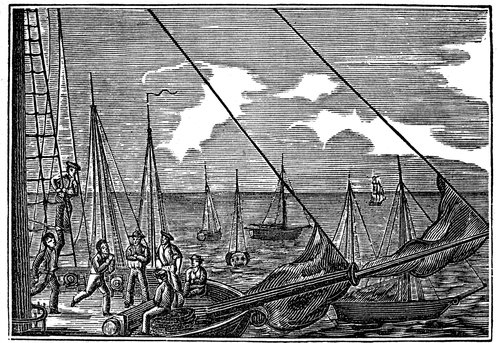
The Pirates Flogging the Captain of a Sloop. Page 155.
After these captures, he cruised in the Gulf of Florida, laying in wait for the West-India homeward bound ships that took the leeward passage, several of which, falling into his hands, were plundered by him, and released. From hence he went to the coast of Carolina, where he cleaned his sloop, and a great many men whom he had forced, ran away from him. However, the natives traded with him for rum and sugar, and brought him all he wanted, without the government’s having any knowledge of him, for he had got into a very private creek; though he was very much on his guard, that he might not be surprised from the shore.
From Carolina he cruised on the coast of Virginia, where he took and plundered several merchantmen, and forced several men, and then returned to the coast of Carolina, where he did abundance of mischief. As he had now an abundance of French on board, who had entered with him, and Lewis, hearing the English had a design to maroon 156them, he secured the men he suspected, and put them in a boat, with all the other English, ten leagues from shore, with only ten pieces of beef, and sent them away, keeping none but French and negroes. These men, it is supposed all perished in the sea.
From the coast of Carolina he shaped his course for the banks of Newfoundland, where he overhauled several fishing vessels, and then went into Trinity Harbour in Conception Bay, where there lay several merchantmen, and seized a 24 gun galley, called the Herman. The commander, Capt. Beal, told Lewis, if he would send his quarter-master ashore he would furnish him with necessaries. He being sent ashore, a council was held among the masters, the consequence of which was, the seizing the quarter-master, whom they carried to Capt. Woodes Rogers. He chained him to a sheet anchor which was ashore, and planted guns at the point, to prevent the pirate getting out, but to little purpose; for the people at one of these points firing too soon, Lewis quitted the ship, and, by the help of oars and the favour of the night, got out in his sloop, though she received many shot in her hull. The last shot that was fired at the pirate did him considerable damage.
He lay off and on the harbour, swearing he would have his quarter-master, and intercepted two fishing shallops, on board of one of which was the captain of the galley’s brother. He detained them, and sent word, if his quarter-master did not immediately come off, he would put all his prisoners to death. He was sent on board without hesitation. Lewis and the crew inquired how he had been used, and he answered, very civilly. “It’s well,” said the pirate, “for had you been ill treated, I would have put all these rascals to the sword.” They were dismissed, and the captain’s brother going over the 157side, the quarter-master stopped him, saying, he must drink the gentlemen’s health ashore, particularly Capt. Rogers’, and, whispering him in the ear, told him, if the crew had known of his being chained all night, he would have been cut in pieces, with all his men. After this poor man and his shallop’s company were gone, the quarter-master told the usage he had met with, which enraged Lewis, and made him reproach his quarter-master, whose answer was, that he did not think it just the innocent should suffer for the guilty.
The masters of the merchantmen sent to Capt. Tudor Trevor, who lay at St. John’s in the Sheerness man of war. He immediately got under sail, and missed the pirate but four hours. She kept along the coast and made several prizes, French and English, and put into a harbour where a French ship lay making fish. She was built at the latter end of the war, for a privateer, was an excellent sailer, and mounted 24 guns. The commander hailed him: the pirate answered, from Jamaica with rum and sugar. The Frenchman bid him go about his business; that a pirate sloop was on the coast, and he might be the rogue: if he did not immediately sheer off, he would fire a broadside into him. He went off and lay a fortnight out at sea, so far as not to be descried from shore, with resolution to have the ship. The Frenchman being on his guard, in the mean while raised a battery on the shore, which commanded the harbour. After a fortnight, when he was thought to be gone off, he returned, and took two of the fishing shallops belonging to the Frenchman, and manning them with pirates, they went in. One shallop attacked the battery, the other surprised, boarded, and carried the ship, just as the morning star appeared, for which reason he gave her that name. In the engagement the owner’s son was killed, who made the voyage out 158of curiosity only. The ship being taken, seven guns were fired, which was the signal, and the sloop came down and lay along side the ship. The captain told him he supposed he only wanted his liquor; but Lewis made answer, he wanted his ship, and accordingly hoisted all his ammunition and provision into her. When the Frenchman saw they would have his ship, he told her trim, and Lewis gave him the sloop; and excepting what he took for provision, all the fish he had made. Several of the French took on with him, who, with others, English and French, had by force or voluntarily, made him up 200 men.
From Newfoundland he steered for the coast of Guinea, where he took a great many ships, English, Dutch, and Portuguese. Among these ships was one belonging to Carolina, commanded by Capt. Smith. While he was in chase of this vessel an accident happened, which made his men believe he dealt with the devil; for he carried away his fore and main-top-mast; he, Lewis, running up the shrouds to the main-top, tore off a handful of hair, and throwing it into the air, used this expression, good devil, take this till I come. And it was observed, that he came afterwards faster up with the chase than before the loss of his top-masts.
Smith being taken, Lewis used him very civilly, and gave him as much, or more in value than he took from him, and let him go, saying, he would come to Carolina when he had made money on the coast, and would rely on his friendship.
They kept some time on the coast, when they quarrelled among themselves, the French and English, of which the former was more numerous, and they resolved to part. The French therefore chose a large sloop newly taken, thinking the ship’s bottom, which was not sheathed, damaged by the worms. According to this agreement they took on 159board what ammunition and provision they thought fit out of the ship, and put off, choosing one Le Barre captain. As it blew hard, and the decks were encumbered, they came to an anchor under the coast, to stow away their ammunition, goods, &c. Lewis told his men they were a parcel of rogues, and he would make them refund; accordingly run along side, his guns being all loaded and new primed, and ordered him to cut away his mast, or he would sink him. Le Barre was obliged to obey. Then he ordered them all ashore. They begged the liberty of carrying their arms, goods, &c. with them, but he allowed them only their small arms and cartridge-boxes. Then he brought the sloop along side, put every thing on board the ship, and sunk the sloop.
Le Barre and the rest begged to be taken on board. However, though he denied them, he suffered Le Barre and some few to come, with whom he and his men drank plentifully. The negroes on board Lewis told him the French had a plot against him. He answered, he could not withstand his destiny; for the devil told him in the great cabin, he should be murdered that night.
In the dead of the night, the rest of the French came on board in canoes, got into the cabin and killed Lewis. They fell on the crew; but, after an hour and a half’s dispute, the French were beat off, and the quarter-master, John Cornelius, an Irishman, succeeded Lewis.
160
CAPTAIN JOHN CORNELIUS.
Having now the command of the Morning Star, Cornelius kept on the coast, and made several prizes, both English and Portuguese. The former he always discharged, after he had taken what he thought fit, but the latter he commonly burnt.
While he was thus ravaging the coast, two English ships, which had slaved at Whidaw, one of 56 guns, and the other 12, which fought close, were ready to sail; and having notice of a pirate, who had done great mischief, resolved to keep company together for their defence. The captain of the small ship lay sick in his cabin, and she was left to the care of the mates. When they had got under sail, 200 negroes jumped overboard from the larger ship, which obliged her to bring to and get out her boats. The mate of the other went into the cabin, told the accident, and advised lying by, and sending their boats to assist their consort; but the captain being ill, and willing to get off the coast, bid him keep on his way, for it would be dangerous; having 400 slaves on board; and being but weakly manned, when the boats were gone they might rise upon him. The mate urged the danger of the pirates, should they leave their consort. The captain answered, the seas were wide, and he would not bring to; accordingly they kept on their way with a fresh gale.
Two days after, the mate, about 8 in the morning, ordered a man to the mast-head, who spied a sail, which made them prepare for an engagement. There was on board one Robert Williams, who had 161served the African company three years on the Guinea coast, who spoke the negro tongue very well. He told the slaves he had picked out, to the number of 50, that the ship in sight he believed would fight them, and if they got the better, would certainly, as they were cannibals, kill and eat them all; and therefore it behoved them to fight for their lives. They had lances and small arms given them.
About 10, Cornelius came up with them, and being hailed, answered he was a man of war, in search of pirates, and bid them send their boat on board; but they refusing to trust him, though he had English colours and pendant flying, the pirate fired a broadside, and they began a running fight of about 10 hours, in-which time the negroes discharged their arms so smartly, that Cornelius never durst attempt to board. About 8 at night the ship blew up abaft. They immediately cut the lashings of the long-boat, but the ship going down, they had not time to get her out, and barely enough to launch the yawl, which lay on the forecastle. The ship went down on one side, and Robert Williams running on the other, was hooked by the mizen-truss, and was carried down with her; but having his knife in his hand, and a great presence of mind, he cut the waistband of his trowsers, where he was caught, got clear, and swam after the boat, into which about 16 had gotten, and either knocked those on the head, or cut off their hands, who laid hold on it; however, with much entreaty, he was permitted to lay one hand on to ease him. They made to the pirate, who refused to receive them, without they would enter with him: which, to save their lives, they all agreed to, and were then civilly received, and dry clothes given them. These and one negro were all the souls saved.
In a little time after this he took two Portuguese ships, which he plundered and kept with him; and 162one foggy morning, hearing the firing of guns, which by the distance of time, he judged to be minute guns, as they really were, for the death of an English commander, he called his men on board from the prizes, sent them about their business, and directed his course by the report of the cannon he had heard. In about two hours he spied the ship that had fired, came up with her very soon, and took her without resistance. The officers of the ship which blew up, finding this prize English, and that the pirate did not intend to detain her begged to be discharged, as they had all large families, which must perish without their support. Cornelius, taking them into considerations, discharged Mr. Powis of Limehouse, who has since been a commander, and raised a fortune. The then chief mate, Mr. George Forelong, the boatswain, carpenter, and other married men, he set on board the prize, and was very generous to them out of the plunder of the Portuguese ships, because they had made a broken voyage; but Robert Williams and the other bachelors he detained, and forced some out of the prize, which he let go.
After this he took three Portuguese ships at an anchor, which he plundered and burnt, after he had hove down by one of them. He continued some time longer on the coast, did a great deal of mischief to the trade, and forced a great many men. These he put to do all the slavery of the ship, and they were beat about the decks, without daring to resent it. I shall take notice of an instance of this kind, to show how far revenge will carry a man. One Robert Bland was at the helm, and called Robert Williams to take whipstaff, till he went to play. Williams refused it; upon which Bland drubbed him with the lanyard of the whipstaff very severely. Williams, that he might revenge himself, and have liberty to fight Bland, went that instant and entered 163himself a volunteer in the ship’s books, and asked leave to fight Bland, which was allowed him, but with no other weapons than his fists. He, however, challenged his antagonist, who was too hard for him; so he turned pirate to be heartily thrashed.
Cornelius, thinking they had been long enough on the Guinea coast, doubled the Cape, off which he spied the Lizard, and two more men of war, under the command of Commodore Littleton. Cornelius was for giving chase, but finding his men unwilling there being, as they gave for reason, 70 forced men on board, and these ships being, as they suspected, men of war, he made the best of his way for Madagascar, went up the river Methelage, or the west side, and anchored against Pombotoque, a small village of blacks.
The quarter-master went ashore, and the black governor examined him, for several of these blacks speak English. He told the governor they were come for provision and to trade; upon which he sent a couple of oxen on board, and then ordered some of the inhabitants to go up with the quarter-master to the king. The boat’s crew seeing a number of blacks come down to the strand without the quarter-master, apprehended some mischief had befallen him; but were eased of their fears, when they saw two oxen given them, and were told the white man, who was gone to the king, would be back next day, it not being above 20 miles from the shore.
When the quarter-master, who carried up a blunderbuss, a fine gun, and a pair of pistols, for a present to the king, told him they wanted provisions, he asked where they were bound? To which he answered, to seek their fortunes, for at present they were very poor. Look ye, replied the king, I require nothing of you; all white men I look upon as my children; they helped me to conquer this country, and all the cattle in it are at their service. I 164will send down provisions enough, and when that is spent, you shall have more. He accordingly sent 1000 head of cattle, out of which he bid them choose what they would, and they salted 100 fat oxen.
Besides the present of oxen, the king sent 100 blacks laden with rice. Cornelius sent him a present of two barrels of powder, and would have given him more, with small arms in return, but he sent them word he would have no more, nor any of their arms, not being in want of either. On the contrary, if they wanted, he would send them ten barrels of powder, as they were his children; bade them proceed on their voyage, and if they were richer when they came back, and would send him any present, he would accept it, but not now, they were so poor.
Here Cornelius lost 70 men by their excesses. Having been long without fresh provisions, the eating immoderately, and drinking toke (a liquor made of honey) to excess, threw them into violent fevers, which carried them off.
The blacks having given Cornelius an account of the Speaker’s having sailed from Methelage about three months before for the East-Indies, he, having taken in his provisions, steered the same course, in hopes to join in consort with her; but the Speaker lying off the Red Sea, and the Morning Star going into the Gulf of Persia, they never met. They run up a pretty way in the gulf, and lay under Antelope Island, where they kept a look out, and whence they made their excursions, and took a number of prizes.
Here they designed to heave down and clean, and they had got a good part of their goods and water casks ashore, when the look-out discovered two lofty ships, one of them wearing a flag at the fore-top-mast-head. This put them into great confusion: they got what casks and necessaries they could on board, and lay till the ships came abreast of them 165Then they got under sail at once, their sails being furled with rope yarns, and came close alongside the larger ship, which was a Portuguese of 70 guns, as the other was of 26. They exchanged a broadside with her, and the smaller ship engaged so close, that they threw hand grenades into each other; but Cornelius’ business was to run, and the great ship put in stays twice to follow him, but missing, was obliged to ware, which gave the pirate a great advantage. The small ship, in staying, tailed aground: she, however, gave chase till she had run a good way ahead of her consort, which the pirate seeing, brought to, and stayed for her, as did the Portuguese for her consort, not caring to engage him singly. When it was quite dark, Cornelius ran up the other shore, passed the Portuguese ships (which kept down the gulf) and came again to anchor at his old station, where he found his enemies had been ashore in their boats and staved his casks. He here cleaned, and finding no money to be got out of any prizes made, and bale goods being of little value to them, they from hence went away to the island of Johanna, where it was designed to maroon the blacks, who were the greater number and all bred among the English. Robert Williams, fearing they would next maroon the English, who were not above a third of the whites, gave the negroes notice of the design, who secured all the arms of the ship, and gave Williams the command till they should get to Madagascar, keeping a good guard on the French and Dutch. When they came to Methelage they gave the ship to the king, her bottom being eaten so much with the worms that she was no longer fit for service; and they all went and lived with the king. About five months after they broke up, Cornelius died, and was buried with the usual ceremony.
166
CAPTAIN DAVID WILLIAMS.
This man was born in Wales, of very poor parents, who bred him up to the plough and the following of sheep, the only things he had any notion of till he went to sea. He was never esteemed among the pirates as a man of good natural parts, perhaps on account of his ignorance of letters; for as he had no education, he knew as little of the sailing a ship, set aside the business of a foremast man, as he did of history, in which, and natural philosophy, he was equally versed. He was of a morose, sour, unsociable temper, very choleric, and easily resented as an affront, what a brave and a more knowing man would not think worth notice; but he was not cruel, neither did he turn pirate from a wicked or avaricious inclination, but by necessity; and we may say, though he was no forced man, he could not well avoid the life he fell into.
When he was grown a lusty lad he would see the world, and go seek his fortune, as the term is among the country youths, who think fit to withdraw themselves from the subjection of their parents. With this whim in his head, he got to Chester, where he was received, and sailed on board a coaster, till he had made himself acquainted with the rigging, learned to knot, splice, and do the other parts of a common sailor’s duty; then coming to London, he shipped himself on board the Mary Indiaman, bound for Bengal and Madras, which voyage he performed outward, and it was not his fault that he did not come home in the same ship; for, in her return, falling short of water, they steered for the island of 167Madagascar, and fell in with the east side, in lat. 20 deg. or thereabouts. The captain manned and sent ashore the long-boat to seek for water, but a large surf running, she came to an anchor, at some little distance from shore, and David Williams, with another, being good swimmers, stripped and swam off in search of water. While they were ashore, the wind, which blew full upon the island, and freshening, caused the surf to run too high for them to get off; and the long-boat, after waiting some time, seeing no possibility of getting these men on board, weighed and stood for the ship, which filled her sails and stood for St. Augustin’s Bay, where she watered, and proceeded on her voyage.
Thus our poor Welchman and his companion were left destitute on an island altogether unknown to them, without clothes or subsistence but what the fruits of the trees offered. They rambled some little time along the coast, and were met by the natives, and by them carried up into the country, where they were humanely treated, and provided with all the necessaries of life, though this was not sufficient to expel his consort’s melancholy, who took his being left behind so much to heart, that he sickened and died in a very little time.
Some time after, the prince of the country, who entertained Williams, had a quarrel with a neighbouring king, which broke into a war. Williams took the field with his patron, but the enemy being superior in number, got the victory, and took a great many prisoners, among whom was the unfortunate Welchman. The king whose prisoner he was, treated him very kindly; and being master of an old musket, gave it him, saying such arms were better in the hands of a white man than those of any of his subjects, who were not so much used to them; that he should be his friend and companion, and should fare as well as himself if he would assist him in his wars.
168It will not be amiss here to take notice, that this island, on the east side is divided into a great number of principalities or kingdoms, which are almost in continual war one with another; the grounds of which are very trivial, for they will pick a quarrel with a neighbour, especially if he has a number of cattle, (in which, and slaves, consist their riches) on the slightest occasion, that they may have an opportunity of plunder; and when a battle or two is lost, the conquered makes his peace, by delivering up such a certain number of bullocks and slaves as shall be demanded by the victorious prince. On the west side the island, the principalities are mostly reduced under one prince, who resides near Methelage, and who is, as we have said in the lives of other pirates, a great friend to white men; for his father, who founded his empire by the assistance of the Europeans, left it in charge with his son, to assist them with what necessaries they should require, and do them all friendly offices; but if he disobeyed this command, and should ever fall out with the white men, or spill any of their blood, he threatened to come again, turn him out of his kingdom, and give it to his younger brother. These menaces had a very great effect on him, for he firmly believed his father would, on his disobedience, put them in execution; for there is not on earth, a race of men equally superstitious.
But to return to Williams, he lived with this prince in great tranquility, and was very much esteemed by him, (for necessity taught him complaisance.) After some time, his new patron was informed that his vanquished enemy had formed a grand alliance, in order to make war upon him; wherefore, he resolved to begin, and march into the countries of the allies, and ravage the nearest before they could join forces. He raised an army, and accordingly marched southward. At the news of his approach, 169the inhabitants abandoned all the small towns, and sending messengers to their friends, raised a considerable body to oppose him, suffering him to over-run a great deal of ground without molestation. At length being reinforced, they took their opportunity, and setting upon him when his men were fatigued, and his army encumbered with booty, they gained a signal victory. The king had the good luck to get off, but Williams was a second time taken prisoner.
He was carried before the conqueror, who, (having been an eye witness of his bravery, for Williams killed a number of his enemies with his shot, and behaved very well, defending himself with the butt end of his musket for some time, when he was surrounded) reached him his hand, and told him, he made war with his enemies only, that he did not esteem the white men much, but should be glad of their friendship. Here Williams was used with more respect than he had been even by his last patron, and lived with this prince some years; but a war breaking out, he was routed in a set battle, in which Williams was his companion. In the pursuit, the poor Welchman, finding he could not get off, clapped his musket at the foot of a tree, and climbing up, he capitulated. He was now terribly afraid of being cut to pieces, for he had shot and wounded a great number of the enemy. They, however, promised him good quarter, and kept their word.
The king of Maratan, who took him, used him as well as any of the former had done, and carried him always with him to the wars, in which fortune was more propitious, for the parties Williams commanded had constantly the better of their enemies, and never returned without great booties of cattle and slaves, for all the prisoners they take are so, until redeemed; though these prisoners are, for the most 170part, women and children, they seldom giving quarter to any other. The fame of his bravery and success, spread itself round the country; and his name alone was so terrible, that the giving out he was at the head of any party, was giving the enemy an overthrow without a battle.
This reaching the ears of Dempaino, a mighty prince who lived 200 miles from him, and who had several petty princes tributaries, he sent an ambassador to demand the white man; but his patron, who had no mind to part with him, denied that he had any white man with him; that he who was called so was a native of the country. For the reader’s better understanding this passage, I must inform him, that there is a race of what they call white men, who have been settled on Madagascar, time out of mind, and are descended from the Arabs; but mixing with the negroes, have propagated a race of mulattoes, who differ in nothing from the manner of living of the black natives.
To proceed, the ambassador desired to see this man, and Williams coming to him, being extremely tanned, he had passed for what he was reported, had he been before apprized of what had been said, to have answered accordingly, for he spoke the language perfectly; or had the ambassador not examined him; who, after he had some time viewed him, asked him of what country he was, and whether it was true that he was one of Madagascar? Williams answered, he was an Englishman, and was left in the country, relating the particulars, as I have already set them down, adding, he had been five years in the island.
The ambassador then told the king, that he must send the white man with him, for such were the orders of his master, the great Dempaino, who was lord over most of the kings on the side of the country where he resided; and that it would be dangerous 171for him to disobey the commands of so great a monarch.
The king answered, those who were subject to Dempaino ought to obey his commands; but for him, he knew no man greater than himself, therefore should receive laws from none; and with this answer dismissed the ambassador; who, at his return, reported to his master the very words, adding, they were delivered in a very haughty strain. Dempaino, who was not used to have his commands disputed, ordered one of his generals to march with 6000 men, and demand the white man, and in case of refusal, to denounce war; that he should send him back an express of it, and he would follow in person with an army to enforce a compliance.
These orders were put in execution with the greatest despatch and secrecy; so that the town was invested, before any advice was given of the approach of an enemy. The general told the king, it was in his choice to have peace or war with his master, since it depended on the delivery of the white man. The king, thus surprised, was obliged, however contrary to his inclinations, to give Williams up to the general, who returned with him to Dempaino, without committing any hostilities; though he threatened to besiege the town, and put all but the women and children to the sword, if the king of Maratan did not pay the expense of sending for the white man, which he rated at 100 slaves, and 500 head of cattle. The king objected to this as a hard condition, and an unjust imposition, but was obliged to acquiesce in it.
He was received by Dempaino with a great many caresses, was handsomely clothed according to the country manner, had slaves allotted to wait on him, and every thing that was necessary and convenient; so that king Dempaino was at the trouble of sending 6000 men, one would think, for no other end 172than to show the great value and esteem he had for the Europeans. He continued with this prince till the arrival of a ship, which was some years after his leaving Maratan, when the Bedford galley, a pirate, commanded by Achen Jones, a Welchman, came on the coast, on board of which ship Williams was permitted to enter. They went to Augustin, where, laying the ship on shore, they broke her back by carelessness, and lost her. The crew lived here till the arrival of the Pelican, another pirate, mentioned in North’s life; some of them went on board this ship, and steered for the East-Indies. Williams shifted out of this on board the Mocha frigate, a pirate, commanded by Capt. Culliford, and made a voyage; then, returning to St. Mary’s they shared the booty they had got in the Red Sea.
Some of the crew, being West-Indians, having an opportunity, returned home; but Williams remained here till the arrival and taking of Captain Fourgette, which has been already mentioned. He was one of those who took the Speaker, went a voyage in her, and returned to Maratan. Here the king seeing him, asked him, what present he intended to make him for former kindness? Williams answered, he had been overpaid by the prince whom he took him from, and by his services; which answer so irritated his Maratanian Majesty, that he ordered him to quit his country; and he could hardly alter that see him with patience.
From hence he went on board the Prosperous, Capt. Howard, commander, who went to St. Mary’s, and thence to the main, as is said in that pirate’s life, and was one of the men left behind when they had a design to carry off Ort Van Tyle. This Dutchman kept him to hard labour, as planting potatoes, &c. in revenge for the destruction and havoc made in his plantations by the crew of the Prosperous. He was here in the condition of a slave six months, 173at the expiration of which time, he had an opportunity to run away, leaving his consort, Thomas Collins, behind him, who had his arm broke when he was taken by the Dutchman.
Having made his escape from a rigid, revengeful master, he got to a black prince, named Rebaiharang, with whom he lived half a year. He from hence went and kept company with one John Pro, another Dutchman, who had a small settlement on shore, till the arrival of the men of war, commanded by Commodore Richards, who took both Pro and his guest Williams, put them in irons on board the Severn, till they came to Johanna, where the captain of the Severn undertook for $2000 to go against the Mohilians, in which expedition several of the man of war’s crew were killed, and the two pirates made their escape in a small canoe to Mohila, where they sheltered themselves awhile in the woods, out of which they got provisions, and made over for Johanna. Here they recruited themselves and went away for Mayotta. The king of this island built them a boat, and giving them provisions and what necessaries they required, they made for and arrived at Madagascar, where, at Methelage, in lat. 16 deg. 40 m. or thereabouts, they joined Captain White.
Here they lay about three months; then setting fire to their boat, they went into White’s, and rounding the north end, came to Ambonavoula. Here Williams remained till Capt. White bought the ship Hopewell, on board of which he entered before the mast, and made a voyage to the Red Sea, towards the end of which he was chosen quarter-master. At their return they touched at Mascarenhas for provisions, where almost half the company went ashore and took up their habitations.
From Mascarenhas they steered for Hopewell (by some called Hopeful) Point, on Madagascar, where, dividing their plunder, they settled themselves.
174Twelve months after, the Charles brigantine Capt. Halsey, came in, as is mentioned in his life. Williams went on board him and made a voyage. At their return they came to Maratan, lived ashore, and assisted the king in his war against his brother, which being ended in the destruction of the latter, and a pirate lying at Ambonavoula, sending his long-boat to Manangcaro, within ten leagues of Maratan, Williams and the rest went on board, and in three months after he had been at Ambonavoula, he was chosen captain of the Scotch ship, mentioned in Halsey’s life. This ship he worked upon with great earnestness, and made the Scotch prisoners labour hard at the fitting her up for a voyage; and she was nearly ready for sea, when a hurricane forced her ashore, and she was wrecked.
Some time after this he set up and finished a sloop, in which he and ten of his men designed for Mascarenhas; but missing the island, they went round Madagascar, to Methelage, where he laid his vessel ashore and tarried a year; but the king being tired with his morose temper, and he disagreeing with every body, was ordered to be gone, and accordingly fitting up his vessel, he put to sea, intending to go round the north end of the island; but the wind being at E. S. E. and the current setting to N. W. he put back to a port called the Boyn, within ten leagues of Methelage, in the same king’s dominions whom he had left. The governor of this place was descended from the Arabs, and it was here that the Arabians traded.
When he came to an anchor, he and three of his men (he had but five with him) went on shore, paddled by two negroes. David Eaton and William Dawson, two of the men, required a guide, to show them the way to the king’s town; the governor ordered them one, and at the same time laid an ambush for them in the road, and caused them to 175be murdered. When they had left the Boyn, Williams and Meyeurs, a Frenchman, who also came ashore in the canoe, went to buy some samsams, which are agate beads. As they were looking over these goods, a number of the governor’s men came about them, seized them both, and immediately despatched Meyeurs. Williams they bound, and tortured almost a whole day, by throwing hot ashes on his head and in his face, and putting little boys to beat him with sticks. He offered the governor 2000 dollars for his life, but he answered, he would have that and the money too; and accordingly, when he was near expiring, they made an end of him with their lances.
After this barbarous murder, the governor thought of seizing the sloop, on board of which were no more than two white men, six negro boys, and some women slaves of the same colour. However, he thought it best to proceed by stratagem, and therefore putting a goat and some calabashes of toke on board Williams’ canoe, with twelve negroes armed, and the sloop negroes to paddle, he sent to surprise her. When the canoe came pretty near the vessel, they hailed, and asked if they would let them come on board? One of the men asked Williams’ negroes where the captain was? He answered, drinking toke with the governor, and sent them provision and toke. A negro wench advised the white man, whose name was William Noakes, not to let them come on board, for as four white men went ashore, and none of them appeared, she suspected some treachery. However, on the answer made him from the canoe, he resolved to admit them, and called them on board. No sooner were they come on deck, than one of them, snatching Noakes’ pistol, shot him through the head, and seizing the other white man, threw him overboard 176and drowned him; after which, being masters of the vessel, they carried her in and rifled her.
The king was at this time hunting, as is his custom to hunt boars three months in the year; but an account of these murders soon reached him. However, he continued the accustomed time of his diversion; but when he returned home, and the whites who were about him demanded justice, he bade them be quiet, they might depend upon his doing it. He sent to the governor of Boyn, and told him, he was glad that he had cut off Williams and his crew, an example he was resolved to follow, and clear the country of them all; that he had some affairs to communicate to him, and desired he would come to court as soon as possible, but take care he was not seen by any of the whites, for fear they should revenge the death of their companions.
The governor, on these orders, came away immediately, and stopped at a little town, two miles distant from the king’s, and sent word he there waited his commands.
The king ordered him to be with him early next morning, before the white men were out of their beds. He set forward accordingly the next day betimes, but was seized on the road by negroes placed for that purpose, and brought bound to the king, who, after having reproached him with the barbarity of the action he had been guilty of, sent him to the white men, bidding them put him to what death they pleased; but they sent word back, he might dispose of the lives of his subjects as he thought fit, but for their part, they would never draw a drop of blood of any who belonged to him. Upon which answer the king’s uncle ordered him to be speared, and he was accordingly thrust through the body with lances. The king, after this execution, sent to Boyn, and had every thing brought which 177had belonged to Williams and his men, and divided it among the whites, saying, he was sorry the villain had but one life, to make atonement for the barbarity he had been guilty of.
CAPTAIN SAMUEL BURGESS.
Captain Samuel Burgess was born in New-York, and had a good education. He sailed some time in a privateer in the West-Indies, and very often, the gang he was with, when the time of their cruising was expired, would make no ceremony of prolonging the commission by their own authority.
By his privateering he got together some little money, and returned home, where the government having no notice, or at least taking none, of his piratical practice, in staying beyond the date of his commission, he went out mate of a ship, in the service of Frederick Phillips, bound to the island of Madagascar, to trade with the pirates, where they had the misfortune to lose their ship, and lived 18 months at Augustin, when an English pirate coming in, the king of the country obliged him to go on board her, though much against his inclination, for he was tired of a roving life: but their choice was to go or starve, for the king would keep them no longer.
He went with this freebooter to the East-Indies, where they made several rich prizes, and returned 178to St. Mary’s, where they took in provisions, wood, and water. Several of their gang knocked off here; but the captain, Burgess, and the remainder, went away for the West-Indies, disposed of their plunder on the Spanish coast, and then returning to New-York, purposely knocked the ship on the head at Sandy Hook, after they had secured their money ashore.
The government not being informed of their piracy, they lived here without molestation, and, in a short time, Burgess married a relation of Mr. Phillips, who built a ship, called the Pembroke, and sent him a second time to Madagascar. In his way to this island, he went into the river of Dilagou on the African coast, where he took in a quantity of elephant’s teeth; and thence to Augustin, where he met with several of his old ship-mates, with whom he traded for money and slaves. Leaving this place, he went to Methelage, where he also took some money and negroes; and from thence he shaped his course for St. Mary’s, on the east side, where he also drove a considerable trade with his old comrades, took several of them passengers, who paid very generously for their passage; and taking with him an account of what was proper to bring in another trip, he returned to New-York, without any sinister accident. This voyage cleared £5000, ship and charges paid.
His owner, encouraged by this success, bade him choose what cargo he pleased, and set out again. Accordingly he laded with wine, beer, &c. and returning to Madagascar, arrived at Maratan, on the east side, where he disposed of a great part of his cargo at his own rates. At Methelage he disposed of the rest, and returned, clearing for himself and owner, £10,000, besides 300 slaves he brought to New-York.
After a short stay at home, he set out again on 179the old voyage, fell in first with Methelage, where he victualled and traded, and from thence went round the south end, and sold part of his cargo at a large profit, to his old acquaintance. He made a trading voyage round the island, and at St. Mary’s met another ship belonging to his owner, which had orders to follow his directions. He remained at this port till he had disposed of the cargoes of both ships. He then shaped his course homewards, with about twenty pirate passengers, who had accepted the pardon brought by Commodore Littleton.
In his way he touched at the Cape of Good Hope, for wood, water, and fresh provision. While he was here, the Loyal Cook, an East-Indiaman, came in, who made prize of Burgess, and carried him to the East-Indies. He there would have delivered Burgess’ ship to the governor of Madras, but the governor would have no hand in the affair, and told the captain, he must answer to the East-India company and Burgess’ owner for what he had done.
Most of the pirate passengers thought themselves cleared by the act of grace; but some, not willing to trust to it, got off with what gold they could, in a Dutch boat. They who trusted to the pardon, were clapped in gaol, and died in their irons. I cannot omit the simplicity of one of them, who had, however, the wit to get off. When he designed to go away, he looked for his comrade for the key of his chest, to take his gold with him, which amounted to seventeen hundred pounds; but this comrade being ashore, he would not break open the chest, for it was a pity, he said, to spoil a good new lock; so left his money for the captain of the East-Indiaman.
The news of this capture came to the owner before the ship returned, and he sued the Company; but at their request, waited for the arrival of the Loyal Cook, which brought Burgess prisoner to England soon after. The Captain finding himself 180in an error, and that what he had done could not be justified, absconded; and the Company made good the ship and cargo to the owner. Burgess was set at liberty, continued some time in London, was impeached, and piracy sworn against him by Culliford, who, notwithstanding he came home on the act of grace, was committed to Newgate, tried, and acquitted, though he was beggared.
Burgess’ owner laboured very hard, and expended great sums of money to save him. However, though he pleaded the necessity of his going on board the pirate, he was tried and condemned; but by the intercession of the bishops of London and Canterbury, was pardoned by the queen.
After this, he made a broken voyage to the South Sea, lieutenant of a privateer, and returning to London, was out of business a whole year. He then shipped himself as mate on board the Hannah, afterwards called the Neptune, and went to Scotland to take in her cargo, the owner being of that country; but before she got thither, he broke, the ship was stopped, and lay eighteen months before she was disposed of. At length, being set to sale, six Scotch gentlemen bought her, the old officers were continued, and she proceeded on her first designed voyage to Madagascar, in which the captain and Burgess quarrelling, caused the loss of the ship; for the latter, who was acquainted with the pirates, when they arrived at Madagascar, instigated them to surprise her. The manner how, being already set down in Halsey’s life, I need not repeat.
I shall only take notice, that Capt. Miller being decoyed ashore, under pretence of being shown some trees, fit for masting, Halsey invited him to a surloin of beef, and a bowl of arrack punch; he accepted the invitation, with about twenty pirates. One Emmy, who had been a waterman on the Thames, did not come to table, but sat by, muffled 181up in a great coat, pretending he was attacked by the ague, though he had put it on to conceal his pistols only. After dinner, when Halsey went out, as for something to entertain his guests, (Miller and his supercargo,) Emmy clapped a pistol to the captain’s breast, and told him he was his prisoner. At the same instant, two other pirates entered the room, with each a blunderbuss in his hand, and told the captain and his supercargo, that no harm should come to either, if they did not bring it upon themselves by an useless resistance. While this passed within doors, the wood being lined with pirates, all Miller’s men, whom he had brought ashore to fall timber, were secured, but none hurt, and all civilly treated. When they had afterwards got possession of the ship, in the manner mentioned before, they set all their prisoners at liberty.
Miller with eleven of his men, was sent off, as is said in Halsey’s life. The company chose Burgess quarter-master, and shared the booty they had made out of the Scotch ship, and the Greyhound.
Soon after happened Halsey’s death, who left Burgess executor in trust for his widow and children, with a considerable legacy for himself; and the other pirates grumbling at a new comer’s being preferred to all of them, took from Burgess £3000 of Halsey’s money, and £1200 of his own, which was his share of the two prizes. Though he had been treated in this manner, they were idle enough, to give him the command of the Scotch ship, and ordered him to fit her out with all expedition, and to take on board some men and goods left in the brigantine. He set to work on the ship, with full design to run away with her; but some pirates, who were in another part of the island, being informed of these proceedings, thought it not prudent to trust him, so he left the ship, and getting among his old 182comrades, by their interposition had all his money returned.
After this he lived five months on the island of St. Mary’s, where his house was, by accident, burnt down, out of which he saved nothing but his money. He then went on board David Williams, when he missed the island of Mascarenhas, and returned to Methelage, where he tarried with the king, and was one of the men among whom he divided Williams’ effects.
From Methelage he went with a parcel of samsams to Augustin, with which he bought fifty slaves, whom he sold to the Arabians. In his return to Methelage, he met Capt. North, in a sloop, with 30 of Miller’s men on board. These men proposed taking Burgess, who had, as they said, betrayed, ruined, and banished them their country, by forcing them to turn pirates; but North would not consent: upon which they confined him, took Burgess and stripped him of all the money, and then releasing their captain, gave him £300 as his share, which he returned to Burgess on his arrival at Methelage.
Burgess lived here two or three years, till he was carried off by some Dutchmen. They belonged to an East-Indiaman, and were taken by two French ships, which being bound for Mocha, and short of provisions, came into Methelage to victual, where they set 80 of their prisoners ashore. When they parted from this port, they sailed for Johanna, where they left the Dutch officers, who built a ship, and came back for their men. Burgess being of great use to them, they took him on board, and steered for a port, where some Dutch, taken in another ship, were marooned; but they were wrecked at Youngoul, where Burgess continued 18 months. After this time was expired, he was desirous of leaving the place, and addressed himself to the king, 183who was uncle to the king of Methelage, he requested his black majesty to send him back to that port, which he readily complied with, where Burgess continued almost five years, afflicted with sickness, in which he lost one eye. While he was here, the Drake pink, of London, came in for slaves. He took Burgess, with design to carry him home; but Capt. Harvey, in the Henry, which belonged to the same owners, arriving, and being a stranger to the trade, at the request of Capt. Maggot, commander of the Drake, and on promise of a ship when in the West-Indies, he entered as third mate, and continued with him. Captain Harvey carrying it pretty high, and disagreeing with the king, lay here nine months before he could slave. Burgess was sent up to tell the king he had not fulfilled his agreement with Capt. Harvey. The king resented being reproached by a man whom he had entertained so many years, and reviled him. He was, however, carried to dinner with some of the principal blacks, and drank very plentifully with them of toke, in which it is supposed he was poisoned, for he fell ill and died soon after, leaving what he had to the care of the chief mate, for the use of his wife and children.
184
CAPTAIN NATHANIEL NORTH.
Captain North was born at Bermuda, and was the son of a sawyer, which business he himself was bred up to, but took at last to the seas, at the age of 17 or 18, shipping himself cook on board a sloop, built at Bermuda, for some gentlemen of Barbadoes, with design to fit her out for a privateer. She was bound to her owners, but the master took Santa Udas in the way, and loaded with salt. When they came to Barbadoes, all the crew was pressed, and North with his companions were put on board the Reserve.
The master applied himself to the governor, and got all his men cleared, North excepted, who, as he was a lad, was neglected, and left on board the man of war, which soon after sailed for Jamaica. Some time before the Reserve was relieved from this station, he laid hold of an opportunity to run away, and shipped himself on board a sugar drover, in which way of life he continued about two years, and being an able sailor, though no artist, he was offered to go master of one of these coasters, which he refused, and went on board a privateer.
The first cruise he made, they took a couple of good prizes, which made every man’s share very considerable; but North, as he got his money lightly, so he spent it, making the companions of his dangers the companions of his diversions, or rather joining himself with them, and following their example; which all (who are acquainted with the way of life of a successful Jamaica privateer) know is not an example of the greatest sobriety and economy. 185His money being all spent, he took the same method for a recruit, that is, he went a second time privateering, and met with such success, that he engaged very heartily in this course of life, and made several lucky cruises. Some time after, he grew tired, thought of trading, and shipped himself on board a brigantine, bound for the Spanish coast, commanded by one Capt. Reesby. This vessel went both on the trading and privateering account, so that the men shipped for half wages, and equal shares of what prizes they should make, in the same manner as to the shares, as on board a privateer. Their trading answered very poorly, and their privateering business still worse, for they returned without making any prize. They were forced to leave the Spanish coast on account of a Spanish guarda-la-costa, of 40 guns and 350 Frenchmen, commanded by a captain of the same nation. When they made the island of Jamaica, they fell in with Bluefields, off which place two French privateer sloops were cruising, one of which was formerly a privateer of Jamaica, called the Paradox. They immediately clapped Captain Reesby on board, taking him for a trader from the Spanish coast, and weakly manned. However, they were soon sensible of the mistake, for Reesby took one of them, and the other was obliged to a good pair of heels for his safety. Reesby lost 10 men killed outright in the engagement, and had 7 wounded. The latter, though he had made but a broken voyage, he put ashore at Bluefields, and ordered great care to be taken of them, at the owners’ expense. Here he took in fresh provision, and then beat up to Port Royal, where Reesby paid his men very honourably, gave them a handsome entertainment, and begged they would not leave him, as he had a very great value for them all; but for North particularly, who 186was a good swimmer, managed a canoe with great dexterity, and feared nothing.
Upon this desire of the captain’s, North and the greater part tarried ashore till Capt. Reesby was refitted, and went a second voyage with him to the coast, at seventeen dollars a month, and no share. They carried 300 negroes, besides bale goods, and disposed of all the slaves and goods to great advantage. Upon their return to Jamaica, after some stay on the island, Capt. Reesby not going out again, North went once more a privateering, and made considerable booty. While North was ashore after a cruise, he was pressed on board the Mary man of war, made a cruise in her to the Spanish coast, and returned to Jamaica; but hearing the Mary was soon to go to England, he, and three more, resolved to swim ashore from the keys, where the men of war lay, but he was taken as he was going off the head, and whipped. He, however, found means to make his escape, before the ship left the island, and went on board the Neptune sloop, a privateer, commanded by Capt. Lycence, then lieutenant of the Reserve, who, while the ship was in the carpenter’s hands, got a commission of the governor to take a cruise. Capt. Moses, who commanded the Reserve, went on board their sloop, under the command of his lieutenant, for diversion only. They cruised off Hispaniola, where they met with a French letter-of-marque, of 18 guns, and 118 men, who had the day before engaged the Swan man of war, and shook her off. The Neptune attacked her, and Capt. Moses was one of the first wounded, and carried down. Lycence ordered to board, but the quarter-master, who steered, mistook the helm, the sloop fell off, and the French pouring in a volley of small shot, Capt. Lycence was killed, which being told to Moses, as the surgeon dressed him, he ordered 187North to the helm, bid them not to be discouraged, and he would be upon deck immediately. Accordingly, he came up as soon as dressed, laid the ship on board, where they made a very obstinate resistance; but the French captain being killed, who received eleven shot before he dropped, they, at length, became masters.
The privateer lost 10 men, and 20 were wounded. The French had 50 killed and wounded, among whom was the captain, who had received two shot, as he was going down to the surgeon to get his blood stanched, and came upon deck just as he was boarded, where, encouraging his men, he was distinguished and aimed at. When they had brought the prize into Jamaica, as she was an English bottom, built at Bristol, and called the Crown, the former owners sued to have half the ship and cargo, and recovered one third.
Capt. Moses’ ship not being fitted, he would take a second cruise in a privateer, and North went with him. Some time after their return, Capt. Moses being cruising in the Reserve, North, who was ashore, was pressed on board the Assistance man of war; and on the Reserve’s coming in, being recommended by Capt. Moses to his own captain, he was handsomely treated, and made one of the barge’s crew. He was very easy till the Assistance was ordered to England, and then, as he was apprehensive of going into a cold climate, he took his leave and said nothing. He then went on board a privateer again, and made several prizes, two of which were English bottoms, and sued for by former owners. North thinking it hard to venture his life, and have part of his prize money taken away, and the press being hot in Jamaica, he resolved to sail no more with the English; but went to Curacoa into the Dutch service, and sailed with a Spanish trader to the coast of New Spain several voyages. In the last he made, 188they were chased ashore by a couple of French sloops, one of which was commanded by a Dutchman, named Lawrence, who, with his comrade, took possession of their vessel and rifled her. The crew of the prize called to them, and asked if they would give them good quarters? which they promised; took them all on board, and used them very handsomely.
The French gave the prisoners a small sloop they took a while after, and they returned to Curacoa.
He having now forgot his resentment, returned to Jamaica, and went on board and cruised in a Spanish barcalonga, of 10 guns, commanded by Capt. Lovering, born at Jamaica. They cruised three months in the West-Indies, and making but a small hand of it, they steered for Newfoundland, to try their fortune on the banks. Here they met a man of war, who renewed their commission for six months longer. The first prize they made was a French ketch, with a Spanish pass, and would have passed for a Spaniard, but by strict search, and threatening the men, they discovered her to be what she really was, though she had, as a Spaniard, slipped through the fingers of a man of war before.
They carried their prize into harbour, went again upon a cruise, met with a French letter-of-marque, a Bristol built ship, called the Pelican, of 18 guns, and 75 men, half laden with fish. This ship stood them a long argument; they clapped her on board, and two of their men entered, but missing lashing, the barcalonga fell astern, and the two men were made prisoners. However, they came up with her again, clapped her on board a second time, and carried her into the same port where they had left the ketch.
They after this put to sea again, and being discovered by the French settlement ashore, they went into St. Mary’s Bay, where they fell in with a large French fly-boat, of 800 tons, 80 men, and 18 guns, 189laden with fish. They chased and came up with her, under French colours. When they were pretty near, the Frenchman hailed, and asked whence they came? A Guernsey-man, at the bowsprit end, answered, from Petit Guave, that they had been cruising on the Banks, and were going into the bay for refreshment. The Frenchman bade them come no nearer, but send their boat on board. They keeping on the chase, he fired at them. They did not mind this, but run up along side and boarded him. The French ran to their close quarters, and disputed the ship three quarters of an hour, when they all called for quarters except one man, who would take none, but ran like a madman into the midst of the English, and wounded several, though he was soon despatched by their pistols. They carried this prize to join the others, and turning all the prisoners ashore, except what were necessary to condemn their prizes, they stood, with a fleet of four sail, for Rhode-Island.
Here they condemned the fly-boat and ketch, but found great difficulty in getting the Pelican condemned, the English owners putting in their claim; but, at length, a Scotch lawyer did their business, upon leaving £300 in his hands to bear the charge of any future suit. Capt. Lovering dying here, the ship’s company bought the Pelican, broke up the barcalonga, sent her owners their shares, and got a commission for the master to cruise southward as far as the line, and to be valid for 18 months certain, two years allowing for accidents.
They fitted this ship for a long voyage, out of the joint stock of the company; but iron hoops being scarce in New-England, they were obliged to take casks hooped with wood, which I mention, because it proved the ruin of their voyage to the East-Indies for a whole year.
Being fitted for sea, they set sail and steered for 190the Cape of Good Hope, which they doubled in the month of June, made the best of their way to Madagascar, and went into Augustin Bay, where they victualled and watered; but before this was done it was August, which was too late to go to the East-Indies; which they proposed to do with design to cruise on the Moors, not intending to pirate among the Europeans, but honestly and quietly to rob what Moors fell in their way, and return home with clean consciences, and clean, but full hands, within the limited time of their commission.
From Augustin they went to Johanna, and the provision they had salted at Madagascar not being well done, it began to spoil. This, and their clothes wanting repair, made them desperately resolve to take the king of Johanna and make him ransom himself; but the master would not take charge of the ship, being unacquainted with the coast. They cruised among the islands, landed at Comaro, and took the town, but found no booty, excepting some silver chains, and checked linen. From hence they went to Mayotta, where they took in a Frenchman who had been marooned there, and maintained by the king. They consulted with him about surprising and taking the town; but he was averse to it, as he owed him the obligation of being preserved. However, he was in their hands, and must do as they would have him. They surrounded the king’s house after they had been three days in his town, and took him and all the inhabitants; but the king’s son made his way through the thickest of them with his cutlass, though he was shot afterwards. The pretence they made use of for this unjustifiable violence, was, that the king had poisoned the crew of a ship, which was their consort. He denied it, as well he might, for they themselves never heard of a ship of the name they gave this fictitious one. The king they carried on board, the other prisoners they 191put into a sort of temple, with a guard over them of 36 men.
The alarm being given in the country, the natives came down in a body, of some thousands, and attacked the guard; but the ship hearing the fire, and seeing the hills covered with blacks, discharged several great guns, loaded with partridge, which made a very great slaughter, and obliged them to retire.
The king ransomed himself for some silver chains to the value of a thousand dollars, and for what provision they demanded; and at setting him ashore, swore allegiance to them as masters of the country, and took an oath besides, never to poison any more white men.
After this notable expedition, they stayed here a fortnight, though always on their guard, and then went back for Augustin with about twenty slaves, which they carried away with them for servants. Here a sickness coming among them, they built huts ashore. They lost, notwithstanding all their care and precaution, their captain and thirty men, by the distemper which they contracted; but it abating, they thought of going to sea again, but on examining their water casks, they found the hoops all worm eaten and rotten, so that there was no proceeding; but this defect was repaired by their cooper, who was an ingenious fellow. He went into the woods with the Mayotta slaves, and with withes and other stuff he gathered, fitted them up, and made them tight; in acknowledgment of which service they chose him captain, and North was made quarter-master.
At Augustin they picked up some stragglers, among whom was David Williams, and on a muster, they found they had 105 men. They then made their vessel a free ship; that is, they agreed every man should have an equal share in all prizes; and proceeded for the mouth of the Red Sea.
192In the night, after they had reached their station, they made two ships; one was the Mocha frigate, of 40 guns, commanded by Culliford: she had been an East-Indiaman, under the command of one Capt. Stout; the other ship was called the Soldada, of 16 guns, the captain’s name Shivers; they hailed one another, and on both sides gave the same answers, from the seas, and upon agreement, they all lay by that night. In the morning they consorted, and agreed to make an equal division of all prizes, which any of the three should take from that time for two months to come.
The Pelican spared wood, water, and some of her hands to Capt. Culliford, and here Williams shifted on board him. About ten days after these three had joined company, a large Moor’s ship, on which they afterwards mounted 70 guns, hove in sight.
They all gave chase, but the small ship came first up with the Moor, who exchanged several shot with the Soldada and Pelican; but the Soldada clapped her on board, and before the Pelican could enter a man, the Moors called for quarters. In boarding the Moor, she fired a broadside upon the Soldada, but only two shot hulled her, and killed two men, which was the only loss they had in taking a thousand prisoners, passengers and sailors.
All the money was carried on board the Mocha frigate, and divided between her crew and the Soldada, excluding without other reason than sic volumus, the Pelican from any share. The crew of the Pelican expostulated with them, and bid them remember they had spared both wood and water, or the Mocha could not have kept the station. Instead of any answer, they received a command to be gone, or they would sink them. They answered, they could not go by themselves, wanting the water and wood they had spared. The two consorts gave them a 193thousand dollars, and some water out of the Moor, telling them to buy wood, where they could purchase it, and so left the Pelican to herself, going away for the coast of Malabar, where they put the prisoners and horses they had taken ashore, sunk the Soldada, and thence went to the Isle of St. Mary’s on Madagascar. They shared out of this prize a thousand pounds a man in silver and gold, besides other goods; and the two pirates amounted to the number of 350 men.
The Pelican kept the same station for some days, when a large Moor ship hove in sight. They gave chase, and the Moor not suspecting her for an enemy, did not endeavour to get away. When the Pelican came up, she fired for the Moor to bring to, which made him set his small sails, though with the loss of several men; for the Pelican being close up, brought them down with small arms. When the Moor had, at length, hove out his small sails, the Pelican could not gain upon him enough to board, though she was not a pistol shot astern. Whenever she came upon his lee quarter, the Moor being a tall ship, took away the wind from the Pelican, and she could never get to windward of him. She plied her fore chase all this while, and drove the Moor’s from their stern chase, but could not, as they endeavoured to do, strike the Moor’s rudder, or any other way disable him. At length by the fear and bad steerage of the Moor, the Pelican run up alongside of them, but as she missed lashing, she was obliged to shoot ahead. In the mean while the Moor wore round, the Pelican put in stays after him, but not staying, and being all in confusion, wore also; but in this time the Moor had got the start, and setting all the canvass he could pack on his ship’s back, wronged the Pelican and got off.
The loss of this ship made the crew almost distracted, and caused for some time, a great division 194among them; some cursing the ship for a heavy sailer, and proposing to return home; others cursing themselves, and the ill-management by which they missed lashing, and proposed going to Madagascar, and breaking her up, since as she was a single bottom, she must be worm eaten; but time, which mollifies the greatest rage, abated these contentions, and put an end to the animosities which sprung from their disappointment.
They now resolved for the Malabar coast, on which they took three Moor ships in a little time. The first they discharged, after taking out 6000 dollars; the second they took for their own use, mounted her with 26 guns, and called her the Dolphin: the third they sold on the same coast for 18,000 dollars. Their own ship they set adrift. From this coast they made for Madagascar, and near the island of Mascarenhas lost all their masts in a hurricane. They put up jury masts, came to St. Mary’s and new masted. Here they found Captain Culliford, Capt. Shivers, and their prize, with three merchantmen from America, which had come to trade with them, one of which was the Pembroke, commanded by Samuel Burgess, and belonging to Frederick Phillips, merchant, at New-York. The captain of the Dolphin, and some of the men being weary of this life, went home in these merchants ships, and the crew chose one Samuel Inless, who lived on the island, for their captain. They fitted out for the Straits of Malacca, where they made several prizes of Moor ships, but of little value to them. North, on board one of the prizes, was separated from the rest by bad weather, and drove to great distress for water. The Moor merchant, who was on board with him, and whom he had treated very humanely, showed him a draught, by which he came to a small island not far from the Dutch settlement, and watered. The Moor told 195him, that he ran the risk of his life should it be known that he had given him a sight of this draught. In return for this service, when he met with his companions, he got the Moor’s ship discharged. After this they steered for Nicobar, near Achen, and, in the way, met a large Danish ship, which they plundered, and hove down by, cleaned, and returned to Madagascar, where they shared their booty, which was, besides goods, between 3 and £400 a man. A month after their arrival, Commodore Littleton’s squadron appeared in sight, which occasioned their hauling up the Dolphin; and, as they could not get her so high as they designed, they set fire to her.
Commodore Littleton brought a pardon for such of the pirates as would accept it, and many of them did, among whom were Culliford and Shivers, who went home with merchantmen. North accepted it also, but would not trust to it, finding the time fixed for their surrender had elapsed before the men of war arrived.
Most of the pirates having left the island of St. Mary’s, where the king’s ship lay, North thought it not safe for him to stay, and therefore putting all he had into the Dolphin’s boat, he designed to join his comrades on the main of Madagascar; but being overset by a squall, all the people were lost except himself, who swam ashore, and a negro woman whom he put on the bottom of the boat.
Being now on the main, and quite naked, he frightened the negroes he met with, as he got out of the water, for they took him for a sea-devil; but one women, who had been used to sell fowls at the white men’s houses, had the courage not to run away, and, when he came near, knew him. She gave him some of her own clothing, and calling a negro man who carried her things, and had run into the woods, they helped him to perform his journey to the dwelling of some white men, which was sixteen miles from the place where he came on shore. 196Being quite exhausted, he was kindly received and clothed by his comrades, whom he remained with till he had recovered his strength, and then went to a black prince of his acquaintance, with whom he tarried till the arrival of Capt. Fourgette, which was full a year.
In this vessel, which I have already said in White’s life was taken, he went round the north end to the west side, and came into Methelage, where they surprised the Speaker; the manner of which is also mentioned in the same life; and, after the death of Capt. Booth, was chosen captain’s quarter-master, by Bowen, who succeeded in the voyage, and the consequence of it are already set down, for he was in the Speaker till she was lost.
The next voyage he made was in the Speedy Return (taken from Capt. Drummond) in the capacity of company’s quarter-master, with design to cruise in the Red Sea; but touching at the island of Mayotta, they consorted with Capt. Howard, whom they met with at the island, as is already said. From thence they went and victualled at Augustin, having promised Capt. Bowen to meet him in two months; accordingly returning thither, and missing him, they went to Mayotta to inquire after him; but hearing that he was gone a voyage, and as the place of rendezvous was off the highlands of St. John’s, they steered their course thither, to join him, and lie for the Moor fleet for Mocha.
In their passage they met with a violent storm, in which they were near foundering. It beat in their stern, and obliged them to throw over all their guns (two excepted, which lay in the hold) and forced them into the gulf of Persia, where they took several small vessels, which they ripped up to repair their ship. Being very much in want of water, having staved all their casks, to save themselves in the storm, and meeting with little in the vessels taken, they hoisted out the canoe to chase a fishing 197vessel, that they might be informed where they should find water. This boat made from them with all their force, but the ship firing, the people all leaped into the water, some of whom were drowned, and the rest got ashore, except one man, whom they came up with; but as soon as they thought to lay hold of him, he dived, and kept them in play near an hour and a half. They would not shoot him, because it did not answer their ends; but at length North, who was in the boat, took the sprit, and struck him as he rose, and broke his jaw. They took him by these means, brought him on board, sent him to the surgeon, and when they despaired of his being able to speak, he asked for a pipe of tobacco, which he smoked, and drank a dram; after which he seemed very hearty. As the pirates had on board several black slaves, who spoke the East-India tongue, one of them was ordered to inquire of him where they might find water, promising him his liberty if he would direct them. On this promise he carried them to a convenient landing place, where he showed a well, full of dirt, out of which, after a great deal of trouble to come at it, they drew but three buckets of water, which sufficed those only who went on shore, to the number of thirty. Enraged with this disappointment after so much labour, they threatened their prisoner with death, who told them, if they would have patience till the sun was set, they would have plenty, for the spring would rise, and flow all night; which they found to be the fact, and filled twenty tons of water, and returned on board, carrying the man with them, for whom they made a gathering of some goods, and about 30 dollars. These they gave him, and exacted a promise, that whenever he saw any ship on that coast, which made the same signals they had made, he would go on board and render them what service he could, assuring 198him he would always meet with civil treatment, and be well rewarded.
After this they cruised in the gulf of Persia some days, in hopes of meeting their consort, not doubting but she had some share in the storm; but the time of their partnership having at length expired, and she not appearing, they steered for the highlands of St. John, near Surat, the place of rendezvous. When they made the land they spied a ship, and immediately making all clear for an engagement, they gave chase. The other ship doing the like, they soon met, and to the great joy of both parties, she proved their consort. Upon inquiry they found the Prosperous had been ten days on this station, and had not met with the storm which had so roughly handled the Speedy Return. On giving an account of their misfortune, viz. their being obliged to throw over their guns, and a quantity of provisions, Capt. Howard spared them some fresh provisions, and expressing great concern for the accident, renewed his consortship for two months longer; that is, they agreed whatever prizes were taken should be equally divided between the crews of both ships. After they had cruised here fourteen days, they spied seven sail of lofty ships, which proved to be the Moors from Mocha. They both gave chase, but the Speedy Return being the better sailor, first came up with one of them, laid her on board and carried her in very little time, with little more damage them the loss of her bowsprit. The Prosperous continued the chase, and having Capt. Whaley on board as a pilot, took another at an anchor, as is related in Capt. Howard’s life.
The Speedy Return steered with her prize for the coast of Malabar, where, by agreement, she was to wait ten days for her consort. In six days the Prosperous joined them, but without any prize, having rifled and dismissed her.
199Here they made an equal dividend of their prizes, burnt the Speedy Return, sunk the Prosperous, went all on board the Moor’s ship, put to sea, and cruised on this coast, where they made several prizes. When they came over against Cachine, some black merchants, goldsmiths, and several Dutchmen, came on board to trade with them, bringing a great many sequins, and other gold coin, to change for Spanish dollars. As many of the pirates designed to knock off and return home, they gave 500 dollars for 200 sequins, for the conveniency of close stowage about them. The goldsmiths set up their forges on board the ship, and were fully employed in making them buttons, buckles, and what else they fancied, so that they had a fair opportunity of putting in what alloy they thought proper. They here also furnished themselves with a good quantity of arrack, provisions and stores, and then leaving the coast, shaped their course for Madagascar, but, in the way, fell in with the island of Mauritius, and put into a port called the North West Harbour. Here they wooded and watered. This port affords great abundance of a poisonous fish called the Red-Snapper, the nature of which was well known to Capt. Bowen, who persuaded his men not to eat of them, but they were in port, and then are all commanders, so that this wholesome advice was thrown away upon them. The captain seeing their obstinacy, and that they could not be dissuaded, eat with them, choosing rather to share the same fate, than be left alone to the mercy of the Dutch, as he was conscious of what he merited. They supped plentifully on the fish, and drank very heartily after it. Soon after they began to swell in a frightful manner. The next morning some planters came on board with fowls, goats, &c. and seeing the pirates in a miserable condition, and some of these fish lying on the decks, asked if they had not eaten of them? Being answered 200in the affirmative, they advised their drinking plentifully of strong liquors, which was the only way to expel the poison, which had dispatched them all in less time, had they not done it after their unfortunate meal. They readily followed this advice, as the prescription was agreeable, and by this means, with the care of the surgeons, of whom they had several expert in their business, and stocked with good medicines, they all recovered, four excepted, who paid their obstinacy with their lives.
They here heeled their ship, scrubbed, tallowed, and took in what they wanted. When they had been three months in this port, the governor sent and desired them to put to sea, for he expected the arrival of the Dutch East-Indiamen. They accordingly got every thing ready, and went out, but left several of their men behind them, as we have related in Bowen’s life.
From hence they steered to Madagascar, and in their passage stopped at Don Mascarenhas, where they took in a quantity of hogs, goats, sheep, fowls of all sorts, and green turtle. Captain Bowen here went ashore with 40 of his men, having obtained the governor’s protection by the force of presents. These men designed to give over their piracy, and return home the first opportunities offered them. In six months after they landed here, Capt. Bowen was taken ill of the dry belly-ache, a distemper as common here as in the West-India Islands, died, and was buried in the highway, for the priests would not allow him holy ground, as he was a heretic.
But to return. When Bowen went ashore, North was chosen captain. The ceremony of this installation is as follows:—The crew having made choice of a person to command, either by an unanimous consent, or by a majority of suffrages, they carry him a sword in a very solemn manner, make him some compliments, and desire he will take upon 201him the command, as he is the most capable among them; that he will take possession of the great cabin: and, on his accepting the office, he is led into the cabin in state, and placed at a table, where only one chair is set at the upper end, and one at the lower end of the table for the company’s quarter-master. The captain and he being placed, the latter succinctly tells him, that the company having experience of his conduct and courage, do him the honor to elect him for their head, not doubting his behaving himself with his usual bravery, and doing every thing which may conduce to the public good; in confidence of which, he, in the name of the company, promises to obey all his lawful commands, and declares him captain. Then the quarter-master takes up the sword, which he had before presented him, and he had returned, puts it into his hand, and says, This is the commission under you are to act; may you prove fortunate to yourself and us. The guns are then fired round shot and all; he is saluted with three cheers; and the ceremony ends with an invitation from the captain to such as he thinks fit to have dine with him, and a large bowl of punch is ordered to every mess.
Capt. North, leaving this island, steered for Madagascar, and came to Cape Dolphin at the south end, where he anchored, and took on board some refreshments, but it blowing hard, he was obliged to put to sea, and leave his boat with 30 men behind him. He ran along the east side of the island, and came to Ambonavoula, in lat. 17 deg. 38 m. where they put on shore some of their goods, and settled themselves among the negroes, several living in a house. Here they lived as sovereign princes among the inhabitants.
The Moor prisoners they kept on board, and allowed them sufficient fresh provisions. North privately told the boatswain of the Moors to take advantage 202of the land breeze in the night time, and go off with the ship, and what goods were left on board, or the pirates would soon haul her up, take every thing on shore, and they never see their own country again. Accordingly the boatswain, following this advice, laid hold of the opportunity of a dark night, and communicating his design to the other Moors, whom he did not acquaint with this advice, as North charged him not, till he was on the point of executing his design, they weighed with great silence and stood to sea.
The next morning some of the pirates proposed to go on board and bring off some iron and other things to trade with in the country; but they were strangely surprised when they missed the ship. They alarmed the rest of their comrades, and went in a body to Capt. North, to tell him what had happened. He answered, if the Moors were gone off with the ship, it was their own fault; they ought to have left a sufficient number of hands on board to have secured her; and there was now no remedy but patience, for they had no vessel to pursue with, except they thought the canoe proper.
Some of the pirates thought, as she lay in foul ground, the cable might be cut by some rock, and the ship blown off to sea by that accident. On starting this, some of them ran up to an eminence, and from thence spied the ship as far as they could well see, with all sail set, which was a cruel and convincing proof that their loss was irreparable.
The Moors going to Sea with the Pirates’ Ship, and leaving them on an Island. Page 202.
They endeavoured to make themselves easy, since there was no help; and transporting their goods to different abodes, at small distances, they settled themselves, buying cattle and slaves, and lived in a neighbourly manner, one among another, five years, cleared a great deal of ground, and planted provisions, such as yams, potatoes, &c. The natives among whom they fixed, had frequent 203broils and wars among themselves, but the pirates interposed, and endeavoured to reconcile all differences, North deciding their disputes with that impartiality and strict regard to distributive justice, (for he was allowed, by all, a man of admirable good natural parts) that he ever sent away, even the party who was cast, satisfied with the reason, and content with the equity of his decisions.
These inclinations which the pirates showed to peace, and the example they set of an amicable way of life, (for they carefully avoided all jars, and agreed to refer all cause of complaint among themselves which might arise, to a cool hearing before North, and twelve of their companions,) gave them a great character among the natives, who were before very much prejudiced against the white men. Nay, in this point of keeping up a harmony among themselves, they were so exact, that whosoever spoke but in an angry or peevish tone, was rebuked by all the company, especially if before any of the country people, though even but a slave of their own; for they thought, and very justly, that unity and concord were the only means to warrant their safety; for the people being ready to make war on one another upon the slightest occasion, they did not doubt but they would take the advantage of any division which they might observe among the whites, and cut them off whenever a fair opportunity offered.