A CORRECT ACCOUNT OF THE LATE PIRACIES COMMITTED IN THE WEST-INDIES; AND THE EXPEDITION OF COMMODORE PORTER.
Reading edition
254The public mind has been much agitated by the depredations of these enemies of all laws, human and divine. It is strange, that in this enlightened age, when the principles of civil liberty are so well understood, and when the doctrines of the rights of man are gaining so many adherents both in this country and in Europe, that there should be found men so lost to every good principle, as to pursue such a predatory warfare against defenceless people; and with the slightest pretext, butcher those unfortunate fellow creatures who may fall in their way. And it is no less astonishing, as piracy does exist, that all civilized governments have not combined to suppress this horrid practice, and teach these refractory and deluded men, that the arm of justice is not shortened, nor the rulers of the earth asleep.
Our government has taken a forward step to arrest these free-booters in their blood-thirsty projects, and no doubt the expedition which was under the command of that gallant officer, Commodore Porter, has done much towards putting down this nefarious practice in the West-India seas.
255
PIRACIES, &c.
MUTINY ON BOARD THE BRITISH SHIP KATE.
The crew, 8 in number, of the ship Kate, Captain Purdy, landed in the island of Guadaloupe, on the 24th of January, 1821. They slept on the beach that night, and next morning a planter in the neighbourhood came to them, and brought them to his house. Their story was uniform, all said they belonged to the American ship Retrieve, Capt. Jacob Hawes, belonging to Messrs. Suydam & Wyckoff, merchants, of New-York; that after 6 weeks boisterous weather, not being able to keep the ship free, she being very leaky, the Captain had given orders to get the boat in readiness, and that they were doing it, and getting into the boat about 10 o’clock at night, when the Captain’s son, about 10 years old, fell overboard in trying to get into the boat, and that the Captain threw himself into the sea to save him, but both perished, and the ship went down; that after one night and two days in the boat, they reached the beach near the Mole, with great hazard of their lives.
They were afterwards escorted to Point Petre, where they were examined by the Judge, and persisted in the same story; except one French lad, who privately disclosed the truth to the attorney general.
256They had with them all their baggage, and considerable money. Among the baggage was a Bible, with the label, “Presented by the Merchants’ Seamen Auxiliary Bible Society, to the ship Kate, of London—Gravesend, 11th May, 1818.” This, the mate, Thomas Murdock, said was given to him by a fellow lodger in New-York. The Judge, however, availed himself of this circumstance to interrogate them a second time. Calling on Murdock, he said—“There is the Bible belonging to the ship Kate, of London, Capt. George Purdy, and upon that very same Bible you swear to tell the truth, and nothing but the truth.” Murdock, much embarrassed, said in broken words, that he was not accustomed to swear on the Bible, and resisted some time, when the Judge observed to him, that if he would not answer to the questions, he would pronounce him guilty immediately; for to refuse answering the questions of the Court was declaring himself guilty. Murdock then kissed the Bible. “Since I have taken an oath, (said he,) on the Bible, I will speak the truth,” and related the real story, in substance—
“That they belonged to the ship Kate, of London, Capt. George Purdy, which ship had been chartered in August last, at Halifax, for a voyage to Berbice and back to Halifax. The ship took a cargo of fish, beef, and some lumber. They reached Berbice, where the cargo was sold for cash. The proceeds were put on board in two boxes iron hooped, containing 5600 dollars. The ship sailed for Halifax in ballast. The mate had been discharged at Berbice, after having some quarrel with the Captain. Six weeks after sailing, finding constant head winds, and in want of provisions, the water nearly consumed, the crew asked the Captain what he intended to do—the Captain told them, he had still some coffee which he would give them for their support, and that he would try to get to Bermuda; but after 24 hours, 257the winds against them, they tried for New-York, but without success. On the morning of the 8th of January, three of the crew went and seized the Captain, as he was walking on the deck, and tied him. They said that he and those that lived in the cabin, must either jump overboard, or go into the jolly boat along side. They then embarked the Captain, who wished and asked to go into the cabin for his cloak and boots, but he was not allowed. They begged earnestly for a compass; his lady also went on her knees and begged for a compass, but this was refused also. His lady with their two children, one a boy two years old, the other a girl four years old, Mr. Robert Meredith, a passenger, and a mulatto boy named William, steward in the cabin, were then forced into the boat, with 20 lbs. of bread, two trunks of the Captain’s and Mr. Meredith’s trunks and two oars, were sent adrift. The crew were ignorant of their then latitude. After ten days sailing for the West-Indies, Deseada was the first land he made. They had rigged the long-boat as a sloop, put in their baggage and money, which had been equally divided among them, excepting the two lads, who had a share between them, when two of the crew went below and scuttled the ship.”
Afterwards the rest of the crew confessed their crime. About 1400 dollars were found and lodged at the Register’s office—Murdock said he buried in the yard of the tavern at the Mole 450 dollars, but the money could not be found. He had an American protection, said he was born in New-Brunswick, (N. J.) and had papers from the grand and private lodges of New-York. The cook was a negro, from Philadelphia, from whence he went in a schooner to Halifax; his name was Philip Fisher; he stuttered. One was a French lad; one a London boy, one Welshman, an Irishman, and two Scotchmen.
258
LIST OF ATROCIOUS PIRACIES AND BARBARITIES.
BOSTON, NOV. 6, 1821.
The brig Cobbessecontee, Capt. Jackson, arrived yesterday from the Havana, sailed thence on the morning of the 8th ult. and on the evening of the same day, about four miles from the Moro, was brought to by a piratical sloop, containing about 30 men. A boat from her, with ten men, came along side, and soon after they got on board commenced plundering. They took nearly all the clothing from the Captain and mate—all the cooking utensils and spare rigging—unrove part of the running rigging—cut the small cable—broke the compasses—cut the mast’s coats to pieces—took from the Captain his watch and four boxes cigars—and from the cargo three bales cochineal and six boxes cigars. They beat the mate unmercifully, and hung him up by the neck under the main-top. They also beat the Captain severely—broke a large broad sword across his back, and ran a long knife through his thigh, so that he almost bled to death. Capt. Jackson saw the sloop at Regla the day before.
Capt. Jackson informs us, and we have also been informed by other persons from the Havana, that this system of Piracy is openly countenanced by some of the inhabitants of that place—who say that it is a retaliation on the Americans for interfering against the Slave Trade, and for allowing Patriot privateers to refit in their ports. The pirates, therefore, receiving such countenance, grow more daring—and increase in number from the success which has attended this new mode of filling their pockets.
259Capt. Bugnon, who arrived yesterday from Charleston, spoke on the 2d inst. off the S. Shoal of Nantucket, the brig Three Partners, from Jamaica for St. John—had been robbed, off Cape Antonio, by a piratical vessel, of about 35 tons, and 17 men, of clothing, watches, &c. and the captain was hung up by the neck to the fore-yard arm, till he was almost dead.
Capt. Bourn, who arrived yesterday, from Cape Haytien, spoke on the 26th ult. lat. 33, lon. 78, brig Sea Lion, 36 days from Cape Haytien for Belfast, Ireland, which had been plundered by a pirate in the Gulf.
The brig Harriet, Capt. Dimond, from St. Jago de Cuba for Baltimore, arrived at Havana on the 16th ult. having been robbed of all her cargo of sugar, and $4000 in specie, off Cape Antonio, by a boat with 15 men, having two schooners in co. Capt. D. was hung up by the neck, and remained senseless for some time after he was taken down.
The Dutch brig Mercury, 77 days from Marseilles, arrived at Havana on the 16th ult. after having been robbed of $10,000 worth of her cargo, by a piratical schooner and boat, off Cape Antonio.
Fortunately a U. S. vessel has arrived at the scene of these daring robberies, and has already protected two fleets. It is to be hoped some of the villains who have so long preyed with impunity on mercantile property, and been guilty of the most savage acts, will speedily be caught and brought to justice.
260
U. S. BRIG SPARK.
A letter from a gentleman belonging to this vessel, dated St. Barts, Nov. 3, 1821, says—
“We arrived here, after a rather rough passage, in eighteen days from Boston, all well. We expect to sail again in two or three days. We found here the piratical ship which robbed the Orleans Packet. She is now in possession of the Swedish government. She came into their possession in the following manner:—The crew landed her cargo on a small island near this, from whence it was taken by a schooner to St. Thomas;—they then run the ship into Five Island Harbour, where all the crew, except two men, deserted her.—The government hearing of her being there, sent a guard and took possession of her, brought her into this harbour, and confined the two men found in her as pirates.—It is said, Capt. Elton has requested the Governor to allow him to take them to the United States for trial. This piratical ship was originally the U. S. brig Prometheus, which was condemned two years since, and was then sold.”
A letter from on board the Hornet, dated at Cape Maise, 31st, October, says, “The pirate which we took yesterday mounted two long four pounders, and her crew consisted of twenty gallows-looking scoundrels.”—After the capture of the Hornet, spoke three merchant brigs, which probably would have fallen into the hands of the pirates;—and were very happy at their escape.
261Piratical Forts.—Captain Sisson, from Havana, reports that seventy of the Pirates belonging to the vessels captured and destroyed by the Enterprize, have erected two forts on Cape Antonio, for their defence.
From the American Monthly Magazine, of Feb. 1824.
PIRACY.
In the early part of June I sailed from Philadelphia in the schooner Mary, on a voyage to New-Orleans. My principal object in going round by sea was the restoration of my health, which had been for many months declining. Having some friends in New-Orleans whose commercial operations were conducted on an extensive scale, I was charged with the care of several sums of money in gold and silver, amounting altogether to nearly eighteen thousand dollars. This I communicated to the captain, and we concluded to secure it in the best manner our circumstances would admit. A plank was accordingly taken off the ribs of the schooner in my own cabin, and the money being deposited in the vacancy, the plank was nailed down in its original place, and the seams filled and tarred over. Being thus relieved from any apprehension that the money would be found upon us in case of an attack from pirates, my mind was somewhat easier. What other articles of value I could conveniently carry about with me, I did so. I had also brought a quantity of bank notes to the amount of fifteen thousand dollars. Part of these I caused to be carefully sewed in the left lapel of my coat, supposing that in case of my being lost at sea, my coat, should my body be found, 262would still contain the most valuable of my effects. The balance was carefully quilted into my black silk cravat.
Our crew consisted of the Captain and four men, with a supply of live stock for the voyage, and a Newfoundland dog, valuable for his fidelity and sagacity. He had once saved his master from a watery grave, when he had been stunned and knocked overboard by the sudden shifting of the boom. I was the only passenger on board. Our voyage at first was prosperous, and time went on rapidly. I felt my strength increase the longer I was at sea, and when we arrived off the southern coast of Florida, my feelings were like those of another man.
It was towards the evening of the fourteenth day, two hours before sun-set, that we espied a sail astern of us. As twilight came, it neared us with astonishing rapidity. Night closed, and all around was impenetrable darkness. Now and then a gentle wave would break against our bow and sparkle for a moment, and at a distance behind us, we could see the uneven glow of light, occasioned by the foaming of the strange vessel. The breeze that filled our canvass was gentle, though it was fresh.
We coursed our way steadily through the night; though once or twice the roaring of the waves increased so suddenly, as to make us believe we had passed a breaker. At the time it was unaccountable to me, but I now believe it to be occasioned by the bark behind us, coming rather near in the darkness of the night.—At midnight I went on deck. Nothing but an occasional sparkle was to be seen, and the ocean was undisturbed. Still it was a fearful and appalling darkness, and in spite of my endeavours I could not compose myself. At the windlass, on the forecastle, three of the sailors, like myself, unable to sleep had collected for conversation. 263On joining them, I found our fears were mutual. They all kept their eyes steadily fixed upon the unknown vessel, as if anticipating some dreadful event. They informed me that they had put their arms in order and were determined to stand or die.
At this moment a flash of light, perhaps a musket burning priming, proceeded from the vessel in pursuit, and we saw distinctly that her deck was covered with men. My heart almost failed me. I had never been in battle, and I knew not what it was. Day at length dawned, and setting all her canvass, our pursuer gained alarmingly upon us. It was evident that she had followed us the whole night, being unwilling to attack us in the dark.—In a few minutes, she fired a swivel and came along side. She was a pirate. Her boat was lowered, and about a dozed hideous looking objects jumped in, with a commander at their head. The boat pushed off, and was nearing us fast, as we arranged ourselves for giving her a broadside. Our whole stock of arms consisted of six muskets and an old swivel used as a signal gun, belonging to the Mary, and a pair of pistols of my own, which I carried in my belt. The pirate boat’s crew were armed with muskets, pistols, swords, cutlasses, and knives; and when she came within her own length of us, we fired five of our muskets and the swivel into her. Her fire was scarcely half given, when she filled and went down with all her crew. At this success we were inclined to rejoice, but looking over the pirate schooner, we observed her deck still swarming with the same description of horrid looking wretches. A second boat’s crew pushed off, with their muskets pointed directly at us the whole time. When they came within the same distance as the other, we fired, but with little, if any effect. The pirate immediately returned the fire, and with horrid cries jumped aboard of us. Two of our brave crew were lying dead upon 264the deck, and the rest of us expected nothing better. French, Spanish, and English, were spoken indiscriminately, and all at once. The most horrid imprecations were uttered against us, and threats that fancy cannot imagine.
A wretch whose black, shaggy whiskers covered nearly his whole face, whose eyes were only seen at intervals from beneath his bushy eye-brows, and whose whole appearance was more that of a hell-hound than of a human being, approached me with a drawn cutlass in his hand. I drew one of my pistols and snapped it in his face; but it flashed in the pan, and before I could draw the other, the pirate, with a brutality that would have disgraced a cannibal, struck me over the face with his cutlass, and knocked me down. I was too much wounded by the blow to resist, and the blood ran in torrents from my forehead. In this situation the wretch seized me by the scalp, and thrusting his cutlass in my cravat, cut it through completely. I felt the cold iron glide along my throat, and even now the very thought makes me shudder. The worst idea I had ever formed of human cruelty seemed now realized, and I could see death stare me in the face. Without stopping to examine the cravat, he put it in his pocket, and in a voice of thunder exclaimed “levez vous?” I accordingly rose on my feet, and he pinioned my hands behind my back, led me to the gunwale of the vessel, and asked another of the gang, in French, whether he should throw me overboard. At the recollection of that scene I am still staggered. I endeavoured to call the prospects of eternity before me, but could think of nothing except the cold and quiver-less apathy of the tomb. His infamous companion replied, “Il est trop bonne heure l’envoyer au diable,” and led me to the foremast, where he tied me with my face to the stern of the vessel. The cords were drawn so tight around my arms 265and legs, that my agony was excruciating. In this situation he left me.
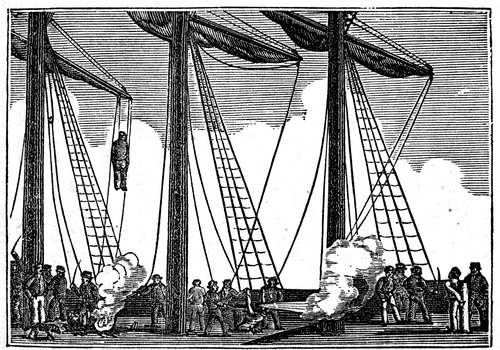
The Vessel taken by the Pirates, their Cruelties, &c. Page 265.
On looking round, I found them all employed in plundering and ransacking every thing we had. Over my left shoulder one of our sailors was strung up to the yard arm, and apparently in the last agonies of death; while before me our gallant Captain was on his knees and begging for his life. The wretches were endeavouring to extort from him the secret of our money; but for a while he was firm and dauntless. Provoked at his obstinacy, they extended his arms and cut them off at the elbows. At this, human nature gave way, and the injured man confessed the spot where we had concealed our specie.—In a few moments it was aboard their own vessel. To revenge themselves on our unhappy captain, when they had satisfied themselves that nothing else was hidden, they spread a bed of oakum on the deck before, and after soaking it through with turpentine, tied the captain on it, filled his mouth with the same combustibles, and set the whole on fire. The cries of the unfortunate man were heart-rending, and his agonies must have been unutterable; but they were soon over. All this I was compelled to witness. Heart-sick with the sight, I once shut my eyes, but a musket discharged close to my ear, was a warning sufficient to keep them open.
On casting my eyes to the stern of the vessel, I discovered that the boatswain had been nailed to the deck through his feet, and the body spiked through to the tiller. He was writhing in the last agonies of crucifixion.—Our fifth comrade was out of sight during all this tragedy; in a few minutes, however, he was brought upon the deck blindfolded. He was then conducted to the muzzle of the swivel, and commanded to kneel. The swivel was then fired off, and his head was dreadfully wounded by 266the discharge. In a moment after, it was agonizing to behold his torments and convulsions—language is too feeble to describe them. I have seen men hung upon the gibbet, but their death is like sinking in slumber when compared with his.
Excited with the scene of human butchery, one of those wretches fired his pistol to the captain’s dog. The ball struck his shoulder and disabled him; he finished him by shooting him again, and at last by cutting out his tongue! At this last hell-engendered act, my blood boiled with indignation at such savage brutality on a helpless, inoffensive dog! But I was unable to give utterance or action to my feelings.
Seeing that the crew had been every one despatched, I began to think more of myself. My old enemy, who seemed to forget me, once more approached me; but shockingly besmeared with blood and brains. He had stood by the side of the unfortunate sailor who suffered before the swivel, and supported him with the point of his bayonet. He drew a stiletto from his side, placed its point upon my heart and gave it a heavy thrust. I felt its point touch my skin; but the quilting of my bank bills prevented its further entrance. This savage monster then ran it up my breast, as if intending to divide my lungs, and in doing so, the bank bills fell upon the deck. He snatched them up greedily, and exclaimed, “Ah! laissez mois voir ce que reste.” My dress in a few moments, was ripped to pieces at the peril of my life. He frequently came so near as to tear my skin and deluge me with blood; but by the mercy of Providence, I escaped from every danger.—At this moment a heavy flaw struck the schooner, and I heard one of the pirates say, “Voila un vaisseau!” They all retreated precipitately, and gaining their own vessel, was soon out of sight.
267Helpless as I now was, I had the satisfaction of knowing that the pirates had been frightened by the appearance of a sail, but it was impossible for me to see it. Still tied to the foremast, I knew not what was my prospect of release.—An hour or two had elapsed after they left me; and it was now noon. The sun played violently upon my head, and I felt a languor and debility that indicated approaching fever. My head gradually sunk upon my breast, when I was shocked by hearing the water pouring into the cabin windows. The wretches had scuttled the vessel, and left me pinioned to go down with her. I commended my Spirit to my Maker, and gave myself up for lost. I felt myself gradually dying away, and the last thing I remembered was the foaming noise of the waves. This was occasioned by a ship passing by me. I was taken in, restored to health, and am now a poor, ruined, helpless man.
The ship Liverpool Packet, Ricker, of Portsmouth, N. H. was boarded on the 16th off Cape St. Antonio, Cuba, by two piratical schooners; two barges containing thirty or forty men, robbed the vessel of every thing moveable, even to her flags, rigging, one boat which happened to be afloat, and having a boy in it which belonged to the ship. They held a consultation whether they should murder the crew, as they had done before, or not—in the mean time taking the ship into anchoring ground. On bringing her to anchor, the crew saw a brig close along side, burnt to the water’s edge, and three dead bodies 268floating near her.—The pirates said they had burnt the brig the day before, and murdered all the crew!—and intended doing the same with them. They said “look at the turtles, (meaning the dead bodies) you will soon be the same.” They said the vessel was a Baltimore brig, which they had robbed and burnt, and murdered the crew as before stated, of which they had little doubt.—Capt. Ricker was most shockingly bruised by them. The mate was hung till he was supposed to be dead, but came to, and is now alive. They told the captain that they belonged in Regla, and should kill them all to prevent discovery.
BRIG DOVER.
Extract from the Log-Book of the brig Dover, Capt. Sabins, from Matanzas for Charleston.
Jan. 16, 1822, sea account, at 1 P. M.—Pan of Matanzas bearing S. saw a boat coming to us from a small drogher, which came out of Matanzas the night before us, with five Spaniards, armed with long knives, pistols, cutlasses, &c. When they got within hail, they fired a musket at us, cheered, and came on board. They were the most villanous looking rascals that any one had probably ever beheld. They immediately drew their weapons, and after beating us severely with their cutlasses, drove us below. They then robbed us of all our clothes except what we had on, our watches, and every thing of value. We were afterwards called up singly. Four men with drawn knives stood over the 269captain, and threatened him if he did not give up his money, they would kill all hands and burn the vessel. After robbing the people they commenced plundering the brig. They broke open the hatches, made us get out our boat and carry their plunder to their vessel. They took from us one compass, five bags coffee, one barrel sugar, nearly all our provisions, our colours, rigging, and cooking utensils. They then ordered us to stand to the north, or they would overhaul us, murder the crew and burn the vessel. We made sail, and shortly after were brought to by another boat of the same character, which fired into us, but left us upon being informed that we had been already robbed.
The Porpoise, Capt. Ramage, arrived at Charleston from his successful cruise against the Pirates, having recaptured a Baltimore schooner which had been in their possession three days, destroyed three of their establishments on shore, 12 of their vessels, besides two on the stocks, and brought in four prisoners, against whom it is supposed there is strong evidence.
It is stated, that a Pirate Captain and his mate quarrelled on the question of putting to death all captives,—they fought a duel with muskets, the Captain was killed, and the Mate (who was the advocate of mercy) succeeded to the command.
The schooner Jane, of Boston, was taken the 24th Jan. by a pirate schooner.—They were carried into a place where were three more of the same trade.—The 270captain and crew were threatened, beat, and the vessel plundered of much property; after which they were released.
If the Spanish Government is unable to drive the Pirates from their strong holds in Cuba, the Baltimore Chronicle suggests the necessity of occupying the island with American forces for that purpose, as robbers and pirates have a right to enjoy no protection whatever; and in this case all civilized powers are warranted in carrying the war into the enemy’s territory.
PIRATES CAPTURED.
Charleston, Feb. 12.—The four pirates brought into this port by the United States Porpoise, were landed yesterday from that vessel, and committed to prison. Three of them are Spaniards, the other a Portuguese; two of the former father and son, the son being only about 18 years of age.
Charleston, Feb. 14, 1824.—The United States schooner Grampus, Lieut. Gregory, from a cruise of 4 months in the West-Indies and along the Spanish Main, arrived at our port yesterday morning, last from Santa Martha. She has brought in three Pirates, viz. James Maxfield, one of the crew that robbed the Orleans, of Philadelphia, and Charles Owens and James Ross, who robbed a Portsmouth schooner of $2600 in the Bite of Leogane. One of these daring free-booters was delivered up to Lieut. G. by the Governor of St. Barts, and the other two 271by the President of Hayti, for trial by the United States. The G. has boarded several privateers during her cruise, and traversed a space of 9000 miles, spreading terror among those wretches whose impotence is equal to their atrocity, and who only require active pursuit to frighten them out of visible existence.
Mobile, June 1, 1822.—Capt. Carter of the schr. Swan, arrived yesterday from Havana, reports that on his outward passage from this port, on the 27th ult. at 8 o’clock, A. M. being then within 30 miles from Havana, he was boarded by an open boat from the shore, manned with nine men, who all appeared to be Spanish, armed with muskets, pistols, cutlasses, and knives, who plundered the vessel of every thing they could carry off. They also robbed the captain and crew of their clothing, even stripping the jackets from their backs, and the shoes from their feet.
The villains would not even spare the property of a Spanish Priest, passenger on board, but they robbed him also of his clothes, money, and plate, the value of 800 dollars; they however afterwards, returned his gown.
A sail heaving in sight, they left the schooner with orders to steer E. N. E. and not go over three leagues from shore, under pain of death. From their conversation while on board, it appeared that they intended to board the schooner again in the evening, run her ashore and burn her, but she escaped by the darkness of the night.
272
LIEUT. ALLEN’S VICTORY AND DEATH.
Extract of a letter from Matanzas, dated November 11, 1822.
“The gallant ALLEN is no more!—You witnessed the promptitude with which he hastened to relieve the vessels which I informed him had been captured off this port. He arrived just in time to save five sail of vessels which he found in possession of a gang of pirates, 300 strong, established in the Bay of Lejuapo, about 15 leagues east of this. He fell, pierced by two musket balls, in the van of a division of boats, attacking their principal vessel, a fine schooner of about eighty tons, with a long eighteen pounder on a pivot, and four smaller guns, with the bloody flag nailed to the mast. Himself, Capt. Freeman of Marines, and twelve men, were in the boat, much in advance of his other boats, and even took possession of the schooner, after a desperate resistance, which nothing but a bravery almost too daring could have overcome. The pirates, all but one, escaped by taking to their boats and jumping overboard, before the Alligator’s boats reached them. Two other schooners escaped by the use of their oars, the wind being light.
Capt. Allen survived about four hours, during which his conversation evinced a composure and firmness of mind, and correctness of feeling, as honourable to his character, and more consoling to his friends than even the dauntless bravery he before exhibited.”
The Surgeon of the Alligator in a letter to a friend, says, “He continued giving orders and conversing 273with Mr. Dale and the rest of us, until a few minutes before his death, with a degree of cheerfulness that was little to be expected from a man in his condition. He said he wished his relatives and his country to know that he had fought well, and added that he died in peace and good will towards all the world, and hoped for his reward in the next.”
Lieut. Allen had but few equals in the service. He was ardently devoted to the interest of his country, was brave, intelligent, and accomplished in his profession. He displayed, living and dying, a magnanimity that sheds lustre on his relatives, his friends, and his country.
PIRATES ENTRAPPED.
The British schooner Speedwell arrived at Nassau N. P. in November, bringing in 18 pirates, who had been captured by the Speedwell and her consort. The schooner had been disguised as a merchantman, and the pirates, taking her to be an easy prize, came carelessly along side of her, for the purpose of boarding, when she gave them a hot fire, and threw them into confusion. Many jumped overboard and were drowned; and with these and the killed, the loss of the pirates was about 15 or 16. The remainder of them, 18 in number, were taken prisoners and carried into Nassau.
274
SAILING OF COMMODORE PORTER.
BALTIMORE, JAN. 17, 1823.
Yesterday Commodore PORTER left this port in the steam galley Enterprize, to join the squadron fitted out at Norfolk, for the purpose of suppressing piracy on the coast of Cuba. Every friend of humanity must wish that the efforts of the distinguished officer who has been selected to this command will be crowned with success. The means adopted are certainly the best calculated to effect the object. Frigates and sloops of war are totally inadequate, by means of their great draft of water; but the vessels which have been selected by Commodore Porter, are precisely calculated to ferret the banditti from their lurking places. The aid of steam we think a most valuable addition to the squadron, and from the manner in which the Enterprize has been fitted out, we have every reason to believe she will completely answer the expectations formed. Commodore Porter has been indefatigable since he came here, and several of our citizens conversant in steam affairs, volunteered their services to aid him in the necessary equipments for that department. We learn that she is provided with duplicates of every piece of machinery which might be carried away in action, and that able and experienced engineers were also procured for her.
In a very short time we hope to hear of the Commodore’s arrival at his cruising ground, and we doubt not he will soon put an end to the ravages of those lawless barbarians.
275
EXECUTION OF THE PIRATES.
Ten of the pirates captured by the British sloop of War Tyne, were executed at Kingston, Jamaica, on Friday, the 7th of February, 1823.
About a quarter of an hour before day dawn, the wretched culprits were taken from the jail, under a guard of soldiers from the 50th regiment, and the City Guard. On their arrival at the wherry wharf, the military retired, and the prisoners, with the Town Guard were put on board two wherries, in which they proceeded to Port Royal Point, the usual place of execution in similar cases. They were there met by a strong party of military, consisting of 50 men, under command of an officer. They formed themselves into a square round the place of execution, with the Sheriff and his officers with the prisoners in the centre. The gallows was of considerable length, and contrived with a drop so as to prevent the unpleasant circumstances which frequently occur.
The unfortunate men had been in continual prayer from the time they were awakened out of a deep sleep till they arrived at that place, where they were to close their existence.
They all expressed their gratitude for the attention they had met with from the Sheriff and the inferior officers. Many pressed the hands of the turnkey to their lips, others to their hearts, and, on their knees, prayed that God, Jesus Christ, and the Virgin Mary, would bless him and the other jailers for their goodness. They all then fervently joined in prayer. To the astonishment of all, no clerical character, of any persuasion, was present. They repeatedly called 276out, “Adonde esta el padre,” (Where is the holy father.)
Juan Hernandez called on all persons present to hear him—he was innocent; what they had said about his confessing himself guilty was untrue. He had admitted himself guilty, because he hoped for pardon; but that now he was to die, he called God, Jesus Christ, the Holy Ghost, the Virgin Mary, and the Saints, to witness that he spoke truth—that he was no pirate, no murderer—he had been forced. The Lieutenant of the pirates was a wretch, who did not fear God, and had compelled him to act.
Juan Gutterez and Francisco de Sayas were loud in their protestations of innocence.
Manuel Lima said, for himself, he did not care; he felt for the old man (Miguel Jose.) How could he be a pirate who could not help himself? If it were a Christian country, they would have pardoned him for his gray hairs. He was innocent—they had both been forced. Let none of his friends and relations ever venture to sea—he hoped his death would be a warning to them, that the innocent might suffer for the guilty. The language of this young man marked him a superior to the generality of his companions in misfortune. The seamen of the Whim stated that he was very kind to them when prisoners on board the piratical vessel. Just before he was turned off, he addressed the old man—“Adios viejo, para siempre adios.”—(Farewell, old man, for ever farewell.)
Several of the prisoners cried out for mercy, pardon, pardon.
Domingo Eucalla, the black man, then addressed them. “Do not look for mercy here, but pray to God; we are all brought here to die. This is not built for nothing; here we must end our lives. You know I am innocent, but I must die the same as you all. There is not any-body here who can do us 277any good, so let us think only of God Almighty. We are not children but men, you know that all must die; and in a few years those who kill us must die too. When I was born, God set the way of my death; I do not blame any body. I was taken by the pirates, and they made me help them; they would not let me be idle. I could not show that this was the truth, and therefore they have judged me by the people they have found me with. I am put to death unjustly, but I blame nobody. It was my misfortune. Come, let us pray. If we are innocent, so much the less we have to repent. I do not come here to accuse any one. Death must come one day or other; better to the innocent than guilty.” He then joined in prayer with the others. He seemed to be much reverenced by his fellow prisoners. He chose those prayers he thought most adapted to the occasion. Hundreds were witnesses to the manly firmness of this negro. Observing a bystander listening attentively to the complaints of one of his fellow wretches, he translated what had been said into English. With a steady pace, and a resolute and resigned countenance, he ascended the fatal scaffold. Observing the executioner unable to untie a knot on the collar of one of the prisoners, he with his teeth undid it. He then prayed most fervently till the drop fell.
Miguel Jose protested his innocence.—“No he robado, no he matado ninguno, muero inocente.”—(I have robbed no one, I have killed no one, I die innocent. I am an old man, but my family will feel my disgraceful death.)
Francisco Miguel prayed devoutly, but inaudibly. His soul seemed to have quitted the body before he was executed.
Breti Gullimillit called on all to witness his innocence; it was of no use for him to say an untruth for he was going before the face of God.
278Augustus Hernandez repeatedly declared his innocence, requested that no one would say he had made a confession; he had none to make.
Juan Hernandez was rather obstinate when the executioner pulled the cap over his eyes. He said, rather passionately—“Quita is de mis ojos.”—(Remove it from my eyes.) He then rubbed it up against one of the posts of the gallows.
Miguel Jose made the same complaint, and drew the covering from his eyes by rubbing his head against a fellow sufferer.
Pedro Nondre was loud in his ejaculations for mercy. He wept bitterly. He was covered with the marks of deep wounds.
The whole of the ten, included in the death warrant, having been placed on the scaffold, and the ropes suspended, the drop was let down. Nondre being an immense heavy man, broke the rope, and fell to the ground alive. Juan Hernandez struggled long. Lima was much convulsed. The old man Gullimillit, and Miguel, were apparently dead before the drop fell. Eucalla (the black man) gave one convulsion, and all was over.
When Nondre recovered from the fall and saw his nine lifeless companions stretched in death, he gave an agonizing shriek; he wrung his hands, screamed “Favor, favor, me matan sin causa. O! buenos Christianos, me amparen, ampara me, ampara me, no hay Christiano en asta, tiara?” (Mercy, mercy, they kill me without cause—Oh, good Christians, protect me, protect me, oh, protect me. Is there no Christian in this land.)
He then lifted his eyes to Heaven, and prayed long and loud. Upon being again suspended, he was for a long period convulsed. He was an immense powerful man, and died hard.
279
PIRATES CAPTURED.
The famous pirate, La Cata, was captured, off the Isle of Pines, about the 1st of March, 1823, by the British cutter Grecian, after a smart action. The cutter had 50 men—the pirate 100, and 8 guns; it was believed that about 30 of the crew of the latter were killed, but only three prisoners were made, the rest making their escape on shore. Considerable quantities of goods were found on board the prize.
The Grecian conveyed the prisoners to Jamaica, where, it seems, there is more law to reach cases of piracy than in the United States.
LAFITTE, THE NOTED PIRATE, KILLED.
A British sloop of war fell in with and captured a piratical vessel with a crew of sixty men, under command of the famous Lafitte. He hoisted the bloody flag and refused quarter, and fought until nearly every man was killed or wounded—Lafitte being among the former.
The schooner Pilot, of Norfolk, was captured by the pirates off Matanzas, and her crew much abused; but they were put ashore, and the wretches went on a cruise in the prize, and captured and 280robbed two vessels, within two miles of the Moro castle, Havana. A few days after, the U. S. schooner Jackall fell in with her and made a re-capture, securing, however, only one of the pirates; but several of them were killed in the action, fighting desperately. Several captures were made about the same time by Com. Porter’s squadron, which was actively employed.
BATTLE WITH THE PIRATES.
Almost every day furnished accounts evincing the activity of Commodore Porter, and the officers and men under his command; but for a long time their industry and zeal was rather shown in the suppression of piracy than the punishment of it. At length, however, an opportunity offered for inflicting the latter, as detailed in the following letter, dated Matanzas, July 10, 1823.
“I have the pleasure of informing you of a brilliant achievement obtained against the pirates on the 5th inst. by two barges attached to Commodore Porter’s squadron, the Gallinipper, Lieut. Watson, 18 men, and the Musquito, Lieut. Inman, 10 men. The barges were returning from a cruise to windward; when they were near Jiguapa Bay, 13 leagues to windward of Matanzas, they entered it—it being a rendezvous for pirates. They immediately discovered a large schooner under way, which they supposed to be a Patriot privateer; and as their 281stores were nearly exhausted, they hoped to obtain some supplies from her. They therefore made sail in pursuit. When they were within cannon shot distance, she rounded to and fired her long gun, at the same time run up the bloody flag, directing her course towards the shore, continuing to fire without effect. When she had got within a short distance of the shore, she came to, with springs on her cable, continuing to fire; and when the barges were within 30 yards, they fired their muskets without touching boat or man; our men gave three cheers, and prepared to board; the pirates, discovering their intention, jumped into the water, when the bargemen, calling on the name of “Allen,” commenced a destructive slaughter, killing them in the water and as they landed. So exasperated were our men, that it was impossible for their officers to restrain them, and many were killed after orders were given to grant quarter. Twenty-seven dead were counted, some sunk, five taken prisoners by the bargemen, and eight taken by a party of Spaniards on shore. The officers calculated that from 30 to 35 were killed. The schooner mounted a long nine pounder on a pivot, and 4 four pounders, with every other necessary armament, and a crew of 50 to 60 men, and ought to have blown the barges to atoms. She was commanded by the notorious Diableto or Little Devil. This statement I have from Lieut. Watson himself, and it is certainly the most decisive operation that has been effected against those murderers, either by the English or American force.
“This affair occurred on the same spot where the brave Allen fell about one year since. The prize was sent to Thompson’s Island.”
A British sloop of war, about the same time, captured a pirate schooner off St. Domingo, with a crew of 60 men. She had 200,000 dollars in specie, and 282other valuable articles on board. The brig Vestal sent another pirate schooner to New-Providence.
CAPTURE OF A PIRATICAL STATION IN CUBA.
The U. S. schooners of war Greyhound and Beagle left Thompson’s Island, June 7, 1823, under the command of Lieuts. Kearney and Newton, and cruised within the Keys, on the south side of Cuba, as far as Cape Cruz, touching at all the intermediate ports on the island, to intercept pirates. On the 21st July, they came to anchor off Cape Cruz, and Lieut. Kearney went in his boat to reconnoitre the shore, when he was fired on by a party of pirates who were concealed among the bushes. A fire was also opened from several pieces of cannon erected on a hill, a short distance off. The boat returned, and five or six others were manned from the vessels, and pushed off for the shore, but a very heavy cannonade being kept up by the pirates on the heights, as well as from the boats were compelled to retreat. The two schooners were then warped in, when they discharged several broadsides, and covered the landing of the boats. After a short time the pirates retreated to a hill that was well fortified. A small hamlet, in which the pirates resided was set fire to and destroyed. Three guns, one a four pounder, and two large swivels, with several pistols, cutlasses, and eight large boats, were captured. A cave, about 150 feet deep, was discovered, near where the houses were, and after considerable difficulty, a party of seamen got to the bottom, where was found 283an immense quantity of plunder, consisting of broadcloths, dry goods, female dresses, saddlery, &c. Many human bones were also in the cave, supposed to have been unfortunate persons who were taken and put to death. A great deal of the articles were brought away, and the rest destroyed. About forty pirates escaped to the heights, but many were supposed to have been killed, from the fire of the schooners, as well as from the men who landed. The bushes were so thick that it was impossible to go after them. Several other caves are in the neighbourhood, in which it was conjectured they occasionally take shelter.
PIRATES TAKEN AND EXECUTED.
A piratical vessel, and her crew of thirty-eight men were captured off Matanzas on the 16th May, 1825, by a British cutter and a steamboat fitted out at that place. Several of the pirates were killed, and the rest sent to Havana for trial. It was ascertained that some of them had assisted in capturing more than twenty American vessels, whose crews were MURDERED!!
An additional gang of pirates was hung at the same period, at Porto Rico.—Eleven at once.
284
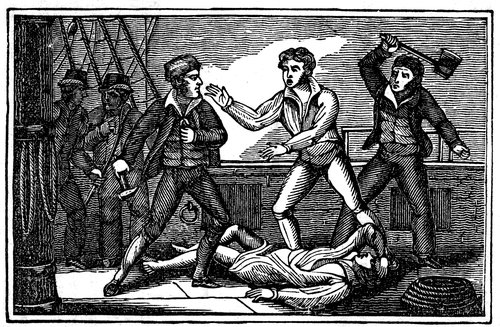
Mutiny on board the Vineyard. Page 284.
285
CHARLES GIBBS, otherwise JAMES D. JEFFERS, AND THOMAS I. WANSLEY.
This atrocious villain was a native of Providence in Rhode-Island. His true name was James D. Jeffers, but as he was more generally known as Charles Gibbs we shall give him that appellation. His adventures, excepting the crime for which he was finally hanged, are only known from his own admissions while under sentence of death, and our readers must judge for themselves how far they are to be credited.
It appears from evidence legally taken, that the brig Vineyard sailed from New-Orleans about the first of November, eighteen hundred and thirty, for Philadelphia. William Thornby was the master of the vessel, and William Roberts the mate. The crew consisted of seven persons, viz. Charles Gibbs, John Brownrigg, Robert Dawes, Henry Atwell, James Talbot, A. Church, and Thomas I. Wansley, a young negro native of Delaware, who acted as cook.
When the Vineyard had been five days at sea, Wansley made it known to the crew that there were fifty thousand dollars in specie on board. This information excited their cupidity, and induced them to consult on the means of getting the money into their own hands. Many conversations took place on the subject, and while these were going on, Dawes, who was a mere boy, was sent to converse with the officers, in order to divert their attention from what was passing. Finally it was resolved, that as the master and mate were old men, it was time they should die and make room for the rising generation. Moreover, they were of opinion that as the mate was of a peevish disposition, he deserved death. Yet, to do no man injustice, it does not appear that Brownrigg or Talbot had any part in these deliberations, or in the foul deed that resulted from them.
The conspirators agreed to commit the greatest earthly crimes, murder and piracy, on the night of the twenty-third. The murder of the master was assigned 286to Gibbs and Wansley; that of the mate to Atwell and Church.
The vessel was off Cape Hatteras, when the time fixed for the murder arrived. The master was standing on the quarter-deck, Dawes had the helm, and Brownrigg was aloft. Dawes called Wansley aft to trim the light in the binacle. The black moved as if to obey, but coming behind Mr. Thornby, struck him on the back of the neck with the pump brake, so that he fell forward, crying “murder!” Wansley repeated his blows till the master was dead, and then, with the assistance of Gibbs, threw the body overboard. While this deed of darkness was being done, the mate, aroused by the noise, came up the companion ladder from the cabin. Atwell and Church were waiting for him at the top of the ladder, and one of them struck him down with a club; but the blow did not kill him. Gibbs followed to complete the work, but not being able to find the mate in the dark, returned to the deck for the binacle light. With this he descended and laid hands on the victim, but was not able to overcome him, even with the aid of Atwell; but finally, with the assistance of Church, he was dragged on deck, beaten and thrown overboard. He was not yet dead, and swam after the vessel four or five minutes, crying for help, before he sank. All these transactions were witnessed by the boy Dawes, who had a passive, if not an active part in them.
The pirates then took possession of the vessel, and Wansley busied himself in wiping up the blood that had been spilled on deck, declaring, with an oath, that though he had heard that the stains of the blood of a murdered person could not be effaced, he would wipe away these. Then, after drinking all round, they got up the money. It was distributed in equal portions to all on board; Brownrigg and Talbot being assured that if they would keep the secret, and share the plunder, they should receive no injury.
287They then steered a northeasterly course toward Long-Island, till they came within fifteen or twenty miles of South-Hampton Light, where they resolved to leave the vessel, in the boats, though the wind was blowing hard. Atwell scuttled the brig and got into the jolly boat with Church and Talbot, while Gibbs, Wansley, Dawes and Brownrigg, put off in the long boat. The jolly boat swamped on a bar two miles from the shore, and all on board were drowned. The long-boat was in great danger also, and was only saved from a like fate by throwing over several bags of specie. Nevertheless, the crew at last got on shore on Pelican Island, where they buried their money, and found a sportsman who told them where they were. They then crossed to Great Barn Island, and went to the house of a Mr. Johnson, to whom Brownrigg gave the proper information. Thence they went to the house of a Mr. Leonard, where they procured a wagon to carry them farther. As they were about to get in, Brownrigg cried aloud that they might go whither they pleased, but he would not accompany them, for they were murderers. On hearing this Mr. Leonard sent for a magistrate, and Gibbs and Dawes were apprehended. Wansley escaped into the woods, but was followed and soon taken.
The evidence of the guilt of the prisoners was full and conclusive. Their own confessions of the crime gratuitously made to Messrs. Meritt and Stevenson, who had the custody of them from Flatbush to New-York, could have left not the shadow of a doubt on the mind of any person who heard the testimony of those officers. Wansley told the whole story, occasionally prompted by Gibbs, and both admitted that Brownrigg was innocent of any participation in their crimes. Their confession was not, however, so favorable to Dawes.
Gibbs was arraigned for the murder of William Roberts, and Wansley for that of William Thornby. They were both found guilty, and the district attorney 288moved for judgment on the verdict. There was nothing peculiar in their deportment during the trial. The iron visage of Gibbs was occasionally darkened with a transient emotion, but he had evidently abandoned all hope of escape, and sat the greater part of the time with his hands between his knees, calmly surveying the scene before him. Wansley was more agitated, and trembled visibly when he rose to hear the verdict of the jury.
The judge proceeded to pass sentence on them severally, that each should be taken from the place where they then were, and thence to the place of confinement, and should be hanged by the neck till dead; and that the marshal of the Southern District of New-York should see this sentence carried into execution on the twenty-second day of April following, between the hours of ten and four o’clock.
The first account which Gibbs gave of himself is, that his father obtained a situation for him in the United States sloop of war Hornet, Captain Lawrence, during the last war with England, in which vessel he made two cruises; in the last of which she captured and sunk the enemy’s sloop of war Peacock off the coast of Pernambuco, after an engagement of twenty minutes. On the arrival of the Hornet in the United States, Captain Lawrence was assigned by the government to the command of the frigate Chesapeake, then lying in Boston harbor, and Gibbs accompanied him to that ill-fated vessel in the month of April, eighteen hundred and thirteen.
This statement of his services was proved to be false, and acknowledged as such by himself. His motive for the falsehood was, to conceal his real adventures about this time, that his proper name might not be discovered. There is much to corroborate and nothing to disprove what follows.
After his exchange, he abandoned all idea of following the sea for a subsistence, went home to Rhode 289Island, and remained there a few months, but being unable to conquer his propensity to roving, he entered on board a ship bound to New-Orleans, and thence to Stockholm. On the homeward passage they were compelled to put into Bristol, England, in distress, where the ship was condemned, and he proceeded to Liverpool. He returned to the United States in the ship Amity, Captain Maxwell.
After its arrival, he left the ship, and entered on board the Colombian privateer Maria, Captain Bell. They cruised for about two months in the Gulf of Mexico, around Cuba, but the crew becoming dissatisfied in consequence of the non-payment of their prize-money, a mutiny arose, the crew took possession of the schooner, and landed the officers near Pensacola. A number of days elapsed before it was finally decided by them what course to pursue. Some advised that they should cruise as before, under the Colombian commission; others proposed to hoist the black flag. They cruised for a short time without success, and it was then unanimously determined to hoist the black flag and declare war against all nations. At last one of the crew, named Antonio, suggested that an arrangement could be made with a man in Havana, that would be mutually beneficial; that he would receive all their goods, sell them, and divide the proceeds. This suggestion being favorably received, they ran up within two miles of Moro Castle, and sent Antonio on shore to see the merchant and make a contract with him, which was done.
The Maria now put to sea, with a crew of about fifty men. The first vessel she fell in with was the Indispensable, an English ship, bound to Havana, which was taken and carried to Cape Antonio. The crew were immediately destroyed: those who resisted were hewed to pieces: those who offered no resistance, were reserved to be shot and thrown overboard. Such was the manner in which they proceeded in all their 290subsequent captures. The unhappy being that cried for mercy, in the hope that something like humanity was to be found in the breasts even of the worst of men, shared the same fate with him who resolved to sell his life at the highest price. A French brig, with a valuable cargo of wine and silk, was taken shortly after: the vessel was burnt and the crew murdered.
The sanguinary scenes through which Gibbs had passed, now effectually wrought up his desperation to the highest pitch, and being as remarkable for his coolness and intrepidity as he was for his skill in navigation, he was unanimously chosen to be their leader in all future enterprises. To reap a golden harvest without the hazard of encountering living witnesses of their crimes, it was unanimously resolved to spare no lives, and to burn and plunder without mercy. They knew that the principle inculcated by the old maxim that “dead men tell no tales,” was the safe one for them, and they scrupulously followed it. Gibbs states that he never had occasion to give orders to begin the work of death.
He now directed his course towards the Bahama Banks, where they captured a brig, believed to be the William of New-York, from some port in Mexico, with a cargo of furniture, destroyed the crew, took her to Cape Antonio, and sent the furniture and other articles to their friend in Havana. Sometime during this cruise, the pirate was chased for nearly a whole day by a United States ship, supposed to be the John Adams; he hoisted Patriot colors, and finally escaped. In the early part of the summer of eighteen hundred and seventeen, they took the Earl of Moira, an English ship from London, with a cargo of dry goods. The crew were destroyed, the vessel burnt, and the goods carried to the Cape. There they had a settlement with their Havana friend, and the proceeds were divided according to agreement.
During the cruise which was made in the latter 291part of eighteen hundred and seventeen, and the beginning of eighteen hundred and eighteen, a Dutch ship from Curacoa was captured, with a cargo of West-India goods, and a quantity of silver plate. The passengers and crew, to the number of thirty, were all destroyed, with the exception of a young female about seventeen, who fell upon her knees and implored Gibbs to save her life. The appeal was successful, and he promised to save her, though he knew it would lead to dangerous consequences among his crew. She was carried to Cape Antonio, and kept there about two months; but the dissatisfaction increased until it broke out at last into open mutiny, and one of the pirates was shot by Gibbs for daring to lay hold of her with a view of beating out her brains. Gibbs was compelled in the end to submit her fate to a council of war, at which it was decided that the preservation of their own lives made her sacrifice indispensable. He therefore acquiesced in the decision, and gave orders to have her destroyed by poison, which was immediately done.
The piratical schooner was shortly after driven ashore near the Cape, and so much damaged that it was found necessary to destroy her. A new sharp-built schooner was in consequence provided by their faithful friend in Havana, called the Picciana, and despatched to their rendezvous. In this vessel they cruised successfully for more than four years. Among the vessels taken and destroyed with their crews, were the Belvidere, Dido, a Dutch brig, the British barque Larch, the other vessels enumerated in the list furnished to Justice Hopson, and many others whose names are not recollected. They had a very narrow escape, at one time, from the English man-of-war brig Coronation. In the early part of October, eighteen hundred and twenty one, they captured a ship from Charleston, took her to Cape Antonio, and were busily engaged in landing her cargo, when the United States 292brig Enterprise, Captain Kearney, hove in sight, and discovering their vessels at anchor, sent in her barges to attack them. A serious engagement followed; they defended themselves for some time behind a four gun battery, but in the end were defeated with considerable loss, and compelled to abandon their vessels and booty, and fly to the mountains for safety.
They left hot poisoned coffee on the cabin table, in hopes that some of the American officers would drink it. This statement is confirmed by Captain Kearney.
On Friday, April twenty-second, 1831, Gibbs and Wansley paid the penalty of their crimes. Both prisoners arrived at the gallows about twelve o’clock, accompanied by the marshal, his aids, and some twenty or thirty United States marines. Two clergymen attended them to the fatal spot, where every thing being in readiness, and the ropes adjusted about their necks, the throne of mercy was fervently addressed in their behalf. Wansley then prayed earnestly himself, and afterwards joined in singing a hymn.
The boy Dawes was not prosecuted, having been received as State’s evidence against Gibbs and Wansley.
PIRACIES ON THE BRIG MEXICAN.
On the 26th day of August, 1834, His Britannic Majesty’s brig of war Savage, from Portsmouth, England, arrived at Salem, Massachusetts, having on board sixteen of the crew of the piratical schooner Panda, which robbed the brig Mexican, of Salem, on the high seas, nearly two years since.
The robbery committed upon the Mexican was one of the most audacious and cruel acts of piracy ever recorded. She was bound to Rio Janeiro from Salem; and was boarded by a piratical schooner under Brazilian colors, on the 20th of September, 1832, lat. 33, long. 34, 30, and robbed of twenty thousand dollars 293in specie, the officers and crew stripped of every thing valuable, and fastened below, and the vessel set on fire with the horrid intention of destroying her with all on board. Captain Butman and his men succeeded in getting on deck through the scuttle which the pirates had left unsecured, and extinguished the flames, and returned home. Our government ordered a vessel to cruise in pursuit, but she gave up the chase as hopeless. The piratical vessel was afterwards taken on the coast of Africa, by His Britannic Majesty’s brig Curlew, and destroyed, under the following circumstances:
The Curlew arrived at St. Thomas, west coast of Africa, from India, with orders to cruise on that coast; and her commander having obtained information that a schooner, suspected to be a pirate, was lying in the river Nazareth, on the southern extremity of the coast, immediately sailed in pursuit, and found the schooner as described. The boats of the Curlew were manned to take possession of her, when the crew of the schooner fled to the shore, with the exception of four who were taken prisoners. They had kindled a fire to destroy the schooner, and she had been stripped of every thing valuable. The fire was extinguished without damage. She had no cargo on board, but her water casks were all filled, and she was apparently ready for another cruise. In her cabin were found a compass, marked Boston, the flags and ensigns of different nations, and custom-house papers made out at Havana. In taking her down the river, she accidentally blew up, and the Curlew’s purser and one man were killed. The four men taken were shipped at St. Thomas after the robbery of the Mexican. The Curlew’s crew pursued the fugitives in various directions, and succeeded in capturing an additional number of the pirates; and several natives’ towns were burned by the Curlew’s men. The pirates had an examination in England before the proper authorities, when five of them offered to turn king’s evidence, two of whom 294were admitted to testify. They were fully committed, and the British government ordered them to this country for trial, and the affidavits and documents relative to their capture and subsequent confinement and examination were delivered to the authorities in this country.
The pirates were tried before the United States court at Boston, November 11th, 1834, which continued for fourteen days, and resulted in the conviction of seven of their number, five of whom were executed agreeably to their sentence, the other two received a reprieve from the President of the United States.
Execution of the Spanish Pirates.—[Thursday, June 11, 1835.]—Pursuant to previous arrangement, Captain Don Pedro Gibert, and Juan Montenegro, Manuel Castillo, Angel Garcia, and Manuel Boyga, were yesterday morning summoned to prepare for their immediate execution, agreeably to their sentence, for having, while belonging to the schooner Panda, committed piracy, by robbing the brig Mexican, of Salem, of twenty thousand dollars, and afterwards attempting to destroy the crew and all evidence of their crime, by setting fire to the vessel. It is understood, that, when the prisoners became thoroughly convinced that there was no longer any grounds to hope for a further respite, they entered into a mutual agreement to commit suicide on Wednesday night. Angel Garcia made the first attempt, in the evening, by trying to open the veins in each arm, with a fragment of a bottle, but was discovered before he could effect his purpose, and a stricter guard was afterwards maintained upon all of them during the remainder of the night, and every thing removed with which they might be supposed to renew any attempt upon their own lives. Yesterday morning, however, about nine o’clock, while the avenues of the jail resounded with the heavy steps of a host of acting marshals, and the “busy note of preparation” 295struck solemnly upon the ears of the spectators within reach of its echo, Boyga succeeded in inflicting a deep gash on the left side of his neck with a piece of tin. The officer’s eye had been withdrawn from him scarcely a minute, before he was discovered lying on his pallet, with a peculiar trembling of his knees, which induced the officers to examine if any thing had suddenly happened to him. They found him covered with blood, and nearly insensible; medical aid was at hand, and the wound was immediately sewed up, but Boyga, who had fainted from loss of blood, never revived again. Two Catholic clergymen, the Rev. Mr. Varella, a Spanish gentleman, and pastor of the Spanish congregation at New-York, and the Rev. Mr. Curtin, of this city, were in close attendance upon the prisoners during the whole morning; and at a quarter past ten, under the escort of the Marshal and his deputies, accompanied them to the gallows, erected on an insulated angle of land in the rear of the jail.
When the procession arrived at the foot of the ladder leading up to the platform of the gallows, the Rev. Mr. Varella, looking directly at Captain Gibert, said—“Spaniards, ascend to heaven.” Gibert mounted with a quick step, and was followed by his comrades at a more moderate pace, but without the least perceptible indication of hesitancy. Boyga, unconscious of his situation and destiny, was carried up in a chair, and seated beneath the rope prepared for him. Gibert, Montenegro, Garcia, and Castillo all smiled subduedly as they took their appointed stations on the platform. Judging only from Gibert’s air, carriage, and unembarrassed eye, as he glanced at the surrounding multitude, and surveyed the mechanism of his shameful death, he might have well been mistaken for an officer in attendance, instead of one of the doomed. With the exception of repeating his prayers, after the clergyman, he spoke but little. Soon after he ascertained his position on the stage, he left it, and passing over to the 296spot where the apparently lifeless Boyga was seated on the chair, he bent over his shoulder and kissed him very affectionately. He then resumed his station, but occasionally turned round to Mr. Peyton the interpreter, and the clergymen. Addressing his followers, he said—“Boys, we are going to die; but let us be firm, for we are innocent.” To Mr. Peyton, removing his linen collar, and handing it to him, he said—“This is all I have to part with—take it as a keepsake. I die innocent, but I’ll die like a noble Spaniard. Good bye, brother, we die in the hope of meeting you in heaven.” Montenegro and Garcia, though exhibiting no terror, vociferated their innocence, exclaiming—“Americans, we are not culpable—we are innocent; but we forgive all who have injured us.” Castillo addressed himself to an individual, whom he recognised in the front rank of the officers below the stage, and said—“Adieu, my friend—I shall see you in heaven—I do not care so much about dying, as to have the Americans think I am guilty,” [culpable.] All of them expressed great satisfaction at the intelligence of De Soto’s reprieve.
The Marshal having read the warrant for their execution, and stated that De Soto was respited for sixty days, and Ruiz for thirty, the ropes were adjusted round the necks of the prisoners, and a slight hectic flush spread over the countenance of each; but not an eye quailed, nor a limb trembled, nor a muscle quivered. As the cap was about to be drawn over Gibert’s face, the Spanish Priest fervently embraced him, and during the operation of covering the faces of the others, the Rev. Mr. Curtin advanced to the railing of the stage, and read a brief declaration on behalf of the prisoners, addressed to the citizens of America assembled, setting forth, that as at the trial they had declared their innocence, so did they now continue to do so. Boyga’s cap and rope were adjusted, as he sat, supported by an officer, in the chair, which was 297so placed as to fall with the drop. At a quarter before 11, after every preparation was completed, and while they were repeating to themselves, in scarcely audible tones, their prayers, Deputy Marshal Bass suddenly cut the small cord which restrained the spring, and the platform fell without even the creaking of a hinge. In falling, Boyga’s chair struck against the bodies of the Captain and Garcia. Boyga struggled slightly once after his descent, and Montenegro and Castillo but little; Capt. Gibert did not die quite so easily, the rope being placed behind his neck. Garcia struggled most and longest—about 3 minutes. After being suspended 30 minutes, the physicians in attendance pronounced them dead, and they were cut down, and placed in black coffins, in readiness in the yard.
It is stated in many of the papers, that Captain Gibert attempted to cut his throat on Wednesday night, but this is not the fact. It is true that he pursued a line of conduct on that night which induced the officers to suspect that he intended to commit suicide. Mr. Tavers, one of the guards, who understands the Spanish language, overheard the signal agreed upon, by the whole party. The Captain proposed to write till one o’clock, when he was to bid “Good bye” to the rest, and they were then to despatch themselves with pieces of glass. Accordingly, at the appointed hour, the Captain, having terminated his writing, destroyed a part of his papers, retired to a corner of his cell, and appeared to be arranging his person to “die with dignity;” but being closely watched at the window, the officers, Messrs. Shute and Pierce, entered his cell before he had completed his toilet. They asked him what he intended to do; but he was irritated by their undesired intrusion, and, showing temper, declined answering. Upon searching, they found a piece of glass in his pocket. They then ironed him, with his hands behind his back. He remained dogged in his disposition, and blew the light out four times, which 298the officer as often re-lighted, and threatened to put his legs in irons if he persisted in putting it out.
Montenegro, it was discovered, after his execution, had cut his throat in two places, and had bled very profusely, but had washed his shirt out in the morning to conceal the attempt. It was the irritation of the wounds, probably, that made him hold his head a little awry when the rope was first put round his neck. He was one of the most piratical looking of the crew, but one of the most innocent, and was always in pleasant humor. Garcia inflicted wounds upon his arms after he was ironed.
Dying Declaration of the Pirates.—The Catholic Sentinel of Saturday contains the following declaration of innocence, written in Spanish by Capt. Gibert, and signed by his companions. The substance of it was delivered from the platform, a few minutes before their execution, by the Rev. Mr. Curtin, one of the Catholic clergymen in attendance:—
“Americans! we, the undersigned, were reduced to this sad and ignominious fate by misfortune, not by guilt. In this world we have nothing to hope; but in the next, we confidently expect salvation from the benign mercy of our heavenly Redeemer. Then, Americans, we declare to you with our dying breath, that we are innocent; and we now aver so in the hearing of that God before whom we must in a few moments appear;—but our souls will not, at that sacred tribunal, be charged with debasing the last act of our lives by the utterance of falsehood. We speak the solemn truth;—we are not culpable,—and we reiterate here, under the gallows, what we declared on our trial, ‘that we die innocent men.’ May God forgive those who brought us to this fatal end, as we leave the world in peace with all men. Farewell, Americans.
Angel Garcia,
Juan Montenegro,
Pedro Gibert,
Manuel Boyga,
Manuel Castillo.”