THE HISTORY OF THE PIRATES. (continued 2)
Reading edition
While they were lying at Rajapora they passed a survey on their shipping, and judging their own to be less serviceable than their prize, they voted them to the flames, and straightway fitted up the Surat ship. They transported both companies aboard of her, and then set fire to the Prosperous and Speedy Return. They mustered at this place 164 fighting 55men; 43 only were English, the greater number French, the rest Danes, Swedes, and Dutch. They took on board 70 Indians to do the drudgery of the ship, and mounted 56 guns, calling her the Defiance, and sailed from Rajapora the latter end of October, in the year 1703 to cruise on the coast of Malabar. But not meeting with prey in this first cruise, they came to an anchor about three leagues to the northward of Cochen, expecting some boats to come off with supplies of refreshments, for which purpose they fired several guns, by way of signal, but none appearing, the quarter-master was sent in the pinnace to confer with the people, which he did with some caution, keeping the boat upon their oars at the shore side. In short, they agreed very well, the pirates were promised whatever necessaries they wanted, and the boat returned aboard.
The next day a boat came off from the town with hogs, goats, wine, &c. with a private intimation from Malpa, the Dutch broker, an old friend of the pirates, that a ship of that country called the Rhimæ, lay then in Mudbay, not many leagues off, and if they would go out and take her, he would purchase the cargo of them, and likewise promised that they should be further supplied with pitch, tar, and all other necessaries, which was made good to them; for people from the factory flocked aboard every hour, and dealt with them as in open market, for all sorts of merchandise, refreshments, jewels, and plate, returning with coffers of money, &c. to a great value.
The advice of the ship was taken very kindly, but the pirates judging their own ship too large to go close into the bay, consulted their friend upon means for taking the said ship, who readily treated with them for the sale of one of less burthen, that then lay in the harbour; but Malpa speaking to one Punt, of the factory, to carry her out, he not only 56refused to be concerned in such a piece of villany, but reproved Malpa for corresponding with the pirates, and told him, if he should be guilty of so base an action, he must never see the face of any of his countrymen more; which made the honest broker change both his countenance and his purpose.
At this place Capt. Woolley, whom they had taken for their pilot on the Indian coast, being in a very sick and weak condition, was, at his earnest entreaty, discharged from his severe confinement among them, and set ashore, and the next day the pirates sailed, and ranged along the Malabar coast, in quest of more booty. In their way they met a second time with the Pembroke, and plundered her of some sugar, and other small things, and let her go again. From the coast they sailed back for the Island of Mauritius, where they lay some time, and lived after their usual extravagant manner.
CAPTAIN ROBERT KIDD.
We are now going to give an account of one whose name is well known in England. The person we mean is Capt. Kidd, whose public trial and execution here, rendered him the subject of all conversation, so that his actions have been chanted about in ballads. However, it is now a considerable time since these things passed, and though the people knew in general that Capt. Kidd was hanged, 57and that his crime was piracy, yet there were scarce any, even at that time, who were acquainted with his life or actions, or could account for his turning pirate.
In the beginning of king William’s war, Capt. Kidd commanded a privateer in the West-Indies, and by several adventurous actions acquired the reputation of a brave man, as well as an experienced seaman. About this time the pirates were very troublesome in those parts: wherefore Capt. Kidd was recommended by the Lord Bellamont, then governor of Barbadoes, as well as by several other persons, to the government here, as a person very fit to be entrusted with the command of a government ship, and to be employed in cruising upon the pirates, as knowing those seas perfectly well, and being acquainted with all their lurking places; but what reasons governed the politics of those times I cannot tell, but this proposal met with no encouragement here, though it is certain it would have been of great consequence to the subject, our merchants suffering incredible damages by those robbers.
Upon this neglect, the lord Bellamont and some others, who knew what great captures had been made by the pirates, and what a prodigious wealth must be in their possessions, were tempted to fit out a ship at their own private charge, and to give the command of her to Capt. Kidd; and to give the thing a greater reputation, as well as to keep their seamen under the better command, they procured the king’s commission for the said Capt. Kidd, of which the following is an exact copy:
William Rex.
“William the Third, by the grace of God, King of England, Scotland, France, and Ireland, defender of the faith, &c. To our trusty and well 58beloved Capt. Robert Kidd, commander of the ship the Adventure galley, or to any other the commander of the same for the time being, Greeting. Whereas we are informed, that Capt. Thomas Too, John Ireland, Capt Thomas Wake, and Capt. William Maze, or Mace, and other subjects, natives or inhabitants of New-York, and elsewhere, in our plantations in America, have associated themselves with divers others, wicked and ill-disposed persons, and do against the law of nations commit many and great piracies, robberies, and depredations on the seas upon the parts of America, and in other parts, to the great hindrance and discouragement of trade and navigation, and to the great danger and hurt of our loving subjects, our allies, and all others, navigating the seas upon their lawful occasions. Now know ye, that we being desirous to prevent the aforesaid mischiefs, and as much as in us lies, to bring the said pirates, free-booters and sea-rovers to justice, have thought fit, and do hereby give and grant to the said Robert Kidd (to whom our commissioners for exercising the office of Lord High Admiral of England, have granted a commission as a private man of war, bearing date the 11th day of December, 1695,) and unto the commander of the said ship for the time being, and unto the officers, mariners, and others, which shall be under your command, full power and authority to apprehend, seize, and take into your custody as well the said Capt. Thomas Too, John Ireland, Capt. Thomas Wake, and Capt. William Maze, or Mace, as all such pirates, free-booters, and sea-rovers, being either our subjects, or of other nations associated with them, which you shall meet with upon the seas or coasts of America, or upon any other seas or coasts, with all their ships and vessels, and all such merchandise, money, goods, and wares as shall be found on board, or with them, in case they shall willingly yield themselves; 59but if they will not yield without fighting, then you are by force to compel them to yield. And we also require you to bring, or cause to be brought, such pirates, free-booters, or sea-rovers, as you shall seize, to a legal trial, to the end they may be proceeded against according to the law in such cases. And we do hereby command all our officers, ministers, and other our loving subjects whatsoever, to be aiding and assisting to you in the premises. And we do hereby enjoin you to keep an exact journal of your proceedings in the execution of the premises, and set down the names of such pirates, and of their officers and company, and the names of such ships and vessels as you shall by virtue of these presents take and seize, and the quantities of arms, ammunition, provision, and lading of such ships, and the true value of the same, as near as you judge. And we do hereby strictly charge and command you, as you will answer the contrary at your peril, that you do not, in any manner, offend or molest our friends or allies, their ships or subjects, by colour or pretence of these presents, or the authority thereby granted. In witness whereof, we have caused our great seal of England to be affixed to these presents. Given at our court at Kensington, the 26th day of January, 1695, in the 7th year of our reign.”
Capt. Kidd had also another commission, which was called a commission of reprisals; for it being then war time, this commission was to justify him in the taking of French merchant ships, in case he should meet with any; but as this commission is nothing to our present purpose, we shall not burthen the reader with it.
With these two commissions he sailed out of Plymouth in May, 1696, in the Adventure galley, of 30 guns, and 80 men; the place he first designed 60for was New-York; in his voyage thither he took a French banker, but this was no act of piracy, he having a commission for that purpose, as we have just observed.
When he arrived at New-York, he put up articles for engaging more hands, it being necessary to his ship’s crew, since he proposed to deal with a desperate enemy. The terms he offered were, that every man should have a share of what was taken, reserving for himself and owners forty shares. Upon which encouragement he soon increased his company to 155 men.
With this company he sailed first for Madeira, where he took in wine and some other necessaries; from thence he proceeded to Bonavista, one of the Cape-de-Verd Islands, to furnish the ship with salt, and from thence went immediately to St. Jago, another of the Cape-de-Verd Islands, in order to stock himself with provisions. When all this was done, he bent his course to Madagascar, the known rendezvous of pirates. In his way he fell in with Capt. Warren, commodore of three men of war: he acquainted him with his design, kept them company two or three days, and then leaving them, made the best of his way for Madagascar, where he arrived in February, 1696, just nine months from his departure from Plymouth.
It happened that at this time the pirate ships were most of them out in search of prey; so that according to the best intelligence Capt. Kidd could get, there was not one of them at that time about the island: wherefore, having spent some time in watering his ship and taking in more provisions, he thought of trying his fortune on the coast of Malabar, where he arrived in the month of June following, four months from his reaching Madagascar. Hereabouts he made an unsuccessful cruise, touching sometimes at the island of Mohila, and sometimes 61at that of Johanna, between Malabar and Madagascar. His provisions were every day wasting, and his ship began to want repair: wherefore, when he was at Johanna, he found means of borrowing a sum of money from some Frenchmen who had lost their ship, but saved their effects, and with this he purchased materials for putting his ship in good repair.
It does not appear all this while that he had the least design of turning pirate; for near Mohila and Johanna both, he met with several Indian ships richly laden, to which he did not offer the least violence, though he was strong enough to have done what he pleased with them; and first outrage or depredation I find he committed upon mankind, was after his repairing his ship, and leaving Johanna; he touched at a place called Mabbee, upon the Red Sea, where he took some Guinea corn from the natives, by force. After this, he sailed to Bab’s Key, a place upon a little island at the entrance of the Red Sea. Here it was that he first began to open himself to his ship’s company, and let them understand that he intended to change his measures; for, happening to talk of the Mocha fleet, which was to sail that way, he said, We have been unsuccessful hitherto; but courage, my boys, we’ll make our fortunes out of this fleet; and finding that none of them appeared averse to it, he ordered a boat out, well manned, to go upon the coast to make discoveries, commanding them to take a prisoner and bring to him, or get intelligence any way they could. The boat returned in a few days, bringing him word, that they saw fourteen or fifteen ships ready to sail, some with English, some with Dutch, and some with Moorish colours.
We cannot account for this sudden change in his conduct, otherwise than by supposing that he first meant well while he had hopes of making his fortune 62by taking of pirates; but now weary of ill success, and fearing lest his owners, out of humour at their great expenses, should dismiss him, and he should want employment, and be marked out for an unlucky man; rather, I say, than run the hazard of poverty, he resolved to do his business one way, since he could not do it another.
He therefore ordered a man continually to watch at the mast head, lest this fleet should go by them; and about four days after, towards evening, it appeared in sight, being convoyed by one English and one Dutch man of war. Kidd soon fell in with them, and getting into the midst of them, fired at a Moorish ship which was next him; but the men of war taking the alarm, bore down upon Kidd, and firing upon him, obliged him to sheer off, he not being strong enough to contend with them. Now he had begun hostilities, he resolved to go on, and therefore he went and cruised along the coast of Malabar. The first prize he met was a small vessel belonging to Aden: the vessel was Moorish, and the owners were Moorish merchants, but the master was an Englishman; his name was Parker. Kidd forced him and a Portuguese that was called Don Antonio, which were all the Europeans on board, to take on with him; the first he designed as a pilot, and the last as an interpreter. He also used the men very cruelly, causing them to be hoisted up by the arms, and drubbed with a naked cutlass, to force them to discover whether they had money on board, and where it lay; but as they had neither gold nor silver on board, he got nothing by his cruelty; however, he took from them a bale of pepper, and a bale of coffee, and so let them go.
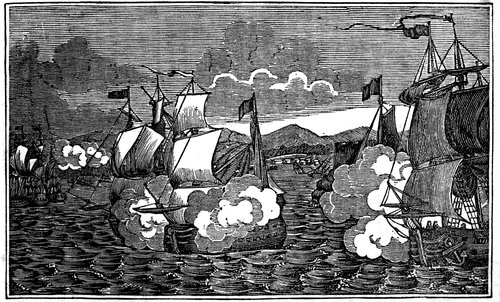
Kidd’s Engagement with the Fleet. Page 62.
A little time after he touched a Carawar, a place upon the same coast, where, before he arrived, the news of what he had done to the Moorish ship had reached them; for some of the English merchants 63there had received an account of it from the owners who corresponded with them; wherefore, as soon as Kidd came in, he was suspected to be the person who committed this piracy; and one Mr. Harvey and Mr. Mason, two of the English factory, came on board and asked for Parker, and Antonio, the Portuguese; but Kidd denied that he knew any such persons, having secured them both in a private place in the hold, where they were kept for seven or eight days, that is, till Kidd sailed from thence.
However, the coast was alarmed, and a Portuguese man of war was sent out to cruise. Kidd met with her, and fought her about six hours, gallantly enough; but finding her too strong to be taken he quitted her; for he was able to run away from her when he would. Then he went to a place called Porca, where he watered the ship, and bought a number of hogs of the natives to victual his company.
Soon after this, he came up with a Moorish ship, the master whereof was a Dutchman, called Schipper Mitchell, and chased her under French colours, which they observing, hoisted French colours too; when he came up with her, he hailed her in French, and they having a Frenchman on board, answered him in the same language; upon which he ordered them to send their boat on board; they were obliged to do so, and having examined who they were, and from whence they came, he asked the Frenchman, who was a passenger, if he had a French pass for himself; the Frenchman gave him to understand that he had. Then he told the Frenchman he must pass for captain, and by ——, says he, you are the captain: the Frenchman durst not refuse doing as he would have him. The meaning of this was, that he would seize the ship as fair prize, and as if she had belonged to French subjects, according to a commission he had for that purpose; though, one 64would think, after what he had already done, that he need not have recourse to a quibble to give his actions a colour.
In short, he took the cargo, and sold it some time after; yet still he seemed to have some fears upon him, lest these proceedings should have a bad end; for, coming up with a Dutch ship some time after, when his men thought of nothing but attacking her, Kidd opposed it; upon which a mutiny arose, and the majority being for taking the said ship, and arming themselves to man the boat to go and seize her, he told them, such as did, never should come on board him again; which put an end to the design, so that he kept company with the said ship some time, without offering her any violence. However, this dispute was the occasion of an accident, upon which an indictment was after wards grounded against Kidd; for Moor, the gunner, being one day upon deck, and talking with Kidd, about the said Dutch ship, some words arose between them, and Moor told Kidd, that he had ruined them all; upon which, Kidd, calling him a dog, took up a bucket and struck him with it, which breaking his scull, he died the next day.
But Kidd’s penitential fit did not last long, for coasting along Malabar, he met with a great number of boats, all which he plundered. Upon the same coast he also fell in with a Portuguese ship, which he kept possession of a week, and then having taken out of her some chests of India goods, thirty jars of butter, with some wax, iron, and a hundred bags of rice, he let her go.
Much about the same time he went to one of the Malabar islands for wood and water, and his cooper being ashore, was murdered by the natives; upon which Kidd himself landed, and burnt and pillaged several of their houses, the people running away; but having taken one, he caused him to be tied to a 65tree, and commanded one of his men to shoot him; then putting to sea again he took the greatest prize which fell into his hands while he followed this trade: this was a Moorish ship of 400 tons, richly laden, named the Queda Merchant, the master whereof was an Englishman, by the name of Wright; for the Indians often make use of English or Dutchmen to command their ships, their own mariners not being so good artists in navigation. Kidd chased her under French colours, and having come up with her, he ordered her to hoist out her boat, and to send on board of him, which being done, he told Wright he was his prisoner; and informing himself concerning the said ship, he understood there were no Europeans on board, except two Dutch, and one Frenchman, all the rest being Indians or Armenians, and that the Armenians were part owners of the cargo. Kidd gave the Armenians to understand, that if they would offer any thing that was worth his taking for their ransom, he would hearken to it. Upon which, they proposed to pay him 20,000 rupees, not quite £3000 sterling; but Kidd judged this would be making a bad bargain, wherefore he rejected it, and setting the crew on shore, at different places on the coast, he soon sold as much of the cargo as came to ten thousand pounds. With part of it he also trafficked, receiving in exchange provisions, or such other goods as he wanted; by degrees he disposed of the whole cargo, and when the division was made, it came to about £200 a man; and having reserved forty shares to himself, his dividend amounted to about £8000 sterling.
The Indians along the coast came on board and trafficked with all freedom, and he punctually performed his bargains, till about the time he was ready to sail; and then thinking he should have no further occasion for them, he made no scruple of 66taking their goods, and setting them on shore without any payment in money or goods, which they little expected; for as they had been used to deal with pirates, they always found them men of honour in the way of trade; a people, enemies to deceit, and that scorned to rob but in their own way.
Kidd put some of his men on board the Queda Merchant, and with this ship and his own, sailed for Madagascar. As soon as he had arrived and cast anchor, there came on board of him a canoe, in which were several Englishmen, who had formerly been well acquainted with Kidd. As soon as they saw him they saluted him, and told him, they were informed he was come to take them, and hang them, which would be a little unkind in such an old acquaintance. Kidd soon dissipated their doubts, by swearing he had no such design, and that he was now in every respect their brother, and just as bad as they; and calling for a cup of bombo, drank their captain’s health.
These men belonged to a pirate ship, called the Resolution, formerly the Mocha Merchant, whereof one Capt. Culliford was commander, and which lay at anchor not far from them. Kidd went on board with them, promising them his friendship and assistance, and Culliford in his turn came on board of Kidd; and Kidd to testify his sincerity in iniquity, finding Culliford in want of some necessaries, made him a present of an anchor and some guns, to fit him out for sea again.
The Adventure galley was now so old and leaky, that they were forced to keep two pumps continually going; wherefore Kidd shifted all the guns and tackle out of her into the Queda Merchant, intending her for his man of war; and as he had divided the money before, he now made a division of the remainder of the cargo: soon after which, the greatest part of the company left him, some going 67on board Capt. Culliford, and others absconding into the country, so that he had not above 40 men left.
He put to sea, and happened to touch at Amboyna, one of the Dutch spice islands, where he was told, that the news of his actions had reached England, and that he was there declared a pirate.
The truth of it is, his piracies so alarmed our merchants, that some motions were made in parliament, to inquire into the commission that was given him, and the persons who fitted him out. These proceedings seemed to lean a little hard upon Lord Bellamont, who thought himself so much touched thereby, that he published a justification of himself in a pamphlet, after Kidd’s execution. In a mean time it was thought advisable, in order to stop the course of these piracies, to publish a proclamation, offering the king’s free pardon to all such pirates as should voluntarily surrender themselves, whatever piracies they had been guilty of, at any time before the last day of April, 1699—that is to say, for all piracies committed eastward of the Cape of Good Hope, to the longitude and meridian of Socatora, and Cape Cormorin; in which proclamation, Avery and Kidd were excepted by name.
When Kidd left Amboyna he knew nothing of this proclamation, for certainly had he had notice of his being excepted in it, he would not have been so infatuated, as to run himself into the very jaws of danger; but relying upon his interest with the lord Bellamont, and fancying that a French pass or two he found on board some of the ships he took, would serve to countenance the matter, and that part of the booty he got would gain him new friends—I say all these things made him flatter himself that all would be hushed, and that justice would but wink at him.—Wherefore he sailed directly for New-York, where he was no sooner arrived, but by the Lord 68Bellamont’s orders, he was secured with all his papers and effects. Many of his fellow-adventurers, who had forsook him at Madagascar, came over from thence passengers, some to New-England and some to Jersey; where hearing of the king’s proclamation for pardoning of pirates, they surrendered themselves to the governor of those places. At first they were admitted to bail, but soon after laid in strict confinement, where they were kept for some time, till an opportunity happened of sending them with their captain over to England to be tried.
Accordingly a sessions of admiralty being held at the Old Bailey, in May, 1701, Capt. Kidd, Nicholas Churchill, James How, Robert Lumley, William Jenkins, Gabriel Loff, Hugh Parrot, Richard Barlicorn, Abel Owens, and Darby Mullins, were arraigned for piracy and robbery on the high seas, and all found guilty except three: these were Robert Lumley, William Jenkins, and Richard Barlicorn, who proving themselves to be apprentices to some of the officers of the ship, and producing their indentures in court, were acquitted.
The three above mentioned, though they were proved to be concerned in taking and sharing the ship and goods mentioned in the indictment, yet, as the gentlemen of the long robe rightly distinguished, there was a great difference between their circumstances and the rest; for there must go an intention of the mind and a freedom of the will to the committing an act of felony or piracy. A pirate is not to be understood to be under constraint, but a free agent; for in this case, the bare act will not make a man guilty, unless the will make it so.
Now a servant, it is true, if he go voluntarily, and have his proportion, he must be accounted a pirate, for then he acts upon his own account, and not by compulsion; and these persons, according to the evidence, received their part, but whether they accounted 69to their masters for their shares afterwards, is the matter in question, and what distinguishes them as free agents, or men that did go under the compulsion of their masters, which being left to the consideration of the jury, they found them not guilty.
Kidd was tried upon an indictment of murder also, viz. for killing Moor, the gunner, and found guilty of the same. Nicholas Churchill, and James How pleaded the king’s pardon, as having surrendered themselves within the time limited in the proclamation, and Col. Bass, governor of West-Jersey, to whom they surrendered, being in court, and called upon, proved the same. However, this plea was over-ruled by the court, because there being four commissioners named in the proclamation, viz. Capt. Thomas Warren, Israel Hayes, Peter Delannoye, and Christopher Pollard, Esqrs. who were appointed commissioners, and sent over on purpose to receive the submission of such pirates as should surrender, it was adjudged no other person was qualified to receive their surrender, and that they could not be entitled to the benefit of the said proclamation, because they had not in all circumstances complied with the conditions of it.
Darby Mullins urged in his defence, that he served under the king’s commission, and therefore could not disobey his commander without incurring great punishments; that whenever a ship or ships went out upon any expedition under the king’s commission, the men were never allowed to call their officers to an account, why they did this, or why they did that, because such a liberty would destroy all discipline: that if any thing was done which was unlawful, the officers were to answer it, for the men did no more than their duty in obeying orders. He was told by the court, that acting under the commission justified in what was lawful, but not in what 70was unlawful. He answered he stood in need of nothing to justify him in what was lawful, but the case of seamen must be very hard, if they must be brought into such danger for obeying the commands of their officers, and punished for not obeying them, and if they were allowed to dispute the orders, there could be no such thing as command kept up at sea.
This seemed to be the best defence the thing could bear; but his taking a share of the plunder, the seamen’s mutinying on board several times, and taking upon them to control the captain, showed there was no obedience paid to the commission; and that they acted in all things according to the custom of pirates and free-booters, which weighing with the jury, they brought him in guilty with the rest.
As to Capt. Kidd’s defence, he insisted much on his own innocence, and the villany of his men. He said, he went out in a laudable employment and had no occasion, being then in good circumstances, to go a pirating; that the men often mutinied against him, and did as they pleased; that he was threatened to be shot in the cabin, and that ninety-five left him at one time, and set fire to his boat, so that he was disabled from bringing his ship home, or the prizes he took, to have them regularly condemned, which he said were taken by virtue of a commission under the broad seal, they having French passes. The captain called one Col. Hewson to his reputation, who gave him an extraordinary character, and declared to the court, that he had served under his command, and been in two engagements with him against the French, in which he fought as well as any man he ever saw; that there were only Kidd’s ship and his own against Monsieur du Cass, who commanded a squadron of six sail, and they got the better of him. But this being several years 71before the facts mentioned in the indictment were committed, proved of no manner of service to the prisoner on his trial.
As to the friendship shown to Culliford, a notorious pirate, Kidd denied, and said, he intended to have taken him, but his men being a parcel of rogues and villains refused to stand by him, and several of them ran away from his ship to the said pirate.—But the evidence being full and particular against him, he was found guilty as before mentioned.
When Kidd was asked what he had to say why sentence should not pass against him, he answered, that he had nothing to say, but that he had been sworn against by perjured and wicked people. And when sentence was pronounced, he said, my Lord, it is a very hard sentence. For my part, I am the most innocent person of them all, only I have been sworn against by perjured persons.
Wherefore about a week after, Capt. Kidd, Nicholas Churchill, James How, Gabriel Loff, Hugh Parrot, Abel Owen, and Darby Mullins, were executed at Execution Dock, and afterwards hung up in chains, at some distance from each other, down the river, where their bodies hung exposed for many years.
72
CAPTAIN TEW.
Before I enter on the adventures of this pirate I must take notice to the reader of the reasons which made me not continue the life of Misson.
In reading the notes, which I have by me, relating to Capt. Tew, I found him joined with Misson; and that I must be either guilty of repetition, or give an account of Tew in Misson’s life, which is contrary to the method I proposed, that of giving a distinct relation of every pirate who has made any figure: and surely Tew, in point of gallantry, was inferior to none, and may justly claim a particular account of his actions. However, before I enter on the life of this pirate, I shall continue that of Misson to the time that these two commanders met.
The blacks seeing them so much on their guard, brought out boiled rice and fowls, and after they had satisfied their hunger, the chief made signs that they were the same who had carried a negro to their ships, and sent for the axe and piece of baize they had given him. While this passed, the very negro came from hunting, who seemed overjoyed to see them. The chief made signs that they might return, and ten negroes coming to them, laden with fowls and kids, he gave them to understand, they should accompany them to their ships with these presents. They parted very amicably, and in hopes of settling a good correspondence with these natives. All the houses were neatly framed and jointed, not built from any foundation, but so made, that half a dozen men could lift and transport them from place to place. The hunters, returning to their ships, with these presents and negroes, were joyfully received; and the negroes were not only caressed, but laden 73with baize, iron kettles, and rum, besides the present of a cutlass for the chief.
While the negroes stayed, which was the space of three days, they examined and admired the forts and growing town, in which all hands were busied, and not even the prisoners excused.
As Misson apprehended no danger from the land, his fort, though of wood, being, he thought, a sufficient defence to his infant colony, he took 160 hands, and went a second time on the coast of Zanguebar, and off Quiloa he gave chase to a large ship which lay by for him. She proved an over-match for the Victoire, which engaged her, with great loss of men, near eight glasses; but finding he was more likely to be taken, than to make a prize, by the advice of his officers and men, endeavoured to leave the Portuguese, which was a 50 gun ship, and had 300 men on board; but he found this attempt vain, for the Portuguese sailed as well as the Victoire, and her commander, who was a resolute and brave man, seeing him endeavour to shake him off, clapped him on board, but lost most of the men he entered. Misson’s crew, not used to be attacked, and expecting no quarter, fought so desperately, that they not only thoroughly cleared their decks, but some of them followed the Portuguese, who leaped into their own ship; which Misson seeing, hoped to make an advantage of their despair, and crying out, Elle est a nous, a l’abordage—She’s our own, board, board her—so many of his men followed the few, that hardly were there enough left to work the ship. Misson, observing the resolution of his men, grappled the Portuguese ship, and leaped on board himself, crying out, la mort, ou la victoire—death or victory. The Portuguese, who thought themselves in a manner conquerors, seeing the enemy not only drive off those who entered them, but board with such resolution, began to quit the decks in spite of 74their officers. The captain and Misson met, as he was endeavouring to hinder the flight of his men. They engaged with equal bravery with their cutlasses: but Misson striking him on the neck, he fell down the main hatch, which put an end to the fight, for the Portuguese seeing their captain fall, threw down their arms, and called for quarters, which was granted; and all the prisoners without distinction being ordered between decks, and the powder rooms secured, he put 35 men on board the prize, and made the best of his way to Libertatia. This was the dearest prize he ever made, for he lost 56 men. She was vastly rich in gold, having near £200,000 sterling on board, being her own and the cargo of her companion, which was lost upon the coast, of whose crew she had saved one hundred men out of 120, the rest being lost by endeavouring to swim ashore. This was the reason that the prize was so well manned, and proved so considerable.
Being within sight of Madagascar, they spied a sloop which stood for them, and when in gun shot, threw out black colours, and fired a gun to windward. Misson brought too, fired another to leeward, and hoisted out his boat, which the sloop perceiving, lay by for. Misson’s lieutenant went on board, and was received very civilly by Capt. Tew, who was the commander, to whom the lieutenant gave a short account of their adventures and new settlement, inviting him very kindly on board Capt. Misson. Tew told him, he could not consent to go with him till he had the opinion of his men. In the mean while, Misson coming along side, hailed the sloop, and invited the captain on board, desiring his lieutenant would stay as a hostage, if they were in the least jealous of him, which they had no reason to be, since he was of force so much superior, that he need not employ stratagem. This determined the company on board the sloop, who advised their 75captain to go with the lieutenant, whom they would not suffer to stay behind, to show the greater confidence in their new friends.
My reader may be surprised that a single sloop should venture to give chase to two ships of such countenance as were the Victoire and her prize; but this wonder will cease, when he is acquainted with the sequel.
Capt. Tew, after being handsomely regaled on board the Victoire, and thoroughly satisfied, returned on board his sloop, gave an account of what he had learned, and his men consenting, he gave orders to steer the same course with Misson, whose settlement it was agreed to visit. I shall here leave them to give an account of Capt. Tew.
Mr. Richier, governor of Bermuda, fitted out two sloops on the privateer account, commanded by Capt. George Drew, and Capt. Thomas Tew, with instructions to make the best of their way to the river Gambia, in Africa, and there, with the advice and assistance of the agent for the royal African company, to attempt the taking the French factory of Goree on that coast.
The above commanders having their commissions and instructions from the governor, took their departure from Bermuda, and kept company some time; but Drew springing his mast, and a violent storm coming upon them, they lost each other.
Tew being separated from his consort, thought of providing for his future ease, by making one bold push; and accordingly, calling all hands on deck, he spoke to them to this purpose.
“That they were not ignorant of the design with which the governor fitted them out: the making and destroying the French factory; that he, indeed, readily agreed to take a commission to this end, though contrary to his judgment, because it was for the sake of being employed; but that he 76thought it a very injudicious expedition, which, did they succeed in, would be of no use to the public, and only be of advantage to a private company of men, from whom they could expect no reward for their bravery; that he could see nothing but danger in the undertaking, without the least prospect of booty; that he could not suppose any man fond of fighting for fighting’s sake; and few ventured their lives, but with some view either of particular interest or public good: but here was not the least appearance of either. Wherefore, he was of opinion, that they should turn their thoughts on what might better their circumstances; and if they were so inclined, he would undertake to shape a course which should lead them to ease and plenty, in which they might pass the rest of their days. That one bold push would do their business, and they might return home, not only without danger, but even with reputation.” The crew finding he expected their resolution, cried one, and all, “A gold chain or a wooden leg—we’ll stand by you.”
Hearing this, he desired they would choose a quarter-master, who might consult with him for the common good; which was accordingly done.
I must acquaint the reader, that on board the West-India privateers and free-booters, the quarter-master’s opinion is like the Mufti’s among the Turks: the captain can undertake nothing which the quarter-master does not approve. We may say the quarter-master is a humble imitation of the Roman tribune of the people; he speaks for, and looks after the interest of the crew.
Tew, now, instead of proceeding on his voyage to Gambia, shaped his course for the Cape of Good Hope, which doubling, he steered for the straits of Babelmandel, entering into the Red Sea, where they came up with a lofty ship bound from the Indies to Arabia; she was richly laden, and as she 77was to clear the coasts of rovers, five more, extremely rich (one especially in gold) being to follow her, she had 300 soldiers on board, besides her seamen.
Tew, on making this ship, told his men she carried their fortunes, which they would find no difficulty to take possession of; for though he was satisfied she was full of men, and was mounted with a great number of guns, they wanted the two things necessary, skill and courage: and, indeed, so it proved, for he boarded and carried her without loss, every one taking more care to run from danger, than to exert himself in the defence of his goods.
In rummaging this prize, the pirates threw over a great many rich bales, to search for gold, silver and jewels; and having taken what they thought proper, together with the powder, part of which (as being more than they could handsomely stow) they threw into the sea, they left her, sharing £3000 sterling a man.
Encouraged by this success, Capt. Tew proposed going in quest of the other five ships, of which he had intelligence from the prize; but the quarter-master opposing him. He was obliged to drop the design, and steer for Madagascar.
Here the quarter-master finding this island productive of all the necessaries of life; and the air was wholesome, soil fruitful, and the sea abounding with fish, proposed settling; but only three and twenty of the crew came into the proposal: the rest stayed with Captain Tew, who having given the new settlers their share of plunder, designed to return to America, as they afterwards did; but spying, the Victoire and her prize, he thought he might, by their means, return somewhat richer, and resolved to speak with them, as I have already said.
Tew and his company having taken the above resolution of visiting Monsieur Misson’s colony, 78arrived with him, and was not a little surprised to see his fortifications.
When they came under the first fort, they saluted it with nine guns, and were answered by an equal number. All the prisoners, at their coming to an anchor, were suffered to come up, a privilege they had never before granted them, on account of the few hands left them, except two or three at a time.
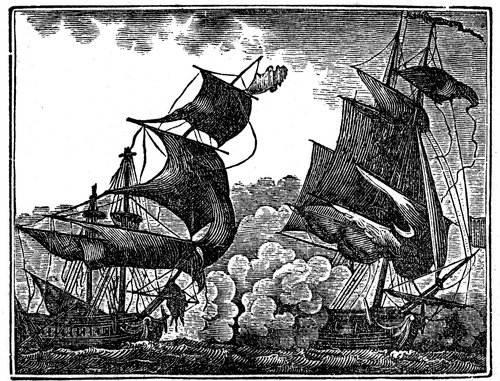
The Victoire engages a Portuguese Ship. Page 78.
The joy those ashore expressed at the sight of so considerable a prize as they judged her at first sight, was vastly allayed, when they heard how dear a purchase she had proved to them. However, the reinforcement of the sloop made some amends. Capt. Tew was received by Caraccioli and the rest, with great civility and respect, who did not a little admire his courage, both in attacking the prize he made, and afterwards in giving chase to Misson. He was called to the council of officers, which was immediately held, to consider what methods should be taken with the prisoners, who were, by 190 brought in by this new prize, near as numerous as those of his own party, though Tew joined them with 70 men. It was therefore resolved to keep them separate from the Portuguese and English, who were before taken, to make them believe they were in amity with a prince of the natives, who was very powerful, and to propose to them, at their choice, the assisting the new colony in their works, or being sent prisoners up the country, if they rejected entering in with them. Seventy-three took on, and the rest desired they might be any way employed rather than be sent up the country; 117 then were set to work upon a dock, which was laid out about half a mile above the mouth of the harbour, and the other prisoners were forbid to pass such bounds as were prescribed then on pain of death; lest they, knowing their own strength, should revolt; 79for I must acquaint the reader, that on the arrival of the Victoire, both their loss and the number of Portuguese they brought in, was known to none but themselves, and the number of those who came over, magnified; besides, the Johanna men were all armed and disciplined, and the Bijoux lay as a guard-ship, where the last prisoners were set to work; but while they provided for their security, both within and without, they did not neglect providing also for their support, for they dug and sowed a large plat of ground with Indian and European corn, and other seeds which they found on board their prizes. In the mean while, Caraccioli, who had the art of persuasion, wrought on many of the Portuguese, who saw no hopes of returning home to join them. Misson, who could not be easy in an inactive life, would have taken another cruise; but fearing the revolt of the prisoners, durst not weaken the colony by the hands he must necessarily take with him. Wherefore, he proposed giving the last prize to, and sending away the prisoners. Caraccioli and Capt. Tew were against it, saying, that it would discover their retreat, and cause their being attacked by the Europeans, who had settlements along the continent, before they were able to defend themselves. Misson replied, he could not bear to be always diffident of those about him; that it was better to die at once, than live in continual apprehensions of death: that the time was come for sending away the Johanna men, and that they could not go without a ship; neither durst he trust a ship out, not well manned, nor man her while so many prisoners were with him. Wherefore there was a necessity of sending them off, or of putting them all to the sword; a barbarity by which he would not purchase his security. A council was called, and what Capt. Misson had proposed, agreed to. The prisoners were then summoned, and he 80told them, in few words, that he knew the consequence of giving them liberty; that he expected to be attacked as soon as the place of his retreat was known, and had it in his hands by putting them to death, to avoid the doubtful fate of war; but his humanity would not suffer him to entertain a thought so cruel, and his alliances with the natives, he hoped, would enable him to repel his assailants; but he required an oath of every one, that he should not serve against him. He then inquired into the circumstances of every particular man, and what they had lost, all which he returned, telling the company it should be reckoned as part of his share; and the prisoners, that he did not make war with the oppressed, but the oppressors. The prisoners were charmed with this mark of generosity, and wished he might never meet a treatment unworthy of that he gave them. The ship victualled for a voyage to the coast of Zanguebar, all her guns and ammunition taken out with the spare sails, and spare rigging, all were ordered to be gone; and 137 departed, highly applauding the behaviour of their enemies. All this while they had heard nothing from the natives, nor had the hunting parties met with any of them, which made Misson suspect they were afraid of his being their neighbour, and had shifted their quarters; but as the Johanna men were upon going away, there came about 50 negroes to them, driving about 100 head of black cattle, 20 negro men bound, and 25 women, for which cattle and prisoners they bartered rum, hatchets, baize, and beads; some hogsheads of which last commodity they had taken on the coast of Angola. Here the negroes belonging to Misson were provided with wives: the natives were caressed, and to the slaves signs made that their liberty was given them; they were immediately clothed and put under the care of as many whites, who, by all possible 81demonstrations, endeavoured to make them understand that they were enemies to slavery. The natives stayed ten days, which retarded the departure of the Johanna men; but, upon their retiring, the Bijoux sailed with 100 of them on board, under the command of Caraccioli’s lieutenant, who excused the keeping them longer than was promised, and not bringing them at once, having no more than two ships. The Portuguese ship, which was unrigged, being made a hulk, the ten men of Misson’s company who had settled at Johanna, being desirous to return, were brought to Libertatia with their wives (of which they had two or three a piece) and their children. The Bijoux, at two more voyages, carried over the rest of the Johannians.
Misson hove down the Bijoux, and resolving on a cruise on the coast of Guinea, to strengthen his colony by the capture of some slaving ship, he gave the command of her to Capt. Tew, and he and Caraccioli pressed the work of the dock. He gave him also 200 hands, of which 40 were Portuguese, 37 negroes, 17 of them expert sailors, 30 English, and the rest French. Tew met with nothing in his way, till he came to the northward of the Cape of Good Hope, when he fell in with a Dutch East-India galley of 18 guns, which he took after a small resistance, and with the loss of one man only. On the coast of Angola he took an English Guinea-man with 240 slaves, men, women, and boys. The negroes who had been before taken on this coast, found among these a great many of their acquaintance, and several of their relations, to whom they reported their unexpected change of fortune, the great captain (for so they now called Misson) having humanely knocked off their chains, and of slaves made them free men, and sharers in his fortunes: that the same good fortune had attended them in their falling into his hands, for he abhorred even the 82name of slavery. Tew, following the orders and acquainted with the policy of Misson, ordered the fetters and handcuffs to be taken off, upon his negro sailors assuring him they would not revolt, and were sensible of their happiness in falling into his hands. Content with these prizes, he made the best of his way home to Libertatia where he arrived without any sinister accident; but I forgot to tell my reader, that he set his Dutch prisoners (nine excepted, who took on with him) ashore, about 30 miles to the northward of the Cape of Saldanha Bay, where had been buried, by Capt. Misson, the English commander. He found a great quantity of English crowns on board his Dutch prize, which were carried into the common treasury; money being of no use where every thing was in common, and no hedge bounded any particular man’s property. The slaves he had released in this last cruise were employed in perfecting the dock, and treated on the footing of free people. They were not ignorant of the change of their condition, and were therefore extremely diligent and faithful. A white man, or one of the old standing negroes, wrought with every four, and made them understand the French words (by often repetition, and the help of their countrymen’s interpreting) used in their works Misson ordered a couple of sloops to be built in a creek, of eighty tons each, which he mounted with eight guns a piece, out of a Dutch prize. These were perfected in a little time, and proved not only shapely vessels, but excellent sailers. The officers of these sloops were chosen by balloting, and as their first design was only to discover and lay down a chart of the coast, sands, shoals, and depth of water round the island of Madagascar, the schoolmaster being sent with the command of one, Tew desired and had the other. They were manned, each sloop with 50 white and 50 black men: which 83voyage round the island was of vast advantage in giving the new released Angola negroes a notion of working a vessel;—and they were very industrious both in endeavouring to learn the French language, and to be useful. These sloops, the one of which was called the Childhood, and the other the Liberty, were near four months on this expedition. In the mean while, a few of the natives had come often to the settlement, and began to speak a little French, mixed with the other European languages, which they heard among Misson’s people, and six of the native families fixed among them, which was of vast use to the planters of this colony; for they made a very advantageous report to their countrymen of the regularity and harmony they observed in them. The sloops having returned, and an exact chart taken of the coast, Caraccioli had a mind for a cruise. He proposed visiting all the neighbouring islands, and accordingly went out to Mascarenhas, and the other islands near it, taking one half of his crew of negroes, and returned with a Dutch prize, which he took off the above mentioned island where they were about fixing a colony. This prize, as it had on board all sorts of European goods, and necessaries for settling, was more valuable than if it had been vastly richer. The negroes growing useful hands, Misson resolved on a cruise to the northward, encouraged by Tew’s success; and with all the blacks, which he divided between the two ships, one of which Capt. Tew commanded set out with 500 men. Off the coast of Arabia Felix they fell in with a ship belonging to the Great Mogul, bound for Zidon, with pilgrims to Mecca, who, with Moor mariners, made up the number of 1600 souls. This ship carried 110 guns, but made a very poor defence, being encumbered with the goods and number of passengers they carried. The two adventurers did not think it their business to cannonade, 84they therefore boarded as soon as they came up with her, and the Moors no sooner saw them entered, but they discharged one volley of small arms at random, we may suppose, because no execution was done, and fled the decks. Being masters of this ship, which did not cost them a single man, they consulted what they should do with her, and the prisoners, and it was resolved to set them ashore between Ain and Aden.
They now made the best of their way for Madagascar, putting 200 hands on board the prize, which proved a very heavy sailer, and retarded them very much. Off the Cape Guarde Fin they were overtaken with a cruel storm, which was near wrecking them on the island called Irmanos; but the wind coming about due north, they had the good luck to escape this danger. Though the fury of the wind abated, yet it blew so hard for twelve days together, that they could only carry their coursers reefed. They spied a sail in their passage, but the weather would not permit their endeavouring to speak with her. In a word, they returned to Libertatia with their prize, without any other accident; but the captors could make no estimate of her value, she having on board a vast quantity of diamonds, besides rich silks, raw silks, spices, carpets, wrought and bar gold. The prize was taken to pieces, as she was of no use; her cordage and knee timber preserved, with all the bolts, eyes, chains, and other iron work, and her guns planted on two points of the harbour, where they raised batteries, so that they were now so strongly fortified they apprehended no danger from any number of shipping which could be brought into those seas to attack them. They had, by this time, cleared, sown, and enclosed a good parcel of ground, and taken in a quantity of pasturage, where they had above 300 head of black cattle, bought of the natives. The dock was now 85finished, and the Victoire growing old and unfit for a long voyage, and the last storm having shook, and loosened her very much, she was pulled to pieces and rebuilt, keeping the same name. She was rigged, victualled, and fit to go to sea, and was to sail to the coast of Guinea for more negroes, when one of the sloops came in, which had been sent out rather to exercise the negroes, than with any view of making a prize, and brought word that five lofty ships chased her into the bay, and stood for their harbour; that she judged them to be Portuguese by their built, and 50 gun ships, full of men. This proved the real truth. The alarm was given, the forts and batteries manned, and every man stood to his arms. Misson took upon him the command of 100 negroes, who were well disciplined, (for every morning they had been used to perform their exercise, which was taught them by a French serjeant, one of their company, who belonged to the Victoire) to be ready where his assistance should be required, Tew commanded all the English. They had hardly ordered their affairs when these ships hove in sight, and stood directly for the harbour with Portuguese colours. They were warmly received by the two forts, which did not stop them, though it brought one of them on the careen. They entered the harbour, and thought they had done their business, but were saluted so warmly from the forts, batteries, sloops, and ships, that two of them sunk downright, and a great many men were drowned, though some got on board the other ships. The Portuguese, who did not imagine they had been so well fortified, and thought in passing the two forts they should without difficulty land their men, and easily root out this nest of pirates, found now their mistake, for they durst not venture to hoist out a boat. They had wisely, however, contrived to enter just before the turn of the tide. Finding the attempt vain, and that 86they had lost a great many men, they clapped upon a wind, and with the help of the tide of ebb, made more haste out than they did to get in, leaving two of their ships sunk in the harbour; but they did not get off so cheaply, for no sooner were they clear of the forts, but Misson, manning with the utmost expedition both the ships and sloops, gave them chase, and engaged them at the mouth of the bay. The Portuguese defended themselves with a great deal of gallantry, and one of them beat off the Libertatians twice, who boarded them from the two sloops; two of them, finding themselves hard pressed made a running fight, and got off, and left the third to shift as well as she could. The Bijoux and Victoire finding the Portuguese endeavoured to clear themselves and knowing there was little to be got by the captures, gave over the chase, and fell upon the third, who defended himself till his decks swam with blood, and the greater number of his men killed; but finding all resistance vain, and that he was left to an unequal fight by his companions, he called for quarter, and good quarter was given, both to himself and men. This prize yielded them a great quantity of powder and shot, and, indeed, they expected nothing of value out of her. None of the prisoners were stripped, and the officers, Misson, Caraccioli, and Tew invited to their tables, treating them very civilly, and extolling the courage they had shown in their defence. Unhappily two prisoners were found on board, who had been released, and had sworn never to serve against them; these were clapped in irons, and publicly tried for their perjury. The Portuguese officers being present, the witnesses proved them the very discharged men, and they were condemned to be hanged at the point of each fort; which execution was performed the next morning after their condemnation, with the assistance of the Portuguese chaplain, 87who attended, confessed, and absolved them. This was the engagement with the pirates, which made so much noise in the Lisbon Gazette, and these the men whom the English ignorantly took for Avery; who, we had a notion here in London, had 32 sail of men of war, and had taken upon himself the state and title of king.
This execution seeming to impugn the maxims of the chiefs, Caraccioli made an harangue, in which he told them, “that there was no rule could be laid down which did not allow exceptions: that they were all sensible how tender the Commodore Monsieur Misson was in shedding blood; and that it was a tenet of his faith, that none had power over the life of another, but God alone who gave it; but notwithstanding, self-preservation sometimes made it absolutely necessary to take away the life of another, especially an avowed and obliged enemy, even in cold blood. As to the blood shed in a lawful war, in defence of that liberty they had generously asserted, it was needless to say any thing, but he thought it proper to lay before them reasons for the execution of the criminals, and the heinousness of their crimes. They had not only received their lives from the bounty of the Libertatians, but their liberty, and had every thing restored them which they laid claim to; consequently their ingratitude rose in proportion to the generous treatment they had met with: that indeed, both he and Capt. Misson would have passed by the perjury and ingratitude which they had been guilty of, with a corporeal punishment, which had not extended to the deprivation of life, but their gallant friend and companion, the English commander, Capt. Tew, used such cogent reasons for an exemplary punishment, to deter others from the like crimes, that they must have been enemies to their own preservation in not following his advice: that the lives of their whole 88body ought to be preferred to those of declared and perjured enemies, who would not cease to endeavour their ruin; and, as they were well acquainted with their settlement, might be fatal instruments of it, if they were again restored to that liberty which they had already abused: that he was obliged to do Capt. Tew the justice, to acknowledge he was inclined to the side of mercy, till he was thoroughly informed of the blackness of their ingratitude, and then he thought it would be cruelty to themselves to let those miscreants experience a second time their clemency. Thus an absolute necessity had obliged them to act contrary to their declared principles; though, to state the case rightly, these men, not the Libertarians, were the authors of their own deaths.” Here the assembly crying out, “their blood is on their own heads, they sought their deaths, and hanging is too good for them;” Caraccioli gave over, and every one returned satisfied to his private or the public affairs.
Some difference arising between Misson’s and Tew’s men, on a national quarrel, which the latter began, Capt. Tew proposed their deciding the quarrel by the sword; but Caraccioli was entirely against it, alleging, that such decision must necessarily be a damage to the public, since the brave men who fell, would be weakening of their colony. He therefore desired Capt. Tew to interpose the authority he had over his crew, and he and Misson would endeavour to bring their men to an amicable agreement; and for the future, as this accident proved the necessity, wholesome laws should be made, and a form of government entered upon. Both parties were therefore called, and Caraccioli showed them the necessity of their living in unity among themselves, who had the whole world for enemies; and as he had a persuasive and insinuating way of argument, with the assistance of Capt. Tew, this 89affair was ended to the satisfaction of both parties.
The next day the whole colony was assembled, and the three commanders proposed a form of government as necessary to their conservation; for where there was no coercive laws, the weakest would always be the sufferers, and every thing must tend to confusion: that men’s passions, blinding them to justice, and making them ever partial to themselves, they ought to submit the differences which might rise to calm and disinterested persons who could examine with temper, and determine according to reason and equity: that they looked upon a democratical form, where the people were themselves the makers and judges of their own laws, the most agreeable; and therefore, desired they would divide themselves into companies of ten men, and every such company choose one to assist in settling a form of government, and in making wholesome laws for the good of the whole: that the treasure and cattle they were masters of should be equally divided, and such lands as any particular man would enclose, should, for the future, be deemed his property, which no other should lay any claim to, if not alienated by a sale.
This proposal was received with applause, and they decimated themselves that very day, but put off the meeting of the states till a house was built, which they set about very cheerfully, and finished it in about a fortnight; it being of framed timber, and they having among them a great number who understood the handling of an axe.
When this body of politicians met, Caraccioli opened the sessions with a handsome speech, showing the advantage flowing from order; and then spoke to the necessity of lodging a supreme power in the hands of one who should have that of rewarding brave and virtuous actions, and of punishing the 90vicious, according to the laws which the state should make; by which he was to be guided: that such a power, however, should not be for life, nor be hereditary, but determine at the end of three years, when a new choice should be made by the state, or the old confirmed for three years longer; by which means, the ablest men would always be at the head of affairs, and their power being of short duration, none would dare to abuse it: that such a chief should have the title of Lord Conservator, and all the ensigns of royalty to attend him.
This was approved nem. con. and Misson was chosen conservator, with power to create great officers, &c. and with the title of Supreme Excellence.
A law was then made for the meeting of the State once every year at least, but oftener, if the conservator and his council thought it necessary for the common good to convene them; and that nothing of moment should be undertaken without the approbation of the State.
In a word their first session lasted ten days; and a great many wholesome laws were enacted, registered in the state book, and dispersed among the crews.
Capt. Tew, the conservator honoured with the title of Admiral, and Caraccioli was made Secretary of State. He chose a council of the ablest among them, without distinction of nation or colour; and the different languages began to be incorporated, and one made out of the many. An equal division was made of their treasure and cattle, and every one began either to enclose land for himself, or his neighbour who would hire his assistance.
Admiral Tew proposed building an arsenal, and augmenting their naval force. The first was agreed to be proposed to the State at the next convention; but the latter was thought unnecessary, till the 91number of inhabitants was augmented; for, should they all be employed in the sea service, the husbandry would be neglected, which would be of fatal consequence to the growing colony.
The Admiral then proposed the fetching in those Englishmen who had followed the quarter-master; but the council rejected this, alleging, that as they deserted their captain, it was a mark of a mutinous temper, and they might infect others with a spirit of disorder; that, however, they might have notice given them of the settlement, and if they made it their earnest entreaty to be admitted, and would desert the quarter-master, it should be granted as a particular favour done them, at the instance of the Admiral, and upon his engaging his parole of honour for their quiet behaviour.
The Admiral then desired he might take a cruise; that he hoped to meet with some East-India ships, and bring in some volunteers, for the number of subjects being the riches of a nation, he thought the colony stood more in need of men, than of any thing else; that he would lie in the way of the Cape, and did not question doing good service; and as he went to the northward, would call upon his own men.
The Victoire was according to the Admiral’s desire fitted out, and in a few days he sailed with 300 men on board. He came to an anchor at the settlement his men had made, hoisted an English ensign in his fore shrouds, and fired a gun; but after he had waited some time, perceiving no signal from the shore, he landed and sent back his boat. Soon after the boat returned towards the ship, two of his men came up to him, to whom he gave an account of Misson’s settlement. They invited him into the wood to see that of theirs, and to advise with their companions, about the proposed migration. The governor, alias quarter-master, received 92him mighty civilly, but told him, that he could see no advantage to themselves in changing their present situation, though they might prove a great one to the new colony, by adding to their force so many brave fellows: that they there enjoyed all the necessaries of life; were free and independent of all the world; and it would be madness again to subject themselves to any government, which, however mild, still exerted some power. That he was governor for three months, by the choice of his companions; but his power extended no farther than to the judging in matters of small difference which might arise, which he hoped to do impartially while his authority continued; that they had agreed among themselves, and confirmed that agreement by oath to support the decrees of the governor for the time, that their tranquility might not be disturbed by the humour of any one man: and that this power of determining, was to devolve at the expiration of three months, to him on whom the lot should fall by balloting, provided he had not before enjoyed the honour, for such a one was not to draw; by which agreement, every one would be raised, in time, to the supreme command, which prevented all canvassing and making interest for votes, as when determined by suffrage; left no opening for making divisions and parties, and was a means to continue to them that repose inseparable from an unity among themselves. However, continued he, “if you will go to America or Europe, and show the advantage which may accrue to the English, by fixing a colony here, out of that love we bear our country, and to wipe away the odious appellation of pirates, with pleasure we will submit to any who shall come with a commission from a lawful government; but it is ridiculous to think we will become subjects to greater rogues than ourselves.”
93Capt. Tew finding the quarter-master spoke the sentiments of his companions, took leave, and returned to his ship: but went on shore again in the evening, the wind not serving to weigh, it blowing due west. He asked the governor how he got acquainted with the natives? He answered, by meeting them a hunting, and using them well: that he wheedled one of them down to their huts, the fellow being alone, and they three in company, he supposed, thought it best to go with seeming willingness. After him several came, and they lived very friendly with them. The captain, had brought ashore with him some rum and brandy, and they were drinking a bowl of punch, when on a sudden, a violent storm arose. Capt. Tew ran to the shore, and made a signal for his boat to carry him off, but the sea ran too high to venture out of the ship. The storm all the while increased, and the Victoire, in less than two hours, parting her cables, was driven ashore where it was very steep, and perished, with all her men, in Capt. Tew’s sight.
The captain stayed with his old companions, without knowing which way to return to his friends he had left with Misson, not one of whom was (luckily for them,) on board the ship. At the end of three months they saw a large ship, which Tew believed was the Bijoux; but she took no notice of the fires they made. As he expected she would return after a short cruise, he, and his companions, made large fires every night on the shore, and visited the coast very often. About a month after this, as they came early to the sea-side, they were surprised at the sight of two sloops which lay at anchor, about a cannon shot from the shore. They had not been long looking upon them, when a canoe was hoisted out of one, and made to them, with six men who rowed, and one sitter.
94Tew soon knew him to be Capt. Misson. He came ashore, and embracing the former, told him, all their proposed happiness was vanished; for without the least provocation given, in the dead of the night, the natives came down upon them in two great bodies, and made a great slaughter, without distinction of age or sex, before they could put themselves in a posture of defence; that Caraccioli (who died in the action) and he, got what men together they could, to make a stand; but finding all resistance vain against such numbers, he made a shift to secure a considerable quantity of rough diamonds and bar gold, and to get on board the two sloops with 45 men: that the Bijoux being gone to cruise, and the number of men he had carried with him in the Victoire, had weakened the colony, and given the natives the boldness to attack them, but for what reason he could not imagine.
Tew gave him an account of the disaster which had happened, and after having mutually condoled their misfortunes, Tew proposed their going to America, where Misson might, with the riches he had, pass his life unknown, and in a comfortable manner. Misson answered he could not yet take any resolution, though he had thoughts of returning to Europe, and privately visiting his family, if any were alive, and then retire from the world. They dined with the quarter-master, who pressed their return to America, to procure a commission for the settling a colony. Misson told Tew, he should have one of the sloops, and what volunteers would keep him company, for his misfortunes had erased all thoughts of future settlements; that what riches they had saved, he would distribute equally, nay, he would be content, if he had only a bare support left him. On this answer, four of the quarter-master’s company offered to join Capt. Tew.
In the afternoon they visited both sloops, and 95Misson putting the question to the men, 30 went on board of one sloop, though they parted with great reluctance from their old commander; and 15 stayed with Misson. The four men who joined Tew made the number of his crew 34: they stayed about a week, in hopes of the Bijoux’s return upon the coast; but she not appearing, they set sail, Captain Misson having first shared the treasure, with Tew and his other friends and companions, hoping to meet the Bijoux on the Guinea coast, for which they shaped their course. Off Cape Infantes, they were overtaken with a storm, in which the unhappy Misson’s sloop went down, within musket shot of Capt. Tew, who could give him no assistance.
Tew continued his course for America, and arrived at Rhode-Island without any accident. His men dispersed themselves, as they thought fit, and Tew sent to Bermuda for his owner’s account, fourteen times the value of their sloop; and not being questioned by any, lived in great tranquillity. The French belonging to Misson, took different routes, one of whom dying at Rochelle, the French manuscript of Misson’s life was found among his papers, and transmitted to me by a friend and correspondent.
Capt. Tew lived unquestioned. He had an easy fortune, and designed to live quietly at home; but those of his men, who lived near him, having squandered their shares, were continually soliciting him to take another trip. He withstood their request a considerable time; but they having got together (by the report they made of the vast riches to be acquired) a number of resolute fellows, they, in a body, begged him to head them but for one voyage. They were so earnest in their desire, that he could not refuse complying. They prepared a small sloop, and made the best of their way to the straits entering the Red Sea, where they met with, and attacked 96a ship belonging to the Great Mogul in the engagement, a shot carried away the rim of Tew’s belly, who held his bowels with his hands some small space. When he dropped, it struck such a terror in his men, that they suffered themselves to be taken, without further resistance.
CAPTAIN JOHN HALSEY.
John Halsey was a Boston man, of New-England, commanded the Charles, brigantine, and went out with a commission from the governor, to cruise on the banks of Newfoundland, where he took a French banker, which he appointed to meet him at Fayal; but missing his prize here, he went among the Canary Islands, where he took a Spanish barcalonga, which he plundered and sunk: from thence he went to the island of Bravo, one of the Cape-de-Verds, where he wooded and watered, turned ashore his lieutenant, and several of his men here running away from him, the governor sent them on board again, his commission being as yet in force. From hence he stood away to the southward, and doubling the Cape of Good Hope, made for Madagascar and the bay of Augustin, where he took in wood and water, with some straggling seamen, who were cast away in the Degrave Indiamen, Capt. Young, commander. After this, he shaped his course for the Red Sea, and met with a Dutchman of 60 guns, coming from Mocha, whom he kept company with 97a week. Though he was resolved upon turning pirate, he intended to rob only the Moor ships, which occasioned a dispute between him and his men; they insisting on the ship’s being a Moor, and he asserting she was Dutch, was positive in his resolve of meddling with no European ships. The men were for boarding, but his obstinacy not being to be conquered, they broke Halsey and his gunner, confined both, and were ready to board the Dutchman, when one of the crew perceiving he was about to run out his lower tier, knocked down the quarter-master (whose business it is to be at the helm, in time of chase or engagement, according to the rules of pirates) clapped the helm hard aweather, and wore the brigantine. The Dutchman stayed, and fired a shot, which taking a swivel gun, carried it aft, narrowly missed the man at helm, and shattered the taffarel. The men perceiving they had caught a Tartar, made the best of their way to shake her off, and some were running down between decks, whom the surgeon pricked up again with his sword, though he was no way consenting to their designed piracy. The captain and gunner were again reinstated after they had seen their mistake, and then they steered for the Nicobar Islands, where they met with a country ship, called the Buffalo, commanded by Capt. Buckley, an Englishman, coming from Bengal, which they took after a short engagement there being only three Europeans on board, the captain and two mates; the rest were Moors. This ship fell seasonably in their way, she being bound for Achen, with butter, rice, and cloth, and the pirates, at that time, were in great straits both for provision and clothing. They took the two mates to sea with them, but left the captain and the Moors at Cara Nicobar, at an anchor, and then took a cruise. Capt. Buckley, who was sick, died before their return. In the cruise they met 98Captain Collins, in a country sloop, bound also to Achen. He had also two English mates with him, but the rest of his company consisted of Moors. Him they carried to the same harbour where they left the Buffalo.
Here a dispute arose among the pirates. Some were for returning to the West-Indies, others were against it, for they had got no money, and that was what engaged their search. They parted upon this; one part went on board the Buffalo, made one Rowe captain, and Myers, a Frenchman, master, whom they had picked up at Madagascar. The sloop’s deck they ripped up, and mended with it the bottom of the brigantine which Halsey still commanded. The ship shaped her course for Madagascar, and the brigantine made for the straits of Malacca, to lie in the track of the Manilla ships. I must observe, that Capt. Buckley’s two mates, whom they intended to force with them, were by strength of entreaty, permitted to go away with a canoe. In these straits, they met an European built ship, of 26 guns, which they had not the courage to attack, being soured by the Dutchman. They afterwards stood in shore, and came to an anchor. A few days after they made a vessel, which they supposed a China junk, and gave chase, but when they came pretty nigh, notwithstanding the pilot assured them she was what they supposed, they swore it was a Dutchman, and would not venture upon him; so leaving off their chase they stood in shore, and came again to an anchor under the peninsula. They lay here some days, and then spied a tall vessel, which they chased, and which proved to be the Albemarle East-Indiamen, Capt. Bews, commander, coming from China. They came up with him, but thinking it too warm a ship after exchanging a few shot, the brigantine made off, and the Albemarle chased in her turn. They however got clear, having 99a better share of heels, and came again to an anchor. Having not above 40 hands, the water growing scarce, and not daring to venture ashore for fear of the Dutch, a council was called, and it was resolved to make the best of their way to Madagascar, to pick up more hands, refresh, and set out on new adventures. Pursuant to this resolution, they steered for that island, but fell in their way on Mascarenhas, where, making a small present to the governor, they were supplied with what they wanted. From hence they went to a place on Madagascar, called by the pirates Hopeful Point; by the natives, Harangby, near the island of St. Mary’s in the lat. of 17, 40, S. where they met with the Buffalo, and the Dorothy, a prize, made by Capt. Thomas White and his company, being about 90 or 100 men, settled near the same place, in petty governments of their own, having some of them 5 or 600, some 1000 negro subjects, who acknowledged their sovereignty. Here they again repaired their brigantine, took in provisions and all necessaries, augmented their company to about 100 men, and set out for the Red Sea. They touched at Johanna, and there took in a quantity of goats and cocoa nuts for fresh provisions, and thence in eleven days reached the Straits of Babelmandel. They had not cruised here many days, when they spied the Moorish fleet from Mocha and Jufa, consisting of 25 sail, which they fell in with, and had been taken, if their oars had not helped them off, it falling a dead calm. They had not apprehended the danger so great, if they had not judged these ships convoyed by some Portuguese men of war. Some days after this, they met a one mast vessel, called a grab, coming from Mocha, which they spied within gun-shot in a thick fog: they fired a shot which cut her halliards, and then took possession of her with their boats. She was laden with drugs, but they took only some necessaries 100and 2000 dollars; and having learned that four English vessels lay at Mocha, of which one was from Jufa, they let her go.
Three days after they spied the four ships, which they at first took to be the trees of Babelmandel. At night they fell in with, and kept them company till morning, the trumpets sounding on both sides all the time, for the pirate had two on board as well as the English. When it was clear day, the four ships drew into a line, for they had hailed the pirate, who made no ceremony of owning who he was, by an answering according to their manner, From the seas. The brigantine bore up till she had slung her gaff. One of the ships perceiving this, advised Capt. Jago, who led the van, in a ship of 24 guns and 70 men, to give chase, for the pirate was on the run; but a mate, who was acquainted with the way of working among pirates, answered he would find his mistake, and said he had seen many a warm day, but feared this would be the hottest. The brigantine turned up again, and coming astern, clapped the Rising Eagle aboard, a ship of 16 guns, and the sternmost. Though they entered their men, the Rising Eagle held them a warm dispute for three quarters of an hour, in which Capt. Chamberlain’s chief mate and several others were killed, the purser was wounded, jumped overboard and drowned. In the mean while the other ships called to Capt. Jago to board the pirate; who bearing away to clap him aboard, the pirate gave him a shot, which raked him fore and aft, and determined Capt. Jago to get out of danger; for he run away with all the sail he could pack, though he was fitted out to protect the coast against pirates. His example was followed by the rest, every one steering a different coast. Thus they became masters of the Rising Eagle. I cannot but take notice, that the second mate of the Rising Eagle, after quarters were called for, fired from out 101the forecastle, and killed two of the pirates, one of whom was the gunner’s consort, who would have revenged his death by shooting the mate, but several Irish and Scots, together with one Captain Thomas White, once a commander among the pirates, but then a private man, interposed and saved him, in regard that he was an Irishman. They examined the prisoners to know which was the ship from Jufa, that had money on board; and having learned it was the Essex, they gave chase, came up with her, hoisted the bloody flag at the main-mast-head, fired one single gun, and she struck, though she was fitted for close quarters, and there was not on board the brigantine above 20 hands, and the prize was astern so far, that her top-mast scarce appeared out of the water. In chasing this ship, they passed the other two, who held the fly of their ensigns in their hands ready to strike. When the ship had struck, the captain of her asked, who commanded the brigantine? He was answered, Capt. Halsey. Asking again, who was quarter-master? He was told Nathaniel North, to whom he called, as he knew him very well. North, learning his name was Punt, said, Capt. Punt, I am sorry you are fallen into our hands. He was civilly treated, and nothing belonging to himself or the English gentlemen, who were passengers, touched, though they made bold to lay hands on £40,000 in money, belonging to the ship. They had about £10,000 in money out of the Rising Eagle. They discharged the Essex, and with the other prize and the brigantine, steered for Madagascar, where they arrived and shared their booty. Some of the passengers, who had been so well treated, came afterwards with a small ship from India (with license from the governor of Madras) called the Greyhound, laden with necessaries, in hopes to barter with the pirates for the dry goods they had taken, and recover them at an easy rate. They were 102received very kindly, an invoice of their goods was asked, the goods agreed for, shared and paid in money and bale goods. In the mean while came in a ship from Scotland, called the Neptune, 26 guns, 54 men, commanded by Capt. Miller, with a design to slave, and to go thence to Batavia to dispose of her negroes (having a supercargo on board, brought up among the Dutch) and thence to Malacca, to take on board the cargo of a ship, called the Speedwell, lost on her return from China; but finding here another ship trading with the pirates, and having many necessaries, French brandy, Madeira wine, and English stout on board, Capt. Miller thought it better to trade for money than slaves. The merchants of the Greyhound, nettled to see any but themselves take money, for the pirates never haggled about a price, told them, They could not do the governor of Madras a more grateful piece of service than to make prize of the Neptune, which was a ship fit for that purpose. To which some of the Scotch and Irish answered, They had not best put such a design on foot, for if the company once got it into their heads to take one, they would go nigh to take both ships. In a short time after came on a hurricane, which obliged the Neptune to cut away all her masts, and lost the three ships belonging to the pirates, which was their whole fleet. They having now no ship, and several of them no money, having been stripped at play, their thoughts were bent on the Neptune. The chief mate of her, Daniel Burgess, who had a spleen to the captain, joining privately with the pirates (among whom he died) got all the small masts and yards ashore; and the pirates being requested to find him proper trees for masting, told Capt. Miller they had found such as would serve his turn, desiring he would take a number of hands ashore to get them down to the water, which (he suspecting no harm) accordingly 103did, and he and his men were seized, and the long-boat detained ashore. The captain was forced to send for the second mate, and afterwards for the gunner; the mate, who was the captain’s brother, went, but the gunner, suspecting foul play, refused. In the evening, Burgess came on board, and advised the surrender of the ship, which, though but sixteen were left on board, they scrupled, and proposed going under the cover of their own guns to fetch their top-mast and yards, and with them put to sea; but the chief mate, Burgess, whose villany was not then known, persuaded them to give up a ship they could neither defend nor sail; which was no small satisfaction to the Greyhound, little thinking how soon they would meet with the same treatment; for two days after, the pirates manned the Neptune’s pinnace, seized the Greyhound, took away all the money they had paid, and shifting out of the Neptune ten pipes of Madeira, with two hogsheads of brandy, into the Greyhound, and putting on board the captain, second mate, boatswain and gunner of the Neptune, and about fourteen of her hands, ordered her to sea. The rest of the Neptune’s company being young men fit for their purpose, they detained, most of whom, by hard drinking, fell into distempers and died. As to Capt. Halsey, while the Scotch ship was fitting, he fell ill of a fever, died and was buried with great solemnity and ceremony; the prayers of the church of England was read over him, colours were flying, and his sword and pistol laid on his coffin, which was covered with a ship’s jack; as many minute guns fired as he was years old, viz. 46, and three English volleys, and one French volley of small arms. He was brave in his person, courteous to all his prisoners, lived beloved, and died regretted by his own people. His grave was made in a garden of water-melons, and fenced in with 104palisades to prevent his being rooted up by the wild hogs, of which there are plenty in those parts.
P. S. The Neptune seized as above, was the year after Capt. Halsey’s death, ready to go to sea; but a hurricane happening, she was lost, and proved the last ship that gang of pirates ever got possession of.
CAPTAIN THOMAS WHITE.
He was born at Plymouth, where his mother kept a public house. She took great care of his education, and when he was grown up, as he had an inclination to the sea, procured him the king’s letter. After he had served some years on board a man of war, he went to Barbadoes, where he married, got into the merchant service, and designed to settle in the island. He had the command of the Marygold brigantine given him, in which he made two successful voyages to Guinea and back to Barbadoes. In his third, he had the misfortune to be taken by a French pirate, as were several other English ships, the masters and inferior officers of which they detained, being in want of good artists. The brigantine belonging to White, they kept for their own use, and sunk the vessel they before sailed in; but meeting with a ship on the Guinea coast more fit for their purpose, they went on board her, and burnt the brigantine.