VI LELIO
Reading edition
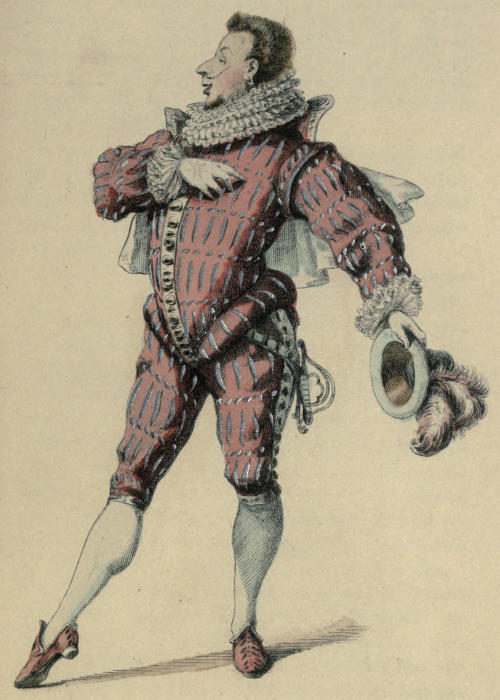
In our theatres to-day the part of the lover may be the great leading rôle, or it may fall to the lot of the juvenile lead, or even to that of the comedian. But in the old Italian comedy the lover was just the lover; as it happened, however, that he almost invariably found himself in a comic situation he was nearly always what to-day we should call the comic lover. The endowments required were a fine figure, a handsome face, an agreeable voice, and the elegant manners of a gentleman of the great world. The portraits which have survived show us handsome men dressed in the latest mode of their day.
But the lover, playing sometimes in two different styles of piece, was a serious comedian. Ordinarily this part was undertaken by the chief of the troupe, like Flaminio Scala, who, under the name of Flavio, was an illustrious comedian.
ii
Flavio was a name that had already served to qualify lovers on the Italian stage before Flaminio Scala.
The young Flavio of Ruzzante in La Vaccaria (1533) is thus described by his rival, the rich Polidoro:
“Because he is beautiful, gallant, fecund in sonnets, because he knows music and takes his manners from the court, Flavio imagines that he will be able to hold the love of Fiorinetta! But what will he do when he perceives that money conquers everything? He will curse the contrariness of Fate and the mercilessness of Heaven.”
Polidoro represents the rich, discourteous and overbearing lover. But the beautiful, the elegant gentleman of this epoch, he who, without money, pleases women, who is the mirror of fashion and the flower of wit, is not without being ridiculous upon occasion, and we suspect Ruzzante of having designedly shown him under an effeminate aspect in his comedy Anconitana.
Two young gallants of the epoch, sons of a good Sicilian family, are reduced by romantic vicissitudes to the necessity of earning their living, and all that they are capable of doing is to seek service with some noble lady. One of them does so in the capacity of a poet, promising to praise her eternally in prose and in verse:
“I shall study how to sing the praises of her charms in choice rhymes, and I shall laud, I shall extol adoringly, now her enchanting eyes, now her blond tresses, now her lovely neck, now her white hand, now her soft glance, her words, her gestures, her grace, her virtues, her garments, her movements; and that in various manners, in chapters, in epistles, in epilogues, in eclogues, in songs, in impromptus, in sonnets, in madrigals, in stanzas, in odes, and in ballads.”
The other brother, contemning the frivolity of such employment, offers himself in the capacity of a valet and perfumer:
“The ladies to whom I shall give my services need not fear those pomades and unguents which are plastered on to the lips of their husbands when they kiss them. I know how to distil perfumes from plants and trees which not only beautify the face and neck, but further steep the flesh in sweet odours; I can distil waters to render tresses curly and golden, waters to smooth the brow, waters to darken the eyebrows, waters to tint the cheeks, waters to render the lips rosy, the teeth dazzling, the neck white, the hands soft. Their virtues, employed on the different parts of the body, will last three days and three nights, and they will not be succeeded, as is the case with vulgar unguents, by that pallor mottled with various colours which disfigures the countenance on the morrow. I have scents of musk, of ambergris, of lavender, of styrax, with which I mingle the juices of certain other herbs or flowers, producing essences so sweet that I consider these aromas capable of preserving body and soul. Waters of jasmine, of orange flowers, of citron, I repute of no account because I shall distil essences from unknown plants which will be infinitely preferred to all those that are considered most admirable and most precious to-day.”
In 1576 Flaminio Scala (Flavio), comico acceso (impassioned comic, or lover), being then in the prime of youth and the fulness of his talent, placed himself at the head of the Gelosi troupe and, for twenty-eight years, was able to command the applause of Italy and France. This troupe, reconstituted in Venice in 1576, went to Blois in 1577 to perform before King Henry III.; later the company was seen at the Hôtel de Bourbon, which at the time was no more than a chapel with a gallery where a theatre was set up upon occasion for the court fêtes. The ordinary headquarters of the Gelosi company were in Florence. Thence it went out to tour the principal cities of Italy and of France.
From 1576 to 1604 the actors playing the rôles of lover in this remarkable troupe were: Flavio (Flaminio Scala), Oratio (Orazio Nobili, born at Padua), Cinthio (Cintio Fidenzi), Fabrizio, and Aurelio (Adriano Valerini, a Veronese gentleman, doctor of law and a fairly good Latin poet). Valerini left the Gelosi troupe in 1579 to undertake the direction of the Comici uniti. At the head of this troupe he was received in 1583 by Cardinal Carlo Borromeo in Milan.
The leading ladies (or amoureuses) in the Gelosi during that period were: Isabella (Isabella Andreini), Flaminia, Ardelia, Lidia (second wife of G. B. Andreini) and Laura.
The soubrettes were Franceschina (Silvia Roncagli), Vittoria (Antonella Bajardi), Ricciolina (Maria Antonazzoni), Olivetta, Ortensia, and Nespola. The old women were played under the name of Pasquella.
The lackeys were Pedrolino, Arlecchino, Burattino, Grillo, Mezzetino, Cavicchio (a peasant), Ciccialboncio (a peasant), Bigolo, Memmei, Piombino.
The old men were Doctor Graziano, Pantalone, Zanobio, Cassandro, Cornelio, Tosano, Adorne, Claudio and Cataldo. Captain Spavento was played by Francesco Andreini and Sireno was one of the first parts played by Domenico Bruni (Fulvio), who joined the company in 1594.
Bruni, who was the son of an old comedian, was then fourteen years of age; he was starved and almost naked when given shelter by Scala and engaged to improvise odd parts until he should reach an age that would permit him to play lovers. A few years later he passed into the service of the Princess of Piedmont.
The two most remarkable appearances made in France by Flaminio Scala and his company seem to be those of 1588 and 1600, when he was accompanied by the famous Isabella Andreini, her husband and her son. After the death of Isabella, Flaminio Scala, weary of the theatre, gave up the direction of the troupe, which was disbanded. He occupied himself then with the publication of his dramatic works, which amount to over fifty, and further he assisted his friend Francesco Andreini to publish the manuscripts which Isabella had left.
Flaminio Scala’s collection is entitled: “Theatre of performable fables, or of comic, rustic and tragic recreation; divided into 50 days. All composed by Flaminio Scala, named Flavio, comedian to the Most Serene Lord Duke of Mantua. In Venice 1611.”[7]
In the scenarii of this collection the scenes are given in great detail but absolutely without dialogue. Nevertheless no one before Scala had ever taken the same degree of pains. Until then, nothing had ever been prearranged beyond mere fragments of detached scenes, business that might be termed classic, traditions of the Atellanæ, interposed more or less suitably into the scenarii for free improvisations.
Flaminio Scala was the first to produce scenarii displaying lucidity and continuity of theme; they deserve indeed to be recognised as his own work. He performed them all over Italy as well as the comedies of Groto, of Lasca, of Cecchi, and of Beolco, and even some tragedies and some opera-ballets. This method of playing in the two styles, the impromptu and the academic, was continued until the eighteenth century by the companies that travelled in Italy, France and Germany.
Flaminio Scala’s collection is prefaced by an interesting speech “to courteous readers” written by Francesco Andreini (known as Capitan Spavento), in which there is proof that Flaminio Scala was the first serious author and editor of scenarii properly so called.
“The man who is born into this world must, in his youth, apply himself to ways of merit that he may live honourably, content himself and please others; for an ignorant man is vicious and evil to himself and noxious to his neighbour. Thus he who would arrive at any sort of perfection must make choice of one of the seven liberal arts and practise it. I shall not speak of Lysippus and Roscius, of Socrates, of Titus, of Varro, nor of many others who, from coarse and ignorant that they were, rendered themselves great and immortal by means of knowledge and of virtue.... I will confine myself to saying that the Signor Flaminio Scala, known as Flavio in the theatre, conforming to these maxims of conduct, devoted himself from his youth to the noble exercises of comedy (a thing not degrading to his noble birth) and in this practice he made such progress that he deserved to be placed in the front rank of good comedians.... That is why the Signor Flavio, after long years consecrated to playing in comedy, wishes to bequeath to the world not his beautiful words, not his magnificent conceits, but his comedies, which in all seasons and in all places have brought him the greatest honour. The Signor Flavio might have elaborated his works (his talent being ample for such a task) and written them word for word, as authors are in the habit of doing. But as to-day too many comedies are seen printed with different versions, thereby undermining all good rules, he desired, by this his new invention, to publish only the scenarii of his comedies, leaving to the actors’ wit the care of supplying suitable dialogue.”
Francesco Andreini adds that, to facilitate the performance and the production of his pieces, Scala has supplied an argument for each, has named and described the characters, and has prepared the list of costumes and properties necessary under the designation of robbe per la commedia.
This list is curious as revealing a somewhat complicated mise en scène: thus: “One head resembling that of a prince of Morocco; one fine valise of leather; one cudgel for beating; one plate of figs and several lanterns; four lighted white candles; two Hungarian vests; one live cat and one live cock; two fires with smoke; several shirts in which to dress up Harlequin as a woman; four hunting dogs and a grotesque hunting-dress for Harlequin; one casket of jewels, one chemise and one dagger for Isabella; two boxes of bonbons; one packet of candles and one piece of cheese; two identical rings; a large cheval-glass and a good deal of coin; six lanterns; two coats and two false beards with which to dress up two notaries; a composition to imitate blood from a wound; a basket with a packet of letters inside; one miniature of a woman; one beard similar to that of Pantaloon; one travelling suit—i.e. one felt hat, boots and spurs; one shirt, soiled and wet, for the Captain; one practicable moon; two rockets; one large tree, in which one may sit; four fine costumes for nymphs; several painted trees; two live babies; one beautiful ship; one earthquake; etc., etc.”
It may throw a useful light upon a theatrical epoch of which but little is known to translate as a specimen one of the scenarii or days (giornate) of Flaminio Scala, not as a work of any value to-day, but as a proof of the relative ability already attained by the authors and the comedians of the Commedia dell’ Arte.
THIRD DAY
“THE WILES OF ISABELLA”
Argument
A pretty widow of quality persuades her own brother to conduct her lover to her upon the pretext that she wishes to marry him to a young girl whom he has betrayed and abandoned. The brother, discovering the ruse, and knowing the lover to be worthy of his sister, consents to their marriage.
Characters in the Comedy
Pantalone, a Venetian.
Pedrolino, his lackey.
Flavio, the lover of Flaminia.
Orazio, the brother of Isabella.
Isabella, a widow, sister to Orazio, in love with Captain Spavento.
Arlecchino, servant to Orazio and Isabella.
Captain Spavento, Isabella’s lover.
Flaminia, sister to Spavento, in love with Flavio.
Burattino, an innkeeper.
Franceschina, his wife.
Two rogues, friends of Pedrolino.
Two thieves, acting on their own account.
Properties for the Comedy
A good deal of coin; costumes for three beggars; a sign for an inn; a pair of shoes; a knife to cut; a basket with edible victuals; a lantern; a kitchen spit; a long stick.
Scene: Perugia