I HARLEQUIN
Reading edition
“Sirs, I was born in Bergamo, but so long ago that I remember nothing of it. I was called in those days—— Ah, but wait!... I can no longer remember my name, by Bacchus! Forgive me if I appeal to Bacchus, but he is the only god whom I ever take to witness.
“Sirs, I was well acquainted of old with one Maccus, whose temper was not always amiable, and it also happened that I had more wit than that coarse brute. Later I was lackey to a doctor who in reality was but an apothecary, and so miserly that for clothes he gave me no more than such old rags of his own as could no longer be employed to repair less seedy ones. I endured a noble poverty, and for long. You are looking at my hat! It is almost new. It was given to me by Henry III. He did not care about hats; he gave me one that proved too small for his monkish head. This rabbit’s tail is the emblem of his courage and of mine; not the courage of the lamb, but the courage of the hare, to run quickly and long.
“I was very naïve, not to say stupid, my masters; but with age, experience and wit came to my assistance, and to-day I have all that I need and some to spare. I said to myself at first, when I left my old apothecary, that I should be well advised to imitate my brother Brighella—that is to say, to find myself a situation where one may eat well. Therefore I chose hostelries. But, alas! if shoemakers are the worst shod, eating-house lackeys are the worst nourished. I abandoned that profession and became a soldier; a poor condition, believe me; later I turned comedian, tumbler, dancer, merry-andrew and mountebank at one and the same time. But, perceiving that my rags did not make a good impression at Court, I bought new cloth of all colours, red, yellow, blue, to replace the tattered pieces of my little garment, the like of which is not to be seen at present within a thousand leagues. On Sundays and holidays I put on my satin clothes; but they wear out too quickly and are too dear. And the fact is—must I confess it sirs?—I never have a halfpenny. That, however, does not prevent me from being gay, or from being pleasing to beauty; upon waiting-maids, now, I exert a peculiar attraction. I understand perfectly how to contrive certain delicate love affairs into which fathers, husbands and guardians have no business to be thrusting their noses. I am, for the moment, a lackey of condition to some young people, whose purse is not always quite as empty as their brains. In short, whilst waiting to transact my own affairs I transact those of others, and I will say with my old friend Polichinelle: ‘I am as good as many another!’
“I contrive so well that I now go to Court; I am the Marquis of Sbruffadeli; I overlook the waiting-maids; I court their mistresses, and I aspire to the hand of Isabella....
“But what is that? Who strikes me? Ah me! Where shall I hide myself? I cry you mercy, my master! I will restore you your garments. Do not beat me to death; let me die of old age! I resume my rags, my bat and my mask; I return to Columbine, and I shall avenge myself upon Pierrot.”
The Greeks represented and put upon the stage all the inhabitants of the earth then known to them, and the members of all classes of society: Greek citizens, merchants of Tyre, Persian wizards and sorcerers, foreign doctors, Egyptian priests, Chaldean astronomers, Macedonian soldiers, Scythian barbers; pedants, parasites, matrons, young girls, courtesans of Lesbos or of Athens, peasants and Asiatic or African slaves. Among these last we find an actor dressed now in the skin of a goat, now in the skin of a tiger, variegated in colour, which clung tightly to his body, armed with only a wooden staff, his head shaved, and covered by a white hat, his face by a brown mask; he was called by the vulgar the young satyr. Could this be the first Harlequin?
In an article on Harlequin, Marmontel writes, in 1776:
“This is at one and the same time the most bizarre and the most amusing character in the theatre. A Bergamese negro is an absurdity. It is probable that an African negro was the first model of the character.”
The Sycionians, with whom the mimes were as ancient as with the Athenians, preserved the name of phallophores for their public phallic singers. These Sycionian phallophores wore no mask, they besmeared their countenances with soot, fuligine faciem obductam, or covered their faces with papyrus bark—that is to say, with a paper mask—to represent foreign slaves. They advanced rhythmically, from the side or back of the theatre, and their first words were always:
“Bacchus! Bacchus! Bacchus! It is to thee, Bacchus, that we consecrate these airs. We shall adorn their simple rhythm by varied songs which were not made for virgins. We do not repeat old songs; the hymn which we address to thee has never yet been sung.”
In Rome these same phallophores take the name of planipes. This name comes to them from the fact that having no need for the high tragic buskin to increase their size—since they performed quite close to the public on the thymele in the orchestra itself—they played, as it were, flat-footed. These actors performed only little pieces and improvisations of the Atellane farces.
“Quid enim si choragium thymelicum possiderem? num ex eo argumentare etiam uti me consuesse trageodi syrmate, histrionis crocata, mimi centunculo,” says Apuleius in his apology.
Mimi centunculo indicates the garb of Harlequin, composed as it is of an infinity of pieces of various colours. His black mask is described by fuligine faciem obductam, and his shaven head, according to Vossius, by Sanniones mimum agebant rasis capitibus (the buffoons performed in their pantomimes with shaven heads).
Harlequin and Brighella are called in Italy zanni, zani or sanni, from the Latin sannio, a buffoon, a mocker; sannium, sanna, mockery, raillery, grimace.
“I have sought,” says Riccoboni (in his History of the Italian Theatre), “the origin of this name of zanni, and I think that it is a change in the first letter that has given rise to doubt. We see that our predecessors very often used Z in the place of S. All the most approved Italian authors have said zambuco for sambuco, zampogna for sampogna, zanna for sanna.
“‘Quid enim potest tam ridiculum quam sannio esse? qui ore, vultu, imitandis motibus, voce, denique corpore ridetur ipso?’ (Cicero, De Oratore, lib. ii.)
“‘Planipes graece dicitur mimus, ideo autem latine planipes quod actores planis pedibus, id est, nudi proscenium introirent’ (Diomed. lib. iii.)
“Is not the footgear of Harlequin indicated there? His foot is simply enveloped in a piece of leather without a heel. From top to toe, then, the dress of Harlequin is precisely that of the Latin mime. I have found a book which, whilst not being as ancient as I might have desired, yet contains enough to show the difference between the costume in those days and the present one.
“... In the time of Henry IV. a troupe of Italian comedians came to Paris. The Harlequin of this troupe sought to induce the king to present him with a gold chain and a medal. He conceived the notion of writing a book, of printing it, and addressing it to the king. On the front page there is a figure of Harlequin of the height of some three inches.”
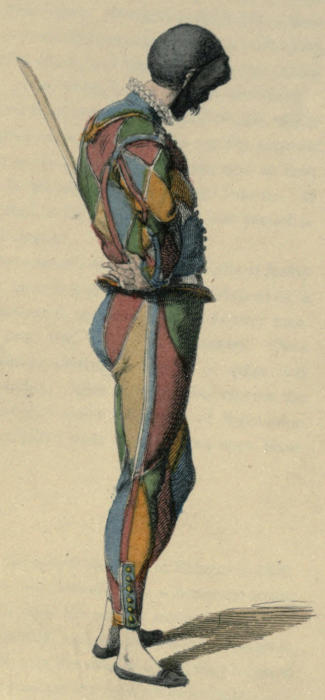
The costume of this Harlequin which Riccoboni has engraved consists of a jacket open in front, and laced with shabby ribbons, and skin-tight trousers, covered with pieces of cloth of various colours, placed haphazard. The jacket is similarly patched. He wears a stiff black beard, a black half mask, a slashed cap, in the fashion of the time of François I. and no linen; he is equipped with a girdle, a pouch and a wooden sword; his feet are shod in very small slippers, covered at the ankle by the trouser, which acts as a gaiter.
As for the mask with which Harlequin appeared in France, and which he wears still to-day, it is said that it was Michel-Angelo who restored it him, copying it from the mask of an ancient satyr. His costume in the seventeenth century, like his character, underwent a metamorphosis; we still find him arrayed in the same pieces of cloth of different colours, but henceforward they are symmetrically placed.
From the time of Domenico, who was the transformer of this type, the costume has changed but very little. The jacket has grown, little by little, whilst the trousers have shrunk, returning to their primitive form. Lozenges of different colours have lengthened; but the mask, the chin-piece, the black head, the rabbit tail—emblem of poltroonery—the bat and the girdle, have remained such as they always were.
That rabbit’s tail which adorns the head of Harlequin is a further tradition of antiquity. It was the custom to attach the tail of a fox or the ears of a hare to those upon whom it was sought to draw ridicule.
An innovation lies in the spangles which render the modern Harlequin a sort of streaming fish in gold and silver scales.
In the first Italian troupes of the sixteenth century—nomad troupes which derived as much from the Bohemians and the mountebanks as from the comedians—we find Trivelino, Mestolino, Zaccagnino, Truffaldino, Guazeto and Bagatino, who are of the same type under various names, and often under the same costume. It was not until Henry III. that a zany of this type appeared in Paris.
It has been pretended that as this zany was without doubt protected by the first president of Parliament, Achille de Harlay, his comrades came to call him Harlequino, meaning thereby the little protégé of Harlay. This name remained to him and to his successors in the type. But its etymology is victoriously refuted in an interesting passage of the learned commentators of Rabelais, Johanneau and Esmangard:
“Donat informs us that the procurers (lenones) in the ancient comedies were dressed in variegated costumes, no doubt after the manner of Mercury their patron, which persuades us that that character in comedy which we call Harlequin, is none other than Mercury, this being the reason why he is given a variegated costume, made up of pieces of different colours. Harlequin is a diminutive of harle, or herle, the name of an aquatic bird, and not a derivative of that of M. de Harlay or of Hercules. In Italy he is called Harlequino; in the anti-chopin he is called Harlequinus, and in a letter of Raulin in 1521 Herlequinus.”
“Harlequin’s performance down to the seventeenth century” (says Riccoboni) “consisted of just a series of extravagant capers, of violent movements and of outrageous blackguardisms. He was at once insolent, mocking, clownish and, above all, obscene. I think that with all this he mingled an agility of body which made him appear to be always in the air, and I might add with assurance that he was an acrobat.”
Our modern Harlequin is, above all, a dancer and a tumbler, in which he is in affinity with the most ancient type.
In the background of some of his drawings Callot shows us several Harlequins who are leaping and dancing and turning backward somersaults. So that in Callot’s day Harlequin was still a dancer.
Nevertheless, from 1560 onwards, we see Harlequin, the native of Bergamo, shedding some of the stupidity that had characterised him until then. He still remains a glutton, and he is always a poltroon, but he is no longer that type of farm servant from the neighbourhood of Bergamo, seeking everywhere for the donkey upon which he was mounted.
“His character,” says Marmontel, “presents a mixture of ignorance, naïveté, stupidity and grace. He is like a mere sketch of a man, a great child visited by flashes of reason and intelligence, in all of whose capers and awkwardnesses there is something sharp and interesting. The model Harlequin is all suppleness and agility, with the grace of a young cat, yet equipped with a superficial coarseness that renders his performances more amusing; the rôle is that of a lackey, patient, faithful, credulous, gluttonous, always in love, always in difficulties either on his master’s account or on his own, afflicting himself and consoling himself again with the readiness of a child, one whose sorrows are as amusing as his joys. Such a part demands a great deal of naturalness and of wit, and a great deal of physical grace and suppleness.”
At the time that the zany Arlecchino was a fool, Brighella, the other Bergamese, was sly and astute. Harlequin and Brighella are both from the town of Bergamo. This town is built like an amphitheatre on the hills between the Brembo and the Serio in their courses from the Valtelline hills. It is said that the inhabitants of the upper and lower town are entirely different in character. Those of the upper town, personified in the character of Brighella, are lively, witty and active; those of the lower town are idle, ignorant and almost entirely stupid, like Harlequin. I crave the pardon of the inhabitants of the lower town for this statement, made upon the assumption that, like Harlequin himself, they also have become, since the sixteenth century, as lively and as witty as their compatriots of the upper town. It is said in the north of Italy that Harlequin the imbecile had over his left eye a wart which covered the half of his cheek, and that it was for this reason that he assumed the mask, which he has retained ever since.
Towards the close of the sixteenth century Harlequin, whilst adhering to his leaping movements, and his cat-like manner, becomes less simple, as we have said, and from time to time even goes so far as to permit himself a certain wisdom. It was in this manner that in 1578 the character was played in Italy by Simone of Bologna.
But it was in the seventeenth century that the rôle of Harlequin was completely transformed by Domenico Biancolelli, a man of merit, well informed, and the friend of literary men, who bestowed his own wit upon the character. Thus Harlequin became witty, astute, an utterer of quips and something of a philosopher. Even in the Italian troupes the actors who played the part under the names of Zaccagnino and of Truffaldino modelled their performances upon those of Domenico.
ii
Giuseppe-Domenico Biancolelli was born in Bologna in 1640. His father and mother were comedians in a company established in that city, and from his earliest infancy Biancolelli played with them in comedy, and made such rapid progress that at the age at which men are usually considering a career he was already counted amongst the good actors of Italy.
In 1659 Cardinal Mazarin, desiring to increase his Italian company, sent for several actors, including Biancolelli, who was then performing at Vienna in the troupe of Tabarini. This Tabarini had already been in France during the reign of Louis XIII. and the minority of Louis XIV. In response to the cardinal’s summons, then, young Biancolelli went to France in the following year, together with Eularia, Diamantina and Ottavio.
At the time an actor named Locatelli was playing the rôles of Trivelino, a sort of Harlequin, in the company which Biancolelli went to recruit. This, however, did not hinder Biancolelli from playing Harlequin, as second comic, alongside of Trivelino, until the death of the latter in 1671. From that moment the stage was dominated by Domenico, as he was generally known. He acquired the reputation of being the greatest actor of his century, and rendered popular the name of Arlecchino. He died at forty-eight of pneumonia contracted whilst dancing before Louis XIV.
“The Sieur Beauchamp, dancing master to Louis XIV. and composer of his ballet, had performed before his Majesty a very singular and greatly applauded dance in a divertissement which the Italian comedians had attached to one of their pieces. Domenico, who danced very well, gave forthwith an extremely comical imitation of Beauchamp’s dance. The king manifested so much delight in these parodying capers that Domenico persisted in them for as long as it was physically possible to him. He was so overheated that, being unable to change his linen upon leaving the stage (because he had to return to it immediately in his own rôle), he caught a severe chill which ended in pneumonia. He lay ill for only eight days, when, after having renounced the theatre, he died on Monday the 2nd of August, 1688, at six o’clock in the evening, and was buried at Saint-Eustache, behind the choir, opposite to the chapel of the Virgin. He dwelt in the Rue Montmartre near the old Hôtel Charôt.”
The loss of Domenico was a shattering thunderbolt upon the Italian comedy. His comrades closed the theatre for a month, and when they reopened it they put up the following announcement:—
“We have long marked our sorrow by our silence, and we should prolong it further if the apprehension of displeasing you did not influence us more profoundly than our legitimate pain. We shall reopen our theatre on Wednesday next, the 1st of September 1688. In the impossibility of repairing the loss we have sustained, we offer you of the best that our application and our care is able to supply. Bear us a little indulgence, and be assured that we shall omit nothing that will contribute to your pleasure.”
Domenico had married in Paris, in 1662, Orsola Corteze, who played under the name of Eularia. She bore him twelve children, five of whom survived him. They were:
Françoise Biancolelli, born in 1664, who played the rôles of Isabella;
Catherine Biancolelli, born in 1665, who played the rôles of Columbine;
Louis Biancolelli, knight of Saint-Louis, captain of the royal regiment of marines, military engineer, and director of the forts of Provence, who died at Toulon in 1729; he was a godson of Louis XIV., and the author of several pieces played at the Comédie-Italienne, and included in Gherardi’s collection;
Philippe Biancolelli de Bois-Morand, born in 1672, king’s councillor, elder councillor to Saint-Domingue, and marine commissioner;
Pierre-François Biancolelli, born in 1681, who, under the name of Dominique, played Trivelino parts at the Comédie-Italienne, and in forain theatres, and who died in 1734.
Anecdotes abound concerning the famous Domenico. It is related of him that being present one night at a royal supper he fixed his eyes upon a certain dish of partridges. Louis XIV., observing this glance of his, said to a lackey:
“Let this dish be given to Domenico.”
“And the partridges also?” inquired Domenico.
“And the partridges also,” replied the king, appreciating this readiness of wit. The dish was of gold.
Louis XIV. returning one day from a hunting expedition went incognito to attend the performance of an Italian piece that was being given at Versailles.
“That is a bad piece,” he said to Domenico, as he was leaving.
“Whisper it,” replied Arlecchino, “because if the king were to hear you he would dismiss me together with my troupe.”
Domenico was of short stature and comely face, but some ten years before his death he had become rather too stout for the part of Harlequin. At the foot of his portrait painted by Ferdinand, and engraved by Hubert, the following quatrain is to be read:—
“Bologne est ma patrie et Paris mon séjour, J’y règne avec éclat sur la scène comique; Arlequin sous le masque y cache Dominique, Qui réforme en riant et le peuple et la cour.”
After Domenico’s death a book was published by Florentin Delaulne bearing the following title:—Arlequiniana, or the Quips and Pleasant and Amusing Stories culled from the Conversations of Harlequin, 1694.
The work begins thus:
“On Saturday last, the 30th of the month, as I was leaving my room on the stroke of midnight, Harlequin appeared before me. He was wearing his little hat, his mask and the coat in which he performed. At first I was surprised to see him; but I was at once reassured, being persuaded that I had nothing to fear from a man for whom my affections had survived his death.
“‘Do not be apprehensive,’ he said to me; ‘I am charmed to see you.’
“Thereupon I ran to embrace him.
“‘No, not that,’ he said, ‘my body is now no more than abstract matter, ill calculated to receive such marks of your friendship. What folly induced you to publish things uttered between us when I was alive? Do you think to gladden the world with my stories? Was I so well known that my name should not yet be forgotten?’ etc.”
The author answers him that his name is immortal, that his person is beloved and esteemed throughout Europe; that in the rôles which he undertook he never played other than with justice and honesty.
“When you portrayed the knaveries of the practitioners, the distortions of women, the trickiness of bankrupts, or the impertinences of the bourgeois, do you think to have done them any harm?”
The conversation continues thus between the author and the deceased Domenico throughout the volume. Into this conversation are brought amusing stories, scandalous anecdotes of the time, quips, facetiæ, moralisings, philosophic dissertations, etc. It is a pot-pourri on the subject of Domenico.
In one of the comedies played by Domenico Harlequin seeks to sell his house. Having found a buyer, he protests that as he does not wish him to buy a pig in a poke he will show him a sample of the goods, and he produces from under his jacket a large piece of plaster.
In another scene Harlequin appears as a beggar. Ottavio questions him upon various matters; amongst other things he asks him how many fathers he possesses.
“I have only one,” replies Harlequin.
“But how does it happen that you have only one father?” demands Ottavio, losing patience.
“What would you?” is the answer. “I am but a poor man, and I have no means of affording more.”
Elsewhere Pasquariello seeks to lead Harlequin to a tavern; but in this piece Harlequin is of sober habits, and replies: “The glass is Pandora’s box; out of it come all the evils.”
Let us cite a few further traits of the character drawn by Domenico in the various Harlequins performed by him.
Mezzetin promises Harlequin that he shall wed Columbine if he will second him in a fresh piece of knavery. Whilst Mezzetin is considering his project, Harlequin counts the buttons of his doublet, and at each button says: “I shall have Columbine, I shall not have her; I shall have her, I shall not have her; I shall have her, I shall not have her; I shall have her, I shall not have her; I shall have her, I shall not have her; (he bursts into tears) I shall not have her!”
Mezzetin. What ails you? Why are you crying?
Harlequin (weeping). I shall not have Columbine! hi! hi! hi!
Mezzetin. Who has said so?
Harlequin (indicating his buttons). Buttonomancy!
In L’Homme à Bonnes Fortunes, Harlequin, disguised as a marquis, is the recipient of many presents from women whom he has contrived to please. He has already received and donned two dressing-gowns, when a third one is brought to him on behalf of a widow who comes to judge for herself of the effect produced by her present. There is a knock at the door. It is she. Harlequin has no more than time to slip this third gown over the other two, whereby he is given the appearance of an elephant. The widow enters, notwithstanding that admission has been refused her.
Harlequin (angrily). Morbleu, madam! Did I not bid them tell you that I was not visible to-day?
The Widow. To find you, sir, it is necessary to come upon you as you leave your bed; throughout the remainder of the day you are unapproachable.
Harlequin. It is true that I have not an hour to myself. I am so exhausted by these adventures which the vulgar call bonnes fortunes that my superfluity would be enough for twenty idlers of the Court.
The Widow. But, sir, I find you very fat. What is the matter with you?
Harlequin. Nothing, merely that I overate last night at supper.
The Widow. There must be some other reason; are you perhaps dropsical?
Harlequin. Indeed no!
The Widow. Let us see. (She pulls off his dressing-gowns, one after the other.)
Harlequin (defending himself). Fie, madam! What are you about? This isn’t decent!
The Widow. One, two, three dressing-gowns! That is to say, three mistresses! Ah! Traitor! It is thus, then, that you betray me! And you say that you love none but me!
Harlequin (attempting to seek refuge in the wardrobe). Madam, I can bear no more!
The Widow. Now I know the worth of your oaths.
Harlequin. Madam, I must go.... If I don’t——
The Widow. Rascal!
Harlequin. Madam, I can no longer answer for the discretion of——
The Widow. Are you shameless? I will have no more to do with you. Return me the dressing-gown. (She attempts to drag her dressing-gown from him; they fight, Harlequin knocks off her headdress, she loses one of her petticoats, and departs.)
On the subject of the etymology of the name of Harlequin, it is explained thus by Domenico:
Cinthio (to his lackey, Harlequin). By the way, since you have been in my employ it has never occurred to me to inquire your name?
Harlequin. I am called Arlecchino Sbrufadelli.
(At the name of Sbrufadelli Cinthio bursts into laughter.)
Harlequin. Do not presume to mock me. All my ancestors were people of consequence. Sbroufadel, the first of the name, was a pork butcher, but so superior in his profession that Nero would eat no sausages but those which he made. Of Sbroufadel was born Fregocola, a great captain; he married Mademoiselle Castagna, who was of so lively a temperament that she gave birth to me two days after the wedding. My father was delighted, but his joy was cut short by certain pettifoggeries on the part of the police. Whenever my father met an honest man on the highway he never failed to take off his hat, and if it happened to be night, he would take off his cloak as well. The police sought to curb this excess of civility and ordered his arrest. My father did not wait for it. He took me in my swaddling clothes, and, having thrust me into a cauldron, and the rest of his movables into a basket, he left the city, driving before him the donkey that bore his house and his heir. He frequently struck the beast to cries of “Ar! Ar!” which in the asinine language means “Get on! get on!” Whilst proceeding thus, he perceived that a man was following him. This man, observing that my father was considering him attentively, hid himself, crouching (se messe chin) behind a bush. My father, who took him for the officer sent to arrest him, conceiving that he assumed this position the better to surprise him, beat his donkey more severely than ever, crying Ar! le chin, that is to say: Get on, he is crouching. So that, as I was still without a name, my father, remembering the fright which he had received, and the words Ar! le chin, Ar! le chin, which he had repeated so often, called me Arlechino.
In another Italian scene we see Pasquariello giving advice to Harlequin, who is in difficulties on the subject of finding a good profession.
Pasquariello. Set up as a doctor. If fortune smiles on you you’ll soon be rich. Consider how much the doctor has earned since he has been in fashion to treat gout. He has amassed more than two hundred thousand francs, and he knows no more about the gout than you do.
Harlequin. Then of necessity he must know very little, for I know nothing.
Pasquariello. That should not hinder you from being a clever doctor.
Harlequin. Parbleu, you mock me! I can neither read nor write.
Pasquariello. No matter, I say. It is not knowledge that makes the successful doctor, it is impudence and wordiness.
Harlequin. But how, then, do they manage with their patients?
Pasquariello. I will tell you. You begin by having a mule and promenading through Paris on it. First comes a man who says: “Sir doctor, I beg of you to come and see my parent who is ill.” “Willingly, sir.” The man goes ahead and the doctor follows on his mule. (Here Pasquariello imitates the man who walks; he turns round and says to Harlequin who follows him trotting): What are you playing at?
Harlequin. I am playing the mule.
Pasquariello. You arrive at the house of the sick man. Your guide knocks, the door is opened, the doctor alights from his mule and together they ascend the staircase.
Harlequin. And the mule? Does the mule also ascend the staircase?
Pasquariello. No, no, the mule remains at the door, it is the man and the doctor who ascend the staircase. Behold them now in the patient’s antechamber. The man says to the doctor, “Follow me, sir, I am going to see if my parent sleeps.”
(Here Pasquariello walks on tiptoe, stretches out his arms, and pretends to draw aside the curtains of a bed.)
Harlequin. Why do you step so softly?
Pasquariello. On account of the sick man. We are now in his chamber, beside the bed. “Sir, the patient is not asleep, you may approach.” Immediately the doctor takes the arm-chair by the bedside, and says to the patient: “Show me your tongue.” (Pasquariello puts out an enormous tongue and, imitating the patient, says:) “Oh, sir, I am very ill!”
Harlequin (considering Pasquariello’s tongue). Eh! what an ugly illness!
Pasquariello. That tongue is very dry and very heated.
Harlequin. It must be put on ice.
Pasquariello. Let us feel the pulse. (He pretends to feel the pulse of the sick man.) Now here is a pulse that goes devilishly quick! Let us feel the stomach. Now here is a stomach that is very hard.
Harlequin. Perhaps he has swallowed iron.
Pasquariello. Let me have paper, pen and ink. (He pretends to write.) Recipe: this evening a lavement, to-morrow morning a blood-letting, and to-morrow evening a medicine. (All this is mimed by Pasquariello as if he were administering a lavement, or a blood-letting, or swallowing a medicine.) Then you take your leave of the patient, and you depart saying, “Sir, to-morrow I shall come at the same hour, and I hope in a short time to restore you completely to health.” Then the man who has introduced you reconducts you again, and slips a golden half-louis into your hand; you mount your mule once more and depart.
Harlequin. But how may I be able to guess whether he has the fever or not?
Pasquariello. I will show you. When the pulse is equal, that is to say when it goes tac, tac, tac, there is no fever, but when it is intermittent, and when it goes quickly, ti, ta, ta; ti, ta, ta; ti, ta, ta, there is fever.
Harlequin. Now that is quite simple: tac, tac, tac, no fever; ti, ta, ta; ti, ta, ta; ti, ta, ta, fever.
Pasquariello. There you are, as learned as the doctors; let us go.
Harlequin. Ti, ta, ta; ti, ta, ta; I am all for ti, ta, ta.
Harlequin, having become a doctor, prescribes as follows for the Captain, who has asked him for a remedy for toothache. “Take,” says Harlequin, “some pepper, garlick and vinegar, and rub your back with them; that will make you forget your pain.”
As the Captain is about to depart, Harlequin calls him back. “Sir, sir,” says he, “I was forgetting the best; take an apple, cut it into four equal parts, put one of these in your mouth, and then thrust your head into an oven until the apple is baked, and I will answer for it that your toothache will be entirely cured.”
In the very curious pictures possessed by the Théâtre-Français, bearing the inscription in gold letters: “Farceurs françois et italiens, depuis soixante ans,” we find Domenico in his costume of Harlequin together with several other Italian types—Brighella, Scaramouche, the Doctor, Pantaloon, Mezzetin, Matamoros—mingling with the French types: Turlupin, Gros-Guillaume, Gaultier-Garguille, Guillot-Gorju, Jodelet, Gros-René and Molière.
iii
In 1689 Evaristo Gherardi took up and continued the performances of the rôles of Harlequin. He was the son of Giovanni Gherardi, born at Prato, in Tuscany. He made his first appearance in the revival of Divorce, in the rôle of Harlequin created by Domenico in the preceding year. Here is what he himself has to say of it:
“This comedy had not succeeded in the hands of M. Domenico. It had been struck out of the catalogue of the plays which were revived from time to time, and the parts had been burnt. Nevertheless (notwithstanding that I had never been on the stage in my life, and that I had but left the college of La Marche, where I had just concluded my course of philosophy, under the learned M. Bublé), I chose it for my first appearance, which took place on the 1st of October 1689. The piece was so successful in my hands that it gave pleasure to everyone, was extraordinarily well attended, and consequently earned a great deal of money for the company.
“If I were the man to derive vanity from the theatrical talents which nature has given me, either with face uncovered or under a mask, in the leading serious or comic rôles, I should have in this the most ample grounds upon which to flatter my self-love. I should say that I did more in my beginnings and in my first years than the most illustrious actors have been able to do after twenty years of experience, and in the full prime of their lives. But I protest that very far from having ever become elated by these rare advantages, I have always considered them to be the results of my good fortune, rather than the consequences of my merits; and if anything has been able to flatter my soul in this connection, it is the pleasure of seeing myself universally applauded after the inimitable M. Domenico, who went so far in the expression of the naïveté—that which the Italians call goffagine—of the character of Harlequin, that all those who witnessed his performances must always find some fault with the most famous Harlequin of any later day.”
It will be seen that Gherardi praises himself quite naïvely. It is true that this self-praise was not exaggerated, that he had great talents, and that he was attended by constant success until the theatre was closed in 1697. He hoped to bring about its reopening by his protectors at Court; but in this he was disappointed. He then produced a very interesting collection of the memorised French scenes, which were frequently interpolated into the Italian scenarii.
Some months before the publication of this collection, in the course of a show given at Saint-Maur, with Poisson and la Thorillière, Gherardi happened to fall upon his head. He neglected to have his hurt properly cared for, and on the very day on which he had been to present his book to Monseigneur he was holding between his knees his son (borne him by Elizabeth Danneret) when he had a seizure, and suddenly expired. That was on the 31st of August 1700.
“Il n’était ni bien ni mal fait, Grand ni petit, plus gras que maigre. Il avait le corps fort allègre, Le front haut, l’œil faible, mais vif. Le nez très-significatif. Et qui promettait des merveilles. La bouche atteignait les oreilles. Son teint était d’homme de feu; Son menton se doublait un peu; Son encolure, assez petite Le menaçait de mort subite.”
From an engraved portrait he resembles this description but little. His forehead is high, it is true, but his eyes are very large and lively, his nose aquiline and sensitive, his mouth small and well formed, and not a gash from ear to ear; the jaw is strongly outlined. In short, it presents a very intelligent countenance, full of finesse, advertising a lively and caustic spirit.
Here are some passages from the book of Gherardi—that is to say, from the scenes collected and performed by him:
DESPAIR OF HARLEQUIN IN L’EMPEREUR DANS LA LUNE
Harlequin. Ah! unfortunate that I am! The doctor wants to marry Columbine to a farmer, and how can I live without Columbine? I shall die. O ignorant doctor! O inconstant Columbine! O knavish farmer! O extremely miserable Harlequin! Let me hasten to die. It shall be written in ancient and modern history: “Harlequin died for Columbine.” I shall go to my chamber; I shall attach a rope to a beam; I shall get upon a chair; I shall fit the rope round my neck; I shall kick away the chair; and behold me hanged! (Mimicry of hanging.) It is done; nothing can stop me; let us hasten to the hanging crutch....
“To the hanging crutch? Fie, sir, you must not think of it. To kill yourself for a girl! It were a great folly....”
“Yes, sir; but for a girl to betray an honest man is a great wickedness....”
“I agree; but when you shall have hanged yourself shall you be any fatter?”
“No, I shall be thinner; I desire a slender shape! What have you to say to that? If you want to join me you have but to come....”
“Oh! as for that, no; you are not going....”
“Oh! but I am....”
“Oh! no, you are not....”
“But I am going, I tell you.” (He draws his sword, strikes himself and then exclaims:) “There! I am rid of that tiresome fellow. Now that there is no one to interfere with me I will go hang myself.” (He makes as if to depart, and then stops short.) “Ah! but no! To hang is a very ordinary death, the sort of death one sees every day; there is no glory in it. Let us seek some extraordinary death, some heroic death, some Harlequinic death.” (He considers.) “I have it! I will stop up my mouth and my nose, so that the air may not pass through and thus I shall die. Behold, it is done.” (He stops his nose and mouth with both hands, and, after remaining thus for some time he says:) “No; the air still escapes; it is not worth while. Alas! what a trouble to die! Sirs, if any amongst you would be so good as to die, so as to afford me a model, I should be infinitely obliged.... Faith, I have it! We read in history that there are people who have been killed by laughter. I am most sensitive to tickling; if some one were to tickle me for long they would make me die of laughter. I shall go and tickle myself, and thus I shall die.” (He tickles himself, laughs and falls down.)
In the same piece, a few scenes later, he goes to visit the Doctor, and announces himself as Colin, the farmer’s son who is to marry Columbine. The Doctor is his dupe until the arrival of the carrier, who announces that the farmer’s son is ill and cannot come. The Doctor turns upon Harlequin, eyeing him from top to toe, and says to him: “You are not Colin!”
“Forgive me, sir,” replies Harlequin, “I thought I was.”
Chagrined at not yet having succeeded, he seeks a new way to obtain Columbine. He runs backwards and forwards across the stage until he is out of breath, when he exclaims: “Will some one of his charity inform me which is the residence of Doctor Grazian Balouard?” (He puts his hand to his mouth and imitates the sound of a trumpet). “Pu, pu, pu! Doctor Balouard, a doctor at fifteen sous!”
The Doctor (aside). What is the meaning of this? (To Harlequin.) Doctor Grazian Balouard? He is here, sir; what do you want with him?
Harlequin. Oh! sir, you are choicely found. Address me your best compliments and bows. I am ambassador extraordinary, envoy from the emperor of the world of the Moon, and I am come to ask of you the hand of Isabella in marriage.
The Doctor. Address yourself to others, my friend. I am not so easily taken in. An emperor in the moon! (Aside.) Yet such a thing might be possible; since the moon is a world like ours, presumably there must be some one to govern it. (To Harlequin.) Are you really from that country, my friend?
Harlequin. No, sir, I am neither from that country nor from this country. I am an Italian of Italy, at your service, born a native of the city of Prato, one of the most charming cities in all Tuscany.
The Doctor. But how, then, did you contrive to ascend to the world of the moon?
Harlequin. I will tell you. We had arranged a party—three of my friends and I—to go and eat a goose at Vaugirard. I was deputed by the company to go and buy the goose. I transported myself to the Valley of Misery; I there made my purchase, and I was wending my way thence to the rendezvous. As I was entering the plain of Vaugirard, behold! six ravenous vultures came swooping down upon my goose, and carried it off. I, who feared to lose it, clung firmly to its neck, so that in a measure as the vultures carried up the goose they carried me up with it. When we had got very high, a further regiment of vultures came to the assistance of the first, hurled themselves upon my goose, and in an instant caused me to lose sight of the highest mountains and the highest steeples. I, obstinate always as the devil, would not let go. I hung on until the neck of my goose failed me, and I tumbled into a lake. Some fishermen, luckily, had spread their net, and I fell into it. The fishermen drew me out of the water, and, supposing me to be a fish of consequence, took me upon their shoulders, and bore me as a present to the emperor. Behold me lying on the ground and the emperor coming with all his court to view me. It is asked, “What sort of a fish is that.” The emperor replies, “I think it is an anchovy.” “Your pardon, Monseigneur,” says a fat gentleman, who accounted himself witty, “rather is it a toad.” “Anyway,” said the emperor, “bid them fry me this fish such as it is.” When I heard that they were going to fry me, I cried out: “But, Monseigneur....” “How,” says he, “do fishes speak?” Thereupon I assured him that I was not a fish, and further I informed him in what manner I had been brought to the Empire of the Moon. He asked me at once: “Are you acquainted with Doctor Grazian Balouard, and his daughter Isabella? Then go and ask her of him in marriage on my behalf.” But I replied, “I shall never be able to find my way there, because I do not know which way I came.” “Do not let that embarrass you,” he replied, “I shall send you to Paris by means of an influence that I am sending thither, laden with rheumatism, catarrhs, pneumonias and other little trifles of that kind.” Further he said: “I reserve for the doctor one of the best places in my empire.”
The Doctor. Is it really possible? Did he tell you what it was?
Harlequin. Indeed yes. He says that about a fortnight ago one of the twelve signs of the Zodiac, the Scorpion, died; and he wants to put you in its place.
The Doctor believes everything, asks a thousand questions concerning this lunar sovereign, inquires what like are the houses, the cities and the habits of life in the Court of that country. Harlequin gives him details of the manner in which the emperor eats. His food is shot at him from arbalists, and he is given to drink from a syringe. “It is very curious,” says he. “One day an awkward arbalister missed the emperor’s mouth and fired a buttered egg into his eye. Hence such eggs have ever since been called œufs pochés.” After this he induces the Doctor to give him a purse and some jewels, and he departs, to return presently dressed as the Emperor of the Moon.
The Doctor addresses several questions to him concerning his empire and his subjects.
Harlequin. My subjects? They are almost without defects, because they are governed solely by interest and ambition.
Columbine. That is exactly as here.
Harlequin. Everyone seeks to do the best he can for himself at the expense of his neighbour, and the highest virtue in my empire is to be wealthy.
The Doctor. That is exactly as here.
Harlequin. In my country there are no executioners; instead of dispatching people in a quarter of an hour on a scaffold, I hand them over to be killed by the doctors, who do them to death as cruelly as they do their patients.
Columbine. What, sir! Do the doctors up there also kill the people? That is exactly as here.
Isabella. And in your empire, sir, are there any wits?
Harlequin. My empire is the source of them. For over seventy years, now, we have been working upon a dictionary which will not be finished in two centuries.
Columbine. It is exactly as here. And is justice properly administered in your empire?
Harlequin. It is administered by hanging.
Isabella. And the judges, sir, do they not permit themselves to be corrupted?
Harlequin. Women there, as elsewhere, importune them. Sometimes presents are made to them; but in general they behave properly.
The Doctor. It is exactly as here. Sir, in your empire, are husbands accommodating?
Harlequin. That fashion arrived there almost as soon as in France. At the beginning we had a little trouble in making up our minds to it, but at present all the world is proud of it.
Columbine. It is exactly as here.... And the women in your empire, are they happy?
Harlequin. It is they who handle all the money and spend it all. The husbands have no concern save that of paying the taxes and repairing the houses.
Columbine. It is exactly as here.
Harlequin. Our women never rise until the afternoon. They invariably take three hours over their toilet; then they enter a coach and repair to the comedy, to the opera or to the promenade. Thence they go to sup with some chosen friend. After supper they play or they attend an opera, according to the season; and, towards four or five o’clock after midnight, they return home, so that a poor devil of a man may sometimes go for weeks without meeting his wife in the house, and you may see him hanging about the streets on foot, what time madam employs the coach for her pleasures.
All. It is exactly as here!
iv
When a new Italian troupe, summoned by the Regent, arrived in Paris, in 1716, Antonio Vicentini (styled Thomassin) made his first appearance in the rôle of Harlequin, supported by the entire troupe, on the 8th of May of that year, in the theatre of the Palais-Royal, in L’Inganno Fortunato.
“The famous Domenico, who had made himself so great a reputation in France, had a defect in his voice to which he had so thoroughly accustomed the public that it was never afterwards conceived that a Harlequin might be endurable who did not speak in his throat, and affect the tones of a parrot.”
Riccoboni and Thomassin were very uneasy as to the manner in which the public would receive a new Harlequin, gifted with a clear and natural voice. There were several night-scenes in L’Inganno Fortunato. “One of these occurred at the commencement of the piece. Lelio called his lackey Harlequin, who at first did not answer, and who then answered at intervals, appearing to fall asleep again after each reply. Lelio went in quest of him, and dragged him on to the stage whilst still asleep though on his feet. Harlequin, awakened, answered and, then letting himself fall down, would drop off to sleep again. His master would awaken him once more. Harlequin would then go fast asleep upon his master’s arm. The public were put in a good humour by this scene, and after having laughed and applauded for a quarter of an hour without the new Harlequin’s having uttered a single word, they had not the courage to censure him upon his voice when at last they heard it.”
Vicentini was born at Vicenza, and had long been playing in Italy when Riccoboni made him offers to induce him to come to Paris. Marivaux wrote several pieces for Thomassin, amongst which were La Surprise de l’Amour, in 1722, and Le Prince Travesti, in 1724. It was no longer a question of improvisation, but of memorised comedy, and Harlequin’s business was solely to get full value out of the author’s wit. Marivaux, whilst preserving to this type his original colour, causes him to appear sometimes scintillant with wit, sometimes entirely stupid. He is a mixture of Sganarelle, Sancho Pança, Crispino and Figaro. In the Prince Travesti, Harlequin is the lackey of the Prince of Léon, who conceals his identity under the name of Lelio. He meets the Princess of Barcelone, who is in love with Lelio, and who puts questions to him on the subject of his master.
The Princess. What do you seek, Harlequin? Is your master in the palace?
Harlequin. Madam, I implore Your Principality to pardon the impertinence of my stupidity; had I but known of your presence here I should not have been so foolish as to have brought my person hither.
The Princess. You have done no harm. But tell me, are you seeking your master?
Harlequin. Exactly. You have guessed it, madam. Since he spoke to you a while ago I have lost him in this plaguey house and, saving your presence, I have lost myself also. If you would show me the way you would be doing me a kindness; there are here so many chambers that I have been travelling for an hour without coming to the end of them. Par la mardi! if you prize all this it must mean that it brings you a lot of money. Nevertheless, what a jumble of furniture, of oddities, and of kickshaws! A whole village might live a year upon the value of it all.... It is so beautiful that one does not dare to look at it; it instils fear into a poor man like me. How rich you are, you princes, and I, what is it that I am by comparison with this! But surely it is another impertinence on my part to reason with you as with an equal. Your companion is laughing, perhaps I have said something foolish.
Hortense. You have said nothing foolish; on the contrary, you seem to me of an excellent wit.
Harlequin. Pardi! I laugh always: what would you? I have nothing to lose. You amuse yourselves with being rich, you others, and I—I amuse myself with being gay; to every one his own amusement in this world.
With his master Harlequin shows himself to be no less critical and profound.
Lelio. I am disposed to confide in you that I am a person of condition, who amuse myself by travelling incognito. I am young; it is a study that will be useful to me some day.
Harlequin. My faith, it is a study that will teach you nothing but poverty; it was hardly worth while to travel post for the sake of studying all this rubbish. What will you make of all this knowledge of men? You will learn but poor things.
Lelio. But they will cheat me no more.
Harlequin. That will spoil you.
Lelio. Why?
Harlequin. You will no longer be so kindly when you are learned on that subject. By dint of seeing so many scoundrels, in truth, you will become a scoundrel yourself.... Good-bye! Which is the way to the kitchen?
Comical scenes follow between Harlequin and Frederick, an ambitious courtier who seeks to seduce Harlequin. The latter thereupon becomes again the loutish lackey, opposing to Frederick’s attack the ponderous and ingenious probity of the peasant.
Harlequin. Pardi! You treat me like your own child. There is no boggling at that. Wealth, employment, and a pretty girl; that means a whole shipload of victuals, money and delicacies. It is clear that you love me very dearly!
Frederick. Yes; your physiognomy pleases me; you are a good lad!
Harlequin. Oh! as for that, I am as droll as a box; leave it to me and we shall laugh like mad together; but let us behold at once this wealth, these employments and this pretty girl, for I am in haste to be rich and at ease.
Frederick has a small service to ask of him. It is that of spying upon his master, and to report to him his words and actions. “Observe all very carefully, and as an earnest of the recompense ultimately to be yours, here is some money for you in advance.”
Harlequin. Can’t you advance me the girl also? We will deduct her from the rest.
Frederick. A service, my child, is never paid for until it is rendered; that is the custom.
Harlequin. A villainous custom!... I prefer to give you my note of hand to the effect that I have received this girl on account.... But, when I come to think of it, I am afraid you want me to do dirty work for you. What do you want with the words of my lord Lelio, my master?
Frederick. Mere curiosity.
Harlequin. Hum.... There is malice under all this. You have a sly look. I will bet you ten sous that you are a worthless fellow.... Get along! you should not tempt a poor lad who has no more honour than is necessary to him, and who is fond of girls. I have all the trouble in the world to prevent myself from being a scoundrel. Must my honour be the ruin of me, to deprive me of wealth, employment and a pretty wench. Par la mardi! you are very wicked to have invented this girl.
Frederick. Consider that I am offering you your fortune, and that you are losing it.
Harlequin. I am considering that your commission smells of trickery, and luckily this trickery fortifies my poor honour which was wavering. Bah! your pretty girl is no better than a drab; your employments are concerned with some dogs’ traffic. That is my last word, and I am going straight to find the princess and my master to relate to them my disaster and all your proposals.
Frederick. Wretch! are you resolved then to dishonour me?
Harlequin. Good! when one has no honour is it necessary to have reputation?
Thomassin would execute at times highly extraordinary turns of strength and of agility.
“He would run round the outside of the boxes of the first, second and third tiers; but the public, too deeply interested in the life of this amiable actor, compelled him to cut out a turn so dangerous which invariably had the effect of frightening the spectators far more than it amused them.
“His natural gaiety and the graces of his clowning would in themselves have sufficed to have charmed the public, even had not nature made him an excellent actor, which is to be taken in the widest sense of the term as meaning that he was natural, naïve, original and pathetic.”
Amid the laughter excited by his buffoonery he would at times suddenly surprise his audience into tears. “Often, after beginning by laughing at the manner in which he expressed his pain, one ended by experiencing the emotion by which he was penetrated.”
Like Domenico, in the matter of pupils, Thomassin produced only very bad copies, and “one saw nothing but pitiful attempts in the rôle of Harlequin” until the day when Carlo Bertinazzi came to succeed him.
Thomassin had married Margarita Rusca, who played waiting-woman parts under the name of Violetta. He died on the 19th of August 1739 at the age of fifty-seven, after a long illness. Among the many children he left and who have appeared on the Italo-French stage, the best known was Madame de Hesse, wife of the actor of this name.
On the 21st of November of 1739 Antonio Constantini, a brother of the celebrated Angelo Constantini, who had created the rôle of Mezzetin in Paris, made his first appearance in the part of Harlequin. He played “with great vivacity,” and held out some hope that he would repair the loss which the theatre had sustained by the death of Thomassin; he did not, however, fulfil this promise, and he was not accepted for the rôles of zany.
The feeble début of the Alsatian, Théodorak—anagram of Cadoret—in 1740, met with no better success.
“It is altogether incredible what a number of Harlequins appeared within the space of three or four years; they seemed to rise from the ashes of Thomassin: but, similar to those shadows which are formed from the exhalations of tombs, and which the least sound dissipates, so all these disappeared before the booings of the groundlings.”
In 1741, Gioachino Vicentini, the youngest son of Thomassin, aged eighteen, made his début as Harlequin, on the 26th of August. “But, as talents are not always hereditary, he was not accepted at the Comédie-Italienne, and he confined himself thereafter to playing in the provinces.”
In the same year the Sieur Molin also attempted the rôle of Harlequin with no better reception. He also repaired to the country.
v
At last, on the 10th of April 1741, Carlo Bertinazzi, born at Turin, 1713, made his début, and was received into the troupe in the month of August 1742, after having played with success the famous character of Harlequin for more than a year, and having surpassed the hopes which had been founded upon his talent. This brilliant début was thus chronicled in the Mercure:
“On Thursday, the 10th of April 1741, the Italian comedians opened their theatre with an Italian piece in prose and in three acts, in which the Sieur Carlin Bertinazzi, born at Turin, some twenty-eight years ago, performed for the first time the rôle of Harlequin, the principal character in the piece. The Sieur Richard, who had addressed the public on the closure of the theatre, addressed it again on the opening, and expressed himself in the following terms:—‘Gentlemen, this day, which renews our efforts and our homage, was to have been marked by the novelty which we had prepared for you; but the actor who is going to have the honour of appearing before you for the first time was too deeply interested, and too impatient to learn his fate, to permit us to postpone his début. “Should your novelty fail,” said he, “I shall learn how your public hisses, and that is something that I do not want to learn; should it succeed I shall know how they applaud, and I shall draw, perhaps, a sad comparison between its reception and that which may be accorded to me.” So as not to give this new actor any grounds for reproach, we have conformed entirely with his wishes. He knows, gentlemen, not only what he has to dread in appearing before you, but also in following that excellent actor whom we have lost (Thomassin) in whose rôle you are about to see him. These just causes of apprehension would be counterbalanced in his mind if he were aware of the resources which await him in your indulgence; but it is in vain that we have endeavoured to reassure him on this score; he can be convinced of the truth of it only by yourselves, and we hope, gentlemen, that you will be disposed to fulfil the promises which we have made to him on your behalf. They are founded upon an experience so long and so happy that we are as assured of your kindliness as you must be of our zeal and profound respect.’”
It was in such terms that the public was flattered in those days. And being thus flattered, it received Carlin with an indulgence of which he was very far from standing in need.
Carlin’s performance was easy, natural and comical. Garrick, seeing him in a scene in which he had just received a correction from his master, menacing this last with one hand, whilst rubbing his side with the other, was so charmed by the naturalness of his miming that he exclaimed: “Behold, how the very back of Carlin has a physiognomy and an expression!”
Carlin Bertinazzi was, like Domenico and all great buffoons, of a very melancholy character; he depended upon his wit and not upon his temperament.
Of Domenico it is related that, being intensely troubled with his spleen, he went to consult Dumoulin, a celebrated doctor, who prescribed for him as a remedy that he should go and see Domenico at the Comédie-Italienne, because Domenico made all the world laugh. “Alas!” replied the poor actor, “I am Domenico, and from now onwards I must look upon myself as a lost man.”
To his histrionic talents Carlin united considerable knowledge on various subjects and all the qualities that go to make a good member of society.
It is related that on a lovely summer evening, when the heat was suffocating, and Carlin was to perform in two plays, Camerani, the manager, came to inform him that there was but one spectator in the theatre, and that there was no occasion to give a performance. Carlin laughed, and replied that it was necessary to play none the less since there was a public (un public). The curtain rose; Carlin appeared, drew his wooden sword, took a turn round the theatre, and after a thousand capers which provoked great bursts of laughter from a fat gentleman seated in a corner of the orchestra, he advanced to the footlights and addressed him:
“Monsieur Tout-Seul, we are desolated, my comrades and I, to be compelled to play in such weather as this to one single spectator; nevertheless, if you demand it, play we will.”
The spectator entered into conversation with the actor, informed him that he was from the country, and that he had come to Paris for no other purpose but that of seeing him perform, and implored Carlin to grant him this favour. Carlin resigned himself and began his performance. All at once the sky became overcast, thunder rumbled and rain came down in torrents. The theatre filled itself as by enchantment, and in less than an hour the receipts rose to nine hundred livres, an enormous figure at this epoch. At the end of the second and last piece, Carlin came forward again to the footlights and sought his fat gentleman, who had been convulsed with laughter throughout the performance. “Monsieur Tout-seul, are you still there?” he cried. The man from the provinces rose to reply: “Yes, M. Carlin, and you have made me laugh very much.” “Monsieur Tout-seul, I come to thank you for having compelled us to perform; as a consequence our receipts are enormous. Thank you then once more, Monsieur Tout-seul.” “I am enchanted, M. Carlin. Au revoir,” replied the fat country gentleman, striding across his bench to depart, whilst the audience shook with laughter.
When there was hesitation to announce a performance, either on account of the heat or from any other cause, Carlin would say to Camerani: “Let us put up our bills, none the less. Who knows?—perhaps Monsieur Tout-seul will come this evening.”
Carlin died in Paris in 1675. He was still playing within a very short time of his death. His advanced age had robbed him of none of his vivacity, mirth and suppleness. The following epitaph was written in his honour:
“De Carlin pour peindre le sort, Très peu de mots doivent suffire: Toute sa vie il a fait rire, Il a fait pleurer à sa mort.”
As author he has left us Les Métamorphoses d’Arlequin.
Modern literature has made of him an historical personage. A very remarkable novel of M. de Latouche attributes to him a regular correspondence with Pope Clement XIV., who was in fact an old schoolfellow of his. MM. Rochefort and Gustave Lemoine wrote some years ago a very pretty piece on this subject. Carlin, ignorant that the new pope was that same Lorenzo Ganganelli, the friend of his youth, received a visit from him, addressed him familiarly in the second person singular, and performed with him a scene of which Ganganelli held the manuscript, laughing so heartily the while that he kept forgetting to take up his cues.
On the subject of the début of a Harlequin at the Théâtre-Italien, Collé, in his Journal Historique, speaks as follows of the masters of the burlesque art:—
“On Monday, the 21st inst. (June 1751), I went to the Comédie to see a new Harlequin who has been playing there for several days. He is a very nimble rascal, a mountebank, a sort of rope dancer, a buffoon and a sound comedian; as he is merely a bird of passage, the Italians would not have been so ill-advised as to have permitted him to appear upon the stage if he had been better than, or even the equal of Carlin, their present Harlequin. The latter, who for some years now has been in possession of this rôle, does not acquit himself at all badly, although he is sometimes ponderous in his action and always stupid in his subjects, whatever may be said to the contrary by the partisans of these paltry spectacles. But we may say at least that Thomassin, his predecessor was quite as stupid as Carlin, and even perhaps more so, although he repaired his short-comings by an unflagging energy and inimitable grace. This comedian even went so far as to endow his Harlequin with a singular attribute; he gave him a pathetic side; he could move his audience even to tears in certain pieces such as La Double Inconstance, Timon, L’Isle des Esclaves, and others; this has always seemed to me a prodigy to perform under the mask of Harlequin.”
In 1777 Bigottini took up the rôles of Harlequin. Grimm refers to him as follows:—
“A young Harlequin of sixty odd summers, the Sieur Bigottini, has made his début on the stage of the Comédie-Italienne in a piece of his own, entitled Arlequin Esprit Follet. The performance of the Sieur Bigottini has no analogy with that of the actor he is replacing; he has not the same grace nor the same subtlety, nor yet the same naïveté; nevertheless his metamorphoses are ingenious and varied, and his movements, without having the suppleness which characterised the slightest gestures of Carlin, are of extraordinary precision and lightness. Nothing could equal the swiftness with which he changes his costume and his mask; his talent on this point approaches prodigy, but it is a style of merit which must fail to amuse for very long. It is only wit that may be infinitely varied, it is only grace whose charm never stales.”
At the end of the eighteenth century, one of the most celebrated Harlequins of Italy was Golinetti.
The character of Harlequin, which underwent as many variations in its type as in the orthography of the name, which from Harlequino became Arlechino, Arlichino and, to-day, Arlecchino, has more or less passed from fashion in Italy. Meneghino and Stenterello have taken his place. Nevertheless he is still to be found in the marionette theatres. There he is dressed in garments broken into squares of yellow, red and green. He still wears his mask and his black chin-piece to simulate a beard; but, perhaps to indicate his great age, his moustachios and his eyebrows have become white.
In France the type is more or less extinct. The wit which he developed in the eighteenth century has descended once more to his legs. He is no more than a traditional mime, more or less graceful. His last successes were leaped and danced by Cossard and Derruder.
In Italy the principal actors who filled the part were: Fremeri, in 1624; Belotti, in 1625; Girolamo Francesco, in 1630; Astori of Venice, in 1720; Bertoli, in 1730; Ignazio Casanova, of Bologna, in 1734.
vi
Trivelino is, under another name and in a different costume, what Harlequin was before Domenico gave him that attribute of subtlety which his successors have always preserved.
Instead of lozenges arranged symmetrically, we find small triangles over the seams of his garments and suns and moons scattered here and there upon his coat and breeches. He too wears the soft hat with the rabbit-tail, but he does not carry a bat. For the rest his name, which signifies a wearer of rags, is perhaps the real name borne by Harlequin before the sixteenth century.
We have said that in 1635 Domenico Locatelli (Trivelin) was performing on the stage of the Comédie-Italienne in Paris, when Domenico Biancolelli went there to make his début under the name of Arlechino. They were both lackeys, and they portrayed more or less the same character. They presented a sort of duplicated rôle and they were known as first and second zany, for in many of the pieces of the Italian troupe which went to Paris in 1716 the rôles of zanies are played under the names of Trivelino, Arlechino and Scapino indifferently.
In the companies that roved through Italy in the seventeenth century the rôle of Trivelino was that of an intriguer who incessantly tormented that poor fool Arlechino. He was in league with Fritellino and Truffaldino to play the most damnable tricks upon the Doctor and upon Pantaloon; he was, in short, a thorough-paced rascal, a worthy rival of Brighella.
Thus, in Artémire, a parody given at the Théâtre-Italien in 1720, we have the following scene:—
Trivelino. The goods of Pantaloon shall be my salary. Crime is to be approved when it is necessary. But here comes Harlequin; though something of a fool, I would have him join us in this plot. (To Harlequin.) Are you brave?
Harlequin. Yes, particularly at table.
Trivelino. I know your talents for eating and for drinking, and I know the activity of your jaws, but I want other exploits from you at present. I have chosen you for a daring enterprise.
Harlequin. Pantaloon is alive....
Trivelino. That does not worry me. I have determined to murder him.
Harlequin. Fie! that smells of the gibbet.
Trivelino. I want you, my dear Harlequin, to second me.
Harlequin. In the art of murder I am still a novice. Do not reckon upon me.
Trivelino. You are a coward.
Harlequin. Better words, my friend! I am prudent.... But, to assassinate Pantaloon—no, no.... I cannot without sorrow behold the slaughter of a pig. How then can I murder Pantaloon?
Domenico Locatelli, who performed the rôles of Trivelino at the Petit-Bourbon Theatre, went to France in 1645. He was an excellent comedian. He wrote a very spectacular French piece entitled Rosaure, Impératrice de Constantinople, which was performed in 1658. After a brilliant career he died in March of 1671.
Pierre-François Biancolelli, born in 1681, and known under the name of Domenico, which had been borne by his father, was educated at a Jesuit college. Upon leaving school he joined Giuseppe Tortoretti (Pasquariello) who was then touring the provinces. He made his début with success as Trivelino at Toulouse. He then went to Montpellier, where he married Tortoretti’s daughter, with whom he had become enamoured in Paris, and for whose sake he had turned comedian.
He repaired immediately to Italy with his wife, and performed in Venice, Milan, Parma, Mantua and Genoa, returning afterwards to France, where he played in the provinces until 1710. He returned to Paris and performed until 1717 at the fairs of Saint-Germain and Saint-Laurent, after which he entered the Italian company of the Regent. This Biancolelli was the author of more than eighty pieces for the Italian repertory. He died in Paris in 1734.
vii
The first creation of Truffaldino took place somewhere about 1530 in the troupe of the famous Angelo Beolco (Ruzzante). He represents the sly and lying servant under the name of Truffa (the crafty). This type achieved popularity in Italy, and towards the middle of the seventeenth century it became one of the varieties of Harlequin, under the diminutive of Truffaldino.
In La Vaccaria of Ruzzante, Truffa is the servant of Flavio, a young lover, and in La Rhodiana by the same author, he is the servant of Roberto, whom he aids in his amours.
“You may trust me entirely” (he assures his master), “because, although you see me in these peasant garments, I am nevertheless of anything but low extraction. I disclose myself to you alone, assured that you will not betray my secret. Learn that my real name is Gasparo, and that I am the son of Roberto San-Severino; I was compelled to flee my country on account of a love affair with a beautiful lady whose relatives sought my life. I have travelled in Italy, in the East and in the West, and I have learnt several languages that have proved very useful to me. Finally, being in Venice, I fell in love with the daughter of my mistress, named Lucretia, and so that I might commune with her in secret, I assumed the garments of a peasant. Do not be offended if, whether alone with you or in company, I employ a language that corresponds with my dress.”
Towards 1738 the actor Sacchi was playing in Italy, and particularly in Venice, rôles similar to that of Harlequin, under the name of Truffaldino, a Bergamese caricature. Goldoni and the Abbé Chiari had boasted that they would drive the Commedia dell’ Arte and the leather masks from the theatre. Sacchi, seeing the national company disappearing, quitted Venice with his troupe and his friends, Brighella, Tartaglia and Pantaloon, to seek his fortune beyond the seas. But the great earthquake at Lisbon drove them out of Portugal. Sacchi then returned to Venice with his troupe, and, in 1761, the theatre of San-Samuele, which had been closed for five years, was put into repair and reopened with L’Amour des Trois Oranges, a fable in five acts, by Carlo Gozzi. The marvellous genre being supported by Gozzi, became a subject of enthusiasm in Venice until 1769, in which year a rival troupe appropriated Sacchi’s pieces and actors, opened the theatre of Sant’ Angelo, and brought about his ruin, notwithstanding the endeavours made by Sacchi in giving the public commedie sostenute. “But,” says M. Paul de Musset, “the decadence and the dispersion of Sacchi’s company was none the less inevitable. Truffaldino was growing old and infirm. Further to complicate matters the old fool fell in love with La Ricci (Gozzi’s mistress), and notwithstanding his seventy years, he gave umbrage to our poet. One day Gozzi discovered La Ricci in the act of cutting out some white satin to make a gown. The material was a present from Sacchi, and the young leading lady would have desired, with Italian naïveté, to have retained at one and the same time the lengths of satin and her virtue. So much was decidedly impossible. She kept the satin.”
The character as performed by Sacchi was that of a poltroon, who is beaten and deceived. Bombastic, very proud of his birth, and calling all others low born, he was nevertheless the butt of the piece. Sacchi was an admirable improvisor, and the rôles destined for him in the plays of Carlo Gozzi are not written in extenso.
“No one,” says Gozzi, “may write the rôle of Truffaldino, either in prose or in verse. It suffices Sacchi to know the intention of the author, so as to enable him to improvise scenes superior to any which a writer might have prepared him.”
Those passages which are intended to be performed by Truffaldino are merely indicated as follows:—“Truffaldino enters, goes through his pleasantries,” or even more simply: “Enter Truffaldino,” and then “Exit Truffaldino.” In certain pieces nevertheless his rôle is more fully set forth.
Truffaldino. You ask me what I am and what I am going to do. I am going to tell you; and I shall sincerely relate to you the story of my life. I came from the foundling hospital. Let me consider a moment my genealogical tree. It is most probable that I am the son of a king, because I have always experienced in my blood a great superiority. In the foundling hospital they attempted to teach me to read and to write, but my greatness of soul could never permit me to lower myself to such meannesses. In consequence of a certain inherent royal ferocity, it was my fate to break the skull of a teacher. After that I ran away and by virtue of my heroism I became a mendicant. Taken by corsairs I was sold as a slave. The Turks, perceiving in my physiognomy the indelible signs of my noble origin and admiring the majesty of my stomach, valued me in the market at the price of fifty philippes. My buyer, having thoroughly experienced how monarchically I was disposed to despise all such work as was set me, sold me again for fifty livres. My third buyer harnessed me with a donkey. In this situation I became so celebrated for my indifference to any kind of occupation other than that of eating that my latest buyer sold me for twenty-seven livres and a half. At last I was decorated with an honourable kick and thus I quitted slavery with honour and glory. I was as much out of place there as a fish in a meadow or a cheese in a library. After all that I have told you, you will readily see for yourself the nature of the employment for which I am fitted.