V PIERROT
Reading edition
There was in the sixteenth century, in Bologna, a sort of improviser, or popular poet, named Giulio-Cesare Croce who sang in the public places to the accompaniment of stringed instruments, which caused him to be given the surname of Della Lira. The burden of his songs was a lament on the life and adventures of a fictitious personage named Bertoldo. Perceiving that the crowd listened attentively and took pleasure in his burlesque epic, he conceived the notion to print his songs in prose and to offer them for sale. The public snatched at these books with enthusiasm, a circumstance which led to his increasing the Life of Bertoldo and adding that of his son Bertoldino, which latter enjoyed no less success than the former.
Croce was born in 1550 in the Bolognese village of Persiceto. At the age of seven he lost his father, and went to live with an uncle, a farrier at Castel-Franco. After having been admitted as a master of his trade of blacksmith, he settled in Bologna, was twice married, and became the father of fourteen children. It was there that the spirit of improvisation seized him and brought him his great reputation. The Cavalieri of Bologna paid him a pension in his old age, and he died in 1609.
Some years after the death of Croce Della Lira, Camillo Scaligero Della Frata composed a third volume, containing the Life of Cacasenno, the son of Bertoldino. This series enjoyed such a success in Italy that it ran into a large number of editions, and at the end of the seventeenth century the Bolognese painter, J. M. Crespi, illustrated various passages of these popular ballads; these were engraved by Lodovico Mattioli, and, instead of issuing a new edition of the romance in prose, several wits shared among themselves the labour of composing a poem in twenty cantos. Twenty-six authors, all of them Bolognese, Ferrarese or Lombards, co-operated in this task. The result was a superb volume in quarto, adorned with pictures and accompanied by notes, arguments and allegories, with Tuscan and Bolognese texts and a Bolognese vocabulary. This work appeared first in 1736 and then in 1740, published by Lelio della Volpe, “At the Sign of the Fox.” A third edition appeared in 1747 in Venice, printed in Bolognese and in Venetian. Such was the vogue of this little poem that it was translated into modern Greek and enjoyed the greatest success in Greece and in Turkey. The fame of this buffoon creation has not yet ceased; to this day in Italy all who can read have read La Vita di Bertoldo, and nurses relate it to their nurslings. Bertoldo is better known in Italy than Bluebeard or Tom Thumb elsewhere. In general the principal features, sallies, retorts, witticisms or episodes of La Vita di Bertoldo are so celebrated that they have become proverbial, like “the peace of Marcolfa.”
Marcolfa was Bertoldo’s wife, a good woman, who, after quarrelling during the day with her husband, made the peace with him in the evening, and she found this peace-making so pleasant that, so as to provide occasion for it, she would frequently set up little disputes.
Croce Della Lira’s little poem begins as follows:—
“In the tenth century of our era, King Alboin reigned over Lombardy and resided in Verona. This prince, who had conquered all Italy, was none the less very good, very gentle and very just.
“At the same time there lived in a little Veronese village a peasant named Bertoldo, whose countenance was ridiculous, whose head was as big as a pumpkin, whose hair was flat and red, whose ears were enormous and whose little eyes were red-rimmed; his nose was thick and flat, and red as a beetroot; his wide mouth was a slit from ear to ear; he displayed two teeth like the tusks of a boar, and his beard was coarse and dirty. His figure was no better than his face; his hands were large, his legs massive and crooked and his skin rough. But his wit was sharp and subtle, his judgment sound, and he was the pleasantest fellow in the village of Bertagnana, in which he lived. His fellow-citizens preferred his moralisings and his discourses to those of their priest. He adjusted their differences more satisfactorily than their lords and judges; and, lastly, he made them laugh more than the charlatans and buffoons who sometimes passed through the village.
“He was the youngest of ten brothers and had barely enough for his own subsistence, that of his wife, Marcolfa, and a child named Bertoldino.
“One day Bertoldo was taken with a fancy to see the city and the court, this from mere curiosity, without any particular intention.
“Arrived in the market-place in Verona, he was in the act of looking at the king’s palace, which he took for a great church, when he perceived two women who were fighting for a mirror. An officer of the guards came to inform them that the king desired to know the subject of their difference. Thus Bertoldo learned that Alboin was a good prince, who lent an ear to everybody. He saw that the gates of the palace stood open and that the guards hindered none from entering. He went in and penetrated to the audience chamber where the king was enthroned. There were some other seats, placed below and destined for the greater of his lords, who, nevertheless, remained respectfully standing. Bertoldo sat down without ceremony. Some courtiers, observing the impertinence of the peasant, and his grotesque countenance, admonished him that it was indecent to sit in the presence of the king.
“‘Why so?’ demanded Bertoldo. ‘I sit down in church in the presence of God!’
“‘But do you not know that the king is a personage elevated above all others?’
“‘Per Bacco, he is not as high as the cock on our village steeple, which even tells us what the weather is going to do.’
“These words are reported to the king, who then questions Bertoldo:
“‘Who are you?’ he demands.
“‘A man.’
“‘When did you come into the world?’
“‘When it pleased the good God to send me, and my parents to bring me into it, for it is a matter with which I was not concerned.’
“‘What is your country?’
“‘The world.’
“These replies stimulated the good king’s curiosity. ‘What,’ he asked, ‘is the fleetest thing in all the world?’
“‘Thought.’
“‘Which is the best wine?’
“‘That which is drunk in your neighbour’s house, for it costs nothing.’
“The king’s fool was named Fagotto. He became extremely jealous of the friendship which the king began to show Bertoldo and of the credit which the latter began to enjoy at court. He had the audacity to pit himself against him, thinking to surpass him in wit.
“‘How,’ quoth the fool, ‘would you set about carrying water in a sieve?’
“‘I should wait until it was frozen.’
“‘How would you catch a hare without running?’
“‘I should wait until it was on the spit.’
“Fagotto set him no riddle which he could not answer on the spot. In the heat of the dispute Bertoldo desired to spit. He begged permission of the king.
“‘I grant it willingly,’ said the king, ‘but choose a place in my palace where there will be nothing to spoil.’
“Bertoldo, after having sought awhile, spat upon Fagotto.
“Alboin the Debonnaire conceived a friendship for Bertoldo, perhaps because the latter did not conceal the truth from him, and set about inducing him by facts to contradict the things he had said the day before.
“Bertoldo, to afford the king a proof of the inconsequence, the indiscretion and the inquisitiveness of the fair sex whispered in the ear of a woman of the town that the king had pronounced a decree according seven wives to every husband. The revolted sex came in a crowd, shouting, screaming and insulting the King Alboin, to demand the revocation of his absurd decree. The king had a great deal of trouble to make himself heard, but he contrived it in the end, and informed them that they had been misinformed. On another occasion the ladies of the court claimed the exercise of political rights. Bertoldo gave them a box inclosing a bird, with the prohibition to open it within the following twenty-four hours. Two hours later the bird had taken flight. Thus Alboin proved to them that their inquisitiveness and their disobedience excluded them from affairs of state. But the Lombard monarch had a proud and haughty wife, who determined to avenge herself upon Bertoldo.
“Bertoldo was summoned to the presence of the queen and, after insults and blows administered by the ladies of the court, he was thrust into a great sack, which was tied at the neck, and in which he was left, the intention being to throw him into the river that night. A guard was set to watch him. The unfortunate Bertoldo ransacked his mind for a way out of the worst pass in which he had ever found himself.
“He persuaded the guard that he was thus imprisoned for very singular reasons, and that he would explain them if the fellow would untie the sack, and permit him to whisper in his ear the truth of the matter. The guard believed him and permitted him to put his head out of the sack. Bertoldo then told him that he was a great nobleman, that it was desired to compel him to marry a lady who was rich and beautiful, but of suspected chastity; that he preferred to drown sooner than make such a marriage, and that he had been imprisoned by way of compulsion; that in the evening they would come again to seek to drive him into this marriage, but that he would prefer to drown. The guard answered him that he was a fool, and offered to take his place and marry the damsel. Bertoldo got out of the sack, tied up the guard in it and departed from the palace.”
This farce of the sack has since been transported into many Italian scenarii and French farces, and Molière, in Les Fourberies de Scapin has written round it a whole scene in the Italian manner.
“Bertoldo was recaptured and taken back to the palace. The queen obtained her complacent monarch’s consent that her enemy should be hanged, and the king announced this to his dear Bertoldo, excusing himself by the fact that he was compelled to the step so as to be agreeable to his wife.
“‘Sir,’ said Bertoldo, ‘I understand your reasons. It is necessary that the little should suffer for the caprices of the great. But, since I am to hang, I ask a favour: It is that I myself shall have the choice of the tree; for after all if a man is hanged to his own taste he is in part consoled.’ The king consented.
“Bertoldo found fault with every tree proposed to him, and discovered none that suited him. This one was too high, that one too low. The branches of this one were too weak, the branches of that one too strong. The leaves of a cypress were of too sombre a green, and those of a lime too bright. Bertoldo promenaded thus his escort, which consisted of an officer, two soldiers and the hangman, for several days, and visited every wood in the country. They tramped all day and stopped only to dine and sup in the villages. Bertoldo kept his guards in good humour, telling them fine stories of old times, the merriest tales in the world, and thus causing them to forget the object of their commission. When, in the end, they bethought them of it, they could not reconcile with their consciences the hanging of so merry a fellow. They advised him to return home, and themselves went back to the city.
“The queen, persuaded that her orders had been carried out, repented of having enforced the death of the unfortunate Bertoldo, and testified her repentance to the king. The king, who knew that the sly peasant was not dead, arranged things in such a fashion that the queen was the first to demand his recall. The monarch sent to fetch Bertoldo. He was slow to decide to return to court, insisting that soup and friendship are never worth anything when warmed up, and that an ounce of liberty is better than a hundredweight of gold. He received, however, so many proofs of friendship on the part of the king and queen that he went; but he bargained: firstly that his wife Marcolfa and his son Bertoldino should remain in the village, and continue to cultivate the little corner of land which they owned in Bertagnana; secondly that he should always retain his peasant garb, consenting, however, to wear garments without patches and stockings without holes; thirdly that he should be permitted always to eat his bread and onion, and his cheese soup.
“But Bertoldo did not long enjoy the royal favour. Compelled to go to bed later than was his custom, because often the king retained him until after sunset; compelled instead of delving the earth to charge himself with serious affairs, to reason upon them and to talk himself hoarse (because he could not write) his health broke down. The doctors compelled him to take medicine, a thing he had never done in his life, and so he died.
“King Alboin, in memory of the services which Bertoldo had rendered him, brought Marcolfa and Bertoldino to court. He had them properly dressed and presented them with a little farm at the gates of Verona, adding to the gift a coffer filled with gold pieces.
“Near the farm there was a pond in which the frogs made a noise such as Bertoldino had never heard in Bertagnana. He conceived a desire to silence them, and looked round for something to throw at them so as to scare or kill them. He came upon the coffer, took the gold pieces, and flung them into the pond at the aggravating beasts. Some few were killed, but the others croaked more loudly than ever. Thus he flung away all the gold that had been given to him. Marcolfa, perceiving what was done, reproached him bitterly, saying, amongst other things, that if men were to be silenced with money, such was not the case with frogs.
“Bertoldino, reasoning from this that animals preferred to be fed rather than paid, took all the provisions of the house and flung them into the pond. Fresh remonstrances from Marcolfa: ‘Since we have no more flour we shall be forced to eat the chickens, and we have but few hens, and they can only hatch a few eggs at a time.’
“‘Leave it to me,’ said Bertoldino. ‘I am bigger than a hen, I shall be able to hatch more.’ And driving away all the hens from their eggs, he gathered the lot into a heap, sat upon it, and reduced it to a horrible omelette.
“Although admonished and sermonised by the king, who perceived that the son was as stupid as the father had been shrewd, Bertoldino continued to commit folly upon folly. He whipped himself with nettles to drive away the flies. Wishing to hinder a hawk from taking little birds from a nest he tied them all together; as a consequence the bird of prey, which had been taking but one every now and then, carried off the lot at once. Having seen at court some little pug dogs whose ears had been clipped to improve their appearance, he cut the ears of his donkey, and paraded it with ostentation, that it might be admired. This last deed was the cause of his being sent back to his village. Marcolfa followed him thither, and they lived there very happily. Bertoldino married a peasant girl named Menghina, who bore him Cacasenno, the third hero of this history. Alboin the Debonnaire, curious to know whether the grandfather’s wit might not have skipped a generation, summoned Cacasenno to court with the good Marcolfa. But the grandson was no greater success than his father. He was lazy and greedy, and all that is related of him turns upon these two faults. His last feat, and that which brings the epic to a close, was his eating a plate of glue which he mistook for broth. He died of it, or was reduced to the point of death.”
There is nothing surprising in the success scored by this peasant Bertoldo, who, solely by his wit and his naïve simple sense, makes his fortune at the court of a great king, soars above all the ridicule which it is sought to heap upon him, issues cleverly and wittily from all the traps that are set for him, and surmounts by his wit the short-comings of his education. Is it possible that Cervantes was acquainted with the doings of Bertoldo when he created that other type of naïve good sense, Sancho Pança?
Bertoldo was not long in being transferred from fiction into life. The types of Bertoldo, of his son Bertoldino, and even of his grandson Cacasenno, passed on to the trestles of Italy towards the end of the sixteenth century. In Florence, in Bologna and in Lombardy there was no troupe of actors without a Bertoldo, a sort of lackey, a famous utterer of truths; but Bertoldino appears to have had a much more enduring vogue in the theatre. This type, entirely doltish in the original, becomes, according to the actors by whom it was played, a mixture of rustic artlessness and shrewdness; he displays a sententiousness akin to Bertoldo’s, whilst at the same time flinging his gold to the frogs to silence them. For the rest, the adventures of our two heroes have furnished a goodly number of scenes, and even of scenarii, in the three hundred years during which they have been reaping success under different names, such as Pirolino and Bigolo.
In the sixteenth century the Comédie-Italienne performed in Paris a comic opera entitled Bertholde à la Ville, drawn from an interlude entitled Bertoldo in Corte. This was sung by the Italian Company at the Opéra in 1753.
Nicolò Zeccha was playing these naïve rôles under the name of Bertoldino at the end of the sixteenth century. Nicolò Barbieri (Beltrame) says, in speaking of him, that he was a young man of great courage, very skilled in the use of weapons, and a fine dancer. He was skilled too in killing birds on the wing, and so fleet a runner that he had many times brought down stags by pursuing them. Victor Amédée I., Duke of Savoy, invited him often to take part in his hunts, and accorded to him, in addition to this honour, full permission to take such horses from his stables as he might desire, and to hunt when or where he should please in the ducal preserves, with the right to banish from them all those who enjoyed this privilege before him. Zeccha was still a member of the Fedeli troupe in 1630.
ii
Pagliaccio first made his appearance in the troupe of Juan Ganassa, and travelled through Italy, France and Spain in 1570.
The name of Pagliaccio (literally, cut straw), which has become the synonym of madcap or giddy fellow, is no more than a corruption of Bajaccio (a bad jester): it is the pejorative of baja (mockery), signifying an utterer of raileries, good or bad.
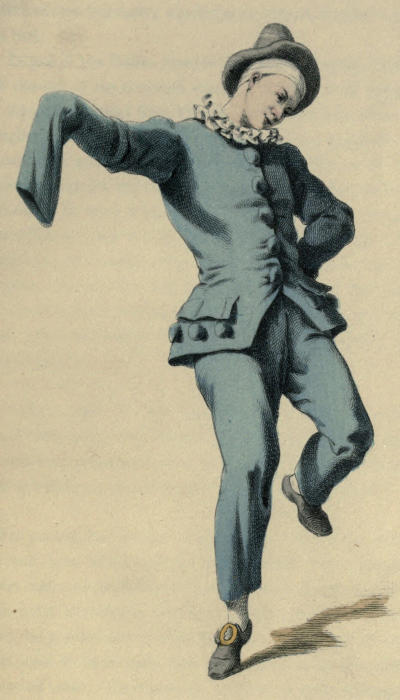
In one of the Italian troupes that passed through Florence at the end of the sixteenth century, in 1598, there appeared a personage named Gian Farina, his countenance white like Pagliaccio’s and dressed in very ample linen garments, but wearing in addition the tabaro and a wooden sword. We cannot ascertain the real name of this actor, who, under his sobriquet of Gian Farina, enjoyed a certain celebrity as a comedian and was the director of an itinerant troupe. Like Pagliaccio he was dressed in white, and his face—as his name implies—was whitened with flour. That it was also the custom of the French comedians thus to whiten their faces so as to give more character to their grimaces, we may gather from Montaigne:
“These men of vile condition who seek to recommend themselves by dangerous leaps and other strange mountebank movements were compelled to whiten their faces and to indulge in savage grimaces to induce us to laugh.”
The custom was anterior to Montaigne, for as early as 1502 we find Jean Serre, and his son Auguste Serre, parading under costumes analogous to those transmitted to us by Callot.
In point of costume, Pagliaccio is but a variant of Pulcinella; his pointed hat of white wool and his garment of white linen seem to be no more than the undress of the Neapolitan macaroni eater. His character, however, is quite different.
Salvator Rosa, who was deeply interested in the theatre and in its costumes, has left us the following description:—
“Pagliaccio is dressed in a coat that is extremely full and pleated, and fastened by enormous buttons; his hat is soft and white and capable of assuming any shape; he wears a mask, yet his face is covered with flour. He is stupid, giddy and awkward, and whilst for ever urging others to the most daring measures, he is himself the greatest poltroon on earth; he affects agility, merely to tumble incessantly and drag down with him his old master, whom he has the air of endeavouring to support.”
His flour-covered face and his white mask particularly distinguish him in point of external features from the Neapolitan Pulcinella. In point of character he differs to a still greater degree. Pagliaccio, the stupid lackey, is no more than a trestle jester, whose rôle consists in clumsily imitating, like the English clown, the gestures and movements of the other mimes, and in receiving constant beatings, to the great amusement of the audience.
In Italian pantomimes, Pagliaccio fills the place occupied by Pierrot in France; he no longer wears a mask, his face being merely covered with flour. He is the rival of Harlequin, and the lackey of Pantaloon. He is in love with Columbine, but—like the French Pierrot—he is never successful in carrying her off from Florindo, the lover who is always dressed in the latest fashion of his time and place. In these pantomimes the rôles of father fall to the lot of the Doctor or old Tabarino.
In 1670 Zaniazi, half Gilles, half Pulcinella, performed rôles which greatly resembled those of the doltish Harlequins.
In 1770 Natocelli achieved renown in Italy as a good Bajaccio, whilst in Paris in 1803 Martini was performing his farces with Podesta, Vanini and other Italian buffoons in the ancient gardens of Tivoli.
The French Paillasse is of very much more recent date. It would be towards the end of the eighteenth century that this character made its appearance in the Nicolet Theatre (La Gaîté) in a sort of satire upon the debauched young nobility, a piece based upon the Festin de Pierre, and coarsely adapted to the tastes of the boulevard public. Paillasse took the place of Sganarelle.
Reduced to the utmost misery in consequence of the follies and excesses of his master, having nothing left in which to dress himself, Paillasse would assume the tattered covering of an old mattress and successfully array himself in it to perform his tricks of equilibrium and juggling. Hence the costume, with blue and white or red and white squares, which from that date has been favoured by itinerant jugglers and knife throwers.
Paillasse neither wears a mask nor powders his face with flour. His Indian camisole in squares is short, tight to the figure, with shoulder-of-mutton sleeves fastened at the wrists; his breeches are wide and full, but tight below the knee. He wears the white collar and the black skull-cap.
Brazier says, in his Histoire des Petits Théâtres de Paris, when speaking of the Boulevard du Temple:
“This famous boulevard was a Parisian kermesse, a perpetual fair, an all-the-year-round market. Here you would find matter for laughter and amusement by day and by night; it was the rendezvous of the best society; a crowd of brilliant equipages were constantly stationed there. Cold and heat were braved for the sake of listening to a Paillasse who, in spite of Deburau, was not without merit. This Paillasse, who was named Père Rousseau, had made himself a reputation by singing in the open air:
“‘C’est dans la ville de Bordeaux Q’est z’arrivé trois gros vaisseaux, Les matelots qui sont dedans, Ce sont, ma foi! de bons enfants.’
“I myself have beheld the remains of this good fat Paillasse, and I have bowed respectfully before him.
“I can affirm that never was there a Paillasse more complete or more amusing; it was not a case of the pale and livid countenance of Deburau; it was not his wise and grave performance nor his artistic poses, nor his expressive winks. Here instead was a full, red, plethoric countenance; it symbolised the gaiety of the populace at its fullest. It was impossible not to laugh like a king’s fool at the sight of his grimaces, at the sound of his hoarse and broken voice; he achieved in song what Deburau achieved in pantomime, for this Paillasse of mine was also a great actor. Do not suppose that he recited like a pupil of the Conservatoire; he knew how to be witty and mordant in his declamation; his physiognomy was of an astounding mobility.... We would remain by the hour watching Père Rousseau, that classic Paillasse! We hardly dared to breathe, such was our fear of missing one of his gestures, one of his contortions!”
The farces performed by Rousseau in public at the close of the eighteenth century were very much what they are still to-day, a tissue of imbecilities and gross ineptitudes.
Paillasse. Sir, since you are so kind, I beg of you to do me a service.
Cassandre. What service?
Paillasse. To compose me a compliment for a lady with whom I am madly in love.
Cassandre. It is first necessary that I should know her qualities. Is she lovable, beautiful?
Paillasse. Oh, as for her beauty, there can be but one opinion. First of all, let me tell you that she has only one eye; but the one that remains is so engaging, so witty, so seductive, that it is without equal, and I really think that if it is alone it is because Nature was incapable of producing such another.
Cassandre. She has only one eye! Well, well, that at least is one charm.
Paillasse. Oh, and her mouth, sir! Oh! you cannot picture it. She can thrust a whole apple into it without the least trouble.
Cassandre. Another advantage; so that, when she wishes to tell herself a secret, she can whisper it in her own ear.
Paillasse. True, sir. And then her nose! It is a model nose, a curiosity; it has something of the pear, something of the mulberry, and something of the beetroot.
Cassandre. Ah, I see; it is a rarity.
Paillasse. Oh, and then her feet! They are so small that I assure you I can hardly get her shoes on over my own boots.
Cassandre. And her figure?
Paillasse. Her figure? She is built like a tower; she is quite round. I beg you, sir, to compose me this compliment, which I am burning to address her.
Cassandre. I consent; but first invite the present company to come inside and see the extraordinary spectacle which we are going to give this evening.
Paillasse (brusquely). Hey, there, you others! come inside!
Cassandre (kicking him). Animal! Is that the way to address polite society?
Paillasse. You are right. I made a mistake. Hi, there, you others! come inside!
(Cassandre chases him off.)
iii
At the end of the sixteenth century the French enfariné or the barbouillé, as he was then called, was Robert Guérin, named Lafleur, but better known as Gros-Guillaume. He was a comedian of the Hôtel de Bourgogne, then managed by Valeran, named the Picard, which was as much as to say, a jester and a wit.
Valeran’s real name was Lecomte. “He was,” says Tallemant, “a tall handsome man. He was the head of the troupe and very generous towards its members, and he himself took the money at the door.”
Gros-Guillaume was more than a jester; he was a remarkable actor, greatly esteemed by Henry IV. and by Richelieu, and often commanded to the Louvre to amuse the Béarnais, who enjoyed performances which ridiculed the language and affectations of the gentlemen of his court, particularly those of the Marshal de Roquelaure, concerning whom Tallemant des Réaux relates the following anecdote:—
“One day the king held him between his knees whilst witnessing a command performance by Gros-Guillaume of the farce of the Gentilhomme Gascon. Every now and again, to amuse his master, the Marshal pretended to want to get away to thrash Gros-Guillaume, shouting, ‘Cousis, ne bous fâchez.’ It happened that after the king’s assassination, the comedians, not daring to perform in Paris in view of the general consternation there, repaired to the provinces and made their way to Bordeaux. There the Marshal was the king’s lieutenant. It was necessary for the players to obtain his sanction. ‘I give it you,’ said he, ‘on condition that you will play the farce of the Gentilhomme Gascon.’ They imagined that a sound cudgelling awaited them, and sought to excuse themselves. They were, however, prevailed upon to perform. The Marshal went to see the farce; but the memories it evoked of the good master he had lost occasioned him so much pain that he departed in tears almost immediately after the beginning of the play.”
Gros-Guillaume had been a baker. Fat beyond all measure, he wore two girdles, one above, the other below, his belly. Dressed in white, he discarded the usual mask of Pagliaccio, but covered his face with flour, which he would cause to fly all about him by blowing out his cheeks and by other grimaces. Turlupin, Gaultier-Garguille and he were the only real French buffoons. With Gaultier-Garguille and Gros-Guillaume, who died within a few months of each other, the French farce died also.
Gros-Guillaume wore a white linen blouse, pantaloons with wide brightly coloured stripes, and a red cap. “... This is my valet, Guillaume le Gros,” says Gaultier-Garguille when speaking of him, “and he is to be known by his piebald costume in the fashion of the Swiss of Francis I., and by his belly, copied from a calabash.”
iv
Pedrolino, Piero and Pierrot are all one and the same personage. Under the designation of Piero, a lackey, he was seen on the Italian stage as early as 1574 in a comedy of Cristoforo Castelletti; we find him filling the same character in I Bernardi, by Giovanmaria Cecchi, in 1563, and in the plays of Luigi Grotto, La Altiera amongst others, in 1587. Under the name of Pedrolino we find him playing rôles of naïve lackeys with Bertolin (Zeccha). In the Gelosi troupe, from 1578 to 1604 inclusive, the rôles of lackey are played by Pedrolino, Burattino and Arlecchino.
Pedrolino is a very complex type, presenting, in point of character, the greatest resemblance to the modern French Pierrot; his especial characteristic is his honesty. In the fifty scenarii of Flaminio Scala he is almost always the preferred lover of the soubrette Franceschina, who, none the less, receives the homage of Pantaloon without prejudice to that of Arlecchino and Burattino. Sometimes he is the husband of Franceschina, and then he plays the rôle of a Sganarelle; betrayed by his wife and discovering it, he rebukes her coquetry, but ends by recognising that the fault is his own, and begs her pardon, which he obtains only after a deal of trouble.
Lackey to the coquette Flaminia, he refuses to undertake the delivery of her love letters to her lover Orazio. Flaminia and Orazio abuse him and call him a rascal. He becomes furiously enraged, whereafter he weeps upon the bosom of Harlequin, bewailing the loss of his reputation.
As the lackey of Pantaloon, and trusted to keep watch over the wife of his master whilst the latter sleeps, Pedrolino also falls asleep, or else he drinks with Captain Spavento and the Doctor, and all three, “drunk as monkeys,” commit the wildest extravagances and end by falling to the ground, “where they remain.” On the morrow, Pantaloon, furious to learn that whilst he slept his wife has been abroad, reproaches Pedrolino, who is still somnolent and weary from yesterday’s drunkenness. Pedrolino, remembering nothing, understands nothing of his master’s complaints. Pantaloon, beside himself with anger, beats him and bites him, to wrest him from his torpor, and ends by leaving him in tears; but the first pangs of sorrow being over, Pedrolino swears vengeance. He contrives so cleverly that all the characters of the piece mystify Pantaloon, and persuade him that his breath is very unpleasant. Pantaloon ends by believing it, and submits to the extraction of four excellent teeth. After that he understands that he has been fooled, and that Pedrolino is the author of this practical joke. Pedrolino simulates madness to escape the blows which threaten him.
He is a poltroon and a boaster. Bent upon avenging the wrong done him by Harlequin, he arrives armed to the teeth, perceives his enemy and hurls himself upon him with drawn weapons. Harlequin, armed with a door-bar, receives him firmly. Then, face to face, they heap abuse each upon the other, whilst depending upon those present to hinder them from coming to blows. The Captain seeks to separate them, whereupon they strike out furiously, with the result that it is the Captain who receives this shower of blows.
Elsewhere, after having boasted that he fears nothing, Pedrolino perceives Harlequin covered by a white garment, lantern in hand; at sight of him he interrupts his conversation and flees as fast as his legs will carry him.
His sorrows do not affect his appetite. We behold him weeping and complaining after having received a beating. He meets Harlequin, who brings him on behalf of the Captain a plate of macaroni. Pedrolino accepts it and continues to weep uninterruptedly whilst eating like an ogre; Harlequin, deeply affected, weeps also and begins to eat with him. Burattino arrives and, beholding them eating and weeping, he too bursts into tears and puts his hand into the dish. Not one of them says a word. The macaroni, watered by their tears, is soon swallowed, whereafter Pedrolino, weeping, turns to Harlequin. “Kiss the Captain’s hands for me,” he says, and goes off. Burattino entrusts Harlequin with a like commission on his own behalf and makes his exit on the other side, also weeping. Harlequin, bursting into fresh sobs, goes off licking the plate.
Pedrolino is utterly the slave of fear. Whilst dining under a tree with Harlequin and the beautiful Dorinda, the repast is interrupted by a gigantic bear which advances upon them. Pedrolino leaps up; the bear does the same; and whilst Harlequin, to hold its attention, throws at it one by one all the apples of the dinner, which the bear very adroitly catches in its jaws, Pedrolino decamps; Harlequin follows him and the bear carries off Dorinda, who lends herself without protest to this abduction.
Arrayed in a long white shirt, wearing a straw hat and carrying a huge staff, Pedrolino is entrusted by his master with a love letter which he is to deliver to Isabella; but as a result of his habitual absent-mindedness he loses the letter; he perceives his loss and, in casting about him for some means of discharging his commission, he is inspired with the happy notion of committing a theft upon a letter-carrier. He purloins from the basket the first letter that comes to his hand and delivers it to Isabella, whence ensues an intrigue of extreme complication.
In another scenario, dressed as a beggar, with a patch over one eye, he meets the Captain and begs alms from him whilst regarding him fixedly with his uncovered eye. The Captain, wearied and rendered impatient by his steadfast glance, demands the reason of it.
“It is,” replies Pedrolino, “that I am a physiognomist and that I perceive from your face that you will shortly be hanged.”
The Captain, to rid himself of such disagreeable prognostications, gives him some money. Another person, for the sake of peace, gives him bread and wine. Pedrolino sits down in a corner to eat and drink, but, finding the bread not clean and the wine not good, he throws one and the other at the legs of him from whom he received them, and goes off to get drunk at the hostelry.
He is mischievous and he plays practical jokes upon everybody. He dons the clothes of Cassandre, his master, and impersonates him; he dresses up as a woman and induces the Captain to abduct him; he gives Harlequin or Burattino filth to drink; he dresses Pantaloon as a woman to lead him to a supposed rendezvous, assuring him that such is the caprice of the lady who awaits him, in her anxiety to save appearances; at the same time he relates some fable to the Doctor, to lure him to the same rendezvous at which he himself is present in hiding. After many amorous proposals between the two cozened old men they finally recognise each other and almost come to blows.
In some pieces he is an intriguer and a lackey in the service of young people. But even then his real nature is preserved and he conforms to his type by his mischievousness and his buffooneries, when, for instance, morion on head and sword at his side, he imitates the roaring furies of Captain Spavento.
Such is the rôle of Pedrolino in the collection of Flaminio Scala. It will be seen therefore that it is quite wrong to attribute to the type of Pierrot a modern and entirely French origin.
“Down to the middle of the seventeenth century,” says M. Édouard Fournier in a recent article on the subject of Molière, “the Italian comedy had but one doltish character, Harlequin: it was always he who was the butt of practical jokes, it was always he who received the beatings. But with the advent of Domenico, all this was changed. As you know, he played Harlequin parts; but he played them like the man of wit that he was; well-read, and the friend of men of letters, he found it impossible, even under a mask, to accommodate himself to a character of imperturbable doltishness. Moreover he recognised, as has been wisely remarked by Léris in his Dramatic Dictionary, the humour of the French public, which insists upon wit in all performances. Therefore he infused wit into the rôle of Harlequin, and from then onward Harlequin was a completely metamorphosed character. Since Domenico justified himself by his success, none interfered with him. Thus Comedy gained a character; but on the other hand it also lost one, and one very much more indispensable than this charming intruder. How, without the necessary fool, was it possible to sustain Comedy’s repertory? Obviously an imbecile was essential to the repertory, to the by-play of the characters and to the lesser pleasures of the public. A fortunate chance, the inspiration of Molière, gave him to the world one fine day in the person of Pierrot.
“It was under these circumstances that Pierrot arrived, it was thus, as has been well said by des Essarts, that this singular character made his appearance, ‘French-born, in the Italian theatre.’”
It was Molière who, first, in his Don Juan, ou le Festin de Pierre, gave a peasant the name of Pierrot. He based this piece upon an Italian scenario entitled, Il Convitato di Pietro (Peter’s Guest), which had already been performed in Paris in 1659 by the Sieur de Villiers, a comedian of the Hôtel de Bourgogne, and elsewhere by others.
“Molière was tempted,” says M. Édouard Fournier, “by the success of the Italian piece, to write his Don Juan. The success obtained by his comedy again in its turn tempted the Italians. He was inspired by them, they were inspired by him. In the early part of February, 1673, a bare fortnight before the death of that great author, the Italians performed in their theatre a new plot made up of the best scenes of their old piece, Il Convitato di Pietro, and, particularly, of the most amusing passages appropriated by them from the comedy of Molière. This comic medley, made up like the dress of Harlequin, was entitled Aggiunta al Convitato di Pietro.
“Among the characters transformed and adapted by the Italians in this extraordinary scenic hotch-potch was Pierrot, with his simpleton ways, his naïve love affairs and his unaltered name. Little attention was paid to this new-comer, so that, haphazard and, as it were, out of charity, the part was entrusted to a low-salaried member of the company named Giaratone. He did marvels. The others had the good sense not to be jealous and thus, in one stroke and by the one success, the character and the comedian alike acquired rights of citizenship.
“From this moment Pierrot never again left the Italian Comedy. In spite of his newness, in spite of his French name, he became as much a type as any of the others, as Mezzetin, Lelio, Cassandre, or even Harlequin himself, whose emancipation was justified by his advent, and who very willingly accepted him as the inheritor of his old-time stupidity and the victim of his malice of more recent date. Since there was nothing to show that he was a character of recent importation, so quickly and usefully was he employed in all the pieces as a type now acquired and naturalised for all time, Pierrot had his successes and his actors, who appropriated his flour-covered mask and the doltishness which became traditional.
“Amongst these was Hamoche, who did marvels somewhere about 1712, and for whom I am inclined to think was composed the air Au Clair de la Lune, always attributed, but without the least evidence, to Lulli.
“The costume of Pierrot was already that with which we are acquainted. Molière, in his Don Juan, had given him the white blouse of a French peasant, such as is still worn by Colin, the sleepy boy in the last scenes of Georges Dandin. Upon being turned into an Italian character Pierrot was compelled to change this garment; but he preserved at least the colour. The garb which he then took, and has never since abandoned, was borrowed from the Neapolitan Pulcinella. But in the case of Pulcinella the tunic is shorter, and fits the figure more closely, whilst the pantaloons are not so wide.[6] Finally Pierrot covered his face with flour.”
Notwithstanding these ingenious assertions it is impossible to think that Giaratone should not have possessed the traditions of Pedrolino, since the character which he introduced into the Franco-Italian theatre accords in every particular with that Italian ancestor of his: we discover the same poltroonery, the same gluttony, the same naïveté, so often malicious, the same stupidity mingled with good sense, and the same fundamental honesty and candour. As for the costume, nothing is discoverable to inform us exactly of that which was worn by the Pedrolino of Flaminio Scala. It is stated in a scenario that Pedrolino is dressed in a long shirt and wears a straw hat. Was his face floured like Pagliaccio’s and was he already dressed in white? That is very possible. Caprice has determined far less than is supposed in those costumes of classic fantasy which, however transformed, never absolutely abandon the lines of tradition. Giaratone, informed of the true character of the old Pedrolino, would no doubt be equally informed on the score of his make-up, and his dress; as for his Gallicised appellation, it is beyond doubt the same name, for in the scenarii of Gherardi the characters address him indifferently as Pierrot or Piero.
It would therefore seem that Giaratone did no more than rejuvenate and adapt to the Franco-Italian theatre the character of the old Pedrolino, taking for his performances those shades of character dominant in the greater number of the scenarii of Scala and abandoning the intriguing qualities sometimes, but exceptionally, attributed to him. He approached the type of Bertoldino, a type which, long before his day, had been confounded with that of Pedrolino. He floured his face after the fashion of the old French badins, who themselves—like Pagliaccio with his white mask and his flour, Pulcinella and Harlequin with their black masks, Pantaloon and Brighella with their brown masks, Coviello and the Doctor, each with his mask of a distinctive colour—derive from the ancient mimes with their countenances blackened, browned, reddened or whitened, who are alleged to have been resurrected during the Renaissance, but who in all probability had never disappeared from the Italian boards.
Just as Pedrolino had been the incarnation of the Italian peasant, so Pierrot was that of the French peasant, and he became with the French public the most popular type after Polichinelle.
In the scenarii and theatrical pieces of Gherardi, Pierrot is always a servant of the Doctor, of Brocantin or of Cinthio, just as in French pieces and pantomimes he is always the servant of Cassandre. He is a fellow who always says what he thinks and who recognises no social distinctions. This privilege of speaking his mind, accorded to the finesse and astuteness of the soubrette, is similarly granted to the simplicity and awkwardness of Pierrot. He never fails to lecture his master.
Pierrot. Sir, sir, I come to tell you once for all that I am very pleased with you and that I have always loved you better than you deserve.
Cassandre. I am much obliged to you for the honour.
Pierrot. Put on your hat [i.e. don’t stand on ceremony]. You have paid me my wages promptly and I have consumed them in your service in like fashion.
Cassandre. That is not my fault. But, Pierrot, what ails you? I find you entirely changed.
Pierrot. That is not your affair. I shall be changed if I wish and I shall not be changed if I do not wish.
Cassandre. I beg you to pardon me for having presumed to take an interest in your concerns.
Pierrot. What I want to know, sir, without all this preamble, is, what do you intend to give me by way of reward?
Cassandre. But you confess, yourself, that I have paid you all your wages.
Pierrot. Agreed. But have I not also told you that I have consumed them?
Cassandre. That is not my fault.
Pierrot. Oh, sir, let us reckon up the services out of the ordinary which I have rendered you, and you will see how stupid you are. Firstly, I have not told your wife that you have a love affair in the town upon which you are spending the best part of your income. I leave it to yourself to put a price upon my discreetness.
Cassandre. It is just. That deserves something.
Pierrot. Secondly, you have been ten times drunk without my permission. I am not compelled to put up with you in such disorders.
Cassandre. That is well reasoned.
Pierrot. Thirdly, I have fallen in love whilst in your service.
Cassandre. That certainly deserves a recompense.
Pierrot. As the total sum of the extraordinary expenditure to which I have been subjected in your service, pay me ten thousand livres, and I will give you a quittance in full.
Cassandre. Your accounts seem to be in order. But whilst awaiting a settlement, go as far as the post to see if there are any letters for me.
(Pierrot goes and returns at the end of an hour. His master is busy when he enters.)
Pierrot. Yes, sir.
Cassandre. What do you want?
Pierrot. I have come to tell you, sir, that I have seen them.
Cassandre. Seen what?
Pierrot. Your letters at the post.
Cassandre. Where are they?
Pierrot. At the post.
Cassandre. And have you not brought them?
Pierrot. No. You told me only to go and see if there were any. I have seen them and I am come to tell you so.
Cassandre. Heaven give me patience with you! I should be better advised to have gone myself.
Pierrot. Really, sir, if you have not the wit to express yourself properly, what can you expect?
Again Pierrot is the valet of Cinthio (an old man) in the Cause des Femmes; he believes himself to be alone whilst, as a matter of fact, his master is finishing his supper within ear-shot close by.
Pierrot. When I come to consider what a woman is, frankly my poor wit goes all to pieces. However I may shut the door, our house is always full of counts and marquises. A lackey brings a letter; his master comes to demand an answer! All night at a ball! All day in merry-makings or at the comedy! What a life for a man of my master’s age! Ah, you may do as you like, but you will never be taken for anything but what you are.
Cinthio (rising). What do you mean, lackey?
Pierrot. I? Nothing, sir, I was not speaking.
Cinthio. How, rascal, you were not speaking? Have you not just said that I shall never be taken for anything but what I am?
Pierrot. Yes, sir.
Cinthio. Well, then, rogue, what am I?
Pierrot. Since you ask me, you are a fool to have married a she-goat of seventeen years of age who finds no house less desirable than yours, and who is for ever trailing a mob of courtiers after her.
Pierrot, like his ancestor Pedrolino, is compounded, it will be seen, of common-sense and simplicity. In him too there is something of the Sancho Pança of Cervantes, at once credulous and sceptical, the eternal type of rustic outspokenness, whom nothing astonishes; it is a type which neither passes nor changes.
The original character of Harlequin after it had been transformed by Domenico was bound to, and did, go out of fashion. Wit is a thing relative to every epoch and to every environment; the jests of that comedian do not now always seem witty to us; among those which have been collected it is impossible to cite more than a certain number. Pierrot, however, might be cited in full; for he exists, and will always exist, on the stage of life itself.
Giuseppe Giaratone, who was a native of Ferrara, had been—as we have seen—but a short while in the troupe when he had the good fortune to create his character of Pierrot on the 4th February 1673. He performed, now in Italian, now in French, until 1697—that is to say, until the suppression of the theatre. He married in France a lady of good family and he lived with her on a little estate which belonged to them in the neighbourhood of Paris. It was thither that he retired, and there that he died.
Antonio Sticotti made his début in peasant parts and as Pierrot in 1729 at the Comédie-Italienne. He retired to Meaux, where he occupied the position of postmaster. He left several comedies which were played with success.
In the theatres of the fairs the most remarkable Pierrots were Prévot in 1707 and Hamoche in 1712. The latter left his theatre to attempt to join the company of the Comédie-Italienne, but he was not received there. In 1725 he repaired to the fair of Saint-Laurent, and his introduction was couched in the following terms: Scaramouche came to announce him to a personification of the Fair and sang:
“Hamoche vous prie De le recevoir; Il tempête, il crie, Voulez-vous le voir?”
The Fair replied:
“C’est ici son centre, Qu’il entre, qu’il entre.”
But the forain audience, by no means flattered at being looked upon as a last resource, hissed Hamoche by way of teaching him a lesson. This punishment so wounded the poor Pierrot that he withdrew from the theatre and died of grief.
From 1715 to 1721 Belloni, remarkable for the extreme simplicity of his performance and for the naïveté and truth of his diction, was another Pierrot of distinction. Then came Dujardin in 1721, Bréon, Maganox, Dourdet, in 1741, and Pietro Sodi, a native of Rome, who was a dancer and mime of very great talent, and the author of many pantomimes, in 1749.
v
The name of Giglio is mentioned for the first time in 1531 in the Italian troupe of the Intronati; but this personage, filling the rôles of servant and sometimes of lover, is but very slightly related to the Giglio played in Naples in 1701 by Filipo and Fabienti.
The French Gilles of the eighteenth century is a lineal descendant of Pierrot. His floured countenance assumes under the brush of Watteau that elegance of line and that charm at once naïve and comic with which we are all acquainted.
In 1702 Maillot, the forain actor, played, under the name of Gilles, rôles identical with those of Pierrot, but, no longer with the same simplicity and good sense with which Giaratone had equipped this character. Later, towards 1780, we see the actor Carpentier (Gilles) appropriating the scenes and the business which had been played by Carlin Bertinazzi at the Comédie-Italienne.
The Master. Hola! Gilles! Hola! I am always compelled to shout myself hoarse when I want that rascal. Gilles! Gilles!
Gilles (arriving very softly and shouting very loudly into his ear). Here I am, sir. I am not deaf.
The Master (recoiling). A plague on the rascal! Does he want to frighten me to death?
Gilles. But then, sir, you were shouting like a stick that has lost its blind man.... I was conferring with the post-man; he has just brought me a letter, and I was asking him to read it to me when you called me.
The Master. Whence is this letter?
Gilles. I don’t know. I barely had time to unseal it. Here it is, sir.
The Master (reading). “From the country.”... What country?
Gilles. Limoges, I suppose.
The Master. Then they ought to say so.
Gilles. Oh! but they are not so wise as that at Limoges. Continue to read, I beseech you.
The Master (reads). “My cousin Gilles, this is to advise you that my aunt your mother is dead....”
Gilles (weeping). My mother is dead! Oh, sir, behold me an orphan. Who will take care of me henceforth?
The Master. But you are big enough to take care of yourself. I am delighted to see your good natural feelings for your mother. But we are all mortal.... Let us proceed with the letter. (He reads.) “She has left you fifty crowns——”
Gilles. My mother has left me fifty crowns? Now that is what I call a good woman. Sir, are you quite sure that is right?
The Master. Quite sure. But it seems to me that you are very soon consoled for the loss of your mother.
Gilles. Oh, she was very old.
The Master. I understand. (He reads.) “I inform you that your little sister Catine has become a child of pleasure——”
Gilles. My sister Catine a child of pleasure! (He weeps.) I shall kill her! I love honour a hundred times better than reputation.
The Master. There, there, be comforted.
Gilles. No, sir; I refuse to be comforted.
The Master. Listen. (He reads.) “In four months she amassed six hundred livres.”
Gilles (laughing). Six hundred livres! But that is very good. My sister Catine was of a saving disposition.
The Master. It looks like it. (He reads.) “I must tell you, cousin, that in the course of a quarrel a fortnight ago she received a wound in the face which horribly disfigured her.”
Gilles (weeping). Oh, my poor little Catine, how I pity you! Alas, that is the fate of nearly all of her kind.
The Master. Wait, my friend. (He reads.) “As the wound was dangerous, she made her will, and you profit by it.”
Gilles. What a good heart that girl had!
The Master (reading). “Soon afterwards she died.”
Gilles. Oh, sir, my heart is bursting.
The Master (reading). “By this will she leaves you a house furnished in the best style.”
Gilles (laughing). A house furnished in the best style? Now that was really well done. There’s a good girl for you, a good virtuous girl!
The Master. A virtuous girl! (He reads.) “But, my dear cousin, a very great disaster followed. The house caught fire and has been burnt, together with all the furniture; what was not burnt was pillaged, and your fifty crowns were also stolen.”
Gilles. Fire! Thieves! Sir, I am ruined. Write to them quickly and bid them have recourse to all the town buckets and throw all the water available on that fire.
In the last years of his theatrical career, Carpentier, who for twenty years had been applauded as an excellent Gilles, had contracted the deplorable habit of drunkenness. His director, Barré, had endeavoured by all means to correct him of a vice which ruined his health and harmed him in his profession; but Carpentier took no notice, with the result that from year to year his memory grew more and more infirm until, having forgotten all his old rôles, he was utterly incapable of learning new ones. His director was compelled to confine him to accessory rôles in which he let him do as he liked; thus he was able to continue to allow him a salary without hurting his feelings.
A year passed without his ever appearing on the boards; then one evening, in a piece (Les Savants de Naissance) in which the whole company was engaged, Carpentier went to his dressing-room without saying a word to anyone and assumed the costume of a Gascon hairdresser, a part in which he was remarkable.
“The comb over his ear, holding a powder-box under his arm, and a razor-case in his hand, he came to the front and saluted the audience. Everyone present recognised him and universal laughter pealed from the spectators; then applause broke forth not only in front, but even in the wings. Thereupon poor Carpentier began to weep, exclaiming to his comrades, with as much joy as modesty, ‘My friends, my friends, they have recognised me.... They have recognised me!’”
A few days later he committed suicide by throwing himself from a window.
vi
Peppe-Nappa is a Sicilian personage who, save for the colour of his dress, is absolutely the same as Giglio or Gilles; and there is no Italian mask which in character so closely resembles the French Pierrot. Whilst Giglio is dressed in white flannel, like the Gilles of Watteau, Peppe-Nappa’s livery is pale blue. He does not cover his face with flour, although he is very pale; he, like Gilles, wears a white skull-cap, a white or grey hat, and shoes of white leather. He is of a surprising agility, continually dancing and bounding. His eyes and his wan countenance are extremely remarkable and expressive. He is equally lively in his gestures. Very swift in his movements and very supple, he seems, when he collapses upon himself, to be no more than a heap of garments that can never have been filled by flesh and bones.
He is nearly always a servant, sometimes, for instance, to the Barone (the Sicilian old man), upon whom he visits his stupidity. But gluttony is Peppe-Nappa’s greatest fault; he has a predilection for kitchens; if he may not always eat in such places, at least he may always inhale what to him is the most delicious of all perfumes.
In a comedy-ballet which is closely related to the Scuola di Salerno, Peppe-Nappa is the servant of a schoolmaster, a sort of doctor, who gesticulates in his chair in the course of teaching his pupils. Amongst these, on the school forms, there are some very big girls, towards whom the Doctor shows more indulgence than towards the others. The class is at an end; the schoolmaster wants to go out, and requires his black robe and his tall pointed hat. He rings for Peppe-Nappa, who, after a long delay, comes in yawning. He approaches his master to learn his orders, but falls asleep on his feet, leaning up against him. The latter withdraws and Peppe-Nappa falls down without waking. The furious pedant lifts him up by the skin of his back and, by kicks and blows, contrives to arouse him from his slumber; thereafter he sends him for his robe. Peppe-Nappa goes off and returns dragging the robe behind him; he then helps his master to assume it. Upon his master complaining that the garment is covered with dust, Peppe-Nappa goes to fetch a bucket of water and a broom, and, before the pedant is aware of his intentions, he washes him down from head to foot as he would wash a wall. This done, the good servant, worn out by so much labour, seats himself apart and fans himself with his hat. The furious schoolmaster seizes his ferrule to correct the servant, who adroitly evades the blows, causing them to fall upon the hands of the schoolmaster himself. Peppe-Nappa has a singular way of giving his master his hat. He brings a ladder and leans it against his master’s shoulders to enable him to put the hat on his head.
After the departure of the schoolmaster, the class is given over to gaiety. The little boys fight, the little girls cry, and the older girls run to the doors to admit their young lovers, who come to dance with them. But Peppe-Nappa, who has been to accompany his master to the end of the street, re-enters wearing the professor’s long black robe, with his head buried in the enormous hat. There is great terror among the youngsters, but they are quick to perceive their mistake, and they are about to fall upon Peppe-Nappa when he threatens to call the master; then two of the more astute ones bring him some macaroni and some eggs to conciliate him. Whilst he is devouring these, and contracting an indigestion, the whole class disappears, the pedant re-enters and discovers Peppe-Nappa torpid from excess of food. Hereupon follow remonstrances and discourses upon frugality, seasoned with blows. The poor servant attempts, by way of showing his repentance of his past conduct, to assist his master to rediscover his pupils. The piece ends in the marriage of all the schoolgirls with their lovers. Peppe-Nappa is the only one who can find no wife.
vii
The Théâtre des Funambules, founded in 1816 by Bertrand, presented spectacles of performing dogs, farces, rope dancers and sometimes pantomimes. The principal mime was Félix Charigny, who, under the name of Pierrot, filled the part of Gilles.
Towards 1830 the Funambules having been transformed into a pantomime and vaudeville theatre, there arose in the person of Deburau a man of genius in his own line, who for fifteen years was able to attract all the lovers of the old French and Italian farces.
In the hands of Deburau, pantomime was then all that remained of the old Italian comedy. The character of Pierrot, however, underwent a complete change. Deburau transformed it as Domenico had transformed Harlequin. By his incomparable talent, which lent itself to all the shades of the mimetic art, he made Pierrot now good, and generous out of carelessness, now a thief, false and sometimes miserly, now cowardly, now daring, and almost always poor; laziness and gluttony remained his incorrigible faults.
Deburau transformed not only the character, but the externals of this personage. His costume was based, first of all, upon that of Charigny, whom he replaced in 1825. The short woollen tunic, with its great buttons and its narrow sleeves, that overhung the hands, soon became an ample calico blouse with wide long sleeves like those of the Italian Pagliaccio. He suppressed the collar, which cast an upward shadow from the footlights on to his face, and interfered with the play of his countenance, and instead of the white skull-cap and the pointed hat of his predecessor, he emphasised the pallor of his face by framing it in a cap of black velvet. To-day Pagliaccio would rather be considered the proper name for this type; but since he was generally recognised for Pierrot, that name is to be preserved him.
“With him [Deburau],” says M. Théophile Gautier, “the rôle of Pierrot was enlarged and widened; it ended by occupying the entire piece, and, be it said with all the respect due to the memory of the most perfect actor that ever lived, by entirely departing from its origin and being denaturalised. Pierrot, under the flour and the tunic of that illustrious actor, assumed the airs of a master and an aplomb unsuited to the character; he no longer received kicks, he gave them; Harlequin now scarcely dared to touch his shoulders with his bat; Cassandre would think twice before boxing his ears. He would kiss Columbine and pass an arm about her waist like a seducer of comic opera; he caused the entire action of the piece to revolve about himself, and he attained such a degree of insolence and audacity that he would even beat his own good genius. The strong personality of the great actor overbore the type.”
“Et du Pierrot blafard brisant le masque étroit, Le front de Deburau perçait en maint endroit.”
M. Jules Janin has published a biography of Deburau entitled, “Deburau, Histoire du Théâtre à Quatre-Sous, pour faire suite à l’histoire du Théâtre-Français, 1833.”
“Being unable to develop enthusiasm for the Théâtre-Français,” he says, “we will become enthusiastic where we can; for instance, in the boulevard theatres. It is in one of these ignored theatres, in the meanest and the most infected, by the light of four wretched candles and in a mephitic atmosphere, situated alongside of a menagerie which bellows whilst the actors are singing, that we have discovered, admired and applauded with all our strength the great comedian, who is also the great clown, Deburau.
“The greatest comedian of our age, Jean-Baptiste Deburau, was born on the 31st July 1796. How he comes to be Deburau I cannot tell you. The fact is, that he has revolutionised his art. He has in truth created an entirely new race of clowns when it was supposed that all the possible varieties had been exhausted. He has replaced petulance by calm, enthusiasm by good sense. In him we no longer see the Paillasse agitated hither and thither, without reason and without aim; we behold instead a stoic who allows himself mechanically to follow all the impressions of the moment, an actor without passion, without words and almost without countenance; one who says everything, expresses everything, mocks everything; capable of playing, without uttering a word, all the comedies of Molière; one who is informed of all the follies of his day, and who reproduces them to the life; an inimitable genius who goes and comes, who looks, who opens his mouth, who closes his eyes, who causes laughter and tears, who is enchanting!
“His fate to-day is as brilliant as it was erstwhile sad. M. Nicolas-Michel Bertrand, the Director of the Funambules, has given his Gilles an engagement worthy of him. After many useless labours and many fruitless researches in the archives of the kingdom of Comedy, we have had the good fortune to discover the following important document bearing upon the history of this art:—
“SPECTACLE DES FUNAMBULES
“Agreement
“Between the undersigned, M. Nicolas-Michel Bertrand, of the Boulevard du Temple, No. 18, Paris, Director of the Funambules Theatre, of the one part,
“And M. Jean-Baptiste Deburau, of the Faubourg du Temple, No. 28, Paris, artist-mime, of the other part:
“It is agreed between us as follows:
“First, I, Bertrand, engage by these presents M. Deburau, to perform in the troupe the parts of Pierrot, and generally all the rôles which may be assigned to him by me or my manager.
“Second, I, Jean-Baptiste Deburau, engage myself to perform all rôles, to dance and take part in the ballets, divertissements, pantomimes and all other pieces, together with the company wherever sent for fêtes, private or public, without exacting any extras beyond the expenses of transit.
“I consent to conform to the rules established or to be established for the performances, and to content myself with such lighting, heating and costumes as may be supplied me by the administration.
“In case of illness the Director reserves himself the right to suspend the salary of the artist until the day of his reappearance.
“The artist is under obligation to supply, according to his costumes, his own linen, stockings, foot-wear, gloves and grease-paints. The administration will supply the costumes and properties, etc., etc.
“Subject to the above clause being faithfully executed, M. Bertrand undertakes to pay M. Deburau the sum of 35 francs weekly throughout the present engagement. The present engagement is for three years. It will begin on Easter Monday of 1828, and conclude on Palm Sunday, 1831.
“The parties hereunto desire mutually that this agreement shall have the same force and value as if drawn before a notary, and the first to infringe it shall pay to the other damages in the fixed sum of 1000 francs.
“Given in duplicate and in good faith, etc., 10th Dec. 1826.
“(Signed) Bertrand. “Deburau.
“Additional clause.
“M. Deburau undertakes moreover the care of the properties of any piece performed—that is to say, he will look after them and distribute them every evening, and lock them up after the performance, etc.
“In consideration of this further clause M. Bertrand undertakes to pay M. Deburau 10 francs weekly in addition to his salary, and this is accepted by the latter.
“(Signed) Bertrand. “Deburau.”
The spectacular pantomime-harlequinades in which Deburau was extraordinary for his spirit, his gestures, and his facial play, in which he abandoned himself to all manner of fantasies, were: Le Bœuf Enragé, Ma Mère L’Oie, La Mauvaise Tête, Le Billet de Mille Francs.
Les Épreuves, a great pantomime-harlequinade in thirteen scenes, in the English manner, by Deburau and M. Charles, was cast in the following manner:—Harlequin, Cossard; Pierrot, Deburau; Pandolphe, Laplace; Léandre, Orphée; Isabella, Mademoiselle Isménie; La Fée, Madame Lefèvre.
Isabella is the daughter of old Pandolphe. She is in love with Harlequin, who is protected by a fairy. Léandre wishes to marry Isabella, who runs away with her lover. Pandolphe, followed by his servant Pierrot and by Léandre, the possessor of a talisman, pursues them.
Pierrot is in a public place. Instead of following his master, he is sniffing round a pastrycook’s shop and at last decides to enter it; within he discovers his mistake; the shop is a milliner’s. Having no use for the bonnets that are offered him, he goes out again in quest of the pastrycook, whose shop is on the other side of the square. But the shops perform a fantastic chassé-croisée, and Pierrot discovers himself once more at the milliner’s. This being several times repeated, Pierrot is worn out and ends by being amused. He loses his head and performs incoherences. He upsets the shoemaker’s stall and then assumes such absurd and ridiculous poses before the customers of a vintner that they depart scandalised. After several pleasantries, some of them of a distinctly coarse order, he draws down punishment upon his head. His dupes unite against him and, being ten to one, they valiantly pursue Pierrot. Pandolphe and the beautiful Léandre come to his aid and a battle royal is fought with broom-sticks.
In the next scene Pierrot, to throw his enemies off the scent, conceals himself under the garments of a mountebank. He arrives in the midst of a village fête, and there, assisted by Pandolphe, who plays the fiddle, and Léandre, who plays the trombone, he beats a big drum as if his aim were to burst it. The village folk begin to dance, but presently become angry, for no apparent reason. Pierrot and his acolytes have little chance against them, and they escape before the blows that threaten.
Next, Pierrot’s head is cut off in a tavern. It is glued on again. The doctor, who is none other than Harlequin, demands his fee, but Pierrot pretends that his head is not properly re-attached, and receives a shower of blows from the false doctor.
In the following scene he is disguised as a woman, no doubt with a view to escaping from the ill intentions of Harlequin. He is about to do his washing when, after the fashion of pantomimic fantasy, an Englishman with red whiskers and an impossible collar comes to order Pierrot to wash some soiled linen. Pierrot finds the task disgusting, refuses it, and ends by throwing the Englishman into the tub, whereupon he runs away.
He is again in a tavern, and, after an adventure with a thief, he finds himself in need of a bath. He seeks the baths, but in that country there are no baths except for women. He assumes a bonnet and a petticoat, and enters one of those establishments, wherein he is badly received, for under a stroke of the fairy’s wand the baths are changed into a roasting-house and Pierrot finds himself roasting on a grille.
Delivered from this, and having no longer any garments, he enlists and becomes a soldier that he may be clothed. He quarrels with the corporal and fights a duel with pistols. Pierrot loads his own weapon with nothing but a candle, but he plants this candle full in the face of his adversary. This remarkable feat of arms causes him to be appointed drum-major on the spot. He immediately holds a review of the drummers, the oldest of whom is not four years of age.
The piece ends by an apotheosis in which we behold the rout of Léandre, who has lost his talisman. Harlequin and Isabella are united by a cupid with cardboard wings, arrayed in a garland of roses, and a sky-blue tunic: he extends his protecting arms over the two lovers and promises them a life of eternal happiness.
“It has been pretended,” says M. Champfleury, “that Deburau died as the result of a fall at the Funambules. Deburau died of asthma, which had been undermining his health for five years.
“His medical advisers had prescribed for him a long period of rest; but he thought only of his public. For five years he was afflicted by a cough that tore his lungs. But the moment he appeared on the stage the affliction would leave him; he would become once more for a quarter of an hour young, happy and healthy. The terrible disease, however, awaited him in the wings, and would lay its claws on the breast of the mime every time he made his exit.
“The cough became so tyrannical that Deburau was compelled to rest. One day he felt better. The bills announced his reappearance. At most, he had been absent for three weeks, but as a consequence there was a long impatient queue that would have filled five theatres.
“Be it noted that the performance was Les Noces de Pierrot, a farce which had been played six hundred times at the theatre of the Funambules. The shouts and roars of the spectators during the first half of the evening may be imagined. Outside, those who had been unable to enter shouted still more loudly. After the three vaudevilles the usual three knocks were heard.
“The curtain rose slowly. Deburau appeared in his white costume, a posy in his button-hole, a pretty girl on his arm. It is impossible to conceive an idea of the enthusiasm in the theatre; it was frenetic. In the gods four hundred faces were alight with joy; eight hundred eyes devoured the mime; four hundred mouths roared ‘Bravo!’ The heights of delirium were reached. Those who had been unable to enter shouted outside the door.
“Deburau quite simply placed his hand on his heart below his bridegroom’s posy. A tear ploughed through the flour on his countenance.
“A real tear is so rare in the theatre!
“A little while afterwards a slight incident proved the solemnity of this performance. At the introduction of the pantomime the peasants—boys and girls—are grouped upon the stage. Apart, the bailie, who is a traitor, plots his infamies. The orchestra plays the refrain of the dance.
“Ordinarily Deburau would now execute one of those eccentric dances the secret of which died with him; it was a mixture of the steps of the Directoire and of the more audacious steps of the cancan. More than ordinarily affected, his heart too full of joy, Deburau did not dance.
“‘The chahut!’ cried a rough voice.
“‘No, no!’ replied the whole theatre.
“The most vulgar of publics has its moments of exquisite delicacy. It had understood the emotion of the great comedian.
“Towards midnight there was a great gathering at the stage door. Deburau came forth. He had preserved, no doubt through a presentiment, his white bridegroom’s posy. It was the posy of his nuptials with Death.
“A thousand voices shouted: ‘Vive Deburau!’ But Death, that cruel ghoul, was in haste to embrace her pale bridegroom.
“He died a few days later (1846).”
A little while before this last performance of which M. Champfleury writes, an incident took place in a performance of the Épreuves which showed the public’s affection for Deburau; it was the occasion of the fall to which his death has been wrongly attributed.
At the end of the tenth scene Deburau was to disappear through a trap-door, and this was not working properly. He stamped impatiently with his foot upon the trap, and it was precisely at this moment that it gave way. His body had lost its poise and, as he went through, his head was thrown back and struck the stage. The scene being changed, the manager came forward to announce that M. Deburau was wounded. The audience was about to withdraw, after having expressed its sympathy with the mime, when Deburau himself appeared and wished to continue. “Enough! enough!” was cried on every side by the idolatrous public, but by a gesture Pierrot made them understand that he was too deeply touched not to continue, and the theatre shook with the applause and the bravos of the spectators.
George Sand, who was in one of the stage boxes, having perceived him in the wings holding his head in an attitude of pain, went on the morrow to inquire his condition. He wrote her his thanks for the inquiry and at the same time for an article in praise of him which she had published in the Constitutionnel:
“Madame,—Permit me to address you my double thanks for the interest you are kind enough to take in a little accident which has had no serious consequences for me, and for the kindly article published in the Constitutionnel, in which, concerning yourself benevolently for my future, you extol my poor talent with a warmth and a spirit that are really irresistible.
“I hardly know in what terms to express my gratitude. My pen is like my voice on the stage, but my heart is like my countenance, and I pray you to accept its sincere expression.
“I have the honour to be your servant,
“Deburau.
“P.S.—It was my intention to go to thank you in person, but rehearsals have prevented this. Be good enough, I beg you, to excuse me.
“Paris, 9 Feb. 1846.”
“Deburau was charming in all his ways. He would never be tempted to the least drop of champagne, out of fear, he said, for his nerves, and because he required the completest self-possession for his performances. I have never seen an artist who was more serious, more conscientious, more religious in his art. He loved it passionately, and spoke of it as of a grave thing, whilst always speaking of himself with the extremest modesty. He studied incessantly and was never weary, notwithstanding continued and even excessive playing. He did not trouble to think whether the admirable subtleties of his play of countenance and his originality of composition were appreciated by artists. He worked to satisfy himself and to realise his fancy. This fancy, which appeared to be so spontaneous, was studied beforehand, with extraordinary care” (George Sand: Histoire de Ma Vie).
Deburau’s son took up his father’s career in 1847. He was perhaps the handsomest and most elegant Pierrot that was ever seen. By his suppleness, his grace and charming fantasy, he rightly acquired an enormous vogue.
Paul Legrand, born at Saintes in 1820, played at first in the Théâtre des Funambules, comic parts in vaudeville and the rôles of Léandre in pantomime. It was only in 1845 that he undertook the rôles of Pierrot. A pupil of Deburau, he succeeded him in this character in 1847. He sustained in that theatre and afterwards with honour in the Folies-Nouvelles his double rivalry with the memory of Deburau and the deserved success of Deburau’s son. He was less elegant in shape than the latter, but none the less pleasing to the eye by his attitudes. He was full of resources, gifted with a handsome countenance, and a very characteristic expression, full of comical and bizarre notions and inventions, and—and this in particular distinguishes his talent—he had a peculiar power of producing pathetic and dramatic effects. Like the celebrated Thomassin, he drew laughter and tears at one and the same time; so that he may be reckoned as a mime of the very first order.
The first creations of Paul Legrand at the Funambules were: L’Œuf Rouge et l’Œuf Blanc, Pierrot Valet de la Mort, Pierrot Pendu, by M. Champfleury; Pierrot Recompensé, Pierrot Marquis, etc.
Summoned to London in December 1847 by Madame Céleste, who was managing the Adelphi Theatre, he remained for a year in England. But the English, accustomed to the much more exaggerated performances of their clowns, could make nothing of the subtle and witty expressions of the French Pierrot. Legrand returned to the Funambules in 1849, to find himself replaced there by Deburau’s son. But all Pierrots are brothers. They played concurrently together: Les Deux Pierrots, Des Trois Pierrots, with Dimier, called Calpestri; Les Deux Blancs, etc.
In 1853, a new pantomime theatre having been opened (Les Folies-Nouvelles), Legrand was engaged there, and from that day, being the master of his actions and able to give a free rein to his fancy, he invested the type of Pierrot with an originality and a unique colour of his own.
viii
The English Pierrot, or rather the English Clown, is a bizarre and fantastic creation not based upon any French type. The Florentine Stenterello alone may be compared with him by his singular methods. And what an extraordinary fancy has presided over the dressing of this personage, who seems to have been born among the savages of America! He is arrayed in a tight-fitting tunic, white, red, yellow, green, in stripes, in squares or in circles; his face is pasted with flour, set off with stripes, with moustachios, with impossible eyebrows; his cheeks are raddled with a brutal carmine; his forehead is carried up to the summit of the occiput and surmounted by a wig of a blazing red, from the height of which a little stiff queue lifts itself towards heaven. His manners are no less singular than his costume. He is not mute, like our Pierrot; on the contrary, he holds forth in an extremely buffoon manner and is in addition a very able acrobat. Kemp and Boxwell, circus clowns, were the types of this personage. It was impossible to see Boxwell without admiring his strength and his adroitness, and without laughing at his versatility and bizarre effects.
To define the English clown, M. Champfleury cites the following passage borrowed from Baudelaire:—
“The English Pierrot is by no means the personage pale as the moon, mysterious as silence, supple and mute as the serpent, lean and long as a pole, to which we were accustomed by Deburau. The English Pierrot enters like a tempest, falls like a bale, and shakes the house when he laughs. This laughter resembles a joyful thunderstorm. He is a short thick fellow, who has increased his bulk by a costume loaded with ribbons which fill upon his person the same office as the feathers on a bird, or the hair upon a Persian cat. Over the flour on his countenance he has plastered crudely, without gradation or transition, two enormous discs of pure scarlet. His mouth is increased by a simulated prolongation of the lips carried out in two carmine strokes, so that when he laughs this mouth of his seems to open from ear to ear. As for the character, at bottom it is the same as that which we know: egotistical heedlessness and neutrality; hence the accomplishment of all rapacious and gluttonous fancies, to the detriment now of Harlequin, now of Cassandre, and of Léandre. But with this difference, that where Deburau thrust in the point of his finger that he might afterwards lick it, the clown thrusts in both hands and both feet, and this may express all that he does; his is the vertigo of hyperbole. This Pierrot passes by a woman who is washing her doorstep; after having emptied her pockets he seeks to cram into his own the sponge, the broom, the soap and even the very water itself.”
This exaggerated personage of the English pantomime is a direct descendant of the clownish peasants of the theatre of Shakespeare. No dramatic author ever understood his public as did he. He knew not only how to captivate the attention of Queen Elizabeth and her court by presenting such heroes as no longer existed in his day, but he knew also how to amuse and satisfy his coarse groundlings, who drank and smoked throughout the performance. He knew how to put into the mouth of his clowns exactly what each naïve spectator would have said under similar circumstances. He knew, in short, how to adapt to the English stage the eternal type of Bertoldo.
At the beginning of the eighteenth century a dancer, acrobat and mime named Grimaldi made his appearance on the stage of the Comédie-Italienne in Paris. Dancing one day before the Turkish ambassador, he gave such a leap in honour of his Excellency that he struck his head against the crystal lustre suspended above it. One of the girandoles, detached by the blow, struck the ambassador of the Sublime Porte on the nose and narrowly missed putting out one of his eyes. The Turk in a passion laid a complaint before his ministry, demanding no doubt the bastinado as a punishment for the clumsy dancer. But the minister condemned Grimaldi merely to make a public apology to the inviolable representative of the Grand Turk.
Grimaldi had a son, Giuseppe Grimaldi, who had a long career in the fairs of Italy and France, dancing and singing in pantomime. In 1755 he went to England to play in the ballet pantomimes at the Theatre Royal, Haymarket. The critics of the time found only one fault with this Italian buffoon, who became an English clown, that of being too comical. He died in 1788.
One of his sons, Joe Grimaldi, enjoyed great celebrity in England at the beginning of the nineteenth century as a mime at Drury Lane. Charles Dickens did not disdain to edit and publish his Memoirs.