UNTO THEM WHICH WOULD KNOW THE TRUTH
Reading edition
I
IT is plain that many things in the first book[40] are mere lies, for proof mark this: it is said that it is translated, so it is, and where it is word for word: But I have talked with the man that first wrote them, having them from Wagner’s very friend, wherein he saith many things are corrupted, some added de nouo, some cancelled and taken away, and many were augmented. As for addition to the Copy is there where Mephostophiles disputeth of the numbers of Hells, and some other disputations: And let a man mark them duly, they shall find them I will not say childish, but certainly superficial, not like the talk of Devils, where with foldings of words they do use to dilate at large, the more subtle by far. But as for his Obligation[41] and the most part, it is certain they are most credible and out of all question.
II
For to take away a doubt, whether there were such a man, which is generally a thing not believed, I assure them this, that there was, and it is proved thus, nor is Germany so unknown but that the truth of these things following may be found if any suspect.
III
First there is yet remaining the ruins of his house, not far from Melanchthon’s house as they call at the town’s end of Wittenberg, right opposite to the Schools.
IV
Secondly, there is yet to be seen his tree, a great hollow Trunk, wherein he used to read Nigromancy to his scholars, not far from the Town in a very remote place, which I think is sufficient testimony to any reasonable ear. And enquire of them which have been there, see if they will not affirm it. Notwithstanding I do not go by these means, to entreat men to believe, for I care not whether they do or no, but only to certify you of the truth as I myself would be.
V
Next, his tomb is at Mars’ Temple, a three miles beyond the City, upon which is written on a Marble stone by his own hand, this Epitaph, which is somewhat old by reason of his small skill in graving.
Hic iaceo Johannes Faustus, Doctor diuini iuris indignissimus, qui pro amore magiae Diabolicae scientiae vanissime cecidi ab amore Dei: O Lector pro me miserrimo damnato homine ne preceris, nam preces non iuuant quem Deus condemnauit: O pie Christiane memento mei, & saltem vnam pro infiducia mea lachrymulam exprime, & cui non potes mederi, eius miserere, et ipse caue.
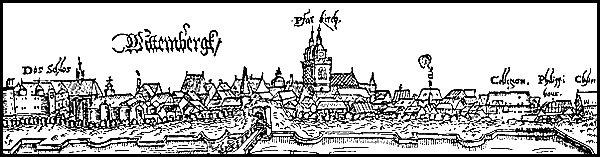
VIEW OF WITTENBERG ABOUT 1546 After a woodcut by Lucas Cranach the Elder
The Stone was found in his study, and his will was fulfilled, and he lieth betwixt a heap of three and thirty fir trees in the fort of the Hill in a great hole where this is erected.
VI
If these will not serve, then shall you hear the testimony of a learned man John Wierus, cap. 4. libro I. de magis infamibus.[42] Which I have translated.
John Faustus, born at Kundling, a little village, learning Magic at Gracovia, where he was openly taught, and exercised it. In sundry places of Germany, with the admiration of many and with manifold lies, fraud, and illusions, with vain vaunting and promises but could do nothing: one example I will shew to the Reader, upon this condition, that he will pass his faith first to me that he will not imitate him: Then rehearseth he one of his knaveries, how he took upon him to make no hair grow upon a man’s face, and took away with a powder which I will not name, both the beard that he had and all the skin, causing such inflammations in his face that it burned all over cruelly. This he committed being taken at Batoburg upon the bank of the river Mosa hard upon the bounds of Gelderland: Another (saith this learned Physician) not unknown to me, having a black beard, the rest of his face somewhat dark and swarthy, witnessing melancholy (for he was splenetic) when he came to Faustus, who readily said: Truly I thought you had been my Familiar, straightway marking your feet, whether long and crooked nails stuck out of them: So likening this man to the Devil, which he thought had come unto him, which Devil he was wont to call Sorarius.
VII
For his death in the same place, thus saith he: At length he was found in a Village of the Duchy of Wittenberg by his bedside stark dead, and his face turned backwards, and the midnight before, the house was shaken as it is reported. Thus far he, an Author not to be doubted of, and approved through Christendom of singular and exact judgment, as appeareth by his writings of the like argument confutation.
VIII
More in the same place he saith: That a schoolmaster amongst the Goslaryens, instructed of Faustus the Magician, or rather Infaustus his evil doctrine, learned a way how the Devil might be bound by spell on a glass, who as you may there read was so affrighted, that lying one whole year speechless, at the end he spake of his fear and Devil’s appearance, and then having received his Christian rites died.
As for the Author this Doctor Wier, doubt you not of his credit, for he is alleged of the very singularest scholars, as the best that ever wrote in that argument. We have a Gentleman of our own country, master Reignold Scot, Esquire,[43] that doth universally quote him as his chief and especial help in his discovery of Witchcraft, yea and he testifieth of him not without good desert, saying: J. Bode[44] in his lawyerly Physic reasoneth contrarily, as though Melancholy were farthest off from these old women whom we call Witches. And the most famous and noble Physician John Wier for his opinion in that behalf: Lo, where he calleth him the most famous Physician as he was then certainly, in the discovery of Witchcraft, lib. 3. Cap. 7.
IX
Thus far I have set down that you may know and persuade yourselves so far as you see just cause by the reasons.
VALE.