INTRODUCTION
Reading edition
THE story of the man who sells his soul to the powers of evil in return for material gain, is one of the most ancient in the history of humanity. It is perhaps as old as humanity, for when the light of self-consciousness first began to dawn on man, he no doubt desired to know more than his limited intellect could tell him, or to possess something that the world could not or would not give him. When he looked around, and was frightened at his own littleness, he created gods for his protection, and these gods he endeavoured to propitiate, until they became his tyrants. They were the symbols of his hopes and fears, so that when he was propitiating his gods he was stereotyping the limitations of his own mind. And the most important of those limitations was that he must not look beyond his manufactured gods for the hidden causes of things. A profound instinct nevertheless urged him to probe beyond, and the resulting spiritual unrest, which has always manifested itself spasmodically in the human race, underwent various personifications at different times. The elements of the Faust story were already present in the Garden of Eden—the Tree of Knowledge, the personification of Evil in the Serpent, and the Woman who was tempted to overstep the bounds of what was permitted by the orthodox authority, in order to grasp the Forbidden Fruit. It is significant for the peculiar construction of the human mind, that it was always the Spirit of Evil which led the way to spiritual emancipation. In order to give concrete expression to his almost unconscious thirst for greater knowledge, man had to pretend to himself that this craving was pernicious. His very attempts to free himself from superstition provide the strongest evidence of the tortuous way in which his mind had to work, for it could only rise to a higher conception of its own worth by playing a game of self-deception.
The Faust problem was not peculiar to the Christian era. The Jews had their Solomon and the Greeks their Prometheus, but it was only at the end of the Middle Ages, when the old world was in the melting-pot, that there arose the most famous of all these legends, the most curious element in which is perhaps the fact that there was at the source of it an actual person.
I
The Historical Personage
The first record of an actual magician or adventurer of the name of Faust occurs in a letter written in Latin by the Abbot Trithemius of Würzburg, formerly of the Benedictine monastery of Sponheim, near Kreuznach in the Palatinate, to the mathematician and Court astrologer, Johann Virdung, on the 20th of August, 1507. The learned abbot, whose name is the Latinized form of Johannes Tritheim, writes to his friend in Heidelberg to warn him against a certain Faust from whom the astrologer is expecting a visit:—
“That man, about whom you have written to me, Georgius Sabellicus, who has ventured to call himself the prince of necromancers is a vagabond, an empty babbler and a knave: worthy to be whipped, that he might no longer profess publicly abominable matters which are opposed to the holy Church. For what are the titles which he assumes, other than the signs of a most stupid and senseless mind, which proves that he is a fool and no philosopher? Thus he has adopted the following title: Magister Georgius Sabellicus, Faustus junior, fountain of necromancers, astrologer, magus secundus, chiromancer, aëromancer, pyromancer, second in hydromancy. Behold the foolish temerity of the man; what madness is necessary to call oneself the fountain of necromancy. A man who is, in truth, entirely devoid of education, should rather call himself a fool than a magister. But his wickedness is not unknown to me. When some years ago I was returning from the March of Brandenburg, I met this man in the town of Gelnhausen, where I was told in the inn of many frivolous things promised by him with great audacity. When he heard of my presence, he fled forthwith from the inn and could not be persuaded by anyone to present himself to me.
He sent to me also by a citizen the advertisement of his foolishness, which I remember he sent to you. In that town I was told by priests, that he had said in the presence of many people that he had attained such great knowledge and memory of all wisdom, that if all the works of Plato and Aristotle, together with all their philosophy, had been absolutely wiped out of human memory, he would restore them, like a second Hebrew Ezra, by his genius, totally and more excellently than before.
When I was later on in Speyer, he came to Würzburg, and is said to have boasted with similar conceit in the presence of many people, that the miracles of our Redeemer Christ are no cause for astonishment; he himself could do everything that Christ had done, as often as and whenever he wished. This year, during the last days of Lent, he came to Kreuznach, where he made vast promises in a similar swaggering manner, and said that in alchemy he was the most perfect of any that had ever lived, and knew and could perform whatever the people wished. During this time the office of schoolmaster in this town was vacant, and it was conferred upon him through the intercession of Franz von Sickingen, the steward of your prince, a man who is exceedingly ardent with regard to mystical matters. But soon afterwards he began to practise a most infamous kind of fornication, forsooth, with the boys, and he fled, when the matter came to light, from his imminent punishment.
This is what is evident to me, according to the most certain testimony, concerning that man whose visit you are awaiting with such eagerness.”
The accusations of the abbot are to be taken with a pinch of salt, for he was himself suspected of dabbling in magic, and his indignation may have been coloured by more than a tinge of jealousy. He is known to have declaimed before the Emperor Maximilian against the followers of the black art, and there is a letter, written by him only four days before the above epistle to Virdung, in which he protests against the imputing to him of magic practices. He was even rumoured to have conjured up the spirits of the dead in the presence of the Emperor. At any rate, he does not seem to have been anxious for popular inclusion among the necromancers. Neither is it at all certain that there is any truth in the scandal about the school at Kreuznach, for that was the sort of vice which it was usual to attribute to dissolute magicians.
It cannot be explained why Faust should have called himself junior, for there is no trace of any earlier magician of the same name. Whether Sabellicus was his real name, and Faustus junior a kind of professional title, or whether George Faust attached the title Sabellicus to his name as an allusion to the magic art of the Sabines, is likewise a mystery. It will be noticed that he is called George, and the same Christian name occurs again, six years later, in the second existing reference to Faust.
Conrad Mutianus Rufus (Conrad Mut, Canon at Gotha, called Rufus on account of his red hair), a friend of Reuchlin and Melanchthon, and one of the most cultured of the Humanists, makes the following statement in a letter written from Erfurt to his friend Heinrich Urbanus on the 7th of October, 1513:—
“There came a week ago to Erfurt a certain chiromancer named Georgius Faustus, Helmitheus Hedebergensis, a mere braggart and fool. The professions of this man and of all the fortune-tellers are vain. The rude people marvel at him, the priests should denounce him. I heard him swaggering at the inn. I did not reprove his boastfulness, for why should I bother about the foolishness of others?”
These two George Fausts are obviously the same person. The term Helmitheus Hedebergensis may be meant for Hemitheus Hedelbergensis, half-god of Heidelberg, where the charlatan perhaps pretended to have studied.[1] There was a Bachelor named Johann Faust, of Simmern, at Heidelberg in the year 1509, but it is unlikely that he has any connection with our Faust.
There is a legend that Faust was given asylum at the monastery of Maulbronn by the Abbot Entenfuss in the year 1516, and that he there pursued his alchemistic activities. The well-known “Faust tower” which is still shown there was, however, not built until nearly a hundred years later.
The next reference we find is an entry in the account book of the Bishop of Bamberg by the latter’s chamberlain, under the date 12th of February, 1520:—
“Item 10 gulden given and presented to Doctor Faustus philosophus in honour of his having cast for my gracious master a nativity or indicium, paid on Sunday after Scholastica by the order of Reverendissimus.”
A less flattering entry is that in the minutes of the resolutions of the Town Council of Ingolstadt in 1528:—
“To-day, Wednesday after St. Vitus, 1528. The fortune-teller shall be ordered to leave the town and spend his penny elsewhere.” This is supplemented by another entry in the record of expulsions: “To-day, Wednesday after St. Vitus, 1528, one who calls himself Dr. Jörg Faustus of Heidelberg has been told to spend his penny elsewhere, and has promised not to resent or mock such summons of the authorities.”
It will be noticed that the same Christian name again occurs, in conjunction with the reference to Heidelberg.
There is then a gap of some eleven years before we meet the name again in the Index Sanitatis of the physician Philipp Begardi of Worms, published in 1539:—
“There is also to be found a renowned and bold man; I did not wish to have mentioned his name, but it will not be hidden or unknown. For some years ago he wandered through almost every province, principality and kingdom, made his name known to everybody, and boasted loudly of his great art, not only in medicine, but also in chiromancy, necromancy, physiognomy, crystal-gazing and more of such arts. And not only boasted, but also gave himself out to be and wrote himself as a famous and experienced master. He also himself acknowledged and did not deny, that he was, and was called Faust, and signed himself Philosophus Philosophorum, etc. There has, however, been a great number of people, who have complained to me, that they have been swindled by him. His promises were as great as those of Thessalus. Similarly his fame, like that of Theophrastus also; but the fulfilment, as I learn, was found to be very small and fraudulent; yet he was not slow in taking money, and at his departure many people were cheated. But what can one do about it, gone is gone.”
When Philipp von Hutten, the cousin of the more famous Ulrich von Hutten, was about to start on his first expedition to Venezuela in 1534, Faust prophesied that the voyage would be unfortunate, and he was right, for von Hutten, in a description of the voyage written in 1540, writes: “I must acknowledge that the philosopher Faustus divined it correctly, for we have had a very bad year.” A rival fortune-teller, Joachim Camerarius, who had declared that the voyage would be lucky, asks in a letter to a friend, written in 1536, what Faust can prophesy about the German Emperor’s next battle with the King of France.
Johann Gast, a protestant clergyman at Basle, relates two anecdotes of Faust in the edition of his Sermones Convivales which appeared in 1548:—
“Concerning the Necromancer Faust.
He once turned into a very wealthy monastery, in order to spend the night there. A brother sets before him ordinary, weak, not very tasty wine. Faust asks him for better wine from another barrel, which is usually given to distinguished guests. The brother says: ‘I haven’t the keys. The prior is asleep, and I may not rouse him.’ Faust replies: ‘The keys lie in that corner; take them and open that barrel on the left and bring me a drink!’ The brother refuses and declares that he has no permission from the prior to give the guests other wine. When Faust hears this, he says: ‘In a short time thou wilt experience strange things, inhospitable brother!’ Early next morning he went away full of bitterness, without taking leave, and sent a raging devil into the monastery, who made an uproar day and night, and set everything in motion in the church and in the rooms of the monks, so that they had no peace, whatever they did. At last they consulted as to whether they should abandon the monastery or totally destroy it. They therefore announced their misfortune to the Count Palatine, who took the monastery under his protection and sent away the monks, to whom he allows every year what they need, keeping the rest for himself. Some assert that even now, when monks enter the monastery, there arises such a tumult, that the inhabitants have no peace. The devil knows how to manage that.
Another Instance of Faust.
When I was dining with him in the great College at Basle, he gave the cook birds of various kinds, concerning which I did not know where he had bought them or who had given them to him, since at that time none was being sold in Basle, and they were birds such as I have never seen in our neighbourhood. He had with him a dog and a horse, which, as I believe, were devils, since they could do everything. Some people told me that the dog had sometimes assumed the form of a servant and brought him food. The wretched man came to a terrible end; for the devil strangled him; his corpse lay on the bier on its face all the time, although it was turned round five times.”
The chronicler appears to have been a superstitious person, and he is the first to refer to Faust as being in league with the Devil, for Trithemius had looked upon him as a dissolute, wandering scholar, and Begardi thought him little more than a common charlatan. None of the last three authorities quoted above has mention of Faust’s Christian name, but he appears as Johannes in a book compiled by Johannes Manlius (Johann Mennel) in 1563, Locorum Communium Collectanea, which consists mainly of reports of conversations with Melanchthon, to whom the following reminiscence is also to be attributed:—
“I knew a man named Faustus of Kundling, a little town near my home. When he studied at Cracow, he had learned Magic, which was formerly keenly studied there and where public lectures were delivered about this art. Later he wandered about in many places and spoke about secret things. When he wanted to create a sensation at Venice, he announced that he was going to fly into the heavens. The devil then lifted him up in the air, but let him fall to earth again, so that he nearly gave up the ghost. A few years ago, this Johannes Faustus sat very downcast on his last day in a village in the duchy of Württemberg. Mine host asked him why he was so downcast, this not being his custom or habit; for he was usually a graceless rogue, who led a dissolute life, so that at one time and another his love affairs had nearly brought him to his death. He thereupon replied to the host in that village: ‘Do not be frightened to-night!’ At midnight the house was shaken. Since on the next morning Faustus had not risen and it was already noon, the host went into his room and found him lying beside the bed with his face twisted round, as the devil had killed him. During his life, he kept a dog, which was the devil.... This Faustus escaped from our town of Wittenberg, when the excellent prince, duke Johann, had given the order that he was to be arrested. In a similar way, he is said to have escaped likewise in Nuremberg. At the beginning of the meal, he felt warm; he immediately rose from the table and paid his scot to the host. He was hardly outside the door when the minions came and asked for him. This magician Faustus, an infamous beast, a cesspool (cloaca) of many devils, boasted that all the victories which had been won by the imperial armies in Italy, had been obtained for them by him through his magic, which was a most shameless lie.”
This story is repeated by Andreas Hondorff in his Promptuarium Exemplorum, which appealed five years later, in 1568:—
“Such a necromancer was Johann Faustus, who practised many tricks through his black art. He had with him always a black dog, which was a devil. When he came to Wittenberg he would have been arrested by order of the Prince Elector, if he had not escaped. The same would have happened to him in Nuremberg also, where he likewise escaped. But this was his reward. When his time was up, he was in a tavern in a village of Württemberg. Upon the host asking him why he was so downcast, he replied, ‘Do not be afraid to-night, if you hear a great banging and shaking of the house.’ In the morning he was found lying dead in his room, with his neck twisted round.”
There is a casual reference to Faust in the Table-talk of Martin Luther, edited by Johannes Aurifaber (Johann Goldschmidt) in 1566:—
“But when in the evening, at table, mention was made of a necromancer named Faustus, Doctor Martin says earnestly, ‘the devil does not employ the services of magicians against me; had he been able to do me hurt, he would have done it long ago. He has no doubt had me often by the head, but he never-the-less had to let me go again.’”
In a chronicle concluded in the same year by the Count Froben Christoph von Zimmern, the scene of Faust’s death is given as Staufen in Breisgau:—
“But that the practice of such art (of soothsaying) is not only godless, but extremely perilous, that is undeniable, as is proved by experience, and we know how it went with the famous necromancer Faustus. He, after many wonderful things which he did during his life, about which one could write a special treatise, was at last, at an advanced age, slain by the evil spirit in the province of Staufen in Breisgau.”
And there is further a reference to his revenge on the inhospitable monks:—
“About that time (i.e. after 1539), Faustus died at, or at least not far from Staufen, the little town in Breisgau. During his life, he was a strange necromancer, who in our times could be found in German provinces and had so many strange dealings, that he will not easily be forgotten for many years. He lived to be an old man, and, as is said, died wretchedly. Many people have thought that he was killed by the evil spirit, whom in his lifetime he only called his brother-in-law (Schwager). The books which he left behind have come into the possession of the lord of Staufen, in whose province he died, and many people have afterwards tried to obtain them, and in my opinion desired in them a perilous and unlucky treasure. He charmed a spirit into the monastery of the monks of Lüxheim in Wasgau, which they could not get rid of for many years, and which troubled them strangely; for the sole reason that they had once been unwilling to give him shelter for the night, that was why he had procured for them this turbulent visitor; at the same time, it is said, that a similar spirit was attached to the former abbot of St. Diesenberg by an envious wandering scholar.”
The last considerable reference, before the publication of the folk-book, is in the edition of De Praestigiis Daemonum by Johannes Wierus (Johann Weyer, or Wier), which appeared in 1568. A German edition of this book was published eighteen years later. Wierus was one of the most distinguished and enlightened physicians of his time, and he fought for years, at first with some success, against the fanatical persecution of witches which was providing human torches in every village in Germany. In this book on the illusions of the devils, he protests against the witch-burnings, and it is noticeable that he does not definitely refer to Faust’s alleged compact with the Devil:—
“When formerly at Cracow in Poland necromancy was taught publicly, there came one of the name of Johannes Faustus, of Kundling, who in a short time understood this art so well, that a short time ago, before the year 1540, he practised it to the amazement of many and with many lies and frauds in Germany, publicly and without fear. What a strange hoaxer and adventurer he was, and what strange tricks he was able to perform, I will here only demonstrate to the reader by one instance, but with the instruction that he promise me beforehand that he will not imitate him. When on one occasion this necromancer Faustus on account of his wicked tricks was imprisoned at Battenburg, which lies on the River Maas and borders on the Duchy of Geldern, in the absence of the Count Hermann, the chaplain of that place, Dr. Johann Dorsten, a pious, simple man, showed him much kindness, because he had promised to teach him many good arts and make him a profoundly experienced man. Therefore, when he saw that Faust was very fond of drink, he sent him wine so long till the barrel was empty. But when the magician Faustus noticed that, and the chaplain also prepared to go to Graven to get a shave, he told him that if he would procure for him more wine, he would teach him an art, how to remove his beard without a razor or anything. When the chaplain forthwith agreed, he bade him take some arsenic and rub well his beard and chin with it, not telling him to prepare it beforehand and mix it with other things. When he did this, his chin began to burn, so that not only the hair fell out, but the skin and flesh came off as well.
I knew another man who had a black beard, and was yellowish of face on account of his melancholy complexion. When he visited the magician Faust, the latter said to him: ‘Really, I thought you were my brother-in-law, my sister’s husband; and so I looked immediately at your feet, to see whether you had long, crooked claws!’ Thus he compared the good man, because he was swarthy, to the devil, and called him also, as was always his custom, his brother-in-law. But he received his reward at last. For, as is said, he was found dead one morning beside his bed in a village in Württemberg, his face turned towards his back, and the previous night there was such a turmoil in the house, that the whole house shook.”
And lastly, there is a reference to Faust’s conjuring up the dead in Wolffgang Bütner’s Epitome Historiarum, in 1576:—
“I have heard that Faustus, at Wittenberg, showed to the students and to an exalted man N——, Hector, Ulysses, Hercules, Æneas, Samson, David and others, who came forth with fierce bearing and earnest countenance and disappeared again, and princely personages are also said to have been present at the time and to have looked on.”
At this point it will be well to summarize what we have learnt about Faust from contemporary references. The difficulty with regard to his Christian name has already been mentioned. If his real name was Georg, it may have been forgotten and replaced by the more common one of Johann, or there may have been two magicians of the name of Faust, the older one named Georg and the later one Johann, who may have taken the name of Faust because it had already been rendered famous by his predecessor. The latter hypothesis is, however, extremely unlikely, and there seems very little reason to doubt that all the references are to the same individual. It has been suggested that the name Johann may have originated through confusion with Johann Fust, the printer, but the latter died in the year 1466, and it was only during the seventeenth century that the Faust legend was attributed to him. The earliest investigators thought that the whole story was a mere legend, and possibly invented by the monks as an expression of their hatred of the inventor of printing, though as a matter of fact, it was only through financial sharp practice that Fust obtained possession of the printing outfit of the real inventor, Gutenberg.
As early as 1683, however, a professor of theology at Wittenberg brought forward evidence of the actual existence of an individual of the name of Faust.[2]
According to Manlius-Melanchthon, Faust was born in Knittlingen and studied at the University of Cracow, though he appears later to have said he came from Heidelberg. About the year 1505, the Abbot Trithemius came in contact with him at Gelnhausen, though he did not speak to him, and does not even say that he actually saw him. He was later in Würzburg, and in 1507 he came to Kreuznach where he obtained a post as schoolmaster, though he was soon compelled to flee on account of alleged immorality. In the year 1513, he was in Erfurt, where he called himself the half-god of Heidelberg. He may have stayed at Maulbronn during the year 1516, but we hear nothing definite until he casts the horoscope of the Bishop of Bamberg in 1520. Eight years later, he was expelled from Ingolstadt, and six years after we find Philipp von Hutten seeking his advice about a forthcoming expedition. Another five years elapse, and a physician of Worms refers to the complaints of people who had been swindled by him; the remark “gone is gone” may allude to the disappearance or death of Faust, though it is more likely that it refers to the money of the victims. The Zimmern Chronicle mentions the village of Staufen, near Freiburg in Breisgau, as the scene of his death, and gives the date as some time after 1539. Wierus places the period of his activity before 1540, and when Gast writes in 1548, he refers to Faust as being already dead. He appears to have travelled extensively, for there are additional allusions to his presence in Wittenberg, Nuremberg, Battenburg on the Maas, and Basle, where Gast met him.
There seems no doubt that Doctor Faust surpassed all the wandering scholars of his time both in pretensions and notoriety. His attempts to fly and to conjure up spirits, to say nothing of the boast that he could restore lost manuscripts of classical authors, are all intelligent anticipations of what has been done or pretended in the present century. He was rather indiscreet in declaring that he had helped the Imperial armies to victory in Italy, but he may have been emboldened by patronage such as that of Philipp von Hutten and the Bishop of Bamberg, though the distinguished humanists and reformers would have nothing to do with the braggart. The students appear to have been greatly impressed by him and he certainly imposed on the uneducated people.
Soon after his death the historical facts become blurred, and the mysterious circumstances surrounding his disappearance may have given an additional impulse to the subsequent legend, which appears, indeed, to have started even during his lifetime. The later contemporary references are already coloured with imaginative detail, and anecdotes relating to his various pranks, real or alleged, were circulating among all classes of the people. These soon became the nucleus of a large collection of stories, some of which had formerly been related of other magicians and were now fathered on Faust, until in the year 1587, scarcely fifty years after his death, the first printed account of the life of “Dr. Johann Faust, the notorious Magician and Necromancer” was published, as a warning to all readers, at Frankfort-on-the-Main. It is astonishing that he should so soon have become a myth, but an explanation may perhaps be sought in the ferment and unrest of an age which stands between the medieval and the modern, when old conceptions were tumbling and new worlds, both material and intellectual, were being discovered. Literature was no longer a diversion for the upper classes, and the dreams and traditions of the people were finding their way into print. Till Owlglass, the Wandering Jew, Doctor Faust are all types in which have been concentrated the lore and myth of centuries. In these representative figures, the people have focussed their longings and their aversions, their hopes and fears, and none of the wizards of popular superstition was more familiar to them than the man who had put forth his pretensions in all the market-places of Germany.
The Zimmern Chronicle declares that when Faust died, he left behind him various books which came into the possession of the lord of Staufen, and that many people had endeavoured to obtain these works. Whether there is any truth in this statement is a matter for considerable doubt, but the booksellers were not long in turning the belief to their own advantage and supplying the demand for books of an occult nature. There were at first manuscripts in circulation, which gave instructions how to practise the various magic arts attributed to Faust, the most famous of them being the Höllenzwang, or Conquest of Hell. They were usually disposed of secretly by disreputable people at exorbitant prices,[3] but later the publishers brought out volumes which they ascribed to the authorship of Faust, and some of these were even supplied with false dates, to give them an appearance of antiquity.
One such manuscript bears the following title:—
“Secret and hidden, highly-authenticated Magic Writings, for the advantage of all, which have been truly tested by me, Doctor Johann Faust, and found trustworthy in each and every case, to the purpose that I have set down herein honestly and without falseness or deceit the principles of all the arts of the world, how I have practised them all myself and come thereby to great fortune; likewise I have presented openly everything which I have herein recounted to my successors, necromantic as well as cabalistic, that I may be well remembered; all Spirits have been subject to me through these my Writings, they have been compelled to fetch for me and do all my bidding. Nothing further have I written but these twelve parts. Let him who finds and obtains them use them with caution and take strict heed of all therein, that you may not endanger body and life, against which I warn you in all sincerity.”
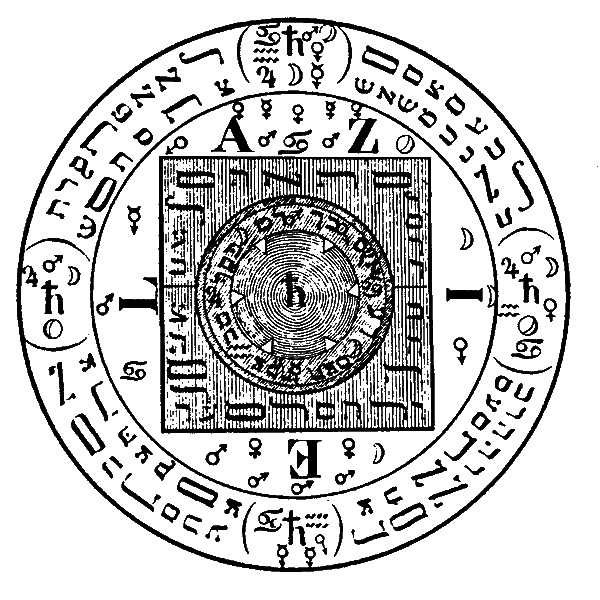
THE SEAL OF AZIEL From Faust’s Triple Conquest of Hell.
A Höllenzwang printed in the year 1607 explains in greater detail the benefits to be attained by its aid:—
“Dr. Johann Faust’s Juggler’s Bag, concerning all kinds of unheard-of, secret, merry feats, mysteries and inventions whereby a man may interpret dreams, tell fortunes, open locked doors, cure the gout, recognize adulterers and fornicators, inspire strange men, women and maids with love, increase his height by some ells, make himself invisible or invulnerable, change his shape, rouse the thunder and lightning, collect and disperse snakes, catch pigeons, fish or birds in his hands, overcome his enemies, and perform other innumerable, incredible and extravagant feats, both merry and advantageous, together with five other extravagant, excellent and authentic devices. Now for the first time from the Original written with his own hand by Dr. Faust, published for the particular pleasure of all artists by Johann de Luna, Christoph Wagner’s former disciple and well-experienced in the Magic Arts.”[4]
II
The German Faust Book
It was not long before a publisher saw the business possibilities of the legend, for in the autumn of the year 1587 there appeared at Frankfort-on-the-Main the first printed account of the life and death of Faust:—
Historia Von D. Johann Fausten, dem weitbeschreyten Zauberer unnd Schwartzkünstler, Wie er sich gegen dem Teuffel auff eine benandte zeit verschrieben, Was er hierzwischen für seltzame Abentheuwer gesehen, selbs angerichtet und getrieben, bisz er endtlich seinen wol verdienten Lohn empfangen. Mehrertheils ausz seinen eygenen hinderlassenen Schrifften, allen hochtragenden, fürwitzigen und Gottlosen Menschen zum schrecklichen Beyspiel, abscheuwlichen Exempel, und treuwhertziger Warnung zusammen gezogen, und in den Druck verfertiget. Iacobi IIII. Seyt Gott underthänig, widerstehet dem Teuffel, so fleuhet er von euch. Cum Gratia et Privilegio. Gedruckt zu Franckfurt am Mayn, durch Johann Spies. M.D.LXXXVII. [History of D. Johann Faust, the notorious Magician and Necromancer, how he sold himself for a stipulated Time to the Devil, What strange Things he saw, performed and practised during this Time, until at last he received his well-merited Reward. For the most Part extracted and herewith printed from his own posthumous Writings as an awful and abominable Example and sincere Warning to all presumptuous, inquisitive and godless Persons. “Submit yourselves to God. Resist the Devil, and he will flee from you” (James iv). Cum Gratia et Privilegio. Printed at Frankfort-on-the-Main by Johann Spies. M.D.LXXXVII.]
The story is preceded by a dedication to two friends of the publisher, and a Preface to the Christian Reader, in the former of which there is reference to the widespread popularity of the legend: “Since many years ago there was great and universal talk in Germany about the various adventures of Doct. Johannes Faustus, the notorious magician and necromancer, and everywhere there is a great demand for the history of the said Faustus at entertainments and gatherings, and since likewise there is now and then mention in the works of some modern historians of this magician, his devilish arts and fearful end, it has often been a matter of astonishment to me that nobody has composed a regular account of this fearful story and published it as a warning to the whole of Christendom. I have also not hesitated to enquire from scholars and wise people whether this history has perhaps already been written down by anyone, but I have never been able to discover anything certain, until recently it was communicated and sent to me by a good friend in Speyer, with the request that I should publish and present it as a fearful example of devilish deceit, murder of body and soul, as a warning to all Christians.” This dedication is dated Monday, the 4th of September, 1587, and signed by Johann Spies himself. The Preface to the Christian Reader, amid much quoting of the Bible, declares that, “The exorcisers of the devil seldom come to a good end, as is to be seen in the case of Dr. Johann Faustus, who was alive within the memory of man, signed a compact and league with the devil, experienced many strange adventures and practised abominable infamy and vice, with guzzling, swilling, fornication and all kinds of sensual pleasure, until at last the devil gave him his deserved reward and wrung his neck in a dreadful manner.”
This little volume must have been enormously popular, for although it appeared so late in the season, there were before the end of the year at least four reprints, a new original edition, and a further edition containing eight new chapters. The editio princeps (of which there is a copy in the British Museum) contains 69 chapters.
It is not long since an older version of the Historia in manuscript, dating from the seventies or early eighties of the sixteenth century, was discovered.[5] It contains a different preface and two more chapters, one of which describes how Faust releases a nobleman and old schoolfellow named von Reuttpüffel from captivity in Turkey, and brings him home just after his wife has married again. The story is told with all the hearty bawdiness of the time, and the wife is made to feel thankful that her vigorous first husband has returned to her, after her single, disappointing experience with the second one. There are in addition a few prophecies made by Faust in his last year concerning the Papacy, including one concerning the Massacre of St. Bartholomew in 1572. It was written, of course, after the event. The preface states that the manuscript was translated from the Latin, but whether the first version of the Faust book was really written in any other language than German it is impossible to say.
It is already obvious from the Preface to the Faust book that the publication of the wicked life and dreadful doom of Faust was intended as a warning to all who could not find peace and content in the bosom of the Church, but would seek to explore beyond, with the treacherous aid of science, which at that time, of course, included magic. Curiosity in theological matters was regarded as an unhealthy symptom, and was only playing into the hands of the Devil, who, in the words of the Epistle of Peter, quoted in the Preface, as a roaring lion, walketh about, seeking whom he may devour. Faust represents the spirit of enquiry, which was regarded as fatal to the soul, but nobody seems to have wondered whether a soul that had to be so jealously guarded and could be so easily lost was worth having at all. The strong Lutheran tendency which was a characteristic of the activities of Spies as a publisher, is also a marked feature of the Faust book. Martin Luther himself shared the prevailing view of the time, that the world is divided into two camps, that of God and that of the Devil, and the latter is mentioned frequently in his writings. Faust can, with some reservation, be looked upon as the great counterpart of Luther; they are the two poles of the sixteenth century. In the book, the contrast is all the more striking since it does not appear as an intentional element in the work. The views of Luther are not definitely defended, but are taken as a matter of course, and the contrast between the theologian and the sceptic develops naturally from the theme, though the Lutheran doctrine occasionally comes prominently to the fore. Both the Faust of the legend and Luther were Doctors of Theology and closely connected with Wittenberg, the cradle of the Reformation. Starting from the same point, they reached goals which were diametrically opposed. They both lectured on the culture of antiquity, and they had both been in Rome, but whereas Luther had set out with feelings of reverence, only to return in disappointment and indignation, Faust was merely amused and contemplated with cynical complacency the license of the Vatican, where the priests were no better than himself. Luther married in accordance with the tenets of the Church, but Faust rejected the sacrament of marriage for the pagan Helena. Luther based his faith on the Bible, Faust was not content to accept the Holy Writ, but sought to penetrate the forbidden mysteries beyond it. Faust entered into league with the Devil, while Luther hurled his inkstand at him.[6]
It is true that it was not in the spirit of Luther to conceive of the defection from orthodox theology as defection from God, and the ridicule to which the Church of Rome and its priests are exposed in the Faust book, even the Devil himself appearing in the guise of a monk, would quite possibly even have appealed to his robust sense of humour. Nevertheless, there seems little reason to doubt that the book was written from the Lutheran standpoint. Since, however, in the field of German literary research, it seems impossible for any definite point of view, with whatever weight of proof it may be supported, to be maintained for very long, before a scholar brings forward its exact opposite, which he defends with equally weighty evidence, there has recently been an attempt to prove that the tendency of the Faust book was not Lutheran but Catholic.[7] The author of this theory does not deny that the intention of some passages is obviously hostile to Catholicism, but he declares that they are later interpolations, and endeavours to prove that the book is a parody on Luther, who is represented as a modern Bacchus and companion of the Devil. The first direct anti-clerical reference is the taunt at the celibacy of the clergy in Faust’s conversation with Mephostophiles concerning the former’s desire to take a wife. The Devil endeavours to dissuade him by declaring that marriage is a divine institution, but Faust retorts that the monks and nuns do not marry. This passage is lacking in the Wolfenbüttel MS. In the chapter which deals with the journey through Europe, Faust remarks at Cologne that the Devil is in the Church of St. Ursula with the 11,000 virgins. The MS. has Tempel instead of Teufel. When Faust arrives in Rome, he spends three days and nights invisible in the pope’s palace, finding that “these pigs at Rome are fattened and all ready to roast and cook,” and after his experience in the harem at Constantinople, he mounts up in the air in the vestments of a pope. These last two adventures are also to be found in the MS., but Dr. Wolff declares them to be interpolations. His evidence, however, is not convincing, and there is little reason to assume that the spirit of any literary version of the Faust book which may have been extant before 1587 was different from the tendency of the edition published by Spies.
The development from historical fact to legend was influenced considerably by contact with other myths of the same type. There were numerous alleged covenanters with the Devil in the Middle Ages, of whom the most akin to Faust was Theophilus of Adana. But Theophilus was saved eventually from eternal damnation by the intervention of the Virgin Mary, and if the Faust book had really been of Catholic origin, there is little doubt that the Madonna and the Saints would have saved him. The fires of Hell are essential to the spirit of the Faust book; the pact is irrevocable. Many features formerly attributed to other wizards were transferred to Faust, including the Devil in the form of a black dog which always accompanied Cornelius Agrippa of Nettesheim, the enchanted garden conjured up by Albertus Magnus for the Emperor in the midst of winter, and the exorcising of the spirit of Alexander the Great and other Greek heroes by the Abbot Trithemius. The incident of Helena may be due to the connection with Simon Magus, who was accompanied on his journeys by a courtesan named Helen. The fame of all these magicians sank into obscurity, and the one figure that carried on into future centuries the memory of their deeds was Faust.
When the oral legend was cast into literary form, the anonymous author appears to have consulted many works of reference. The long chapter which describes the journey of Faust and Mephostophiles, as well as the description of Paradise, is based on the Book of Chronicles of Hartmann Schedel, which appeared in 1493. The peculiar zig-zag nature of the journey is due to the fact that Schedel gives the towns in chronological order, according to the supposed year in which they were founded, and the author of the Faust book has copied them mechanically. Similarly he has taken from the German-Latin dictionary of the Swiss humanist Dasypodius, in alphabetical order, the list of fish, game and wine with which Faust entertains his guests at the court of the Count (really Prince) of Anhalt. For example, the fish are mentioned in the following order: Aal, Barben, Bersing, Bickling, Bolchen, Aschen, Forell, Hecht, Karpffen, Krebs, Moschel, Neunaugen, Platteissen, Salmen and Schleyen, and the wines are Burgunder, Brabänder, Coblentzer, Crabatischer, Elsässer, Engelländer, Frantzösische, Rheinische, Spanische, etc. The conversations concerning the physical sciences and celestial phenomena can be traced to Elucidarius, a collection of scientific dialogues.
Augustin Lercheimer’s (pseudonym for Professor Hermann Witekind of Heidelberg) Christliche Bedenken und Erinnerung von Zauberei, which first appeared in 1585, was formerly thought to have been a direct source of the Faust book, but it is possible that Lercheimer himself borrowed from an earlier manuscript of the Faust book. He anticipates modern science when He protests against the witch-burnings, and declares that witches should be sent to the physician rather than to the judge. In the third edition of his book, which was published in 1597, Lercheimer denounces the Faust book as a libel on the University and Church of Wittenberg:—
“It is all malicious lies.... He had neither house nor yard at Wittenberg or elsewhere, was never at home, lived like a vagabond, was a parasite, guzzled, swilled and lived by his conjuring. How could he have a house and yard by the outer gate of the town in the Scheergasse, since there never was a suburb and therefore no outer gate? Neither was there ever a Scheergasse there. That in such a University, a man whom Melanchthon used to call a cesspool of many devils should have been made Master, to say nothing of Doctor of Theology, which would be an eternal disgrace to the degree and honourable title, who believes that?... About all the other vanity, lies and Teufelsdreck in the book, I will say nothing.... It is, to be sure, nothing new and no cause for surprise that such calumnies are issued by the enemies of our religion, but it is unwarrantable and lamentable that our printers also should publish such books without shame, whereby honest people are slandered and inquisitive youths led to attempt similar magic feats; to say nothing of the abuse of the beautiful and noble art of printing, which has been conferred on us by God.”
The fact that Lercheimer, who was an ardent adherent of Luther, should have condemned the book in such terms, cannot be regarded as evidence of its anti-Lutheran tendency.
Another important manuscript was discovered recently in Nuremberg.[8] A certain Christoph Rosshirt, a teacher of Nuremberg, who had studied in Wittenberg, copied into an album about the year 1575, amidst other matter, anecdotes relating to various magicians, including Doctor Faust. It will be noticed that Faust’s Christian name is given here as George. The Faust stories are four in number:—
1. When Dr. Georgius Faustus is lecturing to the students at the University of Ingolstadt on philosophy and necromancy, he invites some friends to dinner, and tells them that the food and drink they are enjoying come from the wedding-feast of the King of England. He instructs them to hold on to the edge of the towel when water is brought for them to wash their hands, and he will take them to the dance at the King’s wedding. When they are discovered in the ball-room, they are taken for spies and arrested. They are condemned to be hanged, but Faust rescues them in the same way that he had brought them there. They wash their hands in England and dry them in Germany.
2. Faust asks a Jewish merchant at the Frankfort Fair to change him some French money into good talers. The merchant promises to call on Faust at his inn and bring him the money, but when he arrives, Faust is lying on a couch, apparently asleep. The Jew puts his bag of talers on the table and shakes Faust by the arm, but cannot rouse him; he becomes annoyed and shakes him violently by the leg, which comes off in his hand. He rushes in terror from the house, leaving behind him cloak and money-bag which are shared by Faust and his servant.
3. Faust sells a swineherd in Bamberg some fat pigs, but warns him against driving them into flowing water. On the next day the swineherd neglects the warning and the pigs are turned into bundles of straw. By this time Faust is well on the way to Nuremberg.
4. On the evening before he is due to fulfil his pact with the Devil, Faust arrives at a village inn and asks for a room for the night. In the tap-room there is a crowd of drunken, noisy peasants, who refuse to be quiet when Faust asks them. The magician bewitches them so that they remain sitting with their mouths wide open, and he is able to have his last meal in peace. He pays his bill, tips all the servants, and goes to bed, but is persuaded by the host to disenchant the drunken clowns. On the next morning, Faust is found dead in bed.
As some of these stories had already been in circulation about other magicians, it is obvious that Faust was already becoming in popular imagination the prototype, and it is possible to see the myth in progress of development. The magician who sold his soul to the Devil was not a new factor in the superstitious fantasy of the people, but it was convenient to father all the floating rumours on some outstanding personality of whom everybody had heard and who had, in the memory of many, boasted in public of his wicked art. It is of interest to note that whereas Bütner declares that it was at Wittenberg, the leading Lutheran University, that Faust conjured up the Greek heroes, this Nuremberg manuscript transfers his teaching activities in philosophy and necromancy to the centre of Catholic doctrine, Ingolstadt. Later on the scene is shifted to Erfurt, the seat of humanism.
The enlarged edition which appeared in 1587, with a different sequence of chapters and eight new ones added, has drawn for its new matter mainly on the De Praestigiis Daemonum of Wierus and the Christliche Bedenken und Erinnerung von Zauberei of Augustin Lercheimer, where the anecdotes are related for the most part about other magicians. The title-page of this edition states that it was printed by Spies, but his printer’s ornament is lacking, so the statement is most probably false.
The stories are as follows:—
1. Faust meets a peasant who has lost his horse, and tells him that he has just seen a man riding away on it. The peasant hurries after the supposed thief and there is a gory fight, until he notices that the other man’s horse is a stallion, whereas his own was a gelding.
2. Faust meets a priest in Cologne hastening to church with his breviary in his hand, and turns the sacred book into a pack of cards.
3. Faust enters an inn, where he is refused entertainment, as there is no food in the house. He taps the window with his finger, and says “Bring what you have”; then putting his hand outside the window, he draws in a large dish full of boiled pike and a large can of good Rhine wine.
4. A castle in which Faust is living is besieged by the Spanish troops of the Emperor Charles. He shoots fragments from a tree under which a Spanish colonel is sitting, although the latter is not visible from the castle, and catches the Spanish cannon-balls in his hands.
5. Faust swallows a servant in an inn, because he fills the glasses too full, and washes the morsel down with a bucket of water. The servant is afterwards discovered in the yard all wet and dripping.
6. Faust cuts off a man’s head in an inn, but is prevented from setting it on again by the mysterious influence of one of the spectators; so he causes a lily to grow on the table, from which he slices off the head, and immediately one of the spectators falls decapitated from his seat. Faust then sets the first man’s head on his shoulders again.
7. Faust invites some gentlemen to dinner, but when they arrive they find the table empty. Their host bids his spirit fetch food from a neighbouring wedding-party, and after the feast the guests ask him to show them one of his tricks. He causes a vine to grow on the table, with grapes for each of his guests, and tells each one to pick his own fruit with one hand and put his knife to the stalk with the other, but to be very careful not to cut. He then leaves the room, and when he returns they are all grasping their own noses with one hand and holding their knives in dangerous proximity with the other.
8. Faust teaches a chaplain how to remove his beard with arsenic.
The edition of 1589 is important, because it contains the six extra “Erfurt Chapters,” which were most probably based on local tradition in that town. Faust is seen here as a lecturer at the University. The following is a summary of these extra chapters:—
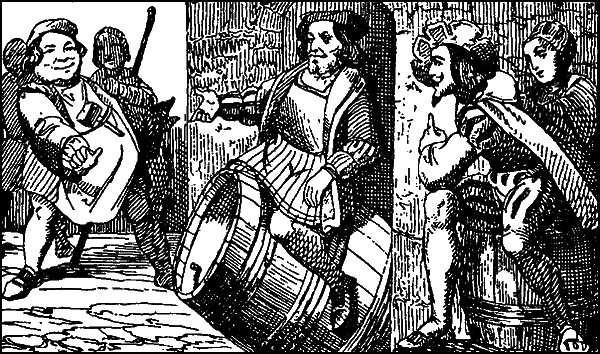
1. Some students invite Faust to accompany them to the Leipzig Fair, and after they have inspected the town and the University they come to a wine-cellar, where some draymen are endeavouring without success to roll out a huge barrel. Faust mocks their efforts, and they return his jeers with interest, but the owner of the barrel offers to make a present of the contents to whoever can lift it out. Faust goes into the cellar, sits astride the barrel as though it were a horse and rides out. The host has to keep his promise, and Faust shares the contents with his companions.
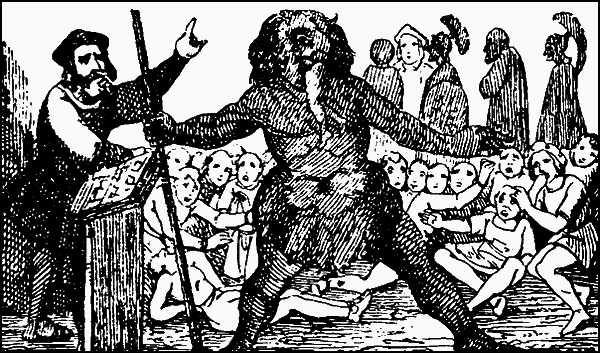
2. Faust was for some years at Erfurt and lectured at the University. On one occasion, when he is lecturing on Homer, the students request him to conjure up the ancient heroes of Greece. He promises to do so at his next lecture, which is consequently very fully attended. The heroes duly appear in their armour—Menelaus, Achilles, Hector, Priam, Alexander, Ulysses, Ajax, Agamemnon and others, followed by the one-eyed giant Polyphemus, with the extremities of a man he is eating still projecting from between his teeth. The spectators are terrified, but Faust laughs and orders the spirits to go away again, which they all do with the exception of Polyphemus, who looks as though he would like to devour one or two of the students. However, he also is persuaded to retire, but the students do not ask Faust to repeat the experiment.
3. Faust offers to bring to light the lost comedies of Terence and Plautus, though only for a sufficient length of time to enable them to be copied. The theologians and members of the University council, however, think that there are enough books in existence from which the students can learn Latin, and in any case there is the possibility of the Devil inserting in the newly discovered works all kinds of poison and bad examples, and the disadvantage might outbalance the gain. So Faust is not given the opportunity this time of proving his skill.
4. While Faust is in Prague, a friend of his, who is giving a party in Erfurt, desires his presence, and presently there is a knock at the door and Faust is seen to have just alighted from his horse. He says he cannot stay long as he must be back in Prague on the morrow. He gets intoxicated, and asks the guests whether they would not like to try some foreign wines. He thereupon bores four holes in the table and puts plugs into them. Glasses are fetched, Faust draws the plugs and serves each man with the wine he desires. It appears that his horse, who is devouring all the oats in the stable and looking for more, is really Mephostophiles. Early in the morning Faust rides away, and the guests who accompany him to the door see his horse rise with him into the air.
5. Faust invites some friends to his lodging, and when they arrive there is neither food nor drink, fire nor smoke. Their host raps on the table with his knife, and a servant comes in. Faust asks, “How swift are you?” and the reply is, “Like an arrow.” “No,” says Faust, “you cannot serve me, go back whence you came.” He raps again, and another servant enters, who tells Faust that he is as swift as the wind. He also is sent away. A third servant is as swift as thought and is accepted by Faust, who orders him to bring food and drink for the feast. The goblets are put on the table empty, but Faust asks each of his guests what kind of wine or beer he would like, holds the goblet out of the window and draws it in again full of the desired liquor.
6. A famous Franciscan monk, named Dr. Kling, who was well acquainted with Dr. Martin Luther, endeavours to convert Faustus. But Faust declares it would be dishonourable to go back on his pact with the Devil, which he has signed with his own blood. “The Devil has honourably kept his part of the bargain, therefore I will keep mine.” The monk reports this conversation to the Rector and Council of the University, and Faust is compelled to quit Erfurt.
These stories are also to be found in a seventeenth-century manuscript chronicle of Thuringia and the town of Erfurt, based on an Erfurt Chronicle of the previous century which is now lost. The author of this earlier chronicle appears to have heard the anecdotes, in the year 1556, from a neighbour of the Franciscan monk who tried to convert Faust. The story of how Faust rode the barrel of wine out of the cellar is recorded in two paintings on the wall of Auerbach’s wine-cellar in Leipzig, which bear the date 1525, but are in reality no earlier than the seventeenth century. The wine-cellar itself was not built till 1530.
There were further editions of the Faust book in 1590 and 1592, as well as a rhymed version, which appeared at Tübingen in the winter of 1587-8. It is probably the authors of this book who are referred to in the complaint of the ducal commissioners to the senate of the University of Tübingen, which is recorded in the minutes of the senate on the 15th of April, 1588. The publisher and authors are ordered to be incarcerated for a couple of days, and sternly reprimanded.
In the year 1599 there was published at Hamburg a considerably enlarged edition, of which the end of each chapter was adorned with an edifying commentary, called an Erinnerung, or Remonstrance, and it is this version which became the basis of the subsequent editions. The story becomes more anti-Catholic than in the earlier editions, and the anti-papal moral is driven home in each Erinnerung. The editor, Georg Rudolf Widman, has successfully eliminated any element of titanism or poetry which may have been present in the original book, and Faust becomes merely a young man led astray by the Church of Rome. Widman has even been delicate enough to condense the Helena episode to a mere reference in a footnote.
Widman’s version was again subjected to re-arrangement in the year 1674, by the Nuremberg physician Johann Nicolaus Pfitzer, who modified the former polemic against the Catholic Church, and in 1725 Pfitzer’s version was published in abbreviated form by an anonymous editor who called himself a Christlich-Meynender, or Man of Christian Sentiments. This volume is exceedingly slim, but it was sold everywhere and became the popular chap-book. It is important in that it contains the germ of the Gretchen episode in Goethe’s drama. Faust tries to seduce a servant-girl, but she is proof against temptation and he offers to marry her; Lucifer, however, dissuades him and gives him Helena instead.
III
Faust in England
The earliest mention of Faust in England is in a translation by R. H. of a book by Ludwig Lavater, Of Ghostes and Spirites, published in 1572:—
“There are also conjurers founde even at this day, who bragge of themselves that they can so by inchauntments saddle an horse, that in a fewe houres they will dispatch a very long journey. God at the last will chasten these men with deserved punishment. What straunge things are reported of one Faustus a German, which he did in these our dayes by inchauntments?”
The History of the Damnable Life and Deserved Death of Doctor John Faustus, which was published in London in 1592, was, as the title-page announces, newly printed and in places amended, so there must have been an earlier edition of which all trace is lost. This was in all likelihood translated from the editio princeps of 1587, but as we are uncertain of its date, it is not impossible that one of the slightly later German editions was used. There occurs in the Stationers’ Registers under the date 28th of February, 1589, the entry of “A ballad of the life and deathe of Doctor Faustus the great Cunngerer. Allowed under the hand of the Bishop of London.”
This ballad has been preserved only in later versions of the seventeenth century,[9] and it is not possible to say definitely whether or no it was founded on the English translation of the German Faust book, though that is the most likely theory. There is little doubt that the latter appeared before the ballad. In any case, The Tragical History of Doctor Faustus, by Christopher Marlowe, which was in all probability on the stage as early as 1589, was based directly, as is shown by internal evidence, on the English Faust book, and it is unlikely that Marlowe was acquainted with the German version.[10] So even if the ballad was founded on Marlowe’s tragedy, which is very improbable, and not on the English Faust book, the latter must have been published an astonishingly short time after the appearance of the original German Historia. The translator is called P. F. Gent. (i.e. Gentleman, and not, as some editors have thought, his surname), but in later editions these initials appear as P. R. or P. K. His identity cannot be established, and it is not even possible to estimate definitely his knowledge of German. To quote Logeman; “That P. F.... must have known some German is of course evident from the whole of the translation and more especially from some passages where a smaller light would have blundered. But that his own cannot have shone very brightly is apparent from the number of lesser and greater blunders in which we have caught our translator, and also from the fact that some passages which present considerable difficulties will be found to have been omitted.” We cannot, however, judge a sixteenth-century translator by present-day standards, for he was at liberty to adapt or modify as he listed. For example, where the German original states that Faust blew in the pope’s face, the translator renders blew by smote, thus altering the whole sense, and it is doubtful whether the false translation is due to P. F.’s sense of humour or his ignorance of German. The description of Florence is even more confused than in the original, and he adds strange lore of his own, such as the mythical story of the Brazen Virgin on the bridge at Breslaw, who was used for the disposal of unruly children. It is possible that P. F. had really visited eastern Germany and the Polish or Galician regions, such as Prague and Cracow, but it is just as likely that he obtained his extra knowledge from a travelled friend. He frequently tones down the German author’s denunciation of Faust’s wicked ways, and emphasizes the fantasies and cogitations rather than the presumption and arrogance of the sorcerer. The English Faust book is therefore the first step in the deepening of the Faust character, and this conception is developed by Marlowe.[11]
There is in the original legend of Faust little of that titanic discontent with the spiritual limits of humanity, which is now regarded as the fundamental characteristic of the Faustian nature. It is not the desire to solve the riddle of the universe that drives him to the pact with the Devil, but the less worthy desire for power and pleasure. It is true that “he took to himself eagles’ wings and wanted to fathom all the causes in heaven and earth,” but the Promethean defiance which some scholars have sought to establish as his guiding motive, was a preconception implanted in their own minds by a study of the Faust of Goethe. The Faust of the Historia obliges the Devil to answer all his questions and shows afterwards a lively interest in the organization of heaven and hell, but the first-fruits of the pact are food, wine and women. Even Marlowe’s Faustus promises himself merely treasure, delicacies and power from intercourse with the spirits; philosophy, medicine, law and theology are all inadequate for the man who longs to “raise the wind, or rend the clouds,” but when his league with hell has endowed him with supernatural powers, the only use he finds for them is to gratify his sensual desires or indulge in practical jokes. It cannot be said that Marlowe has realized in his tragedy the potentiality of the legend, though he seems to have had an inkling of it. The Helen episode gives rise to the finest poetical passage in the play:—
“Was this the face that launch’d a thousand ships, And burnt the topless towers of Ilium?”—
and the final scene, with Faust’s death presaged by the striking of the clock, is impressive, but the author has done little to raise the conception to a higher plane.
After the production of Marlowe’s play the name of Faustus appears to have become a household word, and there are various allusions to the character in contemporary writings, including a reference in Shakespeare’s Merry Wives. William Prynne relates in his Histrio-Mastix, The Players’ Scourge, 1663, a curious incident which occurred during a performance. He is quoting the tragic end of many who have been slain in playhouses in London, “Nor yet to recite the sudden fearful burning even to the ground, both of the Globe and Fortune Playhouses, no man perceiving how these fires came: together with the visible apparition of the Devil on the Stage at the Belsavage Playhouse, in Queen Elizabeth’s days (to the great amazement both of the Actors and Spectators) whiles they were there profanely playing the History of Faustus, ... there being some distracted with that fearful sight.”
There was no further development of the theme in this country, for it degenerated into a subject for farce and pantomime. There were further editions of the English Faust book, and in the year 1664 there was published in London The History of Doctor John Faustus; Compiled in Verse, very pleasant and Delightfull, with a doggerel dedication to the reader:—
“Reader, I would not have you think, That I intend to waste my ink, While Faustus Story I reherse, And here do write his life in verse. For seeing Fryer Bacons Story, (In whom Oxford still may glory) For want of better pen comes forth, Compos’d in Rymes of no great worth: I call’d my Muse to task, and pend Faustus life, and death, and end. And when it cometh forth in print, If you like it not, the Devil’s in’t.”
A farce by the actor W. Mountford, Life and Death of Doctor Faustus, with the Humours of Harlequin and Scaramuch, was acted at the Queen’s Theatre in Dorset Gardens between 1684 and 1688, and revived later at the theatre in Lincoln’s Inn Fields. It was borrowed for the most part, with the exception, of course, of the harlequinade, from Marlowe.
The poet Alexander Pope declares that Faust was the subject of a set of farces, which lasted in vogue two or three seasons, and in which both Drury Lane and Covent Garden strove to outdo each other for some years. John Thurmond, a dancing master, composed a Harlequin Dr. Faustus, which was performed at Drury Lane, and published in the year 1724, and there is a record of a Harlequin Dr. Faustus, Pantomime; altered from the Necromancer, by a Mr. Woodward, which was acted at Covent Garden as late as 1766. These are but casual references to what must have been numerous Faust farces, and there were in addition performances of Faust puppet-plays in the Punch and Judy Theatre of Martin Powell opposite St. Paul’s Church in Covent Garden. Neither the pantomimes nor the puppet-plays appear to derive from Marlowe, but since the appearance of the latter’s tragedy, the Faust story appears definitely to have abandoned the epic form for the dramatic, and it is in its original home, Germany, that further development took place. Although in England the theme degenerated until it was employed for the most insipid type of theatrical entertainment, it was the English dramatist who first gave it the form in which, two centuries later, it was to inspire the greatest of all the poets who have sought to express the strivings of humanity in the figure of Faust.
IV
The Faust Drama in Germany
Throughout the stagnant literary period of the seventeenth century and the first half of the eighteenth, it was not the various editions of the Faust book that kept the legend green in Germany, but the popular drama which developed from Marlowe’s Faustus. Towards the end of the sixteenth century, companies of English actors began to tour the Continent, and in their repertories were the plays of the Elizabethans, much mangled and adapted to the taste of their uncultivated audiences. The popularity of these English Comedians, as they were called, was greatest in Germany, and we find traces of them throughout the first half of the seventeenth century. Acting as a profession began in Germany with these English companies. At first they played only in English, but later they produced German translations of their repertory, even German original plays, and recruited their ranks from among German actors. Soon German troupes were formed on the same lines, who still, however, called themselves “English Comedians,” since the advertisement was of value. The English actors laid great weight on visual effect, for the language difficulty had at first to be surmounted. The actors themselves were for the most part minstrels and dancers, and the most important character was the clown who appeared in every production, however tragic it might be. Even when the play was performed in English, the clown spoke German, and he was known under various names, such as Pickelhäring, while later on he was called Hans Wurst. The plays were not written down and there was plenty of scope allowed for gagging, so that eventually they were distorted out of all recognition and were practically the work of the actors themselves. Among the plays which were produced and gradually adapted in this manner was Marlowe’s tragedy, and in its more spectacular form it provided the public with the two somewhat contradictory essentials, plenty of coarse humour and plenty of blood.
The earliest record of a performance of Marlowe’s play by the English strolling players is one at Gräz in 1608. In 1626, a Tragödia von Dr. Faust was produced at Dresden on the 7th of July, and this was no doubt also Marlowe’s play. We know what the main outline of the popular drama must have been from a comparison of the various puppet-plays which were performed in comparatively recent times in Germany and Austria, for when the Faust drama ceased to be performed by living actors, it was taken over by the proprietors of marionette theatres, and in this form it survived till well into the nineteenth century. The main points which the popular drama possessed in common with Marlowe’s tragedy were the expository opening monologue, the appearance of the good and evil angels, and the presaging of Faust’s impending end by the striking of the clock. The humorous and melodramatic scenes had no doubt been supplemented and exaggerated by other hands even on the English stage. There is no ground for assuming that there was already a Faust play of German origin on the German stage before the arrival of the English Comedians.
The following is an amusing specimen of the type of programme which was issued by the strolling players. It refers to a performance by the famous Neuber troupe in Hamburg, on the 7th of July, 1738[12]:—
“The wicked Life and fearful End of the World-famous Arch-sorcerer D. Johann Faust.
The following Scenes will be presented, among others: A great outer Court in the underworld Palace of Pluto, by the Rivers Lethe and Acheron. On the River comes Charon in a Boat, and to him Pluto on a fiery Dragon, followed by the whole of his underworld Retinue and Spirits.
Dr. Faust’s Study and Library. An agreeable Spirit of the upper World will sing the following touching Aria, accompanied by tender Music:
[A song of three verses.]
A Raven flies out of the Air and fetches the Manuscript of Dr. Faust. Hans Wurst breaks in accidentally on his Master, Dr. Faust’s Magic. He must stand still and cannot move from the spot until he has taken off his Shoes. The Shoes then dance together in a merry Manner.
An insolent Court-menial, who mocks Dr. Faust, is endowed with a pair of Horns.
A Peasant buys a Horse from Dr. Faust, and as soon as he rides it, the Horse turns into a Bundle of Hay. The Peasant wants to call Dr. Faust to Account, Faust pretends to be asleep, the Peasant tugs him and pulls off his Leg.
Hans Wurst wants to have a lot of Money, and to please him, Mephostophiles causes him to rain Money.
The lovely Helena sings, to the Accompaniment of pleasant Music, an Aria which is unpleasant to Dr. Faust, for it presages his Doom.
Dr. Faust takes Leave from his Famulus Christoph Wagner. Hans Wurst also departs, and the Spirits fetch Dr. Faust to the Accompaniment of Fire-works, which play in an ingenious Manner.
The underworld Palace of Pluto is seen once more. The Furies have Possession of Dr. Faust and dance a Ballet round him, because they have brought him safely into their Domain.
The Rest will be more pleasant in the Seeing then here in the Reading.
Commencement at half past four, in the so-called Opera House in the Goosemarket at Hamburg.”
Another programme from Frankfort of the year 1742 announces that after the play there will be a dance, after the dance a ballet, and if time permits, after the ballet there will be a merry comedy.
It will thus be seen to what depths the story of Faust had fallen, before the time came to raise it to the plane of the world’s greatest tragedies. It was Lessing who first saw the potentialities of the theme, and he pointed them out in the famous seventeenth Literaturbrief of the 16th of February, 1759, which commenced a new era for German literature, henceforth to turn away from French models and seek inspiration from Shakespeare. The stilted superficiality of French literature was to yield to the more congenial vigour of the English. It is true that Lessing did not recognize the worth of Marlowe, who stood in the shadow of his greater contemporary, but he declares that the old German plays had possessed much of the English quality. “To mention only the best known of them: Doctor Faust has a number of scenes, which could only have been imagined by a Shakespearean genius. And how deeply was, and in part still is, Germany in love with her Doctor Faust! One of my friends possesses an old draft of this tragedy, and he has communicated a scene to me in which there is undoubtedly much that is great.” He then prints a scene, which was really composed by himself, and among his papers after his death were found sketches relating to his plan for a Faust drama. It is certain that Lessing intended to reject the obsolete orthodox view that Faust must necessarily pay for his sins by an eternity of damnation. The Catholic theologians had permitted sorcerers to be saved by repentance, but the spirit of the Reformation demanded that Faust forfeit his soul, and from this inevitable doom there was no appeal. The age of Enlightenment, on the other hand, looked upon the intellect as supreme, and it was obviously absurd that Faust’s attempt to solve an intellectual problem should lead to the loss of his soul. It is to Lessing that is due the fundamental change in the conception of the Faust problem, whereby Faust is not damned, but saved. The longing to penetrate the mysteries of the universe is no longer regarded as an instinct implanted in humanity by the Devil.
So far as we can judge from the fragments, Lessing’s Faust was to be driven to the pact solely by his thirst for knowledge. Goethe was to create the eternal type, the man who seeks to encompass the universe, who demands complete and ultimate satisfaction for the limitless craving of the human soul. The first impulse to create a Faust drama of his own came to Goethe from a marionette version of the popular drama, a performance of which he saw in Leipzig in his student days, for he never saw it performed by living actors, and neither the Folk book nor Marlowe’s tragedy came into his hands until much later. It was a task which occupied him all his life. His original draft, the Urfaust, has only been discovered in manuscript in recent times, but in the year 1790 he published Faust. A Fragment. The first part of the completed tragedy appeared in 1808, and the second part in 1833, a year after Goethe’s death.
The fundamental difference between Goethe’s conception of the problem and all that had gone before is typified in the fact that it is not a pact into which Faust enters with Mephisto, but a wager. There are indeed two wagers. In the Prologue in Heaven, Mephisto discusses Faust with the Lord and says,[13]
“What will you bet? There’s still a chance to gain him, If unto me full leave you give, Gently upon my road to train him!”
The Lord enters into the spirit of the thing and replies,
“As long as he on earth shall live, So long I make no prohibition, While Man’s desires and aspirations stir, He cannot choose but err.
* * * * *
A good man, through obscurest aspiration, Has still an instinct of the one true way.”
The opening monologue, which shows Faust in his study fighting with the realization that “here, poor fool! with all my lore I stand, no wiser than before,” is an echo of the initial monologue of Marlowe’s tragedy, which came to Goethe through the medium of the popular drama and the puppet-show. Hitherto the pact had been for a definite period of twenty-four years, during which Faust was to enjoy all that the Devil could give him and then to fulfil without hope of mercy his part of the bargain. Goethe’s Faust, however, demands more than the fulfilment of transitory desires. He wants to grasp the moment of supreme satisfaction, and if Mephisto cannot give him that, Faust’s soul remains his own:—
“When on an idler’s bed I stretch myself in quiet, There let, at once, my record end! Canst thou with lying flattery rule me, Until, self-pleased, myself I see,— Canst thou with rich enjoyment fool me, Let that day be the last for me! The bet I offer!...
* * * * *
When thus I hail the Moment flying: ‘Ah, still delay—thou art so fair!’ Then bind me in thy bonds undying, My final ruin then declare!”
That is the important point. Mephisto plunges Faust in the pleasures of revelry, love, power and classic beauty, but in spite of his burning craving for supreme happiness, he is incapable of enjoying the blissful moment. There never is a fleeting moment to which he can say “Ah, still delay—thou art so fair!” There is no absolute truth or absolute beauty, and therefore no absolute happiness. The blissful moment does not exist, and the only satisfaction which man is free to enjoy is in striving after an imaginary absolute. Faust never becomes absorbed in a moment of ecstasy and therefore the Devil loses the wager. By using his power unselfishly to further the lot of others, he is the instrument of his own salvation; he redeems himself by an ever higher and purer form of activity, as Goethe himself said, and dies with the conviction that
“He only earns his freedom and existence, Who daily conquers them anew.”
When Mephisto summons his devils to carry the soul to hell, a host of angels flies from heaven to repel them, and as they bear Faust’s immortal soul into the upper air, they proclaim
“Whoe’er aspires unweariedly Is not beyond redeeming.”
The Devil had not given Faust the blissful moment, but had only enabled him to find a compromise between dream and reality by creative work. Faust’s craving remained unfulfilled, and his reconcilement to the conditions of life was only temporary. But as that is the only possibility, as man’s highest aspirations never can be completely satisfied, the wager was from the first destined to be unfulfilled.
In Goethe’s Faust the theme received the highest treatment of which it was capable. At the time when he first came in contact with the story, Faust dramas were being announced by authors from all corners of Germany, and perhaps it would not be too much to say that every German poet since Goethe has cherished the hope of some day creating his own Faust. Of the tragedies, farces, operas, pantomimes, ballets, novels, short stories, poems, folk-songs and even parodies on the subject, it may be said that their name is legion, and it appears to have been cast into every possible art-form. It will, perhaps, suffice to mention here a dance-poem which was written by the poet Heinrich Heine in 1851 for performance at Drury Lane. Lumley, the director of the theatre, had already made preparations for the production, when it was laid aside as unsuitable. One of the latest treatments of the theme is Faust and the City, by Lunacharski, the Minister of Education in Soviet Russia.
V
The Wagner Book
The first edition of the German Wagner book was published anonymously, without mention even of its place of origin, in 1593, under a title of which the following is a translation:—
Second part of D. Johann Faust’s History, in which is described the Pact of Christopher Wagner, Faust’s former Disciple, contracted with the Devil, called Auerhan, who appeared to him in the form of an Ape, also his adventurous Ribaldries and Pranks, which he performed with the Aid of the Devil, and fearful End which at last overtook him.
Together with an excellent Description of the New Isles, what People live therein, what Fruits grow there, what Religion and Idol-worship they have there, and how they are captured by the Spaniards, all drawn from his posthumous Writings and, for it is very amusing to read, put into Print. By Fridericus Schotus Tolet: Now at P. 1593.
Unlike the publisher of the Faust book, the author of the Wagner book appears to have taken all precautions to hide his identity, for Fridericus Schotus is a pseudonym, and Tolet is Toledo, where there were supposed to be celebrated schools of magic. At the end of his book the author declares that he has translated from a Spanish original, printed seventy years ago, which he received from a Brother Martin of the Order of St. Benedict. That is obviously false, since the Faust legend did not exist in 1523, and certainly could not have been in print in Spain. The author also declares that he has refrained from saying anything that might be considered detrimental to the Church of Rome, but this promise he has not kept very successfully. In an edition which appeared in the following year, the town of origin is given as “Gerapoli,” which is fictitious and may contain an anagram of “Prague,” since the first edition states that it was published at “P.”
The Wagner story is essentially a paraphrase of the Faust legend, and the author keeps to the outline of his hero’s character which is given in the Faust book. The sole difference is in some of the external incidents.
The English Wagner book was licensed about six months after the German Wagner book, according to an entry in the Stationers’ Registers under the 16th of November, 1593, and the date on the title-page is 1594. It is not a translation of the German Wagner book, but an extremely faint imitation, into which the author has introduced many new details. He appears only to have taken the basic idea, though there are occasional quotations from the German book, and it is practically an independent work. The 1680 edition was, in fact, translated into German and published in Scheible’s Kloster.
William Rose.
1925.

THE HISTORIE of the damnable life, and deserved death of Doctor John Faustus, Newly imprinted, and in convenient places imperfect matter amended; according to the true Copie printed at Franckfort, and translated into English by P. F. Gent. Seene and allowed. BY WISDOM PEACE BY PEACE PLENTY Imprinted at London by Thomas Orwin, and are to be solde by Edward White, dwelling at the little North doore of Paules, at the signe of the Gun. 1592.