Part 4 — APPENDICES.
Reading edition
APPENDIX A. ON PLINY’S NATURAL HISTORY.
Sheep and wool—Price of wool in Pliny’s time—Varieties of wool and where produced—Coarse wool used for the manufacture of carpets—Woollen cloth of Egypt—Embroidery—Felting—Manner of cleansing—Distaff of Tanaquil—Varro—Tunic—Toga—Undulate or waved cloth—Nature of this fabric—Figured cloths in use in the days of Homer (900 B. C.)—Cloth of gold—Figured cloths of Babylon—Damask first woven at Alexandria—Plaided textures first woven in Gaul—$150,000 paid for a Babylonish coverlet—Dyeing of wool in the fleece—Observations on sheep and goats—Dioscurias a city of the Colchians—Manner of transacting business.
LIB. VIII. c. 47s. 72. 50s. 76.[569]
“We are also much indebted to sheep both in sacrifices to propitiate the gods, and in the use of their fleeces. As oxen produce by cultivation the food of men, so we owe to sheep the protection of our bodies.... There are two principal kinds of sheep, the covered and the common. The former is softer, the latter more delicate in feeding, inasmuch as the covered feeds on brambles. Its coverings are chiefly of Arabic materials.
“The most approved wool is the Apulian, and that which is called the wool of Greek sheep in Italy, and the Italic wool in other places. The third kind in value is that obtained from Milesian sheep. The Apulian wools have a short staple, and are only celebrated for making pænulas. They attain the highest degree of excellence about Tarentum and Canusium. In Asia wools of the same kind are obtained at Laodicea. No white wool is preferred to those which are produced about the Po, nor has a pound ever yet exceeded a hundred sesterces (about $3,60.). Sheep are not shorn everywhere: in certain places the practice of pulling off the wool continues. There are various colors of wool, so that we want terms to denote all. Spain produces some of those varieties which we call native; Pollentia, near the Alps, furnishes the chief kinds of black wool; Asia and Bætica those ruddy varieties called Erythrean; Canusium a sandy-colored[570] wool; and Tarentum one of a dark shade peculiar to that locality. New-shorn greasy wools have all a medicinal virtue. The wool of Istria and Liburnia being more like hair than wool, is unsuitable for making the cloths which have a long nap. This is also the case with the wool of Salacia in Lusitania; but the cloth made from it is recommended by its plaided pattern. A similar kind is produced about Piscenæ (i. e. Pezenas), in the province of Narbonne, and likewise in Egypt, the woollen cloth of which country, having been worn by use, is embroidered and lasts some time longer. The coarse wool with a thick staple was used in very ancient times for carpets: at least Homer (900 B. C.) speaks of the use of it. The Gauls have one method of embroidering these carpets, and the Parthians another. Portions of wool also make cloth by being forced together by themselves[571]. With the addition of vinegar these also resist iron, nay even fires, which are the last expedient for purging them; for, having been taken out of the caldrons of the polishers, they are sold for the stuffing of beds, an invention made, I believe, in Gaul, certainly in the present day distinguished by Gallic names: for in what age it commenced I could not easily say, since the ancients used beds of straw, such as are now employed in camps. The cloths called gausapa began to be used within the memory of my father; those called amphimalla within my own, (See Part First, p. 30,) as well as the shaggy coverings for the stomach, called ventralia. For the tunic with the laticlave is now first beginning to be woven after the manner of the gausapa. The black wools are never dyed. Concerning the dyeing of the others we shall speak in their proper places, in treating of sea-shells or the nature of herbs.
“M. Varro says, that the wool continued to his time upon the distaff and spindle of Tanaquil, also called Caia Cæcilia, in the temple of Sangus; and that there remained in the temple of Fortune a royal undulate toga made by her, which Servius Tullius had worn. Hence arose the practice of carrying a distaff with wool upon it, and a spindle with its thread, after virgins who were going to be married. She first wove the straight tunic, such as is worn by tiros together with the toga pura, and by newly-married women. The undulate or waved cloth was originally one of the most admired; from it was derived the soriculate[572]. Fenestrella writes, that scraped and Phryxian togas came into favor about the end of the reign of the Divine Augustus. The thick poppied togas are of remoter origin, being noticed even so far back as by the poet Lucilius in his Torquatus. The toga prætexta was invented among the Etruscans. I find evidence that kings wore the striped toga[573], that figured cloths were in use even in the days of Homer; and that these gave rise to the triumphal. To produce this effect with the needle was the invention of the Phrygians, on which account cloths so embroidered have been called Phrygionic. In the same part of Asia king Attalus (see Part I. p. 88.) discovered the art of inserting a woof of gold: from which circumstance the Attalic cloths received their name. Babylon first obtained celebrity by its method of diversifying the picture with different colors, and gave its name to textures of this description. But to weave with a great number of leashes, so as to produce the cloths called polymita (i. e. damask cloths), was first taught in Alexandria; to divide by squares (i. e. plaids) in Gaul. Metellus Scipio brought it as an accusation against Cato, that even in his time Babylonian coverlets for triclinia were sold for 800,000 sesterces ($30,000), although the emperor Nero lately gave for them no less than 4,000,000 sesterces (about $150,000). The prætexta of Servius Tullius, covering the statue of Fortune which he dedicated, remained until the death of Sejanus, and it is wonderful that they had neither decayed of themselves nor been injured by the worms of moths through the space of 560 years. We have, moreover, seen the fleeces of living sheep dyed with purple, with the coccus, or the murex, in pieces of bark a foot and a half long, luxury appearing to force this upon them as if it were their nature.
“In the sheep itself the excellence of the breed is sufficiently shown by the shortness of the legs and the clothing of the belly. Those which have naked bellies used to be called apicæ, and were condemned. The tails of the Syrian sheep are a cubit broad, and in that part they bear a great quantity of wool. It is thought premature to castrate lambs before they are five months old. In Spain, but especially in Corsica, there is a race of animals called musmons, resembling sheep, except that their covering is more like goats’-hair. The ancients called the mixed breed of sheep and musmons Umbri. Sheep have a very weak head, on which account they are obliged to turn from the sun in feeding. They are most foolish animals. Where they have been afraid to enter, they follow one dragged along by the horn. They live ten years at the longest, but in Æthiopia thirteen years. Goats live there eleven years, and in other countries eight at the most.... In Cilicia and about the Syrtes, goats have a shaggy coat, which admits of being shorn.”
LIB. VI. c. 5.
“The remaining shores are occupied by savage nations, as the Melanchlæni and Coraxi, Dioscurias, a city of the Colchians, near the river Anthemus, being now deserted, although formerly so illustrious, that Timosthenes has recorded that three hundred nations used to resort to it, speaking different languages; and that business was afterwards transacted on our part through the medium of one hundred and thirty interpreters.”
APPENDIX B. ON THE ORIGIN AND MANUFACTURE OF LINEN AND COTTON PAPER.
THE INVENTION OF LINEN PAPER PROVEN TO BE OF EGYPTIAN ORIGIN,—COTTON PAPER MANUFACTURED BY THE BUCHARIANS AND ARABIANS, A. D. 704.
Wehrs gives the invention of Linen paper to Germany—Schönemann to Italy—Opinion of various writers, ancient and modern—Linen paper produced in Egypt from mummy-cloth, A. D. 1200—Testimony of Abdollatiph—Europe indebted to Egypt for linen paper until the eleventh century—Cotton paper—The knowledge of manufacturing, how procured, and by whom—Advantages of Egyptian paper manufacturers—Clugny’s testimony—Egyptian manuscript of linen paper bearing date A. D. 1100—Ancient water-marks on linen paper—Linen paper first introduced into Europe by the Saracens of Spain—The Wasp a paper-maker—Manufacture of paper from shavings of wood, and from the stalks or leaves of Indian-corn.
No part of the Res Diplomatica has been more frequently discussed than the question respecting the origin of paper made from linen rags. The inquiry is interesting on account of the unspeakable importance of this material in connection with the progress of knowledge and all the means of civilization, and it also claims attention from the philologist as an aid in determining the age of manuscripts.
Wehrs refers to a document written A. D. 1308 as the oldest known specimen of linen paper; and, as the invention must have been at least a little previous to the preparation of this document, he fixes upon 1300 as its probable date[574]. Various writers on the subject, as Von Murr, Breitkopf, Schönemann, &c., concur in this opinion.
Gotthelf Fischer, in his Essay on Paper-marks[575], cites an extract from an account written in 1301 on linen paper. In this specimen the mark is a circle surmounted by a sprig, at the end of which is a star. The paper is thick, firm, and well grained; and its water-lines and water-marks (vergures et pontuseaux) may readily be distinguished.
The date was carried considerably higher by Schwandner, Principal Keeper of the Imperial Library at Vienna, who found among the charters of the Monastery of Göss in Upper Stiria one in a state of decay, only seven inches long and three wide. So highly did he estimate the value of this curious relic as to publish in 1788 a full account of his discovery in a thin quarto volume, which bears the following title, “Chartam linteam antiquissimam, omnia hactenus producta specimina ætate suâ superantem, ex cimelüs Bibliothecæ Augustæ Vindobonensis exponit Jo. Ge. Schwandner,” &c. The document is a mandate of Frederick II. Emperor of the Romans, entrusting to the Archbishop of Saltzburg and the Duke of Austria the determination of a dispute between the Duke of Carinthia and the Monastery of Göss respecting the property of the latter in Carinthia. Schwandner proves the date of it to be 1243. He does not say whether it has any lines or water-mark, but is quite satisfied from its flexibility and other qualities, that it is linen. Although on the first discovery of this document some doubt was expressed as to its genuineness, it appears to have risen in estimation with succeeding writers; and we apprehend it is rather from inadvertence than from any deficiency in the evidence, that it is not noticed at all by Schönemann, Ebert, Delandine, or by Horne. Due attention is, however, bestowed upon it by August Friedrich Pfeiffer Uber Bücher-Handschriften, Erlangen 1810, p. 39, 40.
With regard to the circumstances which led to the invention of the paper now in common use, or the country in which it took place, we find in the writers on the subject from Polydore Virgil to the present day nothing but conjectures or confessions of ignorance. Wehrs supposes, and others follow him, that in making paper linen rags were either by accident or through design at first mixed with cotton rags, so as to produce a paper, which was partly linen and partly cotton, and that this led by degrees to the manufacture of paper from linen only[576]. Wehrs also endeavors to claim the honor of the invention for Germany, his own country; but Schönemann gives that distinction to Italy, because there, in the district of Ancona, a considerable manufacture of cotton paper was carried on before the fourteenth century[577]. All however admit, that they have no satisfactory evidence on the subject.
A clear light is thrown upon these questions by a remark of the Arabian physician, Abdollatiph, who visited Egypt A. D. 1200. He informs us[578], “that the cloth found in the catacombs, and used to envelope the mummies, was made into garments, or sold to the scribes to make paper for shop-keepers.” Having shown (See Part IV. Chapter I.) that this cloth was linen, the passage of Abdollatiph, therefore, may be considered as a decisive proof, which, however, has never been produced as such, of the manufacture of linen paper as early as the year 1200.
This account coincides remarkably with what we know from various other sources. Professor Tychsen, in his learned and curious dissertation on the use of paper from Papyrus (published in the Commentationes Reg. Soc. Gottingensis Recentiores, vol. iv. A. D. 1820), has brought abundant testimonies to prove that Egypt supplied all Europe with this kind of paper until towards the end of the eleventh century. The use of it was then abandoned, cotton paper being employed instead. The Arabs in consequence of their conquests in Bucharia had learnt the art of making cotton paper about the year 704, and through them or the Saracens it was introduced into Europe in the eleventh century[579]. We may therefore consider it as in the highest degree probable, that the mode of making cotton paper was known to the paper-makers of Egypt. At the same time endless quantities of linen cloth, the best of all materials for the manufacture of paper, were to be obtained from the catacombs.
If we put together these circumstances, we cannot but perceive how they conspire to illustrate and justify the statement of Abdollatiph. We perceive the interest which the great Egyptian paper-manufacturers had in the improvement of their article, and the unrivalled facilities which they possessed for this purpose; and thus, we apprehend, the direct testimony of an eye-witness of the highest reputation for veracity and intelligence, supported as it is by collateral probabilities, clears up in a great measure the long-agitated question respecting the origin of paper such as we now commonly use for writing.
The evidence being carried thus far, we may take in connection with it the following passage from Petrus Cluniacensis:—
[Latin 444]Sed cojusmodi librum? Si talem quales quotidie in usu legendi habemus, utique ex pellibus arietum, hircorum, vel vitulorum, sive ex biblis, vel juncis orientalium paludum, aut ex rasuris veterum pannorum, seu ex qualibet alia forte viliore materia compactos, et pennis avium vel calamis palustrium locorum, qualibet tinctura infectis descriptos.—Tractatus adv. Judæos, c. v. in Max. Bibl. vet. Patrum, tom. xxii. p. 1014.
All the writers upon this subject, except Trombelli, suppose the Abbot of Clugny to allude in the phrase “ex rasuris veterum pannorum” to the use of woollen and cotton cloth only, and not of linen. But, as we are now authorized to carry up the invention of linen paper higher than before, and as the mention of it by Abdollatiph justifies the conclusion that it was manufactured in Egypt some time before his visit to that country in 1200, we may reasonably conjecture that Petrus Cluniacensis alluded to the same fact. The treatise above quoted is supposed to have been written A. D. 1120. The account of the materials used for making books appears to be full and accurate. The expression “scrapings of old cloths” agrees exactly with the mode of making paper from linen rags, but is not in accordance with any facts known to us respecting the use of woollen or cotton cloth. The only objection against this view of the subject is, that, as Peter of Clugny had not when he wrote this passage travelled eastward of France, we can scarcely suppose him to have been sufficiently acquainted with the manners and productions of Egypt to introduce any allusion to their newly invented mode of making paper. But we know that the Abbey of Clugny had more than 300 churches, colleges, and monasteries dependent on it, and that at least two of these were in Palestine and one at Constantinople. The intercourse which must have subsisted in this way between the Abbey of Clugny and the Levant, may account for the Abbot Peter’s acquaintance with the fact. It is therefore probable that he alludes to the manufacture of paper in Egypt from the cloth of mummies, which on this supposition had been invented early in the twelfth century[580].
Another fact, which not only coincides with all the evidence now produced, but carries the date of the invention still a little higher, is the description of the manuscript No. 787, containing an Arabic version of the Aphorisms of Hippocrates, in Casiri’s Bibliotheca Arabico-Hispana Escurialensis, tom. i. p. 235. This MS. was probably brought from Egypt, or the East. It has a date corresponding to A. D. 1100, and is of linen paper according to Casiri, who calls it “Chartaceus.”
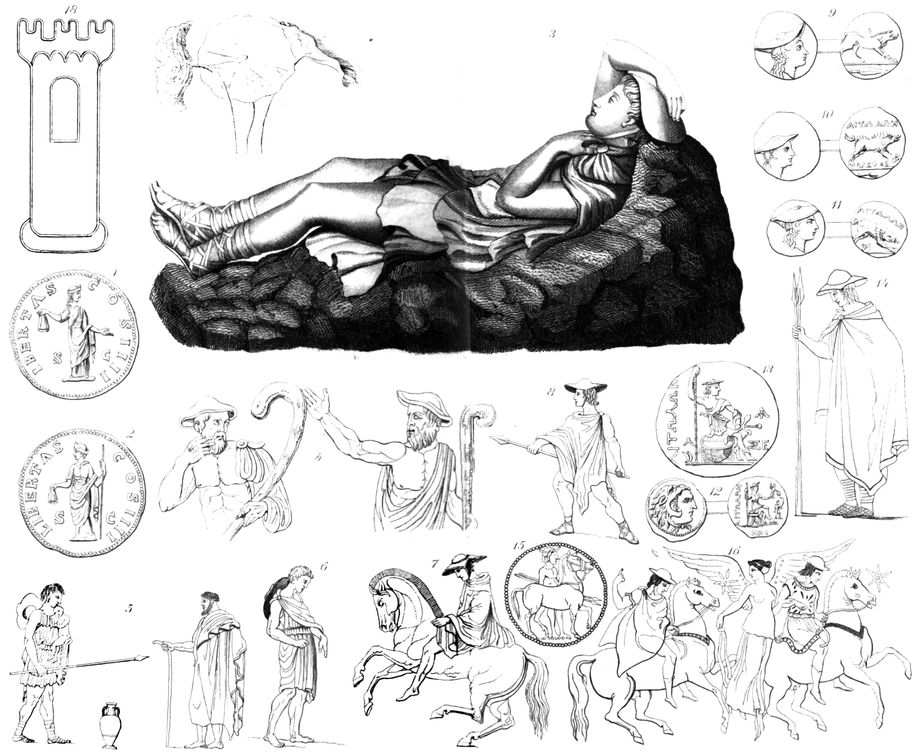
“Codices chartacei,” i. e. MSS. on linen paper, as old as the thirteenth century, are mentioned not unfrequently in the Catalogues of the Escurial, the Nani, and other libraries. Joseph Brooks Yates, Esq. F. S. A., of West Dingle near Liverpool, is in possession of a fine MS. of some of the Homilies of Chrysostom, written in all probability not later than the thirteenth century. It is on linen paper, with the water-lines perfectly distinct in both directions. The water-mark is a tower, the size and form of which are shown in Plate IX. Fig. 18. From the appearance of this paper, it is probable that the form or mould may perhaps have been made of thin rods of cane or some other vegetable. These rods, however, may have been metallic. They were placed so close, that of the water-lines produced by them 17 may be counted in the space of an inch, the water-lines at right angles to these being one inch and a quarter apart.
The preceding facts coincide with the opinion long ago expressed by Prideaux, who concluded that linen paper was an Eastern invention, because “most of the old MSS. in Arabic and other oriental languages are written on this sort of paper,” and that it was first introduced into Europe by the Saracens of Spain[581].
A few observations, by way of concluding this part of the subject, may here be properly bestowed upon the material with which the WASP-FAMILY construct their nests.
The wasp is a paper-maker, and a most perfect and intelligent one. While mankind were arriving, by slow degrees, at the art of fabricating this valuable substance, the wasp was making it before their eyes, by very much the same process as that by which human hands now manufacture it with the best aid of chemistry and machinery. While some nations carved their records on wood, and stone, and brass, and leaden tablets,—others, more advanced, wrote with a style on wax,—others employed the inner bark of trees, and others the skins of animals rudely prepared,—the wasp was manufacturing a firm and durable paper. Even when the papyrus was rendered more fit, by a process of art, for the transmission of ideas in writing. The paper of the papyrus was formed of the leaves of the plant, dried, pressed, and polished; the wasp alone knew how to reduce vegetable fibres to a pulp, and then unite them by a size or glue, spreading the substance out into a smooth and delicate leaf. This is exactly the process of paper-making. It would seem that the wasp knows, as the modern paper-makers now know, that the fibres of rags, whether linen or cotton, are not the only materials that can be used in the formation of paper; she employs other vegetable matters, converting them into a proper consistency by her assiduous exertions. In some respects she is more skilful even than our paper-makers, for she takes care to retain her fibres of sufficient length, by which she renders her paper as strong as she requires. Many manufacturers of the present day cut their material into small bits, and thus produce a rotten article. One great distinction between good and bad paper is its toughness; and this difference is invariably produced by the fibre of which it is composed being long, and therefore tough; or short, and therefore friable.
The wasp has been laboring at her manufacture of paper, from her first creation, with precisely the same instruments and the same materials; and her success has been unvarying. Her machinery is very simple, and therefore it is never out of order. She learns nothing, and forgets nothing. Men, from time to time, lose their excellence in particular arts, and they are slow in finding out real improvements. Such improvements are often the effect of accident. Paper is now manufactured very extensively by machinery, in all its stages; and thus, instead of a single sheet being made by hand, a stream of paper is poured out, which would form a roll large enough to extend round the globe, if such a length were desirable. The first experimenters on paper machinery in England, Messrs. Fourdrinier, it is said, spent the enormous sum of 40,000l. in vain attempts to render the machine capable of determining the width of the roll; and, at last, accomplished their object at the suggestion of a bystander, by a strap revolving upon an axis, at a cost of three shillings and sixpence! Such is the difference between the workings of human knowledge and experience, and those of animal instinct. We proceed slowly and in the dark—but our course is not bounded by a narrow line, for it seems difficult to say what is the perfection of any art; animals go clearly to a given point—but they can go no further. We may, however, learn something from their perfect knowledge of what is within their range. It is not improbable that if man had attended in an earlier state of society to the labors of wasps, he would have sooner known how to make paper. We are still behind in our arts and sciences, because we have not always been observers. If we had watched the operations of insects, and the structure of insects in general, with more care, we might have been far advanced in the knowledge of many arts which are yet in their infancy, for nature has given us abundance of patterns. We have learnt to perfect some instruments of sound by examining the structure of the human ear; and the mechanism of an eye has suggested some valuable improvements in achromatic glasses.
Réaumur has given a very interesting account of the wasps of Cayenne (Chartergus nidulans), which hang their nests in trees[582]. Like the bird of Africa called the social grosbeak (Loxia socia), they fabricate a perfect house, capable of containing many hundreds of their community, and suspend it on high out of the reach of attack. But the Cayenne wasp is a more expert artist than the bird. He is a pasteboard-maker;—and the card with which he forms the exterior covering of his abode is so smooth, so strong, so uniform in its texture, and so white that the most skilful manufacturer of this substance might be proud of the work. It takes ink admirably!
The nest of the pasteboard-making wasp is impervious to water. It hangs upon the branch of a tree, and those rain-drops which penetrate through the leaves never rest upon its hard and polished surface. A small opening for the entrance of the insects terminates its funnel-shaped bottom. It is impossible to unite more perfectly the qualities of lightness and strength.
Mr. J. Rennie, speaking of wasps’ nests, gives us the following interesting account of one lately examined by him:—“The length,” says he, “is about nine inches, six stout circular platforms stretch internally across, like so many floors, and fixed all round to the walls of the nest. They are smooth above, with hexagonal cells on the under surface. These platforms are not quite flat, but rather concave above, like a watch-glass reversed; the centre of each platform is perforated for the admission of the wasps, at the extremity of a short funnel-like projection, and through this access is gained from story to story. On each platform, therefore, can the wasps walk leisurely about, attending to the pupæ secured in the cells, which, with the mouths downward, cover the ceiling above their heads—the height of the latter being just convenient for their work.”
Pendent wasps’-nests of enormous size are found in Ceylon, suspended often in the talipot-tree at the height of seventy feet. The appearance of these nests thus elevated, with the larger leaves of the tree, used by the natives as umbrellas and tents, waving over them, is very singular. Though no species of European wasp is a storer of honey, yet this rule does not apply to certain species of South America. In the “Annals and Magazine of Natural History” for June, 1841, will be found a detailed account, with a figure of the pendent nest of a species termed by Mr. A. White Myraptera scutellaris. The external case consists of stout cardboard covered with conical knobs of various sizes. The entrances are artfully protected by pent-roofs from the weather and heavy rains; and are tortuous, so as to render the ingress of a moth or other large insect difficult. Internally are fourteen combs, exclusive of a globular mass, the nucleus of several circular combs, which are succeeded by others of an arched form—that is, constituting segments of circles.
Good writing, printing and wrapping paper, may be procured from the shavings of common wood. The wood must be reduced to shavings by the ordinary jack-plain shaving size. The shavings are then placed in a cistern or boiler sufficiently large, and covered with water, which should be raised to the boiling-point. To every one hundred pounds of the wood so reduced, from twelve to eighteen pounds of alkali, either vegetable or mineral, is to be added, in proportion to its quality for strength. If salts are used they should be reduced before coming in contact with the wood. The salts may, however, be put in with the water and wood before reduction, but the first method is the most preferable. Should lime be used, there must be a sufficient, in all cases, to equal twelve pounds of pure black salts. One hundred pounds of wood will, if well attended to, make from five to seven reams of paper[583].
APPENDIX C. ON FELT.
MANUFACTURE AND USE OF FELTING BY THE ANCIENTS.
Felting more ancient than weaving—Felt used in the East—Use of it by the Tartars—Felt made of goats’-hair by the Circassians—Use of felt in Italy and Greece—Cap worn by the Cynics, Fishermen, Mariners, Artificers, &c.—Cleanthes compares the moon to a skull-cap—Desultores—Vulcan—Ulysses—Phrygian bonnet—Cap worn by the Asiatics—Phrygian felt of Camels’-hair—Its great stiffness—Scarlet and purple felt used by Babylonish decorators—Mode of manufacturing Felt—Northern nations of Europe—Cap of liberty—Petasus—Statue of Endymion—Petasus in works of ancient art—Hats of Thessaly and Macedonia—Laconian or Arcadian hats—The Greeks manufacture Felt 900 B. C.—Mercury with the pileus and petasus—Miscellaneous uses of Felt.
There seems no reason to question the correctness of Professor Beckmann’s observation[584], that the making of felt was invented before weaving[585]. The middle and northern regions of Asia are occupied by Tartars and other populous nations, whose manners and customs appear to have continued unchanged from the most remote antiquity[586], and to whose simple and uniform mode of existence this article seems to be as necessary as food. Felt is the principal substance both of their clothing and of their habitations. Carpini, who in the year 1246 went as ambassador to the great Khan of the Moguls, Mongals, or Tartars, says, “Their houses are round, and artificially made like tents, of rods and twigs interwoven, having a round hole in the middle of the roof for the admission of light and the passage of smoke, the whole being covered with felt, of which likewise the doors are made[587].” Very recently the same account of these “portable tents of felt” has been given by Julius von Klaproth[588]. Kupffer says of the Caratchai, “Leurs larges manteaux de feutre leur servent en même tems de matelas et de couverture[589].” The large mantle of felt, here mentioned, is used for the same purpose in the neighboring country of Circassia[590]. One of these mantles now in the possession of Mr. Urquhart was made of black goats’-hair, and had on the outside a long shaggy villus. The Circassians sleep under this mantle by night, and wear it, when required, over their other dress by day. A similar article is thus described by Colonel Leake[591]: the postillions in Phrygia “wear a cloak of white camels’-hair, half an inch thick, and so stiff that the cloak stands without support, when set upright on the ground. There are neither sleeves nor hood; but only holes to pass the hands through, and projections like wings upon the shoulders for the purpose of turning off the rain. It is the manufacture of the country.” The Chinese traveller, Chy Fa Hian, who visited India at the end of the fourth century, says, that the people of Chen Chen, a kingdom in a mountainous district situated about the Lake of Lob, wore dresses like those of the Chinese, except that they made use of felt and stuffs (du feutre et des étoffes[592]).
PLATE VIII.
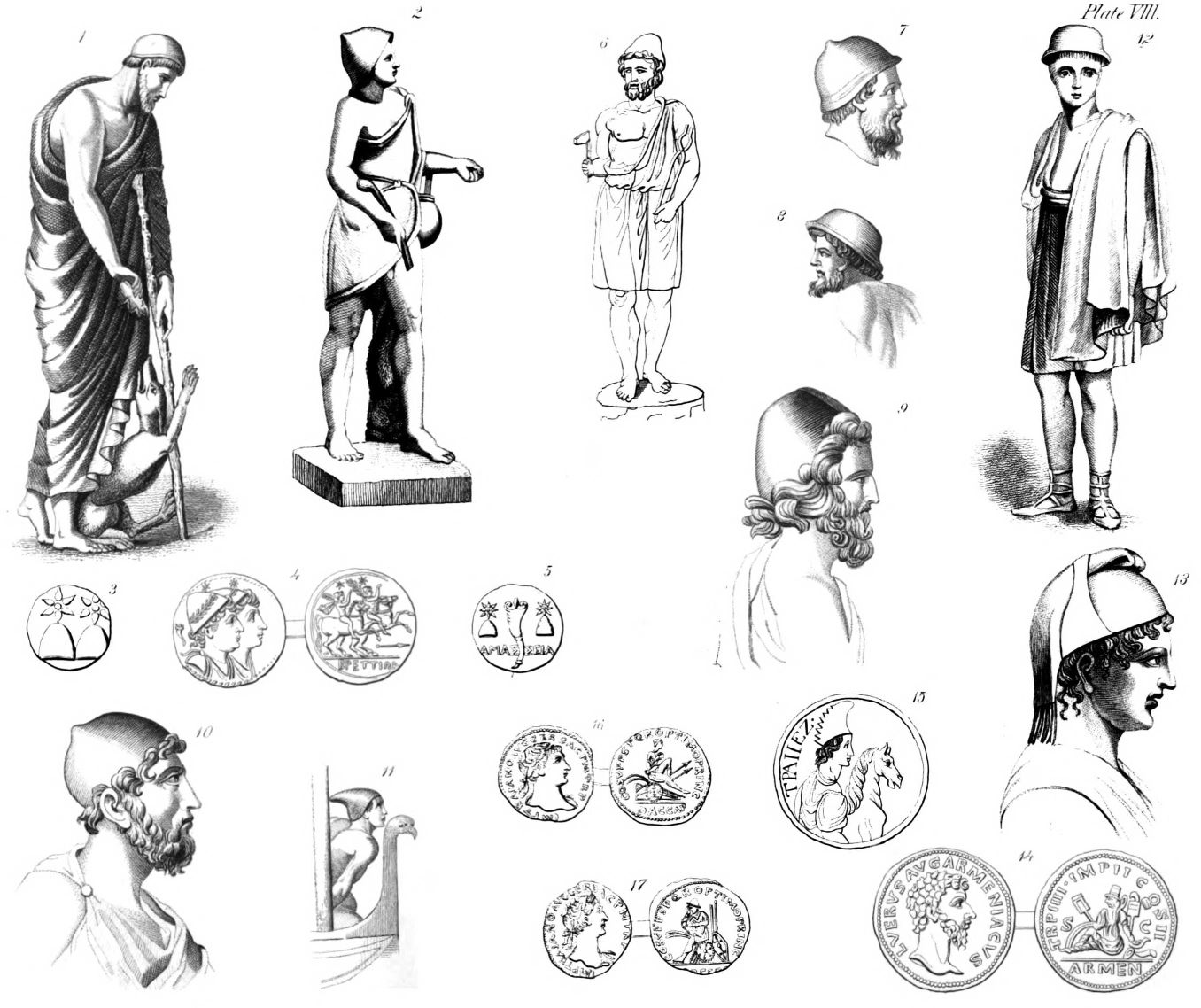
In conformity with the prevailing use of this manufacture in the colder regions of Asia, scarlet or purple felt (such as that lately re-invented at Leeds, in England), was used by the Babylonish decorators for the drapery of the funeral pile, when Alexander celebrated the splendid obsequies of Hephæstion: for so we must understand the expression φοινικίδες πιληταί (Diod. Sic. xvii. 115. p. 251, Wess.). Xenophon (Cycrop. v. 5. § 7.) mentions the use of felt manufactured in Media, as a covering for chairs and couches. The Medes also used bags and sacks of felt (Athenæus, 1. xii. p. 540 c. Casaub.).
The process, by which wool is converted into felt, was called by the Greeks πίλησις (Plato de Leg. 1. viii. p. 115. ed. Bekker), literally a compression, from πιλέω, to compress[593]. The ancient Greek scholion on the passage of Plato here referred to thus explains the term: Πιλήσεως· τῆς διὰ τῆς τῶν ἐρίων πυκνώσεως γινομένης ἐσθῆτος, i. e. “cloth made by the thickening of wool.” With this definition of felt agrees the following description of a πέτασος in a Greek epigram, which records the dedication of it to Mercury:—
Σοὶ τὸν πιληθέντα δι’ εὐξάντου τριχὸς ἀμνοῦ, Ἑρμᾶ, Καλλιτέλης ἐκρέμασε πέτασον. Brunck, Anal. ii. 41.
The art of felting was called ἡ πιλητικὴ, (Plato, Polit. ii. 2. p. 296, ed. Bekker). According to the ancient Greek and Latin glossaries, and to Julius Pollux (vii. 30), a felt-maker, or hatter, was πιλοποιὸς or πιλωτοποιὸς, in Latin coactiliarius. From πῖλος (dim. πίλιον, second dim. πιλίδιον), the proper term for felt in general, derived from the root of πιλέω, came the verb πιλόω, signifying to felt, or to make felt, and from this latter verb was formed the ancient participle πιλωτὸς, felted, which again gave origin to πιλωτοποιός.
It may be observed, that our English word felt is evidently a participle or a derivative, and that its verb or root Fel appears to be the same with the root of πιλέω.
The Latin cogo, which was used, like the Greek πιλέω, to denote the act of compressing, or forcing the separate hairs together, gave origin to the participle coactus, and its derivative coactilis. Pliny (H. N. viii. 48. s. 73.), after speaking of woven stuffs, mentions in the following terms the use of wool for making felt: “Lanæ et per se coactæ (al. coactam) vestem ficiunt,” i. e. “Parcels of wool, driven together by themselves, make cloth.” This is a very exact, though brief description of the process of felting. The following monumental inscription (Gruter, p. 648, n. 4.) contains the title Lanarius coactiliarius, meaning a manufacturer of woollen felt:—
M. Ballorius M. L. Lariseus, Lanarius coactiliarius, conjuga carissimæ B. M. fec.
Helvius Successus, the son of a freed man, and the father of the Roman emperor Pertinax, was a hatter in Liguria (tabernam coactiliariam in Liguria exercuerat, Jul. Cap. Pertinax, c. 3.). Pertinax himself, being fond of money, having the perseverance expressed by his agnomen, and having doubtless, in the course of his expeditions into the East, made valuable observations respecting the manufacture which he had known from his boyhood, continued and extended the same business, carrying it on and conveying his goods to a distance by the agency of slaves. The Romans originally received the use of felt together with its name[594] from the Greeks (Plutarch, Numa, p. 117, ed. Steph.). The Greeks were acquainted with it as early as the age of Homer, who lived about 900 B. C. (Il. x. 265), and Hesiod (Op. et Dies, 542, 546).
The principal use of felt among the Greeks and Romans was to make coverings of the head for the male sex, and the most common cover made of this manufacture was a simple skull-cap, i. e. a cap exactly fitted to the shape of the head, as is shown in Plate VIII. fig. 1. taken from a sepulchral bas-relief which was found by Mr. Dodwell in Bœotia[595]. The original is as large as life. The person represented appears to have been a Cynic philosopher. He leans upon the staff (baculus, βάκτρον, σκῆπτρον); he is clothed in the blanket (pallium, χλαῖνα, τρίβων) with one end, which is covered, over his left breast, and another hanging behind over his left shoulder; he wears the beard (barba, πώγων); his head is protected by the simple skull-cap (pileus, πῖλος). All these were distinct characteristics of the philosopher, and more especially of the Cynic[596]. The dog also probably marked his sect. Leonidas of Tarentum, in his enumeration of the goods belonging to the Cynic Posochares [597], including a dog-collar (κυνοῦχον), mentions, καὶ πῖλον κεφαλᾶς οὔχ ὁσίας σκεπανὸν, i. e. “The cap of felt, which covered his unholy head.” This passage may be regarded as a proof, that among the Greeks, though not among the Romans, the cap of felt was worn by very poor men. It also proves that this cap, which was the fess of the modern Greeks, was worn by philosophers, and therefore throws light on a passage of Antiphanes (ap. Athen. xii. 63. p. 545 a) describing a philosopher of a different character, who was very elegantly dressed, having a small cap of fine felt (πιλίδιον ἁπαλὸν), also a small white blanket, a beautiful tunic, and a neat stick. When Cleanthes advanced the doctrine, that the moon had the shape of a skull-cap (πιλοειδῆ τῷ σχήματι, Stobæi Ecl. Phys. 1. 27. p. 554, ed. Heeren), he probably intended to account for its phases from its supposed hemispherical form. A cap of a similar form and appearance, though perhaps larger and not so closely fitted to the crown of the head, was worn by fishermen[598]. In an epigram of Philippus[599], describing the apparatus of a fisherman, the author mentions πῖλον ἀμφίκρηνον ὑδασιστεγῆ, “the cap encompassing his head and protecting it from wet.” Figure 2. in Plate VIII. represents a small statue of a fisherman belonging to the Townley Collection in the British Museum. His cap is slightly pointed and in a degree, which was probably favorable to the discharge of water from its surface. Hesiod recommends, that agricultural laborers should wear the same defence from cold and showers (Op. et Dies, 545-547). The use of this cap by seamen was no doubt the ground, on which the painter Nicomachus represented Ulysses wearing one. “Hic primus,” says Pliny (H. N. xxxv. 36. s. 22.), “Ulyssi addidit pileum[600].” For the same reason the cap is an attribute of the Dioscuri; and hence two caps with stars above them are often shown on the coins of maritime cities and of others where Castor and Pollux were worshipped. Figure 3. of Plate VIII. is taken from a brass coin of Dioscurias in Colchis, preserved in the British Museum. On the reverse is the name ΔΙΟΣΚΟΥΡΙΑΔΟΣ. Figure 4. represents both sides of a silver coin in the same collection, with the legend ΒΡΕΤΤΙΩΝ. It belongs to Bruttium in South Italy. On the one side Castor and Pollux are mounted on horseback. They wear the chlamys and carry palm branches in their hands. Their caps have a narrow brim. The reverse shows their heads only, and their caps, without brims, are surrounded by wreaths of myrtle. The cornucopia is added as an emblem of prosperity. Figure 5. is from a brass coin of Amasia (ΑΜΑΣΣΕΙΑΣ) in Pontus. It shows the cornucopia between the two skull-caps. Charon also was represented with the mariner’s or fishermen’s cap, as, for example, in the bas-relief in the Museo Pio-Clementino, tom. iv. tav. 35, and the painted vase in Stackelberg’s Grüber der Hellenen, t. 47, 48, which is copied in Becker s Charicles, vol. ii. taf. i. fig. 1, and in Smith’s Dictionary of Greek and Roman Antiquities, p. 404.
A pileus of the same general form was worn by artificers; and on this account it was attributed to Vulcan and to Dædalus, who, as well as Ulysses and Charon, are commonly found wearing it in works of ancient art. Arnobius says, that Vulcan was represented “cum pileo et malleo”—“fabrili expeditione succinctus;” and that on the other hand Mercury was represented with the petasus, or “petasunculus,” on his head.[601] This observation is confirmed by numerous figures of these two divinities, if we suppose the term petasus, which will be more fully illustrated hereafter, to have meant a hat with a brim, and pileus to have denoted properly a fessor cap without a brim.
Fig. 6. Plate VIII. is taken from a small bronze statue of Vulcan in the Royal Collection at Berlin. He wears the exomis, and holds his hammer in the right hand and his tongs in the left. For other specimens of the head-dress of Vulcan the reader is referred to the Museo Pio-Clementino, t. iv. tav. xi., and to Smith’s Dictionary of Greek and Roman Antiquities, p. 589.
Plate VIII. is intended still further to illustrate some of the most common varieties in the form of the ancient skull-cap. Figure 7. is a head of Vulcan from a medal of the Aurelian family[602]. Figure 8. is the head of Dædalus from a bas-relief, formerly belonging to the Villa Borghese, and representing the story of the wooden cow, which he made for Pasiphae[603]. Fig. 10. is from a cameo in the Florentine collection. Fig. 9. is the head of a small bronze statue, wearing boots and the exomis, which belonged to Mr. R. P. Knight, and is now in the British Museum. It is engraved in the “Specimens of Ancient Sculpture published by the Society of Dilettanti,” vol. i. pl. 47. The editors express a doubt whether this statue was meant for Vulcan or Ulysses, merely because the god and the hero were commonly represented wearing the same kind of cap. Not only does the expression of countenance decide the question; but also the small bronze of Mr. Knight’s collection agrees in attitude and costume with many small statues of Vulcan, who is represented in all of them wearing the exomis, holding the hammer and tongs, and having the felt cap on his head[604]. Fig. 11. is another representation of Ulysses from an ancient lamp[605]. It exhibits him tied to the mast, while he listens to the song of the Sirens. The cap in this figure is much more elongated than in the others.
The felt cap was worn not only by desultores, but by others of the Romans upon a journey, in sickness, or in cases of unusual exposure. Hence Martial says in Epig. xiv. 132, entitled “Pileus,”
Si possem, totas cuperem misisse lacernas: Nunc tantum capiti munera mitto tuo.
i. e.
O that a whole lacerna I could send! Let this (I can no more) your head defend.
The wig (galerus) answered the same purpose for the wealthy classes (arrepto pileo vel galero, Sueton. Nero, 26), and the cucullus and cudo for both rich and poor. On returning home from a party, a person sometimes carried his cap and slippers under his arm (Hor. Epist. l. xiii. 15).
The hats worn by the Salii[606] are said by Dionysius of Halicarnassus to have been “tall hats of a conical form[607].” Plutarch distinctly represents them as made of felt. He says (l. c.), that the flamines were so called quasi pilamines, because they wore felt hats, and because in the early periods of Roman history it was more common to invent names derived from the Greek. On coins, however, this official cap of the Salii and Flamines is commonly oval like that attributed to the Dioscuri. We observe indeed continual variations in the form of the pileus from hemispherical to oval, and from oval to conical. A conical cap is seen on the head of the reaper in the wood-cut to the article Flax in Smith’s Dictionary of Greek and Roman Antiquities, which wood-cut is taken from a coin of one of the Lagidæ, kings of Egypt. Caps, regularly conical and still more elongated, are worn by the buffoons or comic dancers, who are introduced in an ancient mosaic preserved in the Villa Corsini at Rome[608]. Telephus, king of Mysia, is represented as wearing a “Mysian cap[609].” This “Mysian cap” must have been the same which is known by the moderns under the name of the Phrygian bonnet, and with which we are familiar from the constant repetition of it in statues and paintings of Priam, Paris, Ganymede[610], Atys, Perseus, and Mithras, and in short in all the representations not only of Trojans and Phrygians, but of Amazons and of all the inhabitants of Asia Minor, and even of nations dwelling still further to the East. Also, when we examine the works of ancient art which contain representations of this Mysian cap, we perceive that it was a cone bent into the form in which it is exhibited, and so bent, perhaps by use, but more probably by design. This circumstance is well illustrated in a bust of Parian marble, supposed to be intended for Paris, which is preserved in the Glyptotek at Munich. A drawing of it is given in Plate VIII. fig. 13. The flaps of the bonnet are turned up and fastened over the top of the head. The stiffness of the material is clearly indicated by the sharp angular appearance of that portion of it which is turned forwards. Mr. Dodwell, in his Tour in Greece (vol. i. p. 134), makes the following observations on the modern costume, which seems to resemble the ancient, except that the ancient πῖλος and πιλίδιον were probably of undyed wool:—“The Greeks of the maritime parts, and particularly of the islands, wear a red or blue cap of a conical form, like the pilidion. When it is new it stands upright, but it soon bends, and then serves as a pocket for the handkerchief, and sometimes for the purse. Others wear the red skull-cap, or fess.” The Lycians, as we are informed by Herodotus (viii. 92), wore caps of felt, which were surrounded with feathers. Some of the Lycian coins and bas-reliefs, however, show the “Phrygian bonnet,” as it is called, in the usual form[611].
The cap worn by the Persians is called by Greek authors κυρβασία or τιάρα[612], and seems to have had the form now under consideration. Herodotus, when he describes the costume of the Persian soldiers in the army of Xerxes, says, that they wore light and flexible caps of felt, which were called tiaras. He adds, that the Medes and Bactrians wore the same kind of cap with the Persians, but that the Cissii wore a mitra instead (vii. 61, 62, 64). On the other hand he says, that the Sacæ wore cyrbasiæ, which were sharp-pointed, straight, and compact. The Armenians were also called “weavers of felt” (Brunck, Anal. ii. p. 146. No. 22). The form of their caps is clearly shown in the coins of the Emperor Verus, one of which, preserved in the British Museum, is engraved in Plate VIII. fig. 14. The legend, surrounding his head, L. Vervs. Avg. Armeniacvs, refers to the war in Armenia. The reverse shows a female figure representing Armenia, mourning and seated on the ground, and surrounded by the emblems of Roman warfare and victory. The caps represented on this and other coins agree remarkably with the forms still used in the same parts of Asia. Strabo (L. xi. p. 563, ed. Sieb.) says, that these caps were necessary in Media on account of the cold. He calls the Persian cap “felt in the shape of a tower” (L. xv. p. 231). The king of Persia was distinguished by wearing a stiff cyrbasia, which stood erect, whereas his subjects wore their tiaras folded and bent forwards.[613] Hence in the Aves of Aristophanes the cock is ludicrously compared to the Great King, his erect comb being called his “cyrbasia.” The Athenians no doubt considered this form of the tiara as an expression of pride and assumption. It is recorded as one of the marks of arrogance in Apollodorus, the Athenian painter, that he wore an “erect cap[614].”
The “Phrygian bonnet” is called Phrygia tiara in the following lines of an epitaph (ap. Gruter. p. 1123):
Indueris teretes manicas Phrygiamque tiaram? Non unus Cybeles pectore vivet Atys.
The coin represented in Plate VIII. fig. 15. (taken from Patin, Imp. Rom. Numismata, Par. 1697, p. 213) is of the reign of the Emperor Commodus, and belonged according to the legend either to Trapezus in Cappadocia or to Trapezopolis in Caria. It represents the god Lunus or Mensis, who was the moon considered as of the male sex agreeably to the ideas of many northern and Asiatic nations (Patin, p. 173). This male moon or month was, as it seems, always represented with the cyrbasia[615]. In another coin published by Patin (l. c.) a cock stands at the feet of this divinity, proving that this was the sacred bird of Lunus, and probably because the rayed form of the cock’s comb was regarded as a natural type of the cyrbasia, which distinguished the kings of Persia and was attributed also to this Oriental divinity. A lamp found on the Celian Mount at Rome[616] represents in the centre Lunus with 12 rays, probably designed to denote the 12 months of the year, and on the handle two cocks pecking at their food. A head of the same divinity, published by Hirt (l. c.) from an antique gem at Naples, has 7 stars upon the cap, perhaps referring to the 7 planets.
Instead of the conical cap of the Asiatics many of the Northern nations of Europe appear to have worn a felt cap, the form of which was that of a truncated cone. Of this a good example is shown in the group of Sarmatians, represented in the wood-cut in Smith s Dictionary of Greek and Roman Antiquities (p. 160), which is taken from the Column of Trajan. The same thing appears in various coins belonging to the reign of this Emperor, two of which, preserved in the British Museum, are engraved in Plate VIII. fig. 16. represents Dacia sitting as a captive with her hands tied behind her back, wearing trowsers (braccæ) and a conical or oval cap with the edge turned up. Figure 17. represents Dacia mourning. In each we see a Dacian target together with Roman armor. Each has the same legend, Dac. Cap. Cos. V. P. P. S. P. Q. R. Optimo. Princ. On the reverse is the head of the Emperor with the inscription Imp. Trajano. Aug. Ger. Dac. P. M. Tr. P.
According to the representation of Lucian (de Gymnas.), the Scythians were in the constant habit of wearing caps or hats: for in the conversation between Anacharsis and Solon described by that author, Anacharsis requests to go into the shade, saying that he could scarce endure the sun, and that he had brought his cap (πῖλον) from home, but did not like being seen alone in a strange habit. In later times we read of the “pileati Gothi” and “pileati sacerdotes Gothorum[617].”
In considering the use of the skull-cap, or of the conical cap of felt, it remains to notice the use of it among the Romans as the emblem of liberty[618]. When a slave obtained his freedom he had his head shaven, and wore instead of his hair the pileus, or cap of undyed felt, (Diod. Sic. Exc. Leg. 22. p. 625, ed. Wess.). Plutarch, in allusion to the same custom, calls the cap πιλίον, which is the diminutive of πῖλος. It is evident, that the Latin pileus or pileum is derived from the Greek πῖλος and its diminutive, and this circumstance in conjunction with other evidence tends to show, that the Latins adopted this use of felt from the Greeks. Sosia says in Plautus (Amphit. i. l, 306), as a description of the mode of receiving his liberty, “Ut ego hodie, raso capite calvus, capiam pileum.” Servius (in Virg. Æn. viii. 564) says, the act of manumitting slaves in this form was done in the temple of Feronia, who was the goddess of freedmen. In her temple at Terracina was a stone seat, on which was engraved the following verse:
“Benemeriti servi sedeant, surgent liberi.”
In allusion to this practice it appears that the Romans, though they did not commonly wear hats, put them on at the Saturnalia.[619] At the death of Nero, the common people to express their joy went about the city in felt caps.[620] In allusion to this custom the figure of Liberty on the coins of Antoninus Pius holds the cap in her right hand. Figures 1 and 2 in Plate IX. are examples selected from the collection in the British Museum, and, as we learn from the legend, were struck when he was made consul the fourth time, i. e. A. D. 145.
In contradistinction to the various forms of the felt cap now described and represented, all of which were more or less elevated, and many of which were pointed upwards, we have now to consider those, which, though made of felt, and therefore classed by the ancients under the general terms pileus, πῖλος, &c.,[621] corresponded more nearly to our modern hat. The Greek word πέτασος, dim. πετάσιον, derived from πετάννυμι, extendo, dilato, and adopted by the Latins in the form petasus, dim. petasunculus, well expressed the distinctive form of these hats. They were more or less broad and expanded. What was taken from their height was added to their width. Those already mentioned had no brim; the petasus of every variety had a brim, which was either exactly or nearly circular, and which varied greatly in its width. In some cases it seems to be a mere circular disc without any crown at all. Of this we have an example in a beautiful statue, which has, no doubt, been meant for Endymion, in the Townley collection of the British Museum. See Plate IX. Fig. 3. His right hand encircles his head, and his scarf is spread over a rock as described by Lucian[622]. He sleeps upon it, holding the fibula in his left hand. His feet are adorned with boots (cothumi) and his simple petasus is tied under his chin. In this form the petasus illustrates the remark of Theophrastus, who, in describing the Egyptian Bean, says, that the leaf was of the size of the Thessalian petasus[623]. For the purpose of comparing these two objects, a representation of the leaves of the plant referred to, is introduced into the same Figure (3); taken from the “Botanical Magazine,” Plates 903, 3916, and Sir J. E. Smith’s “Exotic Botany,” Tab. 31, 32. The petasus here shown on the head of Endymion, the original statue being as large as life, certainly resembles very closely both in size and in form the leaf of the Egyptian Bean, which is the Cyamus Nelumbo, or Nelumbium Speciosum of modern botanists.
The flowers of umbelliferous plants are aptly called by Phanias[624] πετασώδη, i. e. like a petasus. The petasus, as worn by the two shepherds, who discover Romulus and Remus, in a bas-relief of the Vatican[625], is certainly not unlike the umbel of a plant. See Plate IX. Fig. 4.
Callimachus ascribes the same head-dress to shepherds in the following lines:
Ἔπρεπε τοι προέχουσα κάρης εὐρεῖα καλύπτρη, Ποιμενικὸν πίλημα.—Frag. cxxv.
The wide covering projecting from your head, the pastoral hat, became you.
This pastoral hat, if we may judge from the representation of the two shepherds in the bas-relief just referred to (Fig. 4.), was in its shape very like the “bonny blue bonnet” of the Scotch. Figure 5 in Plate IX. is taken from a painted Greek vase, and represents the story of the delivery of Œdipus to be exposed. His name ΟΙΔΙΠΟΔΑΣ is written beside him. The shepherd ΕΥΦΟΡΒΟΣ, who holds the naked child in his arms, wears a flat and very broad petasus hanging behind his neck. It is of an irregular shape, as if from long usage[626]. The shepherd Zethus wears a petasus hanging behind his back in a bas-relief belonging to the Borghese collection, published by Winckelmann (Mon. Inediti, ii. 85). See Plate IX. Fig. 6.
The Athenian ephebi wore the broad-brimmed hat, together with the scarf or chlamys[627]. Meleager, in an epigram on a beautiful boy, named Antiochus, says, that he would be undistinguishable from Cupid, if Cupid wore a scarf and petasus instead of his bow and arrows and his wings[628].
When a young Greek conquered in the games, his friends sometimes bestowed a hat (petasus) upon him as a present[629].
In consequence of the use of the petasus as a part of the ordinary costume of the Athenian youth, we find it in a great variety of works of ancient art illustrative of the religion and mythology of Greece. For example:—
1. In the inner frieze of the Parthenon, the remains of which are now in the British Museum, it is worn by many of the riders on horseback. Figure 7, in Plate IX. shows one of these horsemen (from the slab No. 54.) with his petasus tied under his chin.
2. It is worn by Theseus, as represented on a vase in the Vatican collection. See Winckelmann, Mon. Inediti, vol. ii. 98, and Fig. 8, Plate IX.
3. Also by Œdipus, as represented on one of Sir William Hamilton’s vases (vol. ii. Plate 24.), standing before the sphinx.
4. The coins of Ætolia exhibit Meleager wearing the petasus. Five of these have been selected from the collection in the British Museum, which are engraved according to the size of the originals in Plate IX. Figures 9, 10, and 11, are of silver. In each of them the petasus has the form of a circular disc with a boss at the top like that on a Scotch bonnet: on the reverse is the Calydonian boar, with a spear head beneath it, and the word ΑΙΤΩΛΩΝ. Figure 12, which is of gold[630], and Figure 13, which is of silver, have the head of Hercules on the reverse. The hero, supposed to be Meleager, wears a petasus, a scarf, and boots, as we have seen to be the case with Endymion (Fig. 3), this being the attire of hunters. In these two coins he also holds a spear in his right hand, and is seated upon a shield (see Fig. 13.) and other pieces of armor. ΑΙΤΩΛΩΝ is written by the side. The gold coin (see Fig. 12.) represents him with a Victory in his left hand, and with a small figure of Diana Lucifera in front.
The broad-brimmed hat, or petasus, was more especially worn by the Greeks when they were travelling[631]. Its appearance is well shown in Fig. 14, taken from a fictile vase belonging to the late Mr. Hope[632]. It represents a Greek soldier on a journey, wearing his large blanket, and holding two spears in his right hand. This figure also shows one of the methods of fastening on the hat, viz. by passing the string round the occiput.
The comedies of Plautus, being translated from the Greek, contain allusions to the same practice. In the Pseudolus (ii. 4. 55, and iv. 7. 90,) the petasus and the scarf are supposed to be worn by a person to indicate that he was coming from a journey. In the prologue to the Amphitryo, Mercury says,
Ego has habebo hic usque in petaso pinnulas, Tum meo patri autem torulus inerit aureus Sub petaso: id signum Amphitruoni non erit.
Mercury and his father Jupiter are here supposed to be attired like Sosia and Amphitryo his master, both of whom had been travelling and were returning home. At the same time there is an allusion to the winged hat of Mercury, of which more hereafter. Again, in act i. scene i. l. 287, the petasus is attributed to Sosia, because he is supposed to be coming from a journey; and to Mercury, both because it was commonly attributed to him, and because on this occasion he was personating Sosia.
The Romans were less addicted to the use of the petasus than the Greeks: they often wore it when they were from home; but that they did not consider it at all necessary to wear hats in the open air is manifest from the remark of Suetonius about the Emperor Augustus, that he could not even bear the winter’s sun, and hence “domi quoque non nisi petatasus sub divo spatiabatur.” (August. 82.) Caligula permitted the senators to wear them at the theatres as a protection from the sun (Dio. Cass. lix. 7. p. 909, ed. Reimari). What was meant by wearing hats “according to the Thessalian fashion” is by no means clear. Perhaps the Thessalians may have worn hats resembling those of their neighbors, the Macedonians, and of the shape of these we may form some conception from the coins of the Macedonian kings. One of these coins from the collection in the British Museum is copied in Plate IX. Fig. 15. It is a coin of the reign of Alexander I. and exhibits a Macedonian warrior standing by the side of his horse, holding two spears in his left hand, and wearing a hat with a broad brim turned upwards. This Macedonian petasus is called the Causia (καυσία)[633], and was adopted by the Romans[634], and more especially by the Emperor Caracalla, who, as Herodian states, aimed to imitate Alexander the Great in his costume. It appears probable, nevertheless, that the turning up of the brim was not peculiar to the Macedonians, and it may have depended altogether on accident or fancy; for we find instances of it on painted fictile vases, where there is no reason to suppose that any reference was intended either to Macedonia or Thessaly. Fig. 16. Plate IX. for example, is taken from the head of Bellerophon, on one of Sir William Hamilton’s vases[635]; and the left-hand figure from a fictile vase at Vienna, engraved by Ginzrot[636]. This hat is remarkable for the boss at the top, which we observe also on the Ætolian coins, and in various other examples.
In connection with the above quoted expression of Dio Cassius it may be observed further, that besides the causia two varieties of the petasus seem to be alluded to by several ancient authors, viz. the Thessalian, and the Arcadian or Laconian. How they were distinguished, cannot be ascertained, but the passages which mention them will now be produced, that the reader may judge for himself. The Thessalian variety is mentioned by Dio Cassius, by Theophrastus, as above quoted (p. 427), and by Callimachus in the following fragment, which is preserved in the Scholia on Sophocles, Œd. Col. 316.
And about his head lay a felt, newly come from Thessaly, as a protection from wet.—Frag. 124. ed. Ernesti.
The frenzied Cynic philosopher Menedemus, among other peculiarities, wore an Arcadian hat, HAVING THE TWELVE SIGNS OF THE ZODIAC WOVEN INTO IT[637]! Ammianus (Brunck, Anal. ii. 384.) represents an orator dedicating “an Arcadian hat” to Mercury, who was the patron of his art, and also a native of Arcadia.
Herodes Atticus wore “the Arcadian hat” at Athens, as a protection from the sun; and the language of Philostratus, in recording the fact, shows that the Athenians of his time commonly wore it, more especially in travelling[638]. Arrian, who wrote about the middle of the second century, says, that “Laconian or Arcadian hats,” were worn in the army by the peltastæ instead of helmets[639]. This circumstance shows a remarkable change of customs; for in the early Greek history we find the Persian soldiers held up as the objects of ridicule and contempt, because they wore hats and trowsers[640]. On the whole, it is very evident that “the Arcadian or Laconian hat” was one and the same variety, and that this variety of head-dress was simply the petasus, or hat with a brim, so called to distinguish it from the proper πῖλος, which was the skull-cap, or hat without a brim.
This supposition suits the representations of the only imaginary beings who are exhibited in works of ancient art wearing the petasus, viz. the Dioscuri and Mercury.
It has been already observed that the Dioscuri are commonly represented with the skull-cap, because they were worshipped, as the reader will have perceived, as the guardians of the mariner[641]; but on ancient vases we find them sometimes painted with the petasus; and if this was the same with the πῖλος Λακωνικὸς, it would coincide with their origin as natives of Sparta. In Plate IX. Fig. 16, an example is shown, on one of Sir William Hamilton’s vases, in which their attire resembles that of the Athenian ephebi. They wear boots and a tunic, over which one of them also wears the scarf or chlamys. They are conducted by the goddess Night.
In like manner Mercury, as a native of Arcadia, might be expected to wear “the Arcadian hat.” In the representations of this deity on works of ancient art, the hat, which is often decorated with wings to indicate his office of messenger, as his talaria also did[642], has a great variety of forms, and sometimes the brim is so narrow, that it does not differ from the cap of the artificer already described, or the πῖλος in its ordinary form. These hats, with a brim of but small dimensions, agree most exactly in appearance with the cheapest hats of undyed felt, now made in the United States and Great Britain[643]. On the heads of the rustics and artificers in our streets and lanes we often see forms the exact counterpart of those which we most admire in the works of ancient art. The petasus is also still commonly worn by agricultural laborers in Greece and Asia Minor.
A bas-relief in the Vatican collection[644], represents the birth of Hercules, and contains two figures of Mercury. In one he carries the infant Hercules, in the other the caduceus. In both he wears a large scarf, and a skull-cap, like that of Dædalus[645], without a brim. This example therefore proves that, although the petasus, as distinguished from the pileus, was certainly the appropriate attribute of Mercury[646], yet the artists of antiquity sometimes took the liberty of placing on his head the skull-cap instead of the hat, just as we have seen that they sometimes made the reverse substitution in the case of the Dioscuri.
Another bas-relief in the Vatican[647], represents the story of the birth of Bacchus from Jupiter’s thigh. Thus the subject of it is very similar to that, which relates to the birth of Hercules, the infant being in each instance consigned to the care of Mercury. But the covering of Mercury’s head in these two cases is remarkably different, though from no other reason than the fancy of the artist. In the bas-relief now under consideration, Mercury holds the skin of a lynx or panther to receive the child. He wears the scarf or chlamys and cothumi. This was a very favorite subject with the ancients. It occurs on a superb marble vase with the inscription ΣΑΛΠΙΩΝ ΕΠΟΙΗΣΕ[648], and on one of Sir W. Hamilton’s fictile vases[649].
Figure 4. in Plate X. is from Hope’s Costume of the Ancients, vol. ii. pl. 175. The money-bag is in Mercury’s right hand.
In a painting found at Pompeii[650], Mercury is represented with wings (pinnulæ) on his petasus, though not very ancient, is also recognized in the Amphitryo of Plautus.
Figure 5. in Plate X. is from the Marquis of Lansdowne’s marble bust, published by the Dilettanti Society[651]. In this beautiful bust the brim of the hat is unfortunately damaged.
Figures 6 and 7, Plate X., are from coins engraved in Carelli’s Nummi Veteris Italiæ (plates 58 and 65). Figure 7 is a coin of Suessa in Campania.
To these illustrations might have been added others from ancient gems, good examples of which may be found in the second volume of Mariette’s Traité des Pierres Gravées, folio, Paris, 1750.
Besides the application of felt as a covering of the head for the male sex in the manner now explained, it was also used as a lining for helmets. When in the description of the helmet worn by Ulysses we read
Μέσσῃ δ’ ἐνὶ πῖλος ἀρήρει[652],
we may suppose πῖλος to be used in its most ordinary sense, consequently that the interior of the helmet was a common skull-cap.
PLATE IX.
Being generally thicker than common cloth, felt presented a more effectual obstacle to missile weapons. Hence, when the soldiers under Julius Cæsar were much annoyed by Pompey’s archers, they made shirts or other coverings of felt, and put them on for their defence[653]. Thucydides refers to the use of similar means to protect the body from arrows[654]; and even in besieging and defending cities felt was used, together with hides and sackcloth, to cover the wooden towers and military engines[655].
Felt was also sometimes used to cover the bodies of quadrupeds. According to Aristotle[656], the Greeks clothed their molles oves either with skins or with pieces of felt; and the wool became gray in consequence. The Persians used the same material for the trappings of their horses (Plutarch, Artax. II. p. 1858. ed. Stephani).
The loose rude coverings for the feet called Udones were sometimes made of felt, being worn within the shoes or brogues of the rustic laborers[657].
In concluding this investigation it may be proper to observe, that, although πῖλος originally meant felt, and more especially a skull-cap made of that manufacture, it was sometimes used, at least by the later Greek authors, by an extension of its meaning, to denote a cap of any other material. Thus Athenæus (lib. vi. p. 274. Casaub.) speaking of the Romans, says, that they wore about their heads πίλους προβατείων δερμάτων δασεῖς, i. e. “thick caps made of sheep skins.”
APPENDIX D. ON NETTING.
MANUFACTURE AND USE OF NETS BY THE ANCIENTS—ILLUSTRATIONS OF THE SCRIPTURES, ETC.
Nets were made of Flax, Hemp, and Broom—General terms for nets—Nets used for catching birds—Mode of snaring—Hunting-nets—Method of hunting—Hunting-nets supported by forked stakes—Manner of fixing them—Purse-net or tunnel-net—Homer’s testimony—Nets used by the Persians in lion-hunting—Hunting with nets practised by the ancient Egyptians—Method of hunting—Depth of nets for this purpose—Description of the purse-net—Road-net—Hallier—Dyed feathers used to scare the prey—Casting-net—Manner of throwing by the Arabs—Cyrus king of Persia—His fable of the piper and the fishes—Fishing-nets—Casting-net used by the Apostles—Landing-net (Scap-net)—The Sean—Its length and depth—Modern use of the Sean—Method of fishing with the Sean practised by the Arabians and ancient Egyptians—Corks and leads—Figurative application of the Sean—Curious method of capturing an enemy practised by the Persians—Nets used in India to catch tortoises—Bag-nets and small purse-nets—Novel scent-bag of Verres the Sicilian prætor.
The raw materials, of which the ancients made nets, were flax, hemp[658], and broom[659]. Flax was most commonly used; so that Jerome, when he is prescribing employment for monks, says, “Texantur et lina capiendis piscibus[660].” The operation of netting, as well as that of platting, was expressed by the verb πλέκειν[661]. The meshes were called in Latin maculæ[662], in Greek βρόχοι, dim. βροχίδες[663].
The use of all the Latin and Greek terms for nets will now be explained, and in connection with this explanation of terms, will be produced all the facts which can be ascertained upon the subject.
I. Retis and Rete; dim. Reticulum. ΔΙΚΤΥΟΝ[664].
Retis or Rete in Latin, and δίκτυον in Greek, were used to denote nets in general. Thus in an epigram of Leonidas Tarentinus[665], three brothers, one of whom was a hunter, another a fowler, and the third a fisherman, dedicate their nets to Pan. Several imitations of this epigram remain by Alexander Ætolus[666], Antipater Sidonius[667], Archias[668], and others[669]. In one of these epigrams (Ἰουλιάνου Αἰγυπτίου) we find λίνα adopted as a general term for nets instead of δίκτυα, no doubt for the reason above stated. In another epigram[670] a hare is said to have been caught in a net (δίκτυον). Aristophanes mentions nets by the same denomination among the contrivances employed by the fowler[671]. Fishing-nets are called δίκτυα in the following passages of the New Testament: Matt. iv. 20, 21; Mark i. 18, 19; Luke v. 2, 4-6; John xxi. 6, 8, 11: also by Theocritus, ap. Athen. vii. 20. p. 284, Cas.; and by Plato, Sophista, 220, b. p. 134, ed. Bekker.
Netting was applied in various ways in the construction of hen-coops and aviaries; and such net-work is called rete[672]. It was used to make pens for sheep by night. At the amphitheatres it was sometimes placed over the podium. At a gladiatorial show given by Nero, the net, thus used as a fence against the wild beasts, was knotted with amber[673]. The way in which the net was used by the Retiarii is well known. The head-dress called κεκρύφαλος, was a small net of fine flax, silk, or gold thread, and was also called reticulum[674]. But by far the most important application of net-work was to the kindred arts of hunting and fishing: and besides the general terms used alike in reference to both these employments, there are special terms to be explained under each head.
The use of nets for catching birds was very limited, on which account we find no appropriate name for fowlers’ nets[675]. Nevertheless thrushes were caught in them[676], and doves or pigeons, with their limbs tied up, or fastened to the ground, or with their eyes covered or put out, were confined in a net in order that their cries might allure others into the snare[677]. An account of the nets used by the Egyptians to catch birds is given by Sir Gardner Wilkinson[678], being derived from the paintings found in the catacombs. The net commonly employed for the purpose was the clap-net. Bird-traps were also made by stretching a net over two semicircular frames, which, being joined and laid open, approached to the form of a circle. The trap was baited, and when a bird flew to it and seized the bait, it was instantly caught by the sudden rising of the two sides or flaps.
II. Cassis; Plaga. ΕΝΟΔΙΟΝ, ΑΡΚΥΣ.
In hunting it was usual to extend nets in a curved line of considerable length[679], so as in part to surround a space, into which the beasts of chase, such as the boar, the wild goat, the deer, the hare, the lion, and the bear might be driven through the opening left on one side. Tibullus (iv. 3. 12) speaks of inclosing woody hills for this purpose:—
... densos indagine colles Claudentem.
The following lines of Virgil show, that the animals were driven into the toils from a distance by the barking of dogs and the shouts of men:
Thy hound the wild-ass in the sylvan chase, Or hare, or hart, with faithful speed will trace; Assail the muddy cave with eager cries, Where the rough boar in secret ambush lies; Press the tall stag with clamors echoing shrill To secret toils, along the aërial hill. Georg. iii. 411-413.—Warton’s Translation.
In another splendid passage the boar is described as coming into the midst of the nets after he has been driven to them from a mountain or a marsh at a great distance:
And as a savage boar on mountains bred, With forest mast and fattening marshes fed; When once he sees himself in toils inclosed, By huntsmen and their eager hounds opposed; He whets his tusks, and turns and dares the war: The invaders dart their javelins from afar: All keep aloof and safely shout around, But none presumes to give a nearer wound. He frets and froths, erects his bristled hide, And shakes a grove of lances from his side. Æn. x. 707-715.—Dryden’s Translation.
Even in a case where the same poet introduces an equivalent expression to that of Tibullus, already quoted, viz. “saltus indagine cingunt” (Æn. iv. 121), he represents the hunting-party as going over a large extent of country to collect the animals out of it:
Postquam altos ventum in montes atque invia lustra, Ecce feræ saxi dejectæ vertice capræ Decurrere jugis; alia de parte patentes Transmittunt cursu campos, atque agmina cervi Pulverulenta fuga glomerant, montesque relinquunt. At puer Ascanius mediis in vallibus acri Gaudet equo, jamque hos cursu, jam præterit illos, Spumantemque dari pecora inter inertia votis Optat aprum, aut fulvum descendere monte leonem. Æn. iv. 151-159.
So Ovid (Epist. iv. 41, 42):
In nemus ire libet, pressisque in retia cervis, Hortari celeres per juga summa canes;
and (Epist. v. 19, 20):
Retia sæpe comes maculis distincta tetendi, Sæpe citos egi per juga longa canes.
The younger Pliny describes himself on one occasion sitting beside the nets, while the hunters were pursuing the boars and driving them into the snare (Epist. i. 6). In Euripides (Bacc. 821-832) we find the following beautiful description of a fawn, which has been driven into the space inclosed by the nets, but has leaped over them and escaped:—
ὡς νεβρὸς χλοεραῖς ἐμπαίζουσα λείμακος ἡ- δοναῖς, ἡνίκ’ ἂν φοβερὸν φύγῃ θήραμ’ ἔξω φυλακᾶς εὐπλέκτων ὑπὲρ ἀρκύων, &c.
Here a Bacchanal, tossing her head into the air with gambols and dancing, is said to be “like a fawn sporting in the green delights of a meadow, when she has escaped the fearful chase by leaping over the well-platted nets so as to be out of the inclosure, whilst the shouting hunter has been urging his dogs to run still more swiftly: by great efforts and with the rapidity of the winds she bounds over a plain beside a river, pleased with solitudes remote from man, and hides herself in the thickets of an umbrageous forest.”
If hollows or valleys were inclosed[680], the nets were no doubt extended only in those openings, through which it was possible for the animals to escape. Also a river was of itself a sufficient boundary:
Inclusum flumine cervum.—Virg. Æn. xii. 749.
The proper Latin term for the hunting-net, but more especially for the purse-net, which will be hereafter described, was Cassis. “Cassis, genus venatorii retis.” Isidori Hispalensis Orig. xix. 5. “Arctos rodere casses” is applied by Persius (v. 170) to a quadruped with incisor teeth caught in such a net and striving to escape. See also Propertius as just quoted, and the Agamemnon of Seneca and Virgil’s Georgics as quoted below. Cassis seems to be derived from the root of capere and catch. But Plaga was also applied to hunting-nets, so that Horace describes the hunting of the boar in the following terms:
Aut trudit acres hinc et hinc multa cane Apros in obstantes plagas.—Epod. ii. 31, 32.
Lucretius (lib. v. 1251, 1252) aptly compares the setting up of the plagæ to the planting of a hedge around the forest:
Nam fovea atque igni prius est venarier ortum, Quam sæpire plagis saltum, canibusque ciere.
In the same manner plagæ is used in the Hippolytus of Seneca, as above quoted, and in Pliny[681].
To dispose the nets in the manner which has been described, was called “retia ponere” (Virg. Georg. i. 307) or “retia tendere” (Ovid, Art. Amat. i. 45).
In Homer a hunting-net is called λίνον πάναγρον, literally, “the flax that catches everything[682].” But the proper Greek term for the hunting-net, corresponding to the Latin cassis, was ἄρκυς, which is accordingly employed in the passages of Oppian and Euripides cited above. Also the epigram of Antipater Sidonius, to which a reference has already been made, specifies the hunting-net by the same appellation:
Δᾶμις μὲν θηρῶν ἄρκυν ὀρειονόμων.
The word is used in the same sense by Cratinus[683]; also by Arrian, where he remarks that the Celts dispensed with the use of nets in hunting, because they trusted to the swiftness of their greyhounds[684]. In Euripides[685] it is used metaphorically: the children cry out, when their mother is pursuing them,
Ὡς ἐγγὺς ἤδη γ’ ἐσμέν ἀρκύων ζίφους,
i. e. “Now how near we are being caught with the sword.”
Also in the Agamemnon of Æschylus (l. 1085):
Ἡ δίκτυον τί γ’ Αἴδου; ἀλλ’ ἄρκυς ἡ ζύνευνος, ἡ ζυναιτία φόνου.
In this passage reference is made to the large shawl in which Clytemnestra wrapt the body of Agamemnon, as in a net, in order to destroy him. On account of the use made of it, the same fatal garment is afterwards (l. 1353) compared to a casting-net, which in its form bore a considerable resemblance to the cassis. In l. 1346, ἀρκύστατα[686] denotes this net as set up for hunting. The same form occurs again in the Eumenides (l. 112); and in the Persæ (102-104) escape from danger is in nearly the same terms expressed by the notion of overleaping the net. In Euripides[687] this contrivance is called ἀρκύστατος μηχανὴ; and in the Agamemnon of Seneca[688] the same allusion is introduced:
At ille, ut altis hispidus silvis aper; Cum, casse vinctus, tentat egressus tamen, Arctatque motu vincla, et incassum furit, Cupit, fluentes undique et cæcos sinus Disjicere, et hostem quærit implicitus suum.
Part of the apparatus of a huntsman consisted in the stakes which he drove into the ground to support his nets, and which Antipater Sidonius thus describes:
Καὶ πυρὶ θηγαλέους ὀξυπαγεῖς στάλικας;
i. e. “The sharp stakes hardened in the fire[689].”
The term which Xenophon uses of the stakes is, according to some manuscripts of his work, σχαλίδες. He says, they should be fixed so as to lean backwards, and thus more effectually to resist the impulse of the animals rushing against them[690]. The Latin term answering to στάλικες was Vari. We find it thus used by Lucan:
Aut, cum dispositis adtollat retia varis Venator, tenet ora levis clamosa Molossi. Pharsalia, iv. 439, 440.
i. e. “The hunter holds the noisy mouth of the light Molossian dog, when he lifts up the nets to the stakes arranged in order.”
Gratius Faliscus, adopting a Greek term, calls them ancones, on account of the “elbow” or fork at the top:
Hic magis in cervos valuit metus: ast ubi lentæ Interdum Libyco fucantur sandyce pinnæ, Lineaque extructis lucent anconibus arma, Rarum, si qua metus eludat bellua falsos.—Cyneg. 85-88.
It was the business of one of the attendants to watch the nets:
Ego retia servo.—Virg. Buc. iii. 75.
Sometimes there was a watchman at each extremity and one in the middle, as in the Persian lion-hunt[691]. The prevalence of this method of hunting in Persia might be inferred from the circumstance, that one of the chief employments of the inhabitants consisted in making these nets (ἄρκυς, Strabo, xv. 3. § 18). To watch the nets was called ἀρκυωρεῖν (Ælian, H. A. i. 2), and the man who discharged this office ἀρκυωρὸς (Xen., De Ven. ii. 3; vi. 1.).
The paintings discovered in the catacombs of Egypt show, that the ancient inhabitants of that country used nets for hunting in the same manner which has now been shown to have been the practice of the Persians, Greeks and Romans[692].
Hunting-nets had much larger meshes than fishing or fowlers’-nets, because in general a fish or a fowl could escape through a much smaller opening than a quadruped. In hunting, the important circumstance was to make the nets so strong that the beasts could not break through them. The large size of the meshes is denoted by the phrases “retia rara[693]” and “raras plagas[694];” and it is exhibited in a bas-relief in the collection of ancient marbles at Ince-Blundell in Lancashire. See Plate X. fig. 1. This sculpture presents the following circumstances, which are worthy of notice as illustrative of the passages above collected from ancient authors. Three servants with staves carry a large net on their shoulders. The foremost of them holds by a leash a dog, which is eager to engage in the chase[695]. Then follows another scene in the hunt. A net with very large meshes and five feet high is set up, being supported by three stakes. Two boars and two deer are caught. A watchman, holding a staff, stands at each end of the net. Fig. 2, Plate X. is taken from a bas-relief in the same collection, representing a party returning from the chase, with the quadrupeds which they have caught. Two men carry the net, holding in their hands the stakes with forks at the top. These bas-reliefs have been taken from sarcophagi erected in commemoration of hunters, and they are engraved in the Ancient statues, &c. at Ince-Blundell, vol. ii. pl. 89 and 126. An excellent representation of these forked staves is given in a sepulchral bas-relief in Bartoli, Admiranda, tab. 70, which Mr. Dansey has copied at p. 307 of his translation of Arrian on Coursing, and which represents a party of hunters returning from the chase. Another example of the varus, or forked staff, is seen in a sepulchral stone lately found at York (England), and engraved in Mr. Wellbeloved’s Eburacum, pl. 14. fig. 2. The man, who holds the varus in his right hand, and who appears to be a huntsman and a native of the north of England, though partly clothed after the Roman fashion, wears an inner and outer tunic, and over them a fringed sagum. In the Sepolcri de’ Nasoni, published by Bartoli, there is a representation of a lion-hunt, and of another in which deer are caught by means of nets set up so as to inclose a large space. In Montfaucon’s Supplement, tome iii., is an engraving from a bas-relief, in which a net is represented: but none of these are so instructive as the two bas-reliefs at Ince-Blundell.
Gratius Faliscus recommends that a net should be forty paces long, and full ten knots high:
Et bis vicenos spatium prætendere passus Rete velim, plenisque decem consurgere nodis.—Cyneg. 31, 32.
The necessity of making the nets so high that the animals could not leap over them, is alluded to in the expression Ὕψος κρεῖσσον ἐκπηδήματος, i. e. “a height too great for the animals to leap out[696].”
Xenophon, in his treatise on Hunting, gives various directions respecting the making and setting of nets; and Schneider has added to that treatise a dissertation concerning the ἄρκυς. It is evident that this kind of net was made with a bag (κεκρύφαλος, vi. 7), being the same which is now called the purse-net, or the tunnel-net, and that the aim of the hunter was to drive the animal into the bag; that the watchman (ἀρκυωρὸς) waited to see it caught there; that branches of trees were placed in the bag to keep it expanded, to render it invisible, and thus to decoy quadrupeds into it; that a rope ran round the mouth of the bag (περίδρομος, vi. 9), and was drawn tight by the impulse of the animal rushing in so as to prevent its escape[697]. To this rope was attached another, called ἐπίδρομος, which was used as follows. In fig. 1. of Plate X. we observe, that the upper border of the net consists of a very strong rope. Xenophon calls this σαρδὼν (vi. 9). In the purse-net it was furnished with rings. The ἀρκυωρὸς, or watchman, lay in ambush, holding one end of the ἐπίδρομος, which ran through the rings, and was fastened at the other end to the περίδρομος, so that by pulling it he drew the mouth of the bag still more firm and close. He then went to the bag and despatched the quadruped which it inclosed, or carried it off alive, informing his companions of the capture by shouting[698].
In this treatise Xenophon distinguishes the nets used in hunting by three different appellations; ἄρκυς, ἐνόδιον, and δίκτυον. Oppian also distinguishes the δίκτυον used in hunting from the ἄρκυς[699]. The ἄρκυς or cassis, i. e. “the purse-or tunnel-net,” was by much the most complicated in its formation. The ἐνόδιον, or “road-net,” was comparatively small: it was placed across any road, or path, to prevent the animals from pursuing that path: it must have been used to stop the narrow openings between bushes. The δίκτυον was a large net, simply intended to inclose the ground: it therefore resembled in some measure the sean used in fishing. The term, thus specially applied, may be translated a hay, or a hallier[700]. These three kinds of nets appear to be mentioned together by Nemesianus under the names of retia (i. e. δίκτυα), casses (i. e. ἄρκυς), and plagæ (i. e. ἐνόδια.):
Necnon et casses idem venatibus aptos, Atque plagas, longoque meantia retia tractu Addiscunt raris semper contexere nodis, Et servare modum maculis, linoque tenaci. Cyneg. 299-302.
Xenophon, in his treatise on Hunting, further informs us, that the cord used for making the ἄρκυς, or purse-net, consisted of three strands, and that three lines twisted together commonly made a strand (ii. 4); but that, when the net was intended to catch the wild boar, nine lines went to a strand instead of three (x. 2).
It remains to be noticed, that, when the long range of nets, set up in the manner which has been now represented, was designed to catch the stag (cervus), it was flanked by cords, to which, as well as to the nets themselves, feathers dyed scarlet, and of other bright colors intermixed with their native white, and sometimes probably birds’ wings, were tied so as to flare and flutter in the wind[701]. This appendage to the nets was called the metus or formido (Virg. Æn. xii. 750), because it frightened these timid quadrupeds so as to urge them onwards into the toils. Hence Virgil, speaking of the method of taking stags in Scythia, says,
Nor toils their flight impede, nor hounds o’ertake, Nor plumes of purple dye their fears awake. Georg. iii. 371, 372.—Sotheby’s Translation.
The following passages likewise allude to the use of this contrivance in the stag-hunt:
Nec formidatis cervos includite pennis.—Ovid. Met. xv. 475.
Vagos dumeta per avia cervos Circumdat maculis et multa indagine pinnæ. Auson. Epist. iv. 27.
Nemesianus, in the following passage, asserts that the cord (linea) carrying feathers of this description had the effect of terrifying not the stag only, but the bear, the boar, the fox and the wolf:
Linea quinetiam, magnos circumdare saltus Quæ possit, volucresque metu concludere prædas, Digerat innexas non una ex alite pinnas. Namque ursos, magnosque sues, cervosque fugaces Et vulpes, acresque lupos, ceu fulgura cœli Terrificant, linique vetant transcendere septum. Has igitur vario semper fucare veneno Cura tibi, neveisque alios miscere colores, Alternosque metus subtemine tendere longo. Cyneg. 303-311.
The same fact is asserted in a striking passage, which has been above quoted from Gratius Faliscus. To the same effect are the following passages:
Nec est mirum, cum maximos ferarum greges linea pennis distincta conterreat, et ad insidias agat, ab ipso effectu dicta formido.—Seneca, de Ira, ii. 11.
Feras lineis et pinna conclusas contine: easdem a tergo eques telis incessat: tentabunt fugam per ipsa quæ fugerant, proculcabuntque formidinem.—Seneca, de Clementia, i. 12.
Picta rubenti lineo pinna Vano claudat terrore feras. Seneca Frag. Hippol. i. 1.
III. FUNDA, JACULUM, RETE JACULUM, RETIACULUM. ΑΜΦΙΒΛΗΣΤΡΟΝ, ΑΜΦΙΒΟΛΟΝ.
Fishing-nets[702] were of six different kinds, which are enumerated by Oppian as follows:
Τῶν τὰ μὲν ἀμφίβληστρα, τὰ δὲ γρῖφοι καλέονται, Γάγγαμα τ’, ἠδ’ ὑποχαὶ περιηγέες, ἠδὲ σαγῆναι, Ἄλλα δὲ κικλήσκουσι καλύμματα.—Hal. iii. 80-82.
Of these by far the most common were the ἀμφίβληστρον, or casting-net, and the σαγήνη, i. e. the drag or sean. Consequently these two are the only kinds mentioned by Virgil and Ovid in the following passages:
Atque alius latum funda jam verberat amnem, Alta petens; pelagoque alius trahit humida lina. Virg. Georg. i. 141, 142.
Hi jaculo pisces, illi capiuntur ab hamis; Hos cava contento retia fune trahunt. Ovid, Art. Amat. i. 763, 464.
By Virgil the casting-net is called funda, which is the common term for a sling. In illustration of this it is to be observed, that the casting-net is thrown over the fisherman’s shoulder, and then whirled in the air much like a sling. By this action he causes it to fly open at the bottom so as to form a circle, which is loaded at intervals with stones or pieces of lead, and this circle “strikes the broad river[703]:” for the casting-net is used either in pools of moderate depth, or in rivers which have, like pools, a broad smooth surface; whereas the sean is employed for fishing in the deep (pelago)[704].
Isidore of Seville, in his account of the different kinds of nets (Orig. xix. 5), thus speaks: “Funda genus est piscatorii retis, dicta ab eo, quod in fundum mittatur. Eadem etiam a jactando jaculum dicitur. Plautus:
Probus quidem antea jaculator eras[705].”
Besides the passage of Plautus, here quoted by Isidore, there are two others, in which the casting-net is mentioned under the name of rete jaculum, viz. Asinar. l. i. 87, and Truc. l. i. 14. Pareus, as we find from his Lexicon Plautinum, clearly understood the meaning of the term, and the distinction between the casting-net and the sean. Of the Rete jaculum he says, “Sic dicitur ad differentiam verriculi, quod non jacitur, sed trahitur et verritur.” He adds, that Herodotus calls it ἀμφίβληστρον, and the Germans Wurffgarn.
The word occurs twice in Herodotus, and both places throw light upon its meaning. In Book i. c. 141. he says: “The Lydians had no sooner been brought into subjection by the Persians than the Ionians and Æolians sent ambassadors to Cyrus at Sardis, entreating him to receive them under his dominion on the same conditions on which they had been under Crœsus. To this proposal he replied in the following fable. A piper, having seen some fishes in the sea, played for a while on his pipe, thinking that this would make them come to him on the land. Perceiving the fallacy of this expectation, he took a casting-net, and, having thrown it around a great number of the fishes, he drew them out of the water. He then said to the fishes, as they were jumping about, As you did not choose to dance out of the water, when I played to you on my pipe, you may put a stop to your dancing now.” The other passage (ii. 95) has been illustrated in a very successful manner by William Spence, Esq., F. R. S., in a paper in the Transactions of the Entomological Society for the year 1834. In connection with the curious fact, that the common house-fly will not in general pass through the meshes of a net, Mr. Spence produces this passage, in which Herodotus states, that the fishermen who lived about the marshes of Egypt, being each in possession of a casting-net, and using it in the day-time to catch fishes, employed these nets in the night to keep off the gnats, by which that country is infested. The casting-net was fixed so as to encircle the bed, on which the fisherman slept; and, as this kind of net is always pear-shaped, or of a conical form, it is evident that nothing could be better adapted to the purpose, as it would be suspended like a tent over the body of its owner. In this passage Herodotus twice uses the term ἀμφίβληστρον, and once he calls the same thing δίκτυον, because, as we have seen, this was a common term applicable to nets of every description[706].
The antiquity of the casting-net among the Greeks appears from a passage in the Shield of Hercules, attributed to Hesiod (l. 213-215). The poet says, that the shield represented the sea with fishes seen in the water, “and on the rocks sat a fisherman watching, and he held in his hands a casting-net (ἀμφίβληστρον) for fishes, and seemed to be throwing it from him.” We apprehend that, the position of sitting was not so suitable to the use of the casting-net as standing, because it requires the free use of the arms, which a man cannot well have when he sits. In other respects this description exactly agrees with the use of the casting-net: for it is thrown by a single person, who remains on land at the edge of the water, observes the fishes in it, and throws the net from him into the water so as suddenly to inclose them.
In two of the tragedies of Æschylus we find the term ἀμφίβληστρον applied figuratively by Clytemnestra to the shawl, in which she enveloped her husband in order to murder him.
Ἄπειρον ἀμφίβληστρον, ὥσπερ ἰχθύων, περιστίχιζω, πλοῦτον εἵματος κακόν.—Agamem. 1353, 1354.
Μέμνησο δ’, ἀμφίβληστρον ὡς ἐκαίνισαν.—Choëph. 485.
Lycophron (l. 1101) calls this garment by the same name, when he refers to the same event in the fabulous history of Greece. We have seen, that in other passages the shawl so used is with equal aptitude called a purse-net (ἄρκυς).
One of the comedies of Menander was entitled Ἁλιεῖς, “the Fisherman.” The expression, Ἀμφιβλήστρῳ περιβάλλεται, is quoted from it by Julius Pollus (x. 132)[707].
Athenæus (lib. x. 72. p. 450 c. Casaub.) quotes from Antiphanes the following line, which describes a man “throwing a casting-net on many fishes”:
Ἰχθύσιν ἀμφίβληστρον ἀνὴρ πολλοῖς ἐπιβάλλων.
In an epigram of Leonidas Tarentinus we find the casting-net called ἀμφίβολον instead of ἀμφίβληστρον[708].
The ἀμφίβληστρον is mentioned together with two other kinds of nets by Artemidorus, and which will be quoted presently.
The following curious passage of Meletius de Natura Hominis, in which that author, probably following Galen, describes the expansion of the optic nerves, mentions the casting-net as “an instrument used by fishermen”:
Διασχίζονται δὲ τὰ νεῦρα εἰς τοὺς θαλάμους, ὥσπερ ἤν τις λαβὼν πάπυρον, ταύτην εἰς λεπτὰ διατεμὼν καὶ διασχίζων ἀναπλέκηται πάλιν, καὶ ποιῇ χιτῶνα λεγόμενον ἀμφιβληστροειδῆ, ὅμοιον ἀμφιβλήρτρῳ. ὄργανον δὲ τοῦτο θηρευταῖς ἰχθύων χρήσιμον.—Salmasius, in Tertull. de Pallio, p. 213.
The χιτὼν ἀμφιβληστροειδὴς, or tunica retina, was so called on account of its resemblance in form to the casting-net.
As we learn from Herodotus that the casting-net was universally employed by the fishermen of Egypt, we shall not be surprised to find it mentioned in the Alexandrine, or, as it is commonly called, the Septuagint version of the Psalms and Prophets:—
Πεσοῦνται ἐν ἀμφιβλήστρῳ αὐτοῦ ἁμαρτωλοὶ, i. e. “Sinners shall fall in his casting-net.”—Psalm cxli. 10. Cadent in retiaculo ejus peccatores.—Vulgate Version. “Let the wicked fall in their own nets.”—Common English Version.
The word in the original Hebrew is מכמור, which Gesenius translates “Rete,” a net. This word must have been more general in its meaning than the Greek ἀμφίβληστρον, and included the purse-net, or ἄρκυς. The Chaldee and Syriac versions use in this passage a word, which denotes snares in general. See Isaiah li. 20, where the same word is used in the Hebrew, but applied to the catching of a quadruped, and where consequently the purse-net must have been intended.