Part 4 — APPENDICES. (continued 2)
Reading edition
Καὶ οἱ βάλλοντες σαγήνας, καὶ οἱ ἀμφιβολεῖς πενθήσουσι.
i. e. “And they who throw seans, and they who fish with the casting-net, shall mourn.”—Isa. xix. 8.
Et expandentes rete super faciem aquarum emarcescent.—Vulgate Version.
“And they that spread nets upon the waters shall languish.”—Common English Version.
It is to be observed, that this prophecy relates to Egypt. The Hebrew verb פרש, here translated “expandentes,” “they that spread,” is exactly applicable to the remarkable expansion of the casting-net just as it reaches the surface of the water. In the Alexandrine version we may also observe the clear distinction between the two principal kinds of nets, the sean and the casting-net, and that the man who fishes with the latter is called ἀμφιβολεὺς, as in Latin he was designated by the single term jaculator.
Εἵλκυσεν αὐτὸν ἐν ἀμφιβλήστρῳ, καὶ συνήγαγεν αὐτὸν ἐν ταῖς σαγήναις αὐτοῦ· ἕνεκεν τοὺτου εὐφρανθήσεται καὶ χαρήσεται ἡ καρδία αὐτοῦ. Ἕνεκεν τούτου θύσει τῇ σαγήνῃ αὐτοῦ, καὶ θυμιάσει τῷ ἀμφιβλήστρῳ αὐτοῦ, ὅτι ἐν αὐτοῖς ἐλίπανε μερίδα αὐτοῦ καὶ τὰ βρώματα αὐτοῦ ἐκλεκτά. Διὰ τοῦτο ἀμφιβαλεῖ τὸ ἀμφίβληστρον αὐτοῦ, καὶ διαπαντὸς ἀποκτένειν ἔθνη οὐ φείσεται.
i. e. “He (the Chaldean) hath drawn him in a casting-net and gathered him in his seans: therefore his heart shall rejoice and be glad. Therefore he shall sacrifice to his sean and burn incense to his casting-net, because by them he hath fattened his portion and his chosen dainties. Therefore he shall throw his casting-net, and not spare utterly to slay nations.”—Habakkuk, i. 15-17.
“They catch them in their net and gather them in their drag; therefore they rejoice and are glad. Therefore they sacrifice unto their net and burn incense unto their drag: because by them their portion is fat and their meat plenteous. Shall they therefore empty their net, and not spare continually to slay the nations?”—Common English Version.
The Latin Vulgate in this passage uses without discrimination the terms rete and sagena, which latter is the Greek word in a Latin form.
Ἀμφίβληστρον occurs twice in the New Testament. Matthew iv. 18: “Jesus, walking by the sea of Galilee, saw two brethren, Simon and Andrew, casting a net into the sea; for they were fishers”: in the original, βάλλοντας ἀμφίβληστρον εἰς τὴν θάλασσαν; in the Vulgate version, “mittentes rete.” It appears no sufficient objection to the sense which has been assigned to ἀμφίβληστρον, that here two persons are mentioned as using it at the same time. Being partners and engaged in the same employment, one perhaps collecting the fishes which the other caught, they might be described together as “throwing the casting-net,” although only one at a time held it in his hands. In other respects this explanation is particularly suitable to the circumstances. Jesus was walking on the shore and accosted the two brothers. This suits the supposition that they were on the shore likewise, and not fishing out of a boat, as they did with the sean at other times. In verse 20 the Evangelist uses the term δίκτυα (nets), saying “they left their nets,” and meaning both their casting-net and those of other kinds. In verse 21 he mentions that James and John were in their boat, mending their nets (δίκτυα).
The same things are to be observed in Mark i. 16, which is the parallel passage.
IV. ΓΡΙΦΟΣ, or ΓΡΙΠΟΣ.
Pursuing the order adopted by Oppian in his list of fishing nets above quoted, we come to the Γρῖφος. What kind of net this was we have been unable to discover. It must, however, have been one of the most useful and important kinds, because Plutarch mentions γρίφοι καὶ σαγήναι as the common implements of the fisherman[709], and Artemidorus speaks of this together with the casting-net and the sean in similar terms[710].
It may be observed, that Γριπεὺς is used for a fisherman[711], apparently equivalent to ἁλιεὺς[712]. We also find the expression Γριπηΐδι τέχνῃ, meaning, “By the fisherman’s art[713]”.
V. ΓΑΓΓΑΜΟΝ.
The third fishing-net in Oppian’s enumeration is Γάγγαμον. We find it once mentioned metaphorically, viz. by Æschylus, who calls an inextricable calamity, Γάγγαμον ἄτης[714]. In Schneider’s edition of Oppian we find this note, “Rete ostreis capiendis esse annotavit Hesychius.” Passow also in his Lexicon explains it as “a small round net for catching oysters.” The reference to Hesychius is incorrect. If it was a net for catching oysters, which appears very doubtful, it may have been the net used by the Indians in the pearl-fishery[715].
VI. ὙΠΟΧΗ.
The ὑποχὴ, which is the fourth in Oppian’s enumeration, was the landing-net, used merely to take fishes out of the water when they rose to the surface, or in similar circumstances to which it was adapted. It was made with a hoop (κύκλος) fastened to a pole, and was perhaps also provided with the means of closing the round aperture at the top[716].
Of the Κάλυμμα we find nowhere any further mention.
VII. TRAGUM, TRAGULA, VERRICULUM. ΣΑΓΗΝΗ.
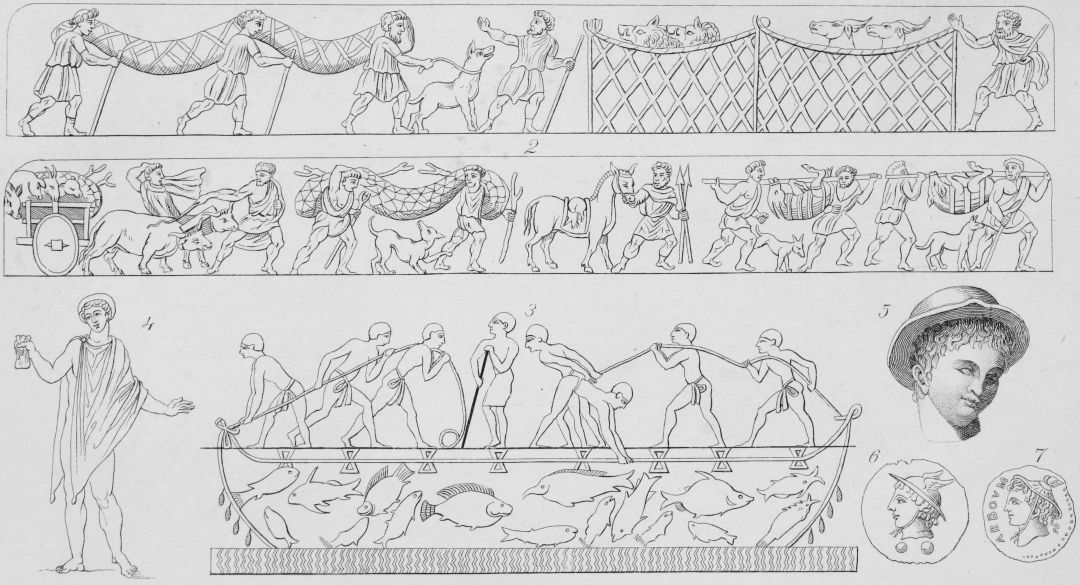
These were the Greek and Latin names for the sean. Before producing the passages in which they occur, we will present to the reader an account of this kind of net as now used by the fishermen on the coast of Cornwall (England) for catching pilchards, and as described by Dr. Paris in his elegant and pleasant Guide to Mount’s Bay and Land’s End[717].
“At the proper season men are stationed on the cliffs to observe by the color of the water where the shoals of pilchards are to be found. The sean is carried out in a boat, and thrown into the sea by two men with such dexterity, that in less than four minutes the fish are inclosed. It is then either moored, or, where the shore is sandy and shelving, it is drawn into more shallow water. After this the fish are bailed into boats and carried to shore. A sean is frequently three hundred fathoms long, and seventeen deep. The bottom of the net is kept to the ground by leaden weights, whilst the corks keep the top of it floating on the surface. A sean has been known to inclose at one time as many as twelve hundred hogsheads, amounting to about three millions of fish.”
Let this passage be compared with the following, which gives an account of the use of the same kind of net among the Arabs. It will then appear how extensively it is employed, since we find it used in exactly the same way both by our own countrymen and by tribes which we consider as ranking very low in the scale of civilization; and on making this comparison, the inference will seem not unreasonable, that the ancient Greeks and Romans, who in several of their colonies in the Euxine Sea, on the coasts of Ionia, and of Spain, and in other places, carried on the catching and curing of fish with the greatest possible activity and to a wonderful extent, used nets of as great a compass as those which are here described.
“The fishery is here (i. e. at Burka, on the eastern coast of Arabia) conducted on a grand scale, by means of nets many hundred fathoms in length, which are carried out by boats. The upper part is supported by small blocks of wood, formed from the light and buoyant branches of the date-palm, while the lower part is loaded with lead. To either extremity of this a rope is attached, by which, when the whole of the net is laid out, about thirty or forty men drag it towards the shore. The quantity thus secured is enormous; and what they do not require for their own consumption is salted and carried into the interior. When, as is very generally the case, the nets are the common property of the whole village, they divide the produce into equal shares[718].”
That this method of fishing was practised by the Egyptians from a remote antiquity appears from the remaining monuments. The paintings on the tombs show persons engaged in drawing the sean, which has floats along its upper margin and leads along the lower border[719]. An ancient Egyptian net, obtained by M. Passalacqua, is preserved in the Museum at Berlin. Some of its leads and floats remain, as well as a gourd, which assisted the floats[720].
Besides the verses of Oppian, which are above quoted, we find another passage of the same poem (Hal. iii. 82, 83), which mentions the following appendages to the σαγήνη, viz. the πέζαι, the σφαιρῶνες, and the σκολιὸς πάναγρος. As the πόδες, or feet of a sail were the ropes fastened to its lower corners, we may conclude that the πέζαι were the ropes attached to the corners of the sean, and used in a similar manner to fasten it to the shore and to draw it in to the land, as is described by Ovid in the line already quoted,—
Hos cava contento retia fune trahunt.
The σφαιρῶνες, as the name implies, were spherical, and must therefore have been either the floats of wood or cork at the top, or the weights, consisting either of round stones or pieces of lead, at the bottom. The σκολιὸς πάναγρος must have been a kind of bag formed in the sean to receive the fishes, and thus corresponding to the purse or conical bag in the ἄρκυς. The term is illustrated by the application of the equivalent epithet ἀγκύλα or “angular,” to hunting-nets in a passage from Brunck’s Analecta, which was formerly explained, and by the epithet “cava” in the line just quoted from Ovid[721].
In the following passage Ovid mentions the use both of the corks and of the leads[722]. This passage also shows that several nets were fastened together in order to form a long sean:
Aspicis, ut summa cortex levis innatat unda, Cum grave nexa simul retia mergat onus? Trist. iii. 4. 1, 12.
This use of cork and lead in fishing is also mentioned by Ælian, Hist. Anim. xii. 43; and that of cork by Pausanias, viii. 12. § 1; and by Pliny, H. N. xvi. 8. s. 13, where, in reciting the various uses of cork, he says it was employed “piscantium tragulis.” Sidonius Apollinaris, describing his own villa, says:—
Hinc jam spectabis, ut promoveat alnum piscator in pelagus, ut stataria retia suberinis corticibus extendat.—Epist. ii. 2.
“Hence you will see how the fisherman moves forward his boat into the deep water, that he may extend his stationary nets by means of corks.”
Alciphron, in his account of a fishing excursion near the Promontory of Phalerum, says, “The draught of fishes was so great as almost to submerge the corks[723].” The earnest desire of a posterity, founded on the wish for posthumous remembrance, which was a very strong and prevailing sentiment among the ancients, is illustrated by the language of Electra in the Choëphorœ of Æschylus, where she entreats her father upon this consideration to attend to her prayer, and likens his memory to a net, which his children, like corks, would save from disappearing:—“Do not extinguish the race of the Pelopidæ. For thus you will live after you are dead. For a man’s children are the preservers of his fame when dead, and, like corks in dragging the net, they save the flaxen string from the abyss.” The use of the corks is mentioned in several of the epigrams of the Greek Anthology, already referred to, and in the following passage of Plutarch:—
Ὥσπερ τοὺς τὰ δίκτυα διασημαίνοντας ἐν τῇ θαλάσσῃ φελλοὺς ὁρῶμεν ἐπιφερομένους.—De Genio Socratis, p. 1050, ed. Steph.
Passages have been already produced from Plutarch, Artemidorus, and the Alexandrine version of Isaiah and Habakkuk, in which the sean is mentioned by its Greek name σαγήνη, in contradistinction to other kinds of nets. Also the passage above cited from Virgil’s Georgics (“pelagoque alius trahit humida lina”), indicates the use of the sean in deep water, and the practice of dragging it out of the water by means of ropes, which gave origin both to its English name, the Drag-net, and to its Latin appellations, tragula, used by Pliny (l. c.), and tragum, which is found in the ancient Glossaries and in Isidore of Seville[724].
We find mention of the sean more especially for the capture of the tunny and of the pelamys, which were the two principal kinds of fish caught in the Mediterranean. Lucian speaks of the tunny-sean[725], which was probably the largest net of the kind, and he relates the circumstance of a tunny escaping from its bag or bosom[726]. The sean is thrice mentioned in the Epistles of Alciphron (l. c. and lib. i. epp. 17, 18.), and in the two latter passages, as used for catching tunnies and pelamides. We read also of a dolphin (δελφὶς) approaching the sean[727]; but this might be by accident. It was not, we apprehend, employed to catch dolphins.
In the following passage of the Odyssey (xxii. 384-387) we have a description of the use of a sean in a small bay, having a sandy shore at its extremity, and consequently most suitable for the employment of this kind of net:
Ὥστ’ ἰχθύας, οὕσθ’ ἁλιήες Κοῖλον ἐς αἰγιαλὸν πολιῆς ἔκτοσθε θαλάσσης Δικτύῳ ἐξέρυσαν πολυωπῷ· οἱ δέ τε πάντες Κύμαθ’ ἁλὸς ποθέοντες ἐπὶ ψαμάθοισι κέχυνται.
The poet here compares Penelope’s suitors, who lie slain upon the ground, to fishes, “which the fishermen by means of a net full of holes have drawn out of the hoary sea to a hollow bay, and all of which, deprived of the waves of the sea, are poured upon the sands.” Although the general term δίκτυον is here used, it is evident that the net intended was the sean, or dragnet.
In one of the passages of Alciphron already referred to, mention is made of the use of the sean in a similar situation. Some persons, who are fishing in a bay for tunnies and pelamides, inclose nearly the whole bay with their sean, expecting to catch a very large quantity[728]. This circumstance proves, that the sean was used with the ancient Greeks, as it is with us, to encompass a great extent of water.
We have seen that the sean supplied figures of speech no less than the purse-net (ἄρκυς), and the casting-net (ἀμφίβληστρον). It is applied thus in the case of persons who are ensnared by the wicked[729], who are captivated by the charms of love[730] or of eloquence[731], or who are held in bondage by superstition[732]. But by far the most distinct, expressive and important of its metaphorical applications, was to the mode of besieging a city by encircling it with one uninterrupted line of soldiers, or sweeping away the entire population of a certain district by marching in similar order across it. Of this the first example occurs in Herodotus iii. 145:—
Τὴν δὲ Σάμον σαγηνεύσαντες οἱ Πέρσαι παρέδοσαν Σολυσῶντι, ἐρῆμον ἐοῦσαν ἀνδρῶν.
“The Persians, having dragged Samos, delivered it, being now destitute of men, to Solyson.”
As we speak of dragging a pit, so the Greeks would have spoken, in this metaphorical sense, of dragging an island. In the sixth book (ch. xxxi.) Herodotus particularly describes this method of capturing the enemy. According to this account the Persians landed on the northern side of the island. They then took hold of one another’s hands so as to form a long line, and thus linked together they walked across the island to the south side, so as to hunt out all the inhabitants. The historian here particularly mentions, that Chios, Lesbos, and Tenedos were reduced to captivity in this manner. It is recorded by Plato[733], that Datis, in order to alarm the Athenians, against whom he was advancing at the head of the Persian army, spread a report that his soldiers, joining hand to hand, had taken all the Eretrians captive as in a sean. The reader is referred to the Notes of Wesseling and Valckenaer on Herod. iii. 149 for some passages, in which subsequent Greek authors have quoted Herodotus and Plato. We find σαγηνευθῆναι, “to be dragged,” used in the same manner by Heliodorus[734].
In addition to the passages of Isaiah and Habakkuk which mention the drag in opposition to the casting-net; we find three references to the use of it in the prophecies of Ezekiel, viz. in Ezek. xxvi. 5. 14; xlvii. 10. The prophet, foretelling the destruction of Tyre, says it would become a place to dry seans upon, ψυγμὸς σαγηνῶν; “siccatio sagenarum,” Vulgate Version; “a place for the spreading of nets,” Common English Version. The Hebrew term for a drag or sean is here חרם.
The only passage of the New Testament which makes express mention of the sean, is Matt. xiii. 47, 48: “The kingdom of heaven is like unto a net (σαγήνη) that was cast into the sea, and gathered of every kind; which, when it was full, they drew to shore, and sat down, and gathered the good into vessels, but cast the bad away.” The casting-net, which can only inclose part of a very small shoal, would not have been adapted to the object of this parable. But we perceive the allusion intended by it to the great quantity and variety of fishes of every kind which are brought to the shore of the bay (αἰγιαλὸν) by the use of the drag. The Vulgate here retains the Greek word, translating sagena as in the above-cited passages of Habakkuk and Ezekiel. In John xxi. 6. 8. 11, the use of the sean is evidently intended to be described, although it is called four times by the common term δίκτυον, which denoted either a sean, or a net of any other kind. It is in this passage translated rete in the Latin Vulgate.
The Greek σαγήνη having been adopted under the form sagena in the Latin Vulgate, this was changed into rezne by the Anglo-Saxons[735], and their descendants, have still further abridged it into sean. In the south of England this word is also pronounced and spelt seine, as it is in French. We find in Bede’s Ecclesiastical History[736] a curious passage on the introduction of this kind of net into England. He says, “the people had as yet only learnt to catch eels with nets. Wilfrid caused them to collect together all their eel-nets, and to use them as a sean for catching fishes of all kinds.”
VIII. Reticulus or Reticulum. ΓΥΡΓΑΘΟΣ.
In the ancient Glossaries we find Γύργαθος translated Reticulus and Reticulum: it meant, therefore, a small net. It was not a name for nets in general, nor did it denote any kind of hunting-net or fishing-net, although the net indicated by this term might be used occasionally for catching animals as well as for other purposes. It was used, for example, in an island on the coast of India to catch tortoises, being set at the mouths of the caverns, which were the resort of those creatures[737]. But the same term is applied to the nets which were used to carry pebbles and stones intended to be thrown from military engines[738]; and a similar contrivance was in common use for carrying loaves of bread[739]. Hence it is manifest that the γύργαθος was often much like the nets in which the Jewish boys in our streets carry lemons, being inclosed at the mouth by a running string or noose. We may therefore translate γύργαθος, “a bag-net,” as it was made in the form of a bag. “To blow into a bag-net,” εἰς γύργαθον φυσᾷν, became a proverb, meaning to labor in vain. But this bag was often of much smaller dimensions, and of much finer materials, than in the instances already mentioned. From a passage of Æneas Tacticus (p. 54. ed. Orell.) we may infer that it was sometimes not larger than a purse for the pocket. Hence Aristotle[740] properly applies the term γύργαθος to the small spherical or oval bag in which spiders deposit their eggs. Among the luxurious habits of the Sicilian prætor Verres, it is recorded, that he had a small and very fine linen net, filled with rose-leaves, “which ever and anon he gave his nose[741].” This net was, no doubt, called γύργαθος in Greek.
THE END.
Plate X.