Part 6 — CHAPTER IV. THE LYDIANS
Reading edition
Of the somewhat numerous nations that inhabited Asia Minor after the disappearance of the Hittites, the Lydians were the only ones who attained a degree of prominence that makes them an object of particular interest to the present day student of ancient history. And even these have an interest of a somewhat negative kind through their associations with the Greeks on the one hand and the Persians on the other.
As to the origin of the Lydians and their early history, all is utterly obscure. It is not even very clearly known whether they are to be regarded as a Semitic, Aryan, or a Turanian stock; most likely they were a mixed race and owed to this fact the relative power which they attained. Tradition, which here does service for history, ascribes to them three dynasties of kings, which are commonly spoken of as the Attyadæ, Heraclidæ, and the Mermnadæ. The first of these dynasties is altogether mythical, and the second very largely so. There are, however, some half dozen kings of the later period of the second dynasty whose names are known to us; these are Alyattes I, Ardys I, Alyattes II, Meles, Myrsus, and Candaules, and they ruled from about the year 814 B.C. to the year 691 B.C. The last of these kings, Candaules by name, is known to fame through the pages of Herodotus and other writers, and with his overthrow by Gyges, the third and last and the only truly historic dynasty of Lydia was ushered in.
The story of the overthrow of Candaules, as told by Herodotus, is one of the most stirring and famous of that author’s narratives. That it must be regarded as half mythical, however, is evident from the fact that other Greeks had different traditions as to the same event. Thus Plato tells a fabulous tale of the finding by Gyges of a ring which had the property of rendering him invisible at pleasure, which ring became the means through which he succeeded in winning the favour of the wife of Candaules, and ultimately in overthrowing that monarch. All these tales, taking thus the characteristic cast of ancient narratives, agree, however, in the one essential point, namely, the overthrow of the dynasty by Gyges and the establishing of himself and his successors on the throne.
If tradition is to be credited, Gyges was a man of no small merit as an administrator; in particular, it is believed that he first invented a system of coinage. The alleged fact rests on somewhat insecure evidence; still, in default of another claimant, it is usually accepted by modern historians, and this alone should be sufficient to preserve the name of Gyges, to the remotest posterity.
The name of Gyges, however, has attained no such popular notoriety as that of his successor, Crœsus, of about a century later. It is, indeed, the story of Crœsus and his overthrow by Cyrus, as told by Herodotus, that has done more than anything else to preserve the name of Lydia. Thanks to the father of history, the name of Crœsus has stood as a synonym of wealth through all the centuries since that monarch lived, and the tragic story of the overthrow of the mighty autocrat through overweening confidence in himself and an underestimate of his enemy will continue, no doubt, to point a moral for successive generations of readers so long as history is read.
Among all the names of antiquity there is, perhaps, no other more widely and popularly known than that of Crœsus, and there is certainly no other name in ancient or modern history so famous, whose possessor achieved so little. The wealth of Crœsus was largely a heritage from his predecessors, and his share in the only important Lydian war of which we have record, was far from a glorious one. The place of this famous monarch in history is, therefore, as unique as it is interesting.a
THE LAND
It is difficult to fix the boundaries of Lydia very exactly, partly because they varied at different times, partly because we are still but imperfectly acquainted with the geography of western Asia Minor.
The name is first found, under the form of Luddi, in the inscriptions of the Assyrian king Asshurbanapal, who received tribute from Gyges about 660 B.C. In Homer we read only of Mæonians, and the place of the Lydian capital Sardis is taken by Hyde, unless this was the name of the district in which Sardis stood. The earliest Greek writer who mentions the name is Mimnermus of Colophon, in the 37th Olympiad. According to Herodotus the Meiones (called Mæones by other writers) were named Lydians after Lydus, the son of Attys, in the mythical epoch which preceded the rise of the Heraclid dynasty. In historical times, however, the Mæones were a tribe inhabiting the district of the Upper Hermus, where a town called Mæonia (now Mennen) existed. The Lydians must originally have been an allied tribe which bordered upon them to the northwest, and occupied the plain of Sardis, or Magnesia, at the foot of Tmolus and Sipylus. They were cut off from the sea by the Greeks, who were in possession, not only of the Bay of Smyrna, but also of the country north of Sipylus as far as Temnus, in the Boghaz, or pass, through which the Hermus forces its way from the plain of Magnesia into its lower valley. In an Homeric epigram the ridge north of the Hermus, on which the ruins of Temnus lie, is called Sardene. Northward the Lydians extended at least as far as the Gygæan Lake (Lake Colœ, now Mermereh) and the Sardene range (now Dumanly Dagh). The plateau of the Bin Bir Tepe, on the southern shore of the Gygæan Lake, was the chief burial-place of the inhabitants of Sardis, and is thickly studded with tumuli, among which the “tomb of Alyattes” towers to a height of 260 feet.
Next to Sardis, Magnesia Sipylum was the chief city of the country, having taken the place of the ancient Sipylus, now probably represented by an almost inaccessible acropolis discovered by Mr. Humann not far from Magnesia on the northern cliff of Mount Sipylus. In its neighbourhood is the famous seated figure of “Niobe,” cut out of the rock, and probably intended to represent the goddess Cybele, to which the Greeks attached their legend of Niobe. According to Pliny, Tantalis, afterwards swallowed up by earthquake in the pool Sale or Salœ, was the ancient name of Sipylus and “the capital of Mæonia.”
Under the Heraclid dynasty the limits of Lydia must have been already extended, since, according to Strabo, the authority of Gyges reached as far as the Troad, and we learn from the Assyrian inscriptions that the same king sent tribute to Asshurbanapal, whose dominions were bounded on the west by the Halys.
But under the Mermnadæ Lydia became a maritime as well as an inland power. The Greek cities were conquered, and the coast of Ionia included within the Lydian kingdom. The successes of Crœsus finally changed the Lydian kingdom into a Lydian empire, and all Asia Minor westward of the Halys, with the exception of Lycia, owned the supremacy of Sardis. Lydia never again shrank back into its original dimensions. After the Persian conquest the Mæander was regarded as its southern boundary, and in the Roman period it comprised the country between Mysia and Caria on the one side, and Phrygia and the Ægean on the other.
Lydia proper was exceedingly fertile. The hillsides were clothed with vine and fir, and the rich broad plain of Hermus produced large quantities of corn and saffron. The climate of the plain was soft but healthful, though the country was subject to frequent earthquakes. The Pactolus, which flowed from the fountain of Tarne in the Tmolus mountains, through the centre of Sardis into the Hermus, was believed to be full of golden sand; and gold-mines were worked in Tmolus itself, though by the time of Strabo the proceeds had become so small as hardly to pay for the expense of working them. Mæonia on the east contained the curious barren plateau known to the Greeks as the Catacecaumene or Burnt Country, once a centre of volcanic disturbance. The Gygæan Lake, where remains of pile dwellings have been found, still abounds with carp, which frequently grow to a very large size.d
Strabo observes that this lake, which was afterwards called Colœ, was forty stadia from Sardis. It was said to have been excavated by the hand of man, as a bason for receiving the waters which overflowed the neighbouring plains. Near the lake, towards Sardis, was the tomb or tumulus of Alyattes, mentioned by Herodotus as one of the wonders of Lydia; he says the foundation of this monument was of huge stone, but the superstructure was a mound of earth. It was raised by the artisans and courtesans of Sardis. The historian adds that in his time there were extant on the top of the mound five pillars, on which were inscribed the different portions of the work completed by the several trades; whence it appeared that the courtesans had the greater share in it. The circumference of this huge mound was six stadia and two plethra, and the width thirteen plethra. Some writers affirmed it was called “the tomb of the courtesan,” and that it had been constructed by a mistress of King Gyges. Strabo reports that there were other tombs of the Lydian kings besides that of Alyattes, which has been confirmed by modern travellers.f
THE PEOPLE
Herodotus states that Lydus was a brother of Mysus and Car, which is borne out by the few Lydian, Mysian, and Carian words that have been preserved, as well as by the character of the civilisation of the three nations. The language, so far as can be judged from its scanty remains, was Indo-European, and more closely related to the western than to the eastern branch of the family. The race was probably a mixed one, consisting of aborigines and Aryan immigrants. It was characterised by industry and a commercial spirit, and, before the Persian conquest, by bravery as well.
The religion of the Lydians resembled that of the other civilised nations of Asia Minor. It was a nature-worship, which at times became wild and sensuous. By the side of the supreme god Medeus stood the sun-god Attys, as in Phrygia, the chief object of the popular cult. He was at once the son and bridegroom of Cybele or Cybebe, the mother of the gods, whose image carved by Broteas, son of Tantalus, was adored on the cliffs of Sipylus. Like the Semitic Tammuz or Adonis, he was the beautiful youth who had mutilated himself in a moment of frenzy or despair, and whose temples were served by eunuch priests. Or again he was the dying sun-god, slain by the winter, and mourned by Cybele, as Adonis was by Aphrodite in the old myth which the Greeks had borrowed from Phœnicia. This worship of Attys was in great measure due to foreign influence. Doubtless there had been an ancient native god of the name, but the associated myths and rites came almost wholly from abroad. The Hittites in their stronghold of Carchemish on the Euphrates had adopted the Babylonian cult of Ishtar (Ashtoreth) and Tammuz-Adonis, and had handed it on to the tribes of Asia Minor.
The close resemblance between the story of Attys and that of Adonis was the result of a common origin. The old legends of the Semitic East had come to the West through two channels. The Phœnicians brought them by sea and the Hittites by land. But though the worship of Makar or Melkarth on Lesbos shows that the Phœnician faith had found a home on this part of the coast of Asia Minor, it could have had no influence upon Lydia, which, as we have seen, was cut off from the sea before the rise of the Mermnadæ. It was rather to the Hittites that Lydia, like Phrygia and Cappadocia, owed its faith in Attys and Cybele. The latter became “the mother of Asia,” and at Ephesus, where she was adored under the form of a meteoric stone, was identified with the Greek Artemis. Her mural crown is first seen in the Hittite sculptures of Boghaz Keui on the Halys, and the bee was sacred to her. A gem found near Aleppo represents her Hittite counterpart standing on this insect. The priestesses by whom she was served are depicted in early art as armed with the double-headed axe, and the dances they performed in her honour with shield and bow gave rise to the myths which saw in them the Amazons, a nation of woman-warriors. The pre-Hellenic cities of the coast—Smyrna, Samorna (Ephesus), Myrina, Cyme, Priene, and Pitane—were all of Amazonian origin, and the first three of them have the same name as the Amazon Myrina, whose tomb was pointed out in the Troad. The prostitution whereby the Lydian girls gained their dowries was a religious exercise, as among the Semites, which marked their devotion to the goddess Cybele. In the legend of Hercules, Omphale takes the place of Cybele, and was perhaps her Lydian title. Hercules is here the sun-god Attys in a new form; his Lydian name is unknown, since E. Meyer has shown that Sandon belongs not to Lydia but to Cilicia. By the side of Attys stood the moon-god Manes or Men.d
SARDIS AND THE NAME OF ASIA
The commercial and strategical superiority of the site of Sardis gives us reason to think that it was always the seat of royal residence. But it does not seem that the place always had the same name. It was at a rather late period that the great city of the Tmolus took the name it has ever since borne. When Strabo mentions it as subsequent to the Troy war, he signifies, not that the place was deserted in the Homeric epoch, but that it then had a different name. As far as one can judge, the town had three successive titles, Asia, Hyde, Sardis, which correspond to the three great periods of its history.
According to Stephen of Byzantium, there was, at the foot of Tmolus, a town called Asia, and Asia took its name either from this town or from Asies, a native hero. The same geographer assures us that the territory of Sardis was called Esio-nia or Asia. Herodotus attests that local traditions, according to Hermus, derived the name of Asia from Asies and that in his time one of the Sardian tribes was called the Asian. As, in referring to the Cimmerian invasion, in the course of which Sardis was taken, Callinus speaks of it as directed against the Esionians, Demetrius of Scepsis conjectures Esionians to be an Ionian form of Asionians, for, according to him, Mæonia was originally called Asia. Finally, the author of the Iliad applies the term Asia to a plain situated in the valley of the Cayster on the route from Ephesus to Sardis. Strabo reports that there was shown by the side of the river a building dedicated to the hero Asies.
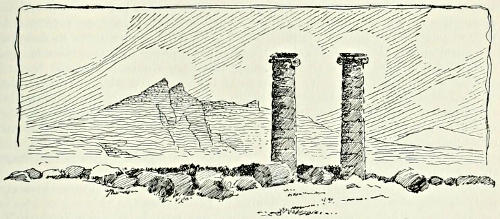
Ruins of the Acropolis of Sardis
If one connects these different evidences and reflects on the other hand that the hero Asies is, according to the legend, the grandson of Manes and therefore either the brother or the nephew of Attys, eponymus of the Attyads, which carries us back to the earliest Lydian dynasty, one may reasonably suppose: (1) that Asia was the most ancient name of Sardis; (2) that this name, by a kind of gradual shading off, extended first to the district of which this town was the capital, then to the entire province, then to the greater part of the continent; (3) that it retained the name until the day when a new people, the Mæonians, doubtless, became masters of the country and substituted another; (4) that it did not even then completely disappear, but in accordance with a fixed law, was still preserved in an obscure and restricted form as a designation of insignificant sections of that organism of which it formerly composed the whole.
It is not known when the name Hyde gave place to that of Sardis, a Lydian word which signifies year. But this change could hardly have taken place until towards 687. It is only comprehensible if it coincide with the fall of the Mæonian power and the coming of the Lydian people. The Mæonians, as long as their hegemony lasted, had no reason for changing the name of their town. One can conceive on the contrary, that Gyges, anxious to break all links with the past, would give a new name and one agreeable to his men, to the capital he had conquered. Perhaps this term Sardis, or “year,” which thenceforward designated the residence of the Mermnadæ, was chosen by the first among them to perpetuate that memorable date when the prince of Tyra, who was the conqueror of Candaules and legitimised by Delphi, seated himself as master on the Eastern throne.
EARLY HISTORY OF LYDIA
Besides these traditions of which we have just spoken, the early history of Lydia offers only tales so purely legendary that it would be vain to seek a rational foundation for them. Cambles, in an excess of voracity provoked by philtres, devours his wife. Meles has a lion by his concubine. The soothsayers of Telmessus predict to him that Sardis will be impregnable if the animal be taken along the walls. So Meles causes it to walk round the Acropolis at all those points where it could be surprised or forced. As to that part of the citadel looking towards Tmolus, he neglects it, deeming it inaccessible. Under the reign of Alcimus, Lydia knew the Golden Age, enjoying profound peace and amassing immense riches. Perhaps there is some truth in this last story. There is nothing to hinder the belief that this Alcimus really represents the time when, whether by the exploitation of mines, the opening of the grand route from Sardis to Pteria, or other industrial or commercial impulses, Lydia laid the basis of her immense economic prosperity.
But these are only hypotheses. It is in the eighth century that more solid ground is found. The last Heraclids emerge from the cloud of mystery in which their predecessors are confusedly gathered. We know the dates of their reigns and possess a few details of their lives.
By the Christian chronographers they are very briefly mentioned. To supplement these references, we have a document of the first order, a passage from the Universal History, composed in the time of Augustus and at Herod’s request by the peripatetic Nicolaus of Damascus, secretary to the Jewish king.
The extracts of Nicolaus of Damascus have an exceptional value. Under the embellishments of the story, and although the facts are clothed in concrete, fabulous, and symbolic forms, one can find serious information scarcely affected by the myths, traits of a striking reality, which are not due to popular imagination nor to the romantic verve of historians, but which bear the impress of a far-off origin and an incontestable authenticity. Xanthus and his abbreviators are far from having understood the traditions of which they make themselves the echoes. But the very fidelity with which they record them helps us to recover their true significance.
As fragment 49 is for the period which precedes and prepares the elevation of Gyges, a leading document—in fact the only one which permits a reconstruction of the political situation of Asia towards the end of the eighth century—it will be better here to translate the first part, that which shows the antecedents of the Lydian revolution.
“Alyattes, king of the Lydians, had twin sons, Cadys and Ardys. He left them the government and they reigned together, loving each other and adored by the people. But the wife of Cadys, Damonno, entered into adulterous relations with a certain Spermos, her uncle’s cousin. The two culprits resolved to kill the king. To do this, Damonno gave him poison. Cadys fell ill, but without succumbing. A doctor cured him, and he enjoyed even better health than before. Furious, Damonno resolved to do away with the doctor. Judging that if she gave him poison he would avoid its effects by his science, she had a deep hole dug in her palace, caused it to be made invisible from the outside, put a couch above it, and placed others in a row beside it. Then inviting her enemy to a festival, she made him lie down where the trap was hidden. He fell to the bottom, when she covered the place with earth, and thus made him disappear.
“It happened that in his turn Cadys died also. Then Damonno, gaining over a large number of the Lydians by bribery, in concert with Spermos, expelled King Ardys, her brother-in-law. Then she married her lover and proclaimed him king.
ARDYS
“Ardys, who had fled precipitately with his wife and daughter, found himself at Cyme in such poverty that he was reduced to becoming first a ploughman, and then an innkeeper. Every time any Lydians came to his inn he received them with extreme urbanity; nor did he rest until they were his friends. This conduct made Spermos anxious. So he sent a brigand to Cyme, named Kerses, instructed to kill the exile. As a reward Kerses was to marry the daughter of the usurper and receive a present of a thousand stateres.
“On arriving at Cyme the bandit presented himself at the inn of Ardys. The royal innkeeper was just as polite to him as to others. Kerses was charmed with his manners, and became enamored of his daughter, who busied herself with domestic cares. He asked her in marriage, promising her father in return that he would render him an exceptional favour. At first, Ardys, who despised the suitor’s base condition, and who was a thorough aristocrat, refused to give his daughter. But, led away at length by the assurances of the wooer, he ended by granting his request. The agreement made, Kerses revealed the object of his journey. Spermos, in exchange for Ardys’ head, had offered him his daughter, but Kerses wanted Ardys’ daughter, and to win her he would bring the exile his enemy’s head. Ardys approved. Kerses cut off the long hair he had hitherto worn. Then, having furnished himself with a wooden head, sculptured in the image of the outlaw, and having put on it the wig, he set out for Lydia. Spermos, learning the return of his emissary, ran to question him.
“‘All is done,’ Kerses assured him. (He had taken the precaution to hide the head in a little room.) ‘Well,’ answered the other, ‘show me the head you brought back.’ ‘No,’ said the bandit, ‘not before this crowd. Come and see it in secret at the house.’ ‘So be it,’ replied Spermos. The wooden figure lay on the ground. Kerses showed it to his accomplice, who bent over to recognise it. Immediately the brigand struck Spermos with his sword, knocked him down, cut off his head, opened the door, and went to rejoin Ardys.
“At the end of some time the Lydians, who were awaiting Spermos, not seeing him appear, entered the house and saw a decapitated corpse. This spectacle, instead of distressing, gave them pleasure, for the usurper was a bad man, and in his reign a drought had desolated the earth. Thus Spermos perished, having held power two years. He is not inscribed on the royal list. However, Kerses, in fleeing, came across an inn. He went in, and being very joyful at having succeeded in his enterprise, he drank to excess. In his drunkenness he confided in the tavern-keeper, and showed him the head of Spermos. The latter, judging from this that Ardys would recover the throne, managed to make the bandit hopelessly drunk, and killed him; then carrying his head and that of Spermos, went to find the fallen prince.
“When he had come to him: ‘I bring,’ he cried, ‘the greatest blessing possible.’ ‘What is that?’ asked the other. ‘That Spermos is dead, and that Kerses is not my son-in-law? There could be no greater blessing for me.’ Thyessos—such was the innkeeper’s name—answered, ‘That is exactly what I bring,’ and he showed the two heads. ‘What do you want for this service?’ asked Ardys of him. ‘Oh, as for myself,’ answered Thyessos, ‘I ask neither your daughter nor your gold. But I desire that when you are king you shall make my tavern exempt from taxation.’ ‘That I will promise,’ answered Ardys.
“As time went on, Thyessos became enriched by the revenue of his inn. He opened a market near his house, and there consecrated a temple to Hermes. The place thenceforth took the name of Hermaion-Thyessou.
“With regard to Ardys, he was recalled to the throne by the Lydians, who sent an embassy composed partly of Heraclids. After his restoration he brought back to Lydia the happy days of Alcimus. He was a just man, and his subjects adored him. It was he who took a census of the army, which was composed principally of cavalry. We are told he found it to contain as many as thirty thousand riders.
“In his old age Ardys had for favourite a prince of the Mermnadian line, Dascylus, son of Gyges. This Dascylus gradually got all the power into his hands. So the king’s son, Alyattes, fearing that on his father’s death he would seize supreme power, secretly assassinated him. Fearing for her life, the victim’s widow, then pregnant, took refuge in Phrygia, of which place she was a native. At the news of the murder, Ardys, consumed with anger, convoked the Lydians in assembly. As his great age rendered him helpless, he was borne to the meeting in a litter. Before all the people he denounced the crime, hurled imprecations on the heads of the guilty, and gave whoever should discover them the right to kill them. Ardys died, after having reigned seventy years.
“Under the reign of Meles, a famine having ravaged Lydia, the inhabitants went to consult the oracle. The god answered that the kings must expiate the murder of Dascylus. Learning from the diviners that the crime must be atoned for by a three years’ exile, Meles voluntarily retired to Babylon. Moreover, he sent to Phrygia, to the son of Dascylus (the same who had been proscribed even before birth, and, like his father, was named Dascylus) a message advising him to return to Sardis, assuring him that an indemnity would be paid for the murder. The young man refused, giving as a reason that he had never seen his father; that at the time of the crime he was not born, and, therefore, it was not his duty to interfere in the settlement of the affair.
“During his exile, Meles confided the government to Sadyattes, son of Cadys. This prince, descended from a far-off ancestor named Tylon, was regent in his master’s name, and when the three years were over and Meles came back from Babylon, he faithfully restored the power. Under the reign of Myrsus, Dascylus, the son of that Dascylus murdered by Sadyattes, fearing that plots were being laid for him by the Heraclids, abandoned Phrygia and took refuge among the Syrians who inhabited the province of Pontus, round Sinope. There he married a native, and it was from this marriage that Gyges was born.”
This narrative lends itself to diverse comments. First, does it offer a complete list of the last Sandonids in order of succession? If so, the catalogue in fragment 49 must be preferred to all the others, for the observation in the course of the recital that Spermos was not inscribed in the royal annals, shows that the author had drawn his information from official registers.c
In striking contrast with this account of the origin of the Lydian monarchy is the dramatic recital of Herodotus, which will be found in Appendix A on the classical traditions. From this story of Ardys and his successors, we may take up Professor Sayce’s brief summary of the whole of Lydian history.a
EARLY DYNASTIES
According to the native historian Xanthus (460 B.C.), three dynasties ruled in succession over Lydia. The first, that of the Attyads, is wholly mythical. It was headed by a god, and included geographical personages like Lydus, Asies, and Meles, or such heroes of folklore as Cambletes, who devoured his wife. To this mythical age belongs the colony which, according to Herodotus, Tyrsenus, the son of Attys, led to Etruria. Xanthus, however, puts Torrhebus in the place of Tyrsenus, and makes him the eponym of a district in Lydia. There was no connection between the Etrurians and Lydians in either language or race, and the story in Herodotus rests solely on the supposed resemblance of Tyrrhenus and Torrhebus. It is doubtful whether Xanthus recognised the Greek legends which brought Pelops from Lydia, or rather Mæonia, and made him the son of Tantalus. The legends must have grown up after the Greek colonisation of Æolis and Ionia, though Dr. Schliemann’s discoveries at Mycenæ have shown a certain likeness between the art of early Greece and that of Asia Minor, while the gold found there in such abundance may have been derived from the mines of Tmolus.
The second dynasty was also of divine origin, but the names which head it prove its connection with the distant East. Its founder, a descendant of Hercules and Omphale, was, Herodotus tells us, a son of Ninus and grandson of Belus. The Assyrian inscriptions have shown that the Assyrians had never crossed the Halys, much less known the name of Lydia, before the age of Asshurbanapal, and consequently the old theory which brought the Heraclids from Nineveh must be given up. But we now know that the case was otherwise with another oriental people, which was deeply imbued with the elements of Babylonian culture. The Hittites had overrun Asia Minor and established themselves on the shores of the Ægean before the reign of the Egyptian king, Ramses II. The subject allies who then fight under their banners include the Nasu or Mysians and the Dardani of the Troad from Iluna or Ilion and Pidasa (Pedasus); and, if we follow Brugsch, Iluna should be read Mauna and identified with Mæonia. At the same time the Hittites left memorials of themselves in Lydia. Mr. G. Dennis has discovered an inscription in Hittite hieroglyphics attached to the figure of “Niobe” on Sipylus, and a similar inscription accompanies the figure (in which Herodotus wished to see Sesostris or Ramses II) carved on the cliff of Karabel, the pass which leads from the plain of Sardis to that of Ephesus. We learn from Eusebius that Sardis was first captured by the Cimmerians 1078 B.C.; and, since it was four centuries later before the real Cimmerians appeared on the horizon of history, we may perhaps find in the statement a tradition of the Hittite conquest. Possibly the Ninus of Herodotus points to the fact that Carchemish was called “the old Ninus” while the mention of Belus may indicate that Hittite civilisation came from the land of Bel. At all events it was when the authority of the Hittite satraps at Sardis began to decay that the Heraclid dynasty arose. According to Xanthus, Sadyattes and Lixus were the successors of Tylon, the son of Omphale.
GYGES
After lasting five hundred and five years, the dynasty came to an end in the person of Sadyattes, as he is called by Nicolaus of Damascus, whose account is doubtless derived from Xanthus. The name Candaules, given him by Herodotus, meant “dog-strangler,” and was a title of the Lydian Hermes. Gyges, termed Gugu in the Assyrian inscriptions, Gog in the Old Testament, put him to death, and established the dynasty of the Mermnads, 690 B.C. Gyges initiated a new policy, that of making Lydia a maritime power; but his attempt to capture old Smyrna was unsuccessful. Towards the middle of his reign the kingdom was overrun by the Cimmerians, called Gimirræ in the Assyrian texts, Gomer in the Old Testament, who had been driven from their old seats on the Sea of Azov by an invasion of Scythians, and thrown upon Asia Minor by the defeat they had suffered at the hands of Esarhaddon. The lower town of Sardis was taken by them, and Gyges turned to Assyria for aid, consenting to become the tributary of Asshurbanapal or Sardanapalus, and sending him, among other presents, two Cimmerian chieftains he had himself captured in battle (about 660 B.C.). At first no one could be found in Nineveh who understood the language of the ambassadors.
A few years later, Gyges joined in the revolt against Assyria, which was headed by the viceroy of Babylonia, Asshurbanapal’s own brother. The Ionic and Carian mercenaries he despatched to Egypt enabled Psamthek to make himself independent. Assyria, however, was soon avenged. The Cimmerian hordes returned, Gyges was slain in battle after a reign of thirty-eight years, and Ardys his son and successor returned to his allegiance to Nineveh.
The second capture of Sardis on this occasion was alluded to by Callisthenes. Alyattes, the grandson of Ardys, finally succeeded in extirpating the Cimmerians, as well as in taking Smyrna, and thus providing his kingdom with a port. The trade and wealth of Lydia rapidly increased, and the Greek towns fell one after the other before the attacks of the Lydian kings. Alyattes’ long reign of fifty-seven years saw the foundation of the Lydian empire. All Asia Minor west of the Halys owned his sway, and the six years’ contest he carried on with the Medes was closed by the marriage of his daughter Aryenis to Astyages, and an intimate alliance between the two empires. The Greek cities were allowed to retain their own institutions and government on condition of paying taxes and dues to the Lydian monarch, and the proceeds of their commerce thus flowed into the imperial exchequer. The result was that the king of Lydia became the richest prince of his age. Alyattes was succeeded by Crœsus, who had probably already for some years shared the royal power with his father, or perhaps grandfather, as Floigl thinks (Geschichte des Semitischen Alterthums). He reigned alone only fifteen years.d
THE TRIUMPH OF PERSIA
Crœsus succeeded in establishing what his predecessors had sought—a powerful monarchy having close fiscal relations with the Hellenic world and ruling through the might of gold. By his efforts Sardis was raised to the height of opulence and became a general rendezvous and a kind of favourite capital of the Greeks. He accomplished this without violence; all his acts show a generous nature, a character inclined to benevolence and forgiveness. In spite of all this he was treated as a barbarian; but he was a refined and charming barbarian, Lydian in his genius for affairs, Greek in his æsthetic tastes—such a Philhellenic barbarian as some of the kings of Macedonia. He had but one fault, an irrational optimism and an excessive faith in the schemes of diplomacy, the virtue of alliances, and the power of gold. This over-confidence, by leading him to defy Cyrus, was his ruin.
Not that the idea of opposing Persia was in itself wrong; Crœsus was obeying a feeling of great foresight when he began preparations for war in 549 B.C. At this date Astyages was dethroned, the Median empire was destroyed, and the equilibrium of the Orient disturbed. The dominions of Cyrus had been extended as far as the Halys, and Persia thus brought into contact with the Lydian kingdom.
Apart from the annoyance of having such a neighbour, Crœsus could not forget that Astyages was his brother-in-law and that both sentiment and interest made it his duty to avenge the Median king.
Moreover, there were economic reasons that influenced him. The Persians were poor mountaineers who knew nothing of business, esteemed nothing but the trade of arms, and professed a profound disdain of all commerce, comfort, and culture. These prejudices of a military people caused particular alarm among the merchant states of the valleys of the Hermus and the Euphrates. From the day when the savage bands from Iran replaced the Median garrisons in Cappadocia it was easy to foresee the annihilation of the rich trade over the ancient route of Pteria.
Thus personal feeling, political fears, and commercial necessities actuated Crœsus to challenge Persia. With this end in view he formed a series of alliances. Nabonidus of Babylon and Aahmes II of Egypt, menaced like Crœsus himself by the ambition of Cyrus, promised him their aid. Foreseeing a conflict with one or another of the powers of the Orient, Crœsus had some time before assured himself of the help of the greatest military power of the time, Sparta. Now that war was imminent, he sent an embassy which by flattery and the representation that the enterprise had the sanction of the Delphic oracle easily induced the Spartans to sign the compact of alliance and friendship.
After this brilliant diplomatic campaign Crœsus believed success was certain. Lacedæmonia was fitting out vessels and equipping troops. Aahmes despatched his contingent. Nabonidus was only awaiting a signal to take the field; his tributaries, the Phœnicians, were ready to obey. Lydian agents were recruiting mercenaries in Thrace. If the forces of the league could have effected their junction, Cyrus would have found himself in grave peril.
But he was warned in time. An Ephesian whom Crœsus despatched to the Peloponnesus to enlist soldiers deserted to Cyrus and informed him of the coalition that was forming against him. The Persian king hastened to act before his enemies were ready. Babylon being his nearest adversary, he at once attacked the city.
Without waiting for the union of all his forces, without which such an undertaking was quite hopeless, Crœsus hastened to go to the relief of his ally. He crossed the Halys and took the city of Pteria without much difficulty. But he had not counted on the fearful energy of his foe. Cyrus at once set out for the north with his entire army. Passing through the defiles of Cappadocia, he quickly made himself master of the Anti-Taurus, and was in a position from which he could make an attack wherever he chose. Then he proposed a peaceful settlement, offering Crœsus, if he would become a vassal of Persia, the retention of his kingdom with the title and dignity of satrap. The Lydian king defiantly replied that he had never served any one, as had the Persians, the former slaves of the Medes and future slaves of the Lydians.
But these boastful words were not borne out in the campaign that followed. Not only did Crœsus prove himself to possess none of the qualities of a good general, but his heterogeneous army of mercenaries and foreign auxiliaries was utterly unable to cope with the seasoned troops of Cyrus. There was a single furious and bloody battle, which, according to Herodotus, was indecisive, but which other writers, probably with greater accuracy, declare was a victory for the Persians. Crœsus evacuated Pteria, abandoned the bend of the Halys, although it presented an excellent line of defence, and returned to Sardis. He felt quite secure here, for he did not dream that Cyrus would follow at once.
But Cyrus did follow very promptly, after having removed the danger of an attack in the rear by a treaty with Nabonidus. The sudden appearance of the Persians before the gates of Sardis astonished Crœsus, but did not dismay him.
The short campaign which ensued culminated in a great battle on the plain of Thymbrium. (Herodotus says “the plain before Sardis.”) The forces of Crœsus were much depleted by the dispersion of his mercenaries, especially of the Greek hoplites. Of his allies Aahmes was the only one who had sent his contingent. Crœsus’ great hope lay in his famous cavalry, which was considered the bravest and most skilful in the world. Nor were the Persians without fear of these terrible lancers, who might create irremediable disorder should they once succeed in breaking the Persian lines and penetrating the squares of the infantry. To avoid this danger Cyrus employed a stratagem that was suggested by a Mede. He covered the front of his army with a line of camels. Charging upon these enormous beasts that were opposed to them, the Lydian horses were so startled at the sight of them and so annoyed by their odour that they were thrown into confusion and the riders forced to dismount. But in spite of their courage they were overwhelmed and routed by the rude foot-soldiers of Iran. The survivors reached Sardis in safety, and were besieged there by Cyrus.
The defeat of Thymbrium placed Crœsus in a most critical situation. He despatched couriers everywhere, especially to Sparta, to beg his allies for help. The Lacedæmonians, whose soldiers were ready and vessels equipped, were about to give the order to set sail when a new message brought consternation to the city. Sardis had been taken and the king was a captive. [546 B.C.]
Among the conflicting accounts of the fall of Sardis, that of Herodotus appears to be the most trustworthy. According to him the walls were stormed at a vulnerable point that had been discovered accidentally by a Persian soldier.
Although the tradition of the funeral pile of Crœsus has often been attacked by modern critics, principally on the ground that it would have been contrary to the religion of the Persians, after all no valid objection has been brought against it. In condemning Crœsus to the fire the Persians were not acting on their own initiative; they were simply tolerating a usage common to Semitic religions. Death by fire was one of the characteristic traits of Lydian civilisation. A solemn festival was celebrated at Sardis every year, in which the principal divinity of the Lydians, Heracles-Sandon, was represented as perishing on a funeral pile. In delivering himself up to the flames the last king of Lydia was but making himself like a god and securing for himself a glorious end. [See the legend in Appendix A.]
Then by some means of which we are ignorant, perhaps nothing more than an ordinary tempest of rain, the consummation of the sacrifice was prevented.
Crœsus, after his escape from death, found favour with Cyrus, who treated him with great distinction, made him his adviser, and took him with him on his expeditions. The last that is known of him is that he accompanied Cambyses on his Egyptian expedition in 525 B.C.
Such was the end of the house of Gyges. This sudden fall of a powerful empire stupefied the Greeks. Crœsus had dazzled them by his power, his wealth, and his liberality, and they were sorry for him. According to Justin, his fall was considered in all Hellas as a public calamity. The cordial reception and the honours accorded to Greek merchants, soldiers, and artists at his court were not forgotten. His name became familiar, and Greek imagination took delight in embellishing his legend.c
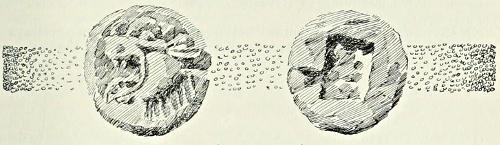
Lydian Coins
(Now in the British Museum)
LYDIAN CIVILISATION
The Lydian empire may be described as the industrial power of the ancient world. The Lydians were credited with being the inventors, not only of games such as dice, huckle-bones, and ball, but also of coined money. The oldest known coins are the electrum coins of the earlier Mermnads, stamped on one side with a lion’s head or the figure of a king with bow and quiver; these were replaced by Crœsus with a coinage of pure gold and silver. To the latter monarch were probably due the earliest gold coins of Ephesus.[12] Mr. Head has shown that the electrum coins of Lydia were of two kinds, one weighing 168.4 grains for the inland trade, and another of 224 grains for the trade with Ionia. The standard was the silver “mina of Carchemish,” as the Assyrians called it, which contained 8656 grains.
Originally derived by the Hittites from Babylonia, but modified by themselves, this standard was passed on to the nations of Asia Minor during the period of Hittite conquest, but was eventually superseded by the Phœnician mina of 11,225 grains, and continued to survive only in Cyprus and Cilicia. The inns, which the Lydians were said to have been the first to establish,[13] were connected with their attention to commercial pursuits. Their literature has wholly perished, and the only specimen of their writing we possess is on a marble base found by Mr. Wood at Ephesus.[14]
They were celebrated for their music and gymnastic exercises; and their art formed a link between that of Asia Minor and that of Greece. A marble lion at Achmetly represents in a modified form the Assyrian type, and the engraved gems found in the neighbourhood of Sardis and Old Smyrna resemble the rude imitations of Assyrian workmanship met with in Cyprus and on the coasts of Asia Minor. For a description of a pectoral of white gold, ornamented with the heads of animals, human faces, and the figure of a goddess, discovered in a tomb on Tmolus, see Academy, January 15, 1881, p. 45. Lydian sculpture was probably similar to that of the Phrygians as displayed at Doghanlu, Kumbet, and Ayazin, a necropolis lately discovered by Mr. Ramsay. Phallic emblems, for averting evil, were plentiful; even the summit of the tomb of Alyattes is crowned with an enormous one of stone, about 9 feet in diameter. The tumulus itself is 281 yards in diameter and about half a mile in circumference. It has been partially excavated by Spiegelthal and Dennis, and a sepulchral chamber discovered in the middle, composed of large, well-cut, and highly polished blocks of marble, the chamber being 11 feet long, nearly 8 feet broad, and 7 feet high. Nothing was found in it except a few ashes and a broken vase of Egyptian alabaster. The stone basement which, according to Herodotus, formerly surrounded the mound, has now disappeared.d
Of the glories of Lydian civilisation it would be well to have a portrayal. None could be more vivid than Radet’s glowing revivification of the probable splendours of such a scene.
A PICTURE OF LIFE IN LYDIA
One would like to know more of Sardis, that glorious capital of the Lydian state, that strange city which was the advance guard of Hellenism towards the interior, and at the same time the last stage of the Semitic world towards the west: it is not impossible to imagine it. Of complex physiognomy, it reflected the very character of the population who dwelt there. It was a city of contrasts. The traveller coming over the Leuco-Syrian route was informed of the strange sights awaiting him by the monuments of every style along the road. There were colossal figures graven in the rock, figures of strange gods, processions of priests with pointed tiaras, and soldiers with boots turned up at the toe, while lion and bull fights spread along the skirts of the mountain. Occasionally hieroglyphics accompanied these rock-hewn bas-reliefs, witnessing to their Pterian origin; again, the alphabet of the inscriptions showed they were the work of Phrygian sculptors. In places were enormous conical mounds, tombs in the Thracian style, high as little hills, uniformly surmounted by a phallus. The most recent of these funeral mounds were ornamented with friezes. These, showing hunting scenes, files of warriors, groups of animals, all bore the mark of oriental inspiration but in style revealed Greek handiwork. It was like being in a land of transition where the most diverse influences crossed and mingled.
Whether coming from the direction of Sipylus or issuing from the Catacecaumenian gorges, what struck one first on reaching the vast mountain amphitheatre, in the centre of which Sardis rises, was the imposing mass. The official and military town, the fortress, the acropolis with its broken outline, its abrupt façade rising above the plain in the fashion of a promontory, the vast circle of ramparts; then, beyond the walls, above the battlements, temples, as for instance that of Apollo, grand public buildings, as the royal treasury—a confused mass of roofs, pediments, and towers, standing in bold relief against the background of the Tmolus, whose heights receded far beyond, sombre and confused, in a striking disorder of peaks, ravines, and woods.
The impression of majesty which the capital of Asia Minor gave from the distance, the idea it suggested of a centre of splendour and opulence, vanished as one drew nearer. In the suburbs, on coming out of the immense flat plain which surrounds them, the picture ceased to be majestic and became picturesque, gaining by wildness what it lost in magnificence. The city, on this side, with its gardens, meadows, fields, clusters of trees, thatched huts trellised with roses, had an air of wild forest land. It retained something of the Homeric Hyde, the wild and green land whose sombre oak groves were often ravaged by lightning. It was the quarter of the poor. Straw huts, rough plank cottages, homesteads half in ruins, smothered in high grass or hidden by trees, sheltered a whole population of workmen, mule proprietors or drivers, caravan conductors, miserable horse breeders.
Higher up, on the semicircular terraces seen at the foot of the acropolis, appeared the commercial part, with bazaars, shops, markets, caravanseries, and baths. The extreme west was marked by the agora which spread along the two banks of the Pactolus round the temple of Cybele. Probably more to the east, facing the plain stood the palace of Crœsus, its solid brick walls rising above the confused mass of badly built small houses.
This part of the town was always extremely lively. Carefully driven chariots spun with surprising swiftness along the narrow and tortuous streets. The horses, short, strong, well built, collarless and quick footed, easily carried men or loads. Here and there a convoy of merchandise disappeared into a caravansery. Through the open door could be seen an immense court, a group of plane trees shading a well, and rows of cells with doors opening out under a wooden gallery.
In the bazaar were tiny shops, long and narrow, built one against the other like cells in a hive. Here were sold all the products of the East. The different trades were assembled in groups. Here was the leather market, with every invention in red, blue, yellow, stitched, spangled, and embroidered leather to be found at an Asiatic leather-seller’s; bright-coloured purses, laced sandals, peaked shoes, dyed and embroidered straps, sheaths and lashes, all giving out agreeable odours in the heavy air. In another place was the weavers’ quarter, where were purple stuffs, luxurious hangings, trappings of soft tints, and carpets of striking colours. Farther on, glittered the goldsmiths’ wares; marvels of Assyrian jewelry, necklaces, bangles, rings, whole sets in electrum and silver, and ivory playthings. One of the most curious corners was the perfumery section. There were piled up drugs without number, powders exposed in sacks or heaps, coffers and cases full of pastiles, sachets, smelling salts; essences coloured the flasks; there were pots containing pomades or unguents. Many of these balms and aromatics had saffron as a base. It was with saffron that the most celebrated Lydian composition, baccaris, was made, whose odour, heady and bewildering, was felt above all those that filled the atmosphere.
Buyers and sellers and hangers-on belonged to the most diverse races. Lydians sold everything, and notably eunuchs. Pterians brought wool and grain; Phrygians, cattle; Greeks spread out pottery, jewels, objects of art conceived after Asiatic types, but fashioned with much more elegance and finish; Carians brought arms, plumed helmets, and graven bucklers, while the Chaldeans offered amulets with a mysterious air.
In a town so cosmopolitan, where industry and commerce brought together so much wealth, morals were naturally very dissolute. Luxury, show, and pleasure were sought after. Every one wore clothes of vivid colour, long and floating tunics, like the bassara, which fell to the feet. Princes had caftans of purple with gold embroidery. As to the coiffure, it generally consisted in a simple ribbon of cloth or gold which bound the hair and prevented it falling over the face. This was the ampyx, used above all by the Greek-loving Lydians. Partisans of old Eastern fashions preferred the mitre. Rings swung in the pierced ears. On the garments shone a profusion of jewels, necklaces, bracelets, anklets, and pendeloques. Every one was scented, locks glistened with aromatic oils, faces had that sickly look given by rouge and cosmetics.
All minds were continuously set on pleasure. At Colophon, where Lydian customs were widely copied, flute and zither players received an official salary to play from dawn till dusk. It is probable that the same custom existed at Sardis. To the Lydians are attributed the invention of the majority of games, such as dice and ball. Their banquets were models of careful taste. This was in contrast to Thessalonian banquets, which were orgies of guzzlers, with piles of victuals, whose sole merit was in being able to fill chariots. In his Gastronomy, the poet Archestratus, a connoisseur and good liver, recommends the real lover of delicacies to have a Lydian pastry cook. Herodotus likewise boasts of the confectionery of Callatebus. At Sardis the favourite dishes were karuke and kandaulos, stews so complicated that the recipes, as transmitted to us by the authors, are as unintelligible grammatically as they are amazing in a culinary way. What is most clearly known of these strange compositions is that they were made of aphrodisiac ingredients and had the reputation of inciting to love. Their action on the organism was compared to that of whips.
There was at Sardis a rendezvous for all the debauchées. This was a sort of park, planted with trees of such thick foliage that the stars could not pierce their impenetrable branchings. According to the imitation that Polycrates made of it at Samos, it was not a simple garden ornamented with arbours and shrubberies, flower beds and fountains, rare animals and exotic plants, but a real town, full of buildings and lanes, small hotels and shops.
This place of feasting and orgy was called the Happy Corner or the Woman’s Theatre.
It was above all in times of grand religious ceremony that the Lydian nature gave play to its two favourite passions, parade and exaltation. During the Cybelean orgies a wild bacchanalia was seen on the slopes of Tmolus. At night, to mourn the death of Attys, the people wandered about in the darkness. Mournful wailing mingled with the sound of muffled drums and piercing notes from the flute. Among the mountain peaks moved and howled fantastic shadows, made disproportionally large by the light of flickering torches. Then, the dawn having come, when the divine lover was restored to light, the terror and anguish were followed by delirious joy. An immense cortège paraded through the town in magnificent procession, every one rivalling his neighbour in magnificence and showing his most sumptuous treasures.
Such was Sardis. Like all towns situated at the confluence of several worlds, it offers us contradictory traits. A sensual materialism reigned, united with ardent mysticism. In this centre, full of surprises, the love of realities was allied with a taste for art. The fever of enjoyment did not detract from practical sense. Ease went hand in hand with boldness. When, on the return from an expedition in the interior, a squadron of Lydian cavalry came in to the sound of the syrinx, and double flute, the Greek—Solon or Thales—philosophising in the streets and seeing the forest of lances high above the roofs, could but ask himself whether the merchants, so pale, languid, and painted, whom he saw in a cloud of perfume in the shadowy shops, really belonged to the same race as these men, so proud, robust, weather-beaten by the winds of the Phrygian Mountains and tanned by the heat of the higher plateaus, showing glorious wounds and curvetting on powerful horses. Yet there was not one of those careless-looking merchants who had not, many times in his life, known the hard toil of caravan traffic—rising before dawn, marching in all weathers, sleeping on hard ground with frequent surprises and needing to be always vigilant.
The spirit of enterprise was the mainspring of the Lydian nature. The Greek did not always understand this, and too frequently looked upon the Lydians merely as instructors in vice. Doubtless they showed no aptitude for intellectual research or moral observation or philosophical speculation. But if not metaphysicians they were remarkable economists, excelling in producing and spreading riches. Above all, they were prudent, tolerant, amiable, genial and frank, well fitted for the task of serving as a bond between the East and the West.c
FOOTNOTES
APPENDIX A.—CLASSICAL TRADITIONS
On Asia Minor the necessity for a liberal quotation from the classics is both imperative and fruitful of much delight. In this place we may be permitted to read of the Amazons, of Gyges and the curious fatality that lifted him from shepherd to king, and finally of the opulence and downfall of the king Crœsus who has become a very proverb of wealth. We shall quote, then, from Justin, from Pomponius Mela, from Diodorus, and from the ever-dramatic Herodotus, keeping usually to the antique flavour of old English versions.a
JUSTIN’S ACCOUNT OF THE SCYTHIANS AND THE AMAZONS
Scythia, which far and wide extendeth towards the East, is bounded on one side with Pontus, and on the other with the Rhipæi Mountains, on the back with Asia and the river Phasis. It is very long & of no less breadth. The Inhabitants have no boundaries to their Possessions, no Houses, or certain Places of Abode. Their whole Business is to feed vast Herds of Cattle, as they wander thro’ uncultivated Desarts. They carry their Wives and Children with them in Carts cover’d with Hides to defend them from the Cold and Rain, and these serve them instead of Houses.
Their Justice is rather owing to their own natural temper than to their laws. No Crime is reckoned by them so heinous as Theft; for as their Flocks and Herds have no Housing or fence to secure ’em, what could they call their own in such a vast Tract of Wood if Stealing were permitted? They scorn Gold and Silver as much as the rest of Mankind covet it. Their Food is Milk and Hony. The Use of Wool for Cloathing is unknown to them, and tho’ the Cold Weather never abandons them, they only wear the Furs of several Animals. This natural indifference for Wealth has so far improv’d their Justice that they don’t covet what belongs to another, for Riches are only desired in those Places where they can be used. It were to be wish’d that the rest of Mankind were indued with the same generous Principle of Moderation, and abstaining from what is our Neighbours, for then we should not have had so many bloody Wars in all Ages and Countries of the World, neither would the Sword destroy more numbers of Men than the natural Condition of Mortality. So that ’tis really to be admir’d that Nature should frankly give to these People that which the Grecians with all the learning of their Wise Men, and all the repeated Precepts of their Philosophers, were never able to attain, and that so refin’d and Polish’d a Nation, should in these Respects be inferiour to a barbarous uncultivated People; so much greater influence has the Ignorance of Vice on the Lives of the latter, than the Knowledge of Virtue in the former.
They thrice attempted the Empire of Asia, but as for themselves they always remained untouch’d from a foreign Power, or came off Conquerors when invaded. They obliged Darius, King of Persia, to retire with a great but ignominious Precipitation, out of their Country. They cut Cyrus with his whole Army to pieces. With the like Success, they gave a total Defeat to Zopyrion, one of the Generals of Alexander the Great. They heard of the Roman Arms, but never felt them.
They erected the Parthian and Bactrian Empires. The People with continual Wars and Labour are fierce and hardy, and of a prodigious Strength, they lay up nothing which they are afraid to lose, and when they are Victors in the Field, they desire nothing but honour.
Vexoris, King of Egypt was the first that made War upon the Scythians, and sent Ambassadors, to them first, to let them know under what Conditions they should be subject to him. But the Scythians being inform’d beforehand by their Neighbours, that the King was marching towards them return’d this Answer to the Ambassadors, that their Master, who was the Head of so wealthy a People, was certainly ill-advised to fall upon a parcel of poor wretches, whom he had more Reason to expect at home; that the Hazards of War were great, the Rewards of Victory in respect of them none at all, but the Losses evident; for which Reason the Scythians would not tarry till the King came up to them, since the Enemy had so much rich Booty about them, but would make hast to seize it for their own use. This was no sooner said, but put in Execution; but the King hearing with what speed they advanced towards him, betakes himself to flight, and leaving his Army and all his Military provisions behind him, retires in great Fear to his own Kingdom. The Morrasses hindered the Scythians from making a Descent into Egypt; however, in their return from thence they conquered Asia imposing a gentle Tribute upon the Inhabitants, rather as an Acknowledgment of their Title than Reward of Victory. Having spent fifteen Years in the reducing of Asia, they are recall’d Home by the importunity of their Wives, who despatched Messengers on purpose to acquaint them, that unless they speedily return’d, they would have recourse to their Neighbours for Issue, and that it should never happen thro’ the Fault of the Women, that the Scythian Race should be extinct. Thus Asia became tributary to them for the space of a Thousand five Hundred Years. Ninus, King of Assyria, put an end to the paying of this Tribute.
But in this interval of time, two Youths of Royal Extraction, whose names were Hylinos and Scolopitos, being driven out of their Native Country by a Faction of the Nobility, carried vast Multitudes of young Men with them, and settled in Cappadocia near the River Thirmodon, and having possessed themselves by force of the Themiscyrean Plains, took up their Quarters there. Here they continu’d for several Years to ravage their Neighbours. At last by a Combination of the Natives, they were all cut to pieces in an Ambuscade. Their Wives finding so cruel a Loss as this added to their Banishment, take Arms and make a shift to defend their borders, by dislodging the Enemy first from thence, and afterwards carrying the War into his Country. They laid aside all Inclinations of Marrying with their Neighbours, calling it Servitude and not Matrimony, and what cannot be paralleled in History, they encreased their Dominions, without the Alliance of Men, and afterwards in perfect defiance of them, defended their own Acquisitions. To prevent Envy, lest some should seem to be happier than the rest, they fairly killed all the Men that had tarried at Home, and revenged the Loss of their slain Husbands, by retaliating upon their Neighbours. When they had obtained Peace by their Arms, they copulated with the adjoyning Nations to keep up their Race and Name.
They kill’d all their Male Children; As for the Females they bred them up like themselves not in Idleness, nor Spinning, but in Exercises of War, in Hunting and Riding; and burnt off their right Paps, when Infants, that they might not hinder their Shooting, from whence they derived the Name of Amazons. They had two Queens, Marpesia and Lampedo, who being now considerable for their Wealth and Power, divided their Troops into two Bodies, carrying on War, and defending their Frontier by turns, and to procure the greater Authority to their Victories, they gave out that they were the Daughters of Mars. Thus having subdued the greatest part of Europe, they possess’d themselves of some Cities in Asia: After they had founded Ephesus, and several other Cities there, they sent part of their Army with a great Booty Home. The rest that tarried behind to secure their Acquisition in Asia, being attacked by the Barbarians, were all cut to pieces, together with their Queen Marpesia. Her Daughter Orithya succeeded her in the Kingdom, who besides her admirable Skill in Military Affairs, has made her name celebrated to all Ages, by preferring her Virginity.
By her Gallantry, and Prowess the Amazons got such a reputation in the World, that the King, who set Hercules upon his twelve Labours, commanded him, as if it had been a thing utterly impossible to bring him the Armour of the Queen of Amazons. So he sail’d thither in nine Ships, several of the young Grecian Princes accompanying him in this Expedition, and invaded them unawares. At that time two Sisters jointly governed the Amazons; Antiope and Orithya: But the latter was then engaged in Wars abroad; so that when Hercules landed there was but a small Body of them with their Queen Antiope, who had not the least Apprehensions of an Hostile Invasion: By which means only a few that were alarmed in the Hurry could take Arms, and these gave a cheap and easy Victory to the Enemy. Many were slain and taken Prisoners. Amongst the rest the two Sisters of Antiope were made Captives, Menalippe by Hercules; Hyppolite by Theseus. But Theseus obtaining her for his Reward, took her to Wife, and of her begot Hippolytus. Hercules after his Victory restored his Prisoner Menalippe to her Sister, and received the Queen’s Armour as his Recompence. Thus having performed what he was commanded, he returned back to the King.
But Orithya, so soon as she understood that War had been made upon her Sister, and that the Prince of the Athenians was chiefly concerned in it, persuades her Companions to revenge this Affront, telling them that they had in vain conquered Pontus and Asia, if they lay thus exposed, not so much to the Wars as the Rapines of the Grecians. Then she desired Sagillus King of Scythia to assist her with some Forces representing to him that they were of Scythian Extraction, the Loss of their Husbands, the necessity of their taking Arms, and the Reasons of the War; Lastly, that to their Bravery it was owing that the Scythian Women were not inferiour to the Men. This Prince, touch’d with the Glory of his own Nation, sent his Son Panasagorus with a great Body of Horse to her assistance, but a Quarrel happening between them before the Battle, they were deserted by their Auxiliaries, and soon overcome by the Athenians. However they took Sanctuary in the camp of their late Allies, by whose Protection, other Nations not daring to meddle with them, they returned safe to their own Country.
After Orithya, Penthesilea reign’d, who signalized herself by several gallant Actions in the Trojan War, whom she assisted against the Grecians: But being slain at last, and her Army quite destroyed, some few which tarried at Home, defending themselves with much ado from the Insults of their Neighbours, continued till the time of Alexander the Great. Minithya or Thalestris was then their Queen, who lay with Alexander thirteen Nights successively, in order to have Issue by him, and then returned to her Kingdom, where she dy’d, and with her the whole Name of the Amazons.
But the Scythians in their Third Expedition into Asia, having been absent eight Years from their Wives and Children, were received on their return by a War with their own Slaves. For their Wives, weary of expecting their coming so long, and imagining that they were not detained by the War, but were all destroyed, married their Slaves that were left at Home to look after the Cattle, and these Fellows when they heard that their Masters were returning with Victory, marched to the Frontier, and would suffer them to come no farther, as if they had been Strangers to the Country. Several Skirmishes happen’d on both sides with different Success.
At last the Scythians were advised to alter their Method of fighting, calling to mind that they had not to do with the Enemy, but their own Slaves, who were not to be overcome by the Right of Arms, but the Authority of Masters: That therefore they should bring Whips and Rods, and such other Instruments that Slaves are used to be frightened with, into the Field. All approve of this advice, and being accordingly provided, when they came upon the Enemy, they surprised them so, with showing them their Whips that those People whom they could not overcome by Dint of Sword, they routed by the pure apprehensions of Stripes, so that they fled not like a vanquished Enemy, but run-away Slaves. All that could be taken of them were rewarded for this Insolence with the Gallows. The Women, too, being conscious to themselves that they had done amiss, partly Stab’d and partly Hang’d themselves.
After this, the Scythians lived in Peace till the time of Jancyrus their King. Upon whom, as we have already related, Darius, King of Persia, made War, after he could not obtain his Daughter in Marriage, and invaded Scythia with an Army of Seven Hundred Thousand fighting Men. But not being able to bring them to a pitch’d Battle, and fearing lest if his Bridge over the Ister was broken down, he should be disabled from making a Retreat after the loss of Eighty Thousand Men, which, however, made no show in so prodigious a Multitude, he retired in great Precipitation. Then he Conquer’d Asia and Macedonia, overcame the Ionians in an Engagement at Sea, and finding that the Athenians had assisted them against him, he turned the whole Force and Fury of the War upon them.b
POMPONIUS MELA ON THE SCYTHIANS AND OTHER TRIBES
The marches and situation of Asia extending to our Sea and the River Tanais are suche as I have shewed afore. Nowe to them that rowe backe againe downe the same river into Mæotis, on the right hand is Europe which was directlie on the left side of them as they sayled up the streame, it butteth upon the mountain Rhipæ, for the same also extendeth hither. The snow which falleth continually, dooth make ye Countrie so ontraivellable that a man is not able to see any farnesse into it.
Beyond is a Countrie of very rich soyle, but oninhabitable not withstanding, because the Griffins (cruell and eger kinde of wild Beastes) do wonderfully love the golde which lieth altogether discovered above the ground and doo wonderfully keep it, and are very fierce oppon them that touch it. The first men are Scythians, and of the Scythians, the first are the Arimaspi; which are reported to have but one eye a-piece. From thence are the Essedones onto Mæotis. The River Buges cutteth the compasse of the Lake, and the Agathyrsi, and the Sauromatæ, inhabite about it, who because they dwell in Cartes, are named Hamaxobii. Then the coast that runneth out askew to the Bosphorus is enclosed betweene Pontus and Mæotis. The side to-ward the Lake is possessed by the Satarchæ. The brest toward the Bosphorus of Cimmeria, hath the Townes of Myrmecium, Panticapæum, Theodosia, and Hermisium. The other side toward Pontus Euxinus, is possessed by the Taurians. Above them is a Bay full of Havens, and therefore is called the Fayre Haven, and it is enclosed betweene two Forelands whereof the one called the Rammes head butteth against the Foreland of Carambis, which we saide before to be in Asia: and the other called Parthenium hath neere onto it a towne called Chersonesus builded (if it may be beleeved) by Diana, and is very famous fore the cave Nymphæum in the toppe thereof hallowed to the nymphes. When the Sea fleeteth onder a banke and following continually oppon the shores flying backe (which the Satarchæ and Saurians possesst) ontyl he be but five miles from Mæotis, maketh a Recesse. That which is betweene the Lake and the Bay it selfe is called Taphræ and the Bay it selfe is called Carcinites. In the same is the Cittie Carcine by the which doo run two rivers Gerhus and Hypacyris, which fall into the sea in one mouth, but come from sevral heads, and from two sevral places. For Gerhus, sweepeth betweene the Basilads and Nomades. Then are there woods whereof those countries beare very great store, and there is the river Panticapes, which dissevreth the Nomades and Georgians. From thence the land wideneth far, and ending in a slender shanke joineth with the sea shore, afterward enlarging againe measurably, it sharpeneth it selfe by little and little and gathering his long sides as it were into a point, groweth into the likeness of the blade of a sworde laide flatlinges.
Achilles entering the Sea of Pontus with a Navie lyke an enimie after he had gotten victorie is reported to have made a gaming in the same place for ioy thereof, and to have exercised himselfe and his men in running while they rested from warre and therefore the place is called Achilles race. There runneth Boristhenes by a nation of the same name, the pleasantest of all the Rivers of Scythia. For whereas all the Other are thicke and muddie: he runneth exceeding cleere, more gentle than the rest, and most pleasant to drinke of. It cherisheth most fine and fatting pasture, and great Fishes which are of very delicat taste and have no bones. He commeth from farre, and springing from an unknown head, beareth in his channel forty daies jorney: and being all that way able to beare shippes, he falleth into the sea, hard by Borysthenis and Olbia, Greeke Citties.
Hypanis, rising out of a great Poole, which the dwellers by call the mother of Hypanis, incloseth the Callipeds, and along while together rinneth the same that he was at his head. At length not farre from the Sea, he taketh so bytter waters out of a little Fountaine called Exampæus, that from thenceforth he runneth onlike himselfe and altogether onsaverie. The next which is called Axiaces, commeth downe among the Callipedæ and Axiacæ. The River Tyras separateth these Axiacæ from the Istrians: it springeth among the Neures, and falleth into the sea by a Towne of his own name. But that famous River which parteth the nations of Scythia from the Nations following, rysing from hys spring in Germanie, hath an other name at his head, than at his falling into the Sea. For through huge Countries of great Nations, a long while together he beareth the name of Danow. Afterwarde being diversely termed by the dwellers by, hee taketh the name of Ister, and receiving many rivers into him, wereth huge, and giving place in greatnesse to none of all the Rivers that fall into our Sea, saving onelie to Nile, he runneth into the sea with as many mouths as he, whereof three are but final. The rest are able to beare shippes.
The natures and behaviours of the Nations differ. The Essedones solemnise the deaths of their Parents merilie, with sacrifices and feasting of their neighbours and acquaintances. They cutte their bodies in pieces, and chopping them finelie with the inwards of beasts make a feast of them and eate them up. The heads of them, when they have cunningly polished them, they bind about with gold and occupie them for cups. These are the last dueties of naturall love amonge them. The Agathyrsies paint their faces and their lims: and as any of them cometh of better Auncestors, so dooth he more or less die himself: but all that are of one lineage are died with one kinde of marke and that in such sort as it cannot be gotten out. The Sarmatæ, being altogether onacquainted with golde and silver, the greatest plagues in the world, doo in stead thereof oft exchange of one thing for another. And because of the cruell coldnesse of the winter which lasteth continually, they make them houses within the ground, and dwell together in Caves or else in Sellars. They goe in longe side garments downe to the ground, and are covered face and all, saving onelie their eies. The Taurians (who be chiefly renowned with the arrivall of Iphigenia, and Orestes) are horrible of conditions and have a horrible report going of them, namely that they are wont to murder strangers, and to offer them up in sacrifice.
The originall of the Nation of the Basilides, commeth from Hercules and Echidna. Theyr manners are Prince-like, their weapons are onelie arrows. The wandering Nomades, follow the pastures for their cattell and as feeding for them lasteth so is their continuance of abiding in one place. The Georgi occupy tillage of ye ground and husbandrie. The Axiacæ knowe not what stealing means; and therefore they neither keep theyr own nor touch another man’s. They that dwel more upland live after a hard sort, and have a country less husbanded. They love warre and slaughter, and it is their custome to sucke the bloode cleane out of the wounds of him they kill first. As everie of them hath slain most, so is he counted the joliest fellowe among them. But to be cleere from slaughter, is of all reproaches the greatest. Not so much as their love-daies are made without blood-shed. For they that ondertake the matter, wound themselves, and letting their blood drop out into a vessel, wher they have stird it together they drinke of it thinking that to be a most assured pledge of the promise to be performed. In their feasting their greatest myrth and commonest talke, is in making report what everie man hath slaine, and they that have told of most, are set betweene two cuppes full of drinke, for that is the cheefe honour among them. As the Essedones make cuppes of the heads of their Parents; so doo these of the heads of their enimies.
Among the Androphagi, the daintiest dishes are made of mens’ fleshe. The Geloni apparell themselves and their horses, in the skins of their enimies heads, themselves with the skinnes of the rest of their bodies. The Melanchlæni goe in blacke cloathes, and thereof they have their name. The Neuri have a certain time to evrie of them limited wherein they may (if they will) be chaunged into Woolves, and returne to their former shape againe. The God of them all is Mars, to whome in steade of Images they dedicate Swords and Tents, and offer to him men in Sacrifice. The Countries spread verie large, and by reason that the rivers doo divers times over flow their bankes there is everie where great store of good pasture. But some places are in all other respects so barreine that the inhabiters, for lacke of Woodde, are fayne to make fyre of bones.c
DIODORUS ON THE AMAZONS AND THE HYPERBOREANS
The Scythians anciently enjoy’d but a small Tract of Ground, but (through their Valour) growing stronger by degrees, they inlarg’d their Dominion far and near, and attain’d at last to a vast and glorious Empire.
At the First a very few of them, and those very despicable for their mean original seated themselves near to the River Araxes. Afterwards one of their Ancient Kings, who was a warlike Prince, and skilful in Arms, gain’d to their Country all the Mountainous Parts as far as to Mount Caucasus, and all the Champain Country, to the Ocean, and the Lake Mæotis, and all the rest of the plain to the River Tanais. Then they tell a Story, That a Virgin was born among them of the Earth, of the shape of a Woman from the Middle upwards, and of a Viper downwards: and that Jupiter begot of her a Son call’d Scythes: they say, that from this Prince (being more eminent than any of his Ancestors) the People were call’d Scythians: There were Two Brothers that descended from this King, that were remarkable for Valour, the one call’d Palus and the other Napas. These Two Brothers, after many Glorious Actions done by them, divided the Country between them, and from their own Names call’d one part of the Inhabitants Palians, and the other Napians.
Some time afterwards their Posterity becoming famous and eminent for Valour and martial affairs, subdu’d many Territories beyond Tanais.
Then turning their Arms the other way they led their Forces as far as to the River Nile in Egypt, and having subdu’d many Nations lying between, they inlarg’d the Empire of the Scythians as far as to the Eastern Ocean one way, and to the Caspian Sea and the Lake of Mæotis another.
This Nation prosper’d still more and more, and had Kings that were very famous; from whom the Sacæ, the Massagetæ, and the Arimaspani, and many others call’d by other Names derive their Original. Amongst others, there were two remarkable Colonies that were drawn out of the conquer’d Nations by those Kings; the one they brought out of Assyria, and settl’d in the Country lying between Paphlagonia and Pontus; the other out of Media, which they placed near the River Tanais, which People are call’d Sauromatians, who many Years after increasing in number and power, wasting the greatest part of Scythia, and rooting out all that they conquer’d, totally ruinated the whole Nation. Afterwards the Royal Line failing, they say, Women remarkable for Courage and Strength of Body reign’d instead of Kings. For in these Nations, Women like Men, are train’d up for the Wars, being nothing inferior to Men for Courage.
Henceforward many and great things were done by famous Women, not only in Scythia, but in the Neighbouring Nations. For when Cyrus King of Persia the most Powerful Prince in his Age, led a mighty Army into Scythia, the Queen of Scythia routed the Persian Army, and taking Cyrus himself in the Battel Prisoner, afterwards Crucify’d him. And such was the Valour of the Amazons, after they had strengthened themselves, that they not only overran their Neighbours, but conquer’d a great part both of Europe and Asia. But since now we have begun to speak of the Amazons, we conceive it not impertinent if we here relate cursorily those things concerning them which for the strangeness of the matter may seem to resemble Romantic Fables.
There was heretofore a Potent Nation seated upon the River Thermodon, govern’d always by Women, as their Queens; in which the Women, like Men, manag’d all their Martial Affairs. Amongst these Female Princes (they say) there was one that excell’d all the rest for strength and valour, who got together an Army of Women, and having train’d them up in Martial Discipline, first subdued some of her Neighbouring Nations; afterwards by her Valour growing more fam’d and renown’d, she led her Army against the rest, and Fortune favouring her Arms, she was so puft up, that she call’d herself The Daughter of Mars, and ordered the Men to spin Wool, and do the Womens Work within Doors.
She made Laws also, whereby she in join’d the Women to go forth to the Wars, and the Men to be as Slaves, and do all the Servile work at Home. Therefore when any Male Child was born, they broke their Thighs and Arms, to render them useless and unfit for War: And for the Females they sear’d off the right Breast, lest it should be an hinderance to them in Fight: And hence they were call’d Amazons. At length grown eminent for Policy and Skill in Military Affairs, she built a large City call’d Themiscyra, at the Mouth of the River Thermodon, and beautify’d it with a stately Palace. She was very exact in Martial Discipline, and keeping good Order: She first conquer’d all the Neighbouring Nations, as far as to the River Tanais; and having perform’d all these noble Exploits (they say) in a Battel, she afterwards fought, (having first signallized her Valour) she ended her Days like an Hero. Upon her Death her Daughter succeeded her in the Kingdom, who imitating her Mother’s Valour, in some Exploits excell’d her: For she caus’d the Girls from their very Infancy to be exercis’d in Hunting, and daily train’d up in Martial Discipline. Then she instituted solemn Festivals and Sacrifices to be offer’d to Mars and Diana, call’d Tauropoli. She advanc’d her Arms beyond Tanais, and brought under all the Nations as far as to Thrace. Then returning to her own Country with a rich Booty, she erected stately Temples to those Deities before mention’d, and gain’d the Hearts of her Subjects by her easie and gentle Government. Afterwards she undertook an Expedition against them that lay on the other side of the River, and added a great part of Asia to her Dominion, and extended her Arms as far as to Syria.
After her Death, the Crown descended still to the next of Kin, and every one in their time govern’d with great Commendation, and advanc’d the Honour and Renown of the Amazons Kingdom.
Many Ages after (the Fame and Renown of the Amazons being spread Abroad all the World over) they say, that Hercules, the Son of Jupiter and Alcmena, was enjoin’d by Eurystheus to fight Hippolyta, the Amazon Queen, and to strip her of her Belt. Upon which, he made War upon the Amazons, and in a great Battel routed them, and took Hippolyta, and her Belt together, which so weaken’d them, that the Neighbouring Barbarians knowing their low Condition, despis’d them; and remembring what ruin and destruction they had formerly made amongst them, so wasted them with continual War, that not so much as the Name of Amazons is now to be found any where in the World. For a few Years after Hercules’s Time, the Trojan War broke forth, at which time Penthesilia, Queen of those Amazons that were left, and Daughter of Mars (having committed a cruel Murther among her own People) for the horridness of the Fact fled, and after the Death of Hector, brought aid to the Trojans; and though she bravely behav’d her self, and kill’d many of the Greeks, yet at last she was slain by Achilles, and so in Heroick Actions ended her Days. This, they say, was the last Queen of the Amazons, a brave spirited Woman, after whom the Nation (growing by degrees weaker and weaker) was at length wholly extinct: So that these later Ages look upon all those old Stories concerning the valiant Acts of the Amazons, to be but meer Fictions and Fables.
Now since we have thus far spoken of the Northern Parts of Asia, it’s convenient to observe something relating to the Antiquity of the Hyperboreans.
Amongst them that have written old Stories much like Fables, Hecateus and some others say, that there is an Island in the Ocean over against Gall, (as big as Sicily) under the Artick Pole, where the Hyperboreans inhabit, so call’d, because they lye beyond the Breezes of the North Wind. That the Soyl here is very rich, and very fruitful; and the Climate temperate, insomuch as there are Two Crops in the Year.
They say that Latona was born here, and therefore they that worship Apollo above all other Gods; and because they are daily saying Songs in praise of this God, and ascribing to him the highest Honours, they say that these Inhabitants demean themselves, as if they were Apollo’s Priests, who has there a stately Grove, and renown’d Temple of a round Form, beautify’d with many rich Gifts.
That there is a City likewise consecrated to this God, whose Citizens are most of them Harpers, who playing on the Harp, chant Sacred Hymns to Apollo in the Temple, setting forth his glorious Acts. The Hyperboreans use their own natural Language: But of long and ancient time, have had a special Kindness for the Grecians; and more especially for the Athenians, and them of Delos. And that some of the Grecians pass’d over to the Hyperboreans, and left behind them divers Presents, inscrib’d with Greek Characters; and that Abaris formerly travell’d thence into Greece, and renew’d the ancient League of Friendship with the Delians.
They say moreover, that the Moon in this Island seems as if it were near to the Earth, and represents in the face of it Excrescences like Spots in the Earth. And that Apollo once in Nineteen Years comes into the Island; in which space of time, the Stars perform their Courses, and return to the same Point; and therefore the Greeks call the Revolution of Nineteen Years, the Great Year. At this time of his appearance (they say) that he plays upon the Harps, and sings and daunces all the Night from the Vernal Equinox, to the rising of the Pleiades, solacing himself with the Praises of his own successful Adventures. The Sovereignty of this City, and the care of the Temple (they say) belongs to the Boreades, the Posterity of Boreas, who hold the Principality by Descent in a direct Line from that Ancestor.d
HERODOTUS ON THE LEGENDARY GYGES
The family of Crœsus were named the Mermnadæ, and it may be proper to relate by what means the empire descended to them from the Heraclidæ. Candaules, whom the Greeks call Myrsilus, was king of Sardis, and of the family of Alcæus the son of Hercules. The first of the Heraclidæ was Agron, who reigned also at Sardis; he was the son of Ninus, the grandson of Belus, the great-grandson of Alcæus. Candaules, the son of Myrsus, was the last of this race. The people of this district were in ancient times called Mæonians; they were afterwards named Lydians, from Lydus the son of Attys. From him, before the time of Agron, the princes of the country derived their origin. The Heraclidæ, descended from Hercules and a female slave of Jardanus, enjoyed a delegated authority from these princes, and afterwards obtained the supreme dignity from the declaration of an oracle. They retained their power, in regular and uninterrupted succession, from father to son, to the time of Candaules, a period equal to twenty-two ages of man, being no less than five hundred and five years.
Candaules was so vehemently attached to his wife that in his passion he conceived her beauty to be beyond all competition.[15] Among those who attended near his person, Gyges, the son of Dascylus, had rendered him essential service, and was honoured by his particular confidence. To him he frequently extolled the beauty of his wife in exaggerated terms. Under the influence of a most fatal delusion he took an opportunity of thus addressing him:
“Gyges, I am satisfied that we receive less conviction from what we hear than from what we see, and as you do not seem to credit all I tell you of my wife’s personal accomplishments, I am determined that you shall see her naked.”
Gyges replied, much agitated, “What you propose is exceedingly improper. Remember, sir, that with her clothes a woman puts off her modesty. Many are the precepts recorded by wise men for our instruction, but there is none more entitled to our regard than that ‘it becomes a man to look into those things only which concern himself.’ I give implicit confidence to your assertions; I am willing to believe my mistress the most beautiful of her sex; but I entreat you to forbear repeating an unlawful request.”
Gyges, from apprehension of the event, would have persevered in his refusal; but the king could not be dissuaded from his purpose.
“Gyges,” he resumed, “you have nothing to fear from me or from your mistress; I do not want to make experiment of your fidelity, and I shall render it impossible for the queen to detect you. I myself will place you behind an open door of the apartment in which we sleep. As soon as I enter, my wife will make her appearance. It is her custom to undress herself at leisure, and to place her garments one by one on a chair near the entrance. You will have the best opportunity of contemplating her person. As soon as she approaches the bed, and her face is turned from you, you must be careful to leave the room without being discovered.”
Gyges had no alternative but compliance. At the time of retiring to rest he accompanied Candaules to his chamber, and the queen soon afterwards appeared. He saw her enter, and gradually disrobe herself. She approached the bed; and Gyges endeavoured to retire, but the queen saw and knew him. She instantly conceived her husband to be the cause of her disgrace, and determined on revenge. She had the presence of mind to restrain the emotions of her wounded delicacy, and to seem entirely ignorant of what had happened; although, among all the Barbarian nations, and among the Lydians in particular, it is deemed a matter of the greatest turpitude even for a man to be seen naked.
The queen preserved the strictest silence; and in the morning having prepared some confidential servants for the occasion, she sent for Gyges. Not at all suspicious that she knew what had happened, he complied with the message, as he had been accustomed to do at other times, and appeared before his mistress. As soon as he came into her presence, she thus addressed him:
“Gyges, I submit two proposals to your choice: destroy Candaules and take possession of me and of the Lydian kingdom, or expect immediate death. From your unqualified obedience to your master, you may again be a spectator of what modesty forbids: the king has been the author of my disgrace; you also, in seeing me naked, have violated decorum; and it is necessary that one of you should die.”
Gyges, after he had somewhat recovered from his astonishment, implored her not to compel him to so delicate and difficult an alternative. But when he found that expostulations were vain, and that he must either kill Candaules or die himself by the hands of others, he chose rather to be the survivor.
“Since my master must perish,” he replied, “and, notwithstanding my reluctance, by my hands, tell me how your purpose shall be accomplished?”
“The deed,” she answered, “shall be perpetrated in that very place where he exhibited me naked; but you shall kill him in his sleep.”
Their measures were accordingly concerted: Gyges had no opportunity of escape, nor of evading the alternative proposed. At the approach of night, the queen conducted him to her chamber, and placed him behind the same door, with a dagger in his hand. Candaules was murdered in his sleep, and Gyges took immediate possession of his wife and of the empire. Of the above event, Archilochus of Paros, who lived about the same period, has made mention in some trimeter iambics.
A declaration of the Delphic oracle confirmed Gyges in his possession of the sovereignty. The Lydians resented the fate of Candaules, and had recourse to arms. A stipulation was at length made betwixt the different parties, that if the oracle decided in favour of Gyges, he should continue on the throne; if otherwise, it should revert to the Heraclidæ. Although Gyges retained the supreme authority, the words of the oracle expressly intimated, that the Heraclidæ should be avenged in the person of the fifth descendant of Gyges. To this prediction, until it was ultimately accomplished, neither princes nor people paid the smallest attention. Thus did the Mermnadæ obtain the empire to the injurious exclusion of the Heraclidæ.