Part 4 — CHAPTER XVI THE PROPHETS AND THE HISTORY OF SEMITIC STYLE
Reading edition
Written Specially for the Present Work
By Dr. D. H. MÜLLER
Professor in the University of Vienna; Member of the Imperial Academy of Sciences, etc.
The Prophets prophesied in a far-off land, many, many hundred years ago. They prophesied to a small nation that dwelt in a small country and established a petty kingdom. The petty kingdom has been crushed under the iron heel of the world’s advance, the nation scattered to every quarter under heaven; but the writings of the prophets remain; they have come down to us in the original text; they have been translated into every language and are read by every nation.
To this day the words of the prophets resound from every pulpit, in admonition and menace, for comfort and salvation. The substance of the prophetic discourses is sufficiently familiar, and these words spoken thousands of years ago do not fail of their effect to-day. From the depths of the heart they welled forth, divine inspiration was their source, they were addressed to men burdened with passions and frailties; and hence they have kept their power through centuries and tens of centuries.
We will not at present concern ourselves with the substance of the prophetic books nor with the development of prophecy; we will consider the form of the prophetic discourses. Men prized the substance so highly that they neglected to examine the form. Are they prose or poetry? Even this question has not been answered. A Greek oration is minutely analysed; we know the rules of rhetoric, and divide each oration into its component parts. A Greek or Latin poem is classed as drama, epic, lyric, etc., and its metre is studied and criticised. What rules govern the composition of the prophetic books?
MAIN CHARACTERISTICS OF STYLE
On the basis and in pursuance of my previous researches I advance the thesis that “the main characteristics of the style of the prophetic writings are strophic composition and responsion.” What a strophe is every one knows; nevertheless I will expressly state that by “strophe” I mean a group of lines or verses, standing in relation to other verses, and yet forming in and by themselves a compact whole.
In Semitic poetry or rhetoric, in so far as we may speak of it, the “responsion” has hitherto been an unknown quantity; but we are familiar with it in classical literature, the best examples being the choruses of the Greek dramas. The strophe and antistrophe correspond in metre, in form, and in the division of the periods; they frequently correspond in substance also; and this correspondence is often marked by verbal consonance or assonance. This peculiarity, which seems to be of infrequent occurrence and trifling importance in Greek literature, has been recognised and named by the exact observation and penetrative criticism of classical philology; in Semitic poetry, where the responsion, combined with the strophic structure, to which it serves as the element of crystallisation, must be regarded as of the very essence of the poem or discourse, it has neither been explained nor named.
AN EXAMPLE FROM AMOS
I will take an example of the responsion from Amos, the first prophet who cast his discourses into literary form, Chaps. vii.-viii.
1) Thus the Lord God shewed me: And, behold, he formed locusts in the beginning of the shooting up after the latter growth; And, lo, it was the latter growth after the king’s mowings. 2) And it came to pass that when they made an end of eating the grass of the land, Then I said, O Lord God, forgive, I beseech thee: How shall Jacob stand? for he is small. 3) The Lord repented concerning this: It shall not be, saith the Lord. 4) Thus the Lord God shewed me: And, behold, the Lord God called to contend by fire; And it devoured the great deep, And would have devoured up the land. 5) Then said I, O Lord God, cease, I beseech thee: How shall Jacob stand? for he is small. 6) The Lord repented concerning this: This also shall not be, saith the Lord God. 7) Thus he (the Lord God) shewed me: And behold he stood beside a wall made by a plumbline, with a plumbline in his hand. 8) And the Lord said unto me, Amos, what seest thou? And I said, A plumbline. Then the Lord said, Behold, I will set a plumbline in the midst of my people Israel; I will not again pass them by any more: 9) And the high places of Isaac shall be desolate, and the sanctuaries of Israel shall be laid waste. And I will rise against the house of Jeroboam with the sword. 1) Thus the Lord God shewed me: And, behold, [there was] a basket of summer [ripe] fruit. 2) And he said, Amos, what seest thou? And I said, A basket of summer [ripe] fruit. 3) Then said the Lord unto me, The end [ripeness] is come upon my people Israel; I will not again pass by them any more. And the songs of the temple shall be howlings in that day. The dead bodies shall be many; in every place have they cast them forth: be silent.
This vision of Amos sets forth a series of punishments which have overtaken or threaten to overtake the land. “The first two refer to dangers already past at the time of the discourse, the last two to the future.” In form, again, the first two and the last two exhibit a close affinity with one another. All four strophes have eight lines apiece and begin with the same phrase; in all four the second line begins in the same fashion, but proceeds differently even in the verses of each couple. In the third line the couples diverge entirely, the twin strophes alone remaining in close correspondence.
This method of working on a definite plan was a favourite one with the prophets. The change of picture in the same framework produces a lasting impression, and the repetition of the same form with a different substance fixes the mind on the thing seen, which is in danger of vanishing all too quickly. The responsion in verses apparently different is very noteworthy; as are lines 7 and 8 respectively, where the desolate places of Isaac correspond to the songs of the temple changed into howlings, and the rising with the sword of the third strophe to the many dead bodies of the fourth.
AN EXAMPLE FROM EZEKIEL
I take another example of correspondence between the strophes from the Book of the Prophet Ezekiel, Chap. xxi.
1) And the word of the Lord came unto me, saying, 6) And the word of the Lord came unto me, saying, 2) Son of man, 7) Son of man, Set thy face toward the South. Set thy face toward Jerusalem And drop thy word toward the South, And drop thy word toward the Sanctuaries, And prophesy against the forest of the field in the South; And prophesy against the land of Israel; 3) And say to the forest of the South: 8) And say to the land of Israel: Hear the word of the Lord; Thus saith the Lord God: Thus saith the Lord: Behold I will kindle a fire in thee Behold I am against thee, And it shall devour every green tree in thee and every dry tree. And will draw forth my sword from its sheath And will cut off from thee the righteous and the wicked. 9) Seeing that I will cut off from thee the righteous and the wicked. The flaming fire shall not be quenched, Therefore shall my sword go forth out of its sheath against all flesh And all faces shall be burnt thereby. From the north to the south. From the north to the south. 4) And all flesh shall see 10) And all flesh shall know That I, the Lord, have kindled it: That I the Lord have drawn forth my sword out of its sheath; It shall not be quenched. It shall not return any more.
THE SONG OF THE SWORD
One of Ezekiel’s grandest poems is the Song of the Sword. The sword from the North in the hand of Nebuchadrezzar comes forth against Jerusalem and destroys the last remnant of life in the perishing city. The introduction to the Song of the Sword is an allegory such as Ezekiel loves; he looks in prophetic trance towards the south and sees a fire approaching from thence which seizes upon the forest of the south and devours the green tree and the dry. Then he solves the riddle, thus interpreting the vision. By placing the riddle and the interpretation in parallel columns, we obtain a classic example of strict responsion.
As a third example of the responsion I select Matthew vii. 13, 14,
Enter ye in by the narrow gate: For wide is the gate,For narrow is the gate, And broad is the way,And straitened the way, That leadeth to destructionThat leadeth unto life, And many be they that enter in thereby.And few be they that find it.
In order to grasp the fundamental idea, that of the responsion, let us once more clearly define that of the strophe and antistrophe.
STROPHE AND ANTISTROPHE DEFINED
The strophe consists of a number of verses combined so as to form a larger whole; it contains a sheaf of ideas which express a single idea, just as a sheaf of rays unites to form a single light.
The antistrophe represents an analogous or contrasting idea, which is, like the former, the sum or product of another sheaf of ideas, and answers to the former in some or all of its component parts.
Accordingly the responsion, thus conceived of, is the formal expression of this relation of two or more strophes to one another. Where the principle of the responsion is strictly carried out each line of the first strophe corresponds to the corresponding line of the second, either verbally or substantially, and in the latter case either by parallelism or antithesis. The similarity of the majority of lines which thus correspond throws the differences at certain points into strong relief and renders them all the more forcible and impressive.
The highest organic structures have been analysed and found to be built up from a single cell. All the preliminary conditions which enable the cell to form organisms lie dormant in it already, but the germ cannot become an organic being except by a slow process of development. What we now have to do is to find the germ from which the responsion has developed; and the germ of this phenomenon is the parallelismus membrorum which constitutes the vital element of apothegm and verse in the Semitic languages, and more particularly in Hebrew. But two things may be parallel one with another not only by analogy but by contrast. The parallelismus membrorum places side by side two or more ideas, analogous but not identical, and adapted by their slight diversity to give an image of what the poet desires to convey. Such sentences abound in the prophetic discourses, as in Isaiah i. 3,
The ox knoweth his owner, and the ass his master’s crib: But Israel doth not know, my people doth not consider.
And Amos ix. 2,
Though they dig into hell, thence shall my hand take them; And though they climb up into heaven, thence will I bring them down.
The idea, being presented under a different figure, is repeated without producing an effect of tedium or monotony.
What the parallelismus membrorum is to the verse or sentence, that the responsion is to the strophe or discourse.
By slight variations on the responsion two literary forms were evolved to supply an æsthetic want. When two strophes stand in such a relation that the conclusion of the one answers to the beginning of that which succeeds it, the result is the concatenation, which unites two strophes with one another and leads the way from one field of thought to another. Again, if the beginning of one strophe or group of strophes corresponds with the conclusion of the same, the result is the inclusion, the object of which is to emphasise the logical and æsthetic unity of the said strophe or group of strophes.
An example of concatenation may be cited from Isaiah, Chap. i.
One column begins—
Hear, O heavens, and give ear, O earth, for the Lord hath spoken—
and ends—
We should have been as Sodom, we should have been like unto Gomorrah.
The second strophe-column begins—
Hear the word of the Lord, ye rulers of Sodom; Give ear unto the Lord our God, ye people of Gomorrah.
Here, as we see, the beginning of the second column answers to the beginning of the first and is linked with its conclusion.
Habakkuk (ii. 11) affords another example,
(end of strophe)
For the stone shall cry out of the wall, And the beam out of the timbers shall answer it.
Herewith the image of a building rises before the prophet as before the reader. A thought flashes through the prophet’s mind, and he proceeds,
(beginning of strophe)
Woe to him that buildeth a town with blood And stablisheth a city by iniquity.
And as an example of the inclusion we may quote Jeremiah xlvi. 20-24:
(beginning of strophe)
Egypt is a very fair heifer; but destruction out of the north is come, it is come.
(end of strophe)
The daughter of Egypt shall be put to shame, she shall be delivered into the hand of the people of the north.
In the second chapter of Zephaniah, we find an example of the two-lined inclusion:
(beginning of strophe)
8) I have heard the reproach of Moab, and the revilings of the children of Ammon, Wherewith they have reproached my people and magnified themselves against my border.
(end of strophe)
10) This shall they have for their pride, Because they have reproached and magnified themselves against the people of the Lord of hosts.
Thus the three literary forms, besides the strophic measure, which govern the composition of the prophetic books are—the responsion, the concatenation, and the inclusion.
If the responsion is the expression of the outward and inward symmetry—of substance and form—proper to two strophic organisms which, though they may be far apart, show their relation one to another by similarity of character and structure, and correspond to each other more or less, either by analogy or antithesis, the concatenation may be regarded as the complement and counterpart of the responsion, inasmuch as it unites the two strophic organisms by an outward and inward bond—of substance and form. By this means the two are combined to constitute a greater whole. For this reason the concatenation does not run parallel to the responsion, but joins the end of one strophe to the beginning of a second, and leads from one field of thought to another. The inclusion may be regarded as, in a certain sense, the reverse of the concatenation. As the concatenation brings about the conjunction of two strophes, so the inclusion constitutes the boundary line that cuts one strophic organism off from the next. The concatenation obliterates the distinctive character of two separate strophic organisms, the inclusion rounds off and defines a strophe, or group of strophes, and emphasises its distinctive character.
AN EXAMPLE FROM ISAIAH
I cannot refrain from giving at least one example from Isaiah of a strophe-column, which corresponds with a parallel column of similar structure. I select the famous vision of Chapter vi. for the purpose. It may be regarded as one of the earliest prophecies of Isaiah, in conception perhaps the earliest of all. The Tesetes tradition gives the passage as a single whole, without break or paragraph. In dealing with a prophet of Isaiah’s rank, and one so pre-eminent in the composition of these prophetic discourses, we naturally seek to discover a definite plan in the composition of this vision, and such a plan does, as a matter of fact, become manifest to the critical student. The vision begins, “And I saw the Lord,” and the continuation and complement opens with the words (verse 8), “And I heard the voice of the Lord.” The passage, accordingly, falls into two parts, one describing what the prophet saw, the other what he heard. If we examine the two parts more closely we are struck by the phrase, “Then said I,” occurring in the one after he had seen all, and in the other after he had heard all. Hence it appears that the grand vision consists of two images, which correspond with each other exactly.
1) And I saw the Lord 8) And I heard the voice of the Lord, saying, Sitting upon a throne, high and lifted up, Whom shall I send, and who will go for us? And his train filled the temple. Then I said, Here am I, send me. 2) Above him stood the Seraphim: Each one had six wings; 9) And he said, Go, and tell this people With twain he covered his face, Hear ye indeed, but understand not; And with twain he covered his feet, And see ye indeed, but perceive not. And with twain he did fly. 3) And one cried unto another, and said, 10) How fat is the heart of this people Holy, Holy, Holy, is the Lord of hosts. And their ears how heavy, The whole earth is full of his glory. And their eyes as it were shut. Else might they see with their eyes 4) And the foundations of the thresholds were moved at the voice of him that cried, And hear with their ears And understand with their heart, And turn again, and be healed. And the house was filled with smoke. 5) Then said I, Woe is me! 11) Then said I, Lord, how long? Because I am a man of unclean lips, etc. And he answered, Until the cities be waste, without inhabitant, etc.
Besides these two-column discourses, of which we have just seen an example, we find three-column discourses, especially in Micah, Jeremiah, and Ezekiel. They frequently consist of three parallel parts, each divided into two or three strophes. The strophes of each column correspond on the one hand, the corresponding stanzas of each part on the other, so that we have, if we may so express it, a vertical and a horizontal responsion. The double responsion gives, as it were, the fixed points between which the network of the strophes is outspread. A classic example of this method is the great discourse in the ninth chapter of Jeremiah, which belongs to the best period, and the authenticity of which is unreservedly admitted by Biblical criticism. Lack of space unfortunately forbids me to give it here arranged according to the principles I have laid down.
It is time to observe that the same laws may be shown to prevail in cuneiform inscriptions and the works of the prophet Mohammed.
AN ASSYRIAN EXAMPLE
As an example of responsion I give a passage from the great inscription of Sargon (L. 186-194).
That city and that palace, (But) its ruler, Asshur, the father of the gods, Its royal architect, In the glory of his shining countenance May he attain to old age, May he obtain power Graciously may he look upon it, For ever and ever, To days far hence May its maker grow old. May he proclaim its renewing. With his shining mouth may he decree: With his sounding lips may he speak: The protecting genius, He who dwelleth in them, The rescuing God, In health of body, Day and night And joy of heart, Let them rule therein, And gladness of spirit, Nor let their power cease. May he rejoice therein, May he taste the joy of life.
A BABYLONIAN EXAMPLE
A very instructive example of the strophe combined with responsion is afforded by the second Babylonian version of the Creation, which has been for the first time translated and published by T. G. Pinches. It consists of forty lines, and is arranged in four strophes of ten lines each. The responsion is clear and vivid to the last degree, the end harks back to the beginning with manifest intention. The concatenation constitutes, as it were, a rivet between the strophes. I will confine myself at present to quoting the beginning of the first three and the ending of the last two strophes.
Str. I (beginning),
The glorious house, the house of the gods, in a glorious place had not been made, A plant had not been brought forth, a tree had not been created, etc.
Str. I (end),
(As for) the glorious house, the house of the gods, its seat had not been made, The whole of the lands were sea.
Str. II (beginning),
When within the sea there was a stream In that day Eridu was made, Ê-sagila was constructed, etc.
Str. II (end),
The gods were to be caused to sit in a seat of joy of heart, He made mankind.
Str. III (beginning),
Aruru had made the seed of mankind with him. He made the beasts of the field and the living creatures of the desert; etc.
The age of this Babylonian story of the Creation probably goes back to at least the middle of the second millennium of our chronology, and in this very ancient specimen of Semitic poetry we find this poetic form fully developed.
EXAMPLES FROM THE KORAN
It seems hardly possible to believe that the Arab prophet, who regarded it as an insult to be described as a poet, should have employed definite literary forms, and more particularly the strophe combined with the responsion, in his revelations. Yet such is the fact. In most cases the strophes rise and fall in harmony with his abrupt and agitated style (similar strophes occur in the prophetic books), but regular strophes are to be found, and in those that rise and fall we can trace a definite law which altogether excludes the idea of chance. The occurrence of the strophe combined with the responsion in the Koran, is a point of the utmost importance to the hypothesis of strophic composition, because the correctness of the arrangement of the Koran in lines seems to be assured both by the rhyme and by tradition. I will bring to your notice in this place an example of the regular strophe from the Koran. In the thirty-sixth surah we come upon a passage framed, as it were, between two verses, which form the inclusion.
v. 28. There was only one cry (of Gabriel from heaven), and behold, they became utterly extinct. v. 49. They only wait for one sounding (of the trumpet), which shall overtake them while they are disputing together.
Between these two lie five strophes of four lines each.
Str. I, begins (v. 29),
Oh, the misery of men! no apostle cometh unto them but they laugh him to scorn.
Str. II, begins (v. 33),
One sign [of the resurrection] unto them is the dead earth, we quicken the same, etc.
Str. III, begins (v. 37),
The night also is a sign unto them, we withdraw the day from the same, etc.
Str. IV, begins (v. 41),
It is a sign also unto them that they carry off their offspring in the ship filled with merchandise, etc.
Str. V (v. 45), takes up the burden of the first, and begins,
And if it is said unto you, Fear that which is before you and that which is behind, It may be ye shall find mercy, etc.
I will also subjoin an example of the falling strophe combined with the responsion, from sura 56, vv. 57-72.
57) We have created you, will ye not therefore believe.… 58) What think ye? The seed that ye emit. 59) Do ye create the same or are we the creators thereof? 60) We have decreed death unto you all, and we shall not be prevented. 61) We are able to substitute others like you in your stead, and to produce you again in the condition or form which ye know not. 62) Ye know the original production by creation; will ye not therefore consider.… 63) What think ye the grain which ye sow? 64) Do ye cause the same to spring forth, or do we cause it to spring forth? 65) If we pleased, we could render the same dry and fruitless, so that you would not cease to wonder, saying, 66) Verily we have contracted debts for seed and labour, but we are not permitted to reap the fruit thereof. 67) What think ye? The water which ye drink, 68) Do ye send down the same from the clouds, or are we the senders thereof? 69) If we pleased we could render the same brackish: will ye not therefore give thanks? 70) What think ye? The fire which ye strike, 71) Do ye produce the tree whence ye obtain the same, or are we the producers thereof? 72) We have ordained the same for an admonition, and an advantage to those who travel through the deserts.
This passage, which is complete in itself, consists of four stanzas, of 5-4-3-2 verses, all of them diverse presentations of the same idea and alike in construction.
The whole group is enclosed between two single verses which correspond to one another, and form, as it were, a frame to it.
An exact observation of the Koran shows that strophes of the most varied structure occur in it, often combined with the responsion, and held together by all kinds of other literary forms. The principal characteristic of the strophe is still unity of idea, which, being in its nature relative, is subject to great variation. Nor is the strophe the final and greatest unit. As the strophe is formed by the combination of several lines or sentences, so a group is formed of a number of strophes and a great systematically constructed discourse of several groups. The same laws which govern the sentence and the verse prevail in the structure of the strophe and the formation of the group. Parallelism and antithesis are the principal elements of form in sentence and verse; they are likewise the forces that struggle for expression, and assert themselves in the structure of the strophe and the formation of the group.
The question may be raised: How did Mohammed come to adopt this form of composition? For the present, I can only advance a hypothesis in reply. Mohammed received the first impulse to meditate upon matters of religion from various wise and learned men, and through them became acquainted with the principal doctrines of Judaism and Christianity; and in like manner he must have acquired from them the tradition of this form of poetry, a form which, unlike the poetry of the heathen, was not devoted to the delight and joy of life, but to religious meditation and to ancient and pious legend. This form of composition may have been practised and preserved by the old soothsayers (Kahin) after it had been generally superseded by the new-fangled and rigidly metrical poetry. Mohammed may possibly have acquired the secret of this form of composition from such a Kahin, who had meditated upon the nature of religion. He therefore rightly rejected the title of poet, and with equal right called himself the “Seal of the Prophet”; for he spoke and wrote in the style of the prophets of old.
THE PREVALENCE OF STROPHIC FORM AND RESPONSION EXPLAINED
A careful consideration of the laws of strophic form and responsion which can be shown to exist, though in unequal measure, in the three great Semitic literatures, leads us to the conclusion that there are only three possible explanations of their occurrence. Either we have to do with a phenomenon evolved independently in different parts of the world, or these literary forms were invented by one nation and borrowed and imitated by the others, or, lastly, they must all be referred to a common origin.
The three nations among whom we find these literary forms are so widely separated in space and time that there can be no question of borrowing between them. But, again, phenomena so original and complicated could not appear in different places without something of a common origin.
Accordingly, the only possible assumption is that they may all be referred to a common origin, and that even in primitive times religious poetry was governed by these literary forms. They have been preserved in the Bible, the cuneiform inscriptions, and the Koran.
The establishment of the fact that strophic composition combined with responsion is to be found in all three Semitic literatures naturally drew my attention to a similar phenomenon in the choruses of Greek tragedy, a phenomenon noted and recognised by classical philology, though not treated with the consideration it deserves. Too much stress has been laid on the metrical uniformity of the strophes, too little on their substantial correspondence, and more especially on the way in which the latter is interwoven with assonance and verbal responsion. A certain amount of critical acumen is required for the recognition of these subtly concealed and delicate allusions and antitheses, but when once they are recognised, we cannot doubt that in their choruses the Greek tragedians employed the same artistic methods as the prophets. Strophe and antistrophe are modelled on the same pattern, not in rhythm and syntax alone, but in idea. Now and then the correspondence may be seen and shown to exist line for line, but in most cases it is found only in single lines, though almost always in such as occur in the same place, a circumstance that proves that the correspondence is not due to chance, but that a definite artistic intention was at work to create a certain symmetry between the two strophes.
EXAMPLES FROM THE GREEK TRAGEDIES
I subjoin a few examples in support of this assertion. From the Prometheus of Æschylus, 397-414.
Strophe I mourn thy grievous fate, Prometheus! From my tender eyes pours forth a flood of tears, Wetting my cheeks from the springs of weeping. 400 For thus harshly Zeus, Ruling in the law of his own will, displays An imperious sceptre to the gods of old. Antistrophe And now all the earth mourns, And for that grand and ancient sway she weeps, With mourning for the empire thou and thy brothers held. 410 And all who have abodes On holy Asia’s borders, in thy loud mourned woes Those mortals suffer with thee.
The curious responsion of these two strophes is very interesting, interwoven as it is with most of the lines, now by verbal similarity (as in στένω and στονόεν), now by similarity of sense (tears and weeps), now by antithesis (gods and men), and lastly, by an etymological play upon words (νόμος and νέμονται). In addition we have the contrast of ideas in the last lines, in the one strophe Zeus constrains the gods, in the other men mourn complaining. Again in the Œdipus Rex of Sophocles, 1, 863-910:
Strophe I Antistrophe I Beginning. 863) Be it my lot to keep 873)’Tis insolence begets the tyrant, That reverent purity of word and deed, etc. Insolence, foolishly puffed up, etc. Conclusion. 870) Ne’er shall forgetfulness lull them to rest: 880) Rivalry that brings Weal to the state I ask not God to end: A great god in them dwells, nor ever waxeth old. Never shall I depart from God my champion. Strophe II Antistrophe II Beginning. 883) But a man who walks in haughty insolence of word or deed, 897) Never shall I more in reverence go to Delphi’s holy place Fearing not the hand of Justice, nor revering shrines of gods. Nor the shrine of Abæ, nor Olympia. Conclusion. 895) But if such deeds as these are held in honour 909) No longer in Apollo’s worship manifest, What offerings need I bring the gods? But honours to the gods go all unpaid.
This form of strophic construction is worthy of note, because not only do the strophe and antistrophe correspond, but the couples of strophes answer to one another; in other words, besides the vertical responsion we find a horizontal responsion (as in Jeremiah ix.), expressed sometimes by the use of identical words, sometimes by antithesis.
Euripides, Bacchæ.
Strophe. 862-870 All night in choric dances my white foot shall beat The Bacchic rout; my head I will toss in the dewy air, As the fawn that sports among the pleasures of green fields, When in fear it flees the chase, Escaping the trap, overleaping the well-wrought toils.… Antistrophe. 882-890 Slowly, yet surely moves the power divine, It punisheth mortals who go the way of folly, And madly fail to reverence the gods. But subtly the gods still wait Long time in hiding, and hunt down the impious man.…
In the strophe we have the shy and timid fawn which takes flight from the pasture and rejoices at her escape from the pursuit of the hunters, in the antistrophe the presumptuous man who transgresses the laws of nature and custom. In the one the timid flight, in the other the subtle (ποικίλος) lying in wait of the gods; the fawn escapes the huntsman, man escapes not the gods. The antithesis in lines 4-5 is most striking. The last lines of both strophes are identical.
A careful study of the responsion in all the wonderful variety of form it presents will suffice to show, even from these few examples, that they bear an amazing resemblance to the forms exhibited by Semitic poetry, particularly by the prophetic writings.
SEMITIC INFLUENCE AND THE GREEK CHORUS
Instead of attempting to prove here that the Greek chorus came into being under Semitic influences I will subjoin the opinion of a classical philologist who has studied the question more minutely than any one else. I refer to D. P. Thomas M. Wehofer (Untersuchungen zur altchristlichen Epistolographie, p. 16).
“For the rest, long before the Christian era Greek literature had received a strong admixture of Semitic art-forms. For, as has been convincingly proved, in my opinion, by Dr. D. H. Müller (Die Propheten, p. 244 seq.), the Greek choruses, those splendid productions of Greek poetry, must be referred for their origin to the temple of Apollo at Delphi, whither (according to the tradition preserved by Euripides in the Phœnissæ) ‘chosen Phœnician virgins were sent from Tyre to conduct the service of the god.’ It is evident that the Greek chorus, the germ from which Greek tragedy was destined to be evolved, followed the same path as Greek painting and plastic art.
“The Greek spirit took possession of all the elements of beauty it encountered, not to preserve them in a petrified state, but by its own working to shape and perfect them, and bring them to the highest conceivable pitch of development.”
The genius of Greece recognised the power of Semitic poetry; it gladly left it its soaring flight, but brought into it the noble feeling for form which was its own peculiar gift, and to ideas and responsion added metrical symmetry. The choruses present a happy combination of the Semitic spirit and the Greek sense of beauty.
The assumption that the Greek chorus, with its strophe and antistrophe, is a Semitic invention is not without bearing on the history of the earliest ages of Semitic poetry. If the Greeks borrowed the chorus, it must have been in use in the religious worship of the Phœnicians. If, in connection with this fact, we consider the responsion in the strophes of the prophetic writings, which exhibit precisely the same method of composition and literary form as the Greek choruses, we are forced upon the hypothesis that the earliest form of prophetic composition must be regarded as a chorus with strophes and antistrophes.
Authorities.—Die Propheten in ihrer ursprünglichen Form. Die Grundgesetze der ursemitischen Poesie erschlossen und nachgewiesen in Bibel Keilinschriften und Koran und in ihrer Wirkung erkannt in den Chören der griechischen Tragödie, by D. H. Müller. 2 vols. Vienna, 1896.
Strophen und Responsion. Neue Beiträge. By D. H. Müller. Vienna, 1898. (Cf. also Felix Perles in the Wiener Zeitschrift für Kunde des Morgenlandes, X, 112, 71; and J. Zeenner in the Zeitschrift für Katholische Theologie, XX, p. 378.)
Untersuchungen zur altchristlichen Epistolographie, by D. P. Thomas M. Wehofer. Vienna, 1901.
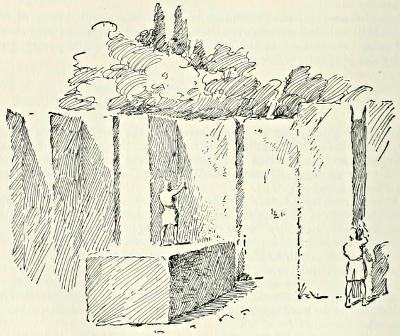
Ancient Quarry near Jerusalem
BRIEF REFERENCE-LIST OF AUTHORITIES BY CHAPTERS
[The letter a is reserved for Editorial Matter.]