PART THREE THE END OF LEAN WISDOM (continued 2)
Reading edition
Florian vastly admired that just and pious summing-up as he leaned back in his chair, and looked toward Janicot. Florian was feeling strangely complacent, though, for Hoprig’s wine was extraordinarily potent tipple to have come from the cupboard of a saint.
“Ah, friend,” returned Janicot, smiling, “and do you really put actual faith in that sensational modern story that I was an angel who rebelled against your Jahveh?”
“It was before my time, of course,” Michael conceded. “I only know that my Lord created me with orders to conquer you, who call yourself the Prince of this World. So I did this, though, to give the devil his due, it was no easy task. But that is far-off stuff: a soldier bears no malice when the fighting is over: and I drink to you.”
“Your health, bright adversary! Yet what if I were not conquered, but merely patient? Why should not I, who have outlived so many gods, remain as patient under the passing of this tribal god come out of Israel as I stayed once under Baal and Beltane? Both of these have had their adorers and tall temples hereabouts: and Mithra and Zeus and Osiris and I know not how many thousands of other beautiful and holy deities have had their dole of worship and neglect and oblivion. Now I have never been omnipotent, I am not worshipped in any shining temple even to-day; but always I have been served.”
Florian, through half-closed eyelids,—for he felt a trifle drowsy after that extraordinary wine,—was admiring the curious proud look which had come into the brown face of Janicot. Florian began complacently to allow this fiend had his redeeming points. This Janicot was quite distinguished looking.
“For I,” said Janicot, “am the Prince of this World, not to be ousted: and I have in my time, good Michael, had need to practise patience. You think with awed reverence of your Jahveh: and that in your station is commendable. Yet you should remember, too, that to me, who saw but yesterday your Jahveh’s start in life as a local storm-god upon Sinai, he is just the latest of many thousands of adversaries whom I have seen triumph and pass while I stayed patient under all temporary annoyances. For in heaven they keep changing dynasties, and every transient ruler of heaven is bent upon making laws for my little kingdom. Oh, I blame nobody! The desire is natural in omnipotence: and many of these laws I have admired, as academic exercises. The trouble seemed to be that they were drawn up in heaven, where there is nothing quite like the nature of my people—”
“A very sinful people!” said Michael.
“There, as in so many points, bright adversary, our opinions differ. You perceive only that they are not what, in accordance with your master’s theories, they ought to be. I am more practical: I accept them as they are, and I make no complaint. That which you call their lust and wantonness, I know to be fertility—” And Janicot spread out both hands. “But it is an old tale. God after god has set rules to bridle and to change the nature of my people. Meanwhile I do not meddle with their natures, I urge them to live in concord with their natures, and to make the most of my kingdom. To be content and to keep me well supplied with subjects, is all that any reasonable prince would require. And as for sin, I have admitted it is a fine word. But the wages of sin—in any event, very often,” said Janicot, and with a smile he illuminated the parenthesis,—“is life.”
“To all this,” said Michael, extending his empty cup, “the answer is simple. You are evil, and you lie.”
“Before your days, before there were men like those of to-day,” said Janicot, indulgently, as he poured sombre wine, “and when the dwarf peoples served me in secret places, even they had other official gods. When your Jahveh is forgotten, men will yet serve me, if but in secrecy. Creeds pass, my friend, just as that little Hoprig said. And it is true, too, that the prelate remains always, as my technical opponent. But the lingham and the yoni do not pass, they do not change, they keep their strong control of all that lives: and these serve me alone.”
“If my Lord passes,” Michael answered, very nobly and very simply, “I pass with Him. We that love Him could then desire no other fate. Meanwhile I have faith in Him, and in His power and in His wisdom, and my faith contents me.”
“Faith!” Janicot said, rather wistfully. “Ah, there we encounter another fine word, a wonder word: and I admit that your anodyne is potent. But it is not to my taste. However, this wine here is emphatically to my taste. So let us drink!”
“It is a good wine. But it begets a treacherous softness of heart and an unsuitable, a quite un-Hebraic tendency to let bygones be bygones. I mean, unsuitable for one in my service. For, after all, old adversary, without intending any disrespect, of course, we were originally for martial law and military strictness, for smiting hip and thigh when the least thing went wrong: and in spite of our recent coming over to these new Christian doctrines—And, by the way, that reminds me of this sinner here. We seem to keep wandering from the point.”
They had looked toward Florian, who discreetly remained lying back in his chair, watching them between nearly closed lids.
“Indeed, we have so utterly neglected him that he has gone to sleep. So let us drink, and be at ease,” said Janicot, “now that we are relieved of his eavesdropping. This little Florian annoys me, rather. For he makes something too much of logic: so he rebels against your creed of faith and of set laws to be obeyed, asking Why? Did you never hear the creature crying out, Let us be logical! in, of all places, this universe? And he rebels against my creed, which he believes a mere affair of the lingham and the yoni, saying This is not enough. Such men as he continue to dream, my friend, and I confess such men are dangerous: for they obstinately aspire toward a perfectibility that does not exist, they will be content with nothing else; and when your master and I do not satisfy the desire which is in their dreams, they draw their appalling logical conclusions. To that humiliation, such as it is, I answer Drink! For the Oracle of Bacbuc also—that oracle which the little curé of Meudon was not alone in misunderstanding,—that oracle speaks the true wonder word.”
Michael had listened, with one elbow on the table, and with one hand propping his chin. Michael had listened with a queer mingling, in his frank face, of admiration and distrust.
The archangel now slightly raised his head, just free of his hand, and he asked rather scornfully, “But what have we to do with their dreams?”
“A great deal. Men go enslaved by this dream of beauty: but never yet have they sought to embody it, whether in their wives or in their equally droll works of art, without imperfect results, without results that were maddening to the dreamer. Men are resolved to know that which they may whole-heartedly worship. No, they are not bent upon emulating what they worship: it is, rather, that holiness also is a dream which allures mankind resistlessly. But thus far,—by your leave, good Michael,—they have found nothing to worship which bears logical inspection much better than does Hoprig. The dangerous part of all this is that men, none the less, still go on dreaming.”
“They might be worse employed.” Michael himself refilled his cup. “For I could tell you—”
“Pray spare my blushes! Yes, they obstinately go on dreaming. Your master is strong, as yet, and I too am strong, but neither of us is strong enough to control men’s dreams. Now, the dreaming of men—mark you, I do not say of humankind, for women are rational creatures,—has an aspiring which is ruthless. It goes beyond decency, it aspires to more of perfectibility than any god has yet been able to provide or even to live up to. So this quite insane aspiring first sets up beautiful and holy gods in heaven, then in the dock; and, judging all by human logic, decrees this god not to be good enough. Thus their logic has dealt with Baal and Beltane and Mithra; thus it will deal—” Janicot very courteously waved a brown and workmanlike hand. “But let us not dwell upon reflections that you may perhaps find unpleasant. In the meanwhile, me too this human dreaming thrusts aside, as not good enough.”
It was plain that Michael distrusted Janicot in all and yet in some sort admired him most unwillingly. Michael asked, with a reserved smiling, “What follows, O subtle one?”
“It follows that all gods must pass until—perhaps—a god be found who satisfies the requirements of this disastrously exigent human dreaming. It follows that I must perforce go quietly about my kingdom because of this insane toplofty dreaming.” And Janicot sighed. “Yes, it is humiliating: but I also have my anodyne, I have my wonder word. And it is Drink!”
“Of course it would be,” Michael replied, with the most dignified of hiccoughs, “since drunkenness is a particularly low form of sin.”
“The drinking I advocate is not merely of the grape. No, it is from the cup of space that I would have all drink, accepting all that is, in one fearless draught. Some day, it may be, my people here will attain to my doctrine: and even these fretful little men will see that life and death, and the nature of their dreams, and of their bodies also, are but ingredients in a cup from which the wise drink fearlessly.”
Janicot had risen now. He came toward Florian, and stood there, looking down. And Florian discreetly continued his mimicry of untroubled slumber.
“Meanwhile he does not drink, he merely dreams, this little Florian. He dreams of beauty and of holiness fetched back by him to an earth which everywhere fell short of his wishes, fetched down by him intrepidly from that imagined high place where men attain to their insane desires. He dreams of aspiring and joy and color and suffering and unreason, and of those quaint taboos which you and he call sin, as being separate things, not seeing how all blends in one vast cup. Nor does he see, as yet, that this blending is very beautiful when properly regarded, and very holy when approached without human self-conceit. What would you have, good Michael? He and his like remain as yet just fretted children a little rashly hungry for excitement.”
Michael stood now beside Janicot. Michael also was looking at Florian, not unkindlily.
“Yes,” Michael said. “Yes, that is true. He is yet a child.”
Then the two faces which bent over Florian were somehow blended into one face, and Florian knew that these two beings had melted into one person, and that this person was prodding him very gently.
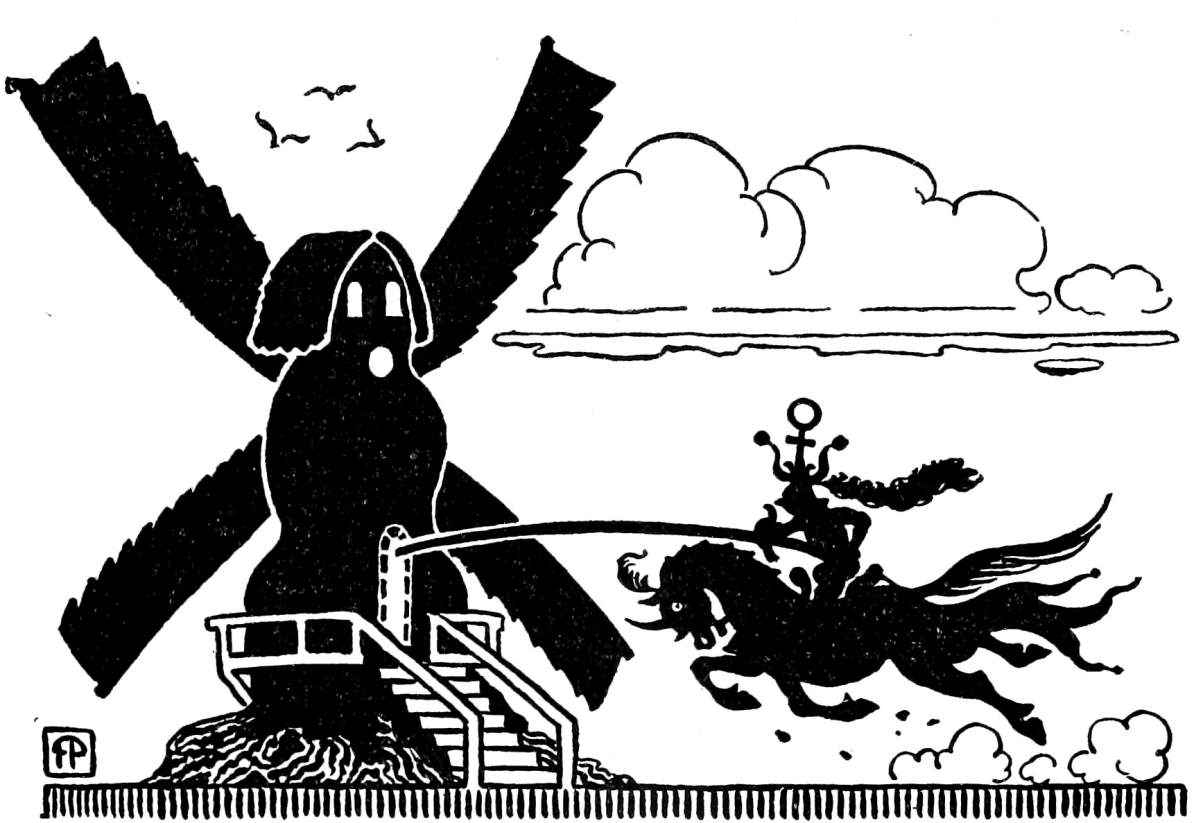
30. The Errant Child
IS father, after all these years, was still wearing the blue stockings with gold clocks. Florian noted that first, because his father’s foot was gently prodding Florian into wakefulness, as Florian’s father sat there under the little tree from the East. Beyond the Duke’s smiling countenance, beyond the face which was at once the face of Michael and of Janicot, Florian could now see a criss-crossery of stripped boughs, each one of which was tipped with a small bud of green.
“Come, lazibones, but you will get your death of cold, sleeping here on the bare ground, at harvest-time.”
“At harvest-time—I have been dreaming—” Florian sat erect, rubbing at his eyes with a hand whose smallness he instantly noted with wonder. The ground, too, seemed surprisingly close to him, the grass blades looked bigger than was natural. He could feel sinking away from him such childish notions about God and wickedness, and about being a grown man, as the little boy—who was he, as he now recollected,—had blended in his callow dreaming: and Florian sat there blinking innocent and puzzled eyes. He was safe back again, he reflected, in the seventeenth century: Louis Quatorze was King once more: and all the virtues were again modish. And this really must be harvest-time, for the sleek country of Poictesme appeared inexpressibly asleep, wrapped in a mellowing haze.
Florian said, “It was a very queer dream, monsieur my father—”
“A pleasant dream, however, I hope, my son. No other sort of dream is worth inducing by sleeping under what, they used to tell me, is a charmed tree, and by using for your pillow a book that at least is charming.”
And the Duke pointed to the book by Monsieur Perrault of the Academy, in which Florian had that very morning read with approving interest about the abominable Bluebeard and about the Cat with Boots and about the Sleeping Beauty and about Cendrillon and about a variety of other delightful persons.
But Florian just now was not for fairy tales, rather all his thoughts still clung to his queer dream. And the child said, frowning:
“It was pleasant enough. But it was puzzling. For there were beautiful ladies that nobody could stand living with, and a saint that was an out-and-out fraud, and”—Florian slightly hesitated,—“and a wicked man, as bad almost as Komorre the Cursed, that did everything he wanted to, without ever being exactly punished, or satisfied either—”
“Behold now,” Monsieur de Puysange lamented, “how appalling are the advances of this modern pessimism! My own child, at ten, advises me that beauty and holiness are delusions, and that not even in untrammeled wickedness is to be found contentment.”
“No: that was not the moral of my dream. That is what bothers me, monsieur my father. There was not any moral: and nothing seemed to be leading up to anything else in particular. I seemed to live a long while, monsieur my father, I had got to be thirty-six and over, without finding any logic and reasonableness anywhere—”
“Doubtless, at that advanced age, your faculties were blunted, and you had become senile—”
“—And the people that wanted things did not want them any longer once they had got them. They seemed rather to dislike them—”
“From your pronominal disorder,” the Duke stated, “I can deduce fancies which are not a novelty here in Poictesme. Such was the crying, in a somewhat more poetic and grammatical version, of our reputed begetters, men say,—of Dom Manuel and of Jurgen also,—in the old days before there was ever a Puysange.”
“Yes, but that was so long ago! when people were hardly civilised. And what with all the changes that have been since then—! Well, but it really seems to me, monsieur my father, that—just taking it logically,—now that we have almost reached the eighteenth century, and all the nations have signed that treaty at Ryswick to prevent there ever being any more wars, and people are riding about peaceably in sedan chairs, and are living in America, and even some of the peasants have glass windows in their houses—”
“Undoubtedly,” said the Duke, “we live in an age of invention and of such material luxury as the world has never known. All wonders of science have been made our servants. War, yesterday our normal arbiter, has now become irrational, even to the most unreflective, since one army simply annihilates the other with these modern cannons that shoot for hundreds of feet. To cross the trackless Atlantic is now but the affair of a month or two in our swift sailing ships. And we trap and slaughter even the huge whale to the end that we, ignoring the sun’s whims, may loan to nights of feverish dissipation the brilliancy of afternoon, with our oillamps. We have perhaps exhausted the secrets of material nature. And in intellectual matters too we have progressed. Yet all progress, I would have you note, is directed by wise persons who discreetly observe the great law of living—”
“And what is that law, monsieur my father?”
“Thou shalt not offend,” the Duke replied, “against the notions of thy neighbor. Now to the honoring of this law the wise person will bring more of earnestness than he will bring to the weighing of discrepancies between facts and well-thought-of ideas about these facts. So, at most, he will laugh, he will perhaps cast an oblique jest with studied carelessness: and he will then pass on, upon the one way that is safe—for him,—without ever really considering the gaucherie of regarding life too seriously. And his less daring fellows will follow him by and by, upon the road which they were going to take in any event. That is progress.”
“Thou shalt not offend against the notions of thy neighbor!” Florian repeated. “Yes, I remember. That was a part of my dream, too.” He was silent for an instant, glancing eastward beyond the gardens of his home. The thronged trees of Acaire, as Florian now saw them just beyond that low red wall, seemed to have golden powder scattered over them, a powder which they stayed too motionless to shake off. “But—in my dream, you know,— that had been learned by living wickedly. And you have always taught Little Brother and me to be very good and religious—”
“My son, my son! and have I reared an errant child, an actual atheist, who doubts that in the next world also we have—a Neighbor?”
“Do you mean the good God, monsieur my father?”
“Eh,” said the Duke, “I would distinguish, I would avoid anthropomorphology, I would speak here with exactness. I mean that in this world we must live always in subjection to notions which a moment’s thought shows always to be irrational; and that nothing anywhere attests the designer of this world, however high His place or whatever His proper title, to be swayed at all by what we describe as justice and logic.”
“I can see that,” said Florian: “though I have been thinking about another sort of high place—”
But the Duke was still speaking: and now, to Florian’s ear, his father’s tone was somewhat of a piece with this sun-steeped and tranquil and ineffably lazy October afternoon, which seemed to show the world as over-satisfied with the done year’s achievements.
“So life, my son, must always display, to him who rashly elects to think about it, just the incoherency and the inconclusiveness of a child’s dreammaking. No doubt, this is to be explained by our obtuseness: I design, in any event, no impiety, for to be impious is unwise. I merely mean that I assume Someone also to be our neighbor, in His high place, and that I think His notions also should be treated with respect.”
“I see,” said Florian. But all that was youthful in him seemed to stir in dim dissent from unambitious aims.
“I mean, in short, that the wise person will conform—with, it may be, a permissible shrug,—to each and every notion that is affected by those neighbors whose strength is greater than his. I would also suggest that, if only for the sake of his own comfort, the wise person will cultivate a belief that these notions, however incomprehensible, may none the less be intelligent and well-meaning.”
“I see,” the boy said, yet again. He spoke abstractedly, for he was now thinking of brown Janicot and of resplendent Monseigneur St. Michael, in that queer dream. His father appeared in some sort to agree with both of them.
And as the Duke continued, speaking slowly, and with something of the languor of this surrounding autumnal world,—which seemed to strive toward no larger upshots than the ripening of grains and fruits,—it occurred to Florian, for the first time in Florian’s life, that this always smiling father of his was, under so many graces, an uneasy and baffled person.
The Duke said: “To submit is the great lesson. I too was once a dreamer: and in dreams there are lessons. But to submit, without dreaming any more, is the great lesson; to submit, without either understanding or repining, and without demanding of life too much of beauty or of holiness, and without shirking the fact that this universe is under no least bond ever to grant us, upon either side of the grave, our desires. To do that, my son, does not satisfy and probably will not ever satisfy a Puysange. But to do that is wisdom.”
The boy for some while considered this. He considered, too, the enigmatic, just half-serious face of his father, the face that was at once the face of Michael and of Janicot. To accept things as they were, in this world which was now going to sleep as if the providing of food-stuffs and the fodder for people’s cattle were enough; and to have faith without reasoning over-logically about it: all these grown persons seemed enleagued to proffer him this stupid and unaspiring advice.
But Florian, at ten, had learned to humor the notions of his elders. So he said affably, if not quite without visible doubtfulness, “I see....”
EXPLICIT
It is gratifying to relate that, in a world wherein most moral lessons go to waste, young Florian duly honored the teaching of his dream. Therefore, as the boy grew toward maturity, he reduplicated in action all the crimes he had committed in fancy, and was appropriately grateful for his fore-knowledge that all would turn out well. But, when he had reached the thirty-sixth year of his living and the fourth chapter of this history, he then, at the conclusion of his talking with Marie-Claire Cazaio, decorously crossed himself, and he shrugged.
“Let sleeping ideals lie,” said Florian: “for over-high and over-earnest desires are inadvisable.”
Thereafter he rode, not into Acaire, but toward the Duardenez. He forded this river uneventfully; and four days later, at Storisende, was married, en cinquièmes noces, to Mademoiselle Louise de Nérac.
It is likewise pleasant to know that this couple lived together in an amity sufficient to result in the begetting of three daughters, and to permit, when the fourth Duke of Puysange most piously and edifyingly quitted this life, in the November of 1736, the survival of his widow.... The moral of all which seems to be that no word of this book, after the fourth chapter, need anybody regard with any least seriousness, unless you chance to be one of those discomfortable folk who contend that a fact is something which actually, but only, happens. A truth—so these will tell you,—does not merely “happen,” because truth is unfortuitous and immortal. This rather sweeping statement ought to be denied—outright—by none who believe that immortals go about our world invisibly.