PART ONE THE END OF LONG WANTING (continued 2)
Reading edition
“Oh, but, Messire Florian,” the girl replied, “of course I will be your wife if you desire it.”
He raised now both his hands a little toward her. She had not drawn back. He did not know whether this was joy or terror which possessed him: but it possessed him utterly. His heart was shaking in him, with an insane and ruthless pounding. He thought his head kept time to this pounding, and was joggling like the head of a palsied old man. He knew his finger-tips to be visited by tiny and inexplicable vibrations.
“If I could die now—!” was in his mind. “Now, at this instant! And what a thought for me to be having now!”
Instead, he now touched his disenchanted princess. Yet their two bodies seemed not to touch, and not to have moved as flesh that is pulled by muscles. They seemed to have merged, effortlessly and without volition, into one body.
In fine, he kissed her. So was the affair concluded.
9. Misgivings of a Beginning Saint
hat Florian remembered, afterward, about Brunbelois seemed rather inconsequential. It was, to begin with, a high place, a remarkably high place. In the heart of the Forest of Acaire, arose a mountain with three peaks, of which the middle and lowest was cleared ground. Here stood the castle of Brunbelois, beside a lake, a lake that was fed by springs from the bottom, and had no tributaries and no outlet. Forests thus rose about you everywhere except in the west, where you looked down and yet further down, over the descending tree-tops of Acaire, and could see beyond these the open country of Poictesme.
Now in this exalted and cleared space wherein stood Brunbelois, there was nothing between you and the sky. You were continually noting such a hackneyed matter as the sky. You saw it no longer as dome-shaped, but as, quite obviously now, an interminable reach of space. You saw the huge clouds passing in this hollowness, each inconceivably detached and separate as one cloud would pass tranquilly above and behind the other, sometimes at right angles, sometimes travelling in just the opposite direction. It troubled you to have nothing between you and a space that afforded room for all those currents of air to move about in, so freely, so utterly without any obstruction. It made a Puysange seem small. And at night the stars also no longer appeared tidily affixed to the sky, as they appeared to be when viewed from Bellegarde or Paris: the stars seemed larger here, more meltingly luminous, and they glowed each in visible isolation, with all that space behind them. It had not ever before occurred to Florian that the sky could be terrible: and he began somewhat to understand the notions of the gray-haired porter who had watched this sky from Brunbelois, night after night, alone.
And Florian remembered Brunbelois as being a silvery and rustling place. A continuous wind seemed to come up from the west. The forests rising about you everywhere except in the west were never still, you saw all day the gray under side of the leaves twinkling restlessly, and you heard always their varying but incessant murmur. And small clouds too were always passing, borne by this incessant wind, very close to you, drifting through the porches of the castle, trailing pallidly over the grass, and veiling your feet sometimes, so that you stood knee-deep in a cloud: and the sunlight was silvery rather than golden. And under this gentle but perpetual wind the broad lake glittered ceaselessly with silver sparklings.
Moreover, the grass here was thick with large white blossoms, which grew singly upon short stalks without any leaves, and these white flowers nodded in an unending conference. They loaned the very ground here an unstable silveriness, for these flowers were not ever motionless. Sometimes they seemed to nod in sleepy mutual assent, sometimes the wind, in strengthening, would provoke them to the appearance of expressing diminutively vigorous indignation. And humming-birds were continually flashing about: these were too small for you to perceive their coloring, they went merely as gleams. And white butterflies fluttered everywhither as if in an abstracted light reconnoitering for what they could not find. And you were always seeing large birds high in the air, drifting and wheeling, as it seemed, in an endless searching for what they never found.
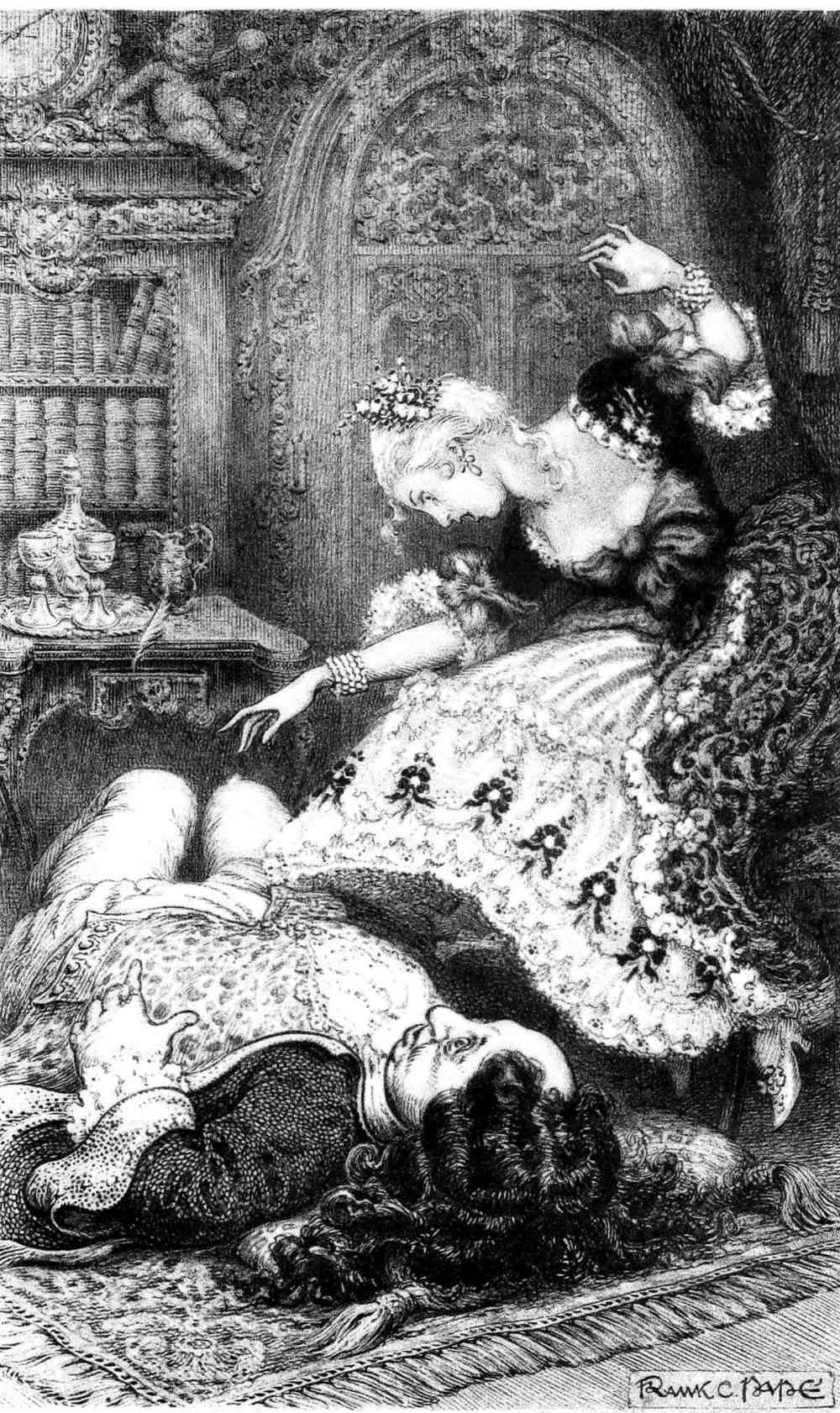
He did not move, but lay quite still, staring upward. See page 136
So Florian remembered, afterward, in the main, the highness and the silveriness and the instability of the place that he now went about exultingly with nothing left to wish for. He hardly remembered, afterward, what he and Melior did or talked of, during the days wherein Brunbelois prepared for their wedding: time and events, and people too, seemed to pass like bright shining vapors; all living swam in a haze of happiness. Florian now thought little of logic, he thought nothing of precedent; he thrust aside the implications of his depressing discovery as to his patron saint: he stayed in everything light-headedly bewildered through hourly contemplation of that unflawed loveliness which he had for a quarter of a century desired. He was contented now; he went unutterably contented by that beauty which he in childhood had, however briefly, seen, and which nothing had since then availed ever quite to put out of his mind. He could not, really, think about anything else. He cared about nothing else.
Still, even now, he kept some habit of circumspection: no man should look to be utterly naīf about his fifth wife. So when St. Hoprig contrived to talk in private with Melior, down by the lake’s border, Florian, for profoundly logical reasons, had followed Hoprig. Florian, for the same reasons, stood behind the hedge and listened.
“It is right that you should marry the champion who rescued us all,” said the voice of Hoprig, “for rules ought to be respected. But I am still of the opinion that nobody could have disposed of so many monsters without being an adept at sorcery.”
“Why, then, it seems to me that we ought to be very grateful for the sorcery by which we profit,” said the sweet voice of Melior. “For, as I so often think—”
“As goes the past, perhaps. The future is another matter. It is most widely another matter, for us two in particular.”
“You mean that as his wife I must counsel my husband to avoid all evil courses—”
“Yes, of course, I mean that. Your duty is plain enough, since a wife’s functions are terrestrial. But I, madame! I am, it appears, this young man’s patron saint, and upon his behavior depends my heavenly credit. You will readily conceive I thus have especial reason to worry over the possibility that Messire de Puysange may be addicted to diabolic practises.”
“Is it certain, my poor Hoprig, that you are actually a Christian saint? For, really, when one comes to think—!”
“There seems no doubt of it. I have tried a few miracles in private, and they come off as easily as old sandals. It appears that, now I am a saint, I enjoy, by approved precedents, all thaumaturgic powers, with especial proficiency in blasting, cursing and smiting my opponents with terrible afflictions; and have moreover the gift of tongues, of vision and of prophecy, and the power of expelling demons, of healing the sick, and of raising the dead. The situation is extraordinary, and I know not what to do with so many talents. Nor can anybody tell me here. In consequence, I must go down into this modern world of which Messire de Puysange brings such remarkable reports, and there I can instruct myself as to the requirements of my new dignity.”
“So you will leave Brunbelois with us, I suppose, and then we shall all—”
“I do not say that: I do not promise you my company. Probably I shall establish a hermitage somewhere, once I have seen something of this later world, and shall live in that hermitage as becomes a Christian saint. Here, you conceive, everyone knows me too well. Quite apart from the conduct of my private affairs,—in which I could not anticipate that sanctity might be looked for,—people would be remembering how I preached against these Christian doctrines, exposed them by every rule of logic, and exterminated their upholders. There would be a depressing atmosphere of merriment. But down yonder, I daresay, I might manage tolerably well.”
“I hope you will let depraved women alone,” said the voice of Melior, “because, as you ought with proper shame to remember—”
“My princess, let us not over-rashly sneer at depraved women. They very often have good hearts, they have attested their philanthropy in repeated instances, and I have noticed that the deeper our research into their private affairs, the more amiable we are apt to find their conduct. In any case, as touches myself, a saint is above all carnal stains and, I believe, diseases also. But it was about other matters I wished to speak with you. I am, I repeat, suspicious of this future husband of yours. Sorcerers have an ill way with their wives, and deplorable habits with their children; and your condition, in view of your fine health and youth, may soon be delicate. I shall ask for a revelation upon these points. Whatever impends, though, I shall be at hand to watch over you both.”
“So you will establish your hermitage at Bellegarde? For in that event—”
“Again, madame, you go too fast. I do not know about that either. In the environs of Bellegarde, they tell me, is a church devoted to my worship, and Messire de Puysange considers—inexplicably, I think,—that it might unsettle the faith of my postulants to have me appear among them. It seems more to the point that this Bellegarde is a retired place in the provinces, with no gaming parlors, and, Messire de Puysange assures me, but one respectable brothel—”
“Then Bellegarde would not suit you—” “No, of course not: for I would find ampler opportunities to put down the wicked, and to implant good seed, in large cities, which are proverbially the haunts of vice. In any case, do you take this ring. It was presented to me as a token of not unearned esteem and admiration, by a lady who had hitherto found men contemptible: and at my request—tendered somewhat hastily, but to the proper authorities,—this ring has been endowed with salutary virtues. The one trait of the holy ring which concerns us just now is its recently acquired habit of giving due warning whenever danger threatens its wearer. Dear me, now, how complete would have been my relaxation if only in my pagan days I had possessed such a talisman to put on whenever I undressed for bed! In any case, should the ring change, then do you invoke me.”
“And you will come with your miracles and your blightings and your blastings! My poor Hoprig, I think you do Messire de Puysange a great wrong, but I will keep the ring, for all that. Because, while you may be utterly mistaken, and no doubt hope you are as much as I do, still, the ring is very handsome: and, besides, as I so often think—”
“Do not be telling me your thoughts just now,” replied the voice of the saint, “for I can hear the bugle calling us to supper. There is another precaution I would recommend, a precaution that I will explain to you this evening, after we have eaten and drunk,” said Hoprig, as they went away together.
Florian, after waiting a discreet while, came from behind the hedge. Florian looked rather thoughtful as he too walked toward the castle.
Sunset was approaching. The entire heavens, not merely the west, had taken on a rose-colored glare. Unbelievably white clouds were passing very rapidly, overhead but not far-off, like scurrying trails of swans’ down and blown powder puffs. The air was remarkably cool, with rain in it. The diffused radiancy of this surprising sunset loaned the gravelled walkway before him a pink hue: the lawns about him, where the grass was everywhere intermingled with white blossoms, had, in this roseate glowing which flooded all, assumed a coldly livid tinge. To Florian’s left hand, piled clouds were peering over the mountain like monstrous judges, in tall powdered wigs, appraising the case against someone in Florian’s neighborhood.
He shrugged, but his look of thoughtfulness remained. It was distinctly upsetting to have one’s patron saint, in place of contriving absolution for the past,—a function which that recreant Hoprig had never, after all, attended to,—now absolutely planning mischief for the future.
10. Who Feasted at Brunbelois
LORIAN had been married so often that he had some claim to be considered a connoisseur of weddings: and never, he protested, had assembled to see him married a more delightful company than the revellers who came from every part of Acaire now that the magic was lifted from these woods.
Acaire was old, it had been a forest since there was a forest anywhere: and all its denizens came now to do honor to the champion who had released them from their long sleeping. The elves came, in their blue low-crowned hats; the gnomes, in red woolen clothes; and the kobolds, in brown coats that were covered with chips and sawdust. The dryads and other tree spirits of course went verdantly appareled: and after these came fauns with pointed furry ears, and the nixies with green teeth and very beautiful flaxen hair, and the duergar, whose loosely swinging arms touched the ground when they walked, and the queer little rakhna, who were white and semi-transparent like jelly, and the Bush Gods that were in Acaire the oldest of living creatures and had quite outlived their divinity. From all times and all mythologies they came, and they made a tremendous to-do over Florian and the might which had rescued them from their centuries of sleeping under Mélusine’s enchantment.
He bore his honors very modestly. But Florian delighted to talk with these guests, who came of such famous old families: and they told him strange tales of yesterday and of the days before yesterday, and it seemed to him that many of these stories were not quite logical. Few probabilities thrived at Brunbelois. Meanwhile the Elm Dwarfs danced for him, pouring libations from the dew pools; the Strömkarl left its waterfall in the forest, to play very sweetly for Florian upon the golden harp whose earlier music had been more dangerous to hear; and the Korrid brought him tribute in the form of a purse containing hair and a pair of scissors. And it was all profoundly delightful.
“I approve of the high place,” said Florian, upon the morning of his marriage: “for here I seem to go about a more heroic and more splendid world than I had hoped ever to inhabit.”
“Then, why,” asked Helmas, “do you not remain at Brunbelois, instead of carrying off my daughter to live in that low sort of place down yonder? Why do you two not stay at Brunbelois, and be the King and Queen here after I am gone?”
Florian looked down from the porch where they were waiting the while that Queen Pressina finished dressing. From this porch Florian could see a part of the modern world, very far beneath them. He saw the forests lying like dark flung-by scarves upon the paler green of cleared fields; he saw the rivers as narrow shinings. In one place, very far beneath them, a thunderstorm was passing like—of all things, on this blissful day,—a drifting bride’s-veil. Florian saw it twinkle with a yellow glow, then it was again a floating small white veil. And everywhere the lands beneath him bathed in graduations of vaporous indistinction. Poictesme seemed woven of blue smokes and of green mists. It afforded no sharp outline anywhere as his gazing passed outward toward the horizon. And there all melted bafflingly into a pearl-colored sky: the eye might not judge where, earth ending, heaven began in that bright and placid radiancy.
It was droll to see this familiar, everyday, quite commonplace Poictesme in that guise, to see it as so lovely, when one knew what sort of men and women were strutting and floundering through what sort of living down there. It would be pleasant to remain here at high Brunbelois, and to be a king of the exalted old time that lingered here and nowhere else in all the world. But Florian remembered his bargain with brown Janicot, and he knew that in this high place it could not be performed: and it was as if with the brightness of Florian’s day-dreaming already mingled the shining of the sword with which Florian was to carry out his part of the bargain. Flamberge awaited him somewhere in those prosaic lowlands of 1723, down yonder.
Therefore, as became a man of honor, Florian said, resolutely: “No, your majesty, my kingdom may not be of this world. For my duty lies yonder in that other world, wherein I at least shall yet have many months of happiness before that happens which must happen.”
“So you are counting upon many months of happiness,” the King observed. “Your frame of mind, my son-in-law, is so thoroughly what it should be that to me it is rather touching.”
“A pest! and may one ask just what, exactly, moves your majesty toward sadness?”
“The reflection that there is no girl anywhere but has in her much of her mother,” the King answered, darkly. “But my dear wife is already dressed, I perceive, and is waiting for us, after having detained us hardly two hours. So let us be getting to the temple.”
“Very willingly!” said Florian. He wondered a little at the blindness of fathers, but he was unutterably content. And straightway he and Melior were married, in the queer underground temple of the Peohtes, according to the marriage rites of Llaw Gyffes.
Melior wore that day upon her lovely head a wreath of thistles, and about her middle a remarkable garment of burnished steel fastened with a small padlock: in her hand she carried a distaff, flax and a spindle. And the marriage ceremony of the Peohtes, while new to Florian, proved delightfully simple.
First Melior and Florian were given an egg and a quince pear: he handed her the fruit, which she ate, and the seeds of which she spat out; he took from her the egg and broke it. Holy Hoprig, who had tendered his resignation as the high-priest of Llaw Gyffes, but whose successor had not yet been appointed, then asked the bridegroom a whispered question.
Florian was astonished, and showed it. But he answered, without comment, “Well, let us say, nine times.”
Hoprig divided a cake into nine slices, and placed these upon the altar. Afterward Hoprig cut the throat of a white hen, and put a little of its blood upon the feet of Melior and Florian. The trumpets sounded then, as King Helmas came forward, and gave Florian a small key.