PART TWO THE END OF LIGHT WINNING
Reading edition
“En femme, comme en tout, je veux suivre ma mode.... Et j’ay beny le Ciel d’avoir trouvé mon faict, Pour me faire une femme au gré de mon souhait.”
11. Problems of Beauty
T was conceded even by the younger and most charming ladies of the neighborhood that the new Duchess of Puysange was quite good looking. The gentlemen of Poictesme appeared, literally, to be dazzled by any prolonged consideration of Melior’s loveliness: otherwise, as Florian soon noted, there was no logical accounting for the discrepancy in their encomia. Enraptured pæeans upon her eyes, for example, he found to differ amazingly and utterly in regard to such an important factor as the color of these eyes. This was, at mildest, a circumstance provocative of curiosity.
Florian therefore listened more attentively to what people said of his wife; and he discovered that his fellows’ ecstasies over Melior’s hair and shape and complexion were not a whit less inconsistent. These envious babblers were at one in acclaiming as flawless the beauty which he had intrepidly fetched down from the high place: but in speaking of any constituent of this loveliness they seemed not to be talking of the same woman. Either her perfection actually did dazzle men so that they were bewilderedly aware of much such a beguiling and intoxicating brightness as Florian, on looking back, suspected Melior to have been in his own eyes before he married her, or else the appearance of this daughter of the Léshy was not to all persons the same. Well, this was queer: but it was not important. Florian at least was in no doubt of his wife’s appearance nor of his right to glory in it.
So Florian tended to let this riddle pass unchallenged, and to quarrel with nothing, for Florian was very happy.
He could not have said when or why awoke the teasing question if, after all, this happiness was greater than or different from that which he had got of Aurélie or Hortense or Marianne or Carola? Being married to a comparative stranger was, as always, pleasant; it was, in fact, delightful: but you had expected, none the less, of the love which had miraculously triumphed over time and all natural laws some sharper tang of bliss than ordinarily flavored your honeymoons. Still, at thirty-five, you were logical about the usual turning-out of expectations. And you were content: and Melior was beautiful; and among the local nobility this new Duchess of Puysange had made friends everywhere, and she was everywhere admired, however puzzlingly men seemed to word their praise of her loveliness.
The newly married pair had journeyed uneventfully from Brunbelois to Florian’s home. The mute hairy persons brought Melior’s trunks in their cart; and St. Hoprig too came with them through Acaire, but no further. Florian had at last persuaded him of how untactful it would be for Hoprig to disrupt a simple and high-hearted faith that had thrived for so many hundred years, by appearing at Bellegarde in person. Florian had pointed out the attendant awkwardnesses, for the fetich no less than for the devotees. And Hoprig, upon reflection, had conceded that for a saint in the prime of life there were advantages in travelling incognito.
So the holy man left them at the edge of the forest. “We shall meet again, my children,” the saint had said, with a smile, just as he vanished like a breaking bubble. It seemed to Florian that his heavenly patron had become a little ostentatious with miracles, but Florian voiced no criticism. Still, he considered the evanishment of the two hairy persons and their monstrous goats, an evanishment quite privately conducted in the stable to which they had withdrawn after uncarting Melior’s trunks, to be in much better taste.
But Florian picked no open fault with Hoprig nor with anyone, for Florian was content enough just now. He began to see that his notions about Melior had been a trifle extravagant, that the strange loveliness which he had been adoring since boyhood was worn by a creature whose brilliance was of the body rather than of the intellect: however, he had not married her in order to discuss philosophy; and, with practise, it was easy enough to pretend to listen without really hearing her.
All this was less worrying, less imminent, than the trouble he seemed in every likelihood about to have with his brother, on account of Raoul’s damnable wife. For Madame Marguerite de Puysange, as Florian now heard, was infuriated by his failure to appear at Storisende upon the twentieth of July, the day upon which he had been due to marry her sister: nor by learning that he had married somebody else was the unconscionable virago soothed. She considered a monstrous affront had been put upon them all, a deduction which Florian granted to be truly drawn, if that mattered. What certainly mattered was that the lean woman had no living adult male relatives. She would be at her husband to avenge this affront by killing Florian: and dear, plastic, good-natured Raoul so hated to deny anybody anything that the result of her coaxing and tears and nagging would probably be a decided nuisance....
“That ring with the three diamonds in it,” Florian had said, “is deplorably old-fashioned—”
“Yes, I suppose it is, sweetheart: but it was given me by a dear friend, and you know the sort of things they pick out, and, besides, I like to have it keeping me in mind of how ridiculously the best-meaning people may be sometimes,” his Melior had answered,—very happily, and nuzzling a very wonderfully soft cheek against his cheek.
So he had let the matter stand....
It was a nuisance, too, this news which Florian had received as to the great Cardinal Dubois, whom Florian had promised—as he regretted now to remember, in carelessly loose terms,—to offer as a Christmas present to Janicot. It appeared that during Florian’s stay at Brunbelois the over-gallant cardinal had been compelled to submit to an operation which deprived him of two cherished possessions and shortly afterward of his life. His death was a real grief to Florian, not as in itself any loss, but because, with Dubois interred at St. Roch, the greatest man living in France when Christmas came would be the Duc d’Orléans.
Florian had long been fond of Philippe d’Orléans, and Florian loathed the thought of making a present of his friend’s life to a comparatively slight and ambiguous acquaintance like Janicot. There seemed no way out of it, however, for Florian had in this matter given his word. But he regretted deeply that he had thus recklessly promised the greatest man in the kingdom instead of specifically confining himself to that selfish Dubois, who could without real self-denial have lived until December, and who could so easily have furthered everybody’s well-being by restricting his amours to ladies of such known piety and wholesomeness and social position as made them appropriate playfellows for a high prince of the Church.
But all this was spilt milk. What it came to in the upshot was that Florian, through his infatuation for Melior, was already in a fair way to lose his most intimate and powerful friend and his only legitimate brother. It was a nuisance, for Florian disliked annoying either one of them, and thus to be burdened with the need of bereaving yourself of both appeared a positive imposition. But we cannot have all things as we desire them in this world, his common-sense assured him: and, in the main, as has been said, the incidental disappointments, now that he had attained his life’s desire, were tepid and not really very deep.
For Melior was beautiful; after months of intimacy and fond research he could find no flaw in her beauty: and in other respects she proved to be as acceptable a wife as any of his own marrying that he had ever had. If she was not always reasonable, if sometimes indeed she seemed obtuse, and if she nagged a little now and then, it was, after all, what past experience had led him to expect alike in marriage and in liaisons. The rapture which he had known at first sight of her, the rapture of the mountain-top, was not, he assured himself, a delusion of which he had ever expected permanence....
“But this remarkably carved staff, my darling—?”
“Oh, it was one of my sister Mélusine’s old things. I would not be in the least surprised if it were magical—And while we are speaking about sisters, Florian, I do wish that black-faced one of yours would not look at me so hard and then shrug, because she has done it twice, in quite a personal way—”
“Marie-Claire is a strange woman, my pet.”
But that fretted him. He knew so well why Marie-Claire had shrugged....
No, he had never, really, expected the rapture of the mountain-top to be permanent. Besides, he need not expect permanency of Melior. It was sad, of course, that when she had borne him a child, the child must be disposed of, and the mother must vanish, in accordance with Florian’s agreement with Janicot. But there was always some such condition attached to marriage between a mortal and any of the Léshy, or some abstention set like a trap whereinto the unwary mortal was sure to flounder, and so lose the more than mortal helpmate. The union must always, in one way or another, prove transitory, as was shown by the sad history of the matrimonial ventures of Melior’s own sister, and of the knight Helias, and by many other honorable old precedents.
And Florian now began to see that if the Melior whom he had adored since boyhood were thus lost to him in the fulltide of their love and happiness,—for these were still at fulltide, he here assured himself,—then he would retain only pleasant and heart-breaking and highly desirable memories. A great love such as his for his present wife ought, by all the dictates of good taste, to end tragically: to have it dwindle out into the mutual toleration of what people called a happy marriage would be anti-climax, it would be as if one were to botch a sublime and mellifluous sonnet with a sestet in prose.
Melior, so long as she stayed unattainable, had provided him with an ideal: and Melior, once lost to him, once he could never hear another word of that continuous half-witted jabbering,—or, rather, he emended, of this bright light creature’s very diverting chat,—then his high misery would afford him even surer ground for a superior dissatisfaction with the simple catering of nature. So the company of his disenchanted princess, her company just for the present, could be endured with a composure not wholly saddened by that dreadful and permanent bereavement which impended.
He reasoned thus, and was in everything considerate and loving. His devotion was so ardent and unremittent, indeed, that, when Florian left Bellegarde, Melior was forehandedly stitching and trimming baby-clothes. This was at the opening of December, and he was going to court in answer to a summons from the great Duke of Orléans.
“It is rather odd,” observed Florian, “that it is at Philippe’s expressed desire I go to him. Eh, but one knows that shrewd old saying as to the gods’ preliminary treatment of those whom they wish to destroy.”
“Still, if you ask me,” observed his wife,—not looking at him, but at her sewing,—“I think it is much better not to talk about the gods any more than is necessary, and certainly not in that exact tone of voice—” The break in speech was for the purpose of biting a thread.
You saw, as she bent over this thread, the top of her frilly little lace cap efflorescent with tiny pink ribbons. You saw, as she looked up, that Melior was especially lovely to-day in this flowing pink robe à la Watteau over a white petticoat and a corsage of white ribbons arranged in a sort of ladder-work. There was now about her nothing whatever of the mediæval or the outré: from the boudoir cap upon her head to the pink satin mules upon her feet, this Melior belonged to the modern world of 1723: and the whiteness and the pinkness of her made you think of desserts and confectionery.
“But what exact tone of voice,” asked Florian, smiling with lenient pride in his really very pretty duchess, “does my darling find injudicious?”
“Why, I mean, as if you were looking at something a great way off, and smelled something you were not quite certain you liked. To be sure, now that we are both good Christians, we know that the other gods are either devils or else illusions that never existed at all—Father Joseph has the nicest possible manners, and just the smile and the way of talking that very often reminds me of Hoprig, and qualifies him to teach any religion in the world, even without stroking both your hands all the time, but in spite of that, as I told him only last Saturday, he will not ever speak out quite plainly about them—”
“About your lovely hands, madame?”
“Now, monsieur my husband, what foolish questions you ask! I mean, about whether they are devils or illusions. Because, as I told him frankly—”
“Ah, now I comprehend. Yet, surely, these abstruse questions of theology—”
She was looking at him in astonishment. “Why, but not in the least! I am not interested in theology, I merely say that a thing is either one way or the other: and, as I so often think, nothing whatever is to be gained by beating about the bush instead of being our own candid natural selves, and confessing to our ignorance, even if we happen to be priests, where ignorance is no disgrace—”
“Doubtless, my dearest, you intend to convey to me—”
“Oh, no, not for one instant!” And this bewitching seamstress was virtually giggling, quite as if there were some logical cause for amusement. “Anybody who called that dear old soft-soaper stupid would be much more mistaken, monsieur my husband, than you suspect. I merely mean that is one side of the question, a side which is perfectly plain. The other is that, as I have told him over and over again, it is not as if I had ever for a moment denied that Father and Mother are conservative, but quite the contrary—”
Florian said: “Dearest of my life, I conjecture you are still referring to your confessor, the good Father Joseph. Otherwise, I must admit that, somehow, I have not followed the theme of your argument with an exactness which might, perhaps, have enabled me to form some faint notion as to what you are talking about.”
And again the loveliest face in the world was marveling beneath that very pleasing disorder of little pink ribbons. “Why, I was talking about Father Joseph, of course, and about my wanting to know how my parents at their time of life could be expected to take up with new ideas. Oh, and I kept at him, too: because, even if they are worshipping devils up at Brunbelois, and doing something actually wicked when they sacrifice to Llaw Gyffes a few serfs that are past their work and are of no use to anybody, and no real pleasure to themselves,—which is a side you have to look at,—it would be a sort of comfort to be certain of the worst. Whereas, as for them, the poor dears, as I so often say, what you do not know about does not worry you—”
“I take it, that you mean—”
“Exactly!” Melior stated, with the most sagacious of nods. “Though, for my part, I feel it is only justice to say that such devils as my sister Mélusine used to have in now and again, in the way of sorcery, were quite civil and obliging. So far as looks go, it is best to remember in such cases that handsome is as handsome does, and I am sure they did things for her that the servants would never have so much as considered—”
“But, still—”
“Oh, yes, of course, we all know what a problem that is, at every turn, with your kindness and your consideration absolutely wasted: and in fact, as I so often think, if I could just have two rooms somewhere, and do my own cooking—” Another thread was bitten through by the loveliest teeth in the world.
“You aspire to such simple pleasures, my wife, as are denied to a Duchess of Puysange. No, one must be logical. We have the duties of our estate. And among these duties, as I was just saying, I now discover the deplorable need of absenting myself from the delights of your society and conversation—”
“I shall miss you, monsieur my husband,” replied Melior, abstractedly holding up a very small undershirt, and looking at it as if with the very weightiest of doubts, “of course. But still, it is not as if I cared to be travelling now, and, besides, there really is a great deal of sewing to be done for months to come. And with everything in this upset condition, I do hope that—if by any chance you are sitting on that other pair of scissors? I thought they must be there. Yes, I do hope that you will be most careful in this affair, because I already have enough to contend with. You ought to send the lace at once, though: and I suppose we might as well have pink yarn and ribbons, since the chances are equal in any event—”
“But in what affair, delight of my existence, are you requesting me to be careful?”
“Why, how should I know?” And Melior, he perceived, had still the air of one who is dealing patiently with an irrational person. “It is probably a very good thing that I do not, since you are plainly up to something with your friend Orléans which you want nobody to find out about. All men are like that: and, for my part, I have no curiosity whatever, because, as I so often think, if everybody would just attend to their own affairs—”
He bowed and, murmuring “Your pardon, madame!” he left her contentedly sewing. It seemed to Florian a real pity that a creature in every way so agreeable to his eye should steadily betray and tease his ear. He did not find that, as wives average, his Melior was especially loquacious: it was, rather, that when she discoursed at any length, with her bewildering air of commingled self-satisfaction and shrewdness, he could never make out quite clearly what she was talking about: and as went intelligence, his disenchanted princess seemed to him to rank somewhere between a magpie and a turnip.
This, upon the whole, adorable idiocy might have made it appear, to some persons, surprising that Melior should divine, as she had so obviously divined, that Florian, in going to Philippe d’Orléans, was prompted by motives which discretion preferred to screen. But Florian had learned by experience that your wives very often astound you by striking the target of your inmost thinking, fair and full, with just such seemingly irrational shots of surmise. You might call it intuition or whatever else you preferred: no husband of any at all lengthy standing would be quick to call it accident. Rather, he would admit this to be a faculty which every married woman manifested now and then: and he would rejoice that, for the health of the world’s peace, such clairvoyancy was intermittent. Florian esteemed it to be just one of the inevitable drawbacks of matrimony that the most painstaking person must sometimes encounter discomfortable moments when his wife appears to be looking over his secret thoughts somewhat as one glances over the pages of a not particularly interesting book. So the experienced husband would shrug and would await this awkward moment’s passing, and the return of his wife’s normal gullibility and charm.
Melior, too, then, had her instants of approach to wifely, if not precisely human, intelligence. And Melior was beautiful. There was no flaw anywhere in her beauty. This Florian repeated, over and over again, as he prepared for travel. Here, too, one must be logical. That ideal beauty which he had hopelessly worshipped, and had without hope hungered for, ever since his childhood, was now attained: and the goddess of his long adoration was now enshrined in, to be exact, the next room but one, already hemming diapers for their anticipated baby. Nobody could possibly have won nearer to his heart’s desire than Florian had come; he had got all and more than his highest dreaming had aspired to: and so, if he was now sighing over the reflection, it must be, he perceived, a sigh of content.
Then he kissed his wife, and he rode away from Bellegarde, toward the vexatious duties which awaited him at court. Florian stopped, of course, to put up a prayer, for the success of his nearing venture into homicide, at the Church of Holy Hoprig. That ceremonial Florian could not well have omitted without provoking more or less speculation as to why the Duke of Puysange should be defaulting in a pious custom of long standing; nor, for that matter, without troubling his conscience with doubts if he was affording the country-side quite the good example due from one of his rank.
Through just such mingled considerations of expediency and duty had Florian, since his return from Brunbelois, continued his giving to this church with all the old liberality, if with somewhat less comfort to himself. It was a nuisance to reflect that so many irregularities which Florian had believed compounded, to everybody’s satisfaction, had never been attended to at all by his patron saint. It was annoying to know that the church had got, and was continuing to get, from the estate of Puysange so many pious offerings virtually for nothing. Even so, replied logic, what was to be gained by arousing criticism or by neglecting your religious duties in a manner that was noticeable? Let us adhere to precedent, and then, if we can no longer count assuredly on bliss in the next world, we may at least hope for tranquillity in this one.
So Florian, for the preservation of the local standards, now put up a fervent prayer to his patron saint in heaven; and reflected that, after all, the actual whereabouts, and the receptivity to petitions, of Holy Hoprig was none of Florian’s affair. A little wonder, however, about just where the saint might be doing what, was, Florian hoped, permissible, since he had found such wondering not to be avoided.
12. Niceties of Fratricide
OW that Florian came out of the provinces, he wished to take matters in order. Not merely a snobbish pride of race led him to give his family affairs precedence to those of the Bourbons. It was, rather, that Florian yet had a day to wait before the coming of the winter solstice. He was unwilling to waste these twenty-four hours, because Florian looked with some uneasiness toward the inevitable encounter with his wife-ridden brother, and Florian was desirous to get this worry off his mind. For, a thing done, as Janicot had mentioned, has an end....
Florian therefore made inquiries as to where Raoul was passing that evening; and the two brothers thus met, as if by chance, at the home of the Duc de Brancas. The circle of Monsieur de Brancas was not gallant toward women, and his guests were gentlemen in middle age, the most of whom came each with a boy of seventeen or thereabouts.
Florian was grieved when, as he approached the group clustered about the big fireplace, he saw with what ceremony Raoul bowed. Raoul had fattened, he seemed taller, he was to-night superb in this crimson coat, with huge turned-back cuffs,—that must be the very latest mode,—and in this loose gold-laced white waistcoat, descending to the knees, and unfastened at the bottom. Raoul had the grand air of their father: a tall man was always so much more impressive. For the rest, it was fully apparent that the dear fellow’s abominable wife had been at her mischief-making.
“Monsieur the Duke,” Raoul began, “this encounter is indeed fortunate.”
“To encounter Monsieur the Chevalier,” replied Florian, with quite as sweet a stateliness, but feeling rather like a bantam cock beside this big Raoul, “is always a privilege.”
People everywhere were listening now: this gambit hardly seemed fraternal. The well-bred elderly friends of Monsieur de Brancas, to be sure, made a considerate pretence at going on with their talk, but most of the scented and painted boys had betrayed their lower social degree by gaping openly: and Florian knew he was in for an unpleasant business.
“—For I am wondering if you have heard, monsieur,” the Chevalier went on, “that the Comte d’Arnaye has spread the report that at Madame de Nesle’s last ball I appeared with two buttons missing from my waistcoat?”
“I really cannot answer for the truth of such gossip, monsieur,”—thus Florian, with high civility,—“since I have not seen my uncle for some time.”
“Ah, ah! so the Comte d’Arnaye is your uncle!” Raoul seemed gravely pleased. “That is excellent, for, inasmuch as I cannot readily obtain satisfaction for this calumny from your uncle, who has retired into the provinces for the winter, I can apply to you.”
Florian said, with careful patience: “I am delighted, monsieur, to act as his representative. In that capacity I can assure you whoever asserted Monsieur d’Arnaye declared the waistcoat in which you attended the last ball of Madame de Nesle to be deficient in two buttons, or in one button, or in a half-stitch of thread, has told a lie.”
Raoul de Puysange frowned. “Diantre! it was my own cousin, the Count’s youngest son, who was my informant; and since my cousin, monsieur, as you are well aware, is little more than a child—”
“You should have the less trouble, then,” said Florian, vexed by his brother’s pertinacity, “in horsewhipping the brat for his silly falsehood.”
“Come, Monsieur the Duke, but I cannot have my cousin called a liar, far less listen to this talk of horsewhipping one who is of my blood. I must ask satisfaction for these affronts, and I will send a friend to wait upon you.”
Florian looked sadly at his brother. But the Duc de Puysange shrugged before a meddlesome and quite unimportant person.
Florian answered: “I am well content, Monsieur the Chevalier. Only, to save time, I would suggest that your friend go direct to the Vicomte de Lautrec, since he is here to-night, and since I have promised him that he should second me in my next affair.”
The two brothers bowed and parted decorously, having thus arranged a public quarrel in which Mademoiselle de Nérac was in no way involved. The instant’s tension was over, and the guests of Monsieur de Brancas thronged hastily through the corridor,—which was rather chilly, because all the outer side of this corridor was builded of stained glass,—and went into the little private theatre, where the fiddles were already tuning for the overture of a new and tuneful burletta that dealt with The Fall of Sodom. The curtain by and by rose on the civic revels, and the rest of the evening passed merrily.
After the first act, while the scenery was being shifted so as to represent Lot’s cave in the mountains, all details of the fraternal duel were arranged by Messieurs de Lautrec and de Soyecourt. Tall lean Monsieur de Soyecourt had, as a cousin, been prompt to insist upon his right to act for Raoul in an encounter so sure to be discussed everywhere. Shortly after midnight,—at which hour the other guests of Monsieur de Brancas went into the Salon des Flagellants to amuse themselves at a then very fashionable game which you played with little whips,—the two brothers left the hôtel with their seconds. A surgeon had been sent for, and he accompanied them and the five girls, whom the Vicomte de Lautrec had caused to be fetched from La Fillon’s, to a house near the Port Maillot, where all indulged in various pleasantries until morning.
The wine here proved so good, the girls were so amiable and accomplished, that by daylight Florian had mellowed into an all-embracing benevolence, and he proposed to compound the affair. The suggestion roused an almost angry buzz of protest.
Lautrec was demanding, of the company at large, would you have me, who was married only last week, staying out all night, with no better excuse than that I was drunk with these charming girls? Why, I was committed to three rendezvous last night, and if there be no duel I shall have trouble with a trio of ladies of the highest fashion. Nor is it, put in the Marquis de Soyecourt,—whose speaking was always somewhat indistinct, because of the loss of all his upper front-teeth,—nor is it kind of you, my dear, to wish to deprive us of taking part in a business which will make so much noise in the world: brothers do not fight every day, this affair will be talked about. I quite agree with Lautrec that your whim is foolish and inconsiderate. Besides, Raoul was saying reprovingly, the honor of our house is involved. To have a Puysange cry off from a duel would be a reflection upon our blood that I could not endure—
“What is honor,” replied Florian, “to the love which has been between us?”
The Chevalier looked half-shocked at this sort of talk: but he only answered that Hannibal and Agamemnon had been very pretty fellows in their day while it lasted; so too the boys who had loved each other at Storisende and Bellegarde. Let the dead rest. No, to go back now was impossible, without creating a deal of adverse comment, in view of the publicity of their quarrel.
Florian sighed, half wearied, half vexed, by the remote sound of his brother’s talking, and he replied: “That is true. One must be logical. You three are better advised than I, and we dare not offend against the notions of our neighbors.”
The gentlemen went into the park. They walked toward the old Château de Madrid. There had been a very light fall of snow. It felt like sand underfoot as you walked. Florian reflected it was droll that oak-trees should retain so many bronze leaves thus late in winter. They quite overshadowed this place, and made the snow look bluish.
The gentlemen prepared for their duel, each of the four being armed with two pistols and a sword. When all was ready, Raoul fired at once, and wounded Florian in the left arm. It hurt. The little brother whose face was always grimy would never have hurt you.
At Florian’s side Lautrec had fallen, dead. The bullet of the Marquis de Soyecourt had by an incredible chance struck the Vicomte full in the right eye, piercing the brain.
“Name of a name!” observed the Marquis, who was unwounded, “but here is another widow to be consoled,—when I had aimed too at his ear! That is the devil of this carousing all night, and then coming to one’s duels with shaken nerves. But how fare our sons of Œdipus?”
The Marquis turned, and what he saw was sufficiently curious.
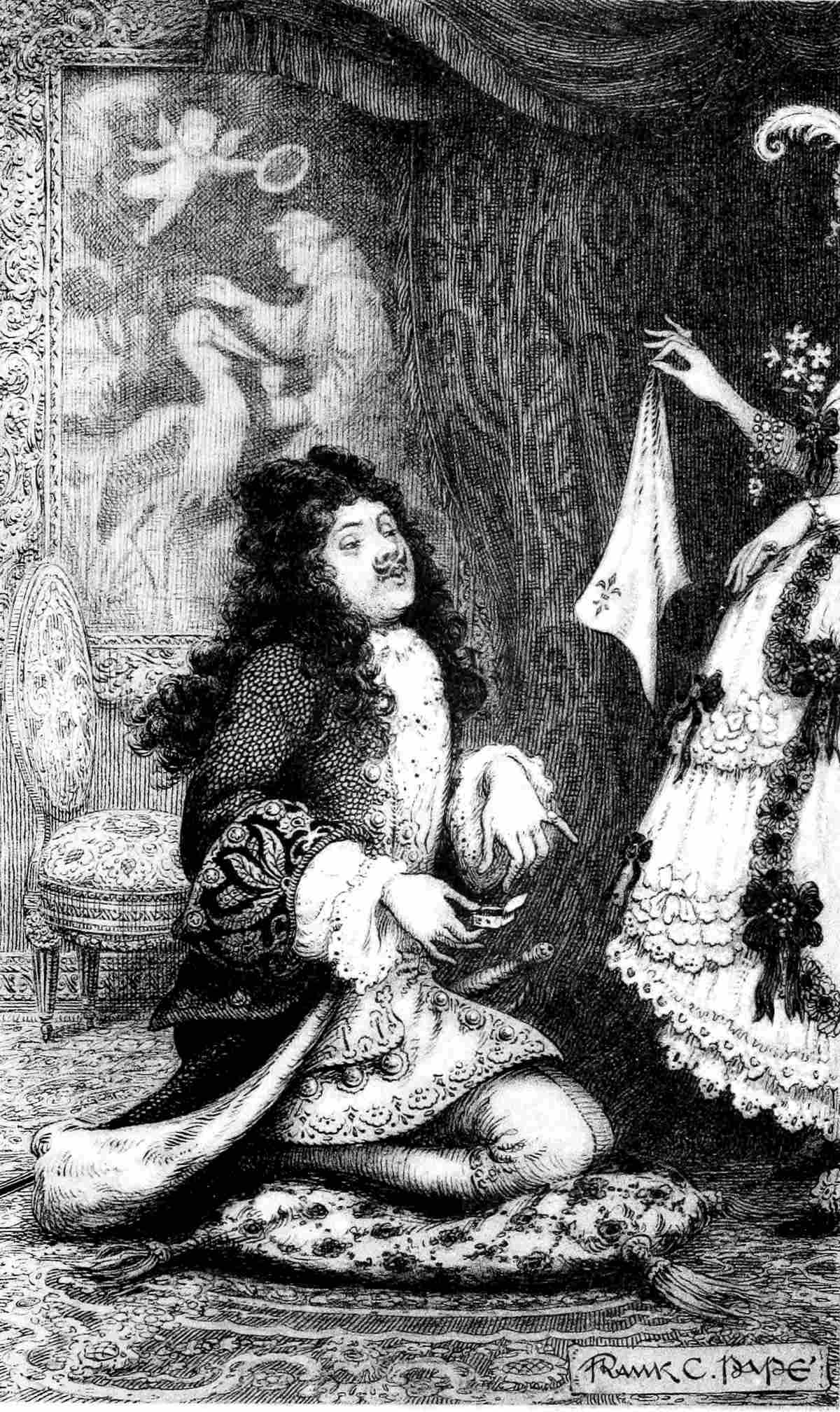
Florian’s plump face was transfigured, as he knelt before his Melior. See page 222
Florian had winced when hit, thus for an instant spoiling his aim, but he at once lowered his pistol, and he shot this tall man who had nothing to do with his little brother, neatly through the breast. Raoul de Puysange fired wildly with his second pistol, and drew his sword as if to rush upon Florian, who merely shifted the yet loaded pistol to his uncrippled right hand, and waited. But Raoul had not advanced two paces when Raoul fell.
Florian dropped the undischarged pistol, and went to his brother. This thin snow underfoot was like scattered sand, and your treading in it was audible.
“You have done for me, my dear,” declared the Chevalier.
And Florian was perturbed. He wished, for all that his arm was hurting him confoundedly, to reply whatever in the circumstances was the correct thing, but he could think of no exact precedent. So he put aside the wild fancy of responding, “Am I my brother’s keeper?” and to this stranger at his feet he said, with a quite admirable tremor wherein anguish blended nicely with a manly self-restraint: “Raoul, you are the happier of us two. Do you forgive me?”
“Yes,” replied the other, “I forgive you.” Raoul gazed up fondly at his brother. Raoul said, with that genius for the obviously appropriate which Florian always envied, “I feel for you as I know you do for me.”
Thus speaking, Raoul de Puysange looked of a sudden oddly surprised. His nostrils dilated, he shivered a little, and so died.
Florian turned sadly to the gaunt Marquis de Soyecourt. “You spoke of the sons of Œdipus, Antoine. But many other eminent persons have been fratricides. There was Romulus, and Absalom in Holy Writ, and Sir Balen of Northumberland, and several of the Capets and the Valois. King Henry the First of England, a very wise prince, also put his brother out of the way, as did Constantius Chlorus, a most noble patron of the Church. Whereas all Turkish emperors—”
“Oh, have done with your looking for precedents!” said the Marquis. “What we should look for now, my dear, is horses to get us away from this sad affair. For one, I am retiring into the provinces, to spend Christmas at my venerable father’s chateau at Beaujolais, where I shall be more comfortable than in the King’s prison of the Bastile. And I most strongly advise you to imitate me.”
“No,” Florian said, gently, “these are but the first fruits of the attainment of my desire. For, as you remind me, Antoine, Christmas approaches, and I have still unfinished business at court.”
13. Débonnaire
HEREAFTER Florian went to the Duke of Orléans, with two motives. One was the obvious necessity of obtaining a pardon for having killed the Chevalier: Florian’s other motive was the promise given to brown Janicot that he should have for his Christmas present, upon this day of the winter solstice, the life of the greatest man in the kingdom. The greatest man in the kingdom, undoubtedly, was Philippe of Orléans, the former Regent, now prime minister, and the next heir to the throne. The King was nobody in comparison: besides, the King was not a man but a child of thirteen. One must be logical. Florian regretted the loss of his friend, for he was unfeignedly fond of Orléans, but a promise once given by a Puysange was not to be evaded.
He must get the pardon first. Florian foresaw that the granting of a pardon out of hand for his disastrous duel would seem to the Duke of Orléans an action liable to involve the prime minister in difficulties. Florian thought otherwise, in the light of his firm belief that to-morrow Orléans would be oblivious of all earthly affairs, but this was not an argument which Florian could tactfully employ. Rather, he counted upon the happy fact that Florian’s services in the past were not benefits which any reflective statesman would care to ignore. Yes, the pardon would certainly be forthcoming, Florian assured himself, this afternoon, as he rode forth in his great gilded coach, for his last chat, as he rather vexedly reflected, with all-powerful Philippe of Orléans, whom people called Philippe the Débonnaire.
“So!” said the minister, when they had embraced, “so, they tell me that you have married again, and that you killed your brother this morning. I am not pleased with you, Florian. These escapades will come to no good end.”
“Ah, monseigneur, but I like to take a wife occasionally, whereas you prefer always to borrow one. It is merely a question of taste, about which we need not quarrel. As to this duel, I lamented the necessity, your highness, as much as anybody. But these meddling women—”
“Yes, yes, I know,” replied Orléans, “your sister-in-law talks too much. In fact, as I recall it, she talks even in her sleep.”
“Monseigneur, and will you never learn discretion?”
“I am discreet enough, in any event, to look upon fratricide rather seriously. So I am sending you to the Bastile for a while, Florian, and indeed the lettre de cachet ordering your imprisonment was made out an hour ago.”
Florian at this had out the small gold box upon whose lid was painted a younger and far more amiable looking Orléans than frowned here in the flesh,—in a superfluity of flesh,—and Florian took snuff. It was always a good way of gaining time for reflection. Wine and cakes were set ready upon the little table. Philippe was probably expecting some woman. There had been no lackeys in the corridor which led to this part of the château. Philippe always sent them away when any of his women were to come in the day-time. Yes, one was quite alone with this corpulent, black-browed and purple-faced Philippe, in this quiet room, which was like a great gilded shell of elaborately carved woodwork, and which had bright panels everywhere, upon the walls and the ceiling, representing, very explicitly indeed, The Triumphs of Love. Such solitude was uncommonly convenient; and one might speak without reticence.
Florian put up his snuff-box, dusted his finger-tips, and said: “I regret to oppose you in anything, monseigneur, but for me to go to prison would be inconvenient just now. I have important business at the Feast of the Wheel to-morrow night.”
Since Philippe had lost the sight of his left eye he cocked his head like a huge bird whenever he looked at you intently. “You had best avoid these sorceries, Florian. I have not yet forgotten that fiend whom your accursed lieutenant evoked for us in the quarries of Vaugirard—” Orléans paused. He said in a while, “Before that night and that vision of my uncle’s death-bed, I was less ambitious, Florian, and more happy.”
“Ah, yes, poor old Mirepoix!” said Florian, smiling. “What a preposterous fraud he was, with his absurd ventriloquism and stuffed crocodiles and magic lanterns! However, he foretold very precisely indeed the extraordinary series of events which would leave you the master of this kingdom: and I had not the heart to see the faithful fellow exposed as an ignoramus who talked nonsense. So I was at some pains to help his prophesying come true, and to make you actually the only surviving male relative at the old King’s death-bed.”
“Let us speak,” said Orléans, with a vexed frown, “of cheerier matters. Now, in regard to your imprisonment—”
“I was coming to your notion of a merry topic. This visit to the Feast of the Wheel is about a family matter, your highness, and is imperative. So I must keep my freedom for the while: and I must ask, in place of a lettre de cachet, a pardon in full.”
“Instead, Florian, let us have fewer ‘musts’ and more friendliness in this affair.” Orléans now put his arm about Florian. “Come, I will put off your arrest until the day after to-morrow; you shall spend the night here, my handsome pouting Florian; and you shall be liberated at the end of one little week in the Bastile.”
Florian released himself, rather petulantly. “Pardieu! but I entreat you to reserve these endearments for your bed-chamber! No, you must find some other playfellow for to-night. And I really cannot consent to be arrested, for it would quite spoil my Christmas.”
Orléans, rebuffed, said only, “But if I continue to ignore your misbehaviors, people will talk.”
“That is possible, your highness. It is certain that, under arrest, I also would become garrulous.”
“Ah! and of what would you discourse?”
Florian looked for a while at his red-faced friend beyond the red-topped writing-table.
Florian said: “I would talk of the late Dauphin’s death, monseigneur; of the death of the Duc de Bourgogne; of the death of the little Duc de Bretagne; and of the death of the Duc de Berri. I would talk of those inexplicable fatal illnesses among your kinsmen which of a sudden made you, who were nobody of much consequence, the master of France and the next heir to the throne.”
Orléans said nothing for a time. Speaking, his voice was quiet, but a little hoarse. “It is perhaps as well for you, my friend, that my people have been dismissed. Yes, I am expecting Madame de Phalaris, who is as yet amusingly shame-faced about her adulteries. So there is nobody about, and we may speak frankly. With frankness, then, I warn you that it is not wholesome to threaten a prince of the blood, and that if you continue in this tone you may not long be permitted to talk anywhere, not even in one of the many prisons at my disposal.”
“Ah, your highness, let us not speak of my death, for it is a death which you would deplore.”
“Would I deplore your death?” Orléans’ head was now cocked until it almost lay upon his left shoulder. “It is a fact of which I am not wholly persuaded.”
“Monseigneur, mere self-respect demands that one’s death should rouse some grief among one’s friends. So I have made certain that your grief would be inevitable and deep. For I am impatient of truisms—”
“And what have truisms to do with our affair?”
“The statement that dead men tell no tales, your highness, is a truism.”
“Yes, and to be candid, Florian, it is that particular truism of which I was just thinking.”
“Well, it is this particular truism I have elected to deride. My will is made, the disposing of my estate is foreordered, and every legacy enumerated. One of these legacies is in the form of a written narrative: it is not a romance, it is an entirely veracious chronicle, dealing with the last hours of four of your kinsmen; and it is bequeathed to a fifth kinsman, to your cousin, the Duc de Bourbon. Should I die in one of your prisons, monseigneur,—a calamity which I perceive to be already fore-shadowed in your mind,—that paper would go to him.”
The Duke of Orléans considered this. There had been much whispering; mobs in the street had shouted, “Burn the poisoner!” when Orléans passed: but this was different. Once Bourbon had half the information which Florian de Puysange was able to give, there would be of course no question of burning Orléans, since one does not treat a prince of the blood like fuel: but there would be no doubt, either, of his swift downfall nor of his subsequent death by means of the more honorable ax.
Orléans knew all this. Orléans also knew Florian. In consequence Orléans asked, “Is what you tell me the truth?”
“Faith of a gentleman, monseigneur!”
Orléans sighed. “It is a pity. By contriving this conditional post-mortem sort of confession to the devil-work you prompted, you have contrived an equally devilish safeguard. Yes, if you are telling the truth, for me to have you put out of the way would be injudicious. And you do tell the truth, confound you! Broad-minded as you are in many ways, Florian, you are a romantic, and I have never known you to break your given word or to voice any purely utilitarian lie. You are positively queer about that.”
“I confess it,” said Florian, frankly. “Puysange lies only for pleasure, never for profit. But what do my foibles matter? Let us be logical about this! What does anything matter except the plain fact that we are useful to each other? I do not boast, but I think you have found me efficient. You needed only a precipitating of the inevitable, a little hastening here and there of natural processes, to give you your desires. Well, four of these accelerations have been brought about through the recipes of a dear old friend of mine, through invaluable recipes which have made you the master of this kingdom. It is now always within your power, without any real trouble, to remove the scrofulous boy whose living keeps you from being even in title King of France. Yes, I think I have helped you. Some persons would in my position be exigent. But all I ask is your name written upon a bit of paper. I will even promise you that your mercifulness shall create no adverse comment, and that to-morrow people shall be talking of something quite different.”
And Florian smiled ingratiatingly, the while that he fingered what was in his waistcoat pocket, and reflected that all France would very certainly have more than enough to talk about to-morrow.
“This dapper imp, in his eternal bottle-green and silver, will be the ruin of me,” Orléans observed. But he had already drawn a paper from the top drawer: and he filled it in, and signed it, and he pushed it across the red-topped writing-table, toward Florian.
“I thank you, monseigneur, for this favor,” said Florian, then, “and I long to repay it by making you King of France. Let us drink to Philippe the Seventh!”
“No,” said Orleans,—“let us drink if you will, but i have no thirst for kingship. I play with the idea, of course. To be a king sounds well, and I once thought—But it would give me no more than I already have of endless nuisances to endure. As matters stand, I can make shift with the discomforts of being a great personage, because I know that I can, whenever I like, lay aside my greatness. I can at will become again a private person, and I can find a host of fools eager to fill my place. But from the throne there is no exit save into the vaults of St. Denis. So I procrastinate, I play with the idea of putting the boy out of the way, but I do nothing definite until to-morrow.”
“There are many adages that speak harshly of procrastination,” said Florian, as he poured and, with his back to Orléans, flavored the wine which was set ready. “Logic is a fine thing, monseigneur: and logic informs me that no man is sure of living until to-morrow.”
“But it is no fun being a great personage,” Orléans lamented, as he took the tall, darkly glowing glass. “I have had my bellyful of it: and I find greatness rather thin fare. I am master of France, indeed I may with some show of reason claim to be master of Europe. I used to think it would be pleasant to rule kingdoms; but you may take my word for it, Florian, the game is not worth the candle. There are times,” said Orléans, as lazily he sipped the wine which Florian had just seasoned, “there are times when I wish I were dead and done with it all.”
“That, your highness, will come soon enough.”
“Yes, but do you judge what I have to contend with.” Orléans launched into a bewailing of his political difficulties. Florian kept a polite pose of attention, without exactly listening to these complaints about Parliament’s obstinacy, about Alberoni’s and Villeroy’s plottings in their exile, about the sly underminings of Fréjus, about what the legitimated princes were planning now, about Bourbon, about Noailles, about the pig-headedness of the English Pretender, about the empty Treasury—Of these things Philippe was talking, in a jumble of words without apparent end or meaning. But Florian thought of a circumstance unrelated to any of these matters, with a sort of awed amusement.
“All this to make a maniac of me,” the minister went on, “and with what to balance it? Anything I choose to ask for, of course. But then, Florian, what the deuce is there in life for one to ask for at forty-nine? I was once a joyous glutton: now I have to be careful of my digestion. I used to stay drunk for weeks: now one night of virtually puritanic debauchery leaves me a wreck to be patched up by physicians who can talk about nothing but apoplexy. Women no longer rouse any curiosity. I know so well what their bodies are like that an investigation is tautology: and half the time I go to bed with no inclination to do anything but sleep. Not even my daughters, magnificent women that you might think them—”
“I know,” said Florian, with a reminiscent smile.
“—Not even they are able to amuse me any more. No, my friend, I candidly voice my opinion that there is nothing in life which possession does not discover to be inadequate: we are cursed with a tyrannous need for what life does not afford: and we strive for various prizes, saying ‘Happiness is there,’ when in point of fact it is nowhere. They who fail in their endeavors have still in them the animus of desire: but the man who attains his will cohabits with an assassin, for, having it, he perceives that he does not want it; and desire is dead in him, and the man too is dead. No, Florian, be advised by me; and do you avoid greatness as you should—and by every seeming do not,—the devil!”
So Philippe d’Orléans also, thought Florian, had got what he wanted, only to find it a damnable nuisance. Probably all life was like that. Over-high and over-earnest desires were inadvisable. It was a sort of comfort to reflect that poor Philippe at least would soon be through with his worries.
A bell rang; and Florian, rising, said: “I shall heed your advice, monseigneur—But that bell perhaps announces an arrival about which I should remain in polite ignorance?”
“Yes, it is Madame de Phalaris. We are to try what Aretino and Romano can suggest for our amusement, before I go up to my hour’s work with the King. So be off with you through the private way, for it is a very modest little bitch.”
Florian passed through the indicated door, but he did not quite close it. Instead, he waited there, and he saw the entrance of charming tiny Madame de Phalaris, whom Orléans greeted with tolerable ardor.
“So you have come at last, you delicious rogue, to end my expounding of moral sentiments. And with what fairy tale, bright-eyed Sapphira, will you explain your lateness?”
“Indeed, your highness,” said the lady, who had learned that in these encounters the Duke liked to be heartened with some gambit of free talk, “indeed, your question reminds me that only last night I heard the most diverting fairy tale. But it is somewhat—”
“Yes?” said the Duke.
“I mean, that it is rather—”
“But I adore that especial sort of fairy story,” he announced. “So of course we must have it, and equally of course we must spare our mutual blushes.”
Thus speaking, Orléans sat at her feet, and leaned back his head between her knees, so that neither could see the face of the other. Her lithe white fingers stroked his cheeks, caressing those great pendulous red jaws: and her sea-green skirts, flowered with a pattern of slender vines, were spread like billows to each side of him.
“There was once,” the lady began, “a king and a queen—”
“I know the tale,” Orléans said,—“they had three sons. And the two elder failed in preposterous quests, but the third prince succeeded in everything, and he was damnably bored by everything. I know the tale only too well—”
He desisted from speaking. But he was making remarkable noises.
“Highness—!” cried Madame de Phalaris.
She had risen in alarm; and as she rose, the Duke’s head fell to the crimson-covered footstool at her feet. He did not move, but lay quite still, staring upward, and his foreshortened face, as Florian saw it, was of a remarkable shade of purple among the elaborate dark curls of Orléans’ peruke.
There was for a moment utter silence. You heard only the gilded clock upon the red chimney-piece. Then Madame de Phalaris screamed.
Nobody replied. She rang wildly at the bell-cord beside the writing-table. You could hear a remote tinkling, but nothing else. The shaking woman lifted fat Orléans, and propped him against the chair in which she had just been sitting. Philippe of Orléans sprawled thus, more drunken looking than Florian had ever seen him in life: the corpse was wholly undignified. The head of him whom people had called Philippe the Débonnaire had fallen sideways, so that his black peruke was pushed around and hid a third of his face. The left eye, the eye with which Philippe had for years seen nothing, yet leered at the woman before him. She began again to scream. She ran from the room, and Florian could now just hear her as she ran, still screaming, about the corridors in which she could find nobody. It sounded like the squeaking of a frightened rat.
Florian came forward without hurry, for there was no pressing need of haste. Florian quite understood that Orléans had dismissed all his attendants, so that Madame de Phalaris might come to him unobserved: her husband was a notionary man. After a little amorous diversion with the lady, Orléans had meant to go up that narrow staircase yonder, for an hour’s work with the young King. It was odd to reflect that poor Philippe would never go to the King nor to any woman’s bed, not ever any more; odd, too, that anyone could be thus private in this enormous château wherein lived several thousand persons. At all events, this privacy was uncommonly convenient.
So Florian reflected for an instant, after his usual fashion of fond lingering upon what life afforded of the quaint. It was certainly very quaint that history should be so plastic. He had, with no especial effort or discomfort, with no real straining of his powers, changed the history of all Europe when he transferred this famous kingdom of France and the future of France from the keeping of Philippe to guardians more staid. Probably Monsieur de Bourbon would be the next minister. But whoever might be minister in name, the Bishop of Fréjus, the young King’s preceptor, would now be the actual master of everything. Well, to have taken France from a debauchee like this poor staring gaping Philippe here,—Florian abstractedly straightened the thing’s peruke,—to give control of France to such an admirable prelate as André de Fleury was in all a praiseworthy action. It was a logical action.
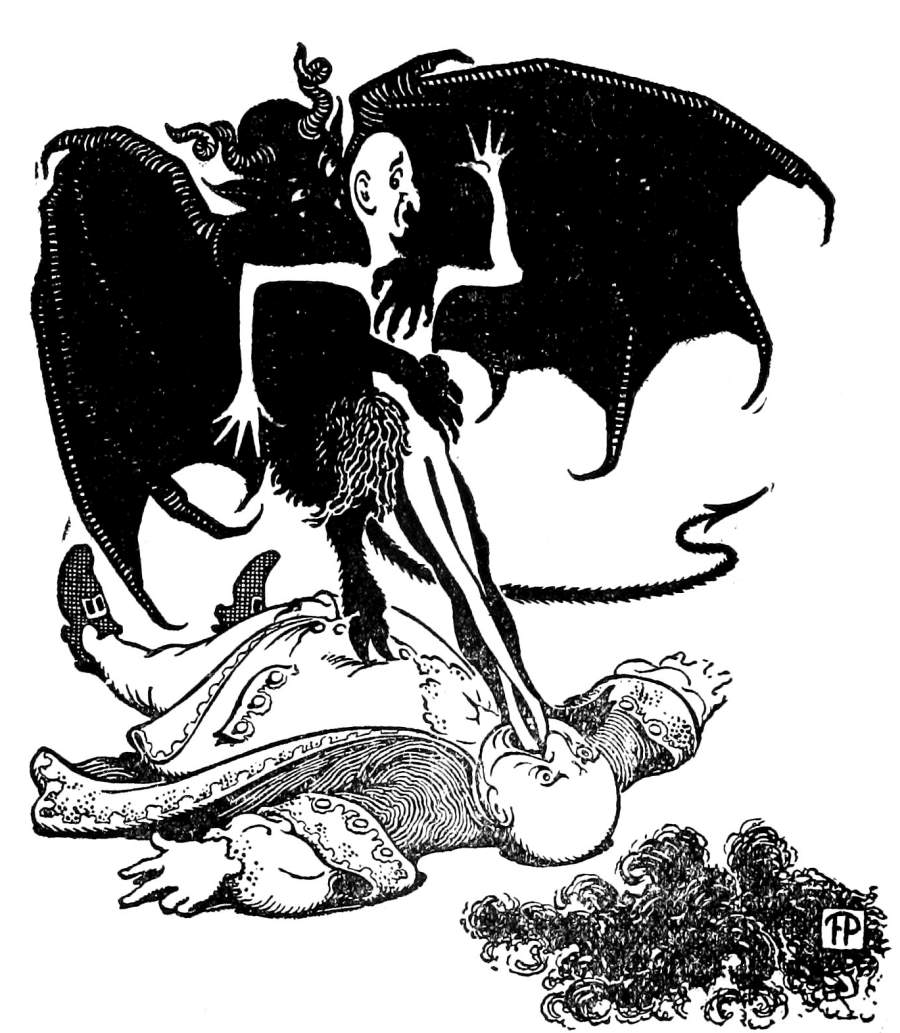
Then Florian performed unhurriedly the rite which was necessary, and there was a sign that Janicot accepted his Christmas present. It was not a pleasant sign to witness, nor did they who served Janicot appear to be squeamish. After this came two hairy persons, not unfamiliar to Florian, and these two removed as much as their master desired of Philippe d’Orléans. They answered, too, in a fashion no whit less impressive because of their not speaking, the questions which Florian put as to the proper manner of his coming to Janicot and the Feast of the Wheel. Then they were not in this room: and Florian, somewhat shaken, also went from this room, not as they had gone but by way of the little private door.
It was a full half-hour, Florian learned afterward, before Madame de Phalaris returned with a cortége of lackeys and physicians. These last attempted to bleed Duke Philippe, but found their endeavors wasted: La Tophania’s recipes were reliable, and to all appearance he had for some while been dead of apoplexy. The obscene toy discovered, hanging about his neck, when they went to undress him, surprised nobody: the Duke had affected these oddities. When the physicians made yet other discoveries, a trifle later, they flutteringly agreed this death must, without any further discussion, be reported to have arisen from natural causes. “Monsieur d’Orléans,” said one of them, jesting with rather gray lips, “has died assisted by his usual confessor.”
Florian had of course not needed to amass good precedents for putting out of life anybody who was to all intents a reigning monarch. As he glanced back at history, this seemed to him almost the favorite avocation of estimable persons. So, as Florian rode leisurely away in his great gilded coach, leaving behind him the second fruits of the attainment of his desire, if he lazily afforded a sidethought to Marcus Brutus and Jacques Clément and Aristogeiton and Ehud the Benjaminite, and to a few other admirable assassins of high potentates, it was through force of habit rather than any really serious consideration. For the important thing to be considered now was how to come by the sword Flamberge, for which Florian had, that day, paid.
14. Gods in Decrepitude
OT one of the ambiguous guardians of the place in any way molested Florian in that journey through which he hoped to win the sword Flamberge. His bearing, which combined abstraction with a touch of boredom, discouraged any advances from phantoms, and made fiends uneasily suspect this little fellow in bottle-green and silver to be one of those terrible magicians who attend Sabbats only when they are planning to kidnap with strong conjurations some luckless fiend to slave for them at unconscionable tasks. That sort of person a shrewd fiend gives a wide berth: and certainly nobody who was not an adept at magic would have dared venture hereabouts, upon this night of all nights in the year, the guardians reasoned, without considering that this traveler might be a Puysange. So Florian passed to the top of the hill, without any molestation, in good time for the beginning of the Feast of the Wheel.
When Florian came quietly through the painted gate, the Master was already upon the asherah stone receiving homage. The place was well lighted with torches which flared bluishly as they were carried about by creatures that had the appearance of huge dark-colored goats: each of these goats bore two torches, the first being fixed between its horns, and the second inserted in another place. Florian stood aside, and watched these venerable rites of unflinching osculation and widdershins movings and all the rest of the ritual. One respected of course the motives which took visible form in these religious ceremonies, but the formulæ seemed to Florian rather primitive.
So he sat upon a secluded grassbank, beyond the light of the blue torches, and waited. It was quaint, and pathetic too in a way, now that the communicants were reporting upon their unimaginative doings since the last Sabbat. The Master listened and advised upon each case. To Florian it appeared a rather ridiculous pother over nothing, all this to-do about the drying up of a cow or the unfitting of a bridegroom for his privileges or the sapping away of someone’s health. Florian inclined to romanticism even in magic, whose proper functions he did not consider to be utilitarian or imitative of real life. It seemed to him mere childish petulancy thus to cast laborious spells to hasten events which would in time have happened anyhow, through nature’s unprompted blunderings, when the obvious end of magic should be to bring about chances which could not possibly happen. But the Master had an air of taking it all quite seriously.
Nor were the initiations much more diverting, however dreadfully painful they must be to the virgin novitiates. Florian could not but think that some more natural paraphernalia would be preferable, would be more logical, than that horrible, cold and scaly apparatus. It was interesting, though, to note what disposition was made of the relics of Philippe d’Orléans: and in the giving of four infants also, by the old ritual, Florian took a sort of personal concern, and he watched closely, so as to see just how it was done. He was relieved to find it a simple enough matter, hardly more difficult than the gutting of a rabbit, once you had by heart the words of the invocation. Florian assumed that Janicot would in due course supply the woman whose body must serve as the altar, and Florian put the matter out of mind.
Besides, to one with his respect for ancient custom and precedent, the fertility rites now in full course were interesting: he imagined that to a professed and not prudish antiquary they would be of absorbing interest, coming down, as these ceremonies did unaltered, from the dwarf races that preceded mankind proper. Still, as a whole, the Feast of the Wheel was rather tedious, Florian declared to his large neighbor. Florian had just noticed that others sat on this secluded grassbank, to both sides of him, in a twilight so vague that he could only see these other watchers of the feast were of huge stature and had unblinking shining eyes.
Yes, this dim person assented, these modern ways lacked fervor and impressiveness: and matters had been infinitely better conducted, he said, in the good old days when the Sabbat was held in blasphemy against him.
Florian, really interested at last, asked questions. It developed that this shadowy watcher was called Marduk. He had once been rather widely esteemed, by he had no notion how many millions of men, as the over-lord of heaven and all living creatures, in whose hands were the decrees of fate, and as the bright helper and healer from whom were hid no secrets. Apsu yonder had in those fine days conducted his blasphemies, Marduk repeated, with considerably more splendor and display. Yes, the times worsened, the thing was now done meagrely. Apsu had never been really the same, said Marduk,—with a dry chuckle, like the stirring of a dead leaf,—since Apsu lost his wife. She was called Tiamat: and, say what you might about her—
“I quite agree with you. He was a far more dashing rogue,” put in another half-seen shape, “in the good times when I was the eternal source of light, the upholder of the universe, all-powerful and all-knowing, and when nobody anywhere except that rascal Anra-Mainyu was bold enough to talk back to Ahura-Madza. Yes, the times worsen in every way: and even his effrontery flags, if that is any comfort.”
“Oh, for that matter,” said a third, “this Vukub-Kakix was at hand with his impudence when the Old Ones covered with Green Feathers first came out of the waters and tried to make men virtuous. He was then a splendid rogue. I found him annoying, of course, but wonderfully amusing. Now the times worsen: and the adversary of all the gods of men no longer has such opponents as used to keep him on his mettle.”
“Each one of you,” marvelled Florian, “gives the Master a new and harder christening! And what, monsieur,” asked Florian, of the last speaker, “may be your name?”
The third dim creature answered, “Xpiyacoc.”
“Ah, now I understand why you should be the most generous to the Master in the matter of cacophony! I take it that you also have retired from a high position in the church. And I am wondering if all you veteran gods are assembled upon half-pay”—here Florian discreetly jerked a thumb skyward,—“to conspire?”
“No,” said a fourth,—who, like that poor Philippe, had only one eye,—“it is true we look to see put down the gods who just now have men’s worship. But we do not conspire. We are too feeble now, and the years have taken away from us even anger and malevolence. It was not so in the merry days when the little children came to me upon spear points. Now the times worsen: and they can but make the best of very poor times up yonder, as we do here.” He seemed to listen to the thing in the appearance of a raven perched on his shoulder, and then said: “Besides, wise Huginn tells me that the reign of any god is an ephemeral matter hardly worth fretting over. I fell. They will fall. But neither fact is very important, says wise Huginn.”
And about the Master these dim watchers preferred not to talk any more. He had denied them, they said, when they were kings of heaven and of man’s worship and terror: and the Master had always maintained his cult against whatever god was for the moment supreme. He had never been formidable, he had never shown any desire toward usurping important powers. He had remained content to assert himself Prince of this World, whoever held the heavens and large stars: and while he had never meddled with the doings of any god in other planets, here upon earth he had displayed such pertinacity that in the end most rulers of the universe let him alone. And now their omnipotence had passed, but the Master’s little power—somehow—endured. The old gods found it inexplicable; but they were under no bonds to explain it; and it was not worth bothering about: nor was anything else worth bothering about, said they, whom time had freed of grave responsibilities.
And Florian mildly pitied their come-down in life, and their descent into this forlorn condition, but felt himself, none the less, to be sitting among ne’er-do-wells, and to be in not quite the company suited to a nobleman of his rank. So it was really a relief when the Master’s religious services were over, and when, with the coming of red dawn, his servants departed, trooping this way and that way, but without ever ascending far above earth as they passed like sombre birds. The Master now stood unattended upon the asherah stone.
Florian then nodded civilly to the fallen gods, and left them. Florian came forward and, removing his silver-laced green hat with a fine stately sweep, he gave Janicot that ceremonious bow which Florian reserved for persons whose worldly estate entitled them to be treated as equals by a Duke of Puysange.
15. Dubieties of the Master
OME,” said Janicot, yawning in the dawn of Christmas Day, “but here is our romantic lordling of Puysange, to whom love is divine, and the desired woman a goddess.”
Florian did not at once reply. He had for the instant forgotten his need of the sword Flamberge. For on account of the requirements of the various ceremonies, Janicot, except for a strip of dappled fawn-skin across his chest, was not wearing any clothes, not even any shoes. Florian had just noticed Janicot’s feet. But Florian was too courteous to comment upon personal peculiarities: for this only is the secret of all good-breeding, he reflected, not ever to wound the feelings of anybody, in any circumstances, without premeditation. So his upsetment was but momentary, and was not shown perceptibly, he felt sure, by the gasp which politeness had turned into a sigh.
“But what the deuce,” said Janicot then, “is this a proper groan, is this the appropriate countenance, for one whose love has overridden the by-laws of time and nature and even of necromancy?”
“Ah, Monsieur Janicot,” answered Florian, “gravity everywhere goes arm-in-arm with wisdom, and I am somewhat wiser than I was when we last talked together. For I have been to the high place, and my desires have been gratified.”
“That is an affair of course, since all my friends have all their desires in this world. What cannot be with equal readiness taken for granted is the fact that you appear on that account to be none the happier.”
“Merriment,” replied Florian, “is a febrile passion. But content is quiet.”
“So, then, you are content, my little duke?”
“The word ‘little,’ Monsieur Janicot, has in its ordinary uses no uncivil connotations. Yet, when applied to a person—”
“I entreat your pardon, Monsieur the Duke, for the ill-chosen adjective, and I hastily withdraw it.”
“Which pardon, I need hardly say, I grant with even more haste. I am content, then, Monsieur Janicot. I have achieved my heart’s desire, and I find it”—Florian coughed,—-“beyond anything I ever imagined. But now, alas! the great love between my wife and me draws toward its sweet fruition, and one must be logical. So I comprehend—with not unnatural regret,—that my adored wife will presently be leaving me forever.”
“Ah, to be sure! Then you have already, in this brief period, passed from the pleasures of courtship to the joys of matrimony—?”
“Monsieur, I am a Puysange. We are ardent.”
“—And she is already—?”
“Monsieur, I can but repeat my remark.”
“Eh,” replied Janicot, “you have certainly spared no zeal, you have not slept, in upholding the repute of your race: and this punctilious and loving adherence to the fine old forthright customs of your fathers affects me. There remains, to be sure, our bargain. Yet I am honestly affected, and since this parting grieves you so much, Florian, some composition must be reached—”
“It is undeniable,” said Florian, with a reflective frown, “that my most near acquaintances address me—”
“I accept the reproof, I withdraw the vocative noun, and again I entreat your pardon, Monsieur the Duke.”
“I did not so much voice a reproof, Monsieur Janicot, as a sincere lament that I have never enjoyed the privilege of your close friendship.” And Florian too bowed. “I was about to observe, then, that a gentleman adheres in all to all his bargains. So I can in logic consider no alteration of our terms, though you comprehend, I trust, how bitter I find their fulfilment.”
“Yes,” Janicot responded, “it is precisely the amount of your grief which I begin to comprehend. Its severity has even brought on a bronchial irritation which prevents your speaking freely: and indeed, one might have foreseen this.”
“—So I have come to inquire how I am to get the sword Flamberge, which, as you may remember, must figure in the ceremony of—your pardon, but I really do appear to have contracted a quite obstinate cough in the night air,—of giving you your honorarium, by the old ritual.”
Janicot for a moment reflected. “You have sacrificed—”
“Monsieur, pray let us be logical! I have offered you no sacrifice. I have participated in no such inadvisable custom of heathenry. I must remind you that this is Christmas; and that I, naturally, elect to follow our Christian custom of exchanging appropriate gifts at this season of the year.”
“I again apologize, I withdraw the verb. You have made me a Christmas present, then, of the life of a person of some note and mightiness, as your race averages. So it is your right to demand my aid. Yet there is one at your home, in an earthen pot, who could have procured for you the information, and very probably the sword too, without your stirring from your fireside and adored wife. It appears to me odd that, with so few months of happiness remaining, you should absent yourself from the sources of your only joy.”
Florian’s hand had risen in polite protest. “Ah, but, Monsieur Janicot, but in mere self-respect, one would not employ the power of which you speak, unless there were some absolute need. Now, for my part, I have always found it simple enough to get what I wanted without needing to thank anyone for help except myself. And Flamberge too is a prize that I prefer to win unaided, at the trivial price of a slight token of esteem at Christmas. I prefer, you conceive,” said Florian, as smilingly he reflected upon the incessant carefulness one had to exercise in dealing with these fiends, “to settle the affair without incurring humiliating and possibly pyrotechnic obligations to anybody.”
Janicot replied: “Doubtless, such independent sentiments are admirable. And it shall be as you like—”
“Still, Monsieur Janicot,” said Florian, with just the proper amount of heartbreak in his voice, “is it not regrettable that this cruel price should be exacted of me?”
“Old customs must be honored, and mine are oldish. Besides, as I recall it, you suggested the bargain, not I.”
“Yes, because I know that gifts from you are dangerous. Why, but let us be logical! Would you have me purchase an ephemeral pleasure at the price of my own ruin, when I could get it at the cost of somewhat inconveniencing others?”
“You say that my gifts are dangerous. Yet, what do you really know about me, Florian? Again I entreat your pardon, Monsieur the Duke, but, after all, our acquaintance progresses.”
“I know nothing about you personally, Monsieur Janicot, beyond the handsomeness of your generosity. I only know the danger of accepting a free gift from any fiend; and you I take to be, in cosmic politics, a leader of the party in opposition.”
Janicot looked grave for a moment. He said:
“No, I am not a fiend, Monsieur the Duke; nor, for that matter, does your current theology afford me any niche.”
“Well, then,” asked Florian, with his customary fine frankness, “if you are not the devil, what the devil are you?”
Janicot answered: “I am all that has been and that is to be. Never has any man been able to imagine what I am.”
“Ah, monsieur, that sounds well, and, quite possibly, it means something. Of that I know no more than a frog does about toothache, but I do know they call you the adversary of all the gods of men—”
“Yes,” Janicot admitted, rather sadly, “I have been hoping, now for a great while, that men would find some god with whom a rational person might make terms, but that seems never to happen.”
“Monsieur, monsieur!” cried Florian, “pray let us have no scepticism—!”
“Scepticism also is a comfort denied to me. Men have that refuge always open. But I have in my time dealt at close grips with too many gods to have any doubt about them. No, I believe, and I shudder with distaste.”
“Come, now, Monsieur Janicot, religion and somewhere to go on Sundays are quite necessary amenities—”
Janicot was surprised. “Why, but, Monsieur the Duke, can it be true that you, as a person of refinement, approve of worshipping goats and crocodiles and hawks and cats and hippopotami after the Egyptian custom?”
“Parbleu, not in the least! I, to the contrary—”
“Oh, you admire, then, the monkeys and tigers, in whose honor the men of India build temples?”
“Not at all. You misinterpret me—”
“Ah, I perceive. You approve, instead, of those gods of Greece and Rome, who went about earth as bulls and cock cuckoos and as sprinklings of doubloons and five franc pieces, when they were particularly desirous of winning affection?”
“Now, Monsieur Janicot, you very foolishly affect to misunderstand me. One should be logical in these grave matters. One should know, as the whole world knows, that the Dukes of Puysange care nothing for the silly fables of paganism, and that for five centuries we of Puysange have been notable and loyal Christians.”
Janicot said: “For five whole centuries! Jahveh also, being so young a god, must think that a long while; and doubtless he feels honored by these five centuries of patronage.”
“Well, of course,” said Florian, modestly, “as one of the oldest families hereabouts, we find that our example is apt to be followed. But we ourselves think little of our long lineage, we have grown used to it, we think that logically it is only the man himself who matters: and I confess, Monsieur Janicot, that it seems almost droll to see you impressed by our antiquity.”
“I!” said Janicot. Then he said: “For all that, I am impressed. Yes, men are really wonderful. However, let that pass. So it is Jahveh of whom you approve. You confess it. Why, then, I ask you, as one logical person addressing another—”
“A pest! logic is a fine thing, but let us not put these matters altogether upon the ground of logic,” said Florian, recoiling just perceptibly, as a large tumble-bug climbed on the rock, and sat beside Janicot.
“—I ask you,” Janicot continued, “as one person of good taste addressing another—”
“It is not wholly an affair of connoisseurs. Let us talk about something else.”
“—For you have this Jahveh’s own history of his exploits all written down at his own dictation. I allow him candor, nor, for one so young, does he write badly. For the rest, do these cruelties, these double-dealings, these self-confessed divine blunders and miscalculations, these subornings of murders and thefts and adulteries, these punishments of the innocent, not sparing even his own family—”
Florian yawned delicately, but without removing his eyes from the tumble-bug. “My dear Monsieur Janicot, that sort of talk is really rather naïve: it is, if you will pardon my frankness, quite out of date now that we have reached the eighteenth century.”
“Yes, but—”
“No, Monsieur Janicot, I can consent to hear no more of these sophomoric blasphemies. I must tell you I have learned that in these matters, as in all matters, it is better taste to recognize some drastic regeneration may be necessary without doing anything about it, and certainly without aligning ourselves with the foul anarchistic mockers of everything in our social chaos which is making for beauty and righteousness—”
“Why, but, Monsieur the Duke,” said Janicot, “but what—!”
“I must tell you I perceive, in honest sorrow, that with a desire for fescennine expression you combine a vulgar atheism and an iconoclastic desire to befoul the sacred ideas of the average man or woman, collectively scorned as the bourgeoisie—”
“Yes, doubtless, this is excellent talking. Still, what—?”
“I must tell you also that I very gravely suspect you to be one of those half-baked intellectuals who confuse cheap atheism, and the defiling of other men’s altars, with deep thinking; one of those moral and spiritual hooligans who resent all forms of order as an encroachment upon their diminutive, unkempt and unsavory egos; one of the kind of people who relish nasty books about sacred persons and guffaw over the amours of the angels.”
“Yes, I concede the sonority of your periods; but what does all this talking mean?”
“Why, monsieur,” said Florian, doubtfully, “I do not imagine that it means anything. These are merely the customary noises of well-thought-of persons in reply to the raising of any topic which they prefer not to pursue. It is but an especially dignified manner of saying that I do not care to follow the line of thought you suggest, because logic here might lead to uncomfortable conclusions and to deductions without honorable precedents.”
“Ah, now I understand you,” said Janicot, smiling. He looked down, and stroked the tumble-bug, which under his touch shrank and vanished. “I should have noticed the odor before; and as it is, I confess that, in this frank adhesion to your folly without pretending it is anything else, I recognize a minim of wisdom. So let us say no more about it. Let us return to the question of that sword with which the loyal servant of him who also came not to bring peace, but a sword, has need to sever his family ties. Those persons just behind you were very pretty swordsmen in their day: and I imagine that they can give you all the necessary information as to the sword Flamberge.”
16. Some Victims of Flamberge
T was really no affair of Florian’s, how these five vaguely-hued and quaintly appareled persons happened to be standing just behind him. They had not been there a moment ago: but Janicot seemed partial to these small wonder-workings, and such foibles, while in dubious taste, did not greatly matter.
So Florian was off again with his silver-laced hat, and Florian saluted these strangers with extreme civility. And Florian inquired of the gray and great-thewed champion if he knew of the whereabouts of Flamberge; and this tall man answered:
“No. It was a fine sword, and I wore it once when I had mortal life and was very young. But I surrendered this sword to a woman, in exchange for that which I most desired. So I got no good of Flamberge, nor did anyone else so far as I could ever hear, for there is a curse upon this sword.”
“A curse, indeed!” said Florian, somewhat astonished. “Why, but I have always been told, monsieur, that the wearer of Flamberge is unconquerable.”
“That I believe to be true. Thus the wearer of Flamberge can get all his desires, and he usually does so: and, having them, he understands that the sword is accursed.”
“And did you too get your desire in this world, monsieur, and perceive the worth of it?”
“My boy, there is a decency in these matters, and an indecency. I got my desire. And having it, I did not complain. Let that suffice.”
With that, the speaker picked up his shield, upon which was blazoned a rampant and bridled stallion, and this tall gray squinting soldier was there no longer.
Then came a broad and surly man, in garments of faded scarlet, and with gems dangling from his ears, and he said: “From him, who was in his day a Redeemer, the sword came to my mother, and from her to me, and with it I slew my father, as was foreordained. And the sword made me unconquerable, and I went fearing nobody, and I ruled over much land, and I was dreaded upon the wide sea. And the sword won for me the body of that woman whom I desired, and the sword won for me long misery and sudden ruin.”
“A pest!” said Florian. “So you also, monsieur, were the victim of your own triumph!”
“Not wholly,” the other answered. “For I learned to envy and to admire that which I could not understand. That is something far better worth learning than you, poor shallow-hearted little posturer, are ever likely to suspect.”
And now came a third champion, who said: “From him, who was in his day a most abominable pagan and a very gallant gentleman as well, the sword came to me. And I cast it into the deep sea, because I meant to gain my desire unaided by sorcery and with clean hands. And I did get my desire.”
“And did you also live unhappily ever afterward?”
“Our marriage was as happy as most marriages. My love defied Time and Fate. Because of my love I suffered unexampled chances and ignominies, and I performed deeds that are still rhymed about; and in the end, through my unswerving love, I got me a wife who was as good as most wives. So I made no complaint.”
And Florian nodded. “I take your meaning. There was once a king and a queen. They had three sons. And the third prince succeeded in everything—Your faces and your lives are strange to me. But it is plain all four of us have ventured into the high place, that dreadful place wherein a man attains to his desires.”
Then said another person: “That comes of meddling with Flamberge. Now my weapon was, at least upon some occasions, called Caliburn. And I ventured into a great many places, but I was careful of my behavior in all of them.”
“And did you never attain to your desire, monsieur?”
“Never, my lad, although I had some narrow shaves. Why, once there was only a violet coverlet between me and destruction, but I was poet enough to save myself.”
“Parbleu, now that is rather odd! For I first saw my wife—I mean, my present duchess,—asleep beneath a violet coverlet.”
“Ah,” said the other, drily, “so that is where you sought a woman to be, of all things, your wife! Then you are braver than I: but you are certainly not a monstrous clever fellow.”
“Well, well!” said Florian, “so the refrain of this obsolescent quartet is a jingle-jangle of shallow and cheap pessimism: and the upshot of the matter is that Flamberge is lost somewhere in the old time, and that I know not how to come to it.”
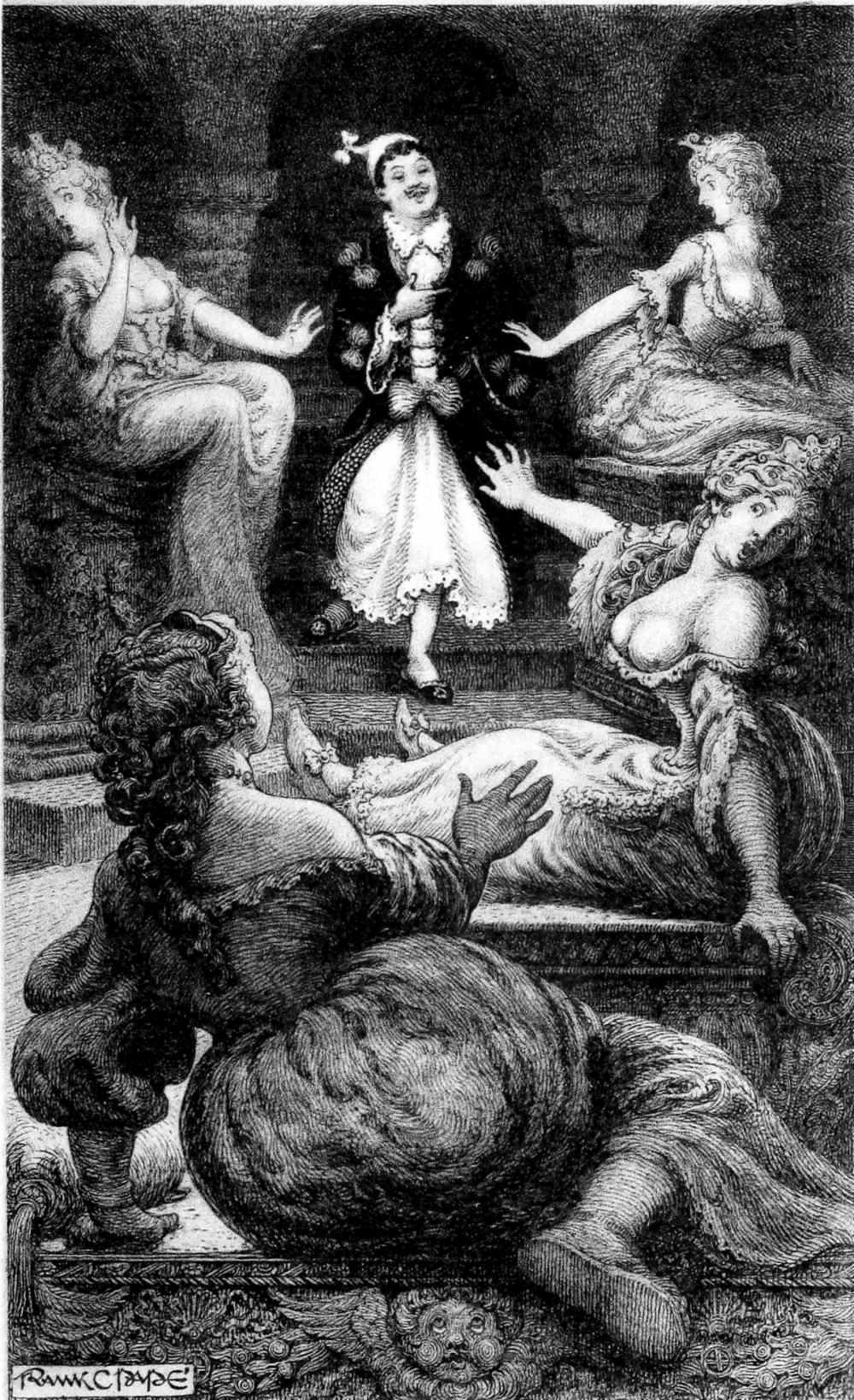
Now FLORIAN came forward. See page 234
“That is easy,” said the fifth person, the only one who now remained. “You must adventure as they once adventured, who were your forefathers, and you must go with me, who am called Horvendile, into Antan.”
“Were those evaporating gentlemen my forefathers?” asked Florian. “And how does one go into Antan?”
“They were,” answered Horvendile. “And one goes in this way.” He explained the way, and the need for traveling on it.
And Florian looked rather dubious and took snuff. He saw that Janicot had vanished from the asherah stone, with that ostentatious simplicity the brown creature seemed to affect. Then Florian shrugged, and said he would go wherever Horvendile dared go, since this appeared now the only chance of coming by the sword Flamberge.
“And as for those who were my forefathers, and begot me, I would of course have said something civil to express my appreciation of their exertions, if I had known. But between ourselves, Monsieur Horvendile, I would have preferred to meet some of the more imposing progenitors of Puysange,—say, heroic old Dom Manuel or the great Jurgen,—instead of these commonplace people. It is depressing to find any of one’s own ancestors just ordinary persons, persons too who seem quite down in the mouth, and with so little life in them—”
“To be quite ordinary persons,” replied Horvendile, “is a failing woefully common to all men and to the daughters of all men, nor does that foible shock anybody who is not a romantic. As for having very little life in them, what more do you expect of phantoms? The life that was once in these persons to-day endures in you. For it is a truism—preached to I do not, unluckily, know how many generations,—that the life which informed your ancestor, tall Manuel the Redeemer, did not perish when Manuel passed beyond the sunset, but remained here upon earth to animate the bodies of his children and of their children after them.”
“But by this time Manuel must have the progeny of a sultan or of a town bull—”
“Yes,” Horvendile conceded, “in a great many bodies, and in countless estates, that life has known a largish number of fruitless emotions. At least, they appear to me to have been rather fruitless. And to-day that life wears you, Monsieur de Puysange, as its temporary garment or, it may be, as a mask: to-morrow you also will have been put by. For that is always the ending of the comedy.”
“Well, so that the comedy wherein I figure be merry enough—”
“It is not ever a merry comedy,” replied Horvendile, “though, for one, I find it amusing. For I forewarn you that the comedy does not vary. The first act is the imagining of the place where contentment exists and may be come to; and the second act reveals the striving toward, and the third act the falling short of, that shining goal,—or else the attaining of it to discover that happiness, after all, abides a thought farther down the bogged, rocky, clogged, befogged heart-breaking road.”
“Ah, but,” said Florian, “these reflections are doubtless edifying, since they combine gloom with verbosity and no exact meaning. Still, it is not happiness I am looking for, but a sword to which all this philosophizing brings us no step nearer. No, it is not happiness I seek. For through that sword, when I have got it, will come such misery as I cannot bear to think of, since its sharp edge must sever me irrevocably from that perfect beauty which I have adored since boyhood. None the less, I have given my word; and these old phantoms have unanimously reassured me that it is better to have love end at fulltide. So let us be logical, and let us go forward, Monsieur Horvendile, as merrily as may be possible.”
17. The Armory of Antan
HE way to Antan was made difficult by darkness and obstacles and illusions, and the three that guarded the cedar-shadowed way were called Glam of the Haunting Eyes and Ten-jo of the Long Nose and Maya of the Fair Breasts. But these warders did not greatly bother Horvendile, who passed them by the appointed methods and through means which Florian found remarkable if not actually indelicate. In no other way than through these cedar-groves and the local customs might you win to Freydis, whom love brought out of Audela to suffer as a mortal woman, and whom the druids and satirists had brought, through Sesphra’s wicked aid, to Antan. Thus had she come to reign in Antan, and to attest, with many dreadful instances, her ardor to do harm and work great mischief.
Now this Antan was a queer place, all cloudiness and grayness, but full of gleamings which reminded you of sparks that linger insecurely among ashes: and there were no real noises, not even when you talked. And when Horvendile had departed, you asked this gray and dimly golden woman if the sword Flamberge was to be come by anywhere in madame’s most charming and tasteful residence? She replied, a shadow speaking with the shadow of a voice, that it was very probably somewhere in her armory: and she led the way into a misty place wherein were the famous swords whereby came many deaths and a little fame.
Very curious it was to see them coldly shining in the mistiness, and to handle them. Here was long Durandal, with which Sir Roland split a cleft in the Pyrenees; and beside it hung no less redoubtable Haulte-Claire, with which Sir Oliver had held his own against Durandal and Durandal’s fierce master, in that great battling which differed from other military encounters by resulting in something memorable and permanent, in the form of a proverb. Here was Lancelot’s sword Aroundight, here was Ogier’s Courtain, and Siegfried’s Balmung. One saw in this dim place the Cid’s Colada, Sir Bevis’s Morglay, the Crocea Mors of Cæsar, and the Joyeuse of Charlemagne. Nor need one look in vain for Curtana and Quernbiter, those once notable guardians of England and Norway, nor for Mistelstein, nor Tizona, nor Greysteel, nor Angurvadel, nor any other charmed sword of antiquity. All were here: and beside Joyeuse was hung Flamberge; for Galas made both of them.
Well, you estimated, Flamberge was by no means the handsomest of the lot: but it would serve your turn, you did not desire to seem grasping. And since madame appeared somewhat oversupplied with cutlery—
Indeed that was the truth, as Freydis could not deny, in the thin tones which people’s voices had in Antan, since not only these patrician murderers harbored here. Here too were death’s plebeian tools in every form. Here were Italian stilettoes heaped with Malay krisses, the hooked Turkish scimitar with the Venetian schiavona; curved Arab yataghans, sabres that Yoshimitzu had tempered, the Albanian cutlass, and the notched blades of Zanzibar; the two-handed claymores of Scotland, the espada of the Spanish matador, the scalping-knives of the Red Indians and the ponderous glaives of executioners: swords from all cities and all kingdoms of the world, from Ferrara and Toledo and Damascus, from Dacia and Peru and Muscovy and Babylon.
To which you replied that, while you had never greatly cared for the cataloguing method in literature, you allowed its merits in conversation. These crisp little résumés indicated a really firm grasp of the subject. For the rest, it was most interesting to note what ingenuity people had displayed in contriving how to kill one another.
Freydis assented as to men’s whole-heartedness in malignity, but was disposed to view without optimism the support it got from human ingenuity. She considered these swords in any event to be outmoded lumber, as concerned the needs of anybody who really desired to do harm and work any actually great mischief.
Still, you, whose speaking seemed even to you a whisper in the grayness, declined to be grasping: and Flamberge would serve your turn. Therefore it was vexatious that, instead of gracefully presenting you with the sword, the Queen of Antan went through a gray vague corridor, wherein upon a table lay a handful of rusty iron nails and a spear, and then into another twilit place.
Here, as you hastily observed, were madame’s pistols, cannons, culverins, grenades, musketoons, harquebusses, bombs, petronels, siege-guns, falconets, carbines, and jingals, and swivels. Yes, it was most interesting.
Freydis looked at you somewhat queerly: and it was, again, as outmoded lumber that she appraised this arsenal. Then Freydis almost proudly showed the weapons she had in store for men’s needs when men should go to war to-morrow, and such assistants would further every patriot’s desire to do harm and work great mischief. And you felt rather uncomfortable to see the sleek efficiency of these gleaming things in this ambiguous place.
Yes, they were very interesting, and beside them, Flamberge certainly seemed inadequate. Still, you admitted, you had never been grasping: and Flamberge would serve your turn.
It was really maddening how the woman kept turning to irrelevant matters. These engines of destruction, although ingenious and devastating toys within their limits, should not be regarded overseriously. A million or so of persons, or at most a few nations, could be removed with these things, but that was all. So speaking, she passed into a room wherein were books,—but not many books,—and four figures modelled in clay, as she told you, by old Dom Manuel very long ago. It was more important, her thin talking went on, that as occasion served she was sending into the world these figures, to follow their six predecessors, to all whom she had given a life empoisoned with dreams, with dreams that were immortal and contagious; and so would infect others and yet others eternally, and would make living as unhappy and detestable a business as dying. What were these dreams? she was asked: and she in turn asked, Why should I tell you? Your dream is different, nor may you escape it. This must suffice: that these dreams are the most subtle and destructive of poisons, and do harm and work great mischief, in that they enable men to see that life and all which life can afford is inadequate to men’s desires.
This seemed rather morbid talk. To evade it tactfully, the four changelings as yet unborn were examined, with civil comments: and indeed there was about one little hook-nosed figure a something which quite took the fancy. He reminds me of a parrot, was your smilingly tendered verdict: and Freydis, with her habitual tired shrugging, replied that others, later, would detect, without much reticence, a resemblance to that piratical and repetitious bird.
Now then, all this was very interesting, most interesting, and you really regretted having to return to the topic of the sword Flamberge—Freydis had not made up her mind: she might or might not give the sword, and her deciding must pivot upon what harm you meant to do with it. Her visitor from the more cheery world of daylight was thus forced to make a clean breast of why he needed Flamberge, the only sword that may spill the blood of the Léshy, so that he might give, by the old ritual, his unborn child, and rid himself of his wife.
Whereon Queen Freydis expressed frank indignation, because the child would by this plan be rescued from all, and the woman from much, sorrow. Could even a small madman in bottle-green and silver suppose that the Queen of Antan, after centuries of thriving malevolence, was thus to be beguiled into flagrant philanthropy?