THIRD JOURNEY.
Reading edition
I. THE PEMIGEWASSET IN JUNE.
O child of that white-crested mountain whose springs Gush forth in the shade of the cliff-eagle's wings, Down whose slopes to the lowlands thy wild waters shine, Leaping gray walls of rock, flashing through the dwarf-pine! Whittier.
PLYMOUTH lies at the entrance to the Pemigewasset Valley, like an encampment pitched to dispute its passage. At present its design is to facilitate the ingress of tourists.
I am sitting at the window this morning looking down the Pemigewasset Valley. It is a gray, sad morning. Wet clouds hang and droop heavily over. In the distance the frayed and tattered edges are rolled up, half-disclosing the humid outlines of the hills on the other side of the valley. The trees are budded with rain-drops. Through a lattice of bordering foliage I look down upon the river, shrunken by drought to half its usual breadth, and exposing its parched bed of sand and pebbles. It gives an expiring gurgle in its stony throat. It is one of those mornings that, in spite of our philosophy, strangely affect the spirits, and are like a presentiment of evil. The clouds are funereal draperies; the river chants a dirge.
In this world of ours, where events push each other aside with such appalling rapidity, perhaps it is scarcely remembered that Hawthorne breathed his last in this house on the night of May 18th, 1864. He who was born in sight of these mountains had come among them to die.
In company with his old college mate and loving friend, General Pierce, he came from Centre Harbor to Plymouth the day previous to the sad event. Devoted friends--and few men have known more devoted--had for some time seen that his days were numbered. The fire had all but gone out from his eye, which seemed interrogating the world of which he was already more than half an inhabitant. A presentiment of his approaching end seemed foreshadowed in the changed look and faltering step of Hawthorne himself: he walked like a man consciously going to his grave. Still, much was hoped--it could hardly be that much was expected--from this journey, and from the companionship of two men grown gray with care, each standing on the pinnacle of his ambition, each disappointed, but united, one to the other, by the ties of life-long friendship; turning their backs upon the gay world, and walking hand-in-hand among the sweet groves and pleasant streams like boys again. It was like a dream of their lost youth: the reality was no more.
On this journey General Pierce was the watchful, tender, and sympathetic nurse. Without doubt either of these men would have died for the other.
But these hopes, these cares, alas! proved delusive. The angel of death came unbidden into the sacred companionship; the shadow of his wings hovered over them unseen. In the night, without a sigh or a struggle, as he himself wished it might be, the hand of death was gently and kindly laid on the fevered brain and fluttering heart. In the morning his friend entered the chamber to find only the lifeless form of Nathaniel Hawthorne plunged in the slumber that knows no awakening. Great heart and mighty brain were stilled forever.
While the weather gives such inhospitable welcome let us employ the time by turning over a leaf from history. According to Farmer, the intervales here were formerly resorted to by the Indians for hunting and fishing. At the mouth of Baker's River, which here joins the Pemigewasset, they had a settlement. Graves, bones, gun-barrels, besides many implements of their rude husbandry, have been discovered. Here, it is said, the Indians were attacked by a party of English from Haverhill, Massachusetts, led by Captain Baker, who defeated them, killed many, and destroyed a large quantity of fur. From him Baker's River receives its name.
Before the French and Indian war broke out this region was debatable ground, into which only the most celebrated and intrepid white hunters ventured. Among these was a young man of twenty-three, named Stark, who lived near the Amoskeag Falls, in what is now Manchester. In April, 1752, Stark was hunting here with three companions, one of whom was his brother William. They had pitched their camp on Baker's River, in the present limits of Rumney, and were prosecuting their hunt with good success, when they suddenly discovered the presence of Indians in their vicinity. Though it was a time of peace, they were not the less apprehensive on that account, and determined to change their position. But the Indians had also discovered the white hunters, and prepared to entrap them. When Stark went out very early the next morning to collect the traps he was intercepted and made prisoner. The Indians then took a position on the bank of the river to ambush his companions as they came down. Eastman, who was on the shore, next fell into their hands; but the two others were in a canoe floating quietly down the stream out of reach. Stark was ordered to hail and decoy them to the shore. He obeyed; but, instead of lending himself to the treachery, shouted to his friends that he was taken, and to save themselves. They instantly steered for the opposite shore, receiving a volley as they did so. Stinson, one of those in the boat, was shot dead; but William Stark escaped through the heroism of his brother, who knocked up the guns of the savages as they covered him with fatal aim.
Stark and his fellow-prisoner were taken to St. Francis by Actæon and his prowling band, with whom they had had the misfortune to fall in. At St. Francis the Indians set Stark hoeing their corn. At first he cut up the corn and spared the weeds; but this expedient not serving to relieve him of the drudgery, he threw his hoe into the river, telling his captors that hoeing corn was the business of squaws, not of warriors. This answer procured him recognition among them as a spirit worthy of themselves. He was adopted into the tribe, and called the "Young Chief." The promise of youth was fulfilled. The young hunter of the White Mountains and the conqueror of Bennington are the same.
The choice is open to leave the railway here and enter the mountains by the Pemigewasset Valley, or to continue by it the route which conducts to the summit of Mount Washington, by Bethlehem and Fabyan's. To journey on by rail to the Profile House is seventy-five miles, while by the common road, following the Pemigewasset, the distance is only thirty miles. A daily stage passes over this route, which I risk nothing in saying is always one of the delightful reminiscences of the whole journey. Deciding in favor of the last excursion, my first care was to procure a conveyance.
At three in the afternoon I set out for Campton, seven miles up the valley, which the carriage-road soon enters upon, and which by a few unregarded turnings is presently as fast shut up as if its mountain gates had in reality swung noiselessly together behind you. Hardly had I recovered from the effect of the deception produced by seeing the same mountain first in front, next on my right hand, and then shifted over to the other side of the valley, when I saw, spanned by a high bridge, the river in violent commotion far down below me.
The Pemigewasset, confined here between narrow banks, has cut for itself two deep channels through its craggy and cavernous bed; but one of these being dammed for the purpose of deepening the other, the general picturesqueness of the fall is greatly diminished. Still, it is a pretty and engaging sight, this cataract, especially if the river be full, although you think of a mettled Arabian harnessed in a tread-mill when you look at it. Livermore Fall, as it is called, is but two miles from Plymouth, the white houses of which look hot in the same brilliant sunlight that falls so gently upon the luxuriant green of the valley. The feature of this fall is the deep water-worn chasm through which it plunges.
By crossing the bridge here the left bank of the stream may be followed, the valley towns of Campton, Thornton, and Woodstock being divided by it into numerous villages or hamlets, frequently puzzling the uninitiated traveller, who has set out in all confidence, but who is seized by the most cruel perplexity, upon hearing that there are four villages in Campton, each several miles distant from the other. One would have pleased him far better.
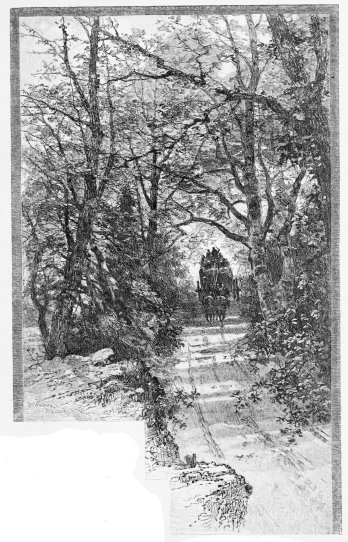
ON THE PROFILE ROAD.
Crossing this bridge, and descending to the level meadow below the falls, I made a brief inspection of the establishment for breeding and stocking with trout and salmon the depleted mountain streams of New Hampshire. The breeding-house and basins are situated just below the falls, on the banks of the river. This is a work undertaken by the State, with the expectation of repeopling its rivers, brooks, and ponds with their finny inhabitants. All those streams immediately accessible from the villages are so persistently fished by the inhabitants as to afford little sport to the angler from a distance, who is compelled to go farther and fare worse; but the State is certainly entitled to much credit for its endeavor to make two trout grow where only one grew before. It is feared, however, that the experiment of stocking the Pemigewasset with salmon will not prove successful. The farmers who live along the banks say that one of these fish is rarely seen, although the fishery is protected by the most rigid regulations. No one who has not visited the mountains between May 1st—the earliest date when fishing is permitted—and the middle of June, can have an idea of the number of sportsmen every year resorting to the trout streams, or of the unheard-of drain upon those streams. Not the least of many ludicrous sights I have witnessed was that of a man, weighing two hundred pounds, excitedly swinging aloft a trout weighing less than two ounces, and this trophy he exhibited to me with unfeigned triumph—the butcher! This is mere slaughter, and ought not to be tolerated. A pretty sight is to see the breeding-trout follow you in your walk around the margin of their little basin to be fed from your hand. They are tame as pigeons and ravenous as sharks.
Mount Prospect, in Holderness, is the first landmark of note. It is seen, soon after leaving Plymouth, rising from the opposite side of the valley, its green crest commanding a superb view of the lake region below, and of the lofty Franconia Mountains above. It is worth ascending this mountain were it only to see again the beautiful islet-spotted Squam Lake and far-reaching Winnipiseogee quivering in noonday splendor.
The beautiful valley is now open throughout its whole extent. Of course I refer only to that portion lying above Plymouth. But it is an anomaly of mountain valleys. Its length is about twenty-five miles, and its greatest width, I should judge, not more than three or four. For twenty miles it is almost as straight as an arrow. There is nothing to hinder a perfectly free and open view up or down. Contrast this with the wilful and tortuous windings of the Ammonoosuc, or the Saco, which seem to grope and feel their way foot by foot along their cramped and crooked channels. The angle of ascent, too, is here so gradual as to be scarcely noticed until the foot of the mountain wall, at its head, is reached. True, this valley is not clothed with a feeling of overpowering grandeur, but it is beautiful. It is not terrible, but bewitching.
The vista of mountains on the east side of the valley becomes every moment more and more extended, and more and more interesting. A long array of summits trending away to the north, with detached mountains heaved above the lower clusters, like great whales sporting in a frozen sea, is gradually uncovered. Green as a carpet, level as a floor, the valley, adorned with clumps of elms, groves of maples, and strips of tilled land of a rich chocolate brown, makes altogether a picture which sets the eye fairly dancing. Even the daisies, the clover, and the buttercups which so plentifully spangle the meadows seem far brighter and sweeter in this atmosphere, nodding a playful welcome as you pass them by. We are in the country of flowers.
Since passing Blair’s and the bridge over the river to Campton Hollow I was on the alert for that first and most engaging view of the Franconia Mountains which has been so highly extolled. Perhaps I should say that one poetic nature has revealed it to a thousand others. Without doubt this landscape is the more striking because it is the first, and consequently deepest, impression of grand mountain scenery obtained by those upon whom at a turn of the road, and without premonition, it flashes like the realization of some ecstatic vision.
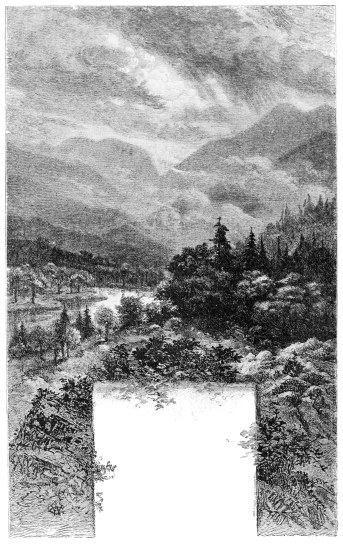
Half a mile below the little hamlet of West Campton the road crosses the point of a hill pushed well out into the valley. It is here that the circlet of mountains is seen enclosing the valley on all sides like a gigantic palisade. In one place, far away in the north, this wall is shattered to its centre, like the famous Breach of Roland; and through this enormous loop-hole we see golden mists rising above the undiscovered country beyond. We are looking through the far-famed Franconia Notch. On one side the clustered peaks of Lafayette lift themselves serenely into the sky. On the left a silvery light is playing on the ledges of Mount Cannon, softening all the asperities of this stern-visaged mountain. The two great groups now stand fully and finely exposed; though the lower and nearer summits are blended with the higher by distance. Remark the difference of outline. A series of humps marks the crest-line of the group, which culminates in the oblique wall of Mount Cannon. On the contrary, that on the right, culminating in Lafayette, presents two beautiful and regular pyramids, older than Cheops, which sometimes in early morning exactly resemble two stately monuments, springing alert and vigorous as the day which gilds them. At a distance of twenty miles it demands good eyes and a clear atmosphere to detect the supporting lines of these pyramidal structures, which in reality are two separate mountains, Liberty and Flume. This exquisite landscape seldom fails of producing a rapturous outburst from those who are making the journey for the first time.
There are many points of resemblance between this view and that of the White Mountains from Conway Corner. Both unfold at once, and in a single glance, the principal systems about which all the subordinate chains seem manœuvring under the commanding gaze of Washington or Lafayette.
Soon after starting it was evident that my driver’s loquaciousness was due to his having “crooked his elbow” too often while loitering about Plymouth. The frequent plunge of the wheels into the ditches by the roadside, accompanied with a shower of mud, was little conducive to the calm and free enjoyment of the beauties of the landscape. The driver alone was unconcerned, and as often as good fortune enabled him to steer clear of upsetting his passengers would articulate, thickly, “Don’t be alarmed, Cap’: no one was ever hurt on this road.”
Silently committing myself to that Providence which is said to watch over the destinies of tipplers, I breathed freely only when we drew up at the hospitable door of the village inn, bespattered with mud, but with no broken bones.
Sanborn’s, at West Campton, is the old road-side inn that long ago swung the stag-and-hounds as its distinctive emblem. A row of superb maples shades the road. Here we have fairly entered the renowned intervales, that gleam among the darker forests or groves like patches of blue in a storm-clouded sky. Looking southward, across the level meadows, the hills of Rumney flinging up smooth, firm curves, and the more distant, downward-plunging outline of Mount Prospect, in Holderness, close the valley. Upon the left, where the clearings extend quite to the summits of the near hills, the maple groves interspersed among them resemble soldiers advancing up the green slopes in columns of attack. Following this line a little, the valley of Mad River is distinguished by the deep trough through which it descends from the mountains of Waterville. And here, peering over the nearer elevations, the huge blue-black mass of Black Mountain flings two splendid peaks aloft.
For a more intimate acquaintance with these surroundings the hillside pasture above the school-house gives a perspective of greater breadth; while that from the Ellsworth road is in some respects finer still. About two miles up this road the valley of the East Branch, showing the massive Mount Hancock, cicatriced with one long, narrow scar, is lifted into view. The other features of the landscape remain the same, except that Mount Cannon is now cut off by the hill rising to the north of us. As often as one of these hidden valleys is thus revealed we are seized with a longing to explore it.
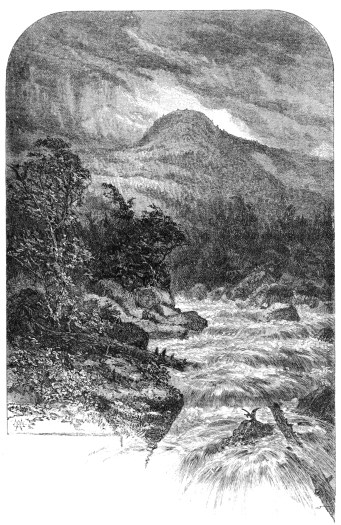
WELCH MOUNTAIN, FROM MAD RIVER.
One need not push inquiry into the antecedents of Campton or the neighboring villages very far. The township was originally granted to General Jabez Spencer, of East Haddam, Connecticut, in 1761. In 1768 a few families had come into Campton, Plymouth, Hebron, Sandwich, Rumney, Holderness, and Bridgewater. No opening had been made for civilized men on this side of Canada except for three families, who had gone fifty miles into the wilderness to begin a settlement where Lancaster now is. The name is derived simply from the circumstance that the first proprietors built a camp when they visited their grant. The different villages are much frequented by artists, who have spread the fame of Campton from one end of the Union to the other. But a serpent has entered even this Eden—the villagers are sighing for the advent of the railway.
Having dedicated one day to an exploration of the Mad River Valley, I can pronounce it well worth any tourist’s while to tarry long enough in the vicinity for the purpose. It is certainly one of the finest exhibitions of mountain scenery far or near. Here is a valley twelve miles long, at the bottom of which a rapid river bruises itself on a bed of broken rock, while above it are heaped mountains to be picked out of a thousand for peculiarity of form or structure. The Pemigewasset is passed by a ford just deep enough at times to invest the journey with a little healthy excitement at the very beginning. The ford has, however, been carefully marked by large stones placed at the edge of the submerged road.
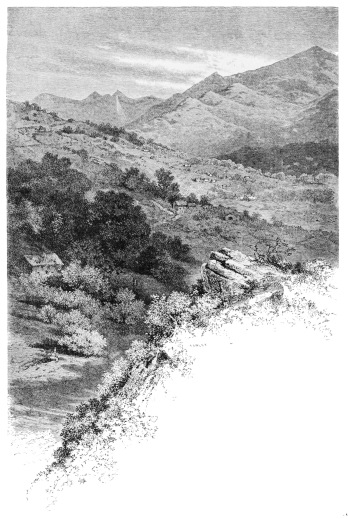
Fording the river and climbing the hill which lies across the entrance to this land-locked valley, I was at once ushered upon a scene of great and varied charm. Right before me, sunning his three peaks four thousand feet above, was the prodigious mass of Black Mountain. Far up the valley it stretched, forming an unbroken wall nearly ten miles long, and apparently sealing all access from the Sandwich side. A nipple, a pyramid, and a flattened mound protruding from the summit ridge constitute these eminences, easily recognized from the Franconia highway among a host of lesser peaks. At the southern end of this mountain the range is broken through, giving passage to a rough and straggling road—fourteen hundred feet above the sea-level—to Sandwich Centre, and to the lake towns south of it. This pass is known as Sandwich Notch.
Campton Village lies along the hill-slope opposite to Black Mountain. Completely does it fill the artistic sense. Its situation leaves nothing to be desired in an ideal mountain village. So completely is it secluded from the rest of the world by its environment of mountains, that you might pass and repass the Pemigewasset Valley a hundred times without once surprising the secret of its existence. All those houses, half hid beneath groves of maples, bespeak luxurious repose. Opposite to Black Mountain, whose dark forest drapery hides the mass of the mountain, is the immense whitish-yellow rock called Welch Mountain. Only a scanty vegetation is suffered to creep among the crevices. It is really nothing but a big excrescent rock, having a principal summit shaped somewhat like a Martello tower; and, indeed, resembling one in ruins. The bright ledges brilliantly reflect the sun, causing the eye to turn gratefully to the sombre gloom of the evergreens crowding the sides of the neighboring mountains. Welch Mountain reminded me, I hardly know why, of Chocorua; but the resemblance can scarcely extend farther than to the meagreness, mutually characteristic, and to the blistered, almost calcined ledges, which in each case catch the earliest and latest beams of day. In fact, I could think only of a leper sunning his scars, and in rags.
At the head of the vale, alternately coming into and retreating from view—for we are still progressing—is the mysterious triple-crowned mountain known on the maps as Tripyramid. When first seen it seems standing solitary and alone, and to have wrapped itself in a veil of thinnest gauze. As we advance it displays the white streak of an immense slide, which occurred in 1869. This mountain is visible from the shore of the lake at Laconia. It is one of the first to greet us from the elevated summits, though from no point is its singularly admirable and well-proportioned architecture so advantageously exhibited as when approaching by this valley. Its northern peak stands farthest from the others, yet not so far as to mar the general grace and harmony of form. Hail to thee, mountain of the high, heroic crest, for thy fortunate name and the gracious, kingly mien with which thou wearest thy triple crown! Prince thou art and potentate. None approach thy forest courts but do thee homage.
The end of the valley was reached in two hours of very leisurely driving. The road abruptly terminated among a handful of houses scattered about the bottom of a deep and narrow vale. This is, beyond question, the most remarkable mountain glen into which civilization has thus far penetrated. On looking up at the big mountains one experiences a half-stifled feeling; and, on looking around the scattered hamlet, its dozen houses seem undergoing perpetual banishment.
This diminutive settlement, in which signs of progress and decay stand side by side—progress evidenced by new and showy cottages; decay by abandoned and dilapidated ones—is at the edge of a region as shaggy and wild as any in the famed Adirondack wilderness. It fairly jostles the wilderness. It braves it. It is really insolent. Yet are its natural resources so slender that the struggle to keep the breath in it must have been long and obstinate. A wheezy saw-mill indicates at once its origin and its means of livelihood; but it is evident that it might have remained obscure and unknown until doomsday, had not a few anglers stumbled upon it while in pursuit of brooks and waters new.
BLACK AND TRIPYRAMID MOUNTAINS.
The glen is surrounded by peaks that for boldness, savage freedom, and power challenge any that we can remember. They threaten while maintaining an attitude of lofty scorn for the saucy intruder. The curious Noon Peak—we have at length got to the end of the almost endless Black Mountain—nods familiarly from the south. It long stood for a sun-dial for the settlement; hence its name. Tecumseh, a noble mountain, and Osceola, its worthy companion, rise to the north. A short walk in this direction brings Kancamagus[31] and the gap between this mountain and Osceola into view. All these mountains stand in the magnificent order in which they were first placed by Nature; but never does the idea of inertia, of helpless immobility, cross the mind of the beholder for a single moment.
The unvisited region between Greeley’s, in Waterville, and the Saco is destined to be one of the favorite haunts of the sportsman, the angler, and the lover of the grand old woods. It is crossed and recrossed by swift streams, sown with lakes, glades, and glens, and thickly set with mountains, among which the timid deer browses, and the bear and wildcat roam unmolested. Fish and game, untamed and untrodden mountains and woods, welcome the sportsman here. With Greeley’s for a base, encampments may be pitched in the forest, and exploration carried into the most out-of-the-way corners. The full zest of such a life can only be understood by those to whom its freedom and unrestraint, its healthful and vigorous existence, have already proved their charm. The time may come when the mountains shall be covered with a thousand tents, and the summer-dwellers will resemble the tribes of Israel encamped by the sweet waters of Sion.
Waterville maintains unfrequent communication with Livermore and the Saco by a path twelve miles long—constructed by the Appalachian Mountain Club—over which a few pedestrians pass every year. I have explored this path for several miles beyond Beckytown while visiting the great slide which sloughed off from the side of Tripyramid, and the cascades on the way to it. Osceola, Hancock, and Carrigain, three remarkably fine mountains, offer inviting excursions to expert climbers. I was reluctantly compelled to renounce the intention of passing over the whole route, which should occupy, at least, two days or parts of days, one night being spent in camp.
The Mad River drive is a delightful episode. In the way of mountain valley there is nothing like it. Bold crag, furious torrent, lonely cabin, blue peak, deep hollow, choked up with the densest foliage, constitute its varied and ever-changing features. The overhanging woods looked as if it had been raining sunshine; the road like an endless grotto of illuminated leaves, musical with birds, and exhaling a thousand perfumes.
FRANCONIA NOTCH, FROM THORNTON.
The remainder of the route up the Pemigewasset is more and more a revelation of the august summits that have so constantly met us since entering this lovely valley. Boldly emerging from the mass of mountains, they present themselves at every mile in new combinations. Through Thornton and Woodstock the spectacle continues almost without intermission. Gradually, the finely-pointed peaks of the Lafayette group deploy and advance toward us. Now they pitch sharply down into the valley of the East Branch. Now the great shafts of stone are crusted with silvery light, or sprayed with the cataract. Now the sun gilds the slides that furrow, but do not deface them. Stay a moment at this rapid brook that comes hastening from the west! It is an envoy from yonder great, billowy mountain that lords it so proudly over
“many a nameless slide-scarred crest And pine-dark gorge between.”
That is Moosehillock. Facing again the north, the road is soon swallowed up by the forest, and the forest by the mountains. A few poor cottages skirt the route. Still ascending, the miles grow longer and less interesting, until the white house, first seen from far below, suddenly stands uncovered at the left. We are at the Flume House, and before the gates of the Franconia Notch.
II. THE FRANCONIA PASS.
Beyond them, like a sun-rimmed cloud, The great Notch Mountains shone, Watched over by the solemn-browed And awful face of stone!—Whittier.
WHEN Boswell exclaimed in ecstasy, “An immense mountain!” Dr. Johnson sneered, “An immense protuberance!” but he, the sublime cynic, became respectful before leaving the Hebrides. Charles Lamb, too, at one time pretended something approaching contempt for mountains; but, after a visit to Coleridge, he made the amende honorable in these terms:
“I feel I shall remember your mountains to the last day of my life. They haunt me perpetually. I am like a man who has been falling in love unknown to himself; which he finds out when he leaves the lady.”
Notwithstanding their prepossessions against nature, and their undisguised preference for the smoke and dirt of London, the mountains awoke something in these two men which was apparently a revelation of themselves unto themselves. I have felt a higher respect for both since I knew that they loved mountains, as I pity those who have only seen heaven through the smoke of the city. It is not easy to explain two ideas so essentially opposite as are presented in the earlier and later declarations of these widely famous authors, unless we agree, keeping “Elia’s” odd simile in mind, that in the first case they should, like woman, be taken, not at what she says, but what she means.
The Flume House is the proper tarrying-place for an investigation of the mountain gorge from which it derives both its custom and its name. It is also placed opposite to the Pool, another of those natural wonders with which the pass is crowded, and which tempt us at every step to turn aside from the travelled road.
Fronting the hotel is a belt of woods, with two massive mountains rising behind. In the concealment of these woods the Pemigewasset, contracted to a modest stream, runs along the foot of the mountains. A rough, zigzag path leads through the woods to the river and to the Pool. Now raise the eyes to the summit-ridge of yonder mountain. The peak finely reproduces the features of a gigantic human face, while the undulations of the ridge fairly suggest a recumbent human figure wrapped in a shroud. The outlines of the forehead and nose are curiously like the profile of Washington; hence the colossal figure is called Washington Lying in State. This immortal sculpture gave rise to the idea that the tomb of Washington, like that of Desaix, on the St. Bernard, should be on the great summit that bears his name.
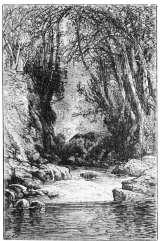
A GLIMPSE OF THE POOL.
From the Flume House I looked up through the deep cleft of the Notch—an impressive vista. To the left is Cannon, or Profile Mountain; to the right the beetling crags of Eagle Cliff; then the pointed, shapely peaks of Lafayette; and so the range continues breaking off and off, bending away into lesser mountains that finally melt into pale-blue shadows. Now a stray cloud atop a peak gives it a volcanic character. Now a puff scatters it like thistle-down. It is a sultry summer’s morning, and banks of film hang like huge spider’s-webs in the tree-tops. Soon they detach themselves, and, floating lazily upward, are seized by a truant breeze, spun mischievously round, and then settle quietly down on the highest peaks like young eaglets on their nest.
Let us first walk down to the Pool. This Pool is a caprice of the river. Imagine a cistern, deeply sunk in granite, receiving at one end a weary cascade, which seems to crave a moment’s rest before hurrying on down the rocky pass. In the mystery and seclusion of ages, and with only the rude implements picked up by the way, the river has hollowed a basin a hundred feet wide and forty deep out of the stubborn rock. Without doubt Nature thus first taught us to cut the hardest marble with sand and water. Cliffs traversed by cracks rise a hundred feet higher. The water is a glossy and lustrous sea-green, and of such marvellous transparency that you see the brilliant pebbles sparkling at the bottom, shifting with the waves of light like bits of glass in a kaleidoscope. Overtopping trees lean timidly over and peer down into the Pool, which coldly repulses their shadows. Only the colorless hue of the rocks is reflected; and the stranger, seeing an old man with a gray beard standing erect in a boat, has no other idea than that he has arrived on the borders and is to be accosted by the ferryman of Hades.
The Flume is reached by going down the road a short distance, and then diverging to the left and crossing the river to the Flume Brook. A carriage-way conducts almost to the entrance of the gorge. Then begins an easy and interesting promenade up the bed of the brook.
This is a remarkable rock-gallery, driven several hundred feet into the heart of the mountain, through which an ice-cold brook rushes. The miracle of Moses seems repeated here sublimely. Some unknown power smote the rock, and the prisoned stream gushed forth free and lightsome as air. You approach it over broad ledges of freckled granite, polished by the constant flow of a thin, pellucid sheet of water to slippery smoothness. Proceeding a short distance up this natural esplanade, you enter a damp and gloomy fissure between perpendicular walls, rising seventy feet above the stream, and, on lifting your eyes suddenly, espy an enormous bowlder tightly wedged between the cliffs. Now try to imagine a force capable of grasping the solid rock and dividing it in halves as easily as you would an apple with your two hands.
THE FLUME, FRANCONIA NOTCH.
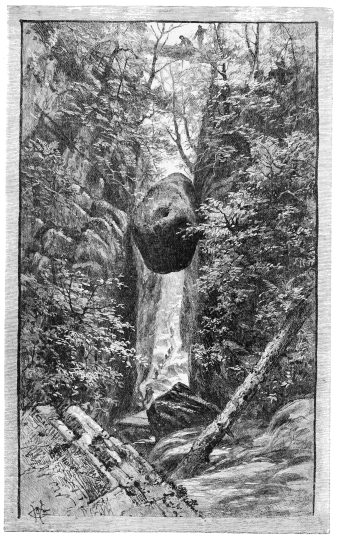
At sight of the suspended bowlder, which seems, like Paul Pry, to have “just dropped in,” I believe every visitor has his moment of hesitation, which he usually ends by passing underneath, paying as he goes with a tremor of the nerves, more or less, for his temerity. But there is no danger. It is seen that the deep crevice, into which the rock seems jammed with the especial purpose of holding it asunder, also hugs the intruder like a vise; so closely, indeed, that, according to every appearance, it must stay where it is until doomsday, unless released by some passing earthquake from its imprisonment. Sentimental tourists do not omit to find a moral in this curiosity, which really looks to be on the eve of dropping, with a loud splash, into the torrent beneath. On top of the cliffs I picked up a visiting-card, on which some one with a poetic turn had written, “Does not this bowlder remind you of the sword of Damocles?” To a civil question, civil reply: No; to me it looks like a nut in a cracker.
Over the gorge bends an arcade of interlaced foliage shot through and through with sunshine; and wherever cleft or cranny can be found young birches, sword-ferns, trailing vines, insinuating their long roots in the damp mould, garland the cold granite with tenderest green. The exquisite white anemone blooms in the mossy wall wet with tiny streams that do not run but glide unperceived down. What could be more cunning than the persistency with which these hardy waifs, clinging or drooping along the craggy way, draw their sustenance from the rock, which seems to nourish them in spite of itself? Underneath your feet the swollen torrent storms along the gorge, dashing itself recklessly against intruding bowlders, or else passing them with a curl of disdain. How gallantly it surmounts every obstacle in its way! How crystal-clear are its waters! On it speeds, scattering pearls and diamonds right and left, like the prodigal it is; unpolluted, as yet, by the filth of cities, or turned into a languid, broken-spirited drudge by dams or mill-wheels. “Stop me?” it seems exclaiming. “Why, I am offspring of the clouds, their messenger to the parched earth, the mountain maid-of-all-work! Stay; step aside here in the sun and I will show you my rainbow-signet! When I rest, do you not behold the mother imaged in the features of the child? Stop me! Put your hand in my bosom and see how strong and full of life are my pulse-beats. To-morrow I shall be vapor. Thought is not freer. I do not belong to earth any more than the eagle sailing above yonder mountain-top.”
Overhead a fallen tree-trunk makes a crazy bridge from cliff to cliff. The sight of the gorge, with the flood foaming far below, the glitter of falling waters through the trees, the splendid light in the midst of deepest gloom, the solemn pines—the odorous forest, the wildness and the coolness—impart an indescribable charm to the spot that makes us reluctant to leave it. Many ladies ascend to the head of the gorge and, crossing on the rude bridge, leave their visiting-cards on the other side; one had left her pocket-handkerchief, with the scent fresh upon it. I picked it up, and out hopped a toad.
After the Pool and the Flume, an ascent of the mountain behind the hotel will be found conducive to enjoyment of another kind. This mountain commands delicious views of the valley of the Pemigewasset. A short hour is usually sufficient for the climb. It was a very raw, windy morning on which I climbed it, but the uncommon purity of the air and the exceeding beauty of the landscape were most rarely combined with cloud effects seen only in conjunction with a brisk north-west wind. I had taken a station similar to that occupied by Mount Willard with respect to the Saco Valley, now opening a vista essentially different from that most memorable one in my mountain experience. The valley is not the same. You see the undulating course of the river for many leagues, and but for an intercepting hill, which hides them, might distinguish the houses of Plymouth. The vales of Woodstock, Thornton, and Campton, spotted with white houses, lie outspread in the sun, between enclosing mountains; and the windings of the Pemigewasset are now seen dark and glossy, now white with foam, appearing, disappearing, and finally lost to view in the blended distance. The sky was packed with clouds. Over the vivid green of the intervales their black shadows drifted swiftly and noiselessly, first turning the light on, then off again, with magical effect. To look up and see these clouds all in motion, and then, looking down, see those weird draperies darkly trailing over the land, was a reminiscence of
“The dim and shadowy armies of our unquiet dreams— Their footsteps brush the dewy fern and paint the shaded streams.”
The mountain ridges flowed southward with marvellous smoothness to the vanishing-point, on one side of the valley bright green, on the other indigo blue. This picture was not startling, like that from the Crawford Notch, but, in its own way, was incomparable. The sunsets are said to be beautiful beyond description.
One looks up the Notch upon the great central peaks composing the water-shed—Cannon, Lafayette, Lincoln, and the rest—to see crags, ridges, black forests, rising before him in all their gloomy magnificence.
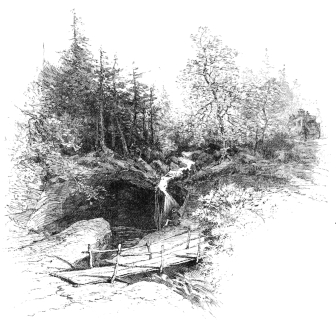
THE BASIN.
On one side all is beauty, harmony, and grace; on the other, a packed mass of bristling, steep-sided mountains seem storming the sky with their gray turrets. Could we but look over the brawny shoulders of the mountains opposite to us, the eye would take in the vast, untrodden solitudes of the Pemigewasset forests cut by the East Branch and presided over by Mount Carrigain—a region as yet reserved for those restless and adventurous spirits whom the beaten paths of travel have ceased to charm or attract. But an excursion into this “forest primeval” is to be no holiday promenade. It is an arduous and difficult march over slippery rocks, through tangled thickets, or up the beds of mountain torrents. Hard fare and a harder bed of boughs finish the day, every hour of which has been a continued combat with fresh obstacles. At this price one may venture to encounter the virgin wilderness or, as the cant phrase is, “try roughing it.” It is a curious feeling to turn your back upon the last cart-path, then upon the last foot-path; to hear the distant baying of a hound grow fainter and fainter—in a word, to exchange at a single step the sights and sounds of civilized life, the movement, the bustle, for a silence broken only by the hum of bees and the murmur of invisible waters.
I left the Flume House in company with a young-old man, whom I met there, and in whom I hoped to find another and a surer pair of eyes, for, were he to have as many as Argus, the sight-seer would find employment for them all.
While gayly threading the green-wood, we came upon a miniature edition of the Pool, situated close to the highway, called the Basin. A basin in fact it is, and a bath fit for the gods. It is plain to see that the stream once poured over the smooth ledges here, instead of making its exit by the present channel. A cascade falls into it with hollow roar. This cistern has been worn by the rotary motion of large pebbles which the little cascade, pouring down into it from above, set and kept actively whirling and grinding at its own mad caprice. But this was not the work of a day. Long and constant attrition only could have scooped this cavity out of the granite, which is here so clean, smooth, and white, and filled to the brim with a grayish-emerald water, light, limpid, and incessantly replenished by the effervescent cascade. In the beginning this was doubtless an insignificant crevice, into which a few pebbles and a handful of sand were dropped by the stream, but which, having no way of escape, were kept in a perpetual tread-mill, until what was at first a mere hole became as we now see it. The really curious feature of the stone basin is a strip of granite projecting into it which closely resembles a human leg and foot, luxuriously cooling itself in the stream. Such queer freaks of nature are not merely curious, but they while away the hours so agreeably that time and distance are forgotten.
As we walked on, the hills were constantly hemming us in closer and closer. Suddenly we entered a sort of crater, with high mountains all around. One impulse caused us to halt and look about us. In full view at our left the inaccessible precipices of Mount Cannon rose above a mountain of shattered stones, which ages upon ages of battering have torn piecemeal from it. Its base was heaped high with these ruins. Seldom has it fallen to my lot to see anything so grandly typical of the indomitable as this sorely battered and disfigured mountain citadel, which nevertheless lifts and will still lift its unconquerable battlements so long as one stone remains upon another. Hewed and hacked, riven and torn, gashed and defaced in countless battles, one can hardly repress an emotion of pity as well as of admiration. I do not recollect, in all these mountains, another such striking example of the denuding forces with which they are perpetually at war. When we see mountains crumbling before our very eyes, may we not begin to doubt the stability of things that we are pleased to call eternal? Still, although it seems erected solely for the pastime of all the powers of destruction, this one, so glorious in its unconquerable resolve to die at its post—this one, exposing its naked breast to the fury of its deadliest foes—so stern and terrific of aspect, so high and haughty, so dauntlessly throwing down the gauntlet to Fate itself—assures us that the combat will be long and obstinate, and that the mountain will fall at last, if fall it must, with the grace and heroism of a gladiator in the Roman arena. The gale flies at it with a shriek of impotent rage. Winter strips off its broidered tunic and flings white dust in its aged face. Rust corrodes, rains drench, fires scorch it; lightning and frost are forever searching out the weak spots in its harness; but, still uplifting its adamantine crest, it receives unshaken the stroke or the blast, spurns the lightning, mocks the thunder, and stands fast. Underneath is a little lake, which at sunset resembles a pool of blood that has trickled drop by drop from the deep wounds in the side of the mountain.
We are still advancing in this region of wonders. In our front soars an insuperable mass of forest-shagged rock. Behind it rises the absolutely regal Lafayette. Our footsteps are stayed by the glimmer of water through trees by the road-side. We have reached the summit of the pass.
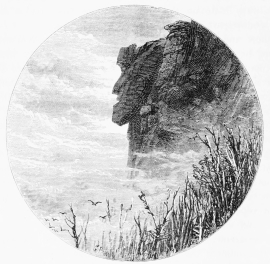
Six miles of continued ascent from the Flume House have brought us to Profile Lake, which the road skirts. Although a pretty enough piece of water, it is not for itself this lake is resorted to by its thousands, or for being the source of the Pemigewasset, or for its trout—which you take for the reflection of birds on its burnished surface—but for the mountain rising high above, whose wooded slopes it so faithfully mirrors. Now lift the eyes to the bare summit! It is difficult to believe the evidence of the senses! Upon the high cliffs of this mountain is the remarkable and celebrated natural rock sculpture of a human head, which, from a height twelve hundred feet above the lake, has for uncounted ages looked with the same stony stare down the pass upon the windings of the river through its incomparable valley. The profile itself measures about forty feet from the tip of the chin to the flattened crown which imparts to it such a peculiarly antique appearance. All is perfect, except that the forehead is concealed by something like the visor of a helmet. And all this illusion is produced by several projecting crags. It might be said to have been begotten by a thunder-bolt.
Taking a seat within a rustic arbor on the high shore of the lake, one is at liberty to peruse at leisure what, I dare say, is the most extraordinary sight of a lifetime. A change of position varies more or less the character of the expression, which is, after all, the marked peculiarity of this monstrous alto relievo; for let the spectator turn his gaze vacantly upon the more familiar objects at hand—as he inevitably will, to assure himself that he is not the victim of some strange hallucination—a fascination born neither of admiration nor horror, but strongly partaking of both emotions, draws him irresistibly back to the Dantesque head stuck, like a felon’s, on the highest battlements of the pass. The more you may have seen, the more your feelings are disciplined, the greater the confusion of ideas. The moment is come to acknowledge yourself vanquished. This is not merely a face, it is a portrait. That is not the work of some cunning chisel, but a cast from a living head. You feel and will always maintain that those features have had a living and breathing counterpart. Nothing more, nothing less.
But where and what was the original prototype? Not man; since, ages before he was created, the chisel of the Almighty wrought this sculpture upon the rock above us. No, not man; the face is too majestic, too nobly grand, for anything of mortal mould. One of the antique gods may, perhaps, have sat for this archetype of the coming man. And yet not man, we think, for the head will surely hold the same strange converse with futurity when man shall have vanished from the face of the earth.
This gigantic silhouette, which has been dubbed the Old Man of the Mountain, is unquestionably the greatest curiosity of this or any other mountain region. It is unique. But it is not merely curious; nor is it more marvellous for the wonderful accuracy of outline than for the almost superhuman expression of frozen terror it eternally fixes on the vague and shadowy distance—a far-away look; an intense and speechless amazement, such as sometimes settles on the faces of the dying at the moment the soul leaves the body forever—untranslatable into words, but seeming to declare the presence of some unutterable vision, too bright and dazzling for mortal eyes to behold. The face puts the whole world behind it. It does everything but speak—nay, you are ready to swear that it is going to speak! And so this chance jumbling together of a few stones has produced a sculpture before which Art hangs her head.
I renounce in dismay the idea of reproducing the effect on the reader’s mind which this prodigy produced on my own. Impressions more pronounced, yet at the same time more inexplicable, have never so effectually overcome that habitual self-command derived from many experiences of travel among strange and unaccustomed scenes. From the moment the startled eye catches it one is aware of a Presence which dominates the spirit, first with strange fear, then by that natural revulsion which at such moments makes the imagination supreme, conducts straight to the supernatural, there to leave it helplessly struggling in a maze of impotent conjecture. But, even upon this debatable ground, between two worlds, one is not able to surprise the secret of those lips of marble. The Sphinx overcomes us by his stony, his disdainful silence. Let the visitor be ever so unimpassioned, surely he must be more than mortal to resist the impression of mingled awe, wonder, and admiration which a first sight of this weird object forces upon him. He is, indeed, less than human if the feeling does not continually grow and deepen while he looks. The face is so amazing, that I have often tried to imagine the sensations of him who first discovered it peering from the top of the mountain with such absorbed, open-mouthed wonder. Again I see the tired Indian hunter, pausing to slake his thirst by the lake-side, start as his gaze suddenly encounters this terrific apparition. I fancy the half-uttered exclamation sticking in his throat. I behold him standing there with bated breath, not daring to stir hand or foot, his white lips parted, his scared eyes dilated, until his own swarthy features exactly reflect that unearthly, that intense amazement stamped large and vivid upon the livid rock. There he remains, rooted to the spot, unable to reason, trembling in every limb. For him there are no accidents of nature; for him everything has its design. His moment of terrible suspense is hardly difficult to understand, seeing how careless thousands that come and go are thrilled, and awed, and silenced, notwithstanding you tell them the face is nothing but rocks.
THE OLD MAN OF THE MOUNTAIN.
If the effect upon minds of the common order be so pronounced, a first sight of the Great Stone Face may easily be supposed to act powerfully upon the imaginative and impressible. The novelist, Hawthorne, makes it the interpreter of a noble life. For him the Titanic countenance is radiant with majestic benignity. He endows it with a soul, surrounds the colossal brow with the halo of a spiritual grandeur, and, marshalling his train of phantoms, proceeds to pass inexorable judgment upon them. Another legend—like its predecessor, too long for our pages—runs to the effect that a painter who had resolved to paint Christ sitting in judgment, and who was filled with the grandeur of his subject, wandered up and down the great art palaces, the cathedrals of the Old World, seeking in vain a model which should in all things be the embodiment of his ideal. In despair at the futility of his search he hears a strange report, brought by some pious missionaries from the New World, of a wonderful image of the human face which the Indians looked upon with sacred veneration. The painter immediately crossed the sea, and caused himself to be guided to the spot, where he beheld, in the profile of the great White Mountains, the object of his search and fulfilment of his dream. The legend is entitled Christus Judex.
Had Byron visited this place of awe and mystery, his “Manfred,” the scene of which is laid among the mountains of the Bernese Alps, would doubtless have had a deeper and perhaps gloomier impulse; but even among the eternal realms of ice the poet never beheld an object that could so arouse the gloomy exaltation he has breathed into that tragedy. His line—
“Bound to earth, he lifts his eye to heaven”—
becomes descriptive here.
Again and again we turn to the face. We go away to wonder if it is still there. We come back to wonder still more. An emotion of pity mingles with the rest. Time seems to have passed it by. It seems undergoing some terrible sentence. It is a greater riddle than the gigantic stone face on the banks of the Nile.
All effects of light and shadow are so many changes of countenance or of expression. I have seen the face cut sharp and clear as an antique cameo upon the morning sky. I have seen it suffused, nay, almost transfigured, in the sunset glow. Often and often does a cloud rest upon its brow. I have seen it start fitfully out of the flying scud to be the next moment smothered in clouds. I have heard the thunder roll from its lips of stone. I recall the sunken cheeks, wet with the damps of its night-long vigil, glistening in the morning sunshine—smiling through tears. I remember its emaciated visage streaked and crossed with wrinkles that the snow had put there in a night; but never have I seen it insipid or commonplace. On the contrary, the overhanging brow, the antique nose, the protruding under-lip, the massive chin, might belong to another Prometheus chained to the rock, but whom no punishment could make lower his haughty head.
I lingered by the margin of the lake watching the play of the clouds upon the water, until a loud and resonant peal, followed by large, warm drops, admonished me to seek the nearest shelter. And what thunder! The hills rocked. What echoes! The mountains seemed knocking their stony heads together. What lightning! The very heavens cracked with the flashes.
“Far along From peak to peak the rattling crags among Leaps the live thunder! not from one lone cloud, But every mountain now hath found a tongue, And Jura answers, through her misty shroud, Back to the joyous Alps, who call to her aloud!”
III. THE KING OF FRANCONIA.
Hills draw like heaven And stronger, sometimes, holding out their hands To pull you from the vile flats up to them. E. B. Browning.
AT noon we reached the spacious and inviting Profile House, which is hid away in a deep and narrow glen, nearly two thousand feet above the sea. No situation could be more sequestered or more charming. The place seems stolen from the unkempt wilderness that shuts it in. An oval, grassy plain, not extensive, but bright and smiling, spreads its green between a grisly precipice and a shaggy mountain. And there, if you-will believe me, in front of the long, white-columned hotel, like a Turkish rug on a carpet, was a pretty flower-garden. Like those flowers on the lawn were beauties sauntering up and down in exquisite morning toilets, coquetting with their bright-colored parasols, and now and then glancing up at the grim old mountains with that air of elegant disdain which is so redoubtable a weapon—even in the mountains. Little children fluttered about the grass like beautiful butterflies, and as unmindful of the terrors that hovered over them so threateningly. Nurses in their stiff grenadier caps and white aprons, lackeys in livery, cadets in uniform, elegant equipages, blooded horses, dainty shapes on horseback, cavaliers, and last, but not least, the resolute pedestrian, or the gentlemen strollers up and down the shaded avenues, made up a scene as animated as attractive. There is tonic in the air: there is healing in the balm of these groves. Even the horses step out more briskly. Peals of laughter startle the solemn old woods. You hear them high up the mountain side. There go a pair of lovers, the gentleman with his book, whose most telling passages he has carefully conned, the lady with her embroidery, over which she bends lower as he reads on. Ah, happy days! What is this youth, which, having it, we are so eager to escape, and, when it is gone, we look back upon with such longing?
EAGLE CLIFF AND THE ECHO HOUSE.
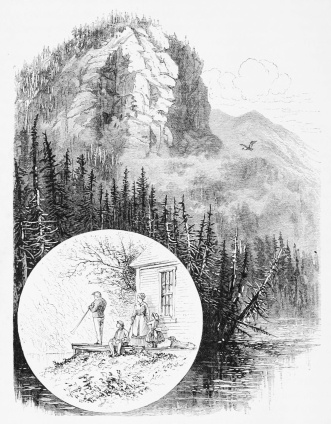
The lofty crag opposite the hotel is Eagle Cliff, a name at once legitimate and satisfying, although it is now untenanted by the eagles which formerly made their home in the security of its precipitous rocks. The cliff is also seen to great advantage from Echo Lake, half a mile farther on, of which it constitutes a striking feature. In simple parlance it is an advanced spur of Mount Lafayette. The high and curving wall of this cliff encloses on one side the Profile Glen, while Mount Cannon forms the other. The precipices tower so far above the glen that large trees look like shrubs. Behind Eagle Cliff, almost isolating it from the mountain, of which it is the barbacan, a hideous ravine yawns upon the pass. Here and there, among the thick-set evergreen trees, beech and birch and maple, spread masses of rich green, and mottle it with softness. The purple rock bulges daringly out, forming a parapet of adamant.
The turf underneath the cliff was most beautifully and profusely spangled with the delicate pink anemone, the fleur des fées, that pale darling of our New England woods, to which the arbutus resigns the sceptre of spring. It is a moving sight to see these little drooping flowers, so shy and modest, yet so meek and trustful, growing at the foot of a bare and sterile rock. The face hardened looking up; grew soft looking down. “Don’t tread on us!” “May not a flower look up at a mountain?” they seem to plead. Lightly fall the dews upon your upturned faces, dear little flowers! Soft be the sunshine and gentle the winds that kiss those sky-tinted cheeks! In thy sweet purity and innocence I see faces that are beneath the sod, flowers that have blossomed in Paradise.
We see also, from the hotel, the singular rock that occasioned the change of name from Profile to Cannon Mountain. It nearly resembles a piece of heavy ordnance protruding, threateningly, from the parapet of a fortress.
Taking one of the well-worn paths conducting to the water-side, a few minutes’ walk brings us to the shore of Echo Lake, with Eagle Cliff now rising grandly on our right. Nowhere among the White Hills is there a fuller realization of a mountain lake than this. Light flaws frost it with silver. Sharp keels cut it as diamonds cut glass. The water is so transparent that you see fishes swimming or floating indolently about.
ECHO LAKE.
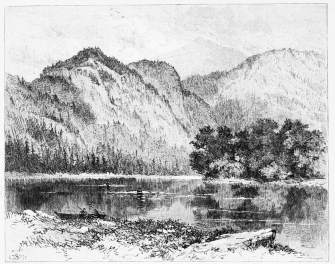
Echo Lake is somewhat larger than Profile Lake, and is only a step from the road. Its sources are in the hundred streams that descend the surrounding mountains, and its waters are discharged by the valley, lying between us and the heights of Bethlehem, into the Ammonoosuc. Therefore, in coming from one lake to the other we have crossed the summit of the pass. On one side the waters flow to the Merrimac, on the other to the Connecticut. An idle fancy tempted me to bring a cup of water from Profile and cast it into Echo Lake, forgetting that, although divided in their lives, the twin lakes had yet a common destiny in the abyss of the ocean. I found the outlook from the boat-house on the whole the most satisfying, because one looks back directly through the deep chasm of the Notch.
In this beautiful little mountain-tarn the true artist finds his ideal. The snowy peak of Lafayette looked down into it with a freezing stare. Cannon Mountain now showed his retreating wall on the right. The huge, castellated rampart of Eagle Cliff lifted on its borders precipices dripping with moisture, and glistening in the sun like casements. Except for the lake, the whole aspect would be irredeemably savage and forbidding—a blind landscape; but when the sun sinks behind the long ridge of Mount Cannon, purpling all these grisly crags, and the cloaked shadows, groping their way foot by foot up the ravines, seem spectres risen from the depths of the lake, you see, underneath the cliffs, long and slender spears of golden light thrust deep into its black and glossy tide, crimsoning it as with its own life-blood. Then, too, is the proper moment for surprising these vain old mountains viewing themselves in their mountain mirror, in which the bald, the wrinkled, and the decrepit appear young, vigorous, and gloriously fair; to see them gloating over their swarthy features like the bandit in “Fra Diavolo.” Their ragged mantles are changed to gaudy cashmeres, picturesquely twisted about their brawny shoulders, their snows to laces. Oh the pomp, the majesty of these sunsets, which so glorify the upturned faces of the haggard cliffs; which transmute, as in the miracle, water into wine; which instantly transform these rugged mountain walls into gates of jasper, and ruby, and onyx—glowing, effulgent, enrapturing! And then, after the sun drops wearily down the west, that gauze-like vapor, spun from the breath of evening, rising like incense from the surface of the lake, which the mountains put on for the masque of night; and, finally, the inquisitive stars piercing the lake with ice-cold gleams, or the full-moon breaking in one great burst of splendor on its level surface!
The echo adds its feats of ventriloquism. The marvel of the phonograph is but a mimicry of Nature, the universal teacher. Now the man blows a strong, clear blast upon a long Alpine horn, and, like a bugle-call flying from camp to camp, the martial signal is repeated, not once, but again and again, in waves of bewitching sweetness and with the exquisite modulations of the wood-thrush’s note. From covert to covert, now here, now there, it chants its rapturous melody. Once again it glides upon the entranced ear, and still we lean in breathless eagerness to catch the last faint cadence sighing itself away upon the palpitating air. A cannon was then fired. The report and echo came with the flash. In a moment more a deep and hollow rumbling sound, as if the mountains were splitting their huge sides with suppressed laughter, startled us.
The ascent of Mount Lafayette fittingly crowns the series of excursions through which we have passed since leaving Plymouth. This mountain dominates the valleys north and south with undisputed sway. It is the King of Franconia.
At seven in the morning I crossed the little clearing, and, turning into the path leading to the summit, found myself at the beginning of a steep ascent. It was one of the last and fairest days of that bright season which made the poet exclaim,
“And what is so fair as a day in June?”
The thunder-storm of the previous afternoon, which continued its furious cannonade at intervals throughout the night, had purified the air and given promise of a day favorable for the ascension. No clouds were upon the mountains. Everything betokened a pacific disposition.
MOUNT CANNON, FROM THE BRIDLE-PATH, LAFAYETTE.
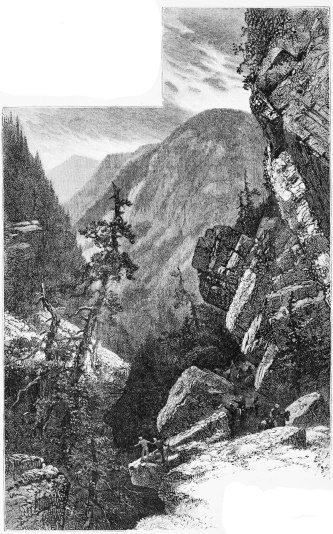
The path at once attacks the south side of Eagle Cliff. A short way up, openings afford fine views of Mount Cannon and its weird profile, of the valley below, and of the glen we have just left. The stupendous mass of Eagle Cliff, suspended a thousand feet over your head, accelerates the pace.
After an hour of steady, but not rapid, climbing, the path turned abruptly under the shattered, but still formidable, precipices of the cliff, which rose some distance higher, skirted it awhile, and then began to zigzag among huge rocks along the narrow ridge uniting the cliff with the mass of the mountain. Two deep ravines fall away on either side. For two or three hundred yards, from the time the shoulder of the cliff is turned until the mountain itself is reached, the walk is as romantic an episode of mountain climbing as any I can recall, except the narrow gully of Chocorua. But this passage presents no such difficulties as must be overcome there. Although heaped with rocks, the way is easy, and is quite level. In one place, where it glides between two prodigious masses of rock dislodged from the cliff, it is so narrow as to admit only a single person at a time. When I turned to look back down the black ravine, cutting into the south side of the mountain, my eye met nothing but immense rocks stopped in their descent on the very edge of the gulf. It is among these that a way has been found for the path, which was to me a reminiscence of the high defiles of the Isthmus of Darien; to complete the illusion, nothing was now wanting except the tinkling bells of the mules and the song of the muleteer. I climbed upon one of the high rocks, and gazed to my full content upon the granite parapet of Mount Cannon.
In a few rods more the path encountered the great ravine opening into the valley of Gale River. Through its wide trough brilliant strips of this valley gleamed out far below. The village of Franconia and the heights of Lisbon and Bethlehem now appeared on this side.
I think that the perception of a distance climbed is greater to one who is looking down from a great height than to one looking up. Doubtless the imagination, which associates the plunging lines of a deep gorge with the horror of a fall, has much to do with this impression. Upon crossing a bridge of logs, the peak of Lafayette leaped up; yet so distant as to promise no easy conquest. Somewhere down the gorge I heard the roar of a brook; then the report of the cannon at Echo Lake; but up here there was no echo.
The usual indications now assured me that I was nearing the top. In three-quarters of an hour from the time of leaving the natural bridge, joining Eagle Cliff with the mountain, I stood upon the first of the great billows which, rolling in to a common centre, appear to have forced the true summit a thousand feet higher.
The first, perhaps the most curious, thing that I noticed—for one hardly suspects the existence of considerable bodies of water in these high regions, and, therefore, never comes upon them except unawares—was two little lakelets, nestling in the hollow between me and the main peak. Reposing amid the sterility of the high peaks, these lakes surround themselves with such plants as have survived the ascent from below, or, nourished by the snows of the summit, those that never do descend into temperate climates. Thus an appearance of fertility—one of those deceptions that we welcome, knowing it to be such—greets us unexpectedly. But its appearance is weird and forbidding. Here the extremes of arctic and temperate vegetation meet and embrace; here the flowers of the valley annually visit their pale sisters, banished by Nature to these Siberian solitudes; and here the rough, strong Alpine grass, striking its roots deep among the atoms of sand, granite, or flint, lives almost in defiance of Nature herself; and when the snows come and the freezing north winds blow, and it can no longer stand erect, throws itself upon the tender plants, like a brave soldier expiring on the body of his helpless comrade, saved by his own devotion.
But these Alpine lakes always provoke a smile. When some distance beyond the Eagle Lakes, as they are called, and higher, I caught, underneath a wooded ridge of Cannon, the sparkle of one hidden among the summits on the opposite side of the Notch. The immense, solitary Kinsman Mountain overtops Cannon as easily as Cannon does Eagle Cliff. In its dark setting of the thickest and blackest forests this lake blazed like one of the enormous diamonds which our forefathers so firmly believed existed among these mountains. They call this water—only to be discovered by getting above it—Lonesome Lake, and in summer it is the chosen retreat of one well known to American literature, whom the mountains know, and who knows them.
I descended the slope to the plateau on which the lakes lie, soon gaining the rush-grown shore of the nearest. Its water was hardly drinkable, but your thirsty climber is not apt to be too fastidious. These lakes are prettier from a distance; the spongy and yielding moss, the sickly yellow sedge surrounding them, and the rusty brown of the brackish water, do not invite us to tarry long.
CLOUD EFFECTS ON MOUNT LAFAYETTE.
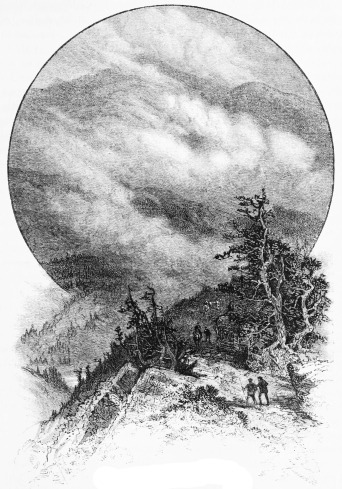
The ascent of the pinnacle now began. It is too much a repetition, though by no means as toilsome, of the Mount Washington climb to merit particular description. This peak, too, seems disinherited by Nature. The last trees encountered are the stunted firs with distorted little trunks, which it may have required half a century to grow as thick as the wrist. I left the region of Alpine trees to enter that of gray rocks, constantly increasing in size toward the summit, where they were confusedly piled in ragged ridges, one upon another, looming large and threateningly in the distance. But as often as I stopped to breathe I scanned “the landscape o’er” with all the delight of a wholly new experience. The fascination of being on a mountain-top has yet to be explained. Perhaps, after all, it is not susceptible of analysis.
After gaining the highest visible point, to find the real summit still beyond, I stopped to drink at a delicious spring trickling from underneath a large rock, around which the track wound. I was now among the ruin and demolition of the summit, standing in the midst of a vast atmospheric ocean.
Had I staked all my hopes upon the distant view, no choice but disappointment was mine to accept. Steeped in the softest, dreamiest azure that ever dull earth borrowed from bright heaven, a hundred peaks lifted their airy turrets on high. These castles of the air—for I will maintain that they were nothing else—loomed with enchanting grace, the nearest like battlements of turquoise and amethyst, or, receding through infinite gradations to the merest shadows, seemed but the dusky reflection of those less remote. The air was full of illusions. There was bright sunshine, yet only a deluge of semi-opaque golden vapor. There were forms without substance. See those iron-ribbed, deep-chested mountains! I declare it seemed as if a swallow might fly through them with ease! Over the great Twin chain were traced, apparently on the air itself, some humid outlines of surpassing grace which I recognized for the great White Mountains. It was a dream of the great poetic past: of the golden age of Milton and of Dante. The mountains seemed dissolving and floating away before my eyes.
Stretched beneath the huge land-billows, the valleys—north, south, or west—reflected the fervid sunshine with softened brilliance, and all those white farms and hamlets spotting them looked like flakes of foam in the hollows of an immense ocean.
Heaven forbid that I should profane such a scene with the dry recital of this view or that! I did not even think of it. A study of one of Nature’s most capricious moods interested me far more than a study of topography. How should I know that what I saw were mountains, when the earth itself was not clearly distinguishable? Alone, surrounded by all these delusions, I had, indeed, a support for my feet, but none whatever for the bewildered senses.
I found the mountain-top untenanted except by horse-flies, black gnats, and active little black spiders. These swarmed upon the rocks. I also found buttercups, the mountain-cranberry, and a heath, bearing a little white flower, blossoming near the summit. There were the four walls of a ruined building, a cairn, and a signal-staff to show that some one had been before me. This staff is 5259 feet above the ocean, or 3245 feet above the summit of the Franconia Pass.
The ascent required about three, and the descent about two hours. The distance is not much less than four miles; but, these miles being a nearly uninterrupted climb from the base to the summit of the mountain, haste is out of the question, if going up, and imprudent, if coming down. There are no breakneck or dangerous places on the route; nor any where the traveller is liable to lose his way, even in a fog, except on the first summit, where the new and old paths meet, and where a guide-board should be erected.
IV. FRANCONIA, AND THE NEIGHBORHOOD.
Believe if thou wilt that mountains change their places, but believe not that men change their dispositions.—Oriental Proverb.
ALTHOUGH one may make the journey from the Profile House to Bethlehem with greater ease and rapidity by the railway recently constructed along the side of the Franconia range, preference will unquestionably be given to the old way by all who would not lose some of the most striking views the neighborhood affords. Beginning near the hotel, the railway skirts the shore of Echo Lake, and then plunges into a forest it was the first to invade. By a descent of one hundred feet to the mile, for nine and a half miles, it reaches the Ammonoosuc at Bethlehem station. I have nothing to say against the locomotive, but then I should not like to go through the gallery of the Louvre behind one.
FRANCONIA IRON WORKS AND NOTCH.
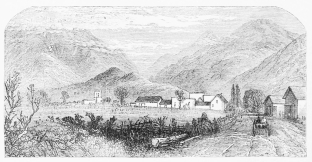
From Echo Lake the high-road to Franconia, Littleton, and Bethlehem winds down the steep mountain side into the valley of Gale River. To the left, in the middle distance, appear the little church-tower and white buildings constituting the village of Franconia Iron Works. This village is charmingly placed for effectively commanding a survey of the amphitheatre of mountains which isolates it from the neighboring towns and settlements.
As we come down the three-mile descent, from the summit of the pass to the level of the deep valley, and to the northern base of the notch-mountains, an eminence rises to the left. Half-way up, occupying a well-chosen site, there is a hotel, and on the high ridge another commands not only this valley, but also those lying to the west of it. On the opposite side to us rise the green heights of Bethlehem, Mount Agassiz being conspicuous by the observatory on its summit. Those farm-houses dotting the hill-side show how the road crooks and turns to get to the top. Following these heights westward, a deep rift indicates the course of the stream dividing the valley, and of the highway to Littleton. Between these walls the long ellipse of fertile land beckons us to descend.
I am always most partial to those grassy lanes and by-ways going no one knows where, especially if they have well-sweeps and elm-trees in them; but here also is the old red farm-house, with its antiquated sweep, its colony of arching elms, its wild-rose clustering above the porch, its embodiment of those magical words, “Home, sweet home.” It fits the rugged landscape as no other habitation can. It fits it to a T, as we say in New England. More than this, it unites us with another and different generation. What a story of toil, privation, endurance these old walls could tell! How genuine the surprise with which they look down upon the more modern houses of the village! Here, too, is the Virginia fence, on which the king of the barn-yard defiantly perches. There is the field behind it, and the men scattering seed in the fallow earth. Yonder, in the mowing-ground, a laborer is sharpening his scythe, the steel ringing musically under the quick strokes of his “rifle.”
Over there, to the left, is the rustic bridge, and hard by a clump of peeled birches throw their grateful shade over the hot road. Many stop here, for the white-columned trunks are carved with initials, some freshly cut, some mere scars. But why mutilate the tree? What signify those letters, that every idler should gratify his little vanity by giving it a stab? Do you know that the birch does not renew its bark, and that the tree thus stripped of its natural protection is doomed? Cease, then, I pray you, this senseless mutilation; nor call down the just malediction of the future traveller for destroying his shade. Unable to escape its fate, the poor tree, like a victim at the stake, stoically receives your barbarous strokes and gashes. Refrain, then, traveller, for pity’s sake! Have a little mercy! Know that the ancients believed the tree possessed of a soul. Remember the touching story of Adonis, barbarously wounded, surviving in a pine, where he weeps eternally. Consider how often is the figure of “The Tree” used in the Scriptures as emblematic of the life eternal! Who would wish to inhabit a treeless heaven?
The stream—which does not allow us to forget that it is here—is a vociferous mountain brook. Hardly less forward is the roadside fountain gushing into a water-trough its refreshing abundance for the tired and dusty wayfarer. It makes no difference in the world whether he goes on two legs or on four. “Drink and be filled” is the invitation thus generously held out to all alike. With what a sigh of pleasure your steaming beast lifts his reluctant and dripping muzzle from the cool wave, and after satisfying again and again his thirst, luxuriously immersing his nose for the third and fourth time, still pretends to drink! How deliciously light and limpid and sparkling is the water, and how sweet! How it cools the hot blood! You quaff nectar. You sip it as you would champagne. It tastes far better, you think, pouring from this half-decayed, moss-crusted spout than from iron, or bronze, or marble. Come, fellow-traveller, a bumper! Fill high! God bless the man who first invented the roadside fountain! He was a true benefactor of his fellow-man.
THE ROADSIDE SPRING.
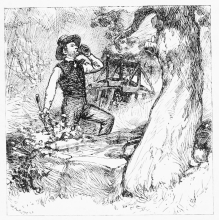
Turn once more to the house. A little girl tosses corn, kernel by kernel, to her pet chickens. There go a flight of pigeons: they curvet and wheel, and settle on the ridge-pole, where they begin to flirt, and strut, and coo. The men in the field look up at the top of the mountain, to see if it is not yet noon. And now a woman, with plump bare arms, coming briskly to the open door, puts the dinner-horn to her lips with one hand while placing the other lightly upon her hip. She does not know that act and attitude are alike inviting. How should she?
Let us follow the pretty stream that is our guide. Franconia has the reputation of being the hottest in summer and in winter the coldest of the mountain villages. It is hot. The houses are strung along the road for a mile. People may or may not live in them: you see nobody. One modest church-tower catches the eye for a moment, and then, as we enter the heart of the village, a square barrack of a building, just across the stream, is pointed out as the old furnace, which in times past gave importance to this out-of-the-way corner. But the old furnace is now deserted except by cows from the neighboring pastures, who come and go through its open doors in search of shade. At present the river, which brings its music and its freshness to the very doors of the villagers, is the only busy thing in the place.
During the Rebellion the furnace was kept busy night and day, turning out iron to be cast into cannon. The very hills were melted down for the defence of the imperilled Union. In the adjoining town of Lisbon the discovery of gold-bearing quartz turned the heads of the usually steady-going population. The precious deposits were first found on the Bailey farm, in 1865, and similar specimens were soon detected on the farms adjoining. It is said the old people could scarcely be made to credit these reports until they had seen and handled the precious metal; for the country had been settled nearly a century, and the presence of any but the baser ores was wholly unsuspected and disbelieved.
There is one peculiarity, common to all these mountain villages, to which I must allude. A stranger is not known by any personal peculiarity, but by his horse. If you ask for such or such a person, the chances are ten to one you will immediately be asked in return if he drove a bay horse, or a black colt, or a brown mare with one white ear; so quick are these lazy-looking men, that loll on the door-steps or spread themselves out over the shop-counters, to observe what interests them most. The girls here know the points of a horse better than most men, and are far more reckless drivers than men. To a man who, like myself, has lived in a horse-stealing country, it does look queerly to see the barn-doors standing open at night. But then every country has its own customs.
One seeks in vain for any scraps of history or tradition that might shed even a momentary lustre upon this village out of the past. Yet its situation invites the belief that it is full of both. Disappointed in this, we at least have an inexhaustible theme in the dark and tranquil mountains bending over us.
Mount Lafayette presents toward Franconia two enormous green billows, rolled apart, the deep hollow between being the great ravine dividing the mountain from base to summit. Over this deep incision, which, from the irregularity of one of its ridges, looks widest at the top, presides, with matchless dignity, the bared and craggy peak whose dusky brown gradually mingles with the scant verdure checked hundreds of feet down. With what hauteur it seems to regard this effort of Nature to place a garland on its bronzed and knotted forehead! One can never get over his admiration for the savage grace with which the mountain, which at first sight seems literally thrown together, develops a beauty, a harmony, and an intelligence giving such absolute superiority to works of Nature over those of man.
The side of Mount Cannon turned toward the village now elevates two almost regular triangular masses, one rising behind the other, and both surmounted by the rounded summit, which, except in its mass, has little resemblance to a mountain. It is seen that on two-thirds of these elevations a new forest has replaced the original growth. Twenty-five years ago a destructive fire raged on this mountain, destroying all the vegetation, as well as the thin soil down to the hard rock. Even that was cracked and peeled like old parchment. This burning mountain was a scene of startling magnificence during several nights, when the village was as light as day, the sky overspread an angry glow, and the river ran blood-red. The hump-backed ridges, connecting Cannon with Kinsman, present nearly the same appearance from this as from the other side of the Notch—or as remarked when approaching from Campton.
The superb picture seen from the upper end of the valley, combining, as it does, the two great chains in a single glance of the eye, is extended and improved by going a mile out of the village to the school-house on the Sugar Hill road. It is a peerless landscape. I have gazed at it for hours with that ineffable delight which baffles all power of expression. It will have no partakers. One must go there alone and see the setting sun paint those vast shapes with colors the heavens alone are capable of producing.
Distinguished by the beautiful groves of maple that adorn its crest, Sugar Hill is destined to grow more and more in the popular esteem. No traveller should pass it by. It is so admirably placed as to command in one magnificent sweep of the eye all the highest mountains; it is also lifted into sun and air by an elevation sufficiently high to reach the cooler upper currents. The days are not so breathless or so stifling as they are down in the valley. You look deep into the Franconia Notch, and watch the evening shadows creep up the great east wall. Extending beyond these nearer mountains, the scarcely inferior Twin summits pose themselves like gigantic athletes. Passing to the other side of the valley, we see as far as the pale peaks of Vermont, and those rising above the valley of Israel’s River. But better than all, grander than all, is that kingly coronet of great mountains set on the lustrous green cushion of the valley. Nowhere, I venture to affirm, will the felicity of the title, “Crown of New England,”[32] receive more unanimous acceptance than from this favored spot. Especially when a canopy of clouds overspreading permits the pointed peaks to reflect the illuminated fires of sunset does the crown seem blazing with jewels and precious stones. All the great summits are visible here, and all the ravines, except those in Madison, are as clearly distinguished as if not more than ten instead of twenty miles separated us.
The high crest of Sugar Hill unfolds an unrivalled panorama. This is but faint praise. Yet I find myself instinctively preferring the landscape from Goodenow’s; for those great horizons, uncovered all at once, like a magnificent banquet, are too much for one pair of eyes, however good, or however unwearied with continued sight-seeing. As we cannot look at all the pictures of a gallery at once, we naturally single out the masterpieces. The effort to digest too much natural scenery is a species of intellectual gluttony the overtaxed brain will be quick to revenge, by an attack of indigestion or a loss of appetite.
I was very fond of walking, in the cool of the evening, either in this direction or to the upper end of the village, on the Bethlehem road. There is one point on this road, before it begins in earnest its ascent of the heights, that became a favorite haunt of mine. Emerging from the concealment of thick woods upon a sandy plain, covered here with a thick carpet of verdure, and skirted by a regiment of pines seemingly awaiting only the word of command to advance into the valley, a landscape second to none that I have seen is before you. At the same time he would be an audacious mortal who attempted to transfer it to page or canvas. Nothing disturbs the exquisite harmony of the scene. To the left of you are all the White Mountains, from Adams to Pleasant; in front, the Franconia range, from Kinsman to the Great Haystack. Here is the deep rent of the Notch from which we have but lately descended. Here, too, overtopped and subjugated by the superb spire of Lafayette, the long and curiously-distorted outline of Eagle Cliff pitches headlong down into the half-open aperture of the pass. Nothing but an earthquake could have made such a breach. How that tremendous, earth-swooping ridge seems battered down by the blows of a huge mace! Unspeakably wild and stern, the fractured mountains are to the valley what a raging tempest is to the serenest of skies: one part of the heavens convulsed by the storm, another all peace and calm. Thus from behind his impregnable outworks Lafayette, stern and defiant, keeps eternal watch and ward over the valley cowering at his feet.
From this spot, too, sacred as yet from all intrusion, the profound ravine, descending nearly from the summit of Lafayette, is fully exposed. It is a thing of cracks, crevices, and rents; of upward curves in brilliant light; of black, mysterious hollows, which the eye investigates inch by inch, to where the gorge is swallowed up by the thick forests underneath. The whole side of the principal peak seems torn away. Up there, among the snows, is the source of a flashing stream which comes roaring down through the gorge. Storms swell it into an ungovernable and raging torrent. Thus under the folds of his mantle the lordly peak carries peace or war for the vale.
After the half-stifled feeling experienced among the great mountains, it is indeed a rare pleasure to once more come forth into full breathing-space, and to inspect at leisure from some friendly shade the grandeur magnified by distance, yet divested of excitements that set the brain whirling by the rapidity of their succession. If the wayfarer chances to see, as I did, the whole noble array of high summits presenting a long, snowy line of unsullied brilliance against a background of pale azure, he will account it one of the crowning enjoyments of his journey.
The Bridal Veil Falls, lying on the northern slope of Mount Kinsman, will, when a good path shall enable tourists to visit them, prove one of the most attractive features of Franconia. Truth compels me to say that I did not once hear them spoken of during the fortnight passed in the village, although fishermen were continually bringing in trout from the Copper-mine Brook, on which these falls are situated. The height of the fall is given at seventy-six feet, and its surroundings are said to be of the most romantic and picturesque character. Its marvellous transparency, which permits the ledges to be seen through the gauze-like sheet falling over them, has given to it its name.
From Franconia I took the daily stage to Littleton, which lies on both banks of the Ammonoosuc, and, turning my back upon the high mountains, ran down the rail to Wells River, having the intention of cultivating a more intimate acquaintance with that most noble and interesting entrance formed by the meeting of the Ammonoosuc with the Connecticut.
V. THE CONNECTICUT OX-BOW.
Say, have the solid rocks Into streams of silver been melted, Flowing over the plains, Spreading to lakes in the fields? Longfellow.
THE Connecticut is justly named “the beautiful river,” and its valley “the garden of New England.” Issuing from the heart of the northern wilderness, it spreads boundless fertility throughout its stately march to the sea. It is not a rapid river, but flows with an even and majestic tide through its long avenue of mountains. Radiant envoy of the skies, its mission is peace on earth and good-will toward men. As it advances the confluent streams flock to it from their mountain homes. On one side the Green Mountains of Vermont send their hundred tributaries to swell its flood; on the other side the White Hills of New Hampshire pour their impetuous torrents into its broad and placid bosom. Two States thus vie with each other in contributing the wealth it lavishes with absolutely impartial hand along the shores of each.
Unlike the storied Rhine, no crumbling ruins crown the lofty heights of this beautiful river. Its verdant hill-sides everywhere display the evidences of thrift and happiness; its only fortresses are the watchful and everlasting peaks that catch the earliest beams of the New England sun and flash the welcome signal from tower to tower. From time to time the mountains, which seem crowding its banks to see it pass, draw back, as if to give the noble river room. It rewards this benevolence with a garden-spot. Sometimes the mountains press too closely upon it, and the offended stream repays this temerity with a barrenness equal to the beneficence it has just bestowed. Where it is permitted to expand the amphitheatres thus created are the highest types of decorative nature. Graciously touching first one shore and then the other, making the loveliest windings imaginable, the river actually seems on the point of retracing its steps; but, yielding to destiny, it again resumes its slow march, loitering meanwhile in the cool shadows of the mountains, or indolently stretching itself at full length upon the green carpet of the level meadows. Every traveller who has passed here has seen the Happy Valley of Rasselas.[33]
Such is the renowned Ox-Bow of Lower Coös. Tell me, you who have seen it, if the sight has not caused a ripple of pleasurable excitement?
Here the Connecticut receives the waters of the Ammonoosuc, flowing from the very summit of the White Hills, and, in its turn, made to guide the railway to its own birthplace among the snows of Mount Washington. Here the valley, graven in long lines by the ploughshare, heaped with fruitful orchards and groves, extends for many miles up and down its checkered and variegated floor. But it is most beautiful between the villages of Newbury and Haverhill, or at the Great and Little Ox-Bow, where the fat and fecund meadows, extending for two miles from side to side of the valley, resemble an Eden upon earth, and the villages, prettily arranged on terraces above them, half-hid in a thick fringe of foliage, the mantel-ornaments of their own best rooms. Only moderate elevations rise on the Vermont side; but the New Hampshire shore is upheaved into the finely accentuated Benton peaks, behind which, like a citadel within its outworks, is uplifted the gigantic bulk of Moosehillock—the greatest mountain of all this valley, and its natural landmark—keeping strict watch over it as far as the Canadian frontiers.
The traveller approaching by the Connecticut Valley holds this exquisite landscape in view from the Vermont side of the river. The tourist who approaches by the valley of the Merrimac enjoys it from the New Hampshire shore.
The large village of Newbury, usually known as the “Street,” is built along a plateau, rising well above the intervale, and joined to the foothills of the Green Mountains. The Passumpsic Railway coasts the intervale, just touching the northern skirt of the village. The village of Haverhill is similarly situated with respect to the skirt of the White Mountains; but its surface is much more uneven, and it is elevated higher above the valley than its opposite neighbor. The Boston, Concord, and Montreal Railway, having crossed the divide between the waters of the Merrimac and the Connecticut, now follows the high level, after a swift descent from Warren Summit. These plateaus, or terraces, forming broken shelves, first upon one side of the valley, then upon the other, strongly resemble the remains of the ancient bed of a river of tenfold the magnitude of the stream as we see it to-day. They give rise at once to all those interesting conjectures, or theories, which are considered the special field of the geologist, but are also equally attractive to every intelligent observer of Nature and her wondrous works.
Of these two villages, which are really subdivided into half a dozen, and which so beautifully decorate the mountain walls of this valley, it is no treason to the Granite State to say that Newbury enjoys a preference few will be found to dispute. It has the grandest mountain landscape. Moosehillock is lifted high above the Benton range, which occupies the foreground. The whole background is filled with high summits—Lafayette feeling his way up among the clouds, Moosehillock roughly pushing his out of the throng. Meadows of emerald, river of burnished steel, hill-sides in green and buff, and etched with glittering hamlets, gray mountains, bending darkly over, cloud-detaining peaks, vanishing in the far east—surely fairer landscape never brought a glow of pleasure to the cheek, or kindled the eye of a traveller, already sated with a panorama reaching from these mountains to the Sound.