SECOND JOURNEY (continued 2)
Reading edition
These enchanting spots, where stones are couches and trees canopies, tempted us to sit down on a cushioned bowlder, or throw ourselves upon the thick carpet into which we sunk ankle-deep at every step. Even the bald, gray rocks were tapestried with mosses, lichens, and vines. All around, under the thick shade, hundreds of enormous trees lay rotting; yet exquisitely the prostrate trunks were overspread with robes of softest green, effectually concealing the repulsiveness, the suggestions of decay. Now and then the dead tree rose into new life through the sturdy roots of a young fir, or luxuriant, plumed ferns growing in its bark. This inexpressible fecundity, in the midst of inexpressible wastefulness, declared that for Nature there is no such thing as death. And they tell us the day of miracles has passed! Upon this dream of elf-land the cool morning light fell in oblique streams through the tree-trunks, as through grated windows, filling all the wood with a subdued twilight glimmer, leaving a portion of its own gleams on the moss-grown rocks, while the trees stretched their black shadows luxuriously along the thick-piled sward, like weary soldiers in a bivouac.
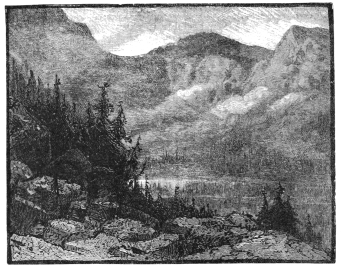
We proceeded thus from chamber to chamber, and from cloister to cloister, at times descending some spur of the mountain into a deep-shaded dell, and again climbing a swift and miry slope to better ground, until we crossed the stream coming from the high spur spoken of. From here the ground rapidly rose for half a mile more, when we suddenly came out of the low firs full upon the Lion’s Head crag, rising above Hermit Lake, and visible from the vicinity of the Glen House. To be thus unexpectedly confronted by this wall of imperishable rock stirs one very deeply. For the moment it dominates us, even as it does the little tarn so unconsciously slumbering at its feet. It is horribly mutilated and defaced. Its sides are thickly sowed with stunted trees, that bury their roots in its cracks and rents with a gripe of iron. In effect it is the barbican of the great ravine. Crouched underneath, by the shore of the lake, is a matted forest of firs and spruces, dwindled to half their usual size, grizzled with long lichens, and occupying, as if by stealth, the debatable ground between life and death. It is, in fact, more dead than alive. Deeply sunk beneath is the lake.
Hermit Lake—a little pool nestling underneath a precipice—demands a word. Its solitary state, its waters green and profound, and the thick shades by which it was covered, seemed strangely at variance with the intense activity of the foaming torrents we had seen, and could still hear rushing down the mountain. It was too small for a lake, or else it was dwarfed by the immense mass of overshadowing rock towering above it, whose reflected light streamed across its still and glossy surface. Here we bid farewell to the forest.
We had now gained a commanding post of observation, though there was yet rough work to do. We saw the whole magnificent sweep of the ravine, to where it terminates in a semicircle of stupendous cliffs that seem hewn perpendicularly a thousand feet down. Lying against the western wall we distinguished patches of snow; but they appeared of trifling extent. Great wooded mountain slopes stretched away from the depths of the gorge on either side, making the iron lineaments of the giant cliffs seem harder by their own softness and delicacy. Here and there these exquisite draperies were torn in long rents by land-slips. In the west arose the shattered peak of Monroe—a mass of splintered granite, conspicuous at every point for its irreclaimable deformity. It seemed as if the huge open maw of the ravine might swallow up this peak with ease. There was a Dantesque grandeur and solemnity everywhere. With our backs against the trees, we watched the bellying sails of a stray cloud which intercepted in its aerial voyage our view of the great summit; but it soon floated away, discovering the whitish-gray ledges to the very capstone of the dome itself. Looking down and over the thick woods beyond, we met again the burly Carter Mountains, pushed backward from the Pinkham Notch, and kept back by an invisible yet colossal strength.
HERMIT LAKE.
From Hermit Lake the only practicable way was by clambering up the bed of the mountain brook that falls through the ravine. The whole expanse that stretched on either side was a chaos of shattered granite, pitched about in awful confusion. Path there was none. No matter what way we turned, “no thoroughfare” was carved in stolid stone. We tried to force a passage through the stunted cedars that are mistaken at a mile for greensward, but were beaten back, torn and bleeding, to the brook. We then turned to the great bowlders, to be equally buffeted and abused, and finally repulsed upon the brook, which seemed all the while mocking our efforts. Once, while forcing a route, inch by inch, through the scrub, I was held suspended over a deep crevice, by my belt, until extricated by my comrade. At another time he disappeared to the armpits in a hole, from which I drew him like a blade from a scabbard. At this moment we found ourselves unable either to advance or retreat. The dwarf trees squeezed us like a vise. Who would have thought there was so much life in them? At our wits’ end, we looked at our bleeding hands, then at each other. The brook was the only clew to such a labyrinth, and to it, as from Scylla to Charybdis, we turned as soon as we recovered breath. But to reach it was no easy matter; we had literally to cut our way out of the jungle.
When we were there, and had rested awhile from the previous severe exertions, my companion, alternately mopping his forehead and feeling his bruises, looked up with a quizzical expression, and ejaculated, “Faith, I am almost as glad to get out of this wilderness as the other! In any case,” he gayly added, “I have lost the most blood here; while in Virginia I did not receive a scratch.”
After this rude initiation into the mysteries of the ravine, we advanced directly up the bed of the brook. But the brook is for half a mile nothing but a succession of leaps and plunges, its course choked with bowlders. We however toiled on, from rock to rock, first boosting, then hoisting each other up; one moment splashing in a pool, the next halting in dismay under a cascade, which we must either mount like a chamois or ascend like a trout. The climber here tastes the full enjoyment of an encounter with untamed nature, which calls every thew and sinew into action. At length the stream grew narrower, suddenly divided, and we stood at the mouth of the Snow Arch, confronted by the vertical upper wall of the ravine.
We stood in an arena “more majestic than the circus of a Titus or a Vespasian.” The scene was one of awful desolation. A little way below us the gorge was heaped with the ruins of some unrecorded convulsion, by which the precipice had been cloven from base to summit, and the enormous fragments heaved into the chasm with a force the imagination is powerless to conceive. In the interstices among these blocks rose thickets of dwarf cedars, as stiff and unyielding as the livid rock itself. It was truly an arena which might have witnessed the gladiatorial combats of immortals.
We did not at first look at the Snow Arch. The eye was irresistibly fascinated by the tremendous mass of the precipice above. From top to bottom its tawny front was covered with countless little streams, that clung to its polished wall without once quitting their hold. They twined and twisted in their downward course, like a brood of young serpents escaping from their lair; nor could I banish the idea of the ghastly head of a Gorgon clothed with tresses of serpents. A poetic imagination has named this tangled knot of mountain rills, “The fall of a thousand streams.” At the foot of the cliff the scattered waters unite, before entering the Snow Arch, in a single stream. Turning now to the right, the narrowing gorge, ascending by a steep slope as high as the upper edge of the precipice, points out the only practicable way to the summit of Mount Washington in this direction. But we have had enough of such climbing, for one day, at least.
Partial recovery from the stupefaction which seizes and holds one fast is doubtless signalized in every case by an effort to account for the overwhelming disaster of which these ruins are the mute yet speaking evidence. We need go no farther in the search than the innocent-looking little rills, first dripping from the Alpine mosses, then percolating through the rocks of the high plateau, and falling over its edge in a thousand streams. Puny as they look, before their inroads the plateau line has doubtless receded, like the great wall of rock over which Niagara pours the waters of four seas. With their combined forces—how long ago cannot be guessed; and what, indeed, does it signify?—knitted together by frost into Herculean strength, they assailed the granite cliffs that were older than the sun, older than the moon or the stars, mined and countermined year by year, inch by inch, drop by drop, until—honey-combed, riddled, and pierced to its centre, and all was ready for its final overthrow—winter gave the signal. In a twinkling, yielding to the stroke, and shattered into a thousand fragments, the cliffs laid their haughty heads low in the dust. Afterward the accumulated waters tranquilly continued the process of demolition, and of removing the soil from the deep excavation they had made, until the floor of the ravine had sunk to its present level. In California a man with a hose washes away mountains to get at the gold deposits. This principle of hydraulic force is borrowed, pure and simple, from a mountain cataract.
SNOW ARCH, TUCKERMAN’S RAVINE.
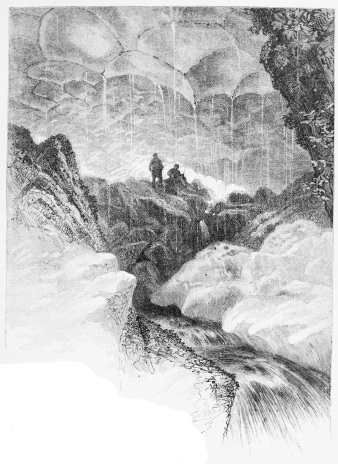
Osgood, the experienced guide, who had visited the ravine oftener than anybody else, assured me that never within his remembrance had this forgotten forgement of winter, the Snow Arch, been seen to such advantage. We estimated its width at above two hundred feet, where it threw a solid bridge of ice over the stream, and not far from three hundred in its greatest length, where it lay along the slope of the gorge. Summer and winter met on this neutral ground. Entering the Arch was joining January and July with a step. Flowers blossomed at the threshold. We caught water, as it dripped ice-cold from the roof, and pledged Old Winter in his own cellarage. The brook foamed at our feet. Looking up, there was a pretty picture of a tiny water-fall pouring in at the upper end and out at the ragged portal of the grotto. But I think we were most charmed with the remarkable sculpture of the roof, which was a groined arch fashioned as featly as was ever done by human hands. What the stream had begun in secret the warm vapors had chiselled with a bolder hand, but not altered. As it was formed, so it remained—a veritable chapel of the hills, the brook droning its low, monotonous chant, and the dripping roof tinkling its refrain unceasingly. If the interior of the great ravine impressed us as the hidden receptacle of all waste matter, this lustrous heap of snow, so insignificant in its relation to the immensity of the chasm that we scarcely looked at it at first, now chased away the feeling of mingled terror and aversion—of having stolen unawares into the one forbidden chamber—and possessed us with a sense of the beautiful, which remained long after its glittering particles had melted into the stream that flowed beneath. So under a cold exterior is nourished the principle of undying love, which the aged mountain gives that earth may forever renew her fairest youth.
The presence of this miniature glacier is a very simple matter. The fierce winds of winter which sweep over the plateau whirl the snows before them, over its crest, into the ravine, where they are lodged at the foot of the precipice, and accumulate to a great depth. As soon as released by spring, the little streams, falling down this wall, seek their old channels, and, being warmer, succeed in forcing a passage through the ice. By the end of August the ice usually disappears, though it sometimes remains even later.
After picking up some fine specimens of quartz, sparkling with mica, and uttering a parting malediction on the black flies that tormented us, we took our way down and out of the ravine, following the general course of the stream along its steep valley, and, after an uneventful march of two hours, reached the upper waters of the Crystal Cascade.
VI. IN AND ABOUT GORHAM.
That lonely dwelling stood among the hills By a gray mountain stream.—Southey.
AFTER the events described in the last chapter, I continued, like the navigator of unknown coasts, my tour of the great range. Half a mile below the Glen House, the Great Gulf discharges from its black throat the little river rising on the plateau at its head. The head of this stupendous abyss is a mountain, and mountains wall it in. Its depths remain unexplored except by an occasional angler or trapper.
Two and a half miles farther on a road diverges to the left, crosses the Peabody by a bridge, and stretches on over a depression of the range to Randolph, where it intersects the great route from Lancaster and Jefferson to Gorham. Over the river, snugly ensconced at the foot of Mount Madison, is the old Copp place. Commanding, as it does, a noble prospect up and down the valley, and of all the great peaks except Washington, its situation is most inviting; more than this, the picture of the weather-stained farm-house nestling among these sleeping giants revives in fullest vigor our preconceived idea of life in the mountains, already shaken by the balls, routs, and grand toilets of the hotels. The house, as we see by Mistress Dolly Copp’s register, has been known to many generations of tourists. The Copps have lived here about half a century.
Travellers going up or down, between the Glen House and Gorham, usually make a détour as far as Copp’s, in order to view the Imp to better advantage than can be done from the road. Among these travellers some have now and then knocked at the door and demanded to see the Imp. The hired girl invariably requests them to wait until she can call the mistress.
THE IMP.
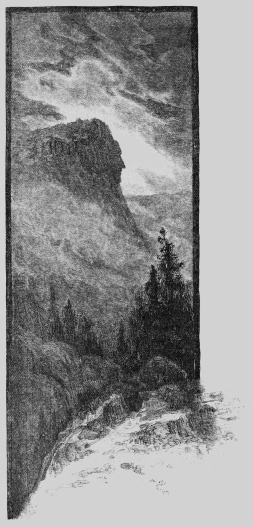
Directly opposite the farm-house the inclined ridge of Imp Mountain is broken down perpendicularly some two hundred feet, leaving a jagged cliff, resembling an immense step, facing up the valley. This is a mountain of the Carter chain, sloping gradually toward the Glen House. Upon this cliff, or this step, is the distorted human profile which gives the mountain its name. A strong, clear light behind it is necessary to bring out all the features, the mouth especially, in bold relief against the sky, when the expression is certainly almost diabolical. One imagines that some goblin, imprisoned for ages within the mountain, and suddenly liberated by an earthquake, exhibits its hideous countenance, still wearing the same look it wore at the moment it was entombed in its mask of granite. The forenoon is the best time, and the road, a few rods back from the house, the best point from which to see it. The coal-black face is then in shadow.
The Copp farm-house has a tale of its own, illustrating in a remarkable manner the amount of physical hardship that long training, and familiarity with rough out-of-door life, will occasionally enable men to endure. Seeing two men in the door-yard, I sat down on the chopping-block, and entered into conversation with them.
By the time I had taken out my note-book I had all the members of the household and all the inmates of the barn-yard around me. I might add that all were talking at once. The matron stood in the door-way, which her ample figure quite filled, trifling with the beads of a gold necklace. A younger face stared out over her shoulder; while an old man, whose countenance had hardened into a vacant smile, and one of forty or thereabouts, alternately passed my glass one to the other, with an astonishment similar to that displayed by Friday when he first looked through Crusoe’s telescope.
“Which of you is named Nathaniel Copp?” I asked, after they had satisfied their curiosity.
“That is my name,” the younger very deliberately responded. “Really,” thought I, “there is little enough of the conventional hero in that face;” therefore I again asked, “Are you the same Nathaniel Copp who was lost while hunting in the mountains, let me see, about twenty-five years ago?”
“Yes; but I wasn’t lost after I got down to Wild River,” he hastily rejoined, like a man who has a reputation to defend.
“Tell me about it, will you?”
I take from my note-book the following relation of the exploit of this mountain Nimrod, as I received it on the spot. But I had literally to draw it out of him, a syllable at a time.
On the last day of January, 1855, Nathaniel Copp, son of Hayes D. Copp, of Pinkham’s Grant, near the Glen House, set out from home on a deer hunt, and was out four successive days. On the fifth day he again left to look for a deer killed the previous day, about eight miles from home. Having found it, he dragged the carcass (weighing two hundred and thirty pounds) home through the snow, and at one o’clock P.M. started for another he had tracked near the place where the former was killed, which he followed until he lost the track, at dark. He then found that he had lost his own way, and should, in all probability, be obliged to spend the night in the woods, with the temperature ranging from 32° to 35° below zero.
Knowing that to remain quiet was certain death, and having nothing with which to light a fire, the hunter began walking for his life. The moon shone out bright and clear, making the cold seem even more intense. While revolving in his mind his unpleasant predicament he heard a deer bleat. He gave chase, and easily overtook it. The snow was too deep for the animal to escape from a hunter on snow-shoes. Copp leaped upon his back, and despatched him with his hunting-knife. He then dressed him, and, taking out the heart, put it in his pocket, not for a trophy, but, as he told me, to keep starvation at arm’s-length. The excitement of the chase made him forget cold until he perceived himself growing benumbed. Rousing himself, he again pushed on, whither he knew not, but spurred by the instinct of self-preservation. Daylight found him still striding on, with no clew to a way out of the thick woods, which imprisoned him on every side. At length, at ten in the morning, he came out at or near Wild River, in Gilead, forty miles from home, having walked twenty one consecutive hours without rest or food, the greater part of the time through a tangled growth of underbrush.
His friends at home becoming alarmed at his prolonged absence during such freezing weather, three of them, Hayes D. Copp, his father, John Goulding, and Thomas Culhane, started in search of him. They followed his track until it was lost in the darkness, and, by the aid of their dog, found the deer which young Copp had killed and dressed. They again started on the trail, but with the faintest hope of ever finding the lost man alive, and, after being out twenty-six hours in the extreme cold, found the object of their search.
No words can do justice to the heroic self-denial and fortitude with which these men continued an almost hopeless search, when every moment expecting to find the stiffened corpse of their friend. Goulding froze both feet; the others their ears.
When found, young Copp did not seem to realize in the least the great danger through which he had passed, and talked with perfect unconcern of hunts that he had planned for the next week. One of his feet was so badly frozen, from the effect of too tightly lacing his snow-shoe, that the toes had to be amputated.
Until reaching the bridge, within two miles of Gorham, I saw no one, heard nothing except the strokes of an axe, borne on the still air from some logging-camp, twittering birds, or chattering river. Ascending the hill above the bridge, I took my last look back at Mount Washington, over whose head rose-tinted clouds hung in graceful folds. The summit was beautifully distinct. The bases of all the mountains were floating in that delicious blue haze, enrapturing to the artist, exasperating to the climber. Turning to my route, I had before me the village of Gorham, with the long slopes of Mount Hayes meeting in a regular pyramid behind it. Against the dusky wall of the mountain one white spire stood out clean and sharp. At my right, along the river, was a cluster of saw-mills, sheds, and shanties; beyond, an irregular line of forest concealing the town—all except the steeple; beyond that the mountain. As I entered the village, the shrill scream of a locomotive pierced the still air, and, like the horn of Ernani, broke my dream of forgetfulness with its fatal blast. Adieu, dreams of delusion! we are once more manacled with the city.
I loitered along the river road, hoping, as the sky was clear, to see the sun go down on the great summits. Nor was I disappointed. As I walked on, Madison, the superb, gradually drew out of the Peabody Glen, and soon Washington came into line over the ridge of Moriah, whose highest precipices were kindled with a ruddy glow, while a wonderful white light rested, like a halo, on the brow of the monarch. Of a sudden, the crest of Moriah paled, then grew dark; night rose from the black glen, twilight descended from the dusky heavens. For an instant the humps of Clay reddened in the afterglow. Then the light went out, and I saw only the towering forms of the giant mountains dimly traced upon the sky. A star fell. At this signal the great dome sparkled with myriad lights. Night had ascended her mountain throne.
Gorham is situated on the Grand Trunk Railway, between Paris and Berlin, with Milan just beyond—names a trifle ambitious for villages with the bark on, but conferring distinction upon half a hundred otherwise obscure villages scattered from Maine to California.
Gorham is also situated in one of those natural parks, called intervales, in an amphitheatre of hills, through which the Androscoggin flows with a strong, steady tide. The left bank is appropriated by Mount Hayes, the right by the village—a suspension bridge giving access from one to the other. This mountain rises abruptly from the river to a broad summit-plateau, from which a wide and brilliant prospect rewards the climber. The central portion of Gorham is getting to be much too busy for that rest and quietude which is so greatly desired by a large class of travellers to the mountains, but, on the other hand, its position with respect to the highest summits is more advantageous than that of any other town lying on the skirts of the mountains, and accessible by railway. In one hour the tourist can be at the Glen House, in three on the summit of Mount Washington. Being at the very end of the great chain, in the angle where its last elevation abuts on the Androscoggin, the valley conducting around the northerly side of the great eminences, through the settlements of Randolph and Jefferson, furnishes another and a charming avenue of travel into the region watered by the Connecticut. As the great tide of travel flows in from the west and south, Gorham has profited little by the extension of railways furnishing more direct communication with the heart of the mountains.
Mount Hayes is the guardian of the village, erecting its rocky rampart over it, like the precipices of Cape Diamond over Quebec. The hill in front is called Pine Mountain, though it is only a mountain by brevet. The tip of the peak of Madison peers down into the village over this hill. I plainly saw the snow up there from my window. To the left, and over the low slope of Pine Mountain, rise the Carter summits, which here make a remarkably imposing background to the picture, and in conjunction with the great range form the basin of the Peabody. I saw this stream, making its final exit from the mountains, throw itself exhausted with its rapid course into the Androscoggin, half a mile below the hotel. North-west of the village street, drawn up in line across the valley, extend the Pilot peaks.
The Carter group is said to have been named after a hunter. According to Farmer, the Pilot Mountains were so called from a dog. Willard, a hunter, had been lost two or three days on these mountains, on the east side of which his camp was situated. Every day he observed that Pilot, his dog, regularly left him, as he supposed in search of game; but toward nightfall would as regularly return to his master. This at length excited the attention of the hunter, who, when nearly exhausted with fatigue and hunger, decided to commit himself to the guidance of Pilot, and in a short time was conducted by the intelligent animal in safety to his camp.
My first morning at Gorham was a beautiful one, and I prepared to improve it to the utmost by a walk around the northern base of Madison, neither knowing nor caring whither it might lead me. Spring was in her most enchanting mood. A few steps, and I was amid the marvels of a new creation, the tasselled birches, the downy willows, the oaks in gosling-gray. Even the gnarled and withered apple-trees gave promise of blossoming, and the young ferns, pushing aside the dead leaves, came forth with their tiny fists doubled for the battle of life. Why did not Nature so order it that mankind might rest like the trees, or shall we, like them, come forth at last strong, vigorous, beautiful, from that long refreshing slumber?
Leaving the village, at the end of a mile and a half I took the road turning to the left, where Moose River falls into the Androscoggin, at the point where the latter, making a remarkable bend, turns sharply away to the north. Moose River is a true mountain stream, clear and limpid, foaming along a bed of sand and pebbles.
From this spot the whole extent of the Pilot range was unrolled at my right, while at the left, majestic among the lower hills, Madison and Adams were massed in one grand pyramid. The snows glistening on the summits seemed trophies torn from winter.
About a mile from the turning, at Lary’s, I found the best station for viewing the statuesque proportions of Madison. The foreground a swift mountain stream, white as the snows where it takes its rise. Beyond, a strip of meadow land, covered with young birches and poplars, just showing their tender, trembling foliage. Among these are scattered large, dead trees, relics of the primeval forest; the middle ground a young forest, showing in its dainty wicker-work of branchlets that beady appearance which belongs to spring alone, and is so exquisitely beautiful. Above this ascends, mile upon mile, the enormous bulk of the mountain, ashen-gray at the summit, dusky olive-green below. Stark precipices, hedged about with blasted pines, and seamed with snow, capped the great pile. Over this a pale azure, deepening in intensity toward the zenith, unrolled its magnificent drapery.
After the ascent of Mount Hayes, which Mr. King has fittingly described as “the chair set by the Creator at the proper distance and angle to appreciate and enjoy” the kingly prominence of Mount Washington, the two things best worth seeing in the neighborhood are the falls of the Androscoggin at Berlin, and the beautiful view of the loftiest of the White Mountain peaks from what is called here the Lead Mine Bridge. To get to the falls you must ascend the river, and to obtain the view you must descend a few miles. I consecrated a day to this excursion.
With a head already filled with the noise of half a hundred mountain torrents, water-falls, or cascades, I set out after breakfast for Berlin Falls, feeling that the passage of a body of water such as the Androscoggin is at Gorham, through a narrow gorge, must be something different from the common.
A word about Berlin. Its situation is far more picturesque than that of Gorham. There is the same environment of mountains, and, in addition to the falls, a magnificent view of Madison, Adams, Jefferson, and of the Carter range. The precipices of Mount Forist, which overhang railway and village, are noticeable among a thousand. Here Dead River falls into the Androscoggin, and here the Grand Trunk Railway, taking leave of this river, turns to the north-west, crosses over to the Upper Ammonoosuc, twists and twines along: with it among the northern mountains, and at last emerges upon the level meadows of the Connecticut.
Berlin has another aspect. Lumber is its business; lumber its staple of conversation; people go to bed to dream of lumber. In a word, lumber is everywhere. The lumberman admires a tree in his way quite as much as you or I. No eye like his to estimate its height, its girth, its thickness. But as ships to Shylock, so trees to him are naught but boards—so many feet. So that there is something almost ferocious in the lumberman’s or mill-owner’s admiration for the forest; something almost startling in the idea that this out-of-the-way corner is devouring the forests at the rate of twenty car-loads a day. In plain language, this village cuts up a good-sized grove every day, and rejoices over it with a new house or a new barn.
At the risk of being classed with the sentimental and the unpractical, every one who is alive to the consequences of converting our forests into deserts, or worse than deserts, should raise a voice of warning against this wholesale destruction. The consequences may be remote, but they are certain. For the most part, the travelled routes have long since been stripped of their valuable timber trees. Now the mills are fast eating their way into the hitherto inaccessible regions, leaving a track of desolation behind wherever they go, like that of a destroying army. What cannot be carried away is burnt. Fires are seen blazing by the side of every saw-mill, in which all the waste material is carefully consumed. A trifle? Enough is consumed every year in this way to furnish the great city of New York with its fuel. I speak with moderation. Not a village but has its saw-mills; while at Whitefield, Bethlehem, Livermore, Low, and Burbank’s Grant, and many other localities, the havoc is frightful. Forest fires, originating chiefly in the logging-camps, annually desolate leagues of forest land. How long is this to continue?
The mountain labors incessantly to re-create, but what can it do against such fearful odds? and what shall we do when it can no longer furnish pine to build our homes, or wood to warm them? Delve deeper and deeper under the Alleghanies? In about two hundred and fifty years the noble forests, which set the early discoverers wild with enthusiasm, have been steadily driven farther and farther back into the interior, until “the forest primeval” exists not nearer than a hundred miles inland. Then the great northern wilderness began at the sea-coast. It is now in the vicinity of Lake Umbagog. Still the warfare goes on. I do not call occasional bunches of wood forests. All this means less and less moisture; consequently, more and more drought. The tree draws the cloud from heaven, and bestows it on the earth. The summer of 1880 was one of almost unexampled dryness. Large rivers dwindled to pitiful rivulets, brooks were dried up, and the beautiful cascades in many instances wholly disappeared. The State is powerless to interfere. Not so individuals, or combinations of individuals for the preservation of such tracts of woodland as the noble Cathedral woods of North Conway. In the West a man who plants a tree is a public benefactor; is he who saves the life of one in the East less so? America, says Berthold Auerbach, is no longer “the Promised Land for the Old World;” if she does not protect her woods, she will become “waste and dry,” like the Promised Land of the ancients—Palestine itself. Look on this picture of Michelet:
“On the shores of the Caspian, for three or four hundred leagues, one sees nothing, one encounters nothing, but midway an isolated and solitary tree. It is the love and worship of every passing wayfarer. Each one offers it something; and the very Tartar, in default of every other gift, will snatch a hair from his beard or his horse’s mane.”
The season when the great movement of lumber from the northern wilderness to the sea begins is one of great activity. The logs are floated down the Androscoggin from Lake Umbagog with the spring freshets, when those destined to go farther are “driven,” as the lumbermen’s phrase is, over the falls and through the rapids here, to be picked up below. It may well be believed that the passage of the falls by a “drive” is a sight worth witnessing. Sometimes the logs get so tightly jammed in the narrow gorge of the river that it seems impossible to extricate them; but the dam they form causes the river to rise behind it, when the accumulated and pent-up waters force their way through the obstruction, tossing huge logs in the air as if they were straws. A squad of lumbermen—tough, muscular, handy fellows they are—accompanies each drive, just as vaqueros do a Texan herd; and the herd of logs, like the herd of cattle, is branded with the owner’s mark. After making the drive of the falls, the men move down below them, where they find active and, so far as appearance goes, dangerous work in disentangling the snarls of logs caught among the rocks of the rapids. Against a current no ordinary boat could stem for a moment; they dart hither and thither in their light bateaux, as the herdsman does on his active little mustang. If a log grounds in the midst of the rapids, the bateaux dashes toward it. One river-driver jumps upon it, and holds the boat fast, while another grapples it with a powerful lever called a cant-dog. In a moment the log rolls off the rocks with a loud splash, and is hurried away by the rapid tide.
During the drive the lumberman is almost always wet to the skin, day in and day out. When a raft of logs is first started in the spring the men suffer from the exposure; but after a little time the work seems to toughen and harden them, so that they do not in the least mind the amphibious life they are forced to lead. Rain or shine, they get to their work at five in the morning, leaving it only when it is too dark to see longer. Each squad—for the whole force is divided into what may be called skirmishers, advanced-guards, main body, and rear-guard, each having its appointed work to perform—then repairs to its camp, which is generally a tent pitched near the river, where the cook is waiting for their arrival with a hot supper of fried doughnuts and baked beans—the lumberman’s diet of preference. They pass the evening playing euchre, telling stories, or relating the experiences of the day, and are as simple, hearty, happy-go-lucky fellows as can be found in the wide world.
To say that the Berlin Falls begin two miles below the village is no more than the truth, since at this distance the river was sheeted in foam from shore to shore. For these two miles its bed is so thickly sown with rocks that it is like a river stretched on the rack. The whole river, every drop of it, is hemmed in by enormous masses of granite, forming a long, narrow, and rocky gorge, down which it bursts in one mad plunge, tossing and roaring like the Maelstrom. What fury! What force! The solid earth shakes, and the very air trembles. It is a saturnalia. A whirlwind of passion, swift, uncontrollable, and terrible.
The best situation I could find was upon a jutting ledge below the little foot-bridge thrown from rock to rock. Several turns in the long course of the cataract prevent its whole extent being seen all at once; but it starts up hither and thither among the rocks, boiling with rage at being so continually hindered in its free course, until, at last, madness seizes it, and, flying straight at the throat of the gorge, it goes down in one long white wave, overwhelming everything in its way. It reaches the foot of the rocks in fleeces, darts wildly hither and thither, shakes off the grasp of concealed rocks, and, racing on, stretches itself on its wide and shallow bed, uttering a tremulous wail.
From the village at the falls, and from Berlin Mills, are elevations from which the great White Mountains are grandly conspicuous. The view is similar to that much extolled one from Milan, the town next to Berlin. Here the three great mountains, closed in mass, display a triple crown of peaks, Washington being thrown back to the left, and behind Madison, with Adams on his right. Best of all is the blended effect of early morning, or of the afterglow, when a few light clouds sail along the crimson sky, and their shadows play hide-and-seek on the mountain sides.
In the afternoon, while walking down the road to Shelburne, I met an apparently honest farmer, with whom I held some discourse. He was curious about the great city he had known half a century before, when it was in swaddling clothes; I about the mountains above and around us, that had never known change since the world began. An amiable contest ensued, in which each tried to lead the other to talk of the topic most interesting to himself. The husbandman grew eloquent upon his native State and its great man. “But what,” I insisted, “do you think of your greatest mountain there?” pointing to the splendid peak.
“Oh, drat the mountains! I never look at ‘em. Ask the old woman.”
Some enticing views may be had from the Shelburne intervales, embracing Madison on the right, and Washington on the left. It is, therefore, permitted to steal an occasional look back until we reach the Lead Mine Bridge, and stand over the middle of the flashing Androscoggin.
The dimpled river, broad here, and showing tufts of foliage on its satin surface, recedes between wooded banks to the middle distance, where it disappears. Swaying to and fro, without noise, the lithe and slender willows on the margin continually dipped their budding twigs in the stream, as if to show its clear transparency, while letting fall, drop by drop, its crystal globules. They gently nodded their green heads, keeping time to the low music of the river.
THE ANDROSCOGGIN AT SHELBURNE.
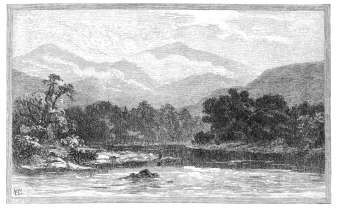
Beyond the river, over gently meeting slopes of the valley, two magnificent shapes, Washington and Madison, rose grandly. Those truly regal summits still wore their winter ermine. They were drawn so widely apart as to show the familiar peaks of Mount Clay protruding between them. It is hardly possible to imagine a more beautiful picture of mountain scenery. Noble river, hoary summits, blanched precipices, over whose haggard visages a little color was beginning to steal, eloquently appealed to every perception of the beautiful and the sublime. Much as the view from this point is extolled, it can hardly be over-praised. True, it exhibits the same objects that we see from Berlin and Milan; but the order of arrangement is not only reversed, but so altered as to render any comparison impossible. In this connection it may be remarked that a short removal usually changes the whole character of a mountain landscape. No two are precisely alike.
The annals of Shelburne, which originally included Gorham within its limits, are sufficiently meagre; but they furnish the same story of struggle with hardship—often with danger—common to the early settlements in this region. Shelburne was settled, just before the breaking out of the Revolution, by a handful of adventurous pioneers, who were attacked in 1781 by a prowling band of hostile Indians. This incursion is memorable as one of the last recorded in the long series going back into the first decade of the New England colonies. It was one of the boldest. The histories place the number of Indians at only six. After visiting Bethel, where they captured three white men, and Gilead, where they killed another, they entered Shelburne. Here they killed and scalped Peter Poor, and took a negro prisoner. Such was the terror inspired by this audacious onset, that the inhabitants, making no defence, fled, panic-struck, to Hark Hill, where they passed the night, leaving the savages to plunder the village at their leisure. The next day the refugees continued their flight, stopping only when they reached Fryeburg, fifty-nine miles from the scene of disaster.
Before taking leave of the Androscoggin Valley, which is an opulent picture-gallery, and where at every step one finds himself arrested before some masterpiece of Nature, the traveller is strongly advised to continue his journey to Bethel, the town next below Shelburne. Bethel is one of the loveliest and dreamiest of mountain nooks. Its expanses of rich verdure, its little steeple, emerging from groves of elm-trees, its rustic bridge spanning the tireless river, its air of lethargy and indolence, captivate eye and mind; and to eyes tired with the hardness and glare of near mountains, the distant peaks become points of welcome repose.
VII. ASCENT BY THE CARRIAGE-ROAD.
Where the huge mountain rears his brow sublime, On which no neighboring height its shadow flings, Led by desire intense the steep I climb. Petrarch.
THE first days of May, 1877, found me again at the Glen House, prepared to put in immediate execution the long-deferred purpose of ascending Mount Washington in the balmy days of spring. Before separating for the night, my young Jehu, who drove me from Gorham in an hour, said, with a grin,
“So you are going where they cut their butter with a chisel, and their meat with a hand-saw?”
“What do you mean?”
“Oh, you will learn to-morrow.”
“Till to-morrow, then.”
“Good-night.”
“Good-night.”
At six in the morning, while the stars were yet twinkling, I stood in the road in front of the Glen House. Everything announced a beautiful day. The rising sun crimsoned, first, the dun wall of Tuckerman’s Ravine, then the high summits, and then flowed down their brawny flanks—his first salutation being to the monarch. In ten minutes I was alone in the forest with the squirrels, the partridges, the woodpeckers, and my own thoughts.
As bears are not unfrequently seen at this season of the year, I kept my eyes about me. One of the old drivers related to me that one morning, while going up this road with a heavy load of passengers, his horses suddenly stopped, showing most unmistakable signs of terror. The place was a dangerous one, where the road had been wholly excavated from the steep side of the mountain, so, keeping one eye upon his fractious team, he threw quick glances right and left with the other; while the passengers, alarmed by the sudden stop, the driver’s shouts to his animals, and the still more alarming backward movement of the coach, thrust their heads out of the windows, and with white faces demanded what was the matter.
“By thunder!” ejaculated Jehu, “there was my leaders all in a lather, an’ backin’ almost atop of the fill-horses, and them passengers a-shoutin’ like lunatics let out on a picnic. ‘Look! darn it all,’ sez I, a-pintin’ with my whip. My hosses was all in a heap, I tell ye, rarin’ and charging, when a little Harvard student, with his head sand-papered, sung out, ‘All right, Cap, I’ve chucked your hind wheels;’ and then he made for the leaders’ heads. Them college chaps ain’t such darned fools arter all, they ain’t.”
“What was it?”
“A big black bear, all huddled up in a bunch, a-takin’ his morning observation on the scenery from the top of a dead sycamore. You see the side of the hill was so slantin’ steep that he wa’n’t more’n tew rod from the road.”
“What did you do?”
“Dew?” echoed the driver, laughing—“dew?” he repeated, “why, them crazy passengers, when they found the bear couldn’t get at them, just picked up rocks and hove them at the old cuss. When one hit him a crack, Lord, how he’d shake his head and growl! But, you see, he couldn’t get at ‘em, so they banged away, until Mr. Bruin couldn’t stan’ it any longer, an’ slid right down the tree as slick as grease, and as mad as Old Nick. It tickled me most to death to see him a-makin’ tooth-picks fly from that tree.”
“Was that your only encounter with bears?” I asked, willing to draw him out.
“Waal, no, not exactly,” he replied, chuckling to himself, gleefully, at some recollection the question revived. “There used to be a tame bear over to the Alpine House. One night the critter got loose, and we all cal’lated he’d took to the woods. Anyhow we hunted high and low; but no bear. Waal, you see, one forenoon our hostler Mike—his real name was Pat, but there was another Pat came afore him, so we called t’other Mike—went up in the barn-chamber to pitch some hay down to the hosses.” Here he stopped and began to choke.
“Well, go on; what has that to do with the bear?”
“Just you hold your hosses a minnit, stranger. Mike hadn’t no sooner jabbed his pitchfork down, so as to git a big bunch, when it struck something soft-like, and then, before he knew what ailed him, the hay-mow riz rite up afore him, with the almightiest growl comin’ out on’t was ever heerd in any maynagery this side of Noah’s Ark.”
Here the driver broke down utterly, gasping, “Oho! aha! oh Lord! ah! ha! ha! ha! ha! ho! ho! Mike!” until his breath was quite gone, and the big tears rolled down his cheeks. Then he heaved a deep sigh, attempted to go on, but immediately went off in a second hysterical explosion. I waited for his recovery.
“Waal,” he at length resumed, “the long and short of it was this: that air bear had buried himself under the hay-mow, and was a-snoozin’ it comfortable and innocent as you please, when Mike prodded him in the ribs with the pitchfork. The fust any of us knew we saw Mike come a-flyin’ out of the barn-chamber window and the bear arter him. Mike led him a length. Maybe that Irishman didn’t streak it for the house! Bless you, he never teched the ground arter he struck it! The boys couldn’t do anything for laughing, and Mick was so scart he forgot to yell. That bear was so hoppin’ wild we had to kill him; and if you wanted to make Mike fightin’ mad any time, all you had to do was to ask him to go up in the barn-chamber and pitch down a bear.”
The first four miles are merely toilsome. It is only when emerging upon the bare crags above the woods that the wonders of the ascent begin, and the succession of views, dimly seen through my eyes in this chapter, challenges the attention at every step. There is one exception. About a mile up, the road issues upon a jutting spur of the mountain, from which the summit, with the house on the highest point, is seen in clear weather.
Suddenly I came out of the low firs, the scrubby growth of birches, upon the fear-inspiring desolation of the bared and wintry summit. The high sun poured down with dazzling brightness upon the white ledges, which, rising like a wall above the solitary cabin before me, thrust their jagged edges in the way, as if to forbid farther progress. Out of this glittering precipice dead trees thrust huge antlers. This formless mass overhanging the Half-Way House, known as The Ledge, is one of the most terrific sights of the journey.
Until clear of the woods, my uneasiness, inspired by the recollection of the ascent from Crawford’s, was extreme; but I now stood, in the full blaze of an unclouded sun, upon a treeless wilderness of rock, a gratified spectator of one of the most extraordinary scenes it has ever fallen to man’s lot to witness. But what a frightful silence! Not a murmur; not a rustling leaf; but all still as death. I was half-afraid.
At my feet yawned the measureless void of the Great Gulf, torn from the entrails of the mountain by Titanic hands. Above my head leaped up the endless pile of granite constituting the dome of Washington. It had now exchanged its gray cassock for pale green. All around was unutterable desolation. Crevassed with wide splits, encompassed round by lofty mountain walls, the gorge was at once fascinating and forbidding, grand yet terrible. The high-encircling steeps of Clay and Jefferson, Adams and Madison, enclosing it with one mighty sweep, ascended out of its depths and stretched along the sky, which seemed receding before their daring advance. Peering down into the abyss, where the tallest pines were shrubs and their trunks needles, the earth seemed split to its centre, and the feet of these mountains rooted in the midst. To confront such a spectacle unmoved one should be more, or less than human.
Looking backward over the forest through which I had come, the eye caught a blur of white and a gleam of blue in the Peabody Glen. The white was the hotel, the blue the river. Following the vale out to its entrance upon the Androscoggin meadows, the same swift messenger ascended Moriah, and, traversing the confederate peaks to the summit of Mount Carter, stopped short at its journey’s end.
As I slowly mounted the Ledge the same unnatural appearance was everywhere—the same wreck, same desolation, same discord. The dead cedars, bleaching all around, looked like an army of gigantic crabs crawling up the mountain side, which universal ruin overspread, and which even the soft sunshine rendered more ghastly and more solemn. I looked eagerly along the road; listened. Not a human being; not a sound. I was alone upon the mountain.
MOUNT ADAMS AND THE GREAT GULF.
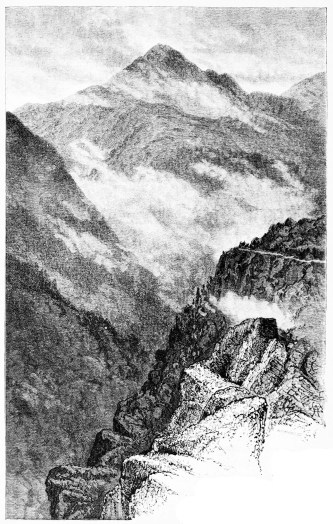
From here I no longer walked upon earth but on air. Respiration became more and more difficult. Not even a zephyr stirred, while the glare was painful to eyes already overtaxed in the endeavor to grasp the full meaning of this most unaccustomed scene. The road, steadily ascending, showed its zigzags far up the mountain. Now and then a rude receptacle had been dug, or rather built up, by the road-side, in which earth to mend the road was stored; and this soil, wholly composed of disintegrated rock, must be scraped from underneath the ledges, from crevices, from hollows, and husbanded with care. “As cheap as dirt,” was a saying without significance here. As I neared the summit the melting snows had, in many places, swept it bare, exposing the naked ledge; and here earth must be brought up from lower down the mountain. But the pains bestowed upon it equals the incessant demand for its preservation, and had I not seen with my own eyes I could scarcely have believed so excellent a specimen of road-making existed in this desert.
But how long will the mountain resist the denuding process constantly going on, and what repair the gradual but certain disintegration of the peak? It is a monument of human inability to act upon it in any way. Be it so. The snows, the frosts, the rains, pursue their work none the less surely. You see in the deep gullies, the avalanches of stones, the sands of the sea-shore—so many evidences of the forces which, sooner or later, will accomplish the miracle and remove the mountain.
From my next halting-place I perceived that I had been traversing a promontory of the mountain jutting boldly out into the Great Gulf, above the Half-Way House; and, looking down over the parapet-wall, a mile or more of the road uncoiled its huge folds, turning hither and thither, doubling upon itself like a bewildered serpent, and, like the serpent, always gaining a little on the mountain. This is one of the strangest sights of this strange journey; but, in order to appreciate it at its full value, one should be descending by the stage-coach, when the danger, more apparent than real, is intensified by the swift descent of the mountain into the gulf below, over which the traveller sees himself suspended with feelings more poignant than agreeable. The fact that there has never been a fatal accident upon the carriage-road speaks volumes for the caution and skill of the drivers; but, as one of the oldest and most experienced said to me, “There should be no fooling, no chaffing, and no drinking on that road.”[21]
Continuing to ascend, the road once more took a different direction, curving around that side of the mountain rising above the Pinkham forest. This détour brought the Carter chain upon my left, instead of on my right.
Thus far I had encountered little snow, though the rocks were everywhere crusted with ice; but now a sudden turning brought me full upon an enormous bank, completely blocking the road, which here skirted the edge of a high precipice. Had a sentinel suddenly barred my way with his bayonet, I could not have been more astonished. I was brought to a dead stand. I looked over the parapet, then at the snow-bank, then at the mountain. The first look made me shudder, the second thoughtful, the third gave me a headache.
At this spot the side of the mountain was only a continuation of the precipice, bent slightly backward from the perpendicular, and ascending several hundred feet higher. The snow, extending a hundred feet or more above, and conforming nearly with the slope of the mountain, filled the road for thrice that distance. I saw that it was only prevented from sliding into the valley by the low wall of loose stones at the edge of the road; but how long would that resist the great pressure upon it? The snow-bank had already melted at its edges, so that I could crawl some distance underneath, and hear the drip of water above and below, showing that it was being steadily undermined. In fact, the whole mass seemed on the point of precipitating itself over the precipice. I could neither go around it nor under it; so much was certain.
What to do? I had only a strong umbrella, the inseparable companion of my mountain jaunts, and the glacier was as steep as a roof. What assurance was there that if I ventured upon it the whole sheet, dislodged by my weight, might not be shot off the mountain side, carrying me with it to the bottom of the abyss? But while I felt no desire to add mine to the catalogue of victims already claimed by the mountain, the idea of being turned back was inadmissible. Native caution put the question, “Will you?” and native persistency answered, “I will.”
When a thing is to be done, the best way is to do it. I therefore tried the snow, and, finding a solid foothold, resolved to venture; had it been soft, I should not have dared. Using my umbrella as an alpenstock, I crossed on the parapet, where the declivity was the least, and without accident, but slowly and breathlessly, until near the opposite side, when I passed the intervening space in two bounds, alighting in the road with the blood tingling to my fingers’ ends.
A sharp turn around a ledge, and the south-east wall of Tuckerman’s Ravine rose up, like a wraith, out of the forest. Nearer at hand was the head of Huntington’s, while to the right the cone of Washington loomed grandly more than a thousand feet higher. A little to the left you look down into the gloomy depths of the Pinkham defile, the valley of Ellis River, the Saco Valley to North Conway, where the familiar figure of Kearsarge is the presiding genius. The blue course of the Ellis, which is nothing but a long cascade, the rich green of the Conway intervales, the blanched peak of Chocorua, the sapphire summits of the Ossipee Mountains, were presented in conjunction with the black and humid walls of the ravine, and the iron-gray mass of the great dome. The crag on which I stood leans out over the mountain like a bastion, from which the spectator sees the deep-intrenched valleys, the rivers which wash the feet of the monarch, and the long line of summits which partake his grandeur while making it all the more impressive.[22]
Turning now my back upon the Glen, the way led in the opposite direction, and began to look over the depression between Clay and Jefferson into the world of blue peaks beyond. From here the striking spectacle of the four great northern peaks, their naked summits, their sides seamed with old and new slides, and flecked with snow, constantly enlarged. There were some terrible rents in the side of Clay, red as half-closed wounds; in one place the mountain seemed cloven to its centre. It was of this gulf that the first climber said it was such a precipice he could scarce discern to the bottom. The rifts in the walls of the ravine, the blasted fir-trees leaning over the abyss, and clutching the rocks with a death-gripe, the rocks themselves, tormented, formidable, impending, astound by their vivid portrayal of the formless, their suggestions of the agony in which these mountains were brought forth.
I was now fairly upon the broad, grass-grown terrace at the base of the pinnacle, sometimes called the Cow Pasture. The low peak rising upon its limits is a monument to the fatal temerity of a traveller who, having climbed, as he supposed, to the top of the mountain, died from hunger or exposure, or from both, at this inhospitable spot.[23] A skeleton in rags was found, at the end of a year, huddled under some rocks. Farther down the mountain a heap of stones indicates the place where Doctor Ball, of Boston, was found by the party sent in search of him, famished, exhausted, and almost delirious. When rescued, he had passed two nights upon the mountain, without food, fire, or shelter, after as many days of fruitless wandering up and down, always led astray by his want of knowledge, and mocked by occasional glimpses of snowy peaks above, or the distant Glen below. More dead than alive, he was supported down the mountain as far as the camp at The Ledge, whence he was able to ride to the Glen House. His reappearance had the effect of one risen from the dead. In reality, the rescuing party took up with them materials for a rude bier, expecting to find a dead body stiffening in the snow.[24]
Besides this almost unheard of resistance to hunger, cold, and exhaustion combined, and notwithstanding the fortitude which enabled the lost man to continue his desperate struggle for life until rescued, all would doubtless have been to no purpose without the aid of an umbrella, which, by a lucky chance, he took at setting out. This umbrella was his only protection during the two terrible vigils he made upon the mountain. How, is related in the chapter on the ascent from Crawford’s.
Crossing the terrace, where even the road seems glad to rest after its laborious climb of seven miles, and where the traveller may also relax his efforts, preparatory to his arduous advance up the pinnacle, I came upon the railway, still solidly embedded in snow and ice.
WINTER STORM ON THE SUMMIT.
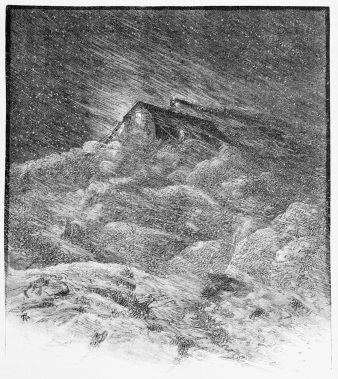
Still making a route for itself among massy blocks, tilted at every conceivable angle, but forming, nevertheless, a symmetrical cone, the carriage-road winds up the steep ascent, to which the railway is nailed. While traversing the plateau, with the Summit House now in full view, my eye caught, far above me, the figure of a man pacing up and down before the building, like a sentinel on his post. I swung my hat in the air; again; but he did not see me. Nevertheless, I experienced a thrill of pleasure at seeing him, so acutely had the sense of loneliness come over me in these awful solitudes. It put such vigor into my steps that in half an hour I crossed the last rise, when the solitary pedestrian, making an about-face at the end of his beat, suddenly discovered a strange form and figure emerging from the rocks before him. He stopped short, took the pipe from his teeth, looking with open-mouthed astonishment, then, as I continued to approach, he hastened toward me, met me half-way, and, between rapid questions and answers, led the way into the signal station.
Behold me installed in the cupola of New England! While I was resting, my host, a tall, bronzed, bearded man, bustled about the two or three apartments constituting this swallow’s nest. He put the kettle on the stove, gave the fire a stir, spread a cloth upon the table, and took some plates, cups, and saucers from a locker, some canned meats and fruit from a cupboard, I, meanwhile, following all these movements with an interest easily imagined. His preparations completed, my host first ran his eye over them approvingly, then, presenting a pen, requested me to inscribe my name in the visitors’ book. I did so, noticing that the last entry was in October—that is, five months had elapsed since the last climber wended his solitary way down the mountain. My hospitable entertainer then, with perfect politeness, begged me to draw my chair to the table and fall to. I did not refuse. While he poured out the tea, I asked,
“Whom have I the pleasure of addressing?” and he modestly replied,
“Private Doyle, sir, of the United States Signal Service. Have another bit of devilled ham? No? Try these peaches.”
“Thank you. At least Uncle Sam renders your exile tolerable. Is this your ordinary fare?”
“Oh, as to that, you should see us in the dead of winter, chopping our frozen meat with a hatchet, and our lard with a chisel.”
This, then, was what my young Jehu had meant. Where was I? I glanced out of the window. Nothing but sky, nothing but rocks; immensity and desolation. I disposed my ideas to hear my companion ask, “What is the news from the other world?”
VIII. MOUNT WASHINGTON.
The soldiers from the mountain Theches ran from rear to front, breaking their ranks, crowding tumultuously upon each other, laughing and shouting, “The sea! the sea!”—Xenophon’s Anabasis.
AFTER the repast we walked out, Private Doyle and I, upon the narrow platform behind the house. According to every appearance I had reached Ultima Thule.
For some moments—moments not to be forgotten—we stood there silent. Neither stirred. The scene was too tremendous to be grasped in an instant. A moment was needed to recover one’s moral equipoise, as well as for the unpractised eye to adjust itself to the vastness of the landscape, and to the multitude of objects, strange objects, everywhere confronting it. My own sensations were at first too vague for analysis, too tumultuous for expression. The flood choked itself.
All seemed chaos. On every side the great mountains fell away like mists of the morning, dispersing, receding to an endless distance, diminishing, growing more and more vague, and finally vanishing on a limitless horizon neither earth nor sky. Never before had such a spectacle offered itself to my gaze. The first idea was of standing on the threshold of another planet, and of looking down upon this world of ours outspread beneath; the second, of being face to face with eternity itself. No one ever felt exhilaration at first. The scene is too solemnizing.
But by degrees order came out of this chaos. The bewildering throng of mountains arranged itself in chains, clusters, or families. Hills drew apart, valleys opened, streams twinkled in the sun, towns and villages clung to the skirts of the mountains or dotted the rich meadows; but all was mysterious, all as yet unreal.
Comprehending at last that all New England was under my feet, I began to search out certain landmarks. But this investigation is fatiguing: besides, it conducts to nothing—absolutely nothing. Pointing to a scrap of blue haze in the west, my companion observed, “That is Mount Mansfield;” and I, mechanically, repeated, “Ah! that is Mount Mansfield.” It was nothing. Distance and Infinity have no more relation than Time and Eternity. It sufficed for me, God knows, to be admitted near the person of the great autocrat of New England, while under skies so fair and radiant he gave audience to his imposing and splendid retinue of mountains.
But still, independent of the will, the eye flitted from peak to peak, from summit to summit, making the slow circuit of this immense horizon, hovering at last over a band of white gleaming far away in the south-east like a luminous cloud, on whose surface objects like birds reposed. It was the sea, and the specks ships sailing on the main. With the aid of a telescope we could even tell what sails the vessels carried. In these few seconds the eye had put a girdle of six hundred miles about.[25]
I consider this first introduction to what the peak of Mount Washington looks down upon an epoch in any man’s life. I saw the whole noble company of mountains from highest to lowest. I saw the deep depressions through which the Connecticut, the Merrimac, the Saco, the Androscoggin, wind toward the lowlands. I saw the lakes which nurse the infant tributaries of those streams. I saw the great northern forests, the notched wall of the Green Mountains, the wide expanse of level land, flat and heavy like the ocean, and finally the ocean itself. And all this was mingled in one mighty scene.
The utmost that I can say of this view is that it is a marvel. You receive an impression of the illimitable such as no other natural spectacle—no, not even the sea—can give. Astonishment can go no farther. Nevertheless, the truth is that you are on too high a view-point for the most effective grasp of mountain scenery. This immense height renders near objects indistinct, obscures the more distant. Seldom, indeed, is the land seen, even under favoring conditions, except through a soft haze, which, you are surprised to notice, becomes more and more transparent as you descend. The eye explores this clair-obscur, and gradually discerns this or that object. It is true that you see to a great distance, but you do not distinguish anything clearly. This is the rule, derived from many observations, to which the crystal air of autumn and winter makes the rare and fortunate exception.
There is a more cogent reason why the view from Mount Washington is inferior to that from other and lower summits. Everything is below you, and, naturally, therefore, any picture of these mountains not showing the cloud-capped dome of the monarch, attended by his cortége of grand peaks—the central, dominating, perfecting group—must be essentially incomplete. Imagine Rome without St. Peter’s, or, to come nearer home, Boston without her State House! One word more: from this lofty height you lose the symmetrical relation of the lesser summits to the grand whole. Even these signal embodiments of heroic strength—the peaks of Jefferson, Adams, and Madison—so vigorously self-asserting that what they lose in stature they gain by a powerful individuality, even these suffer a partial eclipse; but the summits stretching to the southward are so dwarfed as to be divested of any character as typical mountain structures. What fascinates us is the “sublime chaos of trenchant crests, of peaks shooting upward;” and the charm of the view—such at least is the writer’s conviction—resides rather in the immediate surroundings than in the extent of the panorama, great as that unquestionably is.
One thing struck me with great force—the enormous mass of the mountain. The more you realize that the dependent peaks, stretching eight miles north, and as many south, are nothing but buttresses, the more this prodigious weight amazes. Two long spurs, divided by the valley of the Rocky Branch, also descend into the Saco Valley as far as Bartlett; and another, shorter, but of the same indestructible masonry, is traced between the valleys of the Ammonoosuc and of Israel’s River. In a word, as the valleys lie and the roads run, we must travel sixty or seventy miles around in order to make the circuit of Mount Washington at its base.
Even here one is not satisfied if he sees a stone ever so little above him.[26] The best posts for an outlook, after the signal station, are upon a point of rocks behind the old Tip-Top House, and from the end of the hotel platform, where the railway begins its terrifying descent. From all these situations the view was large and satisfying. From the first station one overlooks the southern summits; from the second, the northern. A movement of the head discloses, in turn, the ocean, the lakes and lowlands of Maine and New Hampshire, the broad highlands of Massachusetts, the fading forms of Monadnock and Wachusett, the highest peaks of Vermont and New York, and, finally, the great Canadian wilderness.
After all this, the eye dwells upon the hideous waste of rock blackened by ages of exposure, corroded with a green incrustation, like verd-antique, constituting the dome. It is at once mournful and appalling. Time has dealt the mountain some crushing blows, as we see by these ghastly ruins, bearing silent testimony to their own great age. It is necessary to step with care, for the rocks are sharp-edged. The green appearance is due to lichens which bespatter them. Greedy little spiders inhabit them. Truly this is a spot disinherited by Nature.
Noticing many boards scattered helter-skelter about the top and sides of the mountain, I drew my companion’s attention to them, and he explained that what I saw was the result of the great January gale, which had blown down the shed used as an engine-house, demolished every vestige of the walk leading from the hotel to the signal station, and distributed the fragments as if they had been straws far and wide, as I saw them.
The same gale had swept the coast from Hatteras to Canso with destructive fury. I begged Private Doyle to give me his recollections of it. We returned to the station, and he began as follows:
“At the time of the tornado I was sick, and my comrade, Sergeant M——, who is now absent on leave, had to do my turn as well as his own. ‘Uncle Sam,’ you know, keeps two of us here, for fear of accidents.”[27]
“It surprised me to find you here alone,” I assented.
“This is the third day.” Then, resuming his narrative, “During the forenoon preceding the gale we observed nothing very unusual; but the clouds kept sinking and sinking, until, in the afternoon, the summit alone was above them. For miles around nothing could be seen but one vast ocean of frozen vapor, with peaks sticking out here and there, like icebergs floating in this ocean—all being cased in snow and ice. I cannot tell you how curious this was. Later in the day the density of the clouds became such that they reflected the colors of the spectrum: and that too was beautiful beyond description. It was about this time Sergeant M—— came to where I was lying, and said, ‘There is going to be the devil to pay; so I guess I’ll make everything snug.’
“By nine in the evening the wind had increased to one hundred miles an hour, with heavy sleet, so that no observation could be safely made from without. At midnight the velocity of the storm was one hundred and twenty miles, and the exposed thermometer recorded 24° below zero. We could hardly get it above freezing inside the house. With the stove red, water froze within three feet of the fire; in fact, where you are now sitting.
“At this time the uproar outside was deafening. About one o’clock the wind rose to one hundred and fifty miles. It was now blowing a hurricane. That carpet (indicating the one in the room where we were) stood up a foot from the floor, like a sail. The wind, gathering up all the loose ice on top of the mountain, dashed it against the house in one continuous volley. I lay wondering how long we should stand this terrific pounding, when all at once there came a crash. M—— shouted to me to get up; but I had tumbled out in a hurry on hearing the glass go. You see I was ready-dressed, to keep myself warm in bed.
“Our united efforts were hardly equal to closing the storm-shutters from the inside; but we succeeded, finally, though the lights were out, and we worked in the dark.” He rose in order to show me how the shutters, made of thick oak planks, were secured by a bar, and by strong wooden buttons screwed in the window-frame.
“We had scarcely done this,” resumed Doyle, “and were shivering over the fire, when a heavy gust of wind again burst open the shutters as easy as if they had never been fastened at all. We sprang to our feet. After a hard tussle we again secured the windows by nailing a cleat to the floor, against which we fixed one end of a board, using the other end as a lever. You understand?” I nodded. “Well, even then it was all we could do to force the shutters back into place. But we did it. We had to do it.
“The rest of the night was passed in momentary expectation that the building would be blown over into Tuckerman’s Ravine, and we with it. At four in the morning the wind registered one hundred and eighty-six miles. It had shifted then from east to north-east. From this time it steadily fell to ten miles at nine o’clock—as calm as a daisy. This was the heaviest blow ever experienced on the mountain.”
“Suppose this house had gone, and the hotel stood fast, could you have effected an entrance into the hotel?” I asked.
“No, indeed. We could not have faced the wind.”
“Not for a hundred feet, and in a matter of life and death?”
“In that gale? We should have been lifted clean off our feet and smashed upon the rocks like this bottle,” flinging one out at the door.
“So then for all those hours you expected from one moment to another to be swept into eternity?”
THE TORNADO FORCING AN ENTRANCE.
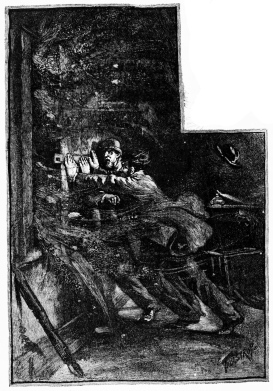
“We did what we could. Each of us wrapped himself up in blankets and quilts, tying these tightly around him with ropes, to which were attached bars of iron, so that if the house went by the board we might stand a chance—a slim one—of anchoring, somehow, somewhere.”
I tried to make him admit that he was afraid; but he would not. Only he forgot, he said, in the excitement of that terrible night, that he was ill, until the danger was over.
“We are going to have a blow,” observed Doyle, glancing at the barometer—“barometer falling, wind rising. Besides, that blue haze, creeping over the valley, is a pretty sure sign of a change of weather.” His prognostic was completely verified in the course of a few hours.
“Now,” said Doyle, rising, “I must go and feed my chick.”
We retraced our steps to the point of rocks overhanging the southern slope, where he stopped and began to scatter crumbs, I watching him curiously meanwhile. Pretty soon he went down on his hands and knees and peered underneath the rocks. “Ah!” he exclaimed, with vivacity, “there you are!”
“What is it?” I asked; “what is there?”
“My mouse. He is rather shy, and knows I am not alone,” he replied, chirruping to the animal with affectionate concern.
Brought to the mountain top in some barrel or box, the little stowaway had become domesticated, and would come at the call of his human playmate. The incident was trifling enough of itself, yet there was something touching in this companionship, something that sharply recalled the sense of loneliness I had myself experienced. In reality, the disparity between the man and the mouse seemed not greater than that between the mountain and the man.
While we were standing among the rocks the sun touched the western horizon. The heavens became obscured. All at once I saw an immense shadow striding across the valley below us. Slowly and majestically it ascended the Carter chain until it reached the highest summit. I could not repress an exclamation of surprise; but what was my astonishment to see this immense phantom, without pausing in its advance, lift itself into the upper air to an incredible height, and stand fixed and motionless high above all the surrounding mountains. It was the shadow of Mount Washington projected upon the dusky curtain of the sky. All the other peaks seemed to bow their heads by a sentiment of respect, while the actual and the spectre mountain exchanged majestic salutations. Then the vast gray pyramid retreated step by step into the thick shades. Night fell.
The expected storm which the observer had predicted did not fail to put in an appearance. By the time we reached the house the wind had risen to forty miles an hour, driving the clouds in an unbroken flight against the summit, from which they rebounded with rage equal to that displayed in their vindictive onset. The Great Gulf was like the crater of some mighty volcano on the eve of an eruption, vomiting forth volumes of thickening cloud and mist. It seemed the mustering-place of all the storm-legions of the Atlantic, steadily pouring forth from its black jaws, unfurling their ghostly standards as they advanced to storm the battlements of the mountain. Occasionally a break in the column disclosed the opposite peaks looming vast and black as midnight. Then the effect was indescribable. At one moment everything seemed resolving into its original elements; the next I was reminded of a gigantic mould, not from mortal hands, in which all these vast forms were slowly cooling. The moon shed a pale, wan light over this unearthly scene, in which creation and annihilation seemed confusedly struggling. The sublime drama of the Fourth Day, when light was striving with darkness for its allotted place in the universe, seemed enacting under my eyes.
The evening passed in comparative quiet, although the gale was now moving from east to west at the rate of sixty miles an hour. Rain rattled on the roof like shot. Now and then the building shuddered and creaked, like a good ship breasting the fury of the gale. Vivid flashes of lightning made the well-lighted room momentarily dark, and checked conversation as suddenly as if we had felt the electric shock. Under such novel conditions, with strange noises all about him, one does not feel quite at ease. Nevertheless the kettle sung on the stove, the telegraph instrument ticked on the table. We had Fabyan’s, Littleton, and White River Junction within call. We had plenty of books, the station being well furnished from voluntary gifts of the considerate-benevolent. At nine Doyle went out, but immediately returned and said he had something to show me. I followed him out to the platform behind the house. A forest fire had been seen all day in the direction of Fabyan’s, but at night it looked like a burning lake sunk in depths of infernal blackness. I had never seen anything so nearly realizing my idea of hell. No other object was visible—only this red glare as of a sun in partial eclipse shining at the bottom of an immense hole. We watched it a few minutes and then went in. I attempted to be cheerful, but how was one to rise above such surroundings? Alternately the storm roared and whined for admittance. Worn out with the tension, physical and moral, of this day, I crept into bed and tried to shut the storm out. The poor exile in the next room murmured to himself, “Ah, this horrible solitude!”
The next morning, while looking down from this eagle’s nest upon the southern peaks to where the bridle path could be distinctly traced across the plateau, and still winding on around the peaked crest of Monroe, I was seized with a longing to explore the route which on a former occasion proved so difficult, but to-day presenting apparently nothing more serious than a fatiguing scramble up and down the cone. Accordingly, taking leave of my companion, I began to feel my way down that cataract of granite, fallen, it would seem, from the skies.[28]
In proportion as I descended, the mountain ridge below regained, little by little, its actual character. Except where patches of snow mottled it with white, it displayed one uniform and universal tinge of faded orange where the soft sunshine fell full upon it, toned into rusty brown when overshadowed, gradually deepening to an intense blue-black in the ravines. But so insignificant did the summits look, when far below, that I hardly recognized them for the same I had seen from Fabyan’s and had traversed from Crawford’s. Monroe, the nearest, has, however, a most striking resemblance to an enormous petrified wave on the eve of dashing itself down into the valley. The lower you descend the stronger this impression becomes; but from the summit of Mount Washington this peak is so belittled that the mountains seemed saying to each other, “Good-morning, Mole-hill!” “Good-morning, Big Bully!”
When I reached the stone-corral, the ground, if ground it can be called, descended less abruptly, over successive stony terraces, to a comparative level, haired over with a coarse, wiry, and tangled grass, strewed with bowlders, and inundated along its upper margin by torrents of stones. Upon closer inspection these stones arranged themselves in irregular semicircular ridges. In the eyes of the botanist and entomologist this seemingly arid region is more attractive than the most beautiful gardens of the valley. Among these grasses and these stones lie hid the beautiful Alpine flowers of which no species exist in the lowlands. Only the arbutus, which puts forth its pink-and-white flowers earliest of all, and is warmed into life by the snows, at all resembles them in its habits. Over this grassy plain the wind swept continually and roughly; but on putting the grass aside with the hand, the tiny blossoms greet you with a smile of bewitching sweetness.
These areas, extending between and sometimes surrounding the high peaks, or even approaching their summits, are the “lawns” of the botanist, and his most interesting field of research. Within its scope about fifty species of strictly Alpine plants vegetate. As we ascend the mountain, after the dwarf trees come the Lapland rhododendron, Labrador tea, dwarf birch, and Alpine willows, which, in turn, give place to the Greenland sandwort, diapensia, cassiope, and other plants, with arctic rushes, sedges, and lichens, which flourish on the very summit.
To the left, this plain, on which the grass mournfully rustled, sloped gently for, I should guess, half a mile, and then rolled heavily off, over a grass-grown rim, into Tuckerman’s Ravine. In this direction the Carter Mountains appeared. Beyond, stretching away out of the plain, extended the long Boott’s Spur, over which the Davis path formerly ascended from the valley of the Saco, but which is now, from long disuse, traced with difficulty. Between this headland and Monroe opened the valley of Mount Washington River, the old Dry River of the carbuncle hunters, which the eye followed to its junction with the Saco, beyond which the precipices of Frankenstein glistened in the sun, like a corselet of steel. Oakes’s Gulf cuts deeply into the head of the gorge. The plain, the ravine, the spur, and the gulf transmit the names of those indefatigable botanists, Bigelow, Tuckerman, Boott, and Oakes.
On the other side of the ridge—for of course this plain has its ridge—the ground was more broken in its rapid descent toward the Ammonoosuc Valley, into which I looked over the right shoulder of Monroe.
But what a sight for the rock-wearied eye was the little Lake of the Clouds, cuddled close to the hairy breast of this mountain! On the instant the prevailing gloom was lighted as if by magic by this dainty nursling of the clouds, which seemed innocently smiling in the face of the hideous mountain. And the stooping monster seemed to regard the little waif, lying there in its rocky cradle, with astonishment, and to forego his first impulse to strangle it where it lay. Lion and lamb were lying down together.
Casting an eye upward, and finding the houses on the summit were hidden by the retreating curvature of the cone, I saw, with chagrin, light mists scudding over my head. It was a notice to hasten my movements idle to disregard here. Crossing as rapidly as possible Bigelow’s Lawn—the half-mile of grass ground referred to, where I sunk ankle-deep in moss, or stumbled twenty times in as many rods over concealed stones—I skirted the head of the chasm for some distance. But from above the ravine does not make a startling impression. I, however, discovered, lodged underneath its walls, a bank of snow. All around I heard water gurgling under my feet in rock-worn channels while making its way tranquilly to the brow of the ravine. These little underground runlets are the same that glide over the head-wall, and are the head tributaries of the Ellis.[29]
Retracing my way to the ridge and to the path, which I followed for some distance, startling the silence with an occasional halloo, I descended into the hollow, where the Lake of the Clouds seems to have checked itself, white and still, on the very edge of the tremendous gully, cut deep into the western slopes. The lake is the fountain-head of the Ammonoosuc. Its waters are too cold to nourish any species of fishes; they are too elevated for any of the feathered tribe to pay it a visit.
LAKE OF THE CLOUDS.
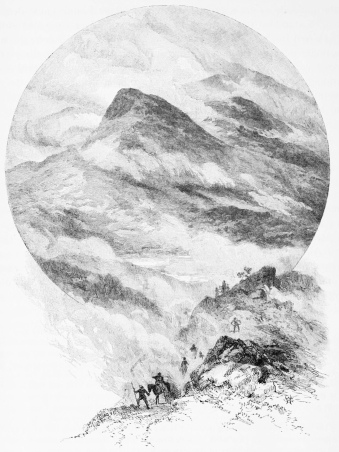
Strange spectacle! A fairy haunt, rock-rimmed and fringed about with Alpine shrubs, half-disclosing, half-concealing its bare bosom, coyly reposed on this wind-swept ridge, like “a good deed in a naughty world.” From its crystal basin a tiny rill trickled through soft moss to the dizzy verge beyond, where, like some airy sprite, clothed with the rainbow and tossing its white tresses to the sport of the breeze, it tripped gayly over the grisly precipice and fell in a silvery shower from height to height. Where it passed, flowers, ferns, and rich herbage sprung forth upon the hard face of the granite. Tapering fir-trees exhaled a dewy freshness; aspens quivered with the delight of its coming, and aged trees, tottering, decrepit, piteous to see, stretched their withered limbs toward heaven. On it went, and still on, leaving its white robe clinging to the mountain side. All the forest seemed crowding forward to catch it; but, now reverently kissing the feet of the old trees, now saucily flinging a handful of crystal in the faces of scowling cliffs, it eluded the embrace of the forest, which thrilled with its musical laughter from lowest deeps to the summit of high-rocking pines. When it was no longer visible a sonorous murmur heralded its triumphal progress. No wonder the bewildered eye roved from bleak summit to voluptuous vale; from the handful of drops above to the brimming river below. The miracle of Horeb was being repeated hour by hour, like an affair of every-day life.
This hand-mirror of Venus has two tiny companion pools close by. The weary explorer may sip a draught of sweetest savor while admiring their exceeding beauty—a beauty heightened by its unexpectedness, and teaching that not all is barren even here. A benison on those little lakes!
Stone houses of refuge are much needed on the mountains over which the Crawford trail reaches the summit. They should always be provided with fagots for a fire, clean straw or boughs for a bed, and printed directions for the inexperienced traveller to follow. A fireplace, furnished with a crane and a kettle for heating water, would be absolute luxuries. Being done, this glorious promenade—the equal of which does not exist in New England—would be taken with confidence by numbers, instead of, as now, by the few. It is the appropriate pendant of the ascent from the Glen by the carriage-road, or from Fabyan’s by the railway. One can hardly pretend to have seen the mountains in their grandest aspects until he has threaded this wondrous picture-gallery, this marvellous hall of statues.[30]
While recrossing the plateau, from which Washington has the appearance of one mountain piled upon another, I suddenly came upon a dead sparrow in my path. Poor little fellow! he was too adventurous, and sunk on stiffening pinions beneath the frozen wind. Ten steps farther on a large brown butterfly flew up and fluttered cheerily along the path. Why, then, did the bird die and the butterfly live?
This mountain butterfly, which endured cold that the bird could not, has excited the attention of naturalists, it is said. The mountain is 6293 feet high, and the butterflies never descend below an elevation of about 5600 feet. Here they “disport during the month of July of every year,” thriving upon the scanty deposits of honey found in the flowers of the few species of hardy plants that grow in the crevices of the rocks at this great altitude, and upon other available liquid substances. The insect measures, from tip to tip of the expanded fore-wings, about one and eight-tenths inches. It is colored in shades of brown, with various bands and marblings diversifying the surface of the wings. The butterfly is known to naturalists as the Œneis semidea, and was first described, in 1828, by Thomas Say. An allied species occurs on Long’s Peak and other elevated heights in Colorado; and another is found at Hopedale, Labrador; but they are confined to these widely separated localities. It is surmised that the butterfly, like the Alpine flora, beautifully illustrates the presence, or rather the advance and retreat, of the glacier.
I took up the little winged chorister of the vale who was not able to make spring come to the mountain for all his warbling. Truly, was not the little bird’s fate typical of those ambitious climbers for fame who, chilled to death by neglect or indifference, die singing on the heights? So the sparrow’s fall gave me food for reflection, during which I reached the little circular enclosure at the foot of the cone.
Once more I climbed the rambling and rocky stairs leading to the summit; but long before reaching it clouds were drifting above and below me. The day was to end like so many others. The crabbed old mountain had exhausted his store of benevolence. I hurried on down the Glen road. After descending a mile I heard a rumbling sound, deep and prolonged, like distant thunder. The thought of being overtaken on the mountain by a thunder-storm made me quicken my pace almost to a run. On turning the corner where the snow-bank had lain, like a lion in the path, devoutly wishing myself well and safely over, I felt something rise in my throat. The bank was no longer there. Every vestige of it had disappeared, and, in all probability, its sudden plunge down the mountain was what I had taken for thunder. Ten minutes sooner and I should have been upon its treacherous bridge.
I passed the Half-Way House, entered the dusk forest, where the tree-tops were swaying wildly to and fro, the birds flitting silently, and the tall pines discordantly humming, as if getting the pitch of the storm. Suddenly it grew dark. A stream of fire blinded me with its glare. Then a deafening peal shook the solid earth. Another and another succeeded: Olympian salvos greeted the arrival of the storm king.
The rain was pattering among the leaves when I emerged into the open vale, guided by the lights of the Glen House shining through the darkness. My heavy feet almost refused to carry me farther, and I walked like the statue in “Don Juan.”