FIRST JOURNEY. (continued 2)
Reading edition
KEARSARGE IN WINTER.
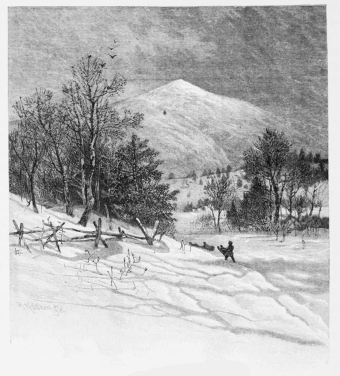
Day broke bright, clear, and crisp. There, again, was the same matchless array of high and noble summits, sitting on thrones of alabaster whiteness. While the moon still lingered in the west, the broad red disk of the sun rose over the wooded ridges in the east. So sun and moon, monarch and queen, saluted each other. One gave the watchword, and descended behind the moated mountain; the other ascended the vacant throne. Thus night and day met and exchanged majestic salutation in the courts of the morning.
The mercury stood at three degrees below zero in the village, when I set out on foot for the mountain. A light fall of snow had renewed the Christmas decorations. The trees had newly-leaved and blossomed. Beautiful it was to see the dark old pines thick-flaked with new snow, and the same feathery substance lodged on every twig and branchlet, tangle of vines, or tuft of tawny yellow grass. Fir-trees looked like gigantic azaleas; thickets like coral groves. Nothing too slender or too fragile for the white flight to alight upon. Talk of decorative art! Even the telegraph-wires hung in broad, graceful festoons of white, and the poor washer-woman’s clothes-line was changed into the same immaterial thing of beauty.
The ascent proved more toilsome than I had anticipated, as my feet broke through the frozen crust at every step. But if the climb had been difficult when in the woods, it certainly presented few attractions when I emerged from them half a mile below the summit. I found the surface of the bare ledges, which now continue to the top of the mountain, sheeted in ice, smooth and slippery as glass.
Many a time have I laughed heartily at the feverish indecision of a dog when he runs along the margin of a pond into which he has been urged to plunge. He turns this way and that, whines, barks, crouches for the leap, laps the water, but hesitates. Imagine, now, the same animal chasing some object upon slippery ice, his feet spread widely apart; his frantic efforts to stop; the circles described in the air by his tail. Well, I experienced the same perplexity, and made nearly the same ridiculous evolutions.
After several futile attempts to advance over it, and as often finding myself sliding backward with entire loss of control of my own movements, I tried the rugged ravine, traversing the summit, with some success, steadying my steps on the iced bowlders by grasping the bushes which grew there among clefts of the rock. But this way, besides being extremely fatiguing, was decidedly the more dangerous of the two; and I was glad, after a brief trial, to abandon it for the ice, in which, here and there, detached stones, solidly embedded, furnished points of support, if they could be reached. By pursuing a zigzag course from stone to stone, sometimes—like a pious Moslem approaching the tomb of the Prophet—upon my hands and knees, and shedding tears from the force of the wind, I succeeded in getting over the ledges after an hour’s obstinate battle to maintain an upright position, and after several mishaps had taught me a degree of caution closely approaching timidity. By far the most treacherous ground was where fresh snow, covering the smooth ice, spread its pitfalls in the path, causing me several times to measure my length; but at last these obstacles were one by one surmounted; I groped my way, foot by foot, up the sharp rise of the pinnacle, finding myself at the front door of the house which is so conspicuous an object from the valley.
Never was air more pure, more crisp, or more transparent. Besides, what air can rival that of winter? I felt myself rather floating than walking. Certainly there is a lightness, a clearness, and a depth that belongs to no other season. At no other season do we behold our native skies so blue, so firm, or so brilliant as when the limpid ether, winnowed by the fierce north wind to absolute purity, presents objects with such marvellous clearness, precision, and fidelity, that we hardly persuade ourselves they are forty, fifty, or a hundred miles distant. To realize this rare condition was all the object of the ascent—an object attained in a measure far beyond any anticipations I had formed.
As may easily be imagined, the immediate effect was bewildering in the extreme. In the first place, the direct rays of the noonday sun covered the mountain-top with dazzling brilliancy. The eye fairly ached with looking at it. In the second, the intensity of the blue was such as to give the idea that the grand expanse of sky was hard frozen. Nothing more coldly brilliant than this immense azure dome can be conceived. There was not the faintest trace of a cloud anywhere; nothing but this splendid void. Under this high-vaulted dome, imagine now a vast expanse of white etched with brown—a landscape in sepia. Such was the general effect.
But the inexpressible delight of having all this admirable scene to one’s self! Taine asks, “Can anything be sweeter than the certainty of being alone? In any widely known spot, you are in constant dread of an incursion of tourists; the hallooing of guides, the loud-voiced admiration, the bustle, whether of unfastening horses, or of unpacking provisions, or of airing opinions, all disturb the budding sensation; civilization recovers its hold upon you. But here, what security and what silence! nothing that recalls man; the landscape is just what it has been these six thousand years.”
The view from this mountain is justly admired. Stripped of life and color, I found it sad, pathetic even. Dead white and steel blue rudely repulsed the sensitive eye. The north wind, cold and cutting, drove me to take shelter under glaring rocks. The cracking of ice first on one side, then on the other, diverted the attention from the landscape, as if the mountain was continually snapping its fingers in disdain. I had constantly the feeling that some one or some thing was at my elbow. What childishness! But where now was the lavish summer, the barbaric splendors of autumn—its arabesques of foliage, its velvet shadows, its dappled skies, its glow, mantling like that of health and beauty? All-pervading gloom and defoliation were rendered ten times more melancholy by the splendid glare. Winter flung her white shroud over the land to hide the repulsiveness of death.
I looked across the valley where Moat Mountain reared its magnificent dark wave. Passing to the north side, the eye wandered over the wooded summits to the silvery heap of Washington, to which frozen, rose-colored mists were clinging. A great ice-cataract rolled down over the edge of Tuckerman’s Ravine, its wave of glittering emerald. It shone with enchanting brilliancy, cheating the imagination with the idea that it moved; that the thin, spectral vapor rose from the depths of the ice-cold gorge below. There gaped, wide open, the enormous hole of Carter Notch; there the pale-blue Saco wound in and out of the hills, with hamlets and villages strung along its serpentine course; and, as the river grows, villages increase to towns, towns to cities. There was the sea sparkling like a plain of quicksilver, with ponds and lakes innumerable between. There, in the south-west, as far as the eye could reach, was Monadnock demanding recognition; and in the west, Moosehillock, Lafayette, Carrigain peaks, lifted with calm superiority above the chaos of mountains, like higher waves of a frozen sea. Finally, there were the snow-capped summits of the great range seen throughout their whole extent, sunning their satin sides in indolent enjoyment.
This view has no peer in these mountains. Indeed, the mountain seems expressly placed to command in one comprehensive sweep of the eye the most impressive features of any mountain landscape. Being a peak of the second order—that is to say, one not dominating all the chains—while it does not unfold the topography of the region in its whole extent, it is sufficiently elevated to permit the spectator to enjoy that increasing grandeur with which the distant ranges rise, tier upon tier, to their great central spires, without lessening materially their loftiness, or the peculiar and varied expression of their contours. The peak of Kearsarge peeps down over one shoulder into New Hampshire, over the other into Maine. It looks straight up through the open door of the Carter Notch, and boldly stares Washington in the face. It sees the sun rise from the ocean, and set behind Mount Lafayette. It patronizes Moat, measures itself proudly with Chocorua, and maintains a distant acquaintance with Monadnock. It is a handsome mountain, and, as such, is a general favorite with the ladies and the artists. Like a careful shepherd, it every morning scans the valleys to see that none of its flock of villages has wandered. For these villagers it is a sun-dial, a weather-vane, an almanac; for the wayfarer, a sure guide; and for the poet, a mountain with a soul.
SLIDING DOWN KEARSARGE.
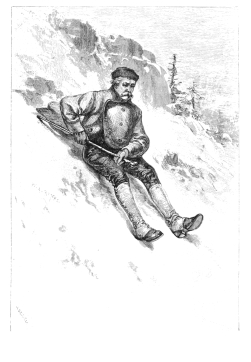
The cold was intense, the wind piercing. On its north side the house was deeply incrusted with ice-spars—windows and all. I feel that only scant justice can be done to their wondrous beauty. All the scrubby bushes growing out of interstices of the crumbling summit—wee twig and slender filament—were stemmed with ice; while the rocks bristled with countless frost feathers. With my pitch-cakes and a few twigs I lighted a fire, which might be seen from the half-dozen villages clustered about the foot of the mountain, and pleased myself with imagining the astonishment with which a smoke curling upward from this peak would be greeted for fifty miles around. I then prepared to descend—I say prepared to descend, for the thing at once so easy to say and so difficult of performance suddenly revived the recollection of the hazardous scramble up the ledges, and made it seem child’s play by comparison. For a brief hour I had forgotten all this. However, go down I must. But how? The first step on the ice threatened a descent more rapid than flesh and blood could calmly contemplate. I had no hatchet to cut steps in the ice; no rope to attach to the rocks, and thus lower myself, as is practised in crossing the glaciers of the Alps; and there was no foothold. For a moment I seriously thought of forcing an entrance into the house, and, making a signal of distress, resign myself to the possibility of help from below. But while sitting on a rock looking blankly at the glassy declivity stretching down from the summit, a bright idea came to my aid. I remembered having read in Bourrienne’s “Memoirs” that Bonaparte—the great Bonaparte—was forced to slide down the summit of the Great St. Bernard seated, while making his famous passage of the Alps. Yes, the great Corsican really advanced to the conquest of Italy in this undignified posture. But never did great example find more unworthy imitator. Seating myself, as the Little Corporal had done, using my staff as a rudder, and steering for protruding stones in order to check the force of the descent from time to time, I slid down with a celerity the very remembrance of which makes my head swim, arriving safe, but breathless and much astonished, at the first irregular patch of snow. The pleasure of standing erect on something the feet could grasp was one not to be translated into words.
Upon reaching the hotel, I procured another pair of pantaloons of my host, and some court-plaster from the village apothecary. If any of my readers think my dignity compromised, I beg him to remember the example of the great Napoleon, and his famous expedient for circumventing the Great St. Bernard.
VI. FROM KEARSARGE TO CARRIGAIN.
Raleigh.—“Fain would I climb, but that I fear to fall.” Queen Elizabeth.—“If thy heart fail thee, climb thou not at all.”
AFTER the storm, we had a fine lunar bow. The corona in the centre was a clear silver, the outer circle composed of pale green and orange fires. Over the moon’s disk clouds swept a continuous stormy flight. The great planet resembled a splendid decoration hung high in the heavens.
Having now progressed to terms of easy familiarity with the village, it was decided to pay our respects to the Intervale, which unites it with the neighboring town of Bartlett.
The road up the valley first skirts a wood, and through this wood are delicious glimpses of Mount Adams. During the heat of the day or cool of the evening this extensive and beautiful forest has always been a favorite haunt. Tall, athletic pines, that bend in the breeze like whalebone, lift their immense clusters of impenetrable foliage on high. The sighs of lovers are softly echoed in their green tops; voices and laughter issue from it. We, too, will swing our hammock here, and breathe the healing fragrance that is so grateful.
In a little enclosure of rough stone, on the Bigelow place, lie the remains of the ill-fated Willey family, who were destroyed by the memorable slide of 1826. The inscription closes with this not too lucid figure:
“We gaze around, we read their monument; We sigh, and when we sigh we sink.”
Where the high terrace, making one grand sweep to the right, again unveils the same superb view of the great summits, now wholly unobstructed by houses or groves, we halt before that picture, unrivalled in these mountains, not surpassed, perhaps, upon earth, and which we never tire of gazing upon. Its most salient features have already been described; but here in their very midst, from their very heart, nature seems to have snatched a garden-spot from the haggard mountains arrested in their advance by the command, “Thus far, and no farther!” The elms, all grace, all refinement of form, bend before the fierce blasts of winter, but stir not. The frozen east wind flies shrieking through, as if to tear them limb from limb. The ground is littered with their branches. They bow meekly before its rage, but stir not. Really, they seem so many sentinels jealously guarding that repose of which the vale is so eloquently the expression. The vale regards the stormy summits around with the unconcern of perfect security. It is rest to look at it.
CONWAY MEADOWS.
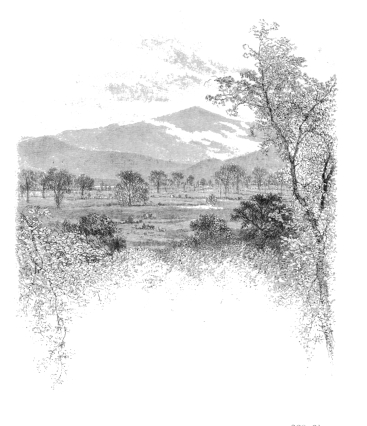
Again we scan the great peaks which in clear days come boldly down and stand at our very doors, but on hazy ones remove to a vast distance, keeping vaguely aloof day in and day out. Sometimes they are in the sulks, sometimes bold and forward. By turns they are graciously condescending, or tantalizingly incomprehensible. One time they muffle themselves in clouds from head to foot, so we cannot detect a suggestive line or a contour; another, throwing off all disguise, they expose their most secret beauties to the free gaze of the multitude. This is to set the beholder’s blood on fire with the passion to climb as high as those gray shafts of everlasting rock that so proudly survey the creeping leagues beneath them.
Nowhere is the unapproachable grandeur of Mount Washington more fully manifested than here. This large and impressive view is at once suggestive of that glorious pre-eminence always associated with high mountains. There are mountains, respectable ones too, in the middle distance; but over these the great peak lords it with undisputed sway. The bold and firm, though gradual, lines of ascent culminating at the apex, extend over leagues of sky. After a clear sunset, Mount Washington takes the same dull lead-color of the clouds hovering like enormous night-birds over its head.
North Conway permits, to the tourist, a choice of two very agreeable excursions, either of which may be made in a day, although they could profitably occupy a week. One is to follow the course of the Saco, through the great Notch, to Fabyans, where you are on the westward side of the great range, and where you take the rail to the summit of Mount Washington. The other excursion is to diverge from the Saco Valley three or four miles from North Conway, ascending the valley of Ellis River—one of the lame affluents of the Saco—through the Pinkham Notch to the Glen House, where you are exactly under the eastern foot of Mount Washington, and may ascend it, by the carriage-road, in a coach-and-four. We had already chosen the first route, and as soon as the roads were a little settled we began our march.
The storm was over. The keen north wind drove the mists in utter rout before it. Peak after peak started out of the clouds, glowered on us a moment, and then muffled his enormous head in fleecy vapor. The clouds seemed thronged with monstrous apparitions, struggling fiercely with the gale, which in pure wantonness tore aside the magic drapery that rendered them invisible, scattering its tattered rags far and wide over the valley.
Now the sun entered upon the work begun by the wind. Quicker than thought, a ray of liquid flame transfixed the vapors, flashed upon the vale, and, flying from summit to summit, kindled them with newborn splendor. One would have said a flaming javelin, hurled from high heaven, had just cleft its dazzling way to earth. The mists slunk away and hid themselves. The valley was inundated with golden light. Even the dark faces of the cliffs brightened and beamed upon the vale, where the bronzed foliage fluttered, and the river leaped for joy. In a little time nothing was left but scattered clouds winging their way toward the lowlands.
BARTLETT BOWLDER.
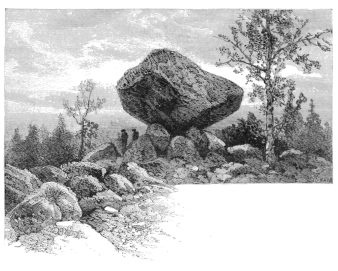
Near Glen Station is one of those curiosities—a transported boulder—which was undoubtedly left while on its travels through the mountains, poised upon four smaller ones, in the position seen in the engraving.
Three miles below the village of Bartlett we stopped before a farm-house, with the gable-end toward the road, to inquire the distance to the next tavern, where we meant to pass the night. A gruff voice from the inside growled something by way of reply; but as its owner, whoever he might be, did not take the trouble to open his door, the answer was unintelligible.
“The churl!” muttered the colonel. “I have a great mind to teach him to open when a gentleman knocks.”
“And I advise you not to try it,” said the voice from the inside.
The one thing a Kentuckian never shrinks from is a challenge. He only said, “Wait a minute,” while putting his broad shoulder against the door; but now George and I interfered. Neither of us had any desire to signalize our entry into the village by a brawl, and after some trouble we succeeded in pacifying our fire-eater with the promise to stop at this house on our way back.
“I shall know it again,” said the colonel, looking back, and nibbling his long mustache with suppressed wrath; “something has been spilled on the threshold—something like blood.”
We laughed heartily. The blood, we concluded, was in the colonel’s eyes.
Some time after nightfall we arrived in the village, having put thirteen miles of road behind us without fatigue. Our host received us with a blazing fire—what fires they do have in the mountains, to be sure!—a pitcher of cider, and the remark, “Don’t be afraid of it, gentlemen.”
All three hastened to reassure him on this point. The colonel began with a loud smack, and George finished the jug with a deep sigh.
“Don’t be afraid of it,” repeated the landlord, returning presently with a fresh pitcher. “There are five barrels more like it in the cellar.”
“Landlord,” quoth George, “let one of your boys take a mattress, two blankets, and a pillow to the cellar. I intend to pass the night there.”
“I only wish your well was full of it,” said the colonel, taking a second pull at the jug, and making a second explosion with his lips.
“Gentlemen,” said I, “we have surely entered a land of milk and honey.”
“You shall have as much of both as you desire,” said our host, very affably. “Supper is ready, gentlemen.”
After supper a man came in for whom I felt, upon the instant, one of those secret antipathies which are natural to me. The man was an utter stranger. No matter: the repugnance seized me all the same.
After a tour of the tap-room, and some words with our landlord in an undertone, the stranger went out with the look of a man who had asked for something and had been refused.
“Where have I heard that man’s voice?” said the colonel, thoughtfully.
Our landlord is one of the most genial to be found among the mountains. While sitting over the fire during the evening, the conversation turned upon the primitive simplicity of manners remarked among mountaineers in general; and our host illustrated it with this incident:
“You noticed, perhaps, a man who left here a few moments ago?” he began.
We replied affirmatively. It was my antipathy.
“Well, that man killed a traveller a few years back.”
We instinctively recoiled. The air seemed tainted with the murderer’s presence.
“Yes; dead as a mutton,” continued the landlord, punching the logs reflectively, and filling the chimney with sparks. “The man came to his house one dark and stormy night, and asked to be admitted. The man of the house flatly refused. The stranger pleaded hard, but the fellow ordered him away with threats. Finding entreaties useless, the traveller began to grow angry, and attempted to push open the door, which was only fastened by a button, as the custom is. The man of the house said nothing, but took his gun from a corner, and when the intruder crossed the threshold he put three slugs through him. The wounded man expired on the threshold, covering it with his blood.”
“Murdered him, and for that? Come, come, you are joking!” ejaculated George, with a half smile of incredulity.
“Blowed him right through, just as I tell you,” reiterated the narrator, without heeding the doubt George’s question implied.
“That sounds a little like Old Kentuck,” observed the colonel, coolly.
“Yes; but listen to the sequel, gentlemen,” resumed the landlord. “The murderer took the dead body in his arms, finding, to his horror, that it was an acquaintance with whom he had been drinking the day before; he took up the body, as I was saying, laid it out upon a table, and then went quietly to bed. In the morning he very honestly exhibited the corpse to all who passed his door, and told his story as I tell it to you. I had it from his own lips.”
“That beats Kentucky,” asseverated the colonel. For my own part, I believed the landlord was amusing himself at our expense.
“I don’t know about Kentucky,” observed the landlord; “I was never there in my life; but I do know that, when the dead man was buried, the man who killed him went to the funeral like any curious or indifferent spectator.”
This was too much. George rose from his chair, and began to be interested in a placard on the wall. “And you say this happened near here?” he slowly inquired; “perhaps, now, you could show us the very house?” he finished, dryly.
“Nothing easier. It’s only three miles back on the road you came. The blood-stain is plain, or was, on the threshold.”
We exchanged glances. This was the house where we halted to inquire our way. The colonel’s eyes dilated, but he said nothing.
“But was there no trial?” I asked.
“Trial? oh yes. After several days had run by, somebody thought of that; so one morning the slayer saddled his horse and rode over to the county-seat to inquire about it. He was tried at the next sessions, and acquitted. The judge charged justifiable homicide; that a man’s house is his fort; the jury did not leave their benches. By-the-bye, gentlemen, that is some of the man’s cider you are drinking.”
I felt decided symptoms of revolt in my stomach; George made a grimace, and the colonel threw his unfinished glass in the fire. During the remainder of the evening he rallied us a good deal on the subject of New England hospitality, but said no more about going back to chastise the man of the red house.[5]
The sun rose clear over the right shoulder of Kearsarge. After breakfast the landlord took us out and introduced us to his neighbors, the mountains. While he was making the presentation in due form, I jotted down the following, which has, at least, the merit of conciseness:
Upper Bartlett: an ellipse of fertile land; three Lombardy poplars; a river murmuring unseen; a wall of mountains, with Kearsarge looking up, and Carrigain looking down the intervale. Item: the cider is excellent.
We had before us the range extending between Swift River and the Saco, over which I looked from the summit of Chocorua straight to Mount Washington. To the east this range is joined with the out-works of Moat. Then come Table, Bear, Silver Spring (Bartlett Haystack), and Tremont, in the order named. Then comes the valley of Sawyer’s River, with Carrigain rising between its walls; then, crossing to the north side of the Saco, the most conspicuous object is the bold Hart’s Ledge, between which and Sawyer’s Rock, on the opposite bank, the river is crowded into a narrow channel. The mountain behind the hotel is Mount Langdon, with Crawford more distant. Observe closely the curious configuration of this peak. Whether we go up or down, it nods familiarly to us from every point of approach.
But Kearsarge and Carrigain are the grand features here. One gives his adieu, the other his welcome. One is the perfection of symmetry, of grace; the other simply demands our homage. His snowy crown, dazzling white against the pure blue, was the badge of an incontestable superiority. These two mountains are the presiding genii of this charming intervale. You look first at the massive lineaments of one, then at the flowing lines of the other, as at celebrated men, whose features you would strongly impress upon the memory.
From the village street we saw the sun go down behind Mount Carrigain, and touch with his glittering sceptre the crest of Hancock. We looked up the valley dominated by the giant of the Pemigewasset wilderness with feelings of high respect for this illustrious hermit, who only deigns to show himself from this single point, and whose peak long yielded only to the most persevering and determined climbers.
Two days were formerly required for the ascent of this mountain, but a long day will now suffice, thanks to the path constructed under the direction of the Appalachian Club. The mountain is four thousand six hundred and twenty-five feet above the sea, and is wooded to its summit. The valley of Sawyer’s River drains the deep basin between Carrigain and Hancock, entering the Saco near the railroad station called Livermore. The lumbermen have now penetrated this valley to the foot of the mountain, with their rude logging roads, offering a way soon, it is hoped, to be made plainer for future climbers than it was our lot to find it.
Thoroughly imbued with the spirit of the mountains, we now regarded distances with disdain, and fatigue with indifference. We had learned to make our toilets in the stream, and our beds in the fragrant groves. Truly, the bronzed faces that peered at us as we bent over some solemn, pine-shaded pool were not those we had been accustomed to seeing at home; but having solved the problem of man’s true existence, we only laughed at each other’s tawny countenances while shouldering our packs and tightening our belts for the day’s march.
Leaving Bartlett at an early hour, we turned aside from the highway a little beyond the bridge which spans Sawyer’s River, and were soon following a rough and stony cart-way ascending the banks of this stream, which thundered along its rocky bed, making the woods echo with its roar. The road grew rapidly worse, the river wilder, the forest gloomier, until, at the end of two miles, coming suddenly out into the sun, we entered a rude street of unpainted cabins, terminating at some saw-mills. This hamlet, which to the artistic eye so disadvantageously replaces the original forest, is the only settlement in the large township of Livermore. Its mission is to ravage and lay waste the adjacent mountains. Notwithstanding the occupation is legitimate, one instinctively rebels at the waste around him, where the splendid natural forest, literally hewed and hacked in pieces, exposes rudely all the deformities of the mountains. But this lost hamlet is the first in which a genuine emotion of any kind awaits the traveller. Ten to one it is like nothing he ever dreamed of; his surprise is, therefore, extreme. The men were rough, hardy-looking fellows; the women appeared contented, but as if hard work had destroyed their good looks prematurely. Both announced, by their looks and their manner, that the life they led was no child’s play; the men spoke only when addressed; the women stole furtive glances at us; the half-dressed children stopped their play to stare at the strangers. Here was neither spire nor bell. One cow furnished all the milk for the commonalty. The mills being shut, there was no sound except the river plashing over the rocks far down in the gorge below; and had I encountered such a place on the sea-coast or the frontier, I should at once have said I had stumbled upon the secret hold of outlaws and smugglers, into which signs, grips, and passwords were necessary to procure admission. To me, therefore, the hamlet of Livermore was a wholly new experience.
From this hamlet to the foot of the mountain is a long and uninteresting tramp of five miles through the woods. We found the walking good, and strode rapidly on, coming first to a wood-cutter’s camp pitched on the banks of Carrigain Brook, and next to the clearing they had made at the mountain’s foot. Here the actual work of the ascent began in earnest.
Carrigain is solid, compact, massive. It is covered from head to foot with forest. No incident of the way diverts the attention for a single moment from the severe exertion required to overcome its steeply inclined side; no breathing levels, no restful outlooks, no gorges, no precipices, no cascades break the monotony of the escalade. We conquer, as Napoleon’s grenadiers did, by our legs. It is the most inexorable of mountains, and the most exasperating. From base to summit you cannot obtain a cup of water to slake your thirst.
Two hours of this brought us out upon the bare summit of the great northern spur, beyond which the true peak rose a few hundred feet higher. Carrigain, at once the desire and the bugbear of climbers, was beneath our feet.
We have already examined, from the rocks of Chocorua, the situation of this peak. We then entitled it the Hub of the White Mountains. It reveals all the magnitude, unfolds the topography of the woody wilderness stretching between the Saco and the Pemigewasset valleys. As nearly as possible, it exhibits the same amazing profusion of unbroken forest, here and there darkly streaked by hidden watercourses, as when the daring foot of the first climber pressed the unviolated crest of the august peak of Washington. In all its length and breadth there is not one object that suggests, even remotely, the presence of man. We saw not even the smoke of a hunter’s camp. All was just as created; an absolute, savage, unkempt wilderness.
Heavens, what a bristling array of dark and shaggy mountains! Now and then, where water gleamed out of their hideous depths, a great brilliant eye seemed watching us from afar. We knew that we had only to look up to see a dazzling circlet of lofty peaks drawn around the horizon, chains set with glittering stones, clusters sparkling with antique crests; still we could not withdraw our eyes from the profound abysses sunk deep in the bowels of the land, typical of the uncovered bed of the primeval ocean, sad and terrible, from which that ocean seemed only to have just receded.
But who shall describe all this solitary, this oppressive grandeur? and what language portray the awfulness of these untrodden mountains? Now and then, high up their bleak summits, a patch of forest had been plucked up by the roots, or shaken from its hold in the throes of the mountain, laid bare a long and glittering scar, red as a half-closed wound. Such is the appearance of Mount Lowell, on the other side of the gap dividing Carrigain from the Notch mountains. We saw where the dark slope of Mount Willey gives birth to the infant Merrimack. We saw the confluent waters of this stream, so light of foot, speeding through the gloomy defiles, as if fear had given them wings. We saw the huge mass of Mount Hancock force itself slowly upward out of the press. Unutterable lawlessness stamped the whole region as its own.
That I have thus dwelt upon its most extraordinary feature, instead of examining the landscape in detail, must suffice for the intelligent reader. I have not the temerity to coolly put the dissecting-knife into its heart. To science the things which belong to science. Besides, to the man of feeling all this is but secondary. We are not here to make a chart.
After a visit to the high summit, where some work was done in the interest of future climbers, we set out at four in the afternoon, on our return down the mountain. A second time we halted on the spur to glance upward at the heap of summits over which Mount Washington lifts a regular dome. The long line of peaks, ascending from Crawford’s, seems approaching it by a succession of huge steps. It was after dark when we saw the lights of the village before us, and were again warmly welcomed by the rousing fire and smoking viands of mine host.
VII. VALLEY OF THE SACO.
With our faint heart the mountain strives; Its arms outstretched, the Druid wood Waits with its benedicte. Sir Launfal.
AT eight o’clock in the morning we resumed our march, with the intention of reaching Crawford’s the same evening. The day was cold, raw, and windy, so we walked briskly—sharp air and cutting wind acting like whip and spur.
I retain a vivid recollection of this morning. Autumn had passed her cool hand over the fevered earth. Soft as three-piled velvet, the green turf left no trace of our tread. The sky was of a dazzling blue, and frescoed with light clouds, transparent as gauze, pure as the snow glistening on the high summits. On both sides of us audacious mountains braced their feet in the valley; while others mounted over their brawny shoulders, as if to scale the heavens.
But what shall I say of the grand harlequinade of nature which the valley presented to our view? I cannot employ Victor Hugo’s odd simile of a peacock’s tail; that is more of a witticism than a description. The death of the year seemed to prefigure the glorious and surprising changes of color in a dying dolphin—putting on unparalleled beauty at the moment of dissolution, and so going out in a blaze of glory.
From the meagre summits enfiladed by the north wind, and where a solitary pine or cedar intensified the desolation, to the upper forests, the mountains bristled with a scanty growth of dead or dying trees. Those scattered birches, high up the mountain side, looked like quills on a porcupine’s back; that group, glistening in the morning sun, like the pipes of an immense organ. From this line of death, which vegetation crossed at its peril, the eye dropped down over a limitless forest of dark evergreen spotted with bright yellow. The effect of the sunlight on this foliage was magical. Myriad flambeaux illuminated the deep gloom, doubling the intensity of the sun, emitting rays, glowing, resplendent. This splendid light, which the heavy masses of orange seemed to absorb, gave a velvety softness to the lower ridges and spurs, covering their hard, angular lines with a magnificent drapery. The lower forests, the valley, were one vast sea of color. Here the bewildering melange of green and gold, orange and crimson, purple and russet, produced the effect of an immense Turkish rug—the colors being soft and rich, rather than vivid or brilliant. This quality, the blending of a thousand tints, the dreamy grace, the sumptuous profusion, the inexpressible tenderness, intoxicated the senses. Earth seemed no longer earth. We had entered a garden of the gods.
From time to time a scarlet maple flamed up in the midst of the forest, and its red foliage, scattered at our feet by the wind, glowed like flakes of fire beaten from an anvil. A tangled maze of color changed the road into an avenue bordered with rare and variegated plants. Autumn’s bright sceptre, the golden-rod, pointed the way. Blue and white daisies strewed the greensward.
After passing Sawyer’s River, the road turned abruptly to the north, skirting the base of the Nancy range. We were at the door of the second chamber in this remarkable gallery of nature.
Before crossing the threshold it is expedient to allude to the incident which has given a name not only to the mountain, but to the torrent we see tearing its impetuous way down from the upper forests. The story of Nancy’s Brook is as follows:
In the latter part of the last century, a maiden, whose Christian name of Nancy is all that comes down to us, was living in the little hamlet of Jefferson. She loved, and was betrothed to a young man of the farm. The wedding-day was fixed, and the young couple were on the eve of setting out for Portsmouth, where their happiness was to be consummated at the altar. In the trustfulness of love, the young girl confided the small sum which constituted all her marriage-portion to her lover. This man repaid her simple faith with the basest treachery. Seizing his opportunity, he left the hamlet without a word of explanation or of adieu. The deserted maiden was one of those natures which cannot quietly sit down under calamity. Urged on by the intensity of her feelings, she resolved to pursue her recreant lover. He could not resist her prayers, her entreaties, her tears! She was young, vigorous, intrepid. With her to decide and to act were the same thing. In vain the family attempted to dissuade her from her purpose. At nightfall she set out.
A hundred years ago the route taken by this brave girl was not, as to-day, a thoroughfare which one may follow with his eyes shut. It was only an obscure path, little travelled by day, deserted by night. For thirty miles, from Colonel Whipple’s, in Jefferson, to Bartlett, there was not a human habitation. The forests were filled with wild beasts. The rigor of the season—it was December—added its own perils. But nothing could daunt the heroic spirit of Nancy; she had found man more cruel than all besides.
NANCY IN THE SNOW.
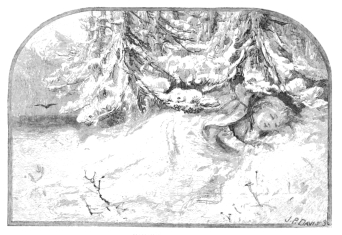
The girl’s hope was to overtake her lover before dawn at the place where she expected he would have camped for the night. She found the camp deserted, and the embers extinguished. Spurred on by hope or despair, she pushed on down the tremendous defile of the Notch, fording the turbulent and frozen Saco, and toiling through deep snows and over rocks and fallen trees, until, feeling her strength fail, she sunk exhausted on the margin of the brook which seems perpetually bemoaning her sad fate. Here, cold and rigid as marble, under a canopy of evergreen which the snow tenderly drooped above, they found her. She was wrapped in her cloak, and in the same attitude of repose as when she fell asleep on her nuptial couch of snow-crusted moss.
The story goes that the faithless lover became a hopeless maniac on learning the fate of his victim, dying in horrible paroxysms not long after. Tradition adds that for many years, on every anniversary of her death, the mountains resounded with ravings, shrieks, and agonized cries, which the superstitious attributed to the unhappy ghost of the maniac lover.[6]
It was not quite noon when we entered the beautiful and romantic glen under the shadow of Mount Crawford. Upon our left, a little in advance, a solidly-built English country-house, with gables, stood on a terrace well above the valley. At our right, and below, was the old Mount Crawford tavern, one of the most ancient of mountain hostelries. Upon the opposite side of the vale rose the enormous mass of Mount Crawford; and near where we stood, a humble mound, overgrown with bushes, enclosed the mortal remains of the hardy pioneer whose monument is the mountain.
We had an excusable curiosity to see a man who, in the prime of life, had forsaken the city, its pleasures, its opportunities, and had come to pass the rest of his life among these mountains; one, too, whose enormous possessions procured for him the title of Lord of the Valley. We heard with astonishment that our day’s journey, of which we had completed the half only, was wholly over his tract—I ought to say his dominions—that is, over thirteen miles of field, forest, and mountain. This being equal to a small principality, it seemed quite natural and proper to approach the proprietor with some degree of ceremony.
A servant took our cards at the door, and returned with an invitation to enter. The apartment into which we were conducted was the most singular I have ever seen; certainly it has no counterpart in this world, unless the famous hut of Robinson Crusoe has escaped the ravages of time. It was literally crammed with antique furniture, among which was a high-backed chair used in dentistry; squat little bottles, containing chemicals; and a bench, on which was a spirit-lamp; a turning-lathe, a small portable furnace, and a variety of instruments or tools of which we did not know the use. A few prints and oil-paintings adorned the walls. A cheerful fire burnt on the hearth.
“Were we in the sixteenth century,” said George, “I should say this was the laboratory of some famous alchemist.”
ABEL CRAWFORD.
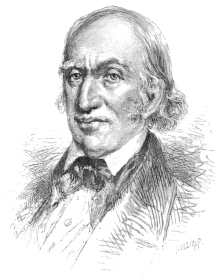
Further investigation was cut short by the entrance of our host, who was a venerable-looking man, turned of eighty, with a silver beard falling upon his breast, and a general expression of benignity. He stooped a little, but seemed hale and hearty, notwithstanding the weight of his fourscore years.
Doctor Bemis received us graciously. For an hour he entertained us with the story of his life among the mountains, “to which,” said he, “I credit the last forty-five years—for I at first came here in pursuit of health.” After he had satisfied our curiosity concerning himself, which he did with perfect bonhomie, I asked him to describe Abel Crawford, the veteran guide of the White Hills.
“Abel,” said the doctor, “was six feet four; Erastus, the eldest son, was six feet six, or taller than Washington; and Ethan was still taller, being nearly seven feet. In fact, not one of the sons was less than six feet; so you may imagine what sort of family group it was when ‘his boys,’ as Abel loved to call them, were all at home. Ah, well!” continued the doctor, with a sigh, “that kind of timber does not flourish in the mountains now. Why, the very sight of one of those giants inspired the timid with confidence. Ethan, called in his day the Giant of the Hills, was a man of iron frame and will. Fear and he were strangers. He would take up an exhausted traveller in his sinewy arms and carry him as you would a baby, until his strength or courage returned. The first bridle-path up the mountain was opened by him in—let me see—ah! I have it, it was in 1821. Ethan, with the help of his father, also built the Notch House above.[7]
“Abel was long-armed, lean, and sinewy. Doctor Dwight, whose ‘Travels in New England’ you have doubtless read, stopped with Crawford, on his way down the Notch, in 1797. His nearest neighbor then, on the north, was Captain Rosebrook, who lived on or near the site of the present Fabyan House. Crawford’s life of hardship had made little impression on a constitution of iron. At seventy-five he rode the first horse that reached the summit of Mount Washington. At eighty he often walked to his son’s (Thomas J. Crawford), at the entrance of the Notch, before breakfast. I recollect him perfectly at this time, and his appearance was peculiarly impressive. He was erect and vigorous as one of those pines on yonder mountain. His long white hair fell down upon his shoulders, and his fresh, ruddy face was always expressive of good-humor.
“The destructive freshet of 1826,” continued the doctor, “swept everything before it, flooding the intervale, and threatening the old house down there with instant demolition. During that terrible night, when the Willey family perished, Mrs. Crawford was alone with her young children in the house. The water rose with such rapidity that she was driven to the upper story for safety. While here, the thud of floating trees, driven by the current against the house, awakened new terrors. At every concussion the house trembled. Wooden walls could not long stand that terrible pounding. The heroic woman, alive to the danger, seized a stout pole, and, going to the nearest window, kept the side of the house exposed to the flood free from the mass of wreck-stuff collected against it. She held her post thus throughout the night, until the danger had passed. When the flood subsided, Crawford found several fine trout alive in his cellar.”
“When do the great freshets usually occur?” I asked.
“In the autumn,” replied our host. “It is not the melting snows, but the sudden rainfalls that we fear.”
“Yes,” resumed he, reflectively, “the Crawfords were a family of athletes. With them the race of guides became extinct. Soon after settling here, Abel went with his wife to Bartlett on some occasion, leaving their two boys in the care of a hired man. When they had gone, this man took what he could find of value and decamped. When Abel returned, which he did on the following day, he immediately set out in pursuit of the thief, overtook him thirty miles from here, in the Franconia forests, flogged him within an inch of his life, and let him go.”
“Sixty miles on foot, and alone, to recover a few stolen goods, and punish a thief!” cried the astonished colonel; “that beats Daniel Boone.”
“Yes; and what is more, the boys were brought up to face hunger, cold, fatigue, with Indian stoicism, and even to encounter bears, lynxes, and wolves with no other weapons than those provided by nature. There, now, was Ethan, for example,” said the doctor, smiling at the recollection. “One day he took it into his head to have a tame bear for the diversion of his guests. Well, he caught a young one, half grown, and remarkably vicious, in a trap. But how to get him home! At length Ethan tied his fore and hind paws together so he couldn’t scratch, and put a muzzle of withes over his nose so he couldn’t bite. Then, shouldering his prize as he would a bag of meal, the guide started for home, in great glee at the success of his clever expedient. He had not gone far, however, before Bruin managed to get one paw wholly and his muzzle partly free, and began to scratch and struggle and snap at his captor savagely. Ethan wanted to get the bear home terribly; but, after having his clothing nearly torn off his back, he grew angry, and threw the beast upon the ground with such force as to kill him instantly.”
“Report,” said I, “credits you with naming most of the mountains which overlook the intervale.”
“Yes,” replied the doctor, “Resolution, over there”—indicating the mountain allied to Crawford, and to the ridge which forms one of the buttresses of Mount Washington—“I named in recognition of the perseverance of Mr. Davis, who became discouraged while making a path to Mount Washington in 1845.”
“Is the route practicable?” I asked.
“Practicable, yes; but nearly obliterated, and seldom ascended. Have you seen Frankenstein?” demanded the doctor, in his turn.
We replied in the negative.
“It will repay a visit. I named it for a young German artist who passed some time with me, and who was fascinated by its rugged picturesqueness. Here is some of his work,” pointing to the paintings which, apparently, formed the foundation of the collection on the walls.
Our host accompanied us to the door with a second injunction not to forget Frankenstein.
“You have something there good for the eyes,” I observed, indicating the green carpet of the vale beneath us.
“True; but you should have seen it when the deer boldly came down the mountain and browsed quietly among the cattle. That was a pretty sight, and one of frequent occurrence when I first knew the place. At that time,” he continued, “the stage passed up every other day. Sometimes there were one or two, but seldom three passengers.”
Proceeding on our way, we now had a fine view of the Giant’s Stairs, which we had already seen from Mount Carrigain, but less boldly outlined than they appear from the valley, where they really look like two enormous steps cut on the very summit of the opposite ridge. No name could be more appropriate, though each of the degrees of this colossal staircase demands a giant not of our days; for they are respectively three hundred and fifty, and four hundred and fifty feet in height. It was over those steps that the Davis path ascended.
A mile or a mile and a half above the Crawford Glen, we emerged from behind a projecting spur of the mountain which hid the upper valley, when, by a common impulse, we stopped, fairly stupefied with admiration and surprise.
Thrust out before us, athwart the pass, a black and castellated pile of precipices shot upward to a dizzy height, and broke off abruptly against the sky. Its bulging sides and regular outlines resembled the clustered towers and frowning battlements of some antique fortress built to command the pass. Gashed, splintered, defaced, it seemed to have withstood for ages the artillery of heaven and the assaults of time. With what solitary grandeur it lifted its mailed front above the forest, and seemed even to regard the mountains with disdain! Silent, gloomy, impregnable, it wanted nothing to recall those dark abodes of the Thousand and One Nights, in which malignant genii are imprisoned for thousands of years.
This was Frankenstein. We at once accord it a place as the most suggestive of cliffs. From the other side of the valley the resemblance to a mediæval castle is still more striking. It has a black gorge for a moat, so deep that the head swims when crossing it; and to-day, as we crept over the cat’s-cradle of a bridge thrown across for the passage of the railway, and listened to the growling of the torrent far down beneath, the whole frail structure seemed trembling under us.
But what a contrast! what a singular freak of nature! At the foot of this grisly precipice, clothing it with almost superhuman beauty, was a plantation of maples and birches, all resplendent in crimson and gold. Never have I seen such masses of color laid on such a background. Below all was light and splendor; above, all darkness and gloom. Here the eye fairly revelled in beauty, there it recoiled in terror. The cliff was like a naked and swarthy Ethiopian up to his knees in roses.
We walked slowly, with our eyes fixed on these cliffs, until another turn of the road—we were now on the railway embankment—opened a vista deserving to be remembered as one of the marvels of this glorious picture-gallery.
The perfection and magnificence of this truly regal picture, the gigantic scale on which it is presented, without the least blemish to mar its harmony or disturb the impression of one grand, unique whole, is a revelation to the least susceptible nature in the world.
Frankenstein was now a little withdrawn, on our left. Upon the right, fluttering its golden foliage as if to attract our attention, a plantation of tall, satin-stemmed birches stretched for some distance along the railway. Between the long buttress of the cliff and this forest lay open the valley of Mount Washington River, which is driven deep into the heart of the great range. There, through this valley, cutting the sapphire sky with their silver silhouette, were the giant mountains, surmounted by the splendid dome of Washington himself.
STORM ON MOUNT WILLEY.
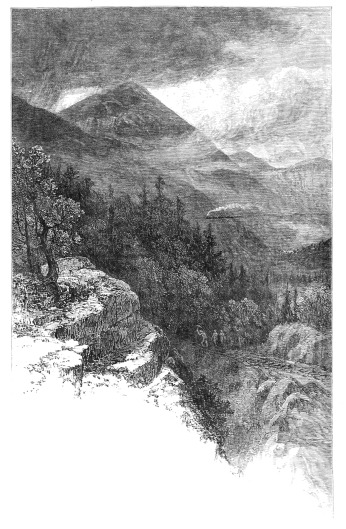
Passing beyond, we had a fine retrospect of Crawford, with his curved horn; and upon the dizzy iron bridge thrown across the gorge beneath Frankenstein, striking views are obtained of the mountains below. They seemed loftier and grander, and more imposing than ever.
Turning our faces toward the north, we now beheld the immense bulk and superb crest of Willey. On the other side of the valley was the long battlement of Mount Webster. We were at the entrance of the great Notch.
VIII. THROUGH THE NOTCH.
Around his waist are forests braced, The avalanche in his hand.—Byron.
THE valley, which had continually contracted since leaving Bartlett, now appeared fast shut between these two mountains; but on turning the tremendous support which Mount Willey flings down, we were in presence of the amazing defile cloven through the midst, and giving entrance to the heart of the White Hills.
These gigantic mountains divided to the right and left, like the Red Sea before the Israelites. Through the immense trough, over which their crests hung suspended in mid-air, the highway creeps and the river steals away. The road is only seen at intervals through the forest; a low murmur, like the hum of bees, announces the river.
I have no conception of the man who can approach this stupendous chasm without a sensation of fear. The idea of imminent annihilation is everywhere overwhelming. The mind refuses to reason, or rather to fix itself, except on a single point. What if the same power that commanded these awful mountains to remove should hurl them back to ever-during fixedness? Should, do I say? The gulf seemed contracting under our very eyes—the great mountains toppling to their fall. With an eagerness excited by high expectation, we had pressed forward; but now we hesitated.
This emotion, which many of my readers have doubtless partaken, was our tribute to the dumb but eloquent expression of power too vast for our feeble intellects to measure. It was the triumph of matter over mind; of the finite over the infinite.
Below, it was all admiration and surprise; here, all amazement and fear. The more the mountains exalted themselves, the more we were abased. Trusting, nevertheless, in our insignificance, we moved on, looking with all our eyes, absorbed, silent, and almost worshipping.
The wide split of the Notch, which we had now entered, had on one side Mount Willey, drawn up to his full height; and on the other Mount Webster, striped with dull red on clingy yellow, like an old tiger’s skin. Willey is the highest; Webster the most remarkable. Willey has a conical spire; Webster a long, irregular battlement. Willey is a mountain; Webster a huge block of granite.
For two miles the gorge winds between these mountains to where it is apparently sealed up by a sheer mass of purple precipices lodged full in its throat. This is Mount Willard. The vast chasm glowed with the gorgeous colors of the foliage, even when a passing cloud obscured the sun. These general observations made, we cast our eyes down into the vale reposing at our feet. We had chosen for our point of view that to which Abel Crawford conducted Sir Charles Lyell in 1845. The scientist has made the avalanche bear witness to the glacier, precisely as one criminal is made to convict another under our laws.
Five hundred feet below us was a little clearing, containing a hamlet of two or three houses. From this hamlet to the storm-crushed crags glistening on the summit of Mount Willey the track of an old avalanche was still distinguishable, though the birches and alders rooted among the débris threatened to obliterate it at no distant day.
We descended by this still plain path to the houses at the foot of the mountain. One and the other are associated with the most tragic event connected with the history of the great Notch.
We found two houses, a larger and smaller, fronting the road, neither of which merits a description; although evidence that it was visited by multitudes of curious pilgrims abounded on the walls of the unoccupied building.
Since quite early in the century, this house was kept as an inn; and for a long time it was the only stopping-place between Abel Crawford’s below and Captain Rosebrook’s above—a distance of thirteen miles. Its situation, at the entrance of the great Notch, was advantageous to the public and to the landlord, but attended with a danger which seems not to have been sufficiently regarded, if indeed it caused successive inmates particular concern. This fatal security had a lamentable sequel.
MOUNT WILLARD FROM WILLEY BROOK.
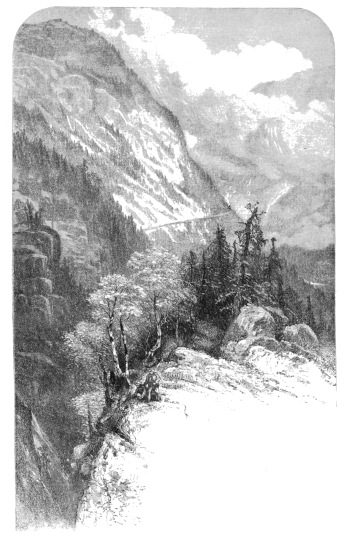
In 1826 this house was occupied by Samuel Willey, his wife, five children, and two hired men. During the summer a drought of unusual severity dried the streams, and parched the thin soil of the neighboring mountains. On the evening of the 26th of June, the family heard a heavy, rumbling noise, apparently proceeding from the mountain behind them. In terror and amazement they ran out of the house. They saw the mountain in motion. They saw an immense mass of earth and rock detach itself and move toward the valley, at first slowly, then with gathered and irresistible momentum. Rocks, trees, earth, were swooping down upon them from the heights in three destroying streams. The spectators stood rooted to the spot. Before they could recover their presence of mind the avalanche was upon them. One torrent crossed the road only ten rods from the house; another a little distance beyond; while the third and largest portion took a different direction. With great labor a way was made over the mass of rubbish for the road. The avalanche had shivered the largest trees, and borne rocks weighing many tons almost to the door of the lonely habitation.
This awful warning passed unheeded. On the 28th of August, at dusk, a storm burst upon the mountains, and raged with indescribable fury throughout the night. The rain fell in sheets. Innumerable torrents suddenly broke forth on all sides, deluging the narrow valley, and bearing with them forests that had covered the mountains for ages. The swollen and turbid Saco rose over its banks, flooding the Intervales, and spreading destruction in its course.
Two days afterward a traveller succeeded in forcing his way through the Notch. He found the Willey House standing uninjured in the midst of woful desolation. A second avalanche, descended from Mount Willey during the storm, had buried the little vale beneath its ruins. The traveller, affrighted by the scene around him, pushed open the door. As he did so, a half-famished dog, sole inmate of the house, disputed his entrance with a mournful howl. He entered. The interior was silent and deserted. A candle burnt to the socket, the clothing of the inmates lying by their bedsides, testified to the haste with which this devoted family had fled. The death-like hush pervading the lonely cabin—these evidences of the horrible and untimely fate of the family—the appalling scene of wreck all around, froze the solitary intruder’s blood. In terror he, too, fled from the doomed dwelling.
On arriving at Bartlett, the traveller reported what he had seen. Assistance was despatched to the scene of disaster. The rescuers came too late to render aid to the living, but they found, and buried on the spot, the bodies of Mr. and Mrs. Willey, and the two hired men. The remaining children were never found.
It was easily conjectured that the terrified family, alive at last to the appalling danger that menaced them, and feeling the solid earth tremble in the throes of the mountain, sought safety in flight. They only rushed to their doom. The discovery of the bodies showed but too plainly the manner of their death. They had been instantly swallowed up by the avalanche, which, in the inexplicable order of things visible in great calamities, divided behind the house, leaving the frail structure unharmed, while its inmates were hurried into eternity.[8]
For some time after the disaster a curse seemed to rest upon the old Notch House. No one would occupy it. Travellers shunned it. It remained untenanted, though open to all who might be driven to seek its inhospitable shelter, until the deep impression of horror which the fate of the Willey family inspired had, in a measure, effaced itself.
The effects of the cataclysm were everywhere. For twenty-one miles, almost its entire length, the turnpike was demolished. Twenty-one of the twenty-three bridges were swept away. In some places the meadows were buried to the depth of several feet beneath sand, earth, and rocks; in others, heaps of great trees, which the torrent had torn up by the roots, barricaded the route. The mountains presented a ghastly spectacle. One single night sufficed to obliterate the work of centuries, to strip their summits bare of verdure, and to leave them with shreds of forest and patches of shrubbery hanging to their stark and naked sides. Thus their whole aspect was altered to an extent hardly to be realized to-day, though remarked with mingled wonder and dread long after the period of the convulsion.
From the house our eyes naturally wandered to the mountain, where quarrymen were pecking at its side like yellow-hammers at a dead sycamore. All at once a tremendous explosion was heard, and a stream of loosened earth and bowlders came rattling down the mountain. So unexpected was the sound, so startling its multiplied echo, it seemed as if the mountain had uttered a roar of rage and pain, which was taken up and repeated by the other mountains until the uproar became deafening. When the reverberation died away in the distance, we again heard the metallic click of the miners’ hammers chipping away at the gaunt ribs of Mount Willey.
How does it happen that this catastrophe is still able to awaken the liveliest interest for the fate of the Willey family? Why is it that the oft-repeated tale seems ever new in the ears of sympathetic listeners? Our age is crowded with horrors, to which this seems trifling indeed. May we not attribute it to the influence which the actual scene exerts on the imagination? One must stand on the spot to comprehend; must feel the mysterious terror to which all who come within the influence of the gorge submit. Here the annihilation of a family is but the legitimate expression of that feeling. It seems altogether natural to the place. The ravine might well be the sepulchre of a million human beings, instead of the grave of a single obscure family.
We reached the public-house, at the side of the Willey house, with appetites whetted by our long walk. The mercury had only risen to thirty-eight degrees by the thermometer nailed to the door-post. We went in.
In general, the mountain publicans are not only very obliging, but equal to even the most unexpected demands. The colonel, who never brags, had boasted for the last half-hour what he was going to do at this repast. In point of fact, we were famishing.
A man was standing with his back to the fire, his hands thrust underneath his coat-tails, and a pipe in his mouth. Either the pipe illuminated his nose, or his nose the pipe. He also had a nervous contraction of the muscles of his face, causing an involuntary twitching of the eyebrows, and at the same time of his ears, up and down. This habit, taken in connection with the perfect immobility of the figure, made on us the impression of a statue winking. We therefore hesitated to address it—I mean him—until a moment’s puzzled scrutiny satisfied us that it—I mean the strange object—was alive. He merely turned his head when we entered the room, wagged his ears playfully, winked furiously, and then resumed his first attitude. In all probability he was some stranger like ourselves.
I accosted him. “Sir,” said I, “can you tell us if it is possible to procure a dinner here?”
The man took the pipe from his mouth, shook out the ashes very deliberately, and, without looking at me, tranquilly observed,
“You would like dinner, then?”
“Would we like dinner? We breakfasted at Bartlett, and have passed six hours fasting.”
“And eleven miles. You see, a long way between meals,” interjected George, with decision.
“It’s after the regular dinner,” drawled the apathetic smoker, using his thumb for a stopper, and stooping for a brand with which to relight his pipe.
“In that case we are willing to pay for any additional trouble,” I hastened to say.
The man seemed reflecting. We were hungry; that was incontestable; but we were also shivering, and he maintained his position astride the hearth-stone, like the fabled Colossus of old.
“A cold day,” said the colonel, threshing himself.
“I did not notice it,” returned the stranger, indifferently.
“Only thirty-eight at the door,” said George, stamping his feet with unnecessary vehemence.
“Indeed!” observed our man, with more interest.
“Yes,” George asserted; “and if the fireplace were only larger, or the screen smaller.”
The man hastily stepped aside, knocking over, as he did so, a blazing brand, which he kicked viciously back into the fire.
Having carried the outworks, we approached the citadel. “Perhaps, sir,” I ventured, “you can inform us where the landlord may be found?”
“You wanted dinner, I believe?” The tone in which this question was put gave me goose-flesh. I could not speak, George dropped into a chair. The colonel propped himself against the chimney-piece. I shrugged my shoulders, and nodded expressively to my companions, who returned two glances of eloquent dismay. Evidently nothing was to be got out of this fellow.
“Dinner for one?” continued the eternal smoker.
“For three!” I exclaimed, out of all patience.
“For four; I shall eat double,” added the colonel.
“Six!” shouted George, seizing the dinner-bell on the mantel-piece.
“Stop,” said the man, betraying a little excitement; “don’t ring that bell.”
“Why not?” demanded George; “we want to see the landlord; and, by Jove,” brandishing the bell aloft, “see him we will!”
“He stands before you, gentlemen; and if you will have a little patience I will see what can be done.” So saying, he put his pipe on the chimney-piece, wiped his mouth with the back of his hand, and went out, muttering, as he did so. “The world was not made in a day.”
In three-quarters of an hour we sat down to a funereal repast, the bare recollection of which makes me ill, but which was enlivened by the following conversation:
“How many inhabitants are in your tract?” I asked of the man who waited on us.
“Do you mean inhabitants?”
“Certainly, I mean inhabitants.”
“Well, that’s not an easy one.”
“How so?”
“Because the same question not only puzzled the State Legislature, but made the attorney-general sick.”
We became attentive.
“Explain that, if you please,” said I.
“Why, just look at it: with only eight legal voters in the tract” (he called it track), “we cast five hundred ballots at the State election.”
“Five hundred ballots! then your voters must have sprung from the ground or from the rocks.”
“Pretty nearly so.”
“Actual men?”
“Actual men.”
“You are jesting.”
My man looked at me as if I had offered him an affront. The supposition was plainly inadmissible. He was completely innocent of the charge.
“You hear those men pounding away up the hill?” he demanded, jerking his thumb in the direction indicated.
“Yes.”
“Well, those are the five hundred voters. On election morning they came to the polling-place with a ballot in one hand, and a pick, a sledge, or a drill in the other. Our supervisor is a very honest, blunt sort of man: he refused their ballots on the spot.”
“Well?”
“Well, one of them had a can of nitro-glycerine and a coil of wire. He deposited his can in a corner, hitched on the wire, and was going out with his comrades, when the supervisor, feeling nervous, said,
“‘The polls are open, gentlemen.’”
“Ingenious,” remarked George.
The man looked astounded.
“He means dangerous,” said I; “but go on.”
“I will. When the votes were counted, at sundown, it was found that our precinct had elected two representatives to the General Court. But when the successful candidates presented their certificates at Concord, some meddlesome city fellow questioned the validity of the election. The upshot of it was that the two nitro-glycerites came back with a flea in each ear.”
“And the five hundred were disfranchised,” said George.
“Why, as to that, half were French Canadians, half Irish, and the devil knows what the rest were; I don’t.”
“Never mind the rest. You see,” said George, rising, “how, with the railway, the blessings of civilization penetrate into the dark corners of the earth.”
The colonel began his sacramental, “That beats—” when he was interrupted by a second explosion, which shook the building. We paid our reckoning, George saying, as he threw his money on the table, “A heavy charge.”
“No more than the regular price,” said the landlord, stiffly.
“I referred, my dear sir, to the explosion,” replied George, with the sardonic grin habitual to him on certain occasions.
“Oh!” said the host, resuming his pipe and his fireplace.
We spent the remaining hours of this memorable afternoon sauntering through the Notch, which is dripping with cascades, and noisy with mountain torrents. The Saco, here nothing but a brook, crawls languidly along its bed of broken rock. From dizzy summit to where they meet the river, the old wasted mountains sit warming their scarred sides in the sun. Looking up at the passage of the railway around Mount Willey, it impressed us as a single fractured stone might have done on the Great Pyramid, or a pin’s scratch on the face of a giant. The locomotive, which groped its way along its broken shell, stopped, and stealthily moving again, seemed a mouse that the laboring mountain had brought forth. But when its infernal clamor broke the silence, what demoniacal yells shook the forests! Farewell to our dream of inviolable nature. The demon of progress had forced his way into the very sanctuary. There were no longer any White Mountains.
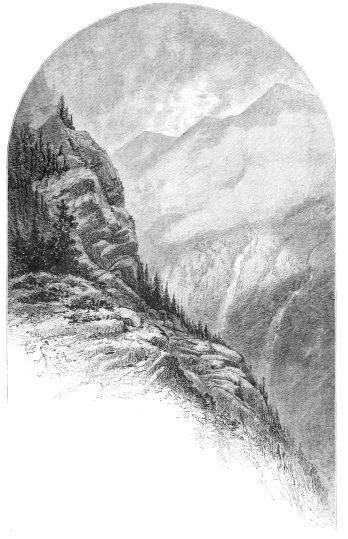
We passed by the beautiful brook Kedron, flung down from the utmost heights of Willey, between banks mottled with colors. Then, high up on our right, two airy water-falls seemed to hang suspended from the summit of Webster. These, called respectively the Silver Cascade, and the Flume withdrew the attention from every other object, until a sharp turn to the right brought the overhanging precipice of Mount Willard full upon us. This enormous mass of granite, rising seven hundred feet above the road, stands in the very jaws of the gorge, which it commands from end to end.
THE CASCADES, MOUNT WEBSTER.
Here the railway seems fairly stopped; but with a graceful sweep it eludes the mountain, and glides around its massive shoulder, giving, as it does so, a hand to the high-road, which comes straggling up the sharp ascent. The river, now shrunken to a rivulet, is finally lost to view beneath heaped-up blocks of granite, which the infuriated old mountain has hurled down upon it. It is heard painfully gurgling under the ruins, like a victim crushed, and dying by inches.
Now and here we entered a close, dark defile hewn down between cliffs, ascending on the right in regular terraces, on the left in ruptured masses. These terraces were fringed at the top with tapering evergreens, and displayed gaudy tufts of maple and mountain-ash on their cool gray. Those on the right are furthermore decorated with natural sculptures, indicated by sign-boards, which the curious investigate profitably or unprofitably, according to their fertility of imagination.
For a few rods this narrow cleft continues; then, on a sudden, the rocks which lift themselves on either side shut together. An enormous mass has tumbled from its ancient location on the left side, and, taking a position within twenty feet of the opposite precipice, forms the natural gate of the Notch, through which a way was made for the common road with great labor, through which the river frays a passage, but where no one would imagine there was room for either. The railway has made a breach for itself through the solid rock, greatly diminishing the native grandeur of the place. All three emerge from the shadow and gloom of the pass into the cheerful sunshine of a little prairie, at the extremity of which are seen the white walls of a hotel.
The whole route we had traversed is full of contrasts, full of surprises; but this sudden transition was the most picturesque, the most startling of all. We seemed to have reached the end of the world.
IX. CRAWFORD’S.
The seasons alter: hoary-headed frosts Fall in the fresh lap of the crimson rose. Shakspeare.
ALL who have passed much time at the mountains have seen the elephant—near the gate of the Notch.
Though it is only from Nature’s chisel, the elephant is an honest one, and readily admitted into the category of things curious or marvellous constantly displayed for our inspection. Standing on the piazza of the hotel, the enormous forehead and trunk seem just emerging from the shaggy woods near the entrance to the pass. And the gray of the granite strengthens the illusion still more. From the Elephant’s Head, a title suggestive of the near vicinity of a public-house, there is a fine view down the Notch for those who cannot ascend Mount Willard.
The Crawford House, being built at the highest point of the pass, nearly two thousand feet above the sea, is not merely a hotel—it is a water-shed. The roof divides the rain falling upon it into two streams, flowing on one side into the Saco, on the other into the Ammonoosuc. Here the sun rises over the Willey range, and sets behind Mount Clinton. The north side of the piazza enables you to look over the forests into the valley of the Ammonoosuc, where the view is closed by the chain dividing this basin from that of Israel’s River. But we are not yet ready to conduct the reader into this Promised Land.
My window overlooked a grassy plain of perhaps half a mile, the view being closed by the Gate of the Notch, now disfigured by snow-sheds built for the protection of the railway. The massive, full-rounded bulk of Webster rose above, the forests of Willard tumbled down into the ragged fissure. Half-way between the hotel and the Gate, over-borne by the big shadow of Mount Clinton, extends the pretty lakelet which is the fountain-head of the Saco. Beyond the lake, and at the left, is where the old Notch House stood. This lake was once a beaver-pond, and this plain a boggy meadow, through which a road of corduroy and sods conducted the early traveller. The highway and railway run amicably side by side, dividing the little vale in two.
ELEPHANT’S HEAD, WINTER.
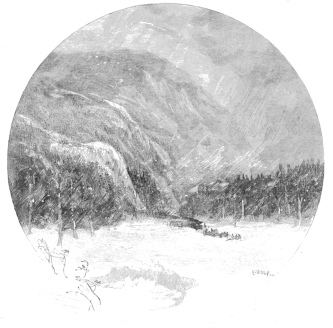
This pass, which was certainly known to the Indians, was, in 1771, rediscovered by Timothy Nash, a hunter, who was persuaded by Benjamin Sawyer, another hunter, to admit him to an equal share in the discovery. In 1773 Nash and Sawyer received a grant of 2184 acres, skirting the mountains on the west, as a reward. With the prodigality characteristic of their class, the hunters squandered their large acquisition in a little time after it was granted. Both the Crawford and Fabyan hotels stand upon their tract.
Of many excursions which this secluded retreat offers, that to the summit of Mount Washington, by the bridle-path opened in 1840 by Thomas J. Crawford, and that to the top of Mount Willard, are the principal. The route to the first begins opposite to the hotel, at the left; the latter turns from the glen a quarter of a mile below, on the right. Supposing Mount Washington a cathedral set on an eminence, you are here on the summit of the eminence, with one foot on the immense staircase of the cathedral.
Our resolve to ascend by the bridle-path was already formed, and we regarded the climb up Mount Willard as indispensable. As for the cascades, which lulled us to sleep, who shall describe them? We could not lift our eyes to the heights above without seeing one or more fluttering in the play of the breeze, and making rainbows in pure diversion. President Dwight, in his “Travels,” has no more eloquent passage than that describing the Flume Cascade. How many since have thrown down pen or pencil in sheer despair of reproducing, by words or pigments, the aerial lightness, the joyous freedom; above all, the exuberant, unquenchable vitality that characterize mountain water-falls! Down the Notch is a masterpiece, hidden from the eye of the passer-by, called Ripley Falls, which fairly revels in its charming seclusion. Only a short walk from the hotel, by a woodland path, there is another, Beecher’s Cascade, whose capricious leaps and playful somersaults, all the while volubly chattering to itself, like a child alone with its playthings, fascinates us, as sky, water, and fire charm the eyes of an infant. It is always tumbling down, and as often leaping to its feet to resume its frolicsome gambols, with no loss of sprightliness or sign of weariness that we can detect. Only a lover may sing the praises of these mountain cascades falling from the skies:
“The torrent is the soul of the valley. Not only is it the Providence or the scourge, often both at once, but it gives to it a physiognomy; it gladdens or saddens it; it lends it a voice; it communicates life to it. A valley without its torrent is only a hole.”
They give the name of Idlewild to the romantic sylvan retreat, reached by a winding path, diverging near the hotel, on the left. I visited it in company with Mr. Atwater, whose taste and enthusiasm for the work have converted the natural disorder of the mountain side into a trysting-place fit for elves and fairies; but where one encounters ladies in elegant toilets, enjoying a quiet stroll among the fern-draped rocks. Some fine vistas of the valley mountains have been opened through the woods—beautiful little bits of blue, framed in illuminated foliage. One notes approvingly the revival of an olden taste in the cutting and shaping of trees into rustic chairs, stairways, and arbors.
After a day like ours, the great fires and admirable order of the hotel were grateful indeed. If it is true that the way to man’s heart lies through his stomach, the cherry-lipped waiter-girl, who whispered her seductive tale in my too-willing ear at supper, made a veritable conquest. My compliments to her, notwithstanding the penalty paid for lingering too long over the griddle-cakes.
The autumn nights being cool, it was something curious to see the parlor doors every now and then thrown wide open, to admit a man who came trundling in on a wheelbarrow a monster log fit for the celebration of Yule-tide. The city guest, accustomed to the economy of wood at home, because it is dear, looks on this prodigality first with consternation, and finally with admiration. When the big log is deposited on the blazing hearth amid fusees of sparks, the easy-chairs again close around the fireplace a charmed circle; and while the buzz of conversation goes on, and the faces are illuminated by the ruddy glow, the wood snaps, and hisses, and spits as if it had life and sense of feeling. The men talk in drowsy undertones; the ladies, watching the chimney-soot catch fire and redden, point out to each other the old grandame’s pictures of “folks coming home from meeting.” This scene is the counterpart of a warm summer evening on the piazza—both typical of unrestrained, luxurious indolence. How many pictures have appeared in that old fireplace! and what experiences its embers revived! Water shows us only our own faces in their proper mask—nothing more, nothing less; but fire, the element of the supernatural, is able, so at least we believe, to unfold the future as easily as it turns our eyes into the past. If only we could read!
When we arose in the morning, what was our astonishment to see the surrounding mountains white with snow. Like one smitten with sudden terror, they had grown gray in a night. Striking, indeed, was the transformation from yesterday’s pomp; beautiful the contrast between the dark green below and the dead white of the upper zones. Thickly incrusted with hoar-frost, the stiffened foliage of the pines and firs gave those trees the unwonted appearance of bursting into blossom. Over all a dull and brooding sky shed its cold, wan light upon the glen, forbidding all thought of attacking the high summits, at least for this day.
Dismissing this, therefore, as impracticable, we nevertheless determined on ascending Mount Willard—an easy thing to do, considering you have only to follow a good carriage-road for two miles and a half to reach the precipices overlooking the Saco Valley.
Startling, indeed, by its sublimity was the spectacle that rewarded our trouble a thousand-fold. Still, the sensations partook more of wonder than admiration—much more. The unpractised eye is so utterly confounded by the immensity of this awful chasm of the Notch, yawning in all its extent and all its grandeur far down beneath, that, powerless to grasp the fulness and the vastness thus suddenly encountered, it stupidly stares into those far-retreating depths. The scene really seems too tremendous for flesh and blood to comprehend. For an instant, while standing on the brink of the sheer precipice, which here suddenly drops seven or eight hundred feet, my head swam and my knees trembled.
LOOKING DOWN THE NOTCH.
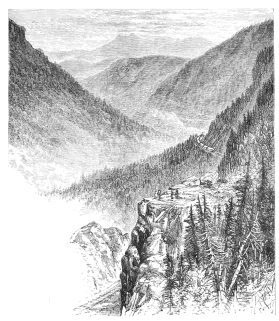
First came the idea that I was looking down into the dry bed of some primeval cataract, whose mighty rush and roar the imagination summoned again from the tomb of ages, and whose echo was in the cascades, hung like two white arms on the black and hairy breast of the adjacent mountain. This idea carries us luck to the Deluge, of which science pretends to have found proofs in the basin of the Notch. What am I saying? to the Deluge! it transports us to the Beginning itself, when “Darkness was upon the face of the deep. And the Spirit of God moved upon the face of the waters.”
You see the immense walls of Mount Willey on one side, and of Webster on the other, rushing downward thousands of feet, and meeting in one magnificently imposing sweep at their bases. This vast natural inverted archway has the heavens for a roof. The eye roves from the shaggy head of one mountain to the shattered cornices of the other. One is terrible, the other forbidding. The naked precipices of Willey, furrowed by avalanches, still show where the fatal slide of 1826 crushed its way down into the valley, traversing a mile in only a few moments. Far down in the distance you see the Willey hamlet and its bright clearing. You see the Saco’s silver.
Such, imperfectly, are the more salient features of this immense cavity of the Notch, three miles long, two thousand feet deep, rounded as if by art, and as full of suggestions as a ripe melon of seeds. I recall few natural wonders so difficult to get away from, or that haunt you so perpetually.
Like ivy on storied and crumbling towers, so high up the cadaverous cliffs of Willey the hardy fir-tree feels its way, insinuating its long roots in every fissure where a little mould has crept, but mounting always like the most intrepid of climbers. Upon the other side, the massed and plumed forest advances boldly up the sharp declivity of Webster; but in mid-ascent is met and ploughed in long, thin lines by cataracts of stones, poured down upon it from the summit. Only a few straggling bushes succeed in mounting higher; and far up, upon the very edge of the crumbling parapet, one solitary cedar tottered. The thought of imminent destruction prevailed over every other. Indeed, it seemed as if one touch would precipitate the whole mass of earth, stones, and trees into the vale beneath.
Between these high, receding walls, which draw widely apart at the outlet of the pass, mountains rise, range upon range. Over the flattened Nancy summits, Chocorua lifts his crested head once more into view. We pass in review the summits massed between, which on this morning were of a deep blue-black, and stood vigorously forth from a sad and boding sky.
From the ledges of Mount Willard, Washington and the peaks between are visible in a clear day. This morning they were muffled in clouds, which a strong upper current of air began slowly to disperse. We, therefore, secured a good position, and waited patiently for the unveiling.
Little by little the clouds shook themselves free from the mountain, and began a slow, measured movement toward the Ammonoosuc Valley. As they were drawn out thinner and thinner, like fleeces, by invisible hands, we began to be conscious of some luminous object behind them, and all at once, through a rift, there burst upon the sight the grand mass of Washington, all resplendent in silvery whiteness. From moment to moment the trooping clouds, as if pausing to pay homage to the illustrious recluse, encompassed it about. Then moving on, the endless procession again and again disclosed the snowy crest, shining out in unshrouded effulgence. To look was to be wonder-struck—to be dumb.
As the clouds unrolled more and more their snowy billows, other and lower summits rose above, as on that memorable morn after the Deluge, where they appeared like islands of crystal floating in a sea of silvery vapor. We gazed for an hour upon this unearthly display, which derived unique splendor from fitful sun-rays shot through the folds of surrounding clouds, then drawing off, and again darting unawares upon the stainless white of the summits. It was a dream of the celestial spheres to see the great dome, one moment glittering like beaten silver, another shining with the dull lustre of a gigantic opal.
I have since made several journeys through the Notch by the railway. The effect of the scenery, joined with some sense of peril in the minds of the timid, is very marked. Old travellers find a new and veritable sensation of excitement; while new ones forget fatigue, drop the novels they have been reading, maintaining a state of breathless suspense and admiration until the train vanishes out at the rocky portal, after an ascent of nearly six hundred feet in two miles.
In effect, the road is a most striking expression of the maxim, “L’audace, et toujours de l’audace,” as applied to modern engineering skill. From Bemis’s to Crawford’s its way is literally carved out of the side of the mountain. But if the engineers have stolen a march upon it, the thought, how easily the mountain could shake off this puny, clinging thing, prevailing over every other, announces that the mountain is still the master.
There are no two experiences which the traveller retains so long or so vividly as this journey through the great Notch, and this survey from the ledges of Mount Willard, which is so admirably placed to command it. To my mind, the position of this mountain suggests the doubt whether nature did not make a mistake here. Was not the splitting of the mountains an after-thought?
X. THE ASCENT FROM CRAWFORD’S.
On a throne of rocks, in a robe of clouds. With a diadem of snow.—Manfred.
AT five in the morning I was aroused by a loud rap at the door. In an instant I had jumped out of bed, ran to the window, and peered out. It was still dark; but the heavens were bright with stars, so bright that there was light in the room. Now or never was our opportunity. Not a moment was to be lost.
I began a vigorous reveille upon the window-pane. George half opened one sleepy eye, and asked if the house was on fire. The colonel pretended not to have heard.
“Up, sluggards!” I exclaimed; “the mountain is ours!”
“Do you know who first tempted man to go up into a high mountain?” growled George.
“Satan!” whined a smothered voice from beneath the bedclothes.
The case evidently was one which demanded heroic treatment. In an instant I whipped off the bedclothes; in another I received two violent blows full in the chest, which compelled me to give ground. The pillows were followed by the bolster, which I parried with a chair, the bolster by a sortie of the garrison in puris naturalibus. For a few seconds the mélée was furious, the air thick with flying missiles. By a common instinct we drew apart, with the intention of renewing the combat, when we heard quick blows upon the partition at the left, and scared voices from the chamber at the right demanding what was the matter. George dropped his pillow, and articulated in a broken voice, “Malediction! I am awake.”
“Come, gentlemen,” I urged, “if you are sufficiently diverted, dress yourselves, and let us be off. At the present moment you remind me of the half-armed warriors on the pediment of the Parthenon.”
“I take it you mean the frieze,” said George, with chattering teeth.
The colonel was on all-fours, picking up the different articles of his wardrobe from the four corners of the chamber. “My stocking,” said he, groping among the furniture.
“What do you call this?” inquired George, fishing the dripping article from the water-pitcher.
“Eh! where the deuce is my watch?” redemanded the colonel, still seeking.
“Perhaps this is yours?” George again suggested, drawing it, with mock dexterity, as he had seen Hermann do, from a boot-leg.
We quickly threw on our clothes, but at the moment of starting George put his hand into his breast and made a frightful grimace.
“What is it?” we both asked in one breath. “What is the matter?”
“My pocket-book is gone.”
After five minutes’ ransacking in every hole and corner of the room, and after shaking the bedclothes carefully, all to no purpose, it was discovered that George and myself had exchanged coats. We then went down-stairs into the great hall, where a solitary jet of gas burnt blue, and a sleepy watchman dozed on a settee. The morning air was more than chilly: it was “a nipping and an eager air.” There were two or three futile attempts at pleasantry, but hunger, darkness, and the cold quickly silenced them. A man is never himself when roused at five in the morning. No matter how desirable the excursion may have looked the night before, turning out of a warm bed to hurry on your clothes by candle-light, and to take the road fasting, strips it of all glamour.
Day broke disclosing a clear sky, up which the rosy tints of sunrise were streaming. The last star trembled in the zone of dusky blue above the grand old hills, like a tear-drop on the eyelids of the night. The warm color flowed over the frosted heads of the pines, mantling their ghastly white with the warm glow of reviving life. Then the eye fell upon the lower forests, still wrapped in deep shadows, the tiny lake, the boats, and, lastly, the oval plain, or vestibule of the Notch, above which ascended the shaggy sides of Mount Willard, and the retreating outline of Mount Webster. The little plain was white with hoar-frost; the frozen fountain dripped slowly into its basin, like a penitent telling its beads.
After a hasty breakfast, despatched with mountain appetites, behold us at half-past six entering the forest in Indian file! My companions again found their accustomed gayety, and soon the solemn old woods echoed with mirth. Our hopes were as high as the mountain itself.
A détour as far as Gibbs’s Falls cost a good half-hour in recovering the bridle-path; but we were at length en route, myself at the head, George behind. The colonel carried the flask, and marched in the middle. He was considered the most incorruptible of the three; but this precaution was deemed an indispensable safeguard, should he, in a moment of forgetfulness, carry the flask to his lips.
The side of Mount Clinton, which we were now climbing, is very steep. The name of bridle-path, which they give the long gully we had entered, is a snare for pedestrians, but a greater delusion for cavaliers. The rains, the melting snows, have so channelled it as to leave little besides interlaced roots of old trees and loose bowlders in its bed. Higher up it is nothing but the bare course of a mountain torrent.
The long rain had thoroughly soaked the earth, rendering it miry and slippery to the feet; the heavy air, compounded of a thousand odors, hindered, rather than assisted, the free play of the lungs. Our progress was slow, our breathing quick and labored. Every leaf trembled with rain-drops, so that the flight of a startled bird overhead sprinkled us with fine spray. Finches chattered in the tree-tops, squirrels scolded us sharply from fallen logs.
Looking up was like looking through some glorious, illuminated window—the changed foliage seemed to have fixed the gorgeous hues of the sunset. Through its crimson and gold, violet and green, patches of blue sky greeted us with fair promise for the day. Looking ahead, the path zigzagged among ascending trees, plunged into the sombre depths above our heads, and was lost. One impression that I received may be, yet I doubt, common to others. On either side of me the forest seemed all in motion; the dusky trunks striding silently and stealthily by, moving when we moved, halting when we halted. The greenwood was as full of illusions as the human heart. I can never repress a certain fear in a forest, and to-day this seemed peopled with sprites, gnomes, and fauns. Once or twice a crow rose lazily from the top of a dead pine, and flew croaking away; but we thought not of omens or auguries, and pushed gayly on up the sharp ascent.
It was a wild woodland walk, with few glimpses out of the forest. For about a mile we steered toward the sun, climbing one of the long braces of the mountain. Stopping near here, at a spring deliciously pure and cold, we soon turned toward the north. As we advanced up the mountain the sun began to gild the tree-tops, and stray beams to play at hide-and-seek among the black trunks. We saw dells of Arcadian loveliness, and we heard the noise of rivulets, trickling in their depths, that we did not see.