Front matter
Reading edition
Note: Images of the original pages are available through Internet Archive. See https://archive.org/details/happyisles00king_0
THE HAPPY ISLES

BOOKS BY BASIL KING
The Happy Isles The Dust Flower The Thread of Flame The City of Comrades Abraham's Bosom The Empty Sack Going West The Side of the Angels
Harper & Brothers Publishers
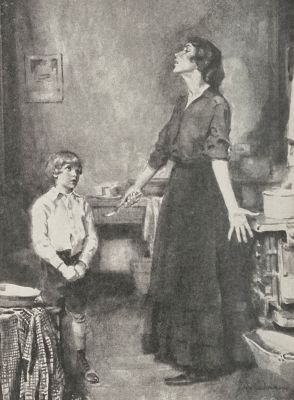
"THEY'LL SAY I STOLE HIM. IT'LL BE TWENTY YEARS FOR ME"
THE HAPPY ISLES
By BASIL KING
Author of
"THE EMPTY SACK," "THE INNER SHRINE," "THE DUST FLOWER," ETC.
With Illustrations by
JOHN ALONZO WILLIAMS
Publishers
Harper & Brothers
New York and London
MCMXXIII
THE HAPPY ISLES
Copyright, 1923 By Harper & Brothers Printed in the U.S.A.
First Edition
K-X
ILLUSTRATIONS
They'll Say I Stole Him. It'll Be Twenty Years for Me That's a Terr'ble Big Wad for a Boy Like You to Wear" Get Up, I Tell You Mrs. Ansley Took Him as an Affliction
The Happy Isles
Many a green isle needs must be In the deep wide sea of misery, Or the mariner, worn and wan, Never thus could voyage on, Day and night, and night and day.... —Shelley.
I
At eight months of age his only experience of life had been one of well-being. He was fed when hungry; he slept when sleepy; he woke when he had slept enough. When bored or annoyed or uneasy he could cry. If crying brought him attentions it was that much to the good; if the effort was thrown away it did no one any harm. Even when least fertile of results it was a change from the crowing and gurgling which were all he had to distract him when left to his own company.
Though his mind worked in co-operation with the subconscious more than with the conscious, it worked actively. In waking minutes there was everything to observe and register.
His intimate needs being met, there were the phenomena of light and darkness. He knew not only the difference between them, but in a general way when to expect the turn of each. He knew that light brought certain formalities, chiefly connected with his person, and that darkness brought certain others. The reasons remained obscure, but the variety was pleasing.
Then there was the room, or rather the spectacular surroundings of his universe. The nursery was his earth, his atmosphere, his firmament, the ether in which his heavenly bodies went rolling away into the infinite. And, just as with grown-up people, the nearness and distance of Mars or Sirius or Betelgueuse have gone through experimental stages of guesswork first and calculation afterwards, so the exact location of the wardrobe, the table, or the mantelpiece, was a subject for endless wonderment. At times they were apparently so close that he would put out his hand to touch them from his crib; but at once they receded, fixing themselves against the light-blue walls, home of a menagerie of birds and animals, with something between him and them which he was learning to recognize as space.
There was also motion. Certain things remained in place; other things could move. He himself could move, but that was so near the fundamental necessities as hardly to call for notice. True, there were discoveries even here. The day when he learned that once his legs were freed he could lie on his back and kick was one of emancipation. In finding that he could catch his foot with his hands and put it in his mouth he made his first advance in skill. But there was motion superior to this. There were beings who walked about the room, who entered it and left it. Merely to watch their goings and comings sent spasms through his feet.
Little by little he had come to discern in these creatures a difference in function and personality. Enormous in size, irresistible in strength, they were nevertheless his satellites. One of them supplied his wants; another worshipped him; the third lifted him up, carried him about, tickled him deliciously with his mustache or his bushy outstanding eyebrows, and otherwise entertained him. For the first his tongue essayed the syllables, Na-Na; for the second his lips rose and fell with an explosive Ma-Ma; the last sent his tongue clicking toward the roof of his mouth in the harsher sound of Da-Da; and yet between these efforts and the accomplishment there was still some lack of correspondence.
Of his many enthralling interests speech was the most magical. In his analysis of life it came to him early that these coughings and barkings and gruntings were meant to express thought. He himself had thoughts. What he lacked was the connection of the sounds with the ideas, and of this he was not unaware. They supposed him a little animal who could only eat and sleep, when all the while he was listening, recording, distinguishing, defining, correlating the syllable with the thing that was evidently meant, so that later he should astonish his circle by uttering a word. It was a stimulating game and in it his daily progress was not far short of marvelous.
If the nursery was his universe, his crib was his private domain, cushioned and soft, and as spotless as an ermine's nest. It was a joy to wake up in it, and equally a joy to go to sleep. Joy, Tenderness, and Comfort, were the only elements in life with which he was acquainted. Thriving on them as he throve on the carefully prepared formulas of his food, he grew in the spirit without obstacles to struggle with, as his body grew in the sunlight and the air.
By the time he had reached the May morning on which his story begins he had come to take Comfort, Tenderness, and Joy, as life's essentials. Never having known anything else, he had no suspicion that anything else would lurk within the possible. The ritual that attended his going out was as much a matter of course to him as a red carpet to tread on is to a queen. He took it for granted that, when he had been renewed by bottle and bath, she for whom he tried to say Na-Na would be in a flutter of preparation, while she whose sweet smile forced the Ma-Ma to his lips would put a little coat on his back, a little cap on his head, little mittens on his hands, and smother him with adoration all the time she was doing it.
On this particular morning these things had been done. Nestled into a canopied crib on wheels, he was ready for the two gigantic ministrants whom he could not yet distinguish as the first and second footmen. These colossi lifted his vehicle down the steps, to set it on the pavement of Fifth Avenue, where for the time being dramatic episodes were at an end. The town didn't interest him. Moreover, a filmy curtain, to protect him against flies as well as against too much sun, having shut him in from the vastness of the scene, he had nothing to do but let himself be lulled to his customary slumber.
II
Miss Nash, the baby carriage in front of her, furrowed a way through the traffic of the avenue, relatively scant in those days, and reaching the safety of the other side passed within the Park. She was a trained child's-nurse, and wore a uniform. England being at that time the only source of this specialty, examples in New York were limited to the heirs-apparent of the noble families. Between a nursemaid and a trained child's-nurse you will notice the same distinction as between a lady's maid and a princess's lady-in-waiting.
Having entered the Park, Miss Nash stopped the carriage to lift the veil protecting her charge. He was already beyond the noises and distractions of the planet in his rosy, heavenly sleep. Miss Nash smiled wistfully, because it was the only way in which she could smile at all. A superior woman by nature, she clung to that refinement which best expresses itself in something melancholic. Daughter of a solicitor's clerk and niece to a curate, she felt her status as a lady most fittingly preserved in an atmosphere delicate, subdued, and rather sad.
And yet when she looked on her little boy asleep she was no longer superior, and scarcely so much as a lady. She was only a woman enraptured before one of those babies so compact of sweetness, affection, and intelligence that they tug at the heartstrings. She was on her guard as to loving her children overmuch, since it made it so hard to give them up when the minute for doing so arrived; but with this little fellow no guard had been effective. Whether he crowed, or cried, or kicked, or snuggled in her arms to croon with her in baby tunelessness, she found him adorable. But when he was asleep, chubby, seraphic, so awesomely undefiled, she was sure that his spirit had withdrawn from her for a little while to commune with the angels.
"No," she confessed one day to her friend, Miss Etta Messenger, the only other uniformed child's nurse among her acquaintance in New York, "it won't do. I must break myself. I shall have to leave him some day. But I do envy the mother who will have him always."
"It don't pay you," Miss Messenger declared, as one who has had experience. "Anyone, I always say, can hire my services; but my affections remain my own. Now this little girl I'm with while I'm in New York, I could leave her to-morrow without a pang if—but then I've got something to leave her for."
"And what does he say to things now?" Miss Nash inquired, with selfless interest in her friend's drama.
Miss Messenger answered, judicially, "I've put it to him straight. I've told him he must simply fix a date to marry me, or give me up. As I know he simply won't give me up—you never knew a fellow so wild about a girl as he is about me...."
The fortnight which had intervened between that conversation and the morning when our little boy's story opens had given time for Miss Messenger's affairs to take another turn. In the hope of learning the details of this turn Miss Nash sought a corner of the Park, not much frequented by nursemaids, where she and Miss Messenger often met, but Etta was not there. Drawing the carriage within the shade of a miniature grove of lilacs in perfumed flower, Miss Nash once more lifted the veil, wiped the precious mouth, and adjusted the coverlet outside which lay the mittened baby hands. Since there was no more to be done, she sat down on a convenient bench to her reading of Juliet Allingham's Sin.
In the scene where the lover drowns she became so absorbed as not to notice that on a bench on the other side of a lilac bush Miss Messenger came and installed herself and her baby carriage in the shade of a near-by fan-shaped elm, bronze-green in its young leafage. Miss Nash looked up only when, her emotions having grown so poignant, she could read no more. She was drying her eyes when, through the branches of the lilac, the flutter of a nurse's cape told her that her friend must have arrived.
"Why, Etta!"
On going round the barrier she found herself greeted by what she had come to call Etta's fighting eyes. They were fine flashing black eyes, set in a face which Miss Nash was further accustomed to describe as "high-complexioned." Miss Messenger spoke listlessly, and yet as one who knew her mind.
"I saw you. I thought I wouldn't interrupt. I haven't very good news."
Miss Nash glided to a seat beside her friend, seizing both her hands. "Oh, my dear, he hasn't——?"
"That's just what he has." Etta nodded, drily. "Bring your baby round here and I'll tell you."
But Miss Nash couldn't wait. "He's all right there. He's sound asleep. I'll hear him if he stirs. Do tell me what's happened."
"Well, he simply says that if that's the way I feel perhaps we'd better call it off."
"And are you going to?"
Etta's eyes blazed with their black flames. "Call it off? Me? Not much, I won't."
"Still if he won't fix a date...."
"He'll jolly well fix a date—or meet me in the court."
"Oh, but, Etta, you wouldn't...."
"I don't say I would for choice. There are two or three other things I could do, and I think I'll try them first."
"What sort of things?"
In the answer to that question Miss Nash was even more absorbed than in Juliet Allingham's sin. Juliet Allingham was after all but a creature of the brain; whereas Etta Messenger's adventures might conceivably be her own. It was not merely some one else's love story that held her imagination in thrall; it was the possibility that one of these days she, Milly Nash, might have a man playing fast and loose with her heart's purest offering....
III
Anyone closely watching the strange woman would have said that her first care was not to seem distraught; but then, no one was closely watching her. On a rapturous May morning, with the lilac scenting the air, and the tulip beds in only the passing of their glory, there were so many things better worth doing than observing a respectably dressed young woman, probably the wife of an artisan, that she went unobserved. As there were at that very minute some two or three hundred more or less like her also pushing babies in the Park, the eye that singled her out for attention would have had more than the gift of sight.
What she did that was noticeable—again had there been anyone to notice her—was to approach first one little group and then another, quickly sheering away. One would have said that she sheered away from some queer motive of strategy. Her movements might have been called erratic, not because they were aimless, but because she didn't know or didn't find the object of her search. Even if that were so, she neither advanced nor receded, nor drifted hither or yon, more like a lost thing than many another nursemaid giving her charge the air or killing time.
There was nothing sinister about her, unless it was sinister to have moments of seeming dazed or of muttering to herself. She muttered to herself only when sure that there was no one to overhear, and with similar self-command she indulged in looking dazed only when she knew that no eye could light on her. As if aware of abnormality, she schooled herself to a semblance of sanity. Otherwise she was some thirty years of age, neatly if cheaply clad, and too commonplace and unimportant for the most observant to remember her a second after she had passed.
At sight of a little hooded vehicle, standing unguarded where the lilac bushes made a shrine for it, she paused. Again, the pause was natural. She might have been tired. Pushing a baby carriage in a park is always futile work, with futile starts and stops and turnings in this direction or in that. If she stood to reconnoiter or to make her plans there was no power in the land to interfere with her.
Her further methods were simple. Behind the bench on which Miss Nash and Miss Messenger were by this time entering on an orgy of romantic confidence there rose a gentle eminence. To the top of this hill the strange woman made her way. She made it with precautions, sauntering, dawdling, simulating all the movements of the perfect nurse. When two women, wheeling young laddies strapped into go-carts, crossed her path she walked slowly till they were out of sight. When a park attendant with a lawnmower clicked his machine along to cut a distant portion of the greensward, she waited till he too had disappeared. A few pedestrians were scattered here and there, but so distant as not to count. A few riders galloped up or down the bridle-path near Fifth Avenue, but these too she could disregard. Except for Miss Nash and Miss Messenger, turned towards each other, and with their backs to her, she had the world to herself. Softly she crept down the hill; softly she stole in among the lilacs.
"My little Gracie! my little Gracie!" she kept muttering, but only between closed lips. "My little Gracie!"
"Oh, don't think, Milly," Miss Messenger was saying, "that I shan't give him the chance to come across honorable. I shall. You say that an action for breach doesn't seem to you delicate, and I don't say but what I shrink from it. But when you've a trunkful of letters simply burning with passion, simply burning with it, what good are they to you if you don't?... And he's worth fifty thousand dollars if he's worth a penny. Don't talk to me! A fishmonger, right in the heart of East Eighty-eighth Street, the very best district.... If I sue for twenty-five thousand dollars I'd be pretty sure of getting five ... and with a sympathetic jury, possibly six or eight ... and with all that money I could set up a little nursing home in London ... say in the Portland Place neighborhood ... with a specialty in children's diseases ... and put you in charge of it as matron. You and me together...."
"Oh, but, Etta, I couldn't leave my little boy, not till he's able to do without me. By that time there may be other children for me to take care of, so that I could keep near him. I've thought of that. He being the first, and his father and mother such a fine healthy young couple, with everything to support a big family...."
During the minutes which marked his transfer from one destiny to another, Miss Nash's little boy remained in the sweet, blest country to which little babies go in dreams. When a swift hand raised the veil, lifting him with deft gentleness, he knew nothing of what was happening. While the cap was peeled from his head and pulled over that of a big, featureless rag doll shaped to the outlines of a baby's limbs, he was still on the lap of Miss Nash's angels. On the lap of these angels he stayed during the rest of the exchange. The strange woman's hand was tender. Lightly it drew over the little boy's head the soiled, cheap bonnet worn by the big rag doll; lightly it laid the little warm body into its new bed. Where he had nestled the big rag doll with his cap on its head gave a fair imitation of his form, unless inspected closely. By the time the veils were lowered on the two little carriages there was nothing for the most suspicious eye to wonder at. A respectable woman of the humbler classes was trundling her baby back to its home. The infant rested quietly.
The rag doll, too, rested quietly when Miss Nash returned to her charge, as Miss Messenger to hers. Miss Nash had heard so much within an hour that she was not quite mistress of herself. Nothing was so rare with her as to neglect the due examination of her child, but this time she neglected it. Etta had given her so much to think of that for the minute her mind was over-taxed. Because the love theme had become involved with the compelling dictates of self-interest, which even a sweet creature like Miss Nash couldn't overlook, she laid her hands absently on the push-bar, beginning to make her way homeward. There was no question as to Etta's worldly wisdom. The choice lay between worldly wisdom and the warm, glowing, human thing we call affection. In Milly Nash's experience it was the first time such a choice had been put up to her.
"Don't talk to me!" Miss Etta pursued, as they sauntered along side by side. "I simply love my children up to every penny I'm paid for it, not a farthing more; and if you'll take my advice, Milly Nash, you'll follow my example."
Miss Nash felt humble, rebuked. Through fear of disturbing her little boy, she pushed as gently as a zephyr blows.
"I'm not sure that I could measure it out, not with this little fellow."
"This little fellow, fiddlesticks! He's just like any other little fellow."
"Oh, no, he isn't. There's character in babies just as there is in grown-up people. This child's got it strong, all sweetness and loveliness, and so much sense—you'd never believe it! Why, he knows—there's nothing that he doesn't know, in his own dear little way. I tell you, Etta, that if you had him you'd feel just like me."
"Just like you and be out of your heart's job—your heart's job, mind you—as soon as he's four years old, and they want to put him with a French girl to learn French. Oh, I know them, these aristocrats! When I get my alimony, or whatever it is, I'm simply going to provide for the future, and you'll be a goose, Milly Nash, if you simply don't come with me, and do the same."
While Miss Nash was shaking her head with her gentle perplexed smile, the strange woman was crossing Fifth Avenue. Having accomplished this feat, she entered one of the streets running from that great thoroughfare toward the East River. Squalor being so much the rule in New York, the wealthier classes find it hard to pre-empt to themselves more than a long thin streak, relatively trim, bearing to the general disorder the proportion of a brook to the meadow through which it runs. The strange woman had left Fifth Avenue but a few hundred yards away before she and her baby were swallowed up in that kind of human swarm in which individuals lose their identity. Afraid of betraying some frenzy she knew to be within her by mumbling to herself, she kept her lips shut with a fierce, determined tightness. She was a little woman, and when you looked at her closely you saw that she had once possessed a wild dark prettiness. Even now, as she pushed her way between uncouth men and women, or screaming children at play, her wild dark eyes blazed with sudden anger or swam with unshed tears by fits and turns.
The house at which she stopped was hardly to be distinguished from thousands of others in which a brief brownstone dignity had fallen, first to the boarding-house stage, and then to that of tenements. From the top of a flight of brownstone steps a frowzy, buxom, motherly woman came lumbering down to lend a hand with the baby carriage.
"So you've brought your baby, Mrs. Coburn. Now you'll be able to get settled."
The reply came as if it had been learned by rote. "Yes, now I'll be able to get settled. I've got her crib ready, though all my other things is strewed about just as when I moved in. Still, the crib's ready, which is the main thing. She's a fretful baby by nature, so you mustn't think it funny if you hear her cry. Some people thought I'd never raise her, so that if you ever hear say that my little girl died...."
"I'll know it's not true," the buxom woman laughed. "She couldn't die, and you have her here, now could she? Do let me have a peep."
By this time they had lifted the carriage over the steps and into the little passageway. Seeing that there was no help for this inspection, the strange woman trembled but resigned herself. The neighbor lifted the veil, and peered under it.
"My, what a love! And she don't look sick, not a little mite."
"Not her face, she don't. Her poor little body's some wasted, but then so long as I've got her...."
"I believe as it'd be too much lime-water in her milk. She's bottle-fed, ain't she? Well, them bottle-fed babies—I've had two of 'em out of my five—you got to try and try, and ten to one you'll find as it's that nasty lime-water that upsets 'em."
Having unlocked her door, which was on the left of the passageway, the strange woman pulled her treasure into a room stuffy with closed windows, and dim with drawn blinds. Turning the key behind her, she was alone at last.
She fell on her knees, throwing the veil back with a fierceness that almost tore it off. She strained forward. Her breath came in racking, panting sobs.
"My Gracie! my Gracie! God didn't take you! God wouldn't be so mean! I just dreamed it, and now I've waked up."
Suddenly she changed. Drawing backward, she put her hands to her brow and pressed them down the whole length of her face. Her eyes filled with horror. Her face turned sallow. Her lips fell apart.
"I'll get twenty years for this. Perhaps it'll be more. I don't think they hang for it, but it'll be twenty years anyhow, if they find it out." She sprang up, still muttering in broken, only partly articulated phrases. "But they'll never find it out. What's there to find? It's my baby! My precious only baby!" She was on her knees again, dragging herself forward by the sides of the little carriage, her eyes strained toward the infant face. "My little Gracie! I've missed you all the time you've been away. My heart was near broke. Now you've come back to me. You're mine—mine—mine!"
He opened his eyes. It was his usual hour for waking up. For the first time in his history amazement gave an expression to his face which it was often to wear afterward. Instead of being in his own nest, downy, clean, and scentless, he was in a humpy little hole unpleasant to his senses. Instead of the Na-Na with her tender smile, or the Ma-Ma with her love, he saw this terrifying woman's stormy eyes, rousing the sensation he was later to know as fear. Instead of his nursery, spotless and gay, he was dumped amid the forlorn disarray of furniture that has just been moved into an empty tenement. Without getting these impressions in detail, he got them at once. He got them not as separate facts, but as facts in a single quintessence, distilled and distilled again, till no one element can be told from any other element, and held to his lips in a poisoned draught.
All he could do was to wail, but he wailed with a note of anguish which was new to him. It was anguish the more bitter because of the lack of explanation. His only awareness hitherto had been that of power. He had been a baby sovereign, obeyed without having to command. Now he had been born again as a baby serf, into conditions against which his will, imperious in its baby way, would beat in vain. Once more, he knew this, not by reasoned argument, of course, but by heartbroken instinct. It was not merely the distress of the present that was in his cry, but dread of the future. There was something else in the world besides Comfort, Tenderness, and Joy, and he had touched it. Without knowing what it was he shrank back from the contact and sobbed.
And yet such is the need for love in any young thing's heart, that when the strange woman had lifted him up, and cradled him on her bosom, he was partly soothed. He was not soothed easily. Though she held him closely, and sang to him softly, seated in the low rocking-chair in which she had rocked her baby-girl, he went on sobbing. He sobbed, not as he had sobbed in his old nursery, for the sport or the mischief of the thing, but because his inner being had been bruised. But his capacity for sobbing wore itself out. Little by little the convulsions grew calmer, the agony less desperate. Love held him. It was not the love of the Ma-Ma or the Na-Na, but it was love. It had love's embrace, love's lullaby. Arms were about him, he was on a breast. The shipwrecked sailor may be only on a raft, but he is not sinking. Little by little he turned his face into this only available refuge. A dangling embroidery adorned it, and in his struggle not to go down his little hands clutched at that.
IV
His first conscious recollection was of sitting on a high chair drawn up to a table at which he was having a meal. He could never recall whether this was in Harlem, Hoboken, Brooklyn, Jersey City, or the Bronx. Because they moved so often he had little more memory of places than he had of clouds. Tenements, streets, and suburbs of New York melted into one big sense of squalor. It was not squalor to him because he was used to it. It only obscured the difference between one dwelling and another, as monotony always obscures remembrance. Wherever their wanderings carried them, the background was the same, crowded, dirty, seething, a breeding place rather than a home.
What marked this occasion was a question he asked and the answer he got back.
"Mudda, id my name Gracie, or id it Tom?"
The mother spoke sharply, as she whisked about the kitchen. "What do you want to know for?"
The question was difficult. He knew what he wanted to know for, and yet it wasn't easy to explain. The nearest he could get to it in language was to say: "I'm a little boy, ain't I?"
"Yes, you're a little boy, but you should have been a little girl. It was a little girl I wanted."
"But you want me, don't you, mudda?"
She dropped whatever she was doing to press his head fiercely against her side. "Yes, I want you! I want you! I want you!"
He remembered this paroxysm of affection not because it was special but because it was connected with his gropings after his identity. Paroxysms were what he lived on. They were of love or of anger or of something which frightened him and yet was nameless. He thrummed to himself, beating time on the table with his spoon, while he worked on to another point.
"Wadn't there never no Gracie, mudda?"
She wheeled round from the gas-stove. "For goodness' sake, what's putting this into your head? Of course there was a Gracie. You're her. You don't suppose I stole you, do you?"
He ceased his thrumming; he ceased to beat on the table with his spoon. The mystery of being grew still more baffling.
"Mudda!"
"What's it now?"
"If I wad Gracie I'd be a little girl, wouldn't I?"
She stamped her foot. "Stop it! If you ask me another thing I'll slap you."
He stopped it, not because he was afraid of being slapped. Accustomed to that he had learned to discount its ferocity. A sharp stinging smart, it passed if you grinned and bore it, and grinning and bearing had already entered his life as part of its philosophy. If for the minute he asked no more questions it was in order not to vex his mudda. She was easily vexed; she easily lost her self-control; she was easily repentant. It was her repentance that he feared. It was so violent, so overwhelming. He loved love; he loved caressing; he loved to sit in her lap and sing with her; but her tempests of self-reproach alarmed him.
As she washed the dishes or switched about the kitchen, he watched her with that trepidation which makes the children of the poor sharp-witted. Though under five years of age, he was already developing a sense of responsibility. You could see it in the gravity of a wholly straightforward little face, which had the even tan of a healthy fairness, in keeping with his crisp ashen hair. He knew when the moment had come to clamber down from his perch, and snuggle himself against her petticoats.
"Mudda, sing!"
"I can't sing now. Don't you see I'm busy! Look out, or this hot dish-water'll scald you."
Nevertheless, a few minutes later they were settled in the rocking chair, he on her knee, with his cheek against her shoulder. She was not as ungracious as her words would have made her seem, a fact of which he was aware.
"What'll I sing, Troublesome?"
"Sing 'Three Cups of Cold Poison.'"
So she sang in a sweet, true voice, the sort of childish voice which children love, her little boy joining in with her whenever he knew the words, but with only a hit-or-miss venture at the tune.
"Where have you been dining, Lord Ronald, my son? Where have you been dining, my handsome young man?" "I've been dining with my true love, mither, make my bed soon, There's a pain in my heart, and I fain would lie doon." "And what did she give you, Lord Ronald, my son? And what did she give you, my handsome young man?" "Three cups of cold poison, mither, make my bed soon, There's a pain in my heart, and I fain would lie doon." "What'll you will to your mither, Lord Ronald, my son? What'll you will to your mither, my handsome young man?" "My gowd and my silver, mither, make my bed soon, There's a pain in my heart, and I fain would lie doon." "What'll you will to your brither, Lord Ronald, my son? What'll you will to your brither, my handsome young man?" "My coach and six horses, mither, make my bed soon, There's a pain in my heart, and I fain would lie doon." "What'll you will to your truelove, Lord Ronald, my son? What'll you will to your truelove, my handsome young man?" "A rope for to hang her, mither, make my bed soon, There's a pain in my heart, and I fain would lie doon."
His next conscious memory was more dramatic. He had been playing in the street, in what town he could never remember. They had recently moved, but they had always recently moved. A month in one set of rooms, and his mother was eager to be off. Rarely did they ever stay anywhere for more than the time of moving in, giving the necessary notice, and moving out again. When they stayed long enough for him to know a few children he sometimes played with them.
In this way the thing happened. The boy's name was Frankie Bell, a detail which remained long after the larger facts had escaped him. Frankie Bell and he had been engaged in scraping the dust and offal of the street into neat little piles, with the object of building what they called a "dirt-house." The task was engrossing, and to it little Tom Coburn gave himself with good will. Suddenly, as each bent over his pile, Frankie Bell threw off the observation, casually uttered:
"My mother says your mother's crazy."
Tom Coburn raised himself from his stooping posture, standing straight, and looking straight. The expression in his dark blue eyes, over which the eyebrows even now stood out bushily, was of pain, and yet of pain that left him the more dauntless. Though knowing but vaguely what the word crazy meant, he knew it was insulting.
"She ain't."
Frankie Bell, a stout young man, lifted himself slowly. "Yes, she is. My mother says so."
"Well, your mudda id a liar."
One rush and Frankie Bell lay sprawling with his head in the cushioned softness of his own dirt-heap. The attack had taken him so much by surprise that he went down before he could bellow. Before he could bellow his enemy was upon him, filling his mouth with the materials collected for architectural purposes. Victor in the fray, Tom Coburn ran homeward blinded with his tears.
He found his mother at the stove, stirring something with a tablespoon.
"Mudda, you're not crazy, are you?"
His reply was a blow on the head with the spoon. The woman was beside herself.
"Who said that?"
Rubbing his head, he told her.
"Don't you ever let them say no such thing again. If you do I'll kill you." She threw back her head, her arms outstretched, the spoon in her right hand. "God! God! What'll they say next? They'll say I stole him. It'll be twenty years for me; it'll be forty; it may be life. I won't live to begin it. I know what'll end it before they can...."
He was terrified now, terrified as he had never been in all his terrifying moments. Throwing himself upon her, he clutched at her skirts.
"Don't, mudda, don't! I'm your little boy! You didn't steal me. Don't cry, mudda! Oh, don't cry! don't cry!"
When, in one of her sudden reactions, she sank sobbing to the floor, he sank with her, petting her, coaxing her, wiping away her tears, forcing himself to laugh so that she should laugh with him; but a few days afterward they moved.
V
Mudda, can I have a book and learn to read?"
The ambition had been inspired in the street, where he had seen a little boy who actually had a book, and was spelling out the words. Tom Coburn was now nominally six years old, though it was in the nature of things that of his age no exact record could be kept. His mother had changed his birthday so many times that he observed it whenever she said it had come round.
Bursting into the room with his eager question, he found her sitting by a window looking out at a blank wall. Given her feverish restlessness, the attitude called attention to itself. The apartment was poorer and dingier than any they had lived in hitherto, while it had not escaped his observation that she was living on the ragged edge of her nerves. This made him the more sorry for her, and the more loving. He put his hand on her shoulder, tenderly.
"What's the matter, mudda?"
It was one of the minutes when a touch made her frantic. "Get away!"
He got away, not through fear, but because she pushed him. He didn't mind that, though the rejection hurt him inside. He stood in the middle of the floor, pity in his young countenance, wondering what he could do for her, when she spoke again.
"I've got hardly any money left. I don't know what to do."
It was the first time his attention had been called to finance. He knew there was such a thing as money; he knew it had purchasing value; but he had not known its relation to himself.
"Why don't you get money where you got it before?"
"Because I ain't got a husband to die and leave me another five thousand dollars of insurance."
"And did you have, mudda?"
"Of course I had. What did you think?"
The question voiced his inner difficulty. He had not known what to think. Having observed that a fundamental social unit was formed of husbands and wives, he had also understood that husbands and wives could, in the terms which were the last to hang over from the lingo of his babyhood, be translated into faddas and muddas. They in turn implied children. The methods were mysterious, but the unit was so composed. The exception to this rule seemed to be himself. Though he had a mudda, he could not remember ever to have heard of a fadda. He had pondered on this deficiency more times than anyone suspected. The effort to link himself up with the human family was far more important to him now than the ways and means of getting cash. Standing pensive, he peered into the blinding light, or the unfathomable darkness, whichever it may be, out of which comes human life.
"Mudda, did Gracie have a fadda?"
She snapped peevishly, her gaze again turned outward to the stone wall. "Of course she did."
He came nearer to his point. "Did I?"
"I—I suppose so."
He approached still nearer. "Did I have the same fadda what Gracie had?"
"No, you hadn't." She caught herself up hurriedly, rounding on him in one of her fits of wrath. "Yes, you had."
The inconsistency was evident. "Well, which was it, mudda?"
She jumped to her feet, threateningly. "Now you quit! The next thing you'll be saying is that your name is Whitelaw, and that I stole you. Take that, you nasty little brat!"
A smack on the cheek brought the color to his face, and the tears to his eyes. "No, I won't, mudda. I won't say you stole me, or that my name is—" oddly enough he had caught it—"or that my name is Whitelaw. My name is Tom Coburn, and I'm your little boy."
Rushing at her in the big outpouring of his love, he threw his arms about her and cried against her waist. He cried so seldom that his grief drove her to one of her paroxysms of repentance. Her self-reproaches abating, all she could do to comfort him was to promise him a book, and begin to teach him to read.
The book was procured two days later, and by a method new to him. Doubtless some other means could have been adopted, but the necessity for sparing pennies had become imperative. Moreover, she had never willingly looked at print since the day when she opened a paper to find that, without knowing who she was, all the forces of the country had been organized against her.
They went out together. After traversing a series of streets he had never been in before they stopped in front of a little shop, in the window of which stationery, ink, wallpaper, rubber bands, and books were arranged in artistic confusion. The impression on the fancy of a little boy already groping toward the treasures of the mind was like that made on the tourist in Dresden by the heaped up riches of the Grüne Gewölbe.
The geography of the shop was explained to him before entering. The stationery counter was on the right as soon as you passed the door. The children's books were opposite, on the left. Books forming a cheap circulating library were back of that, and opposite these, where the shop was dark, were the wallpapers, in small, tight rolls on shelves. She was going to inspect wallpapers. The woman in the shop would exhibit them. He would remain alone in the front part of the shop, and close to the counter with the children's books. He was to keep alert and attentive, waiting for a sign which she would give him. When she turned round in the dark part of the shop, and called out, "Are you all right, darling?" he was to understand it as permissible to slip from the counter any small work on which he could lay his hands, and button it up inside his overcoat. He was to do it quickly, keeping his booty out of sight, and above all saying nothing about it. The plan was exciting, with a savor of adventure and manly incentive to skill.
If in the Grüne Gewölbe you were told you could take anything you pleased you would have some of Tom Coburn's sense of enchantment as he stood by the book counter, waiting for the sign. He could see his mother dimly. More dimly still he could follow the movements of the shop-woman eager for a sale. Sample after sample, the wallpapers were unrolled, and hung on an easel where their flowers lighted the obscurity. Even at a distance he could do justice to their beauty, but more captivating than their glories were the wonders at his hand. Pages in which children and animals disported in colors far beyond those of nature were piled in neat little rows, and so tempting that he ached for the signal. He couldn't choose; there was too much to choose from. He would put out his hand without looking, guided by fate.
"Are you all right, darling?"
Curiously to the little boy, the question came just when he himself could perceive that the shop-woman had dived beneath the counter for another example of her wares. All the conditions were propitious. No one was entering the shop; no one was looking through the window. Without knowing the moralities of his act, he understood the need for secrecy. He stretched forth his arm. His fingers touched paper. In the fraction of a fraction of a second the object was within his overcoat, and pressed to his pounding heart.
A few minutes later his mother came smiling and chatting down toward the exit, giving her address, which the shop-woman jotted in a notebook. "I think it will have to be the pale-green background with the roses. The room is darkish, and it would light it up. But I'll decide by to-morrow, and let you know. Yes, that's right. Mrs. F.H. Grover, 321 Blaisdel Avenue. So much obliged to you. Good morning."
Having bowed themselves out they went some yards up the street before the little boy dared to express his new wonderment.
"Mudda, what did you say you was Mrs. F.H. Grover for? And we don't live on Blaisdel Avenue. We live on Orange Street."
"You mind your own business. Did you get your book? Well, that's what we went for, isn't it?"
The expedition having proved successful, it was tried on other planes. Now it was in the line of groceries; now in that of hardware; now in that of drygoods; now in that of fruit. Needed things could be used; useless things could be sold, especially after they had moved to distant neighborhoods. While the procedure didn't supply an income, it eked out very helpfully such income as remained.
It furnished, moreover, a motive in life, which was what they had lacked hitherto. There was something to which to give themselves. It was like devotion to an art, or even a religion. They could pursue it for its own sake. For her especially this outside interest appeased the wild something which wasted her within. She grew calmer, more reasonable. She slept and ate better. She had fewer fits of frenzy.
With but faint pangs of misgiving the little boy enjoyed himself. He enjoyed his finesse; he enjoyed the pride his mother took in him. In proportion as they grew more expert they enlarged their field, often reversing their rôles. There were times when he created the distraction, while she secreted any object within reach. They did this the more frequently after she became recognized as his superior in selection.
For a superior in selection the great department stores naturally offered the widest field for operation. They approached them, however, cautiously, going in and out and out and in for a good many days before they ventured on anything. When they did this at last it was amid the crowding and pushing of a bargain day.
The system evolved had the masterly note of simplicity. The little boy carried a satchel, of the kind in which school-boys sometimes carry books. He stood near his mudda, or farther away, according to the dictates of the moment's strategy. On the first occasion he kept close to her, sincerely admiring a display of colored silk scarves conspicuously marked down to the price at which it was intended, even before their importation, that they should be sold. Women thronged about the counter, the little boy and his mudda having much ado to edge themselves into the front to where these products of the loom could be handled.
The picking and choosing done, the mother still showed some indecision.
"I'll just ask my sister to step over here," she confided to the saleswoman. "Her judgment is so much better than mine. Run over, dear, to your Aunt Mary," she begged of the boy, "and ask her to come and speak to me." Holding the scarf noticeably in her hands, she smiled at the saleswoman affably. "I'll just make room for this lady, who seems to be in a hurry."
She did not step back; she merely allowed herself to be crowded out. From the front row she receded to the second, from the second to the third. Keeping in sight of the saleswoman, she looked this way and that, plainly for Aunt Mary to appear. At times she made little dashes, as Aunt Mary seemed to come within sight. From these she did not fail to return, but on each occasion to a point more distant from that of her departure. With sufficient time the poor saleswoman, who had fifty other customers to attend to, would be likely to forget her, for a few minutes if no more.
The moment seemed to have come. With the scarf thrown jauntily over her arm where anyone could see it, the mother forced her way amid the crowds in search of her little boy. If intercepted she had her explanation. He had gone on an errand, and had not come back. When she had found him she would return and pay for the scarf, or decide not to take it. Her story couldn't help being plausible.
"Aunt Mary" was a spot agreed upon near one of the side doors, and far from the center of interest in silk scarves. Agreed upon was also a little bit of comedy, for the benefit of possible lookers-on.
"Oh, my dear, I've kept you waiting so long. I'm so sorry. Tell your mother this is the best I could do for her. I knew you were waiting, so I didn't let the lady wrap it up. Open your bag, and I'll put it in."
The bag closed, the little boy went out through one door, and his mother through another. The point where she was to rejoin him was not so far away but that he could walk to it alone.
VI
It's all right, mudda, isn't it?"
He asked this after their campaign had been carried on for a good part of a year, and when they were nearing Christmas. He was now supposed to be seven. For reasons he could not explain the great game lost its zest. In as far as he understood himself he hated the sneaking and the secrecy. He hated the lying too, but lying was so much a part of their everyday life that he might as well have hated bread.
"Of course it's all right," his mother snapped. "Haven't I said so time and again? We get away with it, don't we? And if it wasn't all right we shouldn't be able to do that."
Silenced by this reasoning, even if something in his heart was not convinced by it, he prepared for the harvest of the festival. Christmas was an exciting time, even to Tom Coburn. Perhaps it was more exciting to him than to other boys, since he had so much to do with shops. As long ago as the middle of November he had noted the first stirrings of new energy. After that he had watched the degrees through which they had ripened to a splendor in which toys, books, skis, skates, sleds, and all the paraphernalia of young joyousness, made a bright thing of the world. Where there was so much, the profusion went beyond desire. One of these objects at a time, or two, or three, might have found him envious; but he couldn't cope with such abundance. He could concentrate, therefore, all the more on the pair of fur-lined mittens which his mother promised him, if, as she expressed it, they could haul it off.
By Christmas Eve they had not done so. They had hauled off other things—a purse, a lady's shopping bag, several towels, a selection of pen-trays, some pairs of stockings, a bottle of shoe-polish, a baby's collapsible rubber bathtub, a hair-brush, an electric toaster, with other articles of no great interest to a little boy. Moreover, only some of these things were for personal use; the rest would be sold discreetly after the next moving. It was in the nature of the case that such grist as came to their mill should be more or less as it happened. They could pick, but they couldn't choose, at least to no more than a limited degree. Fur-lined mittens didn't come their way.
The little boy's heart began to ache with a great fear. Perhaps he shouldn't get them. Unless he got them by Christmas Day the spell of the occasion would be gone. To get them a week later wouldn't be the same thing. It would not be Christmas. He couldn't remember having kept a Christmas hitherto. He couldn't remember ever having longed for what might be called an article of luxury. The yearning was new to him, and because new, it consumed him. Whenever he thought that the happiness might after all elude him he had to grind his teeth to keep back a sob, but he could not prevent the filling of his eyes with tears.
It was not only Christmas Eve but late in the day before the mother found her opportunity. At half-past five the counter where fur-lined mittens were displayed was crowded with poor women who hadn't had the money or the time to make their purchases earlier. In among them pressed Tom Coburn's mother, making her selection, and asking the price.
"Now where's that boy? His hands grow so quick that I can't be sure of anything without trying them on."
With a despairing smile at the saleswoman, she followed her usual tactics of being elbowed from the counter, while she looked about vainly for the boy. At the right moment she slipped into the pushing, struggling mass of tired women, where she could count on being no more remarked than a single crow in a flock. The mittens were in the muff which was the prize of an earlier expedition. At a side door the boy was waiting where she had left him. Without pausing for words she whispered commandingly.
"Come along quick."
He went along quick, but also happily, projecting himself into the "surprise" to which he would wake on Christmas morning.
They had reached the sidewalk when a hand was laid on the mother's shoulder.
"Will you come back a minute, please?"
The words were so polite that for the first few seconds the boy was not alarmed. A lady was speaking, a lady like any other lady, unless it was that her manner was quieter, more forceful, more sure of itself, than he was accustomed to among women. But what he never forgot during all the rest of his life was the look on his mother's face. As he came to analyze it later it was one of inner surrender. She had come to the point which she had long foreseen as her objective. She had reached the end. But in spite of surrender, and though she grew bloodlessly pale, she was still determined to show fight.
"What do you want me for?"
"If you'll step this way I'll tell you."
"I don't know that I care to do that. I'm going home."
"You'd better come quietly. You won't gain anything by making a fuss."
A second lady, also forceful and sure of herself, having joined them they pushed their way back through the throng. At the glove counter a place was made for them. The saleswoman was beckoned to. The woman who had stopped them at the door continued to take the lead.
"Now, will you show us what you've got in your muff?"
She produced the mittens. "Yes, I have got these. I bought and paid for them."
The saleswoman gave her account of the incident. Women shoppers gathered round. Floorwalkers came up.
"It's a lie; it's a lie!" the boy heard his mother cry out, as the girl behind the counter told her tale. "If I didn't pay for them it was because I forgot. Here's the money. I'll pay for them now. What do you take me for?"
"No; you won't pay for them now. That's not the way we do business. Just come along this way."
"I'm not going nowheres else. If you won't take the money you can go without it. Leave me alone, and let me take my little boy home."
Her voice had the screaming helplessness of women in the grasp of forces without pity. A floorwalker laid his hand on her shoulder, compelling her to turn round.
"Don't you touch me," she shouted. "If I've got to go anywheres I can go without your tearing the clothes off my back, can't I?"
For the little boy it was the last touch of humiliation. Rushing at the floorwalker, he kicked him in the shins.
"Don't you hit my mudda. I won't let you."
A second floorwalker held the youngster back. Some of the crowd laughed. Others declared it a monstrous thing that women of the sort should have such fine-looking children.
Presently they were surging through the crowd again, toward a back region of the premises. The boy, not crying but panting as if spent by a long race, held his mother by the skirt; on the other side one of the forceful women had her by the arm. He saw that his mother's hat had been knocked to one side, and that a mesh of her dark hair had broken loose. He remembered this picture, and how the shoppers, wherever they passed, made a lane for them, shocked by the sight of their disgrace.
They came to an office, where their party, his mother, himself, the two forceful women, and two floorwalkers, were shut in with an elderly man who sat behind a desk. It was still the first of the forceful women who took the lead.
"Mr. Corning, we've caught this woman shop-lifting."
"I haven't been," the boy heard his mother deny. "Honest to God, I haven't been."
"We've been watching her for some time past," the forceful woman continued, "but we never managed before to get her with the goods."
The elderly man was gray, pale-eyed, and mild-mannered. He listened while the story was given him in detail.
"I'm afraid we must give you in charge," he said, gently, when the facts were in.
"No, don't do that, don't do that," she implored, tearfully. "I've got my little boy. He can't do without me."
"He hasn't done very well with you, has he?" the elderly man reasoned. "A woman who's taught a boy of that age to steal...."
He was interrupted by the coming in of a policeman, summoned by telephone. At sight of him the unhappy woman gave a loud inarticulate gasp of terror. All that for seven years she had dreaded seemed now about to come true. The boy felt terror too, but the knowledge that his mother needed him nerved him to be a man.
"Don't you be afraid, mudda. If they put you in jail I'll go to jail too. I won't let them take me away from you."
"You'd better come with me, missus," the policeman said, with gruff kindliness, when the situation was explained to him. "The kid can come too. 'Twon't be so bad. Lots of these cases. You'll live through it all right, and it'll learn you to keep straight. One of these days you may be glad that it happened."
They went out through a dimly lighted passageway, clogged with parcels and packing-cases which men were loading into drays. It was dark by this time, the streets being lighted as at night. The police-station was not far away, and to it they were led through a series of byways in which there were few foot-passengers. The policeman allowed them to walk in front of him, so that the connection was not too obvious. The boy held his mother's hand, which clutched at his with a nervous loosening and tightening of the fingers. As the situation was beyond words they made no attempt to speak.
"This way."
Within the police-station the officer turned them to the right, where they entered a small bare room. Brilliantly lighted with unshaded electrics, its glare was fierce upon the eyes. At a plain oak desk a man in uniform was seated with a ledger in front of him. Another man in uniform standing near the door picked his teeth to kill time.
"Shoplifting case," was the simple introduction of the party.
They stood before the man at the desk, who dipped his pen in the ink, and barely glanced at them. What to the boy and his mother was as the end of the world was to him all in the day's work.
"Name?"
She gave her name distinctly, and less to the lad's surprise than if she hadn't often used pseudonyms. "Mrs. Theodore Whitelaw."
"Address?"
She gave the address correctly.
"Boy's name?"
She spoke carefully, as one who had prepared her statements. "He's been known as Thomas Coburn. He's really Thomas Whitelaw. His father was my second husband."
"If he's your second husband's child why is he called by your first husband's name?"
She was prepared here too. "Because I'd given up using my second husband's name. I was unhappily married."
"Is he dead?"
"Yes, he is."
Never having heard before so much of his private history, the boy registered it all. It was exactly the sort of detail for which he had been eager. It explained too that name of Whitelaw, allusions to which had puzzled him. He was so engrossed by the fact that he was not Tom Coburn but Tom Whitelaw as hardly to listen while it was explained to his mother that she would spend the night in the Female House of Detention, and be brought before the magistrate in the morning. If the boy had no friends to whom to send him he would be well taken care of elsewhere.
The phlegm to which she had for a few minutes schooled herself broke down. "Oh, can't I keep him with me? He'll cry his eyes out without me."
She was given to understand that no child above the nursing age could be put in prison even for its mother's sake. From his reverie as to Tom Whitelaw he waked to what was passing.
"But I won't leave my mudda," he wailed, loudly. "I want to go to jail."
The kindly policeman put his arm about the boy's shoulder.
"You'll go to jail, sonny, when your time comes, if you set the right way to work. Your momma's only going to spend the night, and I'll see to it that you——"
In a side of the room a door opened noiselessly. A woman, wearing a uniform, with a bunch of keys hanging at her side, stood there like a Fate. She was a grave woman, strongly built, and with something inexorable in her eyes. Even the boy guessed who she was, throwing himself against her, and crying out, "Go 'way! go 'way! You won't take my mudda away from me."
But the folly of resistance became evident. The mother herself understood it so. Walking up to the woman with the keys, she said in an undertone:
"For God's sake get me out of this. I can't look on while he breaks his little heart. He's always been an angel."
That was all. She gave no backward look. Before the boy knew what was about to happen, she had passed into a corridor, and the door had closed behind her.
She was gone. He was left with these strange men. The need for being brave was not unknown to him. Not unknown to him was the power of calling to his aid a secret strength which had already carried him through tight places. He could only express it to himself in the words that he mustn't cry. Crying had come to stand for everything cowardly and babyish. He was so prone to do it that the struggle against it was the hardest he had to make. He struggled against it now; but he struggled vainly. He was all alone. Even the three policemen were talking together, while he stood deserted, and futile. His lips quivered in spite of himself. The tears gathered. Disgraced as he was anyhow, this weakness disgraced him more.
The room had an empty corner. Straight into it he walked, and turned his back, his face within the angle. The head with an old cap on it was bowed. The sturdy shoulders, muffled in a cheap top-coat, heaved up and down. But the legs in their knickerbockers were both straight and strong, and the feet firmly planted on the floor. Except for an occasional strangled sound which he couldn't control, he betrayed himself by nothing audible.
The three policemen, all of them fathers, glanced at him, but forbore to glance at one another. One of them tried to say, "Poor kid!" but the words stuck in his throat. It was the kindly fellow who had brought the lad and the woman there who recovered himself first.
"All right, then, boys. The Swindon Street Home. One of you can 'phone that we're on the way." He went over and laid his hand on the child's shoulder. "Say, sonny, I'm goin' to take you out to see the Christmas Tree."
The thought was a happy one. Tom Coburn had never seen any Christmas Trees, though he had often heard of them. He had specially heard of the community Christmas Tree which was new that year in that particular city. It was to be a splendid sight, and against the fascination of splendor even grief was not wholly proof. He looked shyly round, an incredible wonder in his tear-stained, upturned face.
In the street they walked hand in hand, pausing now and then to admire some brightly lighted window. The boy was in fairyland, but in spite of fairyland long deep sighs welled up from the springs of his loneliness and sorrow. To distract him the policeman took him into a druggist's and bought him a cone of ice-cream. The boy licked it gratefully, as they made their way to the open space consecrated to the Tree.
The night was brisk and frosty; the sky clear. In the streets there was movement, light, gayety. At a spot on a bit of pavement a vendor was showing a dancing toy, round which some scores of idlers were gathered. The dancing was so droll that the little boy laughed. The policeman bought him one.
When they came to the Christmas Tree the lad was in ecstasy. Nothing he had ever dreamed of equalled these fruits of many-colored fires. A band was playing, and suddenly the multitude broke into song.
O come, all ye faithful, Joyful and triumphant, O come ye, O come ye, to Bethlehem!
Even the policeman joined in, humming the refrain in Latin.
Venite, adoremus; Venite, adoremus; Venite, adoremus, Dominum.
Passing thus through marvels they came to the Swindon Street Home. The night-nurse, warned by telephone, was expecting them. She was a motherly woman who had once had a child, and knew well this precise situation.
"Oh, come in, you poor little boy! Have you had your supper?"
He hadn't had his supper, though the cone of ice-cream had stilled the worst pangs of hunger.
"Then you shall have some; and after that I'll put you in a nice comfy bed."
"He's a fine kid," the policeman commended, before going away, "and won't give you no trouble, will you, sonny?"
The boy caught him by the hand, looking up pleadingly into his face, as if he would have kept him. But the policeman had children of his own, and this was Christmas Eve.
"See you again, sonny," he said, cheerily, as he went out, "and a merry Christmas!"
The night matron knew by experience all the sufferings of little boys homesick for mothers who have got into trouble. She had dealt with them by the hundred.
"Now, dear, while Mrs. Lamson is getting your supper we'll go to the washroom and you'll wash your face and hands. Then you'll feel more like eating, won't you?"
Deprived of his policeman, despair would have settled on him again, had it not been for the night matron's hearty voice. The deeper his woe, and it was very deep, the less he could resist friendliness. Just as in that first agony, when he was only eight months old, he had turned to the only love available, so now he yielded again. He was not reconciled; he was not even comforted; he was only responsive and grateful, thus getting the strength to go on.
Going on was only in letting the night matron scrub his face and hands, and submitting patiently. As they went from the washroom to the dining room he held her by the hand. He did this first because he couldn't let her go, and then because the halls were big and bare and dark. Never had he been in any place so vast, or so impersonal. He was used to strangeness, as they moved so often, but not to strangeness on so immense a scale. It was a relief to him, because it brought in a note of hominess, to hear from an upper floor a forlorn little baby cry.
His supper toned him up. He could speak of his great sorrow. While the night matron sat with him and helped him to porridge he asked, suddenly:
"Will they let me go to jail and stay with my mudda to-morrow?"
"You see, dear, your mother may not be in jail to-morrow. Perhaps she'll be let out, and then you can go home with her."
"They didn't ought to put her in. I'm big. I could work for her, and then she wouldn't have to take things no more."
"But bless you, darling, you'll be able to work for her as it is. They won't keep her very long—not so very long—and I'll look after you till she comes out. After that...."
"What's your name?" he asked, solemnly, as if he wished to nail her to the bargain.
"Mrs. Crewdson's my name. I'm a widow. I like little boys. I like you especially. I think we're going to be friends."
As a proof of this she took him to her own room, instead of to a dormitory, where she gave him a bath, found a clean night-shirt which, being too big, descended to his feet, and put him to sleep in a cot she kept on purpose for homeless little children in danger of being too lonely.
"You see, dear," she explained to him, "I don't go to bed all night. I stay up to look after all the little children—there are a lot of them in this house—who may want something. So you needn't be afraid. I'll leave a light burning, and I'll be in and out all the time. If you wake up and hear a noise, you'll know that that'll be me going about in the rooms, but mostly I'll be in this room. Now, don't you want to say your prayers?"
He didn't want to say his prayers because he had never said any. She suggested, therefore, that he should kneel on the bed, put his hands together, and repeat the words she told him to say, as she sat on the edge of the cot.
"Dear God"—"Dear God"—"take care of me to-night"—"take care of me to-night"—"and take care of my dear mother"—"and take care of my dear mudda"—"and make us happy again"—"and make us happy again"—"for Jesus Christ's sake"—"for Jesus Christ's sake"—"Amen"—"Amen."
"God's up in the sky, isn't He?" he asked, as he hugged his dancing toy to him and let her cover him up.
"God's everywhere where there's love, it seems to me, dear. I bring a little bit of God to you, and you bring a little bit of God to me; and so we have Him right here. That's a good thought to go to sleep on, isn't it? So good-night, dear."
She kissed him as she supposed his mother would have done. He threw his arms about her neck, drawing her face close to his. "Good night, dear," he whispered back, and almost before she rose from the bedside she knew he was asleep.
Somewhere toward morning she came into the room and found him sitting up in his cot.
"Will it soon be daytime, Mrs. Crewdson?"
"Yes, dear; not so very long now."
"And when daytime comes could I go to the jail?"
"Not too early, dear. They wouldn't let you in."
"Oh, but I don't want to go in. I only want to stand outside. Then if my mudda looks out of the window, she'll see her little boy."
Throwing herself on her knees, she clasped him in her arms. "Oh, you darling! How I wish God had given me a little son like you! I did have one—he would have been just your age—only I—I lost him."
Touched by this tribute to himself, as well as by his friend's bereavement, he brought out a fine manly phrase he had long been saving for an adequate occasion.
"The hell you did, Mrs. Crewdson!"
Having thus expressed his sympathy, he nestled down to sleep again, hugging his dancing toy.
VII
He woke to his first Christmas. That is, he woke to find a chair drawn up beside his cot and stocked with little presents. He had never had presents before. It had not been his mother's custom to make them. Since she gave him what she could afford, and they shared everything in common, presents would have seemed to her superfluous.
But here were half a dozen parcels done up in white paper and tied with red ribbon, and on them he could read his name. At least, he could read Tom, while he guessed from the length of the word and initial W that the other name was Whitelaw. So he was to be Tom Whitelaw now! The fact seemed to make a change in his identity. He stowed it away in the back of his mind for later meditation, in order to feast his soul on the mystic bounty of Santa Claus.
He knew who Santa Claus was. He had often seen him in the windows of the big stores, surrounded by tempting packages, and driving reindeer harnessed to a sleigh. He knew that he drove over the roofs of houses, down chimneys, and out through grates. Somewhere, too, he harbored the suspicion that this was only childish talk, and that the real Santa Claus must be a father or a mother, or in this case Mrs. Crewdson; only both childish talk and fact simmered without conflict in his brain. It was easier to think that a supernatural goodwill had brought him this profusion than that commonplace hands, which had never done much for him hitherto, should all of a sudden be busy on his behalf.
Raising himself on his elbow, his first thought came with the bubbling of a sob. "My mudda is in jail!" His second was in the nature of a corollary, "But she'll like it when I tell her that Santa Claus took care of her little boy." The deduction gave him permission to enjoy himself.
At first he only gazed in a rapture that hardly guessed at what was beneath these snowy coverings. What he was to get was secondary to the fact that he was getting something. For the first time in his life he was taken into that vast family of boys and girls for whom Christmas has significance. Up to this morning he had stood outside of it wistfully—yearning, hoping, and yet condemned to stand aloof. Now, if his mudda hadn't been in jail....
The parcels were larger and smaller. Beginning with the smallest, he arranged them according to size. Merely to touch them sent a thrill through his frame. The smallest was round like an orange and yet yielded to pressure. He was almost sure it was a rubber ball. He could have been quite sure, only that he preferred the condition of suspense.
It was long before he could bring himself to untie the first red ribbon bow, his surprise on finding a rubber ball being no less keen than if he hadn't known it was a rubber ball on first taking it between his fingers. A handkerchief laid out flat, making the second parcel seem bigger than it was, sent him up in the scale of social promotion. By way of candies, nuts, a toothbrush with tooth paste, he came to the largest of all, a History of Mankind, written in words of one syllable, and garnished with highly-colored pictures of various racial types. If only his mother hadn't been in jail....
That his mother was no longer in jail was a fact he learned later in the day. It was a day of extremes, of quick rushes of rapture out of which he would fall suddenly, to go away somewhere and moan. When he begged, as he begged every hour or two, to be taken to the jail, he could be distracted by rompings with the other children, most of them in some such case as his own, or by some novelty in the life. To eat turkey and plum pudding at the head of one of three long tables, each seating twelve or fourteen, was to be raised to a point of social eminence beyond which it seemed there could be nothing more to reach. But in the midst of this pride the hard facts would recur to him, and turkey and plum pudding choke him.
That something had happened he began to infer when his beloved policeman appeared at the home in the afternoon. Having seen him enter, the boy ran up to him.
"Oh, mister, are you going to take me to the jail?"
Mister patted him on the head, though he answered, absently, "Not just now, sonny. You know you're goin' to have a Christmas Tree. I've come to see Miss Honiton."
Miss Honiton, one of the day matrons, having appeared at the end of the hall, the policeman turned him about by the shoulders.
"Now be off with you and play. This has got to be private."
He took himself off but only to the end of the hall, where they didn't notice that he lingered. He lingered because he knew that, whatever the mystery, it had something to do with him.
He caught, however, no more than words which he couldn't understand. Cyanide of potassium! Only his quick ear and retentive memory enabled him to lay hold of syllables so difficult. His mother had taken something or hadn't taken something, he couldn't make out which. All he saw was that both of his friends looked grave, Miss Honiton summing up their consultation,
"I'll let him enjoy the Christmas Tree before saying anything about it."
The policeman answered, regretfully: "Do you think you must?"
"I know I must. He ought to be told. He has a right to know. He might resent it later if we didn't tell him now."
"Very well, sister. I leave it to you."
The door having closed on this friend, Tom Whitelaw, so to call him henceforth, made his way into the room where the Christmas Tree was presently to be lighted up. But he had no heart for the spectacle. There was something new. In the grip of the forces which controlled his life he felt helpless, small. Even his companions in misfortune, as all these children were, could be relatively light-hearted. They could clap their hands when the Tree began to burn with magic fires, and take pleasure in the presents handed out to them. He could not. He was waiting for something to be told to him—something he had a right to know.
One by one, the presents were cut from the Tree; one by one the children went up to receive this addition to what Santa Claus had brought them in the morning. His own name was among the last. When it was called he went forward perfunctorily at first, and then with a sudden inspiration.
His package was handed him, not by one of the matrons but by a beaming young lady from outside. As she bent to deliver it he had his question ready.
"Please, miss, what's cyanide of potassium?"
He had repeated the words to himself so often during the half hour since first hearing them that he pronounced them distinctly. The young lady laughed.
"Why, I think it's a deadly poison." She turned to the matron nearest her. "What is cyanide of potassium? This dear little boy wants to know."
But the dear little boy had already walked soberly back to his seat. While the other children made merry with their presents he sat with his on his lap, and reflected. Poison was something that killed people. He knew that. In one of the houses where they had lived a woman had taken poison, and two days later he had seen her carried out in a long black box. The impression had remained with him poignantly.
He had no inclination to cry. Tears could bring little relief in this kind of cosmic catastrophe. If his mother had taken poison and was to be carried out in a long black box, everything that had made up his world would have collapsed. He could only wait submissively till the thing he ought to know was told to him.
It was told when the giving of the presents was over, and the children flocked out of the room to get ready for their Christmas supper. Miss Honiton was waiting near the door.
"Come into my office, dear. I want to ask you a few questions."
Miss Honiton's office was a mixture of office and sitting room, in that it had business furniture offset by photographs and knicknacks. Sitting at her desk, she turned to the lad, who stood as if to attention, a long thin sympathetic face, stamped with practical acumen.
"I wanted to ask you if besides your mother you have any relations."
His dark blue eyes, deep set beneath his bushy brows, she thought the most serious and earnest she had ever seen in any of the hundreds of homeless little boys she had had to deal with.
"No, miss."
"No brothers or sisters, no uncles or aunts?"
"No, miss."
"Didn't your mother ever take you to see anyone?"
"No, miss."
"Well, then, didn't anyone ever come to see her?"
"No, miss."
To the point she was trying to reach she went round by another way. Where did they live? How long had they lived there? Where had they lived before that? How long had they lived in that place? He answered to the best of his recollection, but when it came to their flittings from tenement to tenement, and from town to town, his recollection didn't take him very far. Miss Honiton soon understood that she might as well question a bird as to its migrations.
For a minute she said nothing, turning over in her mind the various ways of breaking her painful news, when he himself asked, suddenly:
"Is my mudda dead?"
The question was so direct that she felt it deserved a direct answer.
"Yes, dear."
"Did she"—he pulled himself together for the big words—"did she take cyanide of potassium?"
"Yes, dear; so I understand."
"Will they take her away in a long black box?"
"She'll be buried, dear, of course. There'll have to be a funeral somewhere."
"Can I go to it?"
"Yes, dear, certainly. I'll go with you myself."
He said nothing more, and Miss Honiton felt the futility of trying to comfort him. There was no opening for comfort in that stony little face. All she could suggest to break the tension was to ask if he wouldn't like his supper.
He went to his supper and ate it. He ate it ruminantly, speechlessly. What had happened to him he could not measure; what was before him he could not probe. All he knew of himself was that he had become a clod of misery, with almost nothing to temper his desolation.
Two big tears rolled down his cheeks without his being aware of it. They did not, however, escape the eyes of a little girl who sat near him.
"Who's a cry-baby?" she shrieked, to the entertainment of the lookers-on. She pointed at him with her spoon. "A grea' big boy like that cryin' for his momma!"
He accepted the scorn as a tonic. "A grea' big boy like that cryin' for his momma," were the words with which he kept many a pang during the next few days from being more than a tearless anguish.
Miss Honiton was as good as her word as to going with him to the rooms which housed the long black box. This he understood to be all that now represented his mudda. She had tried to explain the place as an "undertaker's parlor," but the words were outside his vocabulary. In the same way the why and the wherefore of the ceremony were outside his intelligence. He and Miss Honiton went into the dim room, and stood near the thing he heard mentioned as "the body." After some mumbled reading they went out again, and back to the Swindon Street Home.
Back in the Swindon Street Home he was still without a wherefore or a why. He got up, he washed, he dressed, he ate, he went to bed again. He was in a dormitory now with three other little boys, all of them too deep in the problems of parents in jail or in parts unknown to offer him much fellowship. They cried when they were left alone in bed, or they cried in their sleep; but they cried. It was his own pride, and in no small measure his strength, that he didn't cry, unless he cried in dreams.
Everyone was good to him, Mrs. Crewdson and Miss Honiton especially, but no one could give him the clue to life which instinctively he clutched for. That one didn't stay forever in the Swindon Street Home he could see from observation. The children he had found there went away; other children came. Some of these stayed but a night or two. None of them stayed much longer. By those sixth and seventh senses which children develop when they are in trouble he divined that conferences were taking place on his behalf. Now and then he detected glances shot toward him by the matrons in discussion which told him that he was being talked about. It was easy to deduce that he was in the Swindon Street Home longer than was the custom because they didn't know what to do with him. He inferred that they didn't know what to do with him from the many questions which many people asked. Sometimes it was a man, more times it was a woman, but the questions were always along the lines of those of Miss Honiton as he came out from the children's Christmas Tree. Had he any relatives? Had he any friends? If he had they ought to look after him. It was hard for these kindly people to believe that he had no claim whatever on any member of the human race.
He began to hear the words, a State ward. Though they meant nothing to him at first, he strove, as he always did, with new words and expressions, to find their application. Then one evening, as Mrs. Crewdson was putting him to bed, she told him that that was what he had become.
"You see, darling, now that your father and mother are both dead, the whole country is going to adopt you. Isn't that nice? And it isn't everything. You're going to have a home—not a home like this—what we call an institution—but a real home—with a real father and mother in it, and real brothers and sisters."
He took this stolidly. He was not to be moved now by anything that could happen. A waif on the world, the world had the right to pitch him in any direction that it chose. All he could do with his own desires was to beat them into submission. He mustn't cry! His fears and his griefs alike focussed themselves into that resolve. It was the only way in which he could translate his stout-hearted will to endure.
VIII
To conduct him to his new home, Mrs. Crewdson gave up the whole of the morning she was supposed to spend in sleep after her all-night vigil. The home was in a little town a short distance up the Hudson. Though the railway journey was not long, it was the longest he had ever taken, and, once the river came within view, it was not without its excitements. His spirits began to rise with a sense of new adventure. There were things to look at, bridges, steamers, a man-o'-war at anchor, lumber yards, coal sheds, an open-air exhibit of mortuary monuments, and high overhead the clear cold blue of a January sky. On the other side of the river the wooded heights made a bold brown bastion, flecked here and there with snow.
As he had not asked where they were going, or the composition of the family with whom the Guardian of State Wards was placing him, his protectress permitted him to make his own discoveries. New faces, new contacts, new necessities, would help him to forget the old.
They got out at the station of Harfrey. Mrs. Crewdson carried the suitcase containing the wardrobe rescued when they had searched the rooms which he and his mother had occupied last. In front of the station they got on a ramshackle street car, which zigzagged up the face of the bank, rising steeply from the river, so reaching the little town. They turned sharply at the top of the ridge to run through the one long street. It was a mean-looking street of drab wooden dwellings and drab wooden shops, occupied mostly by people dependent on the grand seigneurs of the neighboring big "places." An ugly schoolhouse, an ugly engine house, two or three ugly churches, further defied that beauty of which God had been so generous.
Having got out at a corner at which the car stopped, they walked to a small wooden house with a mansard roof, standing back from the street. It was a putty-colored house, with window and door frames in flecked, anæmic yellow. Perched on the edge of the ridge, it had three stories at the back and but two in front. What had once been an orchard had dwindled now to three or four apple trees, the rest of the ground being utilized as a chicken run. As the day was sunny, a few Plymouth Rocks were scratching and pecking in the yard.
Having turned in here, they found themselves expected, the front door opening before they reached the cement slab in front of it. The greetings were all for Mrs. Crewdson, who was plainly an old friend. The boy went in only because Mrs. Crewdson went in, and in the same way proceeded to a cheery, shabby sitting room. Here there were books and magazines about, while a canary in a cage began to sing as soon as he heard voices. To a homeless little boy the haven was so sweet that he forgot to take off his cap.
The first few minutes were consumed in questions as to this one and that one, relatives apparently, together with data given and received as to certain recognized maladies. Mrs. Crewdson was getting better of her headaches, but Mrs. Tollivant still suffered from her varicose veins. Only when these preliminaries were out of the way and Mrs. Crewdson had thrown off her outer wraps, was the introduction accomplished.
"So I've brought you the boy! Tom, dear, this is Mrs. Tollivant who's going to take care of you. Your cap, Tom! I imagine," she continued, with an apologetic smile, "you'll find manners very rudimentary."
Obliged to take an early train back to New York, Mrs. Crewdson talked with veiled, confidential frankness. A boy of seven could not be supposed to seize the drift of her cautious phraseology, even if he heard some of it.
"So you know the main features of the case.... I told them it wouldn't be fair to you to let you assume so much responsibility without your knowing the whole.... With children of your own to think of, you couldn't expose them to a harmful influence unless you were put in a position to take every precaution against.... Not that we've seen anything ourselves.... But, of course, after such a bringing up there can't but be traces.... And such good material there.... I'm sure you'll find it so.... Personally, I haven't seen a human being in a long time to whom my heart has gone.... Only there it is.... An inheritance which can't but be...."
He didn't feel betrayed. He had nothing to resent. Mrs. Crewdson had proved herself his friend, and he trusted her. Without knowing all the words she used, he caught easily enough the nature of the sentiments they stood for. These he accepted meekly. He was a bad boy. His mother and he had been engaged in wicked practices. Dimly, in unallayed mental discomfort, he had been convinced of this himself; and now it was clear to everyone. If they hadn't known what to do with him it was because a bad boy couldn't fit rightly into a world where everyone else was good. A young evildoer, he had no rôle left but that of humility.
He was the more keenly aware of this after Mrs. Crewdson had bidden him farewell, and he was face to face with his new foster mother. A wiry little woman, quick in action and sharp in tongue, she would be kind to him, with a nervous, nagging kindness. He got this impression, as he got an odor or a taste, without having to define or analyze. Later in life, when he had come to observe something of the stamp which professions leave on personalities, he was not surprised that she should have worn herself out in school-teaching before marrying Andrew Tollivant, a book-keeper. As he sat now, just as Mrs. Crewdson had left him, his overcoat still on his back, his cap in his hand, his feet dangling because the chair was too high for him, she treated him as if he were a class.
"Now, little boy, before we go any farther, you and I had better understand each other."
With this brisk call to his attention, she sat down in front of him, frightening him to begin with.
"You know that this is now to be your home, and I intend to do my duty by you to the best of my ability. Mr. Tollivant will do the same. If you take the children in the right way I'm sure you'll find them friendly. They were very nice to the last little boy the Board of Guardians sent to us."
Staring in fascinated awe at the starry brightness of her eyes, and the wrinkles of worry around them, he waited in silence for more.
"But one or two things I hope you'll remember on your side. Perhaps you haven't heard that the Board has found it hard to get anyone to take you. You're old enough to know that where there are children in a family people are shy of a boy who's had just your history. But I've run the risk. It's a great risk, I admit, and may be dangerous to my own. Do you understand what I mean?"