Front matter (continued 5)
Reading edition
With his tendency to think things out, he mulled for the next few days over the question of inferiority. Why was one man inferior to another? What made him so? Did nature send him into the world as an inferior, or did the world turn him into an inferior after he had come into it? Did God have any part in it? Was it God's will that there should be a class system among mankind, with class animosities, class warfares?
Of the latter he was hearing a good deal. In Grove Street, with its squirming litters of idealistic Jews and Slavs, class warfare was much talked about. Sometimes Tom heard the talk himself; sometimes Honey brought in reports of it. It was a rare day, especially a rare night, when some wild-eyed apostle was not going up or down the hill with a gospel which would have made old Boston, only a few hundred yards away, shiver in its bed on hearing it. To a sturdy American like Tom, and a sturdy Englishman like Honey, these whispered prophecies and plans were no more than the twitter of sparrows going to roost. But now that the boy was working toward man's estate, and had always, within his recollection, been treated as an inferior, he found himself wondering on what principle the treatment had been based. He would listen more attentively when the Jew tailor next door to Mrs. Danker began again, as he had so often, to set forth his arguments in favor of dragging the upper classes down. He would listen when Honey cursed the lor of proputty. He had long been asking himself if in some obscure depth of Honey's obscure intelligence there might not be a glimmer of a great big thing that was Right.
He had reached the age, which generally comes a little before the twenties, when the Right and Wrong of things puzzled and disturbed him. No longer able to accept Rights and Wrongs on somebody else's verdict, he was without a test or a standard of his own. He began to wander among churches. Here, he had heard, all these questions had been long ago threshed out, and the answers reduced to formulæ.
His range was wide, Hebrew, Catholic, Protestant. For the most part the services bewildered him. He couldn't make out why they were services, or what they were serving. The sermons he found platitudinous. They told him what in the main he knew already, and said little or nothing of the great fundamental things with which his mind had been intermittently busy ever since the days when he used to talk them over with Bertie Tollivant.
But one new interest he drew from them. The fragments of the gospels he heard read from altar or lectern or pulpit roused his curiosity. Passages were familiar from having learned them at the knee, so to speak, of Mrs. Tollivant. But they had been incoherent, without introduction or sequence. He was surprised to find how little he knew of the most dominant character in history.
On his way home one day he passed a shop given to the sale of Bibles. Deciding to buy a cheap New Testament, he was advised by the salesman to take a modern translation. That night, after he had finished his lessons, and Honey was asleep, he opened it.
It opened at a page of St. Luke. Turning to the beginning of that gospel, he started to read it through. He read avidly, charmed, amazed, appeased, and pacified. When he came to an incident bearing on himself he stopped.
"Now one of the Pharisees repeatedly invited Him to a meal at his house. So He entered the house and reclined at the table. And there was a woman in the town who was a notorious sinner. Having learnt that Jesus was at table in the Pharisee's house she brought a flask of perfume, and standing behind, close to His feet, weeping, began to wet His feet with her tears; and with her hair she wiped the tears away again, while she lovingly kissed His feet, and poured the perfume over them.
"Noticing this the Pharisee, His host, said to himself:
"'This man, if He were really a prophet, would know who and what sort of person this is who is touching Him, for she is an immoral woman.'
"In answer to his thoughts Jesus said to him: 'Simon, I have a word to say to you.'
"'Rabbi, say on,' he replied.
"'Do you see this woman? I came into your house. You gave me no water for my feet; but she has made my feet wet with her tears, and then wiped the tears away with her hair. No kiss did you give me; but she, from the moment I came in, has not left off tenderly kissing my feet. No oil did you pour even on my head; but she has poured perfume on my feet. This is the reason why I tell you that her sins—her many sins—are forgiven—because she has loved much."
He shut the book with something of a bang. "So they used to do that sort of thing even then!... The water for the feet, and the kiss, and the oil, must have corresponded to our shaking hands and asking people to sit down.... And they wouldn't show Him the courtesy.... He was their inferior.... I wonder if He minded it.... It looks as if He did because of the way He had it in His mind, and referred to it.... If the woman hadn't turned up He would probably not have referred to it at all.... He would have kept it to Himself ... without resentment.... The little disdains of little people were too petty for Him to resent.... He could only be hurt by them ... but on their account."
He sat late into the night, thinking, thinking. Suddenly he thumped the table, and sprang up. "I won't resent it. They're good people in their way. They don't mean any unkindness. It's only that they think like everybody else. Honey would call them orthodocks. They're courteous among themselves; they only don't know how far courtesy can be made to go. They're—they're little. I'll be big—like Him."
XXVIII
The resolution helped him through the summer. It was a pleasant summer, and yet a trying one. It was the first time he had ever done work of which the essence lay in satisfying individuals. In his market jobs the job had been the thing. Even if done at somebody's order, it was judged by its success, or by its lack of it. His work at the inn-club brought him hourly into contact with men and women to whom it was his duty to be specially, and outwardly deferential. He sprang to open the door for them when they entered or left the car; he touched his hat to them whenever they gave him an order. His bearing, his manner of address, formed a part of his equipment only second to his capacity to drive.
To this he had no objection. It only seemed odd that while it was his business to be courteous to others it was nobody's business to be courteous to him. Some people were. They used toward him those little formalities of "Please" and "Thank you" which were a matter of course toward one another. They didn't command; they requested. Others, on the contrary, never requested. If their nerves or their digestions were not in good order, they felt at liberty to call him a damn fool, or if they were ladies, to find fault foolishly. Whatever the injustice, it was his part to keep himself schooled to the apologetic attitude, ready to be held in the wrong when he knew he was in the right. Though he had never heard of the English principle that you may be rude if you choose to your equals, but never rude to those in a position lower than your own, he felt its force instinctively. His humble place in the world's economy entitled him to a courtesy which few people thought it worth their while to show.
Apart from this he had nothing to complain of. He made good money, as the phrase went, his wages augmented by his tips. He took his tips without shame, since he did much to please his clients beyond what he was paid for. His relation with them being personal, he could see well enough that only in tips could they make him any recognition. With the staff in the house he got on very well, especially with the waitresses, all six of them girls working their way through Radcliffe, Wellesley, or Vassar. They chaffed him in an easy-going way, one of them calling him her Hercules, another her Charlemagne because of his height, while to a third he was her Siegfried. When he had no work in the evenings, and their dining-room duties were over, he took them for drives among the mountains. Writing to Honey, he said that what with the air, the food, the fun, and the outdoor life, he was never before in such splendid shape.
Honey was his one anxiety, though an anxiety which troubled him only now and then.
"Go to it, lad," had been his response when Tom had told him of Mr. Ansley's proposition. "With eighty dollars a month for all summer, and yer keep throwed in, yer ought to save two hundred."
"You're sure you won't be lonesome, Honey?"
Honey made a scornful exclamation. "Lord love yer, Kid, if I was ever goin' to be lonesome I'd 'a begun before now. Lonesome! Me! That's a good 'un!"
And yet on the Sunday of his departure Tom noticed a forced strain in Honey's gayety. It was a Sunday because Tom was to drive the car up to New Hampshire in the afternoon to begin his first week on the Monday. Honey was in clamorous spirits, right up to an hour before the boy left.
Then he seemed to go flat. Pump up his humor as he would, it had no zest in it. When it came to the last handshake he grinned feebly, but couldn't, or didn't, speak. Tom drove away with a question in his mind as to whether or not, in Honey's professions of a steeled heart, there was not some bravado.
In driving through Nashua he saw Maisie. It had been agreed that she should meet him by the roadside, at the end of the town toward Lowell, and go on with him till he struck the country again. They not only did this, but got out at a druggist's to spend a half hour over ice-cream sodas.
Picking up the dropped threads of intercourse was not so easy as they had expected. It was hard for Tom to make himself believe that in this pretty little thing, all in white with pink roses in her hat, he was talking to his future wife. Since the fervor of his first love letter there had been a slight shift in his point of view. Without being able to locate the change, he felt that the new interests—the car, the inn-club, the variety of experience—had to some small degree crowded Maisie out. She was not quite so essential as she had seemed on the afternoon when he had learned of her departure. Neither was she quite so pretty. He thought with a pang that Honey's predictions might be coming true. Because they might be coming true, his pity was so great that he told her she was looking lovelier than ever.
"Gee, that's something," Maisie accepted, complacently. "With four brats to look after, and all the cooking and washing, and everything—if my father don't marry again soon I'll pass away." She glanced at his chauffeur's uniform. "You look swell."
He felt swell, and told her so. He told her of his wages, of the economies he hoped to make.
"Gee, and you talk of goin' to college, a fellow that can pull in all that money just by bein' a shofer. Why, if you were to go on bein' a shofer we could get married as soon as I got the family off my hands."
He explained to her that it was not the present, but the future for which he was working. A chauffeur had only a chauffeur's possibilities, whereas a man with an education....
"Just my luck to get engaged to a nut," Maisie commented, with forced resignation. "Gee, I got to laff."
Some half dozen times that summer, when errands took him to Boston, they met in the same way. Growing more accustomed to their new relation to each other, he also grew more tender as he realized her limitations and domestic cares. With his first month's wages in his hand, he could bring her little presents on each return from Boston, so helping out her never-failing joy in the flash of her big diamond. That at least she had, when every other blessing was put off to a vague future.
In August, the Ansleys came flying back, driven by the war. It had caught them at Munich, where their French chauffeur, Pierre, had been interned as a prisoner. While taking driving lessons Tom had made Pierre's acquaintance, and that he should now be a prisoner in Germany made the war a reality. For the first few weeks it had been like a battle among giants in the clouds; now it came down to earth as a convulsion among men.
The Ansleys had come to the inn-club because their own house was closed. With Guy and Hildred Tom found his relations changed by the fact that he was a chauffeur. Guy talked to him freely enough, as one young fellow to another, but Hildred had plainly received a hint to mark the distance between them. If she passed him in the grounds, or if he opened the car door for her, she gave him a faint, self-conscious smile, but never spoke to him. Mrs. Ansley freely used the car and him, always calling him Whitelaw.
Philip Ansley was much preoccupied by the international situation. A small, dry man of slightly Mongolian features, and a skin which looked like a parchment lampshade tinted with a little rose, he had made a specialty of international law as it affected the great corporations. New York and Washington both had need of him. When he couldn't go there, those who wished his opinion came to him. Not a little of Tom's work lay in driving him to Keene, the station for New York, to meet the important men seeking his advice. Thus it happened that Tom brought over from Keene, so late one night that he got no more than a dim glimpse of the visitor, the man who was to leave on him the most disturbing impression of the summer.
Having delivered his charge at the inn-club door, he drove his car to the garage, climbed the stairs to his room, and turned into bed. Before six next morning he was up for a plunge in the lake, this being the only hour he could count on as his own.
It was one of those windless mornings late in summer which bring the first hint of fall. The lake was so still that each throw of his arms was like the smashing of a vast metallic mirror. Only a metallic mirror could have had this shining dullness, faintly iridescent, hardly catching the rays of the newly risen sun. Not leaden enough for night, nor silvery enough for day, it kept the aloofness from man, as well as from Nature's smaller blandishments, of its mighty companion, Monadnock. It was an awesome lake, beautiful, withdrawn, because it gave back the mountain's awesomeness, beauty, and remoteness.
Tom's thrust, as he paddled the water behind him, broke for no more than a few seconds that which at once reformed itself. You would have said that the darting of his body, straight as a fish's, clave the water as a bird cleaves the air. After he had gone there was hardly a ripple to tell that he had passed. Built to be a swimmer, loose limbed, loose muscled, and not too bonily spare, he breathed as a swimmer, deeply, gently, without spluttering or loss of his control. In the limpid medium through which another might have sunk like a stone he had that sense of natural support which helps man to his dominion. Now on his right side, now on his left, he could skim like an arrow to its mark for the simple reason that he knew he could.
He turned over on his back and floated. The quiet was that of a world which might never have known the velocity of wind, the ferocity of war. Above him the inviolate sky; around him the mountains nearly as inviolate! And everywhere the living stillness, vibrating, dramatic, with which Nature alone can quicken a dead calm!
Turning over again, he was abandoning the crawl for the forearm stroke, to make his way back to the bathing cabins, when over the water came a long "Ahoy!" Nearer the shore, and a little abeam, there was another man swimming toward him. Tom gave back an "Ahoy!" and made in the direction of the stranger. It was perhaps another chauffeur. Even if it were a resident, or some resident's guest, the informality of sport would put them on a level.
The newcomer had the sun behind him; Tom had it on his face. His features were, therefore, the first to become visible. A strong voice called out, in a tone of astonishment:
"Why, Tad! What are you doing up here in New Hampshire?"
Tom laughed. "Tad—nothing! I'm Tom!"
The other came nearer. "Tom, are you? Excuse me! Took you for my son."
"Sorry I'm not," Tom laughed again. "Somebody else's."
Coming abreast, they headed toward shore. Each face was turned toward the other. Adopting his companion's stroke, Tom adjusted himself to his pace. Though conversation was not easy, the one found it possible to ask questions, the other to answer them.
"Look like my son. What's your name?"
"Whitelaw."
A light came into the eyes, and went out again. "Where do you live?"
"Boston."
"Lived there all your life?"
"Only for the last three years or so."
"Where'd you live before that?"
"New York some of the time."
"Where were you born?"
"The Bronx."
"What was your father's name?"
"Theodore Whitelaw."
There was again that spark in the eyes, flashing and then dying out. "How did he get that name?"
"Don't know. Just a name. Suppose his mother gave it to him."
"Lots of Theodore Whitelaws. Have come across two or three. Like the Colin Campbells and Howard Smiths you run into everywhere. What did your father do?"
"Never heard. Died when I was a kid." Tom felt entitled to ask a question on his own side. "What do you want to know for?"
The other seemed on his guard. "Oh, nothing! Was just—was just struck by the resemblance to—to my boy."
The swerve which took them away from each other was as slight as that which a ship gets from her rudder. Tom continued to play round in the water till he saw the older man reach the bathing cabins, dress, and go away.
That afternoon he was told to drive back to Keene both Mr. Ansley and the guest whom he, Tom, had brought over on the previous evening. As the latter came out to enter the car it was easy to recognize the swimmer of the morning.
Tom held the door open, his hand to his cap. The gentleman gave him a swift, keen look.
"Oh, so this is what you do!"
"Yes, sir; this is what I do. Mr. Ansley got me the job."
"Young fellow whom Guy has befriended," Mr. Ansley explained, as he took his place beside his friend.
But in the Pullman, when Tom had carried in the gentleman's valise, there was another minute in which they were alone. The car was nearly empty; there were still some five minutes before the departure of the train. While the colored porter took the suitcase the traveler turned to Tom. He was a tall man, straight and flexible like Tom himself, but a little heavier.
"How old are you?"
"Seventeen, sir."
A shadow flew across the face. "Tad is seventeen, too. That settles any—" Without stating what was settled by this coincidence of ages, he went on with his quick, peremptory questions. "What do you do when you leave here?"
"I go back for my last year in the Latin School in Boston."
"And then?"
"I go to Harvard."
"Putting yourself through?"
"Only partly, sir."
"Friends?"
"Yes, sir."
The questions ceased. The face, which even a boy like Tom could see to be that of a strong man who must have suffered terribly, grew pensive. When the eyes were bent toward the floor Tom took note of a pair of bushy, outstanding, horizontal eyebrows, oddly like his own.
The reverie ended abruptly. Some thought seemed to be dismissed. It seemed to be dismissed with both decision and relief. But the man held out his hand.
"Good-by."
"Good-by, sir."
It was not the questions, nor the interest, it was the last little act of farewell that gave Tom a glowing feeling in the heart as he went back to his car and Mr. Ansley.
XXIX
It was late that evening before Tom found an opportunity to ask Miss Padley, who kept what the inn-club knew as the office, the name of the guest who had questioned him so closely. Miss Padley was a red-haired, freckled girl, putting herself through Radcliffe. Unused to clerical work, she was tired. When Tom put his query she gazed up at him vacantly, before she could collect her wits.
"The name of the gentleman who left this afternoon?" She called to Ella, one of the waitresses, in her second year at Wellesley. "What was it, Ella? I forget."
As the house was closing for the night some informality was possible. Ella sauntered up.
"What was what?"
Tom's question was repeated.
"Oh, that was the great Henry T. Whitelaw. Big banker. Partner in Meek and Brokenshire's. They say that he and a few other bankers could stop the war if they liked, by holding back the cash. Don't believe it. War's too big. And, say! He was the father of that Whitelaw baby there used to be all the talk about."
Miss Padley looked up, her cheek resting on her hand. "You don't say! Gee, I wish I'd known that. I'd 'a looked at him a little closer." She turned her tired greenish eyes toward Tom. "Your name is Whitelaw, too, isn't it?"
He grinned nervously. "My name is Whitelaw, too, only, like the lady's maid whose name was Shakespeare but was no relation to the play-actor of that name, I don't belong to the banking branch of the family."
Ella exclaimed, as one who makes a discovery. "But, Siegfried, you look as if you did. Doesn't he, Blanche? Look at his eyebrows. They're just like the banker man's."
"Oh, I've looked at them often enough," Miss Padley returned, wearily. "Got his mustaches stuck on in the wrong place. I'm off."
Yawning, she shut her ledger, closed an open drawer, and rose. But Ella, a dark little thing, kept her snappy black eyes on Tom.
"You do look like him, Siegfried. I'd put in a claim if I were you. I'm single, you know, and I've always admired you. Think of the romance it would make if the Whitelaw baby took home as his bride a poor but honest working girl!"
Dodging Ella's chaff, Tom escaped to the garage. It was queer how the Whitelaw baby haunted him. Honey!—Ella!—and the Whitelaw baby's own father!
But the haunting stopped. Neither Ella nor Miss Padley took it as more than a passing pleasantry, forgotten with the morning. The tall man who had asked him questions never came back again. The rest of the summer went by with but one little incident to remain in his memory.
It was a very little incident. Walking one day in the road that ran round the lake he came face to face with Hildred Ansley. She had grown since the previous winter, a little in height, and more in an indefinable development. She was fifteen now; but, always older than her age, she was more like seventeen or eighteen. Her formal manner, her decided mind, her "grown-up" choice of words, made her already something of that finished entity for which we have only the word lady. Ella had said of her that at twenty she would look like forty, and at forty continue to look like twenty. Tom thought that this might be true—an early fullness of womanhood, but a long one.
She had been playing tennis, and swung her racket as she came along. He was sorry for this direct encounter, since she might find it awkward; but when she waved her racket to him, it was clear that she did not. She felt perhaps the more independent, released from her mother's supervision and the inn. Her smile, something in her way of pausing in the road, an ease of manner beyond analysis, put them both on the plane on which their acquaintance had begun. The slanting yellowish-brown eyes together with the faint glimmer of a smile heightened that air of mystery which had always made her different from other girls.
"How have you been getting along?"
He said he had been doing very well.
"How have you liked the job?"
"Fine! Everybody's been nice to me—"
"Everybody likes you. All the same, I hope, if they ask you to come back next year, that—you won't."
"Why not?"
"Oh, just—because!"
Slipping away, she left him with the summer's second memory. She hoped he wouldn't take the place again—because! Because—what? Could she have meant what he thought she must have meant? Was it possible that she didn't like to see him in a situation something like a servant's? Though he never again, during all the rest of the summer, had so much speech with her alone, it gave him a hint to turn over in his mind.
Driving the car back to Boston, after the inn-club had closed, he saw Maisie for the last time that year. Uncertain of his hours, he had been unable to arrange to have her meet him, and so looked her up in her home. A small wooden house, once stained a dark red, weather-worn now to a reddish-dun, it stood on the outskirts of the town. In a weedy back-yard, redeemed from ugliness by the flaming of a maple tree, Maisie was pinning newly washed clothes to a clothes-line stretched between the back door and a post. Two children, a boy of six and a girl of eight, were tumbling about with a pup. At sound of the stopping of the car in the roadway in front of the house Maisie turned, a clothes-pin held lengthwise in her mouth. Even with her sleeves rolled up and her hair in wisps, she couldn't be anything but pretty.
She came and sat beside him in the car, the children and the pup staring up at them in wonder.
"Gee, I wish he'd get married; but I daresay he won't for ever so long. Married to the bottle, that's what he is. It was six years after my mother died before he took on the last one. That's what makes me so much older than the four kids. All the same I'd beat it if you'd take a shofer's job and settle down. I'm not bound to stay here and make myself a slave."
It was the burden of all Maisie's reasoning, and he had to admit its justice. He was asking her to wait a long four years before he could give her a home. It would have been more preposterous than it was if among poor people, among poor young people especially, a long courtship, with marriage as a vague fulfillment, was not general. Any such man as she was likely to get would have to toil and save, and save and toil, before he could pay for the few sticks of furniture they would need to set up housekeeping. Never having thought of anything else, she was the more patient now; but patient with a strain of rebellion against Tom's whim for education.
She cried when he left her; he almost cried himself, from a sense of his impotence to take her at once from a life of drudgery. The degree to which he loved her seemed to be secondary now to her helpless need of him. True, he could get a job as chauffeur and make a hundred dollars a month to begin with. To Maisie that would be riches; but a hundred and fifty a month would then become his lifelong limit and ambition. Even to save Maisie now he couldn't bring himself to sacrifice not merely his future but her own. Once he was "through college," it seemed to him that the treasures of the world would lie open.
Arrived in Grove Street, he found one new condition which made his return easier. Honey, who, for the sake of economy, had occupied a hall-bedroom through the summer, had reserved another, on the floor above, for Tom. The relief from the sharing of one big room amounted to a sense of luxury.
On the other hand, Honey, for the first time since Tom had known him, was moody and tired. He was not ill; he was only less cast-iron than he used to be. He found it harder to go to work in the morning; he was more spent when he came back at night, as if some inner impulse of virility was wearing itself out. The war worried him. The fact that old England had met a foe whom she couldn't walk over at once disturbed his ideas as to the way in which the foundations of the world had been laid.
"Anything can happen now, kid," he declared, in discussing the English retreat from Mons. "Haven't felt so bad since the bloody cop give me the whack with his club what put out me eye. If Englishmen has to turn tail before Germans, well, what next?"
But to Tom's suggestions that he should go to Canada and enlist in the British army Honey was as stone. "You're too young. Y'ain't got yer growth. I don't care what no one says. War is for men. Yer first business, and yer last business, and yer only business, is yer eddication."
It must be admitted that Tom agreed with him. He had no longing to go to war. Europe was far away while life was near. Education, Maisie, the future, had the first claim on him. It began to occur to him that even Honey had a claim on him, now that he was not so vigorous as he used to be.
There were other interests to make war remote. On returning to town, after a summer amid the spaciousness, beauty, and comfort which the few could give themselves, he was oppressed by the privations of the many. Never before had he thought of them. He had taken Grove Street for granted. He had taken it for granted that life was hard and crowded and bitter and cold and ugly, and couldn't be anything else. Now he had seen for himself that it could be easy and beautiful and healthy. True, he had always known that there were rich people as well as poor people; but never before had he been close enough to the rich to see their luxuries in detail. The contrasts in the human scheme of things having thus come home to him he was moved to a distressed wondering.
What brought these differences about? If all the rich were industrious and good, while all the poor were idle and extravagant, he could have understood it better. But it wasn't so. The rich were often idle and extravagant, and didn't suffer. The poor were nearly always industrious—they couldn't be anything else—and were as good as they had leisure to be, but suffered from something all the time. How could this injustice be endured? What was to be done about it? Wasn't it everybody's duty to try to right such a wrong?
Because he had only now become aware of it he supposed that nobody but the Slav and Jewish agitators had been aware of it before. Louisburg Square, and all that element in the world which Louisburg Square represented, could never have thought of it. If it had, it couldn't have slept at night in its bed. That it should lie snug and soft and warm while all the rest of the world—at least a good three-fourths—lay cold and hard and hungry, must be out of the question. If the rich people only knew! It was strange that someone hadn't told them. What were the newspapers and the governments and the churches doing that they weren't ringing with protests against this fundamental evil?
More than ever Honey's rebellion against the lor of proputty seemed to him based on some principle he couldn't trace. Honey was doubtless all wrong; and yet the other thing was just as wrong as Honey. He started him talking on the subject as they strolled to their dinner that evening.
"Seems as if this 'ere old human race didn't have no spunk. Yer can put anything over on them, and they'll 'ardly lift a kick. It's like as if they was hypnertized. Them as has got everything is hypnertized into thinkin' they've a right to it; and them as have got nothink'll let theirselves believe as nothink is all that belongs to 'em. Comes o' most o' the world bein' orthodocks. Lord love yer, I'd rather think for meself if it landed me ten months out'n every twelve in jail, than have two thousand a year and yet be an old tabby-orthodock what never had a mind."
They were seated at the table in Mrs. Turtle's basement dining-room, when, looking up and down the double row of guests, Honey whispered, "Tabby-orthodocks—all of 'em."
At his sixteen or eighteen fellow-mealers Tom looked with a new vision. With the aid of Honey's epithet he could class them. Mostly men, they sat bowed, silent, futile, gulping down their coarse food with no pretense at softening the animal processes of eating. These, too, he had hitherto taken for granted. In all the months they had "mealed" at Mrs. Turtle's—in the years they had "mealed" at similar establishments in Grove Street—he had looked on them, and on others of their kind, as the norm of humanity. Now he saw something wrong in them, without knowing what it was.
"What's the matter with them?" he asked of Honey, as they went back across Grove Street to Mrs. Danker's.
Honey's reply was standardized. "Bein' orthodocks. Not thinkin' for theirselves. Not usin' the mind as Gord give 'em. Believin' what other blokes told 'em, and stoppin' at that. I say, Kiddy! Don't yer never go for to forget that yer'll get farther in the world by bein' wrong the way yer thinks yerself than by bein' right the way some other feller tells yer."
Having reached their own house they stood, each with a foot on the doorstep, while Tom smoked a cigarette and Honey enlarged on his philosophy.
"I don't believe as Gord put us into this world to be right not 'arf so much as what He done it so as we'd find out for ourselves what's right and what's wrong. One right thing as yer've found out for yerself'll make yer more of a man than fifty as yer've took on trust. Look at 'em in there!" He nodded backward toward Mrs. Turtle's. "They've all took everythink on trust, and see what it's made of 'em. Whoever says, 'I'm an orthodock, and I'm goin' to live and die an orthodock,' is like the guy in the Bible as was bound 'and and foot with grave-clothes. My genius was always for thinkin' things out for meself; and look at me to-day!"
It was another discovery to Tom that Honey felt proud and happy in his accomplishment. Honey to Tom was a machine for doing heavy work. He was a drudge, and a dray-horse. He was shut out from the higher, the more spiritual activities. But here was Honey himself content, and in a measure exultant.
"Been wrong in a lot o' things I have; but I've found it out for meself. I ain't sorry for what I've did. It's learned me. There ain't a old jug I've been in, in England or the State o' New York, that didn't learn me somethink. I see now that I was wrong. But I see, too, that them as tried and sentenced me wasn't right. When they repents of the sins what their lors and gover'ments and churches has committed against this old world, I'll repent o' the sins I've committed against them."
This ability to stand alone, mentally at least, against all religion and society, was, as Tom saw it, the secret of Honey's independence. He might have been a rogue, a burglar, a convict; and yet he was a man, as the orthodocks at Mrs. Turtle's were not, and never had been, men. Having allowed themselves to be hammered into subjection by what Honey called lors, gover'ments, and churches, in subjection they had been trapped, and never could get out again. There was something about Honey that was strong and free.
XXX
To make himself strong and free was Tom Whitelaw's ruling motive through the winter which preceded his going to Harvard. He must be a man, not merely in physical vigor, but in mental independence. Convinced that he was in what he called a rotten world, a world of rotten customs built on a rotten foundation, he saw it as a task to learn to pick his way amid the rottenness. To rebel, but keep his rebellion as steam with which to drive his engine, not as something to let off in futile raging against established convictions, was a hint of Honey's by which he profited.
"It don't do yer no good to kick so as they can ketch and jump on you. I've tried that. And it ain't no good to jaw. Tried that too. If the uninherited was anythink but a bunch o' simps you might be able to rouse 'em. But they ain't. All yer can do is to shut yer mouth and live. Yer'll live harder and surer with yer mouth shut. Yer'll live truer too, just as yer'll shoot straighter when yer ain't talkin' and fidgitin' about. Don't believe what no judge or gov'nor or bishop says to yer just because he says it; but don't let 'em know as yer don't believe it, because they'll hoodoo you with their whim-whams. Awful glad they'll be, both Church and State, to ruin the man what don't believe the way they tell him to."
On the eve of manhood Tom thought more highly of Honey than he had when a few years younger. Having judged him drugged by work, he found that he had ideas of his own, however mistaken they might be. However mistaken they might be, they had at least produced one guiding principle: to keep your mouth shut and live! Taking his notes about life, as he did through the following winter, he made them according to this counsel.
The outstanding feature of the season was the development of something like a real friendship with Guy Ansley. Hitherto the two young men had backed and filled; but in proportion as Tom grew more sure of himself the weaker fellow clung to him. He clung in his own way; but he clung. He was the patron. Tom was the fine young chap he had taken a fancy to and was helping along.
"I'm awful democratic that way. Whole lot of fellows'll think they've just got to go with their own gang. Doolittle and Pray's is full of that sort of bunk. The Doolittle and Pray spirit they call it. I call it fluff. If I like a fellow I stick by him, no matter what he is. I'd just as soon go round with you as with the stylishest fellow on the Back Bay. Social position don't mean anything to me. Of course I know it's very nice to have it; but if a fellow hasn't got it, why, I don't care, not so long as he's a sport."
"Keep your mouth shut and live," Tom reminded himself. He liked Guy Ansley well enough. He was at least a fellow of his own age, with whom he could be franker than had been possible with Maisie, and who would understand him in ways in which Honey never could. With the difference made by ten years in his point of view, he discussed with Guy the same sort of subjects, sex, religion, profession, vices, politics, that he had talked over with Bertie Tollivant. Merely to hear their own voices on these themes eased the adolescent turmoil in their brains.
Hildred Ansley, having entered Miss Winslow's school as a boarder, was immured as in a convent. Her absence made it the easier for Tom to run in and out of the Ansley house on the missions, secret and important, which boys create among themselves. Guy had a set of maps by which you could follow the ebb and flow on the battlefront. Guy had a wireless installation with which you could listen in on messages not meant for you. Guy had skis, and bought another pair for Tom so that they could tramp together on the Fenway. Guy had a runabout which Tom taught him to drive. Guy had tickets for any play or concert he chose to attend, and invited Tom to go along with him.
Doubtful at first, Mrs. Ansley came round to view the acquaintance almost without misgiving.
"I think you're a steady boy, aren't you?" she asked of Tom one day, when finding him alone.
Tom smiled. "I don't get much chance, ma'am, to be anything else."
Lacking a sense of humor, Mrs. Ansley was literal.
"I don't like you to say that. It sounds as if when you do get the chance—But perhaps you'll know better by that time. It's something I hope Guy will help you to see in return for all the—well, the physical protection you give him."
"Oh, but, ma'am, I—"
"That'll do. I know my boy is brave. But I know too that he's not very strong, and to have a great fellow like you, used to roughing it—It reminds me of the big Cossack who always goes round with the little Tsarevitch. Not that Guy is as young as that, but he's been tenderly brought up."
"Oh, mother, give us a rest!" Guy had rushed into his flowered room from whatever errand had taken him away. "If I have been tenderly brought up, I'm as tough to-day as any mucker down where Tom lives."
"The dear boy!"
She smiled at Tom, as at one who like herself understood this extravagance, moving away with the stately lilt that made her skirts flounce up and down.
"It's Hildred that's sicking the old lady on to her little song and dance in your favor," Guy declared, when they had the room to themselves again. "Hildred likes you. Always has. She's democratic, too, just like me. Once let a fellow be a sport and Hildred wouldn't care what he was socially."
"Keep your mouth shut and live," became Tom's daily self-adjuration. That Guy sincerely liked him he was sure, and this in itself meant much to him. The patronage could be smiled away. If he and his mother failed in tact they gave him much in compensation. In their house he was getting accustomed to certain small usages which at first had overawed him. Space didn't dwarf him any more, nor beauty strike him spellbound. He was so courteous to Pilcher that Pilcher, returning deference for deference, had once or twice called him "sir." The plays to which Guy took him were a long step in his education; the music they heard together released a whole new range in his emotions.
He discovered that Guy was what is commonly called musical. He played the piano not badly; he knew something of the classics, of the great romanticists, of the moderns. Back of the library was a music room, and when other occupations palled, there Guy would play and explain, while Tom sat listening and enjoying. Guy liked explaining; it showed his superiority. Tom liked to learn. To know the difference between Mozart and Beethoven was a stage in progress. To have the cabalistic names of Wagner and Debussy, which he had often seen in newspapers, spring to significance was an initiation into mysteries.
So with work, with sports, with amusements, the winter sped by, bringing a sense of an expanding life. He had one main care: Maisie was more unhappy. Her appeals to him to throw up college, to become a chauffeur and marry her, increased in urgency.
He had come to the point of seeing that his engagement to Maisie was a bit of folly. If Honey were to learn of it, or the Ansleys ... but he hoped to keep it secret till he won a position in which he could be free of censure. Once with an income to support a wife, his mistakes and sufferings would be his own business. In proportion as life opened up it was easy for him to face trouble cheerfully.
May had come round, and by keeping his birthday on the fifth of March, he was now more than eighteen. On a Saturday morning when there was no school to attend he and Guy had lingered on the roof of the Ansley house after their task with the wireless apparatus was over. Looking across the river toward Cambridge, where one big tower marked the site of Harvard, they were speculating on the new step in manhood they would take in the following October.
Pilcher's old head appeared through the skylight to inform Mr. Guy that lunch was waiting. Madam wished him to come down.
"Where is she?"
"She's in the dining room, Mr. Guy."
"Get along, Tom. I'll be ready with the runabout at two. You won't be late, will you?"
Tom said he would not be late, following Pilcher through the skylight and down the several flights of stairs. He was eager to slip out the front door without encountering Mrs. Ansley. Mrs. Ansley was eager not to encounter him. With lunch on the table, it would be awkward not to ask him to sit down; and to ask him to sit down would be out of the question. It would be just like Guy....
And then Guy did what was just like him. "Mother," he called out, puffing down the last of the staircases, "why can't Tom have lunch with us? He's got to be back here at two anyway. He's coming out with me in the runabout."
Tom was doing his best to turn the knob of the front door. "Couldn't, Guy," he whispered back, shaking his head violently. "Got to beat it."
In reality he was running away. To sit at the table with Mrs. Ansley, and be served by Pilcher, required a knowledge of etiquette he did not possess.
"Mother, grab him," Guy insisted. "He might as well stay, mightn't he?"
Reluctantly Mrs. Ansley appeared in the doorway. In so far as she could ever be vexed with Guy, she was vexed. "If Whitelaw's got to go, dear—"
"He hasn't got to go, have you, Tom? He don't have a home to toe the line at. He just picks up his grub wherever he can get it."
To such an appeal it was impossible to be wholly deaf. "Oh, then, if Whitelaw chooses to stay with us—"
"Oh, I couldn't, ma'am," Tom cried, hurriedly. "I've got to—"
But Guy, who had now reached the floor of the hall, caught him by the arm. "Oh, come along in. It can't hurt us. The old lady's just as democratic as Hildred and me."
Mrs. Ansley was overborne; she couldn't help herself. Tom also was overborne, finding it easier to yield than to rebel. There being but three places laid at the table, one of which was reserved for Mr. Ansley in case he came home for luncheon, Pilcher set a fourth.
"Will you sit there, Whitelaw?"
"Oh, mother, call him Tom. He isn't a chauffeur, not when he's in town here."
If anyone but Guy had put her in this situation Mrs. Ansley would have deemed it due to herself to sail from the room. As it was, she endeavored to humor the boy, to keep Tom in his place, and to rescue the dignity which had never yet sat down at table with a servant.
"I'm sure there's no harm in being a chauffeur. I'm the last person in the world to say so, dependent on chauffeurs as I am. Besides, we knew, of course, that some of the young people helping us at the inn-club were studying in colleges, and that they didn't mean to stay in those positions permanently." She grew arch. "But I'm not democratic, Mr. Whitelaw. Guy knows I'm not. It's his way of teasing me. He's perfectly aware that I consider democracy a failure. There never was a greater fallacy than that all men were born free and equal. As to freedom I'm indifferent; but I've never pretended that any Tom, Dick, or Harry was my equal, and I never shall."
"You don't mean this Tom, do you, old lady?"
"Now, Guy! Isn't he a tease, Mr. Whitelaw? But I do believe in equality of opportunity. That seems to me one of the glories of our country. So many of our great men have come from the very humblest origin. And if we can do anything to help them along—with Guy that's an obsession. If it's a fault I say it's a good fault. Better to err on that side, I always think, than to see some one achieve the big thing, and know that you had no share in it when you might have had. That's shepherd's pie, Mr. Whitelaw. We have very simple lunches because Mr. Ansley doesn't always come home, and in any case his meal is his dinner."
She rambled on because Guy was too busy with his food to help her, and Tom too terrified. He was sorry not merely for himself, but for her. Compelled to admit him to breaking bread with her, she must feel as if he had been forced on her in her dressing room. As a matter of fact, he admired the way in which she was carrying it off. Long ago, having divined her as taking her inherited position in Boston as a kind of sanctifying aura, shrinking from unauthorized approach like a sensitive plant from a touch, she reminded him of an anecdote he had somewhere read of Queen Victoria. The Queen was holding a council. Present at it among others was a statesman sitting for the first time as a member of the cabinet. Obliged at a given moment to carry a paper from one side of the table to the other, this gentleman passed back of the Queen's chair, accidentally grazing it with his hand. The Queen shuddered and shrank away. The touching merely of the chair was a violation of majesty. "He won't do," she whispered to the prime minister. He didn't do. He passed not only into political but into social oblivion. Tom recalled the incident as he tried to choke down his shepherd's pie. He was the unhappy statesman. He wouldn't do. Amiable as Mrs. Ansley tried to make herself, he knew how she was suffering. He was suffering himself.
And in on his suffering, to make it worse, bustled Mr. Ansley. Throwing his hat and gloves on a settle in the hall, he shot into the dining room at once. He was a man who shot, sharply, directly, rather than one who walked. Tom stood up.
"Sorry I'm so late, Sunshine—" His eye fell on Tom. "Oh, how-d'ye-do? Seen you before, haven't I? Oh! Oh!" The exclamations were of surprise and a little pain. "Why, you're the young fellow who ran the station car for us."
Mrs. Ansley intervened as one who pacifies. "He's going out with Guy at two o'clock, to help him run the runabout."
"Help me run it! Why, mother, you talk as if—"
"And Guy couldn't let him go off without anything to eat."
"Quite so! quite so!" Mr. Ansley agreed. "Glad to see you. Sit down." He helped himself to the shepherd's pie which Pilcher passed again. "Let me see! What was it your name was?"
Tom sat down again. "Whitelaw, sir."
"Oh, yes; so it was. You're the same Whitelaw who's been running about this winter and spring with Guy. Quite so! quite so! Oh, and by the way, Sunshine, speaking of Whitelaw, Henry looked in on me this morning. Ran over from New York about some business cropped up since the sinking of the Lusitania."
"How is he?"
"Seems rather worried. Lost several intimate friends on the ship, besides which the old question seems to be popping up again."
Mrs. Ansley sighed. "Oh, dear! I hope they'll not be dragged through all that with another of their foolish clues. I thought it was over."
"It's over for Eleonora. But you know how Henry feels about it. Got it on the brain. Pity, I call it, after—how many years is it?"
Mrs. Ansley computed. "It was while we were on our honeymoon. Don't you remember? We read it in the paper at Montreal, after we'd come from Niagara Falls. That was the fifteenth of May, and Harry had been stolen on the tenth."
Tom felt a queer sick sinking of the heart. The tenth of May was the last of the three dates his mother had fixed as his birthday. She had told him, too, that the day when he was born was one on which the nursemaids were in the Park, and the lilacs had been in bloom. Why this specification? If, as she had informed him at other times, he was born in the Bronx, where Gracie also had been born, why the reference to the Park and nursemaids, five miles away? He listened avidly.
"How old would that make him if he were living now?"
Again Mrs. Ansley reckoned. "Something over nineteen. I've forgotten just how many months he was when he disappeared."
Tom was reassured. He was only eighteen; he was positive of that. He couldn't have been nineteen without ever suspecting it. Mr. Ansley continued.
"Seems to me a great mistake to bring him back now, even if they found him. A lumbering fellow of nineteen, practically a man, with probably the lowest associations."
"That's what Onora feels. She's told me so. She couldn't go through it. Even if he isn't dead in fact he's dead to them."
"Henry feels that, of course. He doesn't deny it. He doesn't want him back—not now. At the same time when any new will o' the wisp starts up he can't help feeling—"
Tom was back in his little hall bedroom, after the run in the car with Guy, before he had time to think these scraps of conversation over. The details for which he had to render an account were, first, his sickening sense of dread on learning that the Whitelaw baby had been stolen on the tenth of May, and, then, his relief that the child, if now alive, would be nineteen years of age. These sensations or emotions, whatever they might be called, had been independent of his will. What did they portend? Why was he frightened in the one case, and in the other comforted?
He didn't know. That he didn't know was the only decision he could reach. Were the impossible ever to come true, were the parents of the Whitelaw baby ever, no matter how unwillingly, to claim him as their son, the advantages to him would be obvious. Why then did he hate the idea? What was it in him that cried out, and pleaded not to be forsaken?
He didn't know.
XXXI
Luckily the questions raised that day died out like a false alarm. With no further mention of the Whitelaw baby, he graduated from the Latin School, passed his exams at Harvard, and spent the summer as second in command of a boys' camp in a part of New Hampshire remote from the inn-club and the Ansleys. October found him a freshman. The new life was beginning.
He had slept his first night in his bedroom in Gore Hall, where his quarters had been appointed. He had met the three fellow-freshmen with whom he was to share a sitting room. The sitting room was on the ground floor in a corner, looking out on the Embankment and the Charles. Never having had, since he left the Quidmores, a place in which to work better than the narrow squalid room at the end of a narrow squalid hall, his joy in this new decency of living was naïve to the point of childishness. He spent in that retreat, during the first twenty-four hours, every minute not occupied with duties. Because he was glad of the task, his colleagues had left to him as much of the job of arranging the furniture as he would assume.
On the second day of his residence he was on his knees, behind his desk, pulling at a rug that had been wrinkled up. His zeal could bear nothing not neat, straight, adjusted. The desk was heavy, the rug stubborn. When a rap sounded on the door he called out, "Come in!" looking up above the edge of the desk only when the door had been opened and closed.
A lady, dignified, a little portly, was stepping into the room, with the brisk air of one who had a right there. As she had been motoring, she was wreathed in a dark green veil, which partially hid her features. Peeling off a gauntlet, she glanced round the room, after a first glance at Tom.
"I'm sorry to be late, Tad. That stupid Patterson lost his way. He's a very good driver, but he's no sense of direction. Why, where's the picture? You said you had had it hung."
Her tone was crisp and staccato. In her breath there was the syncopated halt which he afterward came to associate with the actress, Mrs. Fiske. She might be nervous; or she might suffer from the heart.
For the first few seconds he was too agitated to know exactly what to do. He had been looked at and called Tad again, this time probably by Tad's mother. He rose to his height of six feet two. The lady started back.
"Why, what have you been doing to yourself? What are you standing on? What makes you so tall?"
"I'm afraid there's some mistake, ma'am."
She broke in with a kind of petulance. "Oh, Tad, no nonsense! I'm tired. I'm not in the mood for it."
Both gauntlets peeled off, she flung them on the desk. With a motion as rapid as her speech she stepped toward a window and looked out over the Embankment.
"It's going to be noisy and dusty for you here. The stream of cars is incessant."
Being now beyond the desk, she caught the fullness of his stature. Her left hand went up with a startled movement. She gave a little gasp.
"Oh! You frightened me. You're not standing on anything."
"No, ma'am, I...."
"I asked for Mr. Whitelaw's room. They told me to come to number twenty-eight."
Making her way out, she kept looking back at him in terror. When he hurried to open the door for her, she waved him away. Everything she did and said was rapid, staccato, and peremptory.
"You've forgotten your gloves, ma'am."
He reached them with a stretch of his arm. Taking them from him, she still kept her eyes on his face.
"No! You don't look like him. I thought you did. I was wrong. It's only the—the eyes—and the eyebrows."
She was gone. He closed the door upon her. Dropping into an armchair by the window, he stared out on a wide low landscape, with a double procession of motor cars in the foreground, and a river in the middle distance.
So this was the woman who had lived through the agony of a stolen child! He tried to recall what Honey had told him of the tragedy. He remembered the house which five years earlier Honey had taken him to see; he remembered the dell with the benches and the lilacs. This woman's child had been wheeled out there one morning—and had vanished. She had had to bear being told of the fact. She had gone through the minutes when the mind couldn't credit it. She had known fear, frenzy, hope, suspense, disappointment, discouragement, despair, and lassitude. In self-defense, in sheer inability of the human spirit to endure more than it has endured, she had thrown round her a hard little shell of refusal to hear of it again. She resented the reminder. She was pricked to a frantic excitement by a mere chance resemblance to the image of what the lost little boy might have become.
A chance resemblance! He underscored the words. It was all there was. He himself was the son of Theodore and Lucy Whitelaw. At least he thought her name was Lucy. Not till he had been required to give the names of his parents for some school record did it occur to him that he didn't positively know. She had always been "Mudda." He hadn't needed another name. After she had gone there had been no one to supply him with the facts he had not learned before. Even the Theodore would have escaped him had it not been for that last poignant scene, when she stood before the officer and gave a name—Mrs. Theodore Whitelaw! Why not? There were more Whitelaws than one. There was no monopoly of the name in the family that had lost the child.
He didn't often consciously think of her nowadays. The memory was not merely too painful; it was too destructive of the things he was trying to cherish. He had impulses rather than ideals, in that impulses form themselves more spontaneously; and all his impulses were toward rectitude. It was not a chosen standard; neither was it imposed upon him from without, unless it was in some vague general direction of the spirit received while at the Tollivants. He didn't really think of it. He took it as a matter of course. He couldn't be anything but what he was, and there was an end of it. But all his attempts to get a working concept of himself led him back to this beginning, where the fountain of life was befouled.
So he rarely went back that far. He would go back to the Quidmores, to the Tollivants, to Mrs. Crewdson; but he stopped there. There he hung up a great curtain, soft and dim and pitiful, the veil of an immense tenderness. Rarely, very rarely, did he go behind it. He would not have done it on this afternoon had not the woman who had just gone out—dressed, as anyone could see, with the expensive easy-going roughness which only rich women can afford—neurotic, imperious, unhappy—had not this woman sent him there. She was a great lady whose tragic story haunted him; but she turned his mind backward, as it hardly ever turned, to the foolish and misguided soul who had loved him. No one since that time, no one whatever in the life he could remember, had loved him at all, unless it were Honey, and Honey denied that he did. How could he forsake ...? And then it came to him what it was that pleaded within him not to be forsaken.
The lecture was over. It was one of the first Tom had attended. The men, some hundred odd in number, were shuffling their papers, preparatory to getting up. Seated in an amphitheater, they filled the first seven or eight semicircles outward from the stage. The arrangement being alphabetical, Tom, as a W, was in the most distant row.
The lecturer, who was also putting his papers together as they lay on a table beside him, looked up casually to call out,
"If Mr. Whitelaw is here I should like to speak to him."
Tom shot from his seat and stood up. The man on his left did the same. Occupied with taking notes on the little table attached to the right arm—the only arm—of his chair, Tom had not turned to the left at all. He was surprised now at the ripple of laughter that ran among the men beginning to get up from their seats or to file out into the corridor. The professor smiled too.
"You're brothers?"
Tom looked at his neighbor; his neighbor looked at Tom. Except for the difference in height the resemblance was startling or amusing, as you chose to take it. To the men going by it was amusing.
It was the neighbor, however, who called out, in a shocked voice: "Oh, no, no! No connection."
"Then it's to Mr. Theodore Whitelaw that I wish to speak."
Mr. Theodore Whitelaw made his way toward the platform, taking no further notice of Tom.
For this lack of the friendly freemasonry general among young men, general among freshmen especially, Tom thought he saw a reason. The outward appearance which enabled him to "place" Tad would enable Tad to "place" him. On the one there was the stamp of wealth; on the other there must be that of poverty. He might have met Tad Whitelaw anywhere in the world, and he would have known him at a glance as a fellow nursed on money since he first lay in a cradle. It wasn't merely a matter of dress, though dress counted for something. It was a matter of the personality. It was in the eyes, in the skin, in the look, in the carriage, in the voice. It was not in refinement, or cultivation, or cleverness, or use of opportunity; it was in something subtler than these, a cast of mind, a habit of thought, an acceptance, a self-confidence, which seeped through every outlet of expression. Tad Whitelaw embodied wealth, position, the easy use of whatever was best in whatever was material. You couldn't help seeing it.
On the other hand, he, Tom Whitelaw, probably bore the other kind of stamp. He had not thought of that before. In as far as he had thought of it, it was to suppose that the stamp could be rubbed off, or covered up. Clothes would do something toward that, and in clothes he had been extravagant. He had come to Harvard with two new suits, made to his order by the Jew tailor next door to Mrs. Danker's. But in contrast with the young New Yorker his extravagance had been futile. He found for himself the most opprobrious word in all the American language—cheap.
Very well! He probably couldn't help looking cheap. But if cheap he would be big. He wouldn't resent. He would keep his mouth shut and live. Things would right themselves by and by.
They righted themselves soon. The three men with whom he shared the sitting room, having passed him as "a good scout," admitted him to full and easy comradeship. In the common-room, in the classroom, he held his own, and made a few friends. Guy Ansley, urged in part by a real liking, and in part by the glory of having this big handsome fellow in tow, was generous of recognition. He was standing one day with a group of his peers from Doolittle and Pray's when Tom chanced to pass at a distance. Guy called out to him.
"Hello, you old sinner! Where you been this ever so long?" With a word to his friends, he puffed after Tom, and dragged him toward the group. "This is the guy they call the Whitelaw Baby. See how much he looks like Tad?"
"Tad'll give you Whitelaw Baby," came from one of the group. "Hates the name of it. Don't blame him, do you, when he's heard everyone gassing about the kid all through his life?"
But that he was going in Harvard by this nickname disturbed Tom not a little. Considering the legend in the Whitelaw family, and the resemblance between himself and Tad, it was natural enough. But should Tad hear of it....
With Tad he had no acquaintance. As the weeks passed by he came to understand that with certain freshmen acquaintance would be difficult. They themselves didn't want it. It was a discovery to Tom that it didn't follow that you knew a man, or that a man knew you, because you had been introduced to him. Guy Ansley had introduced him that day to the little group from Doolittle and Pray's; but when he ran into them again none of them remembered him.
So Tad Whitelaw did not remember him after having met him accidentally at Guy's. The meeting had been casual, hurried, but it was a meeting. The two had been named to each other. Each had made an inarticulate grunt. But when later that same afternoon they passed in a corridor Tad went by as if he had never seen him.
He continued to live and keep his mouth shut. If he was hurt there was nothing to be gained by saying so. Then an incident occurred which threw them together in a manner which couldn't be ignored inwardly, even if outward conditions remained the same.
Little by little the Harvard student, following the general sobering down which makes it harder for people in the twentieth century to laugh than it was to those who lived fifty years ago, was becoming less frolicsome. Pranks were still played, especially by freshmen, but neither so many nor so wild. The humor had gone out of them.
But in every large company of young men there are a few whose high spirits carry them away. Where they have money to spend and no cares as to the future on their minds, the new sense of freedom naturally runs to roistering. In passing Tad Whitelaw's rooms, which were also in Gore Hall, Tom often heard the banging of the piano, and those shouts of song and laughter which are likely to disturb the proctor. Guy, who was often the one at the piano, now and then gave him a report of a party, telling him who was at it, and what they had had to drink.
In the course of the winter his relations with Guy took on a somewhat different tinge. In Guy's circle, commonly called a gang or a bunch, he was Guy's eccentricity. The Doolittle and Pray spirit allowed of an eccentricity, if it wasn't paraded too much. Guy knew, too, that it helped to make him popular, which was not an easy task, to be known as loyal to a boyhood's chum, when he might be expected to desert him.
But behind this patronage the fat boy found in Tom what he had always found, a source of strength. Not much more than at school did he escape at Harvard his destiny as a butt.
"Same old spiel, damn it," he lamented to Tom, "just because I'm fat. What difference does that make, when you're a sport all right? Doesn't keep me from going with the gang, not any more than Tad Whitelaw's big eyebrows, or Spit Castle's long nose."
On occasions when he was left out of "good things" which he would gladly have been in he made Tom come round to his room in the evening for confidence and comfort. Tom never made game of him. There was no one else to whom he could turn with the certainty of being understood. Having an apartment to himself, he could be free in his complaints without fear of interruption.
It was late at night. The two young men had been "yarning," as they called it, and smoking for the past two hours. Tom was getting up to go back to his room, when a sound of running along the corridor caught their attention.
"What in blazes is that?"
By the time the footsteps reached Guy's door smothered explosions of laughter could be heard outside. With a first preliminary pound on the panels the door was flung open, Spit Castle and Tad Whitelaw hurling themselves in. Though they would have passed as sober, some of their excess of merriment might have been due to a few drinks.
Tad carried a big iron door-key which he threw with a rattle on the table. His hat had been knocked to the back of his head; his necktie was an inch off-center; his person in general disordered by flight. Spit Castle, a weedy youth with a nose like a tapir's, was in much the same state. Neither could tell what the joke was, because the joke choked them. Guy, flattered that they should come first of all to him, stood in the middle of the floor, grinning expectantly. Tom, quietly smoking, kept in the background, sitting on the arm of the chair from which he had just been getting up. As each of the newcomers tried to tell the tale he was broken in on by the other.
"Came out from town by subway...."
"Walking through Brattle Square...."
"Not so much as a damn cat about...."
"Saw little old johnny come abreast of little old bootstore...."
"Took out a key—opened the door—went into the shop in the dark—left the key in the keyhole to lock up when he comes outside again—just in for something he'd forgot."
"And damned if Tad didn't turn the key—quick as that—and lock the old beggar in."
"Last we heard of him he was poundin' and squealin' to beat all blazes."
Yellin', 'Pull-ice!—pull-ice!'—whacking his leg, Spit gave an imitation of the prisoner—"and he's in there yet."
To Guy the situation was as droll as it was to his two friends. An old fellow trapped in his own shop! He was a Dago, Spit thought, which made the situation funnier. They laughed till, wearied with laughter, they threw themselves into armchairs, and lit their cigarettes.
Tom, who had laughed a little not at their joke but at them, felt obliged, in his own phrase, to butt in. He waited till a few puffs of tobacco had soothed them.
"Say, boys, don't you think the fun's gone far enough?"
The two guests turned and stared as if he had been a talking piece of furniture. Tad took his cigarette from his lips.
"What the hell business is it of yours?"
Tom kept his seat on the arm of the chair, speaking peaceably. "I suppose it isn't my business—except for the old man."
"What have you got to do with him? Is he your father?"
"He's probably somebody's father, and somebody's husband. You can't leave him there all night."
Spit challenged this. "Why can't we?"
"Because you can't. Fellows like you don't do that sort of thing."
It looked as if Tad Whitelaw had some special animosity against him, when he sprang from his chair to say insolently, "And fellows like you don't hang round where they're not wanted."
"Oh, Tom didn't mean anything—" Guy began to interpose.
"Then let him keep his mouth shut, or—" he nodded toward the door—"or get out."
Tom kept his temper, waiting till Tad dropped back into his chair again. "You see, it's this way. The old chap has a home, and if he doesn't come back to it in the course of, let us say, half an hour his family'll get scared. If they hunt him up at the shop, and find he's been locked in, they'll make a row at the police station just across the street. If the police get in on the business they're sure to find out who did it."
"Well, it won't be you, will it?" Tad sneered again.
"No, it won't be me, but even you don't want to be...."
Tad turned languidly to Guy. "Say, Guy! Awful pity isn't it about little Jennie Halligan! Cutest little dancer in the show, and she's fallen and broken her leg."
Tom got up, walked quietly to the table, picked up the key, and at the same even pace was making for the door, when Tad sprang in front of him.
"Damn you! Where do you think you're going?"
"I'm going to let the old fellow out."
"Drop that key."
"Get out of my way."
"Like hell I'll get out of your way."
"Don't let us make a row here."
"Drop that key. Do you hear me?"
The rage in Tad's face was at being disobeyed. He was not afraid of this fellow two inches taller than himself. He hated him. Ever since coming to Harvard the swine had had the impertinence to be called by the same name, and to look like him. He knew as well as anyone else the nickname by which the bounder was going, and knew that he, the bounder, encouraged it. It advertised him. It made him feel big. He, the brother of the Whitelaw Baby, had been longing to get at the fellow and give him a whack on the jaw. He would never have a better opportunity.
The lift of his hand and the grasp with which Tom caught the wrist were simultaneous. Slipping the key into his pocket, Tom brought his other hand into play, throwing the lighter-built fellow out of his path with a toss which sent him back against the desk. Maddened by this insult to his person, Tad picked up the inkstand on the desk, hurling it at Tom's head. The inkstand grazed his ear, but went smash against the wall, spattering the new wallpaper with a great blob of ink. Guy groaned, with some wild objurgation. To escape from the room Tom had turned his back, when a blow from an uplifted chair caught him between the shoulders. Wheeling, he wrenched the chair from the hands of Spit Castle, chucked it aside and dealt the young man a stinger that brought the blood from the tapir nose. All blind rage by this time, he caught the weedy youth's head under his right arm, pounding the face with his left fist till he felt the body sagging from his hold. He let it go. Spit fell on the sofa, which was spattered with blood, as the wallpaper with ink. Startled at the sight of the limp form, he stood for a second looking down at it, when his skull seemed crashed from behind. Staggering back, he thought he was going to faint, but the sight of Tad aiming another thump at him, straight between the eyes, revived him to berserker fury. He sprang like a lion on an antelope.
Strong and agile on his side, Tad was stiff to resistance. Before the sheer weight of Tom's body he yielded an inch or two, but not more. Freeing his left hand, as he bent backward, he dealt Tom a bruising blow on the temple. Tom disregarded it, pinning Tad's left arm as he had already pinned the right. His object now was to get the boy down, to force him to his knees. It was a contest of brutal strength. When it came to brutal strength the advantage was with the bigger frame, the muscles toughened by work. The fight was silent now, nearly motionless. Slowly, slowly, as iron gives way to the man with the force to bend it, Tad was coming down. His feet were twisted under him, with no power to right themselves. Two pairs of eyes, strangely alike, glared at each other, like the eyes of frenzied wild animals. Tad gave a quick little groan.
"O God, my leg's breaking."
Tom was not touched. "Damn you, let it break!"
Pressed, pressed, pressed downward, Tad was sinking by a fraction of an inch each minute. The strength above him was pitiless. Except for the running of water in the bathroom, where Guy had dragged Spit Castle to wash his nose, there was no sound in the room but the long hard pantings, now from Tad's side, now from Tom's. In the intervals neither seemed to breathe.
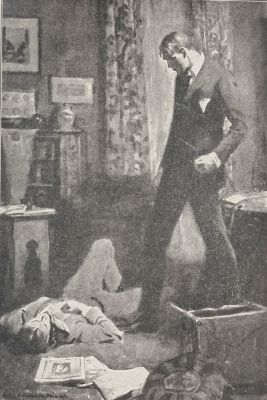
"GET UP, I TELL YOU"
Suddenly Tad collapsed, and went down. Tom came on top of him. The heavier having the lighter fastened by arms and legs, the two lay like two stones. The faces were so near together that they could have kissed. Their long protruding eyebrows brushed each other's foreheads. The weight of Tom's bulk squeezed the breath from his foe, as a bear squeezes it with a hug. Nothing was left to Tad but resistance of the will. Of that, too, Tom meant to get the better.
The words were whispered from one mouth into the other. "Do you know what I'm going to do with you?"
There was no answer.
"I'm going to take you back with me to let that old man out of his shop."
There was still no answer. Tom sprang suddenly off Tad's body, but with his fingers under the collar.
"Get up!"
He pulled with all his might. The collar gave way. Tad fell back. "Damned if I will," was all he could say by way of defiance.
Tom gave him a kick. "Get up, I tell you. If you don't I'll kick the stuffing out of you."
The kick hurt nothing but Tad's pride; but it hurt that badly. It hurt it so badly that he got up, with no further show of opposition. He dusted his clothes mechanically with his hands; he tried to adjust his torn collar. His tone was almost commonplace.
"This has got to be settled some other time. What do you want me to do?"
Tom pointed to the door. "What I want you to do is to march. Keep ahead of me. And mind you if you try to bolt I'll wring your neck as if you were a cur. You—you—" He sought a word which would hit where blows had not carried—"you—coward!"
The flash of Tad's eyes was like that of Tom's own. "We'll see."
He went out the door, Tom close behind him.
It was a March night, with snow on the ground, but thawing. They were without overcoats, and bare-headed. A few motor cars were passing, but not many pedestrians.
"Run," Tom commanded.
He ran. They both ran. The distance being short, they were soon in Brattle Square. Tad stopped at a little shop, showing a faint light. There was too much in the way of window display to allow of the passer-by, who didn't give himself some trouble, to see anything within.
At first they heard nothing. Then came a whimpering, like that of a little dog, shut in and lonely, tired out with yelping. Putting his ear to the door, Tom heard a desolate, "Tam! Tam!" It was the only utterance.
"Here's the key! Unlock the door."
Tad did as he was bidden. Inside the "Tam! Tam!" ceased.
"Now go in, and say you're sorry."
As Tad hesitated Tom gave him a push. The door being now ajar the culprit went sprawling into the presence of his victim.
There was a spring like that of a cat. There was also a snarl like a cat's snarl. "You tam Harvard student!"
Feeling he had done and said enough, Tom took to his heels; but as someone else was taking to his heels, and running close behind him, he judged that Tad had escaped.
Back in his room, Tom felt spent. In his bed he was in emotional revolt against his victory. He loathed it. He loathed everything that had led up to it. The eyes that had stared into his, when the two had lain together on the floor, were like those of something he had murdered. What was it? What was the thing that deep down within him, rooted in the primal impulses that must have been there before there was a world—what was the thing that had been devastated, outraged? Once more, he didn't know.
XXXII
Life resumed itself next day as if there had been no dramatic interlude. Proud of the scrap, as he named it, which had taken place in his room, Guy made the best of it for all concerned. His version was tactful, hurting nobody's feelings. The trick on the old man was a merry one, and after a fight about its humor Tad Whitelaw and the Whitelaw Baby had run off together to let the old fellow out. Spit Castle's tapir nose had got badly hurt in the scrimmage, and bled all over the sofa. The splash of ink on the wall was further evidence that Guy's room was a rendezvous of sports. But sports being sports the honors had been even on the whole, and no hard feeling left behind. Tad and the Whitelaw Baby would now, Guy predicted, be better friends.
But of that there was no sign. There was no sign of anything at all. When the Whitelaw Baby met the Whitelaw Baby's brother they passed in exactly the same way as heretofore. You would not have said that the one was any more conscious of the other than two strangers who pass in Piccadilly or Fifth Avenue. In Tad there was no show of resentment; in Tom there was none of pride. As far as Tom was concerned, there was only a humiliated sense of regret.
And then, in April, life again took another turn. Coming back one day to his rooms, Tom found a message requesting him to call a number which he knew to be Mrs. Danker's. His first thought was of Maisie, with whom his letters had begun to be infrequent. Mrs. Danker told him, however, that Honey had had an accident. It was a bad accident, how bad she didn't know. Giving him the name of the hospital to which he had been taken, she begged him to go to him at once. After all the years they had lived with Mrs. Danker she considered them almost as relatives.
The hospital, near the foot of Grove Street, preserved the air of the sedate old Boston of the middle nineteenth century. Its low dome, its pillared façade, its grounds, its fine old trees, had been familiar to Tom ever since he had lived on Beacon Hill. In less than an hour after ringing up Mrs. Danker he was in the office asking for news.
News was scanty. Expecting everyone to understand what he meant to Honey and Honey meant to him, he had looked for the reception which friends in trouble and excitement give to the friend who brings his anxiety to mix with theirs. It would be, "Oh, come in. Poor fellow, he's suffering terribly. It happened thus and so." But to the interne in the office, a young man wearing a white jacket, Honey was not so much as a name. His case was but one among other cases. A good many came in a day. In a week, or a month, or a year, there was no keeping account of them, except as they were registered. Individual suffering was lost sight of in the immense amount of it. But the interne was polite, and said that if Tom would sit down he would find out.
Among the hardest minutes Tom had ever gone through were those in the little reception room. Not only was there suspense; there was remorse. He had treated Honey like a cad. He had never been decent to him. He had never really been grateful. There had never been a minute, in the whole of the nearly six years they had lived together, in which he had not been sorry, either consciously or subconsciously, at being mixed up with an ex-convict. It was the ex-convict he had always seen before he had seen the friend.
A second interne wearing a white jacket came to question him, to ask him who he was, and the nature of his business with the patient. If he was only a friend he could hardly expect to see him. The man was under opiates, he needed to be kept quiet.
"What's happened? What's the matter with him? I can't find out."
The interne didn't know exactly. He had been crushed. He was injured internally. The cause of the accident he hadn't heard.
"Could I see his nurse?"
There was more difficulty about that, but in the end he was taken upstairs, where the nurse came out to the corridor to speak to him. She was a competent, businesslike woman, with none of the emotion at contact with pain which Tom thought must be part of a nurse's equipment. But she could tell him nothing definite. Not having been on duty when the case had been brought in, she had heard no more than the facts essential to what she had to do.
"Do you think he'll die?"
"You'd have to ask the doctor that. He's not dead now. That's about as much as I can say." At sight of the big handsome fellow's distress she partly relented. "You may come in and look at him. You mustn't try to speak to him."
He followed her into a long ward, with an odor of disinfectant. White beds, mostly occupied, lined each wall. Here and there was one surrounded by a set of screens, partially secluding a sufferer. At one such set they stopped. Through an opening between two screens Tom was allowed to look at Honey who lay with face upturned, and no sign of pain on the features. He slept as Tom had seen him sleep hundreds of times when he expected to get up again next morning. The difference was in the expectation of getting up. Blinded by tears, Tom tiptoed away.
When he came next day the effect of the opiate had worn off, and yet not wholly. Honey turned his head at his approach and smiled. Sitting beside the bed, Tom took the big, calloused hand lying outside the coverlet, and held it in his own relatively tender one. More than ever it was borne in on him at whose cost that tenderness had been maintained. Honey liked to have his hand held. A part of the wall of aloofness with which he had kept himself surrounded seemed to have broken down.
A little incoherently he told what had happened. He had been stowing packing-cases in the hold of a big ship. The packing-cases were lowered by a crane. The crane as a rule was a good old thing, slow paced, gentle, safe. But this time something seemed to have gone wrong with her. Though his back was turned, Honey knew by the shadow above him that she was at her work. When he had got into its niche the case with which he was busy he would swing round and seize the new one. And then he heard a shout. It was a shout from the dock, and didn't disturb him. He was about to turn when something fell. It struck him in the back. It was all he knew. He thought he remembered the blow, but was not certain whether he did or not. When he "came to" he had already been moved to the shed, and was waiting for the ambulance. He seemed not to have a body any more. He was only a head, like one of them there angels in a picture, with wings beneath their chins.
He laughed at that, and with the laugh the nurse took Tom away; but when he came back on the following day Honey's mind was clearer.
"I've made me will long ago," he said, when Tom had given him such bits of news as he asked for. "It's all legal and reg'lar. Had a lawyer fix it up. Never told yer nothink about it. Everythink left to you."
"Oh, Honey, don't let us talk about that. You'll be up and around in a week or so."
"Sure I'll be up and around. Yer don't think a little thing like this is goin' to bust me. Why, I don't feel 'ardly nothink, not below the neck. All the same, it can't do no harm for you to know what's likely to be what. If I was to croak, which I don't intend to, yer'd have about sixteen hundred dollars what I've saved to finish yer eddication on. The will is in the bottom of me trunk at Danker's."
On another day he said, "If anyone was to pop up and say I owed 'em that money, because I took it from 'em...."
He held the sentence there, leaving Tom to wonder if he had thoughts of restitution, or possibly of repentance.
"I don't owe 'em nothink," he ended. "Belonged to me just as much as it belonged to them. Nothink don't belong to nobody. I never was able to figger it out just the way I wanted to, because I ain't never had no eddication; but Gord's lor I believes it is. Never could get the 'ang o' the lor o' man, not nohow."
To comfort him, Tom suggested that perhaps when he got through college he might be able to take the subject up.
"I wouldn't bind yer to it, Kiddy. Tough job! Why, when I give up socializin' to try and win over some o' them orthodocks I thought as they'd jump to 'ear me. Not a bit of it! The more I told 'em that nothink didn't belong to nobody the more they said I was a nut."
Having lain silent for a minute he continued, with that light in his face which corresponded to a wink of the blind eye: "I don't bind yer to nothink, Kiddy. That's what I've always wanted yer to feel. You're a free boy. When I'm up and around again, and yer've got yer eddication, and have gone out on yer own, yer won't have me a-'angin' on yer 'ands. No, sir! I'll be off—free as a bird—back with the old gang again—and yer needn't be worried a-thinkin' I'll miss you—nor nothink!"
It was a few days after this that the businesslike nurse who had first admitted him hinted that, if she were Tom, Honey would have a clergyman come to visit him. A few days more and it might be too late.
Honey with a clergyman! It was something Tom had never thought of. The incongruous combination made him smile. Nevertheless, it was what people who were dying had—a clergyman come to visit them. If a clergyman could do Honey any good....
"Honey," he suggested, artfully, next day, "now that you're pinned to bed for awhile, and have got the time, wouldn't you like to see a clergyman sometimes, and talk things over?"
There was again that light in the face which took the place of a wink. "What things?"
Tom was nonplussed. "Well, I suppose, things about your soul."