Front matter (continued 6)
Reading edition
"What'd a clergyman know about my soul? He might know about his own, but I know all about mine that I've got to know. 'Tain't much—but it's enough."
Tom was relieved. He didn't want to disturb Honey by bringing in a stranger nor was he more sure than Honey that any good could be done by it. He was more relieved still when Honey explained himself further.
"Do yer suppose I've come to where I am now without thinkin' them things out, when Gord give me a genius for doin' it? I don't say I've did it as well as them as has had more eddication; but Gord takes us with the eddication what we've got. Eddication's a fine thing; I don't say contrairy; but I don't believe as it makes no diff'rence to Gord. If you and me was before Him—me not knowin' 'ardly nothink, and you stuffed as you are with learnin' till you're bustin' out with it—I don't believe as Gord'd say as there was a pinch o' snuff between us—not to him there wouldn't be." A little wearily he made his confession of faith. "Gord made me; Gord knows me; Gord'll take me just the way I am and make the best o' me, without no one else buttin' in."
It was the middle of an afternoon. If anything, Honey was better. All spring was blowing in at the windows, while the trees were in April green, and the birds jubilant with the ecstasy of mating.
"Beats everythink the way I dream," Honey confided, in a puzzled tone. "Always dreamin' o' my mother. Haven't 'ardly thought of her these years and years. Didn't 'ardly know her. Died when I was a little kid; and yet...."
He lay still, smiling into the air. Tom was glad to find him cheerful, reminiscent. Never in all the years he had known him had Honey talked so much of his early life as within the last few days.
"Used to take us children into the country to see a sister she had livin' there.... Little village in Cheshire called King's Clavering.... See that little cottage now.... Thatched it was.... Set a few yards back from the lane.... Had flowers in the garden ... musk ... and poppies ... and London pride ... and Canterbury bells ... and old man's love ... and cherry pie ... and raggedy Jack ... and sailor's sweetheart ... funny how all them names comes back to me...."
Again he lay smiling. Tom also smiled. It was the first day he had had any hope. It was difficult not to have hope when Honey was so free from pain, and so easy in his mind. As to pain he had not had much since the accident had benumbed him; but there had always been something he seemed to want to say. To-day he had apparently said everything, and so could spend the half-hour of Tom's visit on memories of no importance.
"Always had custard for tea, my mother's sister had. Lord, how us young ones'd...."
The recollection brought a happy look. Tom was glad. With pleasant thoughts Honey would not have the wistful yearning in his eyes which he had turned on him lately whenever he went away.
"There was a hunt in Cheshire. Onst I saw a lord—a dook, I think he was—ridin' to 'ounds. Sat his 'orse as if he was part of him, he did...."
This too died away without sequence, though the happy look remained. The smile grew rapt, distant perhaps, as memory took him back to long forgotten trifles. Just outside the window a robin fluted in a tree.
Honey turned his head slightly to say: "Have I been asleep, Kid?"
"No; you haven't had your eyes shut."
"Oh, but I must have. Couldn't dream if I was wide awake. I saw ma—just as plain as—" He recovered himself with a light laugh—"Wouldn't it bust yer braces to 'ear me sayin' ma? But that's what us childern used to call...."
Once more he turned in profile, lying still, silent, radiant, occupied. The robin sang on. Tom looked at his watch. It was time for him to be stealing away. Now that Honey was better, he didn't mind going without a farewell, because he could explain himself next time. He was glancing about for the nurse when Honey said, softly, casually, as if greeting an acquaintance:
"Hello—ma!"
He lifted both hands, but they dropped back, heavily. Tom, who had half risen, fell on his knees by the bedside, seizing the hand nearest him in both his own.
"Honey! Honey! Speak to me!"
But Honey's good eye closed gently, while the head sagged a little to one side. The robin was still singing.
Two letters received within a few days gave Tom the feeling of not being quite left alone.
Dear Mr. Whitelaw
In telling you how deeply we feel for you in your great bereavement I wish I could make you understand how sincerely we are all your friends. I want to say this specially, as I know you have no family. Family counts for much; but friends count for something too. It is George Sand who says: "Our relations are the friends given us by nature; our friends are the relations given us by God." Will you not think of us in this way?—especially of Guy and me. Whenever you are lonely I wish you would turn to us, in thought at least, when it can't be in any other way. When it can be—our hearts will always be open.
Very sincerely yours,
Hildred Ansley.
The other letter ran:
Dear Tom
Now that you have got this great big incubous off your hands I should think you would try to do your duty by me and what you owe me. It seems to me I've been patient long enough. It is not as if you were the only peanut in the bag. There are others. I do not say this purposely. It is rung from me. I have done all I mean to do here, and will beat it whenever I get a good chance. I should think you would be educated by now. I graduated from high school at sixteen, and I guess I know as much as the next one. I've got a gentleman friend here, a swell fellow too, a travelling salesman, and he makes big money, and he says that if a fellow isn't hitting the world by fifteen he'll always be a quitter. Think this over and let me know. With passionate love.
Maisie.
XXXIII
The day after Honey was buried Tom went to Mrs. Danker's to pay what was owing on the room rent, and take away his effects. The effects went into one small trunk which Mrs. Danker packed, while Tom sat on the edge of the bed and listened to her comments. A little wiry woman, prim in the old New England way, she was tireless in work and conversation.
"He was a fine man, Mr. Honeybun was, and my land! he was fond of you. He'd try to hide it; but half an eye could see that he was that proud of you! He'd be awful up-and-coming while you was here, and make out that it didn't matter to him whether you was here or not; but once you was away—my land! He'd be that down you'd think he'd never come up again. And one thing I could see as plain as plain; he was real determined that when you'd got up in the world he wasn't going to be a drag on you. He'd keep saying that you wasn't beholding to him for anything; and that he'd be glad when you could do without him so that he could get back again to his friends; but my land! half an eye could see."
During these first days Tom found the memory of a love as big as Honey's too poignant to dwell upon. He would dwell upon it later, when the self-reproach which so largely composed his grief had softened down. All he could do as yet was to curse himself for the obtuseness which had taken Honey at the bluff of his words, when the tenderness behind his deeds should have been evident to anyone not a fool.
He couldn't bear to think of it. Not to think of it, he asked Mrs. Danker for news of Maisie. He had often wondered whether Maisie might not have told her aunt in confidence of her engagement to himself; and now he learned that she had not.
"I hardly ever hear from her; but another aunt of Maisie's writes to me now and then. Says that that drummer fellow is back again. I hope he'll keep away from her. He don't mean no good by her, and she goes daft over him every time he turns up. My land! how do we know he hasn't a wife somewheres else, when he goes off a year and more at a time, on his long business trips? This time he's been to Australia. It was to get her away from him that I asked her to spend that winter in Boston; but now that he's back—well, I'm sure I don't know."
Tom had not supposed that at the suggestion of a rival he would have felt a pang; and yet he felt one.
"Of course, there's some one; we know that. It must be some one too who's got plenty of money, because he's given her a di'mond ring that must be worth five hundred dollars, her other aunt tells me, if it's worth a cent. We know he makes big money, because he's got a fine position, and his family is one of the most high thought of in Nashua. That's part of the trouble. They're very religious and toney, so they wouldn't think Maisie a good enough match for him. Still, if he'd only do one thing or the other, keep away from her, or ask her right out and out to marry him...."
Tom was no longer listening. The mention of Maisie's diamond had made him one hot lump of shame. He knew more of the cost of jewels now than when he had purchased the engagement ring, and even if he didn't know much he knew enough.
A few days later he was in Nashua. He went, partly because he had the day to spare before he took up college work again, partly because of a desire to learn what was truly in Maisie's heart, partly to make her some amends for his long neglect of her, and mostly because he needed to pour out his confession as to the diamond ring. Having been warned of his coming, Maisie, who had got rid of the children for an hour or two, awaited him in the parlor.
A little powder, a little unnecessary rouge, a sweater of imitation cherry-colored silk, gave her the vividness of a well-made artificial flower. Even Tom could see that, with her neat short skirt and high-heeled shoes, she was dressed beyond the note of the shabby little room; but if she would only twine her arms around his neck, and give him one of the kisses that used to be so sweet, he could overlook everything else.
Her eyes on the big square cardboard box he carried in his hand, she received him somberly. Having allowed him to kiss her, she sat down at the end of a table drawn up beside the window, while he put the box in front of her.
"What's this?"
He placed himself at the other end of the table, having its length between them. Because of his waning love, because of the ring above all, he had done one of those reckless things which sometimes render men exultant. From his slender means he had filched a hundred dollars for a set of furs. He watched Maisie's face as she untied knots and lifted the cover of the band-box.
On discovering the contents her expression became critical. She fingered the fur without taking either of the articles from the box. Turning over an edge of the boa, she looked at the lining. It was a minute or two before she took out the muff and held it in her hands. She examined it as if she were buying it in a shop.
"That's a last year's style," was her first observation. "It'll be regular old-fashioned by next winter, and, of course, I shouldn't want a muff before then. The girls'll think I got them second-hand when they're as out of date as all that. They're awful particular in Nashua, more like New York than Boston." She shook out the boa. "Those little tails are sweet, but they don't wear them now. How much did you give?"
He told her.
"They're not worth it. It's the marked-down season too. Some one's put it over on you. I could have got them for half the price—and younger. These are an old woman's furs. The girls'll say my aunt in Boston's died, and left them to me in her will."
Brushing them aside, she faced him with her resentful eyes. Her hands were clasped in front of her, the diamond flashing on the finger resting on a table-scarf of thin brown silk embroidered in magenta ferns.
"Well, Tom, what's your answer to my letter?"
At any other minute he would have replied gently, placatingly; but just now his heart was hot. A hundred dollars had meant much to him. It would have to be paid back in paring down on all his necessities, in food, in carfares, even in the washing of his clothes. He too clasped his hands on the table, facing her as she faced him. He remembered afterward how blue her eyes had been, blue as lapis lazuli. All he could see in them now was demand, and further demand, and demand again after that.
"Have I got to give you an answer, Maisie? If so, it's only the one I've given you before. We'll be married when I get through college, and have found work."
"And when'll that be?"
"I'm sorry to say it won't be for another two years, at the earliest."
"Another two years, and I've waited three already!"
"I know you have. But listen, Maisie! When we got engaged I was only sixteen. You were only eighteen. Even now I'm only nineteen, and you're only twenty-one. We've got lots of time. It would be foolish for us to be married...."
She broke in, drily. "So I see."
"You see what, Maisie?"
"What you want me to see. If you think I'm dying to marry you...."
"No, I'm not such an idiot as that. But if we're in love with each other, as we used to be...."
"As you used to be."
"As I used to be of course; and you too, I suppose."
"Oh, you needn't kill yourself supposing."
He drew back. "What do you mean by that, Maisie?"
"What do you think I mean?"
"Well, I don't know. It sounds as if you were trying to tell me that you'd never cared anything about me."
"How much did you ever care about me?"
"I used to think I couldn't live without you."
"And you've found out that you can."
"I've had to, for one thing; and for another, I'm older now, and I know that nobody is really essential to anybody else. All the same—"
"Yes, Tom; all the same—what?"
"If you'd be willing to take what I can offer you—"
"Take what you can offer me! You're not offering me anything."
He explained his ambitions, for her as well as for himself. Life was big; it was full of opportunity; his origin didn't chain any man who knew how to burst its bonds. He did know. He didn't know how he knew, but he did. He just had it in him. When you knew you had it in you, you didn't depend on anyone to tell you; you yourself became your own corroboration.
But in order to fulfil this conviction of inner power you needed to know things. You needed the experience, the standing, the rubbing up against other men, which you got in college in a way that you didn't get anywhere else. You got some of it by going into business, but only some of it. In any case, it was no more than a chance in business. You might get it or you might not. With the best will in the world on your part, it might slip by you. In college it couldn't slip by you, if you had any intelligence at all. All the past experience of mankind was gathered up there for you to profit by. You could only absorb a little of it, of course. But you acquired the habit of absorbing. It was not so much what you learned that gave college its value; it was the learning of a habit of learning. You got an attitude of mind. Your attitude of mind was what made you, what determined your place in the world. With a closed mind you got nowhere; with an open mind the world was as the sea driving all its fish into your net. College opened the mind; it was the easiest method by which it could be done. If she would only be patient till he had got through the preliminary training and had found the job for which he would be fitted....
"But what's the use of waiting when you can get a job for which you'd be fitted right off the bat? There's a family up here on the hill that wants a shofer. They give a hundred and twenty-five a month. Why go to all that trouble about opening your mind when here's the job handed out to you? The gentleman-friend I told you about says that business has got college skinned. He says colleges are punk. He says lots of men in business won't take a man if he's been to college. They'd want a fellow with some get-up-and-get to him."
He began to understand her as he had never done before. Maisie had the closed mind. She was Honey's "orthodock," the type which accepts the limitations other people fix for it. He registered the thought, long forming in his mind subconsciously, that among American types the orthodock is the commonest. It was not true, as so often assumed, that the average American is keen to forge ahead and become something bigger than he is. That was one of the many self-flattering American ideals that had no relation to life. Mrs. Ansley's equality of opportunity was another. People passed these phrases on, and took for granted they were true, when in everyday practice they were false.
There could be no breaking forth into a larger life so long as the national spirit made for repression, suppression, restriction, and denial. Maisie was but one of the hundred and sixteen millions of Americans out of a possible hundred and seventeen on whom all the pressure of social, industrial, educational, and religious life had been brought to bear to keep her mind shut, her tastes puerile, and her impulses to expansion thwarted. With a great show of helping and blessing the less fortunate, American life, he was coming to believe, was organized to force them back, and beat them into subjection. The hundred and seventeenth million loved to believe that it wasn't so; it was not according to their consciences that it should be so; but the result could be seen in the hundred and sixteen million minds drilled to disability, as Maisie's was.
A young man not yet hardened to life's injustices, he saw himself rushing to Maisie's aid, to make the best of her. Experience would help her as it had helped him. The shriveled bud of her mind would unfold in warmth and sunshine. This would be in their future together. In the meantime he must clear the ground of the present by getting rid of pretence.
"There's one thing I want to tell you, Maisie, something I'm rather ashamed of."
The lapis lazuli eyes widened in a look of wonder. He might be going to tell her of another girl.
"You know, as I've just said, that when we got engaged I was only sixteen. I didn't know anything about anything. I thought I did, of course; but then all fellows of sixteen think that. I'd never had anyone to teach me, or show me the right hang of things. You saw for yourself how I lived with Honey; and before that, as you know, I'd been a State ward. Further back than that—but I can't talk about it yet. Some day when we're married, and know each other better—"
"I'm not asking you. I don't care."
"No, I know you don't care, and that you're not asking me; but I want you to understand how it was that I was so ignorant, so much more ignorant than I suppose any other fellow would have been. When I went out to buy that ring you've got on—"
He knew by the horror in her face that she divined what he had to tell her. He knew too that she had already been afraid of it.
"You're not going to say that it isn't a real diamond?"
To nerve himself he had to look at her steadily. Confessing a murder would have been easier.
"No, Maisie, it isn't a real diamond. At the time I bought it I didn't know what a real diamond was. I'm not sure that I know now—"
He stopped because, without taking her eyes from his, she was slipping the ring from her finger. She was slipping, too, an illusion from her mind. He knew now that to be trifled with in love, to be betrayed in a great trust, would be small things to Maisie as compared to this kind of deception. Her wrath and contempt were the more scathing to behold because of her cherry-colored prettiness.
The ring lay on the table. Drawing in the second finger of her right hand, she made of it a spring against her thumb. She loosed the spring suddenly. The faked diamond sped across the table hitting against his hand. He picked it up, putting it out of sight in his waistcoat pocket. For a fellow of nineteen, eager to be something big, no lower depth of humiliation could ever be imagined.
Maisie stood up. "You cheap skate!"
He bowed his head as a criminal sometimes does when sentenced. He had no protest to make. A cheap skate was what he was. He sat there crushed. Skirting round him as if he were defiled, she went out into the little entry.
He was still sitting crushed when she came back. She did not pause. She merely flung his hat on the table as she went by. It was a cheap skate's hat, a brown soft felt, shapeless, weather-stained, three years out of style. With no further words, she opened the door into the adjoining room, passed through it, and closed it noiselessly behind her.
XXXIV
For probating Honey's will he asked leave to come and consult Mr. Ansley. An appointment was made for an evening when that gentleman was to be at home.
Tom, who had some gift for character, was beginning to understand him. Understanding him, it seemed to him that he understood all that old Boston which had once been a national institution, a force in the country's history, and now, like a man retired from business, sat resting on its hill.
Old Boston was more significant, however, than a man retired from business, in that it was to a great degree a man retired from the pushing of ideals. Generous once with the hot generosity of youth, keen to throw itself into the fight against wrongs, ready to be slaughtered in the van rather than compromise on principles, old Boston had now reached the age of mellowness. It had grown weary in well-doing. It had done enough. Contending with national evils had proved to be futile. National evils had grown too big, too many, too insurgent. Better make the best of life as your people mean to live it. Keep quiet; take it easy; save money; let the country gang its own gait. A big turbulent country, with no more respect for old Boston than for the prophet Jeremiah, it wallowed in prosperous vulgarity. Let it wallow! With solid investments in cotton and copper old Boston could save its own soul. It withdrew from its country; it withdrew from its state; it withdrew from its own city. Where its ancestors had made the laws and administered them, it became, like those proud old groups of Spaniards still to be found in California, a remnant of a former time, making no further stand against the invader. With a little art, a little literature, a little music, a little education, a little religion, a little mild beneficence, and a great deal of astute financial and professional ability, it could pass its time and keep its high-mindedness intact.
To Tom's summing up this was Philip Ansley. He was able, public-spirited, and generous; but he was disillusioned. The United States of his forefathers, of which he kept the ideal in his soul, had turned into such a hodgepodge of mankind, that he had neither hope nor sentiment with regard to it. In his heart he believed that its governments were in the hands of what he called a bunch of crooks. With congresses, state legislatures, and civic councils elected by what to him were hordes of ignoramuses, with laws dictated by cranks and fanatics, with the old-time liberties stampeded by the tyranny of majorities lacking a sense of responsibility, he deemed it prudent to follow the line of least resistance and give himself to making money. Apart from casting his vote for the Republican ticket on election days, he left city, state, and country to the demagogues and looters. He was sorry to do this, yet with the world as it was, he saw no help for it.
But he served as director on the boards of a good many companies; he was an Overseer of Harvard, a trustee of the Museum of Fine Arts, the treasurer of several hospitals, a subscriber to every important philanthropic fund. His club was the Somerset; his church was Trinity. For old Boston these two facts when taken together placed him in that sacred shrine which in England consecrates dowager duchesses.
When Tom was shown up he found his host in the room where two years earlier they had talked over the place as chauffeur, but he was no longer awed by it. Neither was he awed by finding Ansley wearing a dinner-jacket simply because it was evening. The conventions and amenities of civilized life were becoming a matter of course to him.
"How d'ye do? Come in. Sit down. What's the weather like outside? Still pretty cold for April, isn't it?"
Though he offered his hand only from his armchair, where he sat reading the evening paper, he offered it. It was also a tribute to Tom's progress that he was asked to take a seat. A still further sign of his having reached a position remotely on a footing of equality with the Ansleys was an invitation to help himself from a silver box of cigarettes.
Having respectfully declined this honor, as Ansley himself was not smoking, he stated his errand. If Mr. Ansley would introduce him to some young inexpensive lawyer, who would tell him what to do in the probating of Honey's will....
The business was soon settled. In possession of Ansley's card with a scribbled line on it, Tom rose to take his leave. Ansley rose also, but moved toward the fireplace, where a few sticks were smoldering, as if he had something more to say.
"Wait a minute. Sit down again. Have a cigarette."
As Ansley himself lighted a cigar, Tom took a cigarette from the silver box, and leaned against the back of the big chair from which he had just risen. Once more he was struck by the resemblance between the shrewd close-lipped face, dropping into its meditative cast, and the lampshade just below it, parchment with a touch of rose, and an inner light. Ansley puffed for a minute or two pensively.
"You've no family, I believe. You haven't got the complications of a lot of relatives."
Tom was surprised by the new topic. "No, sir. I wish I had, but—"
"Oh, well, for a young fellow like you, bound to get on—" He dropped this line to take up another. "I'm thinking about Guy. Occurred to me the other day that while he'd been dragged about Europe a good many times he didn't know anything of his own country. Never been west of the Hudson."
Tom smoked and wondered.
"I've suggested to him to take his summer's vacation and wander about. Get the lay of the land. Could cover a good deal of ground in three months. Zigzag up and down—Niagara—Colorado—Chicago—Grand Canyon—California—Seattle—back if he liked by the Canadian Pacific. What would you think?"
"I think it would be great."
"Would you go with him?"
It seemed to Tom that his brain was spinning round. Not only was he too dazed to find words, but the question of money came first. How could he afford ...?
But Ansley went on again. "It's a choice between you and a tutor. My wife would like a tutor. Guy wants you. So do I. You'd have your traveling expenses, of course—do everything the same as Guy—and, let us say, five hundred dollars for your time. Would that suit you?"
He didn't know how to answer. Excitement, gratitude, and a sense of insufficiency churned together and choked him. It was only by spluttering and stammering that he could say at last:
"If—if Mrs. Ansley—d-doesn't w-want me—"
"Oh, she'd give in. Simply feels that Guy'd get more good out of it if he had some one to point out moral lessons as he went along. I don't. Two young fellows together, if they're at all the right kind, 'll do each other more good than all the law and the prophets."
"But would you mind telling me, sir, something of what you'd expect from me?"
"Oh, nothing! Just play round with him, and have a good time. You seem to chum up with him all right."
Tom was distressed. "Yes, sir, but if I'm to be—to be paid for chumming up with him I should have to—"
"Forget it. I want Guy to take the trip. It's not the kind of trip anyone wants to take alone, and you're the fellow he'd like to have with him. I'd like it too. You understand him."
He turned round to knock the ash from his cigar into the dying fire.
"Trouble with Guy is that he has no sense of values. Thing he needs to learn is what's worth while and what's not. I don't want you to teach him. I just want him to see. What do you say?"
Tom hung his head, not from humility but to think out a point that troubled him.
"You know, sir"—he looked up again—"that when Guy and I get together we talk about things that—well, that you mightn't like."
"I don't care a hang what you talk about."
"Yes, sir; but this is something particular."
"Well, then, keep it to yourself."
"I can't keep it to myself because—because some day you might think that I'd had a bad ... as long as we've just been chums ... and I wasn't paid—"
Ansley moved away from the fireplace, striding up and down in front of it.
"Look here, my boy! I know what young fellows are. I know you talk about things you wouldn't bring up before Mrs. Ansley and me. I don't care. It's what I expect. Do you both good. You're not specially vicious, either of you, and even if you were—"
"It's not a matter of morals, sir; it's one of opinions."
He dismissed this lightly. "Oh, opinions!"
"But this is a special kind of opinion. You see, sir, I've always been poor. I've lived among poor people. I've seen how much they have to go without. And I begin to see all that rich people have more than they need—more than they can ever use."
"Oh, quite so! I see! I see! And you both get a bit revolutionary. Go to it, boy! Fellows of your age who're not boiling over with rebellion against social conditions as they are'll never be worth their salt. Don't say anything about it before Mrs. Ansley, but between yourselves.... Why, when I was an undergraduate.... You'll live through it, though.... The poor people don't want any champions.... They don't want to be helped.... You get sick of it in the long run.... But while you're young boil away.... If that's all that bothers you...."
Tom explained that it was all that bothered him, and the bargain was struck. He had expressed his thanks, shaken hands, and reached the threshold on the way out when Ansley spoke again.
"Guy tells me that out at Cambridge they call you the Whitelaw Baby. I suppose you know all about yourself—your people—where you began—that sort of thing?"
He decided to be positive, laconic, to do what he could to squelch the idea in Ansley's mind.
"Yes, sir; I do."
"Then that settles that."
XXXV
Between the end of the college year and the departure on the journey westward there was to be an interval of three weeks. Mrs. Ansley had insisted on that. She was a mother. For eight or nine months she had seen almost nothing of her boy. Now if he was to be taken from her for the summer, and for another college year after that, she might as well not have a son at all.
Tom was considering where he should pass the intervening time when the following note unnerved him.
Dear Mr. Whitelaw
Mother wants to know if when college closes, and Guy joins us in New Hampshire, you will not come with him for the three weeks before you start on your trip. Please do. I shall have got there by that time, and I haven't seen you now for nearly two years. We must have a lot of notes to compare, and ought to be busy comparing them. Do come then, for our sakes if not for your own. You will give us a great deal of pleasure.
Yours very sincerely,
Hildred Ansley.
His heart failed him. It failed him because of the details as to customs, etiquette, and dress he didn't know anything about. He should be called on to speak fluently in a language of which he was only beginning to spell out the little words. It seemed to him at first that he couldn't accept the invitation.
Then, not to accept it began to look like cowardice. He would never get anywhere if he funked what he didn't know. When you didn't know you went to work and found out. You couldn't find out unless you put yourself in the way of seeing what other people did. After twenty-four hours of reflection he penned the simplest form of note. Thanking Hildred for her mother's kind invitation, he accepted it. Before putting his letter in the post, however, he dropped in to call on Guy. Guy, who was strumming the Love-Death of Isolde, tossed his comments over his shoulder as he thumped out the passion.
"That's Hildred. She's made mother do it. Nutty on that sort of thing."
Tom's heart failed him again. "Nutty on what sort of thing?"
Isolde's anguish mounted and mounted till it seemed as if it couldn't mount any higher, and yet went on mounting. "Oh, well! She's toted it up that you haven't got a home—that for three weeks after college closes you'll be on the town—and so on."
"I see."
"All the same, come along. I'd just as soon. Dad won't be there hardly. The old lady'll be booming about, but you needn't mind her. You'll have your room and grub for those three weeks, and that's all you've got to think about. Anyhow, it's bats in the attic with Hildred the minute it comes to a lame dog."
While Guy's fat figure swayed over the piano, Isolde's great heart broke. Tom went back to his room and wrote a second answer, regretting that owing to the pressure of his engagements he would be unable....
And then there came another reaction. What did it matter if Hildred Ansley was opening the door out of pity? Pity was one of the loveliest traits of character. Only a cad would resent it. He sent his first reply.
Having done this, he felt it right to go and call on Mrs. Ansley. He was sure she didn't want him in New Hampshire, but by taking it for granted that she did he would discount some of her embarrassment.
As Mrs. Ansley was not at home Pilcher held out a little silver tray. Tom understood that he should have had a card to put in it. A card was something of which he had never hitherto felt the need. He said so to Pilcher frankly.
Pilcher's stony medieval face, the face of a saint on the portal of some primitive cathedral, smiled rarely, but when it did it smiled engagingly.
"You'll find a visitin' card very 'andy, Mr. Tom, now that you're so big. Mr. Guy has had one this long spell back."
It was a lead. In shy unobtrusive ways Pilcher had often shown himself his friend. Tom confessed his yearning for a card if only he knew how to order one.
"I'll show you one of Mr. Guy's. He always has the right thing. I'll find out too where he gets them done. If you'll step in, Mr. Tom...."
As he waited in the dining room, with the good-natured Ansley ancestor smiling down at him, there floated through Tom's mind a phrase from the Bible as taught by Mrs. Tollivant. "The Lord sent His angel." Wasn't that what He was doing now, and wasn't the angel taking Pilcher's guise? When the heavenly messenger came back with the card Tom went straight to his point.
"Pilcher, I wonder if you'd mind helping me?"
"I'd do it and welcome, Mr. Tom."
Mr. Tom told of his invitation to New Hampshire, and of his ignorance of what to do and wear. If Pilcher would only give him a hint....
He could not have found a better guide. Pilcher explained that a few little things had to be as second nature. A few other little things were uncertain points as to which it was always permissible to ask. In the way of second nature Tom would find sporting flannels and tennis shoes an essential. So he would find a dinner-jacket suit, with the right kind of shirt, collar, tie, shoes, and socks to wear with it. As to things permissible to ask about, Pilcher could more easily explain them when they were both in the same house. Occasions would crop up, but could not be foreseen.
"The real gentry is ever afraid of showin' that they don't know. They takes not knowin' as a joke. Many's the time when I've been waitin' at table I've 'eard a born gentleman ask the born lady sittin' next to 'im which'd be the right fork to use, and she'd say that she didn't know but was lookin' round to see what other people done. That's what they calls hease of manner, Mr. Tom."
Under the Ansley roof he would meet none but the gentry born. Any one of them would respect him more for asking when he didn't know. It was only the second class that bothered about being so terribly correct, and they were not invited by Mrs. Ansley. In addition to these consoling facts Tom could always fall back on him, Pilcher, as a referee.
Being a guest in a community in which two years earlier he had been a chauffeur Tom found easier than he had expected because he worked out a formula. He framed his formula before going to New Hampshire.
"Servants are servants and masters are masters because they divide themselves into classes. The one is above, and is recognized as being above; the other is below, and is recognized as being below. I shall be neither below nor above; or I shall be both. I will not go into a class. As far as I know how I'll be everybody's equal."
He had, however, to find another formula for this.
"You're everybody's equal when you know you are. Whatever you know will go of itself. The trouble I see with the bumptious American, who claims that he's as good as anybody else, is that he thinks only of forcing himself to the level of the highest; he doesn't begin at the bottom, and cover all the ground between the bottom and the top. I'm going to do that. I shall be at home among the lot of them. To be at home I must feel at home. I mustn't condescend to the boys of two years ago who'll still be driving cars, and I mustn't put on airs to be fit for Mrs. Ansley's drawing-room. I must be myself. I mustn't be ashamed because I've been in a humble position; and I mustn't be swanky because I've been put in a better one. I must be natural; I must be big. That'll give me the ease of manner Pilcher talks about."
With these principles as a basis of behavior, his embarrassments sprang from another source. They began at the station in Keene. He knew he was to be met; and he supposed it would be by Guy.
"Oh, here you are!"
She came on him suddenly in the crowd, tall, free in her movements, always a little older than her age. If in the nearly two years since their last meeting changes had come to him, more had apparently come to her. She was a woman, while he was not yet a man. She was easy, independent, taking the lead with natural authority. From the first instant of shaking hands he felt in her something solicitous and protective.
It showed itself in the little things as to which awkwardness or diffidence on his part might have been presumed. So as not to leave him in doubt of what he ought to do, she took the initiative with an air of quiet, competent command. She led the way to the car; she told him to throw his handbags and coat into the back part of it; she made him sit beside her as she drove.
"No, I'm going to drive," she insisted, when he had offered to take the wheel. "I want you to see how well I can do it. I like showing off. This is my own car. I drove it all last summer."
They talked about cars and their makes because the topic was an easy one.
Speeding out of Keene, they left behind them the meadows of the Ashuelot to climb into a country with which Nature had been busy ever since her first flaming forces had cooled down to form a world. Cooling down and flinging up, she had tossed into the azoic age a tumble of mountains higher doubtless than Andes or Alps. Barren, stupendous, appalling, they would not have been easy for man, when he came, to live with in comfort, had not the great Earth-Mother gone to some pains to polish them down. Taking her leisure through eons of years, she brought from the north her implement, the ice. Without haste, without rest, a few inches in a century, she pushed it against the barrier she meant to mold and penetrate.
As a dyke before the pressure of a flood, the barrier broke here, broke there, and yet as a whole maintained itself. Heights were cut off from heights. Valleys were carved between them. What was sharp became rounded; what was jagged was worn smooth. The highest pinnacles crashed down. When after thousands of years the glacial mass receded, only the stumps were left of what had once been terrific primordial elevations.
Dense forests began to cover them. Lakes formed in the hollows. Little rivers drained them, to be drained themselves by a nameless stream which fell into a nameless sea. Through ages and ages the thrushes sang, the wild bees hummed, and the bear, the deer, the fox, the lynx ranged freely.
Man came. He came stealthily, unnoted, leaving so light a trace that nothing remains to tell of his first passage but a few mysterious syllables. The river once nameless became the Connecticut; the base of a mighty primeval mountain bears the Nipmuck name Monadnock.
In this angle of New Hampshire thrust in between Massachusetts and Vermont names are a living record. The Nipmuck disappeared in proportion as the restless English colonists pushed farther and farther from the sea. They came in little companies, generally urged by some religious disagreement with those they had left behind. To escape the "Congregational way" they fled into the mountains. There they were free to follow the "Episcoparian way." As "Episcoparians" they printed the map with names which enshrined their old-home memories. Clustering within sight of the blue mass of Monadnock are neat white towns—Marlborough, Richmond, Chesterfield, Walpole, Peterborough, Fitzwilliam, Winchester—rich with "Episcoparian" suggestion.
In the early eighteenth century there came in another strain. Driven by famine, a thousand pilgrims arrived in these relatively empty lands from the North of Ireland, sturdy, strong-minded, Protestant. Grouping themselves into three communities, they named them with Irish names, Antrim, Hillsborough, Dublin. It was to Dublin that Tom and Hildred were on the way.
The subject of cars exhausted, she swung to something else.
"You like the idea of going with Guy?"
"It's great."
"I like it too. I'd rather he was with you than with anybody. You never make game of him, and yet you never humor him."
"What do you mean by that, that I never humor him?"
"Oh, well! Guy's standards aren't very high. We know that. But you never lower yours."
"How do you know I don't?"
"Because Guy says so. Don't imagine for a minute that he doesn't see. He likes you so much because he respects you."
"He respects a lot of other fellows too."
A little "H'm!" through pursed-up lips was a sign of dissent. "I wonder. He goes with them, I know, and rather envies them, which is what I mean by his standards not being very high; but—"
"Oh, Guy's all right. The fellows you speak of are sometimes a little fresh; but he knows where to draw the line. He'll go to a certain point; but you won't get him beyond it."
"And he owes that to you."
"Oh, no, he doesn't, not in the least."
"Well, I—" she held the personal pronoun for emphasis—"think he does."
In this good opinion she was able to be firm because she seemed older than he. In reality she was two years younger, but life in a larger society had given her something of the tone of a woman of the world. This development on her part disconcerted him. So long as she had been the slip of a thing he remembered, prim, sedate, old-fashioned as the term is applied to children, she had not been a factor in his relations with the Ansley family. Now, suddenly, he saw her as the most important factor of all. The emergence of personality troubled him. Since she was obliged to keep her eyes on the turnings of the road, he was able to study her in profile.
It was the first time he had really looked at a woman since he had summed up Maisie in Nashua. That had been two months earlier. The place which Maisie had so long held in his heart had been empty for those two months, except for a great bitterness. It was the bitterness of disillusion, of futility. Rage and pain were in it, with more of mortification than there was of either. He would never again hear of a cheap skate without thinking of the figure he had cut in the eyes of the girl whom he thought he was honoring merely in being true. All girls had been hateful to him since that day, just as all boys will be to a dog who has been stoned by one of them. Yet here he was already looking at a girl with something like fascination.
That was because fascination was the emotion she evoked. She was strange; she was arresting. You wondered what she was like. You watched her when she moved; you listened to her when she talked. Once you had heard her voice, bell-like and crystalline, you would always be able to recall it.
He noticed the way she was dressed because her knitted silk sweater was of a pattern he had never seen before. It ran in horizontal dog-toothed bands, shading from green to blue, and from blue to a dull red. Green was the predominating color, grass-green, jade-green, sea-green, sage-green, but toned to sobriety by this red of old brick, this blue of indigo. Indigo was the short plain skirt, and the stockings below it. An indigo tam-o'-shanter was pinned to her smooth, glossy, bluish-black hair with a big carnelian pin. He remembered that he used to think her Cambodian. He thought so again.
Having arrived at the house, they found no one but Pilcher to receive them. Mrs. Ansley had gone out to tea; Mr. Guy had left word for Miss Hildred to bring Mr. Tom to the club, where he was playing tennis.
"Do you care to go?"
Knowing that he couldn't spend three weeks in Dublin without facing this invitation, he had decided in advance to accept it the first time it came.
"If you go."
"All right; let's. But you'd like first to go to your room, wouldn't you? Pilcher, take Mr. Whitelaw up. I'll wait here with the car. We'll start as soon as you come down." Running up the stairs, he wondered whether it would be the proper thing for him to change to his new white flannels, when, as if divining his perplexity, she called after him. "Come just as you are. Don't stop to put on other things. I'll go as I am too."
This maternal foresight was again on guard as they turned from the road into the driveway to the club.
"Do you want to come and be introduced to a lot of people, or would you rather browse about by yourself? You can do whichever you like."
He replied with a suggestion. As a good many cars would be parked in the narrow space of the club avenues, he thought she had better jump out at the club steps, leaving him to find a space where the car could stand. He would hang around there till Guy's game was over and the party was ready to go home.
Having parked the car, he was in with the chauffeurs, some of whom were old acquaintances. True to his formula, he went about among them, shaking hands, and asking for their news. They were oddly alike, not only in their dustcoats and chauffeurs' caps, but in features and cast of mind.
"You got a job?" he was asked in his turn.
"Been taken on to travel with young Ansley. We stay here for three weeks, and then go out west."
"Loot pretty good?"
"Oh, just about the same, and, of course, I get my expenses."
"Pretty soft, what?" came from an Englishman.
"Yes, but then it's only for the summer."
These duties done, he felt free to stroll off till he found a convenient rock on which to sit by the lakeside. Lighting a cigarette, he was glad of a half hour to himself in which to enjoy the scene. It was a reposeful scene, because all that was human and sporting in it was lost in the living spirit of the background.
It was what he had always felt in this particular landscape, and had never been able to define till now—its quality of life. It was life of another order from physical life, and on another plane. You might have said that it reached you out of some phase of creation different from that of Earth. These hills were living hills; this lake was a living lake. Through them, as in the serene sky, a Presence shone and smiled on you. He had often noticed, during the summer at the inn-club, that you could sit idle and silent with that Presence, and not be bored. You looked and looked; you thought and thought; you were bathed about in tranquillity. People might be running around, and calling or shouting, as they were doing now in the tennis courts on a ledge of the hillside above him, not five hundred yards away, but they disturbed you no more than the birds or the butterflies. The Presence was too immense, too positive, to allow little things to trouble it. Rather, it took them and absorbed them, as if the Supreme Activity, which for millions of years before there was a man had been working to transform this spot into a cup of overflowing loveliness, could use anything that came Its way.
So he sat and smoked and thought and felt soothed. It was early enough in the summer for the birds to be singing from all the wooded terraces and the fringe of lakeside trees. Calls from the tennis courts, cries from young people climbing on the raft in the lake or diving from the spring-board, came to him softened and sweet. It was living peace, invigorating, restful.
XXXVI
A woman passed along the driveway, and looked at him. He looked at her. The rock on which he sat being no more than a dozen yards from where she walked, they could see each other plainly. It seemed to him that as she went by she relaxed her pace to study him. She was a little woman, pretty, sad-faced, neatly dressed and perhaps fifty years of age. Having passed once, she turned on her steps and passed again. She passed a third time and a fourth. Each time she passed she gave him the same long scrutinizing look, without self-consciousness or embarrassment. He thought she might be a lady's maid or a chauffeur's wife.
He turned to watch a young man taking a swan dive from the spring-board. Having run the few steps which was all the spring-board allowed of, he stood poised on the edge, feet together, his arms at his thighs. With the leap forward his arms went out at right angles. When he turned toward the water they bent back behind his head, his palms twisted upward. Nearing the surface they pointed downward, cleaving the lake with a clean, splashless penetration. The whole movement had been lithe and graceful, the curve of a swan's neck, the spring of a flying fish.
Not till she was close beside him did he notice that the little woman had left the roadway, crossed the intervening patch of blueberry scrub, and seated herself on a low bowlder close to his own.
Her self-possession was that of a woman with a single dominating motive. "You've just arrived with Miss Ansley, haven't you?"
The voice, like the manner, was intense and purposeful. In assenting, he had the feeling of touching something elemental, like hunger or fire, which wouldn't be denied.
"And you're at Harvard."
He assented to this also.
"At Harvard they call you the Whitelaw Baby, don't they?"
"I've heard so. Why do you ask?"
"Because I'm the nurse from whom the Whitelaw baby was stolen nearly twenty years ago. My name is Nash."
A memory came to him of something far away. He could hear Honey saying he had seen her, a pretty little Englishwoman, and that Nash was her name. Looking at her now, he saw that she was more than a pretty little Englishwoman; she was a soul in torture, with a flame eating at the heart. He felt sorry for her, but not so sorry as to be free from impatience at the dogging with which the Whitelaw baby followed him.
"Why do you say this to me?"
"Because of what I've heard from the family. They've spoken of you. They think it—queer."
"They think what queer?"
"That your name is Whitelaw—that your father's name was Theodore—that you look so much like the rest of them. Mr. Whitelaw's name is Henry Theodore—"
"And my father's name was only Theodore. My mother's name was Lucy. I was born in The Bronx. I'm exactly nineteen years of age. I've heard that Mr. Whitelaw's son if he were living now would be twenty."
Large gray eyes with silky drooping lids rested on his with a look of long, slow searching. "You're sure of all that?"
He tried to laugh. "As sure as you can be of what's not within your own recollection. I've been told it. I've reason to believe it."
"I'd no reason to believe that I should ever find my boy again; but I know I shall."
"That must be a comfort to you in the trial you've had to face."
"It hasn't been a trial exactly, because you bear a trial and live through it. This has been spending every day and every night in the lake of fire and brimstone. I wonder if you've any idea of what it's like."
"I don't suppose I have."
"If you did have—" He thought she was going to say that if he did have he would allow himself to become the Whitelaw baby in order to relieve her anguish, but she struck another note. "I hadn't the least suspicion of what had been done to me till the two footmen had lifted the little carriage up over the steps and into the hall. Then I raised the veil to take my baby out, and I—I fell in a dead swoon."
He waited for her to go on again.
"Try to imagine what it is to find in place of the living child you've laid in its bed with all the tenderness in your soul—to find in place of that a dirty, ugly, stuffed thing, about a baby's size.... For days after that I was just as if I was drugged. If I came to for a few minutes I prayed that I mightn't live. I didn't want to look the mother and father in the face."
"But hadn't you told them anything about it?"
"There was nothing to tell. The baby had vanished. I'd seen nothing; I'd heard nothing. Neither had my friend who was with me, and who's married now, in England. If an evil spirit had done it, it couldn't have been silenter, or more secret. It was a mystery then; it's been a mystery ever since."
"But you raised an alarm? You made a search?"
"The whole country raised the alarm. There wasn't a corner, or a suspicious character, that wasn't searched. We knew it had been done for ransom, and the ransom was ready if ever the baby had been returned. The father and mother were that frantic they'd have done anything. There never was a baby in the world more loved, or more lovable. All three of us—the father, the mother, and myself—would have died for him."
He grew interested in the story for its own sake. "And did you never get any idea at all?"
"Nothing that ever led to anything. For a good five years Mr. Whitelaw never rested. Mrs. Whitelaw—but it's no use trying to tell you. It can't be told; it can't be so much as imagined. Even when you've lived through it you wonder how you ever did. You wonder how you go on living day by day. It's almost as if you were condemned to eternal punishment. The clues were the worst."
"You mean that—?"
"If we could have known that the child was dead—well, you make up your mind to that. After a while you can take up life again. But not to know anything! Just to be left wondering! Asking yourself what they're doing with him!—whether they're giving him the right kind of food!—whether they're giving him any kind of food!—whether they're going to kill him, and how they're going to kill him, and who's to do the killing! To go over these questions morning, noon, and night—to eat with them, and sleep with them, and wake with them—and then the clues!"
"You said they were the worst."
"Because they always made you hope. No matter how often you'd been taken in you were ready to be taken in again. Each time they said there was a chance you couldn't help thinking that there might be a chance. It didn't matter how much you told yourself it wasn't likely. You couldn't make yourself believe it. You felt that he'd have to be found, that he couldn't help being found. The whole thing was so impossible that you'd have to go to his room and look at his little empty crib to persuade yourself that he wasn't there."
To divert her from going over the ground she must have gone over thousands of times already, he broke in with a new line of thought.
"But I've heard that they don't want to find him now—a grown-up man."
She stared at him fiercely. "I do. I want to find him. They were not to blame. I was. It makes the difference."
"Still he was their son."
"He was their son, and they've suffered; but they can rest in spite of their suffering. I can't. They can afford to give up hope because they've nothing with which to reproach themselves. If they were me—"
He began to understand. "I see. If you could find him and bring him back, even if they didn't want him—"
"I should have done that much. It would be something. It's why I pleaded with them to let me stay with them when I suppose the very sight of me must have tortured them. I swore that I'd give my life to trying to—"
"But what could you do when even the child's father, with all his money, couldn't—?"
"I could pray. They couldn't. They're not like that. Praying's all I've ever done which wasn't done by somebody else. I've prayed as I don't think many people have ever prayed; and now I've come to where—"
"Where what?"
The light in her eyes was lambent, leaping and licking like a flame.
"Where I'm quieter." She made her statement slowly. "I seem to know that he'll be given back to me because the Bible says that when we pray believing that we have what we ask for we shall receive it. Latterly I've believed that. I haven't forced myself to believe it. It's just come of its own accord—something like a certainty."
The claim in the look which without wavering fixed itself upon him prompted another question. "And has that certainty got anything to do with me?"
"I wonder if it hasn't."
"But I don't see how it can have, when you never saw me in your life till twenty minutes ago."
"I never saw you; but I'd heard of you. I meant to see you as soon as I got a chance. I never got it till to-day."
"But how did you know?"
"That it was you? This way. You see I'm here with Miss Lily. She's staying for a few nights at the inn-club before going to make some visits."
"Who's Miss Lily?"
"She was the second of the two children born after my little boy was taken. First there was Mr. Tad. Then there was a little girl. She knows Miss Ansley. Miss Ansley told her you were coming up, that you'd very likely be here this afternoon, so I came and waited. Even if I hadn't seen you drive up with her—if we'd met in the heart of Africa—I'd have known.... You've been taken for Mr. Tad already. You know that, don't you?"
"I know there's a resemblance."
"It's more than a resemblance. It's—it's the whole story. Mr. Whitelaw himself saw it first. When he came back after meeting you, in this very place, nearly two years ago, he was—well, he was terribly upset. If it hadn't been for Mr. Tad and Miss Lily—"
"And their mother too."
"Yes, I suppose; and their mother too. But that's not what we're considering. Whether they want you or not, if you are the boy—"
He tried to speak very gently. "But you see, I couldn't be. I had a mother. I don't remember much about her because I was only six or seven when she died. But two things I recall—the way she loved me, and the way I loved her. If I thought there was any truth in what you—in what you suspect—I couldn't love her any more."
"I don't see why."
"Because I should be charging her with a crime. Would you do that—to your own mother—after she was dead?"
"If she was dead it wouldn't matter."
"Not to her. But it would to me."
"It couldn't do you any harm."
"I'm the only judge of that."
There was exasperation in the eyes which seemed unable to tear themselves from his face.
"But most people would like to have it proved that they'd been—"
"Been born rich men's sons. That's what you were going to say, isn't it? I daresay I should have liked it, if.... But what's the use? We don't gain anything by discussing it. You want to find some one who'll pass for the lost boy. I understand that; and I understand how much it would lessen all the grief—"
She interrupted quickly. "Yes, but I wouldn't try to foist an imposter on them, not if it would take me out of hell. If I didn't believe—"
"But you don't believe now; you can't believe. What I've told you about myself must make believing impossible."
"Oh, if I hadn't believed when believing was impossible I shouldn't have the little bit of mind I've got now. Believing when it was impossible was all that kept me sane."
"But you won't go on doing it, not as far as I'm concerned?"
She rose, with dignity. "Why not? I shan't be hurting you, shall I? In a way we all believe it—even the Whitelaw family—even Miss Ansley."
He jumped up, startled. "Did she tell you so?"
"She didn't tell me so exactly. We were talking about it—we've all talked of it more than you suppose—and Miss Ansley said that you couldn't be what you are unless you were—somebody."
He tried to take this jocosely. "No, of course I couldn't."
"Oh, but I know what she meant." She moved away from him, speaking over her shoulder as she crossed the blueberry scrub, "It was more than what's in the words."
XXXVII
Except for a passing glimpse in Dublin, Tom never saw Lily Whitelaw till in December he met her at the ball at which Hildred Ansley came out. As to going to this ball he had his usual fit of funk, but Hildred had insisted.
"But, Tom, you must. You're the one I care most about."
"I shouldn't know what to do."
"I'll see to that. You'll only have to do what I tell you."
"And I haven't got an evening coat with tails."
"Well, get one. If you look as well in it as you do in your dinner-jacket outfit—and you'd better have a white waistcoat, a silk hat, and a pair of white gloves. What'll happen to you when you get there you can leave to me. Now that I know you look so well, and dance so well, you'll give me no trouble at all."
Her kindness humbled him. He felt the necessity of taking it as kindness and nothing more. Knowing too that he must school his own emotions to a sense of gratitude, he imagined that he so schooled them.
With the five hundred dollars he had earned through the summer added to what remained of Honey's legacy, he had enough for his current year at Harvard, with a margin over. The tailed evening coat, the white waistcoat, the silk hat, the gloves, he looked upon as an investment. He went to the ball.
It was given at the Shawmut, the new hotel with a specialty in this sort of entertainment. The ballroom had been specially designed so as to afford a spectacle. A circular cup, surrounded by a pillared gallery for chaperons and couples preferring to "sit out," you descended into it by one of four broad shallow staircases, whence the coup d'oeil was superb.
By being more or less passive, he got through the evening better than he had expected. Knowing scarcely anyone, he fell back on his formula.
"I mustn't be conscious of it. I must take not knowing anyone for granted, as I should if I were in a crowd at a theater, or the lobby of this hotel. If I feel like a stray cat I shall look like a stray cat. If I feel at ease I shall look at ease."
In this he was supported by the knowledge of wearing the right thing. Even Guy, whom he had met for a minute in the cloakroom, had been surprised into a compliment.
"Gee whiz! Who do you think you are? The old lady's been afraid you'd look like an outsider. Now she'll be struck silly. Lot of girls here that you'll put their eye out."
When he had shaken hands Hildred found a minute in which to whisper, "Tom, you're the Greek god you read about in novels. Don't feel shy. All you need do is to stand around and be ornamental. Your rôle is the romantic unknown." She returned after the next bout of "receiving." "You and I will have the supper dance. I've insisted on that, and mother's given in. Don't get too far out of reach, so that I can put my hand on you when I want you."
He danced a little, chiefly with girls whom no one else would dance with and to whom some member of the Ansley family introduced him. When not dancing he returned to the gallery, where he leaned against a convenient pillar and looked on. It was what he best liked doing. Liking it, he did it well. He could hear people ask who he was. He could hear some Harvard fellow answer that he was the Whitelaw Baby. Once he heard a lady say, as she passed behind his back, "Well, he does look like the Whitelaws, doesn't he?"
The New York papers had recalled the Whitelaw baby to the public mind in connection with the ball given a few weeks earlier to "bring out" Lily Whitelaw. Once in so often the whole story was rehearsed, making the younger Whitelaws sick of it, and their parents suffer again. The fact that Tad and Lily Whitelaw were there that night gave piquancy to the presence of the romantic stranger. His stature, his good looks, his natural dignity, together with the mystery as to who he was, made him in a measure the figure of the evening.
From where he stood by his pillar in the gallery he recognized Lily in the swirl below, a slim, sinuous creature in shimmering green. All her motions were serpentine. She might have been Salome; she might also have been a shop girl, self-conscious and eager to be noticed. Whatever was outrageous in the dances of that autumn she did for the benefit of her elders.
When she turned toward him he could see that she had an insolent kind of beauty. It was a dark, spoiled beauty that seemed lowering because of her heavy Whitelaw eyebrows, and possibly a little tragic. In thought he could hear Hildred singing, as she had sung when he stayed with them at Dublin in the spring, "Is she kind as she is fair? For beauty lives by kindness." Lily's beauty would not. It was an imperious beauty, willful and inconsiderate.
He saw Hildred dancing too. She danced as if dancing were an incident and not an occupation. She had left more important things to do it; she would go back to more important things again. While she was at it she took it gayly, gracefully, as all in the evening's work, but as something of no consequence. She was in tissue of gold like an oriental princess, a gold gleam in her oriental eyes. An ermine stole as a protection against draughts was sometimes thrown over her shoulders, but more often across her arm.
He noticed the poise of her head. No other head in the world could have been so nobly held, so superbly independent. Its character was in its simplicity. Fashion did not exist for it. The glossy dark hair was brushed back from forehead and temples into a knot which made neatness a distinction. Distinction was the chief beauty in the profile, with its rounded chin, its firm, small, well-curved lips, and a nose deliciously snub. Decision, freedom, unconsciousness of self, were betrayed in all her attitudes and movements. Merely to watch her roused in him a dull, aching jealousy for Lily. He surprised himself by regretting that Lily hadn't been like this.
Imperious, willful, and inconsiderate Lily seemed to him again as she drank champagne and smoked cigarettes at supper. The party at her table, which was near the one at which he sat with Hildred, was jovial and noisy. Lily's partner, a fellow whom he knew by sight at Harvard, drank freely, laughed loudly, and now and then slapped the table. Lily too slapped the table, though she did it with her fan.
In the early morning—it might have been two o'clock—Tom found himself accidentally near her when Hildred happened to be passing.
"Oh, Lily! I want to introduce Mr. Whitelaw. He's got the same name as yours, hasn't he? Tom, do ask her to dance."
With her easy touch-and-go she left them to each other. Without a glance at him, Lily said, tonelessly,
"I'm not going to dance any more. I'm going to look for my brother and go home."
A whoop from the other side of the ballroom, where a rowdy note had come over the company, gave an indication of Tad's whereabouts. Tom suggested that he might find him and bring him up. Lily walked away without answering.
Hildred hurried back. "I'm sorry. I saw what she did. Try not to mind it."
"Oh, I don't. I decided long ago that one couldn't afford to be done down by that sort of thing. It pays in the end to forget it."
"One of these days she'll be sorry she did it. Your innings will come then."
"I'm not crazy for an innings. But time does avenge one, doesn't it?" He nodded toward the ballroom floor, where Lily, with a stalking, tip-toeing tread was pushing a man backward as if she would have pushed him down had he not recovered his balance and begun pushing her. "It avenges one even for that. Two minutes ago she said she wasn't going to dance any more."
"Well, she's changed her mind. That's all. Come and take a turn with me."
The affectionate solicitude in her tone was not precisely new to him, but for the first time he dared to wonder if it could be significant. By all the canons of life and destiny she was outside his range. She could take this intimate, sisterly way with him, he had reasoned hitherto, because she was so far above him. She was the Queen; he was only Ruy Blas, a low-born fellow in disguise. If he found himself loving her, if there was something so sterling and womanly in her nature that he couldn't help loving her, that would be his own look-out. He had made up his mind to that before the end of his three weeks in Dublin in the spring. Her tactful camaraderie then had carried him over all the places which in the nature of things he might have found difficult, doing it with a sweet assumption that they had an aim in common. Only they had no aim in common! Between him and her there could be nothing but pity and kindness on the one side, with humility and devotion on the other.
He had felt that till to-night. He had felt it to-night up to the minute of hearing those words, "Come and take a turn with me." The difference was in her voice. It had tones of comfort and encouragement. More than that, it had tones of comprehension and concern. She entered into his feelings, his struggles, his sympathies, his defeats. In the very way in which she put one hand on his shoulder and placed the other within his own he thought there might be more than the conventional gesture of the dance.
"You don't know how much I appreciate your coming to-night," she said, when she found an opportunity. "If you hadn't come I should have felt it as much as if father, or mother, or Guy hadn't come. More, I think, because—well, I don't know why—because. I only believe that I should have. It's been an awful bore to you, too."
"No, it hasn't. I've seen a lot. I like to get the hang of—of this sort of thing. I don't often get a chance."
"I thought of that. It seemed to me that the experience would be something. Everything's grist that comes to your mill, so that the more you see of things the better."
That was all they said, but when he left her she held his hand, she let him hold hers, till their arms were stretched out to full length. Even then her eyes smiled at him, and his smiled down into hers.
Having seen other people go, he decided to slip away himself. But in the cloakroom he found Tad, white and sodden in a chair, his hands thrust into his trousers' pockets, his legs stretched wide apart in front of him. No one was there but the cloakroom attendant who winked at Tom, as one who would understand the effect of too much champagne.
"Too young a head. Ought to be got home."
"I'll take him. Know where he lives. Going his way. Ask some one to call us a taxi."
Tad made no remonstrance as they helped him into his overcoat, and rammed his hat on his head. He knew what they were doing. "Home!" he muttered. "Home bes' place! Bed! God, I cou' go to sleep right now."
He did go to sleep in the taxi, his head on Tom's shoulder. Tom held him up, with his arm around his waist. Once more he had the feeling that had stirred in him before, of something deeper than the common human depths, primitive, pre-social, antedating languages and laws. "He's not my brother," he declared to himself, "but if he were...." He couldn't end that sentence. He could only feel glad that, since the boy had to be taken home, the task should have fallen to him.
At Westmorley Court, where Tad now had his quarters, there was no difficulty of admittance. In his own room he submitted quietly to being undressed. Tom even found a suit of pajamas, stuffing the limp form into it. He got him into bed; he covered him up. Winding his watch, he put it on the night-table. All being done, he stooped over the bed to lift the arm that had flung aside the bedclothes, and put it under them again.
He staggered back. There flashed through his mind some of the stories by which Honey had accounted for the loss of his eye. His own left eye felt smashed in and shattered. He was sick; he was faint. He could hardly stand. He could hardly think. The room, the world, were flying into splinters.
"You damn sucker! Get out of this!"
By the time Tom had recovered himself Tad was settling to sleep.
XXXVIII
Nothing but the knowledge that the boy was drunk had kept him from striking back there and then. His temper was a hot one. It came in fierce gusts, which stormed off quickly. The quickness saved him now. Before he was home in bed he had reconciled himself to bearing this thing too. It was bigger to bear it, more masculine, more civilized. He would never forget his racking remorse after the last fight.
He didn't lose his eye, but he was obliged to see an oculist. The oculist pronounced it a close shave.
"Where in thunder did you get that?" Guy demanded, a day or two after the occurrence.
Tom thought it an opportunity to learn whether or not the boy had been conscious of what he did. "Ask Tad Whitelaw."
"What? You don't mean to say you've had another row with him! Gee whiz!"
"No, I haven't had another row with him; but all the same, ask him."
Guy asked him, with no information but that the mucker would get another if he didn't keep out of the way. It was all Tom needed to know. He had not been too drunk to strike with deliberate intention, and to remember that he had struck.
Guy must have told Hildred, because she wrote begging Tom to come to see her. He wasn't to mind his black eye, because she knew all about it. She was tender, consoling.
"I don't believe he's a cad any more than I believe that of Lily," she said, while giving him a cup of tea, "but they're both spoiled with money and a sense of self-importance. You see, losing the other child has made their mother foolish about them. She's lavished everything on them, more than anyone, not a born saint, could stand. It would have been a great deal better if they'd had to fight their way—some of their way at any rate—like you."
"Oh, I'm another breed."
"Another figurative breed—yes. As to the breed in your blood—"
"Oh, but, Hildred, you don't believe that poppy-cock."
Her eyes were on the teapot from which she was pouring. "I don't believe it exactly because I don't know. It only strikes me as being very queer."
"Queer in what way?"
"Oh, in every way. They think so too."
"Then why do they seem to hate me so?"
"I shouldn't say they did that. They're afraid of you. You disturb them. They're—what do they call it in the Bible?—kicking against the pricks. That's all there is to it. When they'd buried the whole thing you come along and make them dig it up again. They don't want to do that. They feel it's too late. You can see for yourself that for Tad and Lily it would be awkward. When you've been the only two children, and such spoiled ones at that, to have an elder brother you didn't know anything about suddenly hoisted over you—"
"Of course! I understand that."
"Mr. Whitelaw feels the same, only he feels it differently. He'd accept him, however hard it was."
"And Mrs. Whitelaw?"
"Oh, poor dear, she's suffered so much that all she asks is not to be made to suffer any more. I don't believe it matters to her now whether he's found or not, so long as she isn't tortured."
"And does she think I'd torture her?"
"They haven't come to that. It isn't what you may do, but what they themselves ought to do that troubles them."
"I wish if you get a chance you'd tell them that they needn't do anything."
"They wouldn't take my word for it, or yours either. It rests with themselves and their own consciences."
"A good deal of it rests with me."
"Yes, if you were willing to take the first step; but since you're not—"
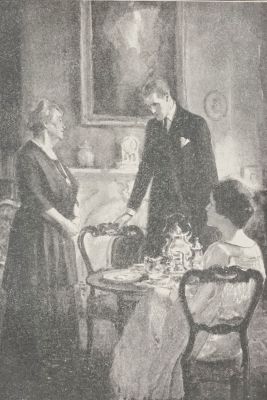
MRS. ANSLEY TOOK HIM AS AN AFFLICTION
They dropped it at that because Mrs. Ansley lilted in, greeting Tom with that outward welcome and inward repugnance he had had to learn to swallow. He knew exactly where he stood with her. She took him as an affliction. Affliction could visit the best families and ignore the highest merits. Guy, dear boy, was extravagant, and this was the proof of his extravagance. He was infatuated with this young man, who had neither means, antecedents, nor connections. She had heard the Whitelaw Baby theory, of course; but so long as the Whitelaws themselves rejected it, she rejected it too. The best she could do was to be philanthropic. Philip, Guy, Hildred, were all convinced that this young man was to make his mark. Very well! It was in her tradition, it was in the whole tradition of old Boston, to help those who were likely to get on. It was part of what you owed to your standing in the world, a kind of public duty. You couldn't slight it any more than royalty can slight the opening of bazaars. An aunt of her own had helped a poor girl to take singing lessons; and the girl became one of the great prima donnas of the world. Whenever she sang in opera in Boston it was always a satisfaction to the family to exhibit her as their protégée. So it might one day be with this young man. She hoped so, she was sure. She didn't like him; she thought the fuss made over him by Hildred and Guy, more or less abetted by their father, an absurdity; but since she was obliged to play up to the family standard of beneficence, up to it she would play. She bore with Tom, therefore, wisely and patiently, never snubbing him except when they chanced to be alone, and hurting him only as a jellyfish hurts a swimmer, by clamminess of contact.
Clamminess of contact being in itself a weapon of offense, Tom ran away from it, but only to fall into contact of another kind.
It was a cloudy afternoon with Christmas in the near future. All over town there were notes of Christmas, in the shop windows, in the Christmas trees exposed for sale, in the way people ran about with parcels. He never approached this season without going back to that fatal Christmas Eve when he and his mother had been caught shop-lifting. He could still feel as he felt at the minute when he turned his face to the angle of the police-station wall, and wept silently. He wondered what Hildred would think of him if he were to tell her that tale. He wondered if he ever should.
Partly for the exercise, partly to find space to breathe and to think, he followed the Boston embankment of the Charles, making his way to the Harvard Bridge, and so toward Cambridge. In big quietly dropping flakes it had begun to snow. Presently it was snowing faster. The few pedestrians fled from the esplanade. He tramped on alone, enjoying the solitude.
The embankment lamps had been lit when he noticed, coming toward him, two young men, their collars turned up about their ears. They were laughing and smoking cigarettes. Drawing nearer, he recognized them as Tad Whitelaw and the fellow who had slapped the table at the dance. It was not hard to guess that they were on their way to see Hildred. He hoped that under cover of the darkness and the snow he might slip by unobserved.
But Tad stopped squarely in front of him. "Let's look at your eye."
The tone was so easy and friendly that Tom thought he might be going to apologize. He let him look.
"Well, you got that," Tad went on. "Another time you'll get worse. By God, if you don't keep away from me I'll shoot you."
Tom was surprised, but it was the sort of situation in which he could be cool. He smiled into the arrogant young face turned up toward his.
"What's the good of that line of talk? You know you wouldn't shoot me; you wouldn't have the nerve. Besides, you haven't anything to shoot me for. I'll leave it to this fellow." He turned to Tad's companion, who stood as a spectator, slightly to one side. "I found him dead drunk the other night. I took him home in a taxi, and put him to bed. That's no more than the common freemasonry among men. Any man would do the same at a pinch for any other man."
The companion played up nobly. "That's the straight dope, Tad. Take it and gulp it down. This guy is a good guy or he wouldn't have—"
"Go to hell," Tad interrupted, insolently. "I'm only warning him. If he hangs round me any more—"
Tom kept his temper by main force, addressing himself still to the companion.
"I've never hung round him. He knows I haven't. Two or three times I've run into him, as I've done to-day. Twice I've stepped in, to keep him from getting the gate, this time as a drunk, the other time as a damn fool. I'd do that for anyone. I'd do it for him, if I found him in the same mess again."
"That's fair enough, Tad," the referee approved. "You can't kick against it."
Tad tried to speak, but Tom went on with quiet authority.
"So that since he likes warnings he can take that one. I shan't let him be chucked out of Harvard if I can help it."
Tad sprang. "The devil you won't!"
Tom continued to speak only to the third party. "No, the devil I won't! I don't know why I feel that way about him, but that's the way I feel. And anyhow, now he knows."
Still addressing the companion only, he uttered a curt "Good-night." The companion responded civilly with "Good-night" on his side.
He neither looked at Tad, nor flung a word at him. Wheeling to face what had now blown into a snowstorm, he walked off into its teeth. But as he went he repeated the question he had put to Hildred Ansley.
"Why do they seem to hate me so?"
He thought of Lily, slippery, snake-like, perverted; he thought of the mother as he had seen her on that one day, in that one glimpse, a quivering bundle of agony; he thought of the father, human, sympathetic, with the iron in his soul.
Then he saw them with their heaped up money, their luxuries, their pride, their domineering self-importance. He knew just enough of the lives they led, the exemptions they enjoyed, to feel Honey's protest on behalf of the dispossessed.
Near an arc-light he stopped abruptly. The snow made a tabernacle for him, so that he was all alone. As he looked upward and outward millions and millions of sweet soft white things flew silently across the light. Out of his heart, up to his lips, there tore the kind of prayer which in times of temptation the Tollivant habit sometimes wrung from him:
"O God, keep me from ever wanting to be one of them!"
XXXIX
In January, 1917, it began to occur to Tom Whitelaw that he might have to go and fight. He might possibly be killed. Worse than that, he might be crippled or blinded or otherwise rendered helpless.
He had followed the war hitherto as one who looks on at tragedies which have nothing to do with himself. Europe was to him no more than a geographical term. Intense where his own aims and duties were concerned, but lacking the imaginative faculty, he had never been able to take England, France, and Germany as realities. The horrors of which he read in newspapers moved him less than a big human story on the stage. That the struggle might suck him into itself, smashing him as a tornado smashes a tree, came home to him first at a Sunday evening supper with the Ansleys.
"If it does come," Philip Ansley said, complacently, "a lot of you young fellows will have to go and be shot up."
"I'm on," Guy announced readily. "If it hadn't been for the family I'd have enlisted in Canada long ago."
His mother took this seriously. "Well that, thank God, can't happen to us. Darling, with your—"
"Oh, yes, with my fat! Same old bunk! But, mother, I'm losing weight like a snowbank in April. It's running away. I'm exercising; I'm taking Turkish baths; I don't hardly eat a damn thing. I weighed two-fifty-three six weeks ago, and now I'm down to two-forty-nine."
"Don't worry," his father assured him. "You'll get there. You'll make a fine target for Big Bertha. Couldn't miss you any more than she would a whole platoon."
"Philip, how can you!"
"Oh, they're all crazy to go." He looked toward Tom. "Suppose you are too. Exactly the big husky type they like to blow into hash."
Turning to help himself from the dish Pilcher happened to be passing, Tom's eyes encountered Hildred's. Seated beside him, she had veered round on hearing her father's words. The alarm in her face was a confession.
"Oh, I can wait," he tried to laugh. "If I've got to go I will, but I'm not tumbling over myself to get there."
A half hour later Mrs. Ansley and the three younger members of the party were in the music room, where Guy was at the piano. The mother sat on a gilded French canapé, making an excuse for keeping Hildred beside her. Tom had already begun to guess that the friendship between Hildred and himself was making Mrs. Ansley uneasy. For all these years she had taken him as Guy's protégé with whom "anything of that kind" was impossible. But lately she had so maneuvered as not to leave Hildred and himself alone. Whether Hildred noticed it or not he couldn't tell, since she never made a counter-move. If she was not unconscious of her mother's strategy she let it appear as if she was.
All the while Guy chimed out the Carillon de Cythère of Couperin le Grand Mrs. Ansley patted Hildred's hand, and rejoiced in her two children. Guy's touch was velvety because it was Guy's; Couperin le Grand was a noble composer because Guy played him. Her amorphous person quivered to the measure, with a tremor here and a dilation there, like the contraction and expansion of a medusa floating in the sea.
But when Guy had tinkled out the final notes she bubbled to her feet.
"Darling, I don't think I ever heard you play as well as you're doing this winter. I think if you were to give a private recital...."
In the general movement Tom lost the rest of this suggestion, but caught on again at a whisper which he overheard.
"Hildred, I simply must go and take my corsets off. I've had them on ever since I dressed for church. It's Nellie's evening out. I'll have to ask you to come and help me."
But as her mother was kissing Guy good-night Hildred managed to say beneath her breath, "Don't go away. I'll try to come back. There's something I want to speak about."
Left to themselves, the two young men exchanged bits of college gossip while Guy twirled on the piano stool. They had the more to say to each other since they met less often than in their year at Gore Hall. Guy was now in Westmorley Court, and Tom in one of the cheaper residential halls in the Yard. Their associations would have tended to put them apart, had not Guy's need of moral strengthening, to say nothing of a dog-like loyalty, driven him back at irregular intervals upon his old friend. Now and then, too, when his mother insisted on his coming home for the Sunday evening meal, Hildred suggested that he bring Tom.