REMARKS ON The LETTER of Admiral DE FONTE. (continued 2)
Reading edition
There are nine other Accounts, in each of which the Places the Persons were bound to are particularly mentioned. In this Account (the Design being only to shew the wonderful Deliverance of Gibbons) Dr. Mather could not mention the Place to which the Voyage had been made in any other Manner, than to some other Parts of America, which hath an exact Correspondence with the Voyage in which Major Gibbons was intercepted by de Fonte; for that Voyage was properly to several Parts, not being to one particular Part of America; which Parts were, at that Time, nameless. It is said further, that their Misfortune was occasioned by contrary Winds. De Fonte had a fair Wind from the sixth of August to the fifth of September, and for a longer Time, so contrary to the Boston Ship; afterwards they had the Wind again contrary, when they came into the Ocean, being North-west or to Westward of it, as they could see no Land; the Land expected to be seen may be supposed the Land of Newfoundland, or they were to Eastward and Southward of the Gulph of St. Lawrence: And which Account of the Weather is agreeable to the Time of the Year that they were there, the latter End of September, or Beginning of October, being the Equinoctial Gales. Also as to the Fish which must have been a Sturgeon, which Fish frequently jump into Boats; and shews, as the Boat was out, that they had then moderate Weather, but contrary; though a hard Gale succeeded, as one of the Birds of Passage, which are also then going to Southward, was blown off the Coast and tired, rested on the Mast. Far be it from me to reckon these as mere Accidents, and not the Assistances of the Almighty, but a Relief which the Almighty sent them by Contingencies which are natural: And as to the Ship, which was a French Pirate, she had probably come with a fresh Wind out of the Gulph of St. Lawrence, and Standing to Eastward of Sables to clear that Island and Nautuchet, for which she had a fair Wind; and it is said the Commander had an Acquaintance with Major Gibbons, and received Favours from him at Boston; but I must add an Anecdote, to shew that there might also be another Reason assigned, which would not be suitable to be published with that Account; Alexander Shapley had used to hold a Correspondence with these Kind of Gentry, as is evident from a severe Censure on him on that Account, recorded in the Council Book at Boston. It was a Ship that Major Gibbons was in when intercepted by de Fonte; and this Account also mentions a Ship. After the Death of Major Gibbons, his Family, according to the Account of a very ancient Gentlewoman at Boston, removed to Bermuda; which Lady, who was near ninety Years of Age, had some traditional Account of the Major having been such a Voyage to discover a new Way to the East Indies, and suffered much from the Snow and Ice, went through a great many Hardships, and, she said, she thought it was from Boston that he set out. The Persons discovered by Mons. Groseliers, at what he calls an English Settlement, near Port Nelson, as it is now termed, were Benjamin the Son of Captain Zachary Gillam, and some others, from Boston, who were the same Year taken to Canada, whose Journal of that Voyage the Author hath seen, and this Circumstance is mentioned in it, which Persons have been mistaken for Major Gibbons and his Company.
'We arrived at the River Parmentiers the 11th of August 86 Leagues, and was on the South Side Lake Belle on board our Ships the 16th of August, before the fine Town Conosset, where we found all Things well, and the honest Natives of Conosset had, in our Absence, treated our People with great Humanity, and Capt. de Ronquillo answered their Civility and Justice.'
We have been before told, that the Admiral went sixty Leagues up Los Reyes, which I take to be the whole Distance between the Entrance of Los Reyes to Conosset in Lake Belle; and if we transpose the above Words, 'arrived at Parmentiers the eleventh of August, and was on the South Side Lake Belle eighty-six Leagues on board our Ships the sixteenth of August,' then we have the Distances respecting every Part of de Fonte's Course thro' Land, from Los Reyes to Conosset sixty Leagues, from Conosset to Lake de Fonte eighty-six Leagues, from the Entrance of Lake de Fonte to the Streight of Ronquillo one Hundred and sixty Leagues, from the Entrance of the Streight of Ronquillo to the Sea thirty-six Leagues. The Time that de Fonte was passing down the River of Parmentiers, and the Time he took to return, are equal, which is plainly owing to his being obliged to wait the Tides for getting over the Falls both Ways. The sixth of July they had entered the Lake de Fonte, and by the fifteenth were through the Streights of Ronquillo, and at the Indian Town the seventeenth, so they were eleven Days from their Entrance into the Lake de Fonte; but in their return the same Way only five, favoured by a strong Current which the Wind occasioned to set into the Lake, and having as much Wind as they could fly before, and now came directly back; whereas in their Passage out they had made some Delays. The Course to Conosset being nearest North-east, I compute it to be in Lat. 56 Deg. Long. 118° 2´ from London. The Entrance of Lake de Fonte (supposing the Course of the River Parmentiers and from Conosset East North East) in Lat. 59° 4´. Long. 113°. The Entrance of the Streights of Ronquillo East North East, in Lat. 61 Deg. 8 Min. Long. 98 Deg. 48 Min. the Course through the Streights to enter the Sea North by East, such Entrance to be in Lat. 62 Deg. 48 Min. Long. 98 Deg. 2 Min. which Course must be consistent with de Fonte's Account that a strong Current set in, as by this Course such Current must be accelerated, if it set to the Southward, by the Wind from the Northward, or if it was from the Southward, would be opposed in going to the Northward.
De Fonte proceeds to give an Account of the good Estate in which he found all Things on his Return; mentions the Honesty and Humanity of the Natives, and the prudent Conduct of Captain Ronquillo, who answered their Civility and Justice. For they had, during the Time of de Fonte's Absence, procured, by dealing with the Natives, Store of good Provisions to salt, Venison, Fish; also one Hundred Hogsheads of Indian Maiz; besides the Service this would be of on their Return, procured pursuant to de Fonte's Order, it employed the People, with the other necessary Work about the Ships after so long a Run, and kept them from brangling with the Natives. The Natives were also employed to their Interest, which preserved them in good Humour; and a Justice in dealing preserved their Friendship.
'The 20th of August an Indian brought me a Letter to Conosset, on the Lake Belle, from Captain Bernarda, dated the 11th of August, where he sent me Word he was returned from his cold Expedition, and did assure me there was no Communication out of the Spanish or Atlantick Sea, by Davis Streight; for the Natives had conducted one of his Seamen to the Head of Davis Streight, which terminated in a fresh Lake, of about 30 Mile in Circumference, in the 80th Degree of North Latitude; and that there was prodigious Mountains North of it, besides the North-west from that Lake the Ice was so fixed, that from the Shore to 100 Fathom of Water, for ought he knew from the Creation; for Mankind knew little of the wonderful Works of God, near the North and South Poles: He writ further, that he had sailed from Basset Island North East, and East North East, and North East and by East, to the 79th Degree of Latitude, and the Land trended North, and the Ice rested on the Land.'
The Orders Bernarda received were to sail up a River North and North East, North and North West, which River I suppose to have emptied itself near to Los Reyes into the South-east Part of the South Sea; and it is not uncommon, in America, that two great Rivers should have their Entrances contiguous to each other; and I suppose Conabasset, afterwards called Basset, to be in Lat. 58 Deg. 10 Min. to the Westward of Los Reyes in Long. 122 Deg. 9 Min. from London. The Course up the River Haro North 14 Deg. West; and as Conosset is laid down in Lat. 56 Deg. Long. 118 Deg. 2 Min. the Distance from Basset to Conosset is one Hundred and seventy-seven Miles; the Course North 46 Deg. West. The Letter by the first Messenger was dated the 27th of June, and is received the fourth Day, as he could not come a direct Course, we may suppose he travelled fifty Miles a Day, which is an extraordinary Allowance, the greatest Part by Water, and Light most of the Night. We know he would go Part by Water in Lake Belle, and Lake Belle issuing its Waters both by Los Reyes and the River Parmentiers, must receive some considerable Influx of Waters by which it is formed, as well as to give a constant Supply of the Waters that issue from it, and which must be principally or only from the Northward, for it cannot be supposed to receive its Waters from the Southward, and discharge them there again, and which the Messenger would make Use of as soon as possible, and come down Stream. The second Messenger, who is expresly mentioned to be an Indian, is nine Days a coming. But Bernarda mentions nothing as to his Ship or People in this Account, only says he is returned from his cold Expedition, therefore probably he sent away the Indian as soon as he could after he entered the River, which ran into the Tartarian Sea, in Lat. 61. If this was the Case, we may suppose that the Waters which came into the Lake Belle head a great Way up in the Country.
Bernarda had Directions, after he left Lake Valasco, to sail one Hundred and forty Leagues West, and then four Hundred and thirty Leagues North East by East to seventy-seven Degrees of Latitude. Bernarda, in his Letter of the 27th of June observes, there was a River eighty Leagues in Length, not comprehended in his Instructions or Orders, and emptied itself in the Tartarian Sea; and says, in his Letter of the 11th of August, that he sailed from the Island Basset North-east; with that Course, when he entered the Tartarian Sea, in Latitude 61, his Longitude would be 116 Deg. he then begins the Course de Fonte directed him, one Hundred and forty Leagues East North East; and he mentions on his Return he had steered that Course, keeping the Land aboard. So that West and the Land trending North East, are Mistakes in the Publication in April; but the mentioning how the Land trended, shews he was then entering the Sea; for to talk of Land, with respect to a River, is absurd; and with the Course and Distance he steered would be in Lat. 63 Deg. 39 Min. and Long. 110 Deg. from London: Then he steers four Hundred and thirty-six Leagues North East and by East, and that brings him into Latitude 79 Deg. Long. 87 Deg. from London. But the Land trending North, and with Ice, which would be dangerous for the Periagos; and as the Land trended North, where he was appearing to him to be the nearest Part he could attain to to go to the Head of Davis Streight; and as to the Distance over Land, and the Propriety of sending a Messenger, the Indians would inform him; he sends a Seaman over with an Indian to take a Survey of the Head of such Streights, by us called Baffin's Bay; which Name was not at that Time generally received. Which Seaman reports, that it terminated in the eightieth Degree of Latitude, in a Lake of about thirty Miles in Circumference, with prodigious Mountains North of it, which indeed formed that Lake, or is a Sound, as that of Sir James Lancaster and of Alderman Jones; and along the Shore, from the Lake North-west, the Ice was fixed, lying a great Distance out, which was very consistent with there being no Inlets there, the Waters from which would have set it off. The Distance that the Indian and Sailor travelled would not exceed fifty Miles; and their mentioning the high Mountains to Northward imply, that they were in a more level Country where they were to take this View. Light all Night, the Snow off the Ground, and the Heighth of Summer there. It is no vain Conjecture to suppose that the Journey was practicable, even if performed all the Way by Land, and much easier, which is not the least improbable, if they had an Opportunity of making Part of it by Water. Bernarda proceeding thus far in the Tartarian Sea, and entering in Latitude 61, is no Way contradictory to the Russian Discoveries; and by the Tartarian Sea is meant, the Sea which washes the Northern Coasts of Tartary, and is supposed to extend round the Pole. Those Discoveries are agreeable to the Japanese Map, as to the North-east Parts of Asia, and North-west Parts of America, brought over by Kemper, and in which Map there is expressed a Branch of the Tartarian Sea or Gulph, extending to the Southward, agreeable to this Account of de Fonte. Who calls it, with respect to Asia, the North and East Part of the Tartarian Sea. Which compared with what de Fonte says, as to sailing down the River to the North-east Part of the South Sea, these Expressions cast a mutual Light on each other, and that the Archipelagus of Saint Lazarus is a Gulph or Branch of the Sea, in the like Manner.
Places which are in one and the same Latitude, have not an equal Degree of Heat or Cold, or are equally fertile or barren, the Difference in these Respects chiefly consists in their Situation. The Country of Labrador, which is to Eastward of Hudson's Bay, in Latitude 56, almost as high a Latitude as Port Nelson, is a Country capable of being improved by Agriculture, and would supply all the Necessaries of Life, though intermixed with rugged and craggy Mountains. The Winter's not so severe as in the more Southern Parts of Hudson's Bay, as the Earth is not froze there, as it is in the same and lower Latitudes about that Bay: Also People have wintered in the Labrador, wearing only their usual Cloathing: Therefore drawing a Parallel between Port Nelson and Conosset, as to the Infertility of one, therefore the other being in the same Latitude, could not produce Maiz to supply Ronquillo, is an Objection which hath no Foundation in it. The higher the Latitude the quicker is the Vegetation; and as Indian Corn or Maiz may be planted and gathered in three Months in lower Latitudes, it may be in an equal or less Time in higher Latitudes, in a good Soil. As to Port Nelson, or York Fort, in Hudson's Bay, it is a low Country through which two large Rivers pass, with the Bay in Front, and nothing is certainly known of the more inland Parts.
The physical Obstacles that are produced against our giving Credit to this Account of de Fonte, from the Depth of the Falls at the Entrance of Lake Belle in the River Parmentiers, and from the River Bernarda passed up, are, from not understanding what is expressed by the Word Falls amongst the Americans. They mean by a Fall wherever there is the least Declivity of the Water; and the Fall of thirty-two Feet in the River Parmentiers, doth not mean a perpendicular Fall, as the Objector would have it understood, however ridiculous to suppose it, but eight gradual Descents, from the Beginning of which to the Extremity of the last there was a Difference of thirty-two Feet, and which became level or even at the Time of high Water.
What Bernarda says as to his cold Expedition, a Person used to the Climate of Peru might justly say so, of the Nights and Evenings and Mornings, at that Time of the Year, in the Latitude of seventy-nine, though temperate in Latitude fifty-six; and the whole Disposition of the Country, the immense high Lands, their barren and desert Aspect, in Places their Summits covered with perpetual Snow, the Ice fixed to the Shores, Sheets of floating Ice in the Waters, the immense Islands, frequently seeing Whales, Sea-horse, and a great Variety of the Inhabitants of those Waters, which do not frequent the Southern Parts: The Whole a Scene so different from the Verdure and Delights of the Plains about Lima, and from the pleasing Views that present themselves on running along the Coasts of Peru, Bernarda might well be affected with such Scene as to express himself, that Mankind knew little of the wonderful Works of God, especially near the North and the South Poles. But he was not so ignorant as to report, that he saw Mountains of Ice on the Land, as well as in the Sea, though he might see them forming between Points of Land, which jetted out into the Sea; and such a Column of Ice would appear to him as something very curious.
That these Parts were inhabited does not appear, for it was a Native of Conibasset that conducted the Seaman over the Land; and, at that Season of the Year, the fresh Waters are thawed, no Snow on the low and level Lands, only on the extreme Summits of the Hills.
What is objected as to the Affability of the Inhabitants, that it is not consistent with the Character of the Indians. Hospitality is the Characteristick of the Indians towards Strangers, until such Time as they are prejudiced from some ill Treatment; and by the Account given by Sir Francis Drake, as to the Indians of California, and by the Spaniards who surveyed the Western Coasts, and the Islands lying off, they are represented in general as a kind, tractable People, and of a docile Temper.
As to the Dispatch used by Indians in carrying Expresses, or their Runners as they term them, to carry Messages from one Nation to another, they will gird themselves up with the Rhind of Trees, and keep going incessantly great Distances with a surprising Agility Night and Day, taking little either of Sleep or other Refreshments, and keep a direct Course, and in the Night steer either by the Moon or Stars. Nor is there any Thing miraculous in these Journeys, which the Expresses performed, either as to Distance or as to Time, especially as they passed through a Country abounding with Waters, and which Country being inhabited they could be supplied with Canoes, or they would find Floats at the Places where they usually pass the Waters.
Bernarda meeting de Fonte at a Port up the River Rio los Reyes, shews he had Persons aboard who could direct him there, therefore must have been previously there; and they can be supposed to be no other than the Jesuits, which is a further Proof of the Jesuits having been before in these Parts. It was consistent that the Ships should join and return home together. From where Bernarda came to with his Ship was one Hundred and twenty Miles to Conosset: His Letter from thence was dated the 29th of August, and de Fonte sailed the second of September: It may be supposed the Letter came to Hand the first of September, which is four Days, and the Express had now all the Way by Water, and mostly against Stream. De Fonte, to shew that he had preserved the Affection of the Natives, mentions that he was accompanied with them; and they were of Assistance to him in the Pilotage down the River. De Fonte adds, he had sent a Chart with the Letter, which is misunderstood, as if such Chart had come to the Hands of the Editors; which will make this much more demonstrative, were Words added by them; but it was usual in all the Naval Expeditions to have Persons aboard whom they called Cosmographers, to take Draughts of Places, and compose their Charts, and at that Time a very reputable Employment.
Miguel Venegas, a Mexican Jesuit, published at Madrid in 1758, a Natural and Civil History of California; a Translation of which was published in London in 1759, in two Volumes; and Vol. i. P. 185, says, 'To this Æra (the last Voyage he mentions was in 1636) belongs the Contents of a Paper published at London, under the Title of the Narrative of Bartholomew de Fuentes, Commander in Chief of the Navy in New Spain and Peru, and President of Chili, giving an Account of the most remarkable Transactions and Adventures in this Voyage, for the Discovery of a Passage from the South Sea, to that of the North in the Northern Hemisphere, by Order of the Viceroy of Peru in the Year 1640. This Writing contains several Accounts relating to California; but without entering into long Disputes, let it suffice to say, that little Credit is to be given to this Narrative. For the same Reason we have before omitted the Accounts of Voyages made from the South Sea to the North round beyond California, and those of a contrary Direction, of which an Account is given by Captain Seixas and Lobero, in Theatro Naval, in Spanish and French; and particularly of that Spaniard who is supposed, in three Months, to have come from Puerto de Navidad and Cabo Corientes to Lisbon. These and other Accounts dispersed in different Books, we designedly omit, as they want the necessary Authenticity.'
This Work was published with a Design to induce the Court of Spain to a further Conquest of, an intire Reduction of, and the full settling of California, as of the utmost Importance to Religion and the State; and one of the Arguments is, for their immediate putting what he recommends in Execution, the repeated Attempts of the English to find a Passage into the South Sea. And observes, 'Should they one Day succeed in this, why may not the English come down through their Conquests, and even make themselves Masters of New Mexico, &c.' which implies, that he did not look on such an Attempt as void of all Hopes of Success; and he again says, 'Whoever is acquainted with the present Disposition of the English Nation, and has heard with what Zeal and Ardour the Project for a North-west Passage has been espoused by many considerable Persons, will be convinced that the Scheme is not romantick, and it would not be surprizing if the Execution of it should one Day come under Deliberation.' Thus artfully hints, should the Scheme come under Deliberation, the Event would be to be feared; and though he ascribes his Opinion of its not being romantick, is, to many considerable Persons having espoused the Scheme, yet he tacitly applies to their own Knowledge, to what the Court of Spain knows as to this Passage. He then proceeds, 'If this should ever happen,' the Deliberation, 'what would be the Condition of our Possessions?' The Deliberation would, from Consequences that would follow on such a Deliberation, endanger our Possessions.
Don Cortez informed the King, by a Letter of the 15th of October 1524, that he was building two Ships, to get a Knowledge of the Coast yet undiscovered between the River of Panaco and Florida, and from thence to the Northern Coast of the said Country of Florida, as far as the Baccaloo, 'It being certain, as he expresses himself, that on that Coast is a Streight running into the South Sea'—'God grant that the Squadron may compass the End for which it is designed, namely, to discover the Streight, which I am fully persuaded they will do, because in the Royal Concerns of your Majesty nothing can be concealed; and no Diligence or Necessaries shall be wanting in me to effect it.' Again, 'I hereby inform your Majesty, that by the Intelligence I have received of the Countries on the upper Coast of the sending the Ships along, it will be attended with great Advantage to me, and no less to your Majesty. But acquainted as I am with your Majesty's Desire of knowing this Streight, and likewise of the great Service it would be to your Royal Crown.' Vol. i. P. 130.
Agreeable to this Letter several Attempts were made by Sea to discover whether Florida was Part of the Continent, or separated by a Streight; but whether Cortez pursued his Design by searching between Florida along the Coast of Baccaloos, Newfoundland, and the Terra de Labrador, for a Streight, by which there was a Passage from the North to the South Sea is uncertain. Florida comprehended the Country from the Cape of Labrador to the Cape de los Martires, or of Martyrs, opposite to the Island of Cuba. From thence to the Streights of Magellan was called Peruan Part.
The King of Portugal, with a View of finding a shorter Passage to those Parts of the Indies, which he had discovered, than by the Cape of Good Hope, sent, in the Year fifteen Hundred, Gasper de Corte Real to the North of America, who landed on the Terra de Labrador; also gave his Name to a Promontory on that Coast which he called Promonterium Corteriale. The Name of Labrador implies a fertile Country, and given in Distinction from the high barren mountainous Country to Northward, which Gasper discovered in Latitude sixty, and to the Southward of it. But this Distinction seems to have been soon lost, and the Name of Labrador is now given to the whole Coast.
From the Knowledge we have of these Parts we may conclude, that the Promonterium Corteriale was what we at present name Cape Chidley, and the Islands de Demonios, where Gasper lost a Vessel, those Islands now named Button's Islands; and it was Hudson's Streights to which he gave the Name of the River of the Three Brothers, though the Reason of his giving that Name is not known to us.
We may perceive from this Account of Gasper's Voyage, who did not proceed to Westward to make a Passage, but coasted down the main Land, the Accounts of their being a Portuguese who made a Voyage through the Streights of Anian, calling a Promontory after his Name Promonterium Corteriale, hath had some Foundation in Truth; and in what is said by Frisius, an antient Geographer, calling it the Streights of Three Brothers, or Anian (which that Word imports) because three Brothers had passed through a Streight from the North to the South Sea. It is also apparent that the Name of Anian was first given by Gasper Corterialis (for some particular Reason unknown to us) to that Part, which is now Hudson's Streights. Though in Time this became a proper Name to express a Streight by which there is a Passage from the North to the South Sea, and is contended for to be the proper Name of the Streight that divides Asia from America, by which there is a Communication with the Tartarian and Southern Ocean. After a Discovery of these Coasts had been made to Northward, the following Year the King of Portugal sent Americus Vespusino to Southward, to discover the Land there.
Cortez's Designs seem to have their Foundation in these Expeditions of the Portuguese; but it was not until after the Year 1513, that the South Sea was discovered, and the Portugueze had discovered the Moluccas, that the finding a Streight to the Northward, by which a Passage might be made to the South Sea, became a Matter of particular Attention, and was the first and principal Object of Cortez's Attention after he had become Master of the Capital of Mexico in 1521; and this Opinion of a Passage to Northward continued during the Reign of Charles the Fifth. Who in the Year 1524 sent from Old Spain to discover a Passage to the Moluccas by the North of America, without Success; but Esteven Gomez, who was sent on that Expedition, brought some Indians home with him. Then in the Year 1526 Charles the Fifth wrote to Cortez, in Answer to his Letters, and orders him to send the Ships at Zacapila to discover a Passage from New Spain to the Moluccas.
From this Time, the Year 1526, the Opinion of there being a Streight was generally received, though on what Foundation does not appear. It was certainly on some better Reason than Gasper's Discoveries; and a Consideration of the Importance such a Passage would be of to the King of Spain with respect to the Spice Islands. It is not consistent with the Characters of the Emperor Charles the Fifth, and of Cortez, when there were so many other solid Projects to pursue and this was preferred, to suppose that they should go, at that Time, on a meer visionary Scheme.
The same Opinion of a Passage to Northward prevailed in the Time of Philip the Second, and in the Year 1596 he sent Orders to the Viceroy of Mexico for discovering and making Settlements in proper Parts of California, and one Reason assigned was, 'There was much Talk about the Streight of Anian, through which the South Sea was said to communicate with that of the North, near Newfoundland; and should the English find out a practicable Passage on that Side, our Dominions, which then included all Portuguese India, would be no longer secure, all the Coast from Acapulco to Culiacan being quite defenceless, and from Culiacan Northward, not one single Settlement was made on the whole Coast.' Hist. Cal. V. i. P. 163. That now not only the Opinion of there being a Streight prevailed, but it was also fixed as to the Part, and had the Name of Anian.
The Opinion of a Passage still existed in the Reign of Philip the Third; and the same political Motives induced him to order the Conquest of California to be undertaken with all possible Expedition; and one Reason assigned is, 'His Majesty also found among other Papers a Narrative delivered by some Foreigners to his Father, giving an Account of many remarkable Particulars which they saw in that Country, when driven thither by Stress of Weather from the Coast of Newfoundland; adding, they had passed from the North Sea to the South, by the Streight of Anian, which lies beyond Cape Mendocino; and that they had arrived at a populous and opulent City, walled and well fortified, the Inhabitants living under a regular Policy, and were a sensible and courteous People; with many other Particulars well worth a further Enquiry.' It must be considered this is given us in the History of California, V. ii. P. 239, from the Monarchia Indiana of Juan Torquemada, a learned Franciscan, published at Madrid in 1613, and republished in 1723, Vol. i. P. 629, That a Paper of this Sort was found in the Cabinet of Philip the Second, was thought deserving the Attention of Philip the Third. However the Matter of it is represented here, for nothing could be published but what was first perused and altered, so as to make it consistent with the Interest of Holy Church, the State, or good Manners, before it was licensed, such Paper must have contained some material Intelligence as to a Passage; and if is said to have contained some remarkable Particulars. Neither would the Work have been licensed, if what is related as to their having been such a Paper, had not been true.
Torquemada, Vol. i. P. 20, quotes Francisco Lopez de Gomara, deemed a careful Writer, and Author of the History of the Indies. Who says the Snowy Mountains are in forty Degrees, and the furthermost Land that is laid down in our Maps; but the Coast runs to the Northward until it comes to form an Island by the Labrador, or as separated from Greenland; and this Extremity of the Land is five Hundred and ten Leagues in Length.
As to what is said as to the Latitude of forty Degrees in this Quotation from Gomara, Torquemada hath prefixed a Map to his Work, agreeable to that formed by the King's Cosmographers, in which he hath made the most Western and Northern Part of the Land in almost forty-seven Degrees, and then the Land trends to the Eastward, and the Serras Nevadas are represented to extend a great Length along the Coast, and to Latitude 57 Degrees. Mentions, Vol. i. P. 16, the Royal Cosmographers do not insert any Thing in their Charts of the Sea Coasts but what they have upon Oath, or from creditable Persons; and 'They make a Supputation in the Northern Parts of Islands, which do not lie near or contiguous to the Lands of Europe; as to which Islands, not long since discovered, the one is called Iceland, the other Greenland, which are the Bounds, Limits, or Marks, that divide the Land of the Indies from any other Part howsoever situated or disposed;' afterwards observes, which Islands are not far from the Labrador; from which it is plain he calls America an Island. And this is agreeable to what Acosta says, in the Sense which I understand him, that Quivira and Anian extend to the Western Extremity of America; and that the Extremity of the Kingdom of Anian to the North extends under the Polar or Artick Circle, and, if the Sea did not prevent it, would be found to join the Countries of Tartary and China; and the Streight of Anian takes its Course through the Northern Region, under the Polar Circle, towards Greenland, Iceland, England, and to the Northern Parts of Spain. By Greenland I understand the Land to Northward, which is the North Part of Hudson's Streights, and Cumberland Isles; and that this Streight should determine here is agreeable to what Cortez says he would send to search as far as the Baccallaos, (which was a Name given by Cabot in 1496) for the Streight by which he expected a Passage from the North to the South Sea. By Iceland is meant, as is apparent from a View of such Map hereunto annexed, the Land to Northward of Cape Farewel, or the Proper Greenland. Gomara mentions these Islands had not been long discovered. It is apparent from the Map, that they had a very imperfect Account of these Discoveries, which were made by Frobisher and Davis, who also were far from being exact in their Computations of the Longitude.
In this Map prefixed to Torquemada's Work, and here annexed, the Southern Part of Newfoundland is laid down in Lat. 55, nine Degrees more to the Northward than it ought to be, for which Reason the Labrador, Greenland, and Iceland, are placed much further to Northward than they ought to be placed, and are made to extend beyond the Polar Circle. It is from this Supposition of Newfoundland being in so high a Latitude that Acosta says, the Streight of Anian takes its Course through the Northern Region under the Polar Circle towards Greenland and Iceland. In the same Map the extremest Point of California, answerable to Cape St. Lucas, is laid down in Longitude 105 Degrees from the Meridian of Ferro, and the Extremity of the Land to Westward a Cape to Northward of Cape Fortunes, but to which no Name is given, and in Latitude 47, is placed in 135 Degrees from the Meridian of Ferro; the Difference of Longitude is 30 Degrees. This Map, published by Torquemada, was constructed before the Year 1612, therefore prior to a Map published in Holland in 1619, under the Title of Nova Totius Orbis Descriptio, prefixed to the Voyage of George Spilbergen, in which the Errors of Torquemada's Map, as to the Situation of Newfoundland, and the Places to Northward are corrected; yet great Errors are committed as to the Parts to Westward of America, making eighty-five Degrees of Longitude between Cape St. Lucas and the Extremity of the Land to Westward and Northward in Lat. 42; and ninety-five Degrees between Cape St. Lucas and the Extremity of the Land nearest to Asia. The Reason of this Difference is plain, they both err with respect to those Parts, of which they had not authenticated Accounts.
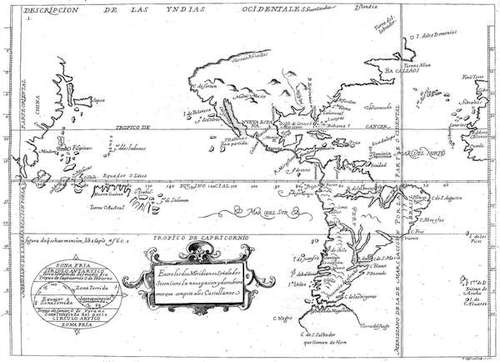
The Original from which this Map is copied was published in 1608 by the authority of Philip IV. King of Spain, in the 1st Edition of Torquemadas Monarquia Indiana Vol. 1.
Cortez wrote to the Emperor that he had sent People on Discovery, both by Land and Water, it was not designed that their Discoveries should be communicated, as Cortez intended to turn them to his own private Advantage. But when Mendoza fitted out two Armaments, one by Land under the Command of Coronado, and the other by Sea under Alarcon; Alarcon was ordered to Latitude 53, to join the Land Forces, and to make a Survey of the Coast, and see if there was a Passage or a Communication by Water through those Countries which Coronado was to discover and subdue, with the South Sea. As to Coronado, the Franciscans had been before in those Parts, and they gave Information and Direction as to his Part of the Expedition; but as to the Part that Alarcon had, on what Information he was ordered to go to Latitude 53, and what Probability there was that it was possible for him to find such Passage, and join the Land Forces, does not appear. But from his not finding such Passage, not joining the Land Forces, and proceeding no further than the Lat. 36, though his Reason for not going further is, that the Land then trended to the Northward, which he supposed would put him further off from the Army, whom he knew were in ten Days March of him, and the Excuse of Sickness and ill Condition of his Vessels, occasioned him to return before his Time; yet his Conduct threw the whole Disgrace of the ill Success of that Expedition on Alarcon, both with the Emperor and the Viceroy: And what he wrote to the Emperor was not attended to. He wrote to the Emperor, 'That it was for him only, and not in Subordination to the Viceroy, that he had conquered, discovered, and entered on the Californias, and all those Lands on the Coasts of the South Sea; that he had learnt that some of those Lands were not far from the Coasts of Grand China; that there was but a small Navigation to the Spice Islands, which he knew was wished for at that Time; that it engaged all his Thoughts, and was his most ardent Desire to undertake such Navigation.' Torquem. Vol. i. P. 609.
On Alarcon's Return Juan Rodrique de Cabrillo was fitted out, who went as far as Lat. 44. Sickness, Want of Provisions, and his Ships not being of sufficient Strength for those Northern Seas, obliged him to return, though he was designed to go further to Northward. The Ships returning from the Philippines, which was also an Expedition in the Time of Viceroyship of Mendoza, fell in with the Land in Lat. 42, and found it all to be Terra Firma, from a Cape there, which they named Mendocino to the Port of La Navidad. In 1602 Vizcaino went, and then the Discovery was made by Martin de Aguilar; and Torquemada tells us, Vol. i. Lib. 5. P. 725. That if there had not been, only fourteen healthy Persons when they were at Cape Blanco, they were resolved to pass thro' the Streight, which they named Anian, and which Streight is said to be there; and P. 719, speaking of the Entrance of Martin Aguilar, it is understood to be a River, by which you may pass to a great City, which the Hollanders discovered coming through the Streight, which is the Streight of Anian, and which City, he says, was named Quivira.
These Voyages, and we have Accounts of no others, could not have furnished the Cosmographers the principal Materials for composing their Map, and it must have been agreeable to those Materials, besides the Accounts of these Voyages sent to Old Spain, that they set down the utmost Limits of the Western Coast to be in the Longitude of 135 Decrees from the Meridian of Ferro. Therefore it was their Opinion at that Time that one Hundred and thirty-five Degrees was near the Difference of Longitude of the Entrance of the Streight of Anian in the South Sea, accounting the Longitude from the Meridian of Ferro. For which Reason the Spaniards can never be understood to mean by the Streight of Anian the Streight which separates Asia and America, now named Beering's Streight, and by which there is a Communication between the Sea of Tartary, or the Frozen Ocean, and the South Sea.
It is something remarkable, and supports what hath been before said as to Deficiency of the Spanish Records, what Jesuit Venegas, the Author of the History of California, says, Vol. ii. P. 228, 'I was extremely desirous of finding Capt. Sebastian Vizcaino's Narrative, and the Representations of the Council to his Majesty Philip the Third, especially the Maps, Plans, Charts of his Voyage and Discoveries, in order to communicate the Whole to the Publick. Accordingly at my Request Search was made in the Secretary's Office of the Council of the Indies: But in this Intention of being serviceable to the Publick I have been disappointed.' And he again observes, on the Governor of Cinaloa being ordered to pass over and take a Survey of the Coasts, Islands, Bays, Creeks, and the Disposition of the Ground of California, in the Year 1642, Vol. i. P. 188, 'There would have been little Occasion, says he, for this preparatory Survey, after so many others which had been continually making for above a Century, had the Reports, Narratives, Charts, Draughts and Maps, which were made, or should have been made, by so many Discoveries still continued in being. But these are the Effects of a Want of a proper Care in preserving Papers, a Fault to be regretted by Persons in Power, to whom they would be of Service in the Conduct of Affairs, and by private Persons, on the Account of their Interest, or as Entertainments of a commendable Curiosity.'—'But by the Loss of some Papers, either thro' a Change in the Government, or Irregularity in the Records, the whole Advantage of an Expedition is lost.'
From this Declaration by one who being a Jesuit, and of Mexico, composing a Work entirely for the publick Service, under the Direction of the Jesuits; by their Influence could attain the Sight of any Papers which were thought interesting as to the Work he was composing; and his last Reflection is not confined to the Records of Old Spain only; it is apparent what Uncertainty there is of attaining any Evidence from such Records, as to the Discoveries made in the first Century after the Conquest of Mexico, and for a long Time after. The Narrative of Vizcaino's Voyage, and every Thing thereto relating, as to any remaining Records might have become disputable, had not Torquemada collected it, and published it amongst other Accounts; yet what Torquemada hath preserved is but imperfect, as is apparent from a Journal of that Voyage, preserved in a private Hand at Manilla, and a Sight of large Extracts from which the Author hath been favoured by a Gentleman in London. It is owing to what Torquemada and some others have collected of the Accounts which the Religious were the Authors of, that the Publick have the Accounts of those Parts; but such Voyages and Accounts as have not met with the same Means of being preserved, the Publick, from such Neglect, know nothing of them. It is plain from Gomara's Account, also from Acosta's, that great Discoveries had been made in these Parts, but as to many of such Discoveries, by whom is not known; and Venegas says, Vol. i. P. 30, the River Santo Thome was discovered in the Year 1684; 'And tho' I do not find, says he, in the Narratives of that Expedition (of Admiral Otondo) that Otondo ever went ashore only to visit the Harbours of the Eastern Coast and the Gulph; yet from the ardent Curiosity of Father Kino, and the great Concern he had in the Affairs of California, I cannot think that he should be mistaken in any Particular relating to the Discovery: That Father Kino, both in his large Manuscript Map, and likewise in the lesser Impression, places the River of Santo Thome as rising between the 26th and 27th Degrees of N. Latitude, and, after crossing the whole Peninsula, discharging itself into the South Sea, in the 26th Deg. and forming at its Mouth a large Harbour, which he calls Puerto de Anno Nuevo, being discovered in the Year 1685. On both Sides the River are Christian Villages, as is evident from their Names; Santiago, Santo Innocentes, &c. yet, in the Accounts of that Time, I do not meet with any Intelligence of this Discovery; to which I must add, that in the subsequent Relations no mention is made of any such River, Settlements or Harbours, though even little Brooks, are taken Notice of.' And he observes many other Difficulties occur about this Coast. This Harbour made by the River Santo Thome, is evidently that which de Fonte and others call Christabel. Some Settlements had been made there, as these Names were given, but either deserted from the Barrenness of the Country, or had been only frequented by those who went out private Adventurers, in order to trade with the Natives. But as to which River, Settlements and Harbour, were not the Names preserved by Father Kino, it would not have been known that any Persons had been in those interior Parts of California, or that there were such River and Harbour. Father Kino looked upon it as a Thing so well known, as he had no Occasion to defend himself, by giving the Reason of his inserting those Names to protect himself from the Reproach of Posterity. And Venegas before tells us, that as to the Discoveries which had been made for a Century passed, the Papers were lost.
Between the Year sixteen Hundred and eighty-five, and the Time of Venegas's Publication, though in the Year sixteen Hundred and eighty-five, it was well known that there was such a River as St. Thome, this River is exploded out of the Maps by the Geographers, on Account of the Uncertainty; not duly considering that there was as full a Proof as could be required with respect to so unfrequented a Part. The Account being from a Person whose Business it was to make Observations there, who had been so laborious and accurate as to discover, what had been so long desired to be known, whether California was an Island or not, as to which he was believed; and the Truth hath been confirmed by later Observations of what he had reported, That it was not an Island. Therefore there was no Foundation for any Uncertainty in this Case, the same as with respect to the Letter of de Fonte, owing to the Neglect of a proper Enquiry into the Circumstances relating to it, by such an Inquiry the Uncertainty would have been removed.
What hath been said is to shew that the Argument on which so great a Stress is laid, that there is no Account of this Voyage amongst the Spanish Records, is an Argument of no Weight against the Authenticity of this Account; and that as a Publication of this Voyage was not permitted, an Account of such Voyage could not be perpetuated by the Religious, the only probable Means at that Time of preferring it from Oblivion. As it was intended what was the Effect of this Expedition should be kept a Secret, it is not consistent there should be many written Accounts of it; the Officers concerned would be cautious of letting Transcripts be made from their Journals; and it may be attributed to an extraordinary Accident, rather than to what could be expected, that a Copy of the Letter of de Fonte should ever come into the Possession of the English.
These Observations being previously made, we are better enabled to consider, what we have before inserted, the Objection of Venegas for not inserting this Account of de Fonte, as being of little Credit; but he seems rather to wish that we would be of his Opinion, than to imagine that he could convince us by any Arguments; therefore excuses himself as to the Length of the Dispute he might be engaged in. His Manner of expressing himself with respect to this Disappointment in the Secretary's Office, shews he hath a Manner of Address that his Words will admit of a further constructive Meaning than what is set down. The principal Object of his Writing is to incite the Court of Spain to prepare in Time against the ill Consequences of the English making a Discovery of a Passage; and he is to be understood, that it is not only his Opinion that the finding of such a Passage is practicable, but he apprehends it is of the Opinion of the Court also. Declares, that such Opinion hath prevailed from the first settling of Mexico, and that there really is a Passage in such a Manner as a Person who published an Account of this Sort would be permitted to express himself, to have it pass the Approbation of the Licenser; and does not desire to suppress the Account of de Fonte, as it is an absolute Contradiction to what he would infer, there being a Passage, and in such Letter it is declared there is no North-west Passage. For he must have had further and better Authorities for his Assertions of there being a Passage than such, as that single Assertion would prevail against. But desired to suppress this Account, as it was an Account which he knew it was more consistent with the Designs of the Court, it should be continued in Oblivion than revived. Mentions it therefore as the Contents of a Paper published in London, which contained a Narrative of little Credit; and to give the better Authority to what he says, as he could not trust to the Opinion that might be had of such Account on a fair Representation of the Title; to support the Character he gave of it, therefore uses Art, misrepresenting such Title; says it was by Order of the Viceroy of Peru, in the Year 1640, and giving an Account of the most material Transactions and Adventures in this Voyage. Was the Letter so entituled, the Transactions and Adventures of a Commander in Chief of the Navy, in New Spain, he would not be singular in his Opinion, but it would be understood by every one as a Romance, and not deserving of Credit.
This Misrepresentation is intentionally done; for if he never saw the Letter, or had not a right Account of it, on what Authority could he assert it was of little Credit; and that it would engage him in a long Dispute, a Dispute which his Sagacity would point out to him how to determine in a very few Lines, by proving that there was no such Person as de Fonte, Admiral of New Spain; which it was in his Power to do had it been the Case. But what he mentions is so far from a Denial of there being such a Person Admiral of New Spain, that he gives us the Name, and sets forth the Character de Fonte was in, in a more proper Manner than we have it expressed in the Title of the Letter. Bartholomew de Fuentes, Commander in Chief of the Navy in New Spain and Peru, and President of Chili; and he is to be understood not to mean that there was no such Person, but that the Narrative is not credible as to any such Voyage having been made by Admiral de Fonte.
By a Schedule of the King of Spain in 1606 to the Governor of the Philippines, Vizcaino was to be again fitted out to discover a Harbour on the Western Coast of California, for the Reception of the Aquapulco Ship; but the Death of Vizcaino prevented that Design being carried into Execution; as the Court had found so many Disappointments, and such ill Success in these Undertakings, they did not think proper to entrust it to any other Person in the Philippines or New Spain. And Venegas says, Hist of Cal. Vol. i. P. 180. 'During the succeeding nine Years inconsiderable Voyages only were made to California, and these rather to fish for Pearls, or procure them by Barter, than to make any Settlement, and therefore they have been thought below any separate Account, especially as in the subsequent Royal Commissions they are only mentioned in general without any Circumstances.' Though Commissions were given to go into these Parts, without any Account remaining to whom, and on what particular Occasion; it is not to be doubted as in all Commissions of this Nature they would be under an Obligation to make a Report to the Court, and it is not to be understood that these Commissions were continued for nine Years only; and therefore what hath been said as to Parmentiers and the Jesuits, their having been in these Parts, is not the least improbable. By these Commissions they were not confined to the Gulph of California, is evident from Father Kino, as already mentioned, giving Names in his Map to Villages, or occasional Settlements rather, on the River Santo Thome: And he says, P. 299, what made Father Kino desirous of discovering whether California was an Island or not, 'That all the Moderns had placed it as an Island, there being extant also some Journals of Mariners, according to which they went round California through a Streight, and gave the Parts and Places through which they passed their own Names.' It appears from this Account they were permitted, by these Commissions, to rove about, though not to make Settlements, induced by their private Advantage, and the Advantage to the Government was from their Discoveries. Also Vol. i. P. 182, he mentions, 'That a great many private Persons, from the Coast of Culiacan and Chametla, made Trips in small Boats to the Coast of California, either to fish for Pearls, or purchase them of the Indians;' which is agreeable to de Fonte's Account of the Master and Mariners he procured at Zalagua and Compostilo. We may also observe what the Missionaries say, as to the Tides at the Head of the Bay, which still adds to the Authenticity of this Account. 'In those Parts the Tide shifts every six Hours; the Flood, with a frightful Impetuosity, rises from three to seven Fathoms, overflowing the flat Country for some Leagues, and the Ebb necessarily returns with the same dangerous Violence.—However the Pilot went on Shore in the Pinnace, at several Parts, in order to make a complete Drawing of it for his Chart; was equally convinced that this Cape was the Extremity of the Gulph of California, and that the Waters beyond it were those of the River Colorado.' Therefore it was, from the exact Observation of the Tide which this Pilot took so much Pains to make, an unsettled Point from whence the Tide proceeded. Which, at the Time of de Fonte's Expedition, was said to come from the Northward, agreeable to the then prevailing Opinion of California being an Island. According to the usual Practice, though the true Cause of a Phænomena is unknown, to quote that Phænomena that favours a System which there is a Desire to establish as a Truth, not only in support of but to confirm such System, as to render the Truth of it unquestionable.
After Vizcaino's Death, and though the Court of Spain was disappointed as to finding able and sufficient Persons in New Spain whom they could intrust, yet Adventures were made by private Persons, at their own Expence, both for Discovery and Settlements; yet these could not be undertaken without the Permission of his Majesty, who had taken it into his own Hand to grant such Commissions, and mostly required a Voyage to Old Spain to attain them; and the next Expedition that was made, at the Crown's Expence, was conducted by an Admiral from Old Spain, who arrived in New Spain in 1643, Admiral Cassanate, with full Power and Necessaries to equip a Fleet, and make Settlements in California; and he sailed on such Expedition in 1644. By which it is apparent that there were Ships at that Time in New Spain proper for such Expeditions. As he came into these Parts within three Years after de Fonte's Expedition, and took the Command as Admiral of New Spain when he arrived, it is to be supposed the Expedition Cassanate was sent on was too fatiguing for de Fonte, who was therefore retired to his Government of Chili. In the Year 1649 Admiral Cassanate, in Reward for his Services, being after the same Manner promoted to the Government of Chili, de Fonte must be dead at that Time. This Circumstance fixes the Period in which the Copy of this Letter was taken.
As what Venegas says as to the Account (which Account hath been before mentioned) given by Seyxas y Lovera, as to its wanting the necessary Authenticity. Besides the usual Licences, wherein the Licencers declare there is nothing contrary to good Manners, and besides being dedicated to the King in his Royal and Supreme Council of the Indies, Seyxas's Book hath the Licence and Approbation of the Professor of Divinity in the University of Alcara, Preacher to the King, and Principal of a College of Jesuits in Madrid. Hath also the Approbation and Licence of the Professor of Erudition and Mathematicks in the Imperial College of the Company of the Jesuits at Madrid. What unfavourable Opinion soever we may entertain of the Principles of these Persons, we must have such an Opinion of their Prudence, that they would not sign their Approbation to a Book while it contained an unnecessary Lie, which could be easily expunged, or until they were satisfied as to the Authenticity of this Account which Seyxas gives of Peche's Voyage, having been published in various Places. And it is indisputable from the Countenance his Book received, he was looked on at that Time as a deserving honest Man.
Venegas designedly omits other Accounts dispersed in various Books for Want of necessary Authenticity; but it is not to be understood that he absolutely denies that such Accounts are true. Neither is there so great an Improbability in such Discoveries having been made, as some of these Accounts mention, as is imagined, when such Accounts are duly considered.
We have already mentioned one Account which engaged the Attention of the King of Spain, therefore must have been of some Authority. There is another Account (unless it be the same Account differently represented) of a Ship that, to the Northward of Cape Blanco, on the Coast of California, passed through the Streight into the North Sea, and to Old Spain, which was also made known to the King of Spain, mentioned by Torquemada, Vol. i. P. 725.
Most of the Discoveries are reported to have been made by Ships coming from the Moluccas, or from the Philippine Islands to the Eastward, and which have met with bad Weather. And what, in those Times, Ships were necessitated to do, if there was a Continuance of hard Gales of Wind, we may learn from the Schedule of Philip the Third, History of California, Vol. i. P. 175, after mentioning a Harbour found by Vizcaino, on the Western Coast of California, adds, 'And lies very convenient for Ships returning from the Philippine Islands to put into, and thus, in case of Storms, avoid the Necessity of making for Japan, as they have several Times done, and expended great Sums of Money. Besides, they usually have Sight of the Coast of China, which is an additional Benefit, as knowing where they are, they will not as formerly, in case of bad Weather, make for Japan, or those Islands, as the same Winds which would carry them thither, bring them into this Harbour. Again, P. 177, considering how much it concerns the Security of Ships coming from those Islands, in a Voyage of no less than 2000 Leagues, on a wide and tempestuous Sea, that they should be provided with a Port where they might put in and furnish themselves with Water, Wood, and Provisions: That the said Port of Monterey lies in 37 Degrees, nearly about half Way the Voyage.'
A Ship flying before the Wind, and the People steering her towards the Coast of America, to avoid Japan and the Islands, making a Cape Land on the Coast of California, would run for what they supposed a Harbour, and the bad Weather continuing might proceed up the Bay or Opening they were then in, to meet with the Inhabitants, in order to obtain Refreshments, and to learn where they were, by which Means find a Passage. As Ships were distressed in hard Gales of Wind, in the Manner the Schedule mentions, there is no Improbability of a Passage being first accidentally discovered by a single Ship coming from Sea with a leading Wind into a large Opening, in Expectation of a Harbour, though such Discovery hath not been made by Ships intentionally sent along Shore for that Purpose.
It is to be observed, the People of the Philippine Islands are those who most talked of a Passage: They informed Peche and others; and it is easily accounted for why they should do so: For if the Portugueze made the Discovery in a Ship from the Moluccas, there was a constant Intercourse between them and the People of the Philippines; and whether the Discovery was made by the Spaniards or Portugueze, some of the Company who were aboard such Ship as had passed through the Streight from the South to the North Sea, would return to the Moluccas or the Philippines; and others would meet their Acquaintance from thence in Portugal or Old Spain; who would take Pleasure in relating to them the Accounts of their Voyage, and which they who heard those Accounts would be equally fond of communicating to others, especially when they returned back to the Indies. By which Means it would be known that there had been such a Discovery; and it would be out of the Power of the King of Spain or Portugal to prevent its being so far known, but could prevent the Account of such Discovery being published, or the Particulars communicated to Foreigners.
In the Year 1568 Salvatierra, a Gentleman of Spain, who had accidentally landed in Ireland from the West Indies, gave an Account of a Passage having been made by one Andrew Urdanietta, and by the Circumstances of that Account it was about the Year 1556 or 1557. This Urdanietta was a Friar, was with and greatly assisted Andrew Miguel Lopez de Legaspi in the Expedition to the Philippine Islands in the Year 1564, and was called the celebrated Religious Andrew de Urdanietta. His being thus employed, and so serviceable in this Expedition to the Philippine Islands, as he is said to have been, implies, that he had a prior Knowledge of those Parts, and must have been there before; and the Character that Salvatierra gave of him to Sir Hugh Sydney, then Lord Deputy of Ireland, and Sir Humphrey Gilbert, was, that he was the greatest Discoverer by Sea that was in that Age.
Salvatierra said that a North-west Passage was constantly believed to be in America navigable; and that Urdanietta had shewed him at Mexico eight Years before Salvatierra arrived in Ireland, a Chart made from his own Observations in a Voyage in which he came from Mare del Zur into Germany, through this North-west Passage, wherein such Passage was expressed, agreeing with Ortelius's Map: That Urdanietta had told the King of Portugal of it as he came there from Germany in his return home; but the King earnestly intreated him not to discover this Secret to any Nation: For that (said he) if England had once a Knowledge and Experience of it, it would greatly hinder the King of Spain and me. And Salvatierra was himself persuaded of a Passage by the Friar Urdanietta, and by the common Opinion of the Spaniards inhabiting America.
It was this Account with some other that gained the Attention of the greatest Men of that Age to pursue the Discovery of a North-west Passage. Neither would Dudley, Walsingham, or Sir Humphrey Gilbert, and other honourable Persons about the Court, be deceived with fictitious Stories, and pursue a Phantom. Could the great Abilities and Penetration of a Walsingham be defective in this Respect, which was so perfect in all other Respects, as to be the Admiration of the present Age. Those who condemn this Account, and some other Accounts of this Sort, have not considered, that upon a slight Surmise or Suspicion only they put their Judgments in Competition with and in Contradiction to the Judgments of those great Men, who embraced no Opinion as to any Matter but what was founded in Reason, and all the Circumstances relating to which they had first fully considered, and which Opinion they adhered to. As to a North-west Passage, making a Distinction between the Disappointments as to the effecting the Discovery of a Passage, and the Probability there was of their being such Passage. The King of Spain was equally successless as to the Execution, and at the same Time as much assured of the Practicability of making it; for which Reason Secretary Walsingham was concerned at his Death, as the Attention of the Publick was drawn to a North-east Passage, by which nothing more was proposed than a Trade to Cathæy or China, and that a North-west Passage was neglected on the Part of the English.
It was an Opinion received in England in the Year 1560, or earlier, that there was such a Passage; and before the Philippines were settled by the Spaniards. Soon after the Discovery of Urdanietta, Frobisher, who set out in 1576, is said to have projected his Design, and made an Application for fifteen Years before. Did not succeed in the City probably, as they might not see any certain Advantage; but when he applied to the Court he succeeded. On what Plan he went is also evident, to find an Entrance to Northward of the Labrador; for when he fell in with the South-west Part of Greenland, it was supposed by him to be the Labrador Coast.
There is another Account on the Oath of Thomas Cowles of Bedmester, taken the 9th of April 1579, at a Time when Oaths were considered by all People as solemn and sacred Obligations to declare the Truth. He says that six Years before, he heard a Portugueze read a Book which he set out six Years before in print in the Portugal Tongue, declaring that he, Martin Chacke, had found, now twelve Years past, a Way from the Portugal Indies through the Gulph of Newfoundland, which he thought to be in Latitude 59° of the North Pole, by Means that he being in the said Indies with four Ships of great Burthen, and he himself being in a small Ship of eighty Ton, far driven from the Company of the other four Ships with a West Wind; after that he had passed along by a great Number of Islands, which were in the Gulph of the said Newfoundland, and after that he overshot the Gulph, he set no more Sight on any other Land, until he fell in with the North-west Part of Ireland; and from thence he took his Course homeward, and by that Means came to Lisbon four or five Weeks before the other Ships. But the Books were afterwards called in by the King's Order.
This Passage was made about ten Years after that of Urdanietta; and it is probable Chacke was encouraged to proceed through such Passage, from the Report or an Account which he had heard of such Passage having been before made. It is evident he met with some Difficulties in such Passage which delayed him, as the Ships were at Lisbon so soon after him, and as he expresses that he was far driven from the other four Ships he left them in a low Latitude, and being got to the Northward, without any Expectation of rejoining them, proceeded intentionally to make his Voyage by the Passage; which he would not have done to the Hazard of losing his Vessel and Cargo, for he was not on Discovery, but returning to Lisbon in Company with other loaden Vessels, from whom he was separated, unless he had been assured that what he undertook was practicable, and a Passage had been made by some Vessel before that Time. This Account was received as a Truth by the principal People of the Kingdom, who certainly made a due Enquiry as to the Character of the Person who made the Affidavit with respect to his Capacity, there would be a proper Precaution also, at the Time of administering such Affidavit, that it was exact and only what he knew positively as to this Matter, tho' there might be other Circumstances which he was not so positive in. And as this Account was at that Time believed, it must have been on better Reasons than can be at present urged by any one to call the Veracity of this Account in Question.
Juan de Fuca (the Account is from Purchase and North-west Fox) was an ancient Pilot, who had been in the West India of Spain for near forty Years, and had sailed as Mariner and Pilot to many Places thereof in Service of the Spaniards.
He was Pilot of three small Ships which the Viceroy of Mexico sent from thence, armed with a hundred Soldiers, under a Spaniard Captain, to discover the Streights of Anian along the Coast of the South Sea, and to fortify in that Streight, to resist the Passage of the English Nation, but by Reason of a Mutiny which happened amongst the Soldiers, for some ill Practices of the Captain, the Voyage was overset, and they returned to New Spain.
The Viceroy sent de Fuca out again in 1592, with a small Caravel and Pinnace, armed with Mariners only, for the Discovery of the said Streights. Finding the Land to trend North and North-east, with a broad Inlet between 47 and 48, he entered it, and sailing therein more than twenty Days, found the Land trending still, sometimes North-west, sometimes North-east, and also South-eastward, far broader Sea than at the said Entrance; and passed by diverse Islands in that Entrance.
He went upon Land in several Places, and saw some People on Land, clad in Beasts Skins; and that the Land was very fruitful, and rich of Gold and Silver, and Pearls, and other Things like Nova Hispania.
Being entered thus far in the said Streight, and come into the North Sea already, and finding the Sea wide enough every where, and to be about thirty or forty Leagues wide in the Streight where he entered; he thought he had well discharged his Office, and done the Thing he was sent to do; and that he not being armed to resist the Force of the savage People, that might happen to assault him, therefore set sail and returned to Nova Hispania, where he arrived at Aquapulco, Anno 1592, hoping to be well rewarded by the Viceroy for his Voyage so performed.
The Viceroy received him kindly, and gave him Promises; but after an Expectation of two Years the Viceroy wished him to go to Spain, where the King would reward him; and he accordingly went.
He was well received at Court; but after long Suit could get no Reward to his Content, so stole away and came to Italy, to live amongst his Kindred in his own Country, being very old, a Greek by Birth, born in the Island of Sepholonica, and his proper Name Apostollos Valerianos.
De Fuca went first to Leghorn, then to Florence, where he met one John Dowlass, an Englishman, a famous Mariner, ready coming for Venice, to be a Pilot for a Venetian Ship to England; they went in Company to Venice. Dowlass being acquainted with Mr. Lock, at least a considerable Merchant if not a Consul there; gave him an Account of this de Fuca, and introduced him to Mr. Lock, who gave Mr. Lock the preceding Account; and made a Proposal, if Queen Elizabeth would make up the Loss which he had sustained aboard the Aquapulco Ship taken by Captain Cavendish, which was to the Value of sixty Thousand Ducats, he would go to England, and serve her Majesty to discover the North-west Passage into the South Sea, and engage his Life for the Performance, with a Ship of forty Tons and a Pinnace. They had two several Meetings on this Occasion; and Lock, at de Fuca's Request, wrote to the old Lord Treasurer Cecil, Sir Walter Rawleigh, and Mr. Richard Hackluit, the Cosmographer, desiring a Hundred Pounds for to pay his Passage to England. His Friends wrote Lock Word, the Action was very well liked, if the Money could be procured. As no great Expectations were to be had from this Answer, de Fuca left Venice in a Fortnight after, pursued his Design of going to Greece, and there died.
There is nothing in this Relation but what is very natural and simple. De Fuca's Demand was excessive, for which Reason, probably, as a Man who over-rated his Services, he was not rewarded by the Viceroy or the King; yet the Viceroy availed himself of him, by sending him to Court to give an Account of his Voyage, which he might be ordered to do, as another Expedition was desired, and a Representation for that Purpose made by the Viceroy Luis Velasco, as is mentioned in the Schedule of the King. History of California, P. 173.
It did not appear that he could certainly perform what he undertook, concluding he was in the North Sea, from such Sea returned back to New Spain, therefore had not acquired a Knowledge of the Entrance into the Streights from the Eastward; which was the Difficulty that obstructed this Discovery on the Part of the English, and had been so much sought after, but unsuccessfully. His Age was also a very material Objection, that he would scarce be able to bear the Fatigue of such a Voyage, his Desire to undertake which immediately proceeded from his Avarice: Nor was it confident that the Hundred Pounds should be sent over to bring him to England, if the other Part of the Terms could not be complied with; which seems to be the Meaning of the Expression, the Action is well liked of if the Money could be procured. And de Fuca, whose Motive for proposing this Undertaking, was to be satisfied for his Loss by Captain Cavendish, would not have altered his Design of going into his own Country, and proceeded to England, unless he was assured of his being so gratified on a Performance of what he undertook.
Dowlass, who was a good Mariner, as he travelled with him, and kept his Company, would have had particular and frequent Conversation with de Fuca, and who, as a Mariner, was more capable of finding out if his Account was true, and was thoroughly satisfied it was so, as he spoke to Mr. Lock about him. Neither Lock nor Dowlass could have any sinister Views, but only animated by a publick Spirit to do their Country so acceptable a Service, which it was thought to be in England, as it is said the Action is well liked of.
As to de Fuca being taken Prisoner by Captain Cavendish, and how did he escape out of the Hands of the English? When the Ship was taken all the People were put ashore on the Coast of California, the Goods were taken out, and then the Ship was set a Fire, which burnt to the Water Mark, the Wreck floated ashore, they erected Jury-masts in her, and fortunately got to Aquapulco.
De Fuca says, the Cause he thought of the ill Reward he had of the Spaniards was, that they understood very well the English Nation had now given over all their Voyages for the Discovery of a North-west Passage, wherefore they feared not them to come any more that Way into the South Sea; and therefore they needed not his Service therein any more: Which is so far agreeable to the Accounts of those Times, that, after the Death of Sir Francis Walsingham, the Discovery of a North-west Passage had no Patron at Court; and Sir Francis had particularly interested himself in procuring Davis to go on his last Expedition. The Discovery was not re-assumed until the Year 1602, by the Muscovy Company, who had never engaged as a Company in this Discovery; but having made some successless Attempts, as to the North-east Passage, fitted out Capt. George Weymouth for the Discovery of a North-west Passage, which it is observable was the same Year with Vizcaino's Expedition. And it is observable the next Expedition for the Discovery of a North-west Passage, was not until the Year 1606, when Mr. John Knight was fitted out; and the same Year the King of Spain orders Vizcaino on a third Expedition, but Vizcaino died, though in the interim Vizcaino had been to Old Spain, to make Application to make a fresh Attempt, at his own Expence, and he could not obtain Permission of his Majesty. As the Expeditions which the Court of Spain order peremptorily to be undertaken, correspond as to the Time with those from England, shews a Jealousy on the Part of the King of Spain that the English might succeed as to a Passage through the Streights. And though it is mentioned as the principal Design in the Expeditions by Order of the King of Spain, is the Discovery of a Harbour for the Aquapulco Ship, the Publick understood there was yet a farther Design, and as much may be collected from the King of Spain's Schedule in 1606. Count de Monterey, 'by pursuing the Discovery intended by Don Luis de Velasco, wrote to me concerning, and was of Opinion that small Vessels from the Harbour of Aquapulco were the fittest; and that in the Discovery might be included the Coasts and Bays of the Gulph of California, and of the Fishery, to which, in my Letter of the 27th of September 1599, I ordered to be answered, that the Discovery, and making Draughts, with Observations of that Coast, and the Bays along it, having appeared to me highly convenient, it was my Will he should immediately put it in Execution, without troubling himself about California, unless occasionally—And Sebastian Vizcaino carefully informed himself of these Indians, and many others, whom he discovered along the Coast for above eight Hundred Leagues; and they all told him, that up the Country there were large Towns, Silver, and Gold; whence he is inclined to believe that great Riches may be discovered, especially as, in some Parts of the Land, Veins of Metal are to be seen; and that the Time of their Summer being known, a farther Discovery might be made of them by going within the Country, and that the Remainder of it may be discovered along the Coast, as it reaches beyond 42 Degrees, the Limits specified to the said Sebastian Vizcaino in his Instructions.' Though these Orders were received in Mexico in 1599, no Voyage was set out on until 1602, the Time that Weymouth sailed, then probably enforced by additional Orders from the Court of Spain. The Expedition which was overturned by the Mutiny of the Soldiers, seems to have been about the Time of Captain Davis's Expedition; for de Fuca says, after the Voyage was so ill ended, the Viceroy set him out again in 1592, which implies a Distance of Time between the first and second Voyage.
The Instructions Vizcaino had in the first Voyage were given by the Viceroy, for it was the Viceroy who appointed him, and were formed according to the Opinion that the Land beyond forty-two Degrees took a Course to Westward and Southward of West. And the Maps were constructed agreeable thereto, therefore the King says, 'Vizcaino had represented to him that the Coast, as far as 40 Degrees, lies North-west and South-east, and that in the two other Degrees, which makes up the 42 Degrees, it lies North and South,' and, as before mentioned, says, 'and that the Remainder of it may be discovered along the Coasts, as it reaches beyond 42 Degrees, the Limits specified to the said Sebastian Vizcaino in his Instructions.' Therefore when Martin Aguilar got to 43 Degrees and found an Opening, he concluded, as the Coast was represented to be terminated to the Northward, by the Maps and Charts in Use, that this must be the desired Streights; and therefore said on their Return, 'they should have performed a great deal more, had their Health not failed them; for it is certain that only fourteen Persons enjoyed it at Cape Blanco. The General and those that were with him had a mind to go through the Streight, which they call of Anian, and is said to be thereabouts. It had been entered by the foreign Ship, who gave Intelligence of it to the King, describing its Situation, and how through that Passage one might reach the North Sea, and then sail back to Spain, along Newfoundland and the Islands of Baccalaos, to bring an Account of the Whole to his Majesty.' Torquemada, Vol. i. P. 725. But it is very plain the King had another Information of this Matter, and as to the Extent of the Land to Northward. Luis de Velasco was the Viceroy in whose Time the Expedition of de Fuca was; and the Expedition of Vizcaino was under the Direction of the Count de Monterey, who was either not informed of what had been done by de Fuca, or might not think de Fuca's Account of sufficient Authority to justify him, the Viceroy, in drawing his Instructions agreeable thereto; contrary to the general Opinion of the Cosmographers at that Time, and the Description they gave of the Coasts in their Maps.
It must appear from what hath been said that there are no such great Improbabilities in the Accounts of Salvatierre, Chacke, or de Fuca, as hath been represented. It is also evident that the English had great Expectations of succeeding; and the Court of Spain had great Apprehensions we should meet with Success, and be enabled to attain a Passage by the Streight of Anian into the South Sea; for which there must have been some reasonable Foundation both on the Part of the one and the other. The English were first induced to attempt the Discovery of such a Passage, from the Accounts which they had from Spain of there being such a Passage. The Court of Spain entertained, as hath been shewn, an Opinion of there being such a Passage from the Time they conquered Mexico; and, agreeable to what Torquemada says, had a certain Account of it, or at least an Account which appeared to the King to be authentick. What that Account really contained we do not know, nor was it consistent that it should be made publick; therefore what is said as to the Particulars of it are but Conjecture, and Representations upon Reports, for which the Reporters could have no real Authority. As Vizcaino regretted being prevented, by the Sickness of his People that he could not go round the World, and have carried home to Old Spain his Account of his Expedition. This firm Persuasion that he should have accomplished his Passage to Old Spain, by the Streight of Anian, must have been from some Information which he had received before he set out, that such Passage was practicable: Neither is it mentioned as if he proposed making a Discovery of it, but as of a Thing before done. It was the Opinion of all those who were with him, that it was practicable; which is agreeable to what Salvatierra informed Sir Hugh Sydney, and Sir Humphrey Gilbert, That a North-west Passage from us to Cathay was constantly believed in America navigable. Vizcaino, who is represented as a Commander of great Conduct and Discretion (and which the Account of his Voyage expresses him to have been) would not have attempted to make a Passage thro' such Streights, to the Hazard, perhaps entire Loss, of the King's Ships, and what he had before done rendered of no Effect, unless he had a discretionary Power either to pass to Old Spain by these Streights, or return to Aquapulco.
After the Expedition of Knight failed, and Vizcaino died, we hear of no other Expeditions at the Expence of or by the positive Order of the Court of Spain until that of Admiral Cassanate, who went the third Year after the Expedition of de Fonte, to make a Survey of the Coast of California; yet we have no Reason to conclude there were no other Expeditions, but it is rather to be supposed that, after the English had proceeded in their Discoveries as far as Hudson's Bay, the Court of Spain thought it necessary, and found an effectual Way of keeping their Expeditions, both in respect to their Equipment and what was done on such Expeditions a Secret, by sending Officers from Old Spain to conduct them, and as to which the Religious would not think themselves at Liberty to make any Publication without the Permission of the Court.
Having no Intercourse by Trade with those Parts, we cannot be acquainted with what is transacted in those Parts, any further than what the Spanish Writers are permitted to inform us, and the imperfect and uncertain Intelligence of those who have been cruizing in those Seas. The Spanish Nation have been particularly cautious of keeping the Knowledge of their Coast secret: Neither was it known, in the Year 1745, that an exact Survey was made of those Coasts until Pasco Thomas annexed to his Account of Lord Anson's Expedition, published in 1745, a Copy of a Manuscript, which Manuscript contained an Account of the Latitudes and Longitudes of all the most noted Places in the South Sea, corrected from the latest Observations by Manuel Monz Prieto, Professor of Arts in Peru, and are composed with as much Precision and Exactness, as Tables of that Sort are usually made; but when these Coasts were surveyed to the Northward, to attain a Knowledge of which was formerly attended with such immense Difficulty; and to what Purpose and what Trade is carried on there, we are at present entire Strangers to. It is by Accident only that we have this Account; and if the Spanish Nation have used this Precaution, with respect to the Knowledge of their Coasts, undoubtedly they would use the same Caution with respect to giving us any Insight as to how we might find a more ready Access to such Coasts by a North-west Passage.
The Point of Sueste del Estrech d'Anian, inserted in such Tables, shews the Opinion of the Streights is far from being exploded; but it is acknowledged by the Geographers of Peru and New Spain, at the present Time, that there are such Streights. The naming the South Point of the Streight implies there is Land to the Northward, as to which it doth not seem to be consistent with the Purpose of the Person who composed this Table to take any Notice, but that there is such Land is confirmed by the Russian Discoveries.
The Extent of America to Northward and Westward, that America and Asia were contiguous and only separated by a Streight, that California was an Island, that a Passage by the North-east was practicable, have been by later Geographers treated as Chimeras, contrary to the earliest Accounts, and the Reports of the first Discoverers, and which, by later Accounts, the Consequence of actual Observations are found to be true. There was a Simplicity and Honour in the People of that Age; there was no Motive for telling the Lie, that they faithfully reported the Discoveries they made, and if a Falshood was discovered it might be dangerous in the Consequences; their Voyages were not lucrative Jobs, in Hopes of a Repetition of which they formed their Accounts accordingly. There was no particular System to support, for the Parts they went to were entirely unknown, that a Reward and Reputation should be procured through a prevailing Interest to such as spoke in Favour of the System. While those to whose Fidelity and Assiduity alone it would be owing that such Discoveries were made, though repeated Endeavours were used to render the Undertaking ineffectual; and through whose Means alone the Truth would be made known to the Publick; should be ill spoken of, accused of Bribery, discountenanced, and the whole Merit ascribed to, where it would be least deserved, and, in Truth, where there could not be the least Pretension. Nevertheless the Reward given would be an Instance of a generous Regard in those who had Power to bestow of rewarding Merit, though they were inevitably deceived as to the proper Persons to whom such Reward should have been given.
No Authorities have been produced from Tradition or History which oppose the Probability of there being a North-west Passage, or the Reality of this Account of de Fonte, which the more we examine the less there appears to be of a Falsity, the Circumstances of it so consistent and united, and there are so many extra Circumstances which concur with that Account, that we cannot but admit to be an incontestable Truth. We have not had a full Account of the Voyages and Expeditions of the Spaniards in New Spain, as some of them have not been permitted to be published. Venegas particularly mentions, Vol. i. P. 14, and in other Parts, There are also Accounts of Voyages made to other Parts of the World, which are only preserved in the Collections of the Curious, and it is known but to few Persons that such Voyages were ever made. There are some Voyages which are mentioned to have been made, but cannot, after the most diligent Inquiries, be procured; yet it is no just Objection to the Authenticity of such Voyages, or as to their not having been made. What the first Discoverers represented as to the Extent of America, its being contiguous to Asia, as to California, and as to a North-east Passage, being in all Respects found to be true, there is the greatest Reason to believe that there is a North-west Passage; and it is consistent with that Precaution which the Spanish Nation have made Use of, that we should not have any authentick Accounts relating to such Passage, which they were desirous of discovering as a shorter Way to the Spice Islands and the Indies. But when the King of Portugal and Spain came to an Agreement as to the Moluccas, the principal Reason for making such Discovery was determined, and it became their mutual Interest that it should not be known that there was such a Passage. Their continued Silence with respect to such Passage, implies they are acquainted with there being such a Passage, though not to an Exactness. It cannot imply they are dubious, when we consider the Number of Circumstances there are already mentioned, which express the contrary.
There are Circumstances in de Fonte's Account which shew the Inference of there being no North-west Passage is not just, though just as far as it appeared to de Fonte, as the River Parmentiers was not navigable for Shipping. One Circumstance is, that in the River Haro, and Lake Velasco, there were Salmon Trouts and large white Perch; also in Los Reyes and Lake Belle, but in Lake de Fonte excellent Cod and Ling; which are Fish that always abide in the Salt Water, the others come out of the Salt Water into the fresh Waters to spawn. Which de Fonte would account for that they came into the Lake de Fonte from the North Sea, and when he passed the Streight of Ronquillo, supposed himself to be in that Sea, or from the Intelligence that he obtained from Shapley that he was in a Gulph or Branch of it. Another Circumstance, as it flowed in the River Los Reyes twenty-two Feet, and in Haro twenty-four, and but a small Tide went into Lake Belle, de Fonte concluded that the Western Tide terminated there, and that as the Waters rose to such a Heighth at the Entrance of those Rivers, that it was a Gulph he was in which confined these Waters and occasioned their rise at such Entrances of the Rivers. That the Tides in Parmentiers, Lake de Fonte, and the Streights of Ronquillo, were from the North Sea. But by later Observations of the Rise of the Tides, a Tide cannot proceed from Hudson's Bay to that Sea where Shapley was met by de Fonte, than through the Streights of Ronquillo into the great Lake of de Fonte, and afterwards to rise so high in the River Parmentiers. Neither can such a Tide proceed through the broken Land to Northwards of Hudson's Streights, named Cumberland Isles (formerly Estotland) and which extend as far as Latitude 70; for it is evident the Strength of such Tides is spent in Hudson's Bay and Baffin's Bay: For at the Bottom of Hudson's Bay it flowed but two Feet, at the Bottom of Fretum Davis or Baffin's Bay, but one Foot. Which is agreeable to the Opinion of all the Discoverers of that Time, as to the Eastern Tide from the Proportion that the great Spaces or Seas which were to receive it bore to the Inlets by which it came in, that the Force of such Tide must be consumed in such Seas, and therefore expected to meet with a Tide from Westward, which counterchecked the Eastern Tide. On the other Hand, if we consider this Tide to be from the Western Ocean, such Tide forced through various Entrances up a Streight as that of de Fuca, must enter the Sea where Shapley was met, with great Impetuosity; rise in Heighth proportionable to the Width in all Openings that there are to receive it. As it is the Tide round Greenland, and that which comes from the Southward along the Coast of Labrador, being both received in those Indraughts of Hudson's Streights, and the broken Lands of Cumberland Isles, which causes the Rise of the Tides there. It may be supposed that the North-east Part of the South Sea, and the Streight of de Fuca, received the Tides which set to Eastward along the Western Main from Beering's Streights, and the Tide which comes from the Southward along the Coast of California. That the Tide is not from the Tartarian Sea, in Lake de Fonte, &c. is evident from Bernarda's Account, who shews there is no Communication with that Sea and the Sea that Shapley was met in.