The Future Life. (continued 5)
Reading edition
"HE WHO SURPASSES OR SUBDUES MANKIND,"
says Byron, "must look down on the hate of those below." "Who soars too near the sun, with golden wings, melts them," says Shakspeare. We all have upon us golden wings of happiness. Let us not soar near the sun. "Fling away ambition," mourns old Cardinal Wolsely in Henry VIII; "by that sin fell the angels; how can man, then, the image of his Maker, hope to win by it?" "It often puts men upon doing the meanest offices," says Swift, "as climbing is performed in the same posture with creeping." It has been aptly called by Sir William Davenant,
"THE MIND'S IMMODESTY."
Watch this petty man. He is consumed by a desire to be a little higher than he now is. He is driver on a street car, in a city. Unconsciously, he is an excellent driver. He has not become so by the silent care which befits a real climber. No! he was born a horseman. But he was also born ambitious. If he were private secretary to the President, he would want to be President, simply because his attention would be more closely directed to the Chief Magistracy than elsewhere.
BEHOLD HIM INSTALLED AS CONDUCTOR.
He rings the bell incessantly for a milk-wagon to get out of the road. The passengers expostulate. One of them is drunk, therefore extra-expostulatory. Our conductor beholds the moment arrived when he must "bounce" the passenger. The passenger is landed free on track, with only the conductor's badge in his mind, which he reports to the office. The next day the conductor tells a passenger to get his feet off that seat, or he will put him off. In a dispute which follows, the conductor loses a chance to get across a swinging-bridge, and a passenger who has thus missed a train, gets angry and reports the conductor. The driver is quietly asked about our friend, and our friend is thrown out of his place like a shot out of a gun. He is too proud to drive again, and takes a trip into the country for his health. This homely drama is played in all the hotels where head-waiters are employed, in all the departments of business where head-clerks are needed; in all the great stores where floor-walkers "strut their brief hour,"—everywhere that gives an opportunity for little Envy to peep, from
THE RIDICULOUS AMBUSCADE
of some incompetent subordinate, out upon the goings and comings of unsuspecting Merit. "There is a native baseness," says Simms, "in the ambition which seeks beyond its desert, that never shows more conspicuously than when, no matter how, it temporarily gains its object." So, to me, there has always seemed a real baseness in these attempts of unfit people, who have only their self-conceit for training and their cheek for capital. Half our failures in business come from men attempting something they know nothing about. A printer will open a drug store, and a country dry goods merchant will start a daily paper in a city! "Alas!" says Young, "ambition makes my little less."
Once in a while there is born, in every State, a soul which is to be "like a star and dwell apart." It is to be gifted with qualities of an exalted character. But it is also to be lashed with the scourge of ambition. It is to stand, as William Penn said,
"THE TALLEST TREE,
therefore the most in the power of the blasts of fortune." How little should we desire the dizzy niche in which it seats itself. Our little heads would swim in the sickness of our unfamiliarity. We would fall. "Remarkable places," said Madame Necker, "are like the summits of rocks; eagles and reptiles only can get there." Napoleon, possibly, never had a true friend in his life. He certainly never deserved one. Each year saw him surrounded by new associates, whom he meant to sacrifice, if he could.
UPON THE BLOODY FIELD OF ASPERN AND ESSLING,
he offered up Marshal Lannes. He was forced to stand by that brave dying man and listen to his awful reproaches. So, again, in the terrible carnage of Spain at Eylau, at Borodino, Lutzen, Bautzen, Dresden, Leipsic, Hanau, everywhere, he was compelled to hear the outspoken protests of the men who had held the ladder for him—to stamp his foot at the constant declarations of "Dukes," "Princes," and "Kings," that he was a monster whose thirst demanded only human blood. At last, the whole world cried out that it had had
"ENOUGH OF BONAPARTE!"
The expression became a war-cry, and the world escaped from the baleful sceptre under whose shadow it had too long suspired. "What millions died that Cæsar might be great!" cries Campbell. "None think the great unhappy but the great," says Young. They deserve their unhappiness. It is the mess of pottage to obtain which they have sold everything. Fame has always seemed to the philosopher like some mountain in a polar clime—cold, lonesome, inhospitable.
Tall mountains meet, and giddy greet The clouds in their exalted homes; What may they show, save ice and snow, Unto the fleets that pass their domes? Their crests are bold with solar gold: Their charming cliffs enchant the eye; Yet earth shows not more dreary spot Than toilers in their heights descry.
There points a peak which mortals seek— Fraught are its crags with human woes; Shrill through its fasts shriek envy-blasts— Forever drift hate's blinding snows. Its towering height beams with a light— The wondrous blaze of Glory's orb; Still those who gaze feel most the rays, While they who climb no warmth absorb. Contentment creeps—Renown climbs steeps Where consummations ne'er appease; Below, how oft, when Care's aloft, Unhappiness, distrusting, flees.

In ancient times the sacred plough employed The kings and awful fathers of mankind.
work of this character—a book for the home—would be manifestly halt without some consideration of that grand subject, Agriculture,—the tilling of the continents of this wide earth, to whose fruitfulness the oceans apply their beneficent offices; to whose generosity the sun lends his quickening rays of brightness and beauty. "The awful fathers of mankind" to-day pay attention to the "sacred plough" as in ancient days, aye, thousands of times as much attention! The tribes which then wandered upon the globe have now increased until Nature must needs groan with the load of her gifts to sustain them, and the rulers must scan the sky, and send the telegraph out-riding the storms, to warn the husbandman that danger to his crops approaches—danger, which if not averted, were more deadly than the hatred of an enemy on a foreign strand.
The magnificent, conservative forces of our Republic live upon its farms. There is our safety in the hour of trial! Rome fell because
HER LOAFERS AND CITYITES
were the only voters. They had no homes to protect—they had only votes to sell. But here, with our mighty experiment in human government, we have an irresistible power, the elements of which are straight-thinking men, who want only the right to prevail, and who have wheat and corn to sell, but absolutely no votes! God be thanked for this! When the torch of Communism shall
BURN THE SENATE HOUSE
in the city, the swords which were yesterday plow-shares will surround the glaring pile, and steadfastly blot out of existence the conspiracy of the beer-saloon and the "dead-fall;" when the bayonet of the gaudy foreigner shall glisten on our coasts, the ranks of farmers will hurry, side by side with the metropolitans, to chase the adventurers back into the seas.
"Agriculture," says Zenophon, "for an honorable and high minded man, is the best of all occupations and arts by which men obtain the means of living." How true this is! One would think
"BUSINESS"
in the days of the Greek were carried on just as it is now—the concourse of a pack of men turned wolves, hungry for trade, and devouring each other in the absence of common sustenance. To succeed in business in a city in this epoch, and to be at the same time a high-minded and honorable man, is very rare—is usually the result of employing lieutenants to do the "business," and keeping the "dirty work" away from the knowledge of the principal. But when the farmer drives a bargain with
"THE GOOD GODDESS"
how clean is the transaction! There is no lying, no cheating, no treachery, no rivalry. How frank and open is the face of him who has concealed nothing! How hearty is his laugh—for has he not laughed with nature—with the twitter of the birds, with the low beating of the bells? Has he not faithful friends—friends of a life-time? When he has gone into debt has he not paid? Has he ever considered
FIFTY CENTS ON HIS NEIGHBOR'S DOLLAR
a full return, and has he walked into his neighbor's parlor (shabby for lack of the fifty per cent) and congratulated him on the return of the holidays? A spade is a spade with him. A thief is a thief. He does not like thieves. He says so. Neither does his city cousin like thieves. His city cousin is very careful not to say so. He does not like monopolies, he says so. Neither does his city cousin like monopolies. His city cousin would "turn off" any clerk who said so very loudly, let alone saying it himself. He does not like corruption and hypocrisy. On this point his city cousin has
POSITIVELY NO OPINION,
as "it really would ruin his business." Thus we see the farmer—free, ingenuous, independent. Thus we see the city merchant—smooth, prudent, sycophantic. Thank God for Agriculture! And now
CANNOT WE INSPIRE YOUNG MEN
with a little truer idea of life? Cannot we teach them that money in itself is not what they want above all things? How little wealth the really wise find necessary! On the farm is health, independence, high standing—all within the reach of any young man. He certainly sacrifices one or two of these objects when he enters a city. He can get money but he will lose his health. If he get true independence he will be
ONE OUT OF TEN THOUSAND,
all the rest of whom are slaves. With the new combinations forming in the business of the world, new experiences are constant. The man employing three hundred fortunate workers to-day, may be himself searching for work next year. The man getting $5,000 a year to-day may next week be trying to find labor at a dollar a day, and may absolutely fail. The financial panic has no such thing in store for the farmer. He will live on, just as his brook runs on, and when the sleek magnates in the hotel-parlor decree that he must lose his farm, as they need it for a "colony," he will rise up and smite them, and thereafter the sleek magnate will be an affair of the past. Young man, if you have not an absolute genius for something else, stay on the farm. Read books which will make you desire to be a pure man, just for the noble name it will give you. If you can get as great a desire to be a good man as you have to be a purse-proud man, you will be on the right track; for you will see that honesty is easier in the perfumed fields than it is in the polluted air of a city business-house. Read over the biographies, and see how certainly all our great men got their greatness in the open air of the country. Take a big city, for instance. Has it not surprised you to see how few great men New York or Chicago have furnished to the nation? The city levels men. It drags them down. Their individualities are put into a dredge-box, and the flour of mediocrity is scattered on all alike.
"IN A MORAL POINT OF VIEW,"
says Lord John Russell, "the life of the agriculturist is the most pure and holy of any class of men; pure because it is the most healthful, and vice can hardly find time to contaminate it; and holy because it brings the Deity perpetually before his view, giving him thereby the most exalted notions of supreme power, and the most fascinating and endearing view of moral benignity."
Farmers, you take pains to get two teams, so that the boys can take hold at the ploughing and in the corn. See to it that you also get the boys a light wagon, so that they can go to a picnic or a bee without discommoding you.
START YOUR BOYS OUT IN THIS WAY,
and they will not abuse their opportunities. Instead of going six miles on Sunday to a lake or river, they will "turn out" of their own accord and go to church with their heads up, self-reliant, perhaps just a little bit proud. Why? Because when they sneak off to a river, it is because they have nothing with which they are decently pleased for all their hard toil. Make your home a pleasant place for your sons, even if it be at great hazards. It will all come out right. Give the children some comforts before you take big chances on a short-horn herd. Rig up a bath-room, a swing, a sort of gymnasium. Buy games of recreation, such as your taste approves. Buy above all things good books and plenty of them. Remember some book in your own old childhood-home! What a gigantic influence that book has exercised on your whole life! It does not seem to you that your sons will pay so much attention to the books in your house, but they will. Some one book will furnish a key to a life—will sway its reader while young, while old, until he goes over the bounds of its dominion into the next life. You and Society both desire your young people to
STAY OUT OF THE CITIES.
The safety of our Great Republic entirely depends upon the existence of a conservative class of independent individuals, unable to become crazed, through laziness, over some miserable idea unconnected with the business of living. When any great wrong is to be righted by absolute force it is necessary that the body exercising that force should be amenable to a sense of practical justice. If it shall be necessary to take the railroads away from their owners, or to close the boards of trade, or to go the other way and farm out the post-office and machinery of the government to get rid of the crime of office-hunting,—why then, the action of independent men is necessary—the doings of wage-workers are not satisfactory, and are almost always fatal to the order of things which was to be renovated. If this Republic have any vitality not enjoyed formerly by the democracies now buried in the yellow pages of history, it is the tremendous scope of her quarter-section farms. Not many years ago one of the largest business houses in Chicago put up a placard, just before election, stating that the proprietor considered his interests justly the interests of his clerks, and it was decidedly to his interests to have the Honorable Barnacle Bigbug re-elected. All employes were requested to note well. You see the crime of this dry-goods "prince" (how we all run to idiotic titles!) lay in subordinating the good of the State to the good of his particular millions. He totally forgot that the good of each clerk was as much to be looked after by the Government as the good of his own ambitious flesh and blood. He drowned every principle of democracy in the monarchical desire to "get it all and then give some away." The desire to give away is where the theory gives away. Now this can never happen on the farm.
The plutocrats must always tremble before the man with hay-seed in his hair. They cannot reach him. They cannot tempt or debauch him. Teach this to your sons. Teach it with horses, buggies, churches, picnics, schools, books, rest, and travel. Take the boys to the rank-smelling cities; show them the factories, the store-gangs, and the street gangs. Then they will go home with joy in their hearts, and when Old Brindle moos and Old Sorrel whinnies in recognition at their gate you may be sure that the greedy city will never swallow up your sturdy sons, the pride of your declining years. I have been somewhat earnest in this because my life on a farm was harder than circumstances make imperative nowadays. Clearing is heavy work. The culture of an Indiana opening among stumps that make a field look like a drag turned wrong-side-up leaves little chance for gymnasium or bath-room. But all that is gone by. I have been earnest, again, because
THE FOREIGNERS
are all getting our farms, while our own folk seem to think that a precarious existence as a rich man's slave in the city, is a more sensible thing than to take advantage of opportunities for which the people of other worlds tear out their heart-strings, leave native climate, language, habits, government, everything, and hurry hitherward. For shame upon ourselves!
My lord rides through his palace gate; My lady sweeps along in state; The sage thinks long on many a thing And the maiden muses on marrying; The minstrel harpeth merrily, The sailor plows the foaming sea, The huntsman kills the good red deer, And the soldier wars without a fear; Nevertheless, whate'er befall, The farmer he must feed them all.

O thou invisible spirit of wine; if thou hast no name to be known by, let us call thee—devil.—Shakspeare.
ociety has much to attend to. The whole wonderful mechanism by which those citizens who now do measurably right, can have blessings far beyond the totals of luxuries enjoyed by Kings a few centuries ago—this whole mechanism, I think, has been perfected by one law, the self-interest of the class wielding the force necessary to compel the change desired. To-day, among the evils which we suffer,—not as results of the new civilization, but as vestiges of the old barbarism,—is the abuse of stimulants. The effects of this abuse are, perhaps, next to atrocious crime, the most discouraging which menace the march of progress, and
EVEN THE ANNALS OF ATROCIOUS CRIME
so closely link the curse of strong drink with deeds of violence as to totally extinguish the mark of difference in the minds of many good men. Society as to-day organized, commits the keeping of a woman to the hands of a man, who in turn, is legally free to condemn her to the horrors of companionship with a man (that man being himself) bereft periodically or continuously of his moral motives of conduct. He is entitled by law to return to his wretched home with murder in his heart, and to vent upon a woman from whom he fears no defense, the anger which
IT WOULD BE UNSAFE TO MANIFEST
toward the person who may have originally inspired the passion. The point at which this cruelty becomes practically illegal is that limit which the wife puts to her own endurance, which in turn, is generally gauged not by her own powers, but by the personal safety of her children. So long as her own life seems to be alone in jeopardy, she waits to be killed—as in the notable case at Minneapolis, Minn.,—and Society permits itself to be called in simply to attend the funeral of the murdered woman, who, however, is often buried as a victim of some hypothetical disease, invented to take the blame off the prevailing order of things. Now while this is
ENTIRELY HORRIBLE IN THE ABSTRACT,
the abstract is notoriously a false way of getting the general drift of things. The abstract philosopher, the moment he is charged with the practical conduct of an affair, as a general rule, fails ignominiously, even in his own opinion. With regard to drunkenness, for instance, let us ask ourselves: "Is drunkenness less prevalent now than in olden times?" Yes. "Is the condition of the woman better, in addition to the improved habits of the man?" Yes. Therefore, it is evident Society,
THE GRAND MACHINE
(let us never say "Society" when we mean spike-tailed coats), has an eye on the scourge of Rum, and will eventually stamp it out. "But why," asks the Impracticable, "does not Society stamp it out at once?" "Why does not the sun shine twenty-four hours in America on the Fourth of July?" Simply because America is not the whole world. Neither is the subject of the murder of wives and the degradation of offspring the whole affair with which Society deals.
THE FIRST GREAT DUTY OF SOCIETY
is to feed and clothe her individuals. This burden is just beginning to sit on her shoulders without galling weight. The next effort is to protect the more industrious against the forays of the wicked and the mistakes of the unwise. This is the problem with which the past century has had most to deal. It is an immeasurably greater question than is that of drunkenness, and it is immeasurably far from solution. For instance, a foolish statesman can to-day plunge fifty millions of people into
WAR
—a thing represented among words by three letters, but which among events entirely fails to find complete expression, from the lack of any other misfortune worthy of comparison. An angry statesman, acting like a boy, may stop, not a game of marbles, but ten thousand grain-laden ships. But, notwithstanding, as an attendant in the betterment of her condition, Society is advancing rightly toward the rum-bottle. She does not hearken always to the voice of
THE PROFESSIONAL TEMPERANCE "WORKER"
because a betterment in Society is naturally and rightly the result of self-interest. The man who spends his time altogether in the bettering of others does not establish reforms on the surest basis. Society usually has to do his work after him, with considerable delay and additional cost. He is all right in the abstract, but he delays matters. What I would illustrate is this: The place for the reformer to deal with drink on a fair battle field is in the city. The place where the professional reformer finds it profitable to go is in the country, where the youth wear
THE BADGE OF TEMPERANCE
in their cheeks—not in the button-hole of their coats. In the country, surrounded by circles of persons as free from stimulants or the need of them as is their snow from the smut of soft-coal, they swear eternal "conversion" to the views of a man—usually a former victim of intoxication,—often a subsequent wallower in his same old gutters. Society sometimes looks upon this Peter the Hermit with little pleasure. The excitements, the passions and the commotions which he sometimes foments are pitiable from the very fact that
NO RUM CAN BE BLAMED
as having fired the unhappy brains that rush into the vortex of public confusion, like ships into the whirlpool. All the practical laws would be passed (and at a date earlier than that at which the public finally accept them in reality) without the sacrifices of the man who proudly calls himself a "horrible example" of the power of strong drink. How does Society do it? I am sure I do not know. All I know is this:
ON THE REAL BATTLE-GROUND,
in the city, where stimulant is often needed—whisky, iron, quinine, coffee, tobacco, opium, or tea—the men who waste the most nerve-tissue are more rigidly required to abstain from the abuse of stimulants than was the case fifteen years ago. To put it plainer, fifteen years ago, a smart man would be employed on a newspaper to "write" or "report". If he were brilliant, he was entitled almost by custom to "go on the war-path" once a week—that is, to be drunk that often, and to be totally unable or unwilling to do the current day's work.
NOW-A-DAYS,
if a man in the same position were to get drunk once a year he would be superseded. No matter how brilliant he may be, the drunkard at once sinks to the bottom. The "fat jobs" are filled by men as steady as clock-work. How has Society done this wonderful thing? Hard to tell. She has constantly tempted the steady man. In fact, she inclines to treat him a shade the better if he can drink some stimulant each day without unbalancing himself—some alcohol, some coffee or some tea—but
WOE TO HIM
if he transgress her limits. In the country it is asked "Does he drink?" In the city it is asked "Does he get drunk?" The two methods are essentially the results of two conditions. The mistake of the one locality is to apply its own preliminary to the other. Now, again, to this frightful question of woman-torture: Society knows all about woman. It knows that the wife must be the arbiter of her own sufferings. Her brother, being less wise than Society, separates the wife from
THE OCCASIONAL BRUTE
who married her, takes her ills and her children to his house, kicks the brute on the street, and, for all his pains, is eventually either assassinated by the wretch or anathematized by the wife. Having made matters much worse (by unanimous opinion), he abandons his reform, and then, with his valuable experience, joins Society and becomes a wave in the tide of events, instead of a presumptuous pebble rolling in small opposition on the beach of time. How will Society approach the wife-beater? Nobody knows. Probably she will exterminate the breed. The woman, like the newspaper proprietor, will at last awake. The man who gets drunk will not gain her affections—above all, he will not keep them. The "old soak" will be wifeless. Monsters will cease to propagate their species. When once the strong hand of Bread-and-Butter gets hold of Whisky, then whisky will be as useful for good as it now is powerful in evil. Society however deals with the affections cautiously, and wisely, because her experience is inconceivably great.
TRY PLAYING ON HEARTSTRINGS YOURSELF
to hear the music you make! Let us then pray for the day when the "drop too much" with the bottle will be as nefarious as a cut too much with the razor or a blaze too much with the torch.

Virtue maketh men on the earth famous, in their graves illustrious, in the heavens immortal.—Chilo.
erhaps there is no man so well known and yet so little thought about in any one community as he who, in the universal opinion, bears a good name. Upon his brow he wears the modern laurel, the highest emblem of his worth, yet the simplest tribute of his fellow citizens.
There are certain exigencies in the histories of all groups of people when the ordinary machinery of life will not operate. The citizens require the utmost letter of the bond; they look with suspicion on all who have usually given satisfaction by their services. A great man is needed. It is then that the people, with one voice, cry out for succor from him of of whom, in days of greater prosperity, they had no imploring need; and it is then astonishing to what a degree the voice of the people at once becomes the voice of God.
A bank which, owing to its high-sounding title, had attracted the savings of the people, fell into the hands of a clique of scoundrels and was compelled to suddenly suspend, the President flying to a distant land to escape the penalties of his crimes. When thirteen thousand depositors were thus confronted with total or partial ruin, there was but one man in a great city whom they would trust to enter the desecrated temple of their hopes and set to rights the treasure yet unstolen. This man came
LIKE CINCINNATUS FROM HIS FARM—
like a father to his children—and from the hearts of plundered widows and orphans there breathed relief in every sigh. In peaceful times this great man was seldom heard of; rogues could be elected over him to places of usual trust; but, in a crisis, his whole biography seemed embossed upon the people's hearts, rising forth like muscles in an agony.
Again a city—itself an exhalation, rising like Milton's hall of Pandemonium—perished in a night. Where, in one week, there had been one hundred "leading candidates" for Mayor, in the next week there was none so rash as to offer himself. A stricken city—the pity of a Christlike world—cast its eyes upon one citizen; and he, as an act of supreme duty, took the perilous post of helmsman through a storm that unsettled the deeps of credit and prosperity all over the earth.
In each of these illustrations party politics played no part. Tall masts were needed for the great ships, and these two men, like red wood patriarchs, touched hard against the zenith of the people's vision. Admirable tributes! Magnificent rewards of life-times of virtue and high character!
THE SILENT GROWTH OF REPUTATION.
How does a man become so great that malice and envy and utter hatred cannot by their constant stings infect his blood? How can a man silently amass a capital of virtuous renown which, when the clear vision of adversity is given to the people, will show with unerring certainty his assets and liabilities of character? It is hard to say. Accidents and circumstances so surround us all that we are the clay, baked either in fair moulds or foul. When the mould is made we have the least judgment; yet when the clay is baked we must abide.
Josh Billings has said that, "after the age of forty, a man cannot form new habits; the best he can do is to learn to steer the old ones." Yoke, therefore, the ox you call Firmness with the one you call Contentment. When you come to drive them down the road the neighbors may laugh at the hawing and jeeing, and jee-hawing, but keep on until you break your oxen in. No man ever got so he could handle that team but had
A HIGH STANDING ON THE ROAD OF LIFE.
Never discuss other folks' affairs except with the common-sense view of doing the folks good. Never start out to do a thing which is impossible of execution. Never start back after you have started out. Never pay the slightest attention to the criticism of persons who are trying to do what you are trying to do. When he who has ever done you a kindness gets angry and addresses you angrily, ponder on every word he says. Pearls then drop from his mouth. Live in no great regard of the passing fashion; it may be a very foolish one, and people who are foolish have a surprising power of perception in pointing to folly in others. Owe no man other than your good office. Have no pride above your fellow mortal; he is essentially like you.
THE BAG OF THINGS
in which ye are alike (if each thing were a grain of wheat) would freight a ship; the things in which you are better than he could be put into your vest-pocket. Gold does not tarnish, and good names do not soil easily, though herein custom has something to do with the affair. "The soul's calm sunshine" however, should spread abroad. It often reflects hidden beauty in other faces. "Be just, and fear not." You may stand apparently without honor when you have it most. If you are the man of good name in your community, you are on the high hill where your people will gather in time of need, as did the ancients to the rocky acropolis.

Those strains that once did sweet in Zion glide, He wales a portion with judicious care; And "Let us worship God," he says, with solemn air.—Burns.
he good and holy custom of family prayers is, I fear, dropping into disuse. Our lives are so full of business that a season of God's service in the morning and in the evening is almost thought to be an excuse of sloth. But what a sad effect do we see on our youth! They have quick eyes for cant and hypocrisy. They follow us to church on Sunday less and less willingly, until finally there is rebellion in their hearts and irreligion in their souls. Family worship is a fount of piety pure enough for even the young, who are pure themselves. Into its depths they look and see only a chastity of spirit reflected. The machinery and the ambition that adulterate the true faith at the church have not had their birth at the fireside of a good man. At that fireside the child grows up religious, because he loves religion. It is kind and good to him. His shrine is at home. And where can we ever build
SO HOLY AN ALTAR
as at that sweet spot where life has come in upon us, and love been wrapped around us! Burns sees the humble cotter finish his family service in the presence of his little ones, and then, to show a further duteous regard for the souls intrusted to his care, kneel again with the wife:
The parent-pair their secret homage pay, And proffer up to Heaven the warm request, That he who stills the raven's clamorous nest, And decks the lily fair in flowery pride. Would in the way his wisdom sees the best, For them and for their little ones provide; But chiefly in their hearts with grace divine preside.
"From scenes like these old Scotia's grandeur springs," sings the sweet poet, and this very poem has touched a chord in the hearts of all humanity, in every clime, and nearly every tongue, that has almost doubled that Scotia's fame. "A house without family worship," says Mason, "has neither foundation nor covering." "Measure not men by Sundays," says Fuller, "without regarding what they do all the week after." "Educate men without religion," said the Duke of Wellington, "and you make them but clever devils."
THE IRON DUKE
was forced to fight one of the cleverest of this kind, and his victory was earned so hardly that he remembered it. "The dullest observer must be sensible," says Washington Irving, "of the order and serenity prevalent in those households where the occasional exercise of a beautiful form of worship in the morning gives, as it were, the key-note to every temper for the day, and attunes every spirit to harmony." "It is for the sake of man, not of God," says Blair, "that worship and prayers are required; not that God may be rendered more glorious, but that men may be made better—that he may acquire those pious and virtuous dispositions in which his highest improvement consists." How can religion bear fruit so well as by daily instruction from God? How can the family bear its burdens more easily than with God's help?
HOW CAN THE BROOD BE GATHERED TOGETHER
at night so surely as when there is an engagement with the Creator at the hearth where life began? In all views, from all sides, this holy custom is seen to be founded in divine wisdom—and divine wisdom includes human wisdom "as the sea her waves."
I have prefaced this subject of worship with the matter of family services, on account of its vital importance. Without the reading of the Bible and the praise of God at home, worship appears to the young like the grinding of the corn, the shoeing of the horses, or the aid of the physician—a matter to be paid for rather than to be done by one's self.
SOME OF THE HAPPIEST AND BEST FAMILIES,
who have turned out into the world the strongest, bravest men, have not limited their worship to stated hours, even, but upon occasions of unusual peril or unusual gladness have poured out to God their prayers or their gratitude. Charnock, in his "Attributes," says: "As to private worship, let us lay hold of the most melting opportunities and frames. When we find our hearts in a more than ordinary spiritual frame, let us look upon it as a call from God to attend Him; such impressions and notions are God's voice, inviting us into communion with Him in some particular act of worship, and promising us some success in it. When the Psalmist had a secret notion
'TO SEEK GOD'S FACE'
and complied with it, the issue is the encouragement of his heart, which breaks out into an exhortation to others to be of good courage, and wait on the Lord: 'Wait on the Lord and be of good courage, and He shall strengthen thy heart; wait, I say, on the Lord.' One blow will do more on the iron when it is hot, than a hundred when it is cold; melted metals may be stamped with any impression; but once hardened, will, with difficulty, be brought into the figure we intend."
THE WISEST AND THE BEST.
We have in religion the experience of the wisest and the best minds before us. Their guarantee in all else is of the very highest human standing and degree. We must, therefore, in reason, profit by their knowledge. In this, also, we are aided by our own development. Behold the truth of this from the mouth of Colton: "Philosophy is a bully that talks very loud when the danger is at a distance, but the moment she is hard pressed by the enemy she is not to be found at her post, but leaves the brunt of the battle to be borne by her humbler but steadier comrade Religion, whom, on most other occasions, she effects to despise." There died in Paris, not long ago, a man named Emile Littre, as well known in France for his infidelity as is Colonel Ingersoll in this country. Over there
THEY CALL ATHEISM POSITIVISM,
which is a good name. It signifies that a man is positive he knows more about the future state than God! Upon his death-bed this Monsieur Littre,—although he had been the means of sending thousands of other souls before their Maker, rebellious and unredeemed—this same Monsieur Littre dared not to meet God with his Positivism on his soul, and embraced the offices of the Church with great relief. Men, before entering upon a course which flings away the only hope a man has,
SHOULD LOOK WELL TO IT
that they know what they are doing. I wandered in the terror-stricken streets of burned Chicago. The multitudes—nearly two hundred thousand—were eating in gratitude; the mothers with babes were under shelter. Was the unburned temple of the atheist open? Oh, no! He had none. Who was cutting the meats and breaking the bread? The wives and daughters of the parishes which had been spared from the hot flames. It was a solemn lesson. I said: "I will not, Colonel Ingersoll, throw away the hope I have." By their works shall ye know them! 'Tis as true upon the field of blood as in the track of fire, but we must pass on. "When I was young," said
THE GREAT NEWTON,
the ornament of his race, "I was sure of many things; there are only two things of which I am sure now: one is that I am a miserable sinner; and the other, that Jesus Christ is an all-sufficient savior." The closing pages of Dr. Johnson's works are filled with simple little prayers to his Lord and Savior, Jesus Christ. "I have lived long enough to know what I did not at one time believe—that no society can be upheld in happiness and honor without the sentiment of religion." This is the language of La Place, the author of "La Mecanique Celeste," one of the greatest books of the world. He spoke from real experience. He had seen religion "abolished by law." He had seen the "worship of Reason" established with the decapitation of seven thousand innocent citizens of France. He had heard one of the apostles of Reason arise in the Constituent Assembly and demand two hundred and ninety thousand corpses instead of seven thousand. Then this man who had grasped the machinery of the heavens, who had shown the absolute accuracy of Newton's great discovery, wrote, in the same spirit of absolute knowledge: "I have lived long enough to know what I did not once believe." Magnificent testimony! Almost as valuable as the teachings of our own hearts! The same statement comes from
THE ROCK OF ST. HELENA.
Victor Hugo, with a mind like that of Shakspeare, says: "I believe in the sublimity of prayer." "If we traverse the world," says Plutarch, "it is possible to find cities without walls, without letters, without Kings, without wealth, without coin, without schools, without theatres; but a city without a temple, or that practiceth not worship, prayers, and the like, no one ever saw." "Wonderful!" cries Montesquieu, "that the Christian religion, which seems to have no other object than the felicity of another life, should also constitute the happiness of this!"
SAYS GEORGE WASHINGTON:
"Religion is as necessary to reason as reason is to religion." "Religion is a necessary, an indispensable element in any great human character," says Daniel Webster. "Nothing," says Gladstone, "can be hostile to religion which is agreeable to justice." "It is the property of the religious spirit," admits Emerson, "to be the most refining of all influences. The writers against religion," says Edmund Burke, "whilst they oppose every system, are wisely careful never to set up any of their own." "I fear God," says Saadi, "and next to God, I chiefly fear him who fears him not." "Space is the statue of God," cries Joubert. "Truth is his body and light his shadow," says Plato.
There is almost a revelation of God in the cries upward to Him, of some of his human souls. Says Wordsworth:
Thou who didst wrap the cloud Of infancy around us, that Thyself, Therein with our simplicity awhile Mightst hold on earth communion undisturbed; Who from the anarchy of dreaming sleep,
Or from its deathlike void, with punctual care, And touch as gentle as the morning light, Restor'st us daily— Thou, Thou alone. Art everlasting!
The poet Young, driven by sorrow to God's foot-stool, addresses his Creator in the same nobility of language:
Thou, who didst put to flight Primeval silence, when the morning stars, Exulting, shouted o'er the rising ball; O Thou! whose word from solid darkness struck That spark the sun, strike wisdom from my soul; My soul which flies to Thee, her trust, her treasure, As misers to their gold, while others rest.
"Come unto me, ye that are weary and heavy-laden, and I will give you rest." Therefore, accept this boon. Take your own child by the hand, and pray, and pray:
The way is long, my Father! and my soul Longs for the rest and quiet of the goal; While yet I journey through this weary land, Keep me from wandering, Father, take my hand.

Forth from his dark and lonely hiding-place, (Portentous sight!) the owlet Atheism, Sailing on obscene wings, athwart the noon, Drops his blue-fringed lids and holds them close, And hooting at the glorious Sun in heaven, Cries out: "Where is it?"—Coleridge.
he laugh of the foolish infidel and the sneer of the solemn atheist are abroad in the land. The awful draught they hold to the lips of humanity is well honeyed with some of the adjuncts of religion itself, else the perilous cup would be rejected. Let us see how the atheist secures his victim, for he is never content to enjoy alone the extravagances of his folly. I have noticed that when a Democratic editor receives dispatches containing news of a Republican victory, he is frequently expert enough in the guile pertaining to his profession to put a displayed heading on those same dispatches which clearly saves the day for the Democrats—or vice versa. And I have also noticed that it takes true mental pluck to rightly scan, first, that rooster of roosters (invented during the last few years), then the ten lines of Democratic Io Paians which follow, and lastly, the small type containing the real facts.
MAN IS SO MUCH LIKE A FISH
that certain bait is sure to catch him. The morning after the election the most astute Republican or Democrat in the country trembles before the terrors of a ten-line Democratic or Republican displayed heading, as the case may be. Now the crafty atheist has a way of laying down fallacies which often terrifies one into involuntarily believing that those fallacies are facts, until one stops to think that the atheist is but a man, after all, and that there is an appeal from his findings. It is, therefore, in the defense of humanity that I advance against him,
HOPING TO HIT HIM BECAUSE HE IS SO BIG,
and to escape his blows because I am so small. "What though the day be lost, all is not lost!" Though man have glaring faults, he is still a problem far beyond the fiat of any atheist. He still has a destiny. The atheist lays down dogma after dogma. In this changing world, where even the little balance-wheel of a watch must be "compensated," it is clearly as impossible for any atheist to lay down an undeviating dogma as it was for the Cretan to truly say that all Cretans were liars! "Broadly, an unselfish deed is impossible. There never was a human thought that reached beyond the human body." Let us capture those two atheistic dogmas and take off their displayed headings.
AWAY BACK ON THE PLAINS OF CHALDÆA,
in the youth of the world, there lived men who watched their flocks by day and the hosts of heaven by night. Their study of the heavens lifted them out of themselves, in my belief, and their observations of celestial phenomena led them to the discovery of the fact that eclipses of the great heavenly lights happened in a regular rotation of eighteen years and ten days. This discovery has been very useful in purging the idolatry from eclipses—as, had it not been for the Chaldæans, perhaps the mother of the atheist might have offered him as an oblation in
THE FIRST TOTAL ECLIPSE
after his birth! Again, Proctor and Airy have been for ten years mapping stars for the use of humanity 25,868 years after the map is done—that is, that period will furnish the first opportunity for the utilization of a truly laborious task. There is no glory in it. The difference between glory and hard work in astronomy is just the difference between Ptolemy and Hipparchus. The one made a great noise in the world and got up an atheistic solar system which put science back a thousand years, while the other stayed on his island and mapped stars to the best of his ability, rendering possible some of
THE GODLIKE DEDUCTIONS
of Kepler, Halley, and Newton. The affairs of this world are managed in the light of history. It is technically called precedent. There is yet no history of astronomy. In the desired actual placing of the present positions of the stars there would be a record which, 25,868 years hence, would enable the observer of those times to accurately measure movements of the earth now beyond mortal ken for lack of history. By the character of those movements, the force, speed, heat, and
OTHER QUALITIES OF GRAVITATION
might possibly be determined. Now I cannot connect the idea of selfishness with this view of the aspirations of humanity. Proctor and Airy absolutely know that they will be forgotten so far out in on-coming time, but still they drudge away, in the belief that man can only acquire knowledge of God's works as the coral reef attains continental proportions—that is, by the infinitesimal contributions of countless unselfish individualities. They are desirous that man should some day know the truth. Is there any unselfishness in the aspiration?
THE ATHEIST
says: "First and last of all, we have no idea of anything beyond, above, or superior to these curious bodies of ours. The highest flight of genius in art, religion, or invention has never reached beyond the body of man." These statements are false. They should not be accepted by anybody as true, for they tend to a lower grade of existence. They lead the pardoned convict back to his hatching-house of crime. Philosophy of this kind forgets the "still small voice."
THE NOBLE "IT BEHOOVETH ME!"
rings in every intelligent mind. "I have not done that which I ought to have done; I therefore am disturbed and in unrest." Where does this thought come from? Why do I sit in judgment on myself? The atheist says it is selfishness. A peculiar selfishness is that voice of duty which cries to those whom we rightly call good to go forth to the bedside of the distressed, is it not? At the corner of Lake and Paulina streets, in Chicago, a man, his wife, and his child were nearly burned to death. The child died, and perhaps they all died. They were taken to the hospital. The next day a thrifty landlord tumbled their goods down-stairs to the sidewalk.
WHAT WAS IT IN MY SOUL
which, when I saw the young barbarians all at play tearing and destroying those meagre comforts, cried out so sharply: "O, ignoble! you do not lift your finger to succor this poor man! Have shame upon you!" Why is it that that voice still sounds in my ears? Surely it is not selfishness. Listen to a short colloquy:
Immanuel Kant—Duty! wondrous thought, that workest neither by fond insinuation, nor flattery, nor by any threat, but merely by holding up thy naked law to the soul, and so extorting for thyself always reverence, if not obedience; before whom all appetites are dumb, however secretly they rebel; whence thy original?
The Atheist—I am glad to inform you that selfishness is the original you seek!
FURTHER FALLACIES.
In the interest of an advancing Christian humanity, I call attention to still further fallacies as I hear them in the mouth of atheism: "While we cannot quite hold that the idea expressed by the modern word 'selfishness' is new to mankind, we can safely say that it is only recently that selfishness came to be held a very sin. In the day of lance, and fort, and mailed right hand, the Knight took what he could, and held what he could, and there were no mealy-mouthed words about the rights of others, and a broad Christian charity, either. To-day, all of society has the precise motive of the old Robber-Barons."
LET US LOOK DOWN BROADWAY
some Saturday forenoon. Myriads of vehicles confuse the common mind with their din and their movement. A horse comes along, walking on a hoof that is no longer a hoof. What stops every team within two blocks for twenty minutes? Why, an officer has rushed into that torrent of traffic, has grasped that poor beast by the bridle, and has sent a bullet on a mission of mercy through its brain. How is it that the frightful objurgations of the high-charioted host fall so lightly on that officer? Why does he not get killed himself? Because he is in the second largest aggregation of human beings in the world, where the voice of religion is strongest, and where that voice cries in unmistakable tones,
"WELL DONE!"
It could not be done in Leadville! It could not be done even in Chicago! Not enough religious education; not enough development; not enough of the voice of duty! Let not the atheist say that there is a child in the back alley dying. So there is, but society will get there in time. Let not the atheist criticise society; it is too big an affair. Inside of a thousand years it will be a necessity of society as well as it now is of religion, to be kind to humanity as well as to the brute creation. Society will then attend to it. When a victim fell before Achilles or Diomedes, that victim begged for mercy. The spear then went through his bowels. The times demanded it. They knew no mercy. There is no mercy in the Iliad. The Barons, also, were a crowd of thugs. To-day, in New York, or London, or Paris, they would each get twenty years on general principles. We have no sluggers who are not their superiors. The atheist should know it, and does. The world moves.
THERE MUST BE THOUGHTS
which reach beyond the human body. I remember well a day of serious mental depression which I once suffered. But out of my sadness came peace. Points in our memory lose their coloring rapidly, of course, yet the feelings of that day and night still cause a thrill of pleasure in my mind. I had been for days convinced that there were no real joys in life. As my peace came, I began laboriously to pick out some chords on a piano from the opera of "Lucretia Borgia"—the finale of the second act. My labor was rewarded by the most pleasing sounds I had ever made with my own fingers, and there was a general ebullition of pleasure and expectation of future harmonies through my whole body for many hours afterward. That night I went to hear a great scientist lecture on astronomy.
THE SUBLIMITY OF HIS SUBJECT,
the idea of a universe of stars as yet unbounded, the higher idea of an infinitude of such universes, each but a handful of mist in the greatest telescope, raised me to a point of feeling which made life an ineffable delight. I went to my bed, and thanked a Creator out of a boundless thankfulness. I have thought that the twenty-third Psalm (beginning, "The Lord is my shepherd)" is a hymn of thanksgiving inspired with the same high quality of satisfaction. Surely,
MAN IS NOT THE VICIOUS LUMP OF CLAY
which the atheist would have him when he is able to command that picture of Faith which Wordsworth wrote:
I have seen A curious child, who dwelt upon a tract Of inland ground, applying to his ear
The convolutions of a smooth-lipped shell; To which in silence hushed, his very soul Listened intensely, and his countenance soon Brightened with joy,—for murmurings from within Were heard, sonorous cadences! whereby, To his belief the monitor expressed Mysterious union with its native sea. Even such a shell the universe itself Is to the ear of Faith; and there are times I doubt not, when to you it doth impart Authentic tidings of invisible things.
No! No! To found the problem or the actions of man on any one agent, and to cut him off from God, is peurile! The reason of man necessitated the discovery of gravitation, and it is to-day the best-established physical fact before our view. The reason of man also demands a Creator, to endow us with motives above our own development, and that reason, in the soul of every man, atheist and Christian alike, must and will, secretly or openly, have divine satisfaction.
The atheist, in these days, is the champion and the leader of a scrubby lot of social and religious ideas. He should not "march them through Coventry that's flat."

Those holy fields Over whose acres walked those blessed feet Which, fourteen hundred years ago, were nailed For our advantage on the bitter cross.—Shakspeare.

our little child, on Christmas day, may give you a beautiful copy of the history of "those holy fields." But a few hundred years ago, it might have cost a throne. To-day we may have either Testament printed in our daily newspaper and put upon our table before breakfast. So free is the word of God that only the mere wish to have it is necessary to secure at once the greatest of spiritual boons and the most perfect piece of writing in our language, or in any other tongue. The beauties of the Bible have charmed the critical of all ages. The young have departed from its simplicity of speech only to return in riper years for rapt tuition. The wise have lingered over its perfect sentences, striving to catch the art which was showered upon those unassuming translators who gave its pages to the English-speaking world. One of the brightest wits of his time was Sidney Smith. His love of the Bible, not only as his guide and his strength, but as the greatest of all literary works, was passionate. He once impressed a circle of friends very deeply with this noble veneration: "What," said he, "is so beautiful as
THE STYLE OF THE BIBLE?
what poetry in its language and ideas!" and taking it down from the book-case he read, with his clear, manly voice, and in his most affecting manner, several of his favorite passages; among others: "Thou shalt rise up before the hoary head, and honor the face of an old man;" and part of that most beautiful of Psalms, the 139th: "O Lord, thou hast searched me, and known me. Thou knowest my downsitting and mine uprising; thou understandest my thoughts afar off. Thou compassest my path and my lying down, and art acquainted with all my ways. Whither shall I go from thy spirit, or whither shall I flee from thy presence? If I ascend up into heaven, thou art there; if I make my bed in hell, behold thou art there; if I take the wings of the morning, and dwell in the uttermost parts of the sea; even there shall thy hand lead me and thy right hand shall hold me. If I say, Surely the darkness shall cover me, even the night shall be light about me; yea, the darkness hideth not from thee; but the night shineth as the day; the darkness and the light are both alike unto thee." And thus he would charm his hearers, visiting their ears, perhaps, with the first true knowledge of Biblical beauty which had ever sounded upon them. Listen to
THE MERITED EULOGY
of a Roman Catholic, in the Dublin Review, of June, 1853: "Who will say that the uncommon beauty and marvelous English of the Protestant Bible is not one of the strongholds of heresy in this country? It lives on the ear like music that can never be forgotten, like the sound of church-bells, which the convert hardly knows how he can forego. Its felicities often seem to be things rather than mere words. It is part of the national mind, and the anchor of national seriousness. Nay, it is worshiped with a positive idolatry, in extenuation of whose gross fanaticism its intrinsic beauty pleads availingly with the man of letters and the scholar. The memory of the dead passes into it The potent traditions of childhood are
STEREOTYPED IN ITS PHRASES.
The power of all the griefs and trials of a man is hidden beneath the words. It is the representative of his best moments; and all that there has been about him of soft, and gentle, and pure, and penitent, and good, speaks to him forever out of his English Bible. It is his sacred thing, which doubt has never dimmed, and controversy never soiled. It has been to him all along as the silent, but oh! how intelligible voice of his guardian angel; and in the length and breadth of the land there is not a Protestant with one spark of religiousness about him whose spiritual biography is not in his Saxon Bible."
WHAT A PANEGYRIC
from an avowed opponent of this translation! And to whom are we principally indebted for this lovely poem of God? To William Tyndale. Says Froude, the historian: "The peculiar genius, if such a word may be permitted, which breathes through the Bible, the mingled tenderness and majesty, the Saxon simplicity, the preternatural grandeur unequaled, unapproached, in the attempted improvements of modern scholars—all are here, and bear the impress of one man, and that man William Tyndale."
AND WHO WAS WILLIAM TYNDALE?
He was a gentle clergyman of great piety and learning. He was born in Gloucestershire, England, in 1477. He endured great persecution and was forced to quit England. He visited Luther in Germany. He printed his New Testament at Antwerp. Its beauties were at once recognized in England, although to read it was illegal and punishable with death. Cardinal Wolsely did his best to entice the translator to England, to destroy him. An assistant in the work, named John Frith, was lured back and burned to death. Finally Henry the Eighth of England procured Tyndale's arrest at Antwerp. He was given a "trial," at Vilvoorden, near Antwerp, and pronounced guilty. In September, 1536,
THEY STRANGLED THIS INSPIRED SERVANT
of God, and then burned his body. At the stake he cried: "Lord, open the King of England's eyes!" Upon Tyndale's version of the Bible the King James translation is solidly based. "It is astonishing," says Dr. Geddes, a profound scholar, "how little obsolete the language of it is, even at this day; and, in point of perspicuity and noble simplicity, propriety of idiom, and purity of style, no English version has yet surpassed it." Of course our language has changed greatly in 400 years. Yet
THE LORD'S PRAYER
does not contain, in Tyndale's exact language, one unrecognizable word. It ran as follows: "Oure Father which arte in heven, halowed be thy name. Let thy kingdom come. Thy wyll be fulfilled, as well in erth, as hit ys in heven. Geve vs this daye oure dayly breade. And forgeve vs oure treaspases, even as we forgeve them which treaspas vs. Leede vs not into temptacion, but delyvre vs from yvell. Amen."
THE MARKED POETICAL SUPERIORITY
of the Protestant over the Catholic Bible may be shown in the twenty-third Psalm, and elsewhere. The first says: "The Lord is my shepherd; I shall not want;" the second: "The Lord ruleth me; and I shall want nothing." The first says: "He maketh me to lie down in green pastures; he leadeth me beside the still waters; he restoreth my soul;" the second: "He hath set me in a place of pasture; he hath brought me up on the water of refreshment; he hath converted my soul" (thus completely losing the original metaphor of the shepherd). The first says: "Yea, though I walk through the valley of the shadow of death, I will fear no evil;" the second: "For though I should walk in the midst of the shadow of death, I will fear no evils." In Job v. 7, the first says: "Yet man is born unto trouble, as the sparks fly upward;" the second: "Man is born to labor, and the bird to fly." In Job xiv. 1, the first says: "Man that is born of a woman is of few days, and full of trouble;" the second: "Man born of a woman, living for a short time, is filled with many miseries." These examples will suffice to show the differences which pervade the two translations.
"INTENSE STUDY OF THE BIBLE
will keep any one from being vulgar in point of style," says Coleridge. "There are no songs," says Milton, "comparable to the songs of Zion, no orations equal to those of the prophets, and no politics like those which the scriptures teach." "The pure and noble, the graceful and dignified simplicity of language," says Pope, "is nowhere in such perfection as in the Scriptures. The whole book of Job, with regard both to sublimity of thought and morality, exceeds, beyond all comparison, the most noble parts of Homer." "I use the Scriptures," says Boyle, "not as an arsenal to be resorted to only for arms and weapons, but as
A MATCHLESS TEMPLE,
where I delight to contemplate the beauty, the symmetry, and the magnificence of the structure, and to increase my awe and excite my devotion to the Deity there preached and adored." "There never was found, in any age of the world," says Bacon, "either religion or law that did so highly exalt the public good as the Bible." "It is the window in this prison of hope," says Dwight, "through which we look into eternity." "How admirable and beautiful," says Racine, "is the simplicity of the Evangelists! They never speak injuriously of the enemies of Jesus Christ, of his judges, nor of his executioners. They speak the facts without a single reflection. They comment neither on their Master's mildness, nor on his constancy in the hour of his ignominious death, which they thus describe: 'And they crucified Jesus.'" "Men cannot be well educated without the Bible," says Dr. Nott. "It ought, therefore, to hold a chief place in every situation of learning throughout Christendom." "I am of the opinion," says Sir William Jones, "that the Bible contains more true sublimity, more exquisite beauty, more pure morality, more important history, and finer strains of poetry and eloquence, than can be collected from all other books, in whatever age or language they have been written." "I will answer for it," says Romaine,
"THE LONGER YOU READ THE BIBLE
the more you will like it; it will grow sweeter and sweeter; and the more you get into the spirit of it, the more you will get into the spirit of Christ." "The greatest pleasures the imagination can be entertained with," says Sir Richard Steele, "are to be found in the Bible; and even the style of the Scriptures is more than human."
THE BIBLE IS AUTHENTIC.
It is old. It is beautiful. It is the only hope we have. If we cast it away we become as the brutes of the field, both in spirit and in body. The strong take from the weak and perish into nothing—this is all that is offered us by those who reject and revile the Bible. Such have exceeding deep ignorance, exceeding ill manners, exceeding bad taste, and exceeding great folly. "I find more sure marks of the authenticity of the Bible," says Sir Isaac Newton, "than in any profane history whatever." We use the word "secular" nowadays where "profane" was formerly written. "Profane" meant "before" or "outside" the "fane," or "temple."
THE BOOK OF JOB
is older than any other writing on earth. It antedates the Chinese Empire. It is lost in the mist of years. The histories of Moses are as old as the pyramids, and the pyramids and obelisks proclaim the integrity of the Hebrew leader and chronicler. So let us prize this greatest gift of God to man. Let us humbly thank Him for the liberties and comforts it has brought us—for even the Atheist himself refrains from robbing us of our property through the influence of the Christian religion. Let us thank God for the schools, and the hospitals, and the charities which have
THE BIBLE AT THEIR FOUNDATION,
and which, without it, it is fair to say, would not be in existence to-day. Those who are the best are guided by its precepts. Those who are the wisest have implicit confidence in it. Those who are the most eloquent have studied it intensely. Those who are powerful in narration of events have imitated its divine simplicity. Have it at your bedside. Your mind will broaden faster under its influence than under that of the daily newspaper. If you have not time to read both, sacrifice the paper. The paper is trash. The Bible is solid gold. If you fill your mind with grand thoughts, your mind will be noble. You will have principle.
WHERE CAN YOU FIND AS GRAND LANGUAGE
in any politician's speech?—"The voice of the Lord is upon the waters; the God of glory thundereth; deep calleth unto deep; the voice of the Lord shaketh the wilderness." Where can you find as graceful speech?—"He shall come down as rain upon the mown grass; mercy and truth are met together; righteousness and peace have kissed each other." The day is now dawning in this Western world when taste and poetic feeling are to flourish. We have got the dollars. We must now get something for the dollars. Now will the Bible, as ever at such epochs in the past, shine out anew, the criterion, not only of the soul, but of the sentiments—the book that is first under the scholar's lamp and alone in his bedchamber.
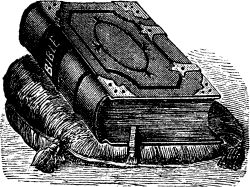

Thy thoughts and feelings shall not die, Nor leave thee when gray hairs are nigh A melancholy slave; But an old age serene and bright, And lovely as a Lapland night, Shall lead thee to thy grave.—Wordsworth.

ge is the outer shore against which dashes an eternity. The mysterious ocean is either tempestuous or tranquil, just as we view it. If we look hard down the cliff of death we are appalled with the force of the waves; we are frightened by the din and shock of collision. But if we gaze afar off we see no great disturbance. All is moving with the true poetry of motion, in the fitness of God's plan, even as viewed by one of His works. "The more we sink into the infirmities of age," says Jeremy Collier, "the nearer we are to immortal youth. All people are young in the other world. That state is an eternal spring, ever fresh and flourishing. Now, to pass from midnight into noon on the sudden; to be decrepit one minute and all spirit and activity the next, must be a desirable change. To call this dying is an abuse of language." Death to the aged is natural, therefore as pleasant and easy as any other natural office of the body. Indeed, it is far easier than the operation by which we even get our teeth in youth. If we, then, are able to forget that greatest shock of pain so quickly as we do, why shall we dread a little sinking of the breath, and the unwilling battle of a body that is tired and
LITERALLY WILLING AT HEART
to surrender? "In expectation of a better, I can with patience embrace this life," says Sir Thomas Browne, "yet in my best meditations do I often desire death. For a pagan there may be some motive to be in love with life; but for a Christian to be amazed at death, I see not how he can escape this dilemma—that he is too sensible of this life, or hopeless of the life to come." We are now of the earth; but all the high reason which has taught us to master fire, and water, and the thunderbolts themselves, has also instructed us that we are only sojourners on this little planet.
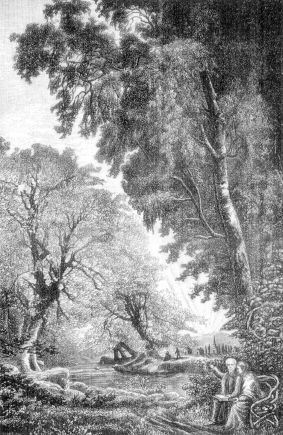
THE EVENING OF LIFE
OUR MINDS ARE AS BROAD
as the range of stellar systems. We are not as large as a horse or an elephant. Are we, therefore, inferior? We are inhabiting bodies which thrive but a few years, on a planet remarkable for its smallness. But we stretch our knowledge over mighty distances; we construct triangles which have for one side the whole sweep of the earth, over 180 millions of miles; we measure the distance of other worlds by this side of a triangle, and the nearest star is thus found to be 103,000 of our measures away from us—103,000 times 180,000,000 miles! Young has well said that
THE UNDEVOUT ASTRONOMER IS MAD.
So did Napoleon die. Was he not the mightiest man of his time? Did not the whole world sigh with relief when the final end came? Yet he was on a tiny rock in the great ocean? On a map of the world that rock has no title even to a dot. Yet it would be foolish to say he belonged simply to that rock. No. He had come from other human worlds. He was as broad as the earth. We, too, have come from other worlds. We are as broad as the universe. Even our minds, clad in clay, betray the high character of our souls.
DOES THE BEAST PEER INTO THE STARS?
Do the birds that pass so easily into the air go on voyages of discovery past Sirius? And yet the air refuses to bear us, and wafts them gently on its lightest zephyrs! We have sublime faculties—the fit companions of a soul. It is not our self-conceit. The Milky Way is not our conceit. The eclipses are not our conceit. The awful sweep of our whole family of planets, moons, and sun, onward in celestial space, is not a conceit. Therefore we possess our souls, flashing within caskets which have not been altogether unworthy of their priceless treasures.
AS THE CASKET DULLS
and grows to its decay, we cannot weep greatly over its loss, for will it not reveal the splendors all within?
"It is worthy the observing," says Lord Bacon, "wisest of men," "that there is no passion in the mind of men so weak, but it mates and masters the fear of death; and, therefore, death is no such terrible enemy when a man hath so many attendants about him that can win the combat from him. Revenge triumphs over death; love slights it; honor aspireth to it; grief flieth to it; fear pre-occupateth it; nay, we read, after Otho the Emperor had slain himself,
PITY (WHICH IS THE TENDEREST OF AFFECTIONS)
provoked many to die out of mere compassion to their sovereign, and as the truest sort of followers. A man would die, though he were neither valiant nor miserable, only upon a weariness to do the same thing so oft over and over again." We all must die, sooner or later. It is easier to die than to live again our stormy and tempestuous lives. Few would re-embark at the cradle, suffer the pains of childhood, the hurts which the feelings of youth get, the pangs of love, the shock of loneliness coming from the departure of those we cling to, the vicissitudes of fortune, the stings of penury, the journeys into the lands of strangers, the flight of summer friends, the alienation of children, and the fevers and the wounds which human nature crosses on its way to the kind haven of a good old age. Jesus stands near. When death comes, his voice will sound, just at the brink: "It is I; be not afraid." "When I look at the tombs of the great," said Joseph Addison, on
HIS VISIT TO WESTMINSTER ABBEY,
"every motion of envy dies in me; when I read the epitaphs of the beautiful, every inordinate desire goes out; when I meet with the grief of parents upon a tombstone, my heart melts with compassion; when I see the tomb of the parents themselves, I consider the vanity of grieving for those whom we must quickly follow. When I see Kings lying by those who deposed them, when I consider rival wits placed side by side, or the holy men that divided the world with their contests and disputes, I reflect with sorrow and astonishment on the little competitions, factions, and debates of mankind. When I read the several dates of the tombs, of some that died yesterday, and some six hundred years ago, I consider that great judgment day when we shall all of us be contemporaries, and make our appearance together."
THE AGED MAN
who has "walked with God" is always ready for the Master's call. His loins are girded about and his lights burning. He "lies down with the Kings of the earth," and that leveling process which is thus intimated and begun in death he feels is the order of a higher plane of life to come, when all the abuses and incongruities of human government will be swept away, and the light of omniscient wisdom will shine on all alike. There will he meet the little child who strayed from the fold into the snows of death early in the married life, and there will he sit beside that fond old heart who heard his first piteous wail in this cold world, and nestled him to her bosom all warm with a mother's love.
IT IS THE ONE POSSIBLE CHANCE
of happiness, and only death stands in the way. Nature carries the soul gently over the river, where those who have gone before stand waiting in glad expectation. Shall we doubt either the goodness of God or the perfection of nature? Shall we hesitate to weave the silk of death around our bodies when we know that we may thence issue a being worthy of a celestial sphere of action?
APOSTROPHE.
Venerable sir, thou hast borne the burdens of the world to the last mile-post. Thy companions have fallen by the wayside, and even some of them may have gone unbidden to their Judge. But thou, having in view the dignity of the human mind and the will of God, hast labored while the light was given thee, and hast journeyed while thy strength remained. Thy destiny is now but opening to thy sight. Thou lookest through the inner doors and seest that infinite cathedral which openeth beyond the vestibule of death.
"The stars shall fade away, the sun himself Grow dim with age, and nature sink in years; But thou shalt flourish in immortal youth, Unhurt amidst the war of elements, The wreck of matter and the crush of worlds."

Whence this pleasing hope, this fond desire, This longing after immortality? Or whence this secret dread, and inward horror, Of falling into naught? Why shrinks the soul Back on herself, and startles at destruction? 'Tis the divinity that stirs within us; 'Tis heaven itself that points out an hereafter, And intimates eternity to man. Eternity! thou pleasing, dreadful thought!—Addison.
sk and it shall be given you; seek and ye shall find; knock and it shall be opened unto you." So spake the Savior. "We know," says Paul, "that all things work together for good to them that love God. In a moment, in the twinkling of an eye, at the last trump; for the trumpet shall sound, and the dead shall be raised incorruptible, and we shall be changed. So when this corruptible shall have put on incorruption, and this mortal shall have put on immortality, then shall be brought to pass the saying that is written, Death is swallowed up in victory. O death, where is my sting? O grave, where is thy victory? For I am now ready to be offered, and the time of my departure is at hand. I have fought a good fight, I have finished my course, I have kept the faith: henceforth there is laid up for me
A CROWN OF RIGHTEOUSNESS,
which the Lord, the righteous judge, shall give me at that day; and not to me only, but unto all them also that love his appearing." "These things saith He that holdeth the Seven Stars in his right hand: Be thou faithful unto death, and I will give thee a crown of life." These are a few of the bright promises held out to us in the Book of Life. Are we not blest? "The joys of heaven," says Bishop Norris, "are without example, above experience, and beyond imagination, for which the whole creation wants a comparison; we an apprehension; and even the Word of God a revelation." "Heaven," says Shakspeare, "is the treasury of everlasting joy." "By heaven we understand a state of happiness," says Franklin, "infinite in degree, and endless in duration." With man's finite mind man solaces himself with
PICTURES OF PARADISE
mortal in their scope. He is not to be blamed for this, for it is God's will to let him grope in darkness a few short years. But man's imagination in all earthly things conjures up that which is far beyond the earthly reality, leaving him a prey to dissatisfaction. How good to believe that our imagination finds in heaven a field where all our most beautiful ideas, collated, joined and woven together into a whole, fail to approach the true glories of the home in the far skies which our kind Father, taking us in His arms, will open before us. "How should we rejoice," says Sir Robert Hall, "in the prospect,
THE CERTAINTY, RATHER,
of spending a blissful eternity with those whom we loved on earth; of seeing them emerge from the ruins of the tomb and the deeper ruins of the fall, not only uninjured, but refined and perfected, 'with every tear wiped from their eyes,' standing before the throne of God and the Lamb, 'in white robes and palms in their hands, crying with a loud voice, Salvation to God that sitteth upon the throne, and to the Lamb, for ever and ever!'
WHAT DELIGHT WILL IT AFFORD
to renew the sweet counsel we have taken together, to recount the toils of combat and the labor of the way, and to approach, not the house, but the throne of God in company, in order to join in the symphonies of heavenly voices, and lose ourselves amid the splendor and fruition of the beatific vision!" Dr. Dick supposes that the soul may find endless employment in beholding "those magnificent displays which will be exhibited of the extent, the magnitude, the motions, the mechanism, the scenery, the inhabitants, and the general constitution of other systems, and the general arrangement and order of the universal system comprehended under the government of the Almighty."
THIS IS ENTIRELY IN REASON.
So far as we are able to judge, there is absolutely no limit to the universe of stars. We are as sure of the law of gravity as we are of the existence of heaven. We build larger telescopes each year only to behold additional millions of stars, each star, possibly, the larger on account of our being able to see it at all. We absolutely know that one star is larger than our sun by 324 times. The moon is about nine times around the earth away from us. The sun is larger than the track of the moon around the earth by 167,000 miles in every direction. If you had a ball which would just fit in the track of the moon, and stuck it all full of pins 167,000 miles long, you would have the size of the sun.
SIRIUS, THE STAR,
is 324 times as large as the sun, and so are many other stars. Now, the most distant star in the largest telescope cannot be at the edge of the universe. Why? It must be in the middle. It must be balanced by exactly as much attraction on one side as another. There must be, above, below, beyond that star, the same stupendous array of worlds, and each relatively outer star, aye, even the star on the farther side of that outer star, must in its turn, be held in the same magnificent and awful suspension. So forever. We actually have Infinity forced on our reason. Eternity is the correlative and co-existent necessity of infinity. Infinity, Eternity, Immortality, become the solemn Trinity confronting the physical as well as the spiritual world! God has even ordained that, when you move your hand, you affect the farthest of His worlds. Can you not grasp the idea that, in reason, the universe is boundless? Why, then, in reason, shall it not be our infinite pleasure to study God's plans forever? I know of no greater pleasure which I could conceive. Those who ask for evidences,
AS THEY ASK FOR BREAD AND CHEESE,
expecting these great truths to be clear to their clotted minds, cannot even be brought to believe a house-fly has 25,000 eyes, constructed each on the plan of our own? They will hardly believe an unseen force flows through the magnetic needle, turning it to the north. If they had refused, with the same logic, to believe that A was A when they had to so believe in order to learn at all, they would now be groping in that stupid illiteracy, which, by a parity of reasoning, they so richly deserve.
SHALL GOD WEIGH OUT ARCTURUS FOR US,
to exhibit His power or its magnitude? Shall He speak to us, and not only kill us with his softer syllables, but send our nicely-balanced earth whirling in toward the sun, and all because some fool hath said in his heart there is no God? No. Our reason and our Oldest Record both point to Eternity as our proper life, the ripening of our soul, our comprehension of the infinite, and our better worthiness to praise God's holy name.
CONCLUSION.
No author of a work calculated to elevate the mind and ennoble the ambitions of mankind could aspire to a higher climax; no writer of a series of admonitions, in escaping "a lame and impotent conclusion," could rest more calmly than he who, having built his tower upon the solid duties of to-day, peers out with the great lenses of Religion, into the hopes of the future—
"Past flaming bounds of place and time, The living throne, the sapphire blaze, Where angels tremble while they gaze."