The Future Life. (continued 3)
Reading edition
THE WESTERN WILDS,
during the early period of their settlement by Americans, have furnished us with accurate views of society without women. And what has that society been? More a den of wild beasts than a congregation of the most reasoning of God's creatures! There we find men living in constant suspicion of their comrades, in constant danger of hazarding their lives for some sentimental canon of personal vanity that, if they were boys in civilized society, would be flogged out of their moral code.
THE WHOLE HISTORY OF HUMAN SICKNESS
is a continuous outcry of the goodness of woman. Wherever the red hand of war has risen to smite, there the white hand of woman has hastened to soothe. After the roar of the conflagration and amidst the ruins piled up by the earthquake ever has that sweet minister sought out the hungry and succored the suffering.
CRITICISM OUT OF PLACE.
One does not feel that he can do any good by criticising woman. We love fruit that is perfect. We do not describe, and we would have little thanks for a description of, those specimens of cherries, strawberries, or grapes which fail to realize our anticipations of a delightful product of the orchard, the garden, or the vineyard. But I have perhaps, by showing the respect in which men of intellect and honor hold a good woman, given needed encouragement to patient hearts, and testified my own humble regard for womanhood.

His hair just grizzled, As in a green old age.—Dryden.
he word papa, I believe, goes back, just as it is, through all the languages, to the Sanscrit, and even beyond to the unknown Aryan, the stock of our civilized tongues. The Pope is papa, kind father, in Italian. How his name ever came to be twisted into the ugly sound we hear in English is a problem, for the difference on the feelings between the sounds of Pope, and papa, kind father, cannot well be exaggerated. The kind father of a good man occupies an enviable place in that man's thoughts. It is no passing admiration; that father is no hero of to-day no study of to-morrow, no dim recollection when the future shall have come—but an active exemplar, an honored memory, a potent spur and stay combined—a spur to urge to all a man should do; a stay to curb unwisdom's flying feet. That father has toiled in weariness that his son might follow an easier path of life. Perhaps you now tread that path. How carefully should your steps be taken; how earnestly you should climb to reach the round which meets your self-denying parent's gaze! With him there have come few paroxysms of delight in his labor. He has not been endowed with that mysterious joy your mother has felt in all your existence. He has delighted in you because he hoped you would bring honor to his house; he would rather you had not lived than to see you in a prisoner's cell—far rather. This could not be said of your mother. She would be contented that you had lived at all, that you had looked into her eyes and laughed. Your father has taken care of you, dutifully. Repay him in kindness. "Honor thy father and thy mother, that thy days may be long upon the land which the Lord thy God giveth thee." This was graven by the Lord in the marble tablets on Sinai, and has been in turn graven on the countless millions of hearts that have beaten "their short funeral marches" since that awful hour.
ALL SOCIETY
has at one time or another rested on the sustaining power of the father. The patriarch, in ancient times, protected and sustained his dependents, and, in return, received their entire allegiance, wielding over them the power of life and death, and thus initiating the first form of human government. Next came the cities where the government was formed by all the fathers together in council, and our village and city legislators are, to this day, called "the city fathers," although the reverence in which so august a body was once held has departed with the silent flight of the dignity of our modern convocations. Some one has said of
A FINE AND HONORABLE OLD MAN,
that he is in the childhood of immortality. "One's age should be tranquil," says Dr. Arnold, "as one's childhood should be playful; hard work at either extremity of human existence, seems to me out of place; the morning and the evening should be alike cool and peaceful; at midday the sun may burn, and men may labor under it." See to it, if it be within your power, that your father has the rest due to the evening of his days. Let him sit in the cool. Let him listen to the voices of his night—the crickets that cry out his mortality and the nightingales that sing of Paradise!
"GRAY HAIRS
seem to fancy," says Richter, "like the light of a soft moon silvering over the evening of life." "Old age," says Madame Swetchine, "is not one of the beauties of creation, but it is one of its harmonies. The law of contrasts is one of the laws of beauty. Shadows give light its worth; sternness enchances mildness; solemnity splendor."
EXPERIENCE.
"Old age was naturally more honored," says Joubert, "in times when people could not know much more than what they had seen." There are still many avenues of learning in which practical experience seems to be paramount in value. In business its great worth is never underestimated. You have heard of the partnership built on a contribution by one firm-member of the money, and by the other of the experience; and of the dissolution of that firm, leaving the one who put in the money with all the experience, and the one who put in the experience with all the money! The practices of law and medicine are famous for the need of age, which they harness anew with the labors and exertions ordinarily demanded of youth. "Tell me," says Shakerly Marmion, "what you find better or more honorable than age. Is not wisdom entailed upon it?
TAKE THE PRE-EMINENCE OF IT IN EVERYTHING—
in an old friend, in old wine, in an old pedigree." "I venerate old age," says the great and good poet Longfellow; "and I love not the man who can look without emotion upon the sunset of life, when the dusk of evening begins to gather over the watery eye, and the shadows of twilight grow broader and deeper upon the understanding." "It is only necessary to grow old to become more indulgent," writes Goethe; "I see no fault committed that I have not committed myself." "An aged Christian," says Chapin, beautifully enlarging on Goldsmith's and Dr. Donne's ideas, "with the snow of time on his head, may remind us that those points of earth are whitest which are nearest heaven."
OLD AGE
"Age is the outer shore against which dashes an eternity."
"LIKE A MORNING DREAM,"
again says Richter, "life becomes more and more bright the longer we live, and the reason of everything appears more clear. What has puzzled us before seems less mysterious, and the crooked paths look straighter as we approach the end." "Time has laid his hand upon my heart gently," says Longfellow, "not smiting it; but
AS A HARPER LAYS HIS OPEN PALM
upon his harp, to deaden its vibrations." "I think that to have known one good old man," George William Curtis says, "one man who, through the chances and mischances of a long life, has carried his heart in his hand, like a palm branch, waving all discords into peace—helps our faith in God, in ourselves, and in each other more than many sermons." "He that would pass the declining years of his life with honor and comfort," says Addison, with fine opposition, "should, when young, consider that he may one day become old, and remember, when he is old, that he has once been young." On the principle that blessings brighten as they take their flight we come to love the sunshine and the birds and all God's glorious works just as we grow old.
"IF WE NEVER CARED FOR LITTLE CHILDREN BEFORE"
says Lord Lytton, "we delight to see them roll on the grass over which we hobble. The grandsire turns wearily from his middle-aged, care-worn son, to listen with infant laugh to the prattle of an infant grandchild. It is the old who plant young trees; it is the old who are most saddened by the autumn, and feel most delight in the returning spring." "Winter," says Richter, "which strips the leaves from around us, makes us see the distant regions they formerly concealed; so does old age rob us of our enjoyments, only to enlarge the prospect of eternity before us." Seneca says that there is nothing more disgraceful than that an old man should have nothing to produce as a proof that he has lived long except his years. I love Longfellow's picture of
THE VILLAGE BLACKSMITH,
the mighty man. It has been set to one of the best musical accompaniments that I have ever heard. When the verses below are reached, the key is changed to one where the sadness intensifies, until the honest old heart hears the "mother's voice singing in Paradise:"
He goes on Sunday to the church; And sits among his boys; He hears the parson pray and preach, He hears his daughter's voice, Singing in the village choir, And it makes his heart rejoice. It sounds to him like her mother's voice, Singing in Paradise; He needs must think of her once more, How in the grave she lies; And with his hard, rough hand he wipes A tear out of his eyes.
I wish, instead of merely printing these simple words, I could breathe them out to you, as some great tenor or baritone like Sims Reeves or Santley sings them—there is such a world of human life and feeling hidden there, ready to spring forth with the touch of sympathetic sounds!
NOTHING BECOMES A YOUNG MAN SO MUCH
as a respectful demeanor toward a reverend man. Nothing lowers a man so much as flippant speech concerning his elders. The young man with the most dignity has the most deference for age. He takes sincere delight in bowing before ripe years and wisdom. Alas! how sad that ever age should come to one who is not fitted for its honors!
I have known a son to thwart every dream of his father. I have seen the parent, struggling with adversity, yet succeed in opening before the child a career of honor and comfort; and I have seen the son clutch those opportunities as a highwayman seizes upon the wayfarer, and throttle them in the dust and ashes of failure and disgrace. How sad the picture!
A BRIGHTER VIEW.
I have seen a parent toil for years, carrying to his cottage the wages which should support his son in seven long years of careful education. I have watched that son in his ceaseless studies and found he thought only of gladdening his father's heart. I have seen him graduate second in a class of one hundred and fifteen, and then after two years of additional study, first in a body of eighty young men, each of whom was a scholar. The best men of a great city have given that young man encouragement. Their homes and their wives and their daughters have smiled at his approach, and his course has been upward without a fall, and with few pauses for rest. Has he forgotten his poor father? No. He still lives in the cottage, and will make the small house with a great man in it more hospitable and more honorable than a wide door that swings open to a narrow soul. How pleasant the picture!

A mother is a mother still, The holiest thing alive.—Coleridge. Not learned save in gracious household ways, Not perfect, nay, but full of tender wants, No angel, but a dearer being, all dipt In angel instincts, breathing Paradise. Who looked all native to her place, and yet On tiptoe seemed to touch upon a sphere Too gross to tread, and all male minds perforce Swayed to her from their orbits as they moved, And girdled her with music. Happy he With such a mother! faith in womankind Beats with his blood.—Tennyson.
o high and holy a title as mother cannot fall too reverently from man's lips. That he might live the mother has gone down into the valley of the shadow of death; that he might thrive she has fed him with willingness from her own weak body, and grown spectre-like as he grew strong and importunate; that he might go among his fellows on an equal footing, she has toiled with his small weak brain teaching him the beginning of his education and tilling "a rank unweeded garden;" that he might have everlasting life, she has instilled into his mind that saving fear of God, which, though he think himself an atheist, will claim the mastery when Death grins by his couch, and grant him a stay of the awful judgment till he may make his peace with a Creator whose mercy endureth forever. Everything a man is he can owe but to his mother; everything he may be in future life has possibly come from her fond intercession, her gentle admonitions. "Unhappy is the man for whom his own mother has not made all other mothers venerable," says Richter. "The future destiny of the child,"
SAYS NAPOLEON,
"is always the work of the mother," and it is certain that he had ample reason in his own remarkable career for making this important admission. He inherited from his mother all those attributes which made him great, and owed his sudden downfall to none of her teachings. She was noted for her sagacity and prudence, but possibly it required more than human sagacity and prudence to balance the mighty impulses which moved Napoleon Bonaparte. "A father may turn his back on his child," says Washington Irving, "brothers and sisters may become inveterate enemies, husbands may desert their wives, wives their husbands; but a mother's love endures through all; in good repute, in bad repute, in the face of the world's condemnation, a mother still loves on, and still hopes that her child may turn from his evil ways, and repent; still
SHE REMEMBERS THE INFANT SMILES
that once filled her bosom with rapture, the merry laugh, the joyful shout of his childhood, the opening promise of his youth; and she can never be brought to think him all unworthy." "There is in all this cold and hollow world," says Mrs. Hemans, "no fount of deep, strong, deathless love, save that within a mother's heart." "Even He that died for us upon the cross," says Longfellow, "in the last hour, in the unutterable agony of death, was mindful of his mother, as if to teach us that this holy love should be our last worldly thought—the last point of earth from which the soul should take its flight for heaven." Who ever saw
A MOTHER ROMPING WITH HER THREE-YEAR-OLD
that did not look upon her as one of the happiest, therefore, necessarily, one of the best of God's creatures? O, in that peek-a-boo, that capturing of that last squealing "pig," the little toe, that paddy-cake opera, is there not the one great bliss of life, to be happy in making others happy? And how the laughter rings through the house! And then the toil and self-denial for the stocking and the tree
AT CHRISTMAS!
Is it any wonder that the child is so easily deceived, and credits all his joys to unseen ministers? It would not be hard to convince the philosopher himself of the dual earthly character of the mother, visibly a woman, invisibly but not the less really to her child, an ethereal spirit of mercy and goodness! What gnaws her cheek and cheats Death into the belief a flag of truce summons him to the final parley? Has not her babe, her hope, been fevered and in pain, and should she sleep lest it should leave her on this world behind, that then would need her not? "Canst bind the sweet influences of the Pleiades?" No more can her anxiety be
FETTERED INTO SLEEP;
no more can her quick ear be deafened to the little wail that echoes pitiful within the chambers of her heart! When we remember the great passion of motherhood, the intensity of the drama, the prolongation into years of its deep interplots, we cannot marvel longer at the perennial, lasting character of the mother's love. Given, the marvel, there is no further marvel. Given life, the scientists say, there is no other problem on this narrow world. And thus the marvel and the mystery never grow less.
MAN ENTERS THE WORLD,
of all animals the most pitiable and weakly. Left to himself he would immediately perish. Extinguish the mother's love and he would at once perish. His growth is by far the slowest of that of all animals, therefore the wisdom of God in so lengthening the tenure of the mother's solicitude. The mighty man who wields the iron halberd which no two people can lift was still a helpless infant, unable to put his own chubby fist into his own mouth! The autocrat who sweeps whole communities into Siberia with a stroke of his pen was ill when his mother was alarmed, was in agony when she was indiscreet with her food! She cannot forget this. It is but yesterday she dried his flesh to keep it sound. It is but yesterday she let him bite his aching gum upon her finger, wishing the ache might go from him to her—hoping that if he gave her pain he would have less. One can well pardon the vanity that would lead a son to insist that his mother should accompany him to
THE EXECUTIVE MANSION OF THE GREAT REPUBLIC,
that she might behold him enter upon the Chief Magistracy of fifty millions of freemen, gained by the first choice of a majority of those freemen, yea, by the unanimous first and second choice, for none so ready to fight for his right to rule as he who yesterday voted for an honored opponent—the very summit of true political ambition—the apex of the mother's boldest hope! "The mother's love is indeed the golden link that binds youth to old age," says Bovee; "and he is still but a child, however time may have furrowed his cheek, or silvered his brow, who can yet recall, with a softened heart, the fond devotion, or the gentle chidings, of
THE BEST FRIEND
that God ever gives us!" I knew an aged woman, who interested me very greatly in tales of "her boy"—that good son who had so often proven his gratitude for her long love. One day, chancing to consider her great number of years, I inquired how old "her boy" was, and found that he had been a grandfather for twenty-three years, and had lately had the satisfaction of holding a great grandson in his arms. Still he was her curly haired-boy—she could remember him in no other condition of life with so much satisfaction.
"I WOULD DESIRE FOR A FRIEND,"
says Lacretelle, "the son who never resisted the tears of his mother." "Love droops, youth fades, the leaves of friendship fall; a mother's secret hope outlives them all," sings Oliver Wendell Holmes. "At first," says Beecher, "babies feed on the mother's bosom, but always on her heart." "Stories first heard at a mother's knee," affirms Ruffini, "are never wholly forgotten—a little spring that never quite dries up in our journey through scorching years."
"AN OUNCE OF MOTHER,"
says the Spanish proverb, "is a pound of clergy." "The mother's heart is the child's schoolroom," says another writer. "Men are what their mothers made them," says Emerson, in study of Napoleon's idea; "you may as well ask a loom which weaves huckabuck why it does not make cashmere, as expect poetry from this engineer, or a chemical discovery from that jobber." "It is generally admitted," says Theodore Hook, "and frequently proved, that virtue and genius, and all the natural good qualities which men possess, are derived from their mothers." "It is well for us," says Bishop Hare, "that we are born babies in intellect. Could we understand half what mothers say and do to their infants, we should be filled with
A CONCEIT OF OUR OWN IMPORTANCE
which would render us insupportable through life. Happy the boy whose mother is tired of talking nonsense to him before he is old enough to know the sense of it." Perhaps the praises of our mothers tarry in our brains too long anyway. It may be a provision of nature that woman shall inspire her child with sufficient self-esteem to take him through the world with a first-class ticket, a cabin passage, that he may escape the poor accommodations of excessive humility, the steerage of the ship of life. It seems incredible that our mother was mistaken in thinking her boys the brightest, best, and most creditable in all the region roundabout! Let us by our lives, marvel rather at the correctness of her vision than the blindness of her love.
"SHE WHO HAS LOST AN INFANT,"
says Leigh Hunt, "is never, as it were, without an infant child. Her other children grow up to manhood and womanhood, and suffer all the changes of mortality; but this one alone is rendered an immortal child; for death has arrested it with his kindly harshness, and blessed it into an eternal image of youth and innocence." The mother teaches us the one grand lesson of
UNALTERABLE FIDELITY.
"Nothing is more noble," says Cicero, "nothing more venerable." One of the most beautiful tributes to an aged mother was written by Lamartine. "The loss of a mother," he says "is always severely felt. Even though her health may incapacitate her from taking an active part in the care of her family, still she is a sweet rallying-point, around which affection and obedience, and a thousand endeavors to please, concentrate; and dreary is the blank when such a point is withdrawn! It is like that lonely star before us; neither its heat nor light are anything to us in themselves; yet the shepherd would feel his heart sad if he missed it when he lifts his eye to the brow of the mountain over which it rises when the sun descends."
THERE ARE MEN WHO FORGET THE CLAIMS
their mothers have upon them. Of such ungrateful wretches, though clothed in outward excellences, the pen can write nothing too harsh in justice. As old Dr. South says, "the greatest favors are to such a one but the motion of a ship upon the waves; they leave no trace, no sign behind them. All kindness descend as showers of rain or rivers of fresh water falling into the main sea; the sea swallows them all, but is not all changed or sweetened by them. If you look backward and trace him up to his original, you will find that he was born so; and if you look forward enough, it is a thousand to one that you will find that
HE ALSO DIES SO.
The thread that nature spins is seldom broken off by anything but death. I do not by this limit the operation of God's grace, for that may do wonders." Be glad, if you are ungrateful, that a wise man has given you so good counsel to pray—and pray as you do when you think yourself in extreme peril!
IF YOUR MOTHER IS YET YOUNG,
you have many years of her great friendship before you. Try and pattern after her boundless affection. Let it melt into your heart and make it warmer. If "age has snowed white hairs" upon her head, treasure her the more fondly during the few swift years she will be left to you. Soon she will go to her reward, and you will be without the only friend of man whose love seems to be inalienable—whose esteem he cannot barter away, either in greed or in vice.
THE MOTHER OF MOTHERS.
In almost every community there is "a mother in Israel," a mother of mothers, whose great heart is like the ocean, and claims the outpourings of every stream of life. To these grand souls of virtue and goodness let every man bow in reverence, for they are mothers to the motherless. When the Reaper came forth to reap he aimed to take the richest sheaf, but lo! the mother in Israel gathered the orphans together, and poured out her tenderness upon them.
Had we never loved sae kindly, Had we never loved sae blindly, Never met or never parted, We had ne'er been broken-hearted!—Burns. Dear as remembered kisses after death, And sweet as those for others; deep as love. Deep as first love, and wild with all regret; O Death in Life! the days that are no more.—Tennyson.
ove, says Cowley, "is a great passion, and therefore I hope I have done with it." I think most people will agree with this sentiment. Love is such a tyrant, it leaves common sense so little to say, that the majority of people are heartily glad when reason returns to her throne and the thrilling lunacy is a remembrance instead of a fact. The remembrance is sweet, and has no angry thorn, no peremptory mandate. The young man is going along in the full enjoyment of his life, when suddenly a huge coiled spring, the existence of which has not attracted his notice, is loosed in his breast, his whole intellectual forces centre on the attainment of one object, and a mental strain begins which is of the exact nature of madness, and has ever been termed so by people who have looked at things merely by what they have seen. In the highly-feverish state of the brain the nerves of the whole system soon become involved, the stomach refuses to perform its functions, and physical emaciation and deep melancholia rapidly ensue. The obvious reason is the insane state of the brain. Nature has suddenly impressed that organ with the one idea that a certain fair maid is actually without the faults of her associates. She is the prize of the whole world! Had the world the information of her perfections which is lodged in this young man's secret brain, there would be a war of extermination for her possession—a second sack of Troy at the very least. Deep pity for other men with wives, who cannot marry this maiden, and pity for young men who have seemingly preferred other maidens, intermit with joy that all the world has been so blind.
CAUTIOUSLY THE YOUTH ADVANCES
toward his prey. The expedition is one of tremendous importance, therefore his exceeding amount of thought. When he is in the ineffable presence, he is there as an actor in a tragedy, or as a tenor in an opera. He has almost counted his hairs; he certainly counts the winkings of his eyelids! Can any detail be unimportant in an undertaking of such measureless risk? It is no wonder, then, that a young man who is giving as much thought as this to a young, thoughtless girl is not worth much in his business for the time being! In fact, it is a miracle to him, after
SOME DOOMFUL FROWN
from his queen, that he has survived the night and goes to his work at all! He is confident that it is base habit. "O, that this too too solid flesh would melt!" he cries, as his dissatisfied employer, or father, requires some reasonable action and fails to get it. In after-life this same young man is glad the "grand passion" will never come to him again. He feels that it has not heightened him in his own regard. His love may have been smooth or it may have been swallowed in the quicksands of adversity—the difference is small. It is not creditable to the human brain to be so hoodwinked and purblind as Cupid makes his victims. But
LOVE RULES THE UNIVERSE,
having its climax in God himself, and its earthly ideality in the mother's affection. We should not complain that when the potent essence is first administered to us it shakes us seriously. Without this passion, selfishness would triumph, and man would not take on the cares of wedded life. Society and religion would wither. The world would be a howling den of chaos and deep crime.
HOW HAVE THE SAGES LOOKED UPON LOVE?
I think they are inclined to praise it, as a whole—to indorse it merely as a sensation, a passing gratification. It has always, on the contrary, seemed to me like an exquisitely painful means to an exquisitely beautiful end. The warm genial love of the home—the love which is as an open grate, cheerful, and which is without those thunderstorms needful to clear the heavily charged atmosphere of youthful love—pleases and repays me for "the dangers I have passed." "The greatest pleasure of life is love," says Sir William Temple. "Love is like the hunter," says Ralph Waldo Emerson, "who cares not for the game when once caught, which he may have pursued with the most intense and breathless eagerness." This is true of only a minority of the hunters. I have more frequently bought additional fish than thrown away those I have caught. Why? Because the weariness and difficulty of catching two or three rock bass had impressed me with the value of a whole string of fish. You have seen
THE ANXIETY OF THE CAT
to make the captive mouse believe she is not on guard. She walks away with the utmost indifference. But let the mouse so much as move its crushed little body, she is upon it with the ferocity of the greatest members of her agile tribe. So it is with us. Let our possession escape us, our consternation is complete. Again the spring uncoils, and again we are madmen. "A murderous guilt shows not itself more soon than love that would seem hid; love's night is noon," says Shakspeare. "It is better to have loved and lost, than never to have loved at all" sings Tennyson. "Nothing but real love," says Lord Lytton, "can repay us for the loss of freedom, the cares and fears of poverty,
THE COLD PITY OF THE WORLD
that we both despise and respect." "Love," says Sir Thomas Overbury, wittily, "is a superstition that doth fear the idol which itself hath made." "To reveal its complacence by gifts," says Mrs. Sigourney, "is one of the native dialects of love." "Love is never so blind as when it is to spy faults," says South. "Love reckons days for years," says Dryden, "and every little absence is an age." "Where love has once obtained an influence," observes Plautus dryly, "any flavoring, I believe, will please." "That is the true reason of love," says Goethe, "when we believe that we alone can love, that no one could either have loved so before us, and that no one will love in the same way after us."
"NO CORD OR CABLE CAN DRAW
so forcibly or bind so fast," says melancholy Burton, "as love can do with only a single thread." "Where there exists the most ardent and true love," says Valerius Maximus, "it is often better to be united in death than separated in life." "A man of sense may love like a madman," says Rochefoucauld, "but not like a fool." Says Addison, who was a bachelor, and knew little about the heart: "Ridicule, perhaps, is a better expedient against love than sober advice; and I am of the opinion that Hudibras and Don Quixote may be as effectual to cure the extravagance of this passion as any one of the old philosophers." "Love lessens woman's delicacy and increases man's," says Richter. This accords with common observation. "It makes us proud when our love of a mistress is returned," says Hazlitt, in a rambling manner; "it ought to make us prouder still when we can love her for herself alone, without the aid of any such selfish reflection. This is the religion of love." All such argument proceeds on the theory that love is a sawing of wood, a digging of potatoes, or some such "emotion," to be entirely controlled by the will and regulated by the decencies. "Loving," says Shakspeare, "goes by haps; some Cupid kills with arrows, some with traps." "The accepted and betrothed lover has lost the wildest charms of his maiden, in her acceptance of him," says Emerson, again; "she was heaven whilst he pursued her as a star—she cannot be heaven if she stoops to such a one as he." I do not think Emerson has got exactly the right idea of the way a lover feels just there. Here it is and nearer the truth—I do not know the author's name:
I've thought, if those dumb, heathen gods could breathe, As shapeless, strengthless, wooden things they stand, And feel the holy incense round them wreathe, And see before them offerings of the land; And know that unto them is worship paid From pure hearts, kneeling on the verdant sod, Looking to helplessness, for light and aid Because by fate they know no higher god: How their dull hearts must ache with constant pain, And sense of shame, and fear to be flung down When all their weakness must one day be plain, And fire avenge the undeserved crown. And reading my love's letter, sad and sweet, I sigh, Knowing that such a helpless, wooden god am I.
"The comparison of love to fire holds good in one respect," says Henry Home, "that the fiercer it burns the sooner it is extinguished." "Love me little love me long" says Marlowe. "The plainest man, that can convince a woman," says Colton, "that he is really in love with her, has done more to make her in love with him than the handsomest man, if he can produce there is a silence in it that suspends the foot; and the folded arms and the dejected head are the images it reflects." "Love is but another name for that inscrutable presence by which the soul is connected with humanity," says Simms. "The beings who appear cold," says Madame Swetchine, "adore where they dare to love." "Man, while he loves, is never quite depraved," says Charles Lamb. "It is possible," says Terence, referring to the unquestionable temporary insanity of the passion, "that a man can be so changed by love that one could not recognize him to be the same person." "Solid love, whose root is virtue, can no more die, than virtue itself," says Erasmus, who was probably talking about a requited affection.
THE CASE OF THE POET PETRARCH,
who loved another man's wife all his life, simply because he fell in love with her before she married the other fellow, does not strike me as exactly the proper thing, or exactly the manly thing. I like better the Sensible Shepherd of George Wither, who sang jauntily:
Be she fairer than the day, Or the flowery meads in May,
If she be not so to me, What care I how fair she be?
Kill off your love if it be not returned, as though it were a condemned felon. The execution is a painful scene, but the effect on your manhood is good. "True love were very unlovely," says Sir Philip Sidney, "if it were half so deadly as lovers term it!" "There are few people," says Rochefoucauld, "who are not ashamed of their loves when the fit is over." "In love we are all fools alike," says Gay. "We that are true lovers" says Shakspeare, "run into strange capers; but as all is mortal in nature, so is all nature in love mortal in folly." "O love," cries LaFontaine, "when thou gettest dominion over us,
WE MAY BID GOOD-BY TO PRUDENCE."
"Love can hope where reason would despair," says Lyttleton. "O love, the beautiful, the brief!" exclaims Schiller. "Love at two-and-twenty is a terribly intoxicating draught," says Ruffini. "At lovers' perjuries they say Jove laughs," smiles Shakspeare. "Where love and wisdom drink out of the same cup, in this everyday world, it is the exception," said Madame Neckar. "The poets, the moralists, the painters, in all their descriptions, allegories, and pictures," says Addison, "have represented love as a soft torment, a bitter sweet, a pleasing pain, or an agreeable distress." "O how this spring of love resembleth the uncertain glory of an April day!
ADIEU, VALOR! RUST, RAPIER!
be still, drum! for your manager is in love; yea, he loveth!" says Shakspeare. "I do much wonder," says the King of Thought, again, "that one man, seeing how much another man is a fool when he dedicates his favor to love, will, after he hath laughed at such shallow follies in others, became the argument of his own scorn, by falling in love."
"LOVE AND FRIENDSHIP EXCLUDE EACH OTHER,"
says DuCoeur. "Love begins by love, and the strongest friendship could only give birth to a feeble love." "Love, which is only an episode in the life of man," says Madame DeStael, "is the entire history of woman's life." "Love is a spaniel," says Colton, "that prefers even punishment from one hand to caresses from another." "A man loved by a beautiful and virtuous woman, carries a talisman that renders him invulnerable," says Madame Dudevant; "everyone feels that such a one's life has a higher value than that of others." "There are no little events with love," says Balzac; "it places in the same scales the fall of an empire and the dropping of a woman's glove." "There's nothing half so sweet in life as love's young dream," says Moore. "Where there is love in the heart," says Beecher, "there are rainbows in the eyes, which cover every black cloud with gorgeous hues." "The greatest happiness of life," says Victor Hugo, "is the conviction that we are loved for ourselves—say,
RATHER IN SPITE OF OURSELVES."
"Love makes its record in deeper colors," says Longfellow, "as we grow out of childhood into manhood; as the Emperors signed their names in green ink when under age, but when of age, in purple." "The heart of a young woman in love is a golden sanctuary," says Paulin Limayrac, "which often enshrines an idol of clay." This thought, the reader can see is a close neighbor of the Boston poet's idea of the "base wooden god," spoken of a while back. "We forgive more faults in love than in friendship," says Henry Home; "expostulations betwixt friends end generally ill, but well betwixt lovers."
"Gold," says Deluzy, "does not satisfy love; it must be paid back in its own coin." "The platform of the altar of love," says Jane Porter, with great accuracy of metaphor, "is constructed of virtue, beauty, and affection; such is the pyre, such the offering; but the ethereal spark must come from heaven that lights the sacrifice." "This passion is," says Dr. South, "the great instrument and engine of nature, the bond and cement of society, the spring and spirit of the universe. It is the whole man wrapped up into one desire, all the power, vigor, and faculties of the soul
ABRIDGED INTO ONE INCLINATION."
"Samson was so tempted," says Shakspeare, "and he had an excellent strength; yet was Solomon so seduced; and he had a very good wit." There has always been one time in a man's life when he felt poets should sing only of this one act in the drama of life. Here is the idea—the same idea we have all had, only dressed in better raiment, for Alexander Smith took great pride in the children of his brain: "Methinks all poets should be gentle, fair, and ever young, and ever beautiful; I would have all poets to be like to this—gold-haired and rosy-lipped, to sing of love." Finally, said the Great Napoleon: "Love is the occupation of the idle man, the amusement of the busy one, and
THE SHIPWRECK OF A SOVEREIGN."
Thus, if we will turn through the pages of our books, we will see everywhere the marks of love upon men's minds. It is a rude bath, which when we have grown more accustomed to the waters, delights and satisfies, and in our sleep our dreams are beautiful. It is natural, and therefore need not be called laudable—though if it were not a part of our development, schools of love would be a necessity, to teach men how to love without scandal in the sight of God.
THE FIRST ATTACK OF LOVE IS RIDICULOUS
to those not acting one of the two parts, yet it is well to remember our own experience. "Love is the fulfilling of the law," says the Bible; "many waters cannot quench it, neither can the floods drown it." Neither can the selfish aim nor the cruel jest of the parent whom it discommodes do aught but fan the flame if God and not folly have truly lighted it. The danger of handling carelessly the fire of the heart is one of the gravest which confront the guardians of younger lives. The switch is fixed; the train is approaching; if you attempt to turn the train you must not only know where it is going after it shall be turned, but you must have the skill to see whether there yet remains time to make the movement with success. A wreck by a switchman is a fearful thing!

"Their Love was like the lava-flood That burns in Ætna's breast of flame." And when with envy Time, transported, Shall think to rob us of our joys, You'll in your girls again be courted, And I'll go wooing in my boys.—Percy.
n flies time, and thus the tale goes on. You are in love with an amiable maiden, and she is pleased. If you could see further into her heart you would find she was idolatrous. But this matter of courtship must have shown you how careless you have been with your money through all those years you might have been hoarding it for this great need. But you did not save your wages, probably, or if you did you are an exceptional young man. You now need money. You should work about fifteen months before you marry. It will be a long, tedious, unpleasant pull, trying to the affections, and it is generally very trying to the health; but it is necessary, and if you have not the persistence to save money for fifteen months, in the meantime quarreling and making up, with all the quarters of the moon, you have not the solidity of citizenship, and will be better unmarried. "Successful love takes a load off our hearts, and puts it upon our shoulders" says Bovee. Square up your shoulders! Get under the load so that you can carry it! The days of responsibility have come. The larger the responsibilities look, the deeper the young man usually loves. The day of the Chicago fire a man put up a pine shed on the ruins of a marble palace, and on his sign he painted
"ALL GONE BUT WIFE AND HOPE!"
People who thought those two things a small capital were greatly mistaken, for that same man is now rich again. When you hear of a man being ruined by getting married, ask for names and dates. The name will usually settle it. Along the front of the lake at Chicago is a breakwater. In hot weather this pier is nearly covered with men of leisure, taking midsummer-night dreams. They are the so-called "harvesters" who start out in droves into the country after something to do—"forced to search for work and not find it!" Marriage has not ruined them. You will find that the men your adviser shows you who has been ruined by marriage, was a born wharf-rat, fit only to be shot with a gun big enough to save the expense of any further funeral.
THERE IS NO POSSIBLE CHANCE
of a man being worse off married than single. As a married man, he is on the right path. As a single man, there is no anchor for him. He may be here to-day, in San Francisco next week. Then, in two or three years, he will be back, as poor as ever. You will have to work, of course. But you have never before done your share of the work. If you are a smart man, you can do your share and more too. You will have a home of your own. You could never get one as a single man, perhaps, because you would not need one.
YOU WILL BE SAFER
as a married man. It seems to me that a virtuous, sober, christian, unmarried man should have twice the credit of a married man, for he is certainly exposed to thousands of extra temptations. Everything is natural in marriage. The builder has "builded wiser than he knew." At thirty-five he finds himself well along on the successful journey of life. His bachelor friend who has lived a selfish existence is poorer, has lost the charm of youth, and is skurrying around to get a wife who will be a queen and slave at the same time. His bachelor friend is
A LAUGHING-STOCK
among the last crop of young girls, who can recollect how he went with their married sisters, and he will be satisfied with nothing above eighteen, though his hair is dropping out, or frosting like a cold night in September. If he had not been so selfish he would have been married eight or ten years ago. Now
NATURE BEGINS TO ASSERT HERSELF.
The friends of his youth have formed the new ties that have come with the march of the years. The trees have their leaves, and cast a grateful shadow, cool and sweet. The bachelor is bare, and under his branches the hot and withering sun pours down unpleasantly. You are lucky to have escaped such a lot, for it is O, so lonesome and unsatisfactory to man! It is not good for him to be alone. Now,
IN TALKING TO YOUR SWEETHEART,
there is one bearing alone which will bring forth good fruit. Be honest and sincere. Remember that the philosophers and sages of the centuries have been studying and marveling over the thing called Truth—why it is that it always asserts itself—why it is that its parts always coincide with each other, as though they had first been put together! When you see cut stones unloading before the site of a building, you know by the marks on them that, when they are put together, they will make a fine-looking front, for the architect has copied them from the front of some building which has, sometime or other, been erected just as this projected structure will be. But here is
THIS QUARRY OF TRUTH;
you enter it without a human architect, hew out a stone, hew out another, and another, and soon a beautiful edifice arises, in the walls of which there is not a single peep-hole or blemish. Everything fits. So bear yourself toward your future partner for life that when you enter the quarry of your brain for her information, you also enter this quarry of Truth. The stones you now cut out will stand as the buttresses of the walls!
HOW SHOCKING IF THEY ARE LIES!
Tell her, when you tell her anything at all, the exact truth. Be very careful about this. Tell her particularly about your money affairs. Your happiness depends more on food and clothes than you are now able to understand. But if you put in solid blocks of truth for the basement, the finer developments of your life will join on with precision and effect. I know a young man who went in debt for a fine span of horses and wagon. His bride supposed they were his own, and he "let her suppose."
A WHOLE AFTERLIFE
of the veriest toil and the most honorable career never wholly expunged the blame which attached to him in both her mind and the minds of her people. It was so foolish in him! One little speech, and long years of bitter pride-wounding would have been averted. The young woman would have married him, just as quickly, for it is easy to make terms before marriage in this country. Do not promise to do things which depend more on events than on yourself. Do not promise to love your future wife always. She may prove unworthy of it. You may prove incapable of it.
INWARDLY MAKE UP YOUR MIND
to ennoble yourself so that your affections will solidify. The companionship of a woman will do much to help you. Promise little by word of mouth—everything by actions. Then, as your days come and go, your character constantly comes more fully into the light, and that light is one of broad, pleasant, humanly love. Your wife will be sure to live happily, for you have built within her mind no extravagant expectations.
LOOK AT A CIRCUS POSTER!
See the absurd and ridiculous promises made upon it! Why do they dare so to humbug the people? Because, in no other way could they get people to ride ten or twelve miles through a summer drouth to hand over their money to the man who is anxious to get it! Here is a man in a chariot, with tigers plunging under his rein like the rays from the sun.
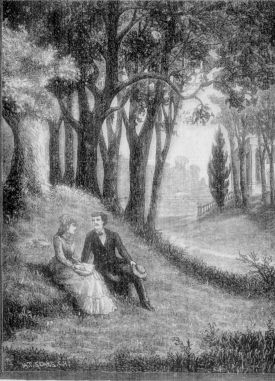
COURTSHIP.
"New hope may bloom, and days may come. Of milder, calmer beam, But there's nothing half so sweet in life, As love's young dream."
Here is a pyramid of elephants four elephants high! Here is the acrobat in the midst of the smoke and blaze of an Armstrong cannon, beginning some flight to a far-off trapeze, or swing, in the air! It is somewhat different inside.
THE CHARIOT OF TIGERS
is an enlarged rat trap with two sleepy, disgusted overgrown cats in it—cats which do not thrive well in this cold land, and which do not smell any too sweet and clean. The pyramid of fine-looking picture-elephants is an ugly live elephant or two standing on a beer-keg or two, which is a wonderful feat for elephants, of course, but not an entertaining one to human sight-seers; and as a final swindle, the cannon act is a man on a spring disguised as a wooden cannon, who is thus hoisted a few feet into the air, where he catches hold of his swinging bar and completes the usual act of an "aerial acrobat." "Fi on't!" as Hamlet says; "reform it altogether!"
DO NOT "BILL YOURSELF TOO STRONGLY"
before your divinity. She would love you if she thought you were just a common man, like George Washington or Abraham Lincoln; so, if you tell her you are poverty-stricken and prodigal, and it be true, then she will think that she had rather have a demi-god, poor as Job's turkey, than a common young man, like your brother or your friend, with all the gold of King Plutus! Bring to her an honest heart, and you will, indeed, bring treasures before her, and she would have no right to complain, even were she so inclined. Love does not seem to be a matter of volition—
OF "WANT TO, OR DON'T WANT TO."
"No man or woman," says Arthur Helps, "was ever cured of love by discovering the falseness of his or her lover. The living together for three long rainy days in the country, has done more to dispel love than all the perfidies in love that have ever been committed." Just think of that during all the time of your courtship. Dread the "living together," and when you come to stand the test, the test will not be too great for you. A young man, truly, doesn't need to be married, as a full-grown one does. But
IN ORDER TO REAP WE MUST SOW.
Our bachelor friend of forty wants to reap just as badly as you, but his fields will be waste while yours will be growing. When you get your life insured at twenty-one they charge you about ten times what the risk really is. Why? Because, although they have not the least idea that you are going to die now, they know the mortgage is on your life, and the dues, when you pass fifty, would, in justice, be higher than mortal man would pay. Therefore they even it up.
YOU LAY ASIDE A SURPLUS
for your old age, and, until lately, the courts held you could collect that surplus, if your contract were not completed to the end of your existence. Thus, in marrying, you are following the wise ordinance of God. You are choosing a blooming, healthy young woman while you are yourself fresh enough to attract her love and hold it. You are living as a married man while you might, probably, live with more strictly selfish personal comfort up to thirty-five as a single man; but you are,
AFTER THIRTY-FIVE,
immensely better off than the single man, and you will, besides, always be given a better place in society than he, because society likes to see every member in its ranks doing his duty like a man and helping to bear the burdens as well as reap the benefits which our system of living deals out to those who participate in it.
IF YOU HAVE THE CONSUMPTION
and the young lady also have that disease, consult the physicians of your families. A very learned man, in a series of papers in the Atlantic Monthly, some years ago, refused to forbid such marriages entirely. Put yourselves especially under the care of your doctors, and follow their advice implicitly. If the young lady, alone, is consumptive, extend your engagement and wait for events. If you yourself are thus tainted with disease, I have little hesitation in saying that it is not manly to get married until you are entirely out of the reach of pecuniary want without your labor, and even then there are other considerations of nearly equal importance which should lead you to frequent conferences with your family doctor.
YOU THUS SEE THAT "LIFE IS REAL,
and life is earnest." If you are healthy, thank God for it, and sing merrily while you build the nest which will hold the mate in warmth and comfort. After the harbor of refuge is built, the ship will find a pleasant and ever-welcome anchorage during the big storms outside.
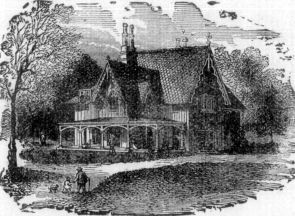
Take the daughter of a good mother.

The lamps shone o'er fair women and brave men; A thousand hearts beat happily; and when Music arose with its voluptuous swell, Soft eyes looked love to eyes which spake again, And all went merry as a marriage-bell.—Byron.
uotation of this verse is made, not because it celebrated a marriage—it, rather, commemorated the frightful carnage of Waterloo—- but because it very faithfully represents the fashionable beginning of wedded life, to which it alludes. There seems to be in woman an inherited, instinctive desire for this kind of thing at her marriage. It is cruel to deny her, therefore man usually goes through with it like a martyr. My prejudices are so heartily enlisted against "blow-outs" of this kind that I feel the compunctions of an honest judge at sitting in such a case. Nevertheless, I may relate some things I have seen, to show how badly a couple may start in life. Here is one instance: The dust has filled the air for six blocks around some stately church. The "hacks" and private barouches and coupes have been packed together so that any movement was entirely impossible; the bride has come like a queen of the orient; she has walked on flowers to the vestibule; there she has passed under an arch of tuberoses; half-way down the aisle a gate of jessamines and smilax has opened with a smothering sense of richness; at the altar she has actually knelt on a pillow of camellias (fifty cents apiece); and a fifty-dollar organist has put on his full instrument, as though he were proclaiming the glory of God most mighty, instead of the folly of man most miserable. Into the church have thronged the elect, proud and disdainful; on the outside has stared the vulgar multitude, too ignorant for anything but rapt wonderment. From the temple of high-priced worship the celebrants have passed, in a still more exclusive body, to a residence where a banquet has been prepared by a man who generally makes ice cream for a living, and where a dazzling display of wedding presents has been uncovered to the careless gaze. Then the train bears away the twain of one foolish flesh, and the farce is over.
OF COURSE IT WAS A FARCE.
The elect read the newspapers next morning with a smile. None but he of the vulgar multitude was hoodwinked. The man and the woman have spent all their money to purchase a "swell wedding." The presents were hired, so were most of the "hacks." The florist has got part of his money. The couple, six months afterward, are "beating" some poor landlady out of their board, and the man, in all likelihood, will never again be heard of. But the women have been intensely agitated by the event. They have never thought about the subsequent aspects of the case.
NO ONE OF THE SAME "SET"
would be willing to spare a single "hack" or one double camellia. Why did the young man and the young woman do it? They did it principally out of vanity, in imitation of some rich person who desired to distribute his money among hard-working folks and at the same time create a feeling of envy among his fellows and "please the women folk."
LET US HAVE THE MANHOOD AND THE WOMANHOOD,
if we have five hundred or a thousand dollars, to buy those necessaries of life which will enable us to live without debt after we are settled for life. We are sailing out of the harbor. Would it not be ridiculous for us to heave into the water our provisions, as a symbol of our delirious joy?—would not our ship be a ship of death when we reached the middle of the sea? There is just as much joy in a simple wedding which has properly shown our respect for the event as the third in importance of all which will punctuate our history. We have been born; we will die;
WE NOW MARRY.
"A man finds himself seven years older, the day after his marriage," says Lord Bacon. "Men should keep their eyes wide open before marriage, and half shut afterwards," says Madame Scuderie. "Marriage is a feast," says Colton, "where the grace is sometimes better than the dinner." "Mistress," cries Shakspeare, "know yourself; down on your knees, and thank heaven, fasting, for a good man's love. For I must tell you friendly in your ear,—sell when you can; you are not for all markets." "To love early and marry late," says Richter, "is to hear a lark singing at dawn, and at night to eat it roasted for supper." "Marriages are best of dissimilar material," says Theodore Parker.
"TO BE A MAN
in a true sense," says Michelet, "is, in the first place, and above all things, to have a wife." "It is in vain for a man to be born fortunate," says Dacier, "if he be unfortunate in his marriage." "When it shall please God to bring thee to man's estate," says Sir Philip Sidney, "use great providence and circumspection in choosing thy wife. For from thence will spring all thy future good or evil; and it is an action of life, like unto a stratagem of war; wherein a man can err but once!" "We are not very much to blame for our bad marriages," says Ralph Waldo Emerson;
"WE LIVE AMID HALLUCINATIONS,
and this especial trap is laid to trip up our feet with, and all are tripped up, first or last. But the mighty mother nature, who had been so sly with us, as if she felt she owed us some indemnity, insinuates into the Pandora box of marriage some deep and serious benefits and some great joys." "It is a mistake to consider marriage merely as a scheme of happiness," says Chapin; "it is also a bond of service. It is the most ancient form of that social ministration which God has ordained for human beings, and which is symbolized by all the relations of nature." "Marriage" says Selden, "is a desperate thing;
THE FROGS IN ÆSOP
were extremely wise; they had a great mind to some water, but they would not leap into the well, because they could not get out again." Why were they wise? They were not wise at all. I have seen frogs in wells who are more contented than they would be outside. "Men are April when they woo, December when they wed," says Shakspeare; but he also says that "maids are May when they are maids, but the sky changes when they are wives," so it is an even tilt between two forms of human nature. "If idleness be the root of all evil," says Vanbruch, "then matrimony is good for something, for it sets many a poor woman to work." "In the opinion of the world," says Madame Swetchine, "marriage ends all; as it does in a comedy;
THE TRUTH IS PRECISELY THE REVERSE.
It begins all. So they say of death, 'It is the end of all things.' Yes, just as much as marriage!" "Humble wedlock," says St. Augustine, "is far better than proud virginity." "Never marry but for love," says William Penn, in his will; "but see that thou lovest what is lovely!" "Strong are the instincts with which God has guarded the sacredness of marriage," says Maria McIntosh. We cannot bear this remark too constantly in mind. You would not dare shut off your supply of water, because you know you will need it. But you are sometimes tempted to shut off your supplies of love; and men do sometimes do it, and
AFTERWARD GO MAD
from clear soul-starvation. "Up to twenty-one I hold the father to have power over his children as to marriage," says Coleridge; "after that age he has authority and influence only. Show me one couple unhappy merely on account of their limited circumstances, and I will show you ten who are wretched from other causes." "He that takes a wife takes care," says Ben Franklin. "I chose my wife," says Goldsmith, "as she did her wedding gown, for qualities that would wear well." "Before marriage," says Addison,
"WE CANNOT BE TOO INQUISITIVE
and discerning in the faults of the person beloved, nor after it too dimsighted and superficial. Marriage enlarges the scene of our happiness and miseries.
A MARRIAGE OF LOVE
is pleasant; a marriage of interest easy; and a marriage where both meet, happy. A happy marriage has in it all the pleasures of friendship, all the enjoyments of sense and reason, and, indeed, all the sweets of life." "It is the policy of the Londoners," says Thomas Fuller, "when they send a ship into the Mediterranean Sea, to make every mariner therein a merchant, each seaman venturing somewhat of his own, which will make him more wary to avoid, and more valiant to undergo dangers. Thus married men, especially if having posterity, are
THE DEEPER SHARERS IN THAT NATION
wherein they live, which engageth their affections to the greater loyalty." "Matrimony hath something in it of nature, something of civility, something of divinity," says Bishop Hall. "Though matrimony may have some pains, celibacy has few pleasures," says old Dr. Johnson, a bachelor. Again says he: "Marriage is the best state for man in general; and every man is a worse man in proportion as he is unfit for the married state." "Marriage is an institution," says Sir Richard Steele "celebrated for a constant scene of as much delight as our being is capable of."
ONE THING KEEP IN MIND!
When the sages, the critics, and the people who love to say smart things, paint the infelicities of marriage, they as often paint simply the general troubles of life, which are common to all people. The bachelor is more apt to be kept awake by the crying child in the next chamber than is the father in the same room with the child. The young man quarrels with his landlady as often as the young husband quarrels with his wife. The young man notoriously finds his wants as lightly resting on the memories of those he hires to attend to them as does the husband of the most careless wife. He cannot escape the sickness of life with even the good fortune of a married man, according to the statistics of the Government. The married woman is also healthier than the maid. So, then, get the critics of the married state to specify its various unhappinesses; then subtract from that schedule all that come alike to the single state, and you will find that marriage, for its separate joys, has not a separate set of troubles in as great proportion. The very highest evidence of the usefulness and agreeableness of marriage is gathered from the well-known haste in which both men and women, when death takes away their companions, seek, in a second marriage, a renewal of those relations which, in their opinion, lend additional charm to the drama of life.

You are my true and wedded wife; As dear to me as are the ruddy drops That visit my sad heart.—Shakspeare.
She's adorned Amply that in her husband's eye looks lovely— The truest mirror that an honest wife Can see her beauty in.—John Tobin.
f all the actions of a man's life, his marriage does least concern other people," says Selden, "yet, of all actions of our life, it is most meddled with by other people." In fact, if people would take home their attention thus so liberally bestowed abroad, it would enable them to make matches of their own far better than those which now burden the records of the churches and the courts. If a young man and a young woman can be left alone three or four years, to wear into the new relations they have assumed, there is little chance of their being unhappily married. An instinct of the strongest character brought them together, and is likely to hold them by its own force. Man is a creature of habit. Strip him of his home after he has been for four years habituated to it, and he will be unhappy, no matter how unpeaceful that home may have been. Therefore, if possible, have your wife and yourself in a house by yourselves for the first four years of your married life. As a general thing this is possible, and I think a firm will, in most cases, greatly aids the possibility of such a course. One thing, at least, is clear,
NO HUSBAND IS DOING RIGHT
to admit to his home as a sharer of its comforts any other man. It is a common sentiment among any two homeless young men that the first one who marries shall take the other to live with him. Nothing is more absurd or out of place. I do not think there could be so dangerous a foe to the peace of the wife, in case the young man do not think his friend has married wisely,—and he must think so, or he would himself have married her if he could have done so. His criticisms will estrange the husband's heart and cool his love. On the other hand, if he has admired the lady, then the situation is all the more atrocious.
THOSE HORRIBLE EVENTS IN LIFE,
where a man's home is transformed suddenly into what has been bitterly but justly termed a "hell on earth," are more than half the time traceable to the carelessness of the husband in not throwing around his wife those barriers which shall ever keep her from temptation. The wife of pure instincts will generally object to the admission of another man to her home as a member of it. How often her womanly and honorable objection is overruled by the husband as the mark of an inhospitable nature. Live alone. Let no one see your meannesses, for the third party will remember and recite those meannesses where you would either never have seen them, or have forgotten them altogether.
BE KIND TO YOUR WIFE.
If you find this difficult, begin by making up your mind that, during the next week, you will not, under any circumstances whatever, speak a cross word to her. Carry out this resolution as well as you can. Then the next week takes off the strain. The natural tendency of cross words to misery will so startle you that you will soon try it for another week. You will do better on the second trial. This is important for your own peace of mind, for, in scolding and fretting, the average woman, if you get her started, can easily hold her own. This woman is bound to you by stronger ties than you suppose.
GO OFF TWO HUNDRED MILES AND SEE!
She is also bound to you by very strong bonds in the law, as you would find out if you deserted her. She is also entitled to a very high place in your goings and comings, as society teaches you. When the President is inaugurated, there is a front seat close by for his wife. The Chief Justice administers the oath, and there is another front seat for his wife, also. So you need not be afraid of doing her too much honor. Speak to her respectfully. Perhaps there is a youngster watching you—you have no idea how closely. This youngster will try on his hand governing his mother, if he sees any opportunity whatsoever. Just look to it that he does not see such an opening! Your wife as you will know, has cares of a multifarious kind. Her hours of labor greatly exceed yours, though she cannot concentrate her mind on one thing as you can. She is fitted, by long years of inherited housewifery, to do this and then that with untiring devotion to the interests of her household. You cannot, as a general thing, lighten those legitimate cares save by your smiles. But you are a selfish man if you increase them by requiring any great amount of extra personal attention. You will find it her nature to minister to you in many ways. Let her alone in it. Accept all gratefully, and do something in return
BY WAY OF FORMAL RECEIPT.
You will grow happier day by day, and your wife will be the happiest woman in the neighborhood. She will be proud of you because you have had the brains to be happy and sensible. We hear a good deal of railing against the general wisdom of getting married. There seems to be a sort of popular contagion lately, making it fashionable to fling jeers and jibes at the cares and sorrows of marriage. We find young men writing to the newspapers that it costs them six dollars to board singly, and that the same "style" of living and enjoyment could not be purchased at
A "BOARDING-HOUSE OF ONE'S OWN"
for less than twenty-two. And again the same sort of writer will assert that he can quit one "boarding-house" when he pleases, whereas he must eat the cold roast beef and cranberry sauce of the other until he crosses the creek called Styx. Let me call this young man Mr. Bachelor, and reply to him in about his own style:
A FEW THOUGHTS IN GENERAL:
1. A man named Payne wrote a seemingly-ordinary song entitled "Home, Sweet Home." This piece, on account of certain sentiments conveyed, at once received the seal of nearly universal approbation. It is safe to say Mr. Bachelor and the class in which he may be placed were not among those who accorded extraordinary attention to the little song. He is and they are, therefore, at once separated from the vast mass of the people. Evidently the sentiments of the song were based on experiences largely known to the general gender and unknown to Mr. Bachelor.
2. The man Daniel McFarland was so worthless that his wife refused to live with him, and, sadly enough, fell in love with still another man. The worthless husband, discovering that Richardson was coming into property which had not always been his own, resorted to an ambuscade, and killed Richardson. To the dullest comprehension this act revealed a deep jealousy. Jealousy is founded on a solid fear of losing something. In this unhappy family, where the man believed he had nothing to care for, he suddenly awoke to find he had thrown away a pearl richer than all his tribe.
3. It seems to me as natural for a man to establish a home, with a wife, as to grow a beard on his face.
SOME CONSIDERATIONS IN PARTICULAR.
1. At twenty-seven years of age a man whom I know met the finest young woman he had ever seen. He wanted her and he got her. Five years have passed.
2. At marriage the man found himself endowed with a godlike selfishness. This he probably owed to the past struggle for existence. With this not very estimable faculty he carried to his home a young woman endowed with nearly the opposite faculties. She only acquired selfishness through association with her companion. At the start, then, they were both willin' oxen—one ox was willing to do all the pulling, and the other ox was willing he should.
3. Now the man had also a high faculty called judgment. He continually wondered why the woman did not despise him on account of his selfishness. He soon discovered that it was because the woman lacked sadly in judgment. The baby would lift up its voice in the night. That baby must be attended to. The weather might be very cold. The man despised that fact, but the woman, because it made her teeth ache and her body cake and cramp, feared the cold. But the man also despised the baby and all its appertainings—particularly the appertainings. Therefore, the man debated within himself that he was very selfish, or he would get up. Perhaps, being a "just" man, the way men go, he really got up about once in a dozen times, but, candidly, he would probably have seen that baby suffer ere he would have attended its wants any oftener. The woman took it for granted that the man would not get up, and yet she did not despise him. She did not have judgment enough to do it.
VANITY AND SELFISHNESS.
4. A man's vanity and selfishness are present (to a woman's perception) in every movement. She likes them. They are the characteristics of masculinity.
5. The man entered matrimony with all the trepidation born out of thinking too much about it. It seemed to him like buying a fifteen-thousand-dollar horse on instalments. This is just as it seems to Mr. Bachelor, too. It was a pretty good price, but it was a high-stepper, a flyer, a beauty. It would take him all his life to pay for it, and it might founder the first year. But he had never in his life wanted anything the way he wanted that woman. Mr. Bachelor has not yet got to that stage.
RETURNING GOOD FOR EVIL.
6. There is little doubt that, speaking of man as an animal, unchastened by the benign influence of religion, "the male hates the sick female." The female knows that. Yet in return she exhibits toward the sick male a tenderness that makes his hair stand on end when he thinks of his own short-comings.
7. The man's astonishment at reaching thirty was tremendous. He found he was changing, and that marriage was evidently
THE EXPRESS PREPARATION FOR THIS CONTINGENCY.
He used to go to the theatre a great deal. He did not then notice that the air in the auditorium was more rotten than the midnight winds that blow over Chicago from the industrious rendering-houses on her outskirts. It is now a real hardship to go to an ordinary dramatic performance, and he thinks theatre-goers are as a class the most discontented people there are in society. He used to spend his earnings in various other places which now weary him beyond measure, and are equally wearisome to those bachelor friends of his who used to keep him company, and are forced by single life, to still frequent such resorts.
THIS HE FINDS OUT
when his wife goes into the country for a week or two. Those two weeks are never halcyon days with him. There is a smell about a restaurant that eloquently pleads the sweetness of home, and there is a lack of confidence expressed in a pewter spoon and a general disinclination to believe that anyone is careful molded in with the thickness of the teacup, which startle him at once into a better conception of his wife's confidence in him.
8. My friend comes home and finds his dressing-gown and slippers in front of the fire. He is tired and cross, and doesn't want to sling ashes nor bang a coal-hod. But the sight of the fire makes him feel better at once, and if there be no fire, there are no ashes. He sits in front of a coke fire in a grate. His little girl brings his slippers and carries off his shoes—or carries off one shoe and one slipper. Then he falls to thinking that girls are poor property as compared with boys, but that any kind of children are a pretty good investment against one's old age. His increasing wonder is that the whole state of things is so natural. His wife takes comfort in having him in the same room with her. When he is reading and she is darning socks, she is the very embodiment of the fine French expression "I am content." She is not as beautiful as she once was. But
ALL THE ELEMENTS OF HER BEAUTY
are still present, and with a return of the flesh she has lost in hard work she will have all her looks. A handsome woman is just as handsome to a man as a handsome girl is to a green young man like Mr. Bachelor. My friend is hugging the shores of personal expense very closely for the purpose of having two weeks in the country with his wife during the heat of July. This woman's face does not intoxicate him as it once unquestionably did. Neither does the "Trovatore miserere," nor the "William Tell" or "Poet and Peasant" overtures so delight him as once upon a time. Nevertheless there is in him a secret joy of possession, calm and pleasant, in contemplating the wife, and a quiet satisfaction, in hearing the music, that the taste of his youth was so thoroughly good.
A WIFE'S PRAYER.
9. When his wife goes to bed she loves to put her head on her husband's knees to say her prayers, and he loves to have her. He has great confidence in a woman's prayers, and he is disposed, selfishly but correctly, to believe the supplication is nearly dual in its character. In his speech he treats his wife as though she were the wife of an honored friend. If he talked either loosely or coarsely to his wife he might fall in love with any woman to whom he showed greater respect. He would, beside, proclaim his folly, for woman has small sense of humor.
DEATH OR WORSE.
10. If my friend were suddenly to lose this home by the death of the wife, he would receive an unmeasured sympathy from all thoughtful men not included in the small class who never understood what there was in "Home, Sweet Home," to set people to humming it. If he were to have this wrenched from him by a sudden awakening of his wife to all his faults, and as blind an infatuation with the faults of another man as was once extended to his own, he would know just how Daniel McFarland felt. My friend is induced to believe, however, that his wife will be strongly under his influence so long as he does not inspire her with fear. He will not pound her unless he falls to whisky-guzzling, which, considering that he does not yet use tobacco, is impossible.
SO MUCH OF A PARTICULAR HOME.
By the study of other women than his own wife (which is a very unjust mode of study) man learns to hate women in general. By observing his wife, however, he is inclined to love all her sex. Again, by contemplating himself he falls into detestation of all humankind. Such "men" as young Mr. Bachelor have spent their time in exhaustive subjective researches. They know themselves too well. They should, in reforming, take an easy step upward, and, by contemplating the good points of Swift's Yahoos, somewhat elevate their opinion of the species which they so graciously ornament! A green old age is universally admired. The color of greenness at thirty, however, is not fashionable. If I have lacked in charity in defending the wisdom of married life, it is because I have seen too much grass thrown at bad boys. When you hear a fool prating of the misery of married men as compared with single men, answer him according to his folly, or, perhaps better, answer him not at all.

I would not my unhoused free condition Put into circumspection and confine, For the sea's worth.—Shakspeare.
When I said I would die a bachelor, I did not think I should live till I were married.—Shakspeare.
othing is further from the single man's thoughts than that he will continue in the single state all his life. He expects, when the young woman meets his gaze who satisfies either his esthetic or pecuniary ideas, generally the latter, or both, to take that young woman to his bosom and begin married life. This is a natural state of mind, and there is no harm in indulging it. It shall be the object of a few of these pages to present such aspects of the unmarried state of man as have principally commended themselves to general attention. The bachelor has plenty of arguments to keep him single while he is not in love. He thinks the arguments keep him single, good fellow. He says, as I heard one of them say: "I would ask the unbiased observer what there is in the world, after all, to induce a man to commit matrimony. Some one will say: 'To have some one to care for him when sick.' This is complimentary to woman—indicating that she marries to become a nurser of the sick and old. And must a man endure all the pains and throes of years of matrimonial cyclones that he may have some one to stew his gruel during the brief space of his last illness? If a bachelor have money, he will have friends to care for him, no fear, and if he be poor, a wife is the last thing in the world he needs. She divides his pleasures and doubles his sorrows.
HE MUST DANCE TO FASHION'S TUNE—
a palatial residence, a corps of servants, a livery, and dresses from Paris—for the sake of having some one to receive and entertain his friends' wives. He must support his wife's relations, and endure no end of feminine abuse, which is not always so feminine. The world is divided into two classes: Those who are unmarried, but wish they were, and those who are married, but wish they were not."
THIS IS A FAIR SPECIMEN
of the argument by which the bachelor convinces himself that he is happy. If it does contribute to his peace of mind, why should the world care? And the world really does not care. When he comes to have his gruel stewed for him in a hospital, or, worse yet, a boarding-house, he finds out, all of a sudden, that he is really in the way, and that, in his life of perfect selfishness, he has never secured that thing which cannot be bought, yet which he so yearns for now in the hour of his feebleness, a woman's love. A good long sickness has greatly enlarged many a man's philosophy!
Still, it is not in the destiny of every man to have a wife, or to keep her if he get one. It is not unwise, therefore to consider that state as one of the phases of life, and to contemplate its various aspects, good and bad, as we have the other conditions of existence. "A man unattached and without wife," says Bruyere, "if he have any genius at all, may raise himself above his original position, may mingle with the world of fashion, and hold himself on a level with the highest; this is less easy for him who is engaged; it seems as if marriage put the whole world in their proper rank." "I have" says Burton, the melancholy, "no wife or children, good or bad, to provide for, and am a mere spectator of other men's fortunes and adventures."
THE ONE GRAND RESULT OF SINGLE LIFE,
so far as is generally noticeable, is selfishness. The chief lesson of marriage is self-denial. Which is the more pleasing of the two traits? When the bachelor views life, he sees nothing good in it, for it all looks selfish. Being so deeply jaundiced, the eye tints everything with yellow. At forty he is heartily sick of it all. Why? Because he has learned that he has squeezed the orange dry. The faculties which God gave him to be pleased with when a recipient have been worked to death.
HE HAS BEEN A RECIPIENT WITHOUT CEASE.
He has chewed on one side of his mouth all his life. The teeth on the other side have loosened and are ready to fall out, while the overworked molars on the other are about to run into decay. The faculties whereby he was expected to please other people have become rudimentary, and he can now no more fascinate other people than he can sing soprano. He makes an effort to engage the interest of a young lady. The hollowness of his attack at once arrests her attention. The ease with which he speaks long sentences of admiration proclaims his long practice in the art, and the utter lack of real meaning in them. He knows that the girl will
LAUGH BEHIND HIS BACK,
and it irritates him, and disposes him to attribute her act to "the falseness of her sex," when it is merely her keen intelligence in such matters. The fact of the matter is, that though an old bachelor is seemingly greatly smitten with nearly every young girl he sees, he does not succeed in marrying because he is a hard man to catch. The young woman takes his measurement. His devotion is overpowering, but she easily sees that it is a sham. The bachelor looks at her glove, and, instead of admiring the hand, as the "marrying young man" does, he says "Dollar and a half!"
HE LOOKS INTO HER EYES AND FIGURES
on the probable cost of board for two. The time of mating is past with him, and that young woman can see it "as quick as a flash of lightning." He may be the man she could love if she "let go of herself," but his slippery words do not mean "marry," and she "passes him around." He loves to go to picnics and church sociables, for he must be amused, and he hopes to find that pleasure in next Tuesday's donation party which he did not get at last Friday's rehearsal.
THE TROUBLE ALL LIES
in his intense love of self. Society in general regards him as useful, and pities him. The older women generally suppose he would marry the first girl who would have him, and he himself hopes to sooner or later to come across a lady who is superior to all others, and who has money enough to pay her share of the expense of living. I wish him success, for
HE IS GENERALLY A GOOD FELLOW,
and strictly a creature of circumstances. If we catch the small-pox nothing is surer than that we will have it in spite of our pride. If a man is cast into a mold of events where he is bound to be taught nothing but selfishness, and to see nothing but the selfishness of others, the wonder is that he will assume, in the matter of self-denial, those relations, even for a day, which he so assiduously avoids for life.
SCHOLASTIC OPPORTUNITIES.
The single man has a fine chance to be "a scholar and a ripe good one." Having been denied the joys of a household all dependent on him, he may surround himself with books, he may pursue investigations, he may gather the ideas of the wits and the thinkers, and he may thus broaden his brains until he is the honored associate of the best minds in his region. This form of happiness is, to those who are within reach of it, one of the most satisfying within the gift of God. There is no reaction, there is no sorrow.
MAN LIVES TO LEARN,
after all. If the mind goes on in the culture of those high qualities which have been inwoven with his weak frame, it seems to me his selfishness has been well disposed of. The dollar which, in the cautious mind, was begrudged to a wee toddler who never lived, for a pair of shoes, has been placed where it has brought new knowledge of the power and wisdom of God, the Creator and Conservator of the Universe. The wisdom thus born out of selfishness will inculcate in those to follow him the folly of selfishness, and the tastelessness of its brightest apples of gold.
BE KIND TO THE OLD BACHELOR.
When he tries to be friendly, give him a lift. His mode of life has left him with many advantages for usefulness which married people have not got. On committees and in preliminary work he is often the best man in the neighborhood. At funerals, in sickness, he has been known to be almost the very instrument of the merciful Father. Teach the young ladies that he is harder to "catch" than they suppose, and perhaps they will turn toward him a portion of their character which will please him better with womankind.
TO HEAR SOME MEN TALK,
and from experience, too, you would think that a breed of creatures born from such women as are now living would be a herd of monsters, incapable of civilization and refinement. And yet the world will go on, and we know, almost, that our posterity will bring about wonders in the arts and sciences, and perhaps even in society itself,—wonders which will even surpass the triumph of our own generation. We are on the eve of both traveling and talking through the bare air. We are in a way to avoid the worst of our wars. It cannot be that the women who will bear the men who will do all these things are to be
JUDGED AS THE BACHELORS VIEW THEM.
The bachelor sees as through a glass, darkly. Being, for the time, incapable of the passion of love, having failed to exercise it when it came upon him, he thus rails at woman. If you are young enough, watch the events of the next thirty years, and see how they will give the lie to such a tirade as this, from
THE SAME BACHELOR
I quoted at the start: "Not one-half of our marriages have unbiased love as a foundation on both sides. (The love is usually on the man's side.) A woman marries for money, position, spite, pride, contrariness, fear of being an old maid, or for a home which she thinks will afford her more pleasure than the one she leaves. Love is the last thing to enter her head, and never her heart. Men of real sound judgment in business throw this judgment entirely aside when they come to select a wife. A man might better remain single than marry with the chances nine out of ten in favor of his making a mistake for life."
SEE HOW LITTLE KNOWLEDGE
of anybody's good points this gentleman displays. The young woman who has worked at ironing in the forenoon until her feet were swollen and her head has got dizzy, comes into the parlor in the evening, all frills and tucks, all "highty-tighty," all full of fun and God's good humor, and impresses my friend with the belief that she has never done an honest hour's labor in her life! Pshaw! she has got more pluck, and nerve, and "sand," than half a dozen men, when it comes to where the need is! She is going to be
THE MOTHER OF AN AMERICAN,
and Americans are not noted for their servility, their laziness, their mediocrity, or their lack of brains! For shame, then to judge a young woman as she appears to you when she is anxious to get rid of you! How would you like to be judged solely at those times when you were "carrying on," and "didn't care whether school kept or not"? That is precisely the way this gentleman has spoken of young women a page back. He thinks they love no one because they have never loved him! He never loved them, and how could he expect them to be swindled? Read his remarks over again, and see how events themselves deny his correctness.
HOW MANY HUSBANDS HAS HE SEEN
follow a drunken wife into a gutter? And, on the contrary, has he not seen the reverse of this sad picture many a time? I heard a Judge say to a poor woman once,—she was all scars: "I would send this woman-beater to the work-house for two hundred days if I did not know you would starve yourself to pay his way out." And then the poor, foolish, faithful heart appealed to his Honor to "spare the man, just once more;" she was sure he was a little the worse for drink when he misused her. What does our friend call this thing in woman, if it be not love? The being capable of a wife's love, and a mother's love, and a sister's love, is not much in danger of the criticisms of a man who has only a front-porch knowledge of all her sex!

ven with the best of our philosophy we who are well are unable to command at will the feelings of those who are ill. We lie on a bed, racked with the pains of some passing affliction, and the chasm which separates us from the hale and hearty seems prodigious. We are led down the stairs, out into the sunlight. The very rays themselves sit heavily upon our shoulders, and nearly crush us to the earth. With those vivid impressions of the terrors of illness, we feel that our brains will remain steeped in memories such as will enable us to appreciate our health if we ever get it again, yea, though we have hardly a crust of bread to spare. But lo! behold us once well again, and we have forgotten our good fortune; at the slightest turn in our personal affairs we bemoan our fate as sharply as though the whole night had been rolling in upon us through some fever, or all the blasts of the arctic world had crept through our bones in some frigid chill. There is no boon so great as health. Of course everybody admits that. But why can we not attach meaning to it? If a man rise in a public gathering and say "I will give a hundred dollars!" he knows exactly what he is saying, and so do his hearers know. But if he rise behind a pulpit or on a rostrum and say