The Future Life. (continued 4)
Reading edition
"PRESERVE YOUR HEALTH
at all hazards!" no significance so deep attaches, though the one statement is a thousand times as important as the other. I cannot understand why we are so oblivious to the sufferings of illness while we are well unless it be a provision of nature to keep us from that suffering through sympathy which we would surely undergo if we really had any vivid feeling for the sick. On this earth each one has to do his own suffering—the King in the palace of the royal family and the baby in the hut of the miner. All who are well go their way rejoicing, even having no momentary realization of the state of mind of the disabled associate. It may be that this has not always been so, for we inherit a salutation among our other traits which implies a desire to be informed as to the physical condition of the body of the person addressed. Two men of affairs meet. One says:
"HOW ARE YE?"
The other responds: "How are ye? Are you going to be at the meeting to-night?" etc., the conversation being now under full headway. The words indicate that, at one time, they carried a meaning which they have lost. Yet we are not worse than our fathers before us, and are not exceeded in the milk of human kindness. It may be that the old form was such a cumbrous piece of hypocrisy that latter-day people have thrown it off in disgust. Anyway, there is nothing more certain nor more astonishing than that a well man cannot conceive the feelings of a sick man, even though he try, and that those who are sick have to grin and bear it all without any very great affliction falling to the lot of those who stand at the bedside.
BEHOLD THE STRONG MAN IN THE FEVERISH AIR
of the sick-chamber. Last week all his clock-wheels worked with ease, and merrily struck the hours of feast and sleep. Afterward the wheels dragged a little and annoyed him some. Suddenly a whole handful of sand was thrown into the cogs, and the cogs have been grinding it and the hammer striking continuously ever since. His brain is distracted, his soul is sorely perplexed, and his mind is like an infant in house-cleaning time, strangely in the way and infinitely aware of it. Here lies proud-riding vanity, thrown from his high saddle. Kindnesses are showered on him of which he feels that he deserves few, and yet wants more.
SYMPATHY IS EXPRESSED
for him which greatly moves him, for he is accompanying the words he hears with the ills he feels, while the speaker is speaking a conventionality which he would feel had he the ability. The sick man mentally resolves that all the mistakes of his life shall be corrected if he shall survive, and yet there are few who are able to fulfill the programmes thus formulated—frequently the thriftless man is more prodigal after an illness which has stabbed his pride with an advertisement of his indigence than he was before his great vow of future economy was recorded up on the ceiling, where,
IN THE RIFTS OF THE PLASTER,
the Missouri River flows into the Mississippi! Perhaps if the would-be reformer would take a look frequently at those objects in his whilom sick-room which so riveted his fevered attention, some of their old association would return upon him, and do him good. The ancients practiced the memory in this way. After a course of meanderings through a garden, each object represented and recalled some piece of knowledge which it was important the pupil should retain in his mind. "Few persons," says Thomas a Kempis "are made better by the pain and languor of sickness; as few great pilgrims become eminent saints." Here lies your bachelor now. He has always felt that when he got sick he could get his gruel stewed as well by the hired girl of his landlady, as the French say, as by a wife. He lies up there, O, so in need of care and kindness!
HIS BRAGS WERE MADE IN TIME OF STRENGTH,
and he expected to have strength to keep himself stoical. But now he is weak,—weak and truly miserable. He hears the people come in to their supper, go to their rooms, wash, run gayly down-stairs, chat, go down another pair of stairs,—and then come the jarring sounds of plates and knives and spoons, and, worse, the sickening smell of victuals. How can they laugh and joke when he, a man and a brother, lies sick of a fever? Ah! my friend, it would not be so were you the head of the house. All would be changed. The supper-hour would come with a hush instead of a clatter. The light stol'n forth o' the building would leave the whole house in gloom. And in your selfish soul you would be glad, for God so made all of us! Now you turn yourself to the wall, and marvel at the lightness of human words and
THE GREEDINESS OF HUMAN WANTS.
You are little to be pitied in justice—greatly, in mercy! Lie there and pity humanity, for they would be all like you, did not they follow in nature's paths, where the roses of the wayside hide more of their ugliness. All I would impose is that you walk where you will look least hideous, even in your own eyes.
As, in Paradise, when Milton was all ablaze with poetic glory, he waved his more than kingly sceptre and thus ushered in the night—
Now came still evening on— Now glowed the firmament With living sapphires: Hesperus that led The starry host rode brightest—
—So does woman, soft as still Evening, shining as all the starry hosts with goodness and with mercy, come into the night of disease, and soften its harsh desert with the dews of her kindness. Sickness teaches us how good and true is woman, how useful in the world, how necessary to our welfare and proper destiny. If any man have learned this on a sick bed
HE HAS NOT BEEN SICK FOR NAUGHT.
He is a man of progressive ideas and unfolding nature. Sir Walter Scott has put into words a thought that has ever had man's approbation:
O woman! in our hours of ease, Uncertain, coy, and hard to please, And variable as the shade By the light, quivering aspen made; When pain and anguish wring the brow, A ministering angel thou!
"It is in sickness," says Hosea Ballou, "that we most feel the need of that sympathy which shows how much we are dependent one upon another for our comfort and even necessities. This desire, opening our eyes to the realities of life, is an indirect blessing." "Sickness," says Burton, "puts us in mind of our mortality, and while we drive on heedlessly in the full career of worldly pomp and jollity, kindly pulls us by the ear, and brings us to a sense of our duty." "It is then," says Pliny, "that man recollects there is a God, and that he himself is but a man. No mortal is then the object of his envy, his admiration, or his contempt." "In sickness," says Shakspeare, playing with his prepositions, "let me not so much say, 'Am I getting better of my pain?' as 'Am I getting better for it?'"
LET US THEREFORE GIVE UP THE IDEA
of those great reformations which we formulate upon our mattresses of misery, and rather confine ourselves to a few betterments of our lives which are possible. If we are spendthrifts, we should vow to spend our money for goods of more solid worth than a taste of this thing, a whiff of that, or a sight of the other. If we are proud, let us resolve to speak kindly at least to those who have been lately ill. If we are stingy, let us make ready to give, notwithstanding, to those who need as badly as we have needed. If we are doubtful of the goodness of the gentle sex, let us at any rate thereafter except forever their qualities as a faithful succor of
THE MOST MISERABLE OF CREATURES,
a sick man who cannot move from his bed of pain and discontent. If we are impenitent, let us arise out of our wearying couch respectful to those who worship God, and reverent also before God in the presence of other worshipers. Perhaps if we aim our sudden goodness at a lower mark, we may make a record that will not entirely proclaim (as the quick eye of Pope has cynically perceived) our unpromising folly, and our unteachable ignorance of human nature.

When sorrows come, they come not single spies, But in battalions.—Shakspeare. But sorrow returned with the dawning of morn, And the voice in my dreaming ear melted away.—Campbell.
athering clouds crowd thickest round the tallest mountain, yet do their summits, far up above, forever gaze out upon the undimmed sun. So is it with the great heart smitten with deep sorrow. There is no soul upon whom the glory of God's love falls more serenely and uninterruptedly. There is no better friend, no lovelier associate. "Blessed are they that mourn, for they shall be comforted." And comfort does come, in the broad and kindly love and mercy toward humanity which those who have known suffering so frequently evince, "Out of suffering have emerged the strongest souls;" says Chapin, "the most massive characters are seamed with scars; martyrs have put on their coronation robes glittering with fire, and through their tears have the sorrowful first seen the gates of heaven." "The echo of the nest-life, the voice of our modest, fairer, holier soul" says Richter, "is audible only in a sorrow-darkened bosom, as the nightingales warble when one veils their eye." "Every noble crown is, and on earth will ever be, a crown of thorns," says Carlyle "Sorrow", says Haunay, with rare knowledge, "turns all the stars into mourners, and every wind of heaven into a dirge." Sometimes all nature seems to condole with animate woes:
One weeping heart may tone a rural scene To sadness. Reverently the trees will bend; The little stream will sigh, with heaving pulse, And swans, in soft and solemn silence float— Grief's snowy celebrants.
It is a manifest peculiarity of the human mind to believe that its sorrows should be more enduring than they really are. We have in this phenomenon some of the clearest views of our weakness and inconsistency, for though we deplore the destiny which deals out so much misery to us, yet we despise ourselves, and are also thought somewhat less of by our associates, if we do not embalm our griefs and remain a sort of mummy-house above ground until the memory of our friends has grown faulty and unreliable when applied to our affairs. Thus,
A WIFE LOSES HER HUSBAND.
The grief which she feels nearly crushes her spirit and evokes the sympathies of her neighbors, as well it may. She finds a bitterness within her heart which it is difficult to sweeten into resignation. Why should the blow have singled her as its object? Then, with the lapse of the days, comes a change of the season, and the wonderful climatic effects on both mind and body accompanying them. She wanders into the woods, and the rustling of the leaves beneath her feet betrays her from her dead husband for the first time, and her
CONSCIENCE, THE SOLEMN OFFICER
of her moral nature, suddenly arrests a little girl wandering in the woods in search of a butternut tree which lives like a hermit in the deep of the forest. It is a stray memory of herself in the long ago! It has wandered into her house of grief, and when it falls under the hand of the law she feels great guilt for having harbored it. "O, my poor, dear husband, have I so forgotten you?" she cries in mental sackcloth and ashes. And then the frailty of human reason and action appear before her and appall her. The time flies by. Soon still another season is here, with
A TROOP OF LITTLE TRAITORS, HAPPY MEMORIES,
carrying her "over the hills and far away" into that dim past whence she emerged, all happiness and health. The conscience now has loosened its harsh rule. The memories play in her brain like children on a lawn, and their merry music often drowns the dirges still sadly chanted in her deeper soul. And thus the winter passes—not in a whirlwind of grief as did the summer, whose days she never saw, or will not know she saw, until they come again hot and heavy with the association of her bitterness. But it is safe to say her dread of those days will exceed the actual grief they cause her, and she can soon look back upon her sorrow, and say that she has mourned
RATHER NOT ENOUGH THAN TOO MUCH.
If there be joined to this a new association, one that nature and God have both approved, then there is lifted up the sneer of the world, and again the weakness of woman, the frivolity of humanity, is deplored by those who demand that grief shall co-survive with remembrance. We do not suffer so much as we think we ought to, and yet, foolish and illogical, we call upon our fate in a grand monotony of complaint at the heaviness of our ills. The young man falls in love. His love is not returned. He has believed himself capable of undying and unalterable affection for a maiden. Unselfish, therefore, it must endure, whether she love him or not, for
HAS HE NOT PROCLAIMED IT TO HIS OWN SOUL?
She loves him not! The test is come. He must despise himself as a shallow-hearted hind, or dwell in extacies of adoration over one who will resign herself into the keeping of another, a thing most detestable to this young man. Either horn of the dilemma shows him life, true life. Not a poem or a dream, but as a range of mountains would form if they were piled down from some other world; first a row of little peaks, then monster heights arising where valleys hid, and valleys forming on the points of peaks.
THIS YOUTHFUL PEAK OF GRIEF,
the young man finds in after years, is but the more substantial bottom of two slopes which rise sublimely toward the zenith of his life. He banishes his false conceptions of the grandeur of the human mind. He banishes an attachment which had not a substantial girder under it, and within a few years his heart is all the broader, gentler and more charitable for his young sorrow. Do not think me underrating the poignancy of ill-requited love. It is no mean sorrow. But no great mind ever was crushed under it. No great mind ever was crushed under any sorrow dealt out to humanity.
TRUE GREATNESS,
after all, lies in true humanity, true understanding of the feebleness of our nature and our capacities. We do not overload an animal, merely because it evinces a willingness to make an effort. We therefore must not overweight our soul with sorrow. We must not nurse our woe. We must not have that grand, conceited idea of our nobility which demands of us a great long future of melancholy; but rather must we nurse our bodies, suspecting our liver if our soul be heavy, and blaming our chamber if our brow be clouded. Then, if a high intelligence wait at the couch of our sick soul, as does faithful woman by an invalid, soon will vanish all the clouds, soon will come a brighter vista in the journey of our lives. We are as God has made us, weak, miserable and sinful. Let us expect from ourselves conduct becoming a being weak, sinful and miserable. It would seem that this is the secret of those great lives who profit by adversity. They have charity, for they have erred. They have hope, for it has been their true anchor, never failing. They have withal more consistency than have we, though they have
NEVER MADE SUCH HIGH-SOUNDING REQUISITIONS
on their untried natures. Where they have stepped into the stream of their existence in some new fording-place, they have gone with great caution, not with an immature confidence born of naught save foolish audacity. Their river of life is an open water before their pleasant eyes; they prepare not for a flood in the fall, neither do they make ready to pass over dry-shod when the waters come down in the spring. Though they have the more mercy, they make the lesser appeals for mercy; though they have the more strength, they pray the oftener for aid. Sorrow has brought it about. Affliction has stretched their heart-chords
INTO TRUE HARMONY.
"The safe and general antidote against sorrow," says Dr. Johnson, "is employment. It is commonly observed that among soldiers and seamen, though there is much kindness, there is little grief; they see their friend fall without any of that lamentation which is indulged in security and idleness, because they have no leisure to spare from the care of themselves; and whoever shall keep himself equally busy will find himself equally unaffected with irretrievable losses. Time is observed to wear out sorrow, and its effects might doubtless be accelerated by quickening the succession and enlarging the variety of objects."
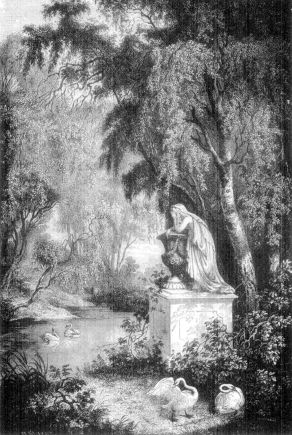
SORROW.
THERE IS ANOTHER AND AN UNHAPPY PHASE
of sorrow. "When it is real," says Madame Swetchine, "it is almost as difficult to discover as real poverty. An instinctive delicacy hides the rags of the one and the wounds of the other." "The deeper the sorrow, the less tongue hath it," says the Talmud. "Light griefs do speak," says Seneca, "while sorrow's tongue is bound." "The wringing of the hands and knocking of the breast," says Dr. South, "or the wishing of one's self unborn: all are but the ceremonies of sorrow, the pomp and ostentation of an effeminate grief, which speak not so much the greatness of the misery as the smallness of the mind."
NOW COMES RELIGION,
shining down into this Alpine valley of grief, not as the sun of the Alps, but as a continual orb of light; not between a few short hours in a "long, long weary day," but as a constant illumination of the soul, irradiating its beams out upon the countenances of God's afflicted, and setting them before mankind as a beacon for groping humanity. I know of no more perfect expression of the power of sorrow to chasten the soul and draw it nearer the Maker than is contained in
MARIA LOWELL'S "LAMB IN THE SHEPHERD'S ARMS."
I quote it as giving that lesson which my humble prose would never teach:
1. After our child's untroubled breath Up to the Father took its way, And on our home the shade of death, Like a long twilight, haunting lay,
And friends came round with us to weep Her little spirit's swift remove, This story of the Alpine sheep Was told to us by one we love: 2. They, in the valley's sheltering care, Soon crop the meadow's tender prime, And, when the sod grows brown and bare, The shepherd strives to make them climb To airy shelves of pastures green That hang along the mountain-side, Where grass and flowers together lean, And down through mist the sunbeams glide. 3. But nought can tempt the timid things That steep and rugged path to try, Though sweet the shepherd calls and sings, And seared below the pastures lie; Till in his arms their lambs he takes Along the dizzy verge to go,— Then, heedless of the rifts and breaks, They follow on o'er rock and snow; 4. And, in those pastures lifted fair, More dewy soft than lowland mead, The shepherd drops his lowly care, And sheep and lambs together feed. This parable by Nature breathed Blew on me as the south wind free O'er frozen brooks that float unsheathed From icy thralldom to the sea. 5. A blissful vision, through the night, Would all my happy senses sway, Of the Good Shepherd on the height Or climbing up the starry way, Holding our little lamb asleep; And like the burthen of the sea, Sounded that voice along the deep, Saying, "Arise, and follow me."

'Tis a little thing To give a cup of water, yet its draught Of cool refreshment, drained by fevered lips, May give a shock of pleasure to the frame More exquisite than when nectarean juice Renews the life of joy in happiest hours.—Talfourd.
eal poverty, it may not be impossible, is to the individual, more of a question when directed to his country than to his actions. In Ireland or Italy, it seems to me, the greatest of individual excellence in sobriety and economy may not shield the citizen from abject want, which is a terrible thing. But in America the man who is often called "poor" gets as much rest for his body and quite as beneficial food for his stomach as the man whose wealth is the wonder of the world. It is a magnificent land where there is so much food raised and so many clothes made that a man calls himself poor if he have only plenty to eat and wear! Our definition of the word "poverty" is a marvelous corruption of the word. To be poor in the true sense of the word, in this great land, one must have either been sick or criminally negligent. Many a clerk eats as much and dresses as well as Vanderbilt. What does Vanderbilt do with the great number of millions which he controls?
HE FEEDS AND DRESSES AN ARMY
of about one hundred thousand other men. If he kept his wheat, it would rot. If he kept his clothes, they would pass into speedy decay. By spending one hundred and fifty million dollars he is enabled to secure services which return an aggregate result of about one hundred and sixty-five million dollars in a year. Men have eaten up his first one hundred and fifty million dollars, but their works are worth one hundred and sixty-five million dollars, and he has fifteen million dollars profit. Suppose the men took his one hundred and fifty million dollars away from him and ate it up and wore it out in a year, doing no work in the mean time. At the end of the year they would begin starving if they relied on him alone, and he would have neither one hundred and fifty million dollars capital nor fifteen million dollars profit.
VIEWED AS IT IS,
Vanderbilt is really only richer than other people to the extent that he can gratify rational desires more than others, and this at once puts him alongside hundreds of thousands who have money enough to purchase everything they can rationally want. In the system of labor for wages, Vanderbilt is only a commander, having the largest force intrusted to his supervision—or paid with his money; the thing is the same. Almost all
THE ENORMOUSLY RICH MEN OF THE WORLD
have lived in the apprehension of having the bulk of their possessions seized by envious rulers or fellow citizens. Not many years ago Vanderbilt suddenly bought fifty million dollars of four per cent Government bonds, simply, it is believed, for the purpose of shifting the enormous risk of active employment upon shoulders which would be less apt to excite popular manifestations of greed should the Commune bring about its foolish and chaotic reign. The cares of great wealth are a class of the most serious burdens borne by humanity.
THEY SHOULD NEVER BE FORGOTTEN
in making up the account between the citizen who has all he needs and the citizen who has to spare for others who will pay him a profit. Men who have lived in constant dread of poverty have been astonished, upon being stranded on that shore of ill-repute to find the sun shining more brightly and the birds singing more cheerily than when, driven with the ever multiplying engagements of business, they had no slumber which was not an imaginary hurrying into a bank-president's parlor, and no conversation which was not distressing some impatient caller in an ante-room.
BUT ACTUAL, HARSH, GRINDING WANT
is a nightmare, a delirium of misfortune. It lowers the human being at once to the condition of a brute somewhat of the order of the cats. Men on board a ship, driven to despair by hunger, enter the most wretched state conceivable. The qualities of faith and mercy disappear at once. No man trusts anybody else. Each expects the others to pounce upon him to eat him, and none of them would dare to sleep if he could, owing to the certainty of his peril should his vigilance be relaxed. From this baleful picture of the lowest depths of poverty we may rise to comparatively stupendous heights, and yet be relatively poor as to the consideration of other conditions of life still above us. Let us, then, view poverty as
A REAL, ACTIVE, "INCONVENIENCE,"
as the French wit has put it. "One solitary philosopher maybe great, virtuous and happy in the depth of poverty," says Isaac Iselin, "but not a whole people." "Poverty" says Lucian, "persuades a man to do and suffer everything that he may escape from it." "It requires a great deal of poetry to gild the pill of poverty," says Madame Deluzy; "and then it will pass for a pleasant dose only in theory; the reality is a failure." "A generous and noble spirit" says Dionysius, "cannot be expected to dwell in the breast of men who are struggling for their daily bread."
"HOW LIKE A RAILWAY TUNNEL
is the poor man's life," says Bovee, "with the light of childhood at one end, the intermediate gloom, and only the glimmer of a future life at the other extremity!" "Poverty," says Euripides, "possesses this disease—through want it teaches a man evil." "Poverty," says Saadi, "snatches the reins out of the hands of pity," which is true only in one sense.
MANY PEOPLE ARE GOOD
who would not be so good were they poorer, but the Irish in Ireland are perhaps the poorest and at the same time the most pious people of whom we read or hear. "Poverty makes man satirical, soberly, sadly, bitterly satirical," says Friswell. "Men praise it," says Alexander Smith,
"AS THE AFRICAN WORSHIPS MUMBO JUMBO—
from terror of the malign power, and a desire to propitiate it." "It oft deprives a man of all spirit and virtue," says Ben Franklin; "it is hard for an empty bag to stand upright."
THE SCENES OF DARKEST POVERTY
in this land of ours are surely the results of ignorance and folly. With the crops which follow each other in our favored region of the earth, and with membership in any mutual aid society, the industrious poor man of America has an assurance that no picture so black can be drawn of his class="center"lot "in the rainy day." We cannot reform human nature. When men cheat, steal, lie, and remain idle, they must suffer the results of their deeds, and, at present, those whom they drag down with them must also suffer. But, with industry and sobriety assured,
THE FANGS OF POVERTY
have been drawn, for the poor man in sickness receives his support, and in health contributes his small share to his sick brother. In leaving this painful branch of so vital a portion of any book devoted to the improvement of humanity, let us abjure each other to fly from the sins of idleness and waste, that make this dark panorama in a world which could be bright, and which, rolling along in its foolish fashion, even now gives promise of exceeding joy in the future. Work and save and give work! This is the light of the world, the open sesame of the millennium? Let us come again to the follies of
FALSE POVERTY.
How ridiculous that one should suffer from want of a frill or a furbelow! "I do not call a healthy young man, cheerful in his mind and vigorous in his arms, I cannot call such a man poor," says the eloquent Edmund Burke; "I cannot pity my kind as a kind, merely because they are men." "It is the great privilege of poverty" says Dr. Johnson, "to be happy unenvied, to be healthy without physic, and to be secure without guard." Is it not ridiculous for the poor man, by aping the habits of the rich, to spurn some of the greatest blessings attaching to our life? Thus, as Dr. Johnson says:
"POVERTY, IN LARGE CITIES
is often concealed in splendor and often in extravagance." The tendency of people in comfortable circumstances to move out of a pleasant cottage into a brick house with two inches of marble-front is a sorrowful one. We can progress only through this same sad tendency, but how many happy homes are thus ruined! It requires much brains to count the ultimate cost. There is hardly an article of furniture in the old home which does not look out of place in the new. There is additional work to be done which had been entirely overlooked. The servant is a grievious expense. We do not get the result of her work—only the profit. If she earn the one hundred and fifty million dollars we get only the fifteen million dollars. She must be "kept"—must add her clothes to the wash, her meat to the dish, her bed-room to the house. She breaks with a smile. She scatters as the sower who goeth forth to sow. From every conceivable cranny creep forth disbursements—the expenses of the rich man creeping like tigers upon his poor but vainer neighbor. O, pshaw! why will men and women do it? If those two fine spirits, Prudence and Economy look down upon us, such houses must attract attention only by seeming to mark out upon the earth they cover the writing at Belshazzar's feast—
THE MENE, MENE, TEKEL, UPHARSIN,
of the nineteenth century. I know of an actual instance of a family being forced to eat the bread of charity within the walls of a house for which they had engaged to pay, and had so far paid, the sum of two thousand dollars a year as rent! What foolish thing a vain human being will not do is a more difficult problem than what he will do. If we had no rich people to fire up our self-conceit, we would be happier, though we rose more slowly; yet are we to be despised for being willing to throw the blame so freely from our shoulders. "Poverty is," says Cobbett, "except where there is an actual want of food and raiment, a thing much more imaginary than real. The shame of poverty—the shame of being thought poor—it is
A GREAT AND FATAL WEAKNESS,
though arising in this country from the fashion of the times themselves." Let us shake off this fatal weakness. That man is a coward who, from whatever reason, keeps up the expenditure of a rich man a moment longer than his income will warrant it.
"POVERTY IS ONLY CONTEMPTIBLE
when it is felt to be so," says Bovee. "That man," says Bishop Paley, "is to be accounted poor, of whatever rank he be, who suffers the pains of poverty, whose expenses exceed his resources; and no man, properly speaking, poor, but he." "The poor are only they who seem poor," says Emerson, "and poverty consists in feeling poor." Doubtless you are familiar with the story of the unhappy Sultan to whom the Magi, traveling from the East to his relief, could give no hope unless he could get and wear the shirt of a happy man. Proclamation went forth to all the lands of the empire, offering glittering rewards for a happy man. At last learned doctors and experts, who had gone out into the outer regions, brought in a shepherd, who was vowed to be an entirely happy man. But lo! when he came before the Magi, it was found that
HE HAD NO SHIRT!
The men who have caught this circling planet in the palms of their hands, as God grasps the inconceivable universes, were born poor and struggled in adversity; the men who have throttled the fiery lightning, and chained the fire and the water into willing servitude, were poor boys; the men who have developed the human imagination into a thing almost perfect and unapproachable were poor boys; the men who have led millions of their Maker's feet, were poor both in youth and age. Bear it then, in mind, that all honorable endeavors to ease the yoke of life are good; that all repinings whatsoever are totally ridiculous, and mostly dishonorable.

Yet I doubt not through the ages one increasing purpose runs, And the thoughts of men are widened with the process of the suns.
Tennyson.
ne of the pillars upon which the atheists and social iconoclasts and demolishers base their erroneous philosophy is a seeming belief that the men of to-day work harder for a living than the men of olden times. Now I will lay hold of this pillar, and, although I be not Samson, I may yet hope to rend an ill-constructed edifice. With the aid of a few figures and a little history the mind may possibly discern, through the centuries behind us, some evidence of that progress which Victor Hugo has called "the stride of God."
It is reasonable to suppose that the poor man, during the period of his veritable history, has always, when not suffering severe privation, eaten nearly the same amount of food in any given number of hours. We may, I think, judge of the amount of work cast to his lot if we can find the ruling values of several of the articles of food which have contributed to sustain his life. I have chosen the earlier civilization of England in my examples, not because the Book of Exodus, the Pyramids, and the temples of Baalbec and Karnac fail to betray the needed evidences of almost super human toil, but because the authorities at my disposal touching upon earlier times fail to furnish me
THE SATISFACTORY COMMERCIAL DATA
also needed as a parallel. Let us, then, put our laborer in England in the year 1350. He had at that time so far progressed that, under certain very restricted circumstances, his life was preserved, and he was allowed to earn wages for his labor. He worked fourteen hours for a legal day's work in winter and fifteen hours in summer, but I have everywhere in the following statements computed his hours as fourteen. If he were a common laborer he received one penny. If he were
A SKILLED FIELD HAND,
he could earn three times as much money. The English penny is to-day a very large copper coin, being worth two cents, but in those times it weighed three times as much as to-day, as did all current coins. In addition to this great weight, money was very scarce, and fully six or seven times as valuable in many commodities as to-day. We will not err far in calling the laborer's penny forty American cents. In 1350, then, the skilled laborer earned 3 pence in a day. He paid of his dear money, 1 shilling 10-1/2 pence for a bushel of wheat, and £1 4 shillings 6 pence for an ox. This means that he paid eight days' (112 hours') labor for his bushel of wheat, and 98 days' (1372 hours') labor for his ox. The ox would to-day rate far below a "scalawag" at the Stock Yards of Chicago or East St. Louis, weighing, perhaps, 400 pounds.
TWO HUNDRED YEARS LATER,
in 1550, the same kind of a laborer earned 4 pence in a day. He paid 1 shilling 10-1/2 pence for a bushel of wheat and £1 16 shillings 7 pence for an ox. This means that he paid nearly six days' (about 80 hours') labor for his bushel of wheat, and 110 days' (1540 hours') labor for his ox. The high price of the latter was justified by its great improvement in weight and quality.
IN THE FORTY-THIRD YEAR OF ELIZABETH
the coinage was lowered to about its present weight. In 1675, therefore, we see the laborer getting 7-1/2 pence for a day's service. But he was compelled to pay 4 shillings 6 pence for a bushel of wheat, and £3 6 shillings for an ox. He thus was going backward, for temporary reasons, however, and had to pay seven days' (98 hours') labor for his bushel of wheat and 110 days' (1540 hours') labor for his ox. The ox had twice as much beef on him as the ox of 1350.
AND STILL FOR ANOTHER HUNDRED YEARS,
the march of the laborer upward was retarded by wars, famines, and "deaths," as their plagues were called. In 1795, one of the darkest of those dark years, we find the skilled laborer receiving 1 shilling 5-1/4 pence per day (still of fourteen hours in winter, fifteen in summer). He paid 7 shillings 10 pence for a bushel of wheat and £16 8 shillings for an ox. This means that he paid five days' (70 hours') labor for his bushel of wheat and 119 days' (1666 hours') labor for his ox. The ox was what is technically called "a fair critter."
TO-DAY THE SAME LABORER,
working ten hours a day—counting all the perquisites which have fallen to his lot,—the crumbs from the tables of his prosperous superiors,—the same laborer, I say, gets 3 shillings a day. He pays 6 shillings for a bushel of wheat and £12 for an ox. This means that he pays two days' (twenty hours') labor for his bushel of wheat and 80 days' (800 hours') labor for his ox. The ox rates better than a butchers' "beast," as the English say. In the meantime,
THE CHILDREN OF THE LABORER
have sailed across the ocean and settled in a land where the fields yield steady harvests and where the genius of the inventor has exceeded with its results the wonders of the Arabian Nights. In this land of freedom and plenty the day laborer gets $1.50 a day. He pays 90 cents to $1.30 for a bushel of wheat, and if he desire such food, he can pay $80 for a monster ox weighing 1600 pounds. He thus pays less than a day's labor of ten hours for his bushel of wheat, and about fifty-three days' (530 hours') labor for his ox. He does not need this high grade of meat, however, as few English laborers ever buy from even the round of such beef, and no ordinary American householder in city or country gets as good once a year.
PROGRESS IN FIVE HUNDRED YEARS.
We thus see the condition of the laboring man rise, in five hundred years, from 112 hours' labor for sixty pounds of wheat to about six or seven hours' work, and from 1372 hours' labor for 400 pounds of beef to 267 hours' labor for the same weight of better food!
But the atheist will say that the laborer of the olden time did not work, and got along by hook or crook; that, as it was a miracle if he lived with such wages, anyway, he had every inducement to become a vagabond. But all this had "been seen to." Such things are never unforeseen.
FOR INSTANCE:
"Here is a package of worm-medicine which, for one dollar will save the life of your child. Will you have it? No!! you will not pay one single dollar to save the life of your little child! Here is a man, who, for one standard dollar, in silver, worth intrinsically less than 90 cents, will let his child be lowered into the grave—will listen to the clods falling on its little coffin! But ah! I am provided against such men! They cannot escape me! Here is a smaller package which will save your child's life for fifty cents. It is yours. Death has missed his mark!" Now, with the inevitable forethought of
THIS VERMIFUGE FIEND
whom I have quoted, the law-makers of those days also saw to it that the laborer should not escape the original terms of Eve's surrender to "that first grand thief who clomb into God's fold." Under a statute of Richard II. the laborer was forbidden to remove from one part of the kingdom to another, or to otherwise seek to raise the price of his labor. This law stood for centuries, and was reiterated in the seventeenth George II. and the thirty-second George III., along with fixed wages for services rendered. Personal liberty was held to be the privilege of the proprietary class. By a statute of Henry VIII. (1536), children of five years and up, were compelled to labor. A man able to work who refused a proffer of work was, according to law, dragged to the nearest town on a hurdle, stripped, and whipped through the town until his body was covered with blood. For a second offense his right ear was cut off and he received the bastinado. For a third offense he was put to death. An act passed under Edward VI. (1555) provided that the able-bodied laborer refusing work should be branded on the breast with the letter V and adjudged to the informer as his slave for two years. The master might fasten a ring about the neck, arm, or leg.
REFORM.
Under William IV., by the act of 1832, the laboring hours of children were reduced to ten hours. By the act of 1847 women were included in the ten-hour law. By 1867 the power of the English working man had secured the permanence of a custom making ten hours a day's work. In the factories of Nottingham, England, the men make as high as fourteen dollars a week. Improved machinery has raised their wages. At the spinning machines which formerly required two men, who each received $4.50 a week, there is now required one man, who gets $6.25. At the beginning of the present century the workman in these mills earned 4-1/2 shillings a week. At the present day he earns 10-1/2 shillings, with twenty-four hours' less labor.
THE ENGLISH FIELD-LABORER
who now earns 3 shillings a day spends, for a family of eight, 15 shillings a week in bread, cheese, butter, washing, tea, sugar and schooling. How much cheese, tea, butter, washing, sugar and schooling did our friend and his cubs of the fourteenth century enjoy?
Invention and economy are keeping far in advance of the effects of growth in population. In 1766 England and Wales had but 8,500,000 inhabitants; now, there are 25,000,000. The same thing is
TRUE OF AMERICA.
I have for authorities "England, Political and Social" by August Laugel, private secretary of the Duc d'Aumale, Notes and Queries, No 283, Green's "History of the English People," "Froude's History of England," and current numbers of the Mark Lane Express.
In the terms applied to the laborer, from pariah, helot, servus, serf, knecht, thrall, slave, villain, peasant, and laborer, to artisan and working-man—there is a vision of progress as bright as the light which fell upon Saul of Tarsus as he journeyed toward Damascus.
To the man whose whole mind is given to the work he does, the time goes swiftly. Many a man whom success has translated from the grocery, the plow-factory, the farm, to the matting and the yellow bedsteads of the seaside hotel, finds that he was happier at home, when he was poor, and that he was then often far more comfortable in body.
THE ATHEIST
does not "look upon a beautiful face and see a grinning skull." He must not, then, gaze upon the freest body of workingmen of all the ages and see but a chain of quarry-slaves scourged to their dungeons.
"God is a worker, He has thickly strewn Infinity with grandeur. God is love; He yet shall wipe away Creation's tears, And all the worlds shall summer in His smile."

Macbeth. If we should fail— Lady Macbeth. We fail! But screw your courage to the sticking-place, And we'll not fail.—Shakspeare.
ou see that scrag over in the woods there? Crack! goes the lightning! The scrag has been hit again! Unfortunate! Now, perhaps you know somebody who is a scrag in society. When the thunder storms of life roll and rumble, tell him to look well to himself. He is very liable to another dose of disaster. Why is this? The reason is plain. There is some particular attraction for the bolt which hits him. There is a loadstone of reason in the earth at his roots for this constant attack of misfortune. However badly off he may be, something still worse will happen to him. If he have something profitable to do with his hands, he will get a felon on his finger. If he have walking to do, he will get a peeled heel. If he have only to sit and attend to a certain thing, he will get the brain fever. If he be expected at seven in the morning, his child will suffer an attack of croup at 6:45. The lightning is darting around him silently all the time, a good deal like the movements of a snake's tongue. After all, it is a scrag that has been struck, and everybody laughs and seems to think it a good joke. It is, indeed, close to the ridiculous to see the number of undoubted afflictions which will beset
"A REAL OLD FAILURE IN LIFE."
He is a good old fellow. He hates with a mortal hate only one thing, and that is hard work; that will make him deliriously ill inside of three days. The boils, and felons, and fevers, and chilblains, and fractures, and bereavements he has had are enough to fill an encyclopedia. He never has worked long at any one thing, and he never will. He can relate to you how the lightning broke off his biggest limb, knocked off his bark, broke him off half-way up, finally split him clear through the trunk, and never hit another tree in the whole piece of timber! This will bring tears to his eyes, for it seems so strange to him. But if you get tears in your eyes, also, hire him by the day for a while, and look into "the pulse of the machine," you will soon understand the wonderful workings of society, and the nicety of that order of things which separates the wheat from the tare. When the winds of adversity sweep down upon us,
IT IS THE CHAFF WHICH RISES ON THE GALE.
Many a man with a bilious attack coming upon his system goes to his work, sets his blood dancing, and, drives away the intruder before the reinforcements of the disease arrive. The failure goes out to the enemy, makes a weak parley, and opens his gates to the first squad that will enter.
WHAT CAN WE DO FOR THESE RANK FAILURES?
Nothing. We can take warning from them. "A failure establishes only this," says Bovee, "that our determination was not strong enough." This is very nearly the truth. We fail because we feel the game to be hardly worth the candle. We are not willing to pay the price and the value of success. We had rather slide down the hill than climb up higher. When you hit your head against a door in the dark, you are stunned. You are then twice as likely as before to hurt yourself. Bear that in mind. Stop. Move with the greatest of caution.
THIS IS WHY SHAKSPEARE SAYS
that when sorrows come, they come not single spies, but in battalions. When you have failed, try and get a new start, clear of the consequences of the last disaster. You know exactly where you erred, and can guard against the weak places in your judgment, the cause of your defeat. Above all, study the "dead rank failure" in your community, and do everything precisely opposite to the way he invariably operates.

Virtue without success Is a fair picture shown by an ill light; But lucky men are favorites of heaven: All own the chief, when fortune owns the cause.—Dryden.
ucky men are favorites of heaven, simply because they have been endowed with that charming blindness which keeps them from seeing when they are whipped in the battle of life. The man of success has usually a greater sense of the value of a ten-dollar note than his clerk who, like the braggart Pistol, has got the world for his oyster, and expects to open that tough old mollusk with his rusty sword. The man of success sees each young helper around him given better opportunities than he himself had to begin with. His astonishment that inexperienced young men should think they have no chance is always noticeable. He half-envies some stripling soldier in the battle who is yet a high private in the rear rank. The high private cannot understand how this envy can be possible, and will not believe it exists. If you will study the lucky man you will see that his "luck" is usually more of a matter of course than an extraordinary happening. Reverse the thing, and you can comprehend it. Here is a brakeman. He gets killed by the cars.
WAS IT NOT ASTONISHING?
Well, yes, it was; still, if anybody were going to be killed, the brakeman would be the most likely to be the victim. Go to the accident insurance office and observe how little anxious they are to take such a risk, and what an enormous premium they ask when they do take one! Here is a man running a powder-factory. The insurance men will not touch him at all! Now our man of success is like the brakeman, in a sense. He is always on the train, always between the cars, always standing in the frog. If any such thing as luck is out, it must hit him, or some other brakeman like him. Certainly, it will not touch the man asleep in his house
HALF A MILE FROM THE TRACK!
You have a very small chance to draw money in a lottery, and it is a very foolish thing to throw away earnings buying tickets—yet of two fools who expected to draw the grand prize, that one would be the greatest who had no ticket in the lottery! The man of success wants something to strike around his premises. He, therefore, has got conductors of the celestial fluid on his house, and on his barns. His chicken-coops, his corn-cribs point to heaven, and even the stumps in his back yard
BRISTLE WITH LIGHTNING-RODS.
Clap! comes the bolt; the man of success is the one who has been hit, and those persons who do not understand it are astonished at his luck! The man of success is a stone; there are a number of eggs who are bent on dancing in the same cotillon with him; they think he has great luck to last through to such music! The man of success is a thoroughbred; his sire won a Derby; all the drayhorses believe that, when this lucky thoroughbred runs,
THE EARTH MOVES BACKWARD
beneath his feet, to help him in overcoming distance! The man of success is a lightning calculator; the spectators all think he is a lucky fellow to guess at the sum of a great block of figures so quickly and always guess right; they never could do it!
"LUCK" SAYS RICHARD COBDEN,
"is ever waiting for something to turn up. Labor, with keen eyes and strong will, will turn up something. Luck lies in bed, and wishes the postman would bring him the news of a legacy. Labor turns out at six o'clock, and with busy pen or ringing hammer lays the foundation of a competence. Luck whines. Labor whistles. Luck relies on chance. Labor on character." The man of success who owns a mill is seen in the water up to his waist, dragging a log behind him. "Is he not lucky to get his dam fixed so soon after the flood!" say the neighbors. The man of success who owns a grocery has got ten barrels of flour on the sidewalk, two casks of petroleum in the alley, and twelve barrels of sugar on his trucks. At night the barrels are all in their places, and, so far as I have ever seen,—in the retail business, at least,—it was not the clerks of the man of success who did
THE HEAVY END OF THE LIFTING.
"I never" says Addison, "knew an early-rising, hard-working, prudent man, careful of his earnings, and strictly honest, who complained of bad luck. A good character, good habits, and iron industry are impregnable to the assaults of all the ill-luck that fools ever dreamed of." "Strong men believe in cause and effect," says Emerson. "There are no chances so unlucky," says Rochefoucauld, "that people are not able to reap some advantage from them, and none so lucky that the foolish are not able to turn them to their own disadvantage."
WHEN WE TALK ABOUT LUCK,
we never mean that a man is lucky to be endowed with successful qualities. So long as we do not go back to the real matter of fortune, which lies in the character, let us, at least, be intelligent, and stop talking about one man having any more good things happen to him than another. There is only one sure thing about events, and that is the law of chance. If men take to chance, they will come out even, if it be a fair chance.
THIS IS CERTAIN.
If you try to match the penny some one has covered, and fail ten times in succession, it is a certainty that you will succeed often enough, ere long, to make your failures and your successes balance. Everything which depends entirely on chance is exactly even. If the man you envy to-day on account of some piece of unquestionably good luck, were to be as closely watched to-morrow, he would be seen to suffer some piece of as unquestionably bad luck. You cannot help noticing his good fortune, and he never howls about his disasters.
FORTUNE TELLERS
thrive on this principle—taking even guesses, and trusting to the victim's remembrance of all that comes true and his forgetfulness of all that does not.
Put up your lightning-rods, get between the cars, begin making powder—increase your probabilities of getting blown up, of having something out of the ordinary run happen to you. If you are food for big fish, go where the big fish are, and you will not be left over for lunch. If you can be useful to a great railroad man, a great statesman, or, even, a great nation, they are going to thrive on you. They will take a taste of you almost before you know it. If you are smart, sober, and were not born tired, there is no bad luck that can get even a shade the best of you.
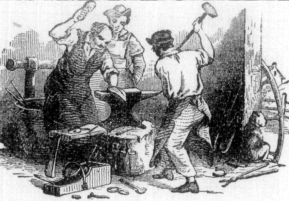

"Tarry a while," says Slow.—Mother Goose.
ur generation is formed largely of men who went to war and experienced the trials and the combats of one of the greatest commotions of all history. Upon those men was imposed the glorious rod of discipline. "Thus far and no farther!" is written upon their broad foreheads as plainly as the God of the great sea marks it on the rocks with which he has hemmed the shores, and I would not wonder if the vast prosperity of the present day were largely attributable to that stern fondness with which the true man passes into the action of daily life, and obeys orders under fire. Young man, carve yourself down to that rugged line that will make you a fitting part of the structure in which you are an element.
BE RATHER THE GIRDER
holding the building than the creaking clapboard flapping in the wind. When you get an order from your employer, school yourself to move mechanically to the action implied. Glory in it. Be sure, only, that you are carrying out the wishes of your superior. Make it your pleasure. It will become an intense delight. Suppose that you are allowed a holiday. You return to your home and find a command to appear at your place of business. A delay in finding you has happened. You can reach your employer just at the end of business hours. You say "I will not mind this; there is not time enough." Alas! You have done yourself
A CRUEL WRONG.
You have given an entrance to a wedge that will rend you in pieces. On the other hand, you do not stop to look twice at the dial. You go. Good! You have strengthened your character. You can depend on yourself. You admire yourself. "I received your directions at 5.30. I have obeyed orders." Drill of this sort will soon hew your mind down to the solid heart of oak. You will know what you mean when you say a thing. "I will get up at 6 o'clock." When 6 o'clock arrives, and you are aroused, your mind is not
A MESS OF PULP,
ready to take the impression of the first lazy wish that comes over you. No, your brain says resolutely, "I will arise," and lo! a victory!—and no small one either. In this way, true firmness is made. It is a growth. Beware of the insects which beset the lordly tree, withering its leaves and driving its sap into the earth.
"Let us put a cable under the ocean," says Cyrus Field. "Tarry a while," says Slow. "Let us put the cities within actual speaking distance!" say Bell, and Gray and Edison. "Tarry a while," says Slow. "Let us print thirty thousand newspapers in an hour, and give them out of the press folded, and pasted, and cut!" say Potter, and Hoe, and Kahler. "Tarry a while" says Slow. And yet, in spite of Slow and Sleepyhead, wonders have accumulated upon wonders, until the Arabian Nights and Gulliver's Travels are only the creations of a poor fancy, while the intimations which the future affords us stagger the understanding and make us almost idolatrous in our admiration of the quiet, keen-acting men who have dared out into fairy-land and returned laden like the spies coming from Canaan.
Our whole history is one of discipline. And what has it made of us? A nation that has sung
THE DEATH-KNELL OF THE KINGS OF THE EARTH.
I think a good deal of these lines of James Russell Lowell:
This land o' ourn, I tell ye's gut to be A better country than man ever see; I feel my sperit swellin with a cry That seems to say: "Break forth and prophesy." O strange New World, that yet wast never young, Whose youth from thee by gripin' want was wrung, Brown foundlin' o' the woods, whose baby bed Was prowled round by the Injun's cracklin' tread, An' who grewst strong thru' shifts, and wants, an' pains. Nursed by stern men, with empires in their brains!
Another sweet poet has sung:
Ill fares the land, to hastening ills a prey Where wealth accumulates and men decay.
There can be no question that wealth is fast accumulating. Let fathers, and mothers, and preceptors spur the rising generation to that love of accuracy, of "right dress," as the soldiers say, which puts each man in his place, certain to stay there as long as he has agreed to, and certain to act when the fitting time arrives.
THE ORGAN AND ITS PIPES AND REEDS.
Perhaps I can impress the true necessity of discipline no more forcibly than by comparing society to a grand organ upon which the Creator sounds his mighty fugue of years. We are the pipes—some the colossal columns which shake the world, and others the tiny tubes which make a feeble cry, almost unheard. No one of us must sound his note save in that proper place and at that proper time which Duty indicates. We mar a perfect harmony by ill-tempered silence, and perhaps ruin the labors of our associates by a continuous sounding of our own ridiculous reed.
WHEREVER WE ARE
In the factory, the counting house, the workshops of the grand industries,—or on the broad acres which watch so fondly for the sun, let us be careful, when there is a troubling jar, a fatal discord, that our key is not the guilty one.

—Books, we know, Are a substantial world, both pure and good; Round these, with tendrils strong as flesh and blood, Our pastime and our happiness will grow.—Wordsworth.
y the aid of books we multiply our sensations a million-fold. Often the reader actually feels what he reads. Such impressions would perhaps never have fallen to his lot in the ordinary way of getting experience. Our indebtedness, then, to the art of printing, is perhaps greater than to any other of the remarkable discoveries which have lent enduring charms to human life. And yet, with all its progress, the book-reading world is still in its infancy. The people do not read half enough, they do not discriminate wisely between good reading and indifferent reading, and they read too much matter of an ephemeral nature, little calculated to be of the slightest benefit to them a week after its perusal. If a man lived on the banks of a beautiful lake, and went down to its shore each pleasant day to take a ride, and, after an excursion upon the peaceful waters, stove his boat in, or cast it adrift, he would be actually following the practice of our people of the present day. The man who owns a library in these times, is considered either a book-worm or an opulent citizen. And yet what treasures are within everyone's reach! Suppose you buy and read a volume. You are
FILLED WITH IDEAS NEW TO YOU,
and you derive great pleasure. Keep that book a year and read it over. It is safe to say you will gain more benefit and reap greater enjoyment from the second perusal than from the first. A library of books, every one of which you have read, is a mine without "walls." It is a merry assembly of old friends ever faithful. Grief cannot drive them away. Slander cannot alienate them. They cannot have rival interests. They cannot want anything you have got, and you can take all they have got,
AND NOT ROB THEM AT ALL.
You have a memory which is as treacherous as the most of the other attributes of human nature. You sit down and read two hours on an interesting topic. A friend opens the same subject to you, a day afterward, in conversation, and you fairly carry him by storm. That is unfair, for you should say you have been "posting up"—but it shows the value of a library. By frequent "posting" on whatever you have read, you become a learned man, which is
A TITLE OF GREAT CREDIT AND DIGNITY
in most men's eyes. The men who read once and "read everything" are never called "learned." They are called "superficial." It is a little unjust, for they have been just as studious as the "learned men," but they have spread themselves out too thin. They have not bought and kept the books they have read, and they cannot remember the vital points. Suppose you recollect that Lord Bacon has said something very wise about riches. That is all you can call to mind. That carries no impression to anybody. If you had the book in which you saw the speech, you could repeat it accurately, and the probability is that the next time you referred to it you could give
THE GIST OF THE WHOLE THOUGHT,
and, by the next attempt, the language itself. You could say to your friend when you were talking about wealth, that you have admired that speech of Bacon where he says that he cannot call riches better than the "baggage" of virtue; that he thinks the Roman word "impedimenta" still better; that, as baggage is to an army, so is riches to virtue; it cannot be spared or left behind, but, in his quaint expression, "it hindereth the march; yea, and the care of it sometimes loseth or disturbeth the victory." Your friend would be gratified with so perfect a figure of speech, and he would never call you "superficial." That is real experience. It is not theory. A book has little value to a man until he has read it at least twice. He has then labeled and pigeon-holed it, and really needs to possess it.
A MAN OUGHT TO READ
his favorite portions of Shakspeare a thousand times—of the Bible a million times. Reading is much more like painting than we think. Go into a palace car. Do you think this polish was put on the wood with one application of the brush—with two, three, four? No; it would possibly be cheaper to cover it with silk plush than to go over it as the skilled workmen have done. Let us buy less ephemeral stuff, to be set adrift and stove in when we have skimmed over it. Let us season our reading, polish it, grain it, varnish it, repolish it and revarnish it, until we are just like it ourselves—clear, concise, intelligent. How enjoyable it is to meet an intelligent person!
WHAT A CHARM
there is about a comrade who can understand what you say, and who can swap ideas with you "even Steven!" It cannot be done without books.
Considering the vast importance of learning in saving labor and reducing the actual cost of existence, there has been little growth in the business of bookmaking compared with what there should have been. The trade in books in America is large, because the country is large. Everything is large here. Comparatively, however, it probably sinks below fishing for mackerel as an industry. As it is now, a shockingly large portion of the industry such as it is is given over to costly bindings. It does not seem that the people, even when they first had books, cared so much for the privilege of reading as they did for a gaudy covering to the volume, on which they could expend a barbaric love for ornament. The wise men of those times marveled, just as the wise men marvel nowadays. "Learning hath gained most by those books," says Old Fuller, "by which the printers have lost." Our follies in the way of "books that are all binding" are almost microscopically small when put beside those of the olden times, when, one would think the art of printing, being new, would have been best appreciated, for surely the grass looks the greenest to us in the spring! Let us do something more than
MAKE JEWELRY OUT OF THE ART OF GUTTENBERG.
"A book may be as great a thing as a battle," said Disraeli, and he meant by that a decisive battle. Now there are sometimes very decisive battles. A Turk once came up against the walls of Vienna and the walls of Tours, in France, and, if he had got through, you and I would to-day, so the scholars say, be "good Mussulmans," instead of Christians, living in freedom and decency. "When a book," says Bruyere, "raises your spirits, and inspires you with noble and courageous feelings, seek for no other rule to judge the work by; it is good, and made by a good workman." The books you buy should have large clear type. They are to be
YOUR COMPANIONS THROUGH LIFE.
Your eyes will not be so bright in their old age. The volumes should not be bulky—that is, for true, practical use. "Great books," says Clulow, "like large skulls, have often the least brains." "Books," says Dr. Johnson, "that you may carry to the fire, and hold readily in your hand, are the most useful, after all." There is no objection to a costly and beautifully-bound Bible, out of which you may read each day with added veneration, but your sons and daughters should have pocket copies. From these modest little volumes, the marvels of language and thought may be gathered without seeming effort.
Do not be afraid you are spending too much money on reading. If you read each book as you buy it, you cannot buy too many—that is, if you are an honorable man, earning your living in the world, and not sponging it off some one else. Read your book slowly, above all things. Read it as you would ride in your boat on the waters, looking down at the pebbles, the fishes, the grasses, and the roots of the pond-lilies which, being of God's creation like yourself, send a responsive thrill of acquaintance through your heart as you float above them. You can, at best, but glide over a book. Even the writer has been but a passing observer of a few of its truths. It is
THE RECORD OF THE CENTURIES.
Respect it. "My latest passion will be for books," said Frederick the Great, in his old age. He had hardly looked down into the waters until he got nearly to the other shore. Gibbon declared that a taste for books was the pleasure and glory of his life; and Carlyle, who, it is supposed, was better acquainted with books than any man who has yet lived, declared that of all man could do or make here below, by far the most momentous, wonderful, and worthy were the things we call books.
HELP OTHERS.
If any members of your family have the love of books, aid them in satisfying it. Such are the salt of the earth. They are the blazed trees in the dark forests of the present generations, to mark out that course which shall, in future ages, be the highway of the whole world.

The friend thou hast, and his adoption tried, Grapple him to thy soul with hooks of steel.—Shakspeare. I praise the Frenchman, his remark was shrewd, "How sweet, how passing sweet is solitude!" But grant me still a friend in my retreat, Whom I may whisper "Solitude is sweet!"—Cowper.
hatever the number of a man's friends" says Lord Lytton, "there are times in his life when he has one too few." "Life," says Sydney Smith, "is to be fortified by many friendships." Says Bishop Hare: "Friendship is love without its flowers or veil." "A faithful friend is the true image of the Deity," said Napoleon, who never believed he had a true friend not a born fool. "A friend loveth at all times," says the Bible. Says Herr Gotthold: "with a clear sky, a bright sun, and a gentle breeze, you will have friends in plenty, but let fortune frown and the firmament be overcast, and then your friends will prove
LIKE THE STRINGS OF THE LUTE,
of which you will tighten ten before you find one that will bear the stretch and keep the pitch." "What an argument in favor of social connections," says Lord Greville, "is the observation that by communicating our grief we have less, and by communicating our pleasures we have more." Horace Walpole has given clear expression to one of the chief pleasures of friendship:
"OLD FRIENDS
are the great blessings of one's latter years. Half a word conveys one's meaning. They have memory of the same events, and have the same mode of thinking. I have young relations that may grow upon me, for my nature is affectionate, but can they grow old friends? My age forbids that. Still less can they grow companions. Is it friendship to explain half one says? One must relate the history of one's memory and ideas; and what is that to the young but old stories?" "Fast won, fast lost," says Shakspeare. Says Dr. Johnson: "If a man does not make new acquaintances as he advances through life, he will soon find himself left alone. A man should keep his friendships in constant repair!"
ALL THROUGH THE WRITINGS OF THE SAGES
on this subject there is a tinge of melancholy. "There are no friends!" says Aristotle. "There have been fewer friends on earth than Kings," says the poet Cowley. Why is this? Let us peer into the solemn question. The ideal of true manhood is easily formulated. Alas! what an abyss separates a man's daily life, as it is, from that high quality he has pictured in his imagination. We are all the time reaching for
THINGS WE DO NOT UNDERSTAND,
and could not assimilate with if they were placed at our disposal. In this way a weary, well-read novel-reader, worn out in all lines of light letters, enters a circulating library, and queruously asks: "Have you any new books?" She expects a negative answer, and in that case would suffer a keen disappointment. The man says "Yes," and brings out several new books. Every one of these is new in every sense. It may be the most trivial set of pages yet printed in this era of scribblers, or, yet, it may be a great work, worthy of the attention of the thoughtful, and the commendation of the pure in heart. Nobody can tell. Then, illogically, she asks: "Is this good?" or "Is that good?" and upon being reminded that she wanted something new or nothing, she asks for something by May Agnes Fleming, or Mary Jane Holmes, and goes off happy, to re-read those expressions which have so well pleased her in the past.
I think I espy in this exhibition of the working of the mind in a rude and unsatisfactory state
A GENERAL PRINCIPLE,
just as potent in the mighty brain of Sir Isaac Newton or of Louis Agassiz. Man idealizes the affair of friendship. He forgets whether he really wants it or not, and then persistently inquires for it. It is not in the library of possibilities. He therefore goes off angry and disappointed. Could he get a glimpse at it, I am afraid he would walk away satisfied with something more nearly en rapport with his nature and his habits. Let us view this golden word friendship as man idealizes it: Being a changeable thing, he views friendship (of which he knows nothing), entirely by comparison with something of which in its turn he knows but little. This something is always a mother's love for her son, notorious as the strongest affection shown by our species. He therefore doubles up this marvelous fact of a mother's love, and creates in his imagination a reciprocatory agency co-respondent to this mother's love. Now, with this magnificent product of invention, he goes forth into the world, seeking for some man upon whom he may bestow a mother's love (of which the "bestower" is entirely incapable), and who will, in payment, respond with a mother's love (of which that man would, of course, be also incapable). In the jargon of electricity a positive and a negative are absolutely necessary to electric energy.
A MOTHER'S LOVE
is a deplorably one-sided action, but it is the highest and noblest of the faculties of affection. Anything beyond it is ideal, made up of two positives, and a thousand years ahead of us. Is it any wonder that when man makes his experiments with the mother's love which he supposes himself capable of bestowing that a universal wail arises, or that Shakspeare, the greatest of mortal minds, brought in those awful verdicts against mankind—"Lear" and "Timon of Athens"?
I THINK THAT IS WHY
the very deepest philosophers grow sad when they touch the question of friendship. The problem is itself the saddest of commentaries upon the weakness of our higher faculties. Separate man from his wife and family and view him in his relations to other persons similarly placed, and the result is not only unsatisfactory, but distressing to a mind anxious to hold to a good opinion of humanity. Put to the right test the quality of human friendship is found to be highly strained—to be liable to curdle in the first thundershower—to sour upon the sensitive stomach. We at once behold mankind forced to flee to God's kind institution of the family and the home to escape a desolation of the heart which follows fruitless efforts to kindle a blaze out of the damp driftwood of life's general associations.
Now, what is possible? Spot friendship is possible, and delightful. "To-morrow do thy worst, for I have lived to-day." Man is a social animal. He "gregates," he flocks. Of nothing am I fonder than the sparkle of a friend's eye, and the gabble of half an hour, or three hours. But I ought not to build on any future gabbles, for, to-morrow, lo! my friend may have discovered my ignoble reality, whereas he has heretofore been shaking hands with my noble ideality.
ANOTHER THING
should always be considered: "Kindred weaknesses" says Bovee, "induce friendships as often as kindred virtues." Here is Herder's beautiful view: "As the shadow in early morning, is friendship with the wicked; it dwindles hour by hour. But friendship with the good increases, like the evening shadows, till the sun of life sets." "People young, and raw, and soft-natured," says South, "think it an easy thing to gain love, and reckon their own friendships a sure price of any man's: but when experience shall have shown them the hardness of most hearts, the hollowness of others, and the baseness and ingratitude of almost all, they will then find that
A TRUE FRIEND IS THE GIFT OF GOD,
and that He only who made hearts can unite them." Says the wise Lord Bacon: "It is a good discretion not to make too much of any man at the first; because one cannot hold out that proportion," and that is so, for some of the strongest bonds of friendship ever felt have been woven without thought of pleasure on either side at the commencement.
"Saul and Jonathan were lovely and pleasant in their lives, and in their death they were not divided." "I am distressed for thee, my brother, Jonathan: very pleasant hast thou been unto me: thy love to me was wonderful, passing the love of woman."
"Very few friends," says Sydney Smith, "will bear to be told of their faults; and, if done at all, it must be done with infinite management and delicacy; for if you indulge often in this practice, men think you hate, and avoid you. If the evil is not very alarming, it is better, indeed, to let it alone, and not to turn friendship into a system of lawful and unpunishable impertinence. I am for frank explanations with friends in cases of affront. They sometimes
SAVE A PERISHING FRIENDSHIP,
and even place it on a firmer basis than at first; but secret discontent must always end badly."
Let us love our friends for what they are to-day—not for what they will be when we come to make unreasonable demands on them. The sun is beautiful and delightful. It will not shine for us in the night nor, in the daytime shine for us alone. We were bereft of our minds did we, therefore, enter a cave and forswear all further pleasure in its genial rays.
IT IS EASIER TO RAIL
against friendship than to enact our parts in that drama of life which is to elevate the term. Thus we hear Goldsmith cry—
What is friendship but a name, A charm that lulls to sleep, A shade that follows wealth or fame, And leaves the wretch to weep.
Yet this same Goldsmith was a burden on his friends. He did his duty to posterity, in leaving them beautiful literature and song, but to his own associates he was unsparing in his good-natured demands. It is safe to say that he who tries to ennoble friendship is best worthy of the name of friend, and he who belittles it, has fewer claims to man's humanity. Everytime we deny the existence of a satisfying, friendship, we proclaim aloud our own baseness. Let us avoid it.
Envy will merit as its shade pursue, But, like a shadow, proves the substance true.
Pope.—Essay on Criticism.
o passion has been more universally recognized than envy as the basest of all the traits that undermine the nobility of man; and yet there is no obnoxious quality so universal in men's characters. In the life of the good man it reminds one of the mice, in our houses, which eat their way to our attention and their own destruction; for there are few men who have looked into their own hearts who have not seen the small but odious traces of this gnawing evil. Again, the mind of the bad man, who has given himself entirely up to envy, is
A WOLF'S DEN—
a howling pandemonium, where no quarter is given, and where the merits of the deserving rather than the lapses of the blameworthy are torn as the most toothsome morsel in a furious feast. The Bible says that envy is the rottenness of the bones, meaning that utter corruption which has finally reached the framework of the structure. Society as now organized is really making progress toward the extinction of this hideous blemish. When, as in Æsop's fables,
A TAILLESS FOX
is found advocating the disuse of tails, he is at once suspected, and his influence greatly limited. For the world is waking up to the meanness of envy. The world, in its better moments, is rising above it. It is one of our principal duties, on entering the Temple of Life, to search our hearts for the little fox with the sharp tooth. When we find ourselves about to enter upon a course of action, either momentary or long continuous, which will be adverse to another of our fellow-creatures, let us ask: "Is there anything of envy in this act?" If there be, let us refrain from acting—the soul is not yet pure, the body fragrant.
Let us see how ignorant this contemptible quality of envy becomes under the lenses of practical life. "Base envy withers at another's joy." What has caused it? In nine cases out of every ten, it is simply the one-sided view of an ignorant mind, which sees only the bare result of unceasing efforts. Envy sees Fame on the peak. Envy therefore hates Fame, and declares that there are no crags, or rifts, or snows, or storms on the way up—that, the path is an easy one, over which all who ever went that way traveled in preference to all other routes!
I lay upon a boarding-house bed day after day, one summer, sick of a fever. On the one side, a building was going up, and workmen filled the air with mighty din. On the other side, a young man sang
"DO, HOORAY, ME, FAH, SOLE, LAH, SE, DO!"
I thought: "The one will be a grand house, and the other will be a great tenor, but oh the way is long. The feet grow weary!"
It has often seemed to me that this was my first true view of life, and nowadays, when—I am tired, especially,—I do not envy the truly great in any avenue of distinction. The walker has walked, the builder has groaned, the fighter has fought, the scribe has scribbled, the statesman has lied and betrayed. Any one of them will tell you his pay has been sadly inadequate.
TAKE A MAN LIKE THEIRS.
Born in an age still drunk with the glory of Napoleon, but himself infused with ideas of popular liberty; chained to the chariot of circumstances, and made to swell the sawdust-magnificence of unpopular kings and the ridiculous success of Napoleon III., the greatest impostor of all history, this Marie Joseph Louis Adolphe Thiers went through a life the bare retrospect of which would actually tire the mind. In his old age this little lover and critic of greatness—this man who could show the weaknesses of Napoleon Bonaparte so clearly that one would feel the critic must be the superior of Napoleon—this squeak-voiced orator, must have felt that whatever greatness might come to him in history was well-earned—that the way had indeed been long!
THE SAME OF GLADSTONE.
Who in his sane mind would be Gladstone living any more than Homer living? Of course, he survives those horrible crises in which public duty has made him the most pitiable object, and in the most dreadful complication of great interests shines forth as Venus fresh-lighted. But I would not have Gladstone's fame for the boon of rest eternal, from fear that his retrospect of inconsistency and apostacy would be its accompaniment, its deeper shadow. Yet who shall blame Gladstone? He was the executor and administrator of the policy of a parvenu Jew, one of the very bad men of the earth. He
REAPED ANOTHER MAN'S WHIRLWINDS.
Forced into geographical relations with the Irish, an unwarlike people with indomitable tongues, England has in the middle ages, naturally done to this unwarlike people just what a warlike people would do in the middle ages—taken everything. With painful volubility the unwarlike people has for centuries sounded its fate over the world, touching the heart of Gladstone and other good Englishmen, and tempting him and them to many struggles. Behold him at the next step, then, in the role of warring upon the unwarlike, of oppressing the oppressed, of answering an Irish clack with a British click! Is it not pitiful? Gladstone fell ill from it. He paid there and then for his illustrious name. And, next, of those brave Boers! God nerved their quick muscles and darted straight their wonderful eye; and when the single hand rose against the hundred hands of British Briarius they were not forsaken. Oh! how clearly that question seemed to an American! No geographical necessity was there—no race hatred, no hotbed to foment conspiracy against the sister country England. The independence of those Boers, if they desired it, ought to have been fought for by England, by Gladstone, willingly, irresistibly—in the very name of England's own love of liberty for herself. And finally Gladstone so saw it.
What a puzzle are those Hibernians!
HOW BITING THE WITTICISM OF CHIN LAN PIN,
the Chinese Ambassador to the United States, that they are able to govern every other country save their own! Behold a statesman like Gladstone, forced to change his policy toward them the moment he has the responsibility of governing them! Oh! what an opportunity for the little foxes! How easily Envy spears him with its jest! How truly Envy shines with the wings of that fly that passes all the sounder parts of a man's body to dwell upon the sores! In this rapid glance across two of the trials of a great man, across the path up to the peak where one clambering must bind himself with strong ropes to his companions, that if one sink into a snow-covered abyss the others may bring him forth—we get, perhaps, a truer view of
THE MEANESS OF ENVY.
Let us look at Gladstone as the great, wise, good, learned man he is, whose wreath of laurel covers a crown of thorns. And if we find an associate making those fatiguing efforts that ever precede the recognition of this cold world, let us glance rather at his efforts than at his fame, that no rust may gather on the brightness of our eye, and no withering cloud shut out the sunlight from our spirits.
I CANNOT CLOSE THIS CHAPTER
without imploring the reader to exterminate this characteristic of envy altogether. Because it is at first so little and so ridiculous, envy often escapes the hand of discipline. Yet the homely saying is a true one that "they which play with the devil's rattles will be brought by degrees to wield his sword," and the force of a nature given up to envy is truly a two-edged sword from the bottomless pit, cutting both the fiend who smites and the victim who smarts.

Mrs. Lofty keeps a carriage— So do I. She has dappled grays to draw it— None have I.—Alma Calder.
nquestionably, the baby-carriage of the poet, with contentment, was a far richer establishment than the gilded barouche and the dappled grays of childless Mrs. Lofty. Riches are often childless; poverty is often contented. Happiness is a golden spell inwoven with most of our lives at certain times, whether we be rich or poor. The first surprise of the newly-rich comes in the non-discovery of additional happiness. Additional cares and duties come thickly enough. The greed of the envious, and the demands of the poor who are likewise needy in thoughtfulness for their more fortunate neighbors, fall upon the wealthy like a mist. There is no escaping it. As James Russell Lowell says of a Scotch fog—an umbrella will afford no protection. They must give all, or accept the hatred of those who believe it to be easier to give than to receive. "Contentment is natural wealth," says Socrates; "luxury is artificial poverty." Contentment is generally a sign of a high class of character. "If two angels were sent down," says John Newton, "one to conduct an empire and the other to sweep a street, they would feel no inclination to change employments."
HUMAN GREATNESS
is at best such a little thing that wise men do not lament its absence in their own persons. Our main pleasures are free to rich as well as poor. What sight is so grand as the sun? What pleasure is greater than to breathe? What fluid is more grateful for all purposes than water? What music is sweeter than the singing of birds, the ringing of free school bells and the hum of machinery? The extra pleasures which the rich man, if he be foolish, tries to buy, almost invariably
END IN HIS EARLY DEATH,
and in his hatred of the whole world. Those noble men of wealth who gain the plaudits of their fellows, have earned those plaudits just as poor men would earn them—by service to their fellow-creatures. Man is not constituted so that he can "take his ease" and be happy. The prisoner in solitary confinement is forced to take his ease, and we are told that he suffers terribly under the ordeal. Of course you have heard of
THE PRISONER IN THE DARK DUNGEON
who had three pins, and who gave himself employment by throwing them into the air and then beginning the long search which should finally secure them. Sometimes a pin would be hidden for years in a crevice. In this way the prisoner preserved his mind from utter decay, and was almost happy—nay, was really happy when his arduous labor would result in the discovery of all three of the objects of his pitiful quest. Instances like this should impress upon us the fact that the principal sum of our happiness is inalienable. We cannot, in health, possibly lose it. The hale pauper is far better off than the invalid Duke. We breathe and eat and see and hear with ease. All of those offices of the body are unquestionably delightful, as is proven by the relative view we get when we are ill and can neither breathe nor eat nor see nor hear without great suffering. "There is scarce any lot so low," says Sterne, "but there is something in it to satisfy the man whom it has befallen." The reason of this lies in this same fact that when the tree of happiness loses superfluous wealth, it but loses its foliage.
THE POOR MAN CARRIES INTO HIS COTTAGE
all the great and marvelous blessings of life. He leaves outside only a lot of artificialities, the most of which are so-called pleasures, but are really miseries. If we cannot be contented without these artificialities, we certainly would not be satisfied with an addition so unimportant. "A tub was large enough for Diogenes," says Colton; "but a world was too little for Alexander." Alexander valued the true blessings of life as nothing, and the power of life and death over others as everything. His disappointment and the contentment of Diogenes, who viewed things more correctly, are matters of tradition. "Contentment," says Fuller, "consisteth not in adding more fuel, but
IN TAKING AWAY SOME FIRE."
Therefore, if you are spending so much money that you need more income, take away some of the fire. If you reduce your expenses two dollars a week, you have added nearly eighteen hundred dollars to your account in fifteen years. If you wear your boots one month after you could well persuade yourself to have a new pair, your new ones will not wear out a month sooner for that reason!
GOOD FORTUNE OF OUR LITTLE EGOTISMS.
We are all, fortunately, greatly disposed to contentment with our lot. We do not seem to realize it, but the importance of the pleasures of life which cannot be bartered in, has its noticeable effect on the mind. Horace remarked this ages ago, and Dr. Johnson has thus translated the thoughts hinging upon it: "Howsoever every man may complain occasionally," says he, "of the hardships of his condition, he is seldom willing to change it for any other on the same level. Whether it be that he who follows an employment, chose it at first on account of its suitableness to his inclination; or that when accident, or the determination of others, have pleased him in a particular station, he, by endeavoring to reconcile himself to it, gets the custom of viewing it only on the fairest side; or whether every man thinks that class to which he belongs the most illustrious, merely
BECAUSE HE HAS HONORED IT WITH HIS NAME—
it is certain that, whatever be the reason, most men have a very strong and active prejudice, in favor of their own vocation, always working upon their minds and influencing their action." Let us be thankful for that laughable egotism which is born with us, and within us, and which, in this natural and unobtrusive affair of contentment, becomes a true anchor, holding us inside the peaceful haven.

Marble may rise from crystal waters spanned By other marbles: founts may plash on stone, And fashionably-branched trees may stand As thieves upon a scaffold. Yet, how cold! How cold!

e are made up of elements. These elements should be well balanced. The delicacy of equilibrium is what makes the perfect man, or, rather, the honorable man. Too much avarice makes a contemptibly mean man; not enough makes a foolish spendthrift, who is always appealing to his friends for help. Too much bravery in man makes a bully; not enough a coward. Too much speech in man makes a bore; not enough a "stick." Too much hope in man makes a speculator and a gambler; not enough, a hermit and a man-hater. So of ambition. It is a flame to be guarded—a willing slave, an unpitying master. In its full sway it is the very essence of self-conceit and selfishness,—two traits, a little of which goes a good way. You know that you do not put much blueing into a washtub full of water. Well, use ambition in the same sparing way. If you spill it in using it, you will have a difficult affair on your hands. It may be just possible, of course, that you have clothes to wash, so to speak, which require the whole box or bottle. If so, your chance of happiness is not great.