Front matter (continued 4)
Reading edition
"If Elaine is going to work anywhere, Mrs. Marshall, she couldn't be in a better place than Uncle John's office. He'd be good to anybody, but, of course, he'd be especially interested in Elaine as long as she's a friend of mine."
"Young people nowadays," quavered Mrs. Marshall, her sense of injury goading her to injustice, "are not sufficiently mindful of what they owe the family name."
Elaine's flippant laugh jarred Peggy's sense of propriety. She looked at her reproachfully, but Elaine would not meet her eye.
"I suppose that's because we have to think what we owe ourselves," she suggested airily. "Clothes and something to eat, to say nothing of carfare."
"And don't you think," asked Peggy, hurling herself into the breach, "that a girl who does hard things when she has to, and keeps brave and plucky about it, is a credit to any family? Seems to me that her ancestors, whoever they were, would have reason to be proud of her."
There was a clarion ring in Peggy's voice. Mrs. Marshall looked at her doubtfully, surprised that enthusiasm could be kindled over what to her mind was a disgrace. But Elaine's expression betrayed a sense of guilt.
"Don't try to make a heroine of me, Peggy," she protested. "I'm not brave, nor plucky, nor anything of the kind. It's only that I've got to have the money. If you think there's any chance, let's go to see your uncle right away before he gets anybody else."
The process of bringing Mrs. Marshall to agree to this suggestion occupied some time. Suspecting the weakness of her arguments, the poor lady fell back on tears and reminiscences. The two girls listened to detailed accounts of the lavish expenditure that had prevailed in her father's household, the big dinners, the imported gowns, the liveried coachman. "And to think that my child should be--getting a job," wailed Mrs. Marshall. "O, what would poor papa have said?" It was not so much, perhaps, that the girls' arguments finally had effect, as that the violence of her emotion had reduced her to the point of exhaustion, which accounted for the fact that Elaine and Peggy were at last allowed to depart on their errand without protest.
Peggy's uncle, Mr. John Mannering, was a big grey-haired man, with eyes that twinkled boyishly, and a voice that could be kind or commanding or both in one, on occasion. He asked Elaine a few questions which had the result of making her feel hopelessly ignorant and incompetent, and then sat considering her with a closeness of attention whose curious impersonality resulted in relieving Elaine from all feeling of embarrassment. "He's sizing me up," she thought, and sat waiting without much hope of a favorable verdict. The atmosphere of the real estate office was like a different world from any to which Elaine had been accustomed. The maps upon the wall, the business-like click of the typewriter, the phrases which she caught as people came and went, all were calculated to make her feel how little her life had prepared her for fitting into so methodical a system of activity.
Mr. Mannering turned abruptly to his niece. "Well, Peggy," he exclaimed, with the smile which was conclusive proof that, as Peggy put it, he was not "petrified." "Do I understand that you stand sponsor for this young woman?"
"Yes, sir," returned Peggy, without troubling herself to inquire into his exact meaning.
"You'll vouch for her being efficient, courteous, obliging, industrious, quick to learn, slow to forget, and above all a sticker."
"Yes, sir," said Peggy without blinking. It was Elaine who uttered a little protesting gasp, and looked frightened.
"Well, I'll take your word for her. You can be on hand in the morning, I suppose," he added, looking at Elaine.
Like one in a dream Elaine heard herself concluding the arrangements for her plunge. She listened to the outlining of her duties, without any clear idea of what was said, agreed to the amount of her salary, without knowing whether it was more or less than she had hoped, and finally found herself outside with Peggy, in the dazed, uncertain mood of one who is not quite sure whether she has been dreaming or not.
"Isn't it glorious?" Peggy's enthusiastic comment sounded wide-awake enough, at all events. "You're a wage-earner, Elaine. Doesn't that sound imposing? Don't you think Uncle John's a dear? I'm coming down some afternoon when I haven't anything to do, and look at all those blue-prints. There's something awfully fascinating in the things you don't know anything about."
Elaine reflected that in this case she was likely to find untold fascination in her new occupation. Her answers to Peggy's cheerful chatter were rather vague. Now that she had taken the final step her courage was ebbing. Her mother's warnings, which she had brushed aside with a sense of irritation when they were spoken, sounded in her ears with monotonous insistence. After her reckless mood of the afternoon had come the inevitable reaction of tremulous cowardice. Why had she ever done it? What had made her suppose herself qualified for such a position? How was she ever going to bear it?
If this was her mood, when sustained by the cheerful companionship of Peggy, it was worse after they had said good night. Mrs. Marshall had received the news of her daughter's prospective advent into business life with a burst of tears, after which she had refused to partake of the evening meal and had retired to her room. Elaine, herself, had choked down her food with difficulty, and went to bed at last with the firm conviction that dreams of the night, however unpleasant, could be no worse than the nightmare of her waking hours. She was not quite clear as to whether she had already disgraced the family name by the work she had chosen, or merely was about to disgrace it, by proving her woeful inefficiency. Whichever was true, she could see nothing but blackness ahead, and as she tossed on her pillow, flushed and wakeful, she wished though vainly for the relief of tears.
CHAPTER XVIII
A REMARKABLE EVENING
A wakeful restless night is not the best of preparations for launching out in untried activities. The pale, tremulous Elaine, who presented herself at Mr. John Mannering's office the next morning, was far less equal to the ordeal of being "sized up" than she had been the previous day. A soldier, on the eve of his first battle, may have sensations very like those of Elaine, as she seated herself at the desk and began her unfamiliar work.
Time in a business office is a deliberate affair, Elaine soon discovered. It was no wonder that much was accomplished when the hours were two or three times as long as the easy-going hours with which she was best acquainted. At ten o'clock she was impatient for luncheon. At eleven she wanted to go home. By noon she was ready for bed.
The other girl in the office gave her information in more or less technical terms, which left Elaine little the wiser. It was incredible that she could ever master the meaning of the phrases Miss Newell rattled off so glibly. Each new item, as she gave it her attention, crowded out all that had gone before. She felt like a spent swimmer, clutching desperately at slippery, water-soaked stalks, to find each giving way in her hand. And when Miss Newell had finished Elaine was gasping, like a swimmer who has come to the surface after going under.
The middle of the afternoon found her tired, bewildered and so near to complete disheartenment that it needed only a feather's weight addition to her load to wreck her weakened courage. As ill luck would have it, that trifling extra was forthcoming. About three o'clock the office door swung ajar to admit a florid gentleman, accompanied by two young girls. Elaine, recalling Miss Newell's instructions, rose hastily and approached them.
"Did you wish to see Mr. Mannering?" she began, addressing the florid gentleman. Then all at once it flashed over her that the something vaguely familiar in the faces of the two girls was not a misleading fancy, as she had thought. She really knew them, for she had met them at Peggy Raymond's Hallowe'en party. So strong had Elaine's feeling of forlornness become by now that even the appearance of these mere acquaintances gave her pleasure out of all proportion to its exciting cause. The color rose in her cheeks, as she said smilingly, "Why, good afternoon."
"Good afternoon," said the girls in chorus, and returned her look blankly. It did not occur to her that her own tardy recognition should have given her the key for interpreting their unresponsive manner. The possibility that these acquaintances failed to recognize her, as she had come so near failing to recognize them, was far from her thoughts. She was being snubbed, taught her place. She would have to remember, henceforth, that a girl who worked in a real estate office must not expect cordial treatment from girls who, like the lilies of the field, toiled not, and yet outdid Solomon in gay apparel.
Just what the florid man wanted, and whether he got it or not, Elaine was never exactly sure. For in the abyss of humiliation into which she had descended connected thought was impossible. In her misery and confusion she was conscious of but one thing, an overwhelming longing for the end of that dreadful day. Plenty of girls have gone home from just such experiences, to be cheered, soothed, encouraged, and sent out in the morning with teeth set and heart resolute. But the atmosphere of Elaine's home was not of the sort to revive the fainting and inspire the discouraged. Mrs. Marshall, as well as her daughter, had spent a wretched day, weeping at frequent intervals, and bemoaning the changed fortunes which had brought her family to such straits. There was nothing in her companionship to invigorate the girl who crept home at nightfall, half crushed under a burden no less heavy because it was largely imaginary. Elaine's evident dejection plunged Mrs. Marshall still deeper into melancholy, and the mother's low spirits reacted on the girl. Instead of the mutual helpfulness which should have been given each was making it harder for the other.
When Peggy Raymond made her appearance at eight o'clock Elaine was lying back in the easy chair, her eyes closed, and her face colorless. Mrs. Marshall, sitting on the other side of the round table, had the air of one who has expected the worst all along, and whose sole remaining comfort is the doubtful joy of saying, "I told you so."
"Headache?" exclaimed Peggy sympathetically, yet cheerily too, for Peggy had an intuitive shrinking from the sympathy which knocks the props out from under a tottering courage. "Well, the first day of anything is always a hard day. Want me to rub your head?"
"I don't know." Elaine spoke languidly, more as if it were too much trouble to refuse than as if she welcomed the thought of Peggy's ministrations. Indeed she was almost in the mood to resent the idea of being made comfortable. But Peggy slipped behind her chair, stroking the throbbing temples with a touch at once gentle and assured. "Uncle John telephoned me this evening," she observed. "He says you take things a little hard, but that you'll be all right as soon as you're used to it."
Mrs. Marshall sighed heavily, and Elaine came to life sufficiently to say with some spirit, "There are some things one never would get used to."
Peggy's caressing hand paused a moment. "Some things! What sort of things do you mean?"
"Like being snubbed, for instance."
"Snubbed?" cried Peggy, startled.
"Of course it's no more than I should have expected. When I took up that work, I ought to have known that people would look down on me, and treat me accordingly. But, somehow, I wasn't prepared for it."
"Look here, Elaine," said Peggy, thoroughly aroused. "Business is business, and when a girl goes into an office, she must expect that she'll be told of her mistakes. But to imagine that Uncle John is going to look down on anybody--"
"Oh!" Elaine's tone was apologetic, as she interrupted. "It wasn't your uncle. He was very kind indeed, all that I saw of him. But along in the afternoon--" to her amazement she was obliged to pause to get control of her voice--"two girls came in, girls I met at your house," she faltered. "Their name is Henderson."
"Bess and Lu! Well, what of it?"
"Why, I spoke to them before I thought, just as I would anywhere. Everything seemed so strange that I had a silly feeling as if it were awfully nice to see anybody I knew. And they--O, Peggy!" Elaine broke down and sobbed helplessly. "They were so cold and distant, and all at once I realized how they must feel to have a girl in an office acting as if she thought she was as good as they were. I suppose I deserved to be snubbed."
"If I had been listened to," observed Mrs. Marshall tragically, "this could not have happened."
"Why, I never heard of such a thing," Peggy cried, finding her voice. "Lu and Bessie are nice, sensible girls, as far as I know. I can't imagine their doing anything so ill-bred and silly as snubbing you for speaking to them. I simply can't believe it."
"It's true, though." Elaine wiped away her tears and Peggy took a long look at her. "Well, what of it?" she said.
Elaine hesitated. "You mean--"
"I mean it's not worth a second thought. If they didn't intend anything, there's no sense in worrying. And if they did, they're beneath your notice."
"But, Peggy!" Elaine expostulated, "don't you see I can't go on with this if people are going to look down on me and despise me? I don't mind how hard I work, but this--"
Something in Peggy's look halted her mid-way in the sentence. The other girl's eyes were ablaze.
"Elaine, see here. Why did you apply for that position in the first place?"
"Why, I needed the money, Peggy."
"You didn't do it on the spur of the moment, did you? You thought about it, and made up your mind that it was the right thing to do?"
"Why, ye-es--" Elaine hesitated, feeling a little suspicious that she was walking into a trap.
"You're the same Elaine to-night that you were yesterday, aren't you? You haven't been spoiled, by spending a day in Uncle John's office. Is there any reason why anybody should like you less or respect you less?"
"Of course not, Peggy. It's only the way people feel about such things."
Peggy did not mean to stop till she had spoken her mind. "You're ready to give up doing something you're sure is right and sensible because of what people think. You know they're wrong. You know such prejudices are silly and mistaken and yet you haven't got the courage to fight them."
"I don't know who would be brave enough for that," Elaine said dejectedly.
"Everybody ought to be brave enough. Think of the people in the world who've conquered real obstacles, people like Helen Keller, for instance. It's a shame for such a girl as you to give in to a lie, to let herself be beaten by something she despises. You're in the right and you know it. Hold your head up and let people think what they please."
Peggy's exhortation broke off abruptly on the discovery that there was a fourth person in the room. A tall girl stood behind her, looking down upon her with a face oddly like Elaine's, though something--not years alone--had given it a rather pathetic maturity. She was pale, and the shadows under her eyes made them seem unnaturally large. As she met Peggy's startled gaze a little smile fluttered across her lips, and then, as if unaccustomed to those surroundings, was lost in instant gravity.
"I've been listening to you, Peggy Raymond," she said, in a voice which Peggy instantly recognized as one she had heard before, and that over the telephone. "And I think the cap fits me."
Peggy sprang to her feet. Even in her excitement she was on her guard against betraying the secret of Elaine's confidence. Fortunately her confusion over Grace's unexpected appearance and contribution to the conversation was sufficient for the exigencies of the case. No one could have guessed from her manner that she had a previous knowledge of Grace's presence in the house.
"Sit down, Peggy Raymond." The older girl touched Peggy's shoulder lightly, and seated herself near by. A furtive glance told Peggy that Mrs. Marshall's face was colorless, and that Elaine was sitting bolt upright in her chair, her eyes protruding, as if her sister had been a chance visitor from another planet.
Apparently Grace was not impressed by the excitement due to her unheralded appearance. "I'm Grace Marshall," she said, addressing Peggy. "Elaine's sister."
"I couldn't help knowing that you were Elaine's sister, after really looking at you," Peggy replied, trying to smile naturally. Grace reflected a minute, apparently studying the pattern of the carpet.
"So you don't believe in giving in to a lie."
"No!" Peggy gulped. "I don't."
"And if you're in the right, you should hold your head up and let people think what they please. Isn't that what you said?"
"It's what I believe, anyway, with all my heart."
"I half think you're right. And do you know, Peggy Raymond, I've been acting on a very different plan. I'm going to tell you something that happened not so very long ago and see what you have to say about that."
It was the story Peggy had heard before, shorn of some of its tragedy, compressed into as few words as possible; a bald little tale, if the burning eyes of the narrator had not supplied the pathos. She sat with crossed hands as she told it, and when she had finished, looked expectantly in Peggy's direction. "Well?" she said as the other hesitated.
"Well," cried Peggy, voicing a sentiment she had expressed earlier, "somebody ought to hide. But not you."
"Then you think I've been silly."
"Yes." Peggy's smile took the edge off her bluntness.
"And cowardly?"
"You could be braver."
"Well, I've been brave enough to come down and see you, anyway." Grace laughed out, and Peggy noticed that both Elaine and her mother started nervously at the sound. "You mustn't think me familiar on short acquaintance. You see I've known you for some time, and the most popular topic of conversation in this house since we moved in has been Peggy Raymond. You don't mind my calling you Peggy?"
"I'd mind dreadfully if you called me anything else. And, by the way!" Peggy had some sensible ideas as to striking when the iron is hot. "Mayn't I bring some of the girls in to see you? They will be so interested when they know Elaine's sister has come."
Grace's gesture reminded Peggy of one who, coming from the darkness of a cellar, blinks and shrinks away from the sunshine.
"Not yet. Not quite yet," she pleaded. "Let me get a little used to things first." And Peggy wisely forbore to press her, guessing that as soon as Grace began to live normally her unnatural shrinking from companionship would disappear.
It was an exciting evening. Peggy stayed till her mother telephoned to ask if anything was the matter. When some reference was made to Elaine's headache, Elaine protested.
"Headache! I haven't any headache. I never felt better in my life."
Peggy viewed her with approval. It was not only that Elaine's color had returned, and her languid eyes had brightened. There was another change, indefinable, but not to be mistaken. When courage and resolution come flooding back into a heart deprived of both the least observing cannot fail to note the difference.
"Going to the office, to-morrow?" Peggy demanded, as she rose to go.
"Of course."
"And you're not going to say silly things any more, are you, about people who look down on you?"
"I'm not going to be beaten by my sister. Grace needn't think she's got a monopoly in the courage of the family." Elaine slipped her arm about Grace's shoulders, her face so transformed by tenderness and pride that it was hardly recognizable.
Grace looked rueful over the implied compliment. "I'm afraid neither of us could be called heroines. But Peggy's started us right, and we'll have to help each other to be brave."
It certainly was a remarkable evening. But the thing which astonished Peggy even more than the dramatic appearance of Elaine's mysterious sister, was the fact that Mrs. Marshall kissed her good night.
CHAPTER XIX
AMY IS DISILLUSIONED
"Elaine's sister here! Why, I didn't even know she had a sister. Is she nice, Peggy? Has she come here to live? It'll be lovely for Elaine, won't it?"
That was the way Friendly Terrace received the announcement of the third member of the Marshall household. It was surprisingly easy, Peggy found, to evade answering questions as to the date of Grace's arrival, and the reason she had not joined the family earlier. Peggy said with perfect truth that Grace was not very strong and that even now it might be some time before she was able to see Elaine's friends.
But by the end of a fortnight Grace was so far restored to the normal attitude of girlhood toward the world outside that she no longer shrank back from the window if a passer-by chanced to look up, nor gave evidences of collapse when Peggy suggested that one of the girls might come in with her after school.
As a matter of fact Grace made a much more favorable impression on the girls of the Terrace than Elaine had done. There was something in her look of fragile delicacy that was distinctly appealing. Ruth lost her heart to her at once, after the impulsive fashion of school girls. Priscilla, who, ever since her misunderstanding with Peggy, had been on her good behavior, took especial pains to be cordial to the new-comer. It occurred to Peggy one afternoon to wonder how it happened that Amy had not as yet accepted any of their invitations to call and meet Elaine's sister.
"I'm sure you'd like her, Amy. And you're just the one to do her good. Suppose we run in for a few minutes."
"I guess not." Amy's tone was hollow. "I don't feel like meeting strangers."
Peggy cast a sidelong glance in her direction, and made a discovery which temporarily banished from her mind the topic under discussion.
"Amy, I believe you are growing thin."
She made the announcement jubilantly, expecting it to be received with enthusiasm, but Amy did not speak.
"Have you really left off eating candy?" continued Peggy, innocently interested. "Seems to me I haven't noticed any boxes of chocolates in your desk lately."
"I haven't been eating very much candy." Amy sighed so heavily that Peggy looked at her again. Amy had really lost flesh, but that was not all. About her hung an air of depression, as inconsistent with the normal Amy as hollow cheeks, or a total loss of appetite.
"Amy, I believe something is the matter. What is it?"
"You'd think it was silly." Amy's tone indicated a longing to confide her griefs, only restrained by a dread of being laughed at.
"Silly troubles are the very worst of all sometimes," Peggy declared comfortingly. "Go ahead, dear. Out with it."
For a moment Amy hesitated. Then her pent-up woes burst bounds.
"I'm not going to live through the year."
"What!" Peggy could not believe that she had heard aright. "What did you say? I didn't understand."
"I'm not going to live through the year." Amy repeated her startling statement with a deliberation and an emphasis which carried the conviction that at least she meant what she said. Peggy burst into excited expostulation.
"Amy, you're crazy. I never heard anything so absurd. You have lost a little flesh, to be sure, but no more than is becoming. I thought you would be delighted. What makes you think that anything ails you?"
"I didn't say that anything ailed me, did I?"
"If you don't expect to live, it stands to reason that you must be sick."
Amy shook her head. "I might be killed in an accident. Or I might be taken sick suddenly, and not live more than two or three days."
Peggy's suspicions were aroused. "Amy Lassell, you've been doing something silly."
"You can laugh if you like. I dare say it seems funny to you." Amy spoke with an injured air which Peggy failed to notice, so busy was she in following the clue which her quick wit had suggested.
"I know," she burst out. "It's a fortune teller."
Amy made no effort at evasion. On the whole it seemed a relief to be found out.
"Yes, it was a fortune teller. But if she'd been a faker she never would have told me that, you know yourself. They tell you how rich you're going to be, and whether you're going to be married once or twice, and things of that sort. But the ones who are just tricksters, don't ever tell people they are going to die right away."
Peggy checked her impulse to laugh. The thing might seem a joke to her, but it was serious enough to Amy. Her loss of flesh, and even more the haunted look in her eyes, was proof of that.
"Tell me all about it," she said soothingly, and Amy closed with her offer so hastily as to suggest that all she had wanted was a chance.
"She's a woman on West Spring Street, Madame Planchet. Lots of girls go there to get their fortunes told, just for the fun of the thing. One day Blanche Estabrook and I were going past, when she suggested that we should stop. Madame Planchet only charges a quarter."
"That's cheap, considering what she gives you," observed Peggy with an irony that glanced harmlessly from her friend's armor.
"Of course neither of us took it a bit seriously," Amy explained. "We were both laughing when we went in and all the time Blanche was having her fortune told I fairly stuffed my handkerchief into my mouth, I giggled so. Blanche's fortune didn't sound a bit true, you know. It was all about coming into a lot of money, and that she was going to have a serious sickness when she was about twenty, but she'd recover and be a lot healthier after that. And I supposed mine would be just the same. But it wasn't."
"Go on!" Peggy prompted impatiently, for poor Amy paused, as if she found it difficult to disclose to another the black page of the future so unexpectedly revealed to herself.
"Well, she looked at my hand a minute, and then she said, 'I can't tell your fortune. There is nothing to tell.' I was so stupid that I didn't understand for a minute. I thought she only meant that there wouldn't be much doing in my life, you know. And I asked her if I wasn't going to get married. I thought fortune tellers married everybody off. And then she said in a dreadful voice, 'You have no future,' and I began to understand."
"Poor Amy! To pay a quarter for that!" Peggy cried, but Amy refused to smile.
"I asked her how long I was likely to live, and she said it wasn't possible to be exact. It might be six months, and it might be a little more. She was sure I shouldn't live out the year." Amy paused a moment before she added, "And one month has gone already."
"O, you goose!" cried Peggy. "You dear silly goose! Don't you see how perfectly absurd it all is?" She launched into arguments convincing to herself, but useless as far as Amy was concerned. More profound logicians than Peggy long ago discovered the hopelessness of mere reason when confronted with a well-grounded superstition.
Peggy went home thoroughly uneasy, and reproaching herself that her absorption in Elaine's affairs had blinded her to Amy's troubles. The month of anxiety had told upon the girl. The dismal prophecy might fulfil itself. Peggy's attention wandered from her geometry that evening. More absorbing than the theorem assigned for her lesson was the question of helping Amy.
When she suggested a walk the following afternoon there was a brightness in her eye which indicated that her hard thinking had not been unprofitable, in her own opinion at least. Amy was not inclined to be enthusiastic over the proposal.
"I don't know as I care much about walking where I'm likely to be seen. I thought it was going to rain this morning, and I put on this old tam I haven't had on my head this year."
"All the better," Peggy said jubilantly. Then, as Amy looked as if she would like to know what was meant by that speech, if it were not too much trouble to ask, Peggy added hastily, "We'll take the side streets. It won't matter if your tam is old."
Once under way Peggy set herself to be entertaining. She talked so rapidly, changing the subject with such abruptness as to hold Amy's attention fixed on her conversational gymnastics. When she halted suddenly in front of a shabby looking building on West Spring Street Amy cast a startled glance about her and fixed her gaze on a fly-specked card, in the window, bearing the announcement, "Madame Planchet, Palmist." Then she turned on Peggy eyes brimful of reproach.
Peggy had expected this. "We are going in," she said quietly.
"No, Peggy. O, not again! I can't stand it."
"Yes, we are, my dear. And the only thing I ask of you is not to say a word more than you can help. Leave me to do the talking."
She pushed Amy up the steps ahead of her, and held tightly to her arm, as she rang the bell, apparently apprehensive that her captive would take to flight if not forcibly detained. Amy's air of shrinking horror did much to justify this suspicion. When shuffling footsteps sounded in the hall, and a slatternly girl opened the door, Amy drew back with a precipitateness which came near sending the two of them to the bottom of the steps.
"Is Madame Planchet at home?" demanded Peggy, righting herself adroitly, and clutching Amy more tightly than before.
"Walk in," said the slattern, and led them down the hall to a stuffy little room hung with mysterious charts. Peggy looked about her with an air of interest.
"I am almost sure this is the place," she cried. "Charts on the wall and red curtains, just as Roxanna said. Yes, I'm pretty sure we're right."
Amy opened her mouth and closed it without emitting a sound, in a fashion suggestive of a dying fish. She perceived from Peggy's expression that she was expected to listen to her friend's observations, instead of taking part in the conversation.
"I don't know why you should act so scared over the idea of having your fortune told, as lucky a girl as you are. For of course your Uncle Philander's money is all coming to you."
Again Amy's jaw dropped. She looked frankly stupid.
"Doesn't it seem lovely to think you're going to see Europe this summer?" continued Peggy enthusiastically. "I think you were sensible though, to travel all over this country first. O, dear! It would make me fairly envious if it were anybody but you. To think that I've hardly been out of the town I was born in, and here you go everywhere."
Peggy's fancy sketches were beginning to be interesting, by virtue of their sheer audacity. Amy listened, a faint amusement showing through her air of perplexity.
"Won't it seem funny to settle down in Germany to study your music, after your lovely summer? But I suppose you love that too, almost as much as travelling. That's what comes of being a genius."
This time Amy was forced to bite her lips to keep from laughing. Musical appreciation had been left out of Amy's composition. She could not recognize the most familiar air when she heard it hummed, and, as far as she could see, the only difference between a street band and a symphony orchestra was that one made more noise in proportion to the number of players. But even her amusement over the role of a musical genius, so unexpectedly assigned her, vanished when the red curtains parted and a tall woman came into the room.
The discovery of her callers appeared to surprise Madame Planchet. "My assistant neglected to inform me that anyone wished to see me," she explained, in what Peggy mentally denominated as a "mincing voice." "You wish your fortunes told, of course. I give several grades of readings, ranging in price from twenty-five cents to a dollar."
"I think the twenty-five cent ones will be all we can afford for to-day," said Peggy with an artlessness which would have made Amy smile, if the horror of her last visit had not been overshadowing her. "And please tell my friend's fortune first. I want to know if she's going to keep on being as lucky as she has been so far."
Amy surrendered her hand to Madame Planchet's inspection, and Peggy noted with sympathy that the girl's face was colorless. She also improved the opportunity to study the appearance of the unconscious fortune teller. The woman's heavy, coarse face gave conclusive proof of bad temper. The lines about her mouth, the furrow plowed between her brows, something in the glance of her restless black eyes, all indicated to Peggy that she would not scruple to take a cruel revenge on the unlucky person who offended her.
"A very good hand." The voice was smooth. "I see a few illnesses in early childhood, but after the twelfth year there is no sign of sickness. You will live to a good old age and enjoy excellent health."
Amy's gasp was so pronounced that Peggy thought best to distract Madame Planchet's attention by dropping her umbrella. As the clatter subsided, she picked it up again and begged pardon.
"Other good fortune is in store for you," continued Madame Planchet. "I see a large amount of money coming to you soon. It is to be left you by a near relative. I should say a cousin, or possibly an uncle." She studied Amy's palm with absorbed interest for a moment and started out on a new tack.
"You have remarkable gifts in the line of music. I see that through their cultivation a great future will be open to you. There is fame in store. You will study abroad, and earn laurels as a singer."
"Wonderful!" Peggy murmured abstractedly. And she was rewarded by a sudden convulsive twitch of Amy's shoulders.
After emphasizing the fact that Amy had already seen much of the world and was to travel extensively in the near future, the fortune teller contented herself with a few prophecies which would apply with equal exactness to nine girls out of ten. She paused with a complacent air, for after following Peggy's supposed clues she was very sure that she had hit the mark with unusual correctness.
Peggy's fortune was the usual jumble. To tell the truth, she hardly listened, and apparently Madame Planchet was of the opinion that after doing so well by one of the pair it was unnecessary to put herself out to make shrewd guesses regarding the other. Peggy was glad when the monotonous voice ceased, and she could drop her half dollar on the table.
"It was well worth it," she said with a significance lost on the smiling Madame Planchet.
"If you young ladies should try the dollar readings," observed the fortune teller, pocketing the coin, "you would find them much more satisfactory. I describe your personal characters fully, showing you the weaknesses against which you should guard, and also the traits which should characterize your life partner. Kindly mention me to your friends. Good afternoon."
Once outside, the two stood looking at each other. "Well, Amy Lassell," Peggy cried, "if you're not convinced now that that woman is a thorough-going, outrageous old fraud, I'll wash my hands of you."
Amy had hardly recovered from her daze. "But why did she do it?" she persisted.
"Don't ask me. Though I think I could make a fair guess. You said yourself that you laughed all the time she was telling Blanche's fortune. I suppose she thought you were making fun of her art or science, or whatever she calls it, and she wanted to get even."
Amy straightened herself and drew a long breath, like one who lays down an intolerable burden. The face she turned on her friend was radiant.
"Peggy," she cried joyously, "let's go down to Bird's--I don't care if I do look like a fright--and get a nut sundae."
CHAPTER XX
AN EVENTFUL PICNIC
For some time Peggy had been waiting anxiously for warm weather. Not that Peggy had any quarrel with the winter months. Her vigorous constitution responded joyfully to the challenge of the cold. When the snow "crunched" under her elastic tread, and the air was full of frost crystals, and the wind whistled boisterously, and played tricks with people's hats and umbrellas, then Peggy's eyes were brightest and the blood in her veins raced most jubilantly.
Peggy's reasons for being impatient for spring's return were not personal ones. They concerned the Dunn family. Various remarks let fall by Estelle, Isabel and the others, had indicated such incredible ignorance of the country, that at first Peggy could not believe that it was not assumed. Gradually, however, she had reached the conclusion that these children, living within a few miles of grass-covered acres and groves of trees, knew as little of either as young Hottentots might be supposed to know of the North Pole.
Along in February Peggy's friends began to hear plans discussed for giving the Dunns a day's outing in the country, as soon as spring should arrive in earnest. Little by little they had all come to feel a personal interest in the affair. Indeed "Peggy's Dunns" had gradually grown to be almost a neighborhood possession, and more than one household had their welfare at heart.
When Peggy decided that the grass was green enough, the air balmy enough, and the orchard trees sufficiently like bridal bouquets to make it practicable to carry out her plan, she passed the word along the line. And in honor of the occasion Amy fell to making fudge, and Priscilla bribed Susan to undertake a batch of doughnuts which would go a long way toward satisfying the inner cravings of the picnic party.
Elaine had not expected to share in the fun. But when she came home one Friday evening to announce that, owing to the presence of calsiminers in the office, the next day would be a holiday, Peggy was inclined to regard the occurrence as an especial interposition of Providence. And truth to tell, the sequel did not cause her to change her mind in that regard.
"It's perfectly heavenly to think that you can go with us. And now perhaps you can coax Grace into coming. It would do her any amount of good."
But Grace, though the change in her from day to day was almost as marked as that taking place in the springtime world, drew the line at chaperoning the Dunn family for a day in the country. The rest of the girls went along, Peggy, Priscilla, Ruth, Amy--now restored to her customary cheerfulness--and Elaine, who, after the long hours and close confinement of office work, found the prospect of a day in the open unspeakably alluring. Each girl had a child in charge, for though Francesca could not leave the factory Jimmy had succeeded in arranging his business affairs so as to take a day off, and the Dunn picnickers numbered five.
They were an odd quintet, as they climbed aboard the street car, for though "Peggy's Dunns" were the first ones thought of along the Terrace when outgrown clothing was to be given away, Mrs. Dunn seemed to have a genius for putting the half-worn suit on the boy it could not fit by any possibility, and for dividing up the girls' garments so that each should present as patched and piecemeal an appearance as possible. But, after all, the misfit coats and mismated skirts mattered very little, Peggy thought, since the faces of the company were beaming with anticipation.
Peggy had selected a charming picnic ground on the edge of a small lake, lying in a cup-shaped hollow, with woods for a background, where spring flowers palpitatingly awaited discovery, and with farmhouses accessible, where milk could be purchased, and other provisions, for that matter, if the contents of the lunch baskets gave out. Peggy, however, had no concern over this possibility, for to all appearances the aforesaid baskets contained ample provisions for fifty.
The Dunns knew what to expect. There was to be a lake, and woods, and wild-flowers, for Miss Peggy had said so, but that the terms meant little to them was proved when Estelle uttered an excited cry. "There's the lake!"
The others joined in rapturously. "Ain't it grand!" "O, my!" Peggy turned wonderingly.
"Lake! Why, we're not nearly there. O, you poor children!" For Estelle's grimy forefinger was pointing triumphantly at a puddle in an adjacent field, a pool perhaps ten feet across, its surface ruffled by a cheerful little breeze. "Well, there's one comfort," Peggy thought. "They'll be wiser before they get home."
When the real lake came in view, the Dunns were breathless with excitement. They climbed down from the street car on the edge of a green meadow and the children walked gingerly across the turf, looking about them apprehensively, as if on the lookout for the warning, "Keep off the Grass." Isabel, who had fallen a little behind, galloped up to Peggy with a spring beauty in her hand.
"Miss Peggy!" She was breathing hard, but whether from her run or from excitement Peggy did not know. "Miss Peggy, kin they put me in jail for that?"
"O, dear!" Peggy cried, an unaccountable lump appearing in her throat. "They won't put you in jail for picking all the flowers you can carry home. Can't I make you understand that everything here belongs to everybody?"
It was a very wonderful picnic. Jimmy Dunn had visited the city park, and boasted a proud familiarity with trees and birds. But the other children could not recover from their amazement at seeing trees that did not grow in rows, out of squares obligingly left in cement sidewalks for that particular purpose, while the unexpected discovery of a blue bird was as startling as the appearance of a blue rabbit would be to the majority of people. "I thought birds was brown," drawled Johnny Dunn. "They is down 'round us."
"Maybe they gets sooty," suggested Estelle wisely. "My, wouldn't it be grand, though, if they'd get washed up, and be flying 'round all red and yaller and ev'ry color."
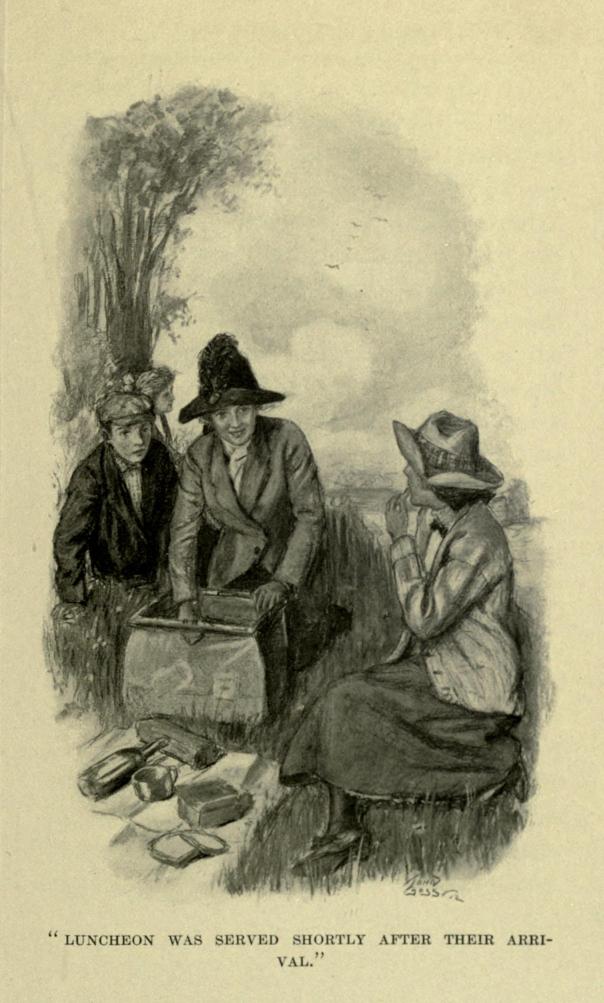
"LUNCHEON WAS SERVED SHORTLY AFTER THEIR ARRIVAL."
Luncheon was served shortly after their arrival. "I don't know why it is," Peggy confessed. "But it always seems as if you couldn't get fairly started on a picnic, till you'd had something to eat. I feel that way myself and I guess these children are just the same only more so." Accordingly they sat in a ring in the fresh young grass, and disposed of such quantities of sandwiches and doughnuts that the scientific estimate of the capacity of the human stomach was then and there proved incorrect, beyond a shadow of a doubt. Peggy expected that the gorged Dunns would find a period of inactivity necessary, but instead of stretching in somnolent attitudes under the trees when the moment arrived that they could hold no more, they scattered in all directions. As it seemed quite impossible that they should get into mischief or danger the girls left them to their own devices, and sat talking happily while the breeze brought the coolness of the little lake, and the fragrance of the apple orchards, mingled with more delicate scents, the perfume of the moist earth, the breath of tiny flowers fading unseen, perhaps, but making earth the sweeter for their blooming.
"I found some grand ones."
Peggy looked up smilingly into Estelle's radiant face. Then she got to her feet rapidly, for the child's hands were filled with early garden flowers, with several clusters of geraniums showing up dazzlingly among the more modest blossoms. "Where did you get them?" Peggy gasped.
"Over back of that house." Estelle gestured with her treasures in the direction of a snug-looking farmhouse standing on a rise of land above the lake.
"Don't pick any more there, dear. I guess those flowers belong to the people who live in the house. But all the flowers in the woods, and growing around the meadows, belong to everybody." She made a grimace at the other girls, over the head of the unconscious Estelle. "I've got to go up to the farmhouse and explain matters."
"I'll go with you," said Elaine, jumping to her feet, and the two started up the long slope, Peggy sighing penitently. "It was all my fault. I was so anxious those children shouldn't think they were going to be arrested if they picked a dandelion, I guess I went a little too far the other way. Who would have thought that they would have stumbled on a garden first thing?"
The farmer's wife, being indoors, had not noticed the rifling of her garden, but so far from displaying annoyance over Peggy's explanations, she was manifestly interested. "I've heard tell," she replied, "that some of those city children set store by flowers to beat all. And she picked her hands full, did she? Didn't know the difference between wildflowers and garden stuff? Well, well!"
But when Peggy, producing a not over-full pocketbook, made tentative offers to pay for the damage Estelle had wrought, the good woman's protest waxed indignant.
"Now I'd like to know what you take me for? Pay for 'em? I'd be ashamed to look my husband in the face when he came in if I took your money." She went to the window and looked with interest down the long slope, to the slight figures moving with such joyous abandon. "All brothers and sisters, you say?"
"Yes, and there's two others not here, a sister who's about fourteen and the baby."
"And we haven't chick nor child," said the farmer's wife. The shadow that crossed her kindly face, as she stood watching the small flitting shapes, had not lifted when Peggy and Elaine said good-bye.
At the door Peggy had an idea, and halted. "There isn't any boat that we could get around here, is there? I'd like to take those children out on the water if I could."
The farmer's wife came to the door. "Why, we've got an old dug-out tied down under the willows. It leaks a little, but you'd have to load it with stone to sink it. We keep it there, 'cause it's handier if we want to go to Mr. Miller's, t'other side of the lake, to row across, than to go all the way 'round. 'Tain't so easy rowing as it might be, but you're welcome to it if you want it."
The ungainly craft, tied under the sheltering willow trees, did not look as if it would be so easy rowing. But the girls undaunted, took their seats, each with a pair of oars, and started bravely for the other shore, the water slapping the square end of the dug-out, as if the two were in a plot to make progress slow and difficult. The appearance of the boat was hailed with shrieks of delight by the Dunn family, who rushed to the water's edge to view its advance.
"There's room enough for all of them at once, if it wouldn't be too heavy," Peggy remarked.
"O, I guess we can take them all," returned Elaine, tugging at her oars. "They'll be satisfied if we just keep it moving, you know."
"They're all waiting to welcome us." Peggy glanced at the row of motionless figures, ranged along the shore as if held spell-bound by the spectacle afforded by the stately craft and the toiling oarsmen. Then instinctively Peggy began counting, "Three, four, five. Where's number five?"
"It's one of the little girls that's missing, Estelle or Isabel. I can't tell them apart." Elaine's eyes travelled from the waiting row, across a clump of trees reaching to the water's edge, on to the cleared acres belonging to the Miller farm. Then she uttered a startled exclamation.
"Peggy! See that child! Will she know enough to let them alone?"
"What? Where?" Wildly Peggy's eyes followed those of her friend, and at the sight which had prompted Elaine's frightened question Peggy rested on her oars, staring blankly ahead.
Against the green of the hillside rows of little white boxes stood out in bold relief. Among them wandered Isabel Dunn, as Gulliver might have wended his way among the habitations of Lilliput, looking about her with a curiosity that betrayed no twinge of timidity.
"Bee-hives!" Peggy gasped. "And I suppose she never heard of such a thing as a bee-sting. O, if she'd only look this way!"
But Isabel Dunn was too absorbed in her own discovery to have any eyes for the pageant on the lake, so attractive to the other members of her family. She stood absorbed in front of one of the hives, watching the busy occupants with an interest which owed part of its zest to the fact that here was something of which Miss Peggy had said nothing. Out in the country folks made houses for bugs to live in. She wondered that Miss Peggy had failed to comment on such surprising philanthropy.
Heedless of the line-up of the Dunn family, eagerly anticipating a row, the girls turned the boat toward the absorbed student of nature. Apprehension put fresh energy into their stroke. The dug-out toiled ahead at what was really a surprising rate of speed. The little Dunns, disappointed, joined in a howl of protest. The sound reached Isabel's ears, and she turned, inadvertently stumbling against a hive. An instant later, her knowledge of natural history was increased by a significant item, in a fashion to impress it on her memory indelibly.
Shrieking wildly, Isabel started down the slope, the enraged bees in pursuit. Peggy and Elaine had thought they were pulling their hardest but at the sight of the child's danger the dug-out seemed fairly to leap ahead, like a lazy horse pricked with a spur and roused to unwonted speed.
Down the hill came Isabel, gaining momentum with every step, driven to frenzy by the darts of her relentless pursuers. Whether the blue lake seemed a refuge, or whether she would have rushed with equal blindness into flames, it is impossible to say. But it is certain when she reached the water's edge she kept on running, with the result that in an instant she had splashed out of sight, while the boat was still some distance away.
"Pull!" gasped Peggy. "Pull hard!" But she would have done better to save her breath, for Elaine, her lips parted, showing her clenched teeth, was putting into each stroke every ounce of energy at her disposal. In an appallingly short time, a tow-colored head came to the surface of the water and again disappeared.
"A little harder on the right oar," warned Elaine. Again she set her teeth and pulled. Again the mop of drenched hair showed on the surface of the water and went under. The girls watched to see it come in sight again, but it did not reappear.
"She's not coming up." Elaine rose in the boat, kicking off her low shoes, and unfastening her heavy walking skirt. Then she went over the side with the ease and celerity of the practised swimmer. Peggy, who had not added swimming to her many accomplishments, and had watched for Isabel's reappearance in an agony of helplessness, felt hope revive. Elaine seemed so sure of herself that it was impossible not to share in her confidence.
The little group on the shore had discovered what was happening. The children ran about crying shrilly. Above the sound of their frightened voices rose Amy's lamentations as she wailed, "O, why didn't I watch her! O, why didn't I watch her!" Not that Peggy spared time just then to interpret the medley of sounds beating upon her ears. She saw nothing but the placid water, heard nothing but the sound of the little ripples breaking against the boat's side.
Elaine came to the surface, after some seemingly interminable seconds, spluttered, filled her lungs and went under again. Peggy, white and shaking, sat crouched in her seat. O, those crawling seconds, that terrible waiting, the ghastly uncertainty. She felt the scented breeze in her face, and dimly realized that overhead the sky was blue. A snatch of bird-song dropping to her ears made her suspense seem unreal. It could not be that this dreadful thing was happening, while all the world around was unchanged.
Peggy came out of her trance when Elaine's dripping head cleaved the blue water. This time Elaine did not come alone. Her left hand was supporting a limp little figure, whose hair floated on the surface of the water like yellow seaweed. Half a dozen strokes brought Peggy alongside the pair. Leaning over, she took Elaine's burden from her. The head that swayed like a broken flower, the open, unseeing eyes, the colorless face, seemed to her inexperience proof that the worst had happened. She sat like one stunned while Elaine gripped the dug-out and pulled her dripping self over the side.
"Quick, Peggy!" Elaine's teeth were chattering, for though the sun was bright the water of the little lake still retained a coolness suggestive of melting snow. "Quick! We must get her to the house, as soon as we can, and get to work."
The suggestion that something still could be done, put new life into Peggy. It is quite certain that the clumsy dug-out made record time in reaching the landing. The farmer's wife was waiting for them there, and she took the unconscious child in her motherly arms, and almost ran up the slope, while the girls followed, Elaine walking with difficulty in her wet clothing, Peggy weak from fear.
Fortunately for them all the suspense was nearly over. For the farmer's wife had hardly begun her work of resuscitation when a soft little sigh escaped from the child's blue lips. A minute after she opened her eyes. Apparently it was too great an effort to be prolonged, for immediately she closed, them again. But the flutter of the lids was enough to render Peggy limp with relief and thankfulness.
"There! There! Have a good cry if you feel like it," exclaimed the farmer's wife, bustling about. "There ain't nothing like a good cry, if anybody's been all keyed up. I'll get some hot milk down her, and she'll be all right. But your friend had better be getting out of her wet things, or she'll be coming down with something. 'Tain't too late yet for pneumonia."
It was a good thing for Peggy to divert her mind with anxiety about Elaine, who, having been duly rubbed and given something hot to drink, was ordered to bed, while her clothing dried by the kitchen fire. By this time Isabel was sufficiently revived so that the other children could be admitted to admire her appearance as she lay between blankets smelling strongly of the ammonia which the farmer's wife had applied to the bee stings. There was a gleam of envy in Estelle's eyes as she gazed upon her sister. It was not fair that Isabel should have everything, first be stung by bees, and then nearly drowned. It would have been more generous of her to have divided those claims to distinction with some equally deserving member of the family.
"Seems like a shame to disturb that child by trying to take her home to-day," said the farmer's wife. "Why don't you leave her with me over Sunday? By that time she wouldn't get any harm from going out."
"I don't know as she would be willing to stay," Peggy replied, but when the case was laid before Isabel she indicated the greatest satisfaction with her present surroundings. Isabel was not accustomed to being a person of importance. She liked the sensation, as she liked the softness of the bed on which she lay and the brightness and neatness of the pleasant little room.
"Of course it would be a great deal better for her to stay. Do you think your mother would mind, Jimmy?" asked Peggy, reflecting that the responsibility of taking a party of children to the country for a day was greater than she could have imagined. Jimmy's attitude was reassuring. "Ma! Why, she'll be glad to get rid of her over Sunday," he declared. "Pa hates so many underfoot on Sundays." It was accordingly arranged that the farmer's wife should bring Isabel home Monday morning, provided Isabel's condition warranted it. Otherwise she was to communicate with Peggy, who assumed the responsibility of conveying the information to Mrs. Dunn.
The picnic was resumed, awaiting the drying of Elaine's clothing, but it is safe to say that no one of the Dunn family had the opportunity again that day to get into mischief. Each girl made herself responsible for a child, and watched it with a hawk's alertness, though not with a hawk's motive. "We've let them steal flowers, and get stung by bees, and then pretty nearly drowned," Amy remarked. "And for one day that's enough," a sentiment received without any dissenting voice.
But in spite of the drawbacks of the day and the fact that Isabel was left behind, the small Dunns were enthusiastic over the picnic. "Be you goin' to take us again some day, Miss Peggy?" little Johnny asked, as he hugged his armful of flowers closer, and smiled at her over the heads of the blossoms.
"I don't know," Peggy answered with a gasp. "I'll have to wait to get thoroughly over this, before I'll be able to make up my mind."
CHAPTER XXI
AN UNEXPECTED VISITOR
The papers Monday evening contained an account of a heroic rescue. There was a fancy sketch of a young woman diving from the deck of a pleasure yacht to save a child who with uplifted arms was drowning in the most dramatic manner imaginable. Elaine saw the sketch over the shoulder of the man who occupied the seat in front of her in the street car, and it was not till she reached home that she discovered that the theatrical young heroine was supposed to represent herself.
Along the Terrace they had found it out long before and each of the girls had made a beeline for the Marshall home with a paper under her arm. Peggy was the first arrival, with Amy a close second, while Ruth and Priscilla reached the door at the same minute. What with the rustling of papers, and the chorus of voices all explaining at once, Mrs. Marshall conceived the idea that something dreadful had happened, and it was necessary to produce the smelling-salts before she was equal to hearing the account.
The story had been written up with high regard for picturesqueness. The Dunn family had multiplied into a car-load of ragged children and the five Terrace girls had become wealthy young women who devoted a large share of their leisure to philanthropy. Upon Elaine, as the heroine of the occasion, adjectives were lavished with the generosity characteristic of newspaper reporters when they start out to be complimentary. Mrs. Marshall gradually lost her look of apprehension as she listened, and her face took on a motherly pride, which obliterated, for the time, its habitual expression of fretful weakness.
When Elaine arrived there was a rush in her direction. Four newspapers were shaken in her face. Four voices, each uplifted in the laudable effort to drown out the other three, read the most thrilling of the head-lines. Elaine stared incredulously at the heroine with the dishevelled hair, on the point of plunging from the deck of the yacht into tossing waves below. At last the truth dawned upon her.
"You don't mean, girls," she gasped, "you can't mean that it is intended for--me. O, it can't be possible."
In chorus four voices read, "The heroine of the occasion is Miss Elaine Marshall, 2618 Friendly Terrace." Further disclosures were checked by Elaine's putting her hands over her ears.
"All that in the paper about me? How perfectly dreadful! How in the world could they have found out about it?"
Ruth looked a little guilty. On her arrival home Saturday night, she had painted Elaine's exploit in glowing colors, and Graham's friend, Jack Rynson, was a reporter on the Star. Fortunately Elaine did not notice the incriminating color in Ruth's cheeks, and Peggy was saying consolingly, "Why, I think it's splendid. Just listen, Elaine! 'Seeing the peril of the child, the intrepid young woman, with a magnificent disregard for her own peril--'"
"Please," implored Elaine, her cheeks flaming. "I feel like a hypocrite, when I look at that yacht and those foaming waves, and think of that ridiculous old dug-out and the smooth little pond. Heroine! It's the most absurd thing I ever heard of."
But though Elaine protested, the fact remains that there are more unpleasant things than to be overpraised for what one has done. Her mother's air of radiant pride, the satisfaction the other girls took in the highly decorated account of the exploit, even the reporter's superfluous adjectives were not without their agreeable side. When the departure of the girls with the rustling newspapers left the house to its customary quiet, Elaine was aware of an inconsistent, and thoroughly inexplicable impression that something very pleasant had happened.
The peremptory ringing of the telephone bell interrupted Elaine's supper. Mrs. Marshall and Grace listened to the following one-sided conversation.
"Yes, yes, it's the same one."
"Why, I didn't know."
"O, it was dreadfully exaggerated. It really wasn't anything."
"No indeed. I feel as well as ever."
"She's very well, thank you, and Grace too."
"I'm sure we're glad to know our friends haven't forgotten us."
"O, we'd be so pleased to see you any time. O, thank you, very much. Good night."
When she had hung up the receiver she turned a luminous face upon her family. "What do you think," she cried tremulously. "That was Mrs. Winthrop."
"Not Mrs. Littleton Winthrop!" Mrs. Marshall set down her tea-cup, her hand shaking.
"Yes. She had read that ridiculous account in the paper, and she said the nicest things. And she and Vivian are coming to see us very soon. O, dear, I'm too excited to eat."
But the excitements of the evening were not over by any means. Shortly after eight o'clock, a motor coughed outside the door. There was a sound of feet on the walk and then a ring at the bell which somehow suggested that somebody who knew exactly what he wanted had his finger on the button.
Elaine opened the door, for enough of Grace's shrinking remained so that she found that simple office difficult. A plump, red-cheeked gentleman, who looked rather like an understudy for Santa Claus, greeted her with something more than cordiality.
"Elaine Marshall! Well, upon my word! You've grown almost out of knowledge." He put his hand upon her shoulder and gave her a smacking kiss on the cheek nearest him. "That's for the heroine," he said. "Mother in? And Grace? Good. First rate."
He had his arm about the girl's shoulder when he walked into the living-room, where Mrs. Marshall and Grace had sprung to their feet at the sound of his voice, and he held Elaine firmly while he shook hands with the others. Then he seated himself, stroking his snowy beard, and looking about him with eyes that twinkled serenely. He looked more like Santa Claus than ever.
"Look here," he said. "I'm not going to scold. That isn't my way. But for you to hide yourselves away from your friends isn't a square deal, you know. I could say considerable on the subject if I were that sort of a man. But as long as our little heroine here--"
"Little!" cried Elaine, her indignation over the adjective eclipsing for the time being her modest reluctance to accept the noun.
"Has given me the clue to your whereabouts," continued the visitor, ignoring the interruption. "We'll let bygones be bygones."
The talk turned to less delicate topics. But presently the caller, who gave increasing evidence of being a man who knew his own mind, turned on Grace with a question.
"Given up the idea of finishing your college course?"
"O, yes, Mr. Clement."
"Why?"
Grace hesitated. "If there were no other reason," she said at last, in a low voice, "the question of expense would settle it."
"That's what I fancied. Suppose you start in next fall, and send your bill to me."
"But, Mr. Clement--"
"It's good business sense, Grace. A thing half done is undone, and that's all you can say. Go ahead and get your education. Fit yourself for the work you like, and the work you want to do."
"But, Mr. Clement, I wouldn't think of accepting--"
"Stop right there, my dear. You're going to talk nonsense about being under obligations and that sort of thing. Your father and I were friends in our boyhood and it was the sort of friendship that stood by in a rough sea. More than once your father has come to my help when his name on my note was all that stood between me and bankruptcy." Santa Claus took out his handkerchief and blew his nose violently. "And after that if his daughter had a silly pride which wouldn't allow her to accept my help in making as much of herself as possible, I should be driven to conclude that she wasn't worthy the name she bears."
Elaine looked at her sister furtively, and something she saw in Grace's face made her heart flutter with a glad expectancy so keen as to be almost pain. Grace's brow was knit, and her face was pale, visible signs of an inner battle. Elaine breathed hard, guessing the tremendous importance of the struggle, and the significance of victory.
"I've grounds for being very angry," Mr. Clement went on with his whimsical smile. "When the three of you disappeared without a word or sign, I was hurt, and many of your friends felt as I did. I tried to make myself think that you would write me soon, but the weeks and months went by, and not a line from any of you. I had a right to be angry, and I was. However, I'm not a man to continue bringing up old scores. We'll call it square, Grace, if you'll close with my offer. What do you say? Is it a bargain?"
His compelling eyes were on her. For a moment he looked less like Santa Claus than some old viking, fearless of tempestuous seas, accustomed to conquest. As Grace's troubled gaze met his a curious change was apparent in her face, as if a spark of his resolution had fired hers.
"I'll--I'll do it, Mr. Clement," she faltered, and checked herself quickly, as if frightened by the rashness of her own promise. But Mr. Clement gave her no time for wavering.
"Done!" he cried, and catching the frail hand in his he shook it heartily. "And this spring and summer devote yourself to getting a little color, and putting a few pounds of flesh wherever you need them most. If you're not careful, this little sister of yours will be putting on airs, and ordering you about just because she's the biggest."
It was not early when Mr. Clement left, but, in spite of the lateness of the hour, Elaine yielded to an overwhelming desire to see Peggy. It was to Peggy alone that she had confided her great unhappiness, and it seemed to her that she could not sleep unless Peggy had heard the good news, the wonderful sequel to the incident which had made the close of the previous week eventful.
Elaine framed some excuse for a late call on Peggy which she herself had forgotten as soon as the door shut behind her, and made her way across the dewy grass. Overhead the stars twinkled in friendly fashion. The splendid winter constellations had given place to the less showy pageant of the summer, but it flashed across Elaine's mind that she had never before dreamed there were so many stars. The sky seemed golden with them. Peggy, upstairs in her own room, struggling with an essay due the end of the week, looked up amazed at an Elaine to whom she had never been introduced. For the new stars which Elaine had seen flashing in the sky, were only reflected from her shining eyes. Her radiant face prepared Peggy for the best news that could be spoken.
"O, Peggy! What do you think? Grace is going back to college."
"To college!" Peggy's sympathy was never of the half-hearted sort. Now the two words fairly tinkled as she spoke them, as if Elaine had announced some tremendous good fortune which had befallen Peggy herself.
"An old friend of papa's, Mr. Clement, is going to send her. And, O, Peggy, another old friend, Mrs. Winthrop, called up while we were eating supper. She had seen that account in the paper and was so sweet about it. I'm afraid that perhaps we weren't just fair to the people we used to know. Perhaps they were better friends than we thought."
"Of course," cried Peggy. "People are almost always better than you think. The things that seem horrid can generally be explained."
"And isn't it funny!" Elaine found in a burst of laughter the relief that might as easily have come through tears. "All this wouldn't have happened, if it hadn't been for those blessed Dunns."
Peggy jumped, as if the name had touched a nerve. "O, I've just been aching to tell you that Isabel was going to stay."
"To stay?"
"Jimmy came over and told me just before supper. That farmer's wife came in bright and early this morning. She wanted to keep Isabel, and Jimmy said his mother was willing, because it would be one less to take care of. There's a sad side to it," Peggy concluded, her bright face falling, "to think that the mother of any child would give her up as easy as that, but I can't help being glad that little Isabel will grow up with grass and flowers around her, and plenty to eat, and all the rest of the things they don't have on Glen Echo Avenue."
Elaine had risen to go. "I feel like staying and talking all night but I must get to bed and be ready for my work to-morrow. Yes, indeed. I'm awfully glad about little Isabel. It seems as if everything was turning out right for everybody."
"It's a pretty good world after all," smiled Peggy, voicing a favorite theory.
The words rang in Elaine's ears as again she sped across the dewy clover under the spangled sky. "Of course," she told herself. "How could it help being a good world as long as it has such people as Peggy Raymond in it?"
THE END.