Front matter (continued 2)
Reading edition
"I haven't asked you yet if you'd help in our Bazar, have I?" exclaimed Peggy, addressing Elaine. "It's the tenth of this month. It was the tenth we decided on at last, wasn't it, Ruth?"
"Yes, the tenth," Ruth replied, and Priscilla took up the explanation. "It's for the Empty Stocking Club. We buy dolls with the money we make, and dress them afterward."
"And it's an awful lot of fun," said Peggy. "Fun all the way, first making the things for the Bazar, and then the Bazar itself, and then buying the dolls and dressing them. And of course giving them to the children is the best fun of all." She looked at Elaine expectantly, but, to her surprise, Elaine hesitated.
"My daughter would have been very glad to help you when our circumstances were different," said Mrs. Marshall, coming to Elaine's assistance. "My family have always given largely to charity. Solicitors for philanthropic objects often said to my father, 'We like to come to you first, Mr. Elwell, because you always give so generously, and that inspires others.' And Mr. Marshall, before his business reverses, thought nothing of writing a check for a hundred dollars for a worthy cause."
"The trouble with me," said Elaine abruptly, "is that it is all I can do to help myself." She looked about the little circle, somewhat defiantly, and Peggy, who knew that this piece of confidence was not in the least like Elaine, felt a twinge of regret at having unintentionally forced her to make such an admission.
"You don't understand. Of course none of us can give big things," she explained hastily. "Now, last year, one of the best sellers at our Bazar was as simple as it could be, and it hardly cost anything. It was only a gingham belt, with two dangling tapes, and, at the end of each tape, a square of gingham padded for lifting things out of the oven. They really are the most convenient things; for, generally, when the cake's ready to come out, you can't find anything to lift it with, and so you take your apron, or else a dish towel. We sold them for twenty cents apiece and took orders for a lot more than we had ready."
"And, sometimes, you can make a dear little work-bag out of pieces you have in the house," suggested Ruth. "I made a real pretty one last year: don't you remember, Peggy? If I had piece of newspaper I could show you just how it was done. You can use scraps of silk and ribbon you wouldn't think were good for anything."
Somebody found the necessary newspaper, and Ruth hastily constructed a pattern of the article she had tried to describe, while Elaine listened, her color rising steadily. The girls had misunderstood her, and their efforts to show her how she could help without being at any expense added to her sense of humiliation. What she had really meant to imply was that a girl situated as she was, should be exempt from any obligations to help other people. Elaine looked upon herself as an object of sympathy. It was bad enough to face the prospect that one's own stocking would be empty at Christmas time--relatively empty, at least--but to be asked to help fill other stockings was adding insult to injury.
Yet this, hard as it was, did not cut as deeply as the suggestions the girls were now making, with the best intentions in the world. Poverty, from Elaine's standpoint, was equally a misfortune and a disgrace. She had confessed defiantly to being poor, without dreaming that her callers would take her at her word, and proceed on the assumption that in her case economy was really a matter of importance. When Priscilla started in with a description of a hat-pin holder, the materials of which, she assured Elaine, impressively, wouldn't cost more than ten cents at the outside, Elaine felt that she had reached the limit of endurance.
"There!" she exclaimed as if the thought had just occurred to her. "I believe I have a little thing ready that I could contribute." She went to her room, a sense of triumph effacing the intolerable humiliation of the past few minutes. The sacrifice she was about to make was insignificant compared with her opportunity to silence her advisers, and to prove that in spite of the reverses with which the family had met, she could be as generous as anybody. The article for which Elaine was looking was put away carefully, wrapped in tissue paper. She looked at it with brightening eyes, and returned to her visitors almost jauntily.
"It's a little thing I made in the summer," she observed casually. "The Irish crochet is awfully popular, you know, and I think the pattern's rather pretty." With a carelessness almost too pronounced, she dropped her offering on Peggy's knee. "If that will do you any good, you're quite welcome to it."
Peggy was staring with all her eyes. "Why, Elaine! Why, girls! It's a collar. Real Irish crochet! Isn't it gorgeous!"
Such as it was, Elaine's triumph was complete. The girls broke into exclamations of admiration, exchanging bewildered glances as they did so.
"She made it herself. Isn't she a wonder? There won't be anything at the Bazar to compare with it."
"That ought to bring a splendid price. Just think of the dolls we can buy with all that money."
"It's gorgeous," repeated Peggy. She looked from the dainty article in her hand toward the giver. "Really, Elaine," she hesitated, "it's too nice. It's more than you ought to give."
An instant reappearance of Elaine's old hauteur convinced Peggy that she had blundered. "If I am going to give anything," Elaine said with dignity, "I want it to be nice."
The tactful Peggy abandoned her well-intentioned effort to prevent what she felt sure was a piece of reckless generosity. "Well, you've done it," she laughed. "It's pretty certain that we won't have anything else nearly as nice as this. And, Elaine, you'll help us the day of the Bazar, won't you? There'll be lots to do, selling the things, and serving the ice cream, and being nice to the people who come in."
Elaine having reinstated herself in her own eyes, by the character of her donation, graciously agreed to lend whatever assistance might be further required, and then everybody seemed to feel at the same moment that it was time to go. Priscilla excused herself on the ground of her lessons. "With your school principal for a father," she explained, "you can't afford to fail very often." Ruth remembered that Graham was going to bring somebody home to supper. Amy made vague references to letters that must be written. They moved toward the door with less chatter and laughter than usually characterizes the farewells of girls of their age. At the foot of the walk they parted, Amy and Peggy walking on together, while the other two turned in the opposite direction.
"Say, Peggy!" Amy cast a sidelong glance at her companion. "Do you think Elaine is awfully generous?"
Peggy's eyes opened. "Why, it was very generous to give us that collar," she exclaimed. "You know that Irish lace--"
"O, yes, I know all about it." Under Amy's careless good nature a shrewdness of observation sometimes cropped out in a rather surprising fashion. "It was generous, if she cared about the Empty Stockings, but something in the way she did it made me feel as if it was mostly intended to impress us."
"O, Amy!" Peggy was unfeignedly shocked. Amy met her reproachful gaze and surrendered with a laugh.
"You funny old Peg!" she said disrespectfully. "Well, never mind why she did it. Our finances will get quite a boost, anyway. Good night." And as she crossed the street, she added with seeming irrelevance, "I'm sorry for anybody who makes such hard work of being poor."
CHAPTER VII
THE BAZAR
The next ten days were busy ones for the girls of the Terrace. It is true the Bazar had been more or less on their minds throughout the year, and many of them had devoted a generous share of their summer's leisure to preparation, but now industry had become epidemic. The girls met at one another's homes after school, and, busy as their tongues were, those nimble organs failed to outstrip the industrious fingers.
Elaine was not invited to any of these gatherings, for the girls all felt that she had done her full share, and that she would probably consider herself imposed on, if asked for further assistance. Dorothy, on the other hand, was an important figure at almost every meeting. To see Dorothy sewing together pieces of bright-colored calico, with stitches an inch long, was a constant incentive to industry, while her habit of waiting till an article was completed before deciding on the use to which it should be put, enlivened the dullest hours. Dorothy scorned to ask advice; she simply put her small head on one side, studied the work of her hands thoughtfully, and, after wavering for five minutes between a doll's sunbonnet and a penwiper, would perhaps surprise the company by announcing that the nondescript article was a necktie for Aunt Peggy.
The Bazar was usually held at Ruth's home, as in the Wylie cottage two rooms, separated by folding-doors, could be thrown into one, while the front hall was of more generous proportions than in most of the houses of the Terrace. On the memorable Saturday designated on the calendar as the tenth, the Wylie establishment was a scene of activity suggesting a hive of bees at swarming time. Girls made their appearance laden with baskets and mysterious parcels. Graham Wylie, Ruth's tall brother, with Dick Raymond, and other boys of the neighborhood, made themselves useful bringing small tables and ferns, borrowed indiscriminately from anyone who would lend them.
Elaine, who had come over to help, had a more pleasant sense of "belonging" than had been hers at any time since the mud-splashed hack had deposited her at the door of the only vacant cottage on the Terrace. She had been assigned to assist with the decorations, and being a girl of excellent taste and original ideas, she gradually found herself taking charge, and directing the others. This was pleasant in itself, and the approving comments called forth by the arrangement of flags over the mantel, and the bunching of the palms and ferns in the front hall, brought an unwonted color to Elaine's cheeks and brightness to her eyes. Peggy, who was accomplishing as much as any other half-dozen of the workers, paused in her labors long enough to admire the decorative effects, including the remarkable transformation wrought in Elaine's case by a bright color and a cheery smile.
"To think she could be so pretty," Peggy said wonderingly, and then finding Graham at her elbow she started and colored high.
"That Marshall girl, you mean?" queried Graham, seemingly unaware of her confusion. "Yes, it does make a difference. Most of the time she looks a mixture of starch and vinegar that isn't particularly attractive. What ails her, anyway?"
"I don't know." It struck Peggy, as she replied, that all she knew of Elaine's affairs was singularly inadequate to account for the weary, disillusioned look which was the other girl's habitual expression. "You know they used to be quite well off," Peggy explained, as Graham helped her move a table which was taking up more than its share of the room. "I guess it's more comfortable never to have much, than to have it and lose it."
It was not till after one o'clock that everything was ready. The fancy work tables were in the front room, and the display proved that the loyalty of the Terrace girls to a good cause was not of the flash-in-the-pan variety. Many days of hard work were represented on those crowded tables, and, though the skill of the workers varied, the average was commendable. Elaine's collar had the place of honor, with a background of black velvet to set off its delicately intricate pattern. In the back parlor were the candy and ice-cream tables, as well as the little tea-table, over which Priscilla was to preside, the latter being a concession to the old ladies who no longer possessed a "sweet tooth," and who shivered at the suggestion of ice cream in November.
The girls flew home to swallow a hasty dinner, without any very definite idea as to what they were eating, and then hurried themselves into their best clothes, and were back again a good half-hour before the advertised time for opening the Bazar. "From three to ten" the announcements had read, and when the grandfather's clock in the hall struck the first-named hour there was a general craning of necks, as if with the expectation of seeing a procession of patrons ascending the front steps. Nobody was in sight, however, and some faces assumed an expression of anxiety.
"Three o'clock and not a soul here," Ruth said tragically. "O, dear! I hope that somebody'll come after we've all worked so hard."
"There's a splendid concert at the Lyric this afternoon. I shouldn't wonder if that took a great many people who might have come here," observed Priscilla, with an air of being prepared for the worst.
"I thought all the time, that we should have some hand-bills," Amy exclaimed. "You tell people, and you put up notices in the drugstore, but that isn't enough. There ought to be hand-bills distributed the night before."
The spirits of the company were rapidly approaching the zero point when Peggy came to the rescue with one of her sunny suggestions, which appreciably raised the temperature. "Why, it's only three o'clock. People never come exactly on time to things of this sort." Then she recounted Dorothy's latest escapade and set them all to laughing.
But when the hands of the clock pointed to twenty minutes past three, Peggy's utmost efforts were unequal to the task of keeping up the spirits of the little crowd. Various explanations were advanced for the failure of the Bazar. Peggy's opinion was asked as to whether or not Murvin would take back the ice cream. And then the atmosphere of gloom was dissipated by the sound of the door-bell.
It was an old lady whom Dick Raymond, acting door-keeper, admitted to the Bazar, a rather shabby old lady, who walked with a limp, and had a market basket on her arm. It is doubtful whether her arrival would have been regarded as an important event anywhere outside of Mrs. Wylie's parlors. But at the sight of her rusty black bonnet the creases suddenly vanished from anxious faces and dimples appeared in their stead. She was the first arrival, and possessed all the mysterious charm that attaches itself to the first blue-bird or the first violet.
She was an appreciative old lady, too. She referred to the hand-painted paper-dolls, which formed the major part of Priscilla's contribution, as "pretty little images," and admired some crocheted wash-cloths, with pink edges, under the impression that they were a substantial sort of doily. Only when her attention was called to a drawnwork handkerchief did she become critical.
"Mine gets holes in 'em fast enough without beginnin' that way," said the old lady, laughing heartily at her own wit, and everybody laughed in sympathy. She wound up her exhaustive examination of all the articles displayed by the purchase of a holder and five cents' worth of peanut brittle. As she limped down the steps she met three or four ladies coming up, but not one of them elicited the enthusiasm which had been the spontaneous tribute to the first arrival.
By quarter after four the rooms were buzzing, and busy as Elaine was, she found opportunity to admire the resourcefulness of Peggy. It was Peggy who soothed the feelings of the girl who thought that they should have charged more for her bureau scarf, and who propitiated the patron who felt that she had paid more than was right for a hem-stitched towel. It was Peggy who came to the assistance of a perplexed "saleslady" who could not think how much change was due her customer, and who took charge of wrapping some peculiarly obstinate article, and it was also Peggy who found, for the lady who was aggrieved over discovering that something she wanted had been sold to another purchaser, a similar article which suited her just as well. Peggy seemed to have the faculty of being every where at once. She was equal to all the little crises of the occasion.
"I don't see how you manage it," Elaine said to her during a temporary lull in the proceedings, late in the afternoon. Compliments were rare on Elaine's lips, and Peggy, looking up, had no idea that she was being complimented. "Manage what?" she asked.
"O, helping everybody out, and smoothing everybody down, and the queer part is that you keep so cheerful about it."
Peggy smiled a little.
"The queer part, as you call it, is really the secret, if I've got any secret. If you keep cheerful and are polite, and don't lose your head, it's easy enough to get other folks to see things the way you do."
By six o'clock the girls were tired but triumphant. Peggy's cheery prophesies had been more than realized, and from eight to ten they were sure of another period of activity, which would, in all probability, empty their tables and fill their treasury. The workers hurried home for a supper, even more of a form than dinner had been, and were back on duty before there was any chance of new arrivals.
On the cheerful group, comparing notes as to the day's experiences and calculating the probable gains, by methods which brought startlingly diverse results, Ruth descended like a whirlwind. "Girls, the ice cream's gone."
"Gone!" echoed a blank chorus, and Peggy, as usual the first to rally, exclaimed, "Why, I don't see how that can be. We didn't have--"
"No, no, you don't understand," cried poor Ruth, wringing her hands. "We only used one freezer of ice cream this afternoon. But the other one, the big one, has disappeared."
"Stolen!" Priscilla gasped. "Well, anybody who's mean enough to steal from empty-stocking children!"
"That'll cut down our profits dreadfully," groaned Amy.
Peggy roused herself. "Maybe there's some mistake," she cried. "It almost seems as if there must be some mistake. Let's look outside."
There was a rush for the back door, despite Graham Wylie's philosophical suggestion that a ten-quart ice cream freezer was a difficult thing to mislay. The November night was starless and chilly, and most of the girls, after taking a disconsolate view of the landscape, withdrew shivering to the warmth within, to bemoan their misfortune. Perhaps Peggy found it harder to give up than most people do. She went down the walk to the alley, Graham following.
"It's such a big thing," observed Peggy over her shoulder, "that you wouldn't think it could get very far without attracting attention. You don't suppose--"
"Sh!" warned Graham suddenly, and both went forward on tiptoe. Further up the alley sounded a curious bumping noise. A murmur of voices broke the hush of the night.
Graham felt for the bolt of the back gate, found it already drawn, and smiled, well pleased. The voices outside were audible by now.
"Say, that's far enough."
"'Tain't far enough till it's inside, kid. You don't s'pose they's goin' to look fer ice cream in no alley, do you?"
Something bumped against the gate. Slowly it opened, and a capped head appeared. Then Graham pounced; there was a thud and a wild scampering, and Peggy flew to the rescue of the overturned freezer.
The two small boys who had walked into the trap were no match for the young collegian, who was training for the hundred yard dash next field day. If the boys had run in the same direction he would have had them both, but as one went east and the other west, he was obliged to make a choice. He came back holding at arm's length an urchin whose squirmings were the most extraordinary display of agility that Peggy could remember to have witnessed.
"Don't try to carry that freezer," exclaimed Graham, as he returned with his struggling captive. "We'll send some of the boys out for it. And now let's come inside and see what we've got here."
Graham's captive proved to be a small boy with carroty hair, innumerable freckles, and a square chin, which, at this moment, seemed possessed of sufficient stubbornness to equip a regiment. His coat had at one time been too large for him, but had been fitted to his diminutive person by cutting the sleeves off at the elbows and pinning the surplus of the back over into a large plait by means of safety pins. His shoes were so large that Peggy no longer wondered at the peculiar flapping echo of the footsteps heard in the alley.
"Well, you young scamp!" Graham held his captive under the chandelier and scowled down upon him impressively. "You're making a nice early start, you are. Do you know where you're likely to end up, if you keep on this way?"
If the boy knew, he had no intention of telling. To all appearances he was both deaf and dumb. His mouth had become a straight, rather bluish line, above his defiant little chin.
"No tongue, eh? Well, I guess we can find a way to make you talk. Just step to the 'phone, one of you," added Graham over his shoulder, "and call up the police station."
There was a chorus of protests.
"O, no, Graham. He's so little."
"And we've got the ice cream back, Graham, so no harm's done."
Peggy flung herself into the discussion. "Why, Graham, he was bringing it back."
"Bringing it back," sneered Graham. "Why should he steal it, and then bring it back?" The logic was irresistible, but Peggy was a girl who never allowed logic to stand in the way of her facts.
"I don't know. But I know he was bringing it back. They were way up the alley when we heard them first, and they'd got to the gate and had it open, when you jumped at them."
The lids of the small prisoner fluttered, lifted, and dropped again, but in that instant a glance had sped straight as an arrow to Peggy. The eyes had uttered an appeal which the stubborn lips would not speak.
"You were bringing it back, weren't you?" Peggy exclaimed. "Tell us about it."
The boy squirmed, cast another furtive glance at Peggy, and seemed to find encouragement in her air of sympathetic attention. His mouth opened; and a hoarse voice exploded two words, as if they had been cannon crackers.
"Skinny said--" Then, apparently overcome by the effect of his beginning, he came to a full stop.
"That's right," Peggy encouraged him. "What was it Skinny said?"
Another period of squirming, as if the small figure were a corkscrew set to remove some obstruction to the free flow of speech, and as if a cork had really popped out, the explanation bubbled forth at last.
"Skinny said you was gettin' money for the empty stockin' kids, an' so--"
"And so you brought it back," exclaimed Peggy, including the entire company in her triumphant glance.
"Yes, Miss. I uster go to them shows myself," said the boy with an air suggesting that his youth was at least a score of years behind him. "They's all right, they is."
There was a certain honesty about the boy's manner, in spite of the transgression in which he had been detected, and this, coupled with the undeniable fact that he was returning the ice cream freezer when captured, resulted in a reversal of public sentiment. Little kindly murmurs passed from one to another, and even Graham did not have the heart to make further references to the police. "Well, youngster," he said gruffly, "guess you'd better skip. And just remember that you won't get off so easy the next time."
The boy's instantaneous acceptance of the permission had carried him as far as the next room when he was checked by Peggy. "Wait a minute," she cried, "I've got something for you." She met Graham's air of disapproving inquiry with a suggestion of defiance. "I'm going to give him a little ice cream," she explained.
"Well, I like that!" Graham was plainly indignant. "He's lucky not to be in the lock-up, and here you are petting and pampering him. That's just like a girl. You know perfectly," he scolded, as Peggy dished out the ice cream with a liberal hand, "that people who do things of that sort ought to be made to smart for it."
"I don't know," said Peggy over her shoulder. "Nobody made you smart when you Sophomores stole the ice cream at the Freshman banquet."
"O, that!" exclaimed Graham, reddening. "That was different."
"Yes," Peggy acknowledged generously, "It was different. As far as I know, you never took it back." And with this parting shot she carried the well-filled saucer to the boy waiting at the kitchen door.
The rapidity with which the ice cream disappeared was startling, to say the least. As a half-starved dog bolts his rations of raw meat so Peggy's protégé gulped down pink wedges of the unyielding dainty in a manner suggesting that his digestive apparatus must be of a peculiar and improved pattern. When the saucer was scraped clean he rolled his eyes in Peggy's direction in a manner which might have been intended to indicate gratitude, or which might be preliminary to a seizure of some kind.
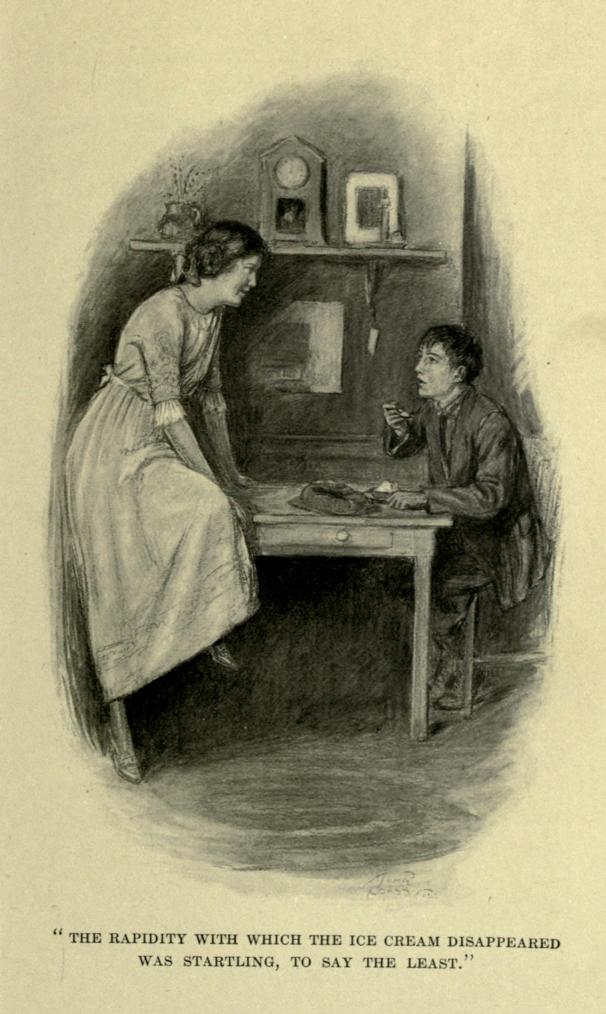
"THE RAPIDITY WITH WHICH THE ICE CREAM DISAPPEARED WAS STARTLING, TO SAY THE LEAST.
"Do you feel all right?" asked Peggy in alarm.
"You bet," the hoarse voice assured her, adding, as an afterthought, "That stuff's out of sight."
Peggy forebore to explain that the rapidity with which the delicacy in question had been put out of sight was the ground of her uneasiness. "What is your name?" she inquired.
"Jimmy Dunn." The gray eyes met her own squarely and she was confirmed in her opinion that they were honest eyes.
"Well, Jimmy, it wasn't right for you to take our ice cream, but it was very--" Peggy searched for a word in the boy's vocabulary--"It was very white of you to bring it back. I like you and I hope I'll see you again. Good night."
The door swung ajar and the queer, ungainly little figure slipped through the opening. Then it turned. "Same to you," said the hoarse voice, and Peggy heard the big shoes clatter on the walk, as the wearer raced to the gate. And though that was the most successful Bazar the girls of the Terrace had ever held, and the spirit of self-congratulation ran high, perhaps the pleasantest memory that Peggy carried home with her was that exchange of compliments on the back doorsteps.
CHAPTER VIII
AT HOME WITH THE DUNNS
"I can't," said Peggy. "I've got to make a call after school."
Priscilla, who had suggested a trip to the public library, to look up some of the history references for the next day, glanced at her friend askance. "O," she said in a voice of deep meaning, "I can't imagine what you see in that Elaine Marshall."
"Can't you?" Peggy's tone was cheery.
"O, she's well enough. But to choose her for an intimate friend! You're the only one of us who really likes her, you know."
"It's lucky I like her so much, then," suggested Peggy, still reprehensibly cheerful.
"O, yes, it's lucky for her. Nobody would deny that. But as far as you're concerned, Peggy, I don't know. Of course the more intimate you get with her, the less you see-- Now, Peggy Raymond, I'd like to know what you're laughing at."
Peggy's pent-up chuckle had broken in on the conversation with rather startling effect. As a tease, Peggy was not an unqualified success, since she never had the heart to carry her teasing to the climax. "I was only laughing at your dragging Elaine into it," she explained blithely. "I'm not going to see her. I'm going to call on the Dunns."
Priscilla wavered between offence and curiosity. Peggy tipped the balance by giving her friend's arm a good-natured squeeze.
"The Dunns," repeated Priscilla hastily, as if glad to get away from the previous topic of conversation. "Where do they live?"
"Glen Echo Avenue."
"Pretty name, but I don't know it."
"It's over across the tracks, just beyond."
"Why, Peggy Raymond, I didn't suppose anybody lived over there."
"Lots of people do. Scads of 'em."
"I didn't mean that, Peggy. Of course, I meant the kind of people one goes to see.
"I never went to see these people before," Peggy admitted. "But I've wanted to ever since the night of the Bazar. That boy, you know--"
"O, the ice cream boy! Was he a Dunn?"
"Jimmy Dunn. I saw him on the street the other day, and asked him where he lived. He's an awful little rag-bag, and Graham Wylie calls him all sorts of names, but there's something about him I can't help liking. And I thought I'd see what sort of woman his mother was. Sometimes we have an extra woman in to scrub, at house-cleaning time, though I must say," Peggy concluded thoughtfully, "that judging from Jimmy, she wouldn't be much of a success as a scrubber."
"I'll go with you," Priscilla said, taking Peggy's arm. "It isn't a suitable neighborhood for you to go alone." Now that she had learned that Peggy was not planning to call upon Elaine, Priscilla's mood had become extremely affectionate. She pressed the arm she held. She complimented the way Peggy was doing her hair. While she did not acknowledge to herself that her impulse to be agreeable had its root in the knowledge that she had just been very disagreeable, Peggy recognized her friend's unusual demonstrativeness as an effort at atonement, and she met her half way.
An idealist of the most pronounced type must have christened Glen Echo Avenue. The objects on the landscape most closely resembling glens, were the grimy coal-sheds along the track, while it would have been hard for a professional riddle-guesser to say why the little twisting, squalid street should have been dignified with the name of avenue. A goat, with oblique, uncanny eyes, occupied apparently in the mastication of a paper bag, gazed at the girls as they passed, and swarms of dirty children paused in their play to take stock of the strangers.
"Does Mrs. Dunn live anywhere around here?" Peggy inquired, addressing a curly-haired little girl with enormous black eyes, and gold rings in her ears. Another girl, with fiery red hair, pushed forward.
"Mary can't understand English,": she explained importantly. "She's a dago and her folks ain't been here long. Who are you looking for?"
"I want to find Mrs. Dunn, Jimmy Dunn's mother."
A babel of shrill voices at once gave directions, which the pointing forefingers rendered unnecessary. As Peggy descended the steps which led to the Dunn's front door, placed, for some inexplicable reason, some feet below the street level, she reflected that in Glen Echo Avenue the name of Jimmy Dunn had proved effective. She was about to knock, when the red-haired girl pushed by and opened the door.
"Mis' Dunn," she screamed. "O, Mis' Dunn, you got company. Come right along," she added, looking over her shoulder. The girls followed as she led the way, uncomfortably aware that all the children from the street were crowding in after them, apparently resolved to lose no detail of the interview.
Mrs. Dunn was seated by the kitchen stove, with a baby in her arms. She was a flabby woman, with a double chin, which seemed superfluous, considering that poor Jimmy had scarcely flesh enough to cover one chin respectably. She eyed her callers with an air more hostile than hospitable.
"If you're lookin' for somebody to wash," she said abruptly, "'tain't no use comin' here. My health don't allow of more than rubbin' out a few pieces for the children."
Peggy explained that their call was purely social, and Mrs. Dunn's manner lost its cold aloofness.
"Isabel," she exclaimed, addressing a freckled child whom Peggy knew at a glance must be one of Jimmy's sisters, "clean off some chairs for the young ladies. Set the potatoes behind the stove. The kindlings might as well go under the bed. 'Liza," she added to the red-haired girl, who, with her usual officiousness, was lending a hand, "now there's a tea-towel hanging up over the sink; take that, some o' you, and dust the chairs off good. No, don't bother about the rungs, Estelle. They ain't going to set on the rungs, be they? Some o' you don't use the sense you was born with."
And so amid a confusion in which Mrs. Dunn sat calm and unperturbed, giving her orders, two chairs were cleared and the girls seated themselves. Peggy, who had discovered that a baby is always a safe entering wedge as a topic of conversation, ventured to pat the round cheek of the child in Mrs. Dunn's arms. "That's a nice fat baby, Mrs. Dunn," she said, and the compliment was not a careless bid for the mother's favor. To Peggy all babies were nice, though some were nicer. This baby was too dirty to admit of the comparative degree, though he was surprisingly plump considering his surroundings.
Mrs. Dunn groaned.
"He may look fat enough, but I've been up with him night and day all winter," she said. "Amonia of the lungs 'twas, and the mumps first of November. So much nursin' is bad for me on account of my heart."
"Do you have heart trouble?" asked Peggy, alarmed.
"Yes, Miss. But that's not the worst. I've got a disease that will take me off some day, I s'pose." She lowered her voice thrillingly. "Lots of folks die of it. You'll see by the papers. It's complication."
"Complication!" Peggy and Priscilla exchanged glances.
"Complication," repeated Mrs. Dunn, as if determined to make no concessions. "I guess it's pretty near the most fatal of any. You can buy things at any drug store to cure consumption and amonia of the lungs, but there ain't a cure for complication. I ast the druggist myself and he said he didn't know of none."
Peggy attempted to change the subject to something less depressing. "I don't suppose Jimmy is home?"
"No, Miss. He's off sellin' papers."
"He's left school, has he? It's a pity, for he seems so bright."
"Jimmy's been through the fourth grade," said Mrs. Dunn. "He can read well enough for anybody. And Francesca, she pretty near finished the fourth grade, too, and she's in the factory now. In the spring they're going to give her a machine."
"Isn't she pretty young? I thought they weren't allowed to work in the factory till--"
"Francesca got a permit," explained Mrs. Dunn, "'count of her pa being out of a job."
"Do you mean that Mr. Dunn hasn't any work at all?" exclaimed Peggy. "Do you have to live on what those two children earn?" Mrs. Dunn plainly expanded under the sympathetic interest.
"This is gettin' to be such a country that a man can't earn an honest living," she said. "Mr. Dunn's an awful smart man. He can turn his hand to most anything, but these Eytalians and other furren folks is comin', and takin' away all the jobs. The doctor told me last week that I'd ought to get some medicine to make my complication a little easier, but I haven't had a cent to spare for it. Seems as if it took all Jimmy and Francesca make to keep us in coal, and pay the rent." She looked thoughtfully in the direction of Peggy's pocket-book, which had a somewhat plump appearance owing to Peggy's habit of cutting recipes and poems out of the newspaper and tucking them away in her pocketbook to show the other girls.
What embarrassing turn the conversation might have taken next it is impossible to say for it was interrupted suddenly by the entrance of a young woman. She was a trim and business-like young woman who betrayed no surprise at the social aspect of Mrs. Dunn's kitchen, and who declined Peggy's offer of a chair, with a pleasant little smile.
"Can't stay long enough to sit down," she said briskly. "I've been down to the works, Mrs. Dunn, and I find that Mr. Dunn hasn't been there since a week ago Monday."
Mrs. Dunn turned so darkly red that Peggy wondered if the mysterious and dread disease "complication" could by any chance be allied to apoplexy.
"The work down there's too hard for him," she said sharply. "He ain't as strong as he looks, Mr. Dunn ain't. And the foreman's always picking on him."
The young woman shook her business-like head. "Come, Mrs. Dunn," she said, "the worst of Mr. Dunn's troubles is laziness, and the reason he had difficulty with the foreman was that he wouldn't attend to business. Now we are ready to help you, if you show a disposition to help yourselves, but there will be no more relief till Mr. Dunn goes back to work."
Peggy and Priscilla were feeling out of place. They rose murmuring something which might have been an apology for their abrupt departure, or a promise to come again. Mrs. Dunn paid little attention to their going, and it was the red-haired girl who ushered them to the door.
"That's the charity lady," she explained, with evident satisfaction in her superior knowledge. "She's all the time comin' to the Dunns. She don't never come to our home, 'less somebody's sick or dies, or something like that. My pa he sticks to his job, and Mr. Dunn don't, that's why."
"I wonder what that is," Peggy cried, losing interest in the red-haired girl's explanation, as she caught sight of something resembling a football scrimmage at the entrance to Glen Echo Avenue.
"Guess the boys are havin' a little fight about something," said the red-haired girl carelessly, and indeed none of the residents of the avenue seemed to take more than a superficial interest in the cluster of struggling bodies, from which proceeded outcries of the most blood-curdling nature. Only the goat which the girls had previously noticed, seemed to share their apprehensions, for it cantered past, a desperate expression in its oblique, wicked eyes, indicating a determination to put as much distance as possible between itself and the scene of the disturbance.
The group broke up as Peggy and Priscilla drew near, and proved to be composed of a score or so of boys, ranging in ages from six to fifteen. Some were grinning and some looked angry. And one was crying. The last was the central figure of the group, and he limped as he approached the sidewalk. His nose was bleeding so profusely as to make his appearance distinctly ghastly, and Peggy fumbled for her handkerchief. Then she uttered an exclamation.
"It's Jimmy! Priscilla, it is Jimmy Dunn!"
Jimmy's tears dissolved in a smile startlingly friendly. "I got it," he exclaimed and held forth a wet, dirty and uninviting object, whose proximity caused Priscilla to take a hasty backward step. "What is it?" she exclaimed in horror.
"It's a kitten, I think," Peggy replied doubtfully. "Yes, it is a kitten." Her uncertainty was less singular because the appearance of the poor bedraggled creature was so little suggestive of the kittens Peggy had known. Jimmy Dunn, however, regarded his prize with unalloyed satisfaction. "They was going to drown it, them smart kids," he said with a gesture that included all his late antagonists. "But they didn't. I got it. And that ain't all, you bet." Jimmy's voice took on a portentous hoarseness. "I can't lick 'em all to onct, but every kid in that bunch is going to get his, and don't you forgit it."
"I'm afraid you're hurt yourself, Jimmy," Peggy said, proffering her handkerchief. Jimmy shook his head and fell back on his sleeve.
"But you were crying," Priscilla suggested with less than Peggy's tact.
Jimmy Dunn looked a little sheepish.
"I mostly bawl when I get mad," he replied. "Seems as if I couldn't put up a good fight till I start cryin'. I'm going to the store and get a cent's worth o' milk for this kitten. Time it's dry and cleaned up, and had some milk to drink, you wouldn't know it."
Peggy thought it was very likely. It was impossible to imagine how any kitten dry, warm and fed, could bear even the faintest resemblance to the wet, muddy lump of fur in Jimmy's arms. Thinking it advisable that measures of resuscitation should begin as promptly as possible, the two girls said good-bye and walked on, hearing till they left Glen Echo Avenue far behind the shrill tones of Jimmy Dunn's voice as he called to his late opponents promises of retribution in the near future.
"Mrs. Dunn is a little disappointing," Peggy observed at last. "She doesn't seem quite--sincere." That was as severe as Peggy could very well be on short acquaintance. "But as for Jimmy," she went on with sudden enthusiasm, "that boy's got lots of good in him."
And in both particulars Priscilla agreed with her.
CHAPTER IX
PEGGY ACTS AS CRITIC
Peggy's thoughts, busy with plans for the relief of the Dunn family, were turned abruptly into another channel at the supper-table. "O, by the way, Peggy," her mother said, "you had a caller this afternoon, Mrs. Summerfield Ely."
"She came in a naughty-mobeel," exclaimed Dorothy, almost choking over the long word in her eagerness to get it out before anybody else had a chance.
"My! Doesn't she think she's swell," scoffed Dick. "Fur coat and a dress that trails." Of all manifestations of feminine vanity a trained gown called forth from Dick the most outspoken expressions of contempt.
"It seems," explained Mrs. Raymond, ignoring her son's outburst, "that she was at your Bazar, and bought a collar, Irish lace, I believe."
"O, yes, mother. That was Elaine's collar. I was a little worried for fear nobody would buy it, but not because it wasn't nice enough. I was afraid it was too nice. Lots of people come to our Bazar with just about fifty cents to spend, and I was sure the price of the collar would look dreadfully big to nearly everybody. But we really couldn't mark it less than it was worth."
"Certainly not," agreed Mrs. Raymond.
"And then Mrs. Summerfield Ely came in, and I was sure the collar was as good as sold, for it was really the nicest thing there, mother. Just as soon as I could get the chance I called her attention to it, and she looked at it a minute through her lorgnette--"
"O, say," sneered Dick, "why doesn't she wear spectacles if she needs 'em?"
"And she said right off, 'I'll take that,'" continued Peggy tranquilly; "I was so glad, especially on Elaine's account. It makes you feel horrid to put lots of work into a thing and have it left over."
Having relieved her mind, Peggy was now ready to listen to other people. "What did Mrs. Ely want of me, mother?"
"She wants to order a pair of cuffs to match the collar. She wasn't sure who did the work, but she thought you could tell her. I am very glad," added Mrs. Raymond, "for, of course, she will pay a good price, and, from what you tell me, I fancy that Elaine needs the money. Why, what are you going to do, Peggy?"
The impulsive Peggy, starting up from her unfinished supper, flushed guiltily and sat down again. "I was going to run over and tell Elaine," she confessed. "But I suppose the news will keep."
As it turned out, it was not till the next afternoon that Peggy found an opportunity to convey to her next-door neighbor the important information of Mrs. Summerfield Ely's order. Callers came before supper was over, and by the time they left the lights in the next house were extinguished. When Peggy presented herself at Elaine's door at the close of school the following day, she was as relieved at the prospect of delivering her news as if it had been a heavy weight which she had been carrying about for nearly twenty-four hours.
Told in Peggy's glowing language the rather commonplace announcement took on life and color. Even the multiplication table, repeated with such animation, and such assurance of the complete sympathy of one's listeners, would have seemed touching and impressive. But when Peggy had finished, she was aware of a sudden drop in the temperature. Without meaning to do it she intercepted glances passing between Elaine and her mother, which impressed her as the very reverse of enthusiastic.
"It's very kind of you, Peggy," Elaine said at length, her manner distinctly apologetic. "Awfully kind to be so interested. But you see--" She hesitated, and again the thermometer seemed to drop several degrees. "But you see doing work like that for pay is very different from doing it for charity."
"O, very different," said Mrs. Marshall in her deepest voice.
"Of course it's different," admitted Peggy, frankly bewildered. "But it's nice to earn money for yourself, isn't it?"
Again the perplexing exchange of glances gave her a feeling of being a hopeless outsider. "O, the money's all right," Elaine admitted with a hard little laugh. "Nobody could want it much more than I do. But to earn it like a sewing woman--"
"Fortunately," Mrs. Marshall broke in, "there are other avenues. My daughter has hopes of making a comfortable income in a manner less unsuited to her position in life."
"O, indeed." Peggy looked at Elaine, with the respect due to the prospects whose magnificence was suggested by Mrs. Marshall's manner, rather than her words. To her surprise Elaine was blushing, and looking very uncomfortable. "O, please, mamma," she murmured appealingly.
"Elaine's literary gift," continued Mrs. Marshall complacently, "has been most pronounced since her childhood. A former governess, Miss Brown--Elaine always called her Brownie--was most enthusiastic over her early attempts. I think, my dear, that she compared some of your first efforts to the writings of--"
"Sometimes I wonder," broke in Elaine with a noticeable increase of color, "if Brownie didn't say all those flattering things just because she thought we liked to hear them."
"Upon my word, Elaine," exclaimed Mrs. Marshall indignantly. "Such suspicion is very unbecoming, especially in a young girl. And Miss Brown is so sincere, so unaffected, so different from that disagreeable Miss Collier who was always criticizing everything and everybody. Such a relief as it was to get that woman out of the house."
"She didn't think me much of a genius, that's certain." Elaine laughed a little, apparently at some recollection whose humor increased with distance. "But I'm not so sure," she added immediately, "that she didn't mean every word of it."
"Really, Elaine!" Mrs. Marshall's irritation showed itself by a sudden flushing of her sallow cheeks. "You are in a very singular mood to-day. If you are going to run down poor dear Brownie, and uphold that dreadful Miss Collier, I don't know but my turn will come next." She drew out her handkerchief rather ostentatiously, and then the awkwardness of the moment was relieved by the arrival of the postman.
Elaine, hurrying to the door, returned with full hands and an expression of countenance anything but enthusiastic. "What a lot of mail!" exclaimed Peggy, thankful for so good an opening for changing the subject.
"Yes, there's enough of it, such as it is," Elaine responded discontentedly. She slammed the postman's offering down on the table. "Two bills--no, three, and the others--"
"A young author has much to contend with," said Mrs. Marshall, forgetting her momentary pique in sympathy. "There is a prejudice against the newcomer, but once get a hearing and it is all plain sailing."
Peggy eyed the long envelopes on the table with sudden understanding. They were returned manuscripts. Very business-like they looked with the row of stamps on the right-hand corner, and even sensible Peggy was thrilled for the moment by something vaguely impressive in the thought of writing for publication.
"I'm sure a great many authors had a discouraging experience to begin with," pursued Mrs. Marshall. "Wasn't it Milton who sold 'Paradise Lost' for a mere song, and I'm sure 'David Harum' was refused by any number of publishers." She looked anxiously at Elaine, who, having opened one of the long envelopes after another, was reading over the rejection slips, her forehead creased in an unmistakable frown.
"Let me see," Mrs. Marshall secured a slip, and perused it carefully. "Why, this is rather encouraging. They say that the rejection does not imply any lack of merit."
"But they must say that to everybody," Elaine insisted gloomily. "It's printed."
"Really, Elaine, if you are determined to take a pessimistic view, read one of the stories to Peggy," cried Mrs. Marshall, forgetting formality for once, "and see what she thinks." Peggy echoed the suggestion heartily. She was really very curious about the contents of those long envelopes.
"If I did, it would be to find out what you really did think about them," Elaine replied. "Most people would say nice things, anyway, but I believe you'd be honest, Peggy." She looked at her friend rather appealingly. "I don't want to waste my time on what isn't going to amount to anything."
Peggy felt a marked decline of enthusiasm. "Of course I'm not any critic," she said uncomfortably. "I can tell you what I think, but that won't be worth much."
"It's what I want, anyway." Elaine jerked a bulky manuscript from its sheath and settled herself in a rocking-chair. "The name of this," she announced in a defiant voice, "is the 'Maid of the Haunted Well.' It's a story for children, you see."
"O, yes." Peggy leaned forward in an attitude of close attention, while Elaine began to read with a rapidity which gave small heed to the marks of punctuation.
"Long ago, on the edge of a vast and mighty forest, lived a young girl, known far and near as the Maid of the Haunted Well. Fair she was, with lustrous, golden hair, that fell in a profusion of silky ringlets. Deep blue were her eyes. Far and wide had the fame of her loveliness spread, and many came to see for themselves if she was as ravishingly beautiful as she was reported to be."
"How wretchedly you are reading, Elaine," remonstrated her mother. "It is impossible to get any idea of the real excellence of the story when you hurry that way." With an evident effort Elaine slackened her speed and continued.
"The Maid of the Haunted Well had hosts of lovers, but to one and all she gave one answer 'Wouldst wed me? Then drink with me one cup of water from the Haunted Well. Whosoever tastes this water shall never--'"
The monotonous voice ceased suddenly, and the sheets comprising the "Maid of the Haunted Well" strewed the carpet like gigantic snow-flakes. "Elaine!" cried Mrs. Marshall.
"I can't go on with it. It chokes me. Peggy, don't you think it's silly?"
Peggy's struggle between her candor and her sympathy resulted in something of compromise. "I didn't know just what you were trying to bring out about the haunted well," she replied. "But it sounded rather ingenious, and interesting. At the same time--"
"Well?" It was Mrs. Marshall who insisted on the conclusion of the sentence. Elaine was staring gloomily at the carpet.
"O, I only wondered if nice breezy stories about jolly boys and girls wouldn't take a little better, but, of course, I don't know anything about it."
"They are not all children's stories," said Mrs. Marshall, as Elaine preserved an uncompromising silence. "Read her the 'Daughter's Defiance,' Elaine."
For a moment Peggy feared Elaine was going to refuse. She looked ruefully at the dejected figure in the rocking-chair, wondering if her frankness was likely to cost her the friendship she had worked so hard to win. But, after a moment, Elaine reached automatically for another envelope, and drew out a second manuscript. "The Daughter's Defiance," she read, "Or, True in Spite of All." Peggy tightened her grip on the arms of her chair, and prepared herself for the worst.
"'Leave me, if you have any mercy, I pray you leave me to myself.' The Countess Rosalie stood trembling, her hands flashing with jewels, clasped in appeal. Beautiful as she always was, she seemed more beautiful than ever, now that grief had left her cheeks white as alabaster."
There was a ring at the doorbell. Peggy hurried to collect the scattered sheets of the "Maid of the Haunted Well," while "The Daughter's Defiance" found a temporary hiding-place behind one of the couch cushions. Before the scramble was over the bell had rung for the second time, and Elaine, looking self-conscious almost to the point of guilt, went to answer it. Peggy heard a surprised exclamation, then a small voice piping resolutely.
"Want my aunt Peggy."
Even Mrs. Marshall joined in the laughter. "O, Dorothy," cried Peggy as her niece appeared, wearing an expression of triumph. "To think of all that excitement just for you." She put her arms about the little figure fondly. "What do you want, honey?"
"Want to stay with you."
"If you stay, you must be as still as a little mouse. I'm listening to a story."
"I likes stories!" Dorothy climbed upon Peggy's knee and composed herself to listen. But long before the harrowing adventures of the Countess Rosalie had reached their tragic culmination she had grown restless. Slipping from Peggy's arms she started on a tour of investigation of the room and its contents, and, to be quite honest, Peggy half wished she might follow her example.
But the Countess Rosalie was finally at peace, and Elaine turned a flushed face on her unwilling critic. "Tell me just what you think of it," she said.
Peggy drew a long breath. The temptation to be comforting and complimentary was for the instant almost irresistibly strong. She fortified herself for the ordeal by recalling the character of Elaine's appeal. It was not right that the girl should waste her time, if a friendly caution could save her. Nevertheless Peggy heartily wished that the thankless task had fallen to somebody else.
"Of course it's any amount better than anything I could write, Elaine. I think your imagination is really wonderful. But--"
"Go on." This time it was Elaine who did the prompting. Mrs. Marshall only compressed her lips.
"It seemed to me that there were a good many things in your story that girls can't be expected to know much about, love and crime and remorse and all that sort of thing. And all the characters are counts and countesses and--Well, I never saw a countess--"
"And you're wondering if I ever did. Well, no."
"I should think," suggested Peggy, feeling the beads of perspiration start on her forehead, "that it would be better to write about the things you know. That's all."
"But I don't know anything worth writing about," said Elaine sharply. Then in a changed voice, "O, I see! Probably that's just the reason I oughtn't to try it."
"It seems to me," floundered Peggy, wondering how editors ever lived through the ordeal of rejecting manuscripts, "that after you've lived longer--"
"I believe," interjected Mrs. Marshall witheringly, "that Bryant wrote 'Thanatopsis' at eighteen."
"I believe he did," Peggy acknowledged meekly.
"But this isn't 'Thanatopsis,'" said Elaine, surveying "The Daughter's Defiance," with critical eye, "and I'm not Bryant. That's all Peggy means." She smiled with a courage that did not conceal a quiver of pain, and Peggy looked at her with a contrition no less keen because she herself felt the need of sympathy.
Again a welcome diversion came from Dorothy. In her search for entertainment she had discovered a basket of photographs, placed upon a small stand. Engrossed in the possibilities of her discovery Dorothy had leaned against the basket's frail support, with the result that the stand was overturned and the pictures strewn far and wide. For the second time during her call Peggy went down on hands and knees to gather up the scattered photographs, having satisfied herself by the agility with which Dorothy scrambled to her feet that she was uninjured.
"O, Elaine!" It was a relief to start a topic of conversation which bore no relation to literary pursuits. "Here's a picture of you, I never saw before."
Elaine glanced up quickly. "O," she exclaimed, "I didn't know that was downstairs."
Peggy's discovery was a kodak picture, apparently a group of picnickers, gathered on the edge of a small lake. When she had removed all traces of the disorder caused by Dorothy's mishap she carried the picture to the window, for a closer look.
"How heavy your hair used to be, Elaine. You've got plenty now, but it was lots heavier then."
No reply.
"I love kodak pictures," Peggy went on. "This is an awfully cute one, but really you look older in it than you look now. I suppose it is because there's no retouching."
Something in the other's silence caused her to look up. Elaine's face was crimson, and her manner so indicative of perturbation that Peggy was on the point of demanding the reason.
Elaine saved her from that blunder. "It's not a bit good picture," she said hastily. "I can't bear it. I never mean to leave it where people can see it." She took the offending photograph from Peggy's hand, and had locked it into the drawer of the desk before Peggy had recovered from her amazement.
On the whole, the afternoon had not been very successful. Peggy suggested to Dorothy that it was time to go home, and Dorothy pranced with uncomplimentary readiness to take her departure. Elaine followed them out into the hall, half closing the door behind them.
"Peggy," she said with an unmistakable effort, "if it isn't too much trouble, I wish you'd tell Mrs. Ely that I'll do those cuffs for her."
Peggy turned with a joyful exclamation, and caught Elaine in her arms. "You dear thing. I think that's just splendid of you." Then, without giving her courage time to cool, she rushed on, "And, O, Elaine, you don't know how I hated to say what I did. You'll forgive me, won't you?"
"I shouldn't have forgiven you, if you'd said what you didn't believe," Elaine returned, her lips trembling. "I didn't want sugar-plums, Peggy. I wanted the truth. I've got to do something to earn money, and if I haven't any chance one way, I've got to try another. And, besides," she added, voicing a truth which many people apparently lose sight of, "it's a lot easier always to say something pleasant than to say what's true."
Peggy went home in a glow. She was proud of the stand Elaine had taken, and grateful to her for realizing that friendly sincerity may be a costly gift. "And she's such a sensitive girl, too," Peggy thought. "She was really annoyed because I didn't quite like the kodak picture of her."
The recollection of Elaine's face came before her as the thought took shape, and she seemed to see in its expression something more than annoyance. Why should Elaine have cared? Unconsciously Peggy laid the matter of the photograph away in some secret drawer of her memory, along with several other little perplexities, to await a future solution.
CHAPTER X
RUTH IS PERPLEXED
Peggy was in her room, combing her hair, when Ruth came in. At the sound of her voice in the hall, Peggy pushed the door ajar, and hailed her cheerily.
"Hello, there! Come on upstairs. I'm trying to do my hair Anna's way, and I'm having such a time."
She had turned back to the mirror, and was struggling with the rebellious locks when Ruth burst into the room, somewhat out of breath after her hasty ascent of the stairs. "O, Peggy!" she panted. "The awfullest thing!"
"What's happened?" Peggy demanded briskly. She knew Ruth well enough to be aware that the "awfullest thing" might mean that her father was bankrupt or that she had mislaid her thimble. People who habitually indulge in superlatives must not complain over belated sympathy.
"Just read this." Ruth checked herself suddenly. "It's something," she said in an altered voice "that it would be better for small persons not to overhear."
Peggy turned hastily. Dorothy stood in the doorway, her resentful gaze fastened upon Ruth. Dorothy was extremely sensitive regarding any reference to her tender years, and seldom failed to grasp the import of a carefully veiled allusion to her presence, even though the words used were beyond her understanding.
"There aren't any small persons over here," she announced, scowling darkly in Ruth's direction. "There's nobody here but free big girls."
Peggy discreetly dropped her hair over her face to veil a smile.
"I wonder what Taffy's doing," she said diplomatically. "I hope he isn't out on the front lawn where he'll get into a quarrel with the butcher's dog."
Dorothy looked stubbornly at the toes of her small shoes, and Peggy tried another tack.
"Let's see! I wonder if I left any caramels on the plate in the pantry last night. Yes, I believe there were two or three."
"Maybe Dick ate 'em," suggested Dorothy, falling into the snare.
"He hadn't eaten them fifteen minutes ago when I came upstairs. On the plate with the blue castle, Dorothy, dear, and Sally'll hand it down to you if you can't reach it." Peggy laughed out, as Dorothy clattered down the stairs. "Isn't she quick?" she exclaimed admiringly. "That child knew in a second you wanted to get rid of her." She shook her hair back as she spoke, and, for the first time, caught sight of Ruth's face.
"Why, Ruth!" Peggy took an impulsive step forward. "Then it's really--"
"It's something really dreadful," Ruth returned, biting the lip which would tremble, in spite of her efforts. She turned the key in the lock to secure the conference against further interruptions, and held a letter toward Peggy. "Read that," she said.
The sheet Peggy drew from the square envelope bore a showy monogram at the top. "My dear boy," Peggy read, and then looked up bewildered. "Why, I don't see--"
"O, go on," Ruth cried, with, an impatient stamp of her foot. "Do go on." And Peggy obediently read the communication aloud.
"MY DEAR BOY:--The charming little pendant came last evening, and I thank you a thousand times. The design is as unique and charming as that of the brooch you sent last week. I noticed that you purchased both at King and Kennedy's, who are noted, I understand, for exclusive designs, as well as for the superior quality of their goods.
"By the way, I noticed a darling little ring, a combination of pearls and sapphires, in their window the other day. Ask to see it sometime when you are passing. They are most obliging and always ready to show their stock whether you wish to purchase or not.
"Again, with many thanks
"Yours, "Maud."
Peggy's blank stare met her friend's disturbed gaze. "I don't understand it," she cried. "Who wrote it, and whom is it written to, and why did you bring it to me, and what makes you act as if it was so dreadful?"
"Because it is dreadful." Ruth's voice was unnaturally hard. "I don't know who wrote it, except that her name is Maud, but the letter is written to Graham."
Peggy glanced quickly at the envelope in her hand, and then let it fall to the floor, as if it had scorched her fingers. "O, Ruth," she exclaimed reproachfully, "why did you tell me to read it?"
"Peggy, hush! This isn't a time for quibbling. You've got to help me and tell me what to do." The tears of utter misery began suddenly to course down Ruth's cheeks, and Peggy hastily assumed the role of comforter.
"O, Ruth! You mustn't feel that way about it. Of course you and Graham have always been great chums, but you must have known that some day there'd be somebody he'd care for more than for you."
"Peggy Raymond, I never thought you could be so stupid." Ruth's voice told of exasperation. "Listen! This letter is written by a girl named Maud, and Graham never mentioned such a person to any of us. He has lots of girl friends, like all college boys, and their pictures are all around his room, and I know the names of every single one. But he never has said a word about Maud."
Peggy shook her head helplessly, unable to suggest any satisfactory explanation for Graham's singular omission. Ruth continued, gradually losing her self-control, as she summed up the evidence against the brother she adored.
"That would be queer, Peggy, and it would make me feel dreadfully hurt, but, of course, Graham isn't obliged to tell me about his friends unless he chooses to. That isn't the worst part. You see he's giving her presents, things that cost a lot. It was a pendant this week, and a brooch last, and now she's hinting for a ring."
"Yes, he must think a great deal of her," Peggy acknowledged gravely.
"But Graham hasn't any money of his own. Father's doing it all, and the worst of it is, that Graham's expenses are so heavy this year that father is having a real hard time. He spoke to Graham about it not a week ago, and asked him to be as careful as he could, and Graham talked so beautifully about it, and he wanted to give up lots of things, and father said no, and that he'd get hold of the money somehow. And after all that, Graham has bought jewelry for this Maud."
Peggy made no effort to check her friend's wild outburst of weeping. Under the circumstances it would do Ruth good to cry. She looked with a sense of shrinking disgust at the letter on the floor, as if it had been some sort of loathsome creature. "How could he?" she said to herself, as Graham's frank, handsome face flashed out on the screen of her memory. Only that morning she had seen Graham and his father pass. The older man was listening to something the younger was saying, smiling a little, and the look he bent upon his son was full of trust and confidence. And all the time Graham had been deceiving him, taking the money which meant sacrifices in the home, to buy costly presents for a girl whose name he had never mentioned to his sister. It was no wonder that Ruth cried. Sunny Peggy felt sick and disillusioned.
The door-knob rattled. "It's me!" said a voice, which sounded very much as if the three caramels were simultaneously occupying one small mouth.
"Run along, Dorothy!" Peggy was too absorbed in the problem confronting her to make her request tactful. She went over to Ruth, who was making a brave struggle to regain her self-control, and possessing herself of the limp hand, stroked it tenderly. Then Peggy's instinct to make excuses for everybody, led her to say, "After all, perhaps we're making a mountain out of a mole-hill."
"Mole-hill!" exclaimed Ruth indignantly. "How you can call it a mole-hill for Graham to take his father's money and pretend it's for things at college when all the time--"
"O, yes, I know. But there's a chance of a mistake," Peggy protested, "I don't suppose you've talked with Graham about it?"
"Goodness, no! I went up to his room this morning to do the work and this letter lay on the floor, not even in the envelope."
"That doesn't look as if he were ashamed of it," Peggy exclaimed triumphantly.
"O, that's Graham all over. No matter what he did, he'd be too careless to cover his tracks. I picked it up and looked at it to see if it was meant to be thrown away or not, and then my eye caught that about the pendant, and I simply couldn't stop. And after I saw what it meant it seemed to me that I should die if I didn't tell somebody."
"But, Ruth," Peggy protested, alarmed, "you surely are going to talk to Graham about it. You can't mean to let it go on, and not give him a chance to explain or anything."
Poor Ruth hid her face in her hands.
"O, Peggy!" she cried in a stifled voice, "if I thought he could explain, I'd be only too glad to give him the chance. But you know yourself he can't. And how can I bear to tell him that I know all about it. If it was anything else, I wouldn't feel so," she added despairingly. "But think, Peggy, of telling your brother that you know he has been cheating your father, and being mean and underhanded, all the time that he talked so beautifully about how grateful he was for what had been done for him, and how hard he was going to try to make us all proud of him."
It was a black picture. "Then, I suppose," said Peggy, after a long pause, "that you'll tell your father."
"Father!" Ruth spoke the word with a little protesting cry. "Why, it would kill father to know such a thing about Graham. He never could bear it."
Peggy hesitated. Strong as her sympathy was for Ruth, her sturdy common sense refused to take her friend's view of the case.
"Ruth, this is too serious a thing for two girls like us to keep to ourselves. Somebody's got to know, somebody who'll understand what to do."
Ruth sprang to her feet. "You don't mean that you'll tell. Peggy, you couldn't be so--so dishonorable as to tell. I came to you because I had to confide in somebody. And, now, if I can't trust you--"
"O, good gracious!" exclaimed Peggy with an irritation of which she was immediately ashamed. "Of course I'm not going to tell. But you are. Ruth, you must."
Again and again they went over the ground, Peggy coaxing, persuading, trying vainly to bring her friend's resolution to the sticking point, while Ruth squirmed and evaded and protested, and even accused Peggy of heartlessness.
"I tell you it would kill father. He's wrapped up in Graham. If he found out that he had tricked and cheated him he'd never have another happy minute."
"Your mother, then."
"Mother! Why, that would be worse, if anything could be worse. Her heart isn't strong, you know. The doctor says we must be careful about shocks--"
"Then, Ruth Wylie, there's no two ways about it. You've got to pluck up your courage and have it out with Graham."
It was in the discussion of this point that Peggy was accused of heartlessness, a most unjust charge, for at the moment her heart was aching for poor Ruth in her misery.
"You don't understand!" Ruth insisted. "You can't understand. Your brother is younger than you are, but if he were older, and you'd always looked up to him, and thought he was perfectly splendid, and felt sorry for other girls with ordinary brothers, just think what it would be like to face him and tell him that you'd found him out, and that he was mean and contemptible. O, it don't seem as if I could be talking about Graham. O, Peggy, why did I ever read that letter?"
Peggy temporarily gave up the effort to bring Ruth to a realizing sense of her responsibility in the matter, and set herself to soothe her. Between indignation on her father's account, and grief over the discovery of the glaring weakness in the brother, whom she had been accustomed to set on a pedestal, poor Ruth's nerves were sadly unstrung. Peggy coaxed her to lie down upon the bed, and stroked her burning forehead with sympathetic fingers, cooing over her like a dove over its nestlings. All that was sweet and womanly in Peggy responded to the challenge of suffering, and her fingers had the deft tenderness which characterizes the born nurse, and is not always secured by a course of training in the hospitals.
She was just congratulating herself that Ruth's tense muscles were relaxing somewhat, and that her breathing was less hurried and irregular, when a crash in the hall, followed by staccato screams, sent her flying to the door. Most unexpectedly she found her exit barred by a solid oak table and, when she pushed that impatiently aside, she stumbled over the upturned rockers of Dorothy's little red chair. Dorothy herself was somewhere on the stairs, screaming lustily, while Mrs. Raymond and Sally were bending over her, imploring her to tell them where she was hurt.
"What is it? What has happened?" shrieked Peggy, plunging down the stairs, forgetful of everything except the possibility that Dorothy was seriously injured.
No one had time to explain, but gradually from scraps of information let fall, aided by her own intuition, Peggy reached an understanding of the catastrophe. Dorothy, aggrieved by the turning of the key in the lock, had pushed a table in front of Peggy's door, and placed her own small rocking-chair on top, intending from this vantage ground to make a dramatic entrance through the transom. The rocking-chair had frustrated this maneuvre by swaying at the wrong moment, and Dorothy had plunged over the banisters while the chair had toppled to the floor with a crash worthy a more imposing piece of furniture.
"Can you move your arms and legs, dear? Let Grandma see you kick?" pleaded Mrs. Raymond, running her fingers anxiously over Dorothy's plump little body in search of broken bones.
"It's her insides that are hurt, most like. My ma had a cousin who got his insides hurt in a fall, and for seventeen years he never left his bed." Sally, who had a taste for the ghastly, contributed this information, and would have gone on to give the harrowing details had she not perceived that no one was paying any attention to her.
Dorothy's screams were gradually subsiding into gasping sobs. She turned her pathetic, tear-stained little face toward Peggy, who crouched on the stairs beside her, a conscience-stricken heap, repeating miserably, "O, Dorothy, where does it hurt, darling?"
"I--I swallowed 'em," Dorothy volunteered at last, and burst into fresh lamentations.
"Swallowed what, dear?"
"The car'mels. I swallowed 'em quick. I didn't have time to eat 'em."
Peggy and her mother exchanged wide-eyed glances.
"Don't mind about that, dear," coaxed Peggy. "By and by, when you feel better, I'll make you some more candy."
Dorothy's sobs ceased with an abruptness that was uncanny. "Feel better now," she said.
"But where does it hurt, Dorothy?"
"Don't hurt. But I like butter-scotch better'n car'mels."
"You shall have butter-scotch, you precious. But where--" Peggy's solicitous inquiries were interrupted by Dorothy's clapping her hands and beginning to frisk about in a manner which set at ease conclusively any fear as to broken bones.
"It's struck into her brains most like," said Sally hopefully. "I knowed an idget boy onct. It was a fall striking into his brains that ailed him."
Mrs. Raymond and Peggy were too accustomed to Sally's doleful prophecies to be cast down. They heaved sighs of relief, exchanged smiles, and Peggy flew to her room to get her apron. At the head of the stairs she encountered Ruth, a red-eyed, drooping figure, and Peggy's conscience reproached her that in her own alarm and relief, she had momentarily forgotten her friend's greater cause for anxiety.
"You see," she whispered, pausing for a moment, "Sometimes things turn out better than you think they will. I was almost sure that Dorothy was dreadfully hurt, you know." But Ruth only shook her head and made the answer characteristic of people in trouble, who are all likely to think their own especial load unlike any other burden.
"But this is different."
CHAPTER XI
CHRISTMAS PREPARATIONS
Peggy's door was locked again, but this time it was not Ruth's fault. Peggy would have said, if questioned, that she had "troubles of her own," and the chances are that it would not have occurred to her that there was anything incongruous in the selection of such a phrase to describe her Christmas preparations.
The little bed-room, usually a model of exquisite neatness, in spite of its simplicity, now suggested a compromise between a church fair and a rummage sale. Articles in various stages of completion were draped over the furniture, or hung on door-knobs. The bed was piled so deep that often when bed-time approached, Peggy was tempted to take to her easy-chair for the night, for what of the night was left, that is to say, for Peggy was infringing sadly on those hours warranted to make one healthy and wealthy and wise, if properly observed. Mrs. Raymond was uneasy when she saw the gleam of light through the transom long after midnight, but Peggy met all remonstrances with the plead, "O, please don't say anything, mother, till Christmas is over. You know I've got to finish."
When Dorothy rattled the door-knob this particular afternoon, Peggy's start was suggestive of over-strained nerves. Her voice was unnaturally sharp as she demanded, "who's there?"
"Me."
"You know you can't come in, Dorothy. Run away and play."
The knob rattled again. It was not an aggressively loud sound, but Peggy was just tired enough to find it unendurable. Her lips tightened.
"Dorothy, will you stop that noise? This minute!"
Surprise kept Dorothy motionless for almost thirty seconds. "What you doing?" she asked, after that amazing pause, her rosy lips close to the key-hole, her voice persuasive.
"I'm making something you can't see. Please don't bother." Peggy jerked her thread savagely. She was, as a matter of fact, hemstitching the little petticoat of the doll she was dressing for Dorothy. She had laughed when her mother suggested that it was hardly worth while to take so much pains. "A strip of embroidery gathered and put in a band would please the child just as well. She isn't old enough to appreciate the work you are putting into these dainty little garments."
"Work! I don't call it work. It's just fun," said Peggy blithely. "And it's such a tiny way round a doll's petticoat, mother, that it won't take any time to speak of." There would have been time enough if there had not been so many things of the same kind; trifles demanding little time when taken separately, but together filling to overflowing Peggy's hours of leisure, and infringing on the time she needed for recreation and sleep. She thought of them with a sense of nervous apprehension which was far removed from anything festive. There were two of the sweet peas on her mother's centrepiece not finished yet, and those sweet peas took so long.
"I must finish Aunt Rachel's bureau scarf to-night," Peggy thought. "I've got to allow for the mails being slow. Perhaps I'd better leave this till that is done, for I can finish the doll the very last thing." She tucked the petticoat out of sight, and produced the bureau scarf from under a rainbow litter of Dresden ribbon, scraps of silk, and odds and ends of lace, all of which Peggy designed for especial use.
"Next year," thought Peggy, frantically attacking the bureau scarf, "I'm going to begin my Christmas presents New Year's afternoon. Perhaps if I start the first of January and keep right at it through the year--Why, what's that?"
There was a sound in the hall, a choked, low, pitiful sound that seemed startlingly out of place with Christmas near. The bureau scarf dropped to the floor. The spool of thread and the thimble made a bee-line to hide themselves under the dresser, as if they both had enough of getting ready for Christmas. Peggy herself lost no time in turning the key and bolting into the hall, where Dorothy a pensive little heap, her face hidden on her knees, was weeping.
Dorothy had a variety of ways of crying. When angry her tears were accompanied by shrill squeals, as pathetic as a fife playing Yankee Doodle. If she hurt herself she was more likely to relieve her feelings by noise than by tears, suggesting those summer showers whose thunder peals and lightning flashes prepare us for a deluge, but which content themselves, after all, with a few scattering drops. These emotional outbreaks on Dorothy's part Peggy took philosophically. But when she cried softly, hiding the face down which the big tears were coursing, while the sobs shook her little body, then indeed, it was another matter.
"Dorothy!" Peggy cried, dropping down on her knees beside the despondent figure. "Dorothy, what is the matter? What are you crying about?"
"Aunt Peggy." It was a full minute before Dorothy could answer, and then the quiver running through the words pierced Peggy's heart. "Ain't Christmas going to be over pretty quick?"
"It comes next week, honey."
"Well, I'll be glad when it's gone." A great sob emphasized the statement. "It's such a horrid time."
"Dorothy!" Peggy was aghast: "You can't mean that you don't like Christmas."
"It's a horrid time," Dorothy repeated, with every indication of sincerity. "Folks lock doors. And then they tell you to go and play, and there ain't anyfing to play. And there's nice fings, but you can't see 'em." She sobbed again as she painted the black picture, and Peggy hastened to explain, "But, darling, you will see them on Christmas day. Think what a good time you will have when you find out all the secrets."
"But I want a good time now," said Dorothy explosively.
For once Peggy had no reply ready. What was there to be said? Of course Dorothy did. Who could reasonably expect this little human thistle-down to fold her hands and wait patiently through weeks of Christmas preparations in which she had no share. Peggy, absorbed in her plans, had found no time for the stories Dorothy loved, for the little after-supper frolics, for candy pulls in the kitchen, for walks over the snow. All these joys had been discontinued with a vague promise of something very nice to happen by and by. What wonder Dorothy was dissatisfied?
"And getting ready for Christmas is almost the nicest part," Peggy thought. "And here I've locked my door and shut her out of it. It's no wonder she thinks Christmas is horrid." She lowered her voice mysteriously. "Dorothy, how would you like to help me make a Jack Horner pie?"
The hands which covered Dorothy's eyes dropped to her knees. The little face revealed was more suggestive of April than of December, with the wet eyes shining, and the dimples swallowing up stray tear drops. "A Jack Horner pie?" repeated Dorothy in a thrilled whisper.
"Yes."
"Will we put in a fum and pull out a plum?"
"They'll be funny plums. Come and I'll show you. But we'll lock the door, because this is our secret and nobody must know."
Under the bed was a shiny tin milk pan, and rolls of tissue paper, green and red. "Now I'm going to cover this pan with green paper," Peggy explained. "And there'll be a pasteboard cover, with a big round hole in the middle, and there's where we will put in our thumbs."
"And cry what a big boy'm I," added Dorothy, hopping on one foot, which with her was an indication of fascinated interest.
"The cover'll be all fixed with red tissue paper, and, instead of plums, there'll be little presents inside."
"Is it going on the Christmas tree, Aunt Peggy?" Dorothy squatted beside her aunt, carried away by the enchantment of the plan. And as Peggy looked at the beaming little face the isolation of her previous preparations suddenly seemed selfish.
"No, this isn't for the tree. It's going on the table for the Christmas dinner. The presents aren't nice ones, you know. They're funny little jokes. Here's Dick's present, a queer little make-believe alarm-clock, because he is so slow about getting up in the morning.
"Dick's a lazy boy to be my uncle," said Dorothy, giggling rapturously. "I guess he'll be 'shamed when he pulls out his plum."
"There's a rhyme to go with it, Dorothy. That's part of the fun. Do you want to hear it?"
Dorothy promptly became a statuette of attention, her hands folded, and her grave face flatteringly expectant, while Peggy read aloud.
"Dick, Dick, the sleepy-head,
Dearly loves his little bed.
Here's a cure; 'twill work for sure,
Wind it tight. Set it right,
And then go ahead and
Blow out the light.
When morning comes, how the folks will stare,
To go to breakfast and find Dick there."
"That's poetry," said Dorothy much impressed. "I learned poetry once, all about Tit, Tiny and Tittens. Did you write a poetry plum for me, too, Aunt Peggy?"
"Yes, but I mustn't read you yours. That's a surprise, but you can hear grandpa's. You see, I'm going to give him a pen because he hates to have anybody else use his pens, and Dick's always doing it." Peggy cleared her throat. "This is grandpa's poem.
"Now, here's a pen for the best of men,
And I wish it were purest gold.
It could not write, in a whole long night,
Half the love my heart does hold.
Not for Dick's abuse, but for father's use,
Is the pen I here present.
May it long keep bright and continue to write,
As well as the maker meant."
"I'm going to write some poetry, too, for my Christmas presents," said Dorothy, fired to emulation. "I'm going to say,
"This is for Aunt Peggy
Because she's eggy."
"But I wouldn't be eggy, I hope," exclaimed Peggy, laughing with an abandon rare in the last ten days. "So your poetry wouldn't fit."
Dorothy's face fell. "Oh!" she exclaimed, with perhaps a glimmering appreciation of the truth that art is long. "Oh! I didn't know that poetry had to be true." She gave up her ambition for the time being. "What's grandma's poetry, Aunt Peggy?"
Peggy unfolded the slip of paper willingly. She was proud of that attempt.
"We could have a jolly Christmas though old Santa Claus should go.
We could do without a turkey at a pinch.
And to spare the cheerful holly and the festive mistletoe
Would be rather in the nature of a cinch.
There is only one thing needed, as you'll readily agree,
One essential that surpasses every other,
For of all absurd endeavors, the most imbecile would be,
Just to try to have Christmas without mother."
"I'm going to have a Christmas 'thout my mover," Dorothy remarked unexpectedly, and Peggy read on rapidly to avoid arguing the point.
"Though the chimney corner stockings should be limp on Christmas day,
Though the postman on his rounds should fail to ring.
Though of all our friends and neighbors there was not a one to say,
'Merry Christmas,' or some other proper thing.
Still I think we could be happy, meet the day with faces bright,
Drawing just a little closer to each other.
But there isn't one among us who could keep his spirits light,
If we had to spend a Christmas without mother.
Dorothy had heard poetry enough by now. She moved about the room, keeping her plump hands tightly folded, in her effort to comply with Peggy's caution not to touch. And Peggy, working busily at the construction of the Jack Horner pie, found Dorothy's presence no drawback to her progress. As a matter of fact there is such a thing as hurrying till one is unable to accomplish anything. The distraction of Peggy's thoughts by the artless questions and the refreshingly original observations of her small niece was helpful rather than hindering. Her tense nerves relaxed. She laughed out half a dozen times, as if Christmas preparations were a joyful matter instead of soul-straining, nerve-racking ordeal, through which one must pass in order to be worthy of the pleasures beyond.
The Jack Horner pie was finished and tucked out of sight when someone ran up the stairs. "Peggy!" said a breathless voice, outside the door. "Peggy!"
"O Ruth!" Peggy sprang up with hospitable intent, but Dorothy frowned. "We're pretty busy," she said warningly, and in tones distinctly audible in the hall.
Peggy threw the door ajar, disclosing her friend's flushed face and heaving chest. "You should put on a coat, instead of running to keep warm," scolded Peggy.
"I'm warm enough." Ruth made an impatient gesture. "Peggy, there's another."
"What, you don't mean--"
"Sh!" Ruth drew Peggy out into the hall. "Yes," she replied, nodding mysteriously. "It's another letter from Maud."
Peggy regarded the square envelope her friend held toward her, and frowned as she drew back. "I don't want it. I shouldn't have read the other if I'd understood."
"Peggy, it's the strangest thing I ever heard of. It's just like the first."
"Just like the first? I suppose you mean--"
"I mean it's word for word like the other one. Do you suppose she could have forgotten that she had written him and thanked him over again?"
"If that's the case she must be a very stupid person," Peggy pronounced judicially. Then curiosity prompted her to ask, "Did Graham leave that lying around too?"
Ruth flushed hotly. "No-o! I took the mail from the postman, and I recognized the monogram. The writing didn't look natural. She must have used a different pen."
Peggy refused to be diverted by the peculiarities of Maud's penmanship. "Ruth Wylie!" she demanded indignantly. "Do you mean to tell me that you opened your brother's letter?"
Ruth squirmed. "Peggy, I just had to know what she said."
"If you wanted to know what she said you should have gone to Graham and asked him. I don't think anything very good ever comes from doing things in an underhanded way."
"Don't be cross, Peggy," pleaded Ruth. "I never was so puzzled and troubled in all my life. And I want you to advise me."
"I am advising you. Go to Graham about it. Or else tell your father. That's the only advice I can give you, and the best you're likely to get from anybody."
"I can't do that," Ruth returned despairingly. Resentfully she studied the address on the letter she held. "Christmas is just spoiled for me, Peggy. I can't think of anything but Maud, and the way Graham is wasting his money, and how deceitful he is, and how poor father would feel if he knew." She swallowed down a sob, and almost remorsefully, Peggy threw her arms about her and hugged her.
"You poor dear thing. I only wish I could help you. But, honestly, Ruth, there is only one way out, and that's to be frank and above board. Even if Graham has done wrong, silly things, it's no sign that he can't be brought to reason. I'd talk to him in a minute, if he were my brother."
Unwelcome advice seldom seems good advice to the recipient. Ruth went away dejected, with the purloined letter in her pocket, but Peggy's remonstrances had at least one good effect. Ruth resolved that in the future she would read no more of her brother's letters without his permission. Peggy, standing in the hall, her forehead knotted over her friend's problem, felt a little twinge of shame as she recalled her varying moods of dejection and irritation during the past week. The finishing of a specified number of gifts at a specified time seemed a trifling cause for disquiet, compared with the burden poor Ruth was carrying.
"Aunt Peggy!" A timid voice spoke from the doorway. "See what I've found."
Peggy whirled about. Dorothy stood on the threshold, the doll's petticoat slipped over her arm. She was studying it speculatively.
"It looks some like a sleeve, Aunt Peggy. A sleeve to a little girl's dress."
Peggy stifled the irritable exclamation which rose to her lips with such unwonted readiness, pulled the petticoat from Dorothy's arm and set it upon her curls. "It looks to me now like a cap," she said cheerily. "A real little dunce cap. Look in the glass and see."
Dorothy gazed at her reflection in the mirror, and agreed rapturously. "It looks 'zactly like a dunce cap, Aunt Peggy, and then I'd be the little dunce, wouldn't I? Or might it be--" she made the suggestion diffidently. "It might be a little teenty petticoat, but I guess it isn't 'cause then there'd have to be a dolly to go with it. And, anyway, I'm not going to pry, 'cause Christmas is coming."
Peggy laughed. After all it was better to have Dorothy suspect, than to have her weeping as if her heart were broken and wanting Christmas over. She sat down to her bureau scarf with less of the air of a sweat-shop worker, than had characterized her earlier in the day, and as her needle flew, and she abstractedly answered Dorothy's comments, her thoughts hovered about Ruth, poor Ruth, whose Christmas was spoiled through no fault of her own, whose joy was poisoned by the bitterest of all disillusions, disappointment in one she had loved and trusted.
CHAPTER XII
DOROTHY GOES SHOPPING
"Dorothy, if you don't keep still, how am I ever going to get your legging on?"
Peggy's protest paralyzed Dorothy's dancing feet for exactly fifteen seconds by the clock. It was an occasion for dancing and handclapping and little gurgles of laughter. Dorothy was going down town to do her Christmas shopping, and the friskiest of Santa Claus' reindeers could not have outdone her in capers.
"I guess I'll buy grandma some 'fumery," she announced, as her youthful aunt, flushed a becoming pink by the violence of her exertions, struggled with the refractory leggings. "And I'll buy grandpa a naughty-mobeel, and Dick a candy cane." There was no purpose of partiality in Dorothy's apportionment of her gifts. She adored her grandparents equally, and really preferred Dick to any other member of the family, since he was the only one of the number who could turn somersaults, an accomplishment Dorothy esteemed above all others. But if an automobile was desirable, so was a candy cane. Dorothy had not reached the point of estimating a gift by its money value.
"Your present is all buyed, Aunt Peggy. Grandma did it, but it's a secret. Want me to tell you?"
"O, no!" Peggy left off buttoning Dorothy's coat, and clapped her hands over her ears. "You mustn't tell secrets," she explained hurriedly. "They're to be kept till Christmas."
"But I don't like secrets to keep," protested Dorothy, unconsciously voicing the sentiments, of some older people. "I like 'em to tell: Aunt Peggy your present's white with pink edges, and--"
The entrance of Mrs. Raymond, with six shining new pennies to add to Dorothy's Christmas funds, diverted her thoughts from the dangerous topic. If each of the glittering coppers had been a gold piece they could not have been received with greater rapture. Dorothy galloped about the room, planning Christmas benefactions with the reckless liberality of a millionaire, and Peggy was so encouraged by this rapid development of generosity as to suggest, "And you're going to buy something for the poor children, aren't you, Dorothy, the children who don't have any Christmas?"