Front matter (continued 3)
Reading edition
Dorothy reflected. Suddenly her little face blossomed into a pensive sweetness beautiful to see.
"I know, Aunt Peggy," she exclaimed, with the triumph of one who has found a happy solution to a puzzling problem. "I know. The poor children can have the outside of my nuts."
"The outside! Why, she means the shells, mother. I don't see how you can laugh." Peggy looked reproachfully at her mother who had suddenly become interested in the view from the window. "Think how terrible it would be if she should grow up selfish."
"She has time to outgrow lots of things, dear, while she's growing up," said Mrs. Raymond comfortingly, and turned to kiss the rosy mouth of her impatient granddaughter. As Peggy and Dorothy went hand in hand down the stairs, a little voice was wafted back to her. "Your present's a secret, grandma. It's going to be 'fum--" And Mrs. Raymond guessed that a resolute hand clapped over Dorothy's too communicative lips, accounted for the sudden breaking off of the sentence.
Dorothy had been so excited over the prospect of spending her twenty-six cents that Peggy deemed it best not to mention the momentous interview which was to preceed the shopping. On the way down town, she broached the subject. "Dorothy, how would you like to see Santa Claus?"
Dorothy immediately stood up on the seat. "Aunt Peggy!" she exclaimed with trembling earnestness, "Are we going to the North Pole?"
"I'm afraid we're not bundled up enough for such a cold journey," laughed Peggy. "But I guess we'll find Santa on the third floor at Myers and Bates. And, if he's there, you can tell him what you want most for Christmas."
"If I ask him for a dolly-baby's carriage, do you s'pose he'll shake his head?" cried Dorothy, lurching as the car jolted, and precipitating herself into Peggy's arms. "Will he 'member how I slapped Sally, 'cause she wouldn't let me eat out of Taffy's plate?"
"Probably he'll forgive you for that, if you're very, very sorry," returned Peggy, smiling as she thought of the gift stored at Priscilla's, to be safe from Dorothy's prying. "Anyway, it won't do any harm to ask him."
On the third floor of the department store, as Peggy had conjectured, a somewhat bored and stolid looking Santa Claus distributed mechanical pats on the heads of the children gathered about him, and nodded encouragement to their artless confidences. Dorothy gazed with half fearful fascination at his wealth of snowy hair, looking all the whiter in contrast to his florid complexion. Whether or not Santa Claus in the flesh fell short of her expectations, Peggy did not know, but whatever the explanation, she found it necessary almost to drag Dorothy to the august presence.
Her turn came after an interminable waiting. A big hand patted the top of Dorothy's head and a deep voice asked, "An' what are you afther wantin' for Christmas?" Considering a life-long residence at the North Pole, Santa Claus' accent was surprisingly suggestive of Tipperary.
Dorothy did not reply and Peggy nudged her. "Tell him what you want for Christmas, darling."
"A pair of mittens," Dorothy said faintly.
"Mittens!" exclaimed the astonished Peggy. "Why, I thought--" But Santa had nodded, and clapped his hand on the red head of the boy next in line. "And what would this foine lad be wantin' for Christmas?"
The two moved on. Then Dorothy hid her face in Peggy's skirts, smothering a wail.
"I don't like Santa Claus," she sobbed. "And I hate mittens. I'll frow 'em away. I'll let Taffy eat 'em up."
"Then why did you tell him you wanted mittens?" asked Peggy, fighting back her laughter, as she realized the seriousness of the situation, from Dorothy's point of view.
"Cause he didn't look as if he'd give me a doll-carriage. He looked as if I hadn't been a good girl. O, dear! O, dear!"
The situation was becoming embarrassing as Dorothy's sobs grew more and more violent. People turned to stare, and Peggy hastily suggested a remedy.
"I tell you what, Dorothy. We'll go back and tell him it was a mistake, and that what you really wanted was a doll-carriage."
Though this suggestion had the effect of drying Dorothy's tears, it was some time before she could be persuaded to act upon it. When they again presented themselves in the line of supplicants, Dorothy hung back, and Peggy acted as spokesman.
"Santa Claus, this little girl made a mistake when she asked you for mittens. What she really wants is a nice doll-carriage, so she can take her dolly out riding."
Santa Claus looked at Dorothy's pink eyelids, and cheeks still stained with tears, and a sudden attractive change came over him. He looked less like a tired, red-faced man, getting through with the drudgery of his day's work, and more like the jolly saint of the chimney and fireplace. A twinkle appeared in his eye.
"I think mesilf 'tis a sinsible change," said Santa Claus, still with a surprising richness of accent. "An' 'twud be no wonder, my little dear, if you got thim both, and a matter o' small trifles beside." And with the gorgeous indefiniteness of this promise sounding in her ears, it was small wonder that Dorothy went away radiant.
Twenty-six cents is easily spent under certain conditions, and then again, its investment is a matter requiring the most profound deliberation, and accompanied by frequent changes of mind. The amount of time and consideration Dorothy found necessary before reaching a conclusion, passed belief. The good-natured Christmas crowd surged about her as she stood immovable before a counter, gazing dreamily on the articles displayed, and responding to Peggy's hints with a reproving "Sh! I'm thinking." But at last her funds were expended, and presents provided for the entire family. As Dorothy would not listen to the suggestion that anything should be sent, both she and Peggy had their arms full of knobby packages anything but small, for the size of a Christmas gift bears little relation to the cost.
Once outside, Peggy drew a breath of relief. "That's over for a year," she congratulated herself. "Dorothy, dear, let's walk down to the next block. I want to get some Christmas seals."
Dorothy who had borne up surprisingly while her own shopping was in progress, now developed symptoms of weariness. "I'm getting awful tired in the legs, Aunt Peggy."
"We'll go home in a very few minutes, Dorothy. Won't grandma be surprised to see all these lovely packages, and won't she wish she knew what was inside?" Thus skilfully did Peggy divert the thoughts of her small companion, till the tired little feet were trotting jubilantly over the pavements, keeping time to joyful thoughts.
Half way down the block a young man stood before a jeweller's window, intent on the display. Something in his attitude struck Peggy as familiar. She looked at him very closely, and then her eyes flew to the sign over the door, King and Kennedy.
Peggy came to an abrupt halt. A sudden anger blazed in her eyes. Righteous indignation made her oblivious to everything but its exciting cause. For the young man by the jeweller's window was Graham Wylie, and Peggy could not doubt that he was racking his brains to decide on a suitable Christmas gift for Maud.
It was not Peggy's habit to evade responsibility by the thought that a thing was none of her business. She pushed her way through the crowd, and stood at Graham's elbow. "Good afternoon."
Graham's start was of course due to a guilty conscience, though the face he turned on Peggy was exasperatingly non-committal and cheerful. "Hello, Peggy. Come over to see the sparklers?"
"I don't care much about jewellers' windows," Peggy said with severity. "What's the use of looking at a lot of things you can't afford to buy, and then getting to want them, and making yourself miserable?"
Graham chuckled.
"That may be all right for some folks," he replied. "But your remarks don't apply, of course, to wealthy individuals like myself. I'm thinking of buying up a few of the novelties before I go home, as Christmas remembrances for my friends."
He looked at Peggy smilingly, as if he expected her to appreciate the joke. Meeting the unblinking gravity of her gaze, his face changed slightly.
"I don't believe any real friend of yours would want a very expensive present from you," exclaimed Peggy, too indignant to realize that she was on dangerous ground. "Because, of course, you can't afford it."
A little irritation mingled with Graham's surprise.
"Naturally a fellow just finishing college and dependent on his father for every cent, isn't going to blow in much for jewelry," he replied with an air of wishing to change the subject. "Some of these designs are great, Peggy, even if we can't buy them."
"Are they?" Peggy looked resolutely over the display, as if defying temptation.
"It's an enterprising firm," continued Graham, mystified by her unusual manner. "They're great on advertising. The first ad. I got from them nearly took me off my feet. It was gotten up like a letter."
"What!" Peggy's sudden accession of breathless interest was as incomprehensible as her previous air of disapproval. "A letter? Tell me about it, Graham."
"Why, there isn't much to tell. It reads like a note of thanks for different presents you've sent. It brings in the name of the firm once or twice, and puffs 'em up in an accidental way. The mother of one of the fellows read his, and thought it was the real thing. He had no end of trouble explaining."
This time Peggy joined in Graham's laughter, and she was thankful that Ruth's unconscious brother did not guess the tension of feeling beneath her merriment. Peggy only wished she had wings to fly to Ruth, and tell her that all was well. She fought against an alarming impulse to cry on the spot, to relieve her own overcharged heart. But as it happened, the fates had provided another outlet. There was no immediate danger of Peggy's losing her head from joy.
"Where's Dorothy?"
She flung the frightened question full in Graham's face. The young fellow stood staring.
"Dorothy? Was she with you?"
"Yes. She was right here. She can't have gotten far away. O, how could I forget her? How could I?"
They pushed through the crowd to the curb, looking wildly in both directions. Standing at Graham's elbow, Peggy babbled on almost incoherently.
"Red coat, Graham, and a red hood. It was only a minute ago. O, why did I do it? Can't you see a little girl all in red? O, what will mother say?"
"Look here, Peggy, you want to keep your head." The sharpness of Graham's tone was like a dash of cold water, disagreeable but effective. "Dorothy won't be hurt because she's out of your sight for a minute. But if you're going to be any help, you must stop this."
Peggy gasped a little, and followed meekly, pale and trembling, but controlling herself by a mighty effort. The policeman at the corner had not seen any little girl in red wandering off by herself, but he took a reassuring view of the situation.
"If you haven't found her in twenty minutes call up the Stark Street station. They're getting 'em there just now at the rate of twenty a day."
Twenty minutes! It was long before Peggy could hear that measure of eternity named, without thinking immediately of a seemingly interminable and altogether miserable stretch of time, in which she seemed to experience enough contrition and agonized foreboding for a half-dozen lives. "Isn't it time to telephone, Graham?" she asked again and again, and each time Graham answered with amazing patience. "Not yet, Peggy. Don't be scared. Everything will be all right."
In twenty minutes they had had time to search both sides of the street through the crowded shopping district, scanning the kalaidoscopic crowd in search of a little girl in a red coat and hood, their faces lighting up at every glimpse of that cheery color, and falling again as a closer look failed to reveal the object of their search.
At length the endless twenty minutes were up, and Graham went to telephone. Peggy waited for him at the corner, and on Graham's return she clapped her hands over her ears. Later Graham wondered why, but at the time he was only thankful that it was not necessary for him to tell the bad news. Peggy lifted her eyes to his face, and on the instant read the truth.
"She isn't there," she gasped. "O, Graham!"
Ruth's brother took her by the arm. "Brace up, Peggy," he urged kindly. "I guess we didn't give them quite time enough. I'll call 'em up again in another ten minutes. Suppose we--"
He never got any further, for at the moment someone pulled Peggy's sleeve, and Peggy, turning, looked down into a beautiful face. Strictly speaking, it perhaps lacked the elements of which beauty is supposed to consist. Under the carroty hair, innumerable freckles stood out in bold relief against the layers of grime, while the absence of a front tooth sacrificed in a fight, gave a peculiar impressiveness to the smile. But to Peggy the countenance was beyond criticism, for it was the face of Jimmy Dunn and he had Dorothy by the hand.
"She's a great kid, she is," exclaimed Jimmy Dunn with his hoarse chuckle. "There was a Santy Claws with a banner, a-avertisin' a sale o' Christmas trees, down on Block street, and she up and trots after him. I seed her, and I knowed she b'longed to you, so I fetched her along back. Ef I hadn't found you 'round here, I was going to take her home."
"Jimmy, old man," Graham exclaimed, "you're all right." He slapped the boy's shoulder with a good fellowship which meant more to Jimmy Dunn than a dollar bill. Meanwhile Peggy was crying over Dorothy, who in her eagerness to impart a great discovery of her own, was quite indifferent to the emotions of her relative.
"Aunt Peggy," she cried breathlessly, "What do you think? There's two of Santa Claus. Two of him, Aunt Peggy."
Graham took them home, telling Peggy good-naturedly that she wasn't fit to be trusted, and Peggy was too thankful to be taken care of, to resent the implication. The car was crowded, and Peggy was glad of the opportunity this gave her to hold Dorothy on her lap, and indulge in surreptitious hugs. Graham sat across the aisle and laughed at them both with the vast superiority of a collegian.
"He was a nice Santa Claus, Aunt Peggy," was Dorothy's only defence when reproached for her abrupt departure. "I asked him for lots of things, a dolly, and another dolly and a naughty-mobeel and a gold watch and a new house and a picture book. O dear! Aunt Peggy, I wish I'd told him another dolly beside."
Graham left his charges at Peggy's door as the early winter dusk was veiling the sky. He was half across the street when Peggy called after him:
"Graham! O, Graham! Please tell Ruth to come over here as quick as she possibly can."
"All right," Graham responded and smiled to himself. Peggy wanted to tell Ruth all about Dorothy's disappearance, of course, and her rescue, as if it were an affair of thrilling moment. "Knew she'd turn up, all right," thought Graham, puffing out his chest, and congratulating himself on being superior to the weakness of girls, even the best of them.
He little guessed the real importance of the news Peggy had to tell, or the difference it was to make in his sister's Christmas. When Ruth came back presently, moist around her lashes, and stooped to kiss him, as he sat poring over the evening paper, he was far from suspecting that in that kiss there was penitence, as well as the love of which he was so sure.
Dorothy had been asleep an hour when Mrs. Raymond bethought herself of a question which the exciting character of Peggy's return had temporarily banished from her thoughts. "By the way, Peggy, where are Dorothy's Christmas presents?"
Peggy sat up straight, stared at her mother, and let her work drop to the floor. "Mother Raymond!"
"Well, what is it, child?"
"Mother, they're lost."
"Lost? You don't mean all of them?"
"I'm--I'm afraid so." Peggy looked shamed-facedly at the carpet. "We both had our arms full, and I'm sure neither of us had a bundle coming home in the car. I suppose when I found Dorothy was lost, I let everything drop."
"And when Dorothy saw the Santa Claus she probably did the same," said Mrs. Raymond, laughing a little. "It isn't a great loss as far as their value is concerned, but I'm afraid she will be dreadfully disappointed."
"I can slip down town to-morrow, mother, and get duplicates of everything. But I guess I'll go alone. I don't feel equal to taking Dorothy shopping again till Christmas is over."
Peggy stole into Dorothy's room as she went upstairs to bed, just to make sure she was really there. The little face against the pillow was charmingly angelic. Dorothy asleep showed no traces of the mischief and elfishness which rendered the Dorothy awake a care as well as a delight. As Peggy stood looking down on her, Dorothy moved restlessly, and murmured the wonderful contribution that day had made to her fund of knowledge.
"There's two--of Santa Claus."
CHAPTER XIII
CHRISTMAS CELEBRATIONS
"Hello, Central. That was the wrong number. I want White 6492, please. No, White. Yes, please."
It was the day before Christmas. At the telephone exchanges the girls, half beside themselves between the people inquiring anxiously as to the fate of packages not yet delivered, and others bent on extending the compliments of the season to their friends, were making connections with the haste which results in waste. Peggy, who was trying to telephone Elaine, and had twice received the wrong number, rolled her eyes impatiently in her mother's direction.
"Reminds me of the telephones we used to make out of tin boxes and linen thread. When we couldn't hear over the 'phone we'd run to the window and shout across the street. I could have gone to the Marshalls twice over, while I've been saving time by telephoning. Hello! Is that you, Mrs. Marshall? May I speak to Elaine a minute?"
It was not a very long wait this time. "Hello!" said a languid voice, not a Christmasy voice, by any means.
"Hello, Elaine. Going to be dreadfully busy this afternoon?"
"O, I guess not." Still the voice had a wilted sound. One knew instinctively that the mouth of the speaker drooped at the corners.
"I've got something to take over to the Dunns. I thought perhaps you'd go with me. And maybe you'd like to slip some little thing into the basket, a ribbon for one of the girls, or a package of nuts or something of that sort."
"All right," said Elaine, with a sufficiently long pause before her reply to give the impression that in point of fact it was all wrong. "I don't mind."
"We'll start about half-past three, I think. Then we'll be back before it begins to be dark. Thank you ever so much." Peggy was smiling as she hung up the receiver, and then, catching her mother's eye, her inward satisfaction boiled over in a chuckle.
"A little Christmas missionary work?" asked Mrs. Raymond, smiling too, for Peggy's pleasure in her diplomacy was infectious.
Peggy nodded. "Mother, you don't know how Elaine talks about Christmas. She says she wishes she could sleep right through it, and never wake up till everything was over. You see it is so different from every other Christmas Day she can remember."
"Of course it is, poor child."
"And I think," Peggy continued wisely, "that going to see the Dunns is pretty likely to give one a thankful feeling. If it wasn't anything but getting back where things were clean, it would be quite a merry Christmas all by itself. Besides, the other girls are up to their neck in work, and Elaine isn't going to give any presents to speak of, so she can spare the time better than anybody else."
When Elaine slipped through the opening in snow-covered hedge that afternoon, her appearance carried out the impression her voice had given in the brief conversation over the 'phone. She moved slowly, heavily, as if some unseen burden, resting on her young shoulders, claimed all her strength. Her face had the blankness of one whose thoughts are far away from her surroundings. When Peggy flung open the door to welcome her, the contrast between the two was almost painful, the one girl glowing, bubbling over with cheery vitality, the other wearily indifferent.
The sight of the big basket waiting in the hall was successful in rousing Elaine from her apathy. "What, all that?" she cried.
Peggy laughed.
"One's the Christmas dinner. And the other has toys for the children. O, you needn't look so surprised. I haven't been extravagant. I've only taken up a collection in a few families where there are children, and got a lot of play-things they were tired of. Dick and I worked like Trojans, mending up things. Dick's a genius when it comes to glue and that sort of thing."
Peggy pulled off the cover of the basket in her pride. "See those picture books! I made the covers of paste-board, with calico pasted over them. The insides were almost as good as new. Isabel's doll has a new head from the ten cent store, and Estelle's has a wig that belonged to another doll first. Francesca is too old for dolls, I suppose, so there's a little bead necklace for her. And Jimmy and John--"
Elaine interrupted. "Isn't it funny that the girls should have such dressy names, and the boys such every-day ones?"
"Mrs. Dunn names the girls, and Mr. Dunn the boys, that's why. I've got a pocket-knife for Jimmy, and a Noah's ark and things like that for the little boys. I guess it'll seem like quite a Christmas to them, even if the toys are second hand."
Each with a basket on her arm, the two started away toward Glen Echo Avenue. The day was crisp and cool, with a clear sky overhead, and snow, still white and sparkling, underfoot. There were holly wreaths in the windows of almost every house they passed, and something electric tingled in the air, as if the Christmas spirit had broken bounds, and escaping from happy hearts, had charged the very atmosphere. Unconsciously Elaine's step quickened, her face brightened, and her voice, instead of reminding one of drooping flowers, was rather suggestive of bright crisp evergreen.
Over on Glen Echo Avenue the holiday spirit was in evidence. The goat whose acquaintance Peggy had made on previous visits, had a piece of evergreen tied to one horn, and to a vivid imagination it might have seemed that he was trying to enact the role of one of Santa Clans' reindeer. The faces of the children wore an expression of joyful anticipation which made Peggy a little anxious for fear that disappointment lay in wait for some of them. "I hope they'll look as happy to-morrow," she said to Elaine with a sigh. "Dear! I wish I had baskets for every house instead of just one."
None of the small Dunns were in evidence on the street, and Peggy and Elaine made their way down the rickety stairs which led to the front door, unannounced. But at the first knock the door flew open with a promptness which suggested that someone of the family had been stationed at the knob to act the part of door-keeper. At the sight of Peggy a cry arose. "Ma, it's Jimmy's lady, the pretty one."
Peggy blushed rosily, at hearing herself thus heralded, and went on to the kitchen, her scarlet face under her green hat, looking not unlike an animated sprig of holly. "Merry Christmas, Mrs. Dunn," she cried, "Merry Christmas, children."
Mrs. Dunn who sat in a rocking-chair beside the stove, a woollen scarf tied around her head, seemed rather inclined to resent the tone of the greeting.
"Thank you kindly, Miss I'm sure," she said. "Though breath is cheap and 'Merry Christmas' ain't a'going to fill nobody's stommick." She cast a covetous eye upon the girls' load, and Peggy set the basket of provisions on the table, smiling encouragingly. "I guess you'll find something filling here, Mrs. Dunn," she said. "And plenty of good wishes go with it."
"Don't hardly look sizeable enough to hold a turkey," suggested Mrs. Dunn, eyeing the basket with disfavor.
"No, there isn't a turkey."
"A chicken's a long way from turkey," observed Mrs. Dunn, with an apparent effort to conceal her disappointment. "But I s'pose you could call it the next best thing. A real good-sized chicken now, with stuffin'--"
"There isn't a chicken either, Mrs. Dunn," said Peggy with firmness. "But there's a nice roast of beef, and plenty of potatoes, and other vegetables, and a mince pie, and, O, yes, a tumbler of jelly."
The lips of the little Dunns were all ajar as if to give visible evidence that their mouths were watering, as Peggy recited the menu of their Christmas dinner, but Mrs. Dunn, evidently feeling that she owed it to herself to regard the traditions of the day, underwent an evident struggle before she could bring herself to the point of magnanimity.
"O, well," she said at last, "roast beef is fillin', even if 'tain't what you could call temptin'. I s'pose it's my complication that makes me peckish about my victuals." She turned sharply upon the children, who were nudging one another, repeating with joyful giggles, "Mince pie!" "Jelly!" Her frown reduced them to instant gravity.
"What ails you, anyway?" demanded Mrs. Dunn. "Act like you never had a Christmas dinner in all your lives."
Peggy steered the conversation from the delicate subject by opening the other basket, and now it would have taken more than Mrs. Dunn's frown to have suppressed the children's hilarity. There was a chorus of voices, shrill squeals, which might have expressed almost anything from acute physical anguish to ecstasy, and really did stand for the latter, gurgles of excited laughter, questions that ran into one another, without waiting for answers, a medley of happy voices which perhaps comes the nearest to perfect Christmas music than any since Bethlehem.
"Look, Ma. It's got shoes and stockings."
"There's animals in this here house. It's a zoolog'cal garden."
"See the baby! Don't he like Christmas, though!"
The baby, indeed, was entering splendidly into the spirit of the occasion. A rattle in one hand, a rubber cow in the other, he regarded his laughing brothers and sisters with a responsive grin, revealing gums guiltless of teeth. "The dear!" said Peggy with a little gulp, for all this artless joy had touched some of those sensitive nerves which lie between pain and pleasure. Peggy was laughing with the rest, but her eyes were dewy.
A mew outside of the door broke in on this hilarity. "It's Jimmy's kitty," screamed Estelle, crossing the kitchen with a hop, skip and jump. "She knows Christmas has come and she wants to be in it."
The kitten for whose rescue Jimmy Dunn had fought so valiantly, showed great improvement over her miserable self on the occasion which Peggy so vividly remembered. She could not be called a handsome cat, even now. A fractured tail had been among the injuries sustained in the hardships of her earlier existence, and that member was carried on one side, in a manner suggesting excessive weight. Though no longer muddy, her fur was by no means clean, and the hollowness of her sides reflected on the Dunns' bounty. Yet she purred, as she entered, arching her back, and craning her neck under Estelle's caresses in a fashion which proved conclusively that though the fare night be meagre at times there was no lack of kindness in the Dunn establishment for the little outcast.
"O, here's Violetta," Peggy cried. Owing to the sex of Jimmy's protégé, Mrs. Dunn had assumed the responsibility of naming her, bestowing on the waif the name that would have been given to Bill, the baby, if his turning out a boy had not transferred the right of decision from his mother to his father. Peggy rummaged in the bottom of her basket, as the Dunns, one after another, stroked Violetta's back, with grimy fingers, and displayed their new acquisitions. "Where has that package gone to?" scolded Peggy. "I hope I haven't forgotten Violetta's present. O, no, here it is."
The small Dunns were bursting now with joyful curiosity, and when Peggy produced a small package from the corner into which it had rolled, and held it close to Violetta's nose, the hush in the kitchen was like the lull that precedes a storm. The storm broke in wild outcries and hilarious laughter when Violetta, having sampled the catnip, threw herself on her ridging backbone, waved her four paws in the air, and indulged in a low rumbling purr, like the sound of distant thunder. Even Mrs. Dunn deigned to smile.
"Law now!" she exclaimed. "That ain't no common alley cat. She acts like she sensed it was Christmas, same as a human."
In spite of Peggy's early start, the dark was coming on when they got away. Elaine slipped her hand through her friend's arm in a fashion that almost had the effect of a caress. More wonderful still, meeting Peggy's eyes, she smiled spontaneously, not as though it cost her an effort.
"It was nice, Peggy," she acknowledged. "But at first I thought I wasn't going to like it a bit. How do you put up with that woman?"
Peggy smiled indulgently. "Mother says," she quoted, "that 'gratitude is the flower of human nature at its best.' I used to scold about some of the people she helped, because it seemed to me that they didn't half appreciate it. But she always told me that it wasn't fair to expect too much gratitude from poor, ignorant people. I guess it's a good thing not to start out with your expectations too high. It keeps you from being disappointed."
"Your mother is so good, Peggy," Elaine said rather wistfully. "It's no wonder--" She checked herself as if fearful of being misunderstood. "Anyway it was lovely to see the children," she hurried on, with a quick change of tone. "For a few minutes I felt as if it were really Christmas, and that's more than I expect to feel again this year."
Peggy stared down the street, resolutely repressing a smile. She had good reason for knowing that Elaine was soon to have another reminder of the arrival of Christmas. She ran up to her room the minute she reached home, to take a look at the miniature Christmas tree, which Dick was to place on Elaine's door-step as soon as it was dark enough so that he could venture out without being seen. It stood up bravely in a big flower-pot, plainly refusing to be considered insignificant because of its diminutive stature. Festoons of popcorn and tinsel hung on its boughs and gaudy ornaments made bright spots of color among the green. Each of the girls had contributed some little gift. Peggy, knowing Elaine's sensitive pride, had emphasized the point that the presents were to be the merest trifles. Rhymes accompanied each, showing varied poetical endowments on the part of the givers. Amy, after having devoted several hours to the composition of something appropriate and effective, had finally fallen back on the couplet,
"When this you see
Remember me."
Peggy, as self-appointed committee on arrangements, was very near rejecting this as unworthy the occasion. It was only Amy's pathetic appeal and her bringing into evidence the sheets of foolscap, scrawled over with her vain attempts to be witty and epigrammatic, which caused Peggy's resolution to weaken, and led her at last to accept reluctantly a contribution which could hardly be considered original.
Altogether it was a brave little tree, as significant of good will as if its tip had brushed the ceiling. It was like a cheery visible voice crying, "Merry Christmas." Peggy felt sure that at the sight of it Elaine would be forced to revise her wish that she could sleep through the twenty-fifth of December without once waking.
Peggy's Christmas day was very much like other Christmas days. Indeed it is difficult to find a new fashion in Christmases, which will be any improvement on the standard variety. There were the usual thrilling moments when the stockings were rifled. As always there were little gifts put into big boxes and larger gifts skilfully concealed, so their presence could not be discovered till the last moment. There were the usual kisses and assurances that everything was exactly what everybody had been hoping for, words that somehow seemed to counteract the frost and chill of the season, and make the December world as balmy as June.
Of course Peggy had to make a number of Christmas calls along the Terrace, to see how beautifully everyone had been remembered, equally of course, the other girls all dropped in on Peggy during the day. That the stock of superlatives in the language had not given out long before the twenty-fifth of December drew to its close was proof positive that the supply was inexhaustible.
Peggy smiling, sleepy, and with the satisfying consciousness that everything had turned out just as she had hoped, was ready to go upstairs to bed, when the telephone bell rang. A sweet voice, with a plaintive undertone, spoke her name.
"Is this Peggy Raymond?"
"Yes, this is Peggy. But I'm afraid I don't recognize your voice."
"It's a little late to wish you a Merry Christmas, I'm afraid. But I couldn't let the day close without good wishes of some sort. May the new year bring you all the happiness you deserve. I don't think I could wish you anything better than that."
There was an earnestness in the strange voice that went to Peggy's heart. "Thank you ever so much," she answered gratefully. "But I'm sure that every year, so far, has brought me lots of happiness I didn't deserve at all. It's queer," she added, changing the subject hastily, "But I can't seem to think who you are."
"A girl who does as much as you do to make other people happy," the strange voice persisted, "deserves the best of everything. Good-night, Peggy, dear."
"But who--" Peggy was beginning, when a little click told her that her question, if completed, would fall on the empty air. She hung up the receiver, perplexed and as near disappointed as was possible at the close of so perfect a day.
"Why didn't she say who she was?" Peggy asked herself. "It seems as if I ought to remember a voice so sweet, but it didn't sound a bit familiar." She paused at the door of the parlor to take a last look at the denuded Christmas tree, and the table where the gifts were still displayed, for the benefit of friends who might drop in within a day or two, and went slowly to her room. But in her dreams, she heard again and again a gentle voice, pensive and sweet, whispering, "A happy new year to dear Peggy Raymond."
CHAPTER XIV
A DISAGREEMENT
It was a doleful Peggy who, coming home late one drizzly January afternoon, found the gas lighted in the living-room and Ruth waiting for her. Peggy acknowledged her friend's presence by a rueful smile, immediately extinguished by an unseasonable shower, as sudden as an April rain.
"There! There! Don't cry, Peggy. I know exactly how you feel." Ruth administered consolation in the shape of sundry comforting pats, while Peggy burrowed in the sofa cushions and sniffed without restraint. "It's dreadful to have them both go at once," she explained in a stifled voice.
"Of course it is."
"I suppose I ought to be glad that Alice is well enough to have Dorothy home again. She must have missed her every minute. I know I shall." A sob.
"Nobody could help it. Such a darling child!"
"Of course she can't travel by herself, and mother was hankering to see Alice, and, besides, she needed a rest. I'm a perfect goose, so there!" Peggy sat up, wiping her eyes with a severity that might have been intended to warn them against repeating their late indiscretion.
Ruth hastened to defend her friend against herself. "You're nothing of the land. Anybody'd cry. And coming home after people have gone away is always dreadful."
"That's why you're here, isn't it?" Peggy gave Ruth's hand a grateful squeeze. "I could hardly get up my courage to come in, till I remembered something I wanted to tell Sally about the supper. You see I am housekeeper now."
"I'm afraid it will be pretty hard for you."
"O, no indeed." Peggy spoke with her usual blitheness. "Sally's splendid if she's looked after. Of course she hasn't any head-piece, but she's as willing as the day is long."
The sudden entrance of the object of this eulogy cut it short. Sally was dressed for the street, even to a faded cotton umbrella tucked under her arm at such an angle that the point would endanger the eyesight of all pedestrians. "I'm leaving," she announced cheerfully.
As Peggy's amazement temporarily bereft her of the powers of speech, Ruth was driven to expostulate. "You don't mean you're going away to stay? You wouldn't do that, I'm sure."
"My step-aunt's husband's had a stroke," explained Sally with unimpaired cheerfulness. "It's his second and 'tain't likely he'll last long. I wouldn't miss his fun'rel for anything."
Peggy by this time was capable of remonstrance. "But, Sally, wait till the time is set for the funeral. He may live some time yet. Just think how hard it will be for me if you leave me while mother's away."
Ordinarily Sally would have been touched by this plea. She was a reliable creature, on the whole, and devoted to the Raymonds, one and all. But the temptation afforded by the serious illness of her step-aunt's husband was of no common sort.
"My goodness, Miss Peggy!" she exclaimed indignantly. "The fun'rel ain't the whole show. I wouldn't miss his last hours for anything you could name. My step-aunt's sister from West Virginia will come on, like enough, to say nothin' of her kin up in Lester County. I ain't the sort o' girl to slight my duties every time the circus comes to town," declared Sally impressively, "but a reel death in the fambly don't happen every day, and 'twould be flying in the face of Providence not to take notice."
If Peggy had looked forward to a pensive evening, with leisure for occasional tears, this unexpected development necessitated an immediate change of program. She had neglected her lessons for the next day in helping her mother to get away, and the sudden accession of Sally's duties in addition to her own meant that every minute must be accounted for. When her father went to bed that night he stood in the doorway for a full minute, his glance travelling from the clock to the desperate figure of his daughter. Peggy's elbows were planted on the table, while her hands clutched her hair, and her lips moved noiselessly. On the whole, her attitude suggested Lady Macbeth rather than a high school girl, poring over one of the gems of English literature.
"Daughter."
Peggy did not hear.
"Daughter, it is eleven o'clock."
Peggy jumped.
"O, yes, father. I'll go to bed as soon as I have finished reading this canto." She bent again over the page, but her father was not satisfied.
"If Sally's likely to be gone any time, I think your mother had better come back. It won't do, you know, to have you overworking--"
Peggy whirled about, quite forgetting the "Fairie Queen." "O, father, don't do that. I'll get along splendidly. It would be such a shame to spoil mother's visit with Alice. And Sally may be back any day. I wouldn't have them know for anything."
Mr. Raymond went upstairs only half convinced, as Peggy guessed from his expression. She made up her mind that in the future when it was necessary for her to study late she would do it in her own room, where it would disturb nobody. She further decided on rising at five o'clock to get as much as possible of the day's work out of the way before school.
Peggy's plan might have been feasible had she ever learned the gentle art of slighting. Perhaps there was an atom of foolish pride at the bottom of her determination to keep the house in as scrupulous order as if her mother and Sally had both been present to assist. She was out of bed long before daylight every morning, sweeping and dusting, rubbing and polishing, till by breakfast time she was faint and tired, and found it necessary to scrub her cheeks violently with a rough crash towel before she dared trust herself under her father's eyes. With her mother the stratagem would probably have failed, but Mr. Raymond seeing the blooming cheeks and vivacious smile of the young person behind the coffee-pot, said to himself that it looked as if Peggy were getting on all right, and that it would be a pity to spoil his wife's visit, unless it were absolutely necessary.
Dick enjoyed the new regime. Dick heartily approved of his sister's cooking, even going so far as to brag of it in the neighborhood. One of the boys who received the brotherly boasts with a supercilious air, was immediately challenged.
"See here, you don't believe it, do you? I tell you what! You and Tom come 'round to-night to supper. That's all. Just come 'round and see for yourselves."
The challenge was accepted, and Dick went home with the high spirits of one who has defended the family honor. As he passed the kitchen window he experienced a distinct shock. Peggy was visible, but not the blooming Peggy of the morning. She was pale and heavy-eyed and a damp towel tied around her forehead gave the clue. Early rising, late study, and almost continuous work between had resulted in a sick headache, which Peggy, limp and languid, was doing her best to fight off.
Dick stood in the hall, a prey to remorse. Peggy was sick, and he had invited company to supper. He realized, with the fatal clearness, which so often accompanies an afterthought, that even if Peggy had not been suffering, the invitation was distinctly inconsiderate. With her school work, and the cares of the house on her shoulders, she was doing too much, at the best of times. Ordinarily Dick did not lack courage, but with his conscience against him the prospect of making a full acknowledgment to Peggy was an ordeal from which he shrank.
After ten minutes of aimless waiting Dick pushed open the door and advanced into the kitchen on tiptoe, a relic of earlier days, when he had somehow formed the impression that not making a noise was equivalent to being good. Peggy turned her pale face in his direction.
"Is that you, Dick? I wish--" She broke off, staring with surprise at her brother's crestfallen figure. "Why, Dick? Is anything the matter?"
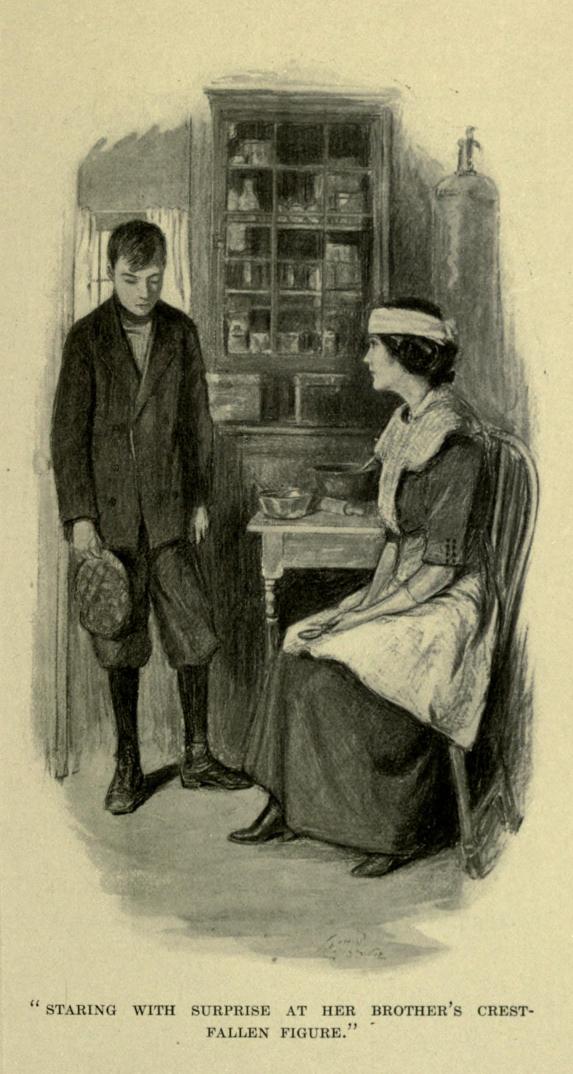
"STARING WITH SURPRISE AT HER BROTHER'S CRESTFALLEN FIGURE."
"Yes." The one miserable word came out with uncompromising bluntness.
Peggy was still staring. "But nothing much, is it, Dick?"
"Yes." Dick had taken a surreptitious glance at his sister, and his burden of self-reproach had at once grown heavier. "It's awful."
Peggy's thoughts flew to her mother. Or perhaps Dorothy had met with an accident. She was such a flyaway. Or could it be that Alice-- She dropped into a chair. "Tell me, Dick," she begged, her lips very white.
"I--I hate to so I can't." Shame made Dick's voice tragic.
Peggy's fingers gripped the sides of her chair. Whatever had happened she must control herself. Like one in a dream she heard Dick floundering on.
"Maybe something will happen yet, so--so it won't be so bad." Dick was thinking hopefully that perhaps one of his invited guests would find himself unable to accept.
"Go on," gasped Peggy. But her appearance, instead of encouraging Dick to confession, made it seem impossible.
"I--I guess I'll wait," he choked. "Maybe you'll feel better before supper."
Peggy's strength returned with miraculous suddenness. She pounced upon her brother as he was about to escape. "Tell me now, Dick. I--I can bear it."
"I--" Dick swallowed. "I asked Skits to supper."
Peggy waited stupidly.
"And Tom, too. I wanted to show 'em what a good cook you were."
Another pause. "Go on," prompted a stifled voice. "What about mother?"
It was Dick's turn to be startled. "Mother? Why, has anything happened to mother?"
Peggy's wits were in working order again. "Dick Raymond, you don't mean that you've almost scared me to death because you invited two boys to supper!" And then, reading in his face that she had hit the mark, Peggy's overtaxed nerves played her false, and she sat down promptly on the floor, where she laughed and cried together.
Poor Dick, at his wit's end, tried vainly to allay the storm. "See here, Peggy. You don't need to have 'em if you don't want 'em." That was when her sobs were most violent. Then with sudden indignation: "I'd like to know what you're laughing at anyway, Peg Raymond. I don't see anything funny."
The laughter had the better of the tears at last and Peggy wiped her eyes, took a long breath, and climbed unsteadily to her feet.
"Dick."
"What?"
"The next time you have any bad news to tell, don't try to break it gently. Just blurt it out, no matter what happens. I think that's safer, on the whole." Peggy moved languidly to the sink, where she removed the encircling towel and proceeded to bathe her eyes. "Dick."
"What d'ye want?" The conscience-stricken Dick was on his feet instantly, ready to fly in any direction at a word.
"You needn't tell the boys not to come. If one of the girls will come over and help me, I guess we can fix up some sort of supper. You run and ask Elaine."
But when Dick appeared fifteen minutes later he was accompanied by Priscilla instead of Peggy's next-door neighbor. "Elaine couldn't come," explained Dick. "She's sick, too. Her mother said she couldn't lift her head from the pillow."
It was Priscilla's first intimation that she had been second choice, and, to a girl of her temperament, the news was disquieting. "I'm sorry you couldn't have the one you wanted, Peggy," she said, with dangerous sweetness. "But I'll do my best to take her place." Then catching sight of poor Peggy's swollen eyes and drooping figure, she had the grace to be ashamed of herself.
It was a very good supper, though Peggy, sitting pale and heavy-eyed, at the end of the table, ate little of it. Strawberry preserves, and some of Sally's fruit cookies, had helped out so nicely that it had not been necessary to do much cooking, and in Dick's present state of penitence he would have eaten pine shavings and sworn that they were delicious. As he watched Skits, gorging himself with preserves, Dick suddenly realized that the supper invitation was not at all in accordance with Skits' deserts. "I'd ought to have punched his head when he acted as if he didn't believe about Peggy's cooking," thought Dick, scowling darkly at his unconscious guest. "Just as though everybody along the Terrace didn't know that she's got 'em all skinned."
Unconscious of the regrets disturbing their host's peace of mind, Skits and Tom made out an excellent meal, and withdrew to the next room to examine some new stamps Dick had recently added to his collection. Priscilla, who had quite recovered from her little pique, pushed Peggy into the rocking-chair, when she attempted to assist with the work.
"You sit still," she scolded. "Don't you dare move! I'll be through the dishes in no time."
The offer was too tempting to refuse. Peggy sat in the kitchen rocking-chair, where Sally rested when her daily labors were over, and watched Priscilla as she proceeded deftly with the work. "It seems a shame," she said, but without conviction, "to leave everything to you."
"Nonsense! As if you weren't always doing things for other people." Priscilla crossed the room to lower the shade and stood transfixed. "I thought Dick said Elaine was sick."
"She hasn't been out of bed to-day. You know she's rather subject to sick attacks," explained Peggy. "But they don't last more than a day or two."
Priscilla's laugh was rather disagreeable. "It hasn't lasted as long as that," she replied. "She's up and dressed. Just passed the window. Rather a remarkable recovery, isn't it?"
Peggy did not speak.
"Elaine isn't particularly fond of housework, I imagine," continued Priscilla, lowering the shade, and turning back to the waiting dishes. "But I'd rather say right out I didn't want to help, than make a pretence of being sick. And especially after all you've done for her, Peggy."
Peggy was in a mood to be an easy prey to suspicion. Tired, half sick, with over-strained nerves, and throbbing temples, it was not strange that for a moment she half believed that Elaine's plea of illness was only an excuse for evading work she did not like. In spite of Peggy's lessons, Elaine still found housekeeping duties very irksome. In a moment, however, Peggy's sense of fairness revolted against the assumption, which for the moment she had accepted as proved.
"Perhaps she felt better, all at once. People often do, after being sick all day."
"She trotted by the window as if she'd never felt better in all her life," remarked Priscilla tartly.
"Maybe her mother exaggerated a little," persisted Peggy. "Or perhaps Dick didn't quite understand."
"O, of course, if you're bound to find excuses for her, Peggy, you can do it. You can excuse anything in anybody, if you simply won't believe what you see with your own eyes." The dishes in the pan clicked ominously, as Priscilla splashed with energy.
Peggy was saved the necessity of replying by the sudden opening of the back door. A tall, ungainly figure appeared on the threshold and the girls united in a rapturous shriek. "Sally!"
Sally came in and removed her coat. Her manner was dejected, and with a pang of conscience Peggy recalled the melancholy reason for her absence, as well as for her return. With a determined effort to keep her own relief out of her voice, she suggested sympathetically "Your uncle, I suppose--"
"My step-uncle, Miss Peggy. He's better a'ready, and quarrelling with his victuals. Doctor thinks he'll be out o' bed by the first o' the week. It might have been such a good fun'rel, too," added Sally, with evident disapproval of the ill-timed recovery. "All the Lester County folks was down, and my aunt's sister from West Virginia. Stands to reason she can't pick up and run again very soon. Like enough when he's laid away at last there won't be a baker's dozen, outside the neighbors. I'll finish them dishes, Miss Priscilla. This is a disappointing world sure enough."
Peggy went to bed at eight o'clock and knew nothing more till fifteen minutes of breakfast time. Her head was clear, and the knowledge that Sally was in the kitchen made her light of heart, though her pallor told that she was still in arrears, as far as sleep was concerned. As she dressed with speed, the discovery Priscilla had announced the evening before came back to her, but she was no longer disposed to attach much importance to it.
"Some little mistake, of course, or else Elaine did feel better all at once. I'm sure she wouldn't have tried to fib out of helping me when I wanted her." Peggy was herself again, and nothing could have persuaded her to accept Sally's dictum that it was a disappointing world.
CHAPTER XV
A PATHETIC STORY
"I've got three tickets. We students always have two, you know, and a girl who didn't want to invite anybody gave me her extra one. Amy doesn't care for concerts, and Ruth is going somewhere with Graham. So I thought--"
Priscilla paused impressively. She was about to do an magnanimous thing, and she meant to get full credit.
"I thought perhaps you'd like to have me invite Elaine. Didn't you say she was fond of music?"
Peggy beamed. "She adores it. And it's lovely of you to ask her. Those conservatory concerts are always splendid."
"They get the best talent that's to be had," said Priscilla. "They go on the principle that hearing good music is part of our education." Priscilla was studying the violin in addition to her work in the high-school, and though possessed of no extraordinary talent, was at least learning a better appreciation of the work of the great artists to whom she listened at frequent intervals.
The two girls were on their way home from school. As they reached the Marshall's cottage, Peggy turned in as a matter of course, and Priscilla followed, feeling highly virtuous. She was not a girl who did things by halves, and her manner as she tendered her invitation was unusually sweet and winning.
"Peggy and I are going to the Conservatory concert Friday afternoon, and we want to take you with us. Powell will play, and it'll be a treat."
"Why, it's ever so kind of you. Of course I'd love to go." A glimmer of suspicion flashed out beneath Elaine's gratitude. She had learned to accept Peggy's kindnesses at their face value, without looking for an ulterior motive. But with Priscilla it was different. Out of Peggy's especial friends Priscilla was the one, Elaine felt sure, who liked her least, and her pleasure in the invitation was lessened by her wonder as to what had called it forth.
Peggy was chattering on gaily. "We'll go early, so as to watch the people come in. I think that's half the fun. We sit so high up that I am afraid to lean forward for fear of falling down, I don't know how many stories, but I hold on tight, and crane my neck so as not to miss anybody."
"You sit high up?" repeated Mrs. Marshall, breaking in on her animated if not literal description. "Is it possible that the management does not furnish orchestra seats to the students?"
"We sit in the second balcony," Priscilla replied, with a flash of resentment which was not allayed by Mrs. Marshall's manner of receiving the announcement.
"And is there really any danger of falling?" Mrs. Marshall was appealing to Peggy. "I have always been accustomed to a box. Dear papa was fond of music, but he invariably secured a box, and he was exceedingly particular about my gowns because we were so conspicuous. But the second balcony! Really I don't know."
Peggy hastened to allay the fears occasioned by her incautious figure of speech, and Elaine said hurriedly and with apparent sincerity, that she shouldn't enjoy a minute if she sat in a box. It was perhaps due to an effort, conscious or unconscious, to atone for her mother's implication, that Elaine blossomed into unusual enthusiasm over the proposed pleasure. When Friday came she was still in a particularly appreciative mood, and Priscilla mentally acknowledged that she had never liked the girl so well. She wondered if there was any truth in the theory that Peggy was always advancing, that you were sure to like people if you tried to be nice to them.
The concert justified the girls' anticipations. The great hall was crowded with an audience of music lovers, and the artist of the occasion was called back again and again, to bow her acknowledgement of the enthusiastic applause. Elaine's sorrowful expression when the last number on the program was reached, was more convincing than even her lament, "O, dear! It can't be over already."
"It's almost five o'clock. But cheer up! There'll be another." Priscilla's smile was thoroughly friendly. Hitherto she had always thought of Elaine as Peggy's especial property, and as an illustration of Peggy's recognized propensity for liking all sorts of people. Now as her thoughts ran ahead to the concert two weeks away, she wondered if by any chance she could secure a ticket for Elaine.
The great throng moved out slowly. Bits of musical criticism came to the girls' ears. The woman afraid of fire made her voice heard as usual, and impressively asked what chance they would have if the building were burning. Someone else called her attention to the emergency exits, and then Peggy lost the thread of the argument in her interest in a new voice which declared, "I know it's the girl. I couldn't be mistaken."
The voice was low but curiously intense. Something in its breathless emotion gripped the attention. Peggy turned her head, and found that Priscilla had done the same. The woman who had spoken was just behind them. She and her companion were leaning toward each other with an air of suppressed excitement which impressed Peggy unpleasantly, and it did not relieve her inexplicable sense of apprehension to discover that the eyes of the two were fixed upon Elaine's slender figure, a little in advance.
"Just wait till she turns," said the woman who had spoken before, and at that moment Elaine glanced back, as if to locate her companions in the slow-moving crowd. The smile on her face died away, as she met the fixed stare of two pairs of observant eyes.
"There!" Triumph was evident in the woman's tone. "It is the girl, just as I said. I should know her among a thousand."
With loyalty as intuitive as her breathing Peggy pushed forward, intending to place herself at Elaine's side. Though the woman who had professed to recognize her had said nothing to her discredit there was something beneath her triumphant tone which suggested an unpleasant reason for satisfaction in the discovery. But to overtake Elaine seemed impossible. Her departure suggested a panic-stricken flight. Before her companions had reached the top of the long flight of stairs she had disappeared.
"Where do you suppose she's gone?" Priscilla, pushing after Peggy, asked the question with an intonation whose meaning was unmistakable. Peggy, looking up, saw her own questioning exaggerated into suspicion on the face of the other.
"I don't know."
"She must have fairly trampled people underfoot. Say, Peggy, I suppose you heard?"
"Ye-es." It was a most reluctant affirmative, but Priscilla was too absorbed in her own thoughts to notice.
"It wouldn't mean anything by itself. But when she sees she's recognized, and runs away, it looks funny. I wonder if she'll wait for us?"
In the throng at the door of the concert hall, the girls could discover no trace of Elaine. Automobiles glided to the curb as their numbers were called through a megaphone, and the people who block the sidewalks on such occasions, stood in chattering groups, unmindful of the desperate attempts others were making to pass them. But at length the crowd thinned sufficiently for the two girls to assure themselves on the point in question. They looked at each other, and for a moment did not speak.
"Well!" Priscilla's tone was dry. "She isn't here."
"No," Peggy was driven to confess, "she's not here."
"We might as well go home. I don't know what you think about it, Peggy Raymond, but it looks pretty queer to me."
Peggy was not communicative. In silence they walked to the cars two blocks away, and on the corner they found Elaine. It was not the enthusiastic Elaine of the concert, not the self-sufficient Elaine, familiar ever since her arrival on the Terrace. She looked pale and wan and harassed.
For her extraordinary flight Elaine offered no explanation. "I thought I'd wait for you here," she said faintly.
"We didn't know that. We've been waiting for you there." Priscilla's tone indicated that she expected something more, but apparently Elaine did not realize the need either of explanation or apology. But as they climbed up into the car, she looked so faint and frail that without thinking, Peggy took her arm to steady her. At the touch Elaine lifted her eyes with a grateful look which had the effect of sweeping away all Peggy's suspicions, like a spring freshet. Peggy made no pretence to being logical. All she asserted was that sometimes she "just knew things."
The ride to Friendly Terrace was silent and constrained. At Priscilla's door Elaine faltered her thanks for a pleasant afternoon and Priscilla replied stiffly. As she went up the walk, Elaine turned to Peggy with unmistakable relief.
"Is it too late for me to go home with you? There's something I want to tell you where nobody'll hear."
"There's all kinds of time. Father doesn't get home to-night till quarter of seven." Peggy led the way into the house, evaded a categorical reply to her mother's smiling inquiries if they had had a pleasant time, and conducted Elaine to her room, where she pulled forward the wicker rocker.
"That's the most easy-going chair in the whole room. Sit down and be comfortable. But, first, take off your coat. It's so warm."
Elaine obeyed automatically. "Peggy," she said as she took her seat, "you saw that woman looking at me so hard to-day?"
"Yes," Peggy acknowledged, "I saw her."
"And she said something, didn't she, to the woman with her?"
"She said she'd know you among a thousand, that's all. And see here, Elaine. Don't tell me anything you don't want to, just because of that."
Elaine put her hands to her head, with a gesture which wrung Peggy's heart. "But I do want to tell. I've got to tell somebody. Sometimes--" her voice rose in a little cry--"Sometimes I've thought I'd go crazy, keeping it to myself."
Peggy pulled up a chair and sat down. She was used to confidences. People of the stamp of Peggy Raymond must expect to be receptacles for the various woes of all sorts and conditions of people. But she realized that what Elaine had to tell was something out of the ordinary, and lost a fraction of her usual bright color.
"I knew those women," Elaine explained, twisting her interlaced fingers. "But they didn't know me. They thought I was my sister."
"I didn't know you had a sister!" Surprise was responsible for Peggy's exclamation.
"I'm several years younger than Grace, but there's a strong resemblance. It was her picture you found that day, Peggy."
"And she died. How dreadful it must have been--" Peggy's sympathetic voice ceased suddenly, as Elaine's look of agitation told her that she had guessed wrong. "She's not dead," Elaine said breathlessly. "She's living, and what's more, she's living here, Peggy."
"Here?"
"On Friendly Terrace."
Peggy had been prepared for unusual disclosures, but this was more than she had bargained for. It was a good half minute before she could answer except by an incredulous stare.
"On Friendly Terrace? In the next house?"
"Yes."
"You don't mean that she's been living there ever since you came?"
"Yes."
"I don't see--why, I never heard of such a thing." But light was pouring in on Peggy. A number of matters that had puzzled her and even aroused her suspicion, suddenly became intelligible in view of the fact that the next-door cottage housed two girls instead of one. "But why--" she began breathlessly, and then checked herself.
"That's what I wanted to tell you, Peggy. It wasn't a year ago that it all happened, and it seems the bigger half of my life. Grace was a Junior in college. It was hard to keep on with her course, after father died, but she wanted to finish. She was engaged to a young lawyer, Carlton Ross his name was, and everybody thought he was such a nice fellow and that Grace was so fortunate."
Elaine's hands were clasping and unclasping convulsively, as she told her story. Peggy laid her warm brown hand over the trembling fingers, and there was a world of friendly comfort in its clasp.
"One Saturday Grace went down town to do a little shopping, and she stopped at a jeweller's and asked to look at some diamond brooches. Some people could never understand why she did it, for, of course, she couldn't have bought diamonds any more than she could have bought the moon. I suppose it was rather silly, but surely it isn't unheard of, Peggy, for people to examine things they can't afford to buy. Anyway that was what Grace did. And when she said she didn't care to buy, and started to go out, the clerk stopped her and said he begged her pardon but there was a brooch missing."
Peggy uttered a horrified exclamation.
"Yes, but that was only the beginning. Grace went back, and they looked all over the counter, and the floor-walker came up, and things began to be dreadful. And then they said that she would have to be searched. Only think! Grace was almost ready to faint, she was so frightened. It was like a terrible dream, she said. It didn't seem as if it could be such things were really happening to her. And then she thought of Carlton, and begged them to telephone for him, and he came."
Peggy heaved a sigh of relief.
"O, but that was the worst of all. For when he heard about it, he asked if he might speak to her alone, and then he begged her to confess. Yes, Peggy, he thought she stole it. You see he knew that she hadn't any money for buying diamonds, and the only way he could explain what she had done was to take it for granted that she was a thief. And then Grace lost her courage. If Carlton didn't believe in her, nobody would. She screamed out that she wished she were dead, and they heard it and thought it proved that she was guilty."
Sympathetic Peggy was in tears by now, but Elaine's eyes were bright and dry. The recital of her sister's wrongs had brought them before her vividly, and her voice was bitter as she continued.
"You can't have any idea of what we went through for nearly two days. They couldn't find the brooch and Grace was arrested. She wouldn't let Carlton do anything for her, and an old friend of papa's went her bail. There were columns about it in the papers, and Grace's picture and all about papa, and then all at once it proved to be a mistake. The brooch had been sent to some customer, along with several others for inspection, and there was some blunder about returning it. They sent it back finally, and Grace was cleared of all suspicion, but her life was ruined."
Peggy protested. "Ruined! Why, she was innocent."
"O, you don't know, Peggy. First there was Carlton, and, of course, Grace broke her engagement the instant she found he didn't believe in her. But he wasn't the only one. Our friends were so sorry for us, but we didn't want them to be sorry. We wanted them to be angry and say it was an outrage, as if they meant it. They made excuses for Grace. Said she'd been used to having so much and that since papa's death things had been so different, and they pitied mamma and me because of our disgrace. When I came here to Friendly Terrace I hated everybody in the world. I thought I never would make a friend again as long as I lived. And I'd have kept my word, I guess, if it hadn't been for you, Peggy."
"You poor darling!" Peggy's arm slipped around Elaine's shoulder, and tightened in a comforting hug. But her thoughts were busy still with the account of the tragedy to which she had just listened. "How long is your sister going to stay hidden away?" she demanded abruptly.
Elaine sighed. "As long as she lives, I guess. She doesn't feel as if she could face people."
"I don't know why. It's the ones who made the mistake who ought to hang their heads. Grace hasn't done anything to be ashamed of."
"I suppose we could have sued the firm," Elaine said wearily. "Mamma's lawyer urged it. But Grace, and all of us, for that matter, felt that we'd gone through all we could bear, and that any more publicity would only make things worse. Of course Grace never left the house in daylight, but whenever mamma and I went out we were stared at as if we'd been curiosities, and we could see people talking about us, and telling the whole story over again. It was such a comfort to come here where nobody knows. At least mamma and I felt so, but poor Grace couldn't get her courage up to let herself be seen even here."
Peggy frowned reflectively. "I don't see how she manages to keep hidden that way."
"It isn't as hard as you might suppose. You notice that we always keep both doors locked, and the shades are drawn a good deal. Grace helps in the housework, and comes down to her meals, just as we do. The afternoon she generally spends upstairs, especially since you girls have got in the way of dropping in after school. And she likes you, Peggy. She sits in a little room at the head of the stairs, and she can hear nearly everything that is said. It's funny, when you didn't even know there was such a person, but she feels real well acquainted with you."
"O!" cried Peggy, another mystery becoming luminous, by virtue of this explanation. "I wonder if it wasn't Grace who telephoned me--"
"On Christmas night? Yes. We'd been talking about you all day, and saying what a dear you were, and admiring the little tree, along about bed-time, Grace said all at once, 'I never expected to wish anybody a happy new year again, but I'm going to wish one to Peggy Raymond.' And she marched over to the telephone, while mamma and I sat there too surprised to say a word."
Peggy pressed her friend's hand, too touched for the moment to speak. This innocent girl, hiding from view like a criminal, held prisoner by her own morbid shrinking, would have impressed a less sympathetic imagination than Peggy's, as a pathetic figure. "And she never goes out of doors," she said, following out her line of thought.
"Sometimes she slips out on the porch when it is very late. Amy saw her there last Halloween."
"To be sure. I think Amy always flattered herself that she really saw a ghost that night." It occurred to Peggy as the words left her lips, that out of all of Amy's superstitious fancies, this was nearest the truth. "I wish," she went on slowly, "that she'd begin to show herself, and see people. It's a dreadful way to live, dreadful! Don't you think she'd be willing to see me? You said that she liked me."
Elaine's alarm at the mere suggestion impressed Peggy, more than anything yet said, with the seriousness of the situation. "If she knew I'd told you all this, she'd never forgive me in the wide world," declared Elaine paling at the thought. "And as for seeing you! No, Peggy! But you can't think what a comfort it is that you know."
"I'm glad," said Peggy, kissing her. But, as a matter of fact, she was far from being satisfied. Anybody could listen to another's troubles. Peggy wanted to be something more than a sympathetic confidante, but it seemed that for the present she must content herself with this passive form of helpfulness.
CHAPTER XVI
A BELATED INVITATION
Priscilla's curiosity grew over night. When she waked Saturday morning, she found herself unable to think of anything but the singular episode of the preceding afternoon. She recalled the absorbed faces of the women who had watched Elaine, the suppressed eagerness of their triumph, when she turned about, and lastly Elaine's incomprehensible panic over finding herself observed. Priscilla racked her brains for a possible explanation, but her imagination was unequal to suggesting any that was creditable to Peggy's next-door neighbor.
It was not long after breakfast when she presented herself at Peggy's door in the hopes that Peggy might be able to throw light on the situation. Peggy was doing the chamber work on the second floor, and Priscilla was glad to assist in the ceremony of bed-making, because of the opportunity this afforded for an uninterrupted discussion of the mystery.
"I want to talk with you about yesterday," she said in the carefully lowered voice which seemed appropriate to the situation, though, as a matter of fact, she might have shouted without attracting anybody's attention. "I've thought about it all night."
"Me, too!" Peggy's tone was enthusiastic. "Especially that andante movement."
"O, Peggy!" Priscilla twitched a sheet with an energy that pulled it away from the foot of the mattress, and sent Peggy hurrying to repair damages. "What nonsense! As though I was thinking of andante movements, or any other kind. I mean about Elaine."
"Wasn't it nice to see how she enjoyed it? She really knows a lot about music, and the more you know, the better you appreciate it, especially classical music." Peggy was clearly talking against time, advancing her by no means original views with an earnestness which was far beyond their deserts. Priscilla was conscious of a feeling of irritation.
"She did seem to enjoy the music, I'll admit. But apparently she doesn't enjoy meeting old acquaintances. Quite the opposite."
"She didn't meet any old acquaintances," said Peggy quietly.
"Those women thought they knew her, even before she turned around, and after that they were sure."
"They might have been mistaken for all that." Peggy smoothed the comforter anxiously, as if to have it lie without a wrinkle was the most important matter under consideration.
"If they were mistaken, why did Elaine run? The suspicious thing was her being frightened to death, the minute she found anybody noticing her. If she hadn't done anything to be ashamed of--"
Peggy felt the time had come to discard the policy of evasion. She straightened herself, looking across the billowing bed-clothes, straight into her friend's eyes. "Elaine hasn't any reason to be ashamed of anything she has done."
"What is the matter, then?"
"There's nothing I can tell, Priscilla."
"Nothing you will tell, you mean. If you know about it, it wouldn't be any more than friendly to explain."
"There's nothing I can tell," repeated Peggy firmly. Priscilla found the reiteration irritating.
"I suppose she's confided everything to you, and expects that we'll take your word for her. Well, I won't, for one. We don't know anything about her, except that she can be mighty disagreeable when she tries, and yesterday capped the climax. I sha'n't have anything more to do with her till I know what it all meant."
"That's for you to decide." Peggy's tone was decidedly cool. Her hands trembled as she twitched the coverlets into place. The intensity of her sympathy, kindled by Elaine's pitiful story, perhaps rendered her incapable of doing full justice to Priscilla. Unfortunately her manner fired the jealous resentment which was Priscilla's greatest weakness.
"Of course if you're going to take sides with her, Peggy Raymond, against your best friends, if you're going to throw me over just because--"
"How silly!" snapped Peggy. "O, please, Priscilla, don't pull those bed-clothes up from the foot again."
Priscilla's face was white. "I see I'm in the way. That girl has spoiled our friendship. You've never been the same, Peggy, since Elaine Marshall moved to Friendly terrace."
"How silly!" exploded Peggy, angered by the injustice of the charge and momentarily abandoning her usual tactful methods. "As if anybody but our two selves could spoil our friendship." She watched Priscilla's dignified withdrawal without protest. She was tired of these scenes, she told herself. It was time Priscilla had a good lesson. She punched a pillow into place with a vehemence implying that she held it solely responsible for all that had occurred.
As for Priscilla she closed the door behind her with the feeling that she had burned her bridges, and that no retreat was possible. All was over. She had been very fond of Peggy, but Peggy's fashion of losing her head over every new girl who came to the Terrace was bound to grow tiresome. Peggy had clearly indicated on which side her sympathies lay. She had chosen Elaine in preference to the friend of many years standing. By the time Priscilla was at her own door she was ready to believe that she had been most unfairly treated.
Priscilla was not the sort of girl to rest quietly under a grievance. Her first impulse was to assert herself, to prove to all observers how little she cared. Accordingly she burst in upon her mother with the request, "May I have some of the girls to luncheon next Saturday, mother? I don't mean two or three; I'd like a dozen or so, a real party--"
"Let me see." Mrs. Combs was accustomed to these impulsive outbreaks on Priscilla's part. "What day is Saturday?"
"The thirteenth."
"I have an invitation to luncheon myself for that day; still you could manage without me, I dare say."
"O, yes. I don't want anything elaborate, only nice, you know. And Susan's cousin can come to wait on the table. She does it very nicely, and doesn't charge much of anything." Priscilla hurried to her writing desk, and pulled out her note paper. A party without Peggy! Could there be a better way of asserting herself and proving how little she was moved by the loss of Peggy's friendship. She dashed off the invitations as hastily as if she were afraid to give herself time for reflection.
Peggy was not long in hearing of Priscilla's luncheon party, and the non-appearance of her invitation was a secret she kept to herself. That she was hurt, goes without saying. The two girls had been friends for years, and, up to this time, Peggy's ground of complaint had been the excess of the other's affection, rather than any lack. It was hard to believe that Priscilla was planning so pronounced a slight. She tried to make herself believe that there was some mistake, but the passing days brought the conviction that the omission was deliberate, and that the chief purpose of the little festivity was her open humiliation.
This would have been bad enough, but, to make matters worse, Peggy's conscience took a hand. An uncompromising monitor was this same conscience, sternly denying Peggy the luxury of self-pity, and arraigning her in a fashion little short of merciless. Ardently it pleaded Priscilla's cause. Her suspicions of Elaine were not without foundation. Peggy herself might have shared them had it not been for the extraordinary story to which she had listened. In any case, she had failed to show the patience due one friend from another. She who prided herself on her tact, had been brusque and tactless. Knowing poor Priscilla's weakness, she had not been on her guard. She had lost her friend, and for her comfort had the reflection that it was, in part at least, her own fault.
It was a blue week for Peggy, and hardly better for Priscilla. She studied cook books, planned out her menu, and tried to think that her low spirits were due to dreadful doubts as to Susan's salad dressing, while all the time she knew that she missed Peggy. She wanted to ask her opinion as to whether to order the ices from Bird's or Connally's, and to consult her about the place cards. How loyally Peggy would have counselled and lent her aid. Many a time she had helped some distracted hostess till she had barely time to fly home and change her dress before the appointed hour.
Saturday was cloudless, a fact which Priscilla came near resenting. Grey skies and a drizzle of rain would have harmonized better with her mood. Mrs. Combs was puzzled by the overcast face her daughter brought down to breakfast.
"What is it, child? Anything wrong with your plans?"
"No, I guess everything's all right," Priscilla responded in the most doleful of voices.
"A pleasant hostess is the chief factor in making pleasant guests. I advise smoothing a few of those wrinkles out of your forehead when you attend to the rest of your toilet," advised Mrs. Combs, smilingly, and she was more puzzled than ever when Priscilla received her counsel with a sigh.
The luncheon hour was set for one o'clock, but at half past twelve, the girls began to arrive, formality never being much in evidence on Friendly Terrace.
"Wonder if Peggy's here yet," Ruth remarked, as she stood before Priscilla's mirror, giving her hair the little caressing pats whose importance every girl understands.
"I don't believe Peggy is coming." It was Blanche Estabrook who made the remark, apparently without realizing its importance.
Ruth and Amy whirled about. "Not coming!" they exclaimed in a breath.
"She was on Elaine Marshall's back steps talking to her as I came by. She had on a blue gingham, and that didn't look very much like going out to luncheon." Blanche ran down the stairs, leaving Amy and Ruth gazing blankly at each other.
"Now I think of it, I believe something has been wrong all the week," Amy exclaimed. "Priscilla has kept to herself, hasn't she? I don't remember her walking home from school with Peggy."
"I don't believe she has. To think of her not asking Peggy!" Ruth gave a refractory lock a jerk which threatened to undo, all in a moment, the result of much patient labor. "I really think I wouldn't have come myself if I'd known."
Downstairs the early arrivals were chatting gaily. Ruth and Amy descended together to join them, feeling little in the mood for festivity of any sort. "If it had been anybody but Peggy," Amy said, angrily on the way down, and Ruth replied, "Seems as if there must be some mistake, Amy. Perhaps she'll come after all."
The doorbell rang several times before one o'clock, but no breathless Peggy appeared, apologizing for the delay, and smiling on everybody. Ruth made no effort to be entertaining, but sat watching the door, and making absent replies to the girl who sat next her. Amy, too, was uneasy, and curious little lulls occurred in the conversation, a phenomenon almost unheard of when a group of girls are together.
"Well, I believe we're all here," Priscilla announced at last. "Excuse me for a minute, while I tell Susan." She rose and stepped into the hall. In an instant Amy had followed, closing the door behind her.
"Priscilla!" Amy's excited tones were plainly audible in the room where the girls sat waiting, though not her words. "You don't mean that these girls are all the party."
"Certainly they're all." Priscilla eyed her friend suspiciously.
"But there are thirteen of us. Do you think I'd sit down thirteen at the table, and on the thirteenth of the month, too." Amy was very much in earnest. Her plump, good-natured face was actually pale. "I tell you I wouldn't think of such a thing."
"I believe there are thirteen. Rae Fletcher couldn't come." Priscilla had recovered herself in a moment. "But that silly old superstition, Amy. You don't mean--"
"Yes, I do mean it. And there's lots of other people who feel just the same about it." Amy suddenly opened the door of the front room. "Come here, Ruth, we want you a minute."
Ruth made her appearance, expecting to be consulted on a very different matter. Amy's tragic explanation took her by surprise, and she smiled a little. "O, well," she was beginning, and then checked herself, as the possibility of turning Amy's superstitious terrors to good account flashed upon her.
"I simply won't do it," Amy was insisting. "And on the thirteenth of the month, especially. I wouldn't have another peaceful minute all the year. Ruth, why don't you say something?"
"Why don't you ask somebody else and make fourteen." Ruth offered the suggestion nonchalantly, though her pulse had quickened.
"There isn't anybody I can ask at the very last minute. Mother's gone to Mrs.--"
"Why not ask Peggy?"
"'WHY NOT ASK PEGGY?'"
Amy's excitement over the fatal number of Priscilla's guests had made her temporarily forgetful of her earlier reason for disquiet. At Ruth's master-stroke, she gasped with admiration, and promptly seconded the suggestion. "O, yes, ask Peggy. She's just the one."
Priscilla stood with downcast eyes, and breathlessly her two friends awaited her answer. For a moment the outcome was uncertain. Priscilla was quite capable of resenting such advice, and earlier in the week would undoubtedly have done so. But if Peggy's conscience had been an uncomfortable companion, Priscilla's had not been less active, and her anticipated triumph in having a party without Peggy had proved bitter as Dead Sea fruit. When she spoke, her voice was tremulous, in spite of her efforts to make it sound indifferent.
"O, I don't believe Peggy will come. We had a little misunderstanding, you see."
"It wouldn't do any harm to try," suggested Ruth, still painstakingly matter-of-fact, while Amy added with less tact, "If anybody would do it, it's Peggy. She's the forgivingest thing."
Peggy was at the dinner table when an agitated knocking sounded at the side-door. A breathless voice in the hall made inquiries of Sally. "Somebody to see you, Miss Peggy," was Sally's grudging announcement. She disapproved of people who came at meal time.
To Peggy's amazement it was Priscilla waiting in the hall, Priscilla in her best white frock, and with a pallor that was rather appealing. "I know you won't do it," was her opening remark.
"Won't do what, Priscilla?" Peggy was to be pardoned if her manner was a little formal.
"There are thirteen of us, and Amy won't sit down at all. But it serves me right if my party's spoiled, after treating you that way."
Priscilla gulped. Peggy's manner became less dignified.
"You mean that there's thirteen and you want me for the fourteenth."
"Of course you won't come. But it serves me right to have you say no." Priscilla bit her lip to keep from crying.
Peggy threw a hurried glance at the mirror. "Will my hair do? I've got to change my dress, of course."
"You're going to do it?" Priscilla fairly screamed. "O, Peggy! You're an angel. You can't think how wretched I've been all the week, and how ashamed. O, you darling! Can you ever forgive me?"
They rushed upstairs, their arms about each other's waists. "Don't make me cry," pleaded Peggy, gulping down a sob, "because I really mustn't take time to wash my face, you know. I'll wear my pink; I can get into that in a shake."
It was only fifteen minutes after the hour named on the invitations, that Priscilla's guests sat down to a very dainty and highly successful luncheon. "Do you know, I thought you weren't coming," Blanche Estabrook said to Peggy as they took their seats.
"I'm so sorry to be late and keep everybody waiting," Peggy answered with gentle regret, and that was all most of them knew about the belated invitation. But there was no doubt in the minds of any of the gay crowd that fourteen was a peculiarly lucky number, on any day of the month.
CHAPTER XVII
ELAINE UPSETS TRADITION
Winter as a rule seems long to people in trouble. That year Elaine Marshall found it endless. The steady cold that set in early in January seemed to her relentless, almost vindictive. It was vain to tell herself that spring would return as always, that the branches of the willows by the river would become clouds of misty green, that violets would start in the woods beyond, and the strips of lawn along the Terrace would take on the hue of spring. Intellectually she knew all this to be true, but in her heart was the hopeless conviction that this winter would last forever.
Elaine was having a hard time, and the hardest part of it all was that, however far she looked ahead, she could see no prospect of relief. Mrs. Marshall's economy was of the inconsistent sort, noticeable in people who late in life have begun to realize the value of money. She scrimped over the pennies, and then threw away dollars for something which even to Elaine's inexperience was plainly not indispensable.
Things counted up incredibly. There was the coal bill, for example. Mrs. Marshall had said at first that the dealer must have made a mistake, and then, that he evidently gave short measure, and, finally, she had looked at her daughter with eyes half-frightened. "We can't freeze, Elaine."
"No, we've got to keep warm," the girl returned, but her voice was absent. She was mentally calculating how far their yearly income would stretch at this rate, and the thought of the weeks for which there would be no provision rushed over her with sickening dismay.
She took up her embroidery and fell to work. Since filling Mrs. Summerfield Ely's first order Elaine had received several others from that lady and her friends. She had outgrown her early foolish humiliation over the idea of doing such work for pay. Mrs. Ely treated her with as scrupulous a courtesy as she would have showed any other girl, and gave her work the praise which to the conscientious is always the best of the rewards of toil. At the same time, Elaine's judgment, sharpened by necessity, was grasping the fact that this dainty work, well enough to fill in the leisure minutes, was a very poor dependence when the bread and butter problem was under consideration.
Peggy came in upon her one afternoon, when the dreariness of the grey winter sky seemed to Elaine an inadequate symbol of her own sombre mood. Peggy's arrival was like a rift in the clouds, letting the blue shine through, a real sunbeam visitation. Smiles were not easy for Elaine these days, but her face did brighten noticeably at the sight of Peggy.
"You don't mind if I keep on, I know," she said as Peggy took the nearest chair. "Mrs. Laughlin is in a hurry for this."
"I don't mind your keeping on as far as I'm concerned," Peggy replied, viewing her narrowly. "But I do mind the way you're squinting over that embroidery. What's the matter? Are your eyes hurting you?"
Elaine let the embroidery fall, closing her eyes, and further protecting them by a sheltering hand. "Hurt?" she repeated. "I should think so."
"What's the matter?"
"Too much close work, I suppose. I've kept at it till late two or three nights this week."
"It isn't going to pay you," warned Peggy, "to ruin your eyes for what you can make out of embroidery."
"It doesn't pay anyway," sighed Elaine. "You wouldn't believe how many hours it takes me to earn ten dollars." She had given herself as long a recess as she dared, and she fell to work again, her eyes blinking and suffused with moisture as if reluctant to reassume their duties.
Peggy's silence was unusually prolonged. "I had a new experience this week," she remarked casually at last. "I had a job offered me and refused it."
"A job?" exclaimed Elaine with interest.
"A job?" echoed Mrs. Marshall, her tone indicating horror. There was a startling vulgarity about the term, she reflected. Young ladies might have employment, though occupation was still better. But to get a job was not to be thought of. She shuddered.
"In my Uncle John's office," Peggy explained. "He's a real estate dealer, you know, and he's especially interested in the new suburb they're opening up, Lakeview, they call it. He thinks there's quite an opening in that work for women, and he painted the prospects in such dazzling colors that I really hated to say no."
"Why did you say it, then?" asked Elaine, her manner proving that the inquiry was by no means perfunctory. Mrs. Marshall uttered an exclamation, apparently indicating that the reason was self-evident.
"O, I wouldn't stop before I finished high school for anything. And Uncle John wants somebody right away. If the chance had come after I had graduated I'd have jumped at it, for I've got to earn some money before I go to college."
Elaine folded her work deliberately and laid it on the table. She set her thimble atop, with particular care that it should be exactly in the centre of the pile. Then she looked hard at Peggy.
"What about me?" Elaine demanded abruptly. "Do you think he'd consider me?"
"Elaine!" gasped Mrs. Marshall. But Peggy, overjoyed that the fish had risen so readily to the bait, failed to notice the horrified protest of the mother's tone.
"Would you really take such a position, Elaine?" she cried. "Why, I should think you'd have the best chance in the world. And Uncle John would be such a splendid person to work for. He's a fine business man, everybody says, but not the petrified sort. He's kind and interested and ready to make allowances--"
"Elaine!" said Mrs. Marshall, breaking in on Peggy's eulogy. This time it was impossible to ignore the tone in which she spoke her daughter's name. It was like the crack of a whip.
Both girls looked at her. Poor Mrs. Marshall sat very straight, her thin cheeks aflame. Her expression betokened a conflict between incredulous anger and hurt pride.
"Elaine, you must be taking leave of your senses. What would your grandfather have said at the idea of one of his blood"--Mrs. Marshall hesitated, then evidently concluded that only the objectionable commercial term Peggy had made use of, was equal to the occasion--"one of his descendants getting a job in a real estate office?"
"I think grandfather would probably have said that circumstances alter cases," replied Elaine promptly.
Not having had the pleasure of the acquaintance of Mrs. Marshall's late father, Peggy was unable to surmise what that old gentleman's attitude would have been under such conditions. But she hastened to suggest, "Lots of awfully nice girls go into business offices nowadays, Mrs. Marshall."
Elaine was in a reckless mood. "I don't know as it matters what other girls do. It's a question of what I've got to do. We can't sit here and starve, just because grandfather was rich."
"Elaine!" cried Mrs. Marshall with a horror which was at least sincere. To acknowledge, even to Peggy, the pressing character of their need, seemed to the poor lady a shocking piece of indelicacy. Her weak chin quivered, as she struggled with her emotions. Peggy possessed enough of the divine art of putting herself in another's place to realize that the consternation, so absurd from her standpoint, was justified by those views of life to which Mrs. Marshall had always adhered. She racked her head for something which would soften the blow.