Part 4 — PART IV.
Reading edition
THE MOODY GIRL.
As there are few things more certain than that girls are given for what stars are given—to give light upon the earth—the moody girl fails lamentably to fulfil her vocation.
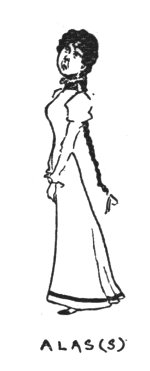
Some are of the opinion that this girl is a nineteenth century product, but so far is that from being the case, that she figures in a play of a hundred years ago. Says Miss Biddy in Garrick’s comedy “Miss In Her Teens”—
“When I say ‘Heigho,’ it means ‘Yes.’”
Yes could hardly be said in a mournfuller way, and the case of Miss In Her Teens to-day is only by so much more mournful than that of her prototype of Garrick’s day that when she says “Heigho” it as often as not means “No.”
Her cause of grief is what the moody girl is rarely able to state. There are people whom this surprises; yet there is nothing surprising in it. The lives of most pessimists, looked at closely, show these persons to have lived under fair advantages, and not, as they would make out, under unfair disadvantages. Many of them follow a process uncommonly like that followed by certain “sturdy beggars,” who, if rumour concerning them be true, rubbed their skins with blistering plants—wild ranunculus and the like—to cause sores which should excite sympathy. The moody girl is she who picks from life’s full garden wild ranunculus only, and puts it to a wicked use devised by “sturdy beggars.”
Has she no aspirations? In truth, she has no fewer than Ovid had, and, like Ovid, she might say, “I see and approve the better things; I follow the worse”—in Ovid’s language, Video meliora proboque, deteriora sequor.
What is she like to look at? Lean as a rake? Not necessarily. Watts’ famous picture named “Aspirations” is the presentment of a fat-faced, woolly-haired boy. A moody girl known to me has nothing bodeful in her face, and has a little, plump, white hand—Napoleon’s hand. Her wail, too, is Napoleon’s: “Nothing is left to do!” Another has a round, troubleful little face with poco fatto—“little done”—written all over it. One moody girl only known to me looks the part she elects to play. This girl has a thin, pallid face, with thick, straight, black, moist, heavy hair. She says dreamily, and says often, “I know I’m disagreeable.” She says little more than that.
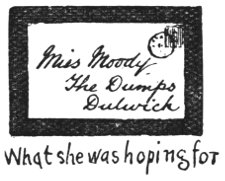
The moody girl has rarely a wide range of conversation. She is apt to end her most voluble narrative with a portentous “But however.” There is a moody girl now living who goes by the name of “But However.” Of another moody girl now living a tradition has it that she never speaks, except to ask, “Is there a letter for me?” Howbeit sometimes a moody girl can string twenty and odd words together, and there is on record a very notable statement in the form of a paradox once made by such a girl; to wit, this—
“When married I shall never know happiness until I have shown my husband that I am master, and then I shall be miserable because I shall despise him.”
Well-a-day!
This is the place perhaps in which to tell of the slaty-blue girl.
Figure to yourself a damsel in a slaty-blue dress and slaty-blue hat, wearing slaty-blue gloves, and having slaty-blue eyes and slaty-blue lips, and figure her to yourself as “footing slow,” to borrow a phase from Milton, and as doing this as one of a party of us making a rush for a train “already in.” And figure us seated in a third-class compartment, a little child in which is drawing his finger down the window-pane. To whom the slaty-blue girl says (as we phase it, “dyingly”) from the end of the seat—
“Don’t, please. That gets on my nerves.”
The moody girl is hyper-nervous.
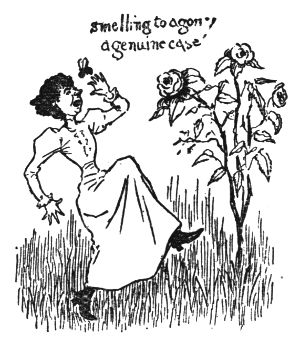
Here is another story of her. She was my visitor, and I led her to a seat and spoke of this and that. She listened absently, then said, as she glanced at a penny bunch of sweet violets distant from her by the length of a large room—
“Would you mind that bouquet’s being taken away? I smell to agony.”
Rather unamiable that, but not intentionally unamiable. Now there are moody girls who are intentionally unamiable—Baubles, for instance. We call her by that name, because she has the word “baubles” much on her lips, and in sound it is not very remote from Barbara, which is her baptismal name.
Baubles is always in deadly earnest; that one may be in lively earnest she does not dream. Another thing; she knows that there is such a thing as “a foolish face of praise.” She has still to learn that there is such a thing as a foolish face of blame. Bauble’s face is her misfortune. In the following I give a conversation which I once had with another girl regarding her.
“She loves you,” said this other girl.
“Does she?” I asked, pleased, but surprised. “She looks at me as if I were especially abhorrent to her.”
“She always,” was the answer, “looks like that at people whom she loves.”
A girl like that is scarcely in the possession of her full reason, and what shall be said of a girl like this? She met a woman of her friends some little time since in the street, and responded to her greeting by a stare of blank non-recognition. The following day brought an apology, coupled with the intimation that she had moments when she could not bow.
A case like that becomes interesting in connection with the anatomy of melancholy. The girl who has moments when she cannot bow is suffering from a form of the disease known in mental pathology as “impulsive insanity.” The victims to this disease lapse into states of defective control.
What shall one say to the moody girl? Shall one not tell her to face life cheerily? There has never been known a year of nights on every one of which the stars shone, but no more has there ever been known a year of nights on not one of which the stars shone. The moody girl takes life as if all her years of days had been years of nights, and as if on not one of these nights the stars had shone. She has much to learn, this chiefly, that there are compensations for almost everything.
“Look at my teeth,” so said a moody girl to a German philosopher, “look at my teeth, and I am a singer.”
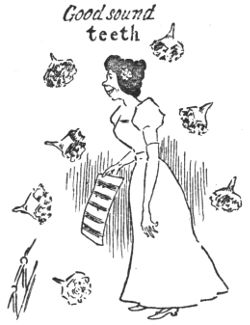
Her teeth were large and protruding.
“Those teeth are good for a singer,” said the German philosopher.
Envy—this thing may not be said aloud, but it may be said in a whisper to the moody girl—is at the bottom of much self-made misery. The cry of Shakespeare’s Helena is the cry of many Helenas.
“How happy some o’er other some can be!”
This, too, is true of the moody girl. She is pre-eminently a faultfinder. In this she is the more to blame that they who find fault are they who seek fault. She is lavish of her censure and is chary of her praise. She should be told what a Frenchwoman has said—
“’Tis in a sort to participate in good deeds to praise them.” In the Frenchwoman’s language, “C’est en quelque sorte se donner aux belles actions que de les louer.”
The suppositions of a moody girl are sometimes singular. “I suppose,” says one Sybil, “any of us could remember six unpleasant circumstances in our lives more easily than six pleasant.”
This Sybil it was who cited to her father the famous line regarding “the loud laugh,” and who learnt from him that the loud groan shows every whit as much “the vacant mind.”
What makes for moodiness? A life of ease according to the poet to whom belongs the phrase “stretched on the rack of a too-easy chair.” The rich girl who wishes she was poor is full as common as the poor girl who wishes she was rich.
Her brother does not spare the moody girl. Sometimes his gibes are stupid; once in a while they are fairly clever. As boy’s satire, what follows appears to me rather good.
“Any baby can put its finger in its eye and cry.”
As girl’s satire, what next follows—being the speech of a girl not moody on the subject of a moody girl—is excellent.
“She is one of those people who always bring up miserable subjects and—sympathise.”
A rather common type of moody person is that composed of girls who not only themselves wear habitually a dolorous expression, but who admire this expression on the faces of others. I sat to such a girl once for my portrait. She surprised me by her variant of the photographer’s familiar request. “Will you,” she said mellifluously, “please try to think of something—unpleasant?”
I tried my hardest and succeeded, within the limitations set to Irishwomen.
It has been said here that no fixed type of face belongs to a moody girl. Everyone therefore, who could paint such a girl would paint a different face. The one that I would paint would be that of one Maud Mary. It is a wonderful face, even without the smile. Something can be told of it, but all could never be told. The colouring of it is rich brown and red, the lips are the line of scarlet praised by the Psalmist, the eyes are pitch-black in shadow and golden-brown in light, the eye-brows and lashes are black, like the hair, and a black frown is much on the face, this with the result that a smile coming to it is like the flashing of light out of darkness. Maud Mary asked me once for a motto. I gave her one which is from Pythagoras, and has been praised by Bacon: “Cor ne edito,” “Eat not the heart.”
Maud Mary asked for another motto, a motto in rhyme, and in English. I gave her one from Shakespeare—
“Jog on, jog on, the footpath way, And merrily hent the stile-a; A merry heart goes all the way, Your sad tires in a mile-a!”
(To be continued.)