Part 4 — OUR LILY GARDEN.
Reading edition
PRACTICAL AIDS TO THE CULTURE OF LILIES.
By CHARLES PETERS.
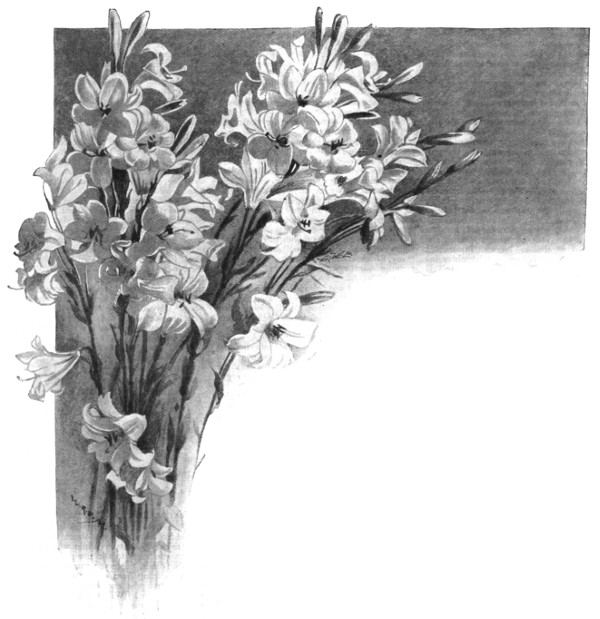
Lilium Candidum.
The genus lilium is a large one, containing as it does over fifty species. The species themselves are very distinct and differ remarkably from each other in their forms and habits. It has therefore been thought advisable to sub-divide the genus into certain groups or sections which are distinguished chiefly by the shape of the flower.
There have been many divisions of the genus, and, as in every other classification of natural objects, all are very imperfect. It is extraordinary the contempt that nature has for human classifications and statistics! However you may divide any set of objects, you will find that there are many of them which will stick on the wall and refuse to be included in any one of your orders. And so it is in the present instance. The most approved division is given below; but you will see that there are grave objections to it. Personally we cannot see the scientific reason for the division of the genus at all. This is our excuse for not following the generally received classification. The arrangement of lilies which we are going to adopt does not pretend to be scientific. It is merely adopted in order that we can group together species which are more or less like each other. It is a classification for the flower grower and not for the botanist.
One of the latest, best, and most generally accepted classifications is the following division of the genus into six groups thus—
Section I.—Cardiocrinum.
Perianth[3] funnel-shaped, with oblanceolate[4] segments, falcate[5] only at the apex. Leaves heart-shaped, ovate, and stalked, 1. Cordifolium. 2. Giganteum.
Section II.—Eulirion.
Perianth same as Cardiocrinum. Leaves linear or lanceolate, not stalked.
(a) Tube scarcely widened from base to middle. 3. Philippinense. 4. Wallichianum. 5. Longiflorum. 6. Neilgherrense.
(b) Tube widened from neck to base, (α) Leaves scattered. 7. Japonicum Odorum. 8. Brownii. 9. Krameri. 10. Nepaulense. 11. Candidum. 12. Belladonna. (β) Leaves in whorls. 13. Washingtonianum. 14. Parryi.
Section III.—Archelirion.
Perianth open and funnel-shaped. Segments deeply spreading and broadest about the middle. Stamens diverging from the style, which is curved.
(a) Leaves sessile. 15. Tigrinum. 16. Oxypetalum.
(b) Leaves stalked. 17. Speciosum. 18. Auratum.
Section IV.—Isolirion.
Perianth erect. Segments falcate, but not revolute. Stamens diverging on all sides.
(a) Leaves in whorls. 19. Philadelphicum. 20. Medeoloides.
(b) Leaves scattered, (α) Style shorter than ovary. 21. Concolor. (β) Style longer than ovary. 22. Bulbiferum. 23. Croceum. 24. Davuricum. 25. Elegans. 26. Catesbaei.
Section V.—Martagons.
Perianth cernuous with the segments very revolute. Stamens diverging on all sides.
(a) Leaves in whorls. (α) American species; bulbs annual bearing rhizomes. 27. Canadense. 28. Pardalinum. 29. Superbum. 30. Lucidum. 31. Roezlii. 32. Columbianum. 33. Humboldti. (β) Old world species. 34. Martagon. 35. Avenaceum. 36. Hansoni.
(b) Leaves scattered, (α) Leaves lanceolate. Many-nerved. (i.) Perianth falcate above middle. 37. Monadelphum. (ii.) Perianth revolute to below middle. 38. Polyphyllum. 39. Ponticum. 40. Carniolicum. (β) Leaves narrow. With one or few nerves. (i.) Segments of the perianth from six to twelve lines broad in the middle. 41. Testaceum. 42. Leichtlini. 43. Batmanniae. 44. Pseudo-Tigrinum. 45. Wallacei. (ii.) Segments of the perianth from three to six lines broad in the middle. 46. Pomponium. 47. Chalcedonicum. 48. Callosum. 49. Tenuifolium.
Section VI.—Notholirion.
50. Hookeri. 51. Roseum.
We said that in all divisions of natural objects there were “aberrant” types which refused to be located in any one group and remained sitting on the wall between several of the divisions. And in this group there are likewise some which stick upon the wall. The chief reasons we have for not using this classification will be apparent from the following criticism of it.
The first section, Cardiocrinum, forms a very natural group. L. Cordifolium and L. Giganteum, though distinct species, are yet very near akin and are totally different from any other lilies.
Of the Eulirion section, the first or Longiflorum group, containing L. Longiflorum, L. Wallichianum, L. Philippinense, L. Neilgherrense, and the new L. Formosanum, forms as natural a division as is Cardiocrinum. But the other members of the Eulirion group are by no means so easy to classify.
L. Japonicum Odorum and L. Brownii are very nearly allied. L. Krameri, with the new L. Rubellum, more nearly resemble the Archelirion than the present group.
In certain characters L. Nepaulense nearly resembles L. Monadelphum, a member of the Martagon group.
L. Candidum bears but little resemblance to the other Eulirions. Its flowers are short and numerous, and the bulb sends up an autumn crop of leaves. In the last characteristic it differs very markedly from every known lily.
L. Belladonna is unknown to us.
L. Washingtonianum and its varieties resemble L. Candidum in bearing numerous small short flowers. Its bulb is very similar to that of L. Humboldti in being an oblique, almost rhizomatose, structure.
L. Parryi resembles L. Nepaulense in some particulars, and L. Washingtonianum in others. Its bulb, however, is more like that of L. Pardalinum than that of any other species.
Of the Archelirion section, L. Auratum and L. Speciosum have much in common. But L. Tigrinum has but little relation to the former two lilies; its drooping flowers strongly suggest that this lily should be placed with the Martagons.
L. Leichtlini and Pseudo-Tigrinum are placed among the Martagons; yet these two lilies bear a very strong resemblance to L. Tigrinum.
L. Oxypetalum differs from all other lilies in many respects. It resembles the fritillaries in most points and was formerly included with those plants.
As regards the Isolirion group, in which the flowers are erect, we would place L. Medeoloides with the Martagons, next to L. Hansoni—the plant which it most resembles.
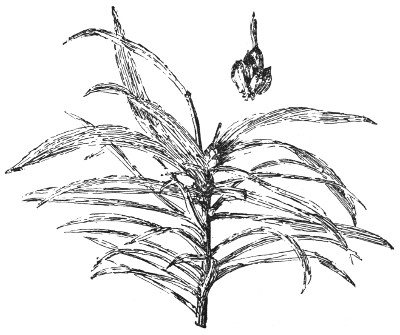
L. Umbellatum. (Showing abnormal development of aerial bulblets.)
L. Concolor and its varieties should form a group of themselves.
L. Batmanniae[6] and L. Wallacei should certainly be included with the Isolirions, and not with the Martagons.
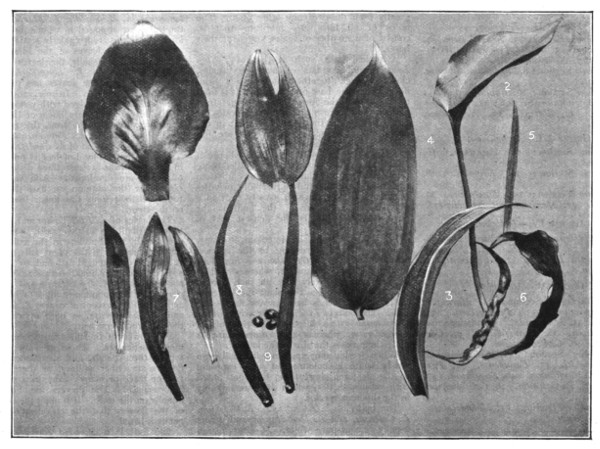
LILY LEAVES. (From a photograph. Quarter diameter.)
1. Leaf from upper part of stem, L. Giganteum.
2. Basal leaf of L. Cordifolium.
3. Leaf of L. Auratum.
4. Leaf of L. Auratum Platyphyllum.
5. Leaf of L. Pyrenaicum.
6. Leaves of L. Longiflorum, showing injury done by green fly.
7. Leaves of L. Brownii, showing commencement of disease.
8. Deformed leaf, L. Longiflorum.
9. Leaves and bulblets of L. Tigrinum.
The Martagons fall naturally into several groups. The first group, which we might call the swamp lilies,[7] includes L. Superbum, L. Canadense, L. Pardalinum, L. Roezlii, and one or two new species. All these lilies have but slightly recurved flowers and rhizomatose bulbs. They are all natives of North America.
Another group which we might call the true Martagons would include L. Martagon, L. Pomponium, L. Pyrenaicum, L. Avenaceum, L. Tenuifolium, L. Callosum, L. Chalcedonicum, and L. Hansoni, etc.
L. Humboldti is different from any other lily in many points. Its bulb somewhat resembles that of L. Washingtonianum.
L. Polyphyllum and L. Monadelphum much resemble each other in the form of their flowers.
L. Testaceum is a hybrid. L. Ponticum is a variety of L. Monadelphum. L. Lucidum is unknown to us.
We are not going to adhere to this division. The one we are about to tabulate seems to us to be more useful. It is tentative, and is subject maybe to grave objections; but on the whole we think that it will be more generally useful to the lily grower. Obviously it is founded on the former classification, and we have used the names of the groups which are generally accepted.
We append no description to each group, for, though we could do so if we were pressed, we wish it to be clearly understood that the division is purely experimental, as what classification is not?
Group I.—Cardiocrinum.
1. Giganteum. 2. Cordifolium.
Group II.—Eulirion.
Longiflorum Section: 3. Longiflorum. 4. Formosanum. 5. Philippinense. 6. Wallichianum. 7. Neilgherrense.
Japonicum Section: 8. Japonicum Odorum. 9. Brownii.
Candidum Section: 10. Candidum.
Washingtonianum Section: 11. Washingtonianum. 12. Parryi. 13. Nepaulense. 14. Lowi.
Group III.—Archelirion.
Auratum Section: 15. Auratum. 16. Speciosum.
Krameri Section: 17. Krameri. 18. Rubellum.
Tigrinum Section: 19. Tigrinum. 20. Leichtlini. 21. Maximowiczi. 22. Henryi.
Group IV.—Isolirion.
23. Bulbiferum. 24. Catesbaei. 25. Batmanniae. 26. Wallacei. 27. Philadelphicum. 28. Elegans. 29. Croceum. 30. Davuricum.
Group V.—Martagon.
True Martagon Section: 31. Martagon. 32. Pomponium. 33. Pyrenaicum. 34. Hansoni. 35. Medeoloides. 36. Avenaceum. 37. Callosum. 38. Tenuifolium. 39. Carniolicum. 40. Chalcedonicum.
Swamp-lily Section: 41. Columbianum. 42. Humboldti. 43. Canadense. 44. Parvum. 45. Maritimum. 46. Superbum. 47. Roezlii. 48. Pardalinum. 49. Californicum. 50. Grayi.
Monadelphum Section: 51. Monadelphum. 52. Polyphyllum.
Group VI.
53. Concolor. 54. Davidii.
Group VII.
55. Oxypetalum. 56. Roseum. 57. Hookeri.
There are therefore fifty-seven distinct species of lilies; but of these there are over one hundred and twenty varieties. Besides these there are four double-flowered varieties, and four definite hybrids.
In our next number we will proceed with the description of these various species and varieties. But before we attempt to describe the individual species, let us glance at some of the chief characteristics of the various parts of lilies.
The lily has two sets of roots. One set develops beneath the bulb, the other is given off by the flower shoot above the bulb. Each set serves a definite purpose, and both are absolutely necessary to the welfare of the plant. The lower roots are concerned chiefly with the development of the bulb; the upper roots, or those given off by the flower-shoot, are the main source of supply to the stem and flowers. Unless these roots develop and are well covered with earth, the plant will not flower.
If the flower stem is removed from the bulb and the upper roots are not disturbed, it will continue to grow unchecked. Or, again, if the bulb be destroyed by disease, or its lower roots do not develop, the lily may still flower; but if the stem roots are destroyed, the shoot dies, even though the bulb and lower roots are quite perfect.
All the lilies possess bulbs. These bulbs are exceedingly characteristic, and differ greatly from those of any other plant. The bulbs of all lilies are imbricate—that is, consist of a number of scales united at their bases.
A typical bulb, such as that of Lilium Longiflorum, consists of numerous scales, closely packed together, united to a firm, fleshy part—the base of the bulb. It is from the base that the lower roots spring. In a perfectly sound fresh bulb the outer scales are approximated to the next layer, but in dry bulbs the outer scales wither and are but loosely applied to the inner ones.
The bulb is narrow at the base, whence it rapidly increases towards the middle, being thickest about one third of the way up from the base. From the middle it rapidly dwindles towards the crown, which usually ends in a point. In the centre of the bulb is the flower spike, which is the densest part of the bulb.
Lily bulbs vary in size, in colour, in shape, and in structure, according to the species. The bulb of Lilium Giganteum is from four to five inches in diameter, whereas that of L. Wallacei is barely half an inch across. As a rule, the larger the plant the larger is its bulb; but this is by no means always the case. The bulb of L. Tigrinum var. Fortunei Giganteum is no larger than that of L. Longiflorum, whereas the former plant is quite three times the size of the latter.
When freshly dug up, most lily bulbs are nearly white in colour; but after exposure to the air for a short time, they get tinted with various shades, which differ remarkably in the different species.
The bulbs of L. Elegans, L. Bulbiferum, L. Croceum, and L. Umbellatum, and others usually remain pure white. L. Longiflorum and a great many others become of a yellowish tint. L. Speciosum and L. Auratum usually become a dark brown or purplish colour. The bulb of L. Giganteum is usually a deep russet colour.
Lily bulbs vary greatly in shape and structure. The typical bulb is ovate or pyramidal in shape, with small regular scales. There are many variations from this. Some are more or less rounded, others, notably that of L. Polyphyllum, are very long and narrow. Some have large flat scales, whilst in others the scales are small and rounded. Some bulbs, such as those of L. Superbum, L. Canadense, and many others, are borne upon a perennial rhizome, the bulbs themselves being annual.
The bulbs of L. Humboldti and L. Washingtonianum are curiously unlike those of any other lilies, being flat and oblique. Some bulbs possess a large number of minute scales, others have but a few large scales.
The bulbs of L. Roseum and L. Hookeri are invested with a dense membranous sheath like the bulbs of the tulip. No other lily bulb possesses this sheath. These are some of the varieties of lily bulbs; an accurate description of most will be found in connection with the accounts of the various species.
The stem of the lily is usually straight and unbranched. Very rarely the stem is branched. It varies in diameter and toughness in the various species. In some species it is covered with down.
The leaves are subject to even greater variety than is the bulb. They may be few or many, arranged in whorls or scattered, and of various colours and shapes.
L. Chalcedonicum has many hundred leaves, whilst L. Auratum rarely has more than thirty. In some lilies, such as L. Washingtonianum, L. Humboldti, L. Martagon, etc., the leaves are arranged in whorls, but in most kinds the leaves are irregularly scattered.
In colour the leaves of the lilies present much variety. Usually the leaves are deep glossy green. In L. Longiflorum Foliis Albo-Marginatis the leaves are pale green bordered with white. In one variety of L. Candidum they are edged with yellow.
Lily leaves are usually linear or lanceolate; but they vary in shape from the thin pine-needle-like leaf of L. Pyrenaicum, to the broad heart-shape leaf of L. Cordifolium.
Usually but one kind of leaf is present, but in L. Giganteum at least three distinct forms of leaves are developed. And in Lilium Candidum the autumn or base leaves are totally distinct from the linear leaves borne on the stem.
The leaves of L. Bulbiferum and L. Tigrinum bear bulblets in their axils. Other lilies occasionally bear bulblets in the axils of their leaves, especially if the plant fails to flower. A bulb is only a modified bud, so that it is not surprising it should occasionally develop above ground. L. Umbellatum and L. Longiflorum are the commonest lilies to bear these aerial bulblets, except of course L. Tigrinum and L. Bulbiferum, in both of which lilies they are always present.
The flowers of the lilies vary immensely in most particulars. There are always three sepals, three petals, and six stamens. The flowers are either solitary, or there may be two or three or many borne in a pyramidal inflorescence. The flowers are borne terminally on the stalk. It is upon the characters of the flowers that the classification of the genus is based.
The fruit is a six-sided capsule, and the seeds are flat with broad membranous wings.
(To be continued.)