Part 4 — FROCKS FOR TO-MORROW.
Reading edition
By “THE LADY DRESSMAKER.”
The principal thing that strikes one in the dressing of to-day is the great stress laid upon the ornamentation of the front portion of both the dress and the jacket, mantle or cape. In fact, here is centred the whole of the smart effect of the costume. The use of real lace seems very great, and I have noticed in the daily press a statement that the Queens of the various kingdoms have bonded themselves together, on the invitation of the Queen of Portugal, to wear nothing but real lace, and to encourage this industry to the utmost of their powers, as it seems its very existence is threatened by the machine-made laces, which have reached a great point of perfection within the last few years. It is even said that none but an expert would know the difference between some of the imitations and the real thing. Of course, we know that great efforts have been made to help the real lace industry already, but it is evident that it is not a thing that everyone could afford, so that the machine laces must be used; but it is quite befitting that the Queens of the many States interested should help by wearing it exclusively. Our own Queen has always been a great patron of the English-made laces, especially Honiton, and one cannot imagine her Majesty wearing anything but real laces, of which it is said she has an immense store.
I saw the other day a priceless cape or scarf of real French lace, worn over a sable cape; and the collars of capes are frequently lined with lace, which finishes in a bow and ruffles in the front. Entire lace fronts are worn both to dresses and coats. In fact, those who possess antique lace to-day are quite in luck, while those who do not, wear the machine-made, which looks (save to the eye of the initiated) quite as good, and in a great deal better state of repair, perhaps. Many old-fashioned women will not have their lace cleaned, but prefer to wear it yellow, and what the outside world might call dirty; and real lace, even when cleaned, never should look as if it were clean, as the cleaner should know how to bestow a yellow cast upon it, which a machine-made lace could not equal. All old laces seem to be fashionable, but the old French lace more than all. I have seen a good deal of Venetian point as well.
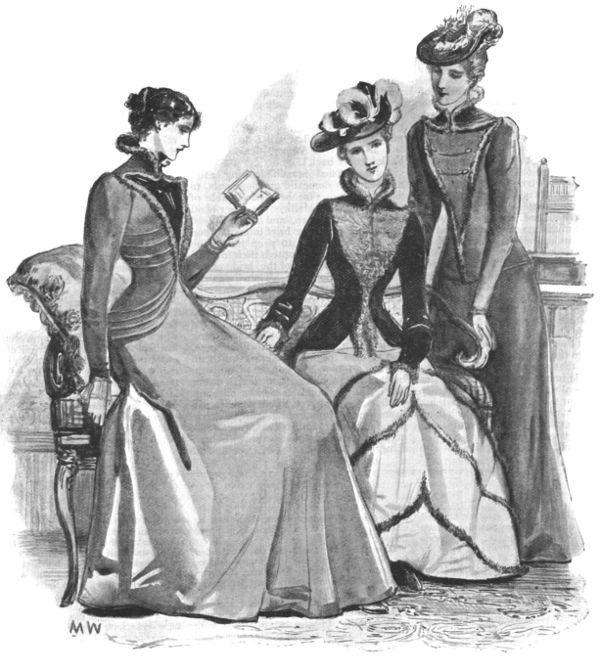
THREE NEW COATS.
Our first large illustration shows three of the newest jacket shapes, or rather coats, of the present season. Two of them follow the fashion closely in being rounded at the front corners, with a wide effect at the shoulders, which comes to a point at the waist, thus giving that effect of length and thinness to the figure which is so much sought after. One really wonders sometimes where all the short-waisted people have gone. It is quite wonderful what changes Dame Fashion can work even in the human frame. Only think of the sloping shoulders in vogue fifty or sixty years ago, and then look at the square shoulders of to-day. Even in the matter of our foreheads we follow the orders of the reigning mode, and that decrees “that foreheads low and wide are to be worn,” and even these are veiled to the eyebrows with frizzled hair. But there is one fashion which mankind follows rather too closely, and that is bald-headedness. It is really dreadful to note the numbers of bald heads, and surely when we women have improved so much in the care and preservation of our locks, our hair doctors might do something for men. It is quite a common thing to see really fine heads of grey and white hair, and the wearing of caps has nearly ceased to be a fashion, for women wear the head covering with which nature provided them. Of course, there are probably a few added locks, but still the head shows no signs of baldness, and even the days of those terrible thin partings seem over. There is a great saving in this emancipation from caps, for they were a serious expense to the poor lady, which was only lightened when a woman was clever enough to make them for herself.
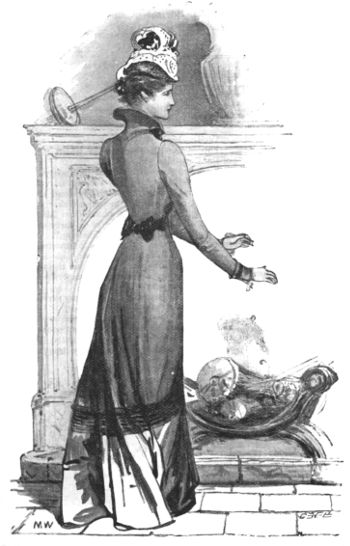
COSTUME OF GREY CLOTH WITH BLACK VELVET AND STEEL ORNAMENTS.
But my chat about the illustrations has diverged from its course, though I am very glad to record here the disappearance of certain prejudices that used to be rampant amongst us. False teeth and false hair were things that one never dared to own up to having. Now we know that if we wish to retain our health and strength we must replace the teeth we have lost, and we have also learnt that a pleasant and taking appearance lends us favour and influence for good, and that it is our duty to attend to this matter as much as to any other, from higher reasons than from those of mere vanity.
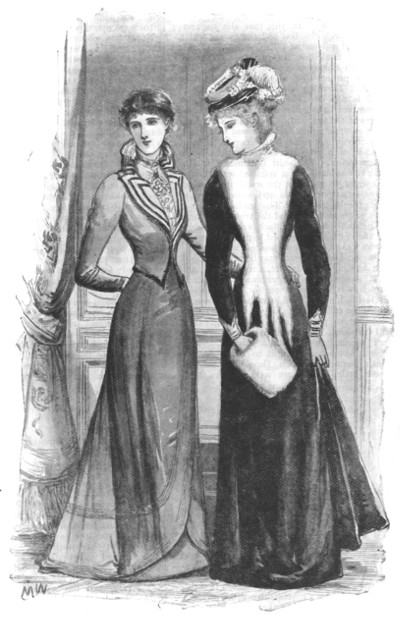
IN THE HOUSE AND OUT.
In “Three New Coats,” the centre figure wears a black Velours du Nord, or velvet coat, which is cut quite without fulness at the back, and has a chinchilla collar and wide revers. The skirt is of grey, and it is also trimmed with narrow bands of chinchilla, put on in a pointed shape in the front, and going round the edge of the skirt at the back. The hat is of black velvet and white feathers, with paste buckles. The jacket of the next figure sitting down is made of light brown cloth, trimmed with bands of lighter brown braid. The collar and revers are made of a darker shade of brown velvet and edged with beaver. The skirt is of the same cloth, but made in quite a plain fashion. The standing figure has a coat made with one of the new capes fitted to the shoulders and neck. The dress itself is of rifle green cloth, made without trimming, and the coat is short. The front is a plastron edged with dark beaver fur, and trimmed across with cords to match the green of the dress. The hat is green, with white feathers.
A great number of white fox boas and muffs are to be seen this winter, and the figure in the illustration we have called “In the House and out” wears one of them. They are very becoming and pretty, and look well with everything. In this case the toque is made to match the boa and the gown, which is of violet velveteen. The new boas of this winter are made flat, not round, and they are lined with either satin or a pretty fancy silk, so they protect the shoulders in a slight degree. There is also white Tibet lamb, which is now dyed to resemble the blue fox. The second figure, dressed for indoors, wears a dress of the new red. The collar and revers of the short Eton coat are trimmed with black satin ribbon. A silk vest underneath the coat is made of a red silk broché with a black pattern on it. The skirt is trimmed with a black ribbon, and has a rounded front, which is brought up as far as the waist at the side. There is a lace necktie and some trimming inside the high collar. The leading colour in Paris just now is red, and the trimmings for it are generally bands of black velvet or satin. For the red hats to be used with these dresses Parma violets are the favourite trimming.
The shade of red worn may be best described as a hunting pink, in fact, a real scarlet, and as it must always be trimmed with black, astrachan is in great favour for its decoration. So is black velvet, and thus toned down, it cannot be called ugly. It is, moreover, very becoming to people with good complexions and fair skins. The small red jackets are seen very frequently worn with a skirt of another colour, which really ought to be black, and which harmonises with them best of all. These little jackets are worn by the best-dressed people, and are especially nice and bright for young girls, not in their teens, but in their twenties, perhaps.
Never has velvet been so popular as this winter, and, of course, in naming velvet I include velveteen, which is often of so good a quality that it looks like the real thing. I have always found a good velveteen an excellent investment, and if treated with care, and used as the “going-out-of-doors” dress which it really ought to be, it is very valuable. Every tone and shade of colour can be obtained in it, and as velvet blouses are still in fashion, we can select with ease either for day or evening wear.
Our third illustration shows a single figure wearing a costume of grey cloth, which is cut into what is called by some of our writers an eel-skin skirt. But I observe that in France it is merely called a fitted skirt, which really means that the dressmaker must bestow just as much trouble upon it as she does on the bodice, and that you must distrust everyone who wishes you to believe otherwise. I notice that paddings for the back and hips are already for sale, and much advertised, but this tightly-fitted skirt is not for the short and stout, nor for the tall and very thin. On neither of them can it be esteemed a success. The dress in our illustration is in grey cloth, with black velvet trimmings and bands, and steel ornaments, a delightful combination of colour. The back of this dress is really princess, while the front has the style of a short double-breasted jacket, very short. This combination is one of the new cuts of the season. The shaped flounce is headed by rows of black velvet, and the sleeves are made with square cuffs, not the much-worn “flare” cuff. The toque is of grey velvet, white silk and feathers, and grey tips, with steel ornaments.
One can scarcely see any real change in the dressing of the hair. All that one can say is that there is a decided tendency for it to go lower on the head, and the present hats and bonnets really answer better when the hair is rather high. There are plenty of small ornaments for the hair to be seen in the shops, but the most popular of all for the evening is, I think, the black velvet bow.
The favourite perfume is still violet, and Violette de Parme seems to be the correct kind. I note that the pretty black moiré ribbons with slides have now been applied to the muff, and have taken the place of muff chains with many people.
One of the odd fashions of the day is a single eyeglass, and many women have taken to it. This hitherto has not been a woman’s fashion, but a man’s, and has even been thought rather an affected one; but I hear that these single eyeglasses are prescribed by doctors, as so many people require help in one eye and not in the other. Just now, however, they look odd, as we have not been used to them, and it is certain that both eyes should be worked alike, the strain being too much for one. Besides, the eye that may need extra help may be the left one. So an oculist should decide the question as to which eye should wear the glass.