"His Career and Adventures at the Royal Military Academy Woolwich" (continued 4)
Reading edition
“There is no doubt,” said Forester, “that of all men in the world who should never be the worse for what they have drunk, a soldier is the one. He and a driver of an engine, if drunk, may cause the death of hundreds of men. Besides, a fellow who gets drunk I look on as a fool, for he must know so little about himself that he cannot tell how much of anything will make him tipsy. I don’t know a more disgusting sight than to see a man drunk and incapable, and why some fellows here think it fast I cannot imagine.”
In our division was an old cadet named Marsden, who was always boasting of the wine he had drank when on leave, or when he had been home. It happened that Marsden’s father was an officer retired on full pay; but, like most officers, he was poor, and, though occasionally he asked cadets to dinner, he never produced any wines besides sherry, and, as cadets declared, his sparkling wine was gooseberry. Saumer in those days was unknown.
More than once Marsden had returned from leave and made a great shouting in the division, asserting that “the Moët’s champagne was so strong.”
Forester had more than once made remarks about this proceeding, and at length, with three or four other cadets who thought the same as he did, organised a plot against Marsden, which turned out a most amusing affair, but one somewhat unpleasant to Marsden.
It wanted about half an hour to roll-call one Sunday evening, when Marsden came into the division shouting.
“There’s Marsden again?” said Forester. “Now for a lesson for him!”
Forester got up and went into the passage, where he was joined by three other cadets, who seemed to have turned out by signal.
“What’s the matter, Marsden?” said Forester.
“Beastly screwed on guv’nor’s champagne!” said Marsden as he leant against the wall.
“It’s close on roll-call,” said Forester, “and the officer will see you!”
“Blow officer!” muttered Marsden.
“We mustn’t let him be discovered,” said Forester in a compassionate tone. “Let’s help him out of it.”
At a signal, Forester and the other cadets seized Marsden, lifted him off his legs, and carried him to the back yard—he shouting and struggling in a half-drunken way. Suddenly, however, he seemed to foresee what was in store for him, for he called out in quite a sober tone, “I’m not drunk, Forester; I was only humbugging. I’m not drunk; I’m not!”
Forester and his companions, whom I had followed, were silent, but very determined. They paid no attention to these shouts, but took off Marsden’s coattee, and reduced his dress to a pair of trousers and a shirt. Three cadets then held him, whilst Forester, seizing the handle of the pump, sent a powerful stream of water over Marsden’s head and down his back.
“Nothing like a cold bath to set a fellow right when he’s screwed?” said Forester, as he worked vigorously at the pump-handle and deluged Marsden with a cold stream.
“I’m not drunk?” shouted Marsden. “Let me go! I’m not drunk!”
Not the slightest attention was paid to Marsden till he had been fully a minute under the pump, when he was released with the inquiry as to his feeling better and more sober.
“I’m not drunk, you confounded donkeys!” shouted Marsden again, in a great rage.
At this instant the officer on duty, having from his quarters heard the shouting, came through the division, and, seeing Marsden with his hair and clothes all wet, and hearing his shouts of “I’m not drunk?” at once said,—
“Mr Marsden, you’re tipsy! You’ll be in arrest, sir, till further orders?”
“I’m not drunk, sir?” said Marsden. “Go to your room, sir, in arrest!” said the officer, as he walked off from the division.
When Forester came into his room he was in fits of laughter. “If that won’t cure Marsden of shamming I don’t know what will!” he said. “It serves him quite right for humbugging as he does?”
On the following morning Marsden asked Forester to give evidence as to his not being drank the night before, “for,” said Marsden, “you know I wasn’t.”
“What?” said Forester; “when you told me you were beastly screwed on guv’nor’s gooseberry—champagne, I mean? You don’t mean to say you told a lie? I was bound to believe you, and did what I thought was best for you to save you from being seen in the state you were by the officer?”
“But I wasn’t screwed!” said Marsden.
“Not when the officer came,” replied Forester; “that’s very likely. A powerful shower-bath is a wonderful soberer; and next time you come in screwed and shouting from the effects of champagne, you’ll find it just as good a cure! No, I can’t say you were not screwed; you looked like being so, and you said you were?”
There was an audible titter on parade that day when the officer on duty read out, among other orders by the Captain of the Cadet Company, that Mr Marsden, having been under the influence of drink when returning from leave on Sunday evening, was to be in arrest for seven days!
Forester’s cure was effective. Marsden was never the worse for his governor’s wine after that evening.
Note 1. “Smashed,” in those days, was the familiar term for having broken one’s word of honour.
Chapter Eleven.
Outbreak to Charlton Fair.
Towards the middle of my second half-year two very stirring events occurred at the Academy, in each of which I played a subordinate part. The singular experiences I had in these two affairs are worthy of being recorded.
In the neighbourhood of Woolwich is a small village, called Charlton, which at that time was a thoroughly rural place. An old blacksmith’s forge stood in the middle of the village, and two old-fashioned-looking inns. At the entrance of this village was a field, termed “The Fair-Field,” where a large fair was annually held. This fair was termed “Horn Fair,” and was one of the sights of the time.
Fairs have now degenerated, and have lost their glory; but thirty years ago Horn Fair day was a kind of Derby day, at which all the élite of the neighbourhood were to be seen from about two till five on one particular day out of the three that the fair lasted.
From the entrance to the fair to the branch roads, where the cemetery is now situated, the carriages used to stand two deep during the time their occupiers strolled about the fair. Since those days, however, the railway has given such facility for the East-end of London to send down its unwashed hundreds, that first the fair was deserted by the ladies of the neighbourhood, next by the gentlemen, and finally was done away with as being detrimental to the neighbourhood.
During the three days that the fair lasted the cadet company were confined to the enclosure, and were not allowed to visit the village of Charlton. Such a restriction was ordered on account of a row which some years previously had occurred between the cadets and some of the fair people; but it was very obnoxious to the old cadets, and particularly to one who had been reduced from the rank of corporal to that of cadet. This individual had a great deal of influence among the seniors, and on the morning of the second day of the fair he paid a visit to the majority of the rooms, in order to ventilate his ideas and organise a plan he had in his mind for the evening.
The cadet, who was named Prosser, came to our room to see Forester, and said, “Don’t you think it’s an awful shame to confine us to barracks like a set of schoolboys, instead of trusting us to go to the fair? I want your opinion about it, Forester.”
“Well,” replied Forester, “I think it’s bad taste, and a mistake, for it seems to say, ‘If you go to the fair you will get into a row,’ but I don’t see what’s the use of complaining.”
“I’ll tell you what the use is,” said Prosser. “I’ve got a lot of fellows who are game to fall in after tea, and go straight away to the fair—that is, if every one will go. You see, if everybody goes, they can’t break a few fellows only, and they can’t pitch into everybody, and I believe they will see it won’t do to shut us up like sheep, but that we shall get more liberty.”
“I won’t join,” said Forester, “if I can help it, and I think it’s not the right way to go to work to remedy a grievance.”
During that afternoon a paper was passed round the Academy, saying that the whole of the first and second class would fall in on the centre parade at half-past eight, and double off to the fair, and the third and fourth class were to fall in at the same hour and place. This came as a kind of order from the old cadets, and we all signed our names as willing to agree to go.
Everything was kept very quiet during the afternoon, for fear the authorities might hear of the plot, and at half-past eight every cadet fell in quietly on the grass inside the Academy, and, the words of command being whispered from file to file, we broke into a double, and ran across the common towards Charlton.
There were present on that occasion every cadet except the eight corporals on duty, who thought they were bound in honour not to leave their posts. This was a sort of compromise with duty, for these eight corporals were perfectly aware that the breakout of barracks was going to be attempted, and had they done their duty they would have reported this, and put a stop at once to the affair; but the moral courage to do so was wanting. Still, none of these cadets liked to leave their posts—an indication of the right feeling that prevailed at that time in many things at the Academy, and at the same time a proof of the inconsistency in the ideas of the cadets.
Forester declined to join the “mutiny,” as it might be termed, on principle, but he left Fenton and myself to do as we liked, and we both went.
The “Cadet Company,” as I might term it, having got well clear of the Academy and across the common, came to a quick march, and the word was then passed down the ranks as to our proceedings at the fair. On nearing the fair we were to form four deep and double through the fair. We were then to enter one of the large dancing-booths, and clear it of its occupants, and finally to “pitch into” any persons who opposed us.
Under the influence of the excitement and companionship of the senior cadets, I thought the proceeding a brilliant one. The effect of charging through the fair would be grand, something like a real battle, and the people of the fair would see what a fine set of daring fellows the cadets were. With such ideas I approached the fair-field, little dreaming that three days would not elapse before I had come to the conclusion that a more foolish, stupid, and ridiculous proceeding could not have been proposed or carried out than this one, and that even the most enthusiastic of the party would admit that it was a contemptible and childish display.
Most rows or street fights, when looked upon calmly, may be classed under the same head. They arise usually from the combatitive stupidity of some individual or individuals who want excitement, or who imagine that they will exhibit their powers before an admiring audience during some fight in which they may be engaged. Two of the original promoters of the raid to the fair were the two biggest and most powerful cadets at the Academy, and were tolerably sure to hold their own in any row that might take place. For us smaller bodies the prospect was not so promising.
On nearing the entrance-gate we formed closely in fours, and at a double charged down between the booths. Men, women, and children were knocked over right and left, and sent sprawling on the ground, whilst we were saluted with stones, sticks, and other weapons seized impromptu by the indignant public.
Having made our way down the fair we entered the largest dancing-booth, which was immediately deserted by the occupants. Seizing the chairs, a few of these were smashed, and shots were then taken at the many-coloured oil-lamps, the majority of which were knocked down, but not broken. There was then a shout to extinguish all the lamps in the fair, whilst one or two of the most reckless cadets shouted, “Turn out the menagerie!”
By this time, however, there was an organised ’stance to us. The sticks used for knock-’em-downs were seized by a number of men, who commenced using these very freely, and we were soon compelled to retreat, which we did in tolerably good order; not, however, without those in rear receiving some very heavy blows.
At the Academy matters had not been idle. The cadets having left the Academy, there was a silence that, to the experienced ears of the officer on duty, at once indicated that something was up. Coming out of his quarters he found the divisions deserted, and, on entering the library, found the corporal on duty, who informed him the cadets had left the enclosure. The assembly was immediately sounded, and was obeyed only by the corporals on duty and two cadets who were ill, having just left hospital. Taking with him the corporals on duty the officer at once started for the fair, giving orders that each cadet seen was at once to be placed in arrest. Now, as a cadet was bound in honour to obey an arrest, this plan would have been effective for sending home the company. When, however, the officer was within a hundred yards of the fair-field he met the cadets returning, and at once ordered the whole of them in arrest to their rooms.
For many hundred yards from the fair we were followed by a rabble, which delighted in pelting us with various missiles and abusing us, as they now could do with impunity.
On reaching the enclosure we all went to our rooms, relating our individual experiences, escapes, and performances.
One cadet had exchanged blows with a supposed prizefighter, and had held his own; another had knocked down a burly rough who was just going to smash the head of a cadet with a life-preserver. This cadet had tripped up a Peeler who was trying to collar a cadet; that cadet had rescued a snooker who was actually in the grasp of two roughs. The feats performed were really marvellous—at least in their accounts—and for that night we were well pleased with ourselves.
Forester listened to Fenton’s account of the affair, and put a few questions, and then pronounced his verdict, that we had all made a set of fools of ourselves, and that probably the company would be decimated, every tenth cadet being discharged.
During the next two or three days there were endless speculations as to what would be the punishment given us for our conduct, and as the excitement of the affair wore off, the corporals and seniors began to get anxious for their prospects, for it was feared a severe example would be made of at least the corporals and under-officers who had gone to the fair. The whole company was confined to barracks, and could not therefore go beyond the “Ha-ha” so that groups of twenty or thirty cadets used to assemble every day and walk about arm-in-arm discussing the proceedings at the fair, and the probable results.
About ten days after the breaking out the whole company was assembled on parade, and the decision of the Master-General made known. It was to the effect that every under-officer and corporal present at the fair was to be reduced to the rank of a cadet, all leave stopped till the end of the half, and the question left open whether or not the commission of these should be delayed six months. By many this punishment was considered slight, for they had expected to be rusticated, and to lose, consequently, a term; so that, as soon as the order had been read out, there was a subdued murmur of satisfaction among those who had been the ringleaders of the affair, and whose position as the seniors rendered them responsible.
This history of the life of a Woolwich cadet is intended to be a relation of the events that occurred some thirty odd years ago, and to be described as those events presented themselves to the mind of a cadet at that time. To mix up with these relations of incidents anything formal or serious would be to a certain extent out of place. This work is not intended as instructive, or as even suggestive; still, if in it some mention were not made of a most important problem connected with military educational establishments, it certainly would lack one feature, without which it would be destitute of what may be termed “backbone.” The problem to which we refer is the discipline necessary in any military educational establishment.
When we consider that a large military establishment devoted to educational purposes, such as that of Woolwich, turns out probably eighty officers per year; that these officers become our future captains, colonels, and generals; that to them are entrusted commands over hundreds and thousands of men according as they rise in rank; that on service the very lives even of men are entrusted to their keeping; that at all times the prospects and happiness, comfort and welfare of the men under their commands are in their hands, it is at once evident how great is their responsibility, and how serious become the every-day duties and acts of an officer.
In civil life a citizen, unless occupying a public position, has the responsibility only of his own family. He has to do his duty by probably half-a-dozen children, to educate and teach these, and to see them started in life. The officer has on his shoulders the responsibility of a soldier and an officer added to that of his duties as a citizen. He has to instruct, guide, and punish the soldier. He is a despot in a way; his word is law, and the prospects of a man may be ruined or made by an officer. Such being the condition of a soldier’s life, it is of importance that the early career of an officer—the period of his life when he receives impressions which he never forgets—should be under the most careful and thoughtful discipline. The impressions received in our youth are never entirely forgotten; and though individuality of character may force itself prominently forward through a covering of education, still such instances are invariably tinged by education and training. Thus, the discipline and teaching of cadets becomes a matter of the gravest importance when we value the effects thereof on an army. The character and conduct of an officer make themselves felt in a regiment, and even beyond the mere limits of a regiment, for the effects of influence are untold. Man is to a great extent an imitative animal, and when young he is much disposed to be a mere follower of others. He has his tastes, his likes and dislikes; but these are in the generality of cases due more to example than to any natural tendency in the individual to a particular line of pursuits. The importance, then, of instilling into the cadet those principles which are necessary to make the army a safe one cannot be overlooked; and we will therefore refer to the conditions prevailing at the time we write of, and compare them with those now in force at the same institution.
In former times a cadet could be punished by a corporal to the extent of a day’s arrest to his room, which entailed turning out to morning drill. If the corporal chose, he might order a cadet out to drill merely, without placing him in arrest. This punishment was given usually on account of unsteadiness in the ranks or in the class-rooms, for not being brushed clean on parade, or for any minor offence, according to the fancy of the corporal. This gave enormous powers to the corporals, and was one of the great strongholds of the fagging and bullying systems. A cadet’s life might be made a burthen to him by his being placed in arrest day after day offences which were “trumped-up” by a corporal. Two drills daring a week stopped a cadet’s leave, and if this occurred he of course had to remain at the Academy during Saturday and Sunday. Instances have taken place where a young cadet committed some offence against the then well-established but unwritten laws of fagging, and thus drew down on himself the odium of the old cadets, who agreed on every possible occasion to place this cadet in arrest. There was no difficulty about carrying out this persecution. A corporal on duty in the class-rooms was absolute; he could place any cadet in arrest for talking, for leaving his desk, for looking round, for making a noise, etc, etc, and one or other of these offences could without difficulty be fixed on any particular individual. It was not till near the end of the half-year that it was discovered that one particular cadet had been placed in arrest by corporals on duty on an average four times a week from the commencement of the half-year. For graver offences than those usually punished by the cadets holding the rank of corporal, the sentence might be arrest from three to seven days, confinement to the enclosure for any length of time, stoppage of leave, twenty-four or forty-eight hours in the “black hole,” as it was termed—a dark room, similar to a modern prison cell—rustication for a term, discharge from the Academy, or dismissal. The latter sentence was given only in very bad cases, as the cadet’s name was then registered, and he could never enter the army.
There was one cadet selected by the Governor as a senior under-officer. To him was entrusted the command of the cadets when no officer was present, and he was a sort of “go-between,” a kind of bat among men, a link between the officers and the cadets, to whom considerable responsibility attached. This senior under-officer was not necessarily the senior in the class. He was taken by selection, and sometimes great mistakes were made in taking an indifferent man when a better was available. This is, of course, the risk in all cases of selection, even when authorities are most anxious to be just, and to select the best man. If, however, so disastrous an element as favouritism should ever in the future creep into the army, and should thrive and prevail under the cloak of selecting men by merit, it will be more disastrous to discipline, more ruinous to the tenacity, as we may term it, of the army, than all the bribery or corruption that the most subtle enemy could bring to bear on the weak or vacillating. To be superseded in any way is, of course, annoying to every man. When it was money that enabled one man to go over the head of another, the supersession was accounted for. It was unpleasant, but the one man possessing money where the other did not was to a certain extent acceptable. If, however, a man, whom we feel to be our inferior, and whom our comrades know to be inferior, is selected, and placed over our head, and we are told that he is so elevated because he is a more clever man and a better soldier than we are, the selection by merit becomes one of the most dangerous and offensive elements in an army.
An amusing case of selection by supposed merit once came under my notice when a cadet. There was one prize which was given according to the judgment of the Instructor, and not by the result of any examination. It was a supposed selection by merit. There was a cadet whom we will term A, who was well acquainted with the subject for which the prize was given previous to his joining the Academy. Another cadet, B, knew nothing about this subject, and found great difficulty in working it. A and B were friends, so they worked together—that is, A did the work, and B copied from him. At the end of the term the Instructor, who was supposed to have daily seen each cadet’s work, examined the whole, and allotted the prize to B, and omitted all notice of A. Strange to say, some years afterwards, B was appointed to a lucrative post in consequence of having been distinguished as a cadet for his knowledge of the subject for which the prize was given, whilst A remained unknown and unrecognised, but soured and disgusted by an injustice which it was impossible to remedy without exposing his friend, and certainly damaging him.
The senior under-officer, however, in those days was selected, and was given considerable influence in consequence of his position. It was therefore considered a matter of great importance to be selected as the senior, and to have such a position of responsibility entrusted to one.
Corporals were selected from amongst the cadets almost entirely in consequence of their position in the Academy—in fact, by seniority. If the conduct of a cadet had been bad, he was passed over; but such passing over was considered very severe, and was seldom done.
The principal punisher of the cadets was the Captain of the Cadet Company, who investigated and tried cases that occurred during any part of the time that cadets were not in study. If any cadet committed a very grave offence he was then brought before the Governor, and received the heaviest punishment. For offences committed in academy, or during hours of study, cadets were amenable to two other authorities, viz, the Inspector and Assistant-Inspector, who used to visit the class-rooms each day, and see that all was going on as it should go.
There was in this system the great defect that the cadets were under several authorities, and not under one head, while the system of entrusting to corporals the power to inflict punishment on their juniors, without inquiry or without comment, opened the door to a system of tyranny that was too often practised with the worst effects.
Another drawback at that time was the great age of the majority of the professors and senior officers. To deal with young, energetic men, such as the greater number of the senior cadets were, required active and energetic men with judgment and discernment, and thus appointments to posts such as those referred to should not have been allotted merely as quiet sinecures, but should have been given to men capable of real work.
In such a Military College as Woolwich a strict discipline is absolutely necessary. The first lesson to teach a soldier is the importance of subordination and obedience. These essentials, it is true, were taught formerly, but there was too often favouritism shown, which made the cadets feel that the scales of justice were often unfairly weighted. To once allow any sign of a want of proper respect for authority to pass over with a light punishment is to sow the seeds of a most dangerous condition. Another necessary item in the training of the cadet is to instil into him a high sense of honour; to teach him that there are certain things which his position as a soldier renders it impossible for him to do without disgrace. At the Academy there seems to have ever been this conscientious feeling, even at times when the discipline and general tone of the establishment was not what it is now. A cadet who was placed in arrest was bound on honour not to break this arrest, and it was often amusing to see two or three cadets in different rooms with their doors open talking to one another and leaning out of the doorways just so far that their centre of gravity was within the room. If one cadet added “honour” to any statement he might make to another, it was always considered certain that this was true.
Considering that the course of education at the Academy rarely occupied more than three years, and that many cadets had their characters entirely formed whilst they were at the “shop,” it is evident that too much importance cannot be given to the training bestowed during this period. A military training college which is not maintained with the strictest discipline becomes a mere pandemonium, where young men soon endeavour to rival one another in acts of folly, and from which men are turned out unfit for command or for the service.
The defects formerly existing at Woolwich have been remedied; the almost irresponsible authority of the older cadets over the juniors does not now exist. The professors, instead of being octogenarians, are men in the prime of life, and are given the authority over the cadets which their position entitles them to; and the result is that with an active, intelligent, and distinguished soldier at the head, the Royal Military Academy at the present time may be fairly claimed as a model establishment.
Chapter Twelve.
My Failure at Examination.
My second half-year passed slowly, though it did not drag its slow length along as had my first half. I fagged for Snipson every morning, and was thus treated much as was a last-joined. In my own room and division I was scarcely fagged at all, and as Forester and Fenton used to talk to me, I enjoyed their society, especially after roll-call, when I knew Snipson could not send for me on some pretence or other.
More than once Forester had asked me how I was getting on in academy, and seemed interested as to my prospect of passing my probationary examination. This also was a question about which I was anxious, for, unless I passed a satisfactory examination, I might be sent away from the Academy just in the same manner as if I had failed at my first examination.
During my first half I had decidedly gone back; the pressure that had been used to prepare for entrance seemed to have tired me mentally, and the perpetual anxiety of being fagged and bullied seemed to paralyse my mind, so that I could learn little or nothing. It was much the same during my second half, although my nights were quieter; but I felt a sort of disinclination to commence work—a feeling I have since learnt is the great drawback to progress in anything.
Men mean to begin doing something at some future period; some day they will set to work and do this or learn that; they will give up this or that bad habit, or begin to learn this or that important subject; but the to-morrow on which they are going to begin never comes, for they drive off from day to day until it is too late, and they go to their graves with very good intentions, and meaning to have done something, but they never did it.
I drove off regularly working until within a few days of the examinations, and when I tried to learn various formulas I found that my mind seemed out of condition and unable to retain a recollection of what my eyes had seen.
It was some time after this that I discovered what seemed to me a new faculty of my mind—that was a capacity of shutting off, as it were, all external matters, and bringing my thoughts to bear on some problem which, with closed eyes or daring the darkness of night, I tried to work out. My first experience of this faculty was in connexion with a game of chess. Forester had been trying to solve a problem of “checkmate in three moves,” and I had been looking on. He had failed to solve the problem when the lights were taken away. As I lay in bed thinking over this problem, I pictured to myself the chess-board and men, and I then imagined a move of the knight, which had not been tried before. The new position of the men I seemed to see plainly. Now and then the picture appeared to fade from my imagination, and it was an effort to reproduce it. I, however, managed to do so, and in a short time moved another piece. I went over three moves again and again, and at length was certain I had found out the solution. Forester was asleep, so I said nothing; but as soon as I awoke in the morning I took the chess-board, arranged the men, and found that I had solved the problem, and could checkmate in the required number of moves.
On informing Forester of this he was much amused, and seemed to think it a very remarkable performance on my part. Having thus employed my mind on a problem, I tried to make various moves for the openings at chess, and found that by practice I could develop this faculty, and could make seven or eight moves on each side and remember the position of the men. It is impossible to describe the pleasure this sort of mental exercise gave me, for as long as I lay awake I could work out chess-moves; and as the efforts seemed to tire me, I often fell asleep in the midst of some complicated series of moves. The results of this proceeding did not then dawn upon me, for I was but a boy after all, and had really to learn how to think and how to use my brain.
The examinations came with their usual regularity, and the questions were unlucky for me. That there should be any luck in examinations may strike some readers as impossible; but those who have had any experience know how much luck there is, and that it is not always a sure test of the relative knowledge of individuals to judge by the results of their examination. When I say that the questions were unlucky, I mean that it appeared as if those particular questions had been selected which referred to problems I had not studied.
As an example:—On one occasion I saw the mathematical master looking at a book and copying something from it. I saw the page was 210. On returning to my seat, I told the cadet next me that I had seen this, and that we should probably be required to work out the formula on page 210.
“Perhaps it may be the formula on page 211,” said my neighbour. “We will toss up, and see which it is—heads 210, tails 211.” It came heads, so we in joke said we knew it would be this formula.
I must own I had so little faith in what I had asserted that I learnt only superficially problem page 210, and doubt whether I could have worked it out. When, however, the examination questions were given out, I saw a very large number of marks were allotted to the problem on page 211, and this problem I had not worked up. After the examination, however, the cadet next me told me he had learnt both problems well, and expected full marks for this question. Now, perhaps I ought to have done the same, and learnt both problems, but I had devoted my time to some twenty others, all of which I knew well, and not one of which were asked.
It has often occurred to me that a different system of examination might be adopted to that now practised, in order to avoid this luck, and also to find out the extent of the knowledge of an individual on any subject.
At present a series of questions are asked, these being some ten or twelve in number, and they are supposed to take in every branch of the subject. The individual examined answers these, and these answers are limited to the questions or inquiries made. The amount of knowledge which any one may possess beyond the questions put is not ascertained, and thus the full extent of one person’s knowledge may have been reached by the questions, and only half the knowledge of another person who may have done at the examination exactly the same. To draw out the knowledge of a person at an examination, the safest way is to give far more questions in a paper than it is possible the best man can in the time answer; then by the amount of work done a fairer estimate can be formed of the relative knowledge of individuals than if only six or seven questions are given, and where, consequently, luck has a great deal to do with the results.
I was certain I had done badly in mathematics at the examination, and this was the subject that counted most; but I was not aware how badly I had done till the result of the examination was made known, when I found I was last but one, and had gained only four in the subject.
Now that I believed it was too late I was ready to stamp with rage at my folly in not having worked harder. I felt I had in me certain powers which had not been yet fully called out. It seemed that I was again sinking back into the condition I occupied at Hostler’s, and I was looked on by my own batch as very stupid. The examination I had failed to pass was, I understood, my probationary, and that therefore I should now be sent away from the Academy. It turned out, however, that because I had not joined with the remainder of my batch, and had thus been absent several weeks, I was allowed another chance and given another half-year’s trial at the Academy.
I was sent for to the Inspector’s office and briefly informed of this fact in a dry, official manner, an intimation being added that unless I worked very hard I was not likely to remain beyond the next term as a cadet at the Royal Military Academy.
I was determined that next term I would work hard and try to recover my position, and it being my third half-year I expected I should not have any fagging, and consequently should have plenty of time for working out of study hours.
Forester had passed his examination well and was fourth of his batch, and would next half be down in the Arsenal with what was termed the “practical class.” This practical class learnt all the practical work connected with field works, military bridges, military surveying, etc, and were distinguished from the other cadets by wearing epaulettes with bullion about an inch long. The practical class rarely came to the upper Academy, their barracks being down in the Arsenal. Once a month for muster, however, they were marched up to the Academy and were the envy and admiration of the younger cadets.
Snipson had failed to qualify for the practical class, and would therefore remain one more half-year at the Academy, when he would have to leave if he did not then pass into the practical class.
On my return home I had to break the intelligence to my father that I had been unsuccessful at my examination, but should have another chance for my probationary. He took the news very quietly, and told me he thought that, with the amount of fagging and bullying that was going on, it was wonderful how any cadets managed to pass their examinations at all.
During my vacation I used to regularly work every morning before breakfast at mathematics, and at night I tried to work out various problems in geometry just in the same manner as I had solved chess puzzles, and I found I could manage this performance very well. I thus established a sort of test for myself; for if I could in my mind work through a problem, I was certain I knew it, and if I could not, I soon found out where I broke down.
I used to practise also raising x + y to various powers without opening my eyes thus: (x + y) to the power of six and (x+y) to the power of eight, and so on. I found that the practice of doing this gave me a sort of extra power, and I could soon multiply any two figures by two figures in my head and obtain correct results.
From commencing such experiments as the best means for qualifying myself for future examinations, I gradually grew to like the work, and in a short time preferred working out some equation or geometrical problem to reading a dull book.
After-experience taught me that a man never does anything so well as that for which he has a liking, and as a rule we dislike those things which we know little or nothing of, or which we do badly. We grow to like any subject very often by learning it, and gradually gaining efficiency in it, and we thus are often impelled to proceed until we are surprised, on comparing with others, to find how much we have learnt in a certain time.
My vacation passed very quickly, for I was happy at home, and having always some work on hand, I was never thoroughly idle, nor did I ever experience that most disagreeable of states, etc, “How ever was I to pass the time?”
On rejoining the Academy for my third half-year, I felt very much more at my ease than I had done on the former occasions. I expected that I should have no fagging, and should do very much as I liked. There were two old cadets in my room, the head being a corporal named Woodville, and the second a cadet named Jamieson, who was only one half my senior. They were both very nice fellows, and Woodville was celebrated as a runner for long distances, he having run a mile in four minutes and fifty seconds. I had grown very much during the past year, and had improved altogether in health and strength, and found also that I could run better than when I had won my hundred and twenty yards’ race. I was still supposed to be the best short distance runner at the shop, though there were one or two who were almost equal to me.
Upon the last-joined cadets coming to the Academy, which they did the day after the rest of us had joined, they had all to pass through nearly the same ordeal that I had. Hats were smashed on entering the hall, and several new plots were started to make the cadets sharp.
One of the favourite tricks to play on a last-joined was to fill one of the tin basins with water, to open the door about afoot, and place the basin on the top of the door, then to call a neux from outside, and tell him to come to the room. The neux, of course, pushed open the door and let the basin fall on his head or back, he getting a good ducking.
This invention was very popular for some time, but all the last-joined soon heard of it, and became cautious, and either entered the doorway without opening the door any wider than it was at the time it supported the basin, or they pushed the door open from a distance.
Another amusement, which also was soon worn out, was to heat the poker, and then rest it against the handle of the door till the handle got quite hot, then to shut the door and watch from the window for cadets to pass. As soon as a last-joined could be seen, he was told to come round to the room, and naturally he took hold of the handle to open the door. The cadets on the inside of the door held fast, so that the door could not be opened. The result was that the victim burnt his hand, for at first he could not tell the handle was hot, and, never suspecting such a thing, probably fancied that the handle was very cold instead of being as it was, very hot. Any way, nearly every cadet burnt his hand who came to the door, and this was considered an excellent joke by the cadets in the room.
At that time bullying was at its height at the Academy, and I heard of various things being done which amounted to the grossest cruelty. One of these was nearly causing the death of a cadet, and exposed to the authorities to what an extent cruelty was carried.
An old cadet used to amuse himself by placing a stool upside down on the top of another stool. He then made a cadet climb onto the top of the second stool, and stand balanced on two legs of the stool. When the cadet was thus standing balancing himself, the old cadet kicked away the under stool, and brought the neux down heavily on the top of the stools.
This proceeding was much admired by Snipson, who was again in the Towers, and occupying his old room, and I heard that a cadet had been much hurt by falling on the upturned leg of one of the stools, on which he had been made to stand by Snipson. The cadet had to be taken to hospital, and was considered for some time in danger.
During the time this cadet was in hospital, Snipson ceased his practices of bullying, and was so very civil to the neux that was hurt that he succeeded in obtaining from him a promise that the authorities should not know by what means he had become hurt.
This matter was generally known among the cadets, but so bad a feeling was then prevalent at the Academy that Snipson was not condemned by the other cadets, nor did the practice referred to at all decrease.
It happened that at the dinner-squad to which I belonged there was a corporal who was a very quiet, steady fellow, and who disliked bullying. The subject of Snipson’s neux having been injured was mentioned at the squad, and I was asked if I had not once been Snipson’s fag. I replied that I had, and that he was one of the greatest bullies in the Academy.
It happened that this remark of mine came by some means to be retailed to Snipson, and led to an affair which must be described in detail.
Two or three days after the conversation at the dinner-squad, Snipson called me as we came out from morning study, and told me to go to his room after parade.
To be told to go to an old cadet’s room was usually understood to mean that a thrashing was to be administered for some cause or other. I could not recall anything I had done, for I had entirely forgotten the remark I had made at the dinner-table, and I fancied that Snipson might want to fag me for something in order to show he could fag a third-half cadet.
When I was broken off drill I went to Snipson’s room in the Towers, where I found Snipson standing by his window.
On my entering the room he said,—“Shut the door and turn the key!” I did so, and then saw that Snipson looked pale with rage, and that something unpleasant was in store for me.
The room in which we were was not more than about ten feet square; the window, like all others at the Academy, was guarded by iron cross-bars, and the furniture of the room consisted of two stools, a small table, a fender and poker, and a bed. Snipson was at that time nearly two years and a half my senior, and was much taller and stouter than I was. He had, however, an awkward way about him, and was not given to any muscle-developing games, such as cricket, football, or rackets.
As soon as I had locked the door Snipson said,—
“Look here, Shepard; you are a young blackguard, and I’m going to lick you! What do you mean by telling lies about me?”
“I have told no lies about you,” I said. “You told the fellows at your squad that I was one of the greatest bullies at the shop, so it’s no use your telling another lie to save yourself a licking?” I was taken aback at this remark, for I now remembered what I had said at the dinner-table about his being a bully. I could not, however, see how this remark could be turned into a lie, for there was no doubt about the fact of Snipson being one of the greatest bullies at the Academy; but I did not know how to argue so as to own to having called him a bully, and yet to show I was not guilty of falsehood.
“You see you’re caught?” said Snipson; “so now just put one of those stools on the other!” I hesitated a moment, and said,—“I remember saying you were a bully, but I didn’t think you would mind that, and I don’t call that a lie.”
“Ah, now you acknowledge saying what you before denied! That’s three lies you’ve told since you have been here! Now, get onto the top of that uppermost stool?”
So great had been the influence of the authority of old-cadetism on me that I obeyed Snipson’s orders, and with some difficulty climbed to the top of the stool. In an instant Snipson kicked over the lower stool, and I fell heavily on my side from a height of about five feet, the leg of the stool striking me on the shin.
Before I could recover myself, and when the pain from the blow I had received was gradually spreading, as it were, over my whole body, Snipson, who was grinning maliciously, said,—
“Put the stools in order and up again! Look sharp!” he shouted, as I hesitated to obey.
“I won’t get up again?” I said. “I may be injured seriously.”
“Then take that!” said Snipson, as he struck me with his clenched fist on the side of the head.
In an instant all fear of old cadets, of fagging, of corporals, and of trials by the seniors left me; and I remembered only Snipson’s repeated acts of cruelty to me when I first joined, his general sneering and self-sufficient manner, and his sneaking conduct relative to the neux he had so seriously injured by the very same proceeding that he was now practising on me. These thoughts flashed, as it were, over my mind like an electric message along a wire, and before Snipson could repeat his blow I caught him a fair shoulder-hit at a well-judged distance, and knocked him completely off his legs against his bed. If I had been given time to reflect after striking this blow, I should probably have taken any licking Snipson might have given me quietly; but I was not given time, for he jumped up and exclaimed,—
“I’ll half kill you for that!” and rushed at me, trying to close with me.
I believed that from his greater size and weight I should soon have got the worst of a close encounter, so I did not give him a chance of doing so, but met him with a right and left, which were delivered with all the force I had gained in hitting under Howard’s instruction, and driven by the additional energy derived from my long endurance of bullying. Snipson went down again like a nine-pin, and I now knew I could thrash him in fair fight; but I did not then know how great a coward he was, and how malicious he could be; but I soon found out my danger. Instead of getting up at once and again rushing at me, Snipson lay for a few seconds where he had fallen, and looked round the room. Suddenly he sprang up and made a dash at the fireplace, and seized the poker. He turned towards me, and I saw from his look that my life was in danger.
“Now it’s my turn?” he hissed, as he came round the table towards me, the poker held ready to strike.
In such positions as mine then was there sometimes comes to us a bright idea, which answers the purpose at the time, but which, when thought of in cooler moments, seems most unlikely to have been of any use, as it could be so easily seen through. The conditions, however, of excitement often induce a state quite unfit for calm reasoning, and most unexpected results are then produced which appear afterwards to be absurd.
As Snipson was coming towards me, with his poker ready to strike me, his back was towards the door, which, as I said before, was locked, and by which consequently no one could enter. I, however, looked over Snipson’s shoulder, and said, “Hullo, Woodville! you are just in time.”
Snipson instantly turned his head to see whether any one was there, and at the same moment I sprang on him, seized the wrist that held the poker, and, throwing my right arm round his neck, tripped him up, when we both fell on the floor, I being uppermost. In the struggle the poker had fallen out of Snipson’s hand, and I instantly gained possession of it, and, jumping on my feet, stood over Snipson, who now did not attempt to rise, but in a half-conciliatory, half-threatening tone, said, “Now you’d better mind what you are about, for the old cadets will give you an awful licking for this!”
“If you tell the old cadets that I hit you,” I said, “I’ll go straight to the Governor, and tell him it was you who injured your neux, and nearly killed him, and I’ll report that you tried to hit me with a poker.”
Saying this, I unlocked the door and rushed out of the room, and went to my own, which I luckily found empty. I closed the door and sat down to consider what I had better do.
I had heard that, shortly before I joined the Academy, a neux had struck an old cadet, and had in consequence been tried by a sort of court-martial by the old cadets, and had been severely thrashed. Not content with this, the body corporate of the old cadets had ordered that no neux should speak to the culprit, and, in addition, he was daily placed in arrest and turned out to drill.
The neux could not stand this ordeal, and ran away from the Academy to his friends. An inquiry into the matter afterwards took place, but a case of cruelty could not be brought home to any particular individual, and the cadet’s friends not having any interest, the affair was dropped. I anticipated that some such treatment would be meted out to me, for, in spite of Snipson’s proceedings, I knew that the offence of striking an old cadet was looked on as so heinous, that no extenuating circumstances would be allowed to outweigh the crime. My threat to report Snipson I did not intend to carry out, but made it with the hope that it would prevent him from telling the old cadets that I had knocked him down. After some minutes’ consideration I went off to D’Arcy’s room to tell him all about the fight, and consult as to what should be done.
When I described to D’Arcy how I had knocked Snipson down, and had escaped his attack on me with the poker, he was delighted. He told me also that the old cadets detested Snipson, and he did not believe they would back him up if he told them what I had done. “I’ll bet any money,” said D’Arcy, “that unless Snipson goes at once now he is in a rage, and tells some of the seniors, he won’t say a word about it.”
“Why not?” I inquired.
“Well, because he knows for your own sake that you won’t say anything, and he would probably be ashamed to own that a fellow so much smaller than he is gave him a licking. I’d advise you to keep quiet, and don’t tell anybody else.”
When we went into dinner I saw Snipson, who showed no signs of the recent set-to; he took no notice of me, and I could tell that as yet he had made no mention to the old cadets of my performance. The day also passed, and the next, without anything occurring, and I began to think Snipson meant to keep quiet; but on the following morning, after breakfast, Fenton, on returning to our room, said, “So Snipson gave you a thrashing the other day?”
I was so taken aback by this remark that I said, “Who told you so?”
“Snipson did,” replied Fenton. “He said you had been cheeky about him, and he had you over and licked you. He said you seemed disposed to show fight, but he soon took that out of you.”
I listened with amazement at this speech of Fenton’s; it was my first experience of the gross misrepresentation of facts which was possible when only two people were present, and I was astonished and amused at the absurdity of the report. It was my first experience of the wilful perversion of truth possible when two persons were together without witnesses. I wish it had been my last. There will probably be many among the readers of this book who have themselves had similar experiences, for, if they have not, their career must have been singularly limited and lucky. There are men—ay, and women too—who from an inability to represent facts correctly, or from interested motives, or from vanity, will misrepresent occurrencies and make out that black was white, and yes, no. There are men and women whom it is dangerous to speak to or be with without witnesses, and we believe that when all secrets are revealed it will be found that more perjury has been committed in connexion with tête-à-tête interviews than with any other event in life, from the days of Joseph to the present time.
During the day D’Arcy came to me, and laughed immensely as he told me that Snipson had told the old cadets what a licking he had given me. “He said you tried to escape from the room, but he locked the door and just polished you off. You are quite certain,” said D’Arcy, “that everything occurred as you told me?”
“Quite,” I replied, “and Snipson is a liar!”
“I believe you,” replied D’Arcy; “but you had better keep quiet, and you will now escape being thrashed by the old cadets, which is no joke, I can tell you.”
I followed d’Arcy’s advice, and did not even deny that I had been thrashed by Snipson, although I could not help adding, on one or two occasions, that “I should not mind such a licking being repeated.”
This was my last adventure with Snipson, who had been a thorn in my side since my first joining the Academy. As, however, it was not the last that I knew of his career, I may here mention what I knew of his future, and then expunge his name from these pages.
Before the end of the half-year Snipson was found drunk by the officer on duty. As he had been nearly four years at the Academy, and had but little chance of qualifying, it was intimated to his friends that they had better withdraw him from the Academy. Following this hint, Snipson suddenly disappeared, and his name was soon forgotten where it had once been a terror to all last-joined.
Twenty years after the events related in this book I was walking down Oxford Street when I saw coming towards me a man with a seedy, threadbare frock-coat, the arms of which were much too short for the wearer, and the collar of which came too high. The coat had evidently previously graced the form of another wearer, and when its youthful beauties had faded had become the property of its present owner. A portion of shirt was visible, and plainly indicated that it had been far too long absent from the washerwoman. A hat bent and without gloss surmounted a red face, with eyes somewhat like those of a crying child, and a beard of about four days’ growth. Brown trowsers, creased and frayed, stained and patched, hung over a pair of split, misshapen shoes, and completed the attire of a man whose type is now and then seen in London.
Something about the man at once attracted me, and I thus noted his appearance. The face, though altered, and indicating the effect of drink, I yet recognised; and as the man walked past me and turned his head so as to avoid showing me his face, I knew this wretched failure of a man was my once bully, Snipson. He had failed as a cadet and he had failed as a man; and from his appearance it was evident he had not done what some men do, who in their young days have failed, etc, begin again at the bottom of the ladder, and by steady work endeavour to recover, themselves; but he was always scheming to recover himself by one grand coup, and was always being disappointed.
I turned round quickly after I had passed Snipson, and saw him peeping at me from a shop-door. When he caught my eye he turned and walked on with an air and style that showed he had not yet suffered enough to make him sensible of his own defects, nor was he yet in a state deserving of sympathy.
One of the singular and yet universal peculiarities in the character of such men as Snipson is, that they assert, and evidently believe, that their unfortunate state is in no manner due to any fault or failing of their own. They can always assure you that if this man had not done so-and-so, or that man had not failed them in the most unexpected way, they would have been all right. They are themselves never wrong; they don’t ever admit a mistake; they are convinced of their own cleverness, and satisfied with their own knowledge. Former companions who have “got on” in life they speak of as “lucky beggars,” and have usually something to say in disparagement of such men, as a sort of attempt to drag down the successful to their own low level. They rarely, if ever, admit any merit or skill in others, and attribute all that others may win, by hard work and thought, to “luck,” and all their own failures to “bad luck.” This was Snipson’s state twenty years after he was a bully—idle and untruthful as a gentleman cadet.
Chapter Thirteen.
Our Row at the Races.
During this my third half-year there were some races by the officers on Woolwich Common, to which the cadets were given leave to go, and a tent was provided for us, in which we had some light refreshment, such as beer and bread and cheese. Now between what is usually termed the “louts” and the schoolboys in any good school in any part of England there seems a natural antagonism, and fights not unusually take place, brought on as much by the insult of the lout as by the natural pugnaciousness of the English well-bred boy. In former times at Woolwich this feeling of antagonism was by no means extinct, for as the cadets marched down the Common to the Arsenal, or out in the country, it was generally found that a number of louts would assemble and hoot them, mewing like cats and calling out “puss”—the term cadet being probably assumed by the unwashed to be an extension of “cat.”
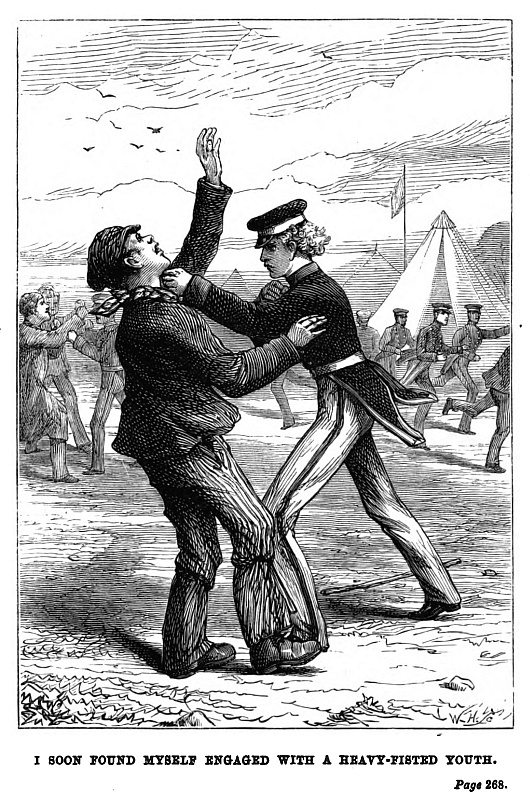
To English boys such proceedings were most offensive and irritating, and more than once the louts had experienced somewhat rough treatment at the hands of cadets whom they had hooted and mocked in the manner described, and once or twice there had been kind of rough-and-tumble fights on the Common between the louts and the cadets.
On the evening after the races, several cadets were in their tent and were laughing and talking, when some louts assembled outside, and commenced imitating the laughter and then calling, “Puss! puss!” Such a challenge was not long in being accepted by the cadets, who suddenly dashed out of the tent and charged about twenty louts, who were assembled within a dozen yards of us. On the party of cadets rushing out (of which I was one) the louts took to their heels, but their clumsy efforts to run were useless, and we soon closed with them, when they turned and showed fight. I soon found myself engaged with a heavy-fisted big youth, who had as much idea of fighting as an ox, but who was heavy and strong. I had plenty to do to guard his blows, and shortly sent him sprawling, when two other louts came on me at once. I dodged and struck for some time, but should soon have got the worst of the fight if D’Arcy had not come to my aid, when the two bolted, as had most of the others.
Seeing the enemy in full retreat we gave up the pursuit and returned to our tent, and had just commenced to pack up the things we had used, when some stones were hurled at the tent, and some came in by the door. On looking out we saw that, instead of twenty louts who had at first appeared, there were now above a hundred, some of them being full-grown men. They were shouting at us, and mewing, and calling on us to come out. As there were not two dozen cadets in our tent, it was decided that I, being a fast runner, should run to the cadets’ barracks and call for reinforcements. This was a service of some danger, for we were almost surrounded by the enemy; but it was agreed upon to threaten a charge in the front of the tent, and when the enemy assembled there to resist us, I was to creep under the canvas and make a dash to the lodge.
The plan succeeded very well. All the louts gathered in front of our tent, and I had crept out and was on my legs and well away before I was seen; then, however, there was a yell, and shouts of “Catch him?”
“Stop him!” whilst about a dozen men and boys gave chase to me.
The distance from the tent to the lodge was about 300 yards, and as I had about thirty yards’ start of my pursuers, I knew that I could easily win my race and reach the lodge, provided it had been a matter of fair running; but the shouts of my pursuers attracted the attention of some other louts who were between me and the lodge, and who I saw were trying to intercept me. I made straight at them, however, and, when close, charged at the biggest. As I expected, he gave way and tried to trip me up. By giving a jump I avoided his leg, continued my course, and entered the Academy grounds in safety.
The news that there was a row had spread over the Academy, and fifty or sixty cadets were already provided with sticks or belts, and had assembled at the back of the Academy, ready to go to the rescue. I joined these, and we all immediately started to the rescue, and arrived only just in time, for the louts, finding they were about ten to one, had got very plucky, and were going to pull the tent down.
We charged down on the enemy, who, seeing our numbers were nearly equal to their own, turned and ran. We gave chase, and, overtaking some of them, administered a good thrashing.
By this time a body of police had come on the scene, and seeming to think it their duty to protect the louts, at once seized two or three of the smallest cadets, and were going to carry them off, when “To the rescue!” was shouted, and we charged on the police. The Peelers drew their truncheons and used them freely, but we were too many for them, and succeeded in recovering the prisoners. Not wishing to have a row with the police, who, we considered, ought to have protected us, we retreated rapidly to the enclosure of the Academy, and dispersed to our various rooms.
In about ten minutes after our entrance a check-roll was called by the officer on duty, and we were all confined to barracks in consequence of the row.
It happened that the senior under-officer had been in the tent from the first commencement of the row, and on entering the Academy he had at once reported to the officer on duty what had happened, and had told him the provocation had been given by the louts. He also said that we could scarcely avoid doing what we had done. Shortly after we had entered the grounds an inspector of police, who had received from his men their account of the row, came to the officer on duty and said several of his men had been seriously hurt, and that they wished for an opportunity of recognising the ringleaders of the party. To give this opportunity, a parade of the whole cadet company was ordered for the following morning at half-past eleven.
We were none of us aware of the importance of the row till we saw in the papers of the following morning a paragraph headed: “Disgraceful Riot at Woolwich by the Gentlemen Cadets!” We then read how the cadets had been drinking in a tent, and had suddenly commenced an unprovoked attack on some boys and women, had pelted them with stones, and had then assaulted and seriously injured the police who had endeavoured to protect the people. “It was hoped,” the article continued, “that the cadets would receive such punishment as their disgraceful conduct deserved.”
We were all very angry at this paragraph in the papers, because we knew how much the outside public is led by such statements, and as they had no means of judging of the truth of the report, they would probably believe what was asserted.
On the following morning, at half-past eleven, the whole of the cadets fell in on parade, and with them, and scattered here and there, were twenty-five cadets of the practical class, all of whom had been in study at the Arsenal during the row. The police assembled on the right of the line, and slowly examined each cadet, with a view to swearing to his identity. The first cadet selected was one of the practical class, who had a slightly black eye, which he had received from a blow by a racket-ball. He was fallen out, and took his station on the right of the line. Two other cadets, who had been well in the thick of the fight, were next picked out, then another cadet of the practical class. Altogether, twenty-five cadets were picked out as ringleaders, and sworn to individually by the police as those who had struck them and had taken part in the row.
We all now saw the plot that our captain had laid for the police. He suspected they were trying to make out a case against us, and so sprinkled the practical class among the others. The police, having declared that they recognised each of the cadets selected as those who had struck them, had committed themselves, for if they had made such a mistake in identity in five cases, which could be proved, it cast doubt upon the evidence in other cases, which were of a doubtful nature.
We were all confined to barracks for a week after this row, and were daily expecting some cadets would be discharged, but finally it ended in the police withdrawing their charge, in consequence, as we heard, of their mistakes relative to the practical class having become known to them.
Chapter Fourteen.
I Pass my Examination Well.
During this my third half-year I had been steadily working in academy, and every night when in bed, and when the room was quiet and dark, I used to think over and try to work out various problems that I had done daring the day. I found that by concentrating my thoughts on these subjects I impressed them on my mind, and on the following morning could work them out very easily on paper. I found that by this means I could do many problems that had formerly seemed so complicated, that I had failed over and over again, and I hoped that I should find the benefit of this process by-and-by.
Woodville more than once had told me that I ought to work hard, as this was my last chance for my probationary; but he was not aware that when he was asleep I was training my brain to think, which, after all, is the great object of all learning or teaching.
In our public schools and colleges we give too much attention to what is called “learning” different subjects, this “learning” being, in the majority of cases, merely cramming our minds with the facts discovered and the conclusions arrived at by those who have preceded us, and who have written what they knew. We rarely endeavour even to so cultivate the mind as to make it competent to judge of the merits of a novelty, for this calls for a mental exertion that few persons ever attempt. It is far easier to accept what is submitted to us without question than it is to investigate and think out a case which no one has previously thought out, and on which consequently we have no guide which we can follow.
The system of cramming for examinations which was prevalent in former times, and has become even more common in the present day, is, we believe, far more detrimental to the mind than it is beneficial. Also we believe that calm reasoning is not certain to be brought out by such examinations as are usually given to students, so that, after all, the power of intellect is, we believe, not likely to be accurately tested by a mere examination.
I stood last but one in my batch—a fact due to my having done so very badly in mathematics and geometry at the last two examinations. In drawing I was very good, but this subject counted very little compared to the two in which I was very bad, so that what I needed was more knowledge of mathematics.
Time passed on very rapidly and very pleasantly. Now that Snipson had left the Academy I had no one ever to fag for or to fear; and it seemed that his departure had been the signal for the commencement of a better tone among the cadets. There was, I heard from the last-joined, less bullying than there had been whilst Snipson was present, and altogether his departure was hailed with pleasure. The examinations commenced, and I screwed myself up to the mark to see whether I was to pass my probationary and remain at the Academy, or be sent away to seek some other career in life.
We had three days for our examination in mathematics and geometry, and I was most careful over my work, reading over my questions deliberately and slowly, and thinking them out before putting pen to paper. As I sat for some time with my eyes shut, trying to recall a somewhat lengthy formula in trigonometry, the examiner saw me, and, supposing I was asleep, called out, “Mr Shepard, you had better wake up and attend to your paper; you cannot afford to sleep!”
I was not much pleased at this remark, for there is always in the mind of all those who are examined an impression that examiners may be prejudiced, and may not allot marks fairly. Such an idea is a very pleasant one to those who fail at an examination, and who thus satisfy their vanity by trying to believe that they deserved well, but were marked badly because the examiner was unfair. I fancied that, because I was supposed to be asleep, especial sharpness would be used in marking me—an idea I have since had reason to know was utterly erroneous, for the Academy was, of all places, the most rigid as regards the fairness with which marks were allotted, and the greatest impartiality was shown by those in whose hands the marking was left.
After each examination-attendance, I looked over the paper out of academy, and compared my answers and working with the book, and I came to the conclusion that I had done remarkably well, and therefore hoped I should be safe to get a satisfactory return for my probationary.
I waited with the greatest anxiety for the result of the examination to be made known, and could scarcely sleep at night for thinking what I should say at home in case I were span. It would, I knew, annoy my father very much, and I should be considered very stupid by probably far more stupid people than I was.
At length the morning came when the result of our mathematical examination was to be made known, and I went into academy with a feeling of dogged determination not to show any sign, no matter what the result might be. I fancied that the result would be satisfactory, as far as I was concerned, because, had it been unfavourable, I should have been sent for to the Inspector’s office, and told to pack up and be off.
We all took our seats and were ready with pencil and paper to copy off the marks as they were read out. The names of the cadets were read out in the order in which they had passed, so that as each name came the excitement as to who would be the next was very great. I was thirty-eighth in the class, out of thirty-nine, but I hoped I should take some places and probably reach to about twenty-fifth of the class, and next half (if I remained at the Academy) I hoped to get on better. As the examiner read out the first name there was no surprise; the cadet who was first was a very good mathematician, who at sixteen had joined the Academy, knowing trigonometry, mechanics, projectiles, and the calculus; he had been pushed on in consequence of his knowledge, and we knew he was almost certain to be first. The second, third, fourth, and fifth cadets were also very good mathematicians, and were known to be tolerably certain of standing high. When the examiner said “Sixth,” he waited for some seconds, whilst we listened attentively, and he then repeated “Sixth, Mr Shepard—235 marks, decimal 87.”
At this announcement all the cadets looked round at me with surprise; it was almost assumed that, judging from my former examinations, I should have great difficulty in passing at all, that is in getting half-marks; when, then, I suddenly shot out from last but one to sixth, and gained so high a decimal as 87, it was like an outsider almost winning the Derby.
There were one or two surprises and several disappointments as the result of the examination was read out, and some cadets did not hesitate to proclaim that it was “a chowse.”
I was quite satisfied, and was glad to find that I had not overrated what I had done at the examination. I little suspected then that my success was likely to place me in a very unpleasant position, which was, perhaps, due in a measure to another cause which I must here relate.
It happened that, during the half-year, I was one morning in study when a cadet in the first row, who used to be generally up to some trick, called my name during the time the corporal on duty was absent. I looked up from my drawing and immediately a ball of bread, made out of the crumb of a roll, was thrown at me. I caught the ball and instantly threw it back, but just as the ball was leaving my hand the door opened and the Inspector appeared. The cadet at whom I had thrown the ball failed to catch it, and the ball struck the door within a foot of the Inspector’s head.
I was immediately placed in arrest, and the next day was taken before the Governor charged with throwing a ball at the Inspector. Luckily the cadet who had thrown the ball to me was available as evidence, and our defence was that we had used the bread to clean our drawings, and had thrown it to one another instead of carrying it from one part of the class-room to another. This defence cleared me in the Governor’s mind from the charge of throwing at the Inspector, but I got seven days’ arrest for creating a disturbance in academy.
The fact of my having suddenly come out as a good mathematician, when hitherto I had shown only as a muff, was a surprise to every one, even to the master himself; but I was completely taken aback when I was sent for to the Inspector’s office, and told that there was a strong suspicion against me of having fudged at my examination.
I indignantly denied the charge, and said that in consequence of its being my probationary examination I had worked very hard to pass, and had quite expected to get a good decimal.
“We have already ascertained,” said the Inspector, “that you have not worked in your room, you rarely studied out of academy, and the examiner found you asleep during examination, so that it seems impossible you could by fair means obtain .8, which you have done.”
“It is very hard on me,” I replied, “to be accused of fudging, when I give you my word of honour I have not fudged, merely because I have done well.”
“We will give you the benefit of the doubt, Mr Shepard,” said the Inspector, with anything but a pleasant manner, and I left his office feeling that in his own mind he was confirmed I had fudged—the how or the means by which I had done so alone preventing him from proceeding with his charge.
Among the cadets of my class I was considered a martyr, for they accounted for my success by attributing it to “luck in the questions.” To me, however, the result was most important. First, it rendered my position at the Academy secure; and, secondly, it showed me that the system I had adopted for gaining a knowledge of mathematics and geometry was a sound one, and that I had a sort of key for the cultivation of the intellect. I now looked forward to my Academy career with hope and pleasure, and a feeling of ambition came upon me which is, perhaps, one of the greatest incentives to work that can be given to a young man.
When I joined the Academy I was a boy and felt like a boy, but the rough handling that I had gone through, and the experience I had gained during the eighteen months I had been at the Academy, had aged me beyond my years. I had also grown considerably, and looked older than I was, several persons putting me down as eighteen or nineteen years old, whereas I was not much past seventeen.
I returned home from the Academy for my vacation with much pleasure. I looked forward to the quiet rambles in the forest, the collecting specimens of natural history, and the general peaceful nature of the life there, as a pleasant change after Woolwich. I also felt some pride in going home after so successful an examination, for it was successful even for the Academy. I thought of the satisfaction I should have in meeting Howard and in telling him of the past half-year’s events. I plotted many amusements for the vacation, but determined to devote a certain amount of time to mathematics and gaining some knowledge of the subjects I should have to study next half.
I was beginning conic sections in the third half-year, and this subject I found was one that I could manage very well by thinking quietly over. I could, in imagination, make my section of the cone and get my co-ordinates very easily without pencil or paper; and more than once I hit off laws that I imagined at first were real discoveries, but I soon found out other men had long since discovered them. This fact, however, showed me that I was on the right road, and that the training of my mind must be going on satisfactorily.
Of all the schemes that I had proposed to carry out during the half-year not one had led in the least to prepare me for an event which for a considerable time produced much effect upon me.
I was much given to long rambles in the forest, and would often take a seat in some retired glen and dream the idle hours away. As I was sitting thus one day I heard some voices near me—one that of a female. I jumped up, surprised at so unusual a sound, for I was out of the regular beat of picnics, and then heard an altercation going on, evidently between a female and an unruly boy. Moving through the furze outside the glade I came suddenly on a young lady, who was trying to pull back a boy of about ten years old. The young lady was fair, and of middle height, and to me seemed quite lovely. She was dressed in a light summer dress, a straw hat, with a wreath of natural ivy round it, and a light-blue scarf. As I came near she said, “Walter, you stupid boy, I know it’s a viper, and it will sting you to death!”
“You donkey!” replied the youth, as he struggled to get free, “it’s only a common snake, and I want it to take to school next half.”
These remarks fully explained to me the cause of the dispute between the youth and the lady; and as the question was one of importance I at once jumped forward, and there saw a full-grown vicious-looking viper on the ground close to the boy. In an instant I struck it with my stick, and broke its back, and said, “I tell you what, youngster, before you call people donkeys you ought to know something about what you are talking of. That thing is a viper, and if you had touched it you would have been poisoned by its bite, and probably would have died.”
“Oh, but I thought it was only a snake!” said the youth, with that air of unmistakable self-satisfaction which at once indicates the unlicked cub.
“I told you it was a viper, Walter,” said the young lady in a conciliatory tone.
“Oh, but you know nothing about it,” replied the youth.
“The young lady knew better than you,” I said, “and you ought to be much obliged to her for having probably saved your life, instead of being as cheeky as you are. If you were my young brother, I’d soon teach you manners!”
The boy looked at me with an air of surprise, but seemed indisposed to make any reply, whilst the young lady thanked me for having killed the viper.
“You don’t remember me, Mr Shepard?” she then said; “I was quite a little girl when we last met, about five years ago, and I have only just returned from Brussels, where I was at school. I was staying with my uncle, General Holloway, near Ringwood, when you came over to fish.”
I then remembered that, during a short visit to General Holloway’s, there was a pretty little girl staying at the house, who used to play and sing very well. I was very bashful at the time, and for the first day or two did not get on with her; but after that we became great friends.
“Surely you are not Helen Stanley,” I said, “who used to sing to me at General Holloway’s?”
“Yes, I am,” she replied, “but I have grown very much since then, and so have you. I’ve heard so much of you, and of your success at Woolwich. What a splendid thing it must be to pass examinations, and to be a soldier too!”
“Rather hard work, though,” I replied. “No one knows till they have tried it what there is to go through.”
“Oh, but see how much it does for a young man! Why, see the young men about here how awkward they are, how clumsily they walk and stand; they are quite different from a soldier. I’m so glad to have met you; and it’s lucky for Walter’s sake I did so, or the viper would have stung him.”
Helen Stanley was at this time about eighteen; but she was older in manner and style than she was in years. It is useless to attempt to describe to the reader a person who attracts us, or who wields an influence over us—the mere detail description of complexion, colour of hair, and of eyes, shape of mouth and nose, giving to a third person no more idea of the individual than if we said nothing. I can only speak, then, of Miss Stanley as a young lady who to me seemed very pretty—whose hand it was a pleasure to touch on meeting—whose society was a pleasure, and who seemed to call up in me all the better parts of my nature. I had not been five minutes talking to her before I knew that she was one who would produce an influence on me in the future.
“How does it happen that you are here?” I inquired.
“Our carriage is in the road beyond, and aunt is there. I got out to walk with Walter, and to try and get some fern-roots. Come and see aunt; she wants to see you, and you have never come over to call.”
I strolled on with Miss Stanley and her young brother, whom I now saw looking at me with staring eyes and evident admiration. A gentleman cadet was in his eyes “somebody,” and he already seemed to regret his rudeness at our first meeting. A forest path led us out into the road, and we soon reached the carriage in which Mrs Holloway, or, as the country people styled her, “Mrs General Holloway,” was reclining, enjoying the view before her.
“Aunt,” said Miss Stanley, “whom do you think I’ve found in the forest?”
Mrs Holloway looked with an air of surprise, and I fancied of displeasure, at seeing me walking with her niece.
“I cannot imagine,” she replied. “Perhaps you had better introduce this gentleman to me.”
“Oh! aunt, can’t you guess? I thought you would know him at once! I did.”
Mrs Holloway looked at me for a few seconds, and shook her head, indicating her want of recognition.
“Why, don’t you remember Mr Shepard?” said Miss Stanley.
Mrs Holloway looked at me with a surprised air, then, holding out her hand, said, “What! is it possible that little Bob Shepard has in two years grown up to be you? What a splendid thing drill and going out in the world is for a boy! I should not have known you, Bob, or Mr Shepard—I ought to say Gentleman Cadet Shepard, perhaps. I’ve heard all about you, though—how you passed examinations that every one said you couldn’t pass, and how you have just succeeded at your last examination. Your friends must be very proud of you. But why have you not been over to see us?”
“I have only been home a few days,” I replied, “and have not been anywhere yet.”
“You must come over and stay with us a few days,” said Mrs Holloway. “Helen has no one to accompany her in her rides besides the groom, and she will be glad, I know, of your society; so we will let you know when to come. Can we drive you anywhere?”
“No, thank you,” I replied. “I am going home through the forest.”
“Good-bye, then, and don’t forget we shall expect you soon.”
“Good-bye!”
The carriage drove off. I waved my hand, and then stood looking after the carriage—a new sphere in my life being thus opened to me.
I walked on through winding paths that led towards my home, thinking of the curious meeting with Miss Stanley, and of how charming she looked, and how pleasing her manner was. I had never before been much in young ladies’ society, for previous to my going to Hostler’s school I avoided girls, as I considered them a nuisance, and they made a practice of laughing at me because I was shy and very small. Three years, however, make a great difference in one’s views, especially when those three years come when we are fifteen years of age. At eighteen I was not the same person I was at fifteen. And now, as I walked home, I speculated on how long it would be before I was asked to the General’s, and should have an opportunity of again seeing Helen Stanley.
On my arrival home I was surprised to find that my aunt and sisters did not seem to appreciate Miss Stanley. She was “stuck up,” they said, and gave herself airs, because she had been to school abroad; but it was generally agreed that I should accept the invitation, as the General was a man of considerable influence.
“You must mind you don’t fall in love with Helen!” said one of my sisters. “She is an awful flirt.”
“That’s not likely,” I replied, with an assurance that I by no means felt, for I found my mind running on little else than the remarks made by Miss Stanley, and her image seemed always before me as I saw her when she reminded me of our former meeting.
Each day I now looked anxiously for a letter from the Heronry, as General Holloway’s house was called, and on the third after my interview with Miss Stanley a formal invitation came, asking me to stay a week at the Heronry, and asking if I could come on the following afternoon. The invitation was, of course, accepted, and on the following afternoon I arrived at the General’s, where I was received very kindly by my host and hostess, and by the fair Helen.
There are few things more flattering to a youth at the doubtful age at which I was, than to be treated as a man by a handsome girl. Helen Stanley never once in any way indicated that she thought me “young,” or anything but a man. I was “Mr Shepard” to her, and whether she meant to flatter me, or whether it was merely the natural agreeableness of her manner, I cannot say, but she had the knack of causing me to think better of myself than I had formerly done. She reminded me how quickly and successfully I had prepared for the Academy, and she compared my success with the failures of some other candidates for Woolwich whom she had known. More than once she had said how she envied me for being a man with such a splendid career before me in the army, either in the Artillery or Engineers, and that she was certain I should distinguish myself in the future.