"His Career and Adventures at the Royal Military Academy Woolwich" (continued 3)
Reading edition
When one looks back through the long vista of years to those distant days when one was a cadet, and remembers one’s career there as a whole, the reminiscences that come most prominently forward are the agreeable. It seems that by some arrangement of nature the pleasant and agreeable events of the past remain longer in our memory than do those that are disagreeable. We can recall the many agreeable hours we passed with this or that cadet, many of whom have long since fallen, fighting gallantly before the enemy, or have sunk from disease in foreign climates, where their duty called them to serve. Some few still remain, most of whom have made their mark in the world, and whose names are now known, not in the corps alone in which they serve, but to the world at large, who note and remember the names of those who have distinguished themselves in various ways.
We can recall, too, how there was a majority at the Academy who had a high sense of honour and of military discipline, and who would willingly have put down bullying had they not somewhat weakly felt that by doing so they were putting themselves forward as “reformers,”—a prominence to which they objected. Though there was an evil crying out for remedy, yet there were good points even then at the Academy, that rendered it a useful school for the soldier. He there learnt to rough it, and to bear hardship, and too often injustice, without complaint. He learnt too the importance of keeping his word and acting up to a promise—matters not unusually neglected in the wide world. We believe that there is not a case on record of a cadet having broken his word of honour, or of having broken his arrest, which he was bound to keep on honour; and at the time we write of, although if a cadet were tipsy (a rare occurrence) all other cadets would try to screen him, yet, if a cadet had been known to break his arrest or his word, every other cadet would have instantly reported him, and used his utmost endeavours to obtain the most severe punishment for the offence.
There seems in this condition a vast amount of inconsistency, but inconsistency is the general characteristic of humanity, and is one of its weakest points. We usually find the best men occasionally do the worst things, the wisest men commit the most foolish acts, and the most pious act like the most wicked; misers squander their money on worthless objects, and the cautious become reckless.
There was great knowledge of character in the relater of the anecdote of the Roman Catholic who was in prison for murdering his father, but who was indignant at the idea of his being considered such a sinner as to eat meat on “a fast day.” Every day we see examples of the grocer who, having ascertained from his assistant that he had mixed the sand with the sugar, and the saw-dust with the coffee, directed him to come in to prayers, and to mind he was attentive.
In former times it was not considered at all a dishonourable act to take a knife belonging to another cadet and to appropriate this to oneself; such an act was termed “smoutching,” and was looked upon as rather a smart thing. If, however, one cadet took from another cadet a sixpence, or oven a penny, just as he had taken the knife, he would have instantly been reported to the authorities as a thief.
To kick, thrash, or fag in any way a neux was considered by old cadets only fair and according to rule; but the instant any neux was on leave, from that instant he was free from fagging, and any old cadet who was known to have fagged a neux who was on leave, even to the extent of requesting to be brushed, would have been tried by his peers.
It was ten days after joining the Academy that I first obtained my uniform, and I can recall even now the secret pride with which I first put it on. I felt now that I really had commenced the career of a soldier, and that I had gained an enviable position by passing my examination. There seemed to come upon me a feeling of responsibility as the coat came on me, and I made up my mind not to disgrace my cloth. A boy at sixteen may well be pardoned for feeling that enthusiasm which hardship and neglect sometimes cause to be extinguished in the breast of a veteran.
Having, as I may term it, shaken down in my uniform, I asked Smart one day if he would come down with me to Hostler’s. The reason proposed for this trip was to see one or two of our schoolfellows; but in my heart the reason was to show myself off in uniform before those boys who had looked down upon me when I was at Hostler’s cram-school; and I also suspect that the same reasons induced Smart to accompany me.
“We shall just find the boys going out,” said Smart, “and it will be great fun to see what they will say to you. What a sell it will be for Tomkins and Hurst—your passing—for I hear, now so many have failed, Hostler won’t let them come up for a year, so you will be an old cadet when they are second-half fellows, and will be able to fag them. Walkwell declares it was your drawing that got you into the Academy, and takes great credit to himself for having taught you.”
We arrived at Mr Hostler’s and entered the well-remembered playground, where we found the boys assembling previous to an afternoon walk. We were both welcomed with enthusiasm, whilst we were stared at as objects of wonder and admiration. In those days the difference between a cadet and a schoolboy was very great, and the cadet was looked up to as so far above the schoolboy, that the latter scarcely liked to speak to the former, for fear of meeting a rebuff. Cadets, too, very often cut their old schoolfellows, as they could not speak to anything so low. Our condescension in coming down to Hostler’s was therefore fully appreciated, whilst the reception I met from many of my old companions, caused me to believe I had been most prejudiced as regards them. There was Smith, who used to make faces at me, and who used to call me a “Hampshire hog” and “Tomfool” when I was at Hostler’s, now came with a deprecating smile on his face and shook hands with me, whilst he intimated he was awfully jolly that I had passed.
There was Bones, as we used to call him, Fraser’s great chum, who hated me after my victory over Fraser, and who used to spread false reports in the school to my detriment, now came up with “Hullo, Shepard, old fellow! You are a swell now! I’m so glad you’re a cadet?”
As I stood surrounded by an admiring group of boys I heard the well-known voice of Hostler, and somehow the old influence came over me, and for an instant I had the fear of three cuts on the hand. Hostler had seen us in the school-yard, and came down to speak to us, but I must confess the style of his address entirely took me aback. Hostler was too clever for me.
“Ah, Shepard,” he said, shaking hands, “glad to see you! Well, so my good groundwork of mathematics and Euclid passed you. I thought it would. And I told Mr Rouse you only wanted a final polish, which I hadn’t time to give you here with so many boys on hand, to give you a fair chance. Then, you see, the fact of your having been here was known at the Academy, and no doubt that helped you on. I feel much flattered at your having passed, for it shows my system is a sound one.”
I was utterly taken aback at this speech of Hostler’s after what had happened; I almost expected he would have apologised to me for his behaviour. I forgot he did not know I had overheard his conversation with reference to my not being sent up, and I could almost swear that no communication whatever had taken place between him and Mr Rouse.
Thinking I would make an awkward remark for him I said, “I’m sorry Fraser and the others didn’t pass.”
“I never thought they would, Shepard,” replied Hostler, who never moved a muscle of his face as he uttered this lie. “Fraser was idle and careless, and his friends would have him pushed on too rapidly, and so he wasn’t sound. I protested against this, but it was no use, so I foolishly gave way.”
Now it happened that Fraser had been four years at Mr Hostler’s, and had been over and over again the coarse that he had to be examined in; and when I was at Hostler’s he was held up to me as one of the most promising boys, who was to bring honour to the establishment at which he had been prepared, and who was considered very likely to pass at the head of his batch.
“You must mind and work hard for your probationary,” said Hostler. “You’ll find you’ve plenty to do; and it’s no child’s play, I can tell you.”
I thanked, him for his advice, and remarked that, having passed my first examination, I hoped I should not break down at the next.
I only once again entered Mr Hostler’s establishment from that day, but the remembrance of the misery I endured there, of the false system of teaching (or rather cramming, for he did not teach) he adopted in his school, of the whalebone and cane arguments he used to convince boys of the advantages of learning their Euclid, is still fresh in my memory; and even now the worst nightmare I can suffer from, is that I am again a boy at Hostler’s, and have failed in my Euclid.
One of the greatest defects at the Academy in former times was the impossibility of ever being alone. We were usually four in each barrack-room; we were marched about by squads, divisions, or classes; we dined, breakfasted, and had tea at squads; we were in classes from thirty to forty for study. At night we could never be alone; the snoring or turning of another cadet in the room disturbed one. Now there are some natures so affected by external influences that they are never thoroughly themselves unless they are entirely alone. Such individuals are never known in their real characters, for before others they are unconsciously actors. Men who appear idlers before the world, mere loungers on society, are not unusually when alone the deepest thinkers or the hardest workers; and to such, solitude is an essential. To many, therefore, especially to those who wished to work hard, it was a great drawback being penned up night and day with companions whose tastes not unfrequently were anything but congenial.
In spite of the hard life I led at the Academy, and the amount of fagging and bullying I had to go through, the time passed quickly; there was a novelty in everything, which was very attractive. As I advanced in my drill, and joined the squad of other “last-joined,” there was a secret pleasure in feeling I was a soldier, that a splendid career was open before me if I could only manage to pass my examinations, and that when I became an officer my career might be most favourable. I made but little progress, however, in my studies; the hard work I had gone through in order to pass, and the varied scenes and events I was daily passing through, gave me a kind of mental indigestion, and I found it very hard work to learn. Although I had passed into the Academy, I could not get over the idea that it was to a certain extent a bit of good luck that I had done so, and I believed I was somehow less gifted with a capacity for learning mathematics than were other boys, and I began to have doubts and fears whether I should pass my probationary examination, especially considering the impossibility there was in working out of academy hours.
I had, after the first two months, got accustomed, to a great extent, to the fagging and bullying. Snipson still continued my greatest tormentor, and had it not have been for him I should not have led so hard a life as I did, for Holms was often very kind, and gave me hints as to what I ought to do under various circumstances. He used also to stop Snipson from bullying me whenever he found him doing so. I consequently looked on Holms as a great friend, and should probably have passed my half-year tolerably had not a circumstance happened which considerably affected my comfort and deprived me of the society and protection of Holms.
It happened that Snipson had great difficulty in getting out of the second academy, as he was very bad in mathematics. In order, therefore, that he might work of a night, he asked Holms if he would allow him to keep up lights. I was not aware at the time I heard this request made by Snipson, and agreed to by Holms, of the risk the latter ran of severe punishment in case of detection; but as it was agreed to, that lights were to be kept up, I was called upon to assist at the preparatory arrangements.
Between the outside window and the room in which I lived there were iron bars arranged in diamond-shape; between these and the window there was a space of a few inches; between these bars a regimental cloak was carefully drawn and so spread out that from the inside of the room no ray of light could be seen coming through any little chink left by the cloak not being properly arranged. To fill up this space in a satisfactory manner four cloaks were required, which, having been placed between the window and the bars, a careful inspection was made, and matters being considered satisfactory, candles were lighted, the door locked, and Snipson commenced his studies.
Holms had gone to bed soon after the cloaks were arranged, but Snipson made me sit up, as he said he should require me to help take down the cloaks when he was tired of working; so I sat up and tried to read, but my eyes gradually closed, and more than once I fell asleep. Snipson, however, took care to wake me by tapping me on the head with a book, and thus we passed the time till about twelve o’clock.
It happened that, on the particular night in question, the officer on duty had been dining at mess, and, on returning to his quarters in the Academy, saw a slight speck of light coming from the window of our room, where a flaw had occurred by one of the cloaks slightly slipping. On coming close to the window he found that lights were being kept up, and that he had discovered the delinquents. From the officers’ quarters to those of the cadets there was a passage which might be passed through of a night. By this passage the officer entered the division, and came to our door, which he tried, and found fastened.
The instant we heard a step approaching our room, Snipson put out the lights, and commenced dragging down the cloaks. The officer, rapping loudly at the door, and requesting to be admitted, Snipson was wonderfully quick in getting down the cloaks, and then, dressed as he was, jumped into bed, telling me to open the door.
Holms had slept soundly during the greater part of this disturbance, and only woke as the knocking became more furious. Upon my opening the door, the officer on duty entered with a dark lantern in his hand, and, looking round the room, said, “Mr Holms, you have been keeping up lights!”
“I am only just awake, sir,” said Holms.
“Don’t prevaricate, sir!” said the officer. “Look here; here’s some tallow on the cloth still warm! You’ll be in arrest till further orders, Mr Holms!”
As the officer was leaving, I felt inclined to say it was not Holms but Snipson who had kept up the lights, but luckily I said nothing, for no matter who had kept them up, Holms, as head of the room, was responsible, and must bear the blame.
As soon as the officer left the room, Snipson said, “I’m awfully sorry, Holms, but it’s all the fault of that confounded young donkey, Shepard, who could not have put the cloaks up properly.
“You’ll get a licking for this to-morrow, Shepard, depend on it,” said Snipson.
“I’m safe to be smashed,” said Holms, “for I was suspected last half of keeping up lights, though they couldn’t prove it; and it’s a nuisance, as this is my last half-year.”
After a few minutes’ conversation, both Holms and Snipson agreed it couldn’t be helped, and we all went to sleep.
At the mid-day parade on the following day an order was read out to the effect that Mr Holms, having been found keeping up lights contrary to orders, was reduced from the rank of corporal, and was removed to another room, whilst gentleman cadet Brag was promoted to corporal and was placed in charge of my room.
Brag was quite a different character from Holms. He was a very small cadet, not so big as I was, though nearly two years my senior; he was not clever, at least at examinations, and was very low down in his batch, below even Snipson. He had a white, leathery face, with a most disagreeable expression, nearly white hair, a bad figure, and awkward legs and feet. Brag was generally unpopular, and was dreaded by the last-joined cadets, as he delighted in bullying for bullying sake; and as when he was a last-joined he had led a very hard life as a fag, he seemed to think he had a long account to pay back upon those who were now his juniors.
Brag came the same afternoon to take charge of my room, and I soon saw that he and Snipson, being birds of a feather, got on well together; they had one point on which they mutually agreed, viz, that I was the slackest neux they had ever seen, and wanted keeping up to the mark.
In order that this, condition of keeping me up to the mark might be obtained, Brag ordered me to start at seven o’clock the following morning, and run down to Charlton’s and see what o’clock it was by his clock.
Now Charlton’s happened to be at Green’s-end, about one mile from the Academy. As I had to go this mile and return, then to rewash and get brushed and be on parade at a quarter to eight, it did not give me much time for the performance. I started about seven on a drizzling morning, and got as far as the barracks, when I saw a clock there which showed ten minutes after seven. It suddenly occurred to me that I need not go down to Charlton’s to find out what o’clock it was, as I could find out by the barrack clock, so, turning back, I came slowly to my room, allowing about as much time as would have elapsed if I had gone all the way to Charlton’s.
“What! back again?” said Brag. “Well, what’s the time?”
“Nearly a quarter past seven,” I said.
“Was that the time by Charlton’s clock?”
“About that,” I replied.
“You’re telling me a lie,” said Brag. “You didn’t go to Charlton’s.”
“I didn’t go quite down,” I answered, as I now felt what a mistake I had made in not obeying the order literally.
“You’ve disobeyed orders, and you’ve told a lie,” said Brag. “Now you come here?”
I was now placed by Brag against the cupboards, and put into the position of an “angle of forty-five,” when he kicked my feet from under me, and I fell heavily on my back, striking my head against the cupboards as I came down.
“Up again!” shouted Brag, who seemed to warm to his work. “I’ll teach you what you get for telling me a cram, and disobeying orders.”
Six times I was brought heavily to the ground, and on the last was half-stunned by the blow my head received in the fall.
During this performance Snipson stood opposite, shouting with laughter, and exclaiming, “Bravo, Brag! That’s the way to serve him! Give it him again!”
At length Brag seemed tired, and having informed me that I was to go down every morning for a week to see what the time was, left me to recover myself as best I could.
I was so shaken and hurt by my falls, that for some time I could not stand, and sat on my bed trying to recover myself. As I sat there an idea came into my head that such treatment as this, if carried out on all the cadets who were last-joined, would drive them to desperation, and that it might be possible to organise a mutiny against the authority of the old cadets, used as it was in this brutal way.
Thinking over this idea of a strike, I began to count the numbers and size of the first and second-half cadets, and to estimate the probabilities of success. I soon saw, however, that there would be no chance for the juniors; the power entrusted to the corporals of placing any cadet in arrest on the plea of making a disturbance in academy, or for being dirty on parade, was so great, and might be used so freely, that such power alone would make the seniors all-powerful. After due deliberation I decided it was better to endure the bullying, and endeavour to stand it as quietly as possible.
Brag was an individual of an inventive turn of mind, and was much pleased with anything original. He was highly amused with the suggestion of Snipson about four neuxes running round the table, whilst he and another cadet flipped them; but he was fond of a little gambling, and so invented another amusement, of which I was one victim.
In former times the gymnasium and racket-court were on the east side of the building, and were of small dimensions compared to the magnificent building which now serves as a gymnasium at the Academy. The posts, ropes, etc, for gymnastic exercises were out of doors, and between two high posts was a stout rope, along which it was considered hard work to pass hand over hand. Brag had thought of making this rope of use as a means of producing excitement. His plan was as follows:—
A cadet (last-joined) was made to hold onto this rope with his hands, and his back turned to Brag and another old cadet. Brag, armed with a racket and some old balls, used then to strike a ball at the cadet, and if he hit him he counted one. Alternate shots were taken, and sixpence a shot was paid for each hit.
Brag was a capital shot, and I used to be “corked,” as he termed it, by him nearly every shot. The distance from the ground to the rope was about twelve feet, so that when we dropped, as we were compelled to at last, we came down rather heavily. As soon as one neux could hold on no longer, another was substituted in his place, who had to pass through the same ordeal. So contagious is bullying of this description, that in two or three days at least twenty old cadets took part in it, and it is difficult to say to what extent it might have been carried had not the officer on duty, suspecting probably that something irregular was going on, paid a visit to the gymnasium, and, seeing what was done, reported the circumstance, on which a court of inquiry was ordered to assemble, composed of officers connected with the Academy, whose duty it was to find out whether any bullying had occurred.
The assembly of this court caused quite a sensation in the Academy, as all the last-joined cadets were to be examined. The old cadets who had taken part in this affair now entirely altered their behaviour to their fags. Brag became quite civil to me, and hoped I wouldn’t split on him. He told me that he, when a neux, had to go through far worse things, and that by-and-by I should be an old cadet and should have the privilege of fagging; that of course he didn’t mean to hurt me, and hoped he hadn’t done so, and finished by asking me not to say anything that would get him into a scrape.
Snipson was even more anxious to persuade me that it was all a joke, and that it was absurd to make such a fuss about a mere trifle. In his day a neux had, he said, to go through far more, and it did them all good; he himself was a deal better for having the conceit taken out of him. He advised me to be very careful what I said before the court, for if, through anything I said, an old cadet got rusticated or into a scrape, I should lead such a life, he assured me, that I should wish myself a galley-slave instead of a cadet.
I had instantly made up my mind that I would say nothing to criminate any one. I hoped that by such a line of conduct I should show both Brag and Snipson that I could be generous. I hated them both, for I soon discovered they were very bad specimens of the old cadet, and that I was unlucky in having two such in my room. Some of the last-joined cadets told me they were not bullied at all, and the head of their room would not allow any other cadet to fag them, and, to prevent them from being fagged, gave them permission to say they were wanted by the head of their room, for “the instant another cadet tries to fag you, then you come to my room.”
On Saturdays and Sundays I usually went on leave, my father having written to several London friends telling them of my being a cadet at Woolwich. This leave was a great boon; it broke the monotony of the week, freed me from Brag and Snipson for about thirty hours, and gave me new ideas. At the Academy I was but a neux, and led a hard life of it; but when I visited my friends I found that a gentleman cadet was thought a great deal of, and I was considered to be remarkably clever in having passed into the Academy—my friends knowing many lads who were supposed clever, but who had failed at their examinations for Woolwich. These visits did me much good. I looked forward to them from week to week, and they tended to keep my mental balance straight; for as we when young judge often of ourselves by the estimate others form of us, so I had almost decided that I was most stupid, thoughtless, and careless, in consequence of Snipson always impressing upon me that I was so.
It not unfrequently happened, however, that I was turned out to extra drill twice during the week for some offences or other, usually for not being properly brushed on parade. It was my business to brush Brag and Snipson, and then Snipson ought to have brushed me. Often he avoided this, and said he “hadn’t time.” My only chance then was to take off my coat and brash it myself. If the time was limited I then could not get my coat on and get on parade quick enough to avoid being considered “slack in turning out;” for if a neux was not on parade by the time the bugle finished sounding, then he was usually turned out to drill to make him smarter.
Two drills stopped one’s leave, and I then had the discomfort of remaining at the Academy on Saturday and Sunday. The season of the year then did not admit of the Sunday march past on the barrack-field. The scene I had witnessed when at Hostler’s, however, was still fresh in my memory, and I looked forward to the time when I should march past as I had seen others do.
If Brag and Snipson were not on leave, I passed a Saturday and Sunday of utter misery. They used to bully me during the whole time. If they were on leave and I was seen about the Academy grounds, I was sure to be seized upon by some old cadet, whose neux was on leave, and who would fag me during the two days. If I remained in my room I was pretty sure to be found, and ordered off to another division, to supply the place of a neux on leave.
At length I adopted a plan by which I managed to escape the afternoon fagging on Saturday, and then usually managed to get a walk on Sunday afternoons.
As soon as Snipson and Brag had gone on leave I used to take off my coat, get a book, and creep behind my bed, which was doubled up so as to give sufficient space for me to sit there. Having arranged the curtains so as to show no indication of disturbance, I could enjoy a quiet read without the momentary fear that every footstep I heard would be that of an old cadet running to order me off to his room, or on some message.
The very first afternoon I tried this plan I found its value. I was snugly concealed when I heard some old cadet ask one of the corporals of my division if there were any neuxes there not on leave.
“Shepard is not,” said the cadet.
“All right?” replied the other. “I want to send him to the ‘Red Lion’ for some lush. Shepard!” he shouted outside my window.
I remained perfectly quiet, hoping that my concealment was secure. The cadet then came round to my room, and, opening the door, evidently looked round the room. I was quiet as a mouse, but was in great fear that I might be discovered, and if I had I should have received heavy punishment.
“He’s not here,” said the cadet; “perhaps he’s in the back yard.”
My name was again shouted, but I did not answer; so the old cadet left, and I heard him say on leaving, “I suppose he’s fagging over at the ‘Towers.’”
By this artifice I managed to escape much of the fagging on Saturday afternoons, and had several hours’ quiet, during which I could read or think as I liked. Unfortunately, however, I in a weak moment confided to another last-joined cadet the plan I practised in order to avoid being fagged on Saturdays. I told him of my plan, because he was rarely on leave, and used to lead a very hard life of it on those days. By some means or other he was found out. I believe his boots were seen protruding from the bed, as he was a very long neux, and he received a severe thrashing for not answering when called. This discovery led the old cadets who wanted a fag on Saturdays to look behind the beds for concealed last-joined, and I became a victim. It happened thus:—
An old cadet, named Lakeman, in my division wanted a fag, and having noted that I was not read out as on leave, came to my room about five o’clock on one Saturday, and called me. I remained quite quiet, hoping not to be discovered, for I had not then heard of the discovery that had been made of the last-joined behind his bed. Suddenly the curtains of my bed were pulled aside, and the foot of the bed let down, when I rolled over on the bed fully exposed to view.
“Now come to my room,” said Lakeman, “and get a licking! This is the way you shirk, is it?”
I knew it was of no use making any excuses, I was found out; and so I went quietly to Lakeman’s room, received a thrashing with a racket, and was kept fagging till Sunday evening, when Brag and Snipson returned. Lakeman informed them both of his having found me shirking, and I discovered that I had at once established a bad reputation, and was a mark for all old cadets to fire off their anger upon.
The time was now coming for the half-yearly examinations, and the first class of cadets were working very hard—a condition which rendered the life of a fag somewhat easier, for the old cadets, instead of amusing themselves by bullying, used out of study to work in their rooms at mathematics and fortification. It was now a matter of frequent occurrence for lights to be kept up in various rooms in order that the cadets who were either trying for Engineers, or had doubts about getting into the “batch,” might work after hours. There was great risk in this keeping up lights; and Brag, who did not want to work, would not let Snipson keep up lights in his room. This made Snipson very angry, but Brag was decided about it, not on principle, but because the situation of his room was such as to make detection easy. At this crisis I obtained for myself considerable reputation for inventing a means by which Snipson could work of a night, and yet stand no chance of being found out keeping up lights. The plan was this:—
Some small squat wax lights, used by nurses to “watch baby,” were procured. These were not more than an inch high, and by themselves gave very little light. One of these being lighted was placed at the far end of the large water-can which was used in our room. The inside of this can, being very shiny, reflected the light and increased its power. The can was laid horizontally and in the bed, and was covered over by wet towels, so that it did not get too hot. By turning the can occasionally also, the wax burner shifted its position, and heated another part of the can. By placing a book at the mouth of the can, any one in bed could read easily.
Having explained this method to Snipson, he got Brag to consent to his adopting it, and he could then read for an hour or two every night.
The safety of the plan was once fully shown, for the officer on duty once took it into his head to come round the rooms about eleven at night, and came very quickly to our room. Snipson had not time to put out the light, so he covered the bedclothes over the mouth of the can, stuck up his knees so as to conceal the shape of it, and lay quite still. The officer turned his dark lantern onto him, gave a good look, and walked out, not the slightest indication of a light being visible.
By this means Snipson was enabled to read at night without much risk, and he complimented me by telling me, after all, I was not such a fool as I looked!
In my own case I could not study by night, as I was not allowed to keep up lights. Such a proceeding would have been considered “cool,” and would have entailed a thrashing. I did not, however, feel disposed to work. I had so much anxiety to avoid my daily thrashing, or extra drill, or kicks, for various things, that actual progress in my studies seemed by comparison a very trifling matter. I hoped I should pull throughout did not think much about it.
Chapter Nine.
I Come out as a Runner.
I may now devote a few lines to the description of the cadets of my own batch who joined with me, and with whom I was to compete during my career at the Academy.
There were among the class some amusing characters, and others who had marked individualities. Boys (for we were boys at that time, being between fifteen and seventeen) have a singular peculiarity of being turned out in similar patterns—that is, two boys belonging to different families, who have never met and never been in similar conditions, yet very often have exactly similar peculiarities. There was Kirk, who never would rub up Indian ink or Prussian blue for himself, but would always take dips from the saucers of other cadets. Then Sykes usually began to work fearfully hard just when it was time to turn out; and Pagner, another cadet, prided himself on being above Swat, and never seemed to work at all—the fact being that he drove off all his half-year’s work till the last fortnight, and then tried to make up the leeway by cramming night and day. He, however, could not manage this, and, as the event proved, was spun at his probationary.
One of my greatest friends was D’Arcy. He was next above me in the batch, and had been prepared for Woolwich by a private tutor. We found that we had in common a taste for natural history, and whenever we had a chance we used to go out in the Shooter’s Hill woods and look for the various grubs or insects that we were interested in. The way we used to race up the hill and back again revealed to me a fact about myself that I was before unacquainted with, viz, that I was a very fast runner for about one hundred and fifty yards.
A boy who had been brought up as much alone as I had could not judge of himself by a fair comparison, and though at Hostler’s I was considered a good runner, running was not much practised or thought of there. D’Arcy, however, told me that he had been thought a very fast runner by a boy who was a crack runner at Eton, and he was surprised to find how easily I beat him.
In those days, at the Academy, there were no annual athletic sports as there are now, for which the cadets regularly trained, and which made a pleasant break during the half-year; and the only use of being a good runner was in securing the first bat at cricket; for this was considered to be the prize of the cadet who first touched the lodge when the parade was broken off. This first bat I had frequently secured, and, though I had not put out all my speed, I found I could beat some of the cadets whose running I had heard spoken of as very good.
The subject of running having been discussed one day at our squad at dinner, the head of the squad said he thought Horsford, a cadet in his third term, the fastest hundred-yards’ runner he had ever seen. Now, on two occasions that I had run for the first bat I had tried against Horsford, and on each occasion his position in the line had given him at least three yards’ start of me; still I had gained on him so that only a yard separated us at last. From these trials I believed I could beat Horsford, and, remembering the advice Howard had given me about being prepared for any contest, I determined to keep up my running, and so I generally ran one or two hundred yards at speed each day.
No one besides D’Arcy had noticed that I was very fast in running, so I was what may be called “a dark horse,” and I had a certain amount of ambition in wishing to try my speed against Horsford.
One evening, when Brag was in a good temper, I said, “Who do you think the fastest runner in the Academy?”
“For a hundred and twenty yards Horsford is. He has won nearly every race he has run at that distance,” replied Brag.
“I don’t think he could give me ten yards in one hundred and twenty,” I replied.
Brag looked at me with curiosity when I said this, and asked if I could run well.
I told him I believed I could, as I had tried several times, and generally secured first bat (which, however, I was never allowed to retain if an old cadet was near).
“I can run fairly,” said Brag, “so I can soon find out what you can do. Come out and have a trial. It’s nearly dark, so we can keep the secret.”
Brag and I went out on the parade and paced off a hundred and twenty yards, and laid down a white handkerchief to mark the distance. We started ourselves, and commenced our race. Before we had gone thirty yards I found I could go away from Brag very, easily. I kept beside him for about seventy yards and then shot away, and beat him by nearly ten yards.
When we pulled up, Brag said, “By George, you can run! Let me get my wind, and then see if you can give me ten yards in one hundred and twenty.”
After a few minutes, Brag announced himself ready, and, having measured ten good paces, we started at “One, two, three, and away!” and commenced our second trial. Not being able to see the handkerchiefs till near them, I did not know how to arrange my speed. I, however, caught and passed Brag, and won by about two yards.
“I don’t think there is anything the matter with me,” said Brag, “and I believe I’ve run all right; and if so, you’ve a tremendous turn of speed. Now, you keep quiet about this, and I’ll have some fun.”
We went again to our rooms, and Brag recommenced his work and said nothing to Snipson about our trial race.
On the following morning we had examinations, and those who had finished their papers came out of academy. There was no drill, so the cadets were scattered about the parade kicking the football and trying to kick it against the face of the clock. I was looking on at this, and watching for a chance of a kick, when I heard one old cadet call out to another,—
“There’s going to be a race soon?”
“Is there?” replied the cadet spoken to. “Yes, Brag says he’s got a neux he will back for one hundred and twenty yards against Horsford, if he will give the neux five yards’ start.”
“Who is the neux?” inquired the cadet. “I believe it’s Brag’s own neux—young Shepard.”
“Oh, he’s too short to run! Horsford will lick his head off! Here comes Brag?”
I now saw Brag and about twenty old cadets coming from the library, and my name was soon called. I went up to Brag, who said,—
“Shepard, you’ve to run a race for me, and if you don’t win I’ll scrag you! It’s one hundred and twenty yards, and you get five yards’ start.”
I asked leave to go to my room to get a pair of light shoes to run in, and, on coming out, found Horsford with flannel trousers on, and all ready for the race. By this time all the cadets had come out of academy, and as any excitement was welcome, they all assembled on parade and made two lines, between which we were to run. The distance was carefully measured off, and I was placed five yards in front of Horsford.
“Now mind your laurels, Horsford!” said one of his backers; “don’t shave it too close!”
“I can manage this lot, I think,” he replied.
“Shepard, you’ll get a licking if you’re beaten!” said a cadet near.
“Who is backing Shepard?” inquired some old cadets.
“Only Brag,” was the reply. “He’s got an idea that Shepard can run, from some trial he had with him, but no one ever heard of Shepard as a runner. Brag has two or three pounds on the race, and I wouldn’t be Shepard for something, for Brag will vent his disappointment on him.”
During this conversation, which I overheard, several cadets had cleared the course and made a line of handkerchiefs at the winning-post, whilst I toed a line five yards before Horsford. I kept taking long breaths so as to oxygenise my blood well, for I hoped to run the whole distance without taking breath. I felt great confidence in myself, because in the races for the bat I fancied I was more speedy than Horsford; for I did not imagine that he was concealing his speed for any purpose, so I saw no reason to doubt the result.
Everything being ready, the word “Off!” was given, and away I went. I was very quick at starting, and got well on my legs at once. I could have run the whole distance at speed, but for the first sixty yards I did not do all I knew. I dared not look round, for I had read in sporting works that many races had been lost by doing so, so I could not tell whether Horsford was near me. At about thirty yards from home, however, I could feel that my opponent was close to me. There were shouts of “Go it, Horsford!” “Run, little ’un!”
“Now for it, Horsford?” which showed me he was close to me; so, bracing myself up, as it were, I dashed on with all my speed and carried away the line of handkerchiefs on my chest.
Brag rushed up to me, and patted me on the back and said,—
“Bravo, youngster! you won cleverly.”
As I walked back to the winning-post I was the centre of curiosity. All the old cadets were staring at me, and I could not help feeling a certain amount of pride in having won this race. I had been so bullied and snubbed as a last-joined neux that all the conceit was taken out of me, and I felt regularly cowed, so that a triumph like the present was quite refreshing to me. The remarks of the old cadets, too, were amusing; for it was the general opinion that I looked less like a runner than any boy they had ever seen, as I looked delicate and was short.
That evening, in our room, Brag was very civil, and even Snipson seemed to think more of me than he did before. When Snipson left the room, which he did to go to the library, Brag asked me if I thought I had won my race easily.
I replied that I had, and added, “You won’t think me conceited, I hope, if I say I am tolerably sure I can beat Horsford even.”
“How can that be,” said Brag, “when you won by only a yard?”
“Because I ran slowly the first part of the race, wanting to try my speed in the last part, and I am certain at about sixty-five yards Horsford was not a foot behind me.”
“Ah! you can’t beat Horsford even,” replied Brag; “he’s got so much longer a stride than you.”
“Well, I believe I can.”
“Horsford says to-day he was out of form, or else he could have won, so perhaps you may have another turn with him. I’ll back you at five yards, but not at evens.”
I met Horsford in the library next day, and he said,—
“You were in great form yesterday, and I was out of sorts, but I didn’t know you were such a runner. We must have another spin after the examinations are over, and I’ll see if I can’t turn the tables on you.”
I told Brag of this remark, and he replied that he would back me again, but recommended me not to eat too much pastry and “soft tack,” or I should get out of form.
The examination now went on every day, and I felt I was not doing well. Any way, if I passed out of the junior class I should be satisfied. I found that those boys who had been long at preparatory schools had an advantage over me in knowing languages better than I did. French and German were the only two languages we then learnt at the Academy, and the curious system then was for the professors at the Academy to teach also at the Woolwich cram-schools. A boy who had, therefore, been for a couple of years at a Woolwich school, and in the first class, knew well and was known by the professors of French and German, whereas one who had been trained as I had did not derive the benefit of the former instruction of the professors. It was supposed in those days that if we did not know languages when we joined the Academy we did not pick them up there. This might be explained from the fact that so much individual and personal instruction is required in order to teach languages, and there was only one professor to about thirty-five cadets.
Day after day the examination continued, and I worked on, and at length, all being finished, there were about five days during which the results of the examination were being made up, and we had nothing to do but drill. This gave us plenty of spare time, and we had games of football, and various matches at rackets and other games. Several cadets, however, who had lost their half-crowns in the race between Horsford and myself, were anxious to recover these, and there were many opinions about our relative merits in running. I heard from some of my own batch that it was the general opinion that if Horsford gave me three yards out of one hundred, it was a certainty for him.
D’Arcy, however, had told the head of his room that he thought I could win at these odds, and I also told Brag I would go halves with him in anything he bet at those odds. A match of this kind caused much interest, and several cadets were interested in the proposed race. I heard that Horsford had been quietly training, in order to get himself into form, and that he had said it was a certainty, as he was seedy when he ran with me, and was called upon all of a sudden to run.
Brag said he did not like the match much, but still, having won, he would give the losers a chance.
It was decided that we should run on the centre parade in the afternoon, and the whole Academy turned out to witness the match. I had carefully practised of an evening, both starting and running, and I could feel I was going very well. As I ran, I found I could pick up my feet quickly, and could, as far as it was possible to judge, run better than I ever ran. It occurred to me that if I could beat Horsford at these odds I would run him even, and a feeling of ambition came over me that it would be something for a neux to be the best runner at the Academy.
The afternoon at length came of the day on which the match was to come off, and all the cadets who could come out came on the centre parade. I had taken the precaution of putting on a pair of loose, plain trousers, and rather tight shoes that I fancied I could run in well. Just as we were assembling, the Captain of the Cadet Company entered the inclosure and inquired what all the assembly was about. He was informed it was for a race, so, being a great advocate for athletic competitions, he stopped to see the match.
Horsford, I could see, was in earnest now, and had taken the same precautions that I had. He was dressed in complete running costume—a suit in which he had won several races at Rugby, from which school he had come to Woolwich.
All the preliminaries having been arranged, we were placed at our respective scratches—I having three yards’ start.
I had ascertained that there were five inches difference in our height—at that time Horsford being five feet six, and I only five feet one—but I believed I had as long a stride as he had, and was as quick on my legs.
On the words, “Are you ready?” being asked, I got all my weight on my rear leg, and, bracing myself up, was prepared for “Off!”
At the first trial we were off, and I ran as nearly as possible at full speed. I knew I could go a little, though not much, quicker than I was going, so I kept on till about twenty yards from goal. I then glanced round, and found Horsford quite two yards behind me, so I maintained the same pace, and came in a winner by about a yard and a half.
The cadets who had lost on this race at once went to Brag and said, “Shepard is too good, you know. Horsford can’t give him these three yards’ start. Let them run a race even, and we’ll back Horsford at two to one.”
Brag looked at me inquiringly, so I gave him a nod, and he at once said, “All right. I dare say I shall lose, and I only bet just to give you a chance.”
The idea now came across me that if I won this race I should be the acknowledged best runner at the Academy for a short distance. There was something pleasing to me in this idea, for I then discovered that I had ambition—and what is a boy or a man without?
The individual who cares not whether he win or lose in any competition is a poor creature. He who is not to a certain extent downcast by defeat, or elated by a success, is not a man who will ever rise to eminence, for he will never use the exertion necessary to obtain success. In almost every case victory is obtained only by thought and care, expended by those who possess some special gifts of nature; and, although there is no reason why we should be unduly elated by any success, still one’s self-love is gratified if we find we succeed above others.
I was of course the hero of the day now that I had beaten Horsford, for I heard he had run races with several old cadets and had won all these, so I longed to try conclusions with him at evens. D’Arcy came to me and said, “If you run the whole distance at that speed, I know you’ll win, so go in at it in earnest.”
This race was considered a hollow affair, as it was supposed that my opponent could not pull up a losing race, but could run well at evens. It was supposed that Brag bet on this just to give the losers back some of the shillings they had lost; it was not supposed I had a chance.
We had two false starts, but at the third trial we got off together, and for about fifty yards we were shoulder to shoulder. Then Horsford got slightly ahead, not more than the breadth of his own body, but I gradually regained this, and at about ninety yards was even with him and passing him. As soon as I had passed him he seemed to shut up, for he dropped behind all of a sudden, and I ran in a winner by about one yard.
Several cadets came up to me and said, “Bravo, youngster! you’ve run well; you must get me the racket-court when I want it;” whilst my own batch wanted to carry me round the parade. However, I went to my room and changed my clothes, and endeavoured not to show any sign of being gratified at my victory. It was, however, to myself as much a gratification as a surprise. Until I joined the Academy I had no idea I had the qualifications of a good runner; I had never competed with other boys, and had consequently no opportunity of discovering my powers; but suddenly to find that out of nearly one hundred and fifty cadets I was the fastest runner was a great surprise, and I began to ask myself whether I had any other powers of which I knew nothing, and which had never before been called upon.
Both Brag and Snipson were now less disposed to bully me than they were before, and so buoyant is youth that all the hard knocks I had received on first joining were almost forgotten, and I began to look forward to the time when I should be an old cadet and have fags of my own.
The result of the examinations was now out, and I found I had done very badly; from eleventh of the batch I had dropped to twenty-eighth, and the return was unsatisfactory in several things. I, however, just got into the third academy, though I was last but one, and I hoped that next term, when I should not be so much worried by fagging and bullying, I should be able to think more about my work, so I was not so much cast down as I otherwise should have been if I had not a reasonable excuse for having done badly.
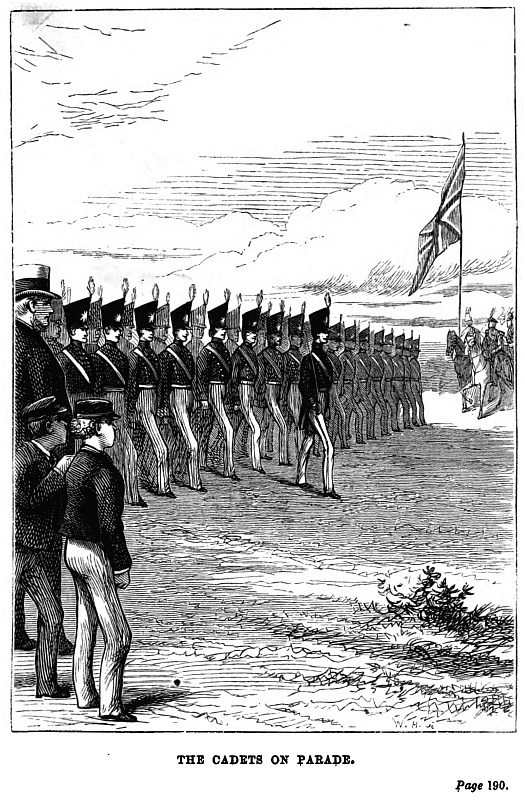
What was termed the “Public” in those days was very dissimilar to the “Duke’s” day at present. Formerly the “Public” was an examination, though it was a sort of sham affair. As, however, it was a great day, I will give a full description of the proceedings.
The “Public” was the day on which the Master-General of the Ordnance, his staff, and all the principal heads of departments came to the Academy to see the cadets. The order of proceeding was as follows:—
The cadets were drawn up on parade and received the Master-General with a salute. They were then put through certain manoeuvres by the senior cadets, and afterwards marched into the dining-hall.
In the centre of the dining-hall a table was placed, large enough to enable the batch about to obtain their commissions to be seated at. Near this was a long table, at which the Master-General and officers were seated. An elevated platform, with stair-like seats, was erected at each end and side of the hall. On this the cadets were seated who were not yet qualified for commissions; a portion was also set aside for visitors belonging to the cadets.
On all being assembled in the hall, the professors at the Academy, beginning with the head cadet of the batch, asked questions, which each cadet answered in turn. Sometimes these questions required demonstrations on the board, and the cadet used his chalk to draw figures and give demonstrations.
After the professors had put questions, any of the officers present might do so, and there was often much amusement at the questions and answers—for very often the inquiries made had no reference whatever to any subject a cadet had learnt at the Academy.
One story that used to be told about these questions was, that a cadet was once asked what was sometimes used to wash out the bore of a gun. The cadet did not know what to say, so another cadet beside him whispered, “Tan ash and water.”
The cadet, standing up, got nervous when he did not know what to say, and only heard imperfectly what his prompter said.
“Tan ash and water,” again whispered the cadet.
“A ten-inch mortar!” blurted out the puzzled cadet.
The batch who heard this answer were ready to burst out laughing, especially when the officer who had asked the question, and who was rather deaf, said, “Tan ash and water—very good!”
An old officer, who was fond of a joke, was reported to have once asked the head cadet of the batch, “What would be the result, supposing an irresistible body came in contact with an immovable post on a plane?”
The cadet answered that the body would come to rest.
“No,” replied the officer; “you forget the body is irresistible, and therefore cannot come to rest.”
“It would carry away the post,” said the cadet. “No,” again said the officer; “the post is immovable.”
After a little hesitation the cadet said he didn’t know what would happen.
“Quite right, sir,” said the officer, “neither do I, nor any one else, for the conditions are impossible. I only wanted you to say, ‘I don’t know.’ Some men would have attempted long explanations.”
When the cadets had been publicly examined, the various prizes were given, and, after one or two speeches by the senior officers, the Academy broke up.
I started for London that afternoon by coach, which was one of about forty four-horse coaches that used then to pass over Shooter’s Hill every day en route from London to Dover, slept at a friend’s, and on the following day was carried by coach to the New Forest, and once more found myself in the quiet of home.
The change that had taken place in me during my first half-year at the Academy was very great. Instead of being a raw country boy I was now a somewhat experienced young man. The knocking about I had received at the Academy had forced me to use my perceptive powers in every way to save myself from being thrashed for neglect; and I had thus cultivated my observational faculties, so that I noticed far more than probably I ever should had I remained at home.
Now that I was at home I found I was somewhat of a hero. All the countrymen round—the foresters—who knew me as quite a little boy, now touched their hats to me, for they called me a “sodger-officer!” and had heard I had done something wonderfully clever at an examination. I also found that among our friends I took quite a different position to what I had done four months before. In reality, I learnt now the advantage of being a soldier, for I was looked on as one; and I felt the benefit of this when I heard young ladies tell their brothers what a pity it was they had not been drilled, and taught to stand up, and walk like Mr Shepard!
I had been at home about a week when my father told me one morning that he had a letter from Howard, who would be in the neighbourhood shortly.
“I will write and ask him to stay here a night or two. You would like to compare notes with him about the Academy, I dare say.”
“Yes, that I should,” I replied, for I still looked, on Howard as a hero, and found my veneration for him by no means decreased when I remembered that he must have gone through all I had, and all I must go through before I obtained my commission; also that he was an old cadet when the present old cadets were only schoolboys. I wanted also to hear from Howard what used to go on when he was a cadet, and compare the bullying, fagging, etc, in his day with what I had myself experienced; for it was a doubtful point in my own mind whether or not I had been more bullied than other neuxes, and whether, if I had been, it was due to any peculiarity in myself, or was owing to the old cadets in my room being what was termed regular bullies.
When I met Howard he expressed his surprise at my improved appearance. “You’ve grown and filled out,” he said, “and before long you’ll be a formidable antagonist with your fists. And how do you like the shop?” he inquired.
I had a brief conversation with Howard then; but it was not till after dinner, when the ladies had left, and Howard, my father, and I were alone, that I became inquiring and confidential; and it was only then that my father became aware of the extent to which bullying was carried at the Academy thirty add years ago. His astonishment was great, for the tales I told were capped by Howard, and there was no margin left on which to place any doubts as regards the truth of our incidents.
After I had described the angle of forty-five, and the running round the table whilst the old cadets flipped me, Howard said, “Yes, all that’s pretty bad, but were you ever kept up half the night looking out for squalls, or has that gone out of fashion?”
“I’ve never heard of that. What is it?” I inquired.
“To look out for squalls a cadet was divested of nearly all his clothes, and was made to climb up the iron bars of the window and there hold on. If he came down without orders he received a tremendous thrashing, and it was supposed to be a trial of a cadet’s obedience to orders. I remember, when I was a neux,” said Howard, “I was sent up once to the top of the window, and told to remain there till further orders. After some time I heard both the old cadets snoring, so I thought I might as well come down and go to bed. I had scarcely gone down many inches when one of the old cadets called out, ‘By George, sir, you shall have a thrashing for that! You thought I was asleep, eh? I just pretended to snore, to see if you could be trusted to obey orders. Why, you ought to remain there till you dropped rather than leave your post!’ I went up again, and remained for above an hour, when I was so cramped I could with difficulty move. Both cadets were snoring, but I suspected another trap, so hesitated about coming down. At length, however, I could hold on no longer, and fell heavily to the ground, from which I was picked up insensible. But I soon got all right, and wasn’t much hurt after all.”
“But,” said my father, “these things are perfectly brutal. Don’t the authorities interfere?”
“Yes,” replied Howard, “they would if what was done was brought before them in any way; but it rarely happens that they hear of these things.”
“But don’t the boys—the fags—complain to the authorities about such ill-usage?”
“If they did, the life they would lead would be unendurable. Every cadet, old and young, would cut them, and they would be bullied to such an extent that I don’t believe any boy would stay at the Academy. He would be considered a sneak; and if a cadet once gained such a name it would be all over with him.
“A case once happened when I was a neux,” continued Howard, “where a cadet told his mother of some of the things he had to do as a neux. His mother foolishly wrote to the Captain of the Cadet Company about it, and said she hoped he would see her son was not put to perform menial offices. The captain of course had to treat the matter officially; there was an inquiry, and it resulted in the head of this cadet’s room being rusticated for a half-year. Well, the result was that the neux became a marked man; he was fagged, and thrashed, and sent to drill so often, that he could not stand it, and at last ran away from the Academy. It’s of no use for a cadet to attempt to go against the stream; he must grin and bear it.”
“I should think it would entirely break a boy’s spirit,” said my father, “and ruin him for life.”
“Not a bit of it,” replied Howard. “It is not that I advocate bullying; but I have never seen very much harm done by it. That it ought to be stopped I think there is no doubt, for I believe that of all the despotic tyrants in the world a boy is the greatest. To him there is a delight in tyrannising; and bully he will. Usually it is size and strength that makes the bully; and this is its worst form, and is known to exist everywhere. Now at the Academy it is not size or strength that gives the right to fag, but seniority only. The smallest old cadet may kick or fag a last-joined giant.”
“It is a bad, brutal system, and ought to be put an end to,” said my father. “If I had known the extent to which this system was carried at Woolwich I never would have let Bob go there.”
“I’m very glad you didn’t know then,” I replied, “for the worst is over now, and I’ve really only another half-year of it, and then I shall be tolerably free.”
“What I believe ought to be done,” said Howard, “is to separate fagging from gratuitous bullying. Nothing is more offensive in society than an unlicked cub, and you find many of these in places where men don’t belong to either service, or have never been to public schools. I believe, from what I have read in Marryat’s novels, that in the navy there is far more bullying with the youngsters than there ever has been at Woolwich; and I fancy also at our principal public schools there is plenty of it. The generality of boys are not so sensitive as we older people are, and we give them credit for feeling much as we should; whereas I know now that I look back with rather a sense of satisfaction to the bullying I went through, and the manner in which I stood it. You see, Mr Shepard,” continued Howard, “we men in the army have to lead a roughish life of it; we don’t always live in drawing-rooms, or mix with ladies; so a soft, delicate, sensitive sort of fellow, who can’t stand a little bullying without crying out for help, is not the sort of man we want for an officer. Now I can see that Bob there is twice the man he was when I first knew him, and he is more fit to battle with the world, than he would have been, if he had merely stopped at home translating Herodotus and catching butterflies.
“I’ll tell you another advantage there is in having fagging at Woolwich. When an officer gets his commission in either the Artillery or Engineers, his seniors never play tricks on him, or attempt skylarking—all that was done with when the officers were neuxes at the Academy. In the Line, how ever, unless an ensign joined from Sandhurst, and had passed through a phase of bullying, he was the victim of various practical jokes; and then there was no regular time at which these practical jokes ceased. Now it is not the right thing for a commissioned officer to be made the butt for the jokes of his seniors; still the ensigns are sometimes so raw, so self-sufficient, and require to be put in their proper places so much, that their seniors have no hesitation in bullying them for a time. It is far better, to my mind, that a cadet about fifteen should be subjected to a system of bullying—if you like to call it so—than that an ensign in her Majesty’s service should be. Fancy, too, what a set of fellows we might get in the service if they were not knocked into shape by their companions! Why, look at your neighbour’s son, Hynton, who may some day be a baronet! He’s nearly twenty, and is little better than a lout, because he has never been to school, but has always had a tutor at home. He is conceited, stupid, and thinks, because he is tall, stout, and strong, that he may do anything. He would have been made into a capital fellow by a little course of fagging when he was a youngster?”
“Ah!” replied my father; “you are a thorough advocate for the system, I can see; but I am dead against it. I think it brutalises boys, and makes bullies of them in afterlife.”
“I don’t think that,” replied Howard. “I believe men who are bullies will be so under any circumstances, and are not inclined to be so by being first fags and then having the power to fag. In my day, also, at the Academy downright bullying was discountenanced by all the old cadets, or at least nearly all of them, and any cadet known to be a regular bully was stopped from being allowed to fag.”
“That’s not the case now,” I remarked. “A cadet may bully as much as he likes.” I thought of Snipson and Brag as I said this, and the amount of suffering I had gone through on first joining came fresh to my memory.
“Then the Academy is degenerating,” said Howard; “and if what I may call wholesome fagging goes out, it will be because a bad style of men get to be old cadets, and carry things so far that the authorities will stop it altogether.”
On the following morning I took a walk with Howard, and took the opportunity of telling him of my having been obliged to hang by my arms whilst I was pegged at by racket-balls; and I asked if any such thing was done in his day.
“The fellow who did that must be a snob,” said Howard, “and deserves to be kicked by the old cadets! Unless you or the other neuxes had struck, or been cool in some way, that kind of thing ought not to have been done.”
Four days Howard stayed with us, and I had learnt much from him during that time. He advised me to work hard all next half, particularly in academy, so as to pass my probationary well, and to make friends with D’Arcy, who, he said, was a very good fellow, and had a brother who was a cadet with him. He also gave me some useful hints about examinations, and recommended a system of artificial memory for remembering formulae and various dates. He also told me I should find the advantage all my life of becoming skilled as a boxer and single-stick player, and that one of the Academy sergeants was a first-rate instructor at both.
“You’re not a fellow,” said Howard, “who would get into a row for the sake of showing off—a gentleman never does that sort of thing—so the knowledge of how to use your fists would not be likely to make you quarrelsome; but it is a pleasure to know that when you see some hulking lout who is a bully, and who is doing what he ought not to do, you can give him a thrashing if you like. I’ve always felt a sort of pleasure,” said Howard, “when walking through the streets of Paris, to think that I could thrash at least ninety-nine out of the hundred of the men one meets, for Frenchmen cannot use their fists. You should go in strong also for rackets and cricket; there is nothing more indicative of a muff than a fellow who is not good at some game or other. I remember hearing once of some general who said he would always select his staff from the men who were best across country, and you may depend on it that there’s great truth in the suggestion. I’ve generally found the best officers were men who were good at games. You can play chess well, I know, as your father told me you were within a pawn of him. So take my advice, and follow the maxim, that ‘what is worth doing at all is worth doing well!’”
My time passed pleasantly enough during the vacation, for I fully appreciated the quiet of the forest and its splendid trees, after having been crowded by my fellows and surrounded by houses during the past year. I did not look forward with much pleasure to my return to the Academy. I knew that some second-half cadets were fagged as much as if they were last-joined, and it was quite possible that such might be my fate; the novelty, too, of being a cadet and wearing uniform was departing, and I looked more to realities than I had at first. The prospect of being turned out at six o’clock a.m. to go and brush clothes in another room was not pleasant, nor did I relish the idea of being once more placed on a table as the target for boots and brushes. In fact, I was getting older rapidly; and as I grew very fast and became much stronger, a rebellious feeling came over me that was not favourable to my future obedience as a neux.
On comparing Brag and Snipson with Howard, or oven with several of the other old cadets I knew, I could not but feel that these two were very bad specimens of the cadet of that day. They were both bullies; they excelled in nothing, were low down in their class, and in spite of this were both very conceited. Their style of conversation, too, was inferior to what I had heard from other old cadets. Their ideas were cramped, and they seemed to take a mean or malicious view of everything, and to attribute to all other persons bad motives for what they did or said. I remarked, also, that neither Brag nor Snipson had a good word for any one. If any cadet’s name was mentioned, one or the other of these would commence with “Oh, yes! he’s all very well in his way, but then he’s not such a swell as he thinks himself, for I have good reason to believe that he,” etc, etc, etc; and here would follow some disparagement of the individual whose name was mentioned.
Brag and Snipson somehow got on well together. They were unpopular at the Academy, and perhaps that gave them some sympathetic feeling for each other; but the principal reason, I believe, was that they used to flatter one another very much. Whatever Brag did, Snipson said was “deuced well done;” and when Snipson did anything, Brag declared it was very clever. There was no use in concealing the fact, between myself and the two old cadets in my room there was a very great antipathy, and I can use no milder term to indicate with truth my feelings towards them than to say I detested them both.
To be at the mercy of a bully for whom you have a contempt, is a very trying position, and such had been my fate during the whole of the first term I was a cadet at Woolwich. As the time arrived for my return to Woolwich, I was anxious principally about the room in which I should live. It was quite a chance whether I had a nice or a disagreeable head of the room, but my comfort or misery for five months was dependent on the peculiar character of this cadet.
Chapter Ten.
A “Second-Half” Cadet at Woolwich.
Having made the journey from Hampshire to Woolwich in one day, I reported myself at the Academy at about six in the evening, and then found that I was appointed to No. 16 room, the head of which was a cadet named Forester. On going to this room I found I was the first arrival, and I also ascertained that the second of my room was Fenton. I was the third, and there was a vacancy for the fourth, who most likely would be a last-joined, and consequently the regular fag of the room. About eight o’clock Forester came, and was very civil to me; asked me if I had been winning any more races during the vacation, and told me I must always secure a racket-court for him. The securing the racket-court was by some cadet, either on coming out from the hall or being broken off at parade, racing to the court and being first in. He could then, if he liked, resign his claim to any one else; so it was not unusual for a neux who could run well to be employed for this purpose.
“You’ll find Fenton a very good fellow,” said Forester; “and I should think you are heartily glad to get out of Brag’s room.”
“Brag and Snipson both used to bully me a great deal,” I said; “but I suppose it’s the usual thing.” I did not yet know Forester well enough to speak freely about the treatment I had received, so I was cautions in my remarks.
About nine o’clock Fenton came in, and I at once took a fancy to him. He was short, stoutly built, and very dark. He and Forester were great friends, and were antagonists at rackets, and I also found they both played chess.
During the first few days of my second half I was very comfortable. I had little to do for either Forester or Fenton. I brushed them, and they did the same to me; and I brought books, etc, from the library for Forester, but there was no bullying from either of them. In a week after my return a last-joined cadet was appointed to our room, and to him was allotted the work which had hitherto fallen to my share. The last-joined was called Hampden, and was a wild Irishman. He was soon called upon to sing his songs of a night, and make his odes to the moon, but I was never sent for now, as the heads of rooms and old cadets in my division were contented in fagging the last-joined. Hampden could neither sing nor make speeches, and his strong Irish accent was very amusing, so that he was well laughed at, and pelted with boots and brushes, when he failed to make any speeches. He was, however, very good-tempered, and the more he was chaffed the more he seemed pleased.
It was about ten days after my return, that Snipson told me one day that he wanted to see me over at his room, which was in the “Towers.” On going there he informed me that he had now a single room, and therefore had not a fag, and as there was a last-joined in my room I couldn’t have much to do, so he should require me at his room every morning at seven to brush clothes, and look out for things he wanted.
This order was a great annoyance to me; I had been so quiet and comfortable in my room that I fancied the worst part of the fagging was over; but now having to turn out and dress by seven, and go over to the “Towers” where Snipson ordered me about, was, as I termed it, “disgusting.” I told Forester of the order, and he said I had better go, for it was the custom for one or two cadets of the second term to be fagged at the “Towers,” where no last-joined were quartered.
I soon found that Snipson seemed to dislike me as much as I did him; there was a natural antipathy between us, and we seemed to have nothing in common. He found fault with all I did, and complained that I mislaid everything and did not brush his clothes properly. I ground my teeth at his complaints and kicks, but I had to bear them nevertheless, for there was in those days the most rigid discipline used against a neux who “struck,” as it was termed, against an old cadet. I knew that of the two evils it was the lesser to bear the bullying of Snipson rather than to commit any act as bad for a cadet as mutiny for an officer or soldier. I found there were no other second-half cadets besides myself who were really fagged regularly, except where there was no fourth to a room, so I thought my case a hard one. However, there was no use in complaining, so I did my work and stood my bullying in as dogged a manner as possible.
When the idea had first seized me of becoming a soldier, I had taken as my model-man Howard. I was won and almost enchanted by the knowledge and apparent power he possessed. He seemed above what may be termed the little trivialities of life, and to have a wide and general view of everything. To him there seemed to be given a capacity for looking at all subjects with the power of an impartial judge, and at the same time he exhibited an enthusiasm for the service which, though toned down by experience, was yet shown in various ways.
When I had been some weeks in the room with Brag and Snipson, and had listened to their conversation, was conversant with their ideas and opinions, I could not but feel disappointed when I knew that two men with such mean sentiments, cramped ideas, and such disparaging views of others, should be so near to becoming officers in one or other of the scientific corps.
One of the charms of Howard was the readiness with which he bestowed praise on anything or anybody that deserved it. The beauty of the New Forest, for example, was a subject on which he used to dilate. I was once with him on a lovely autumnal afternoon, when the sun was lighting up the richly-tinted foliage of the forest, amidst which the dark green of the fir-tree was seen; the distant water of the Solent glittering like silver beyond endless waves of forest glades; the far and cloudy-looking hills in the island marking the distance, and presenting a lovely variety of scenery rarely obtainable in England.
Howard stopped and looked at the view, and, with a heartiness that showed how he appreciated it, exclaimed, “By Jove! that’s a lovely bit of scenery!”
“But,” I said, “abroad you must have seen far more beautiful views than this?”
“Of course I have; I’ve seen grand mountains rising twelve thousand feet direct from a plain, and I’ve seen tropical forests with their branches hung with wild vine, whilst gorgeous metallic-looking broad-leaved exotics were scattered about in profusion. But because I’ve seen that, it does not prevent this from being a perfect bit of English landscape.”
I compared these remarks of Howard’s with those of a gentleman who came to see us some time after Howard had left, and who, on seeing the same view, exclaimed, “Oh, I dare say you think it very fine, but it’s nothing to what I have seen in other places.”
I was young then, and did not know the world or the men comprising it; so, although an uncomfortable feeling came over when I heard this remark, I did not know how to account for the difference between the opinions expressed by Howard and by this visitor. Yet how often in the world do we meet with persons of both the types I have here referred to! We meet men with generous minds, ready to acknowledge merit and to admit its genuineness, who do not condemn that which is good merely because they have seen or heard that which they consider better. These men are usually those who have worked and won themselves, and who know that even mediocrity is not gained without great trouble. They are men whose praise or good opinion is worth having, for they judge of a matter on its merits, not by mere comparison.
Others, again, condemn everything which is not what they consider equal to the very best they have seen or heard. With them it is not the merit of a subject which is examined or considered, but the comparison between that and some other. These men are usually ungenerous and conceited, without the slightest cause for being so. They are men who would make the unaspiring believe that to work for success was a mere waste of time—that even if success were gained it would not be worth having. Such men, and women too, are met everywhere; they are the cold sheets of society, who do harm to the weak and infirm of purpose, and in almost every case have no merit of their own, and not one single point of excellence in their nature.
That which struck me most forcibly during my first half-year, and my acquaintance with Snipson and Brag, was this “nil admirari” style. Neither of them had a good word for anybody. The cadet who was head of his batch before I joined was once discussed by these two, and the following was the conversation:—
“Some fellows say that London is so awfully clever,” said Snipson, “and got a higher decimal than any fellow has since, about four years ago. Now, I don’t think him a bit clever—in fact, I think him rather stupid, for he was a most awful ‘mug.’ I don’t suppose any fellow swatted harder than he did his last two terms in order to be head of the batch.”
“Oh, any fellow who mugged as he did could be head of a batch!” replied Brag. “Besides, I don’t think passing examinations well is any great proof of being very clever. I dare say if I set to work I might pass well, but it’s not worth the trouble.”
“Hopkins of that batch thinks a deal of himself too,” said Snipson, “because he’s third of the batch. Why, I remember the time when I could beat him at everything; but then I didn’t choose to slave away as he did. There’s Dawkins, too, who is fifth; he got to be that I believe merely by sponging; he was always sneaking about the octagon, pretending he was hard at work. I hate a fellow doing like that.”
Young as I was, I could perceive that neither Brag nor Snipson would have made such remarks unless they had imagined themselves superior to all those whom they had mentioned; and the latent belief thus revealed is, we believe, one of the reasons why the slanderer or even scandal-monger of society is agreeable to some natures, and produces abhorrence in others. To the honest, straightforward, hard-working man, who judges of things by their merits, and who loves the truth and detests the sham, this system of disparaging is offensive and painful. To such a nature it is more pleasant to hear the excellence and the good qualities of people referred to than it is to hear only their defects, supposed or real, or their evil deeds, or those attributed to them, referred to.
The thoroughly noble woman who is herself true, and who possesses the gift of charity, finds no pleasure in the society of a person whose conversation consists mainly in slandering her neighbours.
The woman who is herself false, and who endeavours to pervert the truth, finds her vanity gratified when she can hear anything related which drags her neighbour’s name into the mud. As a corollary, therefore, it may be stated that, given the woman who paints her eyebrows, blackens her eyelids, powders and tints her face, and there you find to a certainty the character whose delight is intense when she can glean any intelligence about her dear friends of such a nature as to damage their characters, and to retail such intelligence with additions is to her a luxury.
Having experienced four months of the society of Brag and Snipson, I could not avoid feeling that they were inferior men, who would never by fair means make a mark in the world, and who were not desirable either as friends or enemies.
I had been but a very brief time in Forester’s room before I became deeply interested in him. He used to read a great deal, and had at that time the rare accomplishment of being able to talk about other matters beside “shop.” He was devoted to soldiering, and had studied carefully “Napier’s Peninsula” and other similar books, and used to talk of a night, when lights were out, with Fenton about various actions and their results.
As I look back on those days, I can recall many of the remarks that Forester made, and have been struck with the value of these, and of their practical application even now. One, in particular, I remember was, “that all the extensive theory that we learnt at the Academy would probably never be of use to one in twenty of the cadets in afterlife, whilst we should know nothing about certain practical matters when we became officers, which every non-commissioned officer would be acquainted with.”
“An officer’s head,” said Forester, “ought to be like a soldier’s knapsack—have a few useful things in it always handy and ready for use—just the things required for every day.”
Once, after a long game of chess with Fenton, Forester remarked that people said chess and war were very much alike.
“They would be,” he said, “more alike if, when playing chess, you were bound to move within one minute after your adversary, and also if you had a drum beating in your ears and a fellow shying racket-balls at you. I believe,” he said, “that the men who make the best leaders of troops are usually hard, strong men, without too much brains, whilst the great generals and planners of campaigns are quite different men. These should be careful thinkers, and men with great nervous power, and it is such men who are most upset by disturbing causes. I have often thought,” continued Forester, “that we ought to have a thinking general and a working one—the first to think out the moves, the other to execute them.”
Before I had been long in this room, Forester expressed his opinion about keeping up lights. He said,—
“I think taking away our lights at half-past nine, and leaving us to undress and go to bed in the dark, is absurd; but when I have said to the officer on duty that ‘I have no lights concealed, and no intention of procuring a light,’ I feel bound in honour to act up to what I say.”
“But no one really looks upon the usual report about lights as given on honour,” said Fenton.
“I’ve nothing to do with what other fellows think,” said Forester. “I only know what I state to an officer, and if I keep up lights after having stated I will not do so, I consider I have ‘smashed.’” (Note 1.)
I here learnt for the first time the great effect produced on us by the society in which we mix, and the influence that such society has on our opinions. When Snipson wished to keep up lights, Brag did not object from a moral point of view, but because it was not safe. I also turned my attention to a plan of keeping a light burning without reflecting on its being dishonourable. Now, however, when Forester expressed his views about it, I felt I agreed with him, and was ashamed of having aided Snipson to commit an act which I now looked on as dishonourable.
There were very curious ideas among the cadets in those days. One of these was, that it was rather a smart thing to get very nearly tipsy—that is to say, “screwed.” If a cadet could prove that he had arrived at this state through drinking champagne or “old port,” he thought himself a man of judgment and taste. This peculiar opinion was confined to only a few cadets, a sort of clique, and was much condemned by Forester.