"His Career and Adventures at the Royal Military Academy Woolwich" (continued 2)
Reading edition
It was late in the evening when I reached my father’s lodge, and was welcomed by all my relatives. The change that had taken place in me was marked, and was noticed by all. I was thinner, and the care and thought of the past four months had given me an aged appearance, that made me look a year older than I was. I could scarcely conceal my feelings as my sisters hoped I was getting on splendidly, and would soon be an engineer, like Howard. To enter into all the details of my difficulties with them would, I knew, be useless, and so I avoided answering them, and made up my mind to wait till I could have a quiet talk with my father, and explain matters to him.
After dinner that evening I found my opportunity of speaking to my father when we were alone. I was most eager to open my heart to him, and let him know how things really stood. Without any preface I suddenly said, “I want to tell you, there’s no possible chance of my passing for a cadet.”
“No chance! What do you mean? Why, it’s nearly ten months to your examination! Don’t you mean to try?”
“I may try all I can, and yet it’s impossible; it would take me two years to get into the class that goes up for examination.”
“Mr Hostler thinks differently, Bob, for he says that he hopes you will pass, if you will work; but that up to the present time you have been very idle.”
I listened with astonishment to my father’s remarks, and could hardly believe it possible that Mr Hostler had written such words. My doubts, however, were soon removed, by the production of Mr Hostler’s letter, in which were the very words quoted. I knew that what I had stated was correct, and that Mr Hostler knew, even better than I did, that there was no chance of my success; but at the time I had no idea of the reason for his sending such a letter to my father. It was, I found, the intention to send me back to Hostler’s at the termination of my three weeks’ vacation, and I began to count the days and hours of liberty previous to that, to me, unpleasant period.
On the following morning I received an invitation from Howard, asking me to go over and pass a few days with him, and, having obtained my father’s consent, I started for his lodgings, which were at a farm-house near Lyndhurst.
Howard was now to me even a greater hero than he had formerly appeared. I looked on him as one who had passed a distinguished career at Woolwich, and had also been abroad, and I felt somewhat afraid of him now that I knew how much he had done. He was, however, so kind and friendly that I was soon at my ease, and as we sat at our tête-à-tête dinner I found myself telling him all my disappointments, hopes, and fears at Mr Hostler’s, and my difficulties as regarded the future.
Howard seemed much amused at all I told him, and said that the first thing he must teach me was to be a good “mill,”—that meant, how to use my fists. He did not mean to bother me with work, as he believed I wanted rest more than anything; but he promised to write to Hostler, and ask him to push me on, and he thought that, although it was difficult, yet it was by no means impossible I might pass.
On the following morning, soon after breakfast, Howard produced a pair of boxing-gloves, and, taking a seat on a chair, gave me instruction in what he called “the noble art of self-defence.” He first showed me how to stand, how to raise and hold my fists, how to strike out and make the foot and hand work together. He pointed out the danger of an open guard by giving me light taps in the face, and then explained how to guard them.
“We’ll have an hour a day at this fun,” he said, “while you are here, and I’ll back you to lick Fraser when you go back to Woolwich. There’s nothing that can’t be done by thought and work.”
During the week I passed with Howard I changed from a condition of despondency to one of Hope. I learnt from him the power to be derived from thought and work. He explained to me his own difficulties, and how he had overcome them, and encouraged me by saying that, although I was backward, he believed I had brains enough to come to the front after all. By constant practice I had become, as he said, quite a “dab” with my fists, and ought to hold my own with heavier weights than myself. “Don’t you ever seek a fight,” he advised, “if you are even sure to win, because that’s bad style; but, if a boy tries to bully you, never avoid a fight, and you’ll soon find you’ll lead an easier life, even though you get licked.”
I returned home from my visit to Howard with a lighter heart than I had gone there, for hope now took the place of despair. If I could only manage to pass into the Academy, I thought, what a triumph it would be! but then the knowledge of the work before me cropped up, and it seemed as impossible I could accomplish what I had to do as that I could accomplish flying, or any other impossibility. Any way, I would try hard on my return to Hostler’s, and perhaps he would now push me on faster than he had done before.
My three weeks soon passed, and I once more joined Hostler’s school at Woolwich. There were two new boys, who had, however, been to other schools, and were fairly forward both in Euclid and algebra, and got on very well after the first few days. I soon became better friends than I had been with Strong and two or three other boys; but Fraser, who was the bully of the school, was still very uncivil to me, and more than once had threatened to thrash me if I interfered with him.
Remembering the advice that Howard had given me, I told Strong one day that if Fraser gave me any reason for doing so, I intended to challenge him to fight. Strong warned me against doing anything so rash, for he assured me he knew a case where Fraser had completely cut a boy’s cheek open in a fight, and that I should not be able to stand up against him for five minutes.
Chapter Six.
My First Victory.
It was about a month after I had returned from my vacation that Mr Hostler gave us a holiday, and arrangements were made for our playing a match of cricket on Lessness Heath, a piece of open ground near Belvedere. Each boy took out his lunch, and the whole school turned out for the day, Mr Monk being in charge of us. We walked to Belvedere, and soon arranged sides and commenced our match—Mr Monk leaving us to take care of ourselves whilst he went down to Erith to see some friends.
After my side had been in and scored forty runs, the other eleven, of which Fraser was one, went in, and had scored thirty-six runs, when Fraser, who had retained his bat during the whole match, was “stumped,” and given out by the boy who was umpire. Fraser disputed the decision, and refused to go out, although even his own side owned that there was no doubt about it. At this Fraser became very angry, and declared he would not give in as he had never gone out of his ground. I stood “point,” and saw he was more than a foot out of his ground when stumped by the wicket-keeper, and, on being appealed to, said there was no doubt about it. No sooner had I said so than Fraser dropped his bat and rushed at me, striking me on the side of the head. In an instant I returned the blow, and a fight commenced.
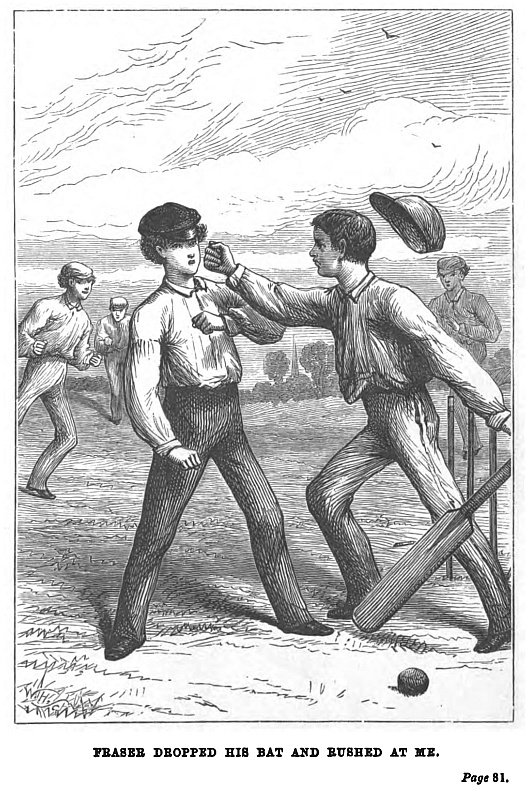
Several of the older boys, seeing there was to be a fight, suggested we should go into a gravel-pit near the heath, as we should not be seen there, and if Mr Monk came back we should be able to see him from a distance, before he saw us. We both went to the gravel-pit, and a ring was formed—Strong acting as my second, whilst the majority of the boys, feeling that Fraser was in the wrong, were on my side. The reputation, however, which Fraser had obtained as a “mill” caused several of the smaller boys to stand by him for fear of future punishment if they excited his displeasure.
We were soon opposite to one another, with our coats off, and our shirt sleeves rolled up, ready to commence, most of the boys looking upon my defeat as certain, and half afraid lest I should be severely punished by my opponent. Fraser was confident of success, and exclaimed, “I’ll soon stop your cheek for you; now look out!”
He made a rush at me, hitting out vigorously, but I remembered Howard’s advice, and determined to keep my head, and try to put in practice what he had taught me. I guarded myself against Fraser’s blows, and succeeded in twice giving him straight hits in the face without receiving a touch from him in return.
The first round seemed to astonish every one, but none more than Fraser himself. When he had thrashed me before, I knew no more about the use of my fists than a girl, and simply stood up to be knocked about. Now, however, I made use of my legs as well as my fists, and jumped away from Fraser’s rushes and blows as expertly as a cat; whilst I instantly recovered myself, and, making my hand and foot keep time, dealt two or three such staggering blows that Fraser was quite bewildered.
There is nothing that so soon puts off a bully, or a man accustomed to easy victory, as being “collared.” The effect is not unusually to make the too confident man lose his head, forget his skill, and fall an easy victim to his opponent. This was the case with Fraser. In the second round he hit wildly and unskilfully at me, and exposed himself to my blows several times, opportunities which I did not neglect, and, finally, I gave him a fair knock-down blow. There were now cries of “Bravo, Shepard!” whilst several small boys who had been quietly watching the fight, and who had been bullied by Fraser on former occasions, jumped about outside the ring with a delight that they did not attempt to conceal.
Three more rounds were fought, during each of which I became more and more confident, as my fear of my adversary’s skill and strength was gradually dispelled, and at the sixth round I commenced the attack and completely knocked Fraser out of time.
Cheers greeted my victory, whilst I was patted on the back by nearly all the boys, and looked at with admiration by the smallest. Even the older boys looked at me with surprise, for, excepting one blow on the cheek, I was unmarked, and seemed untouched.
Strong helped me on with my jacket, and seemed quite delighted at my victory.
“This is a great day for you,” he said. “There’s no one in the school can lick you now; but I’m astonished to find what a mill you are, for six months ago you knew nothing about it.”
“Ah,” I replied, “I did know nothing then but I determined to learn something, and so I got a friend to teach me. Who do you think gave me lessons?”
“I can’t guess.”
“Why Howard, who was at the Academy some years ago.”
“Howard!” exclaimed Strong. “Why, he was the best boxer that was ever at the Academy, and it was he who licked the prizefighter at Charlton Fair. No wonder you thrashed Fraser so easily.”
Fraser took his defeat with a very bad grace. He was a good deal punished, and I was surprised myself at the effect of my blows. It was my first experience of the result of skill in opposition to brute force, and of the advantage of practice before attempting any performance. It was a small thing, it was true, to merely thrash the bully of a school, but the means by which I had achieved this performance gave me a lesson that has never been forgotten. Labour and thought were the means by which I had gained this victory, as they are the means by which nearly every successful result in life is achieved.
From that day I took quite a different position in the school, and led a life free from quizzing or bullying. Fraser hated me, but he feared me too, and to make up for his dislike I found the generality of the boys now sought my society, and always tried to walk with me when we went out for our daily constitutionals. It is a small thing at a school or in afterlife that makes the difference between popularity and unpopularity.
Four months passed after my return from my vacation, and my life at Mr Hostler’s had grown into a sort of routine. I went through the various daily works there much as did the other boys; but I was not advanced as were the other pupils, and as the time went on and drew nearer to the limit of age at which I could go up for examination I felt more and more certain that my chances of being prepared grew less and less. There were now only six months to the date of my examination, and I had not commenced algebra, yet I had to take up cubic equations and three books of Euclid. In this difficulty and anxiety I wrote to Howard, and told him all my fears and anxieties. As I penned my letter to him I felt ill, and out of health and unfit to do anything; but I sent off the letter, and then hoped I should be more at my ease.
On the following morning, when the “quarter” was shouted as usual, I tried to get up, but was unable to stand, and I knew I was very ill. I asked one of the boys to tell Mr Hostler I was too ill to get up, and in an hour a doctor came and immediately ordered me to be removed to a separate room, where I was physicked and attended by an old servant, who acted as nurse to the establishment. I became worse during the day, and at night was delirious, and it was then known that I had a bad attack of measles.
During three weeks I was confined to bed, and of course made no progress towards qualifying for my examination, and at the end of that time was only able to walk about my room.
It happened that the room in which I had been ill was separated by only a thin partition from a room in which Mr Hostler usually saw visitors, and what was said in the next room could be easily heard in mine. I was sitting one evening looking out of my window and wondering what my future would be, when I heard Mr Hostler’s voice in the next room, and my own name mentioned. I listened eagerly to what was said, for I fancied it might be Howard come to see me; but I was soon undeceived, for the second person I ascertained was Monk.
“You see,” said Hostler, “next examination we must send up Hort and Fox, and perhaps two more. They will pass well, but Fraser we will keep another half. It won’t do to send up more than four; besides, I can easily keep him back, on account of his French being bad. Shepard, of course, I never intended to send up. He won’t do us any credit, and he can’t pass. I’ll keep him another month, and then will write to his father, and tell him that this attack of measles destroyed what little chance he had of passing. I think a boy ought to be here at least two years before he goes up, so as to be well grounded; and if Shepard did go up, and did pass by cramming, it would make the parents of other boys discontented if I kept their sons two years.”
I listened to these words as I should to the revelation of an enemy’s plot against me. I now saw why I had been kept back, and why no hurry had been adopted to qualify me for my examination. My blood boiled with rage, as I felt that I had been, sacrificed to the personal interest of Hostler; and I at once wrote a letter to my father, telling him what I knew of Mr Hostler’s intentions. Several days passed without my receiving any answer from home, but at length I received a letter from my aunt, saying my father was too busy to write, and had requested her to reply to me. She said my father was much displeased with me for my suspicions of Mr Hostler—that I was like most idle schoolboys who disliked their tutors—that Mr Hostler had written home before I was ill, saying that I was idle, and that all the special attention he was giving me did not seem to have the desired effect, and that he feared I should not qualify. These faults she said she could quite understand, as when under her tuition she had always found me more fond of play than of work.
At the receipt of this letter I was at a loss what to do. It seemed as if there was a plot against me, and I was helpless to make the truth known. As a last resource I wrote to Howard, and begged of him to come and see me.
Three days after posting this letter, my old nurse came into my room and said a gentleman had come to see me, and I was to go into the dining-room. Upon entering the dining-room I saw, to my delight, Howard, who shook hands with me like an old friend. We drew our chairs together, and I told him how I had been kept back, and how I had heard Mr Hostler’s remarks about me, and, lastly, how my father had been prejudiced about me.
When he had heard all I had to say, he thought for a minute and then said, “I don’t believe Hostler is a bad fellow at heart, and he, no doubt, fully believed that you could not pass. He has his regular routine of cramming, and won’t go out of it; and, if you stop here, there is no doubt you won’t pass. Now I’m thinking of a plan that may succeed: it is just possible, though not probable. You’ve four months in which to do twelve months’ work; but if it is to be done, I know the only way. There’s a man in London who takes only four or five pupils; he is the cleverest fellow I know, for I worked with him half a vacation once, and he got me on wonderfully. His name is Rouse. Now I’ll try to persuade your governor to send you there, and that’s the only chance I see. I shall be back in Hampshire to-morrow, and will see your governor about it.”
On the fourth day after Howard’s visit I received a letter from my father, telling me to have my trunk packed, as he proposed removing me from Mr Hostler’s that day, and transferring me to Mr Rouse’s. I bade my schoolfellows good-bye, most of whom were sorry I was going, and I received their condolence in being withdrawn from Hostler’s, as having no chance of passing my examination.
At about mid-day my father came, and, after a short interview with Mr Hostler, sent for me.
“I’m sorry you’re obliged to be taken away,” said Hostler; “but it wouldn’t be fair to your friends to keep you any longer on the chance of your passing. You’ve only four months now, and it would take the cleverest boy I know a year to pass. If you’d been very quick, I might have done it at first, but now it’s too late! But what you’ve learnt at this school will be of use to you all your life.”
A steamer was in those days the quickest mode of conveyance from Woolwich to London, and by this means we reached London Bridge, and from thence drove to Trinity Square, Tower Hill, where Mr Rouse lived.
On entering Mr Rouse’s drawing-room we were soon joined by a clergyman, who was Mr Rouse himself.
My father stated the case to Mr Rouse, and informed him of the short time before me, and of Hostler having stated the impossibility of my being able to qualify in a year. “The question now is,” said my father, “do you think you can qualify him for the next examination?”
Mr Rouse smiled, and said, “You set me rather a difficult task, asking me to accomplish in four months what the celebrated Mr Hostler says can’t be done under a year. I can only say it is not probable I can do it, but it is not impossible. It depends entirely on your son’s genius and on how well he knows what he has already learnt. I shall be able to tell in a week what he is made of, and what chance there is for me.”
I had watched Mr Rouse carefully from the time I had entered the room. He was rather tall and stout, with a clear dark eye and a half-bald head. There was a sparkle in his eye that at once indicated quickness and thought, whilst his calm, decided manner spoke of a confidence in himself that was not easily shaken. In ten minutes after entering my father left me, and I was installed as a pupil of Mr Rouse’s.
“Come upstairs,” said Rouse; “I will introduce you to your companions.”
I followed my new tutor upstairs, speculating on who the boys might be that I should meet, and was shown into a room that looked more like a drawing-room or study than a schoolroom. In it were three young men, whose ages might be about twenty. One was reading the Times, another was lounging against the fireplace, and the third helping himself to a sandwich from a plate on a tray at the sideboard.
“Let me introduce a new pupil to you,” said Mr Rouse, “Mr Shepard, who is going up for Woolwich. Mr Robinson, Mr Welton, and Mr Wynn, Addiscombe cadets. Will you have some lunch, Shepard?” continued Mr Rouse. “There’s a sandwich and a glass of ale. We dine at six.”
I helped myself to a sandwich and a glass of ale, for I had now a tremendous appetite, as I was recovering from my late illness, and I then looked round at my companions. I felt I had come to a very different place to that I had left; my fellow-students were men, and I saw gentlemen, whilst Mr Rouse’s manner put me at my ease at once; there was none of the bullying, blustering style there used to be in Hostler, and I felt that I had made a good exchange as far as comfort was concerned, though I feared the manner of the cadets did not seem much like hard work.
After about ten minutes’ conversation on politics, the performances at the various theatres, and the last good thing in Punch, Mr Rouse looked at his watch and said, “Well, shall we commence work again?”
The three cadets took chairs beside the table, and commenced reading books. Mr Rouse gave me a slate and said, “I must find out to-day what you know, so that we may go on safe ground. How far have you gone in mathematics?”
“I have just commenced addition in algebra,” I replied.
“Very well, I will give you a couple of questions in rule-of-three, in decimals, in fractions, and in square and cube root, and be careful about your answers.”
I was soon busily employed at these questions, and found little difficulty in solving them, for they seemed particularly easy questions. After a time I told Mr Rouse I had finished, and at once gave him the answers of each. To my surprise I found not a single answer was correct. Something must be wrong I knew, but where it was I did not know. Mr Rouse smiled, and said, “Now, have a careful look at each question, and don’t be in too much of a hurry about them, for sometimes there are difficulties you may not see.”
I once more carefully examined the problems, and then found I had made a mistake at the very first, and had misread the questions in almost every case. I then reworked these, and eventually brought out the right answers.
By the time I had completed my work the hour had arrived for leaving off study.
“This evening,” said Mr Rouse, “you can work out these questions in this paper and have the answers ready by to-morrow morning.”
We all dined together that evening like gentlemen. The scramble and noise that used to prevail at Hostler’s prevented me from ever enjoying a meal there, so that it was a luxury to sit down to a quiet dinner and to listen to the anecdotes and conversation of Mr Rouse. At no time, either during study hours or at meals, was there anything of the schoolmaster about Mr Rouse; he acted the part of a companion to perfection, and I believe it was as much by his pleasant manner, giving confidence to his pupils, and inducing them to ask his help in every difficulty, as by his knowledge, that he gained the successes he had gained at examinations.
After dinner the three cadets went out. I found that my three companions were Addiscombe cadets, who were going into the Indian army, and who were working during the vacation to get either the Artillery or Engineers. They were so much older than I was, that they seemed like men to me, but they had none of the bullying manner about them that the elder boys had at Hostler’s.
When I found myself alone in the study, at Rouse’s, after dinner, I felt I could work and think; everything was so quiet that I was able to get on without interruption, and the time passed rapidly and pleasantly. Question after question I worked out, and by the manner in which the solutions seemed to agree with the questions, I believed I was nearly, if not quite, correct in my work. I continued thus occupied till about ten o’clock, when, having a room to myself, I went to bed, with no fear of being disturbed by a “cold pig,” or the miserable cry of “Quarter?” that used to awake me at Hostler’s.
Before going to sleep, however, I thought over the problems I had worked out, and fancied I had made a mistake in one, which I at once determined to re-examine, and soon found my second thoughts were correct, and that I had made an error.
This was the first time I had ever worked out a problem in my head, when in bed, and the room was dark, but after this I regularly used to think over the various things I had done during the day, and try to recall each portion, and endeavour to repeat to myself what I had done. By this means I soon acquired a habit of thought quite new to me; instead of what I learnt seeming to rest only on the surface of my mind, as it had at Hostler’s, it seemed to impress itself on the brain, and to leave a mark so distinctly as never to be forgotten. I soon realised the fact that I was passing through a phase of mental development, produced, as I believed, by the quiet, calm, and reasonable manner in which I was now treated.
Night after night I used to work out the questions given me, and in the morning handed the solutions to Mr Rouse. In the majority of cases I was correct, but if I were wrong Mr Rouse would go over the work with me, giving me hints as regards the way of arranging my figures or doing portions of the work. I often smiled to myself as I compared this system of teaching with the cramming practised by Hostler, and the reasonable manner in which Mr Rouse pointed out mistakes or want of care, with the three-cuts-on-the-hand system of Hostler. I found, after a week at Rouse’s, I had really learnt more than I should have done at Hostler’s in many months; and it was not only what I had learnt, but the additional power which seemed to have come to my mind, and the consequent ease with which I grappled with problems, that a month before, in the confusion at Hostler’s, would have been to me unintelligible.
I discovered, too, at this time, how problems that perhaps for half an hour would appear impossible of solution, if put by for a day and re-tried, would often be found practicable. This, to me, important discovery led me to never give up anything that at first I could not accomplish, but I waited day after day, till I usually found I grew up as it were, so as to surmount the difficulty.
Remembering what Mr Rouse had said relative to forming an opinion in a week, I was very anxious, as the week elapsed, to hear the result of his experience. He did not, however, mention a word to me, and I had not the courage to ask him whether he believed I had a chance of success. I worked steadily on, hoping to defer the evil day, when perhaps it would be pronounced that I had no chance.
It was after I had been a fortnight at Rouse’s that one morning, as I read out the answers to my night’s work, Mr Rouse said, “Number six question is one you must look at carefully, for when you are at the Academy you will have many such questions in your half-yearly examinations there.”
“Do you think I have a chance of passing, then?” I exclaimed.
“Certainly; every chance, if you continue going on as well as you have done.”
These words were long remembered; they gave me hope, and they excited my ambition. If I could only pass, what a blow it would be for Hostler! and what a surprise for many of the boys there, who had put me down as not only a dunce, but as too stupid to learn! I could not, however, believe there was more than a chance of success, though I had hopes now, especially when I found how easily I could solve many of the most difficult questions that Mr Rouse set me.
Week after week passed, and I was pushed on with a rapidity that surprised me. I passed through the earlier rules of algebra, came to simple equations, understood them; passed on to quadratics, and at length came to cubics. Mr Rouse’s method of teaching was perfect. To him there was no such thing as a difficulty; if he found that I was puzzled at anything, he at once came to the rescue, and asserted that “it was a very simple thing.” In a few words he would give an explanation which made the problem thoroughly clear, and often caused me to wonder how I could have been so stupid as not to see clearly before he explained the difficulty to me.
On several occasions Mr Rouse had willingly consented to my going to the theatre, his object seeming to be to give all the liberty he could, and to impress on his pupils the importance of self-dependence.
Three months after joining Mr Rouse I was working at subjects that only the first and most advanced class attempted at Hostler’s. I could scarcely believe that all this was real. It had been so impressed on me at Hostler’s that I was intensely stupid, and that even a clever boy could not reach the first class from where I had been in less than a year, that I began to fear I must be cramming and had not a thorough sound knowledge of the subjects I was supposed to have learnt.
One day I suggested this difficulty to Mr Rouse, telling him how slowly boys went on at Hostler’s, compared to the rate at which I had advanced.
Mr Rouse replied that, instead of cramming, he hoped I had thought carefully over and thoroughly understood what I had done, and he believed I was less crammed than Mr Hostler’s boys, whom he knew learnt most things by rote like parrots.
As regards their Euclid I knew this opinion was correct, for I understood now far more of geometry than I felt certain any of Hostler’s boys did. I could turn problems upside down, and prove principles as well as mere cases, this proficiency being due to the clear and quiet way in which Mr Rouse would explain the various propositions.
Nothing could be more satisfactory than my progress up to within a month of the examination. I felt considerable hope myself, although I could not get over the feeling that the head boys at Hostler’s must know much more than I knew. One morning, however, on waking, I had a very bad fit of coughing; during the day it became worse. I scarcely slept the following night, and on the next day I learnt that I had a bad attack of hooping-cough.
Mr Rouse looked very grave at the intelligence given him by the doctor, for he knew that I had to pass a medical as well as a mental examination, and that the doctor would not allow me to pass if I had the hooping-cough.
I had now to keep my bed, and was soon leached and blistered, but the cough clung to me most obstinately, and so shook me that I felt too ill to work. I was in this state to within a week of the examination, but I had made up my mind I would take my chance at Woolwich, and well or ill I would go up.
It has often since those days occurred to me that there is in the human mind and human will some power which, if exercised, has the effect of driving off or overcoming sickness; men, it is said, often sink and die from despondency, whilst others, by pure energy as it were, get well. To give in, as it were, to sickness often seems to increase the disease, whilst to fight against it staves it off.
Whether the will to get well was the cause or the effect of the improvement I cannot state, but I suddenly improved wonderfully, and three days before the examination I scarcely coughed at all, though I was weak and felt barely able to walk.
The evening before the examination I started with Mr Rouse for Woolwich, and we took up our quarters at the King’s Arms Hotel. There were several other candidates staying in the house, who, I understood, were going up for the examination on the morrow.
Previous to going to bed Mr Rouse sat chatting with me in our sitting-room, giving me hints about the examination. “You must remember,” he said, “that your success or failure does not depend on what you have done or what you have learnt either with me or at Hostler’s, but it depends solely on what you write on your paper to-morrow. I have known boys fail at examinations merely on account of carelessness at the examination. They knew a problem well, but they wrote so carelessly, and described so loosely, that the examiner concluded they knew nothing about the matter. After you have finished a paper, read over slowly and patiently what you have written, and you will almost always find you have made some absurdly simple mistake. I have known men go to an examination as it is said a Dutchman did at a ditch. He ran a mile to get up his speed, and was then so done that, instead of jumping over, he jumped into the ditch. Concentrate all your power on the work in hand; take the easiest questions first, and when you find a difficulty you can’t get over, go on to another question; then you will sometimes find, on going back, that you can at once get over what before defeated you. Above all things, keep quite calm and thoughtful, and do not lose your head or get into a funk.”
These and other similar precepts Mr Rouse gave me, as modern youths would style them, as “straight tips,” and I thought over them before I went to sleep, and impressed them on my memory.
I woke early on the following morning, and though I tried hard to avoid feeling anxious, yet I could not forget that the whole of my future career hinged on what I did on that and the following days of examination. If I failed, a slur would be on me for life, though perhaps undeserved. If I succeeded, I believed I should accomplish what many considered, if not impossible, at least improbable.
After an early breakfast I walked with Mr Rouse towards the Academy, where the examination was to be held, and on the common was joined by five of my old schoolfellows from Hostler’s.
“What, Shepard!” said one of them, “you don’t mean to say you are going to try the examination? Why, I heard you’d given it up!”
“Oh, I’m going to try, just for the fun of the thing,” I replied.
“If I’d been you I’d have cut the affair, for it’s far better to withdraw than to have the discredit of being spun.”
“How Hostler will laugh when he hears of your coming up!” said another of my old schoolfellows.
“Fraser!” shouted another boy to some one I saw about a hundred yards ahead, “come here! here’s your old antagonist, Shepard?”
Fraser waited for us to join him, and then said, “How are you, Shepard? You’re looking deuced seedy. What’s the matter, and what are you doing here?”
“I’ve had a bad cough,” I replied, “and am coming up just for the fun of the examination.”
“Why, you don’t expect you’ve a chance, do you?” he continued. “Hostler told us you had given it up as the wisest plan.”
“Oh, I don’t suppose I’ve any chance,” I said; “at least, not with you fellows, but I thought I would come up to see what the examination was like.”
“And have it always said of you that you’d been spun at Woolwich. I think you’re a muff for your pains.”
On entering the Academy grounds we were shown to one of the cadets’ rooms, where we had to pass a medical examination. The marks of leeches and blisters on my chest at once attracted the doctor’s attention, and he declined to pass me, and sent me at once before a Board.
To meet this Board I had to walk down to the hospital near the barracks, which I did with a sergeant of Artillery to show me the way; and I soon found myself being tapped on the chest and examined by the doctors as if I were a piece of goods they were about to buy. As good luck would have it I did not cough, or I might never have had a chance for my examination. But after a slight consultation I was passed, and was sent back to the Academy to commence my examination.
I was shown into a fair-sized room, where I found about forty boys at work. They had already an hour’s start of me, and a short, smart-looking officer, who gave me a printed paper of questions, advised me to lose no time, as I was already behindhand.
“Now for the actual trial,” I said to myself, as I looked over the paper, which contained twelve questions in arithmetic and the earlier part of algebra. A feeling of delight came over me as I read this paper, for out of the twelve questions there were eight almost exactly similar to questions I had worked out with Mr Rouse.
I commenced my work without delay, but deliberately and carefully. The answers came out without difficulty, and I was tolerably certain that every question but one I had done correctly. When the time was up I gave my paper to the officer, left the Academy, and met Mr Rouse on the common, to whom I related the style of questions, and described how I had treated them.
“You ought to have done well if you have been careful,” said Rouse, “and I am glad to find that I was correct in my surmise as to the style of questions you would have. The style varies from time to time, but there seems a kind of order in which they return, and on this I trained you. This afternoon you will very likely have a catch equation among the quadratics, such as x = 6. You remember that, don’t you?”
“Oh, yes,” I replied; “I can work that out in my head.”
“You must be careful about your Euclid, too,” he continued; “they lay great stress on that, and cramming won’t do for Euclid, because they give you a variation from the book, in order to test if you know principles.”
In the afternoon a second paper was given me; and there, sure enough, I found the identical equation that Mr Rouse had told me of. This I solved at once, and, looking carefully round, saw that several boys were in difficulties, and seemed to be unable to advance.
During the afternoon I felt certain I had done well, and now my only fear was for my Euclid, which would come off on the morrow.
That evening Mr Rouse said, “I believe you will have one of five problems I can name in the first, second, and third books of Euclid, so if you are not too tired we will just go over them to-night.”
An hour was devoted to the explanation of certain propositions, and I, as before, went to bed early, but was at least two hours before going to sleep, occupied in thinking over the various subjects we had worked at.
On reaching the Academy on the following morning I found all the candidates assembled in the room in which we had worked on the previous day. From this room the candidates were sent for one by one, in order to be examined in Euclid.
When it came to my turn I was shown into a small room, in which I found three officers and a civilian seated at a table, whilst opposite to them was a large black board.
“Mr Shepard,” said the civilian, “will you tell us what the 20th proposition of the first book of Euclid treats of?”
As this question was slowly and deliberately put I felt a strange feeling of nervousness come over me. It suddenly occurred to me, “Suppose I broke down here?” I knew if I did I should be spun to a certainty, and the idea for a moment quite unnerved me. There was a dead silence for about a minute, then, in half-broken sentences, I replied, “To prove two sides greater than the third.”
“Very well,” continued the same gentleman; “will you now draw a figure on that board, and prove the problem, and be kind enough not to prove the same two sides to be greater than the third side that are proved in Euclid?”
I took a piece of chalk, and, though my hand trembled, I drew the first line, and then thought which two sides I should prove to be those greater than the third. As I thought over this, my nervousness seemed to leave me, and I saw nothing but the board and the problem. It would have been no matter to me whether four people or four hundred had been present, for I forgot my audience. I experienced no difficulty in demonstrating the problem, thanks to Mr Rouse’s training; and having then demonstrated two other problems—one in the third, one in the second book—I was told that that would do.
“May I ask who taught you your Euclid?” inquired the examiner.
“Mr Rouse, sir.”
I could not distinctly hear what was said by the examiner to the officers, but the words “that accounts” and “utterly opposed to cramming” were audible.
A brief examination in drawing, in Latin, French, and German, and a paper in history and geography, completed the examination; and I returned with Mr Rouse to London, and on the following day started by coach for home.
Chapter Seven.
Passed.
It was usually four or five days before the result of the examination became known, and another day for a letter to reach us in Hampshire, so that I fairly calculated a week would pass before I should know my fate.
The excitement of the examination, which had kept me up during the past few days, now left me, and a feeling of despondency, caused probably by reaction, came over me. My cough returned, and a low fever came on, which kept me to my bed. Say what I would, I could not help being most anxious about the result of my examination. My nights were sleepless, and each morning, as the time arrived for the postman to come, I could scarcely keep in bed, as I listened to every sound in the hope of hearing that my suspense was ended.
It was on the eighth day after my return home that, on the arrival of the postman, I heard anxious voices downstairs; a minute’s silence, and then a rush of feet. My two sisters hurried into my room, carrying a large letter, and exclaimed,—
“Bob, you’ve passed; and have done well, too! Listen to this:—
“‘Sir,—I have the honour to inform you that at the late examination at Woolwich, your son, Robert Shepard, was found fully qualified for admission to the Royal Military Academy. I am directed to request that he will join that institution on the 1st proximo, and report himself to the Captain of the Cadet Company.
“‘I have the honour to be, (signature)’
“Some one whose name I can’t read,” said my sister.
“Bravo, Bob! isn’t this capital? I knew you’d pass?”
Six months previously, if any prophet had informed me that I should pass my examination and become a gentleman cadet, I should have fancied that such a result would have caused me to shout with joy, and to be quite overcome with delight; now, however, that I had passed, and the intelligence had arrived, so as to place the result beyond a doubt, I was myself surprised at the little effect that was produced on me. Although I did not like to give way to any sanguine hopes, still, when the examination was over, I felt tolerably certain I had done well. The examination had been what may be called a lucky one for me. The questions were such as I had been practising for days previous to the examination, and were consequently easy to me. My success, therefore, was not entirely a surprise to me, and I saw clearly the means by which I had gained success. At Hostler’s, as soon as a boy came out of school, he tried to forget all about work, and his problems, therefore, made but a small impression on him. At Rouse’s, however, the hours of study were so brief by comparison, and reason so completely took the place of cramming, that the mind was not worn out when the evening came, and I often found myself deliberating about a problem as I took a constitutional round the Square gardens. I now knew that the hours of quiet thought I had given to various subjects had enabled me to pass the examination, which to a crammed boy was so very difficult.
When I thought of Mr Hostler, his boys, and his prophecies about the impossibility of my passing, I felt a feeling of intense satisfaction, for I believed, in my innocence, that Hostler would own he had made a mistake. I little imagined then that a man of his type of character never owns to a mistake, but invariably claims some merit to himself, even out of his blunders. I afterwards ascertained that Mr Hostler claimed the entire merit of my passing, in consequence, as he said, of the thoroughly sound groundwork he had given me at his school, thus enabling Mr Rouse to give a little superficial polish on it.
I continued so weak, and my cough was so bad, that it was considered advisable to apply for sick-leave for me, which was granted, and I remained at home for seven weeks. Howard had been removed to Ireland, so I saw nothing of him, a fact I much regretted, as I hoped to gain from him some hints relative to my course at the Academy, a subject on which I was very anxious; for I had heard various rumours, when at Rouse’s, of the “fagging” and “bullying,” as it was termed, carried on by the older cadets on their juniors.
At length the day arrived when I reached Woolwich with my father, and presented myself at the office of the Captain of the Cadet Company, where I signed a paper to the effect that I was amenable to certain laws, was appointed to a room, and then left to commence my experiences as a gentleman cadet at the Royal Military Academy at Woolwich.
Chapter Eight.
Woolwich Academy Forty Years Ago—Experience of a Last-Joined.
Of all the reformations which have taken place during the past thirty-five years in various establishments, none have been greater than that which has occurred at the Royal Military Academy, Woolwich. In the days of which we write fagging was an almost recognised institution, and this so-called fagging in the majority of instances degenerated into bullying. It may seem hard to say it, but we feel compelled to assert our belief that, in the majority of cases, when boys of from fifteen to eighteen have unlimited power entrusted to them they usually become tyrants. What may be termed “the exercise of power” grows more and more severe until it becomes a vice. Boys as a rule are unreflecting, and they are not aware, and scarcely care if they are aware, of the misery or pain they inflict. When, too, a boy in his younger days has been bullied and ill-used, he considers it a point of duty to do unto others as was done unto him, and often this retaliation was passed on with interest. In those days it was considered, too, that fagging to a certain extent aided discipline, and also tended to do away with brute force; for the smallest cadet, if an old cadet, might fag or kick at pleasure a last-joined giant. According to the nature of an old cadet, so did his fag, or “neux,” as he was termed, lead a miserable or a tolerably comfortable life; and often the trial through which a last-joined cadet had to pass was so severe that, rather than pass through it, he left the institution. To such an extent did the bullying extend in some institutions at the date to which we refer that it is stated, and on good authority, that a boy was once roasted by his seniors to such an extent that he died from his exposure to the fire, whilst there are men now living who bear on their bodies the scars received by them when fags. That such a system has been done away with is a necessity of the age. That there were and are advantages in teaching lads that brute force is not the only power, and that discipline is an essential of society, is not to be denied; but the disadvantages of entrusting to boys of from fifteen to seventeen such power over their juniors as was given by the fagging system formerly, either recognised or winked at by the authorities at Woolwich, is a mistake, and it is a subject of congratulation that at the present time even fagging is discountenanced with a strong hand.
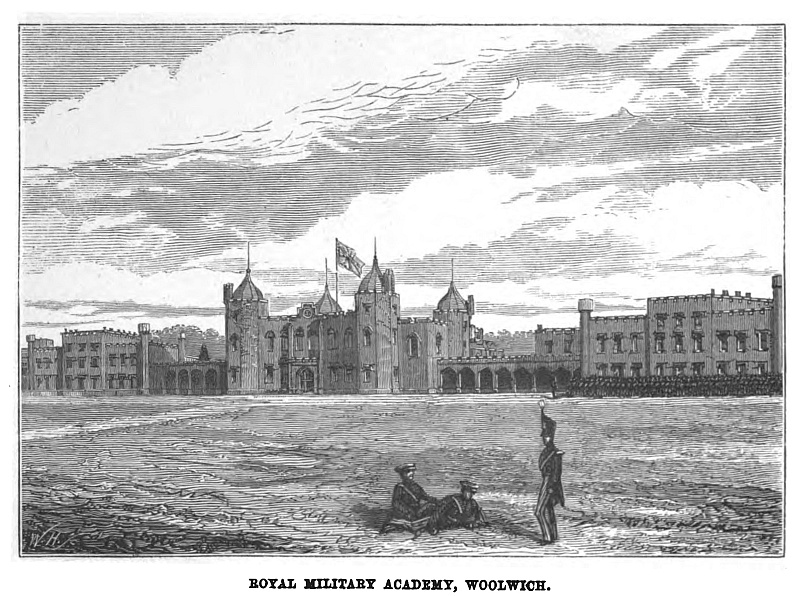
Having reached the Academy at an early hour, I ascertained that the cadets were then in study, or, as it was termed, “in academy.” I was shown to the room to which I was posted, and was shown a bed, which was to be mine. There were four beds in the room, these beds being turned up so as to occupy little or no space. There was one window, which had laced iron bars across it, like a prison window, whilst four cupboards were opposite the fireplace. I was told that in half an hour the cadets would come out of study, when I should see Holms, who was head of the room, and a corporal.
I waited with considerable anxiety for this half-hour to pass, and amused myself in the meantime in noting how scanty the furniture of the room was, which consisted of a table, on which was a red cloth, and four stools. The floor was sanded, and of course had no carpet, and no other article of furniture except a small rectangular looking-glass was visible.
I turned over in my mind how I should introduce myself to Holms when he came in, and at length decided I would say, “Mr Holms, I believe! I am Shepard, appointed to your room.”
Having waited a period that seemed quite an hour, I heard a bell ring, and saw about one hundred and fifty cadets run quickly out from the centre building and form into four divisions. These four divisions remained stationary until an officer went on parade, who, having read out something from a paper, gave some word of command, and the four divisions marched off, two in one direction, two in another.
One division passed the window where I was standing, but the other was dismissed at the door by which I had entered, and instantly there was the rush of feet as the whole party came into the building I was occupying. The door of my room opened, and a dark, good-looking cadet came in, and, seeing me, said,—
“Hullo! who are you?”
“Mr Holms, I believe?” I said in as polite a tone as I could. “I am Shepard, appointed to your room.”
The cadet I addressed looked at me very hard, and then burst out laughing.
“You are rather green, I fancy,” he said, “and you look deuced seedy. What’s the matter?”
“I have only just recovered from the hooping-cough,” I replied; “that’s why I didn’t join before.”
“Well, you must take care of yourself,” said Holms, “for you’re not well now.”
Another cadet now rushed into the room, to whose appearance I at once took a dislike. He had a conceited look about him, and a pale, drawn face, very different from that of Holms.
“Hurrah!” he said, “the neux has come at last! Here, Timpson, come and look at the last-joined neux! He doesn’t look much of a fellow, does he?”
A third cadet here joined us, who was a hard-looking youth, who frowned and looked crossly at me.
“He wants teaching manners,” said the cadet called Timpson. “What do you mean, sir, by looking at me like that? Take that!”
To my surprise and discomfiture, I received a heavy box on the ear which nearly knocked me down. I turned round, and for an instant I thought of returning the blow; but I recalled to mind that I had heard of a neux being all but killed who had struck on old cadet, and, instantly recollecting myself, I said,—
“I did nothing to deserve such a blow as that.”
“You’re cheeky, are you?” said Timpson. “Take that for your cheek!” and another blow was given me as severe as the first.
“Come, Timpson,” said Holms, “you are not going to bully my neux already. He’s seedy, and so let him alone. Brush your hair and wash your face, for you must go on parade in ten minutes.”
I was half-crying now, as I was considerably hurt by the blows Timpson had given me, and stood hesitating what to do.
“Here, brush me!” said the cadet whose name I found was Snipson.
I took up a brush and brushed Snipson, but did this by no means to his satisfaction.
“You’ve a deal to learn, sir,” he said; “why, you don’t even know how to brush one! Give me the brush!”
I gave Snipson the brush, upon which he said, “Turn round!” I turned round, thinking he was going to brush my back, and perhaps give me a hint as to using the brush. Suddenly, however, he rubbed the brush over my mouth and nose, whilst he seized me by the back of the neck, so as to hold me firmly and prevent my escape. The pain of this proceeding was so great that I called “Oh, don’t!” which brought forth a shout of laughter from Snipson. Holms, however, who was brushing his hair, here interfered and said, “Snipson, I’ll lick you if you don’t let my neux alone!”
“He’s mine as much as yours!” replied Snipson.
“I’m head of the room, and I won’t have this bullying,” replied Holms; “so look out!”
A bugle now sounded, which caused both Holms and Snipson to hurry on their belts and prepare for parade, for this bugle was “the warning” that was sounded five minutes before parade. On the second bugle sounding the cadets rushed out of the “division,” as it was termed, in which we were quartered, and fell in in two ranks, in front of the building, whilst I was told to “fall in” in rear, as I was in plain clothes.
When the names of the cadets had been called by Holms, who was corporal on duty, we were marched to the middle of the parade, where soon after three other divisions were marched, and we there waited till an officer came on parade. Whilst we were waiting I could not avoid noticing that I was an object of general attention. I was the only cadet in plain clothes, for the boys who had passed with me were already in uniform, and were also well on with their drill. That I had not joined with the others I soon learnt was a most unfortunate circumstance; amidst the crowd I should then have shared with others the unpleasant notice that a neux usually attracted, but now I was one only, and distinctly marked in consequence of not being in uniform.
After being inspected by an officer, parties of cadets were sent to various drills under soldiers who were corporals or sergeants. I had the special attention of a bombardier devoted to me, who commenced by instructing me in the mysteries of “Stand at ease!” and “Attention!” These commands the man shouted at me as though I were deaf, or were half a mile from him; and the commands were pronounced as “Stand at—hease!”—“’Shon!”
An hour of this drill convinced me that it was not such an easy thing to stand at ease as people imagined, and that a man taken from the plough had a very difficult task before him to learn his drill.
Upon being dismissed from my drill, I was going to walk about the parade a little, but I soon heard my name shouted by Snipson from the room I was appointed to. Upon entering the room Snipson said, “You’re a cool kind of a fellow, swaggering about on parade! You just come here instantly after you’re dismissed your drill, every day! Now get my basin filled with water?”
“Where is your basin?” I inquired.
“Where is my basin? Why, go and find it, and look sharp, or I will give you a licking?”
I glanced all round the room, but saw no sign of a basin, so concluded it must be outside. I opened the door, and saw opposite to me four large tin basins. Rejoicing in my luck in finding the basins, I stooped down and selected one, which I was about to take into my room, when I heard a shout close beside me, and saw Timpson in a great rage glaring at me. “You’re the coolest young ruffian I ever saw!” said Timpson. “What do you mean by taking my basin?” No sooner had he uttered these words than he lifted his leg and gave me a kick, in much the same manner as though I had been a football.
“Drop that basin?” shouted Timpson; “and if I ever catch you touching it again I’ll half kill you!”
“What! in trouble again?” said Snipson, who had now come to the door. “Serve you right! what a donkey you are! Don’t you see our basins are round here?”
I now saw that there were three basins on the left-hand side of the door of our room, which I had overlooked when I first went out. I lifted one of these, and, taking it into the room, placed it on the table—the only place that it seemed possible to wash on.
“Fat the basin in the proper place!” said Snipson. “You’re the greatest idiot I ever saw.”
I looked round, and, seeing only a stool, was about to put the basin there, but was warned I was wrong by the whiz of a clothes-brush close beside my head.
“You don’t mean to tell me you can’t see where the basin is to go?” said Snipson. “Don’t try to make yourself out a fool, for that won’t do.”
I now saw under the window a hanging-shelf, which I raised and propped up with two iron legs. On this I placed the basin, and then went outside for a can of water I had seen beside our door.
“That’s not my basin!” said Snipson, on my entering. “You don’t think I’m such a dirty brute as to wash in another man’s basin? That’s Holms’—bring mine!”
“How am I to know your basin?” I inquired.
“Why, find out, to be sure!”
I was at a loss to find out, but, thinking it better to bring both in, I did so, and placed them on the shelf.
“That’s mine!” said Snipson, pointing to one of the basins; “now mind you never make a mistake again!”
I looked carefully at the basin, but could see no difference between this and either of the others, and I concluded that Snipson was joking, as they all appeared similar.
Holms now came in, and, thinking I would at once make myself useful, I placed a basin for him near Snipson’s.
“That’s not my basin?” said Holms. “Give me the other!”
I was now certain there must be some distinguishing mark, but I could see none, and was much puzzled how I should again distinguish one from the other. A bugle again sounded, and I ascertained this was the warning-bugle for dinner-parade. Our division fell in in front of the building as before, the names of the cadets were called, and we were then marched into the inner square, where an officer came, and, having heard the cadets were all present, gave the word, “Right face! quick march!”
I was in the rear of the division, and dressed in plain clothes; my hat was what modern slang would term “a top hat,” and what in those days we called “a beaver.” This beaver I was rather proud of; it was only the second one I had possessed, a cap having previously done duty for the covering of my head. As I approached the dining-hall, a cadet who was a neux in my division whispered to me, “Look out for your hat!” Thinking that this meant that my hat might be spoilt if I let it rest on the floor instead of hanging it up, I said, “All right!” and marched on in the crowd of cadets, who now broke their ranks as they entered the portico leading to the hall.
Suddenly, and without any warning, a heavy blow was given on the top of my hat, which sent it down over my ears and eyes, and at once prevented me from seeing anything. As I raised my hands to force the hat up, half-a-dozen more blows were showered on my head with no light hand. I succeeded in pushing off my hat, the crown of which was knocked in, but could not see who had struck me—all the cadets looking much amused, but no one appearing to have been the guilty party.
Every cadet at once sat down at a table, there being about twenty tables in the hall; but, being uncertain where I ought to go, I stood in the middle of the hall, a mark for compressed balls of bread, a shower of which quickly rained around and on me.
The officer on duty, who had been detained outside to speak to a cadet, now came into the hall, and each cadet stood as rigid as a statue till the officer, calling to the senior cadet, said, “Say grace?”
The senior cadet in a loud voice shouted, “For what we’re going to receive may we all be thankful!” and the cadets then sat down.
I had remained standing all this time, and the officer, now remembering me, came up and said, “You take a seat at this squad.”
I sat down at the squad where there were four cadets on each side, and one old cadet at the head of the table; they were all strangers to me, and I looked all round the hall to find Fraser or the others of Mr Hostler’s who had come up for examination, but I could see none of them.
“Now then, sir,” said the head of the dinner-squad, “how much longer are you going to stare about before you peel the potatoes?”
I was surprised at this request, but the cadet opposite me pushed a plate of potatoes towards me that had been boiled with their jackets on, and signed to me that I was to peel these for the head of the squad. I commenced the operation, but was very clumsy at it, never having attempted such a performance before. I finished, however, after a fashion, and passed the plate up the table, and received in exchange a plate of meat which the cadet at the head of the table had cut for me.
“Snooker! beer!” said the cadet.
I saw a large jug of beer and a small mug near it, so I tilted up the jug and poured out a mugful of beer and passed this up the table.
When the cadet saw this he said, “What do you mean, sir, by pouring out my beer like that! Put it back and froth it! By Jove! if ever you pour out beer like that again I’ll have you over to my room and give you an angle of forty-five!”
I poured back the beer into the jug, and again filled the mug, this time taking care to froth it.
The meat that we had for our dinner was hard and tasteless, and was of a most inferior description. Our meal consisted only of meat, potatoes, bread, and the thinnest of beer, termed “swipes.” In those days the food of the cadets was scarcely fit to eat, the tea and coffee were most inferior, and the ration of bread and butter allowed us scarcely sufficient for half the number. That an alteration in this particular was much needed was not long after discovered, but, at the time of which we write, the cadets could scarcely have lived had it not been for the additional food they obtained from pastrycooks in the neighbourhood, or that was smuggled into barracks at various times.
After our dinner a quarter of an hour elapsed before we “fell in” for academy. Luckily I found Jenkins, a boy from Hostler’s, who had gone to the Academy a half-year before, who told me that I joined the last squad or division which was now termed “a class,” otherwise I should have made a mistake.
The class I joined was called the fourth class, and on a cadet, who was a corporal, reporting “all present,” we were marched into the class-room where we were to study.
On looking round at my companions I now found that I recognised several cadets as the candidates who came up for examination with me, and one or two nodded to me, but as we were ordered by the corporal who was in charge of the room to take our seats, I had no opportunity of talking to them. I looked round the room to find some of my companions at Hostler’s; I thought it would be great fun to see their surprise at my having passed. I expected to see Fraser high up in the class, and also Fuller and Hunt, and one or two others who at Hostler’s were in the first class, and were always held up to me as examples of learning. Low down in the class I saw a cadet who had been at Hostler’s; he was called Smart, and was considered rather a dull boy; but, seeing none of the others, I concluded they must be in some other room.
As I was re-examining my companions, the cadet in charge called out, “Shepard, look to your front! If I see you locking round again I’ll put you in arrest?”
I now sat looking straight before me, until called by the mathematical master to the octagon, where I was given some work to do, and again took my place at my desk.
On coming out of academy I met Smart, who hook hands with me and congratulated me on passing. “It’s quite wonderful,” he said; “and Hostler, I hear, is tearing his hair with rage at it, for he laughed at the idea of your having a chance.”
“Where is Fraser,” I inquired, “and Fuller, and all those fellows that came up?”
“They are all spun, and I’m the only one from Hostler’s who has passed this time. Fraser now is too old, even if he could get another trial, which he can’t. I often thought I could beat Fraser and Hunt at exams, for they used to cram fearfully—but how you must have worked!”
“Well, I didn’t seem to work so much,” I replied, “though I got on very fast. It was Mr Rouse’s style of teaching that was so good.”
“Hostler says you are certain to be spun at your probationary, as you must have been crammed just for this examination.”
“What is a probationary?”
“It’s the exam, you have to pass at the end of a year. If you don’t pass that satisfactorily, you are sent away from here.”
I then inquired of Smart whether, on his joining, he had met with the same rough treatment that I had, and he informed me he had experienced much the same. The head of his room was a very good fellow, and not at all a bully; but that two cadets who had been smashed from corporals were in his division, and were “awful bullies.” He also informed me that Timpson and Snipson had the reputation of being the greatest bullies in the Academy.
Smart had to leave me, as he had to go down town for the head of his room, and, on leaving, recommended me to get my uniform as soon as I could, for as long as I was in plain clothes I was a mark to be bullied.
Nothing remarkable happened during the remainder of the day. At half-past nine an officer came round the rooms, and received from the senior cadet a report to the effect that all were present, that no lights were concealed in the room, and that he had no intention of procuring a light.
The fire was then raked out and the candles carried off by a servant who accompanied the officer, and we were left to get into bed in the dark.
I now missed the luxury I had enjoyed at Rouse’s, viz, of a room to myself, for my two companions were talking so that I could not go to sleep; and tired as I was, and bruised with the blows I had received, I longed to get to sleep.
As I lay thinking over all the strange events of the day, and what a world of itself the Academy was, Snipson shouted out, “Shepard! call me at five to-morrow morning—not a minute later, mind, or I’ll break your head for you!”
I was wondering how I was possibly to wake at five, when I heard a knock at the door, and on Holms calling, “Come in!” a cadet said, “The fourth of the room is to go to No. 16.”
I did not at first realise that this had anything to do with me, till Snipson shouted, “Shepard, you’d better look sharp, or Foxey will half kill you?”
“What am I to do?” I inquired. “Do, you donkey? why, dress—and sharp too—and go to No. 16! Foxey will soon show you what to do!”
I got up and groped for my clothes, and dressed as well as I could in the dark. I then inquired of Snipson which was No. 16.
“Why, you’ve been here all day, and do you mean to say you don’t know which 16 is yet? You must go and find out; and I’d advise you to be sharp, for Foxey isn’t to be trifled with!”
I went out of the room, and tried to remember whether I had noticed 16 on any particular door. I could not recall that I had done so, and, hearing some talking at the end of the passage, I went to a door and knocked. I was told to “Come in!” and, on entering, was asked who I was.
I replied, “Shepard; and I was told to come to Foxey in No. 16.” There was a shout of laughter from two cadets in the room as I said this, whilst the cadet I first spoke to said,—
“Come here, sir! Who told you to come to Foxey?”
“Snipson, the second in my room.”
“Take that for your impertinence, now; and, when you go back, tell Snipson I will kick him to-morrow!”
The article which I was to take was a boot that was hurled at me by this cadet, whose nickname I afterwards ascertained was Foxey—a title that gave him great offence.
After having served as a target for a pair of boots, which I had after each shot to bring back to the cadet, I was asked if I could sing. Now it happened that one of our men-servants had been a sailor, and had learnt some of the popular sea-songs of the times. These I had heard him sing when I was quite a boy, and soon learnt the words, and also to sing them. Among these were “The Bay of Biscay,” “Tom Bowline,” “The Admiral,” “The Arethusa,” “’Twas in Trafalgar’s Bay,” etc. In answer to the inquiry whether I could sing, I replied that I thought I knew a song.
“Then we’ll have it presently,” said the cadet. “Now, snooker of No. 10!” he continued, “have you made out that ode to the moon yet? I’ll give you another licking if you tell me again you can’t!”
I now found there were several other cadets in the room, all last-joined, like myself; and, from the remarks made, I found that they had some task set them. The cadet addressed replied in a half-blubbering manner, “I’ll try to say something now.”
“Get onto the table, then,” said the cadet, “so that I may have a fair shot at you if you break down! And now go on, sir! You can’t sing, so you must make an ode to the moon! Now then, sir, commence!”
The cadet, who had now mounted on the table, had evidently had a rough time of it. He was a little fellow, whom I had seen belonged to our division, and who was very fat, and looked very stupid. As he stood on the table he was crying, either from fear or from the punishment he had received, or from both combined.
“Now, sir, will you commence?” said the cadet who was the head of the room.
In a tremulous voice that made the words uttered sound more ridiculous than they otherwise would, the cadet on the table said, “O moon, how splendid you are! How beautiful you look! And you light up the night! You are full sometimes, and then you shine bright!”
“Any fool knows that,” interrupted the head of the room, whom I had called Foxey. “Don’t tell us what we know; tell us something original!”
“O moon?” continued the cadet in the same tremulous voice; “with a face in you, you are not made of green cheese! And you shine by night, and are not seen by day!”
“That’s a lie!” said Foxey. “The moon can be seen by day, and you are trying to deceive us poor mortals! I’m not going to remain quiet, and hear the moon slandered in that way! You must have a boot at your head for that!”
A boot was here hurled at the cadet by Foxey, which seemed by the sound to have struck the mark, and also, from certain sniffling sounds, to have added to the grief of the orator. “Go on!” said Foxey. “O moon!—”
“If you commence ‘O moon!’ again, I’ll hurl another boot at you!” said Foxey.
“Lovely moon!” continued the cadet. “Lovely moon!—I don’t know what more to say, please.”
“You’re an idiot!” said Foxey; “and if you don’t write out an ode for to-morrow night, I’ll give you another licking! Now where’s the last-joined neux, Shepard? Now then, up on the table and sing a song!” I climbed onto the table, and hesitated a moment as to which song I should sing.
“Look sharp, sir,” said Foxey, “or you’ll have a boot at you! I’m going to teach you manners.”
At this warning I at once commenced the “Bay of Biscay,” and sang it through without a mistake.
“Very well sung,” said Foxey; “now give us another!”
I now sang the “Arethusa,” when Foxey exclaimed, “That’s a stunning song! You must write me out the words of that by to-morrow night. Now, as you’ve sung so well, you may go, but mind, I must have some more songs from you.”
I thanked Foxey for letting me go, and crept into my room, and went to bed as quietly as I could.
Before going to sleep I thought over the events of the day; it seemed to me an age since the morning, and not a few hours only. I had passed through so many different scenes, and had experienced so much anxiety, that each event seemed to have occurred a very long time after its predecessor. The thought uppermost in my mind was, how little the general world knew what a neux had to go through on joining the Academy, and how trying an ordeal it was for a sensitive and delicate boy.
I remembered my father saying to me on one occasion, that on joining the Academy I should be fag to an old cadet, and should have to run messages for him, and fag at cricket, but that I was not to mind this, as it was almost a recognised system at all the large public schools, and was supposed to teach a boy the respect due to his seniors.
I little imagined at the time, and my father would not have believed, the extent to which fagging had degenerated into bullying, in consequence of its being left in the hands of those totally unfitted to exercise it.
That some boys are benefited by being brought under a rigid discipline, and “kept down,” as we may term it, by a system of fagging, and thus brought to respect their seniors in a school, there is no doubt; for an “unlicked cub” is undoubtedly a most obnoxious youth, and grows into a disagreeable man. But where fagging is now only winked at by the authorities, it ought to be recognised, and to a great extent be under their surveillance. If such power is left entirely to boys or youths from fifteen to eighteen, it not unusually becomes a system of tyranny, that damages alike the exerciser of the power and the victim of it.
At the time of which we write, bullying was at its height at the Woolwich Academy. It was winked at by the authorities, for it was known to exist, and no endeavour was made to put it down. If, however, a case of bullying came so prominently before the officers that they could not avoid taking notice of it, then a rigid inquiry was made, and the cadet found guilty of the offence was severely punished.
These examples, however, had little or no effect in checking those who delighted in exercising the power they possessed, and so for several years the same system prevailed, until an entire reorganisation of the establishment occurred.
On awaking, on the following morning, there was a feeling of anxiety came over me that something was wrong. I did not at first realise where I was, but soon the events of the preceding day were recalled, and I anticipated with dread what might happen to me on this day. Any feeling of pride or satisfaction at having passed my examination so well had been entirely knocked out of me, and occasionally I believe I regretted that I had passed, for I knew that there were many months of fagging before me, and if each day was like the last, I doubted whether I could endure it.
The rule established by the old cadets at that time was that a cadet remained a neux or fag for three half years, and on the fourth became an old cadet, when he could exercise the power of fagging others. It was considered that a third-half cadet should not be fagged except under exceptional circumstances, such as being very unpopular or there being no first or second-half cadet available. Those who had the hardest time of it were of coarse the last-joined, but second-half cadets were often as much bullied as the last-joined. To give an idea of the bad spirit that sometimes was shown by certain individuals at that time, the following fact may be related:—A cadet, whose father was a distinguished officer, but who was considered a Tartar in discipline, was fagged to the end of his third half, because the elder brothers of some of the old cadets had suffered at the hands of the disciplinarian. Another similar case was where a young cadet had had a brother at the Academy, who, as an old cadet, had fagged an individual who now happened to be an old cadet, and who used to boast that he had paid back on the younger brother the thrashings he had received from the elder, with one hundred per cent, interest.
My meditations were interrupted by the sound of a bugle which sounded in front of the Academy, and at the same time Snipson called out, “Hullo! what’s that? Why, that’s reveille! Shepard?” he shouted, “I’ll lick you to within an inch of your life! Didn’t I order you to call me at five o’clock? and now it’s half-past six! Now come here!”
I got up and was going to put on some clothes, but Snipson made me come to him as I was, when, taking down a racket that was on the wall, he belaboured me with this till I howled. Holms here interfered, and threatened Snipson with a thrashing if he did not desist—a threat that seemed to produce its effect on Snipson, who, warning me never to forget to call him again, told me to get up and dress so as to be ready to hand him the various things he required whilst performing his toilet.
I now began my regular duties as fag, and as these, with but slight variations, continued during nearly a year, I can here describe them.
About twice a week I had to call Snipson at five o’clock in the morning and light a candle for him, in order that he might work, for he was very much behind in his mathematics and feared he would not qualify for a commission, so he was now working hard to make up leeway. Very often I had to stand beside Snipson’s bed for an hour to hold the ink and a candle, because he could see better than if the candle rested on the bed, and could get at his ink more easily. Snipson, I found, had been longer at the Academy than Holms, and had been reduced from the rank of corporal on account of keeping up lights in his room after hours. This, it was said, had made him very savage, and caused him to be one of the greatest bullies at the “shop,” as the Academy was termed.
Half an hour before Snipson got up I had to be washed and dressed, in order to hand Snipson his sponge, towel, soap, tooth-brush, etc, and to have his coat brushed and held ready to be put on. I then had to inspect him to see if there was a speck of dust on him, and to brush this off if there was.
Holms exacted very little fagging from me; he merely required to be brushed and his things kept tidy in his cupboard, so I was mainly occupied with Snipson.
One of my most difficult duties was at breakfast parade. For our breakfast we were allowed only bread and butter to eat, and Snipson had a great fancy for jam, hot rolls, and marmalade. It was strictly against orders to take any such things into the dining-hall, and as we were all assembled on parade and inspected by an officer previous to going into breakfast, it required considerable dexterity to convey a pot of jam or a roll into the hall without being discovered. The method in which this was managed was the following—
I, being a small boy, was in the rear rank whilst Snipson was in the front rank. I carried the pot of jam in my tail-pocket until the officer on duty had inspected the front rank and the faces of the rear rank. Just as he reached the end of the line and before he inspected the rear of the rear rank, Snipson used to turn round whilst I, extracting the pot of jam from my tail-pocket, tossed it over to him; he caught it and put it in his tail-pocket.
We became quite dexterous at this performance, and accomplished it like a sleight-of-hand trick, till one morning Snipson missed catching it, and the pot fell on parade, broke, and the jam was discovered by the officer on duty.
“Fall out, the gentleman who brought that jam on parade!” said the officer.
I hesitated a minute, and then fell out and said I had done so.
“Then you will be in arrest, sir, till further orders!” said the officer.
I was rather alarmed at this, for I fancied I might receive some severe punishment for this breach of regulation.
Snipson was very angry with me, and accused me of carelessness in pitching the jam to him, so on returning to my room he told me he would give me an angle of forty-five as a punishment. As this angle of forty-five was a very popular punishment in those days, we venture to describe it with some detail.
The cadet to be thus treated stood to attention against the cupboards, his arms rigid to his side, and he rigid from head to foot. He then rested the back of his head against the cupboard and gradually moved his feet out till he rested at an angle of nearly forty-five degrees with the cupboards. The old cadet with a kick then kicked the neux’s feet outwards, and the victim came down heavily on his back.
Cadets upon whom this was practised were not uncommonly so much hurt that they had to go to hospital for several days.
At every parade—and there were about six per day—Snipson and Holms had to be brushed, and I was responsible if they were in the least dirty. If the servant (for there was one servant to sixteen cadets) did not put the washing-basins down soon enough, I had at once to do his work for him. At the dinner I had occasionally to secure two large potatoes, and carry these out without being seen by the officer on duty or the head of the squad. These potatoes I had to conceal in my room, and then, when evening came, to bake them under the grate for Snipson. If I forgot salt I was sent down to the far end of Woolwich to buy a small quantity, and the time allowed me for the journey was so limited that I soon became a good runner.
Of an evening there were two candles in our room, and when Snipson worked he would not allow me to be in the room, as he said seeing me interrupted him, so I had either to wander about outside on parade or go to the library, where I was almost certain to be called upon by some old cadet to run messages for him, or to go to his room and do something, as it was concluded I was idle, or would not be in the library.
About four nights a week I used to be sent for to some of the eight rooms in the division to sing songs. Other neuxes were usually there also, and were also called on to sing, make speeches or odes, or tell stories, and if they did not acquit themselves to the satisfaction of the old cadets, they became the targets for boots, brushes, and other missiles.
This may be called the regular routine through which a fag had to pass on first joining and for a year after his being at the Academy. To work out of academy hours at any study was impossible; and, in fact, it was considered “cool” for a neux to work in his room, so that there was an advantage in taking into the Academy a more extended stock of knowledge than was sufficient for passing only.
One of the great days of dread to the neux was Saturday afternoon. It was usual then to grant leave, from Saturday at three to Sunday night, to all cadets who could produce invitations; and as all who could do so went away during that time, those who remained were in great request. There were two reasons why a neux could not always get away: one was, that he might not have a written invitation; the other was, that he had been turned out to drill twice during the week, either by a cadet having the rank of corporal, or by the officer on duty, for unsteadiness on parade, or want of attention to drill.
The fagging required on Saturday afternoons was somewhat varied. Those old cadets who were not on leave usually made up a party in one of the rooms, and required something to eat and drink. To accomplish this it was necessary to use great caution, for such feasts were against orders, and to bring wine or spirits into the enclosure entailed, if discovered, the gravest punishment.
The most successful manner in which the matter was accomplished was the following:—
Two or three fags were sent out of an afternoon with cloaks on; one of these returned with the others and carried two bottles concealed under his cloak. Sometimes as many as six or seven cadets would be sent out, and if any of these were met by an officer and examined, the chances were against the one who had the wine being caught among so many.
Snipson sent me on these smuggling expeditions very frequently, and threatened me with the most dire punishment if I ever divulged that he had sent me. He assured me that it would only be by stupidity or carelessness that I should be discovered, and so I must take the blame myself.
I had been very successful in avoiding detection until the fifth time; then, however, as I was coming round by the lodge with a bottle of sherry in each hand, and my cloak on, I ran almost against the officer on duty. I tried to slip one bottle under my arm and salute with the other hand, but I did this so awkwardly that he told me to take off my cloak. I did so, and of course was placed in arrest and the bottles taken from me. An inquiry into the matter led to my receiving seven days’ arrest and a month’s stoppage of leave, with a threat that if I were again found guilty of a similar offence I should be rusticated.
From Snipson I received nothing but blame; he declared that it was my own fault that I had been found out, and might consider myself lucky in not getting a thrashing from him for having lost the wine for which he had paid.
Some days after this event Snipson received what was called an “inattentive return” in some of his studies; the result was, that he had also seven days’ arrest, with its attendant drill. This seemed to utterly sour his temper, for he became a greater bully than ever, and invented an amusement from which I was a sufferer. Being unable, in consequence of his arrest, to leave his room, except for meals, drill, and study in the regular academy hours, Snipson used to send for three last-joined cadets, making, with myself, four. He would then ask Timpson in from the opposite room and commence his amusement, which was carried on as follows:—
Taking a seat about five feet from the angles of the table, he used to provide himself with a towel, which he twisted up and tied at the end; this end he wetted, so as to make it an excellent weapon for flipping. The four last-joined cadets were then started to run round the table—two in one direction, two in the opposite. When the cadets had to pass one another there was a struggle between them as to which should be the insider. The outsider of course got all the flips with the towel, so there was a reason for the straggle for inside place.
Snipson described this amusement as such capital fun that several cadets used to come in to see it; but Holms, who was never present, came in one day and stopped it, saying it was bullying for no reason, and he would not allow it; and I was consequently saved from this in Holms’ room; but when Snipson’s arrest was over he used to take me to other rooms and there practise the same amusement.