Front matter
Reading edition
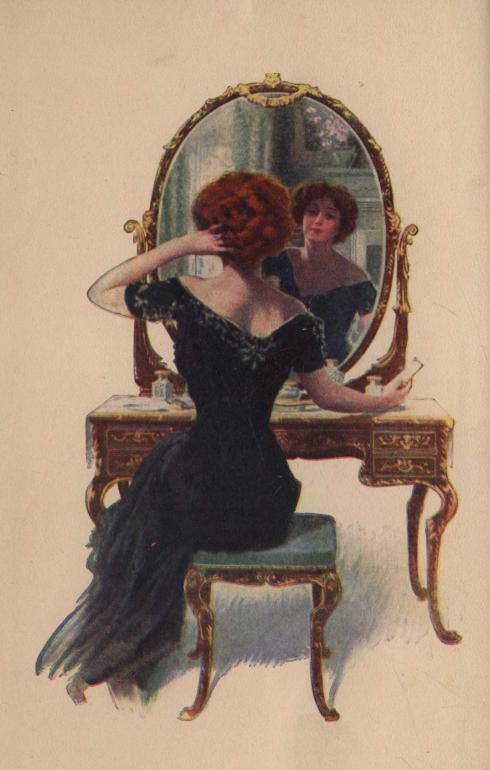
As she sat before her mirror...
THE FORBIDDEN WAY
BY
GEORGE GIBBS
AUTHOR OF THE BOLTED DOOR, ETC.
ILLUSTRATED
NEW YORK GROSSET & DUNLAP PUBLISHERS
Copyright, 1911, BY D. APPLETON AND COMPANY Copyright, 1911, by Associated Sunday Magazines, Incorporated.
Published September, 1911
Printed in the United States of America
CONTENTS
CHAPTER
Sharp Practice
Camilla
New York
The Forbidden Way
Diners Out
Mrs. Cheyne
Braebank
The Brush
The Shadow
Triton of the Minnows
Discord
Tea Cups and Music
Good Fishing
Father and Son
Infatuation
Old Dangers
Old Rose Leaves
Combat
The Lady in Gray
*La Femme Propose*
*L'Homme Dispose*
Private Matters
The Intruder
Gretchen Decides
The Crisis
The Call of the Heart
General Bent
Household Gods—and Goddesses
THE FORBIDDEN WAY
CHAPTER I
SHARP PRACTICE
The young man in the swivel chair drummed with his toes against the desk, while he studied the gaudy fire insurance calendar on the wall before him. His pipe hung bowl downward from his lips, and the long fingers of one hand toyed with a legal document in his lap.
"Something new is hatching in this incubator," he muttered at last, dipping his pen in the ink bottle again. "And I think—I think it's an ugly duckling. Of course, it's no business of mine, but——" He looked up suddenly as a bulky figure darkened the doorway. "Hello, Jeff!"
Jeff Wray nodded and walked to the water cooler.
"Mulrennan's been here to see you three times," said the man in the swivel chair. "Each time he's been getting madder. I wish you'd keep your appointments or get another office-boy. That man's vocabulary is a work of genius. Even you, in your happiest humors—why, what's the matter with your face?"
Wray put his fingers up. Four red streaks ran parallel across his cheek bone. He touched the marks with his hand, then looked at his finger tips.
"Oh, that? Seems like I must have butted into something." He gave a short, unmirthful laugh. "Don't make me look any prettier, does it? Funny I didn't feel it before." And then, as he turned to the inner office, "Is Mulrennan coming back?" he asked.
"Yes, at five."
Wray glanced at the clock. "Has Bent been in?"
"No."
"When will those papers be ready?"
"To-night, if you want them."
"Good!" Wray turned, with his hand on the knob of the door. "When Pete comes, send him back. Will you, Larry?"
Larry Berkely nodded, and Wray went into the back office and closed the door behind him. He took out his keys and unlocked the desk, but, instead of sitting at once, he went over to a cracked mirror in the corner and examined his face, grinning at his image and touching the red marks with his fingers.
"That was a love-tap for fair," he said. "I reckon I deserved it. But she oughtn't to push a man too far. She was sure angry. Won't speak now for a while." He turned with a confident air. "She'll come around, though," he laughed. "You just bet she will." Then he sat down at his desk, took a photograph in a brass frame out of the drawer, put it up against the pen-rack before him, and, folding his arms across the blotter, gazed at it steadily for a moment.
"It was a mean trick, wasn't it, Camilla girl?" he muttered, half aloud. "I'm sorry. But you've got to learn who you belong to. There can't be any fooling of other fellows around Jeff Wray's girl. I just had to kiss you—had to put my seal on you, Camilla. I reckon you put yours on me, too, black and blue." He laughed ruefully. "You'll forgive me, though. A diamond necklace or so will square that. You bet it will!"
He put the picture down, hid it away, and took up some papers that lay before him. But when, a while later, Larry Berkely showed Mulrennan in, they found him sitting with his face to the window, looking out with his baby stare over the hundred thousand acres of the Hermosa Company.
"Come in, Pete, and shut the door. You don't mind, Larry? Mulrennan and I have got some private business." Then, when the door was closed, he said in a half-whisper, "Well? What did you find out about the 'Lone Tree'?"
Mr. Mulrennan carefully sought the cuspidor, then wiped his brow with a dirty red handkerchief. "What didn't I find out? God, Jeff! that mine's lousy with sylvanite. The watchman was asleep, and we got in scrumpshus-like. It's half way down that short winze they made last fall. Max had put some timbers up to hide it, and we pulled 'em down. We only had matches to strike and couldn't see much, but what we saw was a-plenty. It's the vein, all right. Holy Mother! but it started my mouth to watherin'—I haven't had a wink of shlape. Where in h—l have you been all day?"
"Business," said Jeff vaguely, "in the mountains."
"It's no time to be potherin' about wid little matthers." Mulrennan brought his huge fist down on the table. "You've got to nail this deal, Jeff, to-day."
"To-day? Bent hasn't been back."
"Well, you've got to find him—now."
"What for? See here, Pete, cool down. Can't you see if I go after him he'll get suspicious—and then good-bye to everything. You leave this deal to me. He'll sign. Larry's drawing the lease and bond now. Maybe to-morrow——"
"To-morrow? To-morrow will be too late. That's what I'm gettin' at. Max is ugly——"
Wray clenched his bony fingers over the chair arm and leaned across the desk.
"Max!" he whispered angrily. "What——?"
"He's afther more money. He talked pretty big last night, but this mornin'——" He broke off breathlessly. "Oh, I've had the h—l of a day——"
"What did he say?"
"He's talkin' of goin' to the mine owner. He says, after all, Cort Bent never harmed him any, and it's only a matter of who gives him the most."
Wray got to his feet and took two or three rapid turns up and down the room.
"D—n him!" he muttered. And then suddenly, "Where is he now?"
"Up the bar playing pinochle with Fritz."
"Are you sure?"
"He was twenty minutes ago. I haven't left him a minute except to come here. Fritz is losin' money to him. I told him to. That will kape him for a while."
But Wray had already taken up his hat. "Come, let's go up there. We've got to shut his mouth some way," he said, through set lips.
"I've been promisin' myself sick, but he's a sharp one—God! But I wish them papers was signed," sighed Mulrennan.
As they passed through the office Jeff stopped a moment.
"If Bent comes in, Larry, tell him I'll be back in half an hour. Understand? Don't seem anxious. Just tell him I'm going to Denver and want to settle that deal one way or another as soon as possible."
Berkely nodded and watched the strange pair as they made their way up the street. Wray, his head down and hands in his pockets, and the Irishman using his arms in violent gestures.
"I'm sure it's an ugly duckling," commented the sage.
* * * * *
It was three years now since Berkely had come to Colorado for his health, and two since Fate had sent him drifting down to Mesa City and Jeff Wray. Mesa City was a "boom" town. Three years ago, when the "Jack Pot" mine was opened, it had become the sudden proud possessor of five hotels (and saloons), three "general" stores, four barber shops, three pool rooms, a livery stable, and post office. Its main (and only) street was a quarter of a mile in length, and the plains for a half mile in every direction had been dotted with the camps of the settlers. It had almost seemed as if Saguache County had found another Cripple Creek.
A time passed, and then Mesa City awoke one morning to find that the gamblers, the speculators, and the sporting men (and women) had gone forth to other fields, and left it to its fate, and the town knew that it was a failure.
But Jeff Wray stayed on. And when Berkely came, he stayed, too, partly because the place seemed to improve his health, but more largely on account of Jeff Wray. What was it that had drawn him so compellingly toward the man? He liked him—why, he could not say—but he did—and that was the end of it. There was a directness in the way Wray went after what he wanted which approached nothing Berkely could think of so much as the unhesitating self-sufficiency of a child. He seemed to have an intuition for the right thing, and, though he often did the wrong one, Berkely was aware that he did it open-eyed and that no book wisdom or refinement would have made the slightest difference in the consummation of his plans. Berkely was sure, as Wray was sure, that the only reason Jeff hadn't succeeded was because opportunity hadn't yet come knocking at his door. He liked Wray because he was bold and strong, because he looked him in the eye, because he gave a sense of large areas, because his impulses, bad as well as good, were generous and big, like the mountains and plains of which he was a part. His schemes showed flashes of genius, but neither of them had money enough to put them into practice. He was always figuring in hundreds of thousands or even in millions, and at times it seemed to Berkely as though he was frittering his life away over small problems when he might have been mastering big ones. At others he seemed very like Mulberry Sellers, Munchausen, and D'Artagnan all rolled into one.
What was happening now, Berkely could not determine, so he gave up the problem and, when his work was done, filled his pipe, strolled to the door, and watched the changing colors on the mountains to the east of him, as the sun, sinking lower, found some clouds and sent their shadows scurrying along the range to the southward. With his eye he followed the line of the trail up the cañon, and far up above the cottonwoods that skirted the town he could see two figures on horseback coming down. He recognized them at once, even at that distance, for they were a sight to which Mesa City had become accustomed.
"Camilla and Bent," he muttered. "I'm glad Jeff's not here. It's been getting on his nerves. I hope if Bent sells out he'll hunt a new field. There are too few women around here—too few like Camilla. I wonder if she really cares. I wonder——"
He stopped, his eyes contracted to pin points. The pair on the horses had halted, and the man had drawn close to his companion, leaning forward. Was he fixing her saddle? An unconscious exclamation came from Berkely's lips.
"He's got his nerve—right in plain view of the town, too. What——?"
The girl's horse suddenly drew ahead and came galloping down through the scrub-oak, the man following. Berkely smiled. "The race isn't always to the swift, Cort Bent," he muttered.
At the head of the street he saw Miss Irwin's horse turn in at the livery stable where she kept him, but Cortland Bent's came straight on at an easy canter and halted at Berkely's door.
"Is Wray there?" asked Bent.
"No, but he told me to ask you to wait. Won't you come in?"
"Just tell him I'll be in in the morning."
"Jeff may go to Denver to-morrow," said Larry, "but of course there's no hurry——"
Bent took out a silver cigarette case and offered it to Berkely. "See here, Larry," he said, "what the devil do you fellows want with the 'Lone Tree'? Are you going to work it, or are you getting it for some one else? Of course, it's none of my business—but I'd like to know, just——"
"Oh, I'm not in this. This is Jeff's deal. I don't know much about it, but I think he'd probably work it for a while."
Together they walked into the office, and Berkely spread some papers out over the desk. "Jeff told me to draw these up. I think you'll find everything properly stated."
Bent nodded. "Humph! He feels pretty certain I'll sign, doesn't he?"
Berkely stood beside him, smoking and leaning over his shoulder, but didn't reply.
Bent laughed. "Well, it's all cut and dried. Seems a pity to have put you to so much trouble, Larry. I haven't made up my mind. They say twice as much money goes into gold mines as ever comes out of 'em. I guess it's true. If it wasn't for Jeff Wray in this deal I'd sign that paper in a minute. But I've always had an idea that some day he'd make his pile, and I don't relish the idea of his making it on me. He's a visionary—a fanatic on the gold in these mountains, but fortune has a way of favoring the fool——"
"Sounds as though you might be talking about me," said a voice from the doorway, where Jeff stood smiling, his broad figure completely blocking the entrance.
Bent turned, confused, but recovered himself with a short laugh. "Yes, I was," he replied slowly. "I've put twenty thousand dollars in that hole in the rocks, and I hate to leave it."
Jeff Wray wiped his brow, went to the cooler, drew a glass of water, and slowly drank it.
"Well, my friend," he said carelessly between swallows, "there's still time to back down. You're not committed to anything. Neither am I. Suit yourself. I'm going to get a mine or so. But I'm not particular which one. The 'Daisy' looks good to me, but they want too much for it. The terms on your mine, the 'Lone Tree,' just about suited me—that's all. It's not a 'big' proposition. It might pan thirty or forty to the ton, but there's not much in that—not away up there. Take my offer—or leave it, Bent. I don't give a d—n."
He tossed his hat on the chair, took off his coat, and opened the door of the back office.
"Larry," he added, "you needn't bother to stay, I've got some writing to do. I'll lock up when I go."
If Mr. Mulrennan had been present he would have lost his senses in sheer admiration or sheer dismay. Berkely remembered that "bluff" later, when he learned how much had depended on its success.
But it worked beautifully.
"Oh, well," said Bent peevishly, "let's get it over. I'll sign. Are you ready to make a settlement?"
CHAPTER II
CAMILLA
Her pupils had all been dismissed for the day and the schoolmistress sat at her desk, a half-written letter before her, gazing out through the open doorway over the squalid roofs of the "residence section" of Mesa City. The "Watch Us Grow" sign on the false front over Jeff Wray's office was just visible over the flat roof of the brick bank building. "Watch Us Grow!" The shadow in her eyes deepened. For two long years she had seen that sign from doorway and window of the school, and, even when she went home to Mrs. Brennan's bungalow up above, she must see it again from the veranda. Jeff's business card was the most prominent object in town, except perhaps Jeff himself. It was so much larger than it had any right to be, out of scale, so vulgar, so insistent, so—so like Jeff. Jeff had stood in the doorway of the schoolhouse while they were building his office, and, in his masterful way, had told her of the trade-mark he had adopted for his business; he wanted it in plain sight of her desk so that she could see it every day and watch Mesa City (and himself) fulfil the prophecy.
That seemed ages ago now. It was before the "Jeff Wray" had been painted out and "Wray and Berkely" put in its place, before Larry came out, or Cortland Bent, in the days when Jeff was a new kind of animal to her, when she had arrived fresh from her boarding school in Kansas. "Watch Us Grow!" How could any one grow in a place like this—grow anything, at least, but wrinkled and stale and ugly. The sign had been a continual mockery to her, a travesty on the deeper possibilities of life which Fate had so far denied her. She shut her eyes and resolutely turned her head away, but she could not get Jeff Wray out of her mind. She was thoroughly frightened. His air of proprietorship so suddenly assumed yesterday and the brutality of his kiss had brought her own feelings to a crisis—for she had learned in that moment that their relationship was impossible. But her fingers tingled still—at the memory of the blow she had given him. She had promised to marry him when he "made good." But in Mesa City that had seemed like no promise at all. How could any one succeed in anything here?
She leaned forward on the desk and buried her face in her hands. What chance had she? Where was the fairy prince who would rescue her from her hut and broth kettle?
She raised her head at the sound of a voice and saw Cortland Bent's broad shoulders at the open window.
"Morning!" he said, cheerfully. "You look like Ariadne deserted. May I come in?"
She nodded assent, and, thrusting her school books and unfinished letter in the desk, turned the key viciously in its lock.
"Aren't you riding to-day?" he asked from the doorway.
"No."
He came forward, sat on the top of one of the small desks facing her, and examined her at his ease.
"You're peevish—no? What?"
"Yes. I'm in a frightful mood. You'd better not stay."
He only laughed up at the sunflower dangling from the water pitcher. "Oh, I don't mind. I've a heavenly disposition."
"How do you show it?" she broke in impetuously. "Every man thinks the one way to get on with a woman is to make love to her——"
"No—not altogether," he reproached her. "You and I have had other topics, you know—Swinburne and Shakespeare and the musical glasses."
"Oh, yes, but you always drifted back again."
"How can you blame me? If I've made love to you, it was——"
"Oh, I know. I'm a rustic, and it's a good game."
"You're the least rustic person I've ever known," he said seriously. "It's not a game. I can't think of it as a game. It is something more serious than that." He took a few paces up and down the aisle before her and then went on.
"I know you've never been willing to give me credit for anything I've said when I've tried to show you how much you were to me—and yet, I think you cared—you've showed it sometimes. But I've tried to go about my work and forget you, because I thought it was best for us both. But I can't, Camilla, I tell you I can't get you out of my head. I think of something else, and then, in a moment, there you are again—elusive, mocking, scornful, tender, all in a breath. And then, when I find you're there to stay, I don't try any more. I don't want to think of anything else." He leaned across the desk and seized one of her hands with an ardor which took her by storm. "You've got into my blood like wine, Camilla. To be near you means to reach forward and take you—the sound of your voice, the response of your eyes, the appeal of your mind to mine in this wilderness of spirit—I can't deny them—I don't want to deny them."
Her head sank, but she withdrew her hands. "And my sanity?" she asked clearly. "That does not appeal to you."
"Perhaps it does—most of all. It maddens me, too—that I can't make you care for me enough to forget yourself."
She looked up at him, smiling gently now. "It is easy to say forget myself, that you may have one more frail woman to remember. Am I so provincial, Cortland Bent? Am I really so rustic? Two days ago you were telling me I had all the savoir faire of the great lady."
He did not reply to that, but, while she watched him, he got up and walked slowly over to the map of the United States which hung between the windows.
"I don't suppose it will mean anything to you when I tell you I'm going," he said bitterly.
"Going—where?"
"East."
"For long?"
"For good. I've leased the mine."
She started up from her chair, breathless, and stood poised on the edge of the platform, the slender fingers of one hand grasping the projecting edge of the desk.
"You're—going—East to—to stay?"
He did not turn, and, if he noticed any change in her intonation, he gave no sign of it.
"I've finished here. The mine is leased. I'm going back to New York."
"I can't believe—you never told me. It's curious you shouldn't have said something before."
"Why should I? No man likes to admit that he's a failure."
"You've leased the 'Lone Tree'? To whom?"
"To Wray. He made me a proposition yesterday. I've accepted it. In fact, I'm out of the thing altogether."
"Jeff? I don't understand. Why, only yesterday he——"
Was it loyalty to Jeff that made her pause? He turned quickly.
"What—did he say anything?"
"Oh, nothing—only that the mine was a failure. That seems curious if he had decided to lease it."
"Oh!" he said smiling, "it's only Wray's way of doing business. When anything is hanging fire he always says exactly what he doesn't mean. He doesn't worry me. I've gone over that hole with a fine-tooth comb, and I'm glad to get out of it."
"And out of Mesa City?" Then, with an attempt at carelessness, "Of course we'll all miss you," she said dully.
"Don't! You mustn't speak to me in that way. I've always been pretty decent to you. You've never believed in me, but that's because you've never believed in any man. I've tried to show you how differently I felt——"
"By kissing me?" she mocked scornfully.
Bent changed his tone. "See here, Camilla," he said, "I'm not in a mood to be trifled with. I can't go away from here and leave you in this God-forsaken hole. There isn't a person here fit for you to associate with. It will drive you mad in another year. Do you ever try to picture what your future out here is going to be?"
"Haven't I?" bitterly.
"You've seen them out on the ranches, haven't you? Slabsided, gingham scarecrows in sunbonnets, brown and wrinkled like dried peaches, moving all day from kitchen to bedroom, from bedroom to barn, and back again——"
"Yes, yes," said Camilla, her head in her hands. "I've seen them."
"Without one thought in life but the successes of their husbands—the hay crop, the price of cattle; without other diversion than the visit to Kinney, the new hat and frock once a year (a year behind the fashion); their only companions women like themselves, with the same tastes, the same thoughts, the same habits——"
"O God!" whispered the girl, laying a restraining hand on his arm, "don't go on! I can't stand it."
He clasped her hands in both of his own.
"Don't you see it's impossible?" he whispered. "You weren't made for that kind of thing. Your bloom would fade like theirs, only sooner because of your fineness. You'd never grow like those women, because it isn't in you to be ugly. But you'd fade early."
"Yes," she said, "I know it."
"You can't stay. I know, just as you know, that you were never meant for a life like that—you weren't meant for a life like this. Do you care what becomes of these kids? No matter how much chance you give them to get up in the world, they'll seek their own level in the end."
"No, I can't stay here." She repeated the phrase mechanically, her gaze afar.
"I've watched you, Camilla. I know. For all your warm blood, you're no hardy plant to be nourished in a soil like this. You need environment, culture, the sun of flattery, of wealth—without them you'll wither——"
"And die. Yes, I will. I could not stand this much longer. Perhaps it would be better to die than to become the dull, sodden things these women are."
"Listen, Camilla," he said madly. He put his arms around her, his pulses leaping at the contact of her body. Her figure drooped away from him, but he felt the pressure of her warm fingers in his, and saw the veins throbbing at her throat and temples, and he knew that at last she was awakened. "You must come with me to the East. I won't go without you. I want you. I want to see you among people of your own sort. I'll be good to you—so gentle, so kind that you'll soon forget that there ever was such a place as this."
His tenderness overpowered her, and she felt herself yielding to the warmth of his entreaty. "Do you really need me so much?" she asked brokenly.
His reply was to draw her closer to him and to raise her lips to his. But she turned her head and would not let him kiss her. Perhaps through her mind passed the memory of that other kiss only yesterday.
"No, I'm afraid."
"Of me? Why?"
"Of myself. Life is so terrible—so full of meaning. I'm afraid—yes, afraid of you, too. Somewhere deep in me I have a conscience. To-day you appeal to me. You have put things so clearly—things I have thought but have never dared speak of. To-day you seem to be the only solution of my troubles——"
"Let me solve them then."
"Wait. To-day you almost seem to be the only man in the world—almost, but not quite. I'm not sure of you—nor sure of myself. You point a way to freedom from this—perhaps a worse slavery would await me there. Suppose I married you——"
"Don't marry me then," he broke in wildly. "What is marriage? A word for a social obligation which no one denies. But why insist on it? The real obligation is a moral one and needs no rites to make it binding. I love you. What does it matter whether——"
His meaning dawned on her slowly, and she turned in his arms, her eyes widening with bewilderment as she looked as though fascinated by the horror she read in his words. He felt her body straighten in his arms and saw that the blood had gone from her face.
"Do I startle you? Don't look so strangely. You are the only woman in the world. I am mad about you. You know that? Can't you see? Look up at me, Camilla. There's a girl in the East they want me to marry—of an old line with money—but I swear I'll never marry her. Never!"
Slowly she disengaged his arms and put the chair between them. There was even a smile on her lips. "You mean—that I—that you——" She paused, uncertain of her words.
"That I'll stick to you until Kingdom Come," he assented.
Her laugh echoed harshly in the bare room. "Whether you marry the other girl or not?"
"I'll never marry the other girl," he said savagely, "never see her again if you say so——"
He took a step toward her, but she held up her hand as though warding off a blow.
"One moment," she said, a calm taking the place of her forced gayety, her voice ringing with a deep note of scorn. "I didn't understand at first. Back here in the valley we're a little dull. We learn to speak well or ill as we think. At least, we learn to be honest with ourselves, and we try to be honest with others. We do not speak fair words and lie in our hearts. Our men have a rougher bark than yours, but they're sound and strong inside." She drew herself to her full height. "A woman is safe in this country—with the men of this country, Mr. Bent. It is only when——"
"Camilla! Forgive me. I was only trying you. I will do whatever you say—I——"
She walked to the door rapidly, then paused uncertainly, leaning against the door-jamb and looking down the street.
"Will you go?" she murmured.
"I can't—not yet."
"You must—at once. Jeff Wray is coming here—now!"
"What have I to do with him?"
"Nothing—only if he guesses what you've been saying to me, I won't answer for him. That's all."
Bent looked up with a quick smile, and then sat on the nearest desk. "I suppose I ought to be frightened. What? Jeff is a kind of a 'bad man,' isn't he? But I can't go now, Camilla. Wouldn't be the sporting thing, you know. I think I'll stay. Do you mind if I smoke?"
She watched the approaching figure of Jeff for a moment irresolutely and then turned indoors. "Of course, I can't make you go," she said, "but I have always understood that when a woman expressed a wish to be alone, it was the custom of gentlemen——"
"You made my going impossible," he said coolly. "Don't forget that. I'll go after a while, but I won't run. You've got something to tell Jeff Wray. I prefer to be here when you do it."
"I didn't say I'd tell him," she put in quickly. "I'm not going to tell him. Now will you go?"
"No."
He sat on a desk, swinging one long leg to and fro and looking out of the open door, at which the figure of Jeff presently appeared. The newcomer took off his hat and shuffled in uneasily, but his wide stare and a nod to Bent showed neither surprise nor ill-humor. Indeed, his expression gave every sign of unusual content. He spoke to Bent, then gazed dubiously toward the teacher's desk, where Camilla, apparently absorbed in her letter, looked up with a fine air of abstraction, nodded, and then went on with her writing.
"Looks sort of coolish around here," said Jeff. "Hope I haven't butted into an Experience Meeting or anything." He laughed, but Bent only examined the ash of his cigarette and smiled. "I thought, Camilla," he went on, "maybe you'd like to take a ride——"
Miss Irwin looked up. She knew every modulation of Jeff's voice. His tone was quiet—as it had been yesterday—but in it was the same note of command—or was it triumph? She glanced at Cortland Bent.
"I'm not riding to-day," she said quietly.
"Not with Bent, either? That's funny. What will people think around here? We've sort of got used to the idea of seeing you two out together—kind of part of the afternoon scenery, so to speak. Nothing wrong, is there?"
Bent flushed with anger, and Camilla marveled at this new manifestation of Jeff's instinct. It almost seemed as though he knew what had happened between them as well as though she had told him. Jeff laughed softly and looked from one to the other with his mildest stare, as though delighted at the discovery.
Miss Irwin rose and put her letter in the drawer of the desk. "I wish you'd go—both of you," she said quietly. But Wray had made himself comfortable in a chair and showed no disposition to move.
"I thought you might like to ride out to the 'Lone Tree,'" he said. "You know Mr. Bent has leased it to me?"
"Yes, he told me."
"What else did he tell you?"
"Oh, I say, Wray," Bent broke in, "I don't see how that can be any affair of yours."
Jeff Wray wrapped his quirt around one knee and smiled indulgently. "Doesn't seem so, does it, Bent?" he said coolly. "But it really is. You see, Camilla—Miss Irwin—and I have been friends a long time—as a matter of fact, we're sort of engaged——"
"Jeff!" gasped the girl. The calmness of his effrontery almost, if not quite, deprived her of speech. "Even if it were true, you must see that it can hardly interest——"
"I thought that he might like to know. I haven't interfered much between you two, but I've been thinking about you some. I thought it might be just as well that Mr. Bent understood before he went away."
Camilla started up, stammered, began to speak, then sank in her chair again. Bent looked coolly from one to the other.
"There seems to be a slight difference of opinion," he said.
"Oh, we're engaged all right," Jeff went on. "That's why I thought I'd better tell you it wouldn't be any use for you to try to persuade Camilla—that is, Miss Irwin—to go to New York with you."
Jeff made this surprising statement with the same ease with which he might have dissuaded a client in an unprofitable deal. Miss Irwin became a shade paler, Bent a shade darker. Such intuition was rather too precise to be pleasant. Neither of them replied. Bent, because he feared to trust himself to speak—Camilla, because her tongue refused obedience.
"Oh, I'm a pretty good guesser. Camilla told you she wasn't going, didn't she? I thought so. You see, that wouldn't have done at all, because I'd have had to go all the way East to bring her back again. When we're married of course——"
"Jeff!" The girl's voice, found at last, echoed so shrilly in the bare room that even Wray was startled into silence. He had not seemed aware of any indelicacy in his revelation, but each moment added to the bitterness of Miss Irwin's awakening. Bent's indignity had made her hate herself and despise the man who had offered it. She thought she saw what kind of wood had been hidden under his handsome veneer—she had always known what Jeff was made of. The fibre was there, tough, strong, and ugly as ever, but it was not rotten. And in that hour she learned a new definition of chivalry.
"Jeff, will you be quiet?" But she went over to him and put her hand on his shoulder, and her words came slowly and very distinctly, as she looked over Wray's head into Cortland Bent's eyes. "What Mr. Wray says is true. I intend to marry him when he asks me to."
Bent bowed his head, as Jeff rose, the girl's hand in his.
"I reckon that about winds up all your loose ends around Mesa, don't it, Bent?" said Jeff cheerfully. "When are you leaving town?"
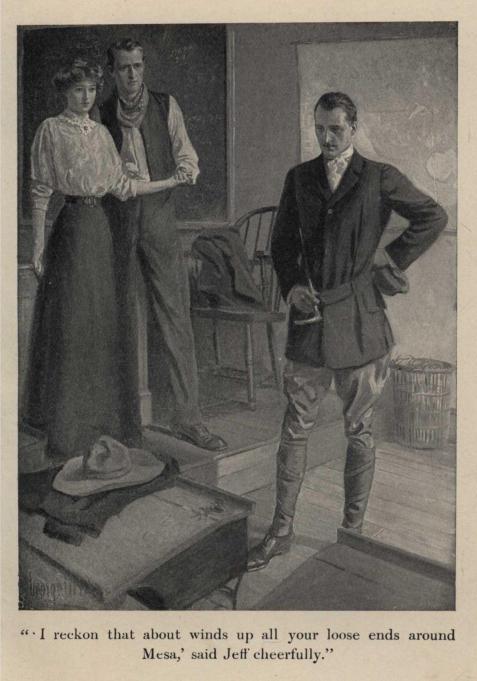
"'I reckon that about winds up all your loose ends around Mesa,' said Jeff cheerfully."
But Bent by this time had taken up his cap, and was gone.
CHAPTER III
NEW YORK
Wonderful things happened in the year which followed. The "Lone Tree" was a bonanza. Every month added to the value of the discovery. The incredulous came, saw, and were conquered, and Mesa City was a "boom town" again. Jeff Wray hadn't a great deal to say in those days. His brain was working overtime upon the great interlocking scheme of financial enterprises which was to make him one of the richest men in the West. He spoke little, but his face wore a smile that never came off, and his baby-blue stare was more vacuous than ever.
And yet, as month followed month and the things happened which he had so long predicted for himself and for the town, something of his old arrogance slipped away from him. If balked ambition and injured pride had made him boast before, it was success that tamed him. There was no time to swagger. Weighty problems gave him an air of seriousness which lent him a dignity he had never possessed. And if sometimes he blustered now, people listened. There was a difference.
As the time for her wedding approached, for the first time in her life Camilla felt the personality of the man. Why was it that she could not love him? Since that hour at the schoolhouse when Cortland Bent had shown her how near—and how fearful—could be the spiritual relation between a woman and a man, life had taken a different meaning to her.
Jeff's was a curious courtship. He made love to her bunglingly, and she realized that his diffidence was the expression of a kind of rustic humility which set her in a shrine at which he distantly worshipped. He seemed most like the Jeff of other days when he was talking of himself, and she allowed him to do this by the hour, listening, questioning, and encouraging. If this was to make the most of her life, perhaps it might be as well to get used to the idea. She could not deny that she was interested. Jeff's schemes seemed like a page out of a fairy book, and, whether she would or not, she went along with him. There seemed no limit to his invention, and there was little doubt in his mind, or, indeed, in hers, that the world was to be made to provide very generously for them both.
It was on the eve of their wedding day that Jeff first spoke of his childhood.
"I suppose you know, Camilla, I never had a father. That is," he corrected, "not one to brag about. My mother was a waitress in the Frontier Hotel at Fort Dodge. She died when I was born. That's my family tree. You knew it, I guess, but I thought maybe you'd like to change your mind."
He looked away from her. The words came slowly, and there was a note of heaviness in his voice. She realized how hard it was for him to speak of these things, and put her hand confidently in his.
"Yes, I knew," she said softly. "But I never weighed that against you, Jeff. It only makes me prouder of what you have become." And then, after a pause, "Did you never hear anything about him?"
"There were some letters written before I was born. I'll show them to you some day. He was from New York, that's all I know. Maybe you can guess now why I didn't like Cort Bent."
Camilla withdrew her hands from his and buried her face in them, while Wray sat gloomily gazing at the opposite wall. In a moment she raised her head, her cheeks burning.
"Yes, I understand now," she muttered. "He was not worth bothering about."
* * * * *
And now they were at the hotel in New York, where Jeff had come on business. The Empire drawing room overlooked Fifth Avenue and the cross street. There was a reception room in the French style, a dining room in English oak, a library (Flemish), smoking room (Turkish), a hall (Dutch), and a number of bedrooms, each a reproduction of a celebrated historical apartment. The wall hangings were of silk, the curtains of heavy brocade, the pictures poor copies of excellent old masters, the rugs costly; and the fixtures in Camilla's bathroom were of solid silver.
Camilla stood before the cheval glass in her dressing room (Recamier) trying on, with the assistance of her maid and a modiste, a fetching hat and afternoon costume. Chairs, tables, and the bed in her own sleeping room were covered with miscellaneous finery.
When the women had gone, Camilla dropped into a chair in the drawing room. There was something about the made-to-order magnificence which oppressed her with its emptiness. Everything that money could buy was hers for the asking. Her husband was going to be fabulously wealthy—every month since they had been married had developed new possibilities. His foresight was extraordinary, and his luck had become a by-word in the West. Each of his new ventures had attracted a large following, and money had flowed into the coffers of the company. It was difficult for her to realize all that happened in the wonderful period since she had sat at her humble desk in the schoolhouse at Mesa City. She was not sure what it was that she lacked, for she and Jeff got along admirably, but the room in which she sat seemed to be one expression of it—a room to be possessed but not enjoyed. Their good fortune was so brief that it had no perspective. Life had no personality. It was made of Things, like the articles in this drawing room, each one agreeably harmonious with the other, but devoid of associations, pleasant or unpleasant. The only difference between this room and the parlor at Mrs. Brennan's was that the furniture of the hotel had cost more money.
To tell the truth, Camilla was horribly bored. She had proposed to spend the mornings, when Jeff was downtown, in the agreeable task of providing herself with a suitable wardrobe. But she found that the time hung heavily on her hands. The wives of Jeff's business associates in New York had not yet called. Perhaps they never would call. Everything here spoke of wealth, and the entrance of a new millionaire upon the scene was not such a rare occurrence as to excite unusual comment. She peered out up the avenue at the endless tide of wealth and fashion which passed her by, and she felt very dreary and isolated, like a vacant house from which old tenants had departed and into which new ones would not enter.
She was in this mood when a servant entered. She had reached the point when even this interruption was welcome, but when she saw that the man bore a card tray her interest revived, and she took up the bit of pasteboard with a short sigh of relief. She looked at it, turned it over in her fingers, her blood slowing a little, then rushing hotly to her temples.
Cortland Bent! She let the card fall on the table beside her.
"Tell him that I am not——" she paused and glanced out of the window. The quick impulse was gone. "Tell him—to come up," she finished.
When the page disappeared she glanced about the room, then hurried to the door to recall him, but he had turned the corner into the corridor outside, and the message was on its way to a lower floor.
She paused, irresolute, then went in again, closing the outside door behind her. What had she done? A message of welcome to Cortland Bent, the one person in the world she had promised herself she should never see again; her husband's enemy, her own because he was her husband's; her own, too, because he had given her pride a wound from which it had not yet recovered! What should she do? She moved toward the door leading to her dressing room—to pause again.
What did it matter after all? Jeff wouldn't care. She laughed. Why should he? He could afford to be generous with the man who had lost the fortune he now possessed. He had, too, an implicit confidence in her own judgment, and never since they had been married had he questioned an action or motive of hers. As for herself—that was another matter. She tossed her head and looked at herself in her mirror. Should she not even welcome the opportunity to show Bent how small a place he now held in her memory? The mirror told her she was handsome, but she still lingered before it, arranging her hair, when her visitor was announced.
He stood with his hands behind his back studying the portrait over the fireplace, turning at the sound of her voice.
"It's very nice of you to see me," he said slowly. "How long have you been here?"
"A few weeks only. Won't you sit down?"
A warm color had come to her checks as she realized that he was carefully scrutinizing her from head to heel.
"Of course we're very much honored——" she began.
"I can't tell you how glad I am to see you," he broke in warmly. "I was tempted to write you a dozen times, but your engagement and marriage to Wray and"—he paused—"the trouble about the mine seemed to make it difficult, somehow."
"I'm sure my husband bears you no ill-will."
He gave a short laugh. "There's no reason why he should. There's nothing for him to be upset about. He got the fortune that should—which might have been mine—to say nothing of the girl——"
"Perhaps we had better leave the girl out of it," she put in calmly. "Even time hasn't explained that misunderstanding."
He shrugged a shoulder expressively. "As you please. I'll not parade any ghosts if I can help it. I'm too happy to see you. You're more wonderful than ever. Really I don't believe I should have known you. You're changed somehow. I wonder what it is?"
"Prosperity?" she suggested.
"I'm not sure I feel at home with you. You're so matured, so—so punctilious and modish."
"You wouldn't have me wear a short skirt and a sombrero?" she said with a slow smile.
"No, no. It is not what you wear so much as what you are. You are really the great lady. I think I knew it there in the West."
She glanced around the room.
"This?" she queried. "This was Jeff's idea." And then, as the possible disloyalty occurred to her, "You know I would much have preferred a quieter place. Fine feathers don't always make fine birds."
"But fine birds can be no less fine whatever they wear." There was a pause, and then he asked:
"How long will you be here?"
"All winter, I think. My husband has business in New York."
"Yes, I know. Mesa City can spare him best at this season."
Bent took up an ivory paper cutter from the table and sat turning it over in his fingers. "I hope—I really hope we may be friends, Mrs. Wray. I think perhaps if you'll let me I can be of service to you here. I don't think that there is a chance that I can forget your husband's getting the 'Lone Tree' away from me. It's pretty hard to have a success like that at the tips of one's fingers and not be able to grasp it. I've been pretty sick about it, and the governor threatened to disown me. But he seems to have taken a fancy to your husband. I believe that they have some business relations. The fifty thousand dollars we got in the final settlement salved his wounds I think. Your husband has the law on his side and that's all there is to it. I'm glad he has it for your sake, though, especially as it has given me a chance to see you again."
"You're very generous," she said. "I'm sorry. It has worried me a great deal."
"Oh, well, let's say no more about it," he said more cheerfully. "I'm so glad that you're to be here. What do you think of my little burg? Does it amuse you at all? What? Have you met many people, or don't you want to meet them? I'd like you to know my family—my aunt, Mrs. Rumsen, especially. She's a bit of a grenadier, but I know you'll get along. She always says what she thinks, so you mustn't mind. She's quite the thing here. Makes out people's lists for them and all that kind of thing. Won't you come and dine with the governor some time?"
"Perhaps it will be time enough when we're asked——"
"Oh—er—of course. I forgot. I'll ask Gladys—that's my sister—to call at once."
"Please don't trouble."
Try as she might to present an air of indifference, down in her heart she was secretly delighted at his candid, friendly attitude. No other could have so effectually salved the sudden searing wound he had once inflicted. To-day it was difficult to believe him capable of evil. He had tried to forget the past. Why should not she? There was another girl. Perhaps their engagement had been announced. She knew she was treading on dangerous ground, but she ventured to ask him.
"Gretchen?" he replied. "Oh, Lord, no! Not yet. You see she has some ideas of her own on the subject, and it takes at least two to make a bargain. Miss Janney is a fine sport. Life is a good deal of a joke with her, as it is to me, but neither of us feels like carrying it as far as matrimony. We get on beautifully. She's frightfully rich. I suppose I'll be, too, some day. What's the use? It's a sheer waste of raw material. She has a romantic sort of an idea that she wants a poor man—the sort of chap she can lift out of a gray atmosphere. And I——" His voice grew suddenly sober. "You won't believe that I, too, had the same kind of notion."
It was some moments before she understood what he meant, but the silence which followed was expressive. He did not choose that she should misunderstand.
"Yes," he added, "I mean you."
She laughed nervously. "You didn't ask me to marry you?"
"No. But I might have explained why I didn't if you had given me time. I don't think I realized what it meant to me to leave you until I learned that I had to. Perhaps it isn't too late to tell you now."
She was silent, and so he went on.
"I was engaged to be married. I have been since I was a boy. It was a family affair. Both of us protested, but my father and hers had set their hearts on it. My governor swore he'd cut me off unless I did as he wished. And he's not a man to break his word. I was afraid of him. I was weak, Camilla. I'm not ashamed to tell you the truth. I knew unless I made good at the mine that I should have nothing to offer you. So I thought if I could get you to come East, stay for a while, and meet my father, that time might work out our salvation."
She got up hurriedly and walked to the window. "I can't see that you can do any good telling me this. It means so little," she stammered.
"Only to justify myself. I want to try and make it possible for you to understand how things were with me then—how they are now."
"No, no. It can do no good."
"Let me finish," he said calmly. "It was the other girl I was thinking about. I was still pledged to her. I could have written her for my release—but matters came to a crisis rather suddenly. And then you told me of your engagement to Mr. Wray. You see, after that I didn't care what happened." He paused, leaning with one hand on the table, his head bent. "Perhaps I ought not to speak to you in this way now. But it was on your own account. I don't know what I said to you. I only remember that I did not ask you to marry me, but that I wanted you with me always."
His voice sounded very far away to Camilla, like a message from another life she had lived so long ago that it seemed almost a message from the dead. She did not know whether what she most felt was happiness or misery. The one thing she was sure of was that he had no right to be speaking to her in this way and that she had no right to be listening. But still she listened. His words sank almost to a whisper, but she heard. "I wanted you to be with me always. I knew afterward that I had never loved any woman but you—God help me—that I never could love any other woman——" He stopped again. In her corner Camilla was crying softly—tears of pity for him, for the ashes of their dead.
"Don't, dear," he said gently. She thought he was coming forward and raised her head to protest, but she saw that he still stood by the table, his back toward her. She turned one look of mute appeal, which he did not see, in his direction, and then rose quickly.
"You must never speak in this way again," she said, with a surer note. "Never. I should not have listened. It is my fault. But I have been so—so glad to hear that—you didn't mean what you said. God knows I forgive you, and I only hope you can understand—how it was—with me. You had been so friendly—so clean. It wounded me—horribly. It made me lose my faith in all things, and I wanted to keep you—as a friend."
"I think I may still be a friend."
"I hope so——" She emerged diffidently and laid her hand gently on his arm. "If you want to be my friend you must forget."
"I'll try. I have tried. That was easier this morning than it is this afternoon. It will be harder to-night—harder still to-morrow." He gave a short laugh and turned away from her toward the fireplace where he stood, watching the gray embers.
"Oh, people don't die of this sort of thing," he muttered.
It was almost with an air of unconcern that she began rearranging the Beauties on the table, speaking with such a genuine spirit of raillery that he turned to look at her.
"Oh, it isn't nearly as bad as you think it is. A man is never quite so madly in love that he can't forget. You've been dreaming. I was different from the sort of girls you were used to. You were in love with the mountains, and mistook me for background."
"No. There wasn't any background," he broke in. "There was never anything in the picture but you. I know. It's the same now."
"Sh—I must not let you speak to me so. If you do, I must go away from New York—or you must."
"You wouldn't care."
She could make no reply to that, and attempted none. When the flowers were arranged she sat on the edge of the table facing him. "Perhaps it would be the better way for me to go back to the West," she said, "but New York is surely big enough to hold us both without danger of your meeting me too often. And I have another idea," her smile came slowly, with difficulty, "when you see enough of me in your own city, you will be glad to forget me whether you want to or not. Perhaps you may meet me among your own kind of people—your own kind of girls, at dinners, or at dances. You don't really know me very well, after all. Wouldn't it bother you if from sheer awkwardness I spilled my wine or said 'yes, ma'am,' or 'no, ma'am,' to my hostess, not because I wanted to, but because I was too frightened to think of anything else? Or mistook the butler for my host? Or stepped on somebody's toes in a ballroom. You know I don't dance very well. Suppose——"
"Oh, what's the use, Camilla?" he broke in angrily. "You don't deceive anybody. You know that kind of thing wouldn't make any difference to me."
"But it might to other people. You wouldn't fancy seeing me ridiculous." He turned to the fire again, and she perceived that her warning hadn't merited the dignity of a reply, but her attitude and the lighter key in which her tone was pitched had saved the situation. When he spoke again, all trace of his discomposure had vanished.
"Oh, I suppose I'll survive. I've got a name for nerve of a certain kind, and nobody shall say I ran away from a woman. I don't suppose there's any use of my trying to like your husband. You see, I'm frank with you. But I'll swallow a good deal to be able to be near you."
There was a silence during which she keenly searched his face.
"You mustn't dislike Jeff. I can't permit that. You can't blame him for being lucky——"
"Lucky? Yes, I suppose you might call it luck. Didn't you know how your husband and Mulrennan got that mine?"
She rose, her eyes full of a new wonder and curiosity.
"They leased it. Everything was legally done," she said.
"Oh, yes. Legally——" he paused.
"Go on—go on."
"What is the use?"
"I must know—everything."
"He never told you? I think I know why. Because your code and his are different. The consciences of some men are satisfied if they keep their affairs within the letter of the law. But there's a moral law which has nothing to do with the courts. He didn't tell you because he knew you obeyed a different precept."
"What did he do? Won't you tell me?"
CHAPTER IV
THE FORBIDDEN WAY
He came forward and stood facing her, one hand clutching the back of a chair, his eyes blazing with newly kindled resentment. "Yes, I will tell you. It's right for you to know. There was a man in my employ who had a fancied grievance against my foreman. He had no just cause for complaint. I found that out and told Harbison to fire him. If Harbison had obeyed orders there would have been a different story to tell about the 'Lone Tree.' But my foreman took pity on him because he had a family; then tried to get him started right again. The man used to work extra time at night, sometimes with a shift and sometimes alone. And one night in the small gallery at the hundred-foot level he found the vein we had been looking for. He was a German, Max Reimer, by name——"
"Max Reimer," she repeated mechanically.
"Alone there in that cavern he thought out the plan which afterward resulted in putting me out of business. He quickly got some timbers together and hid the hole he'd made. This was easy, for the steps and railing of the winze needed supports and planking. He put in a blast farther over and hid the gold-bearing rock—all but a few of the pieces. These he took out in the pockets of his overalls and carried them to Jeff Wray——"
"Jeff——"
"Your husband called in Pete Mulrennan, and they talked it over. Then one night Pete and Max crept up to the mine, got past the watchman, and Max showed Pete what he'd found. I learned all this from Harbison after they let Max loose."
"Let him loose? What do you mean?"
"I'll tell you. Max wanted a lump sum in cash. They laughed at him—chiefly because they didn't have the money to pay. Then he wanted a percentage bigger than they wanted to give. When they temporized he got ugly, swore he'd rather run his chances with Harbison and me, but he never had an opportunity——"
"You don't mean——?" she gasped.
"Wray and Mulrennan lured Reimer to a room over the saloon and got up a fight; they put him out, gagged and trussed him like a fowl, and left him there until Jeff Wray had closed the deal with me. That's how your husband got my mine."
"It can't be," she stammered. "Yes—yes. And Reimer?"
"They hid him for two weeks, until they brought to terms."
"I remember," she said, passing her hand over her brow. "Reimer's boy was in my school. They missed old Max. They thought he had deserted them. What a horrible thing! And Jeff—my husband——"
"That is what people call Jeff Wray's luck," he said, and then added grimly, "and my misfortune."
"But the law?" she said. "Was there no way in which you could prove the—the——"
"The fraud?" he said brutally. "Oh, yes. The Law! Do you know who impersonates the Law in Mesa City? Pete Mulrennan! He's judge, court, and jury. We had the best lawyer in Denver. But Lawrence Berkely had done his work too well. There's a suit still pending, but we haven't a show. Good God, Camilla! do you mean to say you heard nothing of all this?"
"Nothing," she said. "Nothing. When I heard of the suit and questioned Jeff he—he said it was maliciousness, jealousy, disappointment, and I believed him."
He turned away from her and paced the floor. "He was right. It was all of these. But there was something else——"
"Oh, I know," she broke in. "It was what I am feeling now—the sense of a wrong. But you forget——" She got up and faced him, groping vaguely for an extenuating circumstance. "That sort of thing has been done in the West before. A successful mine is all a matter of luck. Max Reimer's find might have only been a pocket. In that case you would have been the gainer, and Jeff would have lost."
"That's sophistry. I can't blame you for defending your husband. Mines have been leased and bought on theory—with a chance to win, a chance to lose—for the mere love of a gamble. There was no gamble here. The gold ore was there—one had only to look. There never has been anything like it since Cripple Creek. It was mine. Jeff Wray wanted it—so he took it—by force."
She had sunk on the settee between the windows, her face buried in her hands, and was trying to think. All this, the hired magnificence, the empty show, the damask she was sitting on, the rings on her hands, her clothing even, belonged by every law of decency and morality to the man who stood there before her. And the wrong she had so long cherished in her heart against him was as nothing to the injury her husband had done to him. She knew nothing of the law, cared nothing for it. All she could think of were the facts of the case as he had presented them. Cortland told the truth, she recognized it in everything he had said, in the ringing note of his voice, the clear light of his eye, the resentment of a nature that had been tried too far. A hundred forgotten incidents were now remembered—Jeff's reticence about the law-suit, Max Reimer's disappearance, the many secret conferences with Mulrennan. She wondered that suspicion of Jeff had never entered her mind before. She realized now more poignantly than ever that she had been moving blindly, supinely, under the spell of a personality stronger than her own. She recalled the scene in the cañon when, beside herself with shame and mortification, she had struck him in the face and he had only laughed at her, as he would have laughed at a rebellious child. In that moment she had hated him. The tolerance that had come later had been defensive—a defense of her pride. When Cortland Bent had left, she had flown like a wounded swallow to the hawk's nest, glad of any refuge from the ache at her heart.
She raised her head and sought Bent's eyes with her own. A while ago it had seemed so easy to speak to him. He had been so gentle with her, and his reticence had made her own indifference possible. He had gone back to the dead fire again as though to find there a phenix of his lost hope, and was leaning with an elbow on the mantel, his head bowed in subjection. He had put his fetters on again as though to make her understand that his sharp indictment of her husband had not been intended to include the woman he loved. Painfully she rose and took a step toward him, and, when she spoke, her voice was low and constrained, for her thoughts came with difficulty.
"You are right. There is a moral code—a law of conscience. In my heart I know that no matter what other men have done in the West in their madness for gold, the fever for wealth, nothing the law holds will make Jeff's responsibility to you any the less in my sight. I—I did not know. You believe me, don't you? I did not know. Even if I had known, perhaps it would not have made any difference. But I am sure of one thing—I could never have married a man to live on what he had stolen from another." As he turned toward her she put her hands over her face. "Oh, I am shamed—shamed. Perhaps I could have done something; I would have tried. You know that I would have tried—don't you?"
"Yes, yes, I know. I would not have told, I would not have made you unhappy—but it maddens me to see you here with what is mine—his wife." He took her hands down and made her look in his face. "Don't think harshly of me. It isn't the money. If you could have had it—if you didn't have to share it with him—can't you understand?"
But she would not look at him, and only murmured, "I understand—I understand many things I did not know before. But the one thing that seems most important is that I am his wife. Whatever he has done to others, he has been very good, very gentle and kind to me."
He dropped her hands and turned violently away. "How could you?" he groaned. "How could you have married him?"
"God knows!"
The words were wrung from her quickly, like the sudden dropping of a burden which shocked by the noise of its impact before she was conscious of its loss. She turned in the same moment and looked at him, hoping that he had not heard her. But before she could prevent him he had caught her in his arms and held her close to his body, so that, struggle as she might, there was no chance for her to escape. And in his eyes she saw the gleam of an old delight, a bright, wild spark among the embers of bitterness.
"Camilla!" he whispered. "I know now. God forgive me that I did not know before—out there in the schoolhouse, when you gave yourself to him. You loved me then—you love me now. Isn't that why you tremble, Camilla? You need not speak. Your heart is close to mine and I can read——"
"No, no, no," she murmured. "It is not true. You must not. I did not mean—what I said, you misunderstood——"
"Once I misunderstood. I won't make the same mistake again. It was I who found you there, parching in the desert, and taught you how to grow—who showed you that life was something more than the barren waste you had found it. Won't you forgive me? I was a fool—and worse. Look up at me, Camilla, dear. You were mine out there before you were his. At least a half of what Jeff Wray has stolen from me—your spiritual side——"
At the sound of her husband's name she raised her head and looked up at him in a daze. He caught her again madly, and his lips even brushed her cheek, but she started from his arms and sped the length of the room away from him.
"Camilla!"
"No, no. You must not." She stood facing him, wildly pleading. "Don't come near me, Cort. Is this the way you are going to try to forget—the way you will teach me to forget?"
"I didn't know then—I want you, Camilla——"
As he came forward she retreated to the door of the library and put her hand on the knob. She did not hear the soft patter of feet on the other side.
"Then I must go," she said decisively.
He stopped, looked at her blankly, then turned away.
"I suppose you're right," he said quietly. "Forgive me. I had almost forgotten."
He slowly paced the room away from her and, his head in his hands, sank in a distant chair. He heard her sharp sigh and the sound of her footsteps as she gathered courage and came forward. But he did not move, and listened with the dull ears of a broken man from whom all hope has departed.
"It is going to be harder than I thought. I hoped at least that I could keep what was in my heart a secret. When my secret was my own it did not seem as if I was doing any injustice to—to Jeff. It was my heart that was breaking—not his. What did my secrets matter as long as I did my duty? But now that you share the burden I know that I am doing him a great wrong—a greater wrong even than he has done to you. I can't blame you for coming here. It is hard to forgive a wrong like that. But with me it is different. No matter what Jeff has done, what he may do, my duty is very clear—my duty to him, and even to you. I don't know just how—I must have time to think it out for myself. One thing is certain: I must not see you again."
He waved a hand in deprecation. "That is so easy to say. You shall see me again," he threatened. "I will not give you up."
"You must! I will find some excuse to leave New York."
"I'll follow you," doggedly. "You're mine."
She paused in dismay. Were all the odds to be against her? A sudden terror gripped her heart and left her supine. She summoned her strength with an effort.
"Cort!" she cried desperately. "You must not speak to me like that. I will not listen. You don't know what you are saying."
"I don't care what I'm saying—you have driven me mad." As he rose, she retreated, still facing him, her lips pale, her eyes bright, her face drawn but resolved.
"And I," she said clearly, "I am sane again. If you follow—I will ring. Do you hear?"
Her hand sought the wall, then was arrested in mid air. A sound of voices, the ringing of a bell, and the soft patter of a servant's steps in the corridor brought Cortland Bent to his senses.
"It's Jeff," she whispered breathlessly; and then with a quiet air of self-command, the dignity of a well-bred hostess, "Will you sit down, Mr. Bent? I will ring for tea."
In the shadowed doorway a tall figure stood.
"Why, Jeff," said Camilla coolly, "you're early, aren't you? I thought——"
She rose as she realized that the gentleman in the doorway wore a frock coat—a garment Jeff affected to despise—and that the hair at his temples was white. "I beg your pardon," she murmured.
The gentleman smiled and came forward into the room with outstretched hand.
"I am General Bent. Is this Mrs. Wray? Your husband is coming along."
Jeff entered from the corridor at this moment. "Hello, Camilla! The General was kind enough to say he wanted to meet you, so he brought me uptown in his machine."
The eyes of both newcomers fell on Cortland Bent, who emerged from the shadow.
"Why, Cort! You here?" said the General, and if his quick tones showed slight annoyance, his well-bred accents meant only polite inquiry.
"Yes, dad. How do you do, Mr. Wray?"
Wray went over and took him by the hand.
"Well! well!" said Wray heartily. "This is sure like old times. Glad to see you, Bent. It seems like only yesterday that you and Camilla were galloping over the plains together. A year and a half has made some changes, eh? Camilla, can't we have a drink? One doesn't meet old friends every day."
"I rang for tea."
"Tea? Ugh! Not tea, Camilla. I can't get used to these foreign notions. General—Cort—some Scotch? That's better. Tea was invented for sick people and old maids," and then, as the servant entered, "Tell Greer to bring the tray, and some cigars. You'll let us, won't you, Camilla? General Bent and I have been talking for two hours, and if there's any thirstier business than that——"
"I hope we aren't intruding," said the General. "I have been very anxious to meet you, Mrs. Wray."
"I'm very much flattered. I'm afraid, though, that Jeff has taken you out of your way." She paused, conscious that the sharp eyes of the old man were peering at her curiously from under the shadows of his bushy eyebrows. "I feel as if I ought to know you very well," she went on. "In the West your son often spoke of you."
"Did he? H—m!" And then, with a laugh, "Cortland, my boy, what did you say to her? You expected to see an old ogre, didn't you?"
"Oh, no, but you are different from the idea I had of you. You and your son are not in the least alike, are you?"
"No. You see Cortland took the comeliness of the Davidges, and I—well, I won't tell you what they call me in the Street," he laughed grimly. "You know Mr. Wray and I have some interests in the West in common—some properties that adjoin, and some railroads that join. It's absurdly simple. He wants what I have, and I want what he has, and neither of us is willing to give up a square inch. Won't you tell us what to do?"
"I give it up," she laughed. "My husband has a way of getting what he wants."
"The great secret of that," said Wray comfortably, "is wanting what you can get. Still, I don't doubt that when the General's crowd gets through with me there won't be enough of me to want anything. You needn't worry about the 'Lone Tree,' Cortland. You'll have it again, after a while, when my hide is spread out to dry."
General Bent's eyes vanished under his heavy brows.
"No," he said cryptically. "It looks as though the fruit of the 'Lone Tree' was forbidden."
CHAPTER V
DINERS OUT
When the visitors had gone, Camilla disappeared in the direction of her own apartment. The thought of being alone with Jeff was intolerable to her. She must have time to think, to wash away the traces of her emotion, which she was sure even the shadows of the drawing room could hardly have hidden from the sharp eyes of her elderly guest. Her husband had given no indication of having noticed anything unusual in her appearance, but she knew that he would not have let her discover it if he had. She breathed a sigh of relief when the door was closed behind her, dismissed her maid, and, slipping into a comfortable garment, threw herself face downward on a couch and buried her head in its pillow.
Out of the disordered tangle of her thoughts one idea gradually evolved—that she must not see Cortland Bent again. She could not plan just now how she was to avoid him, for General Bent had already invited them to dine at his house, and she knew that she must go, for Jeff's sake, no matter what it cost her. She could not blame Cortland as much as she blamed herself, for she realized now how vulnerable she had been even from the first moment when she had entered the room, bravely assuring herself that she cared for him no longer. The revelation of her husband's part in the lease of the "Lone Tree" had shocked her, but even her abomination of his brutal method of consummating the business was lost in the discovery of her own culpability. Before to-day it had not seemed so great a sin to hold another man's image in her heart, but the disclosure of her secret had robbed it of some of the dignity of seclusion. The one thing that had redeemed her in the past had been the soft pains of self-abnegation, and now she had not even those to comfort her.
The revelation to Cort had even made their relation a little brutal. She fought with herself silently, proposing subterfuge and sophistry, then dragging her pitiful treasure forth remorselessly under the garish light of conscience. She could not understand the change that Cortland's presence made; for what yesterday had been only unduteous, to-day was a sin. What then had been a balm was now a poison.
Morning brought regeneration. The sun shone brightly through her yellow curtains, and her maid brought with her breakfast tray a note from the contrite Cortland.
"Forgive me, Camilla. Forgive me. Call me selfish, unreasonable, cruel—anything you like—but don't tell me I shall not see you again. You will find me a model of all the virtues. Gladys is calling on you to-day. You are coming to the dinner, aren't you? I will be there—in a corner somewhere, but I won't bother you. The night has brought me patience. Forgive me.
"C."
Camilla slipped the note among her laces, and when Jeff looked in to bring her the invitation which had arrived in the morning mail to dine at the house of Cornelius Bent, she presented a fair face and joyous countenance.
General Bent's dinners had a way of being ponderous—like himself. From soup to coffee the victuals were rich and highly seasoned, the wines full-bodied; his dishes were heavy, his silver-service massive, his furniture capacious. The impression of solidity was further enhanced by the thick oak paneling, the wide fireplace, and the sumptuous candelabra. Many, if not all, of these adjectives might readily be applied to his men-servants, who had been so long in his employ that the essentials of their surroundings had been seared into their souls. The Bent régime was their religion, the General its high priest, and their offices components of a ceremony which they observed with impressive dignity and sedate fervor.
As a rule, the personality of the General's guests did nothing to detract from the impression of opulence. They were the heavy men of affairs, the big men of clubdom, of business, of religion, of politics. Camilla had been warned of what she must expect, but it was with feelings of trepidation not far removed from awe that she and Jeff got down from their taxi under the glow of the porte-cochère before the wide portal of the great house in Madison Avenue. Her last admonition to her husband in the cab had been, "Jeff, don't shuffle your feet! And don't say 'ma'am.' And keep your hands out of your pockets! If you can't think of anything to say, don't say it."
Wray only laughed. He was very much at his ease, for he had convinced himself downtown that the doors of the Bent establishment would not have swung so wide had the General not found that Wray's holdings and influence in the West were matters which some day he would have to reckon with.
When they arrived they were pleased to discover that there were to be young people among the guests as well as old. Three stout, florid gentlemen, members of the directorate of the Amalgamated Reduction Company, whom Jeff had met downtown, with their wives, and Mr. and Mrs. Worthington Rumsen lent their share to the dignity the General required, but there was a leaven of a younger set in Gladys, his daughter (Mrs. Bent had died many years before), Cortland, his son, and some others. Most of the guests were already in the drawing room when the Wrays were announced. And Camilla entered a little uncertainly, her eyes sparkling, seeking her hostess. There was a subdued masculine murmur of approval, a raising of lorgnons to aged feminine noses, a general movement of appreciation.
Camilla was radiant. Cortland Bent came forward from his corner, slowly drinking in her loveliness with his eyes. She was gowned in white and wore no ornaments. The slenderness which all women ape was hers without asking. Her ruddy hair at the last moment had resisted the arts of the hair-dresser, and so she wore it as she had always done, in a heavy coil like a rope of flame. If she had been pale as she entered, the blood now flowed quickly—almost too quickly to be fashionable—suffusing her face and gently warming her splendid throat and shoulders.
"Am I late?" she asked. "I'm so sorry. Will you forgive me?"
"You're not late," said her hostess. "Awfully glad——"
"We're bountifully repaid," put in General Bent gallantly, as he came forward. "I'm sure you're quite worth waiting for. I've been telling New York for years it had better keep its eyes on the West. Now I must warn its women. How are you, Wray? You know Warrington—and Janney. Let me present you, Wray—the Baroness Charny."
Jeff felt himself appraised civilly.
"You are the Mr. Wray?" she asked him. "The rich Mr. Wray?"
Jeff flushed with pleasure. Nothing ever tickled him more than a reference to his possessions.
"I'm Wray—from Colorado. And you—you know I've never seen a real live baroness before. So don't mind if I look at you a little. You see, we never have anybody like you out our way——"
"I don't mind in the least," she said with a slight accent. "What did you think a baroness ought to look like?"
"I had a kind of an idea she was stoutish, wore a crown, and sat in a big chair all day, ordering people around."
"I'm afraid you read fairy stories. I don't own a crown, and I might order people all day, but nobody would pay the least attention to me."
"What a pity," he said soberly.
His ingenuousness was refreshing.
"You know, Mr. Wray, baronesses aren't any more important nowadays than anybody else. The only barons worth while in the world are the Coal Barons, the Wheat Barons, the Gold Barons, like you." And then, "Did you know that you were to take me in? Are you glad?"
"Of course," with a vague attempt at gallantry. "I'd take you anywhere and be proud to."
"Then give me your arm," she laughed. And they followed the others in to dinner. Wray's other neighbor was Mrs. Rumsen, his host's sister. Camilla had related many tales of her social prowess, and she was really the only person at the table of whom Jeff stood the least in awe. Mrs. Rumsen's nose was aquiline like her brother's, her eyebrows high and slightly arched, her eyes small and rather close together, as though nature had intended them for a short but concentrated vision. She held her head very erect, and from her great height was enabled without pretence to look down on all lesser things. Cortland had described her as a grenadier, and, as Wray realized that the moment when he must talk to her was inevitably approaching, he lost some faith in his moods and tenses.
"Mr. Wray," she began, in a tone which was clearly to be heard the length of the table, "you have a handsome wife."
"Yes, ma'am," he drawled. "I'm glad you think so, Mrs. Rumsen."
"A woman with her looks and your money could have the world at her feet if she wished."
"Yes. I've told her the same thing. But I don't think she likes a fuss. Why, I sent up a whole carload of hats—all colors, with plumes and things, but she wouldn't have one of them."
The old lady's deep wrinkles relaxed.
"And diamonds——" he went on. "She's got half a peck, but I can't get her to put them on."
Mrs. Rumsen did not reply, only examined him with her small eyes through her lorgnon.
"You know, Mr. Wray, ever since you came into the room you have been a puzzle to me. Your features resemble those of some one I have known—years ago—some one I have known intimately—curious I can't——"
"Have you ever been West?"
"Oh, yes. Were your people——?"
"I have no people, Mrs. Rumsen," he said with a quick air of finality.
"Oh!" She still looked at him wonderingly. "I beg your pardon." Then she went on calmly, "You really interest me a great deal. I have seen Westerners in New York before—but you're different—I mean," she added, "the cut of your nose, the lines of your chin, the set of your head on your shoulders. I hope you'll forgive an old woman's curiosity."
Jeff bowed politely. "I'm very much flattered, Mrs. Rumsen."
"You and my brother have business interests in common?"
"Yes, I've a mine—a chain of mines and property interests, including a control of the Denver and Western Railroad."
She laid a hand impressively on his arm.
"Hold them. Take my advice and hold them. I know it is a great temptation to extend your control, to be a big man East and West. But don't try it by weakening what you have. Other men have come here to set the Hudson afire——"
"Some of them have done it, too, Mrs. Rumsen."
She shrugged. "What is the use? You have an empire of your own. Stay at home, develop it. Wouldn't you rather be first in Mantua than second in Rome?"
"I—I'm afraid I don't just take you?"
"I mean, wouldn't you rather be an emperor among your own people than fetch and carry—as so many others are doing—for Wall Street?"
"That's just the point. Only the boot is on the other leg. Wall Street needs the West. Wall Street doesn't think so. It's away behind the times. Those people downtown are so stuck on themselves that they think the whole country is stooping with its ear to the ground listening to what they're doing. Why, Mrs. Rumsen, there are men in the West—big men, too—who think Wall Street is a joke. Funny, isn't it? Wall Street doesn't seem to know that millions of acres of corn, of wheat, and potatoes keep growing just the same. Those things don't wait to hear what Wall Street thinks. Only God Almighty can make 'em stop growing. And as long as they grow, we don't bother much."
She smiled approvingly.
"Then why do you care?"
"Oh, I'm a kind of missionary. These people downtown are heathen critters. They're so ignorant about their own country it almost makes me ashamed to talk to them."
The last vestige of the grenadier aspect in Mrs. Rumsen had vanished, and her face dissolved in smiles.
"Heathens! They are," she laughed delightedly. "Critters—yes, critters, too. Splendid! Have you told Cornelius—my brother—that?"
Wray's truffle stuck in his throat and he gasped, "Good God, ma'am! No. You won't tell him, will you?"
"I'd like to," she chuckled. "But I won't."
Jeff laughed. "I'm afraid I've put my foot in it. I'm apt to. I'm rather a raw product——"
"Whatever you do, Mr. Wray, don't change. You're positively refreshing. Anybody can learn to be good form. It's as simple as a, b, c. If it wasn't easy there wouldn't be so many people practising it. The people in the shops even adopt our adjectives before they're well out of our mouths. Hats are 'smart,' when in earlier days they were simply 'becoming.' Gowns are 'fetching' or 'stunning' that were once merely 'pretty.' Let a fashionable Englishman wear a short coat with a high hat to the Horse Show, and every popinjay in town will be doing the same thing in a week. If you're a raw product, remain so by all means. Raw products are so much more appetizing than half-baked ones."
"I don't think there's any way to make me any different, Mrs. Rumsen," he laughed, "even if I wanted to be. People will have to take me as I am. Your brother has been kind. It seems as if he had a broader view of our people than most of the others."
"Don't be too sure. They're all tarred with the same stick. It's a maxim of mine never to put my trust in any person or thing below Twenty-third Street. The farther downtown you go, the deeper the villainy. You'll find all New Yorkers much the same. Out of business hours they are persons of the most exemplary habits, good fathers, vestrymen in churches, excellent hosts. In business——" she held up her hands in mock horror.
"Oh, I know," Wray chuckled. "But I'm not afraid. I'm something of a wolf myself. Your brother needs me more than I need him. I think we'll get along."
"You have everything you want. Take my advice and keep your money in the West."
"Thanks. But I like New York, and I don't want to be idle. Besides, there's Camilla—Mrs. Wray, you know."
"Yes, I see. I can't blame her. No woman with her looks wants to waste them on mountain scenery. I must know her better—and you. She must let me call on her. I'm giving a ball later. Do you think you could come?"
And the great lady turned to her dinner partner.
The Baroness, too, was amiable. It was her first visit to America. Her husband was an attaché of an embassy in Washington. She had not yet been in the West. Were all the men big, as Mr. Wray was?
She had a charming faculty of injecting the personal note into her questions, and before he was aware of it Wray found himself well launched in a description of his country—the mountains, the plains, the cowboys.
She had never heard of cowboys. What were they? Little cows?
Jeff caught a warning look from Camilla across the table, which softened his laughter. He explained, and the Baroness joined in the merriment. Then he told her that he had been for years a cowpuncher down in Arizona and New Mexico before he went into business, described the "round-up," the grub wagon, and told her of a brush with some Yaqui Indians who were on the warpath. When he began, the other people stopped talking and listened. Jeff was in his element and without embarrassment finished his story amid plaudits. Camilla, listening timidly, was forced to admit that his domination of the table was complete. The conversation became general, a thing which rarely happened at the Bent dinners, and Jeff discovered himself the centre of attention. Almost unconsciously he found himself addressing most of his remarks to a lady opposite, who had listened and questioned with an unusual show of interest.
When the ices were passed he turned to Mrs. Rumsen and questioned.
"Haven't you met her?" And then, across the table, "Rita—you haven't met Mr. Wray—Mrs. Cheyne."
CHAPTER VI
MRS. CHEYNE
Over the coffee, curiously enough, there seemed to be a disposition to refrain from market quotations, for General Bent skilfully directed the conversation into other channels—motoring—aviation—the Horse Show—the newest pictures in the Metropolitan—and Jeff listened avidly, newly alive to the interests of these people, who, as Mrs. Rumsen had said, above Twenty-third Street took on a personality which was not to be confounded with the life downtown, where he had first met them. When Curtis Janney asked him if he rode, Jeff only laughed.
"Oh, yes, of course you do. One doesn't punch cattle for nothing. But jumping is different—and then there's the saddle——"
"Oh, I think I can stay on without going for the leather. Anyway, I'd like to try."
"Right-o!" said Janney heartily. "We've had one run already—a drag. Couldn't you and Mrs. Wray come out soon? We're having a few people for the hunt week after next. There will be Cortland Bent, Jack Perot, the Rumsens, the Billy Havilands, Mrs. Cheyne, the Baroness and—if you'll come along—yourselves."
"Delighted. I'm sure Camilla will be glad to accept. We haven't many engagements."
"I think you've hidden your wife long enough, Mr. Wray. Does she ride, too?"
"Like a breeze—astride. But she wouldn't know what to do on a side-saddle."
"I don't blame her. Some of our women ride across. Gladys, Gretchen, Mrs. Cheyne——"
"Well," Jeff silently raised his brandy glass in imitation of his companion, "I'm glad there are a few horses somewhere around here—I haven't seen any outside of the shafts of a hansom since I left the West."
"The horse would soon be extinct if it wasn't for Curtis Janney," put in the General breezily. "Why, he won't even own a motor. No snorting devils for him. Might give his horses the pip or something. The stable is worth seeing, though. You're going, aren't you, Wray?"
In the library, later, Wray found Mrs. Cheyne. Until he had come to New York Wray's idea of a woman had never strayed from Camilla. There were other females in the Valley, and he had known some of them, but Camilla had made any comparison unfortunate. She was a being living in a sphere apart, with which mere clay had nothing in common. He had always thought of her as he thought of the rare plants in Jim Noakes' conservatory in Denver, flowers to be carefully nurtured and admired. Even marriage had made little difference in his point of view. It is curious that he thought of these things when he leaned over Mrs. Cheyne. To his casual eye this new acquaintance possessed many of the characteristics of his wife. Perhaps even more than Camilla she represented a mental life of which he knew nothing, contributed more than her share to the sublimated atmosphere in which he found himself moving. They might have been grown in the same conservatory, but, if Camilla was the Orchid, Mrs. Cheyne was the Poinsettia flower. And yet she was not beautiful as Camilla was. Her features, taken one at a time, were singularly imperfect. He was almost ready to admit that she wasn't even strikingly pretty. But as he looked at her he realized for the first time in his life the curious fact that a woman need not be beautiful to be attractive. He saw that she was colorful and unusually shapely, and that she gave forth a flow of magnetism which her air of ennui made every effort to deny. Her eyes, like her hair, were brown, but the pupils, when she lifted her lids high enough to show them, were so large that they seemed much darker. Her dinner dress, cut straight across her shoulders, was of black, like the jewelled bandeau in her hair and the pearls which depended from her ears. These ornaments, together with the peculiar dressing of her hair, gave her well-formed head an effect which, if done in brighter hues, might have been barbaric, but which, in the subdued tones of her color scheme, only added to the impression of sombre distinction.
As he approached, she looked up at him sleepily.
"I thought you were never coming," she said.
"Did you?" said Wray, bewildered. "I—I came as soon as I could, Mrs. Cheyne. We had our cigars——"
"Oh, I know. Men have always been selfish—they always will be selfish. Cousin Cornelius is provincial to herd the men and women—like sheep—the ones in one pen, the others in another. There isn't a salon in Europe—a real salon—where the women may not smoke if they like."
"You want to smoke——"
"I'm famished—but the General doesn't approve——"
Wray had taken out his cigarette case. "Couldn't we find a spot?"
She rose and led the way through a short corridor to the conservatory, where they found a stone bench under a palm.
He offered her his case, and she lit the cigarette daintily, holding it by the very tips of her fingers, and steadying her hand against his own as Wray would have done with a man's. Wray did not speak. He watched her amusedly, aware of the extraordinary interest with which she invested his pet vice.