Front matter (continued 2)
Reading edition
"Thanks," she said gratefully. Turning toward him then, she lowered her chin, opened her eyes, and looked straight into his.
"You know, you didn't come to me nearly as soon as I thought you would."
"I—I didn't know——"
"You should have known."
"Why should I——?"
"Because I wanted you to."
"I'm glad you wanted me. I think I'd have come anyway."
She smiled approvingly.
"Then my efforts were unnecessary."
"Your efforts?"
"Yes, I willed it. You interested me, you see."
He looked at her quickly. Her eyes only closed sleepily, then opened again.
"I'm lucky," he said, "that's sure."
"How do you know? I may not be at all the kind of person you think I am."
"I'll take a chance on that—but I wish you'd tell me what made you want me."
"I was bored. I usually am. The Bent parties are so formal and tiresome. Everybody always says the same things—does the same things." She sighed deeply. "If Cousin Cornelius saw me now I'd be in disgrace. I wonder why I always like to do the things people don't expect me to."
"You wouldn't be much of a woman if you didn't," he laughed. "But I like surprises. There wouldn't be much in life if you knew what was going to happen every minute."
"You didn't think I was going to happen then?"
"Er—no. Maybe I hoped so."
"Well," she smiled, "I have happened. What are you going to do about it?"
"Be thankful—mostly. You seem sort of human, somehow. You do what you want to—say what you want——"
"And if I don't get what I want, ask for it," she laughed. "I told Gladys it was very inconsiderate of her not to send you in to dinner with me. She's always doing that sort of thing. Gladys lacks a sense of proportion. As it is, the evening is almost gone, and we've only begun."
"I feel as if I'd known you for years," said Jeff heartily. "That's funny, too," he added, "because you're so different from any other woman I've ever known. You look as if you might have come from a book—but you speak out like Mesa City."
"Tell me about Mesa City. You know I was out West last year."
"Were you? Sure?" eagerly. "In Colorado?"
"Oh, yes," she said slowly, "but I was living in Nevada."
"Nevada? That was my old stamping ground. I punched for the Bar Circle down there. What part?"
"Reno."
"Oh!"
"I went there for my divorce."
His voice fell a note. "I didn't know that. I'm awfully sorry you were so unfortunate. Won't you tell me about it?"
"There's nothing to tell. Cheyne and I were incompatible—at least that's what the lawyers said. As such things go, I thought we got along beautifully. We weren't in the least incompatible so long as Cheyne went his way and let me go mine. It's so easy for married people to manage, if they only knew how. But Cheyne didn't. He didn't want to be with me himself—and he didn't want any one else to be. So things came to a pretty pass. It actually got so bad that when people wanted either of us to dinner they had to write first to inquire which of us was to stay away. It made a lot of trouble, and the Cheyne family got to be a bore—so we decided to break it up."
"Was he unkind to you—cruel?"
"Oh, dear, no! I wish he had been. Our life was one dreadful round of cheerful monotony. I got so tired of the shape of his ears that I could have screamed. Yes, I really think," she mused, "that it was his ears."
Wray examined her with his baby-like stare as though she had been a specimen of ore. There seemed to be no doubt of the fact that she was quite serious.
"I'm really sorry for him. It is—very sad——"
She threw her head back and laughed softly.
"My dear Mr. Wray, your sympathy is touching—he would appreciate it as much as I do—if he had not already married again."
"Married? Here in New York?"
"Oh, yes. They're living within a stone's throw of my house."
"Do you see him?"
"Of course. I dined with them only last week. You see," and she leaned toward him with an air of new confidences, "that's only human. I can't really give up anything I've once possessed. You know, I try not to sell horses that I've liked. I did sell one once, and he turned up one morning in a hired brougham. That taught me a lesson I've never forgotten. Now when they outlive their usefulness I turn them out on my farm in Westchester. Of course, I couldn't do that to Harold, but I did the next best thing. I've satisfied myself that he's properly looked after—and I'm sure he'll reflect credit on his early training."
"And he's happy?"
"Blissfully so. It wouldn't be possible for a man to have the advantages of a training like the one I have given him and not be able to make a woman happy."
"But he didn't make you happy."
"Me? Oh, I wasn't made for bondage of any kind. Most women marry because they're bored or because they're curious. In either case they pay a penalty. Marriage provides no panacea. One only becomes more bored—with one's own husband—or more curious about other people's husbands."
"Are you curious? You don't look as if you cared enough to be curious."
"I do care." She held her cigarette at arm's length and flicked off its ash with her little finger. "Mr. Wray, I'll let you into a secret. A woman never appears so bored as when she is intensely interested in something—never so much interested as when she is bored to extinction. I am curious. I am trying to learn (without asking you impertinent questions) how on earth you and Mrs. Wray ever happened to marry."
She tilted her chin impudently and looked down her nose at him, her eyes masked by her dark lashes, through which it hardly seemed possible that she could see him at all. Jeff laughed. She had her nerve with her, he thought, but her frankness was amusing. He liked the way she went after what she wanted.
"Oh, Camilla—I don't know. It just happened, I guess. She's more your kind than mine. I'm a good deal of a scrub, Mrs. Cheyne. You see, I never went to college—or even to high school. Camilla knows a lot. She used to teach, but I reckon she's about given up the idea of trying to teach me. I'm a low-brow all right. I never read a novel in my life."
"You haven't missed much. Books were only meant for people who are willing to take life at second-hand. One year of the life you lived on the range is worth a whole shelf-ful. The only way to see life is through one's own eyes."
"Oh, I've seen life. I've been a cowboy, rancher, speculator, miner, and other things. And I've seen some rough times. But I wouldn't have worked at those things if I hadn't needed the money. Now I've got it, maybe I'll learn something of the romantic side of life."
She leaned back and laughed at him. "You dear, delicious man. Then it has never occurred to you that during all these years you've been living a romance?"
He looked at her askance.
"And then, to cap it all," she finished, "you discover a gold mine, and marry the prettiest woman in the West. I suppose you'll call that prosaic, too. You're really quite remarkable. What is it that you expect of life after all?"
"I don't know," he said slowly, "something more——"
"But there's nothing left."
"Oh, yes, there is. I've only tasted success, but it's good, and I like it. What I've got makes me want more. There's only one thing in the world that really means anything to me—and that's power——"
"But your money——"
"Yes, money. But money itself doesn't mean anything to me—idle money—the kind of money you people in New York are content to live on, the interest on land or bonds. It's what live, active money can do that counts with me. My money has got to keep working the way I work—only harder. Some people worship money for what it can buy their bodies. I don't. I can't eat more than three square meals a day. I want my money to make the desert bloom—to make the earth pay up what it owes, and build railroads that will carry its products where they're needed. I want it to take the miserable people away from the alleys in your city slums and put them to work in God's country, where their efforts will count for something in building up the waste ground that's waiting for them out there. Why, Mrs. Cheyne, last year I took up a piece of desert. There wasn't a thing on it but rabbit-brush. Last spring I worked out a colonization plan and put it through. There's a town there now called Wrayville, with five thousand inhabitants, two hotels, three miles of paved sidewalk, a public school, four factories, and two newspapers. All that in six months. It's a hummer, I can tell you."
As he paused for breath she sighed. "And yet you speak of romance."
"Romance? There's no romance in that. That's just get-up-and-get. I had to hustle, Mrs. Cheyne. I'd promised those people the water from the mountains on a certain date, but I couldn't do it, and the big ditch wasn't finished. I was in a bad fix, for I'd broken my word. Those people had paid me their money, and they threatened to lynch me. They had a mass meeting and were calling me some ugly names when I walked in. Why they didn't take a shot at me then, I don't know—but they didn't. I got up on the table, and, when they stopped yelling, I began to talk to 'em. I didn't know just what to say, but I knew I had to say something and make good—or go out of town in a pine box. I began by telling 'em what a great town Wrayville was going to be. They only yelled, 'Where's our water?' I told them it was coming. They tried to hoot me down, but I kept on."
"Weren't you afraid?"
"You bet I was. But they never knew it. I tried to think of a reason why they didn't have that water, and in a moment they began to listen. I told 'em there was thirty thousand dollars' worth of digging to be done. I told 'em it would be done, too, but that I didn't see why that money should go out of Wrayville to a lot of contractors in Denver. I'd been saving that work for the citizens of Wrayville. I was prepared to pay the highest wages for good men, and, if Wrayville said the word, they could begin the big ditch to-morrow."
"What did they do?"
"They stopped yelling right there, and I knew I had 'em going. In a minute they started to cheer. Before I finished they were carrying me around the hall on their shoulders. Phew—but that took some quick thinking."
Mrs. Cheyne had started forward when he began, and, as he went on, her eyes lost their sleepy look, her manner its languor, and she followed him to the end in wonder. When he stopped, she sank back in her corner, smiling, and repeated: "Romance? What romance is there left in the world for a man like you?"
He looked up at her with his baby stare and then laughed awkwardly. "You're making fun of me, Mrs. Cheyne. I've been talking too much, I reckon."
She didn't reply at once, and the look in her eyes embarrassed him. He reached for his cigarette case, offered it to her, and, when she refused, took one himself, lit it slowly, gazing out of the transom opposite.
"I hope I haven't tired you, Mrs. Cheyne. It's dangerous to get me talking about myself. I never know when to stop."
"I don't want you to stop. I've never been so entertained in my life. I don't believe you know how interesting you are."
He turned toward her, embarrassed and still incredulous. "You're very kind," he muttered.
"You mustn't be so humble," she broke in sharply. "You weren't so a minute ago. I like you best when you are talking of yourself."
"I thought I'd like to talk about you."
She waved a hand in deprecation. "Me? Oh, no. We can't come to earth like that. Tell me another fairy tale."
"Fairy tale? Then you don't believe me?"
"Oh, yes," she laughed, "I believe you, but to me they're fairy tales just the same. It seems so easy for you to do wonderful things. I wish you'd do some conjuring for me."
"Oh, there isn't any magic business about me. But I'll try. What do you want most?"
She put an elbow on her knee and gazed at the blossom in her fingers. Her voice, too, fell a note.
"What I think I want most," she said slowly, "is a way out of this." She waved the blossom vaguely in the direction of the drawing room. "I'm sick of it all, of the same tiresome people, the same tiresome dinners, dances, teas. We're so narrow, so cynical, so deeply enmeshed in our small pursuits. I'm weary—desperately weary of myself."
"You?"
"Yes." And then, with a short, unmirthful laugh, "That's my secret. You didn't suspect it, did you?"
"Lord! no." And after a pause, "You're unhappy about him?"
"Cheyne? Oh, no. He's the only thing I am happy about. Have you ever been really bored, Mr. Wray?"
"Never. I never even heard the word until I came to New York."
"Have you ever been so tired that your body was numb—so that if you struck it a blow you were hardly conscious of it, when you felt as if you could go to sleep and never want to wake up? Well, that's the condition of my mind. It's so tired of the same impressions that it fails to make note of them; the people I see, the things I do, are all blurred and colorless like a photograph that has been taken out of focus. The only regret I have when I go to sleep is that I have to wake up again."
"My dear Mrs. Cheyne——"
"Oh, I'm not morbid. I'm too bored to be morbid even. I don't think I'm even unhappy. It takes an effort to be unhappy. I can't tell you what the matter is. One drifts. I've been drifting a long time. I think I have too much money. I want to want something."
"Don't you ever want anything you can't have?"
She sat upright, and her voice, instead of drawling languidly, came in the quick accents of discovery. "Yes, I do. I've just found out. You've actually created a new interest in life. Won't you be nice to me? Come and see me often and tell me more fairy tales."
CHAPTER VII
BRAEBANK
"I can't see, Curtis," said Mrs. Janney, in the smoking room, "why you chose to ask those vulgar Wrays to Braebank. It almost seems as if you were carrying your business relationships too far. The woman is pretty enough, and I dare say her easy Western ways will be attractive to the masculine portion of your guests. But the man is impossible—absolutely impossible! He does not even use correct English, and his manners—atrocious!"
The palms of the good lady's hands, as she raised them in her righteous wrath, were very pink on the inside, like the petals of rosebuds. They were sheltered hands, very soft and plump, and their fingers bore many large and expensive jewels. Mrs. Janney was made up wholly of convex curves, which neither art nor starvation could deflect. The roundness of her face was further accented by concentric curves at brows, mouth, and chin, which gave the impression of a series of parentheses. It would not be stretching the figure too far to add that Mrs. Janney, in most of their few affiliations, bore a somewhat parenthetical relation to her husband. Her life, as well as her conversation, was made up of "asides," to which Curtis Janney was not in the habit of paying the slightest attention. Her present remarks, however, seemed to merit a reply.
"My dear Amelia," he said, tolerantly, from his easy chair, "when we were first married you used to say that all a man needed to make his way in New York was a dress suit and a smile. Wray has both. Besides, it is quite necessary to be on good terms with him. As for his wife, I have rarely seen a girl who created such an agreeable impression. Cornelius Bent has taken them up. He has his reasons for doing so. So have I. I'll trouble you, therefore, to be civil."
He got up and put down his cigar, and Mrs. Janney shrugged her shoulders into a more pronounced convexity.
"I won't question your motives, Curtis, though, of course, I know you have them. But I don't think we can afford to jeopardize our standing by always taking up new people like the Wrays. The man is vulgar—the woman, provincial."
Mr. Janney by this time had taken up the telephone and was ordering the wagons to the station.
"Why, Gretchen, dear! You're late. It's almost train time." Miss Janney entered in riding clothes from the terrace, bringing traces of the fine November weather. She was a tall, slender girl of the athletic type, sinuous and strong, with a skin so firm and ruddy from the air that it glowed crisply as though shot with mica.
"Is it, mother? Cortland and I had such a wonderful ride. He is really quite the nicest man in the world. Aren't you, Cort?"
"Of course I am," said Bent, laughing, as he entered, "anything Gretchen says. That's because I never made love to her, isn't it, Gretchen?"
"Partly. Love is so silly. You know, daddy, I've given Cort his congé."
Janney turned testily. "What nonsense you children talk!"
"I mean it, though, daddy," she went on calmly. "I'm too fond of Cort ever to think of marrying him. We settled that still more definitely to-day. Since you were so inconsiderate, you two, as to neglect to provide me with a brother, I've adopted Cort."
"Really, Gretchen, you're getting more hopeless every day," sighed her mother. "What does Cortland say?"
"I?" laughed Bent. "What is there left for me to say? We're hopelessly friendly, that's all. I'm afraid there's nothing left but to take to drink. May I?"
He lifted the decanter of Scotch and poured himself a drink, but Janney, with a scowl in the direction of his daughter, left the room.
"You mustn't speak so heartlessly, dear," said Mrs. Janney. "You know it always makes your father angry. You must be patient with her, Cortland."
"I am," said that gentleman, helping himself to a cigarette. "I'm the soul of patience, Mrs. Janney. I've pleaded and begged. I've even threatened suicide, but all to no purpose. There's no satisfaction in shooting one's self on account of a girl who's going to laugh at your funeral."
He threw himself hopelessly into a big English chair and sighed exuberantly, while Gretchen gave him a reproachful look over her mother's shoulder. "My poor boy, don't give her up," said the lady, genuinely. "All will come right in time, I'm sure. You must be sweeter to him, Gretchen. You really must."
"I suppose I must," said Gretchen with an air of resignation. "I'll not be any more cruel than I can help."
When the good lady left the room they looked at each other for a moment, and then burst into shameless laughter.
"Poor mother! She never had a sense of humor. I wouldn't laugh at your funeral, though, Cort. That was unkind. You know, I'm afraid father is very much provoked."
Bent's laughter died, and he gazed at the ash of his cigarette. "He's really quite serious about it, isn't he?"
"Oh, yes. It's an awful nuisance, because, in his way, he has a will as strong as mine."
Bent smiled. "I'm glad I'm not in his boots. You're fearfully stubborn, Gretchen."
"Because I insist on marrying whom I choose?"
"Because you insist on not marrying me."
Miss Janney sank in a chair by the table, fingering the pages of a magazine. She said nothing in reply, but in a few moments spoke carelessly.
"Tell me something about Lawrence Berkely, will you?"
"Larry? You've only met him once. Your curiosity is indecent."
"You know he's coming here with the Wrays."
"Not really? That's going a bit strong. I don't think I'll stand for that."
"Oh, yes, you will. He's quite as good as we are. He belongs to the Berkelys of Virginia. Mrs. Rumsen knows them."
"That's convincing. Any one Aunt Caroline knows will need no card to Saint Peter. Oh, Larry's all right. But I warn you not to fall in love with him."
"That's precisely what I've done," she asserted.
He glanced at her amusedly, but she met his look coolly.
"It's true, Cort. He's actually the only man I've met since I came out who really isn't eligible. I'm so delighted. Of course, father would never have permitted it if he'd only known that Mr. Berkely wasn't rich. He hasn't much use for poor people. Oh, he's well enough off, I suppose, as Mr. Wray's partner, but then he doesn't own any of that fabulous gold mine."
"How do you know all these things?"
"He told me. Besides, he's terribly good looking, and has had something the matter with his lungs."
"Well, of all the——"
"That's why he's been living in the West. But he's quite well now. Isn't it splendid? I only hope he'll like me. Don't you think he has wonderful eyes?"
"I'm sure I never noticed. See here, Gretchen, you're talking rot. I'm going to tell your father."
"Oh, I don't care," airily. "But if you do, I'll tell Mr. Wray."
"Wray?"
"Yes—that you're in love with his wife."
Miss Janney exploded this bombshell casually while she removed her hat, watching him carefully meanwhile in the mirror. If she had planned her coup, she could not have been more fully rewarded, for Cortland started up, clutching at the chair arms, his face aghast; but when his eyes met hers in the mirror he sank back again, laughing uneasily.
"What—who on earth put that silly idea into your head?"
"You—yourself. I watched you at the Warringtons."
"What nonsense! I've known Camilla a long time."
"Not so long as you've known me. And you never looked at me like that." She laid her hat beside her crop on the table, then turned quickly and put her hand over his on the chair arm. "You may trust me, Cortland, dear. If I'm going to be your sister, I may as well begin at once. It's true, isn't it?"
He remained silent a long while, his gaze fixed on the open fire before him. Then at last he turned his hand over so that his fingers clasped hers. "Yes," he whispered, "it's true, Gretchen. It's true."
"I'm so sorry, Cort," she murmured. "I suspected from your letters. I wish I might have helped you. I feel somehow that I am to blame—that we ever got engaged. Won't you tell me how it happened that she married him—instead of you?"
"No, no," he said, rising and walking to the window. "She—she married Wray—because—because she loved him, that's all. I wasn't the man."
Gretchen watched him wistfully, still standing beside the chair he had vacated, full of the first deep sympathy she had ever known. Slowly she walked over and put her hand timidly on his shoulder.
"You'll forgive me, won't you, Cort? I wouldn't have spoken if I had known how deeply you felt." She turned aside with a bitter little laugh. "Isn't it queer that life should be so full of complications? Everybody expects you and me to marry each other—at least, everybody but ourselves, and we won't because—why is it that we won't? Chiefly because everybody expects us to—and because it's so easy. I'm sure if there was any reason why we shouldn't marry, I'd love you quite madly. Instead of which, you're in love with a married woman, and I—I'm interested in a youth with sad romantic eyes and an impaired breathing apparatus."
"Gretchen, don't be silly," he said, smiling in spite of himself.
"I'm really serious—you'll see." She stopped and clutched Bent's arm. "Tell me, Cort. He's not married already, is he?"
"You silly child. Not that I know of. Berkely is a conscientious sort of a bird—he wouldn't have let you make love to him——"
"I didn't," with dignity, "we talked about the weather mostly."
"That must have been romantic."
"Cort, I'll not speak to you again." She rushed past him to the window, her head erect. Outside was the whirr of an arriving motor. "How tiresome. Here come the Billy Havilands," she said, "and they'll want to be playing 'Auction' at once. They always do. As if there was nothing but 'Bridge' in the world!" She sniffed. "I wish we were going to be fewer in number. Just you and I and——"
"And Larry?"
"Yes—and Mrs. Wray," she put in viciously.
Curtis Janney was already in the big stair hall to welcome the arrivals.
"Billy—Dorothy—welcome! Of course you had to bring your buzz-wagon. I suppose I'll be driven to build a garage some day—but it will be well down by the East Lodge. Do you expect to follow in that thing? Rita! Awfully glad. Your hunter came over last night. He looks fit as a fiddle. Aren't you cold? Gretchen, dear, ring for tea."
Noiseless maids and men-servants appeared, appropriated wraps and hand baggage, and departed.
"We timed it nicely," said Haviland, looking at his watch. "Forty-seven from the ferry. We passed your wagons a moment ago. Gretchen, who's the red-haired girl with the Rumsens?"
"Et tu, Brute? That's Mrs. Wray. None of us has a chance when she's around. Here they are now."
The two station wagons drew up at the terrace, and the guests dismounted. Mr. and Mrs. Rumsen with the Wrays in the station wagon, and the Baroness Charny, the Warringtons, Jack Perot, and Lawrence Berkely in the 'bus.
"Well, Worthy! Got here after all! Caroline, Mrs. Wray, would you like to go right up or will you wait for tea? Wray, there's something stronger just inside. Show him, won't you, Billy?"
Wray entered the big hall with a renewed appreciation of the utility of wealth. The houses in New York which he had seen were, of course, built upon a more moderate scale. He had still to discover that the men of wealth were learning to make their week-ends out of town longer, and that the real home-life of many of them had been transferred to the country, where broad acres and limitless means enabled them to gratify their tastes in developing great estates which would hand down their names in the architectural history of the country when their city houses should be overwhelmed and lost in the march of commerce. Curtis Janney, for all his great responsibilities, was an open-air man, and he took a real delight in his great Tudor house and stables. The wide entrance hall which so impressed Jeff was designed in the ripe Palladian manner which distinguished the later work of the great Inigo Jones. This lofty room was the keynote of the building—a double cube in shape, the staircase which led from the centre opposite the door ornate in a character purely classic—the doorways to the other rooms on the same floor masterful in structural arrangement and elegant in their grace and simplicity. It almost seemed as though the room had been designed as a framework for the two wonderful Van Dykes which were placed at each side of the stairway.
Jeff smiled as he walked into the smoking room—the smile of possession. He realized, as never before, that taste, elegance, style, were things which could be bought with money, as one would buy stock or a piece of real estate. The only difference between Curtis Janney and himself was that his host had an ancestor or two—while Jeff had none.
Miss Janney had quietly and cleverly appropriated Lawrence Berkely and was already on her way to the conservatory. Jack Perot, who painted the portraits of fashionable ladies, had taken the Baroness to the Long Room, where the English pictures were hung. Camilla, after a few polite comments on the dignity of the house, sat a little aside in silence. Cortland Bent, after a glance toward the door through which Miss Janney had vanished, dropped into the vacant chair beside her.
"I'm so glad to see you," she said genuinely. "You know the magnificence is rather bewildering." She paused and lowered her voice. "It seems as if I hadn't seen you for ages."
"Yes," he murmured. "I'm expecting wings any day now. I'm almost too good to be true."
"You're an angel," she smiled. "I want you to be good, and I'm sure I want you to be true. And yet"—she paused—"this seems the only case in the world where to be true is to be bad."
"You can't make the sun stop shining."
"I don't think I want it to stop shining altogether. You see, I'm selfish. I want it under a cloud, that's all."
There was a pause—significant to them both.
"I am trying, Camilla. I am doing my best. You appreciate that?"
"Yes, but it shouldn't be so hard. I don't think it would be hard for me in your place!"
His eyes questioned.
"Miss Janney—she is adorable." She looked over the rim of her cup at him as she finished her tea. "My dear Cort," she laughed, as she handed it to him, "the best I can say for you is that you have the worst taste in the world. I'm really in love with her myself. I can't see what you could have been thinking of——"
"Any more than I can see what you were thinking of."
There was a refuge from the danger toward which she felt herself drifting, and she took it, addressing her nearest neighbor.
"Mrs. Cheyne, don't you think men have abominable taste?"
"Oh, yes, abominable," laughed the lady. "Ugh! I hate mustaches, too, don't you?"
Camilla turned a shade rosier, but her discomfiture was lost in the laughter of those who remembered that Cheyne had worn a beard.
"You know I didn't mean just that," explained Camilla. "I meant their appreciation of women—their sense of the esthetic——"
"Anesthetic, Mrs. Wray. That's the only word for a man's perceptions. A French frock, a smart hat, a little deft color, and the plainest of us is a match for the gayest Lothario. They're only bipeds, instincts on legs——"
"Oh, I say now, Rita," laughed Bent.
"We can't stand for that, Mrs. Cheyne," put in their host. "I suppose you'd think me ungallant if I asked you what kind of instincts women were."
"Instincts with wings," she purred, "angels by intuition, rhapsodists by occupation, and sirens by inheritance. We're not in the least afraid of you, Mr. Janney."
"I should think not. For my part, if I knew that one of you was camping on my trail, I'd give in at once."
"I'm so glad. It's a pet theory of mine that when a woman really sets her cap for a man he had better give up at once, for she will win him—fortune favoring—in the end. Don't you agree, Mrs. Wray?"
"I've never thought about it, Mrs. Cheyne," said Camilla slowly. "By fortune you mean propinquity?"
"Oh, yes—and other things——" laughingly. "For instance, if I had fallen in love with a man I shouldn't stop to consider. If he was another woman's husband—say your husband, Mrs. Wray—that would only add a new element of interest. The more difficult an undertaking, the greater satisfaction in the achievement."
Camilla looked at her steadily for a moment. "I've never thought that any man ought to be dignified by such extraordinary effort. A husband so easily won away is not worth keeping."
The two women had only met once before. They both smiled, sweetly tolerant, their weapons politely sheathed. Only Cortland Bent, who knew the hearts of both, sensed the difference between them.
"You're very flattering, Rita," he broke in, "especially to the bipeds. You've carefully deprived us of every attribute but legs. But we still have those—and can run."
"But you don't," laughed Mrs. Cheyne. "That's just the point. You like the game—all of you. Even your legs aren't proof against flattery."
"Stop, Rita," put in Betty Haviland. "You're letting out all the secrets of the craft."
"Come, Camilla," said Cortland, rising, "wouldn't you like to see the horses and dogs? It's not nearly dark yet."
"Oh, yes," she cried gladly. And then to her host, "What am I to expect, Mr. Janney, silver feed troughs and sterilized water?"
"Oh, no," said their host, "not yet. But they're worth it."
The pair made their way through the library and a small corridor which led to the south portico.
"How do you like my cousin Rita?" Bent asked when they were alone outside.
"Is she your cousin?"
"Through my mother—the Davidges. Quite wonderful, eh?"
"I don't like her. You don't mind my saying so, do you?"
"Not in the least. She's not your sort, Camilla. But then nobody ever takes Rita seriously. She doesn't want them to. She's a spoiled darling. Everybody pets her. That bored kind of cleverness is effective—but everybody knows she doesn't mean half she says."
"I'd be sorry to think she meant anything she says," severely.
Bent laughed. "I'm afraid you're too sincere for my crowd, Camilla."
"Who is Mr. Cheyne?" she asked suddenly.
"A perfectly amiable person with a bald head and a passion for domesticity and music, both of which Rita affects to despise."
"Why did she marry him then?"
"Nobody knows. It was one of the marriages that weren't made in Heaven, that's all."
"Few marriages are, but they're none the less binding because of that."
"Yes, I know," he said soberly.
She recognized the minor note and turned the subject quickly.
"What a heavenly spot! These are the stables, of course. And the buildings beyond?"
"The kennels. Mr. Janney has his own pack—corking hounds. They've been breeding this strain a long while in England. I suppose they're as good as any in the world."
"I'm wild to see them."
The head groom met them at the door of the carriage house and showed them through. The much despised touring car of the Havilands occupied a negligible part of the great floor. The coach, brake, carryall, station wagons, victoria, runabouts, and brake-carts—all in royal blue with primrose running-gear—looked down with an old-fashioned dignity and disapprobation on this product of a new civilization. The paneled walls of the room were covered with sporting prints, and the trophy room, with its cabinets of cups and ribbons, bore eloquent testimony to Curtis Janney's success at horse shows in every large city of the country. In the stables Camilla lost all sense of restraint. A stable had never meant anything like this. The cement floors were spotless, and the long line of stalls of polished wood with brass newels and fittings shone like the silver in the drawing room. The mats and blankets were of blue, and each bore the monogram of the owner in yellow.
"These are the coach and carriage horses, Camilla," Bent explained.
"Yes, ma'am," put in the groom. "The hunters are here," and he led the way to the box stalls.
"Where is Mackinaw? Mr. Janney promised him to me for to-morrow."
"Oh, Mackinaw is right here, ma'am. And a fine bit of flesh he is." He went in and threw off the blanket, while Camilla followed. "Not a blemish. He'll take his four rails like they was two. Just give him his head, and you won't be far off when they kill."
"Oh, what a darling! I'm wild to get on him. Is he gentle?"
She patted him on the neck, and he nosed her pocket for sugar. One by one she saw them all, and they reached the kennels in time for the evening meal.
"Oh, well," she sighed as they turned back toward the house, "I'm almost reconciled to riches. One could live in a place like this and forget there was anything else in the world."
"Yes, perhaps some people might," he said significantly. "I couldn't, even if I wanted to. The only real joy in life is the memory of Saguache Peak at sunset."
"Sunsets pass—they're symbols of the brevity of things beautiful——"
"But the night is long," he murmured. "So long, and so dark."
CHAPTER VIII
THE BRUSH
Jeff Wray was learning many things. The arrival of Lawrence Berkely on the scene had at first seemed rather alarming. Several wires in cipher before Larry reached New York had apprised Jeff of an uncertain state of mind in members of the directorate of the Denver and Western Railroad Company. Collins, Hardy, and even Jim Noakes had been approached by representatives of the Chicago and Utah with flattering offers for their interests in the D. & W., and Berkely reported them on the horns of a dilemma. Collins and Hardy were big owners of land which lay along the trunk line and were dependent on that company for all facilities for moving their wheat and other crops. It had not always been easy to get cars to haul their stuff to market, and this fall they only got their hay and potatoes in by a dispensation from the men higher up. Noakes, as Jeff well knew, owned stock in the through line, but the showing of the Saguache Mountain Development Company for the year had been so strong that he had felt sure his associates would see the importance of keeping their interests intact, temporizing, where they could, with the Denver crowd, who had it in their power to threaten his connections at Saguache.
Mulrennan was wiring Jeff, too—copiously. There was an election pending in Kinney, and the Denver crowd had advanced a candidate for judge in opposition to the party with which Pete was affiliated. Other reports both in New York and from the West indicated a strong pressure from the East on the officers of the D. & W. Berkely viewed all these indications of a concerted movement against Jeff's railroad with increasing dismay and lost no time in giving him his opinion as to the possible outcome of the raid.
But Jeff apparently was losing no sleep over the situation. He was fully aware that the whole movement had originated in New York, and that Cornelius Bent and his crowd were back of it. He knew, too, that the Amalgamated Reduction Company wanted his new smelter. Long ago he had foreseen this possibility and had laid his own plans accordingly. The Denver and Saguache was his. With Noakes, Collins, and Hardy, he had a control of the Denver and Western, but their possible defection, which he had also foreseen, had made other plans necessary. Three months before he came East he had unobtrusively secured through other persons a right of way from Saguache to Pueblo, a distance of one hundred and twenty miles. The line of this survey was well to the southward and would open up a country occupied only by small settlers under the Homestead laws. He had turned the organization of the Development Company loose for two months on that vast tract of land, and had, at a reasonably small expense, secured by purchase or long-time options the most valuable land along his new line. His engineers were Germans, imported for the work, who had no affiliations with other roads, and his plans had so far worked out to a T. He had also worked out (on paper) an irrigation scheme for the whole proposition.
At Pueblo the new road would connect with the Denver and California, a line which had no connection with the Chicago and Utah, and which had even been recently engaged in a rate war with the other roads to the coast. Its officers were friendly, and Wray's plans had all been worked out in their confidence and with their approval. Indeed, a good part of his backing had been furnished by capitalists in San Francisco.
Jeff felt sure that the first move to capture the D. & W. was only a bluff, and in his conferences with General Bent, Janney, and McIntyre, had played a waiting game. The "Daisy" was now a producer—not a producer like the "Lone Tree"—but it was paying, and the "Comet," a new prospect that had been opened farther south, was doing a business of a hundred to the ton. His stamps were working night and day, and the smelter was doing its share in Wray's triumphant progress. All his other plans were working out, and the longer he could wait the more formidable he could make himself as an adversary. He knew that the crux of the situation was the ambition of the Amalgamated Reduction Company. They controlled every smelting concern in three states, and Wray's big plant was a thorn in their side. By waiting, Jeff hoped that he could make them show their hands, so he made no attempt to force an issue, being content to play the part they themselves had assigned him. Their hospitality, his welcome into their exclusive set, his use of their clubs (to two of which he had been proposed for membership), the business associations they were planning for him, did little to convince Jeff of the sincerity of their attentions. But he acted the dupe with a good grace, with one eye to windward, greatly amused at their friendliness, which, while it failed to flatter, gave him an increasing sense of the importance of his mission. General Bent had intimated that within a week or so he would be in a position to make a definite proposition for his railroad, which, of course, meant the absorption of Wray's plant into the Trust. Financially, there were great possibilities in a friendly association with these men.
They were closely in touch with No. — Broadway and, if they chose, could point the way to power such as he had never dreamed of. But in his heart he mistrusted them. He thought of Mrs. Rumsen's words of warning, and he knew that what she said was true. They would not spare him if he offered them a chance which would give them a command of the situation. Well, they hadn't command of it yet, and he knew he held some cards which they had never seen. If they continued to weave their web as they had begun it, there would still be time to side-step.
Meanwhile, he gave himself up to a thorough enjoyment of the situation. There was nothing he liked better than a fight, and the fact that his adversaries were formidable lent a zest to the situation. He reassured Larry, sent a lot of wires to Mulrennan, took a few successful flyers in the stock market (which went to show that his luck had not yet turned), and spent his leisure moments in a riding school uptown going over the jumps with Camilla.
Curtis Janney's dinner table held nothing in common with General Bent's. The viands were well cooked but not heavy; the wines of a lighter variety, dry, for the most part, and sparkling; the service deft and dignified but not austere. The table decorations were not made up of set-pieces from the florists', but came from Janney's own conservatories and were more in the way of colored embroideries against the damask cloth. General conversation was, therefore, continuous, and every person at this table could see and be seen by every other. The formality of the city seemed to be banished by common consent, and Camilla, who went in with Cortland Bent (a mischievous dispensation of Miss Janney), felt very much at home in the frank, friendly atmosphere. Almost all the conversation, she discovered, was of the "horsey" variety, at least at Camilla's end of the table, where their host presided, and, as she had never ridden to hounds before, she seized the opportunity to acquaint herself with the interesting details of the morning which awaited her.
The Sunnybrook Hunt Club, she learned, was only a mile away, but on certain days the Braebank hounds were used and members of the Hunt Club living in the vicinity added their numbers to the field. There were plenty of foxes, Mr. Janney assured her, and to-morrow they were to draw a cover over toward the Chelten Hills. Mrs. Cheyne, she heard, was thought to be the best horsewoman in the county. Her own country-place was but five miles away, and, in spite of her boasted love of ease, she was to be found at every Meet in the season, no matter how early the hour. To-morrow was to be one of the big days of the year, Mr. Janney informed Camilla, and all the farmers over whose fields they hunted were invited to lunch after the Meet, in the Long Gallery.
So when, in the early morning, after a light breakfast, Mr. Janney's guests met on the terrace, it was with a feeling of intense interest and excitement that Camilla drew on her gloves and joined them. Of the men, Curtis Janney, Worthington Rumsen, and Billy Haviland wore the pink coats with gray facings of Sunnybrook, while their host wore in addition the velvet cap which distinguished him as Master of the Hounds. The hounds were already loose on the great lawn, while the Huntsman and Whippers-in rode among them. The sun had not yet risen, and the heavy frost which lay upon the lawns caught the chill greenish opalescent tints of the dawn. Mrs. Cheyne was already in the saddle, her hunter, a lean, rangy boy, pirouetting and mouthing his bits, eager to be off. The Baroness Charny, dainty and very modish in a dark green habit and silk hat, was chatting gaily with Larry Berkely while a groom adjusted her stirrup-leather. Mrs. Haviland, Wray, Perot, and her host were waiting for their horses, which the men were bringing up from the stables. Curtis Janney came forward gaily when Camilla appeared.
"We're all here, Mrs. Wray," he greeted her. "The others will meet us at the Chelten Crossroads. Your horse is ready," and then, with a glance at her habit, "You're riding across, I believe?"
She nodded. "What a heavenly morning!"
"The conditions are perfect. This white frost will soften at sun-up. We'll have a fine run. Won't you let me help you mount?"
They were all in the saddle in a few moments and, walking their horses, with the Huntsman and hounds in the lead, were soon on their way past the big entrance gates. Camilla saw Jeff draw his horse alongside that of Mrs. Cheyne and realized that the few days during which Lawrence Berkely had been in the city had done much for her husband's appearance. She saw the look and heard the laugh with which Mrs. Cheyne greeted her husband and experienced, in spite of herself, a sense of annoyance that Jeff continually showed a preference for her company to that of any of the other women of the party. She knew that in her heart it made no difference to her into whose hands Jeff entrusted himself. Mrs. Cheyne's languid air of patronage had provoked her, and her pride rebelled at the thought of any slight, however thoughtless, at the hands of her husband. But as Cortland Bent came alongside of her, she realized that the friendly relations of her husband and his feminine partner might progress far on extravagantly sentimental lines and still provide no just cause for complaint.
If Mrs. Cheyne had any mental reservations, her graceful back gave no sign of them. She sat her horse squarely, even a little stiffly, which brought into contrast the easy, rather slouchy seat which Jeff had learned on the plains. But Wray was in his element. On a horse, at least, he felt himself the equal of any one in the party and need ask no favors or give any. He examined Mrs. Cheyne's costume curiously. Her long coat was a mere subterfuge, for beneath it she wore white breeches like his own and patent leather boots. Her hair was done in a compact mass on the back of her head, and her hat was held in place by a strong elastic band. The shoulders of her coat were square and her manner easy. He recalled the flowing feminine lines of her costume at dinner the night before, and it seemed difficult to appreciate that she was the same person with whom he had talked so late in the smoking room.
"Am I a freak?" she asked amiably, "or is there a hiatus somewhere? I dressed in a tearing hurry—without a maid."
"Oh, no. Only you're another kind of a person—on the back of a horse."
"Am I? How?"
"Last night you were all woman. You and I are making friends pretty fast, but I was a little afraid of you."
"Why?"
"You're different at night, so sleepy and handsome, like a rattler in the sun, the kind you hate to wake up but must, to see how far he'll strike."
She laughed. "I don't know whether I like that or not. And yet I think I do. How am I different to-day?"
"To-day you're only part woman. The rest of you is just kid. If it wasn't for that knot of hair I'd take you for a boy—a very nice, good-looking boy."
She looked up at him mischievously. "You know you have a faculty of saying unpleasant things very pleasantly. I'm glad I look youthful. My only horror is of growing old. I don't think I like the idea of your thinking me anything unfeminine."
He glanced frankly at her protruding knee. "I don't. Most of you is woman all right—but you don't scare me half as much this morning."
"Why should you be scared? You haven't struck me as being a man who could be scared at anything."
"Not out here, but inside—in the drawing room—you've got me at a disadvantage. I'm new to soft speeches, low lights, and the way you Eastern women dress. There's too much glamor. I never know whether you mean what you say or whether it's all just a game—and I'm It."
She threw back her head and laughed with a full throat.
"You dear, delicious, impossible creature! Don't you know that the world is a tangle of illusions, and that you and I and everybody else were made to help keep them tangled? Nobody ever means what he says. Half of the joy in life consists in making people think you different from what you are."
"Which are you? The kid on the horse or the woman—back there—last night?"
"Do you think I'll tell you?"
"No, I suppose not. And it wouldn't help me much if you're going to lie about it—I mean," he corrected, "if you're trying to keep me guessing."
"My poor, deluded friend, you wouldn't believe me if I told you. So what's the use. For the present," she added defiantly, "I'm the kid on the horse."
"And I guess I'm It, all right," he laughed.
As they approached Chelten Hills they made out at the cross-roads a number of figures on horseback. The sun, a pale madder ball, had suddenly sprung from behind the hills and painted with its rosy hues the streaks of mist which hung in the valleys below them. As its shadows deepened and its glow turned from pink to orange, the figures at the cross-roads stood out in silhouette against the frosty meadows beyond. There were three women and at least a dozen men, most of them wearing the club colors, which took on added brilliancy as the sun emerged from behind the distant hills. A cloud of vapor rose from the flanks of the horses. There was much "hallo-ing" and waving of riding crops as the Huntsman and his hounds rode into their midst and the two parties met. A brief consultation, and the hounds were sent down a narrow lane and across a wooden bridge toward a patch of woods which darkened the hillside half a mile away.
"We'll draw that cover first," said Curtis Janney. "Perhaps we can coax the old Chelten Fox to come out to-day." It was the name they had given to an old quarry of theirs, the elusive victor in half a dozen runs in the last few years.
Cortland Bent had refused to relinquish his post beside Camilla. There seemed no reason why he should, since Gretchen had so completely appropriated Larry, and Jeff, Mrs. Cheyne.
"Be careful, Camilla," he was saying. "You're new at this game, and the going is none too safe."
But Camilla only smiled. She looked forward at Mrs. Cheyne's intolerant back, and there was a joyous flash in her eyes like the one he remembered two years ago when she led the chase of a coyote, which she ran down and roped unaided. She leaned forward gaily and patted her horse's neck.
"We understand each other, don't we, Mackinaw?"
And then, as though to express her emancipation from all earthly barriers, she gave her horse his head in the pasture and followed a party which had scorned the open gate. Mackinaw took the three rails like a bird and shook his head viciously when Camilla restrained him. Cortland followed her, smiling, and in a moment they had all stopped at the foot of the hill, while the hounds went forward into the cover.
Janney had planned well. They waited a while, chatting among themselves, and then suddenly the hounds gave tongue. At the farther end of the cover, taking a diagonal course across an old cornfield up the hill, the old fox emerged, while the hounds, getting the scent, followed hot-foot after him.
"Tally-ho!" was the cry from one of the whips, and it echoed again and again the length of the field. In a second they were off, Curtis Janney in the lead, roaring some instructions which nobody understood. Camilla, overanxious, cleared the brook at a bound and won her way among the leaders. Gretchen Janney and Mrs. Cheyne, their horses well in hand, were a little to the left, following the Master, whose knowledge of the lay of the land foresaw that the run would follow the ridge which farther on turned to the eastward. Camilla only knew that she must ride straight, and went forward up the hill toward the line of bushes around which the last hound had disappeared. Bent thundered after her, watching her anxiously as she took the fence at the top of the hill—a tall one—and landed safely in the stubble beyond.
"Pull up a little, Camilla!" he shouted. "You'll blow him if you don't. This may last all morning."
"I—I can't!" she cried. "He's pulling me. He doesn't want to stop, and neither do I."
"It's the twenty pounds of under weight—but you'd better use your curb."
As they cleared the bushes they "viewed" again from a distance the hounds running in a straight line, skirting a pasture at the edge of a wood half a mile away. The field below to their left was now a thin line of single horsemen or groups of twos and threes. Behind Bent were Billy Haviland and the Baroness. Down the hill they went, more carefully this time, then up again over rocky ground dotted with pitfalls of ice and snow which made the going hazardous. Janney's crowd below on the level meadows was forging ahead, but when Camilla reached the top of the next hill she saw that, instead of surging toward the river, the hounds were far away to the right in open country and going very fast. They reached the road from the meadow just as Curtis Janney, closely followed by Gretchen and Mrs. Cheyne, Larry, and Jeff, came riding into the open.
"Have you 'viewed'?"
Cortland Bent pointed with his crop, and they all saw the pack making for the woods and the trees which lined the creek in the hollow beyond. It was a wide stretch of open country made up of half a dozen fields and fences. The short, sharp cry of the hounds as they sighted the fox was music to Camilla, but the roar of the wind in her ears and the thunder of the horses' hoofs were sweeter. It was a race for the creek. The Master, on his big thoroughbred, was three lengths in the lead, but Jeff, Mrs. Cheyne, and Camilla, just behind him, were taking their jumps together.
At the third fence, for some reason, Mackinaw refused, and, scarcely knowing how it had happened, Camilla slid forward over his ears to the ground. She was a little stunned, but managed to keep her hold on the reins, and before Cortland Bent could dismount she was on her feet again, her cheeks a little pale, but in nowise injured.
"Are you hurt, Camilla?"
"No. Help me up quickly, Cort." She had seen Jeff and Mrs. Cheyne draw rein a moment on the other side of the fence, but, when she rose, ride on together. Jeff shouted something to her, but she could not hear it.
"I didn't give him his head," Camilla stammered. "I'll know better now."
"For God's sake, be careful," whispered Bent.
If she heard him she gave no sign of it, for, with her face pale and her lips compressed, she made a wide turn, and, before the rest of the field came up, she had put Mackinaw at the jump again, giving him his head and the crop on his flank just before he rose to it. The frightened animal cleared the rails with two feet to spare and a good six feet on the farther side, and, when Jeff turned at the bank of the creek to look, he saw Mackinaw nobly clearing the last fence that remained between them.
Camilla, her color coming slowly back, kept her eyes fixed on the smart silk hat of Mrs. Cheyne. The memory of Mrs. Cheyne's smile infuriated her. Her manner was so superior, her equipment so immaculate, her seat such a fine pattern of English horsemanship. The run was to be long, they said. Perhaps there would still be time to show that she could ride—as the boys in the West rode, for every inch—for every pound.
Through the ford she dashed, with Cortland close at her heels, the water deluging them both, up the bank and over the rise of the hill, toward a patch of bushes where the fox doubled and went straight with the wind across the valley for the hills. The going was rougher here—boulders, stone walls, and ploughed fields. Camilla cut across the angle and in a moment was riding beside her husband and Mrs. Cheyne, who seemed to be setting the pace.
"Are you all right?" Jeff asked. But she only smiled at him and touched Mackinaw with her heel. She was riding confidently now, sure of herself and surer of her horse. They understood each other, and Mackinaw responded nobly, for when he found his place by the side of Rita Cheyne's bay mare he sensed the will of his rider that here was the horse that he must outstay. The pace was terrific, and once or twice Camilla felt the eyes of the other woman upon her, but she rode joyously, grimly, looking neither to left nor right, as she realized that Mrs. Cheyne's mount was tiring and that Mackinaw seemed to be gaining strength at every jump.
The old Chelten Fox gained immortality that day. Twice the foremost hounds were snapping at his very heels, when, from some hidden source of energy, he drew another store and ran away from them, doubling through the brush and throwing them off the scent, which they recovered only when he had put a safe distance between them. Camilla had lost her hat, her hair had fallen about her shoulders, and a thorn had gashed her cheek. The pace was telling on Mackinaw, whose stride was not so long or his jumps so powerful, but Mrs. Cheyne still rode beside her, her face a little paler than before, but her seat as firm—her hands as light as ever. If there were any other riders near them, both women were oblivious, seeing nothing but the blur of the flying turf beneath them, hearing nothing but the sharp note of the hounds in front, which told that the chase was nearly ended.
Before them was a lane with two fences of four rails, an "in and out," with a low "take off" from the meadow. Camilla rose in her stirrups to look and saw that Mrs. Cheyne had drawn rein. It was a jump which would tax the mettle of fresher animals. With a smile on her face which might have been a counterfeit of the one Mrs. Cheyne had worn earlier in the morning, Camilla turned in her saddle, catching the eye of her companion, and pointed with her crop straight before her to where the hounds had "killed" in the meadow just beyond, then set Mackinaw for the highest panel she could find.
"Come on, Mrs. Cheyne!" she cried hoarsely. "Come on!"
Mackinaw breasted the fence and reached the road—a pause of a second until Camilla's spurs sank into his flanks, when, mad with pain, he leaped forward into the air, just clearing the other fence and the ditch that lay on the farther side. Camilla pulled up sharply as the Huntsman dismounted and made his way among the dogs. Turning, she saw Mrs. Cheyne's horse rise awkwardly from the lane and go crashing through the fence, breaking the top rail and landing in the ditch. Its rider, thrown forward out of the saddle, landed heavily and then rolled to one side and lay quiet.
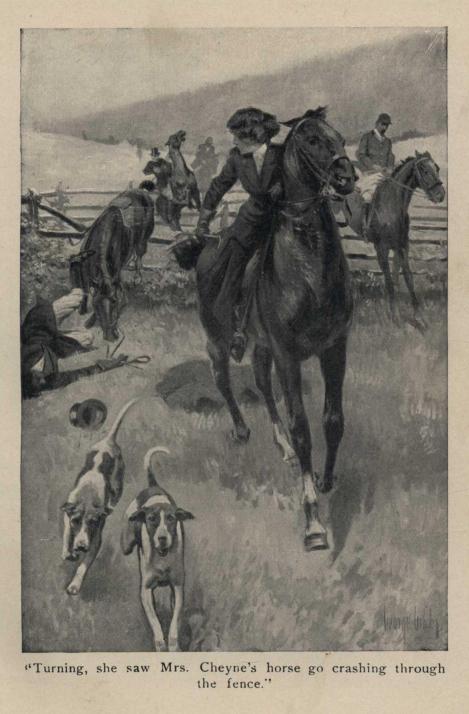
"Turning, she saw Mrs. Cheyne's horse go crashing through the fence."
With a quick cry of dismay, Camilla dismounted, conscience-stricken, and ran to her fallen foe, just as the others rode up and caught the frightened horse.
"Dear Mrs. Cheyne," she heard herself saying, "I'm so sorry. Are you really badly hurt?" But the only reply she got was a feeble shake of the head. Curtis Janney brought out a brandy flask, and, after a sip or two, Mrs. Cheyne revived and looked about her.
"I'm all here, I think," she said. "That was a bad cropper—in my own barnyard, too—the Brush must be yours, Mrs. Wray. Give me a cigarette, somebody."
CHAPTER IX
THE SHADOW
Mrs. Cheyne's farmhands and stablemen came running and took the horses of those who dismounted; and Mrs. Cheyne, after examining herself to see that no bones were broken, led the way, stiffly but without assistance, to the house. Camilla, still a little bewildered, saw Mackinaw led off to the stable for a rub-down. The Master of the Hounds was the first to congratulate her.
"Here is your Brush, Mrs. Wray. You've filled every woman's heart with envy. To be in at the death of the old Chelten Fox is an achievement. You had a fall. Are you injured?"
"I believe not," she said. "Mackinaw is a darling. I hope he's sound?" she inquired anxiously.
"As a bell," he said generously. "He's got the heart of an ox. You know"—he laughed and whispered—"I bought him from Mrs. Cheyne, and to-day you've vindicated me."
Others came up, men of the Hunt Club, and asked to be presented, and Camilla, enjoying her triumph, followed the party to the house.
Mrs. Cheyne's house differed in character from that of the Janneys. It was snugly built in a pocket of the hills, facing to the south. The original building, square and massive, dated from the early eighteenth century, but two symmetrical wings at the sides had greatly increased its original size. Large pillars and a portico gave the graceful lines which the addition demanded. The wide stair hall which ran from front to back had not been altered, and the furniture and hangings rigidly preserved the ancient atmosphere.
The surprised butler and his assistant hurriedly prepared hot Scotches and toddy, and the halls and large rooms on the lower floor were soon filled with the swaggering company—all talking at once, each with his tale of luck or misfortune.
It was not until Camilla was gratefully enthroned in a big chair by the open fireplace that Cortland Bent found a chance to speak to her.
"What possessed you, Camilla? You rode like a demon. You've dragged poor Rita's pride in the mire. Riding is her long suit. She's not used to yielding her laurels as she did to-day. I fancy she's not at all happy about it."
"Why?" asked Camilla, wonderingly.
"You don't know Rita as I do. She runs things out here pretty much in her own way." He chuckled quietly. "Good Lord, but you did put it over her."
"I'm sorry if she feels badly about it," she put in mendaciously.
"There's nothing to be sorry about. You won out against odds on a horse she'd thrown into the discard. That doesn't make her feel any sweeter. She's a queer one. There's no telling how she'll take things. But she doesn't like being the under dog, and she won't forget this soon."
"Neither will I," said Camilla, smiling to herself. "She scored one on me yesterday, but I fancy our accounts are about even."
"Yes, they are. I suppose there's no use warning you."
"No, there isn't, Cort. I fancy I'll be able to look out for myself."
He examined her keenly and realized that she was looking at Jeff, who stood with some men at the end of the room toasting their hostess. He seemed to have forgotten Camilla's existence. In the field before they came into the house Jeff had spoken to her, and when Janney had given Camilla the Brush, Jeff had congratulated her noisily and with the heartiness and enthusiasm he always showed over things which reflected credit on himself. In their private life Jeff still stood a little in awe of Camilla. He realized that his many deficiencies put him at a disadvantage with a woman of her stamp, and, no matter what he felt, he had never asked more of her in the way of companionship than she had been willing to give him ungrudgingly; he was tolerant of her literary moods, her music, her love of pictures, and the many things he could not understand. She was the only cultured woman he had ever known, and his marriage had done little to change his way of thinking of her. Camilla had not meant to abide forever in the shrine in which Jeff had enthroned her.
In the earlier days of their married life she had been willing to sit enshrined because it had been the easiest way to conceal the actual state of her own mind; because it had come to be a habit with her—and with him to behold her there. Their pilgrimage to New York had made a difference. It was not easy for Camilla to define it just yet. He was a little easier in his ways with her, regarded her inaccessibility a little less seriously, and questioned by his demeanor rather than by any spoken words matters which had long been taken for granted by them both. He had made no overt declaration of independence and, in his way, gave her opinions the same respect he had always given them. The difference, if anything, had been in the different way in which they viewed from the very same angle the great world of affairs. Men, as Jeff had always known, were much the same all the world over, but, curiously enough, he had never seen fit to apply any rule to its women. It was flattery, indeed, for him to have believed for so long that, because Camilla was cultured, all cultured women must be like Camilla. His wife realized that Jeff's discovery of Mrs. Cheyne was requiring a readjustment of all his early ideas. And so, while she spoke lightly of Mrs. Cheyne to Cortland Bent, in her heart she was aware that if the lady took it into her pretty head to use Jeff as a weapon she might herself be put upon the defensive.
It seemed as though Cortland had an intuition of what was passing in her mind.
"If there's any way in which I can be of service," he ventured.
"Oh, yes, Cort," she laughed. "I'll call on you. The only thing I ask of you now is—not to fall in love with Mrs. Cheyne."
"Rita? I'd as soon think of falling in love with a kaleidoscope. Besides——"
But she laid restraining fingers on his arm.
"Tell me about Gretchen," she interrupted quickly.
"There's nothing to tell, except," he said with a sigh, "that she's quite gone on Larry."
"You can't mean it?"
"Really—she told me so."
Camilla glanced toward the hall where the two young people were sitting in the big haircloth sofa engaged in a harmless investigation of the science of palmistry.
Camilla laughed. "It really looks so, doesn't it? I am sorry, though. I had begun to look on Miss Janney as one of the solutions of our difficulty."
"There isn't any solution of it—not that way—you must take my word for it. Gretchen and I understand each other perfectly. If I can do anything to help Lawrence Berkely with her, I'll do it."
"Oh, you're quite hopeless, Cort," she sighed, "and I have no patience with Larry. I can't see why he doesn't mind his own business."
Bent glanced at the young couple in the hall. "He seems to me to be doing that tolerably well." He leaned forward so that his tone, though lowered, could be heard distinctly.
"There is another solution. Perhaps you had not thought of it." She turned her head quickly and searched his face for a meaning. For reply he coolly turned his gaze in the direction of Jeff and Mrs. Cheyne, who had withdrawn into an embrasure of one of the windows.
"A solution——" she stammered.
"Yes, a way out—for both of us."
"You mean Jeff—and Mrs. Cheyne?" she whispered.
"I do."
The poison of his suggestion flowed slowly through her mind, like a drug which stimulates and stupefies at the same time.
"You mean that I should allow Jeff—that I should connive in his——" She stopped, horror-stricken. "Oh, Cort, that was unworthy of you," she whispered.
"I mean it. They're well met—those two," he finished viciously.
Camilla held up her fingers pleadingly. "Don't speak. I forbid you." And, rising, she took up her gloves and crop from the table. "Besides," she said more lightly, "I have a suspicion that you are trying to stir up a tempest in a teapot."
"Do you mean you haven't noticed?" he insisted. "At my father's? At the Warringtons'? Last night at the Janneys'?"
"No," she replied carelessly, "I hadn't noticed."
Curtis Janney, who had been moving fussily from one group to another, came forward as he saw Camilla rise.
"I was hoping we might still get another short run, but I suppose you're too tired, Mrs. Wray?"
"A little—but don't let me interfere. I think I can find my way back."
He looked at his watch. "Hello! It's time we were off anyway. The other guests will be eating all our breakfast. Come, Cort, Gretchen, Mrs. Cheyne—you know you're my guest still," strolling from group to group and ruthlessly breaking up the tête-a-têtes so successfully that Rita Cheyne rebelled.
"You're a very disagreeable person, Mr. Janney—Ivywild resents it. You're trying to form the hospitality of the county into one of those horrid trusts. Every time accident throws the hunt my way you insist on dragging it off to Braebank. It isn't fair. Of course, if you insist——"
And then, crossing to Camilla, "Dear Mrs. Wray, I'm borrowing your husband for a while. I feel a little tired, so he promised to lunch with me here and go on to Braebank later. You don't mind, do you?"
"Not in the least, my dear Mrs. Cheyne. I'm so sorry you feel badly." And then to her husband, "Remember, Jeff, Mr. Janney expects you later." Each spoke effusively, the tips of their fingers just touching. Then Mrs. Cheyne followed her visitors to the door.
Outside a coach-horn was blowing, and, as they emerged upon the porch the Janney brake arrived, tooled by the coachman and bearing aloft Mrs. Rumsen, General Bent, and Gladys, who had arrived from town on the morning train. But they would not get down, and the cavalcade soon wound its way along the drive, leaving Jeff and Mrs. Cheyne waving them a good-by from the steps.
Camilla took the road thoughtfully. It was the first time in their brief social career that Jeff had not consulted her before he made his own plans. She did not blame him altogether, for she knew that Jeff's inexperience made him singularly vulnerable to the arts of a woman of the type of Mrs. Cheyne, who, for want of any better occupation in life, had come to consider all men her lawful prey. Camilla knew that mild flirtations were the rule rather than the exception in this gay world where idle people caught at anything which put to flight the insistent demon of weariness and boredom. And she discovered that it was a part of the diversion of the younger married couples to loan husbands and wives to satisfy the light fancy of the hour. All this was a part of the fabric in which she and Jeff were living and endangered society only when the women were weak and the men vicious. But Jeff somehow didn't seem to fit into the picture. His personality she had learned to associate with significant achievements. His faults, as well as his virtues, were big, and he had a habit of scorning lesser sins. The pleasure of a mild flirtation such as his brothers of the city might indulge in for the mere delight of the society of a woman would offer nothing to Jeff, who was not in the habit of doing anything mildly or by halves. Camilla knew him better than Mrs. Cheyne did.
Of course, no one thought anything of his new interest in Mrs. Cheyne. All of the younger men were interested in Mrs. Cheyne at one time or another, and it was doubtful if people had even noticed his attentions. Cortland had, but there was a reason for that. Anything that could discredit Jeff in her eyes was meat and drink to him. But it was cruel of Cortland to take advantage of her isolation, but how could she cut herself off from Cort, when her husband, by the nature of the situation, had thrown her so completely on his mercies? It seemed as though all the world was conspiring to throw her with the one man whose image she had promised her conscience she would wipe from her heart. He rode beside her now remorselessly, proving by his silence more eloquently the measure of his appreciation of the situation. She felt that he, too, was entering the Valley of Indecision, with the surer step of a dawning Hope, while she faltered on the brink of the Slough of Despond.
They had fallen well behind the others, and followed a quiet lane bordered by a row of birch trees which still clung tenaciously to the remnants of their autumn finery. At one side gushed a stream, fed by the early snows, which sang musically of the secrets of earth and sky. There was no indecision here. Every twig, every painted stone, the sky and breeze, spoke a message of blithe optimism. All was right with the world, and if doubt crept into the hearts of men it was because they were deaf to the messages of Nature. The spell of its beauty fell on Camilla, too, and she found herself smiling up at Cortland Bent. There were many things to be thankful for.
"Are you happy?" he asked.
"One can't be anything else on a day like this."
"You don't care then?"
"For what? Oh, yes. I have a natural interest in the welfare of my husband. But I think Mrs. Cheyne is wasting her time."
"I think perhaps you underrate her," he muttered.
"I'd rather underrate Mrs. Cheyne than underrate myself," proudly.
He was silent for a moment, flicking at the weeds with his riding-crop.
"Mrs. Cheyne and you have nothing in common, Camilla," he said. "I'm afraid it isn't in you to understand this crowd. The set in which she and I were brought up is a little world in itself. The things which happen outside of it are none of its concern. It doesn't care. It has its own rules and its own code of decency to which it makes its members subscribe. It is New York in miniature, the essence, the cream of its vices, its virtues, and its follies. It lives like that poison-ivy along the fence, stretching out its tendrils luxuriously in the direction of the sun, moving along the line of least resistance. It does not care what newer growth it stunts, what blossom learns to grow beneath its shade, to fade and droop, perhaps to wither for lack of air and sunlight——"
"And yet—there's Gretchen," she said, "and you."
He smiled almost gaily. "Yes, there are many Gretchens, thank God. Girls with the clean, sound vision of their sturdy forbears, whose mothers were young when the city still felt the impress of its early austerities."
"And you?" she repeated.
His brow darkened and he looked straight before him.
"What I am doesn't matter. I was born and bred in this atmosphere. Isn't that enough?"
"It's enough that you survived—that you, too, have a clean vision."
"No, that is not true," he said sharply. "I can't see clearly—I'm not sure that I want to see clearly—not now."
"I won't believe that, Cort. Back there at her house you said something that was unworthy of you, that showed me another side of your nature, the dark side, like the shadowy places under the ivy. I want you to forget that you ever said them—that you ever thought them even."
"I can't," he muttered savagely. "I want some one to come between you—to make him suffer what I am suffering—to place a distance between you which nothing can ever repair."
"Some one has already come between us," she said, gently. "The one I have in mind is the Cort Bent of Mesa City, who used to help me gather columbines; who rode with me far up the trail to get the last ray of the sunset when the valley below was already asleep in the shadow; who shouted my name in the gorge because he said it was sweet to hear the mountains send back its echoes all silvered over with the mystery of the Infinite; who told me of palaces and gardens in lands which I had never seen, and of the talented men and women who had lived in them; who sang to me in the moonlight and taught me to dream——"
"Don't, Camilla——"
"That was a boy I remember, who lived years and years ago when I was rich—rich in innocent visions which he did nothing to destroy. It was he who gave me an idea that there were men who differed from those I had known before—men in whose hearts was tenderness and in whose minds one might find a mirror for one's harmless aspirations toward a life that wasn't all material and commonplace. He was my knight, that boy, thoughtful, considerate, and gentle. He was foolish sometimes, but I loved him because his ideals had not been destroyed."
"I lied to you. Life is a cinder."
She shook her head. "No, you did not lie to me—not then. Later you did when you asked me to come to New York. Oh, I know. I can see more clearly now. Suppose that even now I chose what you call your solution of the tangle we've made of things. You'd like to see Jeff desert me for Rita Cheyne so that you could have your own way with me now."
"Camilla! I was mad then. I thought you understood. Gretchen and I——"
"I understand many things better than I did," she interrupted. "You were no more mad then than you are now. I think I have always been willing to forgive you for that. I wanted to forgive you because I thought perhaps you didn't know what you were saying. But you make it harder for me now. The boy I knew in the West is dead, Cortland. In his place rides a man I do not know, a man with a shadow in his eyes, a man of the gay world, which moves along the line of least resistance, with little room in his heart for the troubles of the woman he once offered to protect with his life."
"I would still protect you—that is what I am offering."
"How? By making me a woman like Rita Cheyne, who changes her husbands as though they were fashions in parasols. You offer me protection from Jeff. I refuse it." And then she added a little haughtily, "I'm not sure that I need any protection."
He glowered toward her, searching her face sullenly.
"You love him?" he muttered.
She smiled a little proudly. "I can't love you both. Jeff is my husband."
"You love him?" he repeated. "Answer me!"
"Not when you take that tone. I'll answer you nothing. Come, we had better ride forward." And, before he could restrain her, she had urged her horse into a canter.
"Camilla!" he called.
But before he could reach her she had joined the others, outside the gates of Braebank.
CHAPTER X
TRITON OF THE MINNOWS
Mr. Janney's breakfast guests had gone, and, having seen the last of the country wagons depart, he went into the office next to the smoking room, where Cornelius Bent sat awaiting him. Curtis Janney brought a sheaf of telegrams and letters which he laid on the desk. Then he opened a humidor, offered his guest a cigar, took one himself, and sat down.
"Well, what did you hear?" asked General Bent. Janney took a puff or two at his cigar, then frowned at the papers on the table.
"A great deal," he muttered, "both bad and good. I have here reports for the whole week from our men in Denver, Pueblo, Kinney, and Saguache. The pressure from Abington and the Chicago and Utah has finally brought Noakes into line. It was something of a job, for he's tied up in one of Wray's development companies, and it has cost some money. Abington had to give him a big bonus for the stock in the Denver and Western. Collins and Hardy came around all right, and it only remains to put the screws on to make Wray show his hand."
"Have you decided on that?" asked the General.
"No, I haven't."
Curtis Janney took up a letter which he had separated from the others.
"You remember we thought his planning this new line to Pueblo was financial suicide and that, if we gave Wray enough rope, he'd hang himself. We didn't even see the use of throwing the usual impediments in the way."
Bent nodded.
"Well, they're building it."
"It's only a bluff."
"I'm not so sure. My last reports show that the money is in the treasury—some of it is Wray's, but most of it has come from Utah, California, and Washington even. The Denver and California is backing the whole project, and tent towns are springing up along the line of the survey. Those people out there believe in Wray and are following him like sheep."
"They wouldn't follow him long if we found a way to stop him," said the General grimly. "I've seen those stampedes before, but they always come to an end. What does Lamson report?"
"The Denver and California seems set on this thing—the more so as it promises to be a success without much help from them."
General Bent got up and paced the floor with quick, nervous strides.
"Why, Curtis," he said, "you seem to see unusual trouble in the way. The case presents no greater difficulties than the Seemuller plant did, or the Myers and Ott, but we got them both in the end."
"There is a difference."
"Where?"
"The man himself. He'll fight to the last ditch. That jaw wasn't given him altogether as an ornament. I'm sorry we can't find his weak point. A man who looks as far ahead as he does is a good one to tie to."
"But he may not want any strings on him. The other night at dinner at my house he was boasting of his independence. He didn't know how hot it made me."
"Yes, he did. That's why he did it. He said the same thing here yesterday. But I wasn't deceived. It was all a part of his game. I think in a game of bluff he can make old gamesters like you and me sit up and do some guessing." Janney knocked the ash from his cigar and laughed.
"Cornelius, our fine scheme hasn't worked out—not so far. When Wray first came in the office, you sized him up as a social climber. But, if you think we are going to bewilder him by our clubs, the opera, and social connections, you're reckoning without your host."
General Bent smiled tolerantly.
"He assimilates surprisingly well," he said with a reflective nod. "For all his Western manner, he never gives the impression of being ill-at-ease. I'll say that for him. Why, do you know, I strolled in on Caroline the other afternoon on my way uptown and found him teaching her how to play pinochle."
"Mrs. Rumsen?"
"Yes. She'll be making him the rage before the winter is out. But he takes it all as a matter of course. Indeed, I think he fancies himself our equal in any matter." He paused and then rose. "But he must prove that. The Amalgamated must own that smelter."
"Oh, yes," said Janney, following him with his eyes. "It will, of course. We can't have him underbidding us. It's lucky he hasn't tried it yet. But that's the danger from a man with both ability and ambition. And we can't run the risk of letting him get too far."
There was a silence of some moments, which Cornelius Bent improved by running over the correspondence. When he had finished he tossed the letters abruptly on the table, and walked to the window. "Poor Cort," he muttered, "he lost us the whole thing. I wonder what's the matter with that boy. He always seems to miss it somehow. I can never make a business man of him—like you or myself—or like Jeff Wray."
"He's cost us a pretty penny," growled Janney.
The General still stood by the window, his chin deep in his chest, his long fingers twitching behind his back.
"Jeff Wray must pay for that, Curtis. If we can't beat him in one way we must choose another. Jeff Wray stole the 'Lone Tree.' He trespassed on our property in the dead of the night, did violence to one of our employes, and bluffed Cort into signing that lease. If there was any law in the state of Colorado, he'd be serving his term at Cañon City. But I'll get him yet! I will, by God! If he'd come in this office now and hold you up for the money in your safe he'd be a thief. What is the difference?"
"Just this: He was successful, and he left no loose ends behind him."
"I've thought at times, Janney, that you lack some interest in this fight."
"Why? Because I take the precaution to get all the information I can—and because my information turns out to be unfavorable to our plans? You want to crush Wray. Very well. I have no objections. Crush him if you can. But it would hardly do to let him crush us."
Bent turned and examined his host curiously. Then he laughed. It wasn't pretty laughter, and it cracked dryly, like the sound of a creaking door.
"Upon my word, Curtis, you amaze me," he said.
"Very well," put in Janney coolly. "But think it over. Don't be hasty. If he puts that road through and starts the game of underbidding on the raw product, we'll be in for a long fight—and an expensive one. I don't think the Company wants that now. McIntyre doesn't, I know. And Warrington, as usual, is for temporizing."
"Temporizing?" Cornelius Bent's jaws snapped viciously. "This is not a case where personal preferences can be considered. There's a great principle involved. Are we going to let an upstart like Jeff Wray—a petty real estate operator from an obscure Western town—come into our field with a few stolen millions and destroy the plans of an organized business which controls the output of practically all the great gold-producing states—a company whose sound methods have brought order out of chaos, have given employment to an army of people; whose patents have simplified processes, reduced the cost of production, and kept the price of the metal where it is satisfactory both to the mines and the market? Are we going to see all this jeopardized by a wild-catter, a tin-horn gambler, a fellow with neither decency nor moral principle? Temporize like Warrington if you like, but the Board of the Amalgamated must make a fight for the Wray smelter—or accept my resignation."
Bent stalked the floor swiftly, biting off the ends of his sentences as though they were parts of Wray's anatomy, clenching his fingers as he might have done had they encircled Wray's neck. Curtis Janney followed him with his gaze, his brows tangled and his lips compressed, aware of the seriousness of the situation. The resignation of Cornelius Bent from the Board of the Amalgamated was a contingency not for a moment to be considered.
"That, of course, is impossible," he said. "We're all behind you to a dollar if you take that stand. But couldn't it be wise to have Wray in and talk to him? We might learn something that's not on the cards."
"Oh, yes, if you like," growled the General, "but you're wasting time. I've got my idea of what that property is worth. I'll make him the offer. If he refuses"—and his lower jaw worked forward—"it will be war—to the last ditch."
Curtis Janney pressed a bell, and a servant appeared.
"Has Mr. Wray returned?"
"Yes, sir," said the man.
"Tell him General Bent would like to see him here."
The man departed, and General Bent with an effort relaxed the muscles of his face and sat. Both gentlemen looked up quickly when the servant returned a few moments later.
"I delivered your message, sir," he said. "Mr. Wray asked me to say that he is engaged at the present moment and will join you later."
General Bent's brows drew together angrily, but Janney inquired suavely, "Where did you find him, Carey?"
"In the conservatory, sir, with Mrs. Cheyne."
Janney smiled, but suppressed Bent's sudden exclamation with a wave of the hand.
"You may bring in the whisky, then tell him that General Bent and I will await his convenience."
"Yes, sir. Thank you, sir."
"Confound his impudence!" muttered the General, biting at his lip.
"All for effect, Cornelius," said Janney. "That fellow is an artist. He's saving his face for the ordeal."
"Let him save his neck," sneered Bent.
Janney stretched his legs forward and smoked comfortably. "Break it if you like, Cornelius," he said. "I can't, you know, so long as he's my guest."
Wray sauntered in some moments later, accompanied by Rita Cheyne. General Bent looked up with a scowl, which the lady's gay assurance failed to dismiss.
"May I come in, too?" she asked. "I'm wild to hear how big men talk business. Won't you let me, Cousin Cornelius? I'm positively thirsty for knowledge—business knowledge. You' don't mind, do you, Mr. Janney?"
"You can't be interested."
Wray laughed. "I'm the original woolly Western lamb being led to the shearing, Mrs. Cheyne——"
"The golden fleece!" she put in. "I know. But I'm not going to allow it. You're not going to let them—are you, Jeff Wray?"
"I never knew a lamb that had any opinions on the matter," he said easily.
The General got to his feet testily.
"Rita, this won't do at all. We wanted to speak to Wray privately——"
"Oh! You needn't mind me. I'm positively bursting with other people's confidences. But I'm really the soul of discretion. Please let me stay." She went over to Curtis Janney and laid her hands on his shoulders appealingly. "I'll sell you Jack-in-the-Box if you will, Mr. Janney," she said. "You know you've wanted that horse all season."
Janney laughed. "That's a great temptation—but this isn't my affair," and he glanced at General Bent, who stood frowning at them from the window.
"Leave the room at once, Rita!" said the General sternly. "You're interfering here. Can't you see——?"
Mrs. Cheyne dropped her hands.
"Oh, if you take that tone, of course." She moved toward the door, turning with her hand on the knob—"I think you're horrid—both of you. I hope your lamb turns out to be a lion, and eats you up." And, with a laugh and a toss of her head, she went out, banging the door behind her.
Jeff Wray and Curtis Janney laughed, but the frown on General Bent's face had not relaxed for an instant. When the door had closed he sat down in his chair again, while Janney offered cigars. Jeff took one with a sudden serious air, meant perhaps as a tribute to the attitude and years of his fellow guest.
Curtis Janney, looking from one to the other, searched each face for signs of doubt or indetermination and found in each the same deeply set eyes, straight brow, firm, thin mouth, square jaw, and heavy chin which he recognized as belonging to those of this world who know how to fight and who do not know when they are beaten. Wray's features were heavier, the lines in the General's face more deeply bitten by the acid of Time, but their features were so much alike that, had Janney not known the thing was impossible, it might have been easy to imagine some kind of collateral or even more intimate family relationship.
"You asked me to come here," said Wray, easily apologetic. "What can I do for you, General Bent?"
Bent's deeply set eyes were hidden under his bushy eyebrows, but the lips which held his cigar were flickering in a smile.
"Yes," he began with a slow, distinct enunciation, which Wray recognized at once as belonging to his office downtown, "I thought we might talk a little business, if Mr. Janney doesn't object."