Front matter (continued 3)
Reading edition
"Not in the least," said Janney, "but there's no reason why we shouldn't mix in a little of the Old Thorne," and he handed the decanter to Wray. Cornelius Bent refused.
"Wray," he went on, "we've been talking about your plant down in the Valley. From all we've been able to find out, it's a pretty good proposition in a small way. But the Amalgamated Reduction Company has no special interest in acquiring it. That mountain range, in our judgment, will never be a big producer. The 'Lone Tree' is the kind of an exception that one finds only once in a lifetime."
"And yet we're running on full time," said Wray, with an odd smile. "If the other mines keep up their promise we won't need to buy any more ore, General."
"The mountains of the West are full of holes that once were promising, Wray—like notes of hand—but they've long since gone to protest."
Jeff's chin tipped upward the fraction of an inch. "I'm endorsing these notes, General. Besides," he added suavely, "you know I'm not overanxious to sell. When I came into your office it was only with the hope that I might establish friendly relations. That, I'm glad to say, I succeeded in doing. Your health, Mr. Janney."
General Bent refused to be disarmed. "Yes, I know. But friendship and business are two things. Commercially you are in the attitude of a rival of the company I represent. Of course"—opulently—"not a serious rival, but one who must logically be considered in our plans. We didn't like your building that smelter, and you could have brought your ore at a fair price to one of our plants in Pueblo or Colorado Springs."
"Yes—but that interfered with my own plans," said Jeff. "And I have had them a long time."
"It's a little late to talk about that," assented Bent. "The plant is there, the mines are there, and——"
"Yes. But I don't see how they need bother you. Most of the gold we send to market comes from the 'Lone Tree.' I haven't handled any ore below your prices—not yet."
There was, if possible, the slightest accent on the last words, but Wray uttered them with a sweet complacency which failed to deceive. This young fool was threatening—actually threatening the mighty Smelting Trust. It was so preposterous that General Bent actually laughed—a thing he seldom did below Twenty-third Street or when he talked business elsewhere.
"No," he said grimly. "I'm glad that didn't seem necessary. It would have been a pity. See here, Wray"—he leaned forward, his face drawn in decisive lines—"let's get to the point. We've both been dodging it very consistently for a month. You've got some property that may be useful to us. We've thought enough about it at least to make a few inquiries about the whole situation—and about you. We could take that plant under our own management and do a little better than you could. I don't think the location really warrants it—for the big mine may stop paying any day and the railroad facilities, you'll admit, are not of the best. But, if you're willing to sell out at a moderate figure, we might buy it. Or, perhaps, you'd like to come in with us and take stock in the Company. We think a good deal of your ability. There isn't any doubt that you could make yourself useful to us if you chose."
"Thanks," said Jeff, with a sip at his Scotch, and then looked out of the window. He had caught the meaning of General Bent's casual remark about the railroad facilities.
"Of course," Bent went on, "I don't care to show improper curiosity about your plans, but if you are willing to meet me in a friendly spirit we might reach an agreement that would be profitable both to your companies and mine."
"I'd rather think it was interest than curiosity," said Wray with a smile. "But, unfortunately, I haven't got any plans—further than to get all the ore I can out of 'Lone Tree' and to keep my works busy. Just now I'm pretty happy the way things are going. I've screwed the lid down, and I'm sitting on it, besides—with one eye peeled for the fellow with the screw driver."
Cornelius Bent controlled his anger with difficulty. His equality with Jeff, as a guest of Curtis Janney, gave Wray some advantages. The easy good nature with which he faced the situation and his amused indifference to the danger which threatened him put the burden of proof on the General, who experienced the feelings of an emperor who has been jovially poked in the ribs by the least of his subjects. This was lèse majesté. Wray was either a fool or a madman.
"Has it never occurred to you, Wray," snapped Bent, "that somebody might come along with an axe?"
"Er—no. I hadn't thought of that," he replied quietly.
"Well, think it over. It's worth your while."
"Is this a declaration of war?"
"Oh, no," hastily, "merely a movement for peace."
Wray took a few puffs at his cigar and looked from Janney to the General, like a man on whom some great truth had suddenly dawned.
"I had no idea," he said, with a skillfully assumed expression of wonder, "that the Amalgamated was so desperately anxious as this."
In drawing aside the curtain, he had still managed to retain his tactical advantage. Both older men felt it—Bent more than Janney, because it was he who had shown their hand, while Wray's cards were still unread.
The natural response was tolerant amusement, and both of them made it.
"Anxious?" laughed Bent. "Is the lion anxious when the wolf comes prowling in his jungle? Success has twisted your perspective, my dear Wray. The Amalgamated is not anxious—it has, however, a natural interest in the financial health of its competitors."
"But I'm not a competitor. That's just the point. I'm governed by your methods, your plans, your prices. I've been pretty careful about that. No, sir, I know better than to look for trouble with the Amalgamated."
"One moment, Wray," put in Janney; "we don't seem to be getting anywhere. Let's simplify matters. We can get along without your plant, but if we wanted to buy, what would you want for it?"
"Do you mean the smelter—or all my interests in the Valley?" asked Wray quickly.
"The smelter, of course—and the Denver and Saguache Railroad."
"I don't care to sell—I've got other interests—my Development Company, the coal mines and lumber—they're all a part of the same thing, Mr. Janney, like the limbs of my body—cut one off, and I might bleed to death."
"We could give you traffic agreements."
"I'd rather not. I'll sell—but only as a whole—gold mines, coal, lumber, and all."
Wray caught General Bent's significant nod.
"That is my last word, gentlemen," he concluded firmly.
There was a silence, which Cornelius Bent broke at last.
"And what is your figure, Mr. Wray?" he asked.
Jeff Wray reached for the match box, slowly re-lit his cigar, which emitted clouds of smoke, through which presently came his reply. "You gentlemen have been kind to me here in New York. I want you to know that I appreciate it. You've shown me a side of life I never knew existed. I like the West, but I like New York, too. I want to build a house and spend my winters here—I wasn't figuring on doing that just yet—but if you really want my interests I'll sell them to you—without reservation—every stick and stone of them for thirty millions."
"Thirty millions?"
The voices of both men sounded as one, Janney's frankly incredulous—Bent's satirical and vastly unpleasant.
"Thirty millions!" Bent repeated with a sneer. "Dollars or cents, Mr. Wray?"
Jeff turned and looked at him with the innocent and somewhat vacuous stare which had learned its utility in a great variety of services. Jeff only meant it as a disguise, but the General thought it impudent.
"Dollars, sir," said Jeff coolly. "It will pay me that—in time."
"In a thousand years," roared the General. "The Amalgamated doesn't figure on millenniums, Mr. Wray. We don't want your other interests, but we'll buy them—for five million dollars—in cash—and not a cent more. You can sell at that price or—" the General did not see, or refused to see, the warning glance from Janney—"or be wiped off the map. Is that clear?"
"I think so, sir," said Wray politely. "Will you excuse me, Mr. Janney?" and bowed himself out of the room.
CHAPTER XI
DISCORD
That afternoon late, Berkely and the Wrays returned to town, and the Western wires tingled with Jeff's telegrams to Pueblo, Kinney, and Mesa City. He had burnt his bridges behind him, and, like a skillful cavalry leader, was picking out the vantage points in the enemy's country. The answers came slowly, but Wray had planned his campaign before he left the West, and the messages were satisfactory. He realized that his utility in New York, for the present at least, was at an end, and he saw that he must soon leave for the West to repair any possible break in his line of communications.
Camilla learned of his intended departure with mingled feelings. Her husband's rather ostentatious deference to Mrs. Cheyne had annoyed her. She knew in her heart that she had no right to cavil or to criticise, and pride forbade that she should question him. Larry's presence at dinner precluded personal discussions, and Camilla sat silent while the men talked seriously of Jeff's business plans. It had not been her husband's habit to discuss his affairs with her, and, when the coffee was served, he asked her coolly if she wouldn't rather be alone.
"Do you mind if I stay, Jeff?" she asked. "I'd like to hear, if you don't mind."
"I'd rather you wouldn't. You can't be interested in this—besides, the matter is rather important and confidential."
She got up quickly. Larry Berkely, who had caught the expression in her eyes, opened the door for her and followed her into the drawing room.
"Don't be annoyed, Camilla," he whispered. "Jeff is worried. You understand, don't you?"
"Oh, yes, I understand," she replied wearily. "Don't mind me."
As the door closed behind him she stood irresolute for a moment, then suddenly realized she had been up since dawn and was very tired. Her body ached, and her muscles were sore, but the weariness in her mind was greater than these. The closing of the dining-room door had robbed her of the refuge she most needed. She wanted to talk—to hear them talk—anything that would banish her own thoughts—anything that would straighten out the disorderly tangle of her late impressions of the new life and the people she had met in it. She had never thought of Jeff as sanctuary before, and yet she now realized, when the support of his strength was denied her, that in her heart she had always more or less depended upon him for guidance.
And yet she feared him, too. A while ago she had been filled with horror at his share in the "Lone Tree" affair, and since that time the knowledge had haunted her. But she had not dared to speak of it to him. She felt instinctively that this was one of the matters upon the other side of the gulf that had always yawned with more or less imminence between them. Their relations were none too stable to risk a chance of further discord. The difference in his manner which she had noticed a week or more ago had become more marked, and to-night at the dinner table he had troubled less than usual to disguise his lack of interest in her opinions. The image of Cort was ever in her mind, and the danger that threatened her seemed no less distant than before, and yet she still hoped, as she had always done, that something would happen—some miracle, some psychological crisis which would show her husband and herself the way to unity. Since she had seen Cortland Bent, she had lost some faith in herself, gained some fear of Jeff, whose present attitude she was at a loss to understand, but she still clung desperately to the tattered shreds of their strange union, though lately even those seemed less tangible. To-night, when she had asked him to take her West with him, he had refused her impatiently—almost brusquely.
She went into her own rooms slowly and undressed. As she sat before her mirror, the sight of the scratch on her face recalled the incidents of the day. Mrs. Cheyne! Her lips drew together, her brows tangled in thought, and she dismissed her maid, who had come in to brush her hair. What right had Jeff to ignore her as he had done? No matter what her own shortcomings, in public, at least, she had always shown him a proper respect and had never in her heart dishonored him by an unworthy thought. For one brief moment in Cortland Bent's arms she had been swept from the shallows into deeper water, but even then she had known, as she knew now, that loyalty to Jeff had always been uppermost in her thoughts. They must have an understanding before he went away. She would not be left here in New York alone. She had learned to distrust herself, to distrust Jeff, Cort, and all the charming irresponsible people of the gay set into which they had been introduced.
In her dressing gown she sat before her fire and listened to the murmur of voices in the drawing room, from which she had been banished. She could hear Jeff's steps as he rose and paced the floor, his voice louder and more insistent than Larry's. There was a coming and going of pages delivering and receiving telegrams, and she felt the undercurrent of a big crisis in Jeff's career—the nature of which she had only been permitted to surmise. His attitude had wounded her pride. It hurt her that Larry should see her placed in the position of a petitioner. Her one comfort was the assurance that she did not care what Jeff himself thought of her, that it was her pride which insisted on a public readjustment of their relations.
Camilla got up, slowly, thoughtfully, and at last moved to the bell determinedly.
To her maid she said, "Tell Mr. Wray I'd like to see him before he goes out."
When Wray entered the room later, a frown on his face, the cloud of business worry in his eyes, he found Camilla asleep on the divan under a lamp, a magazine on the rug beside her, where it had fallen from her fingers. His lips had been set for short words, but when he saw her he closed the door noiselessly behind him. Even sleep could not diminish the proud curve of the nostrils, or change the firmly modeled chin and the high, clearly penciled brows. Jeff looked at her a moment, his face showing some of the old reverence—the old awe of her beauty.
And while he looked, she stirred uneasily and murmured a name. He started so violently that a chair beside him scraped the floor and awoke her.
"I must have—oh—it's you, Jeff——"
"You wanted to see me?" he asked harshly.
"Yes—I——" She sat up languidly. "I did want to see you. There are some things I want to talk about—some things I want explained. Sit down, won't you?"
"I—I haven't much time."
"I won't keep you long. You've decided to go West—without me?"
"Yes, next week. Perhaps sooner if——"
"I want you to change your mind about taking me with you."
"Why?"
"I want to go."
Jeff laughed disagreeably. "You women are funny. For a year you've been telling me that the only thing you wanted was a visit to New York. Now you're here, you want to go back. I've told you to get all the clothes you need, hired you an apartment in the best hotel, given you some swell friends, bought you jewelry——"
"I don't want jewelry, or clothes, or friends," she insisted. "I want to go back and watch them build 'Glen Irwin.'"
"They've stopped working on 'Glen Irwin.' I wanted the money that was going into that."
"Oh!"
"I've a big fight on, and I need all the capital I can swing. 'Glen Irwin' will have to wait," he finished grimly.
"Of course—I didn't understand. But it makes no difference. I can stay at the hotel or at Mrs. Brennan's."
"After all this? Oh, no, you'd be miserable. Besides, I have other plans."
"You don't want me?"
"No. I'll be very busy."
"No busier than you were before we came here."
Jeff paced the length of the room and returned before he answered her.
"See here, Camilla. You ought to know, by this time that when I say a thing I mean it. I'm going West alone to do some fence-building. You're to stay here and do the same thing—socially. I need these people in my business, and I want you to keep on good terms with them."
She gazed thoughtfully at the fire. "Don't you believe me when I say I want to go with you?"
Jeff made an abrupt movement. "Well—hardly. We've always got along pretty well, so long as each of us followed our own pursuits. But I think you might as well acknowledge that you don't need me—haven't needed me now or at any other time."
"I do need you, Jeff. I want to try and take a greater interest in your affairs—to help you if I can, socially if necessary, but I'd rather do it with you than alone."
"I may not be gone long—perhaps only a week or so. In the meanwhile, you're your own mistress."
"You've always let me be that. But I have reasons for wanting to leave New York."
Wray turned and stared at her blankly. "Reasons?"
"Yes. I—I'm a little tired. The life here is so gay. I'm unused to it. It bewilders me."
"I think I understand," he said slowly. "But it can't be helped. I want you to cultivate the McIntyres, the Warringtons, and the Rumsens. Larry will stay here in the hotel for a while. You can call on him."
She fingered the pages of a book beside her. "Then this is final?" she asked.
"Yes—you must do as I say."
He had never before used that tone with her. The warm impulse that had sought this interview was dried at its source. "Very well—I'll stay," she said coldly, "no matter what happens."
He examined her shrewdly.
"You're afraid?" he asked. "That's too bad. I thought I was doing you a service."
"What do you mean?"
"Cort Bent. That's what I mean. Cort Bent. He's yours. I give him to you."
"Jeff!"
She rose and faced him, trembling, and her eyes flickered like a guttering candle, as she tried to return his look. "How could you?" she stammered. "How could you speak to me so?"
But he was merciless. "Oh, I'm not blind, and I'm not deaf, either. I've seen and I've heard. But I didn't need to see or to hear. Don't you suppose I've always known you married me out of spite—out of pique, because Cort Bent wouldn't marry you. I knew it then just as I know it now, but I hoped I could win you back and that things would be the same as they were before he came meddling in my affairs. Well, you know what happened better than I do. Our marriage has been a failure. I was a fool—so were you. We've made the best of a bad job, but that don't make it a good job. I let you go your own way. I've been good to you because I knew I'd been as big a fool as you were. What I didn't know was that you'd met Cort Bent behind my back——"
"That is not true," she broke in. "That day he called here——"
"Don't explain," impatiently, "it won't help matters. I'm not blind. The main fact is that you've seen Cort Bent again and that you're still in love with him. These people are talking about you."
"Who? Mrs. Cheyne?"
"Yes, Mrs. Cheyne—and others."
Camilla steadied herself with a hand upon the table. The brutality of his short, sharp indictment unnerved her for the moment. She had hoped he would have given her the opportunity to make an explanation in her own way, a confession even which, if he had willed, might have brought them nearer in spirit than they had ever been. But that was now impossible. Every atom of him breathed antagonism—and the words of her avowal were choked in the hot effusion of blood which pride and shame sent coursing to her throat and temples.
"And if I am still in love with him," she said insolently, "what then?" He looked at her admiringly, for scorn became her.
"Oh, nothing," he said with a shrug. "Only be careful, that's all. Back in Mesa City I thought of shooting Cort Bent, but I found a better way to punish him. Here"—he laughed—"I've a different plan. I'm going to give you a free foot. I'm going to throw you two together—to give you a chance to work out your salvation in your own way. Your marriage to me means nothing to you. Time has proved that. You and I are oil and water. We don't mix. We never have mixed. There isn't any reason that I can see that we're ever going to mix. We've worried along somehow, to date, but it's getting on my nerves. I'd rather we understood each other once and for all. I'm past changing. You knew what I was—a queer weed, a mongrel. I took root and I grew as Nature made me grow, in the soil I fell in, hardy, thick-ribbed, stubborn, and lawless. The world was my enemy, but I fought it as Nature taught, by putting on a rough bark and spines like the cactus that grew beside me. Oh, I grew flowers, too, pretty pale blossoms that tried to open to the sun. You had a chance to see them—but they weren't your kind. You looked beyond them at the hot-house plants——"
"Don't, Jeff," she pleaded. "I can't bear it."
But he only laughed at her.
"Well, I've brought them to you—the roses, the orchids, the carnations, and you're going to live with them, in the atmosphere you've always wanted——"
"Won't you let me speak?"
"No!" he thundered. "My mind is made up. I'm going West alone. You go your way. I go mine. Is that clear? You and Cortland Bent can meet when and where you please."
"I don't want to meet him," she whispered brokenly. "I don't want to see him again."
"I can't believe you," he sneered. "We've lived a lie since we were married. Let's tell the truth for once in our lives. When I came in this room you were asleep, but even while you slept you dreamed of him and his name was in your mouth."
The face she turned up to him was haggard, but her eyes were wide with wonder.
"I heard you—you were calling for Cort. I'm not going to be a fool any longer."
He turned away from her and went toward the door, while she got up with some dignity and walked to the fireplace.
"You're going—to Mrs. Cheyne?" she asked coldly.
"If I like," defiantly. "This game works both ways."
"Yes, I see. There's some method in your madness after all."
"I don't see why you should care—since I don't object to Bent. Mrs. Cheyne is a friend of mine. She's investing in my company——"
"Evidently," with scorn. "No doubt you make it profitable to her."
"We won't talk about Mrs. Cheyne. You don't like her. I do. You like Cort Bent. I don't. And there we are. We understand each other. It's the first time in our lives we ever have. I don't question you, and you're not to question me. All I ask is that you hide your trail, as I'll hide mine. I have some big interests at stake, and I don't want any scandal hanging around my name—or yours. I'm giving you into the hands of my enemies. The father wants to ruin my business, the son to ruin my wife. I'll fight General Bent with his own weapons. The son——"
"You're insulting," she broke in. "Will you go?"
He turned at the door—his face pale with fury.
"Yes, I'll go. And I won't bother you again. These rooms are yours. When I'm here, mine are there. Some day when I'm ready I'll get you a divorce. Then you can marry as you please. As for me," he finished passionately, "I'm done with marriage—done with it—you understand?"
And the door crashed between them.
Camilla stood for a moment, tense and breathless, staring wide-eyed at the pitiless door. Then the room went whirling and she caught at the chair at her desk and sank into it helplessly, one hand pressed against her breast. For a moment she could not think, could not see even. The brutality of his insults had driven her out of her bearings. Why he had not struck her she could not imagine, for it was in the character of the part he was playing. He had not given her a chance. He must have seen that she was trying to repair past damages and begin anew. A throb of self-pity that was almost a sob came into her throat. Tears gathered in her eyes and pattered on the desk before her. She did not notice them until she heard them fall, and then she dried her eyes abruptly as though in shame for a weakness. He did not want to begin anew. She could see it all clearly now. He was tired of her and caught at the easiest way to be rid of her, by putting her in the wrong. Her strength came quickly as she found the explanation, and she sat up rigidly in her chair, her face hot with shame and resentment. She deserved something better from him than this. All that was worst in her clamored for utterance.
With a quick movement of decision she reached forward for a pen and paper and wrote rapidly a scrawl, then rang the bell for her maid.
"Have this note mailed at once."
It was addressed to Cortland Bent.
CHAPTER XII
TEA CUPS AND MUSIC
Dropping in on Jack Perot meant being shot skyward for twelve stories in a Louis Sixteenth elevator operated by a magnificent person in white gloves and the uniform of a Prussian lieutenant. Perot's panelled door was no different from others in the corridor upstairs, except for its quaint bronze knocker, but the appearance of a man-servant in livery and the glimpse of soft tapestries and rare and curious furniture which one had on entering the small reception room gave notice that a person of more than ordinary culture and taste dwelt within. The studio of the painter itself was lofty, the great north window extending the full height of two stories of the building, while the apartment beyond, a library and dining room with steps leading above to the bedrooms, contained all the luxuries that the most exacting bachelor might require.
To arrive at the distinction of being a fashionable portrait painter one must have many qualifications. In the schools one must know how to draw and to paint from the model. In the fashionable studio one must know how to draw and paint—then discover how not to do either. If the nose of one's sitter is too long, one must know how to chop it off at the end; if the mouth is too wide, one must approximate it to the Greek proportions; eyes that squint must be made squintless and colorful; protruding ears must be reduced. Indeed, there is nothing that the beauty doctor professes to accomplish that the fashionable portrait painter must not do with his magic brush. He must make the lean spinster stout and the stout dowager lean; the freckled, spotless; the vulgar, elegant; the anæmic, rosy; his whole metier is to select agreeable characteristics and to present them so forcibly that the unpleasant ones may be forgotten, to paint people as they ought to be rather than as they are, to put women in silk who were meant for shoddy, and men in tailored coats who have grown up in shirt-sleeves.
In addition to these purely technical attainments, he must be an infallible judge of character, a diplomat, a sophist; he must have a silver tea-service, to say nothing of excellent Scotch and cigarettes. He must be able to write a sonnet or mix a salad, discuss the Book of Job or the plays of Bernard Shaw, follow the quotations of the stock market, the news of the day, and the fashions in women's hats. He must laugh when he feels dejected and look dejected when he feels like laughing. Indeed, there is nothing the fashionable portrait painter must not be able to do, except perhaps really—to paint.
Jack Perot could even do that, too, when he wanted to. The sketch of the Baroness Charny on his easel was really sincere—an honest bit of painting done with the freedom his other work lacked. Perhaps this was because it was not a commission, but just one of those happy interludes which sometimes occur amid the dreariest of measures. It pleased him, at any rate, and he stood off from it squinting delightedly through his monocle while the Baroness poured the tea.
"Really, madame, it's too bad it's finished. I was almost ready to believe myself back in Paris again," he said in French. "If one could only live one's life backward!"
"Oh, that wouldn't do—in a little while perhaps you would be quite poor."
"Yes," he sighed, "but think how much better I would paint." He stopped before the sketch and sighed again. "I think it's you, Baroness. You bring an echo of my vanished youth. Besides, I didn't paint you for money. That is the difference."
"You are going to paint that handsome Madame Wray?"
"Yes. She's coming in for tea to-day."
"They are wonderful, those people. He is so original—so farouche."
"He's too fond of talking about himself," he growled. "These people represent the Western type so common in New York—climbers—but New York will forgive much in the husband of Mrs. Wray."
"He doesn't care whether he's forgiven or not, does he?"
"That's a pose. All Westerners adopt it. To consent to be like other people would be to confess a weakness."
"I like him; but then"—the Baroness yawned politely—"all Americans are attractive. Mrs. Wray I find less interesting."
"Naturally, madame. You are a woman." Then, after a pause, "It is a pity she's getting herself talked about."
"Really? That's encouraging—with Monsieur Bent?"
"Oh, yes—they met in the West—the phenix of an old romance."
"How delightful! Monsieur Jeff doesn't care?"
"Oh, no," significantly. "He has his reasons."
The door-knocker clanged, and Mrs. Rumsen entered, escorting two débutantes, who paused on the threshold of the studio gurglingly, their eyes round with timidity and a precocious hopefulness of imminent deviltries.
"So kind of you, Mrs. Rumsen. Good morning, Miss Van Alstyne—Miss Champney" (with Jack Perot it was always morning until six of the afternoon). "You've met the Baroness?"
"How too thweetly perfect!"
"How fearfully interesting!"
The newcomers fluttered palpitantly from canvas to canvas and only subsided when Mrs. Cheyne entered.
"Am I welcome?" she drawled. "This is your day, isn't it, Jack? Oh, how charming!" She paused before the sketch of the Baroness. "Why didn't you paint me like that? I'll never forgive you. You were painting me for Cheyne, I know it. My portrait fairly exudes the early Victorian."
Perot kissed the tips of his fingers and wafted them toward her. "Quite correct, dear Rita. Cheyne was paying the bill. Now if you gave me another commission——"
"I won't—you're the most mercenary creature. Besides, I'm too hard up. One must really have billions nowadays." She sank on the couch beside the Baroness. "It's really very exhausting—trying to live on one's income. I'm very much afraid I shall have to marry again."
"You need a manager. May I offer——"
"No, thanks. I shall be in the poor-house soon enough."
"Get Mr. Wray to help," laughed the painter mischievously. "They say he has a way of making dollars bloom from sage-brush."
She glanced at him swiftly, but took her cup of tea from the Baroness and held her peace.
The knocker clanged again, and Mrs. Wray, Miss Janney, Larry Berkely, and Cortland Bent came in.
"This is really jolly, Gretchen. Hello! Cort, Berkely—Mrs. Wray, I've been pining to see your hair against my old tapestry. Oh! shades of Titian! Can I ever dare?"
Camilla colored softly, aware of Mrs. Cheyne's sleepy eyes in the shadow below the skylight. She nodded in their general direction and then took Mrs. Rumsen's proffered hand—and the seat beside her.
"I was so sorry to have missed you this morning," she said. "I'm always out, it seems, when the people I want to see come in."
"I should have 'phoned," said the lady. "I had something particular to speak to you about. Is your husband coming here?"
"I—I really don't know," Camilla stammered. "He has been away and very busy."
"He'll be back for my dance, won't he?"
"I think so—but he's never certain. He's going West very soon."
"He was telling me something about his early life. You ought to be very proud of him."
"I can't tell just what it is, but to me your husband seems like an echo of something, an incarnation of some memory of my youth—perhaps only a long-forgotten dream. But it persists—it persists. I can't seem to lose it."
"How very curious."
"It is the kind of personality one isn't likely to forget. Has he any memory of his father or—of his mother?"
"No. His mother died when he was born. His father—he doesn't remember his father at all."
Mrs. Rumsen smiled. "Forgive me, won't you? I suppose you'll think me a meddlesome old busybody. But I'm not, really. I want to be friendly. You're a stranger in New York, and it occurred to me that perhaps you might crave a little mothering once in a while. It is so easy to make mistakes here, and there are so many people who are willing to take advantage of them."
"You're very kind, Mrs. Rumsen. I'm glad you think us worth while."
"I do. So much worth while that I want to lay particular stress upon it. Perhaps I ought to tell you what I mean. Last night my brother dined with us. He was in a very disagreeable mood—and spoke very bitterly of your husband. I suppose he may even go so far as to carry his business antagonism into his social relations with you both."
"How very unfortunate!" in genuine dismay.
"That is his way. He's rather used to lording it over people here. And people stand it just because he's Cornelius Bent. I suppose Mr. Wray knows what he is about. At any rate, I honor him for his independence. I told my brother so—and we're not on speaking terms."
As Camilla protested she laughed. "Oh, don't be alarmed, dear; we have been that way most of our lives. You see we're really very much alike. But I wanted you to understand that my brother's attitude, whatever it is, will make no possible difference to me."
"I shouldn't dare to be a cause of any disagreement——"
"Not a word, child. I'm not going to permit Wall Street to tell me who my friends shall be. There is too much politics in society already. That is why I want you to dine with me before my ball, and receive with me afterward, if you will."
Camilla's eyes brightened with pleasure. "Of course, I'm very much honored, Mrs. Rumsen. I will come gladly, if you don't think I'll add fuel to the flame."
"I don't really care. Why should you?"
"There are reasons. The General was most kind to us both——"
"Because he had something to get out of you," she sniffed. "I could have told you that before."
"But it was through General Bent that we met everybody—people who have entertained us—the Janneys, the McIntyres, and yourself, Mrs. Rumsen."
"He was the ill-wind that blew us the good," she finished graciously. "Say no more about it. I have a great many friends in New York, my child—some who are not stockholders in the Amalgamated Reduction Company."
* * * * *
In another corner of the studio—a dark one behind a screen—Miss Janney had impounded Larry Berkely.
"Have you seen 'Man and Super-man'?" she was asking.
"I've read it."
"Well, do you believe in it? Don't you think it breeds a false philosophy? Can you imagine a girl so brazen as to pursue a man whether he wanted her or not?"
"No. It was very un-human," said Larry.
"Or a man so helpless, saying such dreadful things—thinking such dreadful things about a girl and then marrying her?"
"It was absurd—quite ridiculous in fact. No one ever meets that kind of people in real life. I never could stand a girl of that sort."
"Oh, I'm so glad you agree with me. Do you know, Larry, I really believe that you and I have exactly the same way of thinking about most things. It's really remarkable. I'm so glad. It's a great comfort to me, too, because ever since I first met you I hoped we'd learn to understand each other better."
"How curious! I've been hoping the same sort of thing—fearing it, too," he added dolefully.
"Fearing it? What do you mean? Tell me at once."
"Oh, nothing," he murmured.
"I insist on knowing."
"I wanted you to like me—and yet I dreaded it, too."
"Don't say that again," she whispered. "I can't stand it, Larry. I do care for you—more and more every time I see you. But it makes me terribly unhappy to feel that anything is bothering you."
"It needn't bother you."
"Yes, it does—if it makes you miserable. What is it? Won't you tell me?"
"I—I don't think we ought to be too friendly."
"Why not?" in surprise.
"Because it wouldn't be good for you—for either of us."
"That's no answer at all. I refuse to listen. What do I mind if it's good for me or not—if I care for you enough to—to—what is it, Larry? Answer me."
"Well, you know I'm all right now, but when I went West my bellows—my breathing apparatus—oh, hang it all! The reason I went West was on account of my health. My lungs, you know——"
"You silly boy. I've known that for ever so long. That's one of the reasons why I fell in love with——"
She stopped, the color suddenly rushing to her cheeks as she realized what she had been saying. But Larry's fingers had found hers in the corner, and she looked up into his eyes and went on resolutely. "I do love you, Larry. I think I always have. Are you glad?"
Then Larry kissed her.
* * * * *
On the other side of the screen, to her own accompaniment on the piano, the Baroness Charny began singing:
"Tes doux baisers sont des oiseaux
Qui voltigent fous sur mes lèvres,
Ils y versent l'oubli des fièvres
Tes doux baisers sont des oiseaux,
Aussi légers que des roseaux,
Foulés par les pieds blancs des chèvres
Tes doux baisers sont des oiseaux
Qui voltigent fous, sur mes lèvres."
Amid the chorus of approval, as the Baroness paused, a thin little lisping voice was heard.
"Oh, how too utterly thweetly exthquithite! I never thought of kitheth being like the flight of little birdth. Are they, Mr. Bent? I thought they lathted longer."
Bent shrugged his shoulders and laughed. "How should I know, Miss Champney? I've never been married."
"Married? How thilly! Of courthe not! It would be thtupid to kith then—tho unneth-eth—unneth-eth—oh, you know what I mean, don't you?"
"I'm afraid I don't. I'd be tempted not to understand, just to hear you say 'unnecessary' again."
"Now you're making fun of me. You're perfectly horrid. Ithn't he, Mr. Perot?"
"He's a brute, Miss Champney—an utter brute; that's because he's never been kissed."
"Oh, how very interethting! Haven't you really, Mr. Bent? Oh, you're really quite hopeleth."
Mrs. Cheyne sipped her tea quite fastidiously and listened, bored to the point of extinction. Nor did her expression change when, some moments later, Jeff Wray was announced. Camilla's face was the only one in the room which showed surprise. She had not seen her husband for several days, and she noticed, as he came over and spoke to Mrs. Rumsen, that he looked more than ordinarily tired and worried. With Camilla he exchanged a careless greeting and then passed her on his way to the others. The servant brought the decanter and soda bottle, and he sank on the divan by the side of Rita Cheyne. It surprised him a little when she began talking quite through him to their host and the Baroness, whom they were asking to sing again.
It was a Chanson Galante of Bemberg
"A la cour
A la cour
Aimer est un badinage
Et l'amour
Et l'amour
N'est dangereux qu'au village
Un berger
Un berger
Si la bergere n'est tendre
Sait se prendre
Sait se prendre
Mais il ne saurait changer.
Et parmi nous quand les belles
Sont legeres ou cruelles,
Loin d'en mourir de depit
On en rit, on en rit,
Et l'on change aussi-tot qu'elles."
Jeff listened composedly and joined perfunctorily in the applause. Rita Cheyne laughed.
"Charming, Baroness. I'm so in sympathy with the sentiment, too. It's delightfully French."
"What is the sentiment?" asked Jeff vaguely of any one.
Mrs. Cheyne undertook to explain.
"That love is only dangerous to the villager, Mr. Wray. In the city it's a joke—it amuses and helps to pass the time."
"Oh!" said Jeff, subsiding, conscious, that the question and reply had been given for the benefit of the entire company.
"Rather dainty rubbish, I should say," said Perot, with a sense of saving a situation (and a client). "Love is less majestic in the village—that's all, but perhaps a little sweeter. Ah, Baroness!"—he sighed tumultuously—"Why should you recall—these memories?"
The conversation became general again, and Wray finished his glass and set it down on the edge of the transom.
"What is the matter, Mrs. Cheyne?" he asked. "Aren't you glad to see me?"
"Why should I be?" coolly.
"I don't know. I thought you might be. I stopped at your house. They told me you were here, so I came right down."
"You're very kind—but I didn't leave any instructions."
"No, but they told me. I wanted to see you." "You didn't want to see me the other night."
"I couldn't—I 'phoned you."
"Don't you think it would have been in better taste if you had come yourself?"
"I left in the morning for Washington. I've just returned. I'm sorry you didn't understand."
"I did. You had other fish to fry. Did you know I came all the way in from the country to see you? No woman cares to throw herself at the head of a man. Personally I prefer an insult to a slight, Mr. Wray."
"Good Lord! I hope you don't think I could do that. I certainly have never showed you anything but friendship. I've been worried over—over business matters."
"That's a man's excuse. It lacks originality. I'm not accustomed to rebuffs, Mr. Wray. I made the mistake of showing that I liked you. That's always fatal, I thought you were different. I know better now. There's no depth too great for the woman who cheapens herself—I'm glad I learned that in time."
"Don't talk like that. I tell you I've been away," he protested.
"Really! Why didn't you write to me then?"
"Write?"
"Or send me some roses?"
"I'll send you a wagon-load."
"It's too late," she sighed. "It was the thought I wanted."
Wray rubbed his chin pensively. It occurred to him that there were still many things with which he was unfamiliar.
"I did think of you."
"Why didn't you tell me so then?"
"I'm telling you now."
She leaned toward him with a familiar gesture of renewed confidences.
"There are a thousand ways of telling a woman you're thinking of her, Mr. Wray. The only way not to tell her is to say that you are. What a man says is obvious and unimportant. A woman always judges a man by the things that he ought to have done—and the things he ought not to have done."
"I don't suppose I'll ever learn——"
"Not unless some woman teaches you."
"Won't you try me again?"
"I'll think about it." And then with one of her sudden transitions, she added in a lower tone, "I am at home to-night. It is your last chance to redeem yourself."
"I'll take it. I can't lose you, Mrs. Cheyne."
"No—not if I can help it," she whispered.
A general movement among Perot's visitors brought the conversation to a pause. Mrs. Rumsen, after a final word with Camilla, departed with her small brood. Cortland Bent, with a mischievous intention of supplying evidence of the inefficacy of the parental will, removed one wing of the screen which sheltered Berkely and his own ex-fiancée. But Miss Janney was not in the least disconcerted, only turning her head over her shoulder to throw at him:
"Please go away, Cort. I'm extremely busy."
Camilla smiled, but was serious again when Bent whispered at her ear, "My refuge!" he said. "Yours is yonder."
She followed his glance toward Wray and Rita Cheyne, who were so wrapped in each other's conversation that they were unconscious of what went on around them.
"Come," said Camilla, her head in the air, "let us go."
CHAPTER XIII
GOOD FISHING
A clock struck the hour of nine. Mrs. Cheyne lowered the volume of Shaw's plays, the pages of which she had made a pretence of reading, and frowned at the corner of the rug. She now wore a house gown of clinging material whose colors changed from bronze to purple in the shadow of the lamps. It fitted her slim figure closely like chain-mail and shimmered softly like the skin of a dusky chameleon. Mrs. Cheyne was fond of uncertain colors in a low key, and her hour was in the dim of twilight, which lent illusions, stimulated the imagination to a perception of the meaning of shadows—softened shadows which hung around her eyes and mouth, which by day were merely lines—a little bitter, a little hard, a little cynical. Mrs. Cheyne's effects were all planned with exquisite care; the amber-colored shades, the warmish rug and scarlet table cover, the Chinese mandarin's robe on her piano, the azaleas in the yellow pots, all were a part of a color scheme upon which she had spent much thought. Her great wealth had not spoiled her taste for simplicity. The objects upon her table and mantel-shelf were few but choice, and their arrangement, each with reference to the other, showed an artistry which had learned something from Japan. She hated ugliness. Beauty was her fetich. The one great sorrow of her life was the knowledge that her own face was merely pretty; but the slight irregularity of her features somewhat condoned for this misfortune, and she had at last succeeded in convincing herself that the essence of beauty lies rather in what it suggests than in what it reveals. Nature, by way of atoning for not making each feature perfect, had endowed them all with a kind of Protean mobility, and her mind with a genius for suggestion, which she had brought to a high degree of usefulness. Without, therefore, being beautiful at all, she gave the impression of beauty, and she rejoiced in the reputation which she possessed of being marked "Dangerous."
She had rejoiced in it, moreover, because she had been aware that, no matter how dangerous she might prove to be with others, with herself she had not been dangerous. The kind of romance, the kind of sentiment, in which she indulged she had come to regard as highly specialized art in which she was Past Grand Mistress. She loved them for their own sake. She was a fisher of men, but fished only for the love of fishing, and it was her pleasure while her victims still writhed to unhook them as tenderly as might be and let them flap ungracefully back into their own element. Her fly-book was a curiosity and of infinite variety. Izaak Walton advances the suggestion that trout bite "not for hunger, but wantonness." Rita Cheyne was of the opinion that men bit for a similar reason; and so she whipped the social streams ruthlessly for the mere joy of the game, matching her skill to the indifference of her quarry, her artistry to their vehemence.
And now she suddenly discovered that she must throw her fly-book away—she had tried them all—the "silver-doctor," the "white moth," the "brown hackle"—and all to no purpose. Her fish had risen, but he would not bite. She was fishing in unfamiliar waters, deeper waters, where there were hidden currents she could not understand. The tackle she had used when fishing for others would not serve for Jeff Wray.
It provoked her that her subtlety was of no avail, for she had the true fisher's contempt for heavy tackle. And yet she realized that it was only heavy tackle which would land him. He was the only man who had really interested her in years, and his conquest was a matter of pride with her. She had other reasons, too. His wife was beautiful. Rita Cheyne was merely artistic. Victory meant that Beauty was only an incident—that Art, after all, was immortal. The theory of a whole lifetime needed vindication.
When Wray entered she was deep in "You Never Can Tell," but looked up at her visitor slowly and extended a languid hand.
"Aren't you early?" she asked, slipping a marker in the pages of her book and closing it slowly.
"No, I don't think so. I thought I was late. I was detained."
She held up a hand in protest.
"I was really hoping you might not come. I've been really so amused—and when one is really amused nowadays one should expect nothing more of the gods."
Wray got up hurriedly. "I won't 'butt in' then. I don't want to disturb——"
"Oh, sit down—do. You make me nervous. Have a cigarette—I'll take one, too. Now tell me what on earth is the matter with you."
"The matter? Nothing. I'm all right."
"You've changed somehow. When I met you at the Bents' I thought you the most wonderful person I had ever met—with great—very great possibilities. Even at the Janneys' the illusion still remained. Something has happened to change you. You do nothing but scowl and say the wrong thing. There's no excuse for any man to do that."
"I'm worried. There's been a slight tangle in my plans. I—but I'm not going to trouble you with——"
"I want to hear—of course. You went to Washington?"
"Yes—to see some of our congressmen. I have the law on my side in this fight, and I'm trying to make things copperlined—so there can't be a leak anywhere. Those fellows down there are afraid of their own lives. They act as though they were on the lookout for somebody to stab them in the back. Washington is too near New York. A fellow goes there from the West and in about six months he's a changed man. He forgets that he ever came from God's country, and learns to bow and scrape and lick boots. I reckon that's the way to get what you want here in the East—but it goes against my grain."
"Weren't you successful?"
"Oh, yes, I found out what I wanted to know. It's only a question of money. They'll fall in line when I'm ready. But it's going to take cash—more than I thought it would."
"Are you going to have enough?"
"My credit's good, and I'm paying eight per cent."
"Eight? Why, I only get four!"
"I know. Eight is the legal rate in my state. Business is done on that basis."
"I wish I could help. You know I'm horribly rich. I'd like to look into the matter. Will you let me?"
"Yes, but there's a risk—you see, I'm honest with you. I'll give stock as security and a share in the profits—but my stock isn't exactly like government bonds. Who is your lawyer? I'll put it up to him if you like."
"Stephen Gillis. But he'll do what I say."
"I'd rather you consulted him."
"Oh, yes, I shall. But I have faith in you, Jeff Wray. It seems like a good speculation. I'd like you to send me all the data. I'll really look into it seriously." She stopped and examined his face in some concern. In the lamplight she saw the lines that worry had drawn there. "But not to-night. You've had enough of business. You're tired—in your mind"—she paused again that he might the better understand her meaning—"but you're more tired in your heart. Business is the least of your worries. Am I right?"
"Yes," he said sullenly.
"I'm very sorry. Is there any way in which I can help?"
"No."
The decision in his tone was not encouraging, but she persevered.
"You don't want help?"
"It isn't a matter I can speak about."
"Oh!"
Her big fish was sulking in the deeps? It was a case for shark-bait and a "dipsy" lead.
"You won't tell me? Very well. Frankness is a privilege of friendship. I'll use it. Your wife is in love with my cousin Cortland."
Wray started violently.
"How do you know?"
She smiled. "Oh, I don't know. I guessed. It's true, though." She paused and examined him curiously. He had subsided in his chair, his head on his breast, his brows lowering.
"Are you unhappy?" she asked.
"No," he muttered at last. "It's time we understood each other."
"What are you going to do about it?"
"Do? Nothing," he said with a short laugh. "There's nothing to do. I'm a good deal of a fool, but I know that putting trouble in a woman's way never made her quit going after what she'd set her mind on. If I licked Cort Bent she'd make me out a brute; if I shot him, she'd make him out a martyr. Any way, I'm a loser. I'm going my own way and she——" He got up and strode the length of the room and back, and then spoke constrainedly: "I'm not going to speak of this matter to you or to any one else."
He dropped into his chair beside her again and glared at the window curtain. Mrs. Cheyne leaned one elbow on the arm of her chair which was nearest him and sighed deeply.
"Why is it that we always marry the wrong people? If life wasn't so much of a joke, I'd be tempted to cry over the fallibility of human nature. The love of one's teens is the only love that is undiluted with other motives—the only love that's really what love was meant to be. It's perfectly heavenly, but of course it's entirely unpractical. Marrying one's first love is iconoclasm—it's a sacrilege—a profanation—and ought to be prohibited by law. First love was meant for memory only—to sweeten other memories later on—but it was never meant for domestication. Rose petals amid cabbage leaves! Incense amid the smells of an apartment kitchen!"
She sank back in her chair again and mused dreamily, her eyes on the open fire.
"It's a pretty madness," she sighed. "Romance thrives on unrealities. What has it in common with the butcher? You know"—she paused and gave a quick little laugh—"you know, Cheyne and I fell in love at first sight. He was an adorable boy and he made love like an angel. He had a lot of money, too—almost as much as I had—but he didn't let that spoil him—not then. He used to work quite hard before we were married, and was really a useful citizen.
"Matrimony ruined him. It does some men. He got to be so comfortable and contented in his new condition that he forgot that there was anything else in the world but comfort and content—even me. He began to get fat and bald. Don't you hate bald-headed men with beards? He was so sleek, shiny, and respectable that he got on my nerves. He didn't want to go anywhere but to symphony concerts and the opera. Sometimes he played quite dolefully on the 'cello—even insisted on doing so when we had people in to dinner. It was really very inconsiderate of him when every one wanted to be jolly. He began making a collection of 'cellos, too, which stood around the walls of the music room in black cases like coffins. Imagine a taste like that! The thing I had once mistaken for poetry, for sentiment, had degenerated into a kind of flabby sentimentality which extended to all of the commonplaces of existence. I found that it wasn't really me that he loved at all. It was love that he loved. I had made a similar mistake. We discovered it quite casually one evening after dinner."
She broke off with a sigh. "What's the use? I suppose you'll think I'm selfish—talking of myself. Mine is an old story. Time has mellowed it agreeably. Yours is newer——"
"I'm very sorry for you. But you know that I'm sorry. I've told you so before. I think I understand you better now."
"And I you," and then softly, "Mrs. Wray was your first love?"
"No," he muttered, "she was my last."
Mrs. Cheyne's lids dropped, and she looked away from him. Had Wray been watching her he would have discovered that the ends of her lips were flickering on the verge of a smile, but Wray's gaze was on the andirons.
They sat there in silence for some moments, but Wray, who first spoke, restored her self-complacency.
"You're very kind to me," he said slowly. "You say you like me because I'm different from other fellows here. I suppose I am. I was born different and I guess I grew up different. If you think I'm worth while, then I'm glad I grew up the way I did." He got up and walked slowly the length of the room. She watched him doubtfully, wondering what was passing in his mind. She learned in a moment; for when he approached her again he leaned over her chair and, without the slightest warning, had put his arms around her and kissed her again and again on the lips.
She did not struggle or resist. It seemed impossible to do so, and she was too bewildered for a moment to do anything but sit and stare blankly before her. He was a strange fish—a most extraordinary fish which rose only when one had stopped fishing. It was the way he did it that appalled her—he was so brutal, so cold-blooded. When he released her she rose abruptly, her face pale and her lips trembling.
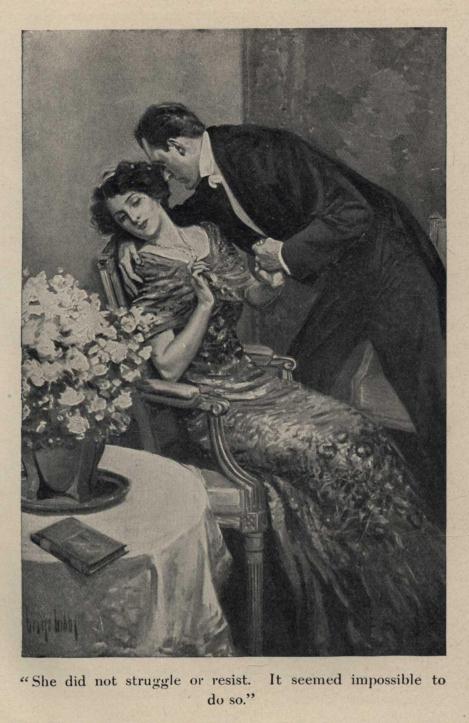
"She did not struggle or resist. It seemed impossible to do so."
"How could you?" she said. "How could you?" And then, with more composure, she turned and pointed toward the door.
"I wish you'd please go—at once."
But as he stood staring at her she was obliged to repeat: "Don't you hear me? I want you to go and not to come back. Isn't that plain? Or would you prefer to have me ring for a servant?"
"No, I don't prefer either," he said with a smile; "I don't want to go. I want to stay here with you. That's what I came for."
She walked over to the door and stood by the bell. "Do you wish me to ring?"
"Of course not."
"Will you go?"
"No."
She raised her hand toward the bell, but halted it in midair. Wray noticed her hesitation.
"Wait a moment. Don't be foolish, Rita. I have something to say to you. It wouldn't reflect much credit on either of us for you to send me out. I thought we understood each other. I'm sorry. You said once that you liked me because I was plain-spoken and because I said and did just what came into my head, but you haven't been fair with me."
"What do you mean?"
"Just this: You and I were to speak to each other freely of ourselves and of each other. You said you needed me, and I knew I needed you. We decided it was good to be friends. That was our agreement. You broke it wilfully. You have acted with me precisely as you have acted with a dozen other men. It was lucky I discovered my danger in time. I don't think any woman in the world could do as much with me as you could—if you wanted to. When I like anybody I try to show them that I do. If you were a man I'd give you my hand, or loan you money, or help you in business. I can't do that with you. You're a woman and meant to be kissed. So I kissed you."
She dropped her hands. "Yes, you kissed me, brutally, shamelessly——"
"Shamelessly?"
"You've insulted me. I'll never forgive you. Don't you think a woman can tell? There are other ways of judging a man. I've interested you, yes, because you've never known any real woman before," contemptuously. "I suppose you're interested still. You ought to be. But you can never care for any woman until you forget to be interested in yourself. For you the sun rises and sets in Jeff Wray, and you want other people to think so, too."
"I'm sorry you think so badly of me."
"Oh, no, I don't think badly of you. From the present moment I sha'n't think of you at all. I—I dislike you—intensely. I want to be alone. Will you please go?"
Wray gave her his blandest stare, and then shrugged his shoulders and turned toward the door.
"You're willing to have me go like this?"
"Yes."
"I'm going West to-morrow."
"It makes no difference to me where you are going."
"Won't you forgive me?"
"No."
As he passed her, he offered his hand in one last appeal, but she turned away from him, her hands behind her, and in a moment he was gone.
Rita Cheyne heard the hall door close behind him and then sank into the chair before the open fire, her eyes staring before her at the tiny flame which still played fitfully above the gray log. Her fish had risen at last with such wanton viciousness that he had taken hook, line, reel, and rod. Only her creel remained to her—her empty creel.
CHAPTER XIV
FATHER AND SON
Father and son had dined together alone, and for most of the time in silence. Cornelius Bent had brought his business mien uptown with him, and Cortland, with a discretion borrowed of experience, made only the most perfunctory attempts at a conversation. Since the "Lone Tree" affair there had happened a change in their relations which each of them had come to understand. Cortland Bent's successive failures in various employments had at last convinced his father that his son was not born of the stuff of which Captains of Industry are made. The loss of the mine had been the culminating stroke in Cortland's ill-fortune, and since his return to New York he had been aware of a loss of caste in the old man's eyes. General Bent had a habit of weighing men by their business performances and their utility in the financial enterprises which were controlled from the offices of Bent & Company. It was not his custom to make allowances for differences in temperament in his employees, or even to consider their social relationships except in so far as they contributed to his own financial well-being. He had accustomed himself for many years to regard the men under him as integral parts of the complicated machinery of his office, each with its own duty, upon the successful performance of which the whole fabric depended. He had figured the coefficient of human frailty to a decimal point, and was noted for the strength of his business organization.
To such a man an only son with incipient leanings toward literature, music, and the arts was something in the nature of a reproach upon the father himself. Cort had left college with an appreciation of Æschylus and Euripides and a track record of ten-seconds flat. So far as Bent Senior could see, these accomplishments were his only equipment for his eventual control of the great business of the firm of which his father was the founder. The Greek poets were Greek, indeed, to the General, but the track record was less discouraging, so Cortland began the business of life at twenty-three as a "runner" for the bank, rising in time to the dignity of a post inside a brass cage, figuring discounts, where for a time he was singularly contented, following the routine with a cheerfulness born of desperation. As assistant to the cashier he was less successful, and when his father took him into his own office later and made him a seller of bonds, Cortland was quite sure that at last he had come into his own. For the selling of bonds, it seemed, required only tireless legs and tireless imagination—both of which he possessed. Only after a month he was convinced that bond sellers are born—not made.
The General, still hoping against hope, had now taken him back into his office on a salary and an interest in business secured, and thus made his son more or less dependent upon his own efforts for the means to enjoy his leisure. Father and son existed now as they had always done, on a basis of mutual tolerance—a hazardous relation which often threatened to lead and often did lead to open rupture. To-night Cortland was aware that a discussion of more than usual importance was impending, and, when dinner was over, the General ordered the coffee served in the smoking room, the door of which, after the departure of the butler, he firmly closed.
General Bent lit his cigar with some deliberation, while Cortland watched him, studying the hard familiar features, the aquiline nose, the thin lips, the deeply indented chin, wondering, as he had often wondered before, how a father and son could be so dissimilar. It was a freak of heredity, Nature's little joke—at Cornelius Bent's expense. The General sank into his armchair, thoughtfully contemplating his legs and emitting a cloud of smoke as though seeking in the common rite of tobacco some ground of understanding between his son and himself.
"I want to speak to you about the Wrays," he said at last.
Cortland's gaze found the fire and remained on it.
"You are aware that a situation has arisen within the past few weeks which has made it impossible for Bent & Company or myself personally to have any further relations, either financial or social, with Jeff Wray? He has taken a stand in regard to his holdings in Saguache Valley which I consider neither proper nor justifiable. To make short of a long matter, I thought it best some weeks ago to forget the matter of the mine and make Wray an offer for his entire interests in the Saguache Valley. It was a generous offer, one that no man in his position had a right to refuse. But he did refuse it in such terms that further negotiations on the subject were impossible."
"Yes, sir, I know," put in his son.
"Wray's rise is one of those remarkable combinations of luck and ability—I'll concede him that—which are to be found in every community once in a decade. From obscure beginnings—God knows what the fellow sprang from—he has worked his way up in a period of three years to a position of commanding influence. He owns the biggest independent smelter in the West—built it, we now believe, with the intention of underbidding the Amalgamated. He has not done so yet because he hasn't been sure enough of himself. But he's rapidly acquiring a notion that nothing Jeff Wray can do will fail. That is his weak point—as it is with every beggar on horseback. You are familiar with all of these facts. You've had some occasion," bitterly, "to form your own judgment of the man. When you came East I was under the impression that, aside from business, there were other reasons, why you disliked him."
"That is correct, sir," muttered Cortland, "there were."
The General eyed his son sharply before he spoke again.
"Am I to understand that those reasons still exist? Or——"
"One moment, sir. I'd like to know just where this conversation is drifting. My relations with Wray have never been pleasant. He isn't the type of man I've ever cared much about. No conditions that I'm aware of could ever make us friendly, and, aside from his personality, which I don't admire, I'm not likely to forget the 'Lone Tree' matter very soon."
"H—m! That still rankles, does it? It does with me—with all of us. Oh, I'm not blaming you, Cort. If you had been a little sharper you might have made one last investigation before you signed those papers. But you didn't, and that's the end of that part of the matter. What I want to know now is just what your relations with the Wray family are at the present moment. You hate Wray, and yet most of your leisure moments are spent in the company of his wife. Am I to understand——?"
"Wait a moment, sir——" Cortland had risen and moved uneasily to the fireplace. "I'd prefer that Mrs. Wray's name be kept out of the discussion. I can't see how my relations with her can have any bearing——"
"They have," the General interrupted suavely. "If Mrs. Wray is to receive your confidences I can't give you mine."
"Thank you," bitterly. "I didn't know I had ever done anything to warrant such an attitude as this."
"Tut! tut! Don't misunderstand me. Whatever your sins, they've always been those of omission. I don't believe you'd betray me wilfully. But intimacies with pretty women are dangerous, especially intimacies with the wives of one's financial enemies; unless, of course, there's some method in one's madness."
"What do you mean?"
"I'm sorry I don't make my intention clear. If your friendship with Mrs. Wray can be useful to Bent & Company I see no reason why it shouldn't continue. But if it jeopardizes my business plans in any way, it's time it stopped. In my office you are in a position and will, I hope, in the near future be in a further position to learn all the business plans of the Amalgamated and other companies. Of course, I don't know how far Mrs. Wray enjoys the business confidences of-her husband. But it is safe to assume that, being a woman, she knows much more than her husband thinks she does. I don't intend that you should be placed in an embarrassing position with respect to her or with respect to me. I'm on the point of starting the machinery of my office on a big financial operation for the Amalgamated Reduction Company—the exact nature of which until the present moment has remained a secret. Your part in this deal has been mapped out with some care, and the responsibilities I have selected for you should give you a sense of my renewed faith in your capabilities. But you can't carry water on both shoulders——"
"You're very flattering, sir. I've never carried much water on either shoulder; and my relations with Mrs. Wray hardly warrant——"
"I can't see that," impatiently. "You're so often together that people are talking about you. Curtis Janney has spoken to me about it. Of course, your affair with Gretchen is one that you must work out for yourselves, but I'll confess I'm surprised that she stands for your rather obvious attentions to a married woman."
Cortland Bent smiled at the ash of his cigar. His father saw it and lost his temper.
"I'm tired of this shilly-shallying," he snapped. "You seem to make a practice in life of skating along the edge of important issues. I'm not going to tolerate it any longer, and I've got to know just where you stand."
"Well, dad," calmly, "where shall we begin? With Gretchen? Very well. Gretchen and I have decided that we're not going to be married."
"What?"
"We have no intention of marrying next year or at any other time."
"Well, of all the——! Curtis Janney doesn't know this."
"He should. Gretchen is in love with somebody else, and I——"
"You! I understand. You are, too. You're in love with Jeff Wray's wife."
He paused, but his son made no reply, though the old man watched his face curiously for a sign. The General knocked his cigar-ash into the fire.
"Is that true?"
"Under the circumstances I should prefer not to discuss the matter."
"Why? You and I haven't always been in sympathy, but the fact remains that I'm your father." The old man's long fingers clutched the chair arm, and he looked straight before him, speaking slowly. "I suppose you've got to have your fling. I did. Every man does. But you're almost old enough to be through that period now. There was never a woman in the world worth the pains and anxieties of an affair of this kind. A woman who plays loose with one man will do it with another. The fashion of making love to other men's wives did not exist when I was young."
Cortland turned to the fire, his lips compressed, and with the tongs replaced a fallen log.
"When I was young," the old man went on, "a man's claim upon his wife was never questioned. Society managed things better in those days. Ostracism was the fate of the careless woman; and men of your age who sought married women by preference were denied the houses of the young girls of their own condition. If a fellow of your type had oats to sow, he sowed them with a decent privacy instead of bringing his mother, his sister, into contact——"
Cortland straightened up, the tongs in his hand, his face pale with fury, saying in stifled tones:
"For God's sake, stop, or I'll strike you as you sit."
The General moved forward in his chair almost imperceptibly, and the cigar slipped from his fingers and rolled on the hearth. For a long moment the two men looked into each other's eyes, the elder conscious that for the first time in his life he had seen his son really aroused. There was no fear in the father's look, only surprise and a kind of reluctant admiration for a side of Cortland's character he had never seen. He sank back into his chair and looked into the fire.
"Oh!" he muttered.
"You had no right to speak of Mrs. Wray in those terms," said Cortland, his voice still quivering.
"I'm sorry. I did not know."
Cortland set down the fire tongs, his hands trembling, and put both elbows on the mantel-shelf.
"Perhaps, since you know so much," he said in a suppressed voice, "I had better add that I would have married her if Wray hadn't."
"Really? You surprise me."
There was a moment of silence which proved to both men the futility of further discussion.
"If you don't mind, I'd rather we didn't speak of this. Mrs. Wray would understand your viewpoint less clearly than I do. She is not familiar with vice, and she does not return my feeling for her. If she did, I should be the last person in the world she would see——"
"I can't believe you."
"It is the truth. Strange as it may seem to you and to me, she loves her husband."
"She married him for his money."
Cortland was silent. Memory suddenly pictured the schoolroom at Mesa City where he had won Camilla and lost her in the same unfortunate hour—his hour of mistakes, spiritual and material—a crucial hour in his life which he had met mistily, a slave of the caste which had bred him, a trifler in the sight of the only woman he could love, just as he had been a trifler before the world in letters and in business.
"No," he replied. "She did not marry him for money. She married him—for other reasons. She found those reasons sufficient then—she finds them sufficient now." He dropped heavily, with the air of a broken man, into an armchair, and put a hand over his eyes as though the light hurt them. "Don't try to influence me, sir. Let me think this out in my own way. Perhaps, after what you've told me about the Amalgamated, I ought to let you know."
"Speak to me freely, Cort," said the old man more kindly.
"I don't want you to think of Camilla as the wife of Jeff Wray. I want you to think of her as I think of her—as herself—as the girl I knew when I first went West, an English garden-rose growing alone in the heart of the desert. How she had taken root there Heaven only knows, but she had—and bloomed more tenderly because of the weeds that surrounded her."
He paused a moment and glanced at his father. General Bent had sunk deep in his chair, his shaggy brows hiding his deeply set eyes, which peered like those of a seer of visions into the dying embers before him. A spell seemed to have fallen over him. Cortland felt for the first time in his life that there was between them now some subtle bond of sympathy, unknown, undreamed of, even. Encouraged, he went on.
"She was different from the others. I thought then it was because of the rough setting. I know now that it wasn't. She is the same here that she was out there. I can't see anything in any other woman; I don't want to see anything in any other woman. I couldn't make her out; it puzzled me that I could do nothing with her. After school hours—she was the schoolmistress, you know, sir—we rode far up into the mountains. She got to be a habit with me; then a fever. I didn't know what was the matter except that I was sick because of the need of her. I didn't think of marriage then. She was nothing. Her father kept a store in Abilene, Kansas. I thought of you. All my inherited instincts, my sense of class distinction, of which we people in New York make such a fetich, were revolted. But I loved her, and I told her so."
Cortland sat up, then leaned forward, his elbows on his knees, and followed his father's gaze into the fire.
"She was too clean to understand me, sir. I knew it almost before I had spoken. In her eyes there dawned the horror, the fear, the self-pity which could not be said in words. Then Jeff Wray came in and I left her—left Mesa City. There was—nothing else—to do."
His voice, which had sunk to a lower key, halted and then was silent. A chiming clock in the hallway struck the hour; other clocks in dainty echo followed in different parts of the house; an automobile outside hooted derisively; but for a long while the two men sat, each busied with a thread of memory which the young man had unreeled from the spool of life. In the midst of his thoughts Cort heard a voice at his elbow, the voice of an old man, tremulous and uncertain, a softer voice than his father's.
"It is strange—very, very strange!"
"What is strange, sir?"
Cornelius Bent passed his fingers before his eyes quickly and straightened in his chair.
"Your story. It's strange. You know, Cort, I, too, once loved a woman like that—the way you do. It's an old romance—before your mother, Cort. Nobody knows—nobody in the East ever knew—even Caroline——"
He stopped speaking as though he had already said too much, got up slowly and walked the length of the room, while Cortland watched him, conscious again of the sudden unusual sense of conciliation in them both. At the other end of the room the General stood a moment, his hands behind his back, his gaze upon the floor.
"I am sorry, Cort," he said with sudden harshness. And then, after a pause, "You must not see Mrs. Wray again."
Cortland's hands clenched until the knuckles were white, and his eyes closed tightly, as though by a muscular effort he might rob them of a persistent vision. When he spoke his voice was husky like that of a man who had been silent for a long time.
"You're right, sir—I've thought so for some days. But it's not so easy. Sometimes I think she needs me——"
"Needs you? Don't they get along?"
"I don't know. There are times when I feel that I am doing the right sort of thing."
"He doesn't abuse her?"
"I don't know. She'd be the last person to speak of it if he did. But I think she doesn't altogether want me to go."
General Bent shook his head slowly. "No, Cort. It won't do. What you've just told me makes your duty very clear—your duty to her and your duty to yourself. There's danger ahead—danger for you both. You may not care for my advice—we've not always understood each other—but I hope you'll believe me when I say that I offer it unselfishly, with the single purpose of looking after your own welfare. Leave New York. I'm prepared to send you West next week, if you'll go. There will be a lot of work for us all. It's possible that I may go, too, before long. I can give you duties which will keep you busy so that you won't have time to think of other things. When I first spoke to you of this business to-night I spoke as President of the Amalgamated Reduction Company, now I am speaking to you as a father. I want you with us more than ever—largely on our account, but more largely now upon your own. Will you go?"
Cortland rose and leaned one elbow on the mantel.
"You want me to help you in the fight for Wray's smelter?"
"Yes, I do."
"Don't you want me to see her again?"
"It's wiser not to. No good can come of it—perhaps a great deal of harm."
"She would not understand—she knows I dislike her husband, but it seems to me I ought to tell her——"
"That you're making financial war upon her husband? Forewarn him—forearm him? What else would you say. That doesn't seem fair to me, does it?"
He paused, watching his son narrowly and yet with a kind of stealthy pity. Cortland's struggle cost him something.
"I suppose you're right," he said at last. And then, turning around toward his father, "I will not see her again. Give me the work, sir, and I'll do my best. Perhaps I haven't always tried to do that. I will, though, if you give me the chance."
"Your hand on it, Cort. I won't forget this. I'm glad you spoke to me. It hasn't always been our custom to exchange confidences, but I'll give you more of mine if you'll let me. I'm getting old. More and more I feel the need of younger shoulders to lean on. I'm not all a business document, but the habit of mercilessness grows on one downtown. Mercy has no place in business, and it's the merciful man that goes to the wall. But I have another side. There's a tender chord left in me somewhere. You've struck it to-night, and there's a kind of sweetness in the pain of it, Cort. It's rusty and out of use, but it can still sing a little."
Cortland laid his hand on the old man's shoulder almost timidly, as he might have done to a stranger.
"You'll forgive me, father——?"
"Oh, that"—and he took his son's hand—"I honor you for that, my son. She was the woman you loved. You could not hear her badly spoken of. Perhaps if I had known my duty—I should have guessed. Say nothing more. You're ready to take my instructions?"
"Yes—and the sooner the better."
"Very good. You'll hear more of this to-morrow. I am—I'm a little tired to-night. I will see you at the office."
Cortland watched him pass out of the door and listened to his heavy step on the broad staircase. Cornelius Bent was paying the toll of his merciless years.
When he was gone, Cortland sank into the big chair his father had vacated, his head in his hands, and remained motionless.
CHAPTER XV
INFATUATION
The season was at its height. The Rumsen ball, the Warringtons' dinner-dance, and some of the subscription affairs had passed into social history, but a brilliant season of opera not yet half over and a dozen large dances were still to follow. Camilla sat at her desk assorting and arranging the cards of her many visitors, recording engagements and obligations. When Jeff had left for the West she had plunged into the social whirlpool with a desperation born of a desire to forget, and, as she went out, there had come a bitter pleasure in the knowledge that, after all, she had been able to win her way in New York against all odds. People sought her now, not because she was a protégée of Mrs. Worthington Rumsen, or because she was the wife of the rich Mr. Wray, but because she was herself.
The dangers which threatened no longer caused her any dismay, for ambition obsessed her. It was an appetite which had grown great with feeding, and she let it take her where it would. There was not an hour of the day when she was not busy—in the mornings with her notes and her shopping, in the afternoons with luncheons, teas, and other smart functions, at night with dinners, the theatre, or the opera and the calendared dances. There were few opportunities for her to be alone, and the thought of a reconciliation with her husband, which had at one time seemed possible, had been relegated to her mental dust-bin in company with an assorted lot of youthful ideals which she had found it necessary to discard.
She could not remember the day when she had not been socially ambitious. Five months ago, before she and Jeff had quarreled, there had been a time when she had been willing to give up the world and go back with him. She had been less ambitious at that moment than ever before in her life. If he had taken her with him then, there might still have been time to repair their damages and begin life on a basis of real understanding. For a brief time she had abhorred the new life he had found for her, had hated herself for the thing that she really was, a social climber, a pariah—too good for her old acquaintances, not good enough for her new ones—a creature with a mission of intrusion, a being neither fish, flesh, nor good red herring, and yet perhaps something of all three. But that period of mental probation had passed. She no longer felt that she was climbing. There were many broken rungs below her on the social ladder, but those above were sound, and her head was among clouds tinted with pink and amber.
Such was the magic of success. She lived in an atmosphere of soft excitements and pleasurable exhilarations, of compliments and of flattery, of violets and roses. Bridge lessons had improved her game, but she still discovered that the amounts she could lose in a week were rather appalling. Checks for large amounts came regularly from the West, and she spent them a little recklessly, convinced that she was obeying to the letter her husband's injunction to strengthen their social position, no matter what the cost. She had written Jeff twice in the first week after his departure asking if she could not follow him to Mesa City. His replies had been brief and unnecessarily offensive—so that, though his image loomed large at times, pride refused further advances. Cortland Bent had been with her continually and of course people were talking. She heard that from Mrs. Rumsen, who, in the course of a morning of casual "mothering," had spoken to Camilla with characteristic freedom.
"I know there's no harm in his attentions, child," she said, "at least so far as you're concerned. You have always struck me as being singularly capable of looking after yourself—and of course Cort is old enough to know what he is about. But it never does any one any good to be talked about—especially a woman who has her way to make in the world. There is a simplicity almost rustic in the way you two young people allow yourselves to be discovered in public places—which, to an ancient philosopher like myself, carries complete conviction of innocence. But others may not be so discerning. If you were ugly or deformed it wouldn't make the slightest difference what you did, but, being handsome, you are on trial; and every pretty woman in society is on the jury of a court which convicts on circumstantial evidence alone."
Camilla thanked her preceptor for the warning, aware of an unpleasant sense of shock at the revelation. She seemed to have reached a point in her mad infatuation with life where warnings made no impression upon her. She had not seen Cort Bent for several days now, and, while she experienced a vague sense of loss in his absence, which had not been explained, she was so busy that she had not even found time to analyze it.
A belated cold season had set in—a season of snow and ice; and fashionable New Yorkers, in a brief interlude of unimportant engagements, flocked for the week-end to their country places to enjoy a few days of old-fashioned winter weather. The Billy Havilands' farm was within motoring distance of the town. It wasn't much of a place in the modern sense, merely a charming old shingled farmhouse which had been remodeled and added to, set in a big lawn like a baroque pearl in green enamel, surrounded by ancient trees which still protected it with their beneficent boughs. As Haviland and his wife preferred the city in winter and went to their Newport cottage in summer, they only used The Cove for small house parties between seasons. It was kept open for just such occasions as the present one, and Camilla, who had joined this party at the last moment, was looking forward with enjoyment to a glimpse of winter life in a different sort of community.
Snow had fallen during the night, but the day was cold and clear—one of those dry, sparkling days like the winter ones in Colorado when the Saguache Peak was laid like a white paper-cutting against the turquoise sky, and the trees at timber line were visible in silhouette to the naked eye. It was freezing hard, and Camilla's skin tingled sharply beneath her motor veil, but she lay back in her warm furs beside Dorothy Haviland in the tonneau, drinking deep breaths of delight as she watched the panorama of purple hills across the river. The snow was not too deep for easy going, but in places it had drifted across the road waist high. Rejoicing in the chance to test the mettle of his high-powered car, Haviland took these drifts on the high gear, sending a cloud of iridescent crystals over and about his guests, who pelted the unresponsive back of his head with snowballs. Farmers in sleighs and wagons on runners drew aside in alarm, to stare with open mouths at the panting demon—which passed them by before their horses had time to be frightened. Every ride with "Billy" was a "joy" ride—he hadn't driven this car in the Vanderbilt Cup race for nothing. Jack Perot clung to the robe rail, and alternately prayed and swore in Haviland's ear; the Baroness Charny punctuated his remarks with cunning foreign cries, and Dorothy herself admonished him to be careful, but Camilla, whatever she felt, sat quietly between the two women, her pulses going fast, a prey to the new excitement of speed.
Haviland had 'phoned his orders from the city to have the bobsled sent over to the Country Club—and when they drove through the entrance gates, the pond in the valley below the golf course was dotted with skaters. A blue thread of smoke trailed skyward from the cabin of the Fishing and Skating Club—a part of the larger organization—from which people came and glided forth by twos and threes over the glossy blue surface of the pond.
A surprise awaited the party, for as the motor drew up at the steps of the Golf House it was greeted by a storm of soft snowballs from a crowd ambushed in a snow fort on the lawn. The motor party got out hurriedly, laughing like children, while Billy Haviland, like a good general, marshaled his forces under the protecting bulk of the machine, while they threw off their heavy furs and made snowballs enough to sally forth valiantly to the attack. The battle was short and furious, until Jack Perot and Camilla by a dexterous flank-movement assailed the unprotected wings and came to close quarters with the enemy, Larry, Gretchen, Cortland Bent, and Rita Cheyne. A well-aimed shot by Camilla caught Cortland on the nose, which disconcerted him for a moment, and Haviland improved his opportunity by washing Rita's face in snow. A truce was declared, however, but not before the besiegers had entered the breastworks and given three cheers for their victory.
"I'll never forgive you, Billy," laughed Rita, brushing the snow from her neck. "Never—I'm simply soaking."
"Spoils of victory! You're lucky I didn't kiss you."
"Yes, I am," she said with sudden demureness. "I'd rather have my face washed."
The machine was sent on, and, chatting gaily, the party made its way down to the cabin by the lakeside, a path to which had been cleared through the snow. Camilla glanced at Cortland Bent, who stood silently at her side.
"What's the matter, Cort? Aren't you going to speak to me?" she asked carelessly.
He forced a laugh. "Oh, yes, of course."
"Where have you been? Do you realize that I haven't seen you for the last two days?"
"Four," he corrected soberly. "I—I've been very busy."
"That's no explanation. You're angry?"
"No, not at all. I—thought I'd better not come."
She examined him curiously, and laid her fingers on his arm. "How funny you are? Has anything happened?"
He didn't reply at once, and kept his gaze away from her. "I came here to-day," he said deliberately, "because I thought it would be the one place where you and I wouldn't meet."