Chapter X · Diseases of Farm Animals
Reading edition
ABORTION.
—The expulsion of the fetus at a period too young to live exterior of its mother is known as abortion. This ailment may afflict cows, mares, sows, and ewes, but is most common among cows.
Abortion may be divided into two classes, namely, accidental and contagious. If we had nothing but the accidental form of abortion to contend with we would hear very little about this disease, owing to the fact that it is perfectly natural for animals to carry their young full time, regardless of how much they may be punished or abused while in this condition if their system be free from the germs of contagious abortion. On the other hand, contagious abortion is a very destructive disease, causing heavy losses to the stockmen of the United States as well as to other countries. Contagious abortion is divided into two classes, namely, acute and chronic. Cows afflicted with the acute form of abortion may lose from one to three calves. Cows, after passing from the acute to the chronic form of abortion, may carry their calves full time, but are as badly affected with the germs of contagious abortion as they were in the acute form, when they were losing their calves.
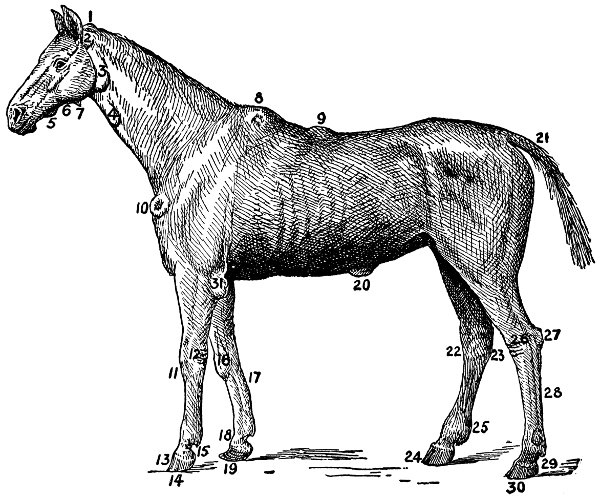
DISEASES OF THE HORSE
1 Poll Evil, 2 Swelling by Bridle Pressure, 3 Inflamed Parotid Gland, 4 Inflamed Jugular Vein, 5 Caries of the Lower Jaw, 6 Fistula of Parotid Duct, 7 Bony Excrescence, 8 Fistula of Withers, 9 Saddle Gall, 10 Tumor Caused by Collar, 11 Splint, 12 Malanders, 13 A Tread on the Coronet, 14 Sand Crack, 15 Quittor, 16 Knee Bunch, 17 Clap on Back Sinews, 18 Ring Bone, 19 Foundered Foot, 20 Ventral Hernia, 21 Rat Tail, 22 Spavin, 23 Curb, 24 Quarter Crack, 25 Thick Leg, 26 Malanders, 27 Capped Hock, 28 Swelled Sinews, 29 Grease, 30 Sand Crack, 31 Tumor of Elbow.
Perhaps the greatest damage brought about with cattle afflicted with the chronic form of abortion is the shortage of milk. Animals afflicted with accidental abortion show very few marked symptoms before they abort. Animals afflicted with contagious abortion have a number of marked symptoms, namely, little red patches of infection on the lining of the vulva, and there may also be present a catarrhal discharge. The sheath of the herd bull in the acute form of the disease has a catarrhal discharge, while the symptoms of calves is a swelling of the glands of the throat from ear to ear. These last named symptoms do not appear in accidental abortion.
Owing to the fact that the germs of contagious abortion are found in the mothers’ blood, in the genital organs of the cow and the bull, and in the stables wherein they are housed, it has been positively decided that the only reliable and effectual treatment for contagious abortion is the hypodermic treatment, which destroys the germ in the mother’s blood. The genital organs of the cow and bull should be washed out with the antiseptic solution made of 1 pint of corrosive sublimate to 1,000 parts of water, and the germs contained in the stables wherein afflicted animals are housed should be destroyed by disinfectants. In this way the disease is met at every turn, and it is impossible for the disease of contagious abortion to exist when thus handled.
ABSCESS.
—A collection of pus in a new-formed cavity in the body. It has a well-defined wall surrounding it. An abscess is the result of entrance of micro-organisms into the body. They may have entered through wounds or into the hair follicles, or abscesses may result from infectious diseases, as strangles or distemper in the horse. At the seat of the abscess formation swelling occurs, the part feels warmer than the surrounding tissue, is painful to touch, and hard. These conditions are due to the inflammation of the part. Later it becomes soft, less sensitive, and fluctuates, which shows that it is coming to a head, or that the pus is collecting. If the skin is white it will show a yellow color in the center, which is usually raised above the surface, and the hair falls out. This soon breaks and discharges pus.
It is advisable to hasten the ripening of the abscess by hot applications in form of poultices, or a large pack of cotton saturated with hot bichloride of mercury 1 part to 1,000 parts of water, or use some one of the coal tar dips 1 part to 50 parts of water. The application of a light blister will often hasten ripening. When the pus has collected or the abscess has come to a head, it should be opened at the lowest part in order to give free drainage to the pus contained within.
Great care should be used in opening abscesses—not to cut blood vessels which might be in the vicinity. In case the abscess breaks of its own accord, it is often necessary to enlarge the opening, in order to give free drainage for the pus. If the abscess is large or deep-seated it should be washed out each day with bichloride of mercury 1 part to water 1,000 parts, or with a 2 per cent solution of some one of the coal tar dips. After it is opened do not apply bandages, as they prevent the free escape of pus. Do not allow the opening to close until it heals from the bottom; or, in other words, as long as it secretes pus, for there is danger of its breaking out again. If the opening is too high up, or not large enough, it may result in a running sore or fistula.
ACTINOMYCOSIS.
—Called lumpy jaw, because of the frequency of the swelling located on the jaw. It is due to the entrance of a specific organism, a fungus, into the tissues. This causes an inflammation, with an increase in the amount of tissue, as shown by the enlargement and in which an abscess is formed. Adult cattle are the only animals commonly affected with this disease, but occasionally nearly all classes of domestic animals may be affected. A number of cases have also been reported in man, but the disease in cattle, being localized to a small region of body, usually the head, there is little danger of transmission from animal to man in eating beef.
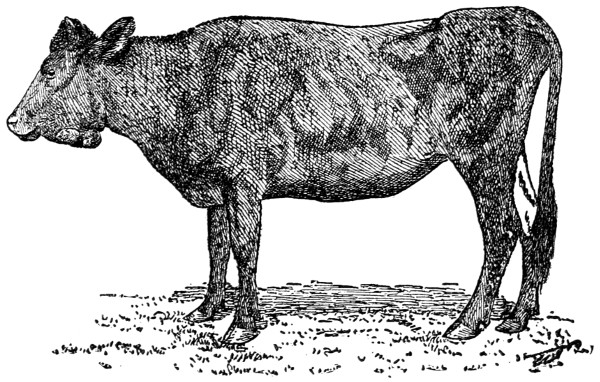
LUMPY JAW
An exterior view showing location of lumpy jaw.
The symptoms are recognized by the characteristic tumor, usually observed on the jaw, either of the bone or of the soft tissues in that vicinity. It may, however, affect the tongue, or, in fact, nearly any of the organs of the body. Its development is more or less of a slow, constant growth, beginning with a very small nodule, but, when allowed to run its course, may reach the size of a cocoanut, or larger. On reaching some size, it usually ruptures and from it discharges a thick, yellowish pus. It is to be distinguished very largely by its commonly affecting cattle, its location, its slow growth and its firm, hard consistency, and finally a discharge of pus from it.
Treatment consists, if of small size in the soft tissues, of complete excision by the knife. But, if of larger size, or when the bone or large blood vessels are involved, recourse should be had to the internal administration of iodide of potash from one to two teaspoonfuls in a drench of a quart of water, or, in some instances, it may be given in the drinking water once daily. This should be continued for a week or ten days, when the treatment should be discontinued for a like time, and, if necessary, repeated several times.
AFTERBIRTH, RETENTION OF.
—This is a condition resulting from the failure of the mother to pass the membranes after the birth of her young. It happens most frequently in cases of abortion, or when birth occurs before time. There is usually more or less of a mass of the membranes hanging from the opening, which occasionally reaches to below the hock, or even to the ground. When fresh it looks somewhat like the intestines, but if exposed to the air for some time it is grayish in color, especially when it begins to decompose. The odor is very offensive, and the discharge soils all the hind parts of the animal. In these cases the health of the animal suffers, and fever frequently results, with a loss of appetite and flow of milk. The fever and inflammation of the parts may go so far as to cause the death of the animal.
The afterbirth should never be allowed to remain over three days in the cow, nor over twenty-four hours in the mare. In the mare, sow, or bitch gently pulling on the membranes, at the same time twisting them easily, will often bring them out without injury to the animal. With the cow it is different. Here the membranes are “buttoned” on in tufts, and the pulling, and especially the twisting, usually makes matters worse and injures the uterus.
After removing the membranes there always remains in the uterus a quantity of fluid, which should be washed out with water a little cooler than the blood of the animal, adding about a teaspoonful of carbolic acid or other good antiseptic to each gallon of water and mixing well. The hands and arms of the operator should be absolutely clean, and during the operation should be kept covered with carbolized oil or carbolized soap and water. In mares, especially, care should be taken not to injure the parts, as inflammation sets in very much quicker than in the cow. Several gallons of the above solution should be injected as soon as the condition is noticed, and a warm bran mash fed to the animal occasionally will help her general health.
ANEMIA.
—A deficiency of red blood corpuscles. The animal is scanty of flesh, hide bound and in a general run-down and debilitated condition. The disease is sometimes called hollow horn. Treatment consists of better food and care. The feed should be of a nature such as will enrich the blood and build up the system. Food of a succulent nature, like roots, green grass, or ensilage, will help out. A tonic, made as follows, will be helpful: Two teaspoonfuls of sulphate of iron, 1 teaspoonful of powdered nux vomica, and 4 tablespoonfuls of ground gentian root. Add this to the food each day for a week or ten days.
ANTHRAX, OR CHARBON.
—An acute, infectious disease of plant-eating animals, which, under favorable conditions, attacks flesh-eating animals as well. It is caused by a microbe which enters the circulating blood and by multiplication therein causes its rapid destruction, and the death of the animal. The disease is as old as human history. It exists in all countries and in all latitudes. It was formerly very destructive to human life, as well as to animals. There is no disease which attacks more different kinds of animals than anthrax, nor one which is more deadly. Also, there is no disease which is harder to deal with from the sanitary point of view; nor harder to stamp out. The reasons for this will be shown later on.
Soil is the prime factor in preserving and propagating the microbe, when it is naturally wet, impermeable, and rich in decomposing animal and vegetable matter. The microbe of anthrax may enter the body by several channels. It may be taken in with the food or drink. It may be breathed into the lungs. It may enter through abraded surfaces on the skin. It may be inoculated into the body by biting insects.
There are several forms of the disease and these are determined by the modes of entrance of the virus. One form, which occurs especially in sheep and cattle, at the commencement of an outbreak, and which is characterized by the suddenness of its onset and its high degree of fatality, is known as the apoplectic, or fulminant form. Without showing any previous symptoms, an animal will suddenly be seized with loss of appetite, trembling, uneasiness, irregularity of movements, difficult breathing, blueness of the nostrils, bellowing, convulsions and hemorrhages from the natural openings. Death may occur in a few minutes or in four or five hours.
Another type is known as anthrax fever, or internal anthrax. Here we have distinct symptoms, the most important being high fever of from three to four degrees, excitability and restlessness. Blood may ooze in drops from the nose, eyes, or ears, and from inside of the forearm or thigh, in sheep. There will be trembling, prostration, numbness of the loins, thirst, grinding of the teeth, colicky pains, bloating, bloody discharges, palpitation of the heart, difficult breathing, blueness of the visible mucous membranes, jerking of the muscles of the back and neck, and rolling of the eyes. The animal will die in comatose state, or in convulsions, and death will occur in sheep in about a day. Cattle will live from two to five days, and horses from one to six days.
A third form is external anthrax, which manifests itself in swelling of the tongue, throat, rectum, and skin in cattle; and of the tongue, throat, neck, shoulders, withers, flank, or thigh in horses. These swellings have a firm, doughy feeling, are not painful generally, and show a marked tendency to gangrene. They never suppurate. If cut (this should never be done), they discharge a pale, straw-colored liquid. In this may be found the microbe.
The rapidity with which putrefaction occurs in an anthrax carcass is very marked. Another characteristic is, the blood loses its property of clotting, is dark and tarry, and does not become light in color by contact with air, like normal blood. In fulminant cases, however, these characters are not so well marked. Other signs of the disease, if a farmer should be so unfortunate as to open an anthrax carcass and thereby spread the infection on his farm, will be great enlargement of the spleen, or milt, and also of the liver. Bloody patches in the tongue, throat, lungs, stomach, and intestines, caul, skin, and muscles, or in fact in almost any part of the body, will be plainly visible.
The Management of the Sick Animal
and disposal of the carcass are the most important procedures in an outbreak of anthrax, from a sanitary standpoint. Medicinal treatment is of little value. A vaccine has been discovered that is very effective in preventing the disease. This has been used very successfully in both this and European countries. If a case of anthrax is suspected, call your veterinarian at once. The disease will not pass through the air from a sick animal to a healthy one, but the discharges which invariably occur during the progress of the disease all contain the microbe, and everything soiled by them is infectious material and capable of spreading the disease.
When an animal is infected, remove at once to the burial lot and tie it near the place it is to be buried, to save handling and scattering the infection. When it dies, dig the grave. Then saturate the animal with kerosene or coal oil and set it afire. By means of ropes tied around the fetlocks turn the animal, saturate the other side and fire that, and also the soles of the feet. When every hair has been burned off, dissolve a one-pound carton of chlorinated lime (freshly opened) in sufficient water to make a fluid that will just pour from the cup. Fill the nostrils with this, also the mouth and eyes, which should be pried open with a stick dipped in solution. Saturate some cotton or rags with the lime, and plug up the nostrils or mouth. Treat the rectum likewise. Turn the animal into its grave, sprinkle the ground on which it has stood and laid with a strong solution of chlorinated lime, and shovel the top layers of this soil into the grave. Follow this with the grave soil, banking it up, as in human graves. In cases where the animal is found dead, the same method is to be pursued, except that the animal is hauled to the grave on a sled (never dragged over the ground). In these cases, also, the place where it died must be disinfected by the same means, after hauling out all loose material and burning the same, as near as possible to the place where the animal died. It would also be necessary to disinfect the sled and all tools which came in contact with the carcass.
APOPLEXY.
—A ruptured blood vessel in the brain; usually causes unconsciousness, at least for a time. The control of certain muscles is lost and a general dullness prevails over the animal. In case the apoplectic attack runs a favorable course, the muscles come more or less under control again and the patient in time may recover. It is in rare cases only, however, that animals recover to an extent to be worth much after being affected with apoplexy. Fortunately the disease in animals is rare.
AZOTURIA, OR MONDAY MORNING DISEASE.
—This is a very peculiar affection of the horse, in which the animal shows a special form of lameness upon exercise, after having remained idle for a day or two. The cause is not definitely known, and yet the circumstances under which the disease develops are rather constant, such, for instance, as an animal in vigorous condition, fed liberally upon nitrogenous feed, remaining idle over Sunday, a holiday or at other times. Upon being taken out the following morning the animal usually shows an excess of energy, but before going far begins to go lame in one or both hind limbs until, if urged further, becomes completely paralyzed behind, going down and unable to rise. He also shows considerable pain, as though he might be suffering from some form of colic, with a profuse sweating. On reaching this point the animal usually ceases to void the urine, which, when drawn, appears a very dark brown or coffee color. The pulse and breathing are somewhat accelerated, and frequently there is considerable nervous excitement. The muscles of the loin and thigh are tense and rigid.
The treatment should begin as soon as the lameness shows itself. After a few hours of rest, the distress will be over. The more exercise given the animal after the lameness begins, the more severe the trouble, and the more energetic means of treatment required. In a case showing signs of nervous excitement, it should receive 2 tablespoonfuls of bromide of potassium every three or four hours until becoming quiet. Sweating should be induced by blanketing the animal well, preferably using blankets wrung out of hot water and covered with a dry one. Allow all the water the animal will drink and give it 4 tablespoonfuls sweet spirits of niter three times a day if bladder is not paralyzed. If unable to void the urine, the bladder must be emptied three times daily. A laxative or purgative should be given early in the disease. If the animal remains somewhat stiff, give a teaspoonful in the feed twice a day of the following: Powdered nux vomica, 4 teaspoonfuls; powdered sulphate of iron, 6 teaspoonfuls; powdered gentian root, 6 teaspoonfuls.
BARRENNESS.
—Failure to breed is usually due to an acid secretion of the genital organs, to the germs of contagious abortion, retention of the afterbirth, or to an abnormal condition of the sexual organs of either the male or female. The acid secretion of the genital organs prevents conception by destroying the semen of the male; the germs of contagious abortion set up a catarrhal inflammation and discharge, which also prevents conception; retention of the afterbirth, whether it be removed by force or permitted to slough away, usually leaves the womb in a diseased and catarrhal condition, effecting a discharge; impotency may be due to excessive use of the male, or to advancing age in both male and female.
Any unnatural discharge irritates and scalds the mouth of the womb so that when the discharge ceases the mouth of the womb heals, and it is impossible to make a cow or mare breed without mechanical interference. This kind of treatment is conducive to fertility by increasing the blood supply to the part. Mechanical contrivances are now on the market for the purpose of dilating the mouth of the womb. These increase the probability of pregnancy. If the womb be opened just before service, many troublesome cases can be corrected. This is done by inserting the oiled hand and arm into the vagina, finding the opening into the womb, and gradually dilating it by inserting one or more fingers until the passage is open and free.
BIG HEAD.
—Just why bones become soft and frequently are absorbed in normal animals is not known, unless it is due to an absence of some essential bone constituent in the food or water. The disease shows that the bone is absorbed and its structure softened. As a consequence, the bone enlarges, becomes spongy and light.
The disease usually starts as a swelling in the head, hence the name. Often the lower jaws are enlarged, and, as the disease progresses, the legs become affected. At the same time the animal loses weight. The treatment consists of nourishing foods, rich in the mineral constituents. Better consult a veterinarian when the disease is first noticed.
BIG JAW OF CATTLE.
—See Actinomycosis.
BIG KNEE.
—Often cattle show large bunches over the knees. These may be soft or hard. In cattle these big knees are caused by hard floors, in lying down and getting up. Big knee in horses is a little different, being more in the nature of spavin or ringbone, and in this case occurring at the knee joints. In cattle the bunch may be localized in the flesh and skin. With horses, it is an attack on the bony structure. When first noticed a blister may be used.
BIG LEG.
—See Lymphangitis.
BITTER MILK.
—Frequently germs get into the udder, and, as a result, bitter milk or blue milk or bad milk results. Sometimes the bad taste of milk is due to the odor in the stable or to the food that the cows get while pasturing. Turnips give a bad taste to the milk, as does garlic or wild onions. If the bitter taste or the blue milk is due to disease germs, then the remedy lies in the destruction of these germs. Just after milking, and each quarter thoroughly emptied, inject a warm solution of boric acid.
BLACKHEAD.
—A germ disease affecting turkeys and chickens. It is characterized by a dark purple appearance in the comb and wattles. Fowls attacked by the disease show dullness and laziness; at the same time indigestion disturbances and diarrhœa is observed. The best treatment is to kill the fowls affected just as soon as they become affected. This will prevent the disease from spreading. It is advisable to burn the bodies of the dead so as to prevent the spreading of the germs. Thorough disinfection is necessary.
BLACKLEG.
—An infectious disease produced by the blackleg bacillus, a parasite which lives and propagates in the soil of infected districts and in the bodies of diseased animals. Certain kinds of soil are very favorable to the existence of the parasite, and such, when once infected, easily remain so permanently and thus constitute the source of the disease. Years ago blackleg was regarded as a form of anthrax. This has been proved erroneous, however, for blackleg and anthrax are two distinct and independent diseases, each being caused by a specific germ. One diseased animal does not transmit the disease directly to a healthy one. When caused, it is the result of self-inoculation, that is, by the germ entering a wound in the skin or mucous membrane of the body, produced on the legs while the animals are roaming over the fields, or at the mouth while grazing; these are the places by which the blackleg germs get into the system.
An animal dying of blackleg is fairly alive with germs, which remain in virulent condition for a long time. It behooves the farmer, therefore, to completely destroy this kind of dead; not by burying, for then the germs remain in the soil. The best way is to burn the animal right on the spot where it died. If the animal is moved to another place, the infection is spread, thereby, and not only the death place, but the grass over which the animal has been moved, should be thoroughly disinfected that no germs may survive. The disease is characterized in the appearance of large swellings on various parts of the body, usually on one of the upper portions of the legs, and never below the hock or knee joints. Swellings vary in size, and are always formed by the presence of gas that has collected in the tissue just beneath the skin. This gas is a product of the germ. You will notice a peculiar crackling sound when you pass your hand over these swellings. When punctured with a knife these swellings emit a bloody fluid possessing a disagreeable and sickening odor.
Associated with the disease are loss of appetite, high fever and lameness. Death follows just a few days from the time of attack. So far no medicinal treatment for cure has been discovered. Stock should not be admitted to infected regions. The only safe practice in regions where blackleg is prevalent is in the use of protective inoculation or vaccination. Such vaccination renders the animals immune, and even if attacked, there is almost no appearance of the disease at all.
Using Blackleg Vaccine.
—The blackleg vaccine now so well known is made from diseased flesh taken from a calf that has died from blackleg. This flesh, after being dried and powdered, is then properly prepared and injected into the animal. There are two kinds—a weak and a strong vaccine and single and double vaccine. The single vaccine requires but one inoculation. The latter is believed to be superior and gives better protection. The vaccine is usually available from the state experiment stations, or can be obtained through your veterinarian. About the only skill required in doing the work is in having the instruments thoroughly cleaned and disinfected. A hypodermic syringe is used and the injection made on the underside of the tail, a few inches from the tip, or just beneath the skin of the neck or shoulder. The point of the syringe should not puncture the muscle at all; simply pick up the skin and draw it away from the muscle and admit the fluid in the loose space between the two.
When vaccinated, the treatment is supposed to last about a year. If calves are vaccinated the operation should be repeated at about the age of yearling. Two periods of vaccination are suggested: when turned to pasture in the spring or when turned to dry food in the fall. Full directions as to the use of vaccines always accompany the preparations and further detail is unnecessary here.
Preventive medicines cannot be relied upon, although a common one is used throughout the West, made as follows: 4 ounces of sulphur, 1 ounce of saltpeter, 2 pounds of sulphate of iron, and 1 pound of air-slaked lime. After being thoroughly pulverized and mixed, this is added to one-third of a gallon of common salt and used in the place of salt.
BLADDER, STONE IN.
—See Concretions or Calculi in Urinary Organs.
BLIND STAGGERS.
—See Staggers.
BLOATING IN CATTLE.
—This disease, sometimes called hoven, is characterized by the distention of the paunch or rumen, and is due to the accumulation of gas. It most frequently occurs when cattle or sheep are pastured on clover or alfalfa, especially if it is moist just after a rain, or when dew is on the ground, and when not accustomed to fresh green food. I have known of many cases where cattle have bloated from eating alfalfa hay during the winter season.
There is no mistaking the disease. The animal shows pain, goes off to itself, and breathes with difficulty. Colic is often associated with bloating. The most characteristic symptom, however, is the excessive swelling due to the gas. The bloating is noticed even over the back of the animal, the gas continues to form, and, unless relief is secured, the animal will choke and die as the result. Or some suppression of the vital processes will occur, even rupturing, with the same fatal ending.
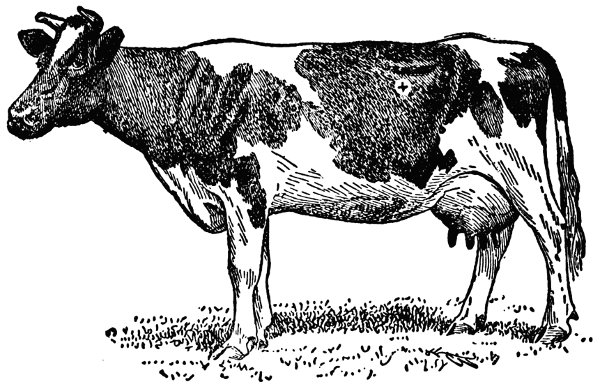
WHERE TO TAP IN BLOATING
Insert the trocar and canula, or if these are not available a knife may be used. Make the puncture downward and forward and plunge the instrument into the rumen.
Bloating may take one or two forms; a mild case in which recovery gradually follows, and a very severe form, where the only salvation is in tapping to release the gas. If it is an ordinary case of bloating, not very severe, ordinary remedies will give relief. Turpentine in doses of 8 or 10 tablespoonfuls is good. Some use 4 tablespoonfuls of hyposulphide of soda dissolved in water, with excellent results. Some veterinarians give doses consisting of 4 tablespoonfuls of aromatic spirits of ammonia in water as a drench. Ginger is frequently given, as much as 4 tablespoonfuls diluted in warm water as a drench. To keep the animal moving about is excellent.
In severe cases it is advisable to tap with the trocar and canula. Indeed, tapping is the last resort if you would save the animal. These are inserted on the left side of the skin and pushed into the rumen or paunch, the incision being made about half way between the point of the hip and the last rib. In introducing the trocar push in and down.
After the insertion is made, the trocar is withdrawn and the canula is left in to furnish an opening through which the gas can escape. In case the canula gets clogged with partially digested feed, insert the trocar so as to push away the material and withdraw it again. If the trocar and canula are not available, then use a pocket knife. Of course, be careful that the incision is not made too large.
Just a few simple precautions are suggested here as a prevention of this trouble. There is always danger from bloating when cattle or sheep are turned into green pastures, especially when not accustomed to such feed and especially when wet. It is advisable, therefore, to keep stock from the pasture until later in the day when the dew has disappeared. Stock should have their regular morning feed just as usual before being turned on the pasture. They will have less greedy appetites, will not like to gorge themselves, and hence the trouble will not be brought on.
BLOOD POISONING.
—When blood poisoning results from the entrance of bacteria into the circulation, it is termed septic infection. This means that the disease may be communicated to a healthy animal by inoculation. Thus, an operator in making a post portem examination may bring on blood poisoning because of an accidental prick of the skin. An animal may step on a nail or get a splinter in a muscle or under the skin, and become self-inoculated, in time becoming affected with septic infection. Consequently bacteria are the direct inducing factors. The chemical poisons produced as a result of the work of these bacteria, as those of putrefaction, may induce what is known as septicæmia. On the other hand where pus is produced, as in the abscesses which follow upon neglected wounds in joints, a form of blood poisoning is produced known as pyæmia. In either case blood poisoning may result, become very serious and may cause the death of the victim.
At first chills may be noticed, then a rise of temperature, quick respiration, rapid but weak pulse, and much prostration. All the time the appetite is disappearing, until it becomes lost. The mucous membranes of the eyes and nose take on a yellowish, red tint often showing spots or blotches of blood and the tongue becomes coated and clammy.
Quick treatment is necessary in every case of blood poisoning. As soon as noticed, the source should be treated with disinfectants, thereby arresting the supply of morbid matter. A strict employment of antiseptics, so as to destroy the bacteria, is the first essential. We look upon the prick from a rusty nail, or wound from a wire fence, or a dirty stable splinter, as matters of frequent occurrence, yet a great deal of danger lurks among these. They should be avoided as much as possible and in all cases immediately treated. As soon as the poison is admitted to the blood or tissue, the disease germs multiply and soon are present in great numbers. Had the wound been cleansed with an antiseptic like carbolic acid in the beginning, it would have been a simple matter and the poison would have been neutralized, and the ingress of the invaders made unattractive, if not altogether impossible.
In all cases of blood poisoning, look to a systematic and constant application of suitable lotions to the injured parts, to careful nursing, and to nourishing food. If the appetite has completely departed, it is often advisable to force food like eggs and milk into the stomach, so that the strength of the patient may never be dissipated or weakened. With this treatment should go pure fresh air, cleanliness and much sunshine. It usually is advisable to call a veterinarian as early as possible.
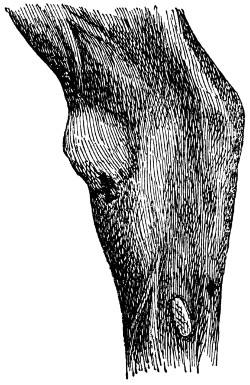
BOG SPAVIN
The bulging outward of the soft tissues of the hock joint is due to the secretion of joint oil or lubricating liquid in abnormal amounts.
BLOODY MILK.
—Sometimes, just after calving, bloody milk is observed. The cause is generally due to a rupture of the small blood vessels in the vicinity of the cells that secrete the milk. It may be due to a tiny accident of some kind or it may be the result of disease, localized in the udder. Bathing the udder with hot water will prove helpful and, until the milk is normal, frequent milkings are desirable. If the condition prevails for any length of time and the cow is not a very good one, it is just as well to fatten her and send her to the butcher.
BLOODY URINE.
—A condition of the urine peculiar to certain diseases like Texas fever in cattle and azoturia in horses. In the latter disease the urine is quite turbid and dark in color, sometimes almost black.
BOG SPAVIN.
—A round, smooth tumor at the front and on the inside of the hock. It is the result of sprains, bruises, or other injuries. When these injuries occur, too much joint oil is secreted, causing a bulging of the ligament. Lameness seldom accompanies a bog spavin. If lameness be present other structures are certain to be affected, and some pain and heat will be noticed, together with a stiffness of the joint.
Treatment consists of applications of cold water to the affected parts and a lotion made of 2 tablespoonfuls of acetate of lead in a quart of water. A blister made of 1 teaspoonful biniodide of mercury and 4 tablespoonfuls of lard rubbed in a little with the fingers and repeated in ten days or two weeks and continued for some months will correct the trouble. Wash the part having received the blister twenty-four hours after application. It is also advisable to tie the horse’s head while the blister is on, so that he cannot bite the part.
BONE SPAVIN.
—See Spavin.
BOT FLIES OR BREEZE FLIES.
—The larvæ or grub of all common bot flies are thick, fleshy grubs and pass their life in some portion of the body. When they are fully developed they leave the body by some route and bore into the ground, where they go through another stage of their development known as the pupa stage. When this stage is completed they crawl out of the ground as a fly ready to deposit eggs.
Horse Bot Fly.
—Everyone is familiar with the common nit fly and the yellow nit that is attached to the hair on almost all parts of the horse, but especially on the chest and legs. The young larvæ or even the egg may be transferred from these regions of the body into the mouth by the horse biting these parts. The grub passes into the stomach where it attaches itself to the mucous lining and continues its development. The bot is not so dangerous as it is popularly supposed to be. They may, when attached in large numbers to the right side of the stomach, interfere with digestion and be responsible for some of the digestive disorders and colics. They are uniformly present in the stomach of all horses that are kept in the open where flies can get at them. A carefully groomed animal may be free from them. The eggs may be destroyed by rubbing the body with a rag wet with kerosene. One of the most common remedies for bots, and at the same time the most useless, is a mixture of molasses and milk. Bots are hard to dislodge from the stomach until they have completed their development there and pass out of their own accord. Half-ounce doses of turpentine three hours apart until three doses are given, followed by an ounce of powdered aloes as a physic, is a good remedy and easily administered. Mix the turpentine with half a pint of milk or gruel and give on an empty stomach. Carbon bisulphide is a good remedy. Take two drachms or one-fourth of an ounce of this and shake with a pint of cold water and drench. Repeat this every two hours until an ounce of bisulphide is given, then give a physic of aloes. These remedies should be given on an empty stomach.
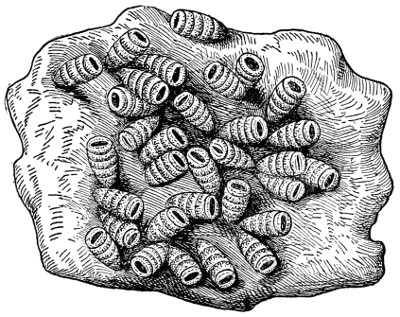
HORSE BOTS IN STOMACH
The bot fly lays its eggs on the hair of the horse. These, taken into the stomach, hatch out and give rise to horse bots or young maggots that attach themselves to the walls of the stomach. After becoming grown they loosen themselves and pass out with the feces.
Bot-Fly of Cattle or Warbles.
—It is now believed that eggs are deposited near the feet and that the grub is taken into the mouth and becomes partially developed in the digestive tract. It then burrows through the tissue until it reaches the region of the back. The only treatment that will amount to much is to destroy the grub as it is developing under the skin. If farmers and stockmen will systematically do this they can soon lessen the damage done. The heel fly annoys cattle, and the grub, when it escapes from the back, leaves a hole in the best part of the hide, causing loss in this way. After the grubs are in the back no treatment helps the animal very much; but the grub can be killed, thus preventing their developing into flies that would annoy other cattle. The grubs may be squeezed out and destroyed. Mercurial ointment may be rubbed through the hole and kill the grub, or chloroform, or creoline, may be injected into the grub with a hypodermic syringe. It does not require very much time to look after the number of cattle usually found on a farm.
The Bot-Fly of Sheep
is a very troublesome pest at times, and always causes trouble and annoyance to the flock when present, and occasionally causes considerable financial loss. The fly attacks sheep during the warm months, July and August generally being the worst. The presence of fly in the flock is easily told by the behavior of the sheep. The fly looks much like a house fly, only it is longer and it always attempts to lay its eggs just inside of the opening of the nose. As soon as the fly begins to get near the nostril the sheep will begin to run, will hold their noses close to the ground, and frequently huddle together as closely as possible for protection. When the fly does succeed in depositing the larvæ it begins immediately to work its way up the cavity of the nose and finally gets into the small cavities in the head, where development goes on. It is during this period of development in the head that most of the damage is done. As the grubs grow larger a discharge from the nostril is noticed, which may soon become very thick and sticky, gumming up the nostrils and making breathing difficult. The sheep will often carry their heads low, but will frequently raise their heads and point their noses straight up.
The treatment may be either preventive or surgical. The first is within the reach of everyone owning sheep. Where only a few sheep are owned each individual should be caught and a mixture of tar and lard, or oil of tar and lard, applied to the nostril with a brush. This can be done in a short time and should be repeated every ten days or two weeks during the warm months. Narrow salt troughs may be made and the edges smeared with tar so that the sheep will get tar on their noses when they take salt. Turpentine may be applied high up in the nostril by means of a feather. Begin the preventive treatment early in the spring or whenever you know by the action of the sheep that the fly is bothering them, and you will have better success than to wait until the sheep are affected and undertake to cure them.
BOTS.
—See Bot Flies.
BROKEN WIND.
—See Heaves.
BRONCHITIS.
—A common disease of domestic animals attacking the bronchial tubes. It may be chronic, but is usually acute, and may affect one side or both. The most frequent causes of bronchial catarrh are colds. A sudden cooling of a heated body by drenching, by the breathing of cold damp air, may all bring on the disorder. Dust, smoke or gas, when inhaled, often produces the same trouble. Acute bronchitis usually sets in with a sudden rise of the temperature of the body, and the animal seems to have a chill. This may be quite violent at times. The cough is noticed very much as with people, being short, dry, and husky. Later on, as the disease progresses, a frothy mucus follows the cough. Associated with the disease is a loss of appetite, constipation, and pains in the chest and rattling in the chest and throat. A favorite position of the horse is standing and of other stock that of lying down. Good care is essential in the treatment. That means, with good treatment, dust, smoke, and bad air are to be severely avoided. Plenty of good ventilation, but no draft; and warm, well-lighted quarters are very desirable. The animal should be blanketed to be kept warm in the early stages and a compress placed over the chest, with blankets over the compress. Frequent changing of this compress is desirable, say a change every hour or two. When the animal is suffering from a chill, stimulants are excellent. A tablespoonful of whiskey in a pint of water and given as a drench every half hour or hour will be helpful.
After the chill period is passed, small doses of tincture of aconite, say 10 to 15 drops, in a little water as a drench will assist in discharging the mucus. When the animal has become at ease, a mustard plaster applied to the lungs will help you somewhat. From now on the treatment should be good nursing and good food. Boiled flaxseed and gruel will be very helpful. A very helpful preparation may be made of the following: Nitrate of potash or saltpeter, tartar emetic, ground gentian root, equal parts. A half pound or pound in all should be mixed thoroughly, and then a teaspoonful given three times each day. When all danger is passed, continue the careful handling and allow two or three weeks’ complete rest.
BUNCHES.
—Bunches are most generally enlargements of the bone. They are most serious in the region of a joint. They are caused, as a rule, by some injury, bruise, or wound. When first noticed they should be treated with a blister to insure a hasty absorption of the enlarged parts.
BURNS.
—Occasionally animals are burned or scalded so badly as to subject them to considerable pain. This may be relieved by the use of a strong solution of common baking soda. Following the use of this, apply an ointment made of one part of carbolic acid to 50 parts of vaseline. If vaseline is not available, then use in its place linseed oil.
CAKED BAG.
—See Mammitis.
CAKED UDDER.
—A diseased condition of the udder, with the secretion of milk altered, the udder hot, dry, and caked, and the glands inflamed. The trouble may be due to external injury, to germs entering the teats or to the milk being kept for too long a time in the udder. As soon as noticed the udder should be bathed in hot water and massaged for several minutes. After being dried with a cloth rub on a salve made of 2 tablespoonfuls of gum camphor dissolved in 12 tablespoonfuls of lard. At the same time give 4 tablespoonfuls of saltpeter morning and night for two or three days. See also Mammitis.
CALF CHOLERA.
—When a new-born calf comes into the world weak, puny, and listless, and dies in a few hours after scouring, bawling, and blatting and has sunken eyes and bloated belly soon after death, the disease by stockmen is called “calf cholera.” Many calves so affected are really “living abortions.” They have just enough life at birth to exist a few hours and show the symptoms described, and such calves are usually the offspring of cows that, during pregnancy, have been incompletely nourished upon timothy or swale hay, or coarse fodder, without an adequate supply of other foods to balance the ration; or similar calves may come from fat, flabby, corn-stuffed, beef-bred cows.
The trouble may be prevented by proper feeding of the pregnant cow, but there is no cure. A majority of such cases, however, are due to germ infection. Cows affected with contagious abortion may produce affected calves; the afterbirth and navel cord are invaded by the germs in such cases and the calf is improperly nourished in the womb. In other instances, calf cholera is due to filth germs entering the calf’s system by way of the raw navel cord stump at birth, or the mouth when the calf nurses from a manure-contaminated udder.
Prevent infective cases by providing a clean, fresh-bedded, disinfected, whitewashed, sunlighted, ventilated pen for the new-born calf, and immediately wet its navel with a 1⁄500 solution of corrosive sublimate and repeat the application twice daily until the cord dries up, drops off and no raw spot remains. Also wash the hind parts of the cow and her udder with a two per cent solution of coal tar disinfectant before the calf is allowed to suck for the first time and repeat the washing twice daily for at least a week. Isolate affected calves. Bury or burn the dead.
CALF SCOURS.
—See White Scours.
CANCER.
—Malignant growths, the cause or causes of which are not known; nor can it be said the disease is infectious. While a very serious disease among human beings, it is, fortunately, however, more rare among farm animals. The only treatment worth while is in surgical removal of the growths. If this be done when the tumors are first noticed and when they are small, their further appearance may not result. It is a good plan, if the growths persist in presenting themselves, to eliminate the affected animal from the herd. With cattle, it is possible to prepare them for market long before any cancer growths may reappear, and in this way the full market value may be secured with no danger when consumed.
CAPPED ELBOW.
—Frequently horses, in lying down, press the foot or the shoe against the elbow. This, in time, causes inflammation and ends in a tumor or shoe boil. The diseased condition is difficult to repair, as there is little flesh or muscle at the joint of the elbow where the trouble starts. Treatment consists of opening the boil and allowing the fluid to escape. In case the swelling is hot and painful, an application of lead acetate will prove comforting and helpful. In preparing the lotion, use 2 tablespoonfuls of acetate of lead to a quart of water. There is no objection to injecting a little of this into the opening. An injection of a little tincture of iodine once a day into the opening is desirable also. In treating cases of this kind, it is a good practice to wrap about the horse’s foot a pad of straw or hay for cushioning the foot. This prevents the wound from being further bruised, otherwise the cure may be greatly delayed, if not indefinitely postponed.
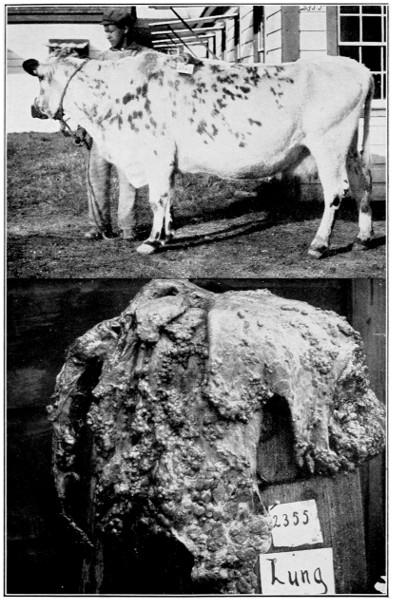
A VICTIM OF TUBERCULOSIS
This cow, reacting to the tubercular test, was killed. The bottom picture shows the extent to which tuberculosis had affected her lungs. At least ten per cent of the cattle in the United States have this dreaded and destructive disease.
CAPPED HOCK.
—An inflammation resulting in a separation of the cap from the point of the bone of the hock. Cases of this kind are the results of kicks or bruises. In the early stage, use 2 tablespoonfuls of lead acetate in a quart of water and bathe the injured part. When there is no longer any temperature, apply a blister composed of 1 teaspoonful of biniodide of mercury and 6 tablespoonfuls of lard. Apply this every week or ten days for several months.
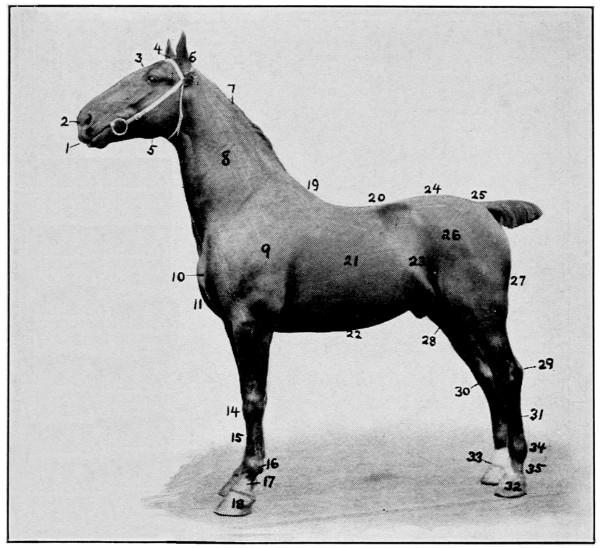
EXTERIOR POINTS OF THE HORSE
1 Lip, 2 Nostril, 3 Forehead, 4 Poll, 5 Cheek, 6 Ear, 7 Mane, 8 Neck, 9 Shoulder, 10 Point or Shoulder, 11 Breast, 12 Forearm, 13 Arm, 14 Knee, 15 Cannon, 16 Fetlock, 17 Pastern, 18 Foot, 19 Withers, 20 Back, 21 Side, 22 Underline, 23 Flank, 24 Croup, 25 Tail, 26 Haunch, 27 Thigh, 28 Stifle, 29 Hock, 30 Point of Hock, 31 Cannon, 32 Foot, 33 Coronet, 34 Fetlock, 35 Pastern.
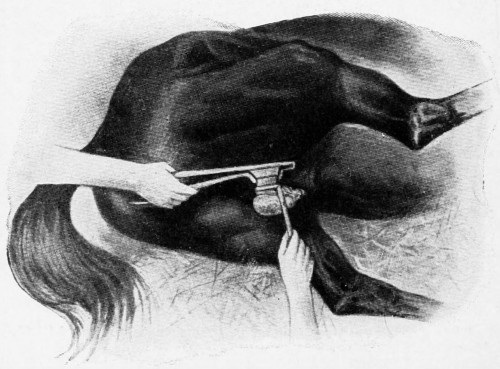
CASTRATION
CAPPED KNEE.
—An enlarged condition of the knee most commonly found in cattle. It is caused by cattle getting up and down on hard floors. It is usually seen in stables where stanchions are used. A baggy tumor forms at the front and just below the knee. In some instances this tumor becomes very large and the cow walks about or moves with great difficulty. Where hard floors are covered with bedding, no trouble of this kind results. Applications of hot water are excellent. Liniment is also very good. Where the tumor has long existed and is stubborn an opening should be made at the bottom so that the fluid may be discharged. A little tincture of iodine injected into the opening once a day is good and at the same time an application of iodine rubbed over the outside will assist in reducing the trouble. Use one part of iodine to eight parts of lard and continue this treatment for a month or two.
CASTRATION.
—The removal of the testicles from male animals. Castration is practiced upon all the domestic animals. Only those male animals possessing desirable characteristics are retained entire. The operations are generally performed when the male animals become troublesome. In horses the time is usually at one to three years old; in cattle one to three months old; sheep at one to four months and pigs two to four months old. Dogs, as a rule, become worthless if castrated. Cats grow to an enormous size when castrated.
Suggestions About the Operation.
—In the castration of all the domestic animals some general suggestions will be beneficial. (1) Secure the animal so he cannot injure himself or the attendants. (2) Do the castration during the early spring. (3) Give the animal exercise after castration. (4) Boil the instruments before operating, using warm water and any good hand soap. (5) Disinfect the skin over the scrotum before operating with corrosive sublimate 1⁄1000. (6) Wash the hands of the operator with soap and water, then disinfect with corrosive sublimate. (7) Great care should be exercised that no corrosive sublimate be left that stock may drink, as it is a deadly poison.
When the instruments have been boiled (sharp castrating knife and emasculator), cast (throw) the animal as carefully as possible. Secure the hind legs so they will not hinder the operator. The operator having his hands clean and the scrotum washed and both his hands disinfected, and also the region to be operated upon, the animal is ready for the operation. The lower testicle is grasped with the left hand and with the right hand an incision is made over the testicle, down to the testicle. The testicle is pulled upon until the cord is seen. Then the emasculator is used to crush the cord. This emasculator should be placed on the cord as high up as possible. Some like their horses castrated proud. This consists in leaving part of the testicle. This last method is not safe, as it allows the testicle to become infected and form what is commonly known as water seeds. A tumor grows on the cord and may become the size of a man’s head.
After the testicle is removed, then enlarge the first incision (cut) that was made through the skin so as to give plenty drainage. This incision should be about eight inches long for horses. By having a large incision the upper part can heal first, and there will be good drainage until the scrotum entirely heals. If possible turn the castrated horse out to pasture after the operation, and it will exercise sufficiently to keep the parts from swelling. Do not keep the animal in a dirty stable after it is castrated, as there is so much danger from infection in the dirty horse stable. If the horse is broken it can be put to light work a week after the castration.
Bulls do not need to be thrown to be castrated. The incision is made over each testicle, and the operation carried out in the same way as with the horse. Bulls are not so susceptible to infection as the horse.
CATARRH.
—Commonly known as a cold, catarrh is recognized as an inflamed state of the upper portions of the air passages, with more or less discharge from the mucous membranes. The eyes often sympathize with this deranged condition, with a watery state as the result. The causes of catarrh or colds in animals are very much the same as those causing the same disturbance in human beings; as with people, so with animals, the malady should be remedied as quickly as possible. Bad air is one of the most frequently observed causes; consequently pure cold air with proper blankets to keep the body warm is considered the best treatment for simple catarrh when unaccompanied with other troubles.
One of the common symptoms is dullness and loss of appetite. The hair stands out and looks rough, a slight cough may be noticed and sometimes a rattling is heard in the head. For cattle a mild dose of physic, consisting of one-half pound Epsom salts and 4 tablespoonfuls of sweet spirits of niter mixed in a pint of lukewarm water and given as a drench, is about all that is necessary. If the cold hangs on, mix together one-half pound of nitrate of potash or saltpeter and one-half pound of gentian root and give a teaspoonful of this three times a day until the animal is better. Of course good food should go along with this treatment. The horse should be fed soft food like bran mashes and be kept quiet in a well-ventilated stable. If the cold hangs on with him, mix one-half pound of saltpeter or nitrate of potash, one-half pound of sulphur, and one-half pound of ground gentian root and give a teaspoonful morning, noon and night.
CATTLE SCAB.
—See Scab in Cattle.
CEREBRO-SPINAL MENINGITIS.
—A disease fatal in violent attacks and not well understood as to cause. It is believed to be non-contagious, although frequently extensive outbreaks occur, suggesting that it may be contagious. The symptoms are not well defined, due, perhaps, to the fact that other diseases are included under the general name. Horses of all ages of both sexes are affected, and temperament and physical condition have nothing to do with susceptibility to the disease. Likewise mules are affected and the mortality among them is equally as great as among horses. The most acceptable belief as to cause centers around a bacterial organism that works in the membranes of the brain. However, some writers attribute the disease to ergot, smuts and molds supposed to be taken with the food. Moldy corn and moldy hay are believed to be associated with the disease. The symptoms are staggering gait, partial or total inability to swallow, various muscular contractions and delirium.
Treatment is seldom effected, especially in violent cases. Mild forms frequently respond to cathartics, blisters on the neck, spine and throat. These give some relief. Small doses of aconite are also believed to be helpful. Some writers place choking, distemper, grass staggers, and blind staggers along with this brain disorder.
CHARBON.
—See Anthrax.
CHEST FOUNDER.
—See Navicular Disease.
CHICKEN CHOLERA.
—Chicken or fowl cholera is a germ disease, and contagious. It attacks poultry of all kinds. Diarrhœa is a prominent symptom of the disease. Bad food or improper food may aggravate the trouble, but the germ introduced into the system either in food or drink, is at the bottom of it. At first the droppings will take on a whitish color. Diarrhœa will then result. The discharges will then become thin and watery, to be at times frothy and greenish in appearance. Fowls thus attacked soon lose their appetites and become stupid and take on a sickly appearance. The head drops toward the body, the eyelids fall, and the fowls stand around as if doped. Some recover, but, unless checked, the flock will be materially injured.
Of course dead fowls must be burned at once and lime and other disinfectants used to keep the disease from spreading. The well birds must be kept apart from the infected quarters. Care must be exercised that infection be not carried either by visitors or attendants from the sick to the healthy quarters. A common remedy consists of 1 part of sulphate of iron to 50 parts of water for drinking purposes. Another common remedy is to mix a tablespoonful of sulphate of iron, 2 tablespoonfuls of dried blood, and 2 tablespoonfuls of tincture of opium with a pint of water. This is given in the food in doses of 1 or 2 tablespoonfuls of this mixture three or four times a day to each sick bird.
CHOKING.
—Horses frequently choke from too rapid eating of oats, and cattle are very commonly troubled on attempting to swallow apples, turnips, or small pieces of ear corn. In either of these cases much distress is occasioned and serious danger. In treating the horse, the best treatment is to give it a little oil, after which rub the hand up and down the gullet to scatter the accumulated oats. Sometimes it is necessary to make an incision in the gullet through which the material is removed. Better have a veterinarian do this. When food lodges in the gullet of cattle, suffocation soon follows if it is serious and in the upper part of the gullet. When such objects have lodged near the stomach end there is less immediate danger. Of course the first treatment is to try to force the object down by using the hand, if at all possible. If this cannot be done a probang should be used. The probang should be very limber, so as to bend easily, and it should be used with great caution. Cattle often are killed by the accidental puncture of the gullet as the probang is pressed down toward the mouth of the stomach. Consequently no unyielding article like a broom handle or even a buggy whip should be used. If a regular probang is not available, a rope a little less than one inch in diameter can be inserted and gently worked down the gullet. Before using the rope, grease it well and make a knob at the end to be inserted. This knob can be made of cotton strings or muslin cloth.
COFFIN JOINT LAMENESS.
—See Navicular Disease.
COLDS.
—See Catarrh.
COLIC.
—Colic is an inflammation of the bowels characterized by a spasmodic contraction of the intestinal walls. It is a very common disease in horses, and occasionally cattle and lambs are affected with it. Both the small and large intestines may be afflicted or only one of them. There are many causes, but feed and water are the controlling factors. An animal just stopped from hard work and given a large quantity of cold water, especially after eating, may be quickly troubled. And the animal hot from work, on drinking very cold water, often gets colic. Then, too, a change of food, or a change from dry feed to green food or eating some root crop when the animal is not used to it, may bring on the disease.
Then, again, some horses and cattle are more given to colic than others. Some individuals are never troubled, and others are almost constantly under its influence. If much inflammation sets in, a very serious case is on your hands. Two kinds of colic are known—the spasmodic, a contraction, commonly known as cramps of the bowels; and wind or flatulent colic or bloating. Some authorities add a third, and call it worm colic.
Spasmodic Colic.
—This kind of colic is first noticed when the horse begins to paw with his forefeet, cringes, bends his head around as if looking at his side, lays on the ground and rolls as if in pain; then he stands quietly for a while and repeats these performances again. During the time between the spasms the animal is more at ease and frequently eats a little. When the spasms come on again the shifting about and the rolling are repeated. If the cramps are severe the animal breaks out with sweat. The pulse is accelerated when the spasms are on, ranging from 60 to 65 beats a minute. If inflammation has set in, the pulse instead of rising and falling remains more constant and is high all the time.
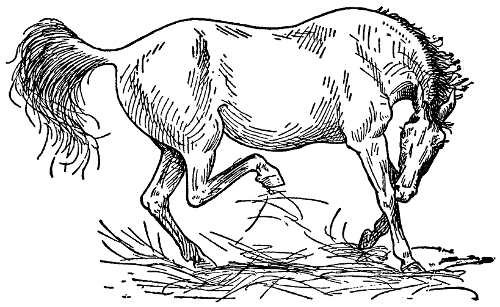
COLIC PAINS
A common attitude with colic. When seized with pains the horse paws, scrapes the ground with his front feet, stamps and strikes the belly with the hind ones, lays back his ears and looks around to his flank.
When the spasms are on, pressing the bowels seems to relieve the pain and please the animal, but if inflammation is present the pressure seems to increase the pain. The best treatment is to relieve the pain with an opiate, and next to obtain a free action of the bowels by a purge. Many prescriptions have been suggested, among which is the following: 4 tablespoonfuls of sweet spirits of niter, 4 tablespoonfuls of laudanum, 1 tablespoonful of ginger and 1 tablespoonful of common soda. These are added to a pint of warm water and given as a drench.
Flatulent Colic.
—This form of colic, though not so acute, is much more constant than the preceding form. The body is swollen in the region of the bowels, the gas extending quite generally through the region. There is also a tendency to inflammation. The pulse will be noticed as more rapid, and at the same time more feeble, the breathing will be more pronounced, and the animal less steady on its feet. In treating the patient it is advisable to unload the rectum with greased hand and arm, and the admission of warm water with soap in it, is also likely to be beneficial. A little turpentine mixed with the soap and water is good. The intestine is to be cleaned out as far as the arm will reach, but a violent purge is unwise, as that only intensifies the inflammation. Naturally the first thing is to mildly open the bowels. For this give 15 or 20 tablespoonfuls of linseed oil and 5 or 10 tablespoonfuls of spirit of turpentine. If the case continues, it is advisable to call a veterinarian, and it may be necessary to use the trocar and canula. If the instrument is sterilized, no great risk attaches to the operation, while immediate relief is secured as the gas passes out through the tube, and the distention is visibly reduced. An excellent mixture for this kind of colic consists of 6 tablespoonfuls of chloral hydrate, 6 tablespoonfuls of laudanum, 3 tablespoonfuls of sulphuric ether, 2 tablespoonfuls of turpentine, and 10 tablespoonfuls of ginger. Of this give 2 or 3 tablespoonfuls in a half pint of warm water and repeat every half hour for 3 or 4 doses and then place the doses an hour apart until all danger has passed.
When there is a good deal of gas with considerable swelling an excellent drench is made of 2 tablespoonfuls of powdered aloes, 4 tablespoonfuls of spirits of ammonia and 4 tablespoonfuls of sulphuric ether. This should be mixed with a pint of water and given promptly. In case of considerable pain use this: 4 to 6 tablespoonfuls of hydrate of chloral and eight tablespoonfuls of sugar mixed in a pint of water and give as a drench.
CONCRETIONS OR CALCULI OF URINARY ORGANS.
—The collection of solid mineral matter in the urine may become lodged in the kidney, the ureter (duct leading from the kidney), the bladder or urethra (the duct leading from the bladder). All animals are more or less subject to these conditions, and yet are not so affected as they are sometimes thought to be. Many a case of so-called kidney colic is in reality an affection of the digestive system. The cause for these mineral accumulations perhaps varies under different conditions, yet the most common circumstance under which they occur is during the time when animals are fed exclusively or largely upon dry feed such as exists in the winter time where silage is not fed. Wheat bran has been attributed as one of the most sourceful means of bringing on this trouble. When it is fed with succulent feeds and an abundance of water allowed these disorders do not occur.
The symptoms do not differ a great deal from some forms of colic, due to stomach or intestinal disturbances, especially in the frequent attempts to empty the bladder. The animal usually shows more or less pain from the restless condition, looks around at the flank, dribbles his urine frequently, which is occasionally blood stained. There may be a complete obstruction of the passages, in which case no urine is voided.
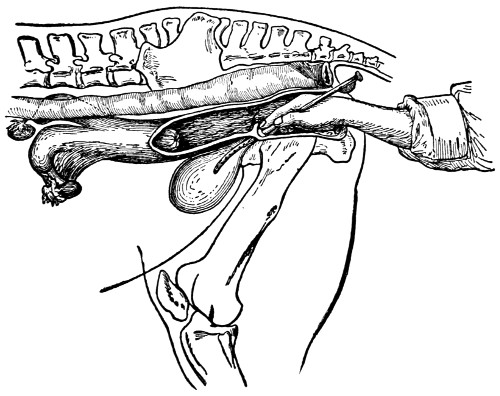
RETENTION OF THE URINE
By means of a catheter the greater portion of the urine can be drawn off. The operation is shown in the picture.
Treatment varies
with the location of the trouble, in which little can be accomplished when the gravel or stone is located in front of the bladder. If within the bladder, not obstructing its outlet, it is not likely to make its presence known. Agents should be given, however, to overcome the pain and to relieve the frequently existing spasm at point of obstruction, as far as possible, which may allow passage of stone. Give 4 tablespoonfuls of laudanum or chloral to a dose and repeat in two or three hours if any pain or trouble is still indicated. In inducing the animal to drink liberal quantities of water the condition may be somewhat relieved by making the urine more watery in character and possibly dissolving a portion, allowing the remainder to pass along its course. When the obstruction occurs within the urethra the removal should be made by incising through the tissues on to or near the obstruction, removing by forceps and suturing up the wound. A skilled operator is required for this, hence the veterinarian should be called.
CONSTIPATION.
—An infrequent movement of the bowels with the dung hard and dry. The animal is said to be bound up or costive. Bad food, improper feeding, lack of exercise, all contribute to the trouble. Treatment is in the line of laxative and succulent food, such as wheat bran, green grass, silage and linseed oil meal. If the case is one requiring immediate action give any of the usual purgatives, but do not continue their use as a regular thing. If green grass is not possible, nor silage available, give one or two teaspoonfuls of the following mixture in the food three times a day: Equal parts of ground gentian root, powdered nux vomica, powdered ginger and sulphur.
CORNS.
—Small swellings or tumors on the sensitive heel in the triangular space between the bars and the wall of the heel. These are found in the fore feet only, and almost always on the inside heel. They are caused most frequently by bad shoeing or from wearing the shoe for too long a time. These growths do not always cause lameness, although, as a rule, they do. They are, however, always sensitive to pressure and usually appear as tumors of a hard, corny character. Neglected corns are liable to fester and must then be laid bare by the knife and be poulticed. Neglect of this treatment results in the matter or pus finding its way up through the coronet. Thus quittor may result.
Give the foot a careful dressing by paring the heel, and bathe the corn with a weak carbolic acid solution. After doing this, place a fold of muslin over the corn and then over all a bran and linseed poultice. A complete rest from work, hard roads and shoes should now be given the animal until the corn has entirely disappeared. When the feet are again shod, leather should be used as a protection. Many corn salves are recommended, but unless the corn be removed and the pressure taken from the wound, there can be no cure, even though the tumor is pared away.
CORNSTALK DISEASE.
—When cattle are allowed to run in stalk fields it frequently happens that a large per cent die from various causes. All these troubles are classed under the one term—cornstalk disease. In some western fields where there is a second growth of cane stalk late in the fall an early frost will at times develop in the stalk a deadly poison (hydrocyanic acid), which kills the animal in a very few minutes after eating it. This poison has not been found in the cornstalk.
In the last year or two some of our state experiment stations have been investigating several molds which seem to affect not only cattle but horses as well. These molds grow quite abundantly upon cornstalks, alfalfa, and other forage crops. The death of a great number of animals has been traced directly to the feeding of such affected fodder, hay, or corn. These molds, however, must have a certain amount of moisture for their growth, and it has been shown that when the feeds have been properly harvested and sheltered no trouble has resulted. Only in materials exposed to the weather, allowing the development of these lower forms of plant life, has serious trouble been found.
In the treatment of these troubles nothing reliable can be given, as the disease usually comes on without any warning and the animal dies suddenly. Much of the trouble can be avoided by allowing the animals only a limited amount of the feed or in the stalk field a few hours only each day. It is necessary that plenty of pure water should be given frequently and enough of other roughage to keep the animals from gorging themselves on the fodder.
COW POX.
—An infectious disease passed from one cow to another. It affects herds in all parts of the world and is similar to smallpox in the human being, only it is not so fatal. When first affected the cow is feverish, slacks somewhat in the milk flow, and presents little red pimple-like spots around the teats. In a day or two these become enlarged and become blisters, containing within a watery fluid, which, if not broken, dry up themselves and form scabs, leaving the teat in time perfectly natural. Ordinarily, special treatment is not given. There is no objection, however, to providing a simple tonic composed of one-quarter pound saltpeter, one-quarter pound sulphur, and one-quarter pound ground gentian root. Give a teaspoonful of this night and morning in a mash. The teats should be bathed, just before milking, with any common disinfecting solution. If the sores are slow in healing, sweet oil, to which is added a little carbolic acid, will soon correct the trouble.
CRACKED HOOFS.
—See Sand Cracks.
CRIBBING.
—A habit of biting the manger or other objects, often sucking in the air at the same time. This bad habit is frequently called wind sucking. It is the result of a habit formed when young. There is really no cure when the habit is once formed, but different measures may be employed to lessen the fault. A broad strap firmly placed around the neck brings the desired effect with some individuals.
CRIB SUCKERS.
—This bad habit usually begins in colt days. It may arise from a sore tooth. The colt, to relieve the feeling, bites the manger, and in so doing acquires the habit. When hanging on to the manger, air is sucked in and this frequently brings on colic. The best treatment is to break up the habit. Examine the mouth first to see if anything is wrong with the teeth. Muzzle while standing in the stable. The old cribbers never give up the habit.
CRAMP COLIC.
—See Colic.
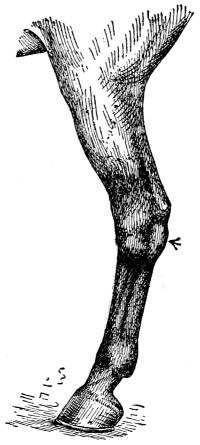
CURB
While common to all varieties of the horse, curbs are most frequently seen in the lighter breeds and especially in roadsters and trotting horses.
CURB.
—A sprain or injury to the ligament situated on the back part of the hock joint. Anything that puts too much stress on this part, such as holding back heavy loads going down hill, or backing up too heavy loads, or the hind legs slipping too far under the horse’s body, may cause curb disease. It is also caused by kicks or by the whiffletree striking against the back of the hock joint.
There will be swelling and heat in the part and lameness. In some cases there will be swelling, but no lameness. If the swelling is hot and tender to the touch, mix half an ounce acetate of lead and two ounces tincture of arnica with one quart of water. Shake up and apply a little to the swollen part three times a day and continue until the heat and swelling disappear. If there should be any swelling after the heat and lameness have disappeared, mix 1 teaspoonful of biniodide of mercury with 4 tablespoonfuls of lard. Rub on a little with the fingers, let it remain on for 24 hours, then wash off with warm water and soap and repeat the blister in three weeks if needed. In cases where there is swelling, but no heat or lameness, the lotion would be of no use, but the above blister should be used as directed. In old or long standing cases of curb, if the animal is not lame, it is best to let it alone, as medicines would be of no service.
DIABETES; PROFUSE STALING.
—In man there are two forms of this trouble seen rather frequently, but among domestic animals only the insipid form is common. It is often simply a sign of some other disease, but not infrequently occurs under similar circumstances; such as certain forms of indigestion, the result of eating musty or damaged feed. The most characteristic symptom, of course, is the frequent urination of liberal quantities of urine. Associated with this is usually an unabating thirst. The animal loses flesh rapidly, the flanks are tucked up, the coat is dull, languid and staring, and great weakness is shown. If not relieved, the animal may die from exhaustion. In the second form of diabetes, the distinguishing feature is the presence of sugar in the urine.
If in a working animal it should be laid off from work. Search should be made for the cause of trouble. If any of the food appears suspicious it should be substituted with wholesome food. To relieve the ardent thirst and assist recovery, a teaspoonful of the crystals of iodine should be given in a ball of linseed or other pasty material. It may be desirable to repeat this in three or four days. Also give in the drinking water 4 tablespoonfuls of bicarbonate of soda three times daily.
DIARRHOEA.
—See Dysentery.
DIFFICULT PARTURITION.
—See Obstetrics.
DIPPING LIVE STOCK.
—There are only two satisfactory methods of treating animals with a dip. The first is hand treating, where the number of animals are few and easy to handle. In hand treating the animal the dip is applied with scrubbing brushes, sponges, etc., and all parts of the body liable to infection should then be thoroughly and vigorously rubbed. If hand treating is properly performed it is an excellent method. The second method consists of immersing the diseased animals in the dipping solution. There are two forms of vats in use for this purpose. The cage vat is designed for comparatively few cattle. As its name implies, it consists of a cage in which the animal is placed and then lowered into a vat containing the dip. Where a large number of animals are to be dipped, the swimming vat is very popular. The animals are forced to pass through the vat, which contains sufficient dip to completely immerse them when they plunge into the solution.
The coal-tar dips are made from some of the products of the distillation of coal tar. When mixed with water they form a milky emulsion, having a strong odor of coal tar. The coal-tar preparations, in addition to being used as parasiticides, have become very popular disinfectants in hospitals. These preparations are used with good success on all open wounds, where a disinfectant is required. In poll evil and fistulous withers they are extremely valuable, owing to the fact that in addition to their power as a germicide they have been perfectly safe to place in the hands of persons not accustomed to handling drugs, because of their non-poisonous nature. They have been found quite efficient when used in three per cent solution.
DISHORNING.
—Some cattle breeds are hornless. Most, however, are not. Removing the horns is done quickly and is more humane than to permit them to remain, by which death frequently follows to stock and even to people. The dishorning machine is intended for animals whose horns are not removed when young. The simplest method of dishorning is to use a stick of caustic potash. Apply it to the small horn button when a calf is a few days old. Moistening this and rubbing the potash over the skin will permanently destroy the horn tissue and no horns will result.
DISTEMPER.
—See Strangles.
DROPSY.
—A condition in which the fluid portion of the blood escapes from the blood vessels and collects in the body cavities or under the skin. Any sluggish condition of the blood occasioned by disease or faulty nutrition may induce this collection in various parts of the body. Dropsy is, therefore, not a disease, but a symptom of some other disease. This being the case, treatment depends upon the original disease, upon the nature of which depends in turn the possibility of permanent or temporary cure.
A mild attack of dropsy is indicated when the legs of a horse swell up, due to lack of exercise and poor circulation as occasioned by standing in the stable. The first thing, of course, is to start better blood circulation. Hand rubbing is good; bathing with hot water acts similarly. Any medicine that stimulates the action of the kidneys will prove helpful. Saltpeter is excellent for this. Use once a day for three or four days in succession, and give 4 tablespoonfuls at a dose. In connection with this treatment supply the animal with succulent or laxative food, that the bowels may be kept free and open. Any of the tonic condition powders will help.
DYSTOKIA.
—See Obstetrics.
ECZEMA.
—An inflammatory, non-contagious disease of the skin in which eruptions may occur in the form of vesicles, pustules, crusts, scales, or simple redness. Its principal victims are animals fed rich food, the penalty being associated with some gastric or intestinal disturbance. Treatment is both external and internal. The former should be in the nature of washes for cleanliness and healing. Tar soap is recommended. A wash made of 4 tablespoonfuls of carbonate of potassium dissolved in a quart of water is also excellent. After a good rub with this, wash off with warm water.
If itching causes any distress, prepare a wash consisting of 2 tablespoonfuls of acetate of lead, 8 tablespoonfuls of tincture of opium and a quart of water. Where scales have formed and the skin is thick and scurvy, rub in a little with the fingers some biniodide of mercury and vaseline. Use 2 teaspoonfuls of the mercury and 8 tablespoonfuls of the vaseline. One application will do the work. If the case is bad, several parts being affected, treat only one part at a time with the mercury salve. Be certain to have the animal tied so that he cannot get his mouth to the treated region.
For internal treatment let the physic come first. For horses, mix 4 tablespoonfuls of aloes, 4 tablespoonfuls of ginger and 4 tablespoonfuls of soda carbonate dissolved in a pint of boiling water. Let cool to proper temperature and give as a drench. For cattle, give a pound of Epsom salts and 4 tablespoonfuls of ginger in water as a drench. Following the physic should come a good blood tonic. To prepare this, mix 16 tablespoonfuls each of nitrate of potassium and sulphate of iron. Give in doses of 11⁄2 tablespoonfuls daily in a bran mash until all is used.
DYSENTERY.
—An inflammation of the lining membrane of the large intestine near the rectum, accompanied with straining, discharge of blood, and fever. Poisonous and irritating food causes it, stagnant and foul water favors its development, but any exposure to cold or excessive heat or overwork may bring it on. In cattle the acute form is attended with shivering, arching of the back and tenderness about the loins. The animal grunts, yawns, grinds its teeth, and, at short intervals, discharges from its bowels a thin, ill-smelling dung mixed with blood and pus. The thirst is excessive, the animal is dull and stupid, and loses flesh rapidly. After the disease has gone on a few days, the hide becomes rough and unhealthy, the teeth loose, the dung bloody and fetid, the eyes sink in the head and dropsical swellings appear about the lower jaws and legs, and usually the creature dies exhausted. For acute dysentery, when seen early, give horses a drench consisting of 15 tablespoonfuls of castor oil, 8 tablespoonfuls of laudanum, and 1 pint of linseed oil. The rectum and lower bowel should be washed out with large injections of simple warm water. For chronic forms 10 grains of calomel, a teaspoonful of opium, and 4 tablespoons each of gentian and chalk are advised. These are to be mixed and given either as a ball or as a drench once a day. Six tablespoonfuls of laudanum in a pint of boiled starch every two hours until the straining ceases, is also very good. When cattle are affected, remove from grass or other succulent food, put on a dry diet and give a pint of linseed oil every day until recovery. If the action of the bowels does not cease promptly, give 2 tablespoonfuls of powdered alum and 2 tablespoonfuls of powdered ginger in a quart of milk once or twice a day until the discharge moderates. An excellent medicine is 10 tablespoonfuls of castor oil and 4 tablespoonfuls of laudanum mixed with linseed gruel and given as a drench.
ENTERITIS.
—See Inflammation of the Bowels.
EPILEPSY.
—See Fits.
EPIZOOTIC.
—See Influenza.
ERGOTISM.
—A parasitic fungus that grows on different species of grass and produces in one stage of its development black or purple enlarged spurs causes ergotism. The disastrous effect of ergot seems to appear in the late fall and winter, when hay or straw infected with ergot are continuously fed. The animals will be troubled with irritation of the bowels and a sloughing off of the extremities. Frequently the animals lose parts of their tails or ears or hoofs. In others, gangrenous sores appear. In the early stages of the poisoning the symptoms are not clearly marked. The best treatment is secured by an entire change of food, so as to remove the cause, and then to follow with good laxative food. Of course, medicinal treatment will not be satisfactory if an important part of the animal like the hoof were to be destroyed. So much expense would be connected with keeping the animal until a new hoof had been formed that it is better at the beginning to destroy the animal unless very valuable. Where sores only manifest themselves such treatment as given an ordinary wound will be efficacious, provided food absolutely free of ergot is supplied.
ERYSIPELAS.
—An inflammation of the skin and tissues beneath. Owing to a blood poison, it is characterized by a swelling and hardness of the affected parts which has a tendency to spread and form abscesses. In horses and cattle, erysipelas is nearly always the result of wounds and generally of those in the legs of animals weakened by hard work and poor food, or else in young animals whose blood is vitiated by the poison of glanders or some other animal contamination. The disturbance is noticed on the third or fourth day after the injury in the immediate neighborhood of the wound. The skin is swollen, smooth, hot, tender, and painful. The swelling gradually extends around it, sometimes deep into the muscles. The surface is hard and tense, but often when the finger is firmly pressed upon it and withdrawn a depression is left. In severe cases chills occur, the pulse is weak and quick, the breathing hurried, the bowels constipated and the urine scanty and highly colored. There is considerable thirst, but no appetite. A brisk purge is the first step in treating. Follow the purge with tincture of chloride of iron, 4 teaspoonfuls in a pint of water. Give this every three or four hours. At the same time give internally 4 tablespoonfuls of hyposulphite of soda in a pint of water three times a day. Externally bathe the wound with the following mixture: Tincture of chloride of iron, 4 tablespoonfuls, and alcohol one pint. Another good ointment is sugar of lead 4 tablespoonfuls in a pint of water. This should be applied with a wet cloth to the diseased parts.
FARCY.
—See Glanders.
FEVER.
—Any rise in temperature above the normal. It is, as a rule, a symptom of the body’s reaction to some form of infection. It is, therefore, not a disease in itself, but an indication of some disorder occasioned by infection or poison. To treat fever is not so necessary as to remove the cause that brought about the disturbance in the first place. It follows from this that fever is not a cause, but a result. Germs come first, and fever is only a sign that tells of their presence. Another thing brought to light in reference to fever is this: Germs are less active, their vital energy is weakened and their power lessened when the heat in the body is increased. Consequently they are less active in their destructive tendencies as the temperature rises. Fever is, therefore, a provision of self-defense, and the body’s plan of bringing its forces together to battle against the germ foes that have invaded it.
Just what degree of temperature is to be considered is difficult to establish. Many things enter into the problem, like exercise, age, food, and mode of living. In general, however, any special rise above the normal, whatever that may be, is the signal of danger and infection. A rise of a degree or two indicates a mild disturbance, hence a mild fever; an elevation of two or three degrees indicates a slight fever; of four or five, of considerable fever; and if six or seven, of high fever. When the elevation reaches 108 degrees, the limit of life has just about been reached. In some diseases there is a regular alternative between morning and evening temperatures. In others, the course is continuous, with slight variations, while in others the course is intermittent. In this last named it varies at different portions of the day, but reaches a normal at a certain time each day.
The pulse-rate usually bears a certain relation to the height of the disease. Consequently the pulse should be taken in connection with the fever height indicated by the thermometer. A fast pulse and a high fever in general is more serious than a high fever with a pulse only slightly above the normal number of beats. There are exceptions to this however, as, for instance, in cerebro-spinal meningitis. In the early stages of fever, the development cannot at the moment always be decided. In many cases little treatment, if any, will be necessary. The caution should be observed, nevertheless, of ascertaining the cause of the disturbance, if possible. In any case, simple cathartics can be given, good air provided, nourishing feed supplied, and time allowed for careful observation of the system and of the actions and movements of the animal.
FISTULAE.
—A chronic discharge from some tubelike channel, with no tendency to heal. Fistulæ are most common in horses. They may be located on the withers (fistulous withers), on the side of the face (tooth fistulæ), on the breast bone (sternal fistulæ), or on the lower jaw (salivary fistulæ). Fistulous withers are caused from some external injury (the animal rolling on a rock, ill-fitting collars, the saddle pressing on the withers, or from being struck by a club). Tooth fistulæ are caused by a decayed tooth. The pus in trying to get out of the body takes the easiest course and eats through the bones of the face and escapes, causing a chronic discharge. A sternal or breast fistula is caused by some sharp object being run into the breast and striking the breast bone, injuring it and causing decay and pus formation. A salivary fistula is caused by an injury to the tube which carries the saliva from the gland to the mouth.
Symptoms of Fistulous Withers.
—At first a large swelling appears on one or both sides of the withers. In about a week this enlargement becomes soft, and the fluid contained in it can be distinctly felt. If left to itself the swelling gets larger and softer, and in a month or so breaks and discharges the contents. The fluid that comes from the swelling is first thin and streaked with blood; later it contains yellow-appearing masses. The last material is the pus. The sack that formed at the time the fistula was caused is a hard, firm membrane. This keeps the wound from healing. For this reason the discharge becomes chronic. The wound may heal and there will be no pus discharged for a month, then the old opening will be broken and the pus will flow out again until the sack is emptied. This healing of the wound and then breaking again may be kept up for years, unless the disease is properly treated. As a general rule, the affected animal runs down in flesh.
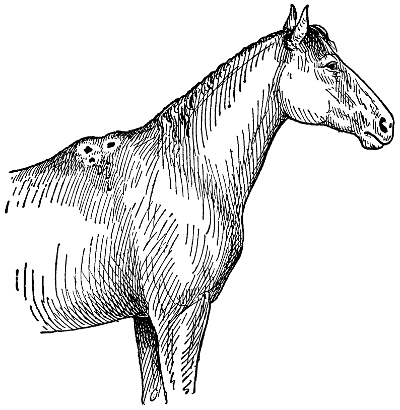
FISTULOUS WITHERS
Sometimes only the skin and tissue immediately under it become affected. In such cases little trouble need be anticipated; but if the cause is not removed, the deeper structures, muscles and bones, may become diseased.
Treatment for fistulous withers consists of opening the swelling and inserting muslin strips that have been dipped into terchloride of antimony. Insert one and remove, inserting another and leave in the opening for three or four hours. Repeat this operation every four or five days for a month. In addition rub on the outside of the swelling once every two weeks a mixture made of 2 teaspoonfuls of cantharides and 4 tablespoonfuls of lard. The tooth fistula usually calls for the removal of the tooth and thorough disinfection of the opening from the face through to the mouth. With a sternal fistula the diseased bone may need to be scraped and then antiseptic washes used daily. The salivary fistula is more difficult to treat. Better have the veterinarian to examine, and an operation may be necessary.
FITS.
—Some horses are subject to fits, and with them it is incurable. These should not be driven, because, when the attack comes on, injury may result to the animal itself and to the occupants in the carriage. The cause of the difficulty may be overfeeding, bad circulation or indigestion. When an attack occurs the best treatment is to throw cold water over the head. If this attack is repeated you had better consult a veterinarian.
FLATULENT COLIC.
—See Colic.
FLEAS.
—Fleas are always a nuisance and always disagreeable. They live in dry, filthy quarters and associate with dogs, hogs, and chickens. To keep fleas away or to destroy them when at hand, clean the quarters occupied by the animals, destroy the bedding and add lime and disinfectants. Dogs may be washed in a creolin solution of, say, 2 tablespoonfuls of creolin to each pint of water. To disinfect chicken, hog, and horse pens use in a hand spray any of the so-called sheep dips or other preparations manufactured for lice, itch, mange, or insect troubles.
FLIES.
—These pests are a nuisance on every farm. While they do not directly cause death they greatly worry and irritate farm stock, especially in summer, and in this way greatly affect the results whether along dairy or beef lines. It would be impossible to estimate the misery these pests inflict on the stock of the country during a single year. Aside from the pain that flies inflict on domestic animals, they are carriers of disease, both to the human family and the beast family. A great many common infectious diseases are spread by flies, including such serious diseases as typhoid fever and tuberculosis. The only treatment is in way of prevention. As the breeding places are in filth and manure, it follows that if these be destroyed or removed, and not permitted to accumulate, the floods of flies will disappear. The fly remedies now on the market are excellent. When sprayed about the stable premises and on the animals the flies stay away until the application evaporates. Darkened stables are not attractive to flies, and by this means the nuisance and annoyance is minimized.
FLUKES, LIVER.
—See Liver Flukes.
FOOT AND MOUTH DISEASE.
—This malady generally affects ruminants, but, although found most often in cattle, sheep, and goats, it may be transmitted to swine, and, in some instances, to horses, dogs, cats, birds, or human beings. In most cases where proper disinfection is made the animal recovers in about 15 days. The most dangerous thing about foot and mouth disease is the fact that it spreads so rapidly. The virus which transmits the disease may be carried by railroad cars, bedding, feeds, dairy products, dogs, cats, birds, or persons. A dog running through a pasture may be the means of infecting a whole herd.