OLD CANTON.
Reading edition
Even the departure of a vessel from New York for Canton in 1824 was a rare occurrence. Neither had it yet become fashionable to place the accent on the last syllable in the name of that distant port. It would have appeared pedantic. Years after, only, did it become ton! As the ship cast off, the neighbouring wharves were crowded with lookers-on, national and private flags were run up to the mastheads of sea-going craft lying near.
Cheers were heard as she glided into the river, and the ship 'Citizen,' Captain E. L. Keen, passed Sandy Hook in the evening of October 9 of the above year, bound to the Central Flowery Land. Friends and relations who had accompanied us thus far now took leave, and returned to the city in the pilot boat, steam tugs not having yet come into existence.
The 'Citizen,' of 498 tons was one of seven ships[1] owned by Mr. Thomas H. Smith, of New York, who had been for many years engaged in the China trade. She had already made two voyages to Canton, and before leaving on her present one, had been newly coppered and 'thoroughly' overhauled, the better to withstand the westerly gales she was likely to encounter on her return passage off the Cape of Good Hope in the winter season. The crew consisted of thirty-two men and boys, with two officers. One of the latter, the second officer, as well as Captain Keen and ten or twelve of the men, had served on board privateers in our last war with Great Britain, while eight sailors had just returned from a three years' cruise in the Pacific, on board the U.S. 74 'Franklin,' Commodore Stewart. As usual at this time with vessels bound on Eastern voyages, the 'Citizen' was well provided with arms and ammunition—not only for the risk of pirates in the Atlantic, to whom her valuable cargo offered great temptation, but from possible mishaps while passing through the Eastern Straits.
The cargo consisted of 350,000 Spanish dollars in kegs (no letters of credit on London bankers then existing), furs, lead, bar and scrap iron, and quicksilver. Passengers were not taken except under peculiar circumstances. I should have been the only one, in virtue of being destined for Mr. Smith's Factory at Canton, but just before sailing a Scotch gentleman presented himself at the office, and sought for a passage on board. The letters he bore were of a high character, among them being one from the celebrated Mr. Hume. His name was Fullerton, and his vocation that of surgeon in the English East India Company's service. He was allowed to go in the ship, and proved to be a most intelligent and amiable person.
He had made several voyages to India and China, was full of anecdote and pleasant conversation, thereby relieving the weariness of the journey. The medical advice he most cheerfully gave rendered him a valuable addition to us, particularly on the occasion of the ship taking fire just before making Sandalwood Island, when one of the men was so seriously injured that his life was despaired of for a time; but although he managed to get back in the ship to New York, he never did a day's work after the accident. My fellow-passenger was only known on board as Doctor Smyth. He had come to New York expressly to get to China in an 'out of season' vessel, which ours was. We had no idea of the object he had in view, and he volunteered no information. There was, however, a little mystery in the matter.
On our arrival at 'Lintin' we had scarcely anchored when my fellow-passenger took a fast[2] boat and went to Macao. Soon after, we heard that he had there engaged two young Chinese small-footed women to accompany him to Calcutta, from whence he took passage with them for England as a 'speculation.' Subsequently we learnt that he was associated in the enterprise with Captain C——, also of the Honourable East India Company's service, on board whose vessel he had filled the office of surgeon. While in England, these 'Golden Lilies'[3] had the honour of a presentation to H.M. George IV. The enterprise, however, was not successful. It met with great opposition in certain quarters, and finally it ended by those young daughters of 'Han'[4] being returned to their own country.
Some years after, in the winter of 1832, I last had the pleasure of shaking hands with my old shipmate at Canton. He was then surgeon of the Honourable Company's ship 'Lady Melville.'
We had the misfortune to lose the ship's cook about five o'clock on the morning of the twenty-fifth day out, when he sprung into the sea. We had rushed on deck at the cry of the 'cook overboard,' and heard him shout as he passed the ship's quarter, 'You are all going to—(a most uncomfortable place of one syllable, beginning with the letter H), I'm going to Guadaloupe.' The ship was instantly brought to the wind, a man sent aloft to keep the poor fellow in sight, and a boat lowered in a trice, but suddenly he disappeared. We resumed our course. The crew had often been amused while about the galley to find its 'monarch' with an open Bible in one hand, and reading aloud from it, while prodding the salt junk in the boiler with a 'tormentor' in the other! They thought him a 'queer fellow,' particularly as he would caution them as to their wickedness in blaspheming, and their utter disregard of the future! We had heard through the officers of those erratic ways and strange conduct for a 'ship's cook,' but no one imagined that his head was turned.
The next morning the chief officer discovered on our starboard beam a three-masted felucca, under small sail, standing as ourselves. It was nearly calm; presently the 'little stranger' steered for us, manned a certain number of sweeps, and seemed to have a great number of men on board. She was about 140 or 150 tons burthen. While examining her with our glasses, a sail was set on her jigger mast. There seemed to be a general wish that she would 'come on,' in spite of what was unmistakably a heavy swivel gun amidships. We showed our colours, to which no reply was made. At last we seemed to have fallen in with the traditional 'long, low, black schooner,' metamorphosed into a felucca for the nonce. Suddenly the man at the wheel directed the attention of the mate to another sail just appearing on our larboard beam; she was steering to the southward, with a light air and under a crowd of sail. As she approached, she proved to be a schooner of the size of our revenue cutters. A barque also hove in sight, bringing up a stiff squall, with heavy rain. The felucca was next observed standing on the same course as ourselves. We trimmed sail to the wind, and hauled up to the eastward; presently, the wind increasing, the schooner crossed our bows, almost within hailing distance—a beautiful object to look at. She set all studding sails as she went by us, with a fore skysail, and that other unusual sail, now, perhaps, never heard of, and then not common, called a 'ring tail.'
We crossed the equator on the thirty-first day out, with a good easterly wind, which hauled to the south-east and blew stiffly. A few days after we discovered a good-sized barque standing in for the coast of South America. She hoisted Brazilian colours. Her decks, forward of the mainmast, were crowded with negroes, while abaft we observed several dark-brown gentlemen, the captain, officers, and supercargoes, perhaps. She was evidently a slaver returning from the West Coast of Africa, with a full cargo of ebony. She crossed our bows within a few hundred yards, and on gaining our starboard side, our dark-brown friends raised their panamas, and waving them, wished us 'Bon voyage.' This vessel proved to be the last 'living thing' we saw for a period of nearly fifty days, except albatross, whales, and Mother Carey's chickens.
Passing within a short distance of Tristan d'Acuna to correct our time, we then began the long tedious running down 'easting.' The weather was generally fine, with a bright sun; it was in the summer season. Our course between 43° and 45° south latitude. The sea ran 'mountains high,' the crest of each wave breaking in masses of sparkling diamonds, then losing itself in this wilderness of waters, an indescribably magnificent sight. The ship rolled gunwale under, receiving on board vast quantities of water, which swashed fore and aft and from side to side, at times two or three feet deep. Gradually this frightful chaos of warring winds and furious seas became a matter of course, while Captain Keen gave way to his delight in exclaiming, 'How splendidly she behaves,' or, 'She rides the seas like a bird;' and thus we went on, with little change, until we made the island of Amsterdam.
We then steered direct for Sandalwood Island, across a pleasant south-east trade, with nothing material occurring until two days before sighting it.
After the cook had left us so abruptly for Guadaloupe, it was arranged that the chief steward should fill his place for the cabin, while some of the crew offered their services for the forecastle and steerage; thus everything went on well in this respect. Before we now made the land, taking advantage of the fine weather and smooth sea which prevailed, all hands were occupied in caulking the bends and the deck, while, as had before happened, the leak decreased. The 'officer of the kitchen' for the day referred to was a fine young sailor about twenty-five years of age. Being in the galley in the afternoon, about seven bells, watching a pot of pitch being boiled, it overflowed, and the contents fell among the burning coals. Instead of immediately clapping on the lid, he seems to have lost his head, and in attempting to unship the pot from the hook it capsized, and in a moment everything was in a blaze, burning the poor fellow so fearfully that he had to be carried to his bunk. His lower limbs were almost peeled, and had it not been for the presence of the 'doctor,' he would inevitably have died.
We passed close to the harbour and town of 'Dilly,' which displayed the Portuguese flag.
Two years before, the ship 'Ontario,' Captain Depeyster, belonging to the owner of the 'Citizen,' called in at Dilly for supplies on her way to Canton, and was totally lost in coming out of the harbour.
The loss of the 'Ontario' gave rise to the longest passage ever made between Whampoa and New York. Captain Depeyster left Dilly, with the treasure saved from the wreck of his ship, for Batavia, and there chartered the American brig 'Pocahontas,' to carry it to Canton. Mr. Smith's agent there rechartered her to take as much of the proceeds of the treasure as she could carry in teas and silks to New York, where she safely arrived in charge of the first officer, Mr. Teel (Captain Snow having died on the passage), close upon ten months from Whampoa.
'A good full,' cries out the second mate to the man at the wheel as a breeze springs up. A first-rate 'old salt,' and as odd a fish, our second mate, as need be. I have been time and again amused with the yarns he has spun during his first watches. Of the war of 1812 he is full of anecdotes. He is always on the dolphin-striker when porpoises are around us, and usually strikes successfully. Anything not done in a sailor-like fashion excites him, and we hear him cry out, 'You'll never be a sailor. You were not shaped for a sailor. You were cut out to handle a musket, not a marlin-spike.' 'Sailors,' said he to me one evening, 'have their prejudices like others; they have always a run upon soldiers, more perhaps in joke than in earnest. A sailor will say, "Give me a messmate before a watchmate, a watchmate before a shipmate, a shipmate before a dog, a dog before a marine, a marine before a soldier, a soldier before—the devil." If you ask why a marine in preference to a soldier, the answer is, because he knows the difference between the best bower anchor and—a "chaw of baccy!"'
We now steered for Dampier Straits. Having left Booro astern, we were struck with a sudden and violent squall, resembling more a tornado. The rain poured down like a deluge, the rattling of the thunder and the vividness of the lightning were frightful. Our maintopsail-yard was snapped asunder in the slings, the fore and mizen topsails flew into ribbons; the jib disappeared from the bolt ropes. Each flash of lightning was succeeded by the darkness of Erebus, while in the midst of all, the loud voices of the officers and the replies of the men created a turmoil such as I had never witnessed.
The squall was luckily of short duration; it came upon us during the dog watch, but so intelligently did all hands do their duty, that by midnight another maintopsail-yard was crossed, the sail bent, the other topsails and the jib replaced, and we were making good way with all sail set, 'low and aloft,' including royals and flying jib. The stars shone out with increased brilliancy, all things had returned to a condition of perfect quiet, so had one watch to their hammocks, and no sound fell upon the ear save the ripple of the water under the bows. We had noticed before, and this night particularly after the squall, a strong spicy odour, the air seemed 'breathing an aromatic redolence.'
As we neared Pigeon Island, the vast and imposing one of New Guinea being to our right, numerous canoes came alongside. The appearance of their inmates was singularly repulsive; the wool on the heads of these Papuans was of so fertile a growth, that it reached a diameter of over two feet, while from the application of chunam, it becomes a dirty, uncertain red, hideous to behold. By means of baskets attached to ropes, we carried on a trade, giving in exchange for shells, plantains, papayas, stuffed birds of paradise, and ingeniously made baskets, everything in the shape of cast-off garments that we could muster. It was thought a mockery when I offered an old straw hat for a bird of paradise, but everything seemed fish that came to their net, and to my surprise the bucket returned with the coveted prize. On the return of the ship to New York I sent it home, and it proved a rare and most acceptable gift. We anchored near Pigeon Island during the night, and the next day entered the Pacific Ocean.
We hove to close to the Pelew Islands, to allow a crowd of canoes to come alongside, that we might obtain further supplies of fruit, shells, and yams, and thereby get rid of the remainder of our old clothes. The natives were considered as unoffensive, but this was not justified by an attack made by them, just before we passed, on a schooner from Java to Lintin. Her deck was crowded with natives, who had been permitted to come on board, and while bartering, suddenly the crew was fallen upon and several killed, all who could taking to the rigging. Plundering then commenced. The 'boarders' were having it their own way, but had overlooked the cook, who had shut himself in his galley. Bolting one door, he suddenly commenced a liberal distribution of hot water on the assailants, who, being entirely naked, plunged overboard with astounding shrieks and yells. The men aloft quickly descended. Seizing handspikes, they were in time to cut off the retreat of many who had been inspecting the cabin lockers, the bodies of these were thrown overboard, a few musket shots hastened the departure of the canoes, and the schooner continued on her journey.
Our course was north-westerly, the crew employed in putting the ship in order. After passing through the Bashees, one of the men being over the side, to reeve the lower studding sail tack, he tumbled overboard. The second officer, to whose watch he belonged, threw him a rope, which he just caught and was soon hauled up on deck. 'You must have been asleep,' said Mr. Hughes, who then asked him if the water felt warm or cold. When the officer came in the cabin later, he exclaimed, 'That fellow wouldn't have fallen had he not been fast asleep; but it is lucky for him he "awoke in time" to get hold of the rope, or he would have gone down.' This is a specimen of what 'Jack' calls 'sojer's comfort.' They had what they called 'sailor's comfort' every Saturday afternoon in the middle watch. It consisted in overhauling their chests and bags, or mending their clothes, on the system, as they said, of putting a patch next to a patch, as being neighbourly, but never a patch upon a patch, as that was beggarly. Many of the men remembered, as boys, the wearing of 'pig tails,' and their being mutually dressed, preceded by the calling out in the 'foksle' of 'Tie for tie,' or, 'Tie me, I'll tie you, and damn all favour.'
No happier crew were ever 'rocked upon the cradle of the deep' than the one of which the 'Citizen' was composed. This was the result of uniformly taut but considerate treatment, the best of food, good grog, and no needless botheration, while the utmost harmony prevailed between Captain Keen and his officers. On the return of the ship to Canton, on her second voyage after, in 1827, Captain Keen related the homeward passage of 1825, which was an unusually hard one. The ship was forty days from point Natal to the Cape, knocked about in the teeth of westerly gales and frightful seas, and referring to his crew he remarked, 'No better men ever manned a ship.'
We made the coast of China at 5 A.M. on February 11, 1825. A pilot came on board off the Lema Islands, took us through the channel of the same name, having to starboard the then 'terra incognita,' 'Hong Kong,' and anchored the ship under the island of 'Lintin,' at 2 o'clock P.M., 125 days from New York.
The island of 'Ling Ting,' or the 'Solitary Nail,' commonly called 'Lin Tin,' was at this time the anchorage of the 'opium store ships,' and temporarily of vessels whose destination was Whampoa (with some exceptions). On the arrival of an American ship, she communicated with her agent at Canton by means of a 'fast boat,' meanwhile despatching another one to Macao for a pilot to take her inside the river. The exceptions were the ships of the English East India Company, and country ships from India having no opium on board (those which had anchoring at Lintin to deliver it); these then took pilots off Macao and sailed directly to the 'inner anchorage,' as Whampoa was called. The Lintin anchorage was not, however, only an opium station. All vessels bound to Whampoa were loaded with general cargo, or with rice only, and were subject to what were called Cumsha and Measurement charges. These were very heavy in the case of the former, but moderate in the latter. It was therefore an object for a vessel entering the river with only part of a general cargo to fill up with any freight that might offer, and thus reduce the heavy charges referred to, or to send up what she had on board, if of moderate quantity, in another ship, then load with rice and go on to Whampoa, if she was to load with tea for her return voyage. It almost always happened that these arrangements could be made, as arrivals were continually taking place with rice cargoes or general cargoes.
After a week's detention at Lintin, the 'Citizen' was directed to receive any river freight that might offer, and proceed to Whampoa. In passing the Bogue[5] Forts, the main topsail was backed while the pilot went on shore to exhibit his pass to the Mandarin, with whom he returned to the ship, ostensibly to verify description with fact; but it is unnecessary to say this had become a mere matter of form. After a glass of wine, and presenting the old gentleman with a few sheets of writing paper, which, I found out afterwards, were considered a great treat, I offered him a box of a then recent invention, viz., friction matches; they astonished him mightily, and he left us with numerous 'Chin-chin's' and best wishes for 'good wind and good water,' equivalent to a quick passage. We anchored abreast of French Island on the 20th.
It was in the year 1745 that Yung Ching, the third Emperor of the present dynasty, ordered all foreign trade to be confined to the port of Canton, universally known as Whampoa. Separated by a branch of the river from French Island stands Dane's Island. These were so named from the privilege that those nationalities originally enjoyed of occupying bankshalls or storehouses upon them, wherein to shelter the crews while smoking ship and overhauling after the desperately long passages they must have made from Europe. All vestiges of those buildings have long since disappeared, but numerous decaying tombstones, half buried beneath earth and weeds, still tell the tale. The regular tea season being over, we found few vessels at Whampoa, and these, as with the 'Citizen,' were designated, 'out of season ships.' The northern side of the anchorage is formed by the important island of Wang-Po; the river is named the Wang-Po, and the same is applied to the anchorage. The words mean the 'Yellow Anchorage.' On the island is a large town of many thousand inhabitants, almost all of whom are directly or indirectly connected with the foreign shipping, as compradores, stevedores, blacksmiths, &c.
The Choo, or Pearl River, commonly called the Canton River, presented a vastly different appearance on the 21st February, 1825, from what it did twenty years later. It was then crowded with native vessels, including those immense coasting junks which have now almost entirely disappeared. They then made voyages to the northern and southern ports of China, to the Celebes, Borneo and Java, and to Singapore, as well as to Manila. Long tiers of salt junks lined the shore of the island of Honam; these brought cargoes from Teenpak and places on the coast south-westward of Macao. They were owned by a corporation of salt merchants, who enjoyed a monopoly of the trade, and, to prevent smuggling, a special fleet of cruisers was organised by the local government. The penalties against a clandestine introduction of salt were as severe and more rigorously carried out than even against opium. The merchants were an influential body, as much considered as the Hong merchants, whom they rivalled in wealth. The number of cargo boats from the interior, of passenger boats, floating residences and up-country craft, with Government cruisers and flower boats, was prodigious. To these must be added sampans,[6] ferry boats plying to and from Honam, and quantities of barbers' boats, vendors of every description of food, of clothes, of toys, and what would be called household requirements if in shops on shore; besides boats of fortune-tellers and of theatrical performers—in short, imagine a city afloat, and it conveys a very correct idea of the incessant movement, the subdued noises, the life and gaiety of the river.
But now, an additional interest was added to this floating scene, from its being the first days of the Chinese new year. The noise of gongs, as a compliment to the meeting of mutual acquaintances or when one boat or junk arrived or set sail, was startling; and finally, the red and gilt patches of paper, on which words or sentences were written in large black characters, appropriate to the opening of the new year, formed another conspicuous feature on every kind of craft. Ships' boats were usually furnished with paddles, which were always brought into use from below the Dutch Folly to the landing place in front of the factories. The oars of our boat being therefore replaced by them, with skill and patience, after two hours from Whampoa, we landed at 'Jackass Point,' so memorable in the days of old Canton. Crossing the Square, under the guidance of Captain Keen, we entered the Suy-Hong, and met with the kindest reception from Mr. Jacob Covert and Oliver H. Gordon, the special agents of Mr. Smith, and from the two younger members of the office, John H. Grosvenor and Thomas Bloodgood.
Having been sent by Mr. Smith to Canton expressly to study the Chinese language preparatory to entering his office there, as the difficulties to be overcome in providing a teacher for me proved insuperable, Mr. Covert decided to send me at once to Singapore, where a college had been commenced in which foreign students could be received, and which might be ready for the purpose. I went, therefore, to the Straits in the Bombay ship 'Good Success,' Captain Poynton, and arrived at my destination in the month of April, after seventeen days' passage. I took letters to the Resident, Mr. Crawford, and others, and was consigned to Messrs. A. L. Johnston and Co. The college, however, had not only not been finished, but there was no prospect of its being. My friends, therefore, after taking information from Malacca, where the Anglo-Chinese College was in full operation, sent me there in a small native brig. We arrived after four days' passage from Singapore. During the two months that I passed at Singapore I was the guest of Mr. and Mrs. Christopher Read in their bungalow on the ascent of Government Hill. I shall never forget the parental care of my host and hostess. They soon caused me to forget that I was the youngest of strangers in, to me, a most strange land. To this day I recall their quiet and unaffected efforts to make me at home, and the drives they took me in their palkee gharrie. The novelty of everything interested me; it was as if I had landed on another planet. At that time the site occupied by the present town of Singapore was being cleared of its primitive jungle.
The Anglo-Chinese College was in every way adapted for instruction, and I continued in it as a student of Chinese until the end of December 1826. I then left in the ship 'Bengal Merchant' for Canton. She was loaded with cotton and opium, and not a fast sailer. Captain Brown was a most pleasant and agreeable gentleman, full of jokes and amusing stories with which to while away the time. We anchored at Singapore, which gave me an opportunity to see my old friends the Reads, Mr. A. L. Johnston, and to run up to Government House to make my salaam to Governor and Mrs. Crawford and their nieces, being received everywhere with a kindly welcome and the exclamation, 'How you have grown!' Continuing on our voyage, we passed through the Caramatta Passage, the Java Sea, Straits of Salayer, and into the Pacific by Dampier's Straits again. Between the Pelews and the Bashees we fell in with a typhoon au grand complet. At night the sea was as white as snow and of portentous height, coming upon us with the full uninterrupted sweep of the Pacific. We anchored at Lintin after a passage of sixty days.
Mr. D. W. C. Olyphant had arrived in 1826 as the successor of Mr. Covert; Mr. Gordon had entered the office of Messrs. Russell and Co., No. 2 Suy-Hong. The American Factory had been entirely built anew since 1825, and to it I betook myself. In addition to Mr. Olyphant were Charles N. Talbot and Charles W. King. Mr. Talbot was filling the office of U.S. Consul, and the flag was daily hoisted in the Square in front of the house. No. 1 Suy-Hong was occupied by James P. Sturgis, No. 3 by John R. Latimer, and No. 4 by John P. Cushing, T. T. Forbes, and John Hart. With Mr. Olyphant I called on, and made the acquaintance of, the Rev. Dr. Morrison, who had recently returned from England. Soon after I underwent a searching examination by him of the progress I had made in my Chinese studies at the Malacca College, and he pronounced it to be 'good.' There was no intention, however, that they should be discontinued, and in a few days I was placed under the tutorship of Le Seen-Sang. The tea season was over; all but one or two 'out of season' ships had sailed, but of those remaining was my old home and 'first cradle of the deep,' the 'Citizen,' and it was not long before Captain Keen and I again on board at Whampoa 'fought over the battles' of our voyage out together.
The year 1827 was a dull one so far as business was concerned, and I read Chinese with my teacher 'Le.' At length the tea season commenced in October. When the ships began to arrive, unpleasant news came also. My brother, of the office of Thomas H. Smith and Son (as it had become), wrote me that 'difficulties' existed in the affairs of the house. Finally it stopped payment and went into liquidation, but from causes not attributable to its China business. The Canton agency had therefore to be closed. Consulting with Mr. Olyphant in regard to myself, he advised me to return to New York, where only my position could be arranged. As usual at the time of which I write, certain indentures between employers and employés were usually drawn up. They existed between Mr. Smith and myself. In them, he engaged to send me to China for the purpose of acquiring the Chinese language, and then to be employed in his Factory at Canton, as clerk or Factor, and I was to render him service until I should have reached the age of twenty-one. It was a long time for me to look forward to in 1827. Several ships of the New York house were loading which had arrived in regular course before insurmountable difficulties had occurred. Amongst them was the 'Mary Lord,' Captain Rosseter. I left in her and arrived in a good run of 120 days. My fellow-passenger was Mr. Daniel Stansbury, whose name has become identified with the American trade at Canton from his having been the inventor of a measuring rod, by which cargoes were ever after measured. It proved to be an instrument of wonderful accuracy and rapidity, simple in the extreme, as well as the most convenient that can be imagined. 'Stansbury's measuring rod,' now proverbial, dates from our last war with Great Britain, 1812, when the inventor, being at Canton, and business with the United States suspended for some time, in his days of forced idleness he conceived the actual mode of measuring cargoes, which up to that time had been measured with the foot rule!
My interviews with Mr. George W. Bruen, the partner of Mr. Smith, led to no other result than the cancelling of the indentures, without indemnity. Not long after Mr. D. W. C. Olyphant himself returned to New York, leaving Messrs. Talbot and King at Canton, with the view of establishing a house there of his own. His first purchase was a very fine ship named the 'Roman,' Captain Lavender, of about 500 tons. He offered me a passage out in her, for the chance of being employed in the new house, which afterwards occupied for a great many years so distinguished a position in the commercial community in China. I accepted the chance and sailed in the 'Roman' in October. We were in all six passengers. The father and brother of Mr. Charles N. Talbot going out for the trip; Mr. Talbot, senior, had already been to Canton in 1802 or 1803. Two of the others were the Rev. E. C. Bridgman and the Rev. David Abeel. They were the first American missionaries to the Chinese. The former became one of the most accomplished Sinalogues of the day (which I do not attribute to my having given to both these gentlemen daily lessons on the passage out!), while Mr. Abeel was the first United States Consul appointed at any port north of Canton, being commissioned to Amoy.
We sailed in October, and anchored at Lintin in February, viâ Dampier's Straits, in 134 days. I was received by Mr. Talbot, who, from the yet uncertain advices from New York as regarded future business, could hold out no encouragement for me of office work; but, failing any other house, I was always welcome to a return passage in the 'Roman.' There were very few American houses then in Canton, and they were Agencies; moreover, they seemed provided with youngsters, and I accordingly prepared to leave again for New York. Meanwhile, however, Mr. Talbot busied himself on my behalf, but the stay of the 'Roman' was short and she was soon to be despatched. There appeared absolutely nothing to be done. A few days before the ship sailed, while in my room, occupied with my luggage, one of the Chinese servants came to me, and said, 'Mr. Talbot chin-chin you come down.' I went accordingly, and was introduced to Mr. Samuel Russell, the chief of the house of Russell & Co. He had heard, he said, from Mr. Talbot, of my probable return home in the 'Roman,' and had come to invite me to his office. I accepted the offer, and in the evening I was duly installed at No. 2 Suy-Hong. This was on March 24, 1829, and it became my uninterrupted home until December 31, 1842.
The word 'Factory' was an importation from India, where the commercial establishments of the 'East India Company' were so designated, and synonymous with 'agency.' It is well to explain this, as it is now being confounded with 'manufactory.'
The space occupied by the foreign community at Canton was about 300 feet from the banks of the Pearl River, eighty miles from Macao, sixty miles from Lintin, forty miles from the Bogue Forts, and ten miles from the Whampoa anchorage. In breadth from east to west it was about 1,000 feet. On it stood the Factories, which comprised the dwellings and places of business of each nation originally under one roof. The line of frontage was uniform, all looking due south. The distinction of new given to one of the two buildings occupied by the 'Company' applied to that one which was rebuilt after the great fire of 1822, which destroyed all the others, with a few exceptions, as well as, according to official accounts, '12,000 Chinese houses, shops, and temples in the western suburb.' Each Factory consisted of a succession of buildings, behind one another, separated by narrow spaces or courts, and running north. The front ones were numbered 1, those back of them, nearly all of three stories, No. 2, 3, and so on. The least numerous Factories were then in the American Hong, the greatest number were in the Danish and Dutch Hongs, which contained seven and eight respectively.
The Chinese word 'Hong' was applied to any place of business, but was more particularly used to designate the Hongs of the 'Security Merchants' whence Hong Merchants or any foreign Factory in its entirety. It signifies a row of buildings. By the Chinese, the places of business of foreigners were known as 'Foreign Hongs;' those of the Security Merchants as 'Foreign Hong Merchants.'
Beginning at the west, stood the Danish Factory; adjoining it were Chinese shops in its whole length, forming New China Street, which here intervened, separating it from the Spanish. Next the French, and by its side in its whole length, that of the Hong Merchant Chungqua; Old China Street here came in, and against it was the American, then the Imperial, by its side the Paou-shun, next in order the Swedish, the old English, and then the Chow-Chow.[7] Now came a small narrow lane, the renowned Hog Lane, most appropriately named. The high walls of the new English Factory bordered the lane, having as next neighbour eastward the Dutch, and next to this stood the Creek Factory. The latter took its name from a small creek, which, running down along the walls of the city, here emptied into the river. Originally this creek formed the ditch of the west side of the city.
The entire number of buildings, therefore, was thirteen. Immediately in their rear, and running east and west, was a long, narrow, but important street, named 'Thirteen Factory Street.'
From the front of the new English a long broad terrace projected towards the river, its columns supporting an entablature, whose pediment bore the arms of England with the substitute of 'Pro Regis et Senatus Angliæ' for 'Honi soit qui mal y pense.' The Dutch company ('Maatschappay') possessed a similar terrace, with the national arms and motto 'Je maintiendrai.' These two, the English and Dutch Companies, were the direct successors of those founded on December 31, 1600, and in 1602 respectively. The English Jack, the Dutch, the United States, and the Spanish flags, were daily, in 1825, hoisted before those respective Factories, and were visible from a great distance. The Spanish flag represented the Philippine Company. The French flag was hoisted on December 13, 1832, after an interval of thirty years; it denoted simply the Canton residence of the Consul, as the trade of that country was insignificant, while the Swedish, Danish, and Imperial (Austrian) direct commerce had ceased, and no other Western nation traded directly with Canton. Portugal was confined in her commercial relations to her own colony of Macao; Russia to Kiachkta. From the port of Cha-po, on the east coast of China, two junks sailed annually to Nagasaki. Siamese vessels would occasionally be seen at Whampoa, when conveying tribute bearers on their way to Pekin, and not far from the Factories was the residence of the Ambassadors.
At the northern extremity of Old China Street, and facing it, stood an extensive and handsomely built series of buildings, in the Chinese style, called the 'Consoo' House, or 'Council Hall of the Foreign Factories.' It contained numerous suites of rooms for receptions and business, with open courtyards, and was always kept in excellent order and cleanliness by the Chinese in charge. It was the property of the Hong merchants collectively, and was maintained by funds appropriated by them for the purpose. When any event bearing upon the foreign trade required it, such as new regulations, or confirming old ones, or a revision of duties, the 'Tai pans' or Chiefs of Houses would be invited to meet the Hong merchants and discuss the subject. Any foreigner went if inclined, and would occasionally learn of many official acts, having a bearing upon business, and even upon his daily walks or boat-pulling on the river, which may have come under the notice of the authorities, who would have suggested shorter journeys or the exercise of care from collisions. It was also in the Consoo House that the Hong merchants met, or a committee of them, in the rare cases of bankruptcy or pecuniary difficulties of one of their number, and it was the depository of books of accounts relative thereto, as well as of records of meetings. The entrance to it was by a flight of broad granite steps, through large heavy folding doors of a highly polished and valuable wood.[8] Being a handsome specimen of this style of Chinese architecture, foreign visitors to Canton were taken to see it as one of the sights.
The Factories were the individual property of the Hong merchants, and were hired of them. By law, no women were permitted to enter them, nor were guns, muskets, powder, or military weapons allowed to be brought within the gates. Entrance to the rear Factories was by arched passages running through those in front. The lower floors were occupied by counting-rooms, go-downs, and store-rooms, by the rooms of the Compradore, his assistants, servants and coolies, as well as by a massively built treasury of granite, with iron doors, an essential feature, there being no banks in existence. In front of each treasury was a well-paved open space, with table for scales and weights, the indispensable adjuncts of all money transactions, as receipts and payments were made by weight only, except in some peculiar case. The second floor was devoted to dining and sitting rooms, the third to bedrooms. As almost all were provided with broad verandahs and the buildings put up with care, they were quite comfortable, although in every respect devoid of ornamental work. In front of the middle Factories between Old China Street and Hog Lane ran a broad stone pavement, and this bordered an open space running down to the banks of the river, a distance of about three hundred feet. On the east side it was bounded by the wall of the East India Company's landing place and enclosure, and on the west by the wall in front of the landing and enclosure of Chungqua's Hong. The Chinese were prohibited from loitering about this 'Square,' as it was called. On the corner of Old China Street and the American Hong stood a guard-house with ten or a dozen Chinese soldiers, acting as police to prevent disturbance or annoyance to the 'foreign devils.' On the edge of the river, facing the 'Pow Shun' and the Creek Hongs were 'Chop' houses,[9] or branches of the Hoppo's department, whose duty it was to prevent smuggling, but whose interest it was to aid and facilitate the shipping off of silks (or the landing of cloths) at a considerable reduction from the Imperial tariff. A few pleasant words, accompanied by a fee, would secure a permit for the boat of the 'Wandering Eagle' to be allowed to pass all revenue cruisers 'without molestation' on her way to Whampoa.
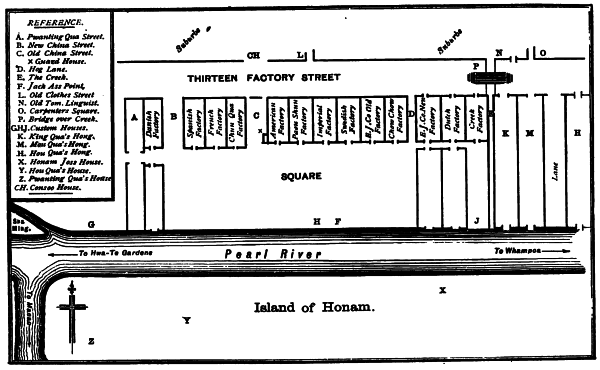
Island of Honam.
REFERENCE.
A.Pwanting Qua Street.
B.New China Street.
C.Old China Street.
X Guard House.
D.Hog Lane.
E.The Creek.
F.Jack Ass Point.
L.Old Clothes Street.
N.Old Tom Linguist.
O.Carpenters Square.
P.Bridge Over Creek.
G.H.J.Custom Houses.
K.King Qua's Hong.
M.Mau Qua's Hong.
H.Hou Qua's Hong.
X.Honam Joss House.
Y.Hou Qua's House.
Z.Pwanting Qua's House.
CH.Consoo House.
The words Factory and Hong were interchangeable, although not identical. The former, as will have been seen, consisted of dwellings and offices combined. The latter not only contained numerous offices for employés, cooks, messengers, weighmasters, &c., but were of vast extent, and capable of receiving an entire ship's cargo, as well as quantities of teas and silk. When speaking of their own residences, foreigners generally used the word 'Factories;' when of a Hong merchant's place of business, the word Hong. The Swedish Factory, however, seemed to enjoy the distinction of going by its Chinese appellation, viz. 'Suy-Hong.'[10]
I have been thus specific in the description of these world-renowned Factories, as they were subsequently razed to the ground consequent upon Sir Michael Seymour's bombardment of the city of Canton. When I last visited the site, nearly thirty-five years after I first took up my residence in them, it was literally unrecognisable. It presented a scene, the desolation of desolation; there remained not one stone upon another! For more than one hundred years they had formed the sole residence of foreigners within the limits of the vast Chinese Empire. The business transacted within their walls was incalculable, and I think I am safe in saying that from the novelty of the life, the social good feeling and unbounded hospitality always mutually existing; from the facility of all dealings with the Chinese who were assigned to transact business with us, together with their proverbial honesty, combined with a sense of perfect security to person and property, scarcely a resident of any lengthened time, in short, any 'Old Canton,' but finally left them with regret.
In no part of the world could the authorities have exercised a more vigilant care over the personal safety of strangers who of their own free will came to live in the midst of a population whose customs and prejudices were so opposed to everything foreign, and yet the Chinese Government was bound by no treaty obligations to specially provide protection for them. They dwelt at Canton purely on sufferance. Neither Consul nor any other official representative from abroad was directly acknowledged as such, and yet the solicitude of the local government never flagged. In addition to the guards always posted at the corner of the American Hong and Old China Street, others were stationed in various directions in the suburbs frequented by foreigners, in order that any Chinese who might be troublesome could be driven off, or that they could escort back to the factories those who were uncertain of their whereabouts.
During the north-east monsoon fires were quite frequent in the densely populated suburbs lying north of the factories. When they threatened the foreign quarter the Hong merchants, acting in consonance with the known wishes of the Mandarins, would send gangs of armed coolies to assist in the removal to boats provided by them of books, papers, treasure, and personal effects. All strange Chinese would be ruthlessly driven from the Square, and an unobstructed passage to the boats secured. I have witnessed this repeatedly. Should a foreigner get into a disturbance in the street, and it was generally safe to say it was through his own fault, the Chinamen went to the wall. When a mob of many thousand ruffians invaded the Factory Square, as in November 1838, shortly preceding the opium surrender, and with stones and missiles of all sorts drove the foreigners inside their gates, which they were forced to barricade, a not unnatural anxiety prevailed amongst us as to what might be the result. Yet this attack was caused by foreigners, who interfered with the Mandarins while attempting to carry out Government orders.
All foreigners who came to Canton, from the first arrivals, were considered as having no other object than that of commerce. The English and the Dutch made their appearance in the first half of the seventeenth century; successively arrived, the Danes, Swedes, and Austrians (Imperialists). The Spaniards invited the Chinese to their new settlement at Manila for a time, and afterwards they themselves came to the provincial city.
Some amongst these different nationalities, tradition said the Dutch, had red hair, which led the Chinese facetiously to apply the term 'Red-headed Devils' ever after to all foreigners alike. They themselves give to the whole of their own race the name of 'Black Hair'd.'
The authorities framed eight regulations for the especial government and control of these divers people from afar. They date from the year 1760, and are curious enough to recall. Never having been abrogated, they were assumed to be in force always. They were confirmed by an edict of the Emperor Kea-King in 1819, after a revision in 1810. Some of them came to be disregarded by the foreign community, particularly those referring to the Gardens, the Honam Temple, and pulling in their own boats on the river; but so far as regards women entering the Factories, an infringement of them in this essential particular took place in 1830, as will be seen hereafter. The chief sufferers in the event of a disregard of any important item of the regulations would of course be the Hong merchants. The 'Eight Regulations' were now and then brought to the Factories by a Linguist, as an intimation that they were not to be considered a 'dead letter.' Translated into English they read thus——
Regulation 1.—All vessels of war are prohibited from entering the Bogue. Vessels of war acting as convoy to merchantmen must anchor outside at Sea till their merchant-ships are ready to depart, and then sail away with them.
Regulation 2.—Neither women, guns, spears, nor arms of any kind can be brought to the Factories.
Regulation 3.—All river-pilots and ships' Compradores must be registered at the office of the 'Tung-Che'[11] at Macao. That officer will also furnish each one of them with a licence, or badge, which must be worn around the waist. He must produce it whenever called for. All other boatmen and people must not have communication with foreigners, unless under the immediate control of the ships' Compradores; and should smuggling take place, the Compradore[12] of the ship engaged in it will be punished.
Regulation 4.—Each Factory is restricted for its service to 8 Chinese (irrespective of the number of its occupants), say 2 porters, 4 water-carriers, 1 person to take care of goods ('go-down coolie'), and 1 mā-chen (intended for the foreign word 'merchant'), who originally performed all the duties of the 'House Compradore,' as he is styled to-day.
Regulation 5 prohibits foreigners from rowing about the river in their own boats for 'pleasure.' On the 8th, 18th, and 28th days of the moon 'they may take the air,' as fixed by the Government in the 21st year of Kea-King (1819). All ships' boats passing the Custom-houses on the river must be detained and examined, to guard against guns, swords, or firearms being furtively carried in them. On the 8th, 18th, and 28th days of the moon these foreign barbarians may visit the Flower Gardens and the Honam Joss-house,[13] but not in droves of over ten at one time. When they have 'refreshed' they must return to the Factories, not be allowed to pass the night 'out,' or collect together to carouse. Should they do so, then, when the next 'holiday' comes, they shall not be permitted to go. If the ten should presume to enter villages, public places, or bazaars, punishment will be inflicted upon the Linguist who accompanies them.
Regulation 6.—Foreigners are not allowed to present petitions. If they have anything to represent, it must be done through the Hong merchants.
Regulation 7.—Hong merchants are not to owe debts to foreigners. Smuggling goods to and from the city is prohibited.
Regulation 8.—Foreign ships arriving with merchandise must not loiter about outside the river; they must come direct to Whampoa. They must not rove about the bays at pleasure and sell to rascally natives goods subject to duty, that these may smuggle them, and thereby defraud His Celestial Majesty's revenue.
Originally there existed two English East India Companies, the oldest of which was incorporated in 1579. In the year 1600 they amalgamated, and received a charter from Queen Elizabeth. At the same time they assumed the title of the 'United East India Company,' and as a trade-mark, a heart with two transverse bars, bearing in the four divisions thus formed the letters V. E. I. C.

This trade-mark had acquired such a well-merited reputation at Canton, that it was considered unnecessary to examine any package of merchandise that bore it. A simple exhibition of musters was made, when transactions were concluded, and the original packages forwarded unopened to all parts of the Empire. The Company's vessels first arrived at Canton between 1650 and 1660, and tea was first used in England in 1666.
By the Chinese the Company was known as Kung-Se, the characters signify 'United Affairs.' By the Canton community its representatives collectively were universally referred to as 'The Factory.' They were much more numerous than the members of any other establishment. In 1825, the 'Factory' consisted of Sir James Urmston, chief; Messrs. W. H. C. Plowden, Marjoribanks, and J. F. Davis, of whom two, with the chief, formed a select committee; of writers (as usually called) there were about twenty; an inspector of teas, Mr. Reeves; chaplain, the Rev. R. H. Vachell; surgeons, Pierson and Colledge; and an interpreter, the Rev. Dr. Robert Morrison.
The 'Factory' entertained with unbounded hospitality and in a princely style. Their dining-room was of vast dimensions, opening upon the terrace overlooking the river. On the left was a library, amply stocked, the librarian of which was Dr. Pierson; on the right a billiard room. At one extremity of the dining-room was a life-size portrait of George IV. in royal robes, with crown and sceptre, the same that had been taken by the Embassy of Lord Amherst to Pekin, offered to and refused by the Emperor Keen-Lung, and brought to Canton overland. Opposite to it hung a smaller full-length portrait of Lord Amherst.
From the ceiling depended a row of huge chandeliers, with wax lights, the table bore candelabra, reflecting a choice service amidst quantities of silver plate.
I was glad to have witnessed this sight, unique in that distant quarter of the world, to reach which the old adage would apply, 'it was not every one who could get to Corinth.' Soon after I landed at Canton, I had the honour of a first invitation to dine with the 'Factory' and must confess that at my then age I accepted it with fear and trepidation. One of the invité from the Suy-Hong, Mr. Oliver H. Gordon, accompanied me. Our way led through the great outer gate, past the 'chapel' whose spire bore conspicuously a large clock, the only one in Canton, and by which everyone regulated his watch; then up a broad flight of stone steps to a verandah, crossing which one entered the library and reception room as well. When the hosts and the guests had assembled, large folding doors were opened and we entered the noble dining-room, whose brilliancy and cheerfulness and gorgeously furnished table I see now. At the remote end of the room were grouped the Chinese servants of the Factory and of the guests, in caps and long robes, who immediately took up their places behind their respective masters as soon as seated.
About thirty gentlemen were present, including Mr. Bletterman, chief of the 'Maatschappay;'[14] Mr. Hollingworth Magniac, of the 'licensed' house of Magniac & Co. (predecessors of the present firm of Jardine, Matheson, & Co.); Mr. Thomas Dent, of another 'licensed' firm, Thomas Dent & Co.; and several of my own countrymen, including Mr. Benjamin C. Wilcox and John R. Latimer.
But the days of the Honourable East India Company were now unconsciously drawing to an end. It had existed for 250 years! It ceased as a 'commercial' body in 1833. Many members of the 'Factory' were then removed to India and there took up civil appointments. Messrs. Astell and Clarke alone remained at Canton to close up outstanding affairs, and finally left in December 1839. Twenty-five more years were accorded to the Company after 1833 to transfer to the Crown the splendid empire those enterprising merchants had founded in India, and in 1858 its sun set—politically.
Few now remain who witnessed the final breaking up and departure of 'the Factory' from Canton; personally, there was much regret, as it had always been a marked feature in the community. The 'Outside' Merchants, unshackled from licenses, hailed it as an auspicious day, opening up to them visions of prosperity, which soon assumed the form and substance of reality. As an event to be placed 'on record' as the Chinese say, the first 'free ship' with 'free teas' was loaded at Whampoa and despatched for London on March 22, 1834, by the still existing house of Messrs. Jardine, Matheson, & Co. The vessel was named the 'Sarah,' Captain Whiteside.
The principal teas shipped by the Company were Bohea and Congo. One may judge of their qualities by their selling in England from 'two shillings and sixpence up to sixty shillings per pound, while sound common Congo is selling to-day at sixpence farthing'! (Messrs. J. C. Sillar & Co's tea circular of February, 1881.) The Company imported English-made woollens and cottons and raw cotton from India. The most important of the licensed houses in 1825 were Magniac & Co., Thomas Dent & Co., Ilberry, Fearon & Co., Whiteman & Co., and Robertson, Cullen, & Co. (Colonel Fearon, who commanded the detachment of troops on board the East India Company's ship 'Kent,' burnt in the Bay of Biscay, 1825, on her way to Calcutta, was a brother of the Mr. Fearon just named.) Their transactions were with India, and in the aggregate on a very extensive scale. They received raw cotton from the three Presidencies; opium from Bombay and Calcutta; rice, pepper, tin, &c., from the Straits of Malacca. The local name for their business was the 'Country Trade' the ships were 'Country Ships' and the masters of them 'Country Captains.' Some of my readers may recall a dish which was often placed before us, when dining on board these vessels at Whampoa, viz., 'Country Captain.' The ships were 'Country' built as well, and of teak; they were not fast sailers, but comfortable and substantial. They made one voyage annually, rolling up the China Sea before the south-west monsoon and rolling down again with the north-east. Some of them, as the 'Sulimany,' the 'Fort William,' the 'Futty Salaam,' were not far from their eightieth birthday.
The Hong merchants (collectively, the Co-Hong) as a body corporate date from 1720. From that year, except for a short interval before 1725, they were the monopolists of the foreign trade. The principal ones, in 1825, were Houqua, Mouqua, Pwankeiqua, Pwansuylan, Chungqua, Kingqua, and Gouqua. The affix qua, which is usually supposed to be a part of the name, is simply a term of civility or respect, and is equivalent to Mister or Sir. The word means literally to 'manage' or 'control.' The number of the 'Co-Hong' was limited to thirteen.
Their establishments commenced on the creek already referred to, and extended eastward on the riverside, whereby the shipping off and landing of cargo were attended with great facilities. They were the 'warehouses' in which were received all the teas and silk from the interior, and in which these articles were repacked, if necessary, weighed, matted, and marked, before being sent to the ships at Whampoa. The boats in which they were conveyed were of a peculiar build, with circular decks and sides, and from their resemblance to a melon they were called 'water-melons' by the Chinese, but by foreigners they were always referred to as 'chop-boats.' They were of the capacity of 500 chests of tea, or 500 piculs of weight. The orderly and intelligent despatch of business at the Hongs was characteristic of the Chinese, as were the neatness of all packages and the dexterity with which they were handled.
The Hong merchants were the only ones officially recognised by the Government, and no goods bought of 'outside' Chinese could be shipped off except through one or the other of the 'Hongs,' which received thereon a tax, and in whose name they were reported to the Hoppo. The 'outside' merchants had, however, become of great importance, their transactions were on an immense scale annually. As manufacturers of silks, of floor-matting, nankeens, crapes, grass-cloth, and a host of less important articles, many of them had amassed great wealth; at the same time, they were always assumed, officially, as confining themselves strictly to such things as were necessary for the 'personal use' of foreign residents. In fact, it was 'custom' from time to time for the authorities to remind them of this, and even to enumerate the things which they were only allowed to furnish. As a curiosity they may be recorded—clothing, umbrellas, straw hats, fans, shoes, and so on!
The Hong merchants were responsible to the Hoppo for the duties on all exports and imports. They alone transacted business with that officer's department—viz., the 'Customs'—by which foreigners were spared trouble and inconvenience. It may be as well to mention here that the 'Hoppo' (as he was incorrectly styled) filled an office especially created for the foreign trade at Canton. He received his appointment from the Emperor himself, and took rank with the first officers of the province. The Board of Revenue is in Chinese 'Hoo-poo' and the office was locally misapplied to the officer in question.
As controllers of the entire foreign commerce of the port of Canton, which amounted annually to many millions of dollars, if the benefits derived therefrom were of vast importance, the responsibilities were also great. For infractions of 'regulations' by a ship or by her agents they were liable. It was assumed that they could, or should, control foreigners residing in the Factories as well as the vessels anchored at Whampoa. In both cases they were required to 'secure' due 'obedience.' Every resident therefore had his 'sponsor' from the moment of landing, as every ship had hers, and hence the Hong merchants became 'security merchants.' My own was Houqua, who of course represented some others also, and in view of these mutual relationships we would jocularly call them 'our horse godfathers.'
The purchases of the East India Company were divided amongst the Hong merchants proportionately, in shares, of which fourteen fell to the lot of Houqua.
The position of Hong merchant was obtained through the payment of large sums of money at Pekin. I have heard of as much as 200,000 taels, say 55,000l. sterling. If the 'license' thus acquired was costly, it secured to them uninterrupted and extraordinary pecuniary advantages; but, on the other hand, it subjected them to calls or 'squeezes' for contributions to public works or buildings, for the relief of districts suffering from a scarcity of rice, as well as for the often imaginary or over-estimated damage caused by the overflowing of the 'Yang-tsze-Keang' or the 'Yellow River.'
'Well, Houqua,' you would say on some visit, 'hav got news to-day?' 'Hav got too muchee bad news,' he would reply; 'Hwang Ho hav spilum too muchee' That sounded ominously. 'Man-ta-le[15] hav come see you?' 'He no come see my, he sendee come one piece "chop." He come to-mollo. He wantchee my two-lac[16] dollar.' It was the old complaint, a 'squeeze' and this time a formidable one. 'You pay he how mutchee?' 'My pay he fitty, sikky tousand so.' 'But s'pose he no contentee?' 'S'pose he, No. 1, no contentee, my pay he one lac.' This actual incident will show the sort of demands upon the senior Hong merchant (each one being called upon in his turn) and their pecuniary importance. They knew at the same time that the object of the 'squeeze' was exaggerated, and, even if necessary, that only a modest portion would go to the repairs of the banks of the river, the mandarin thinking that his own personal wants were far more pressing. They might try to parry the question, they might succeed in getting the sum asked for diminished, but they could not escape. Payments would also be made by them to the Hoppo on the occasion of his return to Pekin, on the appointment of a successor, as well as to the chiefs of the Revenue Board in that capital; but such as these had a raison d'être, they secured influence and protection, and besides, the sums paid were voluntary and comparatively moderate in amount.
As it added to their dignity and privileges, the Hong merchants purchased nominal rank, the insignia of which was denoted by a button or coloured globe attached to the apex of the cap. Of this they might be deprived for offences against the law or for bankruptcy; then a wearer of it in local parlance would be 'unbuttoned,' or deprived of this significant emblem of his social and public status.
The occupation of a 'merchant' in China is looked down upon by wealthy landed proprietors, by the literati, and by those who have risen to official rank through their own talents; but bankruptcy is considered degrading and even criminal.
Bankrupts are first deprived of any nominal rank they may possess before being so adjudged by law. Previous to my arrival at Canton one case of a bankrupt Hong merchant had taken place. The penalty for a member of the Co-Hong was transportation to E-Lee. Only one other occurred during the remainder of the period of the existence of the Co-Hong. The last exiled bankrupt was Mān-Hŏ. He had been a general favourite with the foreign community, was a person of courteous manners, and in every respect a well-bred and kindly man. He had borne on his cap the 'blue button' which denoted the third rank—principal—and it gave him the privilege of a certain title on his cards, &c. The books and affairs of his Hong passed into the charge of the Co-Hong for examination, the result proved most unsatisfactory, and when it was laid before the Hoppo he was declared bankrupt, and sentenced to transportation for life to E-Lee (the present Kuldja), on the north-west frontier. It is commonly spoken of by the Canton Chinese as the 'Colo'[17] country. Few know its geographical position. Preparations having been made for his departure, at a moment when some officials were leaving for that remote province, Mān-Hŏ, with other condemned persons, was placed under their charge. The boats, having all these on board, anchored off the Factories. Many of his old Chinese and foreign friends went on board to say goodbye. One of the latter handed him a letter, in which was expressed sympathy for his misfortunes. And it added that a sum of money, subscribed by the Hong merchants and themselves for his personal comfort, had been placed with reliable servants of his own, who were accompanying him of their own accord. Neither the Government nor the Hoppo objects to such aid being rendered by relations and friends to one who by misfortune or bad management has incurred the penalty of the law, if not excessive. In the present case the amount was 10,000 dollars.
In a few hours after, the convoy left on one of the most dreary journeys that can be imagined. It occupied several months, involving constant transhipment to other boats, now over execrable roads in the most comfortless of bamboo chairs, then on pony back, and frequently on foot.
A very long time after his departure we heard, by the return of one of his servants, that Mān-hŏ had been at first set to work as 'sweeper' in a temple, which he was able to compromise into a purely nominal 'office.' Again, that he had managed to get about him sundry comforts, such as E-Lee possessed, which is saying very little. Years passed, when we at once heard of his death and of the arrival of the body at Canton (in charge of the servants who had remained with him) for interment in his native place.
After Mān-hŏ left Canton I saw, in the hands of one of the above foreign contributors, his promissory note for $60,000, bearing interest at 5 per cent. per month. This was not exorbitant, under the circumstances in which it was given. The current rate of interest, with the best security, was 1 per cent. per month on running account, while 2 to 3 per cent. on temporary loans per month was common.
As a body of merchants, we found them honourable and reliable in all their dealings, faithful to their contracts, and large-minded. Their private residences, of which we visited several, were on a vast scale, comprising curiously laid-out gardens, with grottoes and lakes, crossed by carved stone bridges, pathways neatly paved with small stones of various colours forming designs of birds, or fish, or flowers.
One of the most beautiful was that of Pwankeiqua, on the banks of the river, three or four miles west of the Factories. The number of servants in these private 'palaces,' as they would be called elsewhere, was very great, comprising, with those ordinarily in attendance, doorkeepers, messengers, palankin bearers, and choice cooks. We had occasional opportunities of judging of the skill of the latter by an invitation to a 'chopstick' dinner, signifying that no foreign element would be found in it.
We would be served with such delicacies as birds'-nest soup,[18] with plover's eggs and Beche-de-Mar, curiously prepared sharks' fins and roasted snails; these forming but a very small proportion of the number of courses, which ended with pastry of different sorts. The liquids were wines prepared from rice, called 'Samshoo,' also from green peas, from a fruit called Wang-pe, and others whose names we never knew. The wines were served in tiny silver or porcelain cups, each placed on handsomely worked silver stands.
These feasts were very enjoyable, even when their novelty had worn off; the host, full of bonhomie and politeness, never failing to escort us to the great outer gate on leaving, and place us under the charge of his coolies, who would there be waiting with large lanterns bearing his name to escort us back to the Factories.
It is not true, as has been supposed, that on these convivial occasions the guests were served with roast or boiled 'puppy' as a bonne bouche, and I am sure that the author of the following lines gave way to his imagination after a 'chopstick' dinner with 'green pea' wine when he wrote them, or to fortify a current joke:—
The feast spread out, the splendour round Allowed the eye no rest; The wealth of Kwang-Tung, of all Ind, Appeared to greet each guest. All tongues are still; no converse free The solemn silence broke; Because, alas! friend Se-Ta-Che No word of Chinese spoke. Now here, now there, he picked a bit Of what he could not name; And all he knew was that, in fact, They made him sick the same! Mingqua, his host, pressed on each dish With polished Chinese grace; And much, Ming thought, he relished them, At every ugly face! At last he swore he'd eat no more, 'Twas written in his looks; For, 'Zounds!' said he, 'the devil here Sends both the meats and cooks!' But, covers changed, he brightened up, And thought himself in luck When close before him, what he saw Looked something like a duck! Still cautious grown, but, to be sure, His brain he set to rack; At length he turned to one behind, And, pointing, cried: 'Quack, Quack.' The Chinese gravely shook his head, Next made a reverend bow; And then expressed what dish it was By uttering, 'Bow-wow-wow!'
Numerous instances of munificence and generosity can be recorded on the part of the Hong merchants. I relate some of the senior one as illustrations. He would accept the direct consignment of an American ship, if it was commanded by an old friend. Such a one came to Whampoa, commanded by Captain C——, having on board a cargo consisting in a great measure of quicksilver. The price of this article was much depressed at the time. It was landed at Houqua's Hong and stored, he offering to take it at its market value. Several months elapsed, when the close of the south-west monsoon foretold 'business,' and the Factories began to look out for return cargoes for their ships of new teas daily arriving. Quicksilver still remained without demand. At the price it bore, a considerable deficiency would exist in the capacity of the vessel and the quantity of teas which could be bought with the proceeds. At the same time news had arrived of an improvement in prices at New York which exhibited a large profit. Captain C——, therefore, judging it better to sell his quicksilver and load with all the despatch he could with as many teas as it would purchase, closed the sale, which was, in commercial phraseology, 'puttee book' (duly recorded). Tea purchases were then immediately made, in the course of which Houqua said to his consignor, 'Olo flen,[19] you shall have a full cargo to return with; I will furnish it, you can pay my next voyage—you no trub' (give yourself no anxiety). Everything being thus definitely arranged, the vessel commenced loading, and was half full, when Houqua came to Captain C—— and informed him that a sudden demand had arisen for 'quick'[20] on the part of northern merchants returning to their provinces, that it had advanced materially in value, and he had been credited with the parcel he brought out at the price of the day; moreover, that he had cancelled on his books the first purchase. This generous act on the part of his consignee enabled Captain C—— to leave with a full cargo, all paid for, and made a difference in the outturn of his voyage of nearly 30,000 dollars. This information I received some years after at Canton from Captain C—— himself.
An American gentleman, who had resided many years at Canton, and had possessed a considerable fortune, met with serious losses. The hope of regaining it induced him to continue operations, in which he was materially assisted by Houqua. They had been, as was usually said, in the words of the place, 'olo flen.' Time passed, considerable sums were placed at the disposal of Mr. W——, no reference being made to them by the Hong merchant, until, at the end of a second or third year, Houqua's and his accounts were compared, and the balance in favour of Houqua was 72,000 dollars. For this amount he took a promissory note and it was locked up in his strong box. From knowing Chinese, I was often behind the scenes on similar occasions, not that the holder had any doubt of irregularity on the part of the signers, but simply to translate them into his language for his own satisfaction. It may be stated here that not a single Chinese then existed at Canton who could read or write English. I found that these notes bore simply the endorsement of sum and date with the names of the drawers. Time still went on; Mr. W—— had frequently expressed a desire to return to the United States, but hoped that a 'good turn' would take place in his affairs and enable him to cancel his note. It was cancelled in a most unexpected manner!
One day, when on a visit to his Chinese friend, the latter said, 'You have been so long away from your own country, why do you not return?' To which Mr. W—— replied that it was impossible—he could not cancel his note, and this alone would prevent him. Houqua enquired if the bond, only, kept him in Canton, and if he had not some means wherewith to provide for a residence at home? The answer was that no other debts existed, and he was not without resources—but the note!! Houqua summoned his purser, and ordered him to bring the envelope containing promissory notes from the treasury. Taking out that of Mr. W——, he said, 'You and I are No. 1, "olo flen;" you belong honest man, only no got chance.'[21] He then tore the note up, and throwing the fragments into the waste-paper basket, added, 'Just now hav settee counter, alla finishee; you go, you please.' That is to say, 'Our accounts are now all settled, you can leave when you like.'
When the English troops, under Sir Hugh Gough, on May 21, 1841, had taken up a position on the heights north of the city walls, and were prepared to attack, they were prevented doing so by a despatch from Captain Elliot, the British Superintendent of Trade at Canton, then on board the cutter 'Louisa,' lying off the Factories. He informed Sir Hugh Gough that the city had consented to pay a ransom of six millions of dollars, and directed him to return to the ships in the river with the forces. This was a judicious and humane arrangement, brought about by Captain Elliot. Had the city been entered, the loss of life would have been dreadful, to say nothing of the destruction of houses and property. There would, moreover, have been but little glory to gain, as it was in a state of defence utterly inadequate to resist 2,200 English soldiers and sailors. The authorities of the city, having concluded the arrangement for the ransom, began at once to look about for money, and as usual reminded the Hong merchants that something liberal was expected of them.
They contributed 2,000,000 dollars, of which Pwankeiqua gave 260,000, Houqua 1,100,000, and the others 640,000. A belief exists amongst the Chinese that there is an invisible agency influencing man's career in life, which they call 'Fung Shuy,' literally 'wind and water.' A striking illustration of this belief was brought out on this occasion. Houqua availed himself of the accident of contributing, to express his gratitude to 'wind and water' for notable incidents in his own life, and in this way, mentally, he apportioned his donation. For himself, in recognition of his 'prosperity,' 800,000 dollars; for his eldest son, 200,000 dollars for unswerving filial piety; and 100,000 dollars for his youngest son, who happened to be born when he himself had just completed the full term of a 'cycle,' or sixty years. This is considered a very happy coincidence, or No. 1 'Fung Shuy.' For the total sum, Captain Elliot was handed three promissory notes, drawn by Messrs. Russell & Co. at thirty days' date in favour of Houqua, by whom they were endorsed to his order. Captain Elliot deposited them for collection with Messrs. Jardine, Matheson, & Co. and Dent & Co. These firms had removed their offices to Macao, as well as Messrs. Russell & Co. The notes were for 400,000, 400,000, and 300,000 dollars respectively. At this time the last-named house held about two and a half millions of dollars belonging to their constituent, the endorser. As an instance of the just pride Houqua took in his remarkable position and of his commercial sagacity, a few days before the maturity of the three notes a letter was received from him in Chinese at Macao, which read thus:—
'Benevolent Elder Brother,[22]—The notes endorsed by me to Elut,[23] as you know, will soon be due. Offer to pay them at once. You will see by calculating that if the money is now accepted there will be a gain of over nine hundred dollars by the discount. May all your days be as one.'
Messrs. Jardine, Matheson, & Co. and Dent & Co. were immediately communicated with, the notes came in for payment, and were cashed, less the discount, which amounted to a little short of a thousand dollars! The next time I saw Houqua in Canton he talked merrily over the close of the transaction, and said, 'My all same, "Ba-Blo."'[24] The old gentleman liked to compare himself with that famous house with which, through Messrs. Russell & Co., he had had for years important business.
Demands of money on the Co-Hong never ceased. One instance was a requirement by the Viceroy that they should pay off the indebtedness of three of their own number to 'outside barbarians.' They were Hingtai, Mouqua, and Kingqua. Houqua then paid $1,000,000, Pwankeiqua $130,000, Pwan Hoyqua $70,000, Samqua and Saoqua each $50,000, Footai $90,000. I mention this circumstance as a feature of 'Old Canton;' it being a measure taken to prevent complications with Governments beyond the sea.
In contrast to the style of official language, private letters from the Hong merchants left nothing to be desired in civility. Here is one of many. In the year 1837, a few of us younger members of the community established the 'Canton Regatta Club,' for boat-pulling and sailing on the river, our chief amusements and mode of taking the air. Nothing like a club had yet existed. Presently the Hong merchants, in virtue of their office as 'guardians' of our persons, as well as our 'securities' in the eyes of the local government, on hearing of the club organisation, being apprehensive of accidents, they wrote this letter to one of the members:—
'Ham Tak, venerable old gentleman,—We beg respectfully to inform you that we have heard of the intention of our respected elder brother and other chin-te-le-mun[25] to race boats on the river. We know not if this is true, but heretofore it has not been custom. Should the authorities hear of this, we your younger brothers would be reproved, not mildly, for permitting you to act so indiscreetly. On the river, boats are mysteriously abundant; everywhere they congregate in vast numbers; like a stream they advance and retire unceasingly. Thus the chances of contact are many, so are accidents, even to the breaking of one another's boats, to the injury of men's bodies, while more serious consequences might ensue.
'We therefore beseech our worthy senior[26] to make known to the other chin-te-le-mun that they would do well to refrain from contesting the speed of their boats on the river, so that after troubles may not accumulate. Then all will be well. Daily may your prosperity increase, without difference.
'(Signed) 'Houqua, Mouqua, Pwankeiqua' and others.
The amount of Houqua's fortune was frequently a subject of debate; but on one occasion, in referring to it in connection with his various investments in rice-fields, dwellings, shops, and the banking establishments known as shroffs, and including his American and English shipments, he estimated it, in 1834, at twenty-six millions of dollars. Assuming the purchasing power of money at that time as being but twice greater than at the present day, it would now represent a sum of $52,000,000. He was a person of remarkably frugal habits (as regards his style of living) from choice and from being of a feeble frame of body. His generosity was boundless, and in accounts he was singularly methodical and precise, never multiplying them beyond what was absolutely necessary. The two or three rooms which he occupied during hours of business in his vast, well-regulated Hong were furnished with simplicity itself.
He withdrew from general business with the foreign community after the Honourable East India Company left Canton, and confined himself exclusively to the house of Messrs. Russell & Co. Through them his foreign business was entirely managed. His yearly shipments to London of those celebrated Chops of Congo, grown on his family estates in the Woo-E country, were well known and appreciated in the English market. His transactions were on a very important scale, and he entrusted them to his Canton agents, through whom they were carried out, with the well-merited confidence which they inspired. They embraced England, the United States, and India. As another illustration of his generous nature, I may refer to an affair that took place nearly fifty years ago, in which his orders were not complied with. We had shipped a cargo, principally of raw silk belonging to himself, which he had ordered from the silk country. It was sold at a large profit. His instructions were that the proceeds should be returned in East India Co. bills on Calcutta. To our surprise and his disappointment, the result of the sale was invested in a cargo of British goods. It was as injudicious an arrangement (free trade then beginning) to ship largely of English manufactures as his own shipment was sagacious, for but little silk was exported immediately after the opening of the trade. The result showed a difference of many thousand dollars to his detriment. On the deviation of orders becoming known Houqua was at once informed that he should not suffer for this breach of instructions, and for the loss we would credit his account.
The old gentleman replied, 'My consider, my show you to-mollo'—that is to say, he would think it over and let us know his decision 'to-morrow.' The following day he was at the office, and this was his decision, which he emphasised by striking the floor with his cane—Write to Mr. C——[27] and tell him he must be more careful in future, 'must take care.' He accepted the woollens, and refused to accept any indemnity.
This last chief of the world-renowned 'Co-Hong,' which ceased with the treaties after an existence of 130 years, died at Honam on September 4, 1843, aged seventy-four, having been born in the same year with Napoleon and Wellington, 1769.
Next to the Hong merchants, other Chinese were closely allied to the foreign community as 'Linguists'—so called, as it used to be remarked, because they knew nothing of any language but their own. They were appointed by the Hoppo to act as interpreters, and were duly licensed. Besides, this was in accordance with the orders of the Pekin Government. As up to treaty days, neither Consul nor Vice-Consul of a foreign nation was 'officially' acknowledged, whenever either one of these officers made a communication to the Hoppo, it had to be done through the Hong merchants, to whom the despatch was taken by a Linguist. The reply would be addressed to these merchants, who were directed to make known the answer to the 'Chief' of the nation, that 'he might reverently inform himself of it and be duly obedient' (a matter of form).
The principal Linguists were 'Old Tom,' 'Young Tom,'[28] and 'Alantsae.' They were at the head of numerous assistants employed in the ordinary business of foreigners, such as attending upon Mandarins from inside the city while examining merchandise being landed or shipped off, and making up reports of the duties for those officers to take to the Hoppo's office for registration and subsequent collecting. Their duties were by no means light. They were liable to be summoned at any moment, night or day, in connection with the multifarious matters in which their services were required. They were always ready and ever willing, and proved a wonderful convenience to the community at large. Through them we applied for permits when going on a trip to Macao, for the shipping off of an entire cargo of teas or for landing one of foreign goods. All details of whatever nature were regulated and attended to by them. By law and 'old regulations,' on an excursion on the river, to the 'flower gardens' a few miles off, or to the Great Buddhist Temple at Honam, opposite the Factories, a Linguist should personally attend. One was also at our disposal for a visit to any other place to which the 'regulations' or 'old custom' permitted us to go. It may be added at the same time that the 'regulations' which required his personal presence on such occasions were not strictly enforced, but they were never abolished. The object of the Mandarins in enjoining upon the Linguists that one of them should accompany foreigners in their walks or boating excursions was from the best of motives—that these should not lose their way or become involved in collisions with the people arising from ignorance of one another's language. It was the duty of a Linguist to distribute amongst the Factories any Government proclamations having reference to their affairs, relating to vessels at Whampoa or the 'receiving ships' at Lintin. In regard to these last the Linguist would 'translate it,' and point out that the 'Man-ta-lee' said, 'if they did not immediately get up their anchors and return to their own countries or come to Whampoa, cruisers would be sent down to drive them away, and no more patience manifested.' Then would come the time-honoured question of 'You savee?' or, 'Do you understand?' with the usual addition of, 'This time the Mandarin is really in earnest.' The precious document would then be deposited in the leg of his stocking or in his boot (the customary receptacles), and with 'My chin-chin you'[29] he would pass on to our next-door neighbour.
During the shipping season, from October to March, the Linguist of a ship in course of loading would be summoned in the evening to a foreign counting-room (if necessity required), and was frequently detained until long after midnight while lists of teas to be shipped off in the morning were being prepared. With these lists he would then be obliged to go to perhaps several Hongs, to see that the teas were in readiness and 'chop' boats ordered to convey them to Whampoa. These duties often involved a whole night's work, but no sign of impatience or inattention was shown. When a vessel was ready to be measured, the Linguist informed the Hoppo, who then ordered an officer to Whampoa to attend to this duty, and he was always attended by a member of the Linguists' establishment called the 'mandarin' or 'official' Linguist. Should she be under despatch, the Linguist furnished the agent with a memorandum of the 'Measurement and Cumsha' charges, and at her final departure he brought to his office the 'grand chop,' or port clearance, which was only delivered to him when he had furnished the Hoppo with receipts or certificates of the import and export duties having been paid, and satisfied him that all formalities had been fulfilled. When a fire broke out near the Factories they were immediately in attendance.
They were, as a body, 'our all in all.' The senior Linguist, popularly known as 'Old Tom,' was a remarkable man, both physically and mentally, one whose calmness and self-possession never forsook him. Whether threatened by the authorities or scolded by foreigners, he never gave way to ill-humour. He was wonderfully adroit in making everything smooth with the mandarins and pleasant to the 'outside barbarians,' even in questions the most irreconcilable.
Each vessel anchoring at Whampoa incurred a Linguist fee of $250. For every chop-boat landing her inward cargo, $15.22. Her outward cargo was taken to her by the sellers of it, at their own risk and expense.
The most important Chinese within the Factory was the Compradore. He was secured by a Hong merchant in all that related to good conduct generally, honesty and capability. All Chinese employed in any factory, whether as his own 'pursers,' or in the capacity of servants, cooks, or coolies, were the Compradore's 'own people;' they rendered to him every 'allegiance,' and he 'secured' them as regards good behaviour and honesty. This was another feature that contributed to the admirable order and safety which characterised life at Canton. The Compradore also exercised a general surveillance over everything that related to the internal economy of the 'house,' as well as over outside shopmen, mechanics, or tradespeople employed by it. With the aid of his assistants, the house and private accounts of the members were kept. He was the purveyor for the table, and generally of the personal wants of the 'Tai-pans' and pursers.[30]
The treasury in which all the cash and valuables were kept was under his charge, which was no light matter, as with some houses the amount of cash was extremely large, frequently over a million of dollars and rarely under $150,000 to $200,000. During the dull season, from April to October, the principal books of accounts, all important correspondence and letter books were also deposited in it. For many years after 1824, no such thing as a copying machine was known; all copying was done by hand, and this exacted greater care of business letters and papers, while as no Banks existed in the old days, each house was its own banker. The position of a Compradore was therefore one of great responsibility, and I never knew of but one betraying the trust reposed in him. Although his pay was comparatively small, say $250 or $300 per annum (the pay of our own was raised to $500), his perquisites, from sources which had long been in existence, and had become 'olo custom,' were very important. As the balance of the American trade was greatly in favour of China, large quantities of Spanish and Mexican dollars were yearly imported to make up the deficiency arising from comparatively little other import cargo. Teas and silks, and many minor articles coming under the general head of 'Chow-chow,' were bought for cash. Thus every ship from the United States brought largely of dollars at times—as in the case of the 'Citizen,' $350,000, while in 1831 three vessels alone brought $1,100,000. Added to these supplies, opium was invariably sold for cash, and so were bills on London when they came into use; consequently all this money passed primarily through the hands of the Compradore. He derived a profit from the process of shroffing which it underwent before being deposited in the treasury; but after the goodness of a parcel and its exact amount were ascertained, he was liable for any bad money that might afterwards be found amongst it. He paid the Shroff one-tenth of a dollar per one thousand for examining it, while the fixed charge by the Compradore was one-fifth. This formed an important sum. Another one of his perquisites was five copper cash (about a halfpenny) per dollar on all payments, no matter to whom or on what account, of odd sums less than one thousand dollars, which charge was borne by the payee. He also derived benefit from loans or advances made to 'Outside' Chinese merchants (and from them) on contracts for silks and other merchandise entered into with his employers, while on all Factory supplies he received also a percentage. In the year 1823 occurred the first and only robbery by a Compradore that came under my knowledge. He was in the service of one of the two most important of the American houses, then occupying No. 3 of the Suy Hong. He had made use of a large sum belonging to the firm for his own speculations, and it was accidentally discovered. Mr. A——, the then chief of the house, went directly to Houqua, the Compradore's 'security,' and reported the loss. The man himself was sent for, and, greatly to the indignation of his patron, confessed to having used the money for speculation, intending to replace it, but the unexpected examination by Mr. A—— had not allowed him time to do so. Houqua sent the deficiency to the firm the same evening. It was over $50,000.
We have seen who and what were the Co-Hong, the Outside Chinese merchants, the Linguists and Compradores, and what their respective relations with foreigners were. There now remains the Shroff, or money dealer, whose services were indispensable, particularly in receipts. They were manifest daily and hourly in the broad arched passages passing through the Factories, along which, as was constantly said, one could never move without seeing heaps of silver being examined and hearing its metallic ring as successive quantities were poured in and out of copper scales. Scarcely a day or even an hour passed without this glittering accompaniment of old Canton life.
Pieces of silver as well as dollars were shroffed and weighed before being deposited in the treasury. When that was done, dollars had no longer a distinct existence, for in commerce the Chinese treat silver and gold as they do lead, iron, or copper. In this they show a characteristic good sense, and are rewarded by it in the facility with which all money transactions are carried on. As the result of long experience, the imported dollar was found to be worth 717/1000 taels in weight, and this became the standard in all current book accounts. No coined money exists in the Empire except copper cash, with which every one is familiar. The use of it is confined to the daily wants of the people, and it never enters into transactions of importance, except when money-changers replenish their stocks. The convenience of such a circulating medium gives facility to every one, no matter how humble his requirements, and was a wise piece of legislation. The obverse of the coin bears the name of the Emperor during whose reign it was made, in Chinese characters, with two others which mean 'circulating value.'[31] Commerce, on the other hand, stood in need of a larger representative of value, and this was supplied by gold and silver bars or lumps in portable sizes. Bar gold bears a small proportion to bar silver in quantity, and is in oblong pieces usually of ten taels in weight, and silver[32] in oval lumps called 'shoes' of various sizes and values. There is no Government interference in the manufacture of these bars and shoes for purposes of trade, no more than there is of any other metal, while the guarantee of their purity and value is simply the stamp of the Shroff or money house by which they are issued.