Chapter I · (continued 2)
Reading edition
Much controversy has waged around the interpretation of the Egyptian word ka, especially during recent years. An excellent summary of the arguments brought forward by the various disputants up to 1912 will be found in Morel's "Mystères Égyptiens". Since then more or less contradictory views have been put forward by Alan Gardiner, Breasted, and Blackman. It is not my intention to intervene in a dispute as to the meaning of certain phrases in ancient literature; but there are certain aspects of the problems at issue which are so intimately related to my main theme as to make some reference to them unavoidable.
The development of the custom of making statues of the dead necessarily raised for solution the problem of explaining the deceased's two bodies, his actual mummy and his portrait statue. During life on earth his vital principle dwelt in the former, except on those occasions when the man was asleep. His actual body also gave expression to all the varied attributes of his personality. But after death the statue became the dwelling place of these manifestations of the spirit of vitality.
Whether or not the conception arose out of the necessities unavoidably created by the making of statues, it seems clear that this custom must have given more concrete shape to the belief that all of those elements of the dead man's individuality which left his body at the time of death could shift as a shadowy double into his statue.
At the birth of a king he is accompanied by a comrade or twin exactly reproducing all his features. This double or ka is intimately associated throughout life and in the life to come with the king's welfare. In fact Breasted claims that the ka "was a kind of superior genius intended to guide the fortunes of the individual in the hereafter" ... there "he had his abode and awaited the coming of his earthly companion".[81] At death the deceased "goes to his ka, to the sky". The ka controls and protects the deceased: he brings him food which they eat together.
It is important clearly to keep in mind the different factors involved in the conception of the ka:—
(a) The statue of the deceased is animated by restoring to it the breath of life and all the other vital attributes of which the early Egyptian physiologist took cognisance.
(b) At the time of birth there came into being along with the child a "twin" whose destinies were closely linked with the child's.
(c) As the result of animating the statue the deceased also has restored to him his character, "the sum of his attributes," his individuality, later raised to the position of a protecting genius or god, a Providence who watches over his well-being.[82]
The ka is not simply identical with the breath of life or animus, as Burnet supposes (op. cit. supra), but has a wider significance. The adoption of the conception of the ka as a sort of guardian angel which finds its appropriate habitation in a statue that has been animated does not necessarily conflict with the view so concretely and unmistakably represented in the tomb-pictures that the ka is also a double who is born along with the individual.
This material conception of the ka as a double who is born with and closely linked to the individual is, as Blackman has emphasized,[83] very suggestive of Baganda beliefs and rites connected with the placenta. At death the circumstances of the act of birth are reconstituted, and for this rebirth the placenta which played an essential part in the original process is restored to the deceased. May not the original meaning of the expression "he goes to his ka" be a literal description of this reunion with his placenta? The identification of the ka with the moon, the guardian of the dead man's welfare, may have enriched the symbolism.
Blackman makes the suggestion that "on the analogy of the beliefs entertained by the Hamitic ruling caste in Uganda," according to Roscoe, "the placenta,[84] or rather its ghost, would have been supposed by the Ancient Egyptians to be closely connected with the individual's personality, as" he maintains was also the case with the god or protecting genius of the Babylonians.[85] "Unless united with his twin's [i.e. his placenta's] ghost the dead king was an imperfect deity, i.e. his directing intelligence was impaired or lacking," presumably because the placenta was composed of blood, which was regarded as the material of consciousness and intelligence.
In China, as the quotations from de Groot (see footnote) show, the placenta when placed under felicitous circumstances is able to ensure the child a long life and to control his mental and physical welfare.
In view of the claims put forward by Blackman to associate the placenta with the ka, it is of interest to note Moret's suggestion concerning the fourteen forms of the ka, to which von Bissing assigns the general significance "nourishment or offerings". He puts the question whether they do not "personify the elements of material and intellectual prosperity, all that is necessary for the health of body and spirit" (op. cit., p. 209).
The placenta is credited with all the varieties of life-giving potency that are attributed to the Mother-Goddess. It therefore controls the welfare of the individual and, like all maternal amulets (vide supra), ensures his good fortune. But, probably by virtue of its supposed derivation from and intimate association with blood, it also ministered to his mental welfare.
In my last Rylands Lecture I referred to the probability that the essential elements of Chinese civilization were derived from the West. I had hoped that, before the present statement went to the printer, I would have found time to set forth in detail the evidence in substantiation of the reality of that diffusion of culture.
Briefly the chain of proof is composed of the following links: (a) the intimate cultural contact between Egypt, Southern Arabia, Sumer, and Elam from a period at least as early as the First Egyptian Dynasty; (b) the diffusion of Sumerian and Elamite culture in very early times at least as far north as Russian Turkestan and as far east as Baluchistan; (c) at some later period the quest of gold, copper, turquoise, and jade led the Babylonians (and their neighbours) as far north as the Altai and as far east as Khotan and the Tarim Valley, where their pathways were blazed with the distinctive methods of cultivation and irrigation; (d) at some subsequent period there was an easterly diffusion of culture from Turkestan into the Shensi Province of China proper; and (e) at least as early as the seventh century b.c. there was also a spread of Western culture to China by sea.[86]
I have already referred to some of the distinctively Egyptian traits in Chinese beliefs concerning the dead. Mingled with them are other equally definitely Babylonian ideas concerning the liver.
It must be apparent that in the course of the spread of a complex system of religious beliefs to so great a distance, only certain of their features would survive the journey. Handed on from people to people, each of whom would unavoidably transform them to some extent, the tenets of the Western beliefs would become shorn of many of their details and have many excrescences added to them before the Chinese received them. In the crucible of the local philosophy they would be assimilated with Chinese ideas until the resulting compound assumed a Chinese appearance. When these inevitable circumstances are recalled the value of any positive evidence of Western influence is of special significance.
According to the ancient Chinese, man has two souls, the kwei and the shen. The former, which according to de Groot is definitely the more ancient of the two (p. 8), is the material, substantial soul, which emanates from the terrestrial part of the universe, and is formed of yin substance. In living man it operates under the name of p'oh, and on his death it returns to the earth and abides with the deceased in his grave.
The shen or immaterial soul emanates from the ethereal celestial part of the cosmos and consists of yang substance. When operating actively in the living human body, it is called khi or "breath," and hwun; when separated from it after death it lives forth as a refulgent spirit, styled ming.[87]
But the shen also, in spite of its sky-affinities, hovers about the grave and may dwell in the inscribed grave-stone (p. 6). There may be a multitude of shen in one body and many "soul-tablets" may be provided for them (p. 74).
Just as in Egypt the ka is said to "symbolize the force of life which resides in nourishment" (Moret, p. 212), so the Chinese refer to the ethereal part of the food as its khi, i.e. the "breath" of its shen.
The careful study of the mass of detailed evidence so lucidly set forth by de Groot in his great monograph reveals the fact that, in spite of many superficial differences and apparent contradictions, the early Chinese conceptions of the soul and its functions are essentially identical with the Egyptian, and must have been derived from the same source.
From the quotations which I have already given in the foregoing pages, it appears that the Chinese entertain views regarding the functions of the placenta which are identical with those of the Baganda, and a conception of the souls of man which presents unmistakable analogies with Egyptian beliefs. Yet these Chinese references do not shed any clearer light than Egyptian literature does upon the problem of the possible relationship between the ka and the placenta.
In the Iranian domain, however, right on the overland route from the Persian Gulf to China, there seems to be a ray of light. According to the late Professor Moulton, "The later Parsi books tell us that the Fravashi is a part of a good man's identity, living in heaven and reuniting with the soul at death. It is not exactly a guardian angel, for it shares in the development or deterioration of the rest of the man."[88]
In fact the Fravashi is not unlike the Egyptian ka on the one side and the Chinese shen on the other. "They are the Manes, 'the good folk'" (p. 144): they are connected with the stars in their capacity as spirits of the dead (p. 143), and they "showed their paths to the sun, the moon, the sun, and the endless lights," just as the kas guide the dead in the hereafter.
The Fravashis play a part in the annual All Soul's feast (p. 144), for which Breasted has provided an almost exact parallel in Egypt during the Middle Kingdom.[89] All the circumstances of the two ceremonies are essentially identical.
Now Professor Moulton suggests that the word Fravashi may be derived from the Avestan root var, "to impregnate," and fravaši mean "birth-promotion" (p. 142). As he associates this with childbirth the possibility suggests itself whether the "birth-promoter" may not be simply the placenta.
Loret (quoted by Moret, p. 202), however, derives the word ka from a root signifying "to beget," so that the Fravashi may be nothing more than the Iranian homologue of the Egyptian ka.
The connecting link between the Iranian and Egyptian conceptions may be the Sumerian instances given to Blackman[90] by Dr. Langdon.
The whole idea seems to have originated out of the belief that the sum of the individual attributes or vital expressions of a man's personality could exist apart from the physical body. The contemplation of the phenomena of sleep and death provided the evidence in corroboration of this.
At birth the newcomer came into the world physically connected with the placenta, which was accredited with the attributes of the life-giving and birth-promoting Great Mother and intimately related to the moon and the earliest totem. It was obviously, also, closely concerned in the nutrition of the embryo, for was it not the stalk upon which the latter was growing like some fruit on its stem? It was a not unnatural inference to suppose that, as the elements of the personality were not indissolubly connected with the body, they were brought into existence at the time of birth and that the placenta was their vehicle.
The Egyptians' own terms of reference to the sculptor of a statue show that the ideas of birth were uppermost in their minds when the custom of statue-making was first devised. Moret has brought together (op. cit. supra) a good deal of evidence to suggest the far-reaching significance of the conception of ritual rebirth in early Egyptian religious ceremonial. With these ideas in his mind the Egyptian would naturally attach great importance to the placenta in any attempt to reconstruct the act of rebirth, which would be regarded in a literal sense. The placenta which played an essential part in the original act would have an equally important rôle in the ritual of rebirth. [For a further comment upon the problem discussed in the preceding ten pages, see Appendix A, p. 73.]
The Power of the Eye.
In attempting to understand the peculiar functions attributed to the eye it is essential that the inquirer should endeavour to look at the problem from the early Egyptian's point of view. After moulding into shape the wrappings of the mummy so as to restore as far as possible the form of the deceased the embalmer then painted eyes upon the face. So also when the sculptor had learned to make finished models in stone or wood, and by the addition of paint had enhanced the life-like appearance, the statue was still merely a dead thing. What were needed above all to enliven it, literally and actually, in other words, to animate it, were the eyes; and the Egyptian artist set to work and with truly marvellous skill reproduced the appearance of living eyes (Fig. 5). How ample was the justification for this belief will be appreciated by anyone who glances at the remarkable photographs recently published by Dr. Alan H. Gardiner.[91] The wonderful eyes will be seen to make the statue sparkle and live. To the concrete mind of the Egyptian this triumph of art was regarded not as a mere technical success or æsthetic achievement. The artist was considered to have made the statue really live; in fact, literally and actually converted it into a "living image". The eyes themselves were regarded as one of the chief sources of the vitality which had been conferred upon the statue.
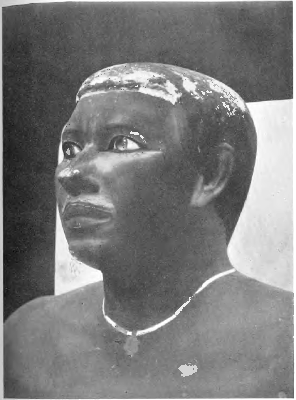
Fig. 5—Statue of an Egyptian Noble of the Pyramid Age to show the technical skill in the representation of life-like eyes
This is the explanation of all the elaborate care and skill bestowed upon the making of artificial eyes. No doubt also it was largely responsible for giving definition to the remarkable belief in the animating power of the eye. But so many other factors of most diverse kinds played a part in building up the complex theory of the eye's fertilizing potency that all the stages in the process of rationalization cannot yet be arranged in orderly sequence.
I refer to the question here and suggest certain aspects of it that seem worthy of investigation merely for the purpose of stimulating some student of early Egyptian literature to look into the matter further.[92]
As death was regarded as a kind of sleep and the closing of the eyes was the distinctive sign of the latter condition the open eyes were not unnaturally regarded as clear evidence of wakefulness and life. In fact, to a matter-of-fact people the restoration of the eyes to the mummy or statue was equivalent to an awakening to life.
At a time when a reflection in a mirror or in a sheet of water was supposed to afford quite positive evidence of the reality of each individual's "double," and when the "soul," or more concretely, "life," was imagined to be a minute image or homunculus, it is quite likely that the reflection in the eye may have been interpreted as the "soul" dwelling within it. The eye was certainly regarded as peculiarly rich in "soul substance". It was not until Osiris received from Horus the eye which had been wrenched out in the latter's combat with Set that he "became a soul".[93]
It is a remarkable fact that this belief in the animating power of the eye spread as far east as Polynesia and America, and as far west as the British Islands.
Of course the obvious physiological functions of the eyes as means of communication between their possessor and the world around him; the powerful influence of the eyes for expressing feeling and emotion without speech; the analogy between the closing and opening of the eyes and the changes of day and night, are all hinted at in Egyptian literature.
But there were certain specific factors that seem to have helped to give definiteness to these general ideas of the physiology of the eyes. The tears, like all the body moisture, came to share the life-giving attributes of water in general. And when it is recalled that at funeral ceremonies emotion found natural expression in the shedding of tears, it is not unlikely that this came to be assimilated with all the other water-symbolism of the funerary ritual. The early literature of Egypt, in fact, refers to the part played by Isis and Nephthys in the reanimation of Osiris, when the tears they shed as mourners brought life back to the god. But the fertilizing tears of Isis were life-giving in the wider sense. They were said to cause the inundation which fertilized the soil of Egypt, meaning presumably that the "Eye of Re" sent the rain.
There is the further possibility that the beliefs associated with the cowry may have played some part, if not in originating, at any rate in emphasizing the conception of the fertilizing powers of the eye. I have already mentioned the outstanding features of the symbolism of the cowry. In many places in Africa and elsewhere the similarity of this shell to the half-closed eyelids led to its use as an artificial "eye" in mummies. The use of the same objects to symbolize the female reproductive organs and the eyes may have played some part in transferring to the latter the fertility of the former. The gods were born of the eyes of Ptah. Might not the confusion of the eye with the genitalia have given a meaning to this statement? There is evidence of this double symbolism of these shells. Cowry shells have also been employed, both in the Persian Gulf and the Pacific, to decorate the bows of boats, probably for the dual purpose of representing eyes and conferring vitality upon the vessel. These facts suggest that the belief in the fertilizing power of the eyes may to some extent be due to this cowry-association. Even if it be admitted that all the known cases of the use of cowries as eyes of mummies are relatively late, and that it is not known to have been employed for such a purpose in Egypt, the mere fact that the likeness to the eyelids so readily suggests itself may have linked together the attributes of the cowry and the eye even in Predynastic times, when cowries were placed with the dead in the grave.
Hathor's identification with the "Eye of Re" may possibly have been an expression of the same idea. But the rôle of the "Eye of Re" was due primarily to her association with the moon (vide infra, p. 56).
The apparently hopeless tangle of contradictions involved in these conceptions of Hathor will have to be unravelled. For "no eye is to be feared more than thine (Re's) when it attacketh in the form of Hathor" (Maspero, op. cit. p. 165). If it was the beneficent life-giving aspect of the eye which led to its identification with Hathor, in course of time, when the reason for this connexion was lost sight of, it became associated with the malevolent, death-dealing avatar of the goddess, and became the expression of the god's anger and hatred toward his enemies. It is not unlikely that such a confusion may have been responsible for giving concrete expression to the general psychological fact that the eyes are obviously among the chief means for expressing hatred for and intimidating and "brow-beating" one's fellows. [In my lecture on "The Birth of Aphrodite" I shall explain the explicit circumstances that gave rise to these contradictions.]
It is significant that, in addition to the widespread belief in the "evil eye"—which in itself embodies the same confusion, the expression of admiration that works evil—in a multitude of legends it is the eye that produces petrifaction. The "stony stare" causes death and the dead become transformed into statues, which, however, usually lack their original attribute of animation. These stories have been collected by Mr. E. S. Hartland in his "Legend of Perseus".
There is another possible link in the chain of associations between the eye and the idea of fertility. I have already referred to the development of the belief that incense, which plays so prominent a part in the ritual for conferring vitality upon the dead, is itself replete with animating properties. "Glaser has already shown the anti incense of the Egyptian Punt Reliefs to be an Arabian word, a-a-netc, 'tree-eyes' (Punt und die Südarabischen Reiche, p. 7), and to refer to the large lumps ... as distinguished from the small round drops, which are supposed to be tree-tears or the tree-blood."[94]
The Moon and the Sky-World.
There are reasons for believing that the chief episodes in Aphrodite's past point to the Red Sea for their inspiration, though many other factors, due partly to local circumstances and partly to contact with other civilizations, contributed to the determination of the traits of the Mediterranean goddess of love. In Babylonia and India there are very definite signs of borrowing from the same source. It is important, therefore, to look for further evidence to Arabia as the obvious bond of union both with Phœnicia and Babylonia.
The claim made in Roscher's Lexicon der Mythologie that the Assyrian Ishtar, the Phœnician Ashtoreth (Astarte), the Syrian Atargatis (Derketo), the Babylonian Belit (Mylitta) and the Arabian Ilat (Al-ilat) were all moon-goddesses has given rise to much rather aimless discussion, for there can be no question of their essential homology with Hathor and Aphrodite. Moreover, from the beginning, all goddesses—and especially this most primitive stratum of fertility deities—were for obvious reasons intimately associated with the moon.[95] But the cyclical periodicity of the moon which suggested the analogy with the similar physiological periodicity of women merely explains the association of the moon with women. The influence of the moon upon dew and the tides, perhaps, suggested its controlling power over water and emphasized the life-giving function which its association with women had already suggested. For reasons which have been explained already, water was associated more especially with fertilization by the male. Hence the symbolism of the moon came to include the control of both the male and the female processes of reproduction.[96]
The literature relating to the development of these ideas with reference to the moon has been summarized by Professor Hutton Webster.[97] He shows that "there is good reason for believing that among many primitive peoples the moon, rather than the sun, the planets or any of the constellations, first excited the imagination and aroused feelings of superstitious awe or of religious veneration".
Special attention was first devoted to the moon when agricultural pursuits compelled men to measure time and determine the seasons. The influence of the moon on water, both the tides and dew, brought it within the scope of the then current biological theory of fertilization. This conception was powerfully corroborated by the parallelism of the moon's cycles and those of womankind, which was interpreted by regarding the moon as the controlling power of the female reproductive functions. Thus all of the earliest goddesses who were personifications of the powers of fertility came to be associated, and in some cases identified, with the moon.
In this way the animation and deification of the moon was brought about: and the first sky deity assumed not only all the attributes of the cowry, i.e. the female reproductive functions, but also, as the controller of water, many of those which afterwards were associated with Osiris. The confusion of the male fertilizing powers of Osiris with the female reproductive functions of Hathor and Isis may explain how in some places the moon became a masculine deity, who, however, still retained his control over womankind, and caused the phenomena of menstruation by the exercise of his virile powers.[98] But the moon-god was also a measurer of time and in this aspect was specially personified in Thoth.
The assimilation of the moon with these earth-deities was probably responsible for the creation of the first sky-deity. For once the conception developed of identifying a deity with the moon, and the Osirian beliefs associated with the deification of a dead king grew up, the moon became the impersonation of the spirit of womankind, some mortal woman who by death had acquired divinity.
After the idea had developed of regarding the moon as the spirit of a dead person, it was only natural that, in course of time, the sun and stars should be brought within the scope of the same train of thought, and be regarded as the deified dead. When this happened the sun not unnaturally soon leapt into a position of pre-eminence. As the moon represented the deified female principle the sun became the dominant male deity Re. The stars also became the spirits of the dead.
Once this new conception of a sky-world was adumbrated a luxuriant crop of beliefs grew up to assimilate the new beliefs with the old, and to buttress the confused mixture of incompatible ideas with a complex scaffolding of rationalization.
The sun-god Horus was already the son of Osiris. Osiris controlled not only the river and the irrigation canals, but also the rain-clouds. The fumes of incense conveyed to the sky-gods the supplications of the worshippers on earth. Incense was not only "the perfume that deities," but also the means by which the deities and the dead could pass to their doubles in the newly invented sky-heaven. The sun-god Re was represented in his temple not by an anthropoid statue, but by an obelisk,[99] the gilded apex of which pointed to heaven and "drew down" the dazzling rays of the sun, reflected from its polished surface, so that all the worshippers could see the manifestations of the god in his temple.
These events are important, not only for creating the sky-gods and the sky-heaven, but possibly also for suggesting the idea that even a mere pillar of stone, whether carved or uncarved, upon which no attempt had been made to model the human form, could represent the deity, or rather could become the "body" to be animated by the god.[100] For once it was admitted, even in the home of these ancient ideas concerning the animation of statues, that it was not essential for the idol to be shaped into human form, the way was opened for less cultured peoples, who had not acquired the technical skill to carve statues, simply to erect stone pillars or unshaped masses of stone or wood for their gods to enter, when the appropriate ritual of animation was performed.[101]
This conception of the possibility of gods, men, or animals dwelling in stones spread in course of time throughout the world, but in every place where it is found certain arbitrary details of the methods of animating the stone reveal the fact that all these legends must have been derived from the same source.
The complementary belief in the possibility of the petrifaction of men and animals has a similarly extensive geographical distribution. The history of this remarkable incident I shall explain in the lecture on "Dragons and Rain Gods" (Chapter II.).[102]
The Worship of the Cow.
Intimately linked with the subjects I have been discussing is the worship of the cow. It would lead me too far afield to enter into the details of the process by which the earliest Mother-Goddesses became so closely associated or even identified with the cow, and why the cow's horns became associated with the moon among the emblems of Hathor. But it is essential that reference should be made to certain aspects of the subject.
I do not think there is any evidence to justify the common theory that the likeness of the crescent moon to a cow's horns was the reason for the association. On the other hand, it is clear that both the moon and the cow became identified with the Mother-Goddess quite independently the one of the other, and at a very remote period.
It is probable that the fundamental factor in the development of this association of the cow and the Mother-Goddess was the fact of the use of milk as food for human beings. For if the cow could assume this maternal function she was in fact a sort of foster-mother of mankind; and in course of time she came to be regarded as the actual mother of the human race and to be identified with the Great Mother.
Many other considerations helped in this process of assimilation. The use of cattle not merely as meat for the sustenance of the living but as the usual and most characteristic life-giving food for the dead naturally played a part in conferring divinity upon the cow, just as an analogous relationship made incense a holy substance and was responsible for the personification of the incense-tree as a goddess. This influence was still further emphasized in the case of cattle because they also supplied the blood which was used for the ritual purpose of bestowing consciousness upon the dead, and in course of time upon the gods also, so that they might hear and attend to the prayers of supplicants.
Other circumstances emphasize the significance attached to the cow: but it is difficult to decide whether they contributed in any way to the development of these beliefs or were merely some of the practices which were the result of the divination of the cow. The custom of placing butter in the mouths of the dead, in Egypt, Uganda, and India, the various ritual uses of milk, the employment of a cow's hide as a wrapping for the dead in the grave, and also in certain mysterious ceremonies,[103] all indicate the intimate connexion between the cow and the means of attaining a rebirth in the life to come.
I think there are definite reasons for believing that once the cow became identified with the Mother-Goddess as the parent of mankind the first step was taken in the development of the curious system of ideas now known as "totemism".
This, however, is a complex problem which I cannot stay to discuss here.
When the cow became identified with the Great Mother and the moon was regarded as the dwelling or the personification of the same goddess, the Divine Cow by a process of confused syncretism came to be regarded as the sky or the heavens, to which the dead were raised up on the cow's back. When Re became the dominant deity, he was identified with the sky, and the sun and moon were then regarded as his eyes. Thus the moon, as the Great Mother as well as the Eye of Re, was the bond of identification of the Great Mother with an eye. This was probably how the eye acquired the animating powers of the Giver of Life.
A whole volume might be written upon the almost world-wide diffusion of these beliefs regarding the cow, as far as Scotland and Ireland in the west, and in their easterly migration probably as far as America, to the confusion alike of its ancient artists and its modern ethnologists.[104]
As an illustration of the identification of the cow's attributes with those of the life-giving Great Mother, I might refer to the late Professor Moulton's commentary[105] on the ancient Iranian Gâthâs, where cow's flesh is given to mortals by Yima to make them immortal. "May we connect it with another legend whereby at the Regeneration Mithra is to make men immortal by giving them to eat the fat of the ... primeval Cow from whose slain body, according to the Aryan legends adopted by Mithraism, mankind was first created?"[106]
The Diffusion of Culture.
In these pages I have made no attempt to deal with the far-reaching and intricate problems of the diffusion abroad of the practices and beliefs which I have been discussing. But the thoughts and the aspirations of every cultured people are permeated through and through with their influence.
It is important to remember that in almost every stage of the development of these complex customs and ideas not merely the "finished product" but also the ingredients out of which it was built up were being scattered abroad.
I shall briefly refer to certain evidence from Asia and America in illustration of this fact and in substantiation of the reality of the diffusion to the East of some of the beliefs I have been discussing.
The unity of Egyptian and Babylonian ideas is nowhere more strikingly demonstrated than in the essential identity of the attributes of Osiris and Ea. It affords the most positive proof of the derivation of the beliefs from some common source, and reveals the fact that Egyptian and Sumerian civilizations must have been in intimate cultural contact at the beginning of their developmental history. "In Babylonia, as in Egypt, there were differences of opinion regarding the origin of life and the particular natural element which represented the vital principle." "One section of the people, who were represented by the worshippers of Ea, appear to have believed that the essence of life was contained in water. The god of Eridu was the source of the 'water of life'."[107]
"Offerings of water and food were made to the dead," not primarily so that they might be "prevented from troubling the living,"[108] but to supply them with the means of sustenance and to reanimate them to help the suppliants. It is a common belief that these and other procedures were inspired by fear of the dead. But such a statement does not accurately represent the attitude of mind of the people who devised these funerary ceremonies. For it is not the enemies of the dead or those against whom he had a grudge that run a risk at funerals, but rather his friends; and the more deeply he was attached to a particular person the greater the danger for the latter. For among many people the belief obtains that when a man dies he will endeavour to steal the "soul-substance" of those who are dearest to him so that they may accompany him to the other world. But as stealing the "soul-substance"[109] means death, it is easy to misunderstand such a display of affection. Hence most people who long for life and hate death do their utmost to evade such embarrassing tokens of love; and most ethnologists, misjudging such actions, write about "appeasing the dead". It was those whom the gods loved who died young.
Ea was not only the god of the deep, but also "lord of life," king of the river and god of creation. Like Osiris "he fertilized parched and sunburnt wastes through rivers and irrigating canals, and conferred upon man the sustaining 'food of life'.... The goddess of the dead commanded her servant to 'sprinkle the Lady Ishtar with the water of life'" (op. cit., p. 44).
In Chapter III. of Mr. Mackenzie's book, from which I have just quoted, there is an interesting collection of quotations clearly showing that the conception of the vitalizing properties of the body moisture of gods is not restricted to Egypt, but is found also in Babylonia and India, in Western Asia and Greece, and also in Western Europe.
It has been suggested that the name Ishtar has been derived from Semitic roots implying "she who waters," "she who makes fruitful".[110]
Barton claims that: "The beginnings of Semitic religion as they were conceived by the Semites themselves go back to sexual relations ... the Semitic conception of deity ... embodies the truth—grossly indeed, but nevertheless embodies it—that 'God is love'" (op. cit. p. 107). [This statement, however, is very misleading—see Appendix C, p. 75.]
Throughout the countries where Semitic[111] influence spread the primitive Mother-Goddesses or some of their specialized variants are found. But in every case the goddess is associated with many distinctive traits which reveal her identity with her homologues in Cyprus, Babylonia, and Egypt.
Among the Sumerians "life comes on earth through the introduction of water and irrigation".[112] "Man also results from a union between the water-gods."
The Akkadians held views which were almost the direct antithesis of these. To them "the watery deep is disorder, and the cosmos, the order of the world, is due to the victory of a god of light and spring over the monster of winter and water; man is directly made by the gods".[113]
"The Sumerian account of Beginnings centres around the production by the gods of water, Enki and his consort Nin-ella (or Dangal), of a great number of canals bringing rain to the desolate fields of a dry continent. Life both of vegetables and animals follows the profusion of the vivifying waters.... In the process of life's production besides Enki, the personality of his consort is very conspicuous. She is called Nin-Ella, 'the pure Lady,' Damgal-Nunna, the 'great Lady of the Waters,' Nin-Tu, 'the Lady of Birth'" (p. 301). The child of Enki and Nin-ella was the ancestor of mankind.[114]
"In later traditions, the personality of that Great Lady seems to have been overshadowed by that of Ishtar, who absorbed several of her functions" (p. 301).
Professor Carnoy fully demonstrates the derivation of certain early so-called "Aryan" beliefs from Chaldea. In the Iranian account of the creation "the great spring Ardvī Sūra Anāhita is the life-increasing, the herd-increasing, the fold-increasing who makes prosperity for all countries (Yt. 5, 1) ... that precious spring is worshipped as a goddess ... and is personified as a handsome and stately woman. She is a fair maid, most strong, tall of form, high-girded. Her arms are white and thick as a horse's shoulder or still thicker. She is full of gracefulness" (Yt. 5, 7, 64, 78). "Professor Cumont thinks that Anāhita is Ishtar ... she is a goddess of fecundation and birth. Moreover in Achæmenian inscriptions Anāhita is associated with Ahura Mazdāh and Mithra, a triad corresponding to the Chaldean triad: Sin-Shamash-Ishtar. Ἀνάιτις in Strabo and other Greek writers is treated as Ἀφροδίτη" (p. 302).
But in Mesopotamia also the same views were entertained as in Egypt of the functions of statues.
"The statues hidden in the recesses of the temples or erected on the summits of the 'Ziggurats' became imbued, by virtue of their consecration, with the actual body of the god whom they represented." Thus Marduk is said to "inhabit his image" (Maspero, op. cit. p. 64).
This is precisely the idea which the Egyptians had. Even at the present day it survives among the Dravidian peoples of India.[115] They make images of their village deities, which may be permanent or only temporary, but in any case they are regarded not as actual deities but as the "bodies" so to speak into which these deities can enter. They are sacred only when they are so animated by the goddess. The ritual of animation is essentially identical with that found in Ancient Egypt. Libations are poured out; incense is burnt; the bleeding right fore-leg of a buffalo constitutes the blood-offering.[116] When the deity is reanimated by these procedures and its consciousness restored by the blood-offering it can hear appeals and speak.
The same attitude towards their idols was adopted by the Polynesians. "The priest usually addressed the image, into which it was imagined the god entered when anyone came to inquire his will."[117]
But there are certain other aspects of these Indian customs that are of peculiar interest. In my Ridgeway essay (op. cit. supra) I referred to the means by which in Nubia the degradation of the oblong Egyptian mastaba gave rise to the simple stone circle. This type spread to the west along the North African littoral, and also to the Eastern desert and Palestine. At some subsequent time mariners from the Red Sea introduced this practice into India.
[It is important to bear in mind that two other classes of stone circles were invented. One of them was derived, not from the mastaba itself, but from the enclosing wall surrounding it (see my Ridgeway essay, Fig. 13, p. 531, and compare with Figs. 3 and 4, p. 510, for illustrations of the transformed mastaba-type). This type of circle (enclosing a dolmen) is found both in the Caucasus-Caspian area as well as in India. A highly developed form of this encircling type of structure is seen in the famous rails surrounding the Buddhist stupas and dagabas. A third and later form of circle, of which Stonehenge is an example, was developed out of the much later New Empire Egyptian conception of a temple.]
But at the same time, as in Nubia, and possibly in Libya, the mastaba was being degraded into the first of the three main varieties of stone circle, other, though less drastic, forms of simplification of the mastaba were taking place, possibly in Egypt itself, but certainly upon the neighbouring Mediterranean coasts. In some respects the least altered copies of the mastaba are found in the so-called "giant's graves" of Sardinia and the "horned cairns" of the British Isles. But the real features of the Egyptian serdab, which was the essential part, the nucleus so to speak, of the mastaba, are best preserved in the so-called "holed dolmens" of the Levant, the Caucasus, and India. [They also occur sporadically in the West, as in France and Britain.]
Such dolmens and more simplified forms are scattered in Palestine,[118] but are seen to best advantage upon the Eastern Littoral of the Black Sea, the Caucasus, and the neighbourhood of the Caspian. They are found only in scattered localities between the Black and Caspian Seas. As de Morgan has pointed out,[119] their distribution is explained by their association with ancient gold and copper mines. They were the tombs of immigrant mining colonies who had settled in these definite localities to exploit these minerals.
Now the same types of dolmens, also associated with ancient mines,[120] are found in India. There is some evidence to suggest that these degraded types of Egyptian mastabas were introduced into India at some time after the adoption of the other, the Nubian modification of the mastaba which is represented by the first variety of stone circle.[121]
I have referred to these Indian dolmens for the specific purpose of illustrating the complexities of the processes of diffusion of culture. For not only have several variously specialized degradation-products of the same original type of Egyptian mastaba reached India, possibly by different routes and at different times, but also many of the ideas that developed out of the funerary ritual in Egypt—of which the mastaba was merely one of the manifestations—made their way to India at various times and became secondarily blended with other expressions of the same or associated ideas there. I have already referred to the essential elements of the Egyptian funerary ritual—the statues, incense, libations, and the rest—as still persisting among the Dravidian peoples.
But in the Madras Presidency dolmens are found converted into Siva temples.[122] Now in the inner chamber of the shrine—which represents the homologue of the serdab—in place of the statue or bas-relief of the deceased or of the deity, which is found in some of them (see Plate I), there is the stone linga-yoni emblem in the position corresponding to that in which, in the later temple in the same locality (Kambaduru), there is an image of Parvati, the consort of Siva.
The earliest deities in Egypt, both Osiris and Hathor, were really expressions of the creative principle. In the case of Hathor, the goddess was, in fact, the personification of the female organs of reproduction.[123] In these early Siva temples in India these principles of creation were given their literal interpretation, and represented frankly as the organs of reproduction of the two sexes. The gods of creation were symbolized by models in stone of the creating organs. Further illustrations of the same principle are witnessed in the Indonesian megalithic monuments which Perry calls "dissoliths".[124]
The later Indian temples, both Buddhist and Hindu, were developed from these early dolmens, as Mr. Longhurst's reports so clearly demonstrate. But from time to time there was an influx of new ideas from the West which found expression in a series of modifications of the architecture. Thus India provides an admirable illustration of this principle of culture contact. A series of waves of megalithic culture introduced purely Western ideas. These were developed by the local people in their own way, constantly intermingling a variety of cultural influences to weave them into a distinctive fabric, which was compounded partly of imported, partly of local threads, woven locally into a truly Indian pattern. In this process of development one can detect the effects of Mycenæan accretions (see for example Longhurst's Plate XIII), probably modified during its indirect transmission by Phœnician and later influences; and also the more intimate part played by Babylonian, Egyptian, and, later, Greek and Persian art and architecture in directing the course of development of Indian culture.
Incidentally, in the course of the discussions in the foregoing pages, I have referred to the profound influence of Egyptian, Babylonian and Indian ideas in Eastern Asia. Perry's important book (op. cit. supra) reveals their efforts in Indonesia. Thence they spread across the Pacific to America.
In the "Migrations of Early Culture" (p. 114) I called attention to the fact that among the Aztecs water was poured upon the head of the mummy. This ritual procedure was inspired by the Egyptian idea of libations, for, according to Brasseur de Bourbourg, the pouring out of the water was accompanied by the remark "C'est cette eau que tu as reçue en venant an monde".
But incense-burning and blood-offering were also practised in America. In an interesting memoir[125] on the practice of blood-letting by piercing the ears and tongue, Mrs. Zelia Nuttall reproduces a remarkable picture from a "partly unpublished MS. of Sahagun's work preserved in Florence". "The image of the sun is held up by a man whose body is partly hidden, and two men, seated opposite to each other in the foreground, are in the act of piercing the helices or external borders of their ears." But in addition to these blood-offerings to the sun, two priests are burning incense in remarkably Egyptian-like censers, and another pair are blowing conch-shell trumpets.
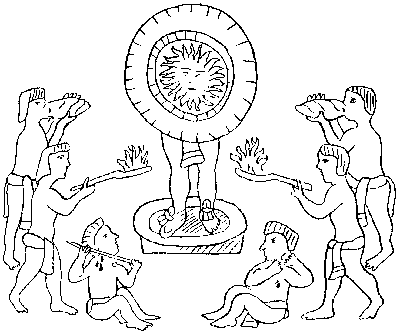
Fig. 6.—Representation of the ancient Mexican Worship of the Sun
The image of the sun is held up by a man in front of his face; two men blow conch-shell trumpets; another pair burn incense; and a third pair make blood-offerings by piercing their ears—after Zelia Nuttall.
But it was not merely the use of incense and libations and the identities in the wholly arbitrary attributes of the American pantheon that reveal the sources of their derivation in the Old World. When the Spaniards first visited Yucatan they found traces of a Maya baptismal rite which the natives called zihil, signifying "to be born again". At the ceremony also incense was burnt.[126]
The forehead, the face, the fingers and toes were moistened. "After they had been thus sprinkled with water, the priest arose and removed the cloths from the heads of the children, and then cut off with a stone knife a certain bead that was attached to the head from childhood."[127]
[The custom of wearing such a bead during childhood is found in Egypt at the present day.]
In the case of the girls, their mothers "divested them of a cord which was worn during their childhood, fastened round the loins, having a small shell that hung in front ('una conchuela asida que les venia a dar encima de la parte honesta'—Landa). The removal of this signified that they could marry."[128]
This use of shells is found in the Soudan and East Africa at the present day.[129] The girdle upon which the shells were hung is the prototype of the cestus of Hathor, Ishtar, Aphrodite, Kali and all the goddesses of fertility in the Old World. It is an admirable illustration of the fact that not only were the finished products, the goddesses and their fantastic repertory of attributes, transmitted to the New World, but also the earliest and most primitive ingredients out of which the complexities of their traits were compounded.
In Chapter III ("The Birth of Aphrodite") I shall explain what an important part the invention of this girdle played in the development of the material side of civilization and the even vaster influence it exerted upon beliefs and ethics. It represents the first stage in the evolution of clothing; and it was responsible for originating the belief in love-philtres and in the possibility of foretelling the future.
It would lead me too far from my main purpose in this book to discuss the widespread geographical distribution and historical associations of the customs of baptism and pouring libations among different peoples. I may, however, refer the reader to an article by Mr. Elsdon Best, entitled "Ceremonial Performances Pertaining to Birth, as Performed by the Maori of New Zealand in Past Times" (Journal of the Royal Anthropological Institute, Vol. XLIV, 1914, p. 127), which sheds a clear light upon the general problem.
The whole subject of baptismal ceremonies is well worth detailed study as a remarkable demonstration of the spread of culture in early times.
Summary.
In these pages I have ranged over a very wide field of speculation, groping in the dim shadows of the early history of civilization. I have been attempting to pick up a few of the threads which ultimately became woven into the texture of human beliefs and aspirations, and to suggest that the practice of mummification was the woof around which the web of civilization was intimately intertwined.
I have already explained how closely that practice was related to the origin and development of architecture, which Professor Lethaby has called the "matrix of civilization," and how nearly the ideas that grew up in explanation and in justification of the ritual of embalming were affected by the practice of agriculture, the second great pillar of support for the edifice of civilization. It has also been shown how far-reaching was the influence exerted by the needs of the embalmer, which impelled men, probably for the first time in history, to plan and carry out great expeditions by sea and land to obtain the necessary resins and the balsams, the wood and the spices. Incidentally also in course of time the practice of mummification came to exert a profound effect upon the means for the acquisition of a knowledge of medicine and all the sciences ancillary to it.
But I have devoted chief attention to the bearing of the ideas which developed out of the practice and ritual of embalming upon the spirit of man. It gave shape and substance to the belief in a future life; it was perhaps the most important factor in the development of a definite conception of the gods: it laid the foundation of the ideas which subsequently were built up into a theory of the soul: in fact, it was intimately connected with the birth of all those ideals and aspirations which are now included in the conception of religious belief and ritual. A multitude of other trains of thought were started amidst the intellectual ferment of the formulation of the earliest concrete system of biological theory. The idea of the properties and functions of water which had previously sprung up in connexion with the development of agriculture became crystallized into a more definite form as the result of the development of mummification, and this has played an obtrusive part in religion, in philosophy and in medicine ever since. Moreover its influence has become embalmed for all time in many languages and in the ritual of every religion.
But it was a factor in the development not merely of religious beliefs, temples and ritual, but it was also very closely related to the origin of much of the paraphernalia of the gods and of current popular beliefs. The swastika and the thunderbolt, dragons and demons, totemism and the sky-world are all of them conceptions that were more or less closely connected with the matters I have been discussing.
The ideas which grew up in association with the practice of mummification were responsible for the development of the temple and its ritual and for a definite formulation of the conception of deities. But they were also responsible for originating a priesthood. For the resuscitation of the dead king, Osiris, and for the maintenance of his existence it was necessary for his successor, the reigning king, to perform the ritual of animation and the provision of food and drink. The king, therefore, was the first priest, and his functions were not primarily acts of worship but merely the necessary preliminaries for restoring life and consciousness to the dead seer so that he could consult him and secure his advice and help.
It was only when the number of temples became so great and their ritual so complex and elaborate as to make it a physical impossibility for the king to act in this capacity in all of them and on every occasion that he was compelled to delegate some of his priestly functions to others, either members of the royal family or high officials. In course of time certain individuals devoted themselves exclusively to these duties and became professional priests; but it is important to remember that at first it was the exclusive privilege of Horus, the reigning king, to intercede with Osiris, the dead king, on behalf of men, and that the earliest priesthood consisted of those individuals to whom he had delegated some of these duties.
In conclusion I should like to express in words what must be only too apparent to every reader of this statement. It claims to be nothing more than a contribution to the study of some of the most difficult problems in the history of human thought. For one so ill-equipped for a task of such a nature as I am to attempt it calls for a word of explanation. The clear light that recent research has shed upon the earliest literature in the world has done much to destroy the foundations upon which the theories propounded by scholars have been built up. It seemed to be worth while to attempt to read afresh the voluminous mass of old documents with the illumination of this new information.
The other reason for making such an attempt is that almost every modern scholar who has discussed the matters at issue has assumed that the fashionable doctrine of the independent development of human beliefs and practices was a safe basis upon which to construct his theories. At best it is an unproven and reckless speculation. I am convinced it is utterly false. Holding such views I have attempted to read the evidence afresh.
APPENDIX A.
On re-reading the discussion of the significance of the ka I realize that, in striving after brevity and conciseness—to keep the size of my statement within the limits of the Bulletin of the John Rylands Library, generously elastic though it is—I have left the argument in a rather nebulous form.
It must not be imagined that a concrete-minded people like the ancient Egyptians entertained highly abstract and ethereal ideas about "the soul". They recognized that all the expressions of consciousness and personality could cease during sleep; and at the same time the phenomena of dreams seemed to afford evidence that these absent elements of the individual's being were enjoying real experiences elsewhere. Thus there was an alter ego, identified by this matter-of-fact people with the twin (placenta) which was born with the child and was clearly concerned with its physical and intellectual nourishment—for it was obviously connected by its stalk to the embryo like a tree to its roots, and it seemed to be composed of blood, which was regarded as the vehicle of mind. But this intellectual "twin" kept pace in its growth with the physical body. When a statue was made to represent the latter the ka could dwell in the real body or the statue.
The identification of the placenta with the moon helped the growth of the conception that this "birth-promoter" could not only bring about a re-birth in the life to come, but also facilitate a transference to the sky-world. The placenta had already been superintending the deceased's welfare upon earth and would continue to do so when he rejoined his ka in the sky world.
The complexity of the conception is due to the fact that the simple early belief in "a double" was gradually elaborated, as one new idea after another became added to it, and rationalized to blend with the former complex in an increasingly involved synthesis. It was only when the elaborate scaffolding of material factors was cleared away that a more ethereal conception of "the soul" was sublimated.
APPENDIX B.
I should like to emphasize the fact that my protest (on p. 63) was directed against the claim that the custom of offering food and drink to the dead was inspired primarily to prevent them from troubling the living. Its original purpose was to sustain and reanimate the dead; but, of course, when its real meaning was forgotten, it was explained in a great variety of ways by the people who made a practice of presenting offerings to the dead without really knowing why they did so.
Dr. Alan Gardiner himself has made a statement which casual readers (i.e., those who do not discriminate between the motive for the invention of a procedure and the reasons subsequently given for its continuance) might regard as a contradiction of my quotation from his writings on p. 62. Thus he says: "Any god could doubtless attack human beings, but savage and malicious deities, like Seth [Set], the murderer of Osiris, or Sakhmet, [Sekhet], the 'lady of pestilence' (nb-t 'idw), were doubtless most to be feared." [This attitude of the malignant goddesses is revealed in a most obtrusive form in the village deities of the Dravidians of Southern India.] "The dead were specially to be feared; nor was it only those dead who were unhappy or unburied that might torment the living, for the magician sometimes warns them that their tombs are endangered" (Article "Magic (Egyptian)," Hastings' Encycl. Ethics and Religion, p. 264).
But it is important to bear in mind, as the same scholar has explained elsewhere ["Life and Death (Egyptian)," Hastings' Encycl., p. 23]: "Nothing could be farther from the truth [than the statement that 'the funerary rites and practices of the Egyptians were in the main precautionary measures serving to protect the living against the dead']; it is of fundamental importance to realize that the vast stores of wealth and thought expended by the Egyptians on their tombs—that wealth and that thought which created not only the pyramids, but also the practice of mummification and a very extensive funerary literature—were due to the anxiety of each member of the community with regard to his own individual future welfare, and not to feelings of respect, or fear, or duty felt towards the other dead."
It was only in response to certain binding obligations that the living observed all those costly and troublesome rules which were believed to insure the welfare of the deceased. But this recognition of the primary and real purpose of the food offerings as sustenance for the dead or the gods must not be allowed to blind us to the fact that there is widespread throughout the world a real fear of the dead and ghosts, and that in many places food-offerings are made for the specific purpose "of appeasing the fairies".
Mr. Donald Mackenzie tells me that offerings of milk and porridge are made at the stone monuments in Scotland, and children carry meal in their pockets to protect themselves from the fairies. For the dead went to Fairyland.
Beliefs of a similar kind can be collected from most parts of the world: but the point I specially want to emphasize is that they are secondary rationalizations of a custom which originally had an utterly different significance.
APPENDIX C.
Prof. Barton's statement (supra, p. 64) is typical of a widespread misapprehension, resulting from the confusion between sexual relations and the giving of life. At first primitive people did not realize that the manifestations of the sex instinct had anything whatever to do with reproduction. They were aware of the fact that women gave birth to children; and the organ concerned in this process was regarded as the giver of life, the creator. The apotheosis of these powers led to the conception of the first deity. But it was only secondarily that these life-giving attributes were brought into association with the sexual act and the masculine powers of fertilization. Much confusion has been created by those writers who see manifestations of the sexual factor and phallic ideas in every aspect of primitive religion, where in most cases only the power of life-giving plays a part.