Chapter II · (continued 2)
Reading edition
Thus we have arrived at the stage where, by a distortion of a series of phases, the new incident emerges that by means of a human sacrifice the Nile flood can be produced. By a further confusion the goddess, who originally did the slaughter, becomes the victim. Hence the story assumed the form that by means of the sacrifice of a beautiful and attractive maiden the annual inundation can be produced. As the most potent symbol of life-giving it is essential that the victim should be sexually attractive, i.e. that she should be a virgin and the most beautiful and desirable in the land. When the practice of human sacrifice was abandoned a figure or an animal was substituted for the maiden in ritual practice, and in legends the hero rescued the maiden, as Andromeda was saved from the dragon.[200] The dragon is the personification of the monsters that dwell in the waters as well as the destructive forces of the flood itself. But the monsters were no other than the followers of Set; they were the victims of the slaughter who became identified with the god's other traditional enemies, the followers of Set. Thus the monster from whom Andromeda is rescued is merely another representative of herself!
But the destructive forces of the flood now enter into the programme. In the phases we have so far discussed it was the slaughter of mankind which caused the inundation: but in the next phase it is the flood itself which causes the destruction, as in the later Egyptian and the borrowed Sumerian, Babylonian, Hebrew—and in fact the world-wide—versions. Re's boat becomes the ark; the winged disk which was despatched by Re from the boat becomes the dove and the other birds sent out to spy the land, as the winged Horus spied the enemies of Re.
Thus the new weapon of the gods—we have already noted Hathor's knife and Horus's winged disk, which is the fire from heaven, the lightning and the thunderbolt—is the flood. Like the others it can be either a beneficent giver of life or a force of destruction.
But the flood also becomes a weapon of another kind. One of the earlier incidents of the story represents Hathor in opposition to Re. The goddess becomes so maddened with the zest of killing that the god becomes alarmed and asks her to desist and spare some representatives of the race. But she is deaf to entreaties. Hence the god is said to have sent to Elephantine for the red ochre to make a sedative draught to overcome her destructive zeal. We have already seen that this incident had an entirely different meaning—it was merely intended to explain the obtaining of the colouring matter wherewith to redden the sacred beer so as to make it resemble blood as an elixir for the god. It was brought from Elephantine, because the red waters of inundation of the Nile were supposed by the Egyptians to come from Elephantine.
But according to the story inscribed in Seti Ist's tomb, the red ochre was an essential ingredient of the sedative mixture (prepared under the direction of Re by the Sekti[201] of Heliopolis) to calm Hathor's murderous spirit.
It has been claimed that the story simply means that the goddess became intoxicated with beer and that she became genially inoffensive solely as the effect of such inebriation. But the incident in the Egyptian story closely resembles the legends of other countries in which some herb is used specifically as a sedative. In most books on Egyptian mythology the word (d'd') for the substance put into the drink to colour it is translated "mandragora," from its resemblance to the Hebrew word dudaim in the Old Testament, which is often translated "mandrakes" or "love-apples". But Gauthier has clearly demonstrated that the Egyptian word does not refer to a vegetable but to a mineral substance, which he translates "red clay".[202] Mr. F. Ll. Griffith tells me, however, that it is "red ochre". In any case, mandrake is not found at Elephantine (which, however, for the reasons I have already given, is a point of no importance so far as the identification of the substance is concerned), nor in fact anywhere in Egypt.
But if some foreign story of the action of a sedative drug had become blended with and incorporated in the highly complex and composite Egyptian legend the narrative would be more intelligible. The mandrake is such a sedative as might have been employed to calm the murderous frenzy of a maniacal woman. In fact it is closely allied to hyoscyamus, whose active principle, hyoscin, is used in modern medicine precisely for such purposes. I venture to suggest that a folk-tale describing the effect of opium or some other "drowsy syrup" has been absorbed into the legend of the Destruction of Mankind, and has provided the starting point of all those incidents in the dragon-story in which poison or some sleep-producing drug plays a part. For when Hathor defies Re and continues the destruction, she is playing the part of her Babylonian representative Tiamat, and is a dragon who has to be vanquished by the drink which the god provides.
The red earth which was pounded in the mortar to make the elixir of life and the fertilizer of the soil also came to be regarded as the material out of which the new race of men was made to replace those who were destroyed.
The god fashioned mankind of this earth and, instead of the red ochre being merely the material to give the blood-colour to the draught of immortality, the story became confused: actual blood was presented to the clay images to give them life and consciousness.
In a later elaboration the remains of the former race of mankind were ground up to provide the material out of which their successors were created. This version is a favourite story in Northern Europe, and has obviously been influenced by an intermediate variant which finds expression in the Indian legend of the Churning of the Ocean of Milk. Instead of the material for the elixir of the gods being pounded by the Sekti of Heliopolis and incidentally becoming a sedative for Hathor, it is the milk of the Divine Cow herself which is churned to provide the amrita.
The Thunder-Weapon.[203]
In the development of the dragon-story we have seen that the instruments of destruction were of a most varied kind. Each of the three primary deities, Hathor, Osiris and Horus can be a destructive power as well as a giver of life and of all kinds of boons. Every homologue or surrogate of these three deities can become a weapon for dragon-destroying, such as the moon or the lotus of Hathor, the water or the beer of Osiris, the sun or the falcon of Horus. Originally Hathor used a flint knife or axe: then she did the execution as "the Eye of Re," the moon, the fiery bolt from heaven: Osiris sent the destroying flood and the intoxicating beer, each of which, like the knife, axe and moon of Hathor, were animated by the deity. Then Horus came as the winged disk, the falcon, the sun, the lightning and the thunderbolt. As the dragon-story was spread abroad in the world any one of these "weapons" was confused with any of (or all) the rest. The Eye of Re was the fire-spitting uræus-serpent; and foreign people, like the Greeks, Indians and others, gave the Egyptian verbal simile literal expression and converted it into an actual Cyclopean eye planted in the forehead, which shot out the destroying fire.
The warrior god of Babylonia is called the bright one,[204] the sword or lightning of Ishtar, who was herself called both the sword or lightning of heaven.
In the Ægean area also the sons of Zeus and the progeny of heaven may be axes, stone implements, meteoric stones and thunderbolts. In a Swahili tale the hero's weapon is "a sword like a flash of lightning".
According to Bergaigne,[205] the myth of the celestial drink soma, brought down from heaven by a bird ordinarily called cyena, "eagle," is parallel to that of Agni, the celestial fire brought by Mâtariçvan. This parallelism is even expressly stated in the Rig Veda, verse 6 of hymn 1 to Agni and Soma. Mâtariçvan brought the one from heaven, the eagle brought the other from the celestial mountain.
Kuhn admits that the eagle represents Indra; and Lehmann regards the eagle who takes the fire as Agni himself. It is patent that both Indra and Agni are in fact merely specialized forms of Horus of the Winged Disk Saga, in one of which the warrior sun-god is represented, in the other the living fire. The elixir of life of the Egyptian story is represented by the soma, which by confusion is associated with the eagle: in other words, the god Soma is the homologue not only of Osiris, but also of Horus.
Other incidents in the same original version are confused in the Greek story of Prometheus. He stole the fire from heaven and brought it to earth: but, in place of the episode of the elixir, which is adopted in the Indian story just mentioned, the creation of men from clay is accredited by the Greeks to the "flaming one," the "fire eagle" Prometheus.
The double axe was the homologue of the winged disk which fell, or rather flew, from heaven as the tangible form of the god. This fire from heaven inevitably came to be identified with the lightning. According to Blinkenberg (op. cit., p. 19) "many points go to prove that the double-axe is a representation of the lightning (see Usener, p. 20)". He refers to the design on the famous gold ring from Mycenæ where "the sun, the moon, a double curved line presumably representing the rainbow, and the double-axe, i.e. the lightning": but "the latter is placed lower than the others, probably because it descends from heaven to earth," like Horus when he assumed the form of the winged disk and flew down to earth as a fiery bolt to destroy the enemies of Re.
The recognition of the homology of the winged disk with the double axe solves a host of problems which have puzzled classical scholars within recent years. The form of the double axe on the Mycenæan ring[206] and the painted sarcophagus from Hagia Triada in Crete (and especially the oblique markings upon the axe) is probably a suggestion of the double series of feathers and the outlines of the individual feathers respectively on the wings. The position of the axe upon a symbolic tree is not intended, as Blinkenberg claims (op. cit., p. 21), as "a ritual representation of the trees struck by lightning": but is the familiar scene of Mesopotamian culture-area, the tree of life surmounted by the winged disk.[207]
The bird poised upon the axe in the Cretan picture is the homologue of the falcon of Horus: it is in fact a second representation of the winged disk itself. This interpretation is not affected by the consideration that the falcon may be replaced by the eagle, pigeon, woodpecker or raven, for these substitutions were repeatedly made by the ancient priesthoods in flagrant defiance of the properties of ornithological homologies. The same phenomenon is displayed even more obtrusively in Central America and Mexico, where the ancient sculptors and painters represented the bird perched upon the tree of life as a falcon, an eagle, a vulture, a macaw or even a turkey.[208]
The incident of the winged disk descending to effect the sun-god's purposes upon earth probably represents the earliest record of the recognition of thunder and lightning and the phenomena of rain as manifestations of the god's powers. All gods of thunder, lightning, rain and clouds derive their attributes, and the arbitrary graphic representation of them, from the legend which the Egyptian scribe has preserved for us in the Saga of the Winged Disk.
The sacred axe of Crete is represented elsewhere as a sword which became the visible impersonation of the deity.[209] There is a Hittite story of a sword-handle coming to life. Hose and McDougall refer to the same incident in certain Sarawak legends; and the story is true to the original in the fact that the sword fell from the sun.[210]
Sir Arthur Evans describes as "the aniconic image of the god" a stone pillar on which crude pictures of a double axe have been scratched. These representations of the axe in fact serve the same purpose as the winged disk in Egypt, and, as we shall see subsequently, there was an actual confusion between the Egyptian symbol and the Cretan axe.
The obelisk at Abusir was the aniconic representative of the sun-god Re, or rather, the support of the pyramidal apex, the gilded surface of which reflected the sun's rays and so made manifest the god's presence in the stone.
The Hittites seem to have substituted the winged disk as a representation of the sun: for in a design copied from a seal[211] we find the Egyptian symbol borne upon the apex of a cone.
The transition from this to the great double axe from Hagia Triada in the Candia Museum[212] is a relatively easy one, which was materially helped, as we shall see, by the fact that the winged disk was actually homologized with an axe or knife as alternative weapons used by the sun-god for the destruction of mankind.
In Dr. Seligman's account of the Dinka rain-maker (supra, p. 113) we have already seen that the Soudanese Osiris was identified with a spear and falling stars.
According to Dr. Budge[213] the Egyptian hieroglyph used as the determinative of the word neter, meaning god or spirit, is the axe with a handle. Mr. Griffith, however, interprets it as a roll of yellow cloth ("Hieroglyphics," p. 46). On Hittite seals the axe sometimes takes the place of the god Teshub.[214]
Sir Arthur Evans endeavours to explain these conceptions by a vague appeal to certain natural phenomena (op. cit., pp. 20 and 21); but the identical traditions of widespread peoples are much too arbitrary and specific to be interpreted by any such speculations.
Sanchoniathon's story of Baetylos being the son of Ouranos is merely a poetical way of saying that the sun-god fell to earth in the form of a stone or a weapon, as a Zeus Kappôtas or a Horus in the form of a winged disk, flying down from heaven to destroy the enemies of Re.
"The idea of their [the weapons] flying through the air or falling from heaven, and their supposed power of burning with inner fire or shining in the nighttime," was not primarily suggested, as Sir Arthur Evans claims (op. cit., p. 21), "by the phenomena associated with meteoric stones," but was a rationalization of the events described in the early Egyptian and Babylonian stories.
They "shine at night" because the original weapon of destruction was the moon as the Eye of Re. They "burn with inward fire," like the Babylonian Marduk, when in the fight with the dragon Tiamat "he filled his body with burning flame" (King, op. cit., p. 71), because they were fire, the fire of the sun and of lightning, the fire spat out by the Eye of Re.
Further evidence in corroboration of these views is provided by the fact that in the Ægean area the double-axe replaces the moon between the cow's horns (Evans, op. cit., Fig. 3, p. 9).
In King's "Babylonian Religion" (pp. 70 and 71) we are told how the gods provided Marduk with an invincible weapon in preparation for the combat with the dragon: and the ancient scribe himself sets forth a series of its homologues:—
He made ready his bow ... He slung a spear ... The bow and quiver ... He set the lightning in front of him, With burning flame he filled his body.
An ancient Egyptian writer has put on record further identifications of weapons. In the 95th Chapter of the Book of the Dead, the deceased is reported to have said: "I am he who sendeth forth terror into the powers of rain and thunder.... I have made to flourish my knife which is in the hand of Thoth in the powers of rain and thunder" (Budge, "Gods of the Egyptians," vol. i., p. 414).
The identification of the winged disk with the thunderbolt which emerges so definitely from these homologies is not altogether new, for it was suggested some years ago by Count d'Alviella[215] in these words:—
"On seeing some representations of the Thunderbolt which recall in a remarkable manner the outlines of the Winged Globe, it may be asked if it was not owing to this latter symbol that the Greeks transformed into a winged spindle the Double Trident derived from Assyria. At any rate the transition, or, if it be preferred, the combination of the two symbols is met with in those coins from Northern Africa where Greek art was most deeply impregnated with Phœnician types. Thus on coins of Bocchus II, King of Mauretania, figures are found which M. Lajard connected with the Winged Globe, and M. L. Müller calls Thunderbolts, but which are really the result of crossing between these two emblems".
The thunderbolt, however, is not always, or even commonly, the direct representative of the winged disk. It is more often derived from lightning or some floral design.[216]
According to Count d'Alviella[217] "the Trident of Siva at times exhibits the form of a lotus calyx depicted in the Egyptian manner".
"Perhaps other transformations of the trisula might still be found at Boro-Budur [in Java].... The same Disk which, when transformed into a most complicated ornament, is sometimes crowned by a Trident, is also met with between two serpents—which brings us back to the origin of the Winged Circle—the Globe of Egypt with the uræi" (see d'Alviella's Fig. 158). "Moreover this ornament, between which and certain forms of the trisula the transition is easily traced, commonly surmounts the entrance to the pagodas depicted in the bas-reliefs—in exactly the same manner as the Winged Globe adorns the lintel of the temples in Egypt and Phœnicia."
Thus we find traces of a blending of the two homologous designs, derived independently from the lotus and the winged disk, which acquired the same symbolic significance.
The weapon of Poseidon, the so-called "Trident of Neptune," is "sometimes crowned with a trilobate lotus flower, or with three lotus buds; in other cases it is depicted in a shape that may well represent a fishing spear" (Blinkenberg, op. cit., pp. 53 and 54).
"Even if Jacobsthal's interpretation of the flower as a common Greek symbol for fire be not accepted, the conventionalization of the trident as a lotus blossom is quite analogous to the change, on Greek soil, of the Assyrian thunderweapon to two flowers pointing in opposite directions" (p. 54).
But the conception of a flower as a symbol of fire cannot thus summarily be dismissed. For Sir Arthur Evans has collected all the stages in the transformation of Egyptian palmette pillars into the rayed pillars of Cyprus, in which the leaflets of the palmette become converted (in the Cypro-Mycenæan derivatives) into the rays which he calls "the natural concomitant of divinities of light".[218]
The underlying motive which makes such a transference easy is the Egyptian conception of Hathor as a sacred lotus from which the sun-god Horus is born. The god of light is identified with the water-plant, whether lotus, iris or lily; and the lotus form of Horus can be correlated with its Hellenic surrogate, Apollo Hyakinthos. "The fleur-de-lys type now takes its place beside the sacred lotus" (op. cit., p. 50). The trident and the fleur-de-lys are thunderweapons because they represent forms of Horus or his mother.
The classical keraunos is still preserved in Tibet as the dorje, which is identified with Indra's thunderbolt, the vajra.[219] This word is also applied to the diamond, the "king of stones," which in turn acquired many of the attributes of the pearl, another of the Great Mother's surrogates, which is reputed to have fallen from heaven like the thunderbolt.[220]
The Tibetan dorje, like its Greek original, is obviously a conventionalized flower, the leaf-design about the base of the corona being quite clearly defined.
The influence of the Winged-Disk Saga is clearly revealed in such Greek myths as that relating to Ixion. "Euripides is represented by Aristophanes as declaring that Aithér the creation devised
The eye to mimic the wheel of the sun."[221]
When we read of Zeus in anger binding Ixion to a winged wheel made of fire, and sending him spinning through the air, we are merely dealing with a Greek variant of the Egyptian myth in which Re despatched Horus as a winged disk to slay his enemies. In the Hellenic version the sky-god is angry with the father of the centaurs for his ill-treatment of his father-in-law and his behaviour towards Hera and her cloud-manifestation: but though distorted all the incidents reveal their original inspiration in the Egyptian story and its early Aryan variants.
It is remarkable that Mr. A. B. Cook, who compared the wheel of Ixion with the Egyptian winged disk (pp. 205-10), did not look deeper for a common origin of the two myths, especially when he got so far as to identify Ixion with the sun-god (p. 211).
Blinkenberg sums up the development of the thunder-weapon thus: "From the old Babylonian representation of the lightning, i.e. two or three zigzag lines representing flames, a tripartite thunder-weapon was evolved and earned east and west from the ancient seat of civilization. Together with the axe (in Western Asia Minor the double-edged, and towards the centre of Asia the single-edged, axe) it became a regular attribute of the Asiatic thunder-gods.... The Indian trisula and the Greek triaina are both its descendants" (p. 57).
Discussing the relationship of the sun-god to thunder, Dr. Rendel Harris refers to the fact that Apollo's "arrows are said to be lightnings," and he quotes Pausanias, Apollodorus and Mr. A. B. Cook in substantiation of his statements.[222] Both sons of Zeus, Dionysus and Apollo, are "concerned with the production of fire".
According to Hyginus, Typhon was the son of Tartarus and the Earth: he made war against Jupiter for dominion, and, being struck by lightning, was thrown flaming to the earth, where Mount Ætna was placed upon him.[223]
In this curious variant of the story of the winged disk, the conflict of Horus with Set is merged with the Destruction, for the son of Tartarus [Osiris] and the Earth [Isis] here is not Horus but his hostile brother Set. Instead of fighting for Jupiter (Re) as Horus did, he is against him. The lightning (which is Horus in the form of the winged disk) strikes Typhon and throws him flaming to earth. The episode of Mount Ætna is the antithesis of the incident in the Indian legend of the churning of the ocean: Mount Meru is placed in the sea upon the tortoise avatar of Vishnu and is used to churn the food of immortality for the gods. In the Egyptian story the red ochre brought from Elephantine is pounded with the barley.
The story told by Hyginus leads up to the vision in Revelations (xii., 7 et seq.): "There was war in heaven; Michael and his angels fought against the dragon; and the dragon fought, and his angels, and prevailed not, neither was their place found any more in heaven. And the great dragon was cast out, that old serpent called the Devil and Satan, which deceiveth the whole world: he was cast into the earth, and his angels were cast out with him."
In the later variants the original significance of the Destruction of Mankind seems to have been lost sight of. The life-giving Great Mother tends to drop out of the story and her son Horus takes her place. He becomes the warrior-god, but he not only assumes his mother's rôle but he also adopts her tactics. Just as she attacked Re's enemies in the capacity of the sky-god's "Eye," so Horus as the other "Eye," the sun, to which he gave his own falcon's wings, attacked in the form of the winged disk. The winged disk, like the other "Eye of Re," was not merely the sky weapon which shot down to destroy mankind, but also was the god Horus himself. This early conception involved the belief that the thunderbolt and lightning represented not merely the fiery weapon but the actual god.
The winged disk thus exhibits the same confusion of attributes as we have already noticed in Osiris and Hathor. It is the commonest symbol of life-giving and beneficent protective power: yet it is the weapon used to slaughter mankind. It is in fact the healing caduceus as well as the baneful thunder-weapon.
The Deer.
One of the most surprising features of the dragon in China, Japan and America, is the equipment of deer's horns.
In Babylonia both Ea and Marduk are intimately associated with the antelope or gazelle, and the combination of the head of the antelope (or in other cases the goat) with the body of a fish is the most characteristic manifestation of either god. In Egypt both Osiris and Horus are at times brought into relationship with the gazelle or antelope, but more often it represents their enemy Set. Hence, in some parts of Africa, especially in the west, the antelope plays the part of the dragon in Asiatic stories.[224] The cow[225] of Hathor (Tiamat) may represent the dragon also. In East Africa the antelope assumes the rôle of the hero,[226] and is the representative of Horus. In the Ægean area, Asia Minor and Europe the antelope, gazelle or the deer, may be associated with the Great Mother.[227]
In India the god Soma's chariot is drawn by an antelope. I have already suggested that Soma is only a specialized form of the Babylonian Ea, whose evil avatar is the dragon: there is thus suggested another link between the antelope and the latter. The Ea-element explains the fish-scales and the antelope provides the horns. I shall return to the discussion of this point later.
Vayu or Pavana, the Indian god of the winds, who afterwards became merged with Indra, rides upon an antelope like the Egyptian Horus. Soma's attributes also were in large measure taken over by Indra. Hence in this complex tissue of contradictions we once more find the dragon-slayer acquiring the insignia, in this case the antelope, of his mortal enemy.
I have already referred to the fact that the early Babylonian deities could also be demons. Tiamat, the dragon whom Marduk fought, was merely the malevolent avatar of the Great Mother. The dragon acquired his covering of fish-scales from an evil form of Ea.
In his Hibbert Lectures Professor Sayce claimed that the name of Ea was expressed by an ideograph which signifies literally "the antelope" (p. 280). "Ea was called 'the antelope of the deep,' 'the antelope the creator,' 'the lusty antelope'. We should have expected the animal of Ea to have been the fish: the fact that it is not so points to the conclusion that the culture-god of Southern Babylonia was an amalgamation of two earlier deities, one the divine antelope and the other the divine fish." Ea was "originally the god of the river and was also associated with the snake". Nina was also both the fish-goddess and the divinity whose name is interchanged with that of the deep. Professor Sayce then refers to "the curious process of development which transformed the old serpent-goddess, 'the lady Nina,' into the embodiment of all that was hostile to the powers of heaven; but after all, Nina had sprung from the fish-god of the deep [who also was both antelope and serpent as well, see p. 282], and Tiamat is herself 'the deep' in Semitic dress" (p. 283).
"At times Ea was regarded as a gazelle rather than as an antelope." The position of the name in the list of animals shows what species of animal must be meant. Lulim, "a stag," seems to be a re-duplicated form of the same word. Both lulim and elim are said to be equivalent to sarru, king (p. 284).
Certain Assyriologists, from whom I asked for enlightenment upon these philological matters, express some doubt as to the antiquity or to the reality of the association of the names of Ea and the word for an antelope, gazelle or stag. But whatever the value of the linguistic evidence, the archæological, at any rate as early as the time of Nebuchadnezzar I, brings both Ea and Marduk into close association with a strange creature equipped with the horns of an antelope or gazelle. The association with the antelope of the homologous deities in India and Egypt leaves the reality of the connexion in no doubt. I had hoped that Professor Sayce's evidence would have provided some explanation of the strange association of the antelope. But whether or not the philological data justify the inferences which Professor Sayce drew from them, there can be no doubt concerning the correctness of his statement that Ea was represented both by fish and antelope, for in the course of his excavations at Susa M. J. de Morgan brought to light representations of Ea's animal consisting of an antelope's head on the body of a fish.[228] He also makes the statement that the ideogram of Ea, turahu-apsu, means "antelope of the sea". I have already (p. 88) referred to the fact that this "antelope of the sea," the so-called "goat-fish," is identical with the prototype of the dragon.
If his claim that the names of Ea meant both a "fish" and an "antelope" were well founded, the pun would have solved this problem, as it has done in the case of many other puzzles in the history of early civilization. But if this is not the case, the question is still open for solution. As Set was held to be personified in all the desert animals, the gazelle was identified with the demon of evil for this reason. In her important treatise on "The Asiatic Dionysos" Miss Gladys Davis tells us that "in his aspect of Moon 'the lord of stars' Soma has in this character the antelope as his symbol. In fact, one of the names given to the moon by the early Indians was 'mṛiga-piplu' or marked like an antelope" (p. 202). Further she adds: "The Sanskrit name for the lunar mansion over which Soma presides is 'mṛiga-śiras' or the deer-headed." If it be admitted that Soma is merely the Aryan specialization of Ea and Osiris, as I have claimed, Sayce's association of Ea with the antelope is corroborated, even if it is not explained.
In China the dragon was sometimes called "the celestial stag" (de Groot, op. cit., p. 1143). In Mexico the deer has the same intimate celestial relations as it has in the Old World (see Seler, Zeit. f. Ethnologie, Bd. 41, p. 414). I have already referred to the remarkable Maya deer-crocodile makara in the Liverpool Museum (p. 103).
The systematic zoology of the ancients was lacking in the precision of modern times; and there are reasons for supposing that the antelope and gazelle could exchange places the one with the other in their divine rôles; the deer and the rabbit were also their surrogates. In India a spotted rabbit can take the place of the antelope in playing the part of what we call "the man in the moon". This interpretation is common, not only in India, but also in China, and is repeatedly found in the ancient Mexican codices (Seler, op. cit.). In the spread of the ideas we have just been considering from Babylonia towards the north we find that the deer takes the place of the antelope.
In view of the close resemblance between the Indian god Soma and the Phrygian Dionysus, which has been demonstrated by Miss Gladys Davis, it is of interest to note that in the service of the Greek god a man was disguised as a stag, slain and eaten.[229]
Artemis also, one of the many avatars of the Great Mother, who was also related to the moon, was closely associated with the deer.
I have already referred to the fact that in Africa the dragon rôle of the female antelope may be assumed by the cow or buffalo. In the case of the gods Soma and Dionysus their association with the antelope or deer may be extended to the bull. Miss Davis (op. cit.) states that in the Homa Yasht the deer-headed lunar mansion over which the god presides is spoken of as "leading the Paurvas," i.e. Pleiades: "Mazda brought to thee (Homa) the star-studded spirit-fashioned girdle (the belt of Orion) leading the Paurvas. Now the Bull-Dionysus was especially associated with the Pleiades on ancient gems and in classical mythology—which form part of the sign Taurus." The bull is a sign of Haoma (Homa) or Soma. The belt of the thunder-god Thor corroborates the fact of the diffusion of these Babylonian ideas as far as Northern Europe.
The Ram.
The close association of the ram with the thunder-god is probably related with the fact that the sun-god Amon in Egypt was represented by the ram with a distinctive spiral horn. This spiral became a distinctive feature of the god of thunder throughout the Hellenic and Phœnician worlds and in those parts of Africa which were affected by their influence or directly by Egypt.
An account of the widespread influence of the ram-headed god of thunder in the Soudan and West Africa has been given by Frobenius.[230]
But the ram also became associated with Agni, the Indian fire-god, and the spiral as a head-appendage became the symbol of thunder throughout China and Japan, and from Asia spread to America where such deities as Tlaloc still retain this distinctive token of their origin from the Old World.
In Europe this association of the ram and its spiral horn played an even more obtrusive part.
The octopus as a surrogate of the Great Mother was primarily responsible for the development of the life-giving attributes of the spiral motif. But the close connexion of the Great Mother with the dragon and the thunder-weapon prepared the way for the special association of the spiral with thunder, which was confirmed when the ram with its spiral horn became the God of Thunder.
The Pig.
The relationship of the pig to the dragon is on the whole analogous to that of the cow and the stag, for it can play either a beneficent or a malevolent part. But the nature of the special circumstances which gave the pig a peculiar notoriety as an unclean animal are so intimately associated with the "Birth of Aphrodite" that I shall defer the discussion of them for my lecture on the history of the goddess.
Certain Incidents in the Dragon Myth.
Throughout the greater part of the area which tradition has peopled with dragons, iron is regarded as peculiarly lethal to the monsters. This seems to be due to the part played by the "smiths" who forged iron weapons with which Horus overcame Set and his followers,[231] or in the earlier versions of the legend the metal weapons by means of which the people of Upper Egypt secured their historic victory over the Lower Egyptians. But the association of meteoric iron with the thunderbolt, the traditional weapon for destroying dragons, gave added force to the ancient legend and made it peculiarly apt as an incident in the story.
But though the dragon is afraid of iron, he likes precious gems and k'ung-ts'ing ("The Stone of Darkness") and is fond of roasted swallows.
The partiality of dragons for swallows was due to the transmission of a very ancient story of the Great Mother, who in the form of Isis was identified with the swallow. In China, so ravenous is the monster for this delicacy, that anyone who has eaten of swallows should avoid crossing the water, lest the dragon whose home is in the deep should devour the traveller to secure the dainty morsel of swallow. But those who pray for rain use swallows to attract the beneficent deity. Even in England swallows flying low are believed to be omens of coming rain—a tale which is about as reliable as the Chinese variant of the same ancient legend.
"The beautiful gems remind us of the Indian dragons; the pearls of the sea were, of course, in India as well as China and Japan, considered to be in the special possession of the dragon-shaped sea-gods" (de Visser, p. 69). The cultural drift from West to East along the southern coast of India was effected mainly by sailors who were searching for pearls. Sharks constituted the special dangers the divers had to incur in exploiting pearl-beds to obtain the precious "giver of life". But at the time these great enterprises were first undertaken in the Indian Ocean the people dwelling in the neighbourhood of the chief pearl-beds regarded the sea as the great source of all life-giving virtues and the god who exercised these powers was incarnated in a fish. The sharks therefore had to be brought into harmony with this scheme, and they were rationalized as the guardians of the storehouse of life-giving pearls at the bottom of the sea.
I do not propose to discuss at present the diffusion to the East of the beliefs concerning the shark and the modifications which they underwent in the course of these migrations in Melanesia and elsewhere; but in my lecture upon "the Birth of Aphrodite" I shall have occasion to refer to its spread to the West and explain how the shark's rôle was transferred to the dog-fish in the Mediterranean. The dog-fish then assumed a terrestrial form and became simply the dog who plays such a strange part in the magical ceremony of digging up the mandrake.
At present we are concerned merely with the shark as the guardian of the stores of pearls at the bottom of the sea. He became identified with the Nâga and the dragon, and the store of pearls became a vast treasure-house which it became one of the chief functions of the dragon to guard. This episode in the wonder-beast's varied career has a place in most of the legends ranging from Western Europe to Farthest Asia. Sometimes the dragon carries a pearl under his tongue or in his chin as a reserve of life-giving substance.
Mr. Donald Mackenzie has called attention[232] to the remarkable influence upon the development of the Dragon Myth of the familiar Egyptian representation of the child Horus with a finger touching his lips. On some pretence or other, many of the European dragon-slaying heroes, such as Sigurd and the Highland Finn, place their fingers in their mouths. This action is usually rationalized by the statement that the hero burnt his fingers while cooking the slain monster.
The Ethical Aspect.
So far in this discussion I have been dealing mainly with the problems of the dragon's evolution, the attainment of his or her distinctive anatomical features and physiological attributes. But during this process of development a moral and ethical aspect of the dragon's character was also emerging.
Now that we have realized the fact of the dragon's homology with the moon-god it is important to remember that one of the primary functions of this deity, which later became specialized in the Egyptian god Thoth, was the measuring of time and the keeping of records. The moon, in fact, was the controller of accuracy, of truth, and order, and therefore the enemy of falsehood and chaos. The identification of the moon with Osiris, who from a dead king eventually developed into a king of the dead, conferred upon the great Father of Waters the power to exact from men respect for truth and order. For even if at first these ideas were only vaguely adumbrated and not expressed in set phrases, it must have been an incentive to good discipline when men remembered that the record-keeper and the guardian of law and order was also the deity upon whose tender mercies they would have to rely in the life after death. Set, the enemy of Osiris, who is the real prototype of the evil dragon, was the antithesis of the god of justice: he was the father of falsehood and the symbol of chaos. He was the prototype of Satan, as Osiris was the first definite representative of the Deity of which any record has been preserved.
The history of the evil dragon is not merely the evolution of the devil, but it also affords the explanation of his traditional peculiarities, his bird-like features, his horns, his red colour, his wings and cloven hoofs, and his tail. They are all of them the dragon's distinctive features; and from time to time in the history of past ages we catch glimpses of the reality of these identifications. In one of the earliest woodcuts (Fig. 17) found in a printed book Satan is depicted as a monk with the bird's feet of the dragon. A most interesting intermediate phase is seen in a Chinese water-colour in the John Rylands Library, in which the thunder-dragon is represented in a form almost exactly reproducing that of the devil of European tradition (Fig. 16).
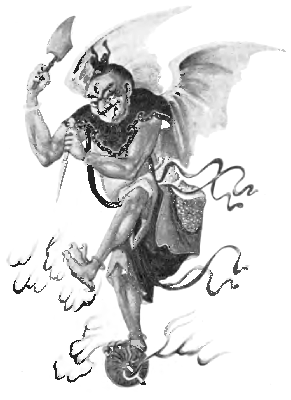
Fig. 16.—The God Of Thunder
(From a Chinese drawing (? 17th Century) in the John Rylands Library)
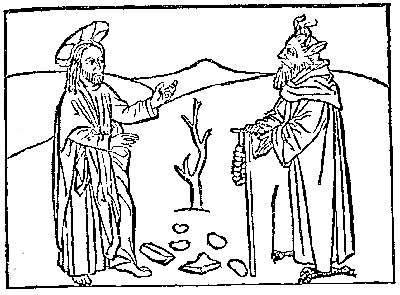
Fig. 17.—From Joannes de Turrecremata's "Meditationes seu Contemplationes". Romæ: Ulrich Hau. 1467
Early in the Christian era, when ancient beliefs in Egypt became disguised under a thin veneer of Christianity, the story of the conflict between Horus and Set was converted into a conflict between Christ and Satan. M. Clermont-Ganneau has described an interesting bas-relief in the Louvre in which a hawk-headed St. George, clad in Roman military uniform and mounted on a horse, is slaying a dragon which is represented by Set's crocodile.[233] But the Biblical references to Satan leave no doubt as to his identity with the dragon, who is specifically mentioned in the Book of Revelations as "the old serpent which is the Devil and Satan" (xx. 2).
The devil Set was symbolic of disorder and darkness, while the god Osiris was the maintainer of order and the giver of light. Although the moon-god, in the form of Osiris, Thoth and other deities, thus came to acquire the moral attributes of a just judge, who regulated the movements of the celestial bodies, controlled the waters upon the earth, and was responsible for the maintenance of order in the Universe, the ethical aspect of his functions was in large measure disguised by the material importance of his duties. In Babylonia similar views were held with respect to the beneficent water-god Ea, who was the giver of civilization, order and justice, and Sin, the moon-god, who "had attained a high position in the Babylonian pantheon," as "the guide of the stars and the planets, the overseer of the world at night". "From that conception a god of high moral character soon developed." "He is an extremely beneficent deity, he is a king, he is the ruler of men, he produces order and stability, like Shamash and like the Indian Varuṇa and Mitra, but besides that, he is also a judge, he loosens the bonds of the imprisoned, like Varuṇa. His light, like that of Varuṇa, is the symbol of righteousness.... Like the Indian Varuṇa and the Iranian Mazdâh, he is a god of wisdom."
When these Egyptian and Babylonian ideas were borrowed by the Aryans, and the Iranian Mazdâh and the Indian Varuṇa assumed the rôle of the beneficent deity of the former more ancient civilizations, the material aspect of the functions of the moon-god became less obtrusive; and there gradually emerged the conception, to which Zarathushtra first gave concrete expression, of the beneficent god Ahura Mazdâh as "an omniscient protector of morality and creator of marvellous power and knowledge". "He is the most-knowing one, and the most-seeing one. No one can deceive him. He watches with radiant eyes everything that is done in open or in secret." "Although he has a strong personality he has no anthropomorphic features." He has shed the material aspects which loomed so large in his Egyptian, Babylonian and earlier Aryan prototypes, and a more ethereal conception of a God of the highest ethical qualities has emerged.
The whole of this process of transformation has been described with deep insight and lucid exposition by Professor Cumont, from whose important and convincing memoir I have quoted so freely in the foregoing paragraphs.[234]
The creation of a beneficent Deity of such moral grandeur inevitably emphasized the baseness and the malevolence of the "Power of Evil". No longer are the gods merely glorified human beings who can work good or evil as they will; but there is now an all-powerful God controlling the morals of the universe, and in opposition to Him "the dragon, the old serpent, which is the Devil and Satan".