Part 4 — CHAPTER XL THE GENERAL SIGNIFICANCE OF THE THEORY OF RELATIVITY
Reading edition
THE theory of relativity, as we have seen, is one of mathematical physics; and its sole aim has been to co-ordinate the greatest number of natural phenomena and experimental results in as simple and as direct a manner as possible. In common with all other great developments of theoretical physics, it has adhered strictly to scientific methods. But now that the mathematico-physical co-ordination has been completed, it becomes permissible to investigate the changes which the theory may necessitate in our philosophical understanding of nature.
The most interesting aspect of the entire theory for philosophers would appear to be the discovery of space-time, with the paradoxes of feeling to which it leads. Thus, the duration of our life, the distance we cover, have no absolute significance. Two twins might both live seventy years in their own estimation, and yet if they met again before their death one might be younger than the other. Two men starting from the same point and travelling in the same direction might both cover what they would measure as the same distance, and yet might find when they came to a stop that they were many miles apart. The fact is that a distance and a duration are not absolute; they merely express a relation between something that is absolute, and the space-time mesh-system or motion of the observer. There is no more cause to be surprised at the curious results we have mentioned than at the relative character of the length of the shadow cast by a pole, or of the visual angle under which we see the pole.
As an immediate consequence of this relativity of distance and duration, we must accept the relativity of simultaneity. Classical science recognised that no absolute significance could be attached to the concept of the same point of space considered at different times; for since points of space could be determined only with respect to a system of reference, two events occurring in succession at the same point of our system would obviously occur at two different points of some other system, in motion with respect to the first. On the other hand, classical science refused to extend similar relativistic considerations to the concept of the same instant of time at two different points. It was assumed that a change of system of reference could have no effect on the rate of time-flow, which remained absolute, ever the same for all observers. It is this belief in the absolute nature of simultaneity that is shattered by Einstein’s discoveries. Henceforth no greater significance can be attached to the absolute sameness of time in different places than to the absolute sameness of location at different times.
We may recall that all these so-called paradoxes of relativity are by no means antinomies of reason or of logic, which the theory could not possibly survive. They are merely paradoxes of feeling, which arise when from force of habit we continue to be haunted by the classical concepts of absolute duration and distance, and to credit these erroneously with some a priori inevitable virtue of logical necessity.
When we consider that there is scarcely a single field in our understanding of the physical universe upon which relativity has failed to throw some new light, we can realise that as yet the full significance of its discoveries is far from being established. Nevertheless, sufficient positive information has been gathered with respect to the concepts of space and time for certain philosophical conclusions to appear legitimate. What the theory has proved conclusively is that real space and real time can be approached only by empirical methods, and in particular by ultra-refined experiment.
We mentioned, when discussing space, that Kant’s philosophy of the a priori nature of three-dimensional Euclidean space as representing the form of pure sensibility was exploded years ago by the mathematicians from Gauss onwards. So far as scientists were concerned, the matter was definitely settled. The theory of relativity merely confirms these views by justifying them no less on physical than on mathematical grounds. Henceforth, four-dimensional space-time, which, though flat, is non-Euclidean (in the extended sense), owing to the negative dimensionality of time, constitutes the fundamental continuum of the universe. Had it not been for the general theory, it might have been argued that space-time possessed no deep significance, and that it reduced to a mere convenient mode of mathematical representation, like the graph of a barometer needle. Though we may state (even confining ourselves to the special theory) that this opinion would have been untenable, the use which Einstein has made of space-time in the general theory excludes this view completely. With space-time we are in the presence of a new continuum which has exactly the same measure of reality as was formerly attributed to three-dimensional space.
Now we have seen that with the rejection of the a priori Kantian attitude, mathematicians long before the advent of Einstein’s theory were thrown back on the empirical philosophy of space as arising from the simplest co-ordination of our sensory impressions. In particular, the apparent inevitability of Euclidean space was assumed to result from the co-ordination of sensory experience, whether that of the individual or that of the species. In other words, it was the behaviour of material bodies and of light rays which was held to be the fundamental source of our natural belief in the Euclideanism of space. But here an objection might be urged, for it might be contended with perfect truth that according to Einstein the behaviour of material bodies and light rays is such as to yield space-time, and not separate space and time. How, then, could we account for space-time having failed to impose itself ages ago; and why had it been necessary to await the arrival of Minkowski and Einstein?
The reason is, of course, obvious. Theoretically, there is a great difference in structure between space-time and separate space and time, and this difference arises, as we know, from the finiteness of the invariant velocity in space-time as contrasted with its infinite magnitude in separate space and time. The higher the relative speeds of bodies, and, in particular, the nearer they approximate to the critical speed of light, the more marked will become the physical discrepancies between the two worlds. And as the velocities of those bodies which enter into our daily experience are exceedingly small in contrast to that of light, crude perception cannot enable us to detect the minute differences which are theoretically present. To all intents and purposes, therefore, the world of common experience is one of separate space and time, and not one of space-time. In much the same way, the mere survey of a landscape would be incapable of revealing the rotundity of the earth. And so we understand why it was that the discovery of space-time had to await the performance of ultra-refined physical experiments. We might, of course, conceive of beings whose senses were so far developed as to detect the minute differences that escape us. If such beings existed, there is every reason to suppose that their sensibility would accept space-time as a matter of course, just as ours accepts three-dimensional Euclidean space and time. In the words of Eddington: “It is merely the accident that we are not furnished with a pair of eyes in rapid relative motion, which has allowed our brains to neglect to develop a faculty for visualising this four-dimensional world as directly as we visualise its three-dimensional section.” Being so poorly equipped as to sensory organs, being unable to discern the minute discrepancies that arise when is very large though finite and when is infinite, we have got into a rut and have believed from ages immemorial in a world of separate space and time. There is no reason to marvel at the paradoxes of feeling which we suffer when told of the strange disclosures that would ensue were relative velocities to become very great or our senses to become more acute. In much the same way, quite apart from the disclosures of relativity, were our eyes to be suddenly gifted with microscopic vision, our familiar world would become so terrifying as to baffle description.
Now the essential characteristic of space-time is that it exhibits no absolute separation between space and time which would hold for all observers, regardless of their motion. Each and every observer will split it up in a different way, so that the totality of space at an instant for one becomes a successive spread of points throughout space at a succession of times for another. Of course, so long as we are considering only our immediate perceptions, we shall always split up space-time into a separate space and time; and this fact has been construed by some as implying that the space-time amalgamation is obviously artificial, since it can be so easily separated into space and time. Needless to say, the argument is faulty. For the space and time that we obtain as a result of a splitting up of the space-time continuum correspond to a private view of the world, and it is never the private views considered in isolation that give us the objective world. It is solely a certain construct or synthesis of the private views which can be deemed to represent objective reality. To revert to an illustration from classical science, it is not the shape of the rock as seen from here or there that yields us a knowledge of the rock’s shape, but solely a synthesis of the appearances of the rock as seen from here, there and anywhere. In relativity we must also consider the perceptions of observers moving with various relative motions Then it is found that objective shape, size and duration can no longer be constructed by a synthesis of private views, in contrast to what classical science had erroneously supposed. For this reason, distance and time separation, or, what comes to the same thing, space and time though remaining real from the standpoint of the private view, can no longer be claimed to constitute the scaffolding of the common objective world. From an objective point of view, such concepts are ambiguous and we must substitute for them a space-time world and space-time configurations. In short, it must be realised that space-time is an entirely new concept, new both in science and in philosophy, and it must not be confused with the mere artificial representation of time and space directions in graphs such as classical science had often made use of.
Possibly further illustrations of space-time may be helpful. Thus, if we consider the three-dimensional extension occupied by the atmosphere and note the variations in temperature that occur from place to place, we are justified in speaking of a four-dimensional continuum space-temperature But it is obvious that we are at liberty to divorce these two entities and study them separately, obtaining thereby two separate continua, one of space and one of temperature. In classical science, it was much the same with space and time. We could consider them jointly as constituting a four-dimensional continuum of events but then again, owing to the absolute nature of time and distance, we could divorce them. When this was done, both three-dimensional space and uni-dimensional time were separated into distinct self-supporting continua.
With the space-time of relativity, a separation of this sort is impossible. We cannot withdraw the time dimension, for it is no longer unique. If we cancel it so far as some definite observer is concerned, leaving him with an instantaneous space, we shall have mutilated the instantaneous space, without having cancelled time, in the estimation of another ob server in relative motion. We see, then, that whereas in classical science the adjunction of time to space was artificial, in that time and space could always be separated like oil and vinegar, such is no longer the case in relativity. Space and time are now blended together and can be claimed to constitute one solid whole. In a very crude way, we may say that space-time is more akin to an opal emitting various colours in various directions. Just as with space-time it was impossible to annihilate time or space for all observers, so here, with the opal, it would be impossible to cancel all the points that reflected green light and only green light since if we pursued this course from the standpoint of one observer we should have failed to achieve our object from the standpoint of another.
Let us now consider the characteristics of metrical continua. From a mathematical standpoint, a metrical continuum is one with which it is possible to associate a geometry, hence to obtain an invariant expression for the distance separating two points of the continuum, the value of this expression holding for all observers. In the case of space-time, this would imply that the distance between any two point-events should exhibit the same space-time separation holding for all observers regardless of their motion. Now, in the space and time of classical science, no such invariant space and time distance was possible. A simple example may make this point clear. Suppose that in classical science we were standing on a railroad embankment, and viewing the production of two instantaneous events—say, two light flashes emitted by two spatially separated signals on the line. By taking into consideration the speed with which the light signals had progressed towards us and by measuring our distance from the respective signals, we could determine the spatial distance between the two signals and the respective times at which the flashes had occurred. We should thus obtain the temporal separation and the spatial separation of the two events as referred to the embankment. But suppose now that we had viewed the same two events from a train moving uniformly along the track. In classical science, time being absolute, the temporal separation between the two events would, of course, suffer no modification. The spatial separation as referred to the train would, however, generally be different. We can understand this by supposing that the train passed before the two successive signals as their respective flashes were emitted; in this case, as referred to the train, the two events would have occurred at the same point of the train, and so their spatial separation would be zero. We see, then, that the time separation would be the same in either case, whereas the space separation would have varied. As a result, the space and time separation could not remain invariant. For the separation between the two point-events to manifest itself as invariant, we may surmise that the time separation should also vary in such a way as to offset the variation of the space separation. The absoluteness of time in classical science rendered this impossible, and this is what is meant by stating that space and time were not amalgamated into one continuum in any deep sense.
Now, what Einstein tells us is that had we performed our measurements with extreme accuracy, using our customary chronometers and rigid rods, we should have found that the time separation between the two events had varied slightly; and that as a result this slight variation would have cancelled the corresponding change of the space separation, leaving the space-time distance unmodified.
Calling and and and the space and time separations, as measured from the embankment and the train, respectively, we should have found that Here, then, was the expression of the space-time distance between the two events, or rather of its square. It is the fact that our measurements would have verified the invariance of this distance, which permits us to consider space and time as amalgamated. It cannot be too strongly emphasised that our clocks and rods would have been the ordinary clocks and rods of classical science. They would not have been adjusted so as to force relativistic results, as is often erroneously supposed; for had this been the case the theory would have been artificial and worthless. All that the theory suggests, therefore, is that our ordinary rods and clocks do not behave quite as we used to believe they did.[159]
We see, then, that the juxtaposition of space and time in classical science was just as artificial as a juxtaposition of space and temperature would have been. In short, the reality of space-time arises from Minkowski’s discovery that it was possible to define an invariant distance between two points in space-time, holding for all observers; and that it was impossible to define any such invariant distance in space alone or in time alone, showing that space and time by themselves were phantoms. These last two concepts must henceforth be considered jointly, and no longer as separate entities.
Now it is apparent that if the model of space-time is to spare us from a conflict with certain fundamental facts of consciousness it is imperative that some kind of mathematical difference should distinguish time directions from space directions. However, we need not anticipate any difficulties from the space-time model on this score; for we know that, owing to the heterogeneity which exists between time directions and space directions, space-time is anisotropic. Bearing this peculiarity in mind, we see that space-time around any point-event can be split up into a bundle of time directions and into bundles of space directions; these, however, can never overlap with the time-bundle. Then, from this bundle of possible time directions, every observer will select that particular line which constitutes his world-line through space-time. As for the flow of psychological time, or the duration between two psychological events measured by a clock at our side, it will be given by the space-time length of our world-line limited by those two events. Thus, two world-lines of equal length will always correspond to the same duration of time lived by the observers who follow these world-lines. For instance, of two identical sodium atoms, one near the sun and one far away, the solar atom will beat a slower time; but with both atoms the segments of the world-lines limited by successive vibrations will be the same in length. The existence of the Einstein shift-effect has verified this fact, and it is equivalent to stating that the atoms behave like perfect clocks.
So far as an observer’s three space directions are concerned, they will be perpendicular to his world-line or time direction. If his time direction is curved owing to his acceleration or to the intrinsic curvature of space-time due to matter, the space and time directions will be properly determined as perpendicular to one another only in the immediate vicinity of the observer. Elsewhere a definition of orthogonality, or perpendicularity will be impossible; as a result the very concepts of time and space become blurred in the general theory, and we have to content ourselves with co-ordinate systems which constitute measurements neither in space nor in time. We cannot dwell on this type of difficulty because it necessitates explanations of too technical a nature; suffice it to say that it is this complication that causes all problems connected with rotating disks and gravitational fields to suffer from a certain measure of obscurity when we attempt to interpret them in terms of space and time. We may also add that when large masses are moving about, the concept of simultaneity throughout space even for a given observer loses all precise significance.
The great difference between our present views and those of classical science is that whereas in classical science our lines of time-reckoning and of space-reckoning were unique, they now offer an indefinite number of possible alternatives, because of the plurality of time and space directions present in space-time. It is as though the flow of time were represented no longer by a single stream, but by a number of branches radiating from every point in different directions. In spite of this ambiguity in the possible space and time directions, we have seen that to each and every observer a definite space and time separation will correspond; so that all ambiguity disappears[160] as soon as we have defined the observer.
The strange results and concepts which the theory of relativity has disclosed have been appealed to by a number of writers in order to justify an ultra-idealistic philosophy of nature. These men have concluded that the real objective universe about which scientists were never weary of talking had been dashed to the ground and that realistic science had finally surrendered to the idealistic school of philosophy. This expression of opinion results from a confusion between the point of view of science and that of the metaphysical realist.
The vast majority of modern scientists are agnostics in that they reject the claim of the metaphysical realist who presumes to have discovered substance and true being in the outside world. They will claim that substance and the thing in itself are unknowable, or at least that these elude rational investigation, and that the objective world of science is nothing but a mental construct imagined for the purpose of co-ordinating our sense impressions. But, once this point is admitted, they will recognise that this mentally constructed objective universe must to all intents and purposes be treated as a reality pre-existing to the observer who discovers it bit by bit. This last expression of opinion is not the result of some philosophical system. It is imposed upon scientists as an inevitable conclusion; for had it been proved impossible to imagine a common objective universe, the same for all men, science could never have existed, since it would have reduced to individual points of view which could never have been co-ordinated. In other words, knowledge would have lacked generality; and without generality there could have been no such thing as science.
Had the theory of relativity, for instance, failed to furnish us with a common objective world, it could never have gone very far. All we can correctly state is that the objective world of absolute duration and distance has faded away, that space and time as the fundamental constituents of the objective world have sunk to mere shadows. Expressed in other words, the so-called primary qualities of shape, size, duration and mass erstwhile considered absolutes must now be regarded as relatives having no definite value until the observer is specified. But this work of destruction has been followed by one of reconstruction, as a result of which a new objective world, that of space-time with its invariant intervals, has taken the place of the discarded world of separate space and time.
Idealistic metaphysicians have a habit of passing rapidly over space-time as if it were of no particular importance. They lose sight thereby of the entire significance of Einstein’s theory. As Einstein tells us himself: “Without space-time the general theory of relativity would perhaps have got no farther than its long clothes.” Even though we were to limit our investigations to the bare facts of the theory, without studying it more deeply, the idealistic interpretation would be open to serious objections.
Consider, for example, the phenomenon of gravitation. It is obviously impossible to assert that the apparent bending of a ray of starlight as it passes near the sun is due entirely to the idiosyncrasies of the observer; for we know that were the sun to be removed suddenly during an eclipse the ray of starlight would automatically cease to bend, in spite of the fact that the purely subjective space and time idiosyncrasies of the astronomer at his telescope would have had no occasion to vary. Again, in the special theory, the space and time computations vary from one observer to another only when relative motion exists between the observers. The norms of Peter do not differ from those of Paul because Peter is Peter and Paul is Paul, but only because Peter and Paul are in relative motion. Were their relative motion to cease, their norms would cease to differ.
But this is not all. According to the idealistic views, the norms of the various observers are so adjusted, owing to some miraculous pre-established harmony, that the velocity of light appears the same to all. As a matter of fact, this statement is incorrect, for the velocity of light is invariant only for Galilean observers; it is variable from place to place when accelerated observers are considered, and it is also variable in the neighbourhood of matter. Again, if we revert to Michelson’s experiment, we see that its essential feature is to have demonstrated that no matter what the velocity of a sphere as a whole may be, rays of light which leave the centre at the same instant of time all return to the centre at the same instant, after having suffered a reflection against the sphere’s inner surface. In this experiment, we are therefore dealing with a coincidence, with waves of light which pass the same point at the same time. The space and time elongations produced by the idiosyncrasies of the observer could never create or disrupt a coincidence of this sort. They might cause a duration or a distance to appear longer or shorter; but they could never cause two rays of light to intersect on the surface of some object if they did not intersect there in the opinion of all other observers. Thus an intersection or a coincidence is an absolute, for the simple reason that no amount of magnification will ever cause a point to appear as two separate points. A point has no dimensions which can be torn apart by magnification. It follows that in an experiment such as Michelson’s it is impossible to attribute the observed coincidence to the idiosyncrasies of the observer; there is obviously a mysterious something in nature which will have to be conceived of as existing independently of the observer and as situated in the objective world of science. This something is found to be represented by the intersections of the world-lines in absolute space-time, i.e., in the objective world of science.
As a matter of fact, in the general theory the concepts of space and time become completely indeterminate, and it is only in the very simplest type of problems that it is feasible to reason in terms of space and time. As Bertrand Russell points out, the idealistic interpretation appears to have arisen from the continual reference to “the observer” in Einstein’s theory. It should be realised, however, that “the observer” is a very loose term. A photographic camera and clock, or any other mechanical registering device, would be just as appropriate for purposes of observation as would a living human being. In short, the principal weakness of the exponents of the idealistic interpretation seems to be their desire to cling to space and time in spite of everything. They fail to see that the objective world of relativity cannot be built up of space and of time in the same simple way as that of classical science. Summing up, we may say that whether space-time be considered a metaphysical reality, or whether it be regarded as a mental construct devised for the purpose of co-ordinating our sensory experience, in either case it plays the part of an objective reality (in the scientific sense). We must conceive of it, therefore, as an entity pre-existing to the observer who explores it and locates events in its substance.
Now the criticism has often been raised that there is nothing in Einstein’s space-time model which enables us to explain the reason for that most fundamental fact of consciousness, our awareness of the flowing of time. It is difficult to see why a criticism of this sort should be directed with any greater justification against space-time than against the classical theory. The fact that in classical science space and time were separate did not allow us to explain the phenomenon of the flowing of time any better than does the space-time theory. To state with Newton that time flows teaches us nothing about the cause of this flow. Hence, we must conclude that whatever merit there may be in the critic’s objections, they would apply with equal force to classical science. But when we analyse the reason for these objections we find that the critic is starting from the assumption that the passage of time must be conceived of as pre-existing in the objective universe, and is thus denying its purely subjective nature. Speculations of this kind can never lead us very far in the present state of our knowledge; but, if need be, there is nothing to prevent us from assuming that space-time presents dynamic properties which urge natural processes on from past to future along the bundle of time directions. Those, however, who suggest views of this sort have not accomplished much thereby; they have merely removed the mystery of the passage of time from human consciousness and placed it elsewhere in the objective universe. It seems safer to concede that our awareness of the passage of time is in all probability of a subjective nature, connected with our consciousness of being alive. In this case we should have to assume that it is our consciousness which rises along a world-line, discovering, as it proceeds on its course, events situated in the cone of its absolute past. This has always been the view defended by the most competent authorities, in particular by Minkowski, Einstein, Weyl and Eddington. As Weyl tells us:
“However deep the chasm may be that separates the intuitive nature of space from that of time in our experience, nothing of this qualitative difference enters into the objective world which physics endeavours to crystallise out of direct experience. It is a four-dimensional continuum, which is neither ‘time’ nor ‘space.’ Only the consciousness that passes on in one portion of this world experiences the detached piece which comes to meet it and passes behind it, as history, that is, as a process that is going forward in time and takes place in space.... It is remarkable that the three-dimensional geometry of the statical world that was put into a complete axiomatic system by Euclid has such a translucent character, whereas we have been able to assume command over the four-dimensional geometry only after a prolonged struggle and by referring to an extensive set of physical phenomena and empirical data. Only now the theory of relativity has succeeded in enabling our knowledge of physical nature to get a full grasp of the fact of motion, of change in the world.”
As can be seen from the preceding quotation, our awareness of the passage of time is ascribed to the passage of our consciousness through the space-time continuum. According to the views of Minkowski, a material body is then represented by a world-line, or continuous chain of events, the entire length of which is subjected to a modification of structure which we come to interpret as connoting the presence of matter. So long as we reason in terms of space-time, this is all we can say. But when in our habitual perception of things, we, as sentient observers, split the world up into an appropriate space and time, what we perceive of the world-line is its momentary intersection with our cone of the passive past. If our world-line and that of the body which is being observed are parallel, the body will be said to be at rest. But if the two world-lines are not parallel, then, when interpreting things in terms of space and time, the body will be said to be in relative motion.
We may illustrate these same views by considering the following example: We shall assume for reasons of convenience that space-time is reduced to three dimensions: two of space and one of time.
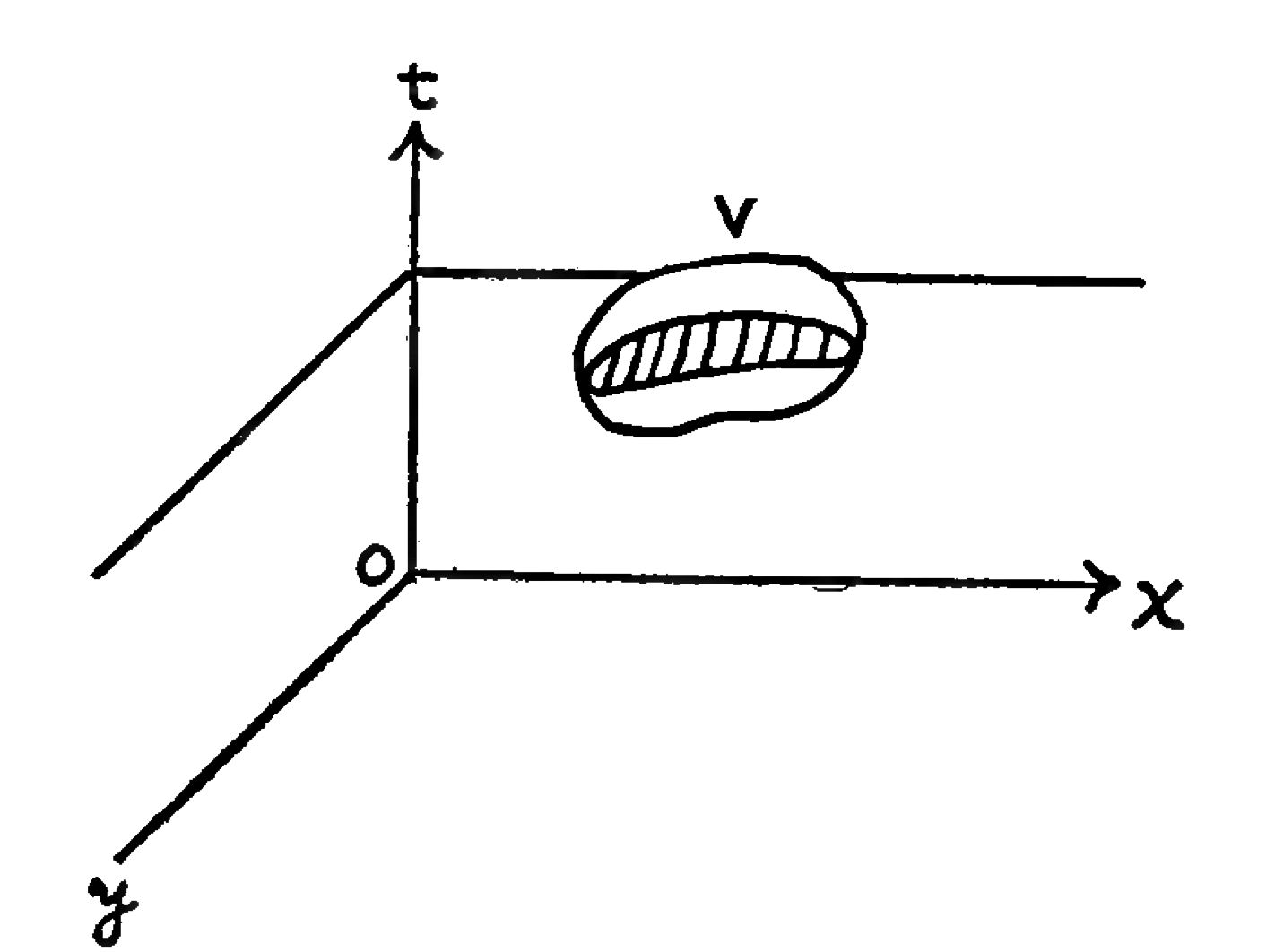
Fig. VII
Suppose, then, that in this block of space-time we consider a volume of redness. If we assume that our own world-line is given by , our instantaneous present will at all times be given by an indefinite plane parallel to . As our existence at every instant is represented by the successive points along , our instantaneous present will gradually rise, intersecting the red volume along successive plane areas (Fig. VII). We may say, therefore, that from the standpoint of space and time, the red space-time volume appears as a splash of red colour squirming and varying in shape; in spite of the fact that from the space-time standpoint the volume is fixed and motionless. But the varying shape of the red patch as described above corresponds to the patch as it exists in our instantaneous present. It is not this that we perceive with our eyes, for whatever we perceive is already situated in our past. Hence, what we perceive at a given instant will be given, not by the intersection of the red volume with the plane of our instantaneous present, but by its intersection with the surface of our instantaneous cone of the passive past (Fig. VIII). This is the light-cone which passes through those space-time events which are in our present range of vision. All other events are from a visual standpoint either in our visual past or future. (More detailed explanations will be given in Appendix I.)
Looking back on what has been accomplished, we see that the motion and change with which we are familiar in our daily experience are now interpreted as arising from a passage of our consciousness through space-time. The cause of this passage remains utterly mysterious; but, as we said before, it would not solve our difficulties to attribute it to dynamic properties of the continuum itself—dynamic properties which would urge our consciousness on. Even were this solution to be adopted, the cause of the dynamic properties and their mode of action on our consciousness would remain as mysterious as ever.
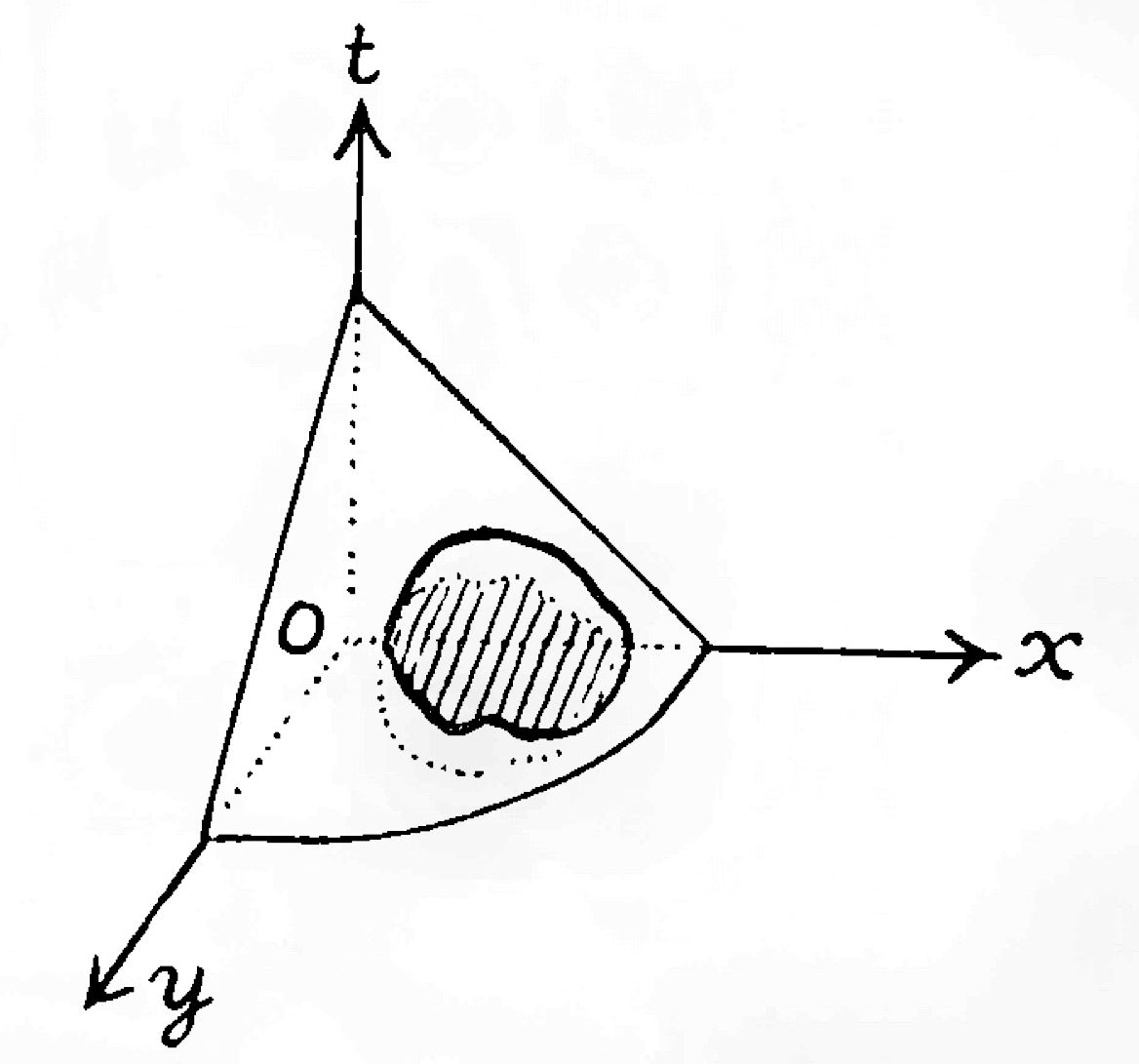
Fig. VIII
Now, in this interpretation of space-time, there is no room for free will, since everything is already predetermined and pre-exists in the future. To be sure, this is a most unsatisfactory aspect of the presentation. But how are we to avoid it? In classical science we could always reserve a part for free will by assuming that the present and the past alone were fully determined while the future might be modified at will. But in relativity this neat separation is no longer possible. For if we consider two observers passing each other, the present of the one comprises both the past and the future of the other. Hence, we cannot banish the future without annihilating a portion of the past together with the present, or at least that portion of the present which stands elsewhere than in our immediate vicinity. Neither may we assume boldly that the seat of free will resides in some suprasensible world transcending that of space-time, for the position of an object on the table is, after all, an effect of the will that placed it there, and the body as a material object occupies a position in space-time.
At any rate, there appears to be very little use in speculating on puzzles of this sort. The fact is that science is necessarily deterministic, not through an act of faith, not because it has convinced itself that free will is non-existent, but because determinism is for science a dire necessity if phenomena are to be co-ordinated and linked to one another. Regardless of what the future may hold in store, the physicist is therefore compelled to act as though a rigidly deterministic scheme were existent in nature, and to consider space-time and its content as given, even though he may doubt whether such is really the case.
Interesting sidelights on causality are offered by the space-time theory. Since no effects can be propagated with a speed greater than that of light, the passage of time is an essential if causal connections are to operate. This was not necessarily true when instantaneous effects (or action at a distance), were contemplated. The theory of relativity thus imposes restrictions on causal connections; it allows us to assert that between certain space-time events no causal connections can ever exist. It is well to note, however, that the category of causality has no place in space-time as such. Only when we consider the perceptions of the observer can causality be considered, since only then is the passage of time introduced. When discussing space-time from an impersonal point of view as a four-dimensional continuum which is static, it would therefore seem preferable to refer to functional relationships.
The next most important aspect of the theory of relativity which we have to consider relates to our conception of real space. We remember that the geometrical space of mathematics was amorphous. It possessed no intrinsic metrics, no special geometry, no size, no shape; and the geometry which the mathematician credited to space was purely a matter of choice. On the other hand, the real space of physics appeared to possess a definite metrics. Furthermore, the amorphous nature of space was belied by the existence of centrifugal forces and the like, proving that not all motions through space were equivalent.
When it came to determining the precise geometry of real space, various methods could be considered. We might proceed by appealing to rigid bodies, that is, to bodies which visually and tactually appeared to be the same wherever we might carry them. More generally, rigid bodies were assumed to be exemplified by material bodies maintained as far as possible under permanent conditions of temperature and pressure. We could also investigate space by means of light rays, assuming that their courses in vacuo would define geodesics. Over a century ago Gauss attempted experiments of this sort between the summits of two mountains. A still more general method consisted in appealing to the laws of physics in general, and determining the type of geometry which would have to be credited to space in order to permit us to co-ordinate natural phenomena with the maximum of simplicity. This procedure was suggested by Riemann in 1854 in his inaugural address at Göttingen.
It will be noted that all these various methods of determining the geometry of space are essentially physical. Hence, the accusation could always be made, as it was indeed made by Poincaré, that all we could determine in this way would reduce to the geometrical properties of material bodies or of light rays, and that space itself was amorphous and would therefore escape us completely. On the other hand, it was an undeniable fact of experience that measurements in space, whether conducted with material rods or with light rays, always yielded the same Euclidean results. Furthermore, the same Euclidean geometry seemed to be imposed upon space when we sought to interpret the laws of physics in the simplest way possible. It was scarcely conceivable that this general concordance of results obtained by these various methods of approach should be attributed to chance. Hence, the problem was reversed and the belief arose that space itself possessed a Euclidean structure, and that it was this structure which controlled the behaviour of material solids, the paths of light rays, and the course of free bodies moving far from matter according to the law of inertia. When this attitude was adopted the significance of measurements with material rods was altered. The geometry of space was not merely the Euclidean geometry of material bodies; it was rather the reverse. The geometry of material bodies was Euclidean by reason of this pre-existing Euclidean structure of space, which moulded them into shape and thus gave them their geometrical properties. Under the circumstances, measurements in space with rigid bodies and light rays would resolve themselves into an exploration of the pre-existing geometry of space, and the rôle of the rigid body and the light ray became similar to that of the thermometer in detecting pre-existing variations of temperature.
Now this attitude of regarding the behaviour of rigid rods and light rays as symptoms, and not as causes, must not obscure the fact that rods, light rays and physical phenomena generally are an essential requirement for the discovery of the pre-existing structure of space. There is no sense, therefore, in attempting to determine this structure a priori on the plea that physical measurements, however perfect they may be, can never transcend a certain approximation, and are therefore of no value in permitting us to discover the precise structure of space. We must never forget that we are dealing here with a problem of physics, not with one of pure mathematics. For instance, in Euclidean geometry the mathematician does not have to appeal to measurements with rigid rods in order to determine the value of , since in virtue of our basic Euclidean postulates and the rules of logical reasoning, can be determined as accurately as we wish by purely mathematical means. But in the case of the geometry of physical space we are completely at sea. A priori, this geometry might be one of a variety of different types. All we might do would be to assert that the principle of sufficient reason compelled us to regard physical space as homogeneous and isotropic, hence as reducing to a constant-curvature geometry, whether Euclidean or not. Even this belief would be open to question until we knew more about the origin of this structure. At any rate, on a priori grounds the precise geometry of space can never be ascertained. Whether we like it or not, we are compelled to resort to rods, light rays and physical methods of exploration; and whatever geometry we obtain in this way will ipso facto become that of real physical space, to the order of precision of our measurements.
Up to this point we have limited ourselves to discussing the first step in our study of physical space. The structure is viewed as pre-existing; and our rods and light rays, by adjusting themselves to this structure, permit us to objectivise it, as it were. In much the same way a coloured liquid poured into an ideally transparent glass (so transparent as to be invisible) permits us to ascertain the inner shape of the glass. But we now come to the second step. What is the cause of this structure? Is it posited by the Creator, as an intrinsic property of space, or is it the mere manifestation of something more fundamental?
Riemann refused to believe that a structure of the void could exist of itself. He recognised, as before, that our rods would adjust themselves and would thus reveal the pre-existing structure; but this structure in turn would have to be created and conditioned by something else foreign to the void. For this “something else” Riemann appealed to the forces generated by the enormous mass of the totality of the star distribution. It would follow that were there no stars and no matter in the universe aside from our exploration rods, no geometry would be revealed. The rods would not know how to act; light rays would not know where to go; physical space would be unthinkable. With this bold idea of Riemann’s, the homogeneity and isotropy of space (whether Euclidean or non-Euclidean), formerly thought to be imposed by the principle of sufficient reason, was no longer inevitable; for star-matter, the generating cause of this structure, was not distributed equally throughout the universe. Riemann, therefore, considered that a varying non-Euclideanism might be present in space. Rods and light rays would, of course, adjust themselves to this heterogeneous structure, yielding different numerical results from place to place throughout space.
All these theories antedate Einstein’s discoveries by many years, but with the advent of the theory of relativity the entire problem presented itself afresh, with this difference, however—that the fundamental continuum to be explored was four-dimensional space-time and no longer three-dimensional space. The introduction of space-time necessitated an appeal to chronometers or vibrating atoms as well as to material rods, although the progress of light rays through space could also serve to measure duration (owing to the postulate of the invariant velocity of light according to which a ray of light would describe equal spaces in equal times). At all events, the time determinations would have to yield the same results whether computed by light rays or by the vibrations of atoms, since otherwise we should have to assume that the structure of space-time itself could not be the governing and moulding influence regulating the behaviour of material bodies and of all processes of change. In this eventuality a belief in the structure of space or of space-time would be difficult to accept. This structure of space-time has received various names. Weyl calls it the affine-relationship, the guiding field or the metrical field. Einstein refers to it as the ether of space-time or the gravitational ether. In order to avoid confusion with the stagnant ether of classical science, from which it differs in so many respects, we shall refer to it as the “metrical field.” Mathematically, as we know, it is represented by the -distribution.
It is to be noted that as space-time can be split up into a space and a time by any given observer (at least in his immediate vicinity), the space-time-structure will automatically be split up into a space-structure and a time-structure, or a spatial and a temporal metrical field. The behaviour of rods and bodies at rest with respect to the observer will be controlled by the space-structure, while the beatings of perfect clocks such as vibrating atoms will be controlled by the time-structure. When we consider space and time together, we may say that the difference between space-time and separate space and time can be expressed as follows: Whereas the three-dimensional Euclidean space of classical science could be considered as cleaved by parallel time-stratifications, defining the spatio-temporal situations of simultaneous events and separating neatly space from time, no such stratification exists in space-time. If we wish to adhere to the older conception, we may still speak of time-stratifications through space-time, but we must be careful to add that these stratifications manifest no fixed direction. This is due to the fact that those stratifications which would be time-stratifications defining simultaneous events for one observer would cease to be time-stratifications defining simultaneous events for another observer in relative motion. The relativity of simultaneity is but another way of expressing the same facts. But, of course, with this admission, the conception of time-stratifications loses all deep significance. It follows that, when discussing the space-time structure, it would be preferable to omit mentioning such relative concepts as those of space and time. Accordingly, we will say that the structure of space-time is defined by the light-cone, that is, by the locus of the world-lines of light rays issuing from any given point at any given time. It is this light-cone which will split up space-time into its permissible space and time directions.[161]
Let us revert to the metrical field, as defining the space-time structure. Although Riemann had attributed the existence of the structure, or metrical field, of space to the binding forces of matter, there is not the slightest indication in Einstein’s special theory that any such view is going to be developed later on; in fact, it does not appear that Einstein was influenced in the slightest degree by Riemann’s ideas. At any rate, in the special theory, the problem of determining whence the structure, or field, arises, what it is, what causes it, is not even discussed in a tentative manner. Space-time, with its flat structure, is assumed to be given or posited by the Creator.
But in the general theory the entire situation changes when Einstein accounts for gravitation, hence for a varying lay of the metrical field, in terms of a varying non-Euclidean structure of space-time around matter. We are then compelled to recognise not only that the metrical field regulates the behaviour of material bodies and clocks, as was also the case in the special theory, but, furthermore, that a reciprocal action takes place and that matter and energy in turn must affect the lay of the metrical field. But we are still a long way from Riemann’s view that the field is not alone affected but brought into existence by matter; and it is only when we consider the cosmological part of Einstein’s theory that this idea of Riemann’s appears to be vindicated.
And here we come to a parting of the ways with de Sitter and Eddington on one side, Einstein and Thirring on the other, and Weyl somewhere between the two extremes. The differences of opinion arise from the views to be entertained on the subject of the origin of the metrical field. It is impossible to accept Einstein’s general theory without admitting that the field regulates the behaviour of matter and all processes of change, and is in turn affected by matter yielding under its influence; but the point to be determined is whether this field or space-time structure is entirely created by matter, or whether some type of structure would subsist in the absence of all matter.
Now we saw when discussing the form of the universe, that if de Sitter’s spherical universe or the infinite quasi-Euclidean universe is adopted, inasmuch as they can both exist in the total absence of matter, we must infer that the metrical field is manifestly not brought into existence by matter. If, on the other hand, we accept Einstein’s cylindrical universe necessitated by the apparent stability of the star distribution, a direct relationship is found to exist between the size and geometry of the universe and the presence of matter. It is not necessary, however, to assume with Einstein that matter creates the field. We might also hold with Eddington that it is the field which creates matter.[162] If Eddington’s views are entertained, what our senses recognise as matter is constituted by certain curvatures of the metrical field. Were the universe to contract, a certain amount of matter would be annihilated; were it to expand, a corresponding amount of matter would be brought into existence. If we accept Einstein’s views it is the reverse. More matter would cause the universe to expand and an annihilation of matter would cause it to contract. We saw that Einstein’s universe would appear to be in perfect harmony with Mach’s belief in the radical relativity of rotation with respect to the stars, and in the relational nature of mass. Just as classical science recognised that weight was due to the proximity of other bodies, so do Mach and Einstein believe that similar considerations must be extended to mass. It is the same eternal conflict between those who, like Maxwell and Faraday, hold to the pure physics of the field, exalting the electromagnetic field over electricity and magnetism proper; and those who, like Lorentz, exalt the substantial electron over the field, or at least consider the field and the electron realities of equal importance, but of different categories.
From the standpoint of methodology there is an interesting difference between the special and the general theories. In the special theory the space-time structure is explored by physical means. It is the Euclidean behaviour of our rods, the behaviour of our clocks, and finally the rectilinear paths and constant invariant velocity of light rays, that indicate that the structure must be flat or semi-Euclidean, at least so far as the accuracy of our observations permits us to assert. Theoretically, the same physical method of exploration might have been continued in the neighbourhood of large masses of matter. But it must be remembered that by these methods we could never have explored regions of space-time in the interior of matter. Furthermore, as can be gathered from the minuteness of such effects as the bending of a ray of light passing near the sun, and from the elusiveness of the Einstein effect, we now know that variations from flatness are most certainly exceedingly minute. Under the circumstances, it would have been extremely hazardous to attribute to a non-Euclideanism of space-time effects which might also have been ascribed to contingent physical influences.
Furthermore, even in the case of falling bodies, which describe ellipses or parabolas deviating widely from straight courses covered with constant speeds, so long as the ordinary Newtonian force of attraction was deemed responsible for these deviations, no particular reason could be given for attributing them to a non-Euclideanism of space-time. It was only after Einstein had become convinced that a modification in the structure of space-time could not help but exist around matter that a new mathematical method suggested itself for determining the structure prior to all physical exploration. We have seen that this method was furnished mathematically by the general principle of relativity, according to which all laws of nature, and in particular the law of gravitation, should be capable of being expressed by tensor equations.
Now it is most important to understand that although, in the case of the space-time structure, or metrical field, the method of discovery differs in the special and general theories, yet the significance of the structure, once it has been determined, remains exactly the same. In either event it is the structure which conditions the behaviour of rods and clocks and directs the courses of light rays and of bodies falling along geodesics; so that although the general structure was not discovered by means of direct physical measurements, theoretically it should have been, had our measurements been susceptible of greater accuracy. Tests of the relativity theory consist, therefore, in discovering whether or not ultra-refined measurements with rods, clocks, light rays and free bodies will reveal the structure as predetermined by Einstein. We know that the motion of Mercury and the double bending of a ray of light have confirmed Einstein’s previsions. But in order to be doubly sure we should also require measurements with rods and with clocks. With rods, unfortunately, the verification is quite impossible, owing to the minuteness of the anticipated deviations from Euclideanism around matter; but with clocks the verification should be possible by appealing to the vibrations of incandescent atoms. This was the reason why the detection of the Einstein shift-effect was held to be of such vital importance. Had this shift been proved non-existent, the theory would have collapsed. It might have been possible to save it by assuming that the atom did not adjust the frequency of its vibrations to the time-curvature of the structure, or, in other words, did not behave like a perfect clock. But as every one will recognise, had this avenue of escape been taken, the entire beauty of the theory would have vanished along with its ability to enable us to foretell and to foresee. Of what significance would be this knowledge of the structure around matter, if among other things it did not result in moulding the time-rate of all processes of change to its curvature? At any rate, Einstein stated long before the shift-effect was finally observed on the companion of Sirius that he would abandon the theory if the shift should prove non-existent. Fortunately for this beautiful theory, such a course is now obviated.
Further verifications of the structure would relate to explorations with rods and clocks in the interior of matter. But, as may well be realised, explorations of this sort are exceedingly difficult and we have to be satisfied for the present with Einstein’s theoretical anticipations in this connection.
When we come to the form of the universe, hence to the space-time structure of the universe as a whole, theoretically again physical explorations should yield us the structure. For instance, a ray of light should circle round the universe, and the motions of the stars in the Milky Way and of the planets in the solar system should be affected by the universal curvature. But once more, in view of the difficulty of direct physical exploration, mathematical methods were resorted to; and, as we have seen, Einstein appealed to the structural tensor law of curvature, which would be compatible with the stable appearance of the star constellations. He thus obtained the cylindrical universe. If this law is adopted, space-time is never perfectly flat; the flat continuum of the special theory becomes an ideal limiting case.
In the theory of relativity the concept of matter also undergoes important modifications. In classical science, matter was distinguished by its attribute of mass and by its ability to create a gravitational field. It is true that the electromagnetic field was also known to possess momentum and hence inertia (as exemplified by the pressure of light), so that even in classical science the distinction between matter and ether was losing its definiteness. Owing, however, to the fundamental difference that was thought to exist between inertial mass, as representative of inertia, and gravitational mass, as representative of attraction, the electromagnetic field was never suspected of developing a gravitational field. Hence the difference between matter and energy remained fairly clear. Einstein’s theory, by identifying mass and energy and by showing that all forms of energy are capable of producing a gravitational field, tends to render the distinction less legitimate. A further consequence of the theory has been to show that conservation of matter cannot hold. The result is that mass, as a substance, loses its meaning.
Passing to the laws of motion, we remember that there is but one law: All free bodies (when reduced to point-masses) follow time-geodesics in space-time regardless of whether space-time be flat, as it is (at least approximately) in interstellar space, or whether it be curved by the presence of matter. If space-time is flat, the geodesics are straight and the bodies describe straight courses with constant speeds as referred to a Galilean frame. Thus Newton’s law of inertia is seen to express the flatness of space-time. When space-time, and hence its geodesics, are curved by the presence of matter, the courses of free bodies appear to be curved, or else their motion to be accelerated. But whereas, under those conditions, the law of inertia was at fault in classical science, and an additional gravitational influence had to be introduced, in Einstein’s theory the general law of geodesic motion still holds good. Inasmuch as the structure of space-time determines the laws of our geometry, the beatings of natural clocks (atoms) and the motion of free bodies, we see that the theory has brought about a fusion between geometry and physics.
We may also remember that the existence of space-time has solved the old enigma of the dual nature of the structure of space in mechanics, seemingly relative for velocity and absolute for acceleration (see Chapter XIX).
Force is another important concept on which the theory of relativity has shed new light; though to avoid any misunderstanding we may state that by force we refer not to muscular pulls, but to the forces of gravitation, of inertia and of the electromagnetic field. Let us recall how the new ideas were obtained. We saw that the fundamental continuum of the world was space-time, and that observers, according to their relative motions, carved it up into space and time in various ways. Now we know that even in flat space-time, far from matter, forces of inertia spring into existence when we place ourselves in a rotating frame or, more generally, in any accelerated frame; translated into terms of space-time, this means when we split up space-time into a curved space and a curved time.
It follows that in an empty region of flat space-time there is no sense in wondering whether forces are present or not. Forces can come into existence only after the splitting up of space-time into separate space and time has been accomplished. Then, according to the method selected forces will appear to be distributed this way or that, or even may not arise at all; the last case would correspond to the choice of a Cartesian mesh-system. But this splitting-up process which may give rise to forces is obviously artificial and corresponds to nothing intrinsic in nature, any more than the splitting up of three-dimensional space into arbitrary directions, which we name above, below, left and right, reveals any intrinsic property of space. So we see that forces are introduced by the observer and that, in the same region of space-time, they may be present for one man and absent for another. We cannot, therefore, attribute to them any absolute existence, one transcending the observer.
Now the forces we have been discussing were those which might arise in flat space-time far from matter. They were the forces of inertia o classical science, and were often referred to as fictitious precisely because their existence depended on our conditions of observation. A distinction was then drawn between these fictitious forces and the force of gravitation, which was assumed to exist around matter regardless of the observer’s frame of reference. But with the relativity theory we see that a discrimination of this sort is no longer permissible. Around matter, space-time manifests curvature, but, just as in the case of flat space-time, it is possible for an observer to carve it up into space and time in such a way that no force will be manifest, at least in his vicinity. This method of partitioning corresponds, as we know, to that of the observer falling freely, hence following a geodesic in space-time. If, then, forces of inertia must be regarded as fictitious, so must forces of gravitation. And it is much the same with electromagnetic forces. Here also, the intensity and nature of the field (whether electric, magnetic, or electromagnetic) depends in large part on the circumstances of observation.
The purport of all these discussions is that if we wish to form an impersonal picture of the universe, there is no place for forces of gravitation or of inertia, since these forces are introduced by the observer. Likewise, in the description of a monument there is no place for shadow, since shadow is introduced only by the sun, and, so far as the monument itself is concerned, the sun and light in general do not constitute essential conditions of its existence. The entire philosophy of the relativity theory is to separate entities which have no significance except as expressing relationships to the frame of the observer, from entities which can be conceived of as enduring regardless of the observer’s presence. We recognise these absolute entities as those which remain unaltered for all observers. Mathematically, they are expressed by invariants and tensors in space-time. Action and the Einsteinian interval are representative of invariants, while the majority of types of space-time curvature, the electromagnetic-field tensors, and the matter tensor are representative of tensors. It is because gravitational force and potential energy are not represented by tensors that we can attribute no absolute significance to them; and as a result, potential energy being discarded as a relative, conservation of energy falls to the ground.
The attitude towards gravitational force which we have outlined is championed more especially by Eddington. Weyl, however, views the problem differently. He argues that the space-time metrical field is related to matter much as the electric field is related to electricity. Just as an electric force is a real force generated by the electric field on a charged body, so now inertial and gravitational forces must be regarded in the same light, arising as they do from the action of the metrical or guiding field on matter. But it should be understood that Weyl’s conception of force is not quite the same as the one commonly accepted. For instance, according to the views of classical science, a body moving through interstellar space in conformity with the law of inertia would be submitted to no forces. It moved as it did in virtue of the principle of inertia, and no question was raised as to why it followed a straight line rather than a curve. Although it was apparent even in classical science that there must be a guiding influence at work emanating from space itself, very little was said of its nature.
It is this “guiding field” whose importance is stressed by Weyl. It is this dynamical property of space or space-time that the theory of relativity has brought into full light. The guiding field, or metrical field, is represented, as we know by the -distribution, and according to Einstein, its origin must in all probability be sought in the presence of the universal masses. To quote Weyl:
“Galilei’s principle of inertia shows that there is a sort of ‘forcible guidance’ which compels a body that is projected with a definite velocity to move in a definite way which can be altered only by external forces. This ‘guiding field,’ which is physically real, was called ‘affine relationship’ above. When a body is diverted by external forces the guidance by forces such as centrifugal reaction asserts itself.”
These considerations pertaining to tensors lead us in turn to an understanding of the significance of the laws of nature. The special theory, by demonstrating the identity of the invariant velocity of the space-time world with Maxwell’s constant , had proved that the laws of nature remained covariant to the Lorentz-Einstein transformations. This was but another way of saying that they expressed relationships between vectors and tensors in flat space-time, at least so far as Galilean observers were concerned. The general theory extends this discovery by assuming it to hold for all observers regardless of their frame of reference and regardless of whether space-time be flat or curved. We thus obtain the general principle of relativity, or of covariance, which expresses the conditions which all laws of nature must satisfy. Those which do not pass this acid test can no longer be regarded as true laws.
We can also approach the problem of the laws of nature in a deductive way by starting from space-time. As soon as we recognise the existence of an absolute universe underlying our spatial and temporal world of immediate perception, and as soon as we realise that variations in our motion correspond to mere differences in our methods of splitting up into space and time the space-time continuum, it becomes evident that all particularities of structure of the absolute universe will subsist regardless of our choice of mesh-system, and hence regardless of our motion. These absolute space-time relations correspond to the laws of nature, which transcend the motion of the observer. From this it follows that the existence of the absolute universe, in which our physical entities are represented by vectors and tensors, and the relativity of all motion so far as the expression of the laws of nature is concerned, are but alternative aspects of one same condition; so that, as we have had occasion to state, the theory of relativity might also be termed the “quest of the absolute.”
And here a rather curious point about Einstein’s theory must be mentioned. Classical science seemed to have established almost beyond the shadow of a doubt that the description of phenomena in terms of the inertial frame of Copernicus had come to stay; since, when we endeavoured to express phenomena in terms of rotating frames, we were compelled to complicate the form of our laws by introducing centrifugal and Coriolis fields of force. But this remained true only so long as we reasoned in terms of separate space and time. With space-time the laws of nature assume invariant forms, so that the mathematical relationships are no longer modified when we pass from the inertial to a rotating frame. It is not that centrifugal and Coriolis forces fail to manifest themselves when we pass from Galilean to rotating frames, but that they no longer have to be introduced as foreign adjuncts, for they are already contained in a latent form in the mathematical expression of the laws. Then the mathematical rules of transformation which correspond to the passage from one frame to another, say from a Galilean to a rotating frame, cause these forces to pass automatically from a latent to an active form.
The heuristic value of this new aspect of the laws of nature is, of course, considerable. In classical science, laws were always tensor equations in separate space and time; but the relativity theory, by compelling us to substitute space-time for space, narrows down our choice of laws in a remarkable manner. Thus, in classical science, the law of gravitation might have been practically anything; it might have been an inverse-cube law, for instance; only the observation of planetary motions could decide between Newton’s law and any other. But with the space-time criterion, a number of conceivable laws, including Newton’s law of the inverse square and those of classical mechanics, are discarded as impossible ab initio.
Here, however, it is necessary to obtain a proper understanding of the limitations which the principle of covariance, or general principle of relativity, imposes upon the laws of nature. The mere fact that all the laws of nature should be expressible in space-time-tensor form is not, of itself, sufficient to determine them unambiguously.[163] By introducing a sufficient number of arbitrary tensors into the laws of gravitation, tensors whose existence we would postulate ad hoc, we might conceivably vary the law ad infinitum while retaining its properties of covariance. Furthermore, even without introducing foreign tensors, the principle of covariance does not restrict the law of gravitation to that simplest form selected by Einstein ( for the infinite universe, or with the additional term for the finite universe). We have mentioned on various occasions that more complicated laws were also possible provided we were willing to consider those involving the derivatives of the potentials to an order higher than the second.
Nevertheless, in spite of these various possibilities, the principle of covariance does allow us to narrow down our choice of permissible laws; it therefore retains considerable heuristic value. And it was thanks to this principle that Einstein, as we remember, was able to formulate the simplest possible law of gravitation even before awaiting the verdict of experiment and precise observation.
We may also note that the general principle of relativity does not signify that all observers are on the same footing. The irrelevance of the observer holds only in so far as the mathematical expression of the laws of nature is concerned; and it would not be true to suppose that a rotating observer could ever beguile himself into believing that he was at rest in a Galilean frame, or that a man tossed about in a ship’s cabin would assume that the sea was perfectly calm.
In short, we see that the general principle of relativity possesses essentially a mathematical and formal significance; the absoluteness of rotation remains, as before, an empirical fact which we cannot conjure away. It is only when we accept the hypothesis of the cylindrical universe, permitted but not obligated by the general principle, that the relativity of all motion in the Machian sense may be possible.
In this book we have attempted to enumerate the most salient features of Einstein’s work. There are, of course, a number of aspects which it has been impossible to mention, owing to the highly technical arguments that they would involve. Nevertheless, from what little has been said, certain general conclusions appear to be legitimate.
The theory of relativity has taught us that, strangely enough, there is nothing in the world of physics to justify our natural belief in the separateness of space and time. It is this discovery, entailing that of the four-dimensional world of space-time, that constitutes the most important contribution of the theory to our knowledge of the universe. What gives added significance to the four-dimensional world is the fact that those entities with which physicists deal are found to be vectors and tensors in its substance, and not in that of some other world. This, in itself, gives physical reality to space-time, and removes from it all trace of fictitiousness.
In addition to the existence of space-time and its invariant intervals, the really novel views which the theory forces upon us consist in the relativity of such primary concepts as length, duration, simultaneity, mass, force, etc., to which temperature should also be added. We also obtain new views on causal connections, and a better understanding of the principle of action and of the principles of conservation. Matter becomes fused with energy and disappears as a substance, and conservation is not rigorous. Furthermore, matter possibly creates space-time, and all motion may be relative. As for mass, it may be of an entirely relational nature, just like weight.
If we confine ourselves to the better-established philosophical aspects of the theory, we may say that it proves that nature is ruled by mathematical laws, at least to a first approximation; but this fact was already known to scientists many years ago, following Newton’s discoveries in celestial mechanics. So far as the unity of nature is concerned (a belief which was indissolubly connected with the very existence of science), the theory merely confirms the scientific attitude by revealing a degree of unity of sublime simplicity and beauty. When it comes to deciding whether nature must be viewed in an idealistic or a realistic sense, relativity affords little new information; and, as before, those who wish to adopt a realistic attitude towards the objective world of science are at liberty to do so, though, as we have mentioned, there are a number of reasons which render this philosophy most unsatisfactory. At any rate, the sole difference between relativity and classical science, in their bearing on realism and idealism, consists in the fact that the objective world of science is now one of space-time, no longer one of separate space and time.
The theory is undoubtedly opposed to the view that we can speculate to any advantage on things which are beyond the control of experiment and observation; so the theory is distinctly anti-metaphysical in this respect. But this again brings no additional information to scientists; for the anti-metaphysical attitude was already that of science prior to Einstein’s discoveries, and was expressed in Planck’s statement: “What can be measured is what exists.”
For similar reasons the theory brings home to us with increased force a truth already recognised by science, namely, that space, time and simultaneity are concepts which can be studied only by empirical methods, by the use of rods, clocks and physical processes, and, more generally, by investigating the simplest co-ordinations of physical laws. In particular, the problems of determining whether a simultaneity of external events has any meaning, and, if so, whether it is a relative or an absolute concept, or, again, whether the universe is finite or infinite, are questions which the theoretical physicist alone is in a position to discuss—and then only after he has been informed of the results of ultra-precise observation. A priori speculations are worthless.
Relativity has also brought about the fusion of two realms of knowledge which had hitherto been developed independently of each other; we refer to geometry and physics. This fusion is illustrated by the fundamental rôle that is played by the geometrical -quantities in the laws of mechanics, in that of gravitation, and in many other physical phenomena. As Weyl tells us, this synthesis may be indicated by the scheme Although not much more can be said at the present time, one may realise that even this fragmentary accretion to our knowledge of nature is of an importance which it would be difficult to overestimate.