Part 2 — CHAPTER XXII AND THE TRIP TO THE STAR
Reading edition
THE inevitable rational consequences which follow with mathematical certainty when once the existence of space-time as a model of the universe is conceded, are often puzzling to beginners, who feel that these consequences are too paradoxical to be acceptable. Of course, we must distinguish between a paradox of feeling, and a paradox of logic or an inconsistency. Any inconsistencies would be fatal to a rational construction and would denote either errors of reasoning or the presence of some fundamental contradiction in our basic premises. If, therefore, when analysing any given example in Einstein’s theory, we proceed to follow our deductions by adopting successively two different alternatives in our point of view, both of which would be consistent with the premises of the theory, and if we finally compare the results thus obtained and find them to be contradictory, hence inconsistent, the theory of relativity could never survive. However, it is scarcely probable that any such inconsistencies will ever be discovered by the layman, inasmuch as the theory of relativity is the work of mathematicians, for whom, more than for any one else, accurate and consistent reasoning is the indispensable condition of research.
On the other hand, though no inconsistencies or paradoxes of logic can exist in Einstein’s theory, this does not mean that the conclusions of relativity may not appear strange and lead to paradoxes of feeling. But once more it is important to differentiate between strangeness or paradoxes of feeling, and inconsistency or paradoxes of reason.
The important point which must be settled, therefore, is whether our habitual notions of time, space and simultaneity are rational necessities, or whether they are merely feasible notions among a number of equally feasible ones. The question we have to decide is analogous to that which Kant proposed to solve when he stated that Euclidean geometry and three-dimensional space were the a priori forms of pure perception. Kant was wrong, as the discovery of non-Euclidean geometries proved without doubt. To-day Einstein has done for space, time and motion what Riemann and Lobatchewski did for the geometry of space alone. He has furnished us with a model just as rational as the model of classical science; and this model has the additional advantage of being in accord with empirical observation to a high order of precision, instead of being a mere approximate construction as was the classical structure. Indirectly, then, Einstein has proved that our innate classical conceptions of space, time, simultaneity and motion were by no means rational necessities.
Many people, however, are of the mistaken opinion that the theory of relativity leads to paradoxes of logic or inconsistencies. But when we analyse their arguments we are always confronted with the same erroneous method of reasoning. In many cases the critics seem to have a very hazy idea of the premises on which the theory is built. Others, while stating that for the sake of argument they are willing to recognise the validity of these premises, appear to forget their good intentions before reaching the end of their discussion. Inadvertently, in the very middle of their demonstrations, they relapse into the premises of classical science and, of course, are led to insufferable contradictions; whereupon they conclude that the theory of relativity leads to inconsistent results.
Let us consider, for example, the relativity of duration. A number of clocks or atoms which beat at the same rate and mark the same time when placed side by side are displaced along different routes to the same terminal point. The relativity theory then demands that when set side by side once again they shall be marking different times. The critic immediately exclaims: “This is inconsistent!” But where is the inconsistency? There would be inconsistency, indeed, had Einstein started out by positing as an axiom that time was absolute. This, in fact, is precisely what the critic has done. But then, when, as a result of this uncalled-for presupposition, he finds that the theory leads him into inconsistencies, he should not blame Einstein; for the theory is inconsistent not with itself as a logical structure, but solely with the critic’s own presuppositions.
Of course, the source of all the trouble lies in the fact that a belief in the absoluteness of duration has become second nature to us; and it requires a certain effort of introspection on our part for us to realise that this belief presents no rational justification. Eventually, however, our ideas become clarified, and we concede that we have no means of figuring out a priori whether time will be absolute or relative. We realise that it is impossible to lay down the law at the start one way or the other, unless we wish to force nature into a preconceived mould—which may not fit.
Our sole means of settling the problem is, then, to appeal to experiment; to ultra-precise experiment in the present case, since the crude variety would not enable us to reach a decision. The experiment of the clocks, could it be performed with sufficient refinement, would constitute one of these. Obviously it would be unwise to assume that its result could be known with certainty in advance; for were men to labour under any such belief, there would be no need for them to experiment. We may, of course, question the likelihood of a certain result occurring, basing our opinion on previous experiments of a similar nature; but in the final analysis our understanding of nature will issue from an accurate observation of facts and not from a-prioristic metaphysics.
Unfortunately, as we mentioned previously, this experiment with clocks or atoms cannot be performed with sufficient accuracy, so that indirect methods must be considered. But it is precisely because all the indirect experiments thus far attempted have yielded results incompatible with the absoluteness of duration and distance that Einstein was compelled to reject these secular beliefs of mankind. Accordingly, we have every reason to anticipate that the clock experiment would bear out Einstein’s views; in fact, were this not the case, the entire theory would collapse.
Let us abandon these generalities, and consider the clock experiment in a more vivid form. We refer to what is known as the problem of the twins. In this we consider twin brothers one of whom remains on earth, while the other steps on to a magic carpet and visits distant Arcturus. On his return he finds that his brother has grown old and decrepit, while he himself has preserved his youth.
This particular consequence of the theory has been one of the stumbling blocks of practically every lay writer who has devoted his time to criticising the theory of relativity. Some have stated that Einstein never upheld any such absurdity, and that the whole trouble must be ascribed to his too enthusiastic followers. Others have stated that the conclusions violated the rules of logic in that they led to inconsistencies; and that if Einstein’s theory necessitated such results, it should be regarded as a gigantic hoax from beginning to end.
Now, in order to avoid any misconception, we may mention that in our example both twins hold in their hands clocks which, when placed side by side, beat out their seconds and minutes in perfect unison. Einstein’s theory indicates that the clock carried by the travelling twin will be behind time when brought back to earth and compared again with the clock that has been left there, in the keeping of the stationary twin. Some critics, such as Bergson, while accepting the postulate of the invariant velocity of light, deny that this slowing down in the beatings of the moving clock is required by the theory in any real sense. It is a mere appearance, Bergson maintains; a mathematical illusion. Just as the gradual shrinking of a man’s apparent size as he moves away from us would not connote any real decrease in his stature, so now, when the travelling twin returns with his clock to his brother on earth, the illusion would vanish, and both twins would recognise that their respective clocks were still marking the same time in perfect agreement, one with the other.
Now, it cannot be stressed too strongly that this interpretation of the problem is worse than incorrect. Not only is it incorrect from the standpoint of Einstein’s theory, but it denotes on the part of the critic a colossal ignorance of the significance of a theory of mathematical physics. Here it must be recalled that the comparative retardation of the travelling twin’s clock is an inevitable consequence of the Lorentz-Einstein transformations. To deny, therefore, that these transformations correspond to what would actually occur, to what would be detected and measured by the most accurate instruments, would be to deny that the transformations possess any physical basis. If this be the stand we wish to take, well and good; but the logical outcome of this attitude will be to deny the legitimacy of the entire theory; it would be quite impossible to retain the theory while contesting the real significance of the transformations. Once again a theory of mathematical physics is not one of pure mathematics. Its aim and its raison d’être are not solely to construct the rational scheme of some possible world, but to construct that particular rational scheme of the particular real world in which we live and breathe. It is for this reason that a theory of mathematical physics, in contradistinction to one of pure mathematics, is constantly subjected to the control of experiment. If, therefore, the Lorentz-Einstein transformations failed to yield the results that would be actually measured, Einstein’s theory as a means of physical discovery, as a co-ordination of physical facts, would be not only useless, but entirely incorrect, and we should have to abandon it.
Furthermore, it should also be noted that every precise physical experiment that it has been possible to accomplish has verified the anticipations of the Lorentz-Einstein transformations; it is owing to this fact that the theory was not abandoned years ago. This in itself should warn us against asserting that the transformations possess no physical significance.
Thus far we have been concerned with generalities and have merely attempted to show why Bergson’s solution of the problem must be discarded on first principles. Leaving aside this aspect of the question, it is instructive to consider the formal proof which he presents in support of his contentions.
He appears to realise that the entire matter hinges on the measure of physical reality which should be credited to the Lorentz-Einstein transformations. Accordingly, he attempts to prove that these transformations do not represent reality, but possess a mere fictitious mathematical significance having nothing in common with the physical world. He calls them “phantasmatical,” contending that mathematicians, not being trained in philosophy, are severely handicapped when they attempt to interpret their equations, and are incapable of distinguishing mathematical fictions from physical reality. So Bergson proceeds to demonstrate the fictitious significance of the transformations.
He first serves us with a series of arguments based on the principle of the relativity of motion itself. In the very first paragraph, however, he confuses the relativity of Galilean motion with the complete relativity of all motion, Newtonian and special relativity with visual relativity, velocity with acceleration. All these errors relate to classical science itself; and it is obviously quite impossible to discuss Einstein’s theory intelligently until we have acquired at least an elementary knowledge of classical mechanics. Following this philosophical demonstration, he goes on to give us a mathematical one; but all he succeeds in proving is that he has not the slightest conception of the most elementary properties of mathematical transformations.
Now, without going into mathematical details, let us make an effort to see why it is that the clock of the travelling twin must necessarily have suffered retardation. To understand the reason, we must revert to Einstein’s premises, and in particular to the postulate of the invariant velocity of light. This postulate, as we have explained on several occasions, states that all Galilean observers situated in their respective Galilean frames will discover, as a result of measurement with rigid rods, that waves of light invariably pass through their frames with the same constant speed of 300,000 kilometres per second. If this postulate be accepted, we must infer that in every Galilean frame, time can be measured by the distance in space covered by a wave of light (the distance being measured with rigid rods at rest in the frame). As a result the postulate allows us to construct a sort of optical clock. We may, for example, consider two parallel mirrors situated at a fixed distance apart of 1.5 kilometres in our Galilean frame, and we may suppose that a wave of light is reflected back and forth from one mirror to the other. These oscillations of the ray of light, covering always the same distance, require equal durations; and in the present case 100,000 such double oscillations would be seen to define a duration of one second for that Galilean frame in which the optical apparatus was situated. We must henceforth consider every Galilean frame as possessing an optical clock of this kind defining the passage of time for its own frame.
Let us now analyse the problem of the two twins; and let us suppose that we as observers are stationed on the earth, say, at the North Pole. To a high degree of approximation we may consider ourselves, therefore, as at rest in a non-rotating or Galilean frame. The moving observer is also situated in a Galilean frame, moving away from us with a speed which we shall assume to be about four-fifths that of light. He visits a distant star which we should recognise as being sixteen light years distant[73] from us, then reverses his velocity and returns to earth.
Both we and the traveller carry optical clocks, of precisely the same dimensions when placed side by side; so that for either one of us, 100,000 oscillations of our respective light rays in our respective optical clocks correspond to one second of our respective times. Let us assume that the optical clock of the travelling observer is placed crosswise to his motion with respect to us, so that his light days oscillate back and forth in a direction perpendicular to his relative motion. So far as the traveller is concerned, the light rays of his optical clock will oscillate along one same straight line 1.5 kilometres in length; and if during his entire trip back and forth he finds that his clock has oscillated times, he will be justified in saying that according to his optical clock his trip has lasted seconds. This, in the precise numerical example we have chosen, would turn out to be twenty years.
Now let us examine the problem from our own point of view; that is to say, let us refer all measurements to our own Galilean system attached to the earth. In this Galilean frame of ours the oscillating wave of light of the traveller will not follow a to-and-fro motion along the same straight line. It will follow a zigzag line analogous to a series of ’s placed end to end. The total length of this path followed by the light wave must therefore be longer than when referred to the frame of the traveller; in the present numerical example it would be just twice as long. The question then arises: “How long will it take for the traveller’s wave of light to describe this zigzag line back and forth when time is measured according to the standards of our Galilean frame attached to the earth?” The postulate of the invariant velocity of light gives us the answer immediately. Since the zigzag line followed by the light wave in our frame is just twice as long as the succession of superposed up-and-down lines which it follows in the traveller’s frame, and since, whether referred to one frame or the other, the velocity of the light wave along its path must be the same (invariant velocity of light in all Galilean frames), then the immediate conclusion is that the total duration of the oscillations will be twice as long when measured by us as when measured by the traveller.
As these oscillations start and end with the beginning and end of the trip, we must assume that the trip, which lasted twenty years according to the traveller, will have lasted forty years in our own estimation. In other words, any registering device would show when both optical clocks were again placed side by side, that our earth clock had performed oscillations during the trip, whereas the moving clock had performed just half that number, namely, . Obviously, there is no illusion about the matter; for, as we have said, the oscillations of the two clocks could perfectly well be registered graphically, so that we should be dealing with a definite enumeration of registrations which any third party could verify.
It is quite easy to understand why these extraordinary results must take place. The cause is to be ascribed entirely to this invariant velocity credited to any light wave in all Galilean frames. Were it not for this postulate, the mere fact that the total length of the zigzag line was twice that of the up-and-down line would not connote any such difference in duration. Classical science would have assumed that since the path was twice as long, the velocity of the light wave along this path would have measured out twice as great; so that finally both durations would have been the same, in full accord with the classical belief in the uniqueness of time. In short, the comparative retardation of the moving clock follows as an inevitable necessity when once we agree to accept the validity of the postulate of the invariant velocity. On no account is it permissible to accept the postulate and then deny its mathematical consequences. If, therefore, the example of the trip to the star is too great a tax on our credulity, we must reject the postulate of invariant velocity and be faced with all the difficulties which surrounded electrodynamics prior to Einstein’s discoveries.
And now we may discuss another type of criticism, not quite so misplaced as that of Bergson, but still utterly erroneous. It has been argued, for instance, that all we have succeeded in proving is that if each Galilean observer measures time with the help of his optical clock, it is true that the duration of the trip will measure out differently according to the observer, but that if, in place of optical clocks, each observer had defined duration in terms of the usual mechanical watches, these strange discrepancies would never have arisen. In other words, the so-called slowing down of time in the frame of the travelling twin would be due entirely to the slowing down, not of time, but of the optical clock wherewith he proposed to measure time. Always according to this same criticism, the optical clock measured duration only in virtue of an artificial convention, and its readings could not be claimed to represent true lapses of time. Real time would flow independently of any clock; and to assert that an arbitrarily postulated clock defined true time would be about as reasonable as claiming that we should be dead were we to forget to wind up our watch. In other words, we might adjust our clock as we pleased, accelerate its motion, retard it, and even stop it completely, but we should go on living just the same.
The only way to refute this fallacious argument is to examine once again the premises of the relativity theory. Einstein starts with the assumption that Galilean motion through the ether is relative. From this it follows that no observer attached to a Galilean frame can by any means whatsoever ascertain whether his frame is in a state of uniform rectilinear motion or in a state of rest (special principle of relativity). Then he lays down his famous postulate on the invariant speed of light (300,000 kilometres per second) through any Galilean frame when measured by the observer attached to the frame. This postulate, as we have seen, enables any Galilean observer to construct an optical clock and to measure duration as referred to his clock, hence to his frame.
Now, in order to answer the criticism which charges Einstein’s selection of optical clocks with being artificial, we must proceed to investigate whether the definitions of congruent durations marked out by the optical clocks are justifiable. And, first, what do we mean by a justifiable definition of the equality of two successive durations? Would it have been justifiable to define equal durations by the durations a body falling vertically towards the earth would require to cover equal Euclidean distances in space? Obviously not.
We saw, when discussing congruence generally, that mathematical analysis by itself afforded us no means of exalting above all others one particular definition of congruent stretches either for space or for time; but that when we combined physics with mathematics, certain precise methods of defining congruence imposed themselves immediately in any given Galilean frame of reference. In the case of time-congruence we found it necessary to assume that any periodic phenomenon at rest in our frame, in a complete state of isolation from all external influences, would have to be regarded as passing at regular congruent intervals of time through the same initial state. This assumption was demanded by our belief in causality, and by a justifiable definition of time-congruence we mean to imply one which would satisfy these consequences of causality.
When, therefore, we stop to consider whether Einstein’s optical clocks yield us a justifiable definition of equal successive durations, the whole question simmers down to deciding whether or not the oscillations of a ray of light in an optical clock constitute an isolated phenomenon, or whether, according to the motion of the Galilean frame in which the clock is situated, certain perturbating influences may not interfere with the state of isolation we credit to the working of the clock.
Until such time as the effect of the ether on an object moving through it had been settled, there was every reason to suppose that in the case of a Galilean frame moving through the ether, the effect of the ether wind would be to disturb the free oscillations of the light rays between the mirrors of the clock. And so the clock could not be considered isolated, and its readings would be valueless, or at least in need of correction. But Einstein’s special principle of relativity has precisely for its object to inform us that the ether behaves as though it were non-existent, so that any perturbative effect which classical science had suspected was ipso facto eliminated. In other words, if we accept the special principle of relativity, the optical clocks may be regarded as perfectly isolated; and their readings must therefore afford us with perfectly reliable measures of congruent time-stretches, as required by the principle of causality.
It follows that if in a Galilean frame we place side by side, at rest, an optical clock, a vibrating atom, a piece of radium gradually losing its mass, and a top revolving without friction, the time determinations defined by all these phenomena will be identical, since all these are perfectly isolated from external influences. To be more precise, if a sodium atom vibrates so many times per second, as measured by the optical clock of its Galilean system, it should still vibrate exactly the same number of times per second (as measured by the clock of the frame) even if the constant velocity of the Galilean frame (with respect to some standard Galilean frame) has been changed to some other constant velocity. In short, all physical phenomena at rest in a frame would evolve at exactly the same rate in terms of the optical clock of the frame, regardless of the magnitude of the Galilean motion of the frame; since, according to the special principle of relativity, this absolute Galilean motion is entirely meaningless.
If observation, by any chance, should prove that the relative rates of vibration of the atom and the clock were to vary according to the Galilean frame in which we set them, we should have a physical means of differentiating one Galilean frame from another, hence of determining the velocity of our frame through the ether; and the special principle of relativity would have to be abandoned. Assuming, therefore, Einstein’s premises to be correct, we must agree that the vibrations of the optical clock constitute as perfect a means of determining congruent intervals of time as it is possible for physicists to obtain. Finally, we see that in any Galilean frame exactly the same time-determinations would be obtained whether we made use of an optical clock, a top spinning on its axis without friction, a vibrating atom, or a mechanical clock, provided all these bodies were at rest as a whole in our Galilean frame.
Consider, then, two Galilean frames, each containing an optical clock and a top spinning without friction on its axis. If, when the two frames are brought to relative rest, side by side, the two tops are spinning at exactly the same rate, both executing rotations per second when measured in terms of their respective clocks, then exactly the same correlation must exist when the Galilean frames are moving apart. It is therefore a matter of indifference whether the observers in the frames measure time by means of their optical clocks or by means of the rotations of their tops.
Now a planet revolving on its axis in space is nothing but a huge top; and if, for instance, we stand at the non-rotating point of a planet, say the North Pole (so as to be in a Galilean frame), we should be perfectly justified in measuring our unit durations by the successive rotations of our planet with respect to the fixed stars. Consider, then, two planets rotating at exactly the same speed when held side by side, and let us call one of these planets the earth. Regardless of whether these two planets be set flying apart or held together, the observer on either planet will be justified in measuring his unit time-stretches in terms of his own planetary rotations. Classical science assumed that since time was one and universal, both planets would always beat out exactly the same unit time through their rotations, whether they were in relative motion or at rest, so it mattered little which particular planet was selected. Under the circumstances, from motives of convenience, the earth was chosen as standard.
The novel point of Einstein’s theory consists in proving that this attitude is untenable. Assuming the various planets to rotate with the same speed when their axes are at relative rest, each different observer must henceforth abide by the rotations of his own planet and not by those of the other planets when relative motion is present. Only thus can the special principle of relativity be maintained. In particular, if we assume one rotating planet to be transferred to a distant star, then returned near the rotating earth as in the example of the two twins, it would be found that, owing to the solidarity between the optical clocks and the rotations of the planets, the wandering planet would have revolved less often during its trip than would have been the case with the earth. So we see that the slowing down we have mentioned is absolutely general, and must indeed be so if the special principle of relativity is to endure.
Furthermore, we see that the great difference between classical science and relativity consists, not in having substituted an optical clock for the earth’s rotation, since both these determinations of time would be identical, but in having proved that the earth’s rotation or the earth’s optical clock is valid only as a measure of time for an earth observer or for one at rest with respect to him.
Having established the solidarity of the evolution of all physical phenomena at rest in the same Galilean frame as an inevitable consequence of the relativity of Galilean motion, we must now enquire whether this general solidarity should be assumed to extend to vital phenomena and to our consciousness of the flight of time. Of course we cannot deny that aging is accompanied by a physiological alteration of our bodies; hence, on this ground alone, there can be no doubt that physiological aging will proceed in terms of the general solidarity of all physical phenomena. But there exists another aspect of the passage of time, and that is our consciousness of its stream.
Our awareness of the flight of time is probably the most fundamental fact of consciousness; and it remains an ever-mysterious enigma. If we credit it to certain physiological processes occurring in the brain, it must of course accompany the general evolution of physical processes; but if we wish to regard this flight of time as a vital or spiritual phenomenon different in its essence from anything physical, there can be no a priori reason for assuming that it would accompany the general physical processes. Of course our awareness of the flight of time is an extremely vague feeling; nevertheless, so long as we retain a conscious state, we have no difficulty in differentiating a duration of twelve hours from one of one second.
If, then, in the example of the two twins, we assume that the length of the trip and the velocity of the travelling twin have been so selected that when the twins meet again, the clock of the traveller marks an advance of only one second, whereas that of his stationary brother marks an advance of ten years, our differentiation between physiological time and our consciousness of the time-flow would lead to the following result: The travelling twin would not have aged, physiologically speaking, but he would be fully aware, in his inner consciousness, that a stretch of time far in excess of one second had elapsed during his trip. However, we cannot fail to observe that if such were the case, if there existed two crates of aging for the same man, one physiological and the other corresponding to a psychological sensing of the flow of time, the special principle of relativity, and with it Einstein’s theory, would have to be abandoned.
The reason for this last statement is easy to understand: If the two species of time-flow varied independently, the rate of evolution of all processes would appear to vary according to the frame in which we might be situated—a tortoise would appear to crawl or to be galloping madly through space. Theoretically, therefore, it would be possible to detect a difference as between Galilean frames, hence to discover absolute velocity through the ether or through space. And this would be contrary to the principle of relativity.
When one places in the balance the mass of empirical evidence which lends support to the special principle of relativity, and the total lack of evidence of any sort or kind which would encourage the belief that the time sensed and lived is different from the time of physics and of physiological aging, one cannot be surprised at the total lack of interest the mathematicians of relativity must take in such vague hypotheses of certain philosophers.
Moreover, there is yet another aspect of the question. The fundamental reason for all the criticisms we have mentioned, is that deep down at the bottom of his heart the critic wishes to preserve, in spite of all, his hereditary belief in the absoluteness of time. Even when convinced that as a result of Einstein’s physical discoveries any such belief is incompatible with the evolution of things physical, he endeavours to assert that absolute time must continue to endure when the sensing of the flow of time and our consciousness of being alive are contemplated. In this way he proceeds to draw a distinction between time actually lived and time as measured by our optical clock. But the critic overlooks the fact that this belief in an absolute time which he refuses to abandon is in no wise a rational necessity, any more than is the hypothesis of the plurality of times. Experiment alone can yield us a clue; and granting that physical experiment may not be capable of throwing light on the spiritual, nevertheless, if we are to be eternally ignorant of things spiritual, there is surely no reason to state a priori that they must be governed by absolute time or that time itself should have any meaning so far as they are concerned. Thus the trouble with the critic who wishes to understand the significance of Einstein’s discoveries is that in spite of himself he remains obsessed by this unwarranted belief in the absoluteness of time. This conviction is undoubtedly hard to eradicate, and only prolonged introspection can gradually rid us of an obsession which is so thoroughly ingrained in the species. Then, and only then, will the so-called paradox of the two twins cease to be a paradox.
For all these reasons, if we accept Einstein’s premises there is no alternative but to recognise that the duration marked out by an optical clock in a Galilean system will give us the same measures of duration as will any other isolated periodic physical phenomenon; and that our aging, our awareness of the flow of time, and the time we are conscious of living accompany the oscillations of the optical clock. In short, therefore, if the optical clock in our Galilean system indicates that one year has elapsed, we must have aged by one year. We shall have gone to sleep and we shall have risen from bed on 365 different occasions, and we shall have had enough time to perform all those duties which usually occupy the space of one year.
Under these circumstances, to what does the example of the two twins finally reduce? Simply to this: The departure of our twin brother and his return to earth constitute two definite events. The duration separating two events being robbed of any definite value by the theory of relativity, there is no cause to be surprised that this duration should manifest different magnitudes to different observers.
Again let us put the paradox in the following alternative form: Our twin brother covers a distance of thirty-two light years (when he goes to the star and then returns), and the duration of his trip is forty years; hence his speed along the distance is four-fifths that of light. How, then, could he ever be misled into believing that he had required only twenty years to cover this total distance? Would not this belief suggest to him that his speed had been greater than that of light, and would not this fact conflict not only with relativity but also with the assertion which he would voluntarily offer, that his speed with respect to us was only four-fifths that of light?
But here, again, the criticism is occasioned by another erroneous obsession, that of absolute distance. The critic does not grasp the fact that the distance from earth to star, just like any other distance, is indeterminate and has no meaning in itself. While it is true that, so far as we are concerned, this distance is sixteen light years, yet in the opinion of the traveller it is only eight light years; and his opinion expresses exactly the same measure of reality as does our own. We can only repeat once more that absolute duration and distance are incompatible with Einstein’s premises; and if we insist upon preserving our classical obsessions, a study of Einstein’s theory will be little better than a nightmare.
Let us now pass in review a totally different order of criticism. It is contended, for example, that the principle of relativity permits us to interpret any problem of relative motion between two bodies in two different ways: by considering either one body or the other as being at rest. Then, according to the critic, since in the problem of the two twins it is the twin’s motion that is the cause of the slowing down of his time, all we need do is to consider him at rest and his brother in motion, in order to reach the ridiculous conclusion that either twin is younger than his brother.
This argument is radically incorrect for two separate reasons. In the first place, the special principle of relativity does not state that, in the general case, when two bodies are in relative motion we can consider either one of them as being at rest. The special principle emphasises the fact that a reversibility of this kind is possible only when the motions of both bodies are Galilean.
In the present case the state of the twin remaining on earth is truly Galilean (if we neglect the earth’s rotation and the curvature of its orbit); but this Galilean condition no longer applies to the twin who reverses his course when he reaches the star. In this latter case there is acceleration, and the well-known symptoms of accelerated motion, namely, forces of inertia, would make their appearance and would bring about well-defined physical disturbances.
As a matter of fact, we can amend the problem of the two twins so as to eliminate acceleration by assuming that the so-called travelling twin passes both earth and star without ever stopping or reversing his course. In this case the motions of both twins are Galilean; and, true enough, the special principle of relativity allows us to consider either one of the twins as at rest and the other as in motion. But, again, we should see that exactly the same relative agings followed, whether we considered one twin or the other as being at rest; hence the critic’s statement that motion produces a slowing down of time is a loose one unless explained more fully.
We may make these points clearer by examining the slightly modified example we have suggested. First, suppose that the earth twin, the earth and the star are all at rest; and that the so-called travelling twin travels without a stop past earth and star. We will further suppose that a rod extends from earth to star. To return to the numerical values selected at the beginning of the chapter, calculation would show that the duration of the passage of the travelling twin from earth to star would be twenty years in the opinion of the earth observer and only ten in the opinion of the wanderer. Why this difference?
Because, as we have already mentioned, since a relative motion exists between the so-called wanderer and the rod, the distance from earth to star, or the length of the rod, is contracted to half its length when computed by him. And here we must note that this contraction is not due to the so-called wanderer’s motion (for motion, unless accelerated, has no absolute significance). It is due to the relative motion between the wanderer and the rod, or the earth-star distance. If, therefore, the wanderer were to consider himself at rest and the earth-twin, together with the earth and star, travelling past him, exactly the same conclusions would endure; since once again the rod, or earth-star distance, would be animated with exactly the same relative velocity in respect to the so-called wanderer, and it is relative velocity, and not absolute velocity, that counts. We see, therefore, that no inconsistencies can arise whether we consider one twin or the other as at rest.
Let us now revert to the complete problem where the wanderer returns to earth. In this case, the wanderer has led an entirely different life history from his brother, since he, and he alone, has suffered acceleration.
It would not be legitimate to attempt to apply the special principle of relativity, and to argue as though the wanderer had always been at rest; for by so doing we should be assuming that he had never suffered acceleration, and we should therefore have to credit his brother with having experienced this acceleration. The problem would be completely modified; and, indeed, the relative aging would then be reversed. But no argument against the theory could be invoked, for the simple reason that we should be considering a totally different problem, one in which the circumstances of acceleration were no longer the same.
For the sake of completeness let us assume that it is now the wanderer who remains at rest, while the earth twin, the earth and the star execute a backward-and-forward motion, being of course subjected, in so doing, to acceleration when their velocity is reversed. Retaining the same numerical values, we should find that the erstwhile wanderer had waited twenty years, as before, for the return of his brother, but this earth brother would now conclude that his absence had lasted ten years instead of forty. So even from a purely numerical standpoint conditions would not have been completely reversed. Thus, in a general way, we see that when two observers leave each other, then meet again, one of the two, if not both, must have been submitted to acceleration; otherwise they could never meet again but would wander farther and farther apart ad infinitum.[74] If we consider twins separating, then meeting again, the younger of the two will invariably be the one who has suffered acceleration.
We need not be surprised at these very real effects produced by acceleration, for we must remember that acceleration is an absolute and not a relative like mere velocity. A body has one velocity or another, according to our point of view or choice of a frame of reference; but when a body is accelerated the choice of our frame of reference is irrelevant for the simple reason that acceleration betrays itself by physical forces and stresses which may exert palpable influences.
We must not allow ourselves to be misled by a further generalisation of Einstein’s, known as the Postulate of Equivalence, according to which even an accelerated observer may be considered at rest. This new postulate modifies to a certain degree the position of the problem of the two twins. Whereas the special principle did not allow us to consider the accelerated wanderer as at rest, the postulate of equivalence permits us to adopt this alternative view. However, those who hope to discover by this means a logical inconsistency in the theory, will again be disappointed; for the postulate states expressly that an accelerated observer may be considered at rest only if we assume that a field of gravitation takes the place of the field of inertial forces to which the accelerated observer was submitted. Then, in virtue of the postulate of equivalence itself, exactly the same relative rejuvenation will take place except that it will now be ascribed to gravitation instead of to acceleration.
It is hoped that the paradox of the two twins has been presented in a sufficient number of ways to enable the conscientious student to master the difficulty. The problem requires a certain effort of introspection; but once we have succeeded in ridding ourselves of our prejudiced ideas regarding space and time, the paradox will vanish of itself.
And now let us mention another type of so-called paradox which appears to cause considerable trouble to beginners. We refer to the Einsteinian addition of velocities. Thus, the critic begins by stating that according to the dictates of common sense , so that it is only natural to assume that a velocity of one mile per second plus another velocity of one mile per second equals a velocity of two miles per second. Einstein’s contention that the resultant velocity is slightly less than two miles per second is therefore an absurdity on the face of it. But if we examine these arguments carefully we shall see that they again are based on a faulty understanding of the problem.
Even in classical science it is not necessarily correct to state that velocities add up like the numbers of arithmetic. Consider, for instance, the following illustration: If, while we are standing on an embankment, a train moves away from us with a speed and if a rifle bullet is shot from the train with a speed , it is not always correct to state that the velocity of the bullet relatively to us on the embankment is . This statement is true only when the velocities of the train and the bullet lie along the same straight line. If we neglect to specify this restriction, our statement is incorrect. In Einstein’s theory the problem is very similar.
If a Galilean frame moves away from us with a speed and if, with respect to this frame and in the direction of its motion, a bullet speeds with a velocity , the resultant speed of the bullet might be only provided our methods of measuring a velocity, and those of the observer in the Galilean frame, were identical; that is, provided our measurements of space and time were identical. This was always tacitly assumed to be the case by classical science; but we know that in Einstein’s theory the identity of our standards of measurement no longer holds, since such a state of affairs would be incompatible with the invariance of the velocity of light.
We may therefore assimilate the conditions surrounding the various space and time measurements in Einstein’s theory to those which would endure in classical science if by reason of some law of nature it were impossible for the observer in the train to fire a bullet in the precise direction of the train’s motion. In other words, in Einstein’s theory, velocities lying in the same direction add up like algebraical numbers, provided the velocities we propose to add and subtract are computed under exactly the same conditions, that is, by the same Galilean observer. It is when one observer computes one velocity and a second observer, in relative motion, computes the second velocity that the classical law of addition is at fault.
Very similar to this problem of the addition of velocities is that of simultaneity. Thus, Einstein’s theory implies that if two events and occur simultaneously for one observer, John, and if in the opinion of another observer, Peter, in motion with respect to John, the event and another event occur simultaneously, it is not correct to assume that and will be simultaneous in the opinion of either of the two observers. Here the critic assumes, without further ado, that the symbolic expression of these relationships would be as follows: ; ; . Therefrom he infers that the theory of relativity is contrary to logic and is a manifest absurdity. And yet, if we examine these statements carefully, we shall have no difficulty in seeing that the error in logical reasoning lies not with Einstein but with the critic himself.
In order to dispel any doubt on this score, let us ask the critic what he intends to convey by the symbol =. Suppose, for example, that we are considering two objects, and , of the same size. Are we entitled to write ? The answer should be: Yes, if the symbol = stands for “is of the same size as”; or No, if it stands for most other types of identity. In order to avoid confusion let us then represent the symbol by ( standing for size) and let us write .
And now consider a third object, . We will assume that is of the same colour as . Beyond that we know nothing of it. Once again, are we entitled to write ? The answer is: Yes, if the symbol = stands for “is of the same colour as”; No, if it stands for some other type of equality. In order to avoid confusion let us then write our symbol: ( standing for colour).
Our two equalities now become ; ; and obviously there is no reason for us to infer that should equal either in size or colour, since the symbols and do not convey the same meaning.
It may be assumed that even the most careless of critics would grant the correctness of the preceding argument. But in the case of his criticism of Einstein’s theory he would argue: “All this is very fine, but in the relativistic absurdity which I am pointing out to you I am perfectly entitled to write ; and . For in the present case the symbol = between and , and between and , stands for exactly the same concept, namely, that of identity in time; it does not refer to such different concepts as ‘size’ in the first instance and ‘colour’ in the second.”
Obviously, it is easy to detect the petitio principii unconsciously introduced into this argument. By stating that the two symbols = must mean the same thing since they both connote identity in time, the critic is accepting a priori as self-evident that there can be only one time-stream, or, in other words, that time is absolute. Of course, if he wishes to introduce his own private assumptions, he may do so; but he must not blame the theory if as a result thereof he is faced with a logical contradiction. He should realise that the contradiction arises solely as a result of his own initial unwarranted assumption, and that were he to withdraw this initial assumption the contradiction would automatically disappear. Then, indeed, he would have to recognise that the two symbols = need not have the same meaning; that the first, which we may write , would represent “at the same time according to John,” whereas the second one, , would represent “at the same time according to Peter.” As a result the relations would be written: and just as in the case of colour and size, he would recognise that the first two equalities in no wise compelled the equality of and .
But we may wonder why it is that the critic does not realise that all the trouble that has arisen is of his own making. The answer appears perfectly clear. It would be somewhat as follows:
“At no time does he realise that he has introduced an arbitrary assumption and has thereby begged the entire question. The traditional belief in absolute time so dominates his mind that he thinks in terms of it even when he knows that the theory of relativity is not based on any such a priori belief.”
Once again, the theory of relativity as a theory of mathematical physics may survive or may succumb. It is for experiment to give the answer. If the anticipations of the theory should not conform to experiment, if, for instance, the recent experiment of Miller were considered conclusive as detecting velocity through the ether, it would be impossible to save the theory, at least in its present form.[75] But we must not confuse the ability of the theory to portray the workings of nature with its legitimacy as a perfectly consistent and rational doctrine of thought. On this last point no doubt exists. The theory has been scrutinised by the greatest of living mathematicians and not the slightest error of mathematical reasoning, nor therefore of logic, has been found in it.
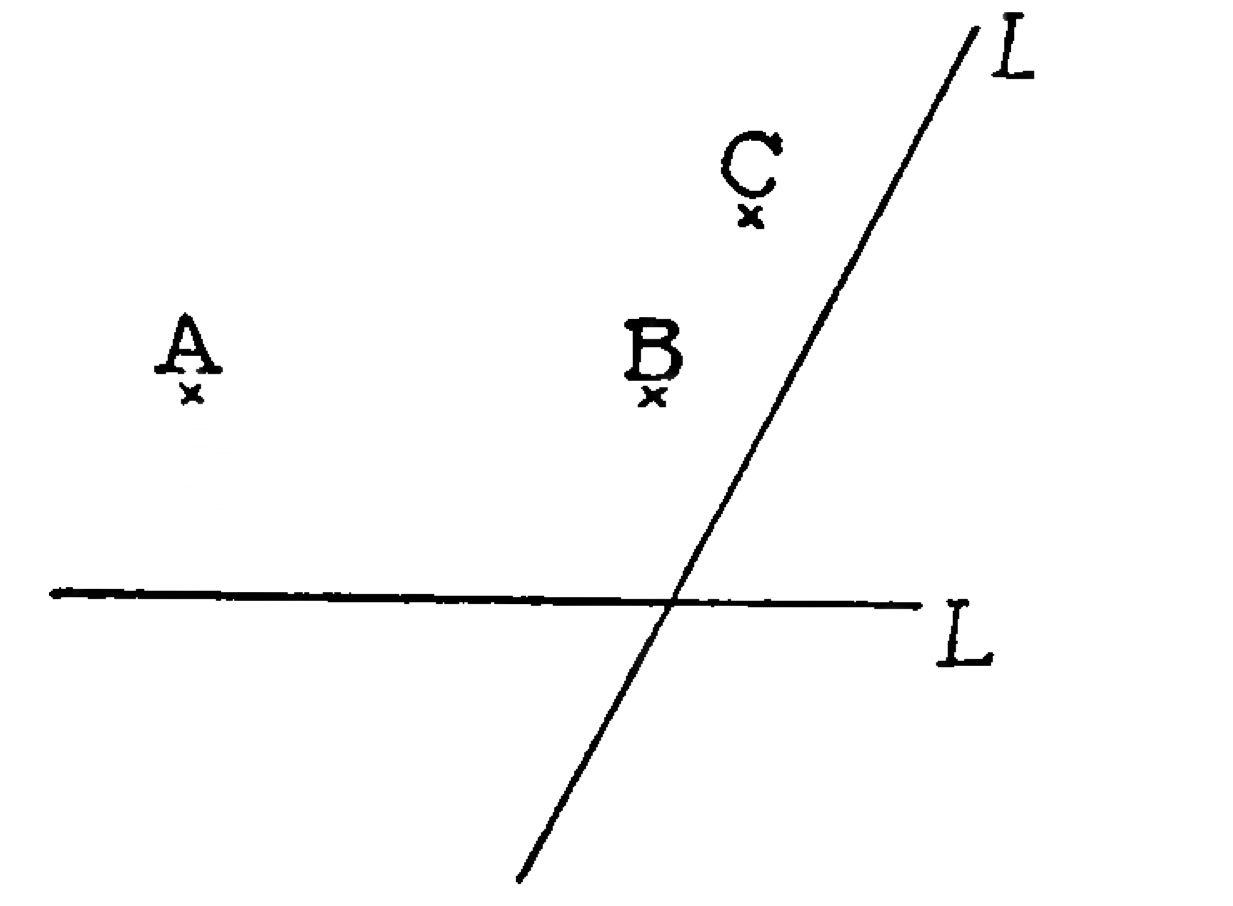
Fig. VIa
As a final illustration of this same problem of the relativity of simultaneity we may present a geometrical analogy. We have only to consider two points and at the same distance above a line , and then to consider the points and at the same distance above another line . We have only to look at the figure to realise that and are at the same distance neither from nor from . Only should the two lines and coincide would they be so.
It is much the same in relativity. The straight lines and correspond to the time directions of the two different observers. Classical science, assuming time to be absolute, considered the two lines coincident. Relativity has proved the error of this belief.