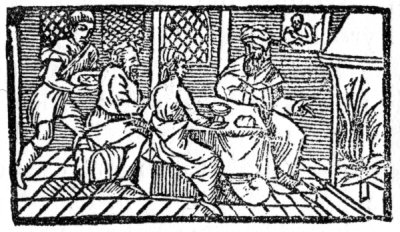
Chapter VII
Elizabeth Lee translation
AFTER SHAKESPEARE.
I.
In the works of Nash and his imitators, the different parts are badly dovetailed; the novelist is incoherent and incomplete; the fault lies in some degree with the picaresque form itself. Nash, however, pointed out the right road, the road that was to lead to the true novel. He was the first among his compatriots to endeavour to relate in prose a long-sustained story, having for its chief concern: the truth. He leaves to his real heroes, Surrey, More, Erasmus, Aretino, their historical character, and he gives to his fictitious ones caprices and qualities which make of them distinct and living beings like those of every-day life. He gives us no more languid shepherds, no more romantic disguises, no more pretended warriors whose helmets cover, as in Ariosto, a woman's fair locks. His style is flexible, animated, suited to the circumstances, free from those ornaments of language so sought after in his time; no one, Ben Jonson excepted, possessed at that epoch, in so great a degree as himself, a love of the honest truth. With Nash, then, the novel of real life, whose invention in England is generally attributed to Defoe, begins. To connect Defoe with the past of English literature, we must get over the whole of the seventeenth century and go back to "Jack Wilton," the worthy brother of "Roxana," "Moll Flanders," and "Colonel Jack."
But shepherds were not yet silenced, nor had romantic heroes spoken their last. On the contrary, their best time was still to come; in the seventeenth century they resumed their hardly interrupted speeches, conversations, correspondence, exploits and adventures, and flourished mightily in the world. We come to the time of the heroic romance and heroic drama. The main originality of the romance literature in England during this century was the increase and over-refinement of heroism in works of fiction. For many among the reading public of that age, Shakespeare was barbarous and Racine tame; but Scudéry was the "greatest wit" that ever lived.
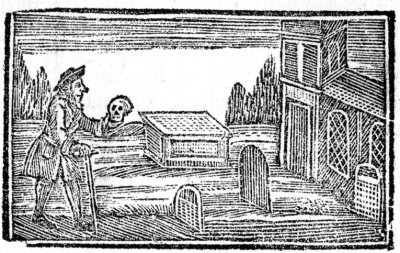
This kind of writing was thus partially renovated through certain superadded characteristics, the part allotted to "heroism" being the foremost; but the groundwork was as old as the very origin of the nation. For this new species of novel was mainly a development of the old chivalrous romances of early and mediæval times. These romances, as we know, had continued in Elizabethan times to enjoy some reputation, and under an altered shape to have a public of their own. Even in the seventeenth century they had not passed entirely out of sight. Palmerins, Dons Belianis and Esplandians continued to be written, translated, adapted, paraphrased, printed, purchased, and read. There was still a brisk trade in this sort of literature. People continued to read "the auncient, famous and honourable history of Amadis de Gaule, discoursing the adventures loves and fortunes of many princes;"[312] or again "the famous history of Hercules of Greece, with the manner of his encountering and overcoming serpents, lyons, monsters, giants, tyrants and powerful armies."[313] Guy of Warwick, our friend of former chapters, still carried on, with undaunted energy, his manifold exploits throughout the world. Only, as time passes, we find that he has become civilized; he has taken trouble to improve his mind, he has read books; he has even gone to the play. And his choice shows him a man of taste and feeling; a man with a memory too; for reaching a cemetery somewhere in his travels he "took up a worm-eaten skull, which he thus addressed: Perhaps thou wert a prince or a mighty monarch, a King, a Duke or a Lord. But the King and the beggar must all return to the earth; and therefore man hath need to remember his dying hour. Perhaps thou mightest have been a Queen or a Dutchess, or a Lady varnished with much beauty; but now thou art worms meat, lying in the grave, the sepolchre of all creatures." We are only surprised that "Alas poor Yorick" does not come in. The page is beautifully adorned with an engraving representing Sir Guy in cocked hat, addressing a skull he carries in his hand.[314]
sir guy of warwick addressing a skull.
The same phenomenon was taking place in France, and from France were to come the first examples of the regular heroic romance. "I have read [Lancelot]" says Sarasin, in a conversation reported by the well-known Jean Chapelain, the author of "La Pucelle," and "I have not found it too unpleasant. Among the things that have pleased me in it I found that it was the source of all the romances which for four or five centuries have been the noblest entertainment of all the courts of Europe and have prevented barbarism from encompassing the whole world."[315] But as well as Guy of Warwick, Lancelot wanted some "rajeunissement." His valour was still the fashion, but his manners, after so many centuries, and his dress too, were a little out of date. The new heroism was to pervade the whole man, and, in order to make him acceptable, to influence his costume as well as his mind. There was to be something Roman in him, and something French; he was to be represented in the style of Louis the Fourteenth's statues, where the monarch appears in a Roman tunic and a French wig.
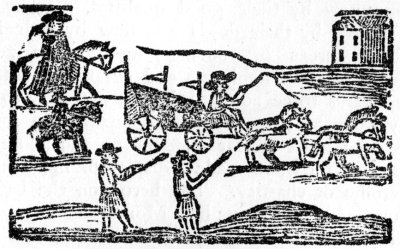
burial of sir guy of warwick.
The transformation occurred first in France, and was received with great applause. The times indeed were most propitious for a display, not of the barbaric heroism of olden times, but of courtly heroism; of an heroism which plumes, wigs and ribbons well fitted, and which, with scarcely any change, could be transferred from the battle field to the drawing-room, from Rocroy to the Hôtel de Rambouillet: no mean heroism, however, for all its ribbons. At this period, in France, manly and lofty virtues, as well as worldly ones, were worshipped in life, in literature and in art. From the commencement to the end of the century, examples of undoubted heroes were not lacking; Henri IV., Richelieu, Mme. de Longueville, Condé, Louis XIV., Turenne, now by their good qualities, now by their caprices, now by their deeds and now by their looks, resembled heroes of romance, and popularized in France an ideal of nobleness and greatness. In order to please and to be admired, it was necessary to show a lofty character; men must be superior to fortune, and women must appear superior to the allurements of passion; the hero made a display of magnanimity, the heroine of chastity. The hero won the battle of Fribourg, and the heroine had Montausier to pay court to her for thirteen years before she consented to be united to him in the bonds of wedlock. Such were the persons most admired in real life; such were the characters of romance and tragedy whom the public liked best, without, however, distinguishing between them. The Cid, Alceste, Artaban, Nicomède, as well as Julie d'Angennes, Montausier and Condé, were all members of the same family, and not any one of them more than another appeared comic or ridiculous: that is why Montausier was very far from being offended that traits of the character of Alceste were thought to be found in him, and that is why Mme. de Sévigné, a passionate admirer of Corneille, becomes as honestly enthusiastic over the extravagant heroes of the new romances as over those of the great Cornelian tragedies. "I am mad for Corneille; everything must yield to his genius ... My daughter, let us take good care not to compare Racine with him. Let us feel the difference!"[316] She writes elsewhere with regard to the heroes of La Calprenède: "The beauty of the sentiments, the violence of the emotions, the grandeur of the incidents and the miraculous success of their invincible swords, all that delights me like a young girl."[317]
This change, which consisted, not of course in the introduction of heroism into novels, where it had in all times found place, but in the magnifying, to an extraordinary degree, of this source of interest, and in a transformation of costume and of tone of speech, appeared not only in romances, but in the drama also, and even in history. Everything worthy of attention was for many years to be heroical. Heroes defy earth and heaven; they do not, like Aucassin, with a temper of ironical submission, give up Paradise in the hope of joining Nicolete in the nether world; they make the nether world itself tremble on its foundations: for nothing can resist them. Even in serious historical works the old rulers of the French nation appear under an heroical garb. King Clovis is thus described by Scipion Dupleix, historiographer royal, in his "Histoire Générale de France," 1634: "The hour of Easter-eve at which the King was to receive the baptism at the hands of St. Remy having come, he appeared with a proud countenance, a dignified gait, a majestic port, very richly dressed, musked and powdered; his flowing wig was curiously combed, curled, frizzed, undulated and perfumed, according to the custom of the old french Kings;"[318] but much more it seems according to the custom of less ancient sovereigns; and there is at the Louvre, a portrait of Louis XIII. bare-legged, periwigged, ermine-cloaked, which corresponds far better to this description than anything we know of Clovis.
The same characteristics appear in the epic and the drama. Antoine de Montchrestien, besides having written the earliest treatise of political economy, and thus having stood, if nothing more, godfather to a new science,[319] wrote a number of plays, flavoured most of them with a grandiloquence and heroism which give us a foretaste of Dryden. In his "Aman ou la vanité," he treats the same subject as Racine in his "Esther," but he has nothing in common with his successor, and much with the dramatists of the heroical school. In order, doubtless, to justify from the first the title of the play, Aman indulges his "vanité" in an opening monologue to the following effect:
"Whether fair Phœbus coming out of the hollow waters brings back colour to the face of the world, whether with his warmer rays he sets day ablaze or departs to take his rest in his watery bower, he cannot see in all the inhabited world a single man to be compared with me for successes of any sort. My glory is without peer, and if any of the gods were to exchange heaven for earth and dwell under the lunar disc, he would content himself with such a brilliant fortune as mine."[320]
Nearly all the dramas of Scudéry are made up of such speeches, and they were the rage in Paris before Corneille arose, Corneille in whom something of this style yet lingers. Each of Scudéry's heroes, be it in his dramas, in his epics, in his romances, is like his Alaric, nothing less than "le vainqueur des vainqueurs de la terre"; and having conquered all the world is in his turn conquered by Love. To write thus was supposed to be following the noble impulse given by the Renaissance, to be Roman, to outdo Seneca.[321]
In the novel especially this style shone in all its lustre and beauty. All the heroes of the interminable romances of the time, by Gomberville, George and Madeleine de Scudéry, La Calprenède and many others, be they Greek, Roman, Turk or French, are all of them the conquerors of the world and the captives of Love. "I can scarcely believe," wrote wise censors, "that the Cyrus and the Alexanders have suddenly become, as I hear it reported, so many Thyrsis and Celadons."[322] But their protests were of no avail, for a time, and romance heroes continued to reign in France, having had from the first for their palace and chief place of resort the famous Hôtel de Rambouillet.
This hotel had been building from 1610 to 1617 in the Rue St. Thomas-du-Louvre. Polite society began to gather there soon after its completion, and began to desert it only thirty years later. The heroic romances of the period were among the chief topics of conversation; and this is easily understood: they were meant as copies of this same polite society, and of its chiefs; under feigned names people recognized in Cyrus the Grand Condé; in Mandane, Madame de Longueville; in Sapho, the authoress herself, Mdlle. de Scudéry; in Aristhée, the poet Jean Chapelain. Persons thus designated often continued in real life to be called by their romance appellations; thus Madame de Sévigné is wont to subscribe herself "the very humble servant of the adorable Amalthée."[323] Men and women considered it a great honour to have their portraits in a romance; they felt sure then of going down to the remotest posterity, a fond belief to which posterity has already given the lie. Much intrigue went on to obtain such a valuable favour. While we are scarcely able now to plod on for a few chapters along the winding road which led Cyrus to his victories, these volumes were awaited with intense interest and discussed with passion as soon as published. Neither the expectation of the next number of the "Revue des deux Mondes," when it contains some important new study of actual life, nor the discussion about the last play of Dumas, can give us now an adequate idea of the amount of interest concentrated in Paris at that time upon those heroical, grandiloquent, periwigged figures.
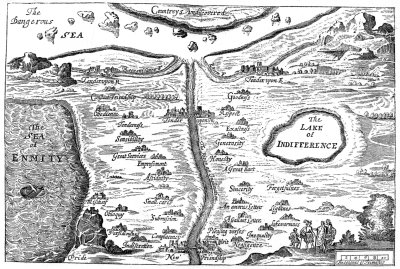
a map of the "tendre" country.
(
From an English translation of "Clélie."
)
[p. 359.
And sometimes it was a very long time before the end of the adventures, and the answers of the lovers were known. These books were not written without care and thought and some attention to rules and style. In the preface to his "Ibrahim" Scudéry gives us a sort of "Ars poetica" for heroic romance writers; he states what precepts it is necessary to follow, and those which may sometimes be dispensed with; he informs us that attention is to be paid to the truth of history, and that manners must be observed. For example, in "Ibrahim" he has thought fit to use some Turkish words, such as "Alla, Stambol"; these he calls "historical marks," and they correspond to what goes now under the name of local colour; according to his way of thinking they give a realistic appearance to his story. His heroes in this particular romance are not kings, he confesses; his excuse is that they are worthy to be such, and that besides they belong to very good families. He has been careful to use an easy, flowing style, and to avoid bombast "except in speeches." He has something to say about the unities, which have their part to play even in romances. Nothing must be left to chance in those works; and as for himself, he would have refused, he declares, the praise bestowed upon the Greek painter who, by throwing his brush against his work, obtained thus the finest effect in his picture. In Scudéry's picture everything is drawn with a will and a purpose, everything is the result of thought and calculation, and, if we are to believe him, much art was thus spent by the gallant Gouverneur de Nostre Dame; much art that is now entirely concealed from the dim eyes of posterity.[324]
Speeches, with descriptions, letters (which are always given in full as if they were documents of state), conversations and incidental anecdotic stories, were among the most usual means employed to fill up the many volumes of an ordinary heroical romance. For the volumes were many: "There never shone such a fine day as the one which was to be the eve of the nuptials between the illustrious Aronce and the admirable Clélie." Such is the beginning of the first volume of "Clélie, histoire romaine," by Madeleine de Scudéry, published in January, 1649. It happens that the marriage thus announced is delayed by certain little incidents, and is only celebrated towards the end of the tenth and last volume published in September, 1654. Volume I. contained the famous "Carte du Tendre," to show the route from "Nouvelle amitié" to "Tendre," with its various rivers, its villages of "Tendre-sur-Inclination," "Tendre-sur-Estime," with the ever-to-be-avoided hamlets of Indiscretion and Perfidy, the Lake of Indifference and other frightful countries. Let us turn away from them and go back to our heroes.
One of their chief pleasures was to tell their own stories. Of this neither they nor their listeners were ever tired. Whenever in the course of the tale a new person is introduced, the first thing he is expected to do is to tell us who he is and what he has seen of the world. Sometimes stories are included in his own, and when the first are finished, instead of taking up again the thread of the main tale, we merely resume the hearing of the speaker's own adventures: a custom which sometimes proves very puzzling to the inattentive frivolous reader of to-day. As for the supposed listeners in the tale itself, the men or women the hero has secured for his audience, they well knew what to expect, and took their precautions accordingly. We sometimes see them go to bed in order to listen more comfortably. In "Cassandre," the eunuch Tireus has a story to tell to Prince Oroontades: "The prince went to his bedroom and put himself to bed; he then had Tireus called to him, and having seats placed in the ruelle, he commanded us to sit," and then the story begins; and it goes on for pages; and when it is finished we observe that it was included in another story told by Araxe; wherefore, instead of finding ourselves back among the actors of the principal tale, we alight only among those in Araxe's narrative.[325] These stories are thus enclosed in one another like Chinese boxes.
II.
This literature as soon as imported into England realized there the most complete success. To find a parallel for it we must go back to the time when mediæval Lancelot and Tristan were sung of by French singers, and afterwards by singers of all countries. Cyrus and Mandane, Oroontades and Tireus, Grand Scipio and Illustrious Bassa, Astrée and Céladon, our heroes and our shepherds once more began the invasion and conquest of the great northern island. As was to be expected from such unparalleled conquerors, they accomplished this feat easily, and their work had consequences in England for which France can scarcely offer any perfect equivalent. Through their exertions there arose in this country a dramatic literature in the heroical style which, thanks especially to Dryden, has still a literary interest. But in France our heroes of fiction were curtailed of much of their glory by the inexorable Boileau. They left, it is true, some trace of their influence in the works of Corneille and even of Racine, but the heroic drama, properly so called, was restricted to the works of the Scudérys and Montchrestiens, which is saying enough to imply that it was not meant to survive very long.
During the greater part of the century French romances were in England the main reading of people who had leisure. They were read in the original, for French was a current language in society at that time, and they were read in translations both by society and by the ordinary public. Most of them were rendered into English, and so important were these works considered that sometimes several translators tried their skill at the same romance, and published independently the result of their labours, as if their author had been Virgil or Ariosto, or any classical writer. French ideas in the matter of novels were adopted so cordially that not only under Charles I., but even during the civil war and under Cromwell this rage for reading and translating did not abate. The contrary, it is true, has often been asserted, without inquiry, and as a matter of course; but this erroneous statement was due to a mere a priori argument, and had no other ground than the improbability of the same fashion predominating in the London of the Roundheads and the Paris of the Précieuses. What likelihood was there of any popularity being bestowed upon heroes who were nothing if not befeathered heroes, heroes à panaches at a time when Puritans reigned supreme, staunch adversaries as we know of panaches, curls, vain talk, and every sort of worldly vanity? Was it not the time when books were published on "The unlovelinesse of Love-lockes," being "a summarie discourse prooving the wearing and nourishing of a locke or love-locke to be altogether unseemely, and unlawfull unto Christians. In which there are likewise some passages collected out of Fathers, Councells and sundry authors and historians against face-painting, the wearing of supposititious, poudred, frizled or extraordinary long haire, the inordinate affectation of corporall beautie, and womens mannish, unnaturall, impudent, and unchristian cutting of their haire"?[326] So early in the century as 1628 it was thus discovered that women's short hair and men's long wigs were equally unchristian. What was to be the fate of our well-curled heroes? They were received with open arms. "Polexandre," for example, was published in English in 1647; "Ibrahim ou l'illustre Bassa," "Cassandre," and "Cléopatre" in 1652; "Le Grand Cyrus" in 1653, the very year in which Cromwell became Protector; the first part of "Clélie" in 1656; "Astrée" in 1657; "Scipion" in 1660, &c.
The English prefaces to these French novels plainly showed that, notwithstanding the puritanical taunts of the party in power, publishers felt no doubt as to the success of their undertaking. These works were not spread timidly among the public; they were announced noisily in the most pompous terms:
"I shall waste no time to tell you how this book hath sold in France where it was born: since nothing falls from Monsieur de Scudéry's hand, but is receiv'd there as an unquestionable piece, by all that have a taste of wit or honour. The translator hath inserted no false stitches of his own, having only turn'd the wrong side of the Arras towards us, for all translations, you know, are no other."[327]
The translator of "Astrée" was fain to inform his readers of a judgment passed, as he pretends, on this work by "the late famous Cardinall of Richelieu. That he was not to be admitted in the Academy of wit who had not been before well read in Astrea." And he claims for his author a highly beneficial purpose, that could be condemned by none except obdurate Puritans: "These are the true designs and ends of works of this nature: these are academies for the lover, schools of war for the soldier, and cabinets for the statesman; they are the correctives of passion, the restoratives of conversation, ... in a word, the most delightful accommodations of civill life."[328]
Another goes so far as to give the lie direct to the Puritans, to "those morose persons" who condemn novels; in truth, "delight is the least advantage redounding from such compositions." French romances (which seem to have altered somewhat in this respect) are nothing but a school of morality, generosity, and self-restraint: "Not to say anything concerning the ground work which is generally some excellent piece of ancient history accurately collected out of the records of the most eminent writers of old, ... the addition of fictitious adventures is so ingenious, the incident discourses so handsome, free and fitted for the improvement of conversation (which is not undeservedly accounted of great importance to the contentment of human life), the descriptions of the passions so lively and naturally set forth; yea the idea of virtue, generosity and all the qualifications requisite to accomplish great persons so exquisitely delineated that ... I must speak it, though I believe with the envy and regret of many, that [the French] have approv'd themselves the best teachers of a noble and generous morality that are to be met with."[329]
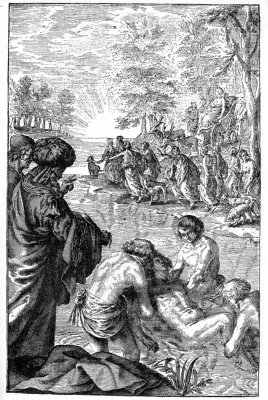
endymion plunged into the river in the presence of diana.
(
French Engraving used in an English book.
)
[p. 367.
Sometimes both the engravings and the story were imported from France. As the illustrations to Harington's translation of "Ariosto" had been originally made by an Italian artist, so now French engravings began to be popularized in England. For example, when a translation appeared of "Endimion," the curious mythological novel of Gombauld, with its pleasant descriptions and incidents, half dreamy, half real, the plates from drawings by C. de Pas were sent over to England and used in the English edition. Sometimes, too, the English copies had original plates or engraved titles; but even in these the French style was usually apparent. Robert Loveday, who translated La Calprenède's "Cléopatre," prefaces his book with one such plate; and it is curious to notice when reading his published correspondence that the engraving was made according to his own minute directions. The bookseller "offer'd to be at the charge of cutting my own face for the frontispiece, but I refused his offer." As, however, the publisher insisted on having something, "I design'd him this which is now a-cutting: Upon an altar dedicated to Love, divers hearts transfix'd with arrows and darts are to lye broiling upon the coals; and upon the steps of it, Hymen ... in a posture as if he were going to light [his taper] to the altar; when Cupid is to come behind him and pull him by the saffron sleeve, with these words proceeding from his mouth: Nondum peracta sunt præludia";[330] a statement that is only too true and in which Loveday summarizes unawares the truest criticism levelled at these romances. You may read volume after volume, and still "nondum peracta sunt præludia," you have not yet done with preliminaries.
But this constant delaying of an event, sometimes announced, as in "Clélie," at the top of the first page, was not in the least displeasing to seventeenth-century readers. The lengthy episodes, the protracted conversations, enchanted them; it was an age when conversation was at its height in France, and from France the taste spread to other countries. Translators, as we have seen, expressly mentioned as an attraction in their books the help they would give to conversation. Numberless examples of this polite pastime are provided in the heroic romances; in "Almahide, or the Captive Queen,"[331] among others, we read discussions as to whether it is better for a man to court a lady in verse or in prose, whether an illiterate lover is better than a learned one, &c., &c.
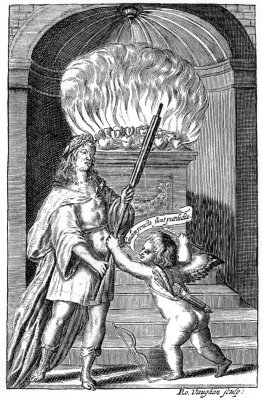
"hymen's præludia."
(
Frontispiece of the translation of La Calprenède's "Cléopatre."
)
[p. 371.
Such topics, and many more of a higher order, which were the subject of persistent debate in the drawing-rooms of the Hôtel de Rambouillet, were also discussed in England; there was, it is true, no Hôtel de Rambouillet, but there was the house of the Philips at Cardigan. There was no Marquise, but there was Catherine Philips, the "matchless Orinda," who did much to acclimatize in England the refinements, elegancies, and heroism à panache of her French neighbours. With the help of her friends she translated some of the plays of Corneille, not without adding something to the original to make it look more heroical. The little society gathered round her imitated the feigned names bestowed upon the habitués of the Parisian hotel. While she went by the name of Orinda, plain Mr. Philips, her husband, was re-baptized Antenor; her friend Sir Charles Cotterel, translator of "Cassandre," was Poliarchus; a lady friend, Miss Owen, was Lucasia;[332] fine names, to be sure, which unfortunately will remind many a reader not only of matchless Arthenice, of the Hôtel de Rambouillet, but of Molière's Cathos and Madelon, who, too, had chosen to imitate the Marquise, and insisted on being called Aminte and Polixène, to the astonishment of their honest father.[333]
The high morality and delicacy, both of the "Hôtel," and, alas, of Molière's "Précieuses," were also imitated at Cardigan. To get married was a thing so coarse and vulgar that people with refined souls were to slip into that only at the last extremity. "A fine thing it would be," says the Madelon of the "Précieuses," "if from the first Cyrus were to marry Mandane and if Aronce were all at once wedded to Clelia!" We have seen that such is not the case, and that ten volumes of adventures interpose between their love and their marriage. In the same way an eternal friendship, a marriage of soul to soul, having been sworn between Orinda and Lucasia, it was a matter of great sorrow, shame and despair for the first when the second, after thirteen years of this refined intercourse proved frail and commonplace enough to marry a lover of appropriate age, fortune and position.
Another centre for heroic thoughts and refined morality was the country house of the pedantic but pretty Duchess of Newcastle, a prolific writer of essays, letters, plays, poems, tales, and works of all kinds. To her, literature was a compensation for the impossibility, through want of opportunity, of performing with her own hand heroical deeds: "I dare not examine," says she, "the former times, for fear I should meet with such of my sex that have out-done all the glory I can aime at or hope to attaine; for I confess my ambition is restless, and not ordinary; because it would have an extraordinary fame. And since all heroick actions, publick employments, powerfull governments and eloquent pleadings are denyed our sex in this age or at least would be condemned for want of custome, is the cause I write so much."[334]
a fashionable conversation.
[p. 375.
She wrote a great deal, and not without feeling a somewhat deep and naïvely expressed admiration for her own performances. The epithet "restless" which she applies to her ambition, well fits her whole mind; there is restlessness about everything she did and wrote. She is never satisfied with one epistle to the reader; she must have ten or twelve prefaces and under-prefaces, which forcibly remind us of her contemporary, Oronte, in his famous sonnet scene with Alceste. Her "Natures pictures drawn by Fancies pencil to the life" is preceded by several copies of commendatory verses and a succession of preambles, entitled: "To the reader—An epistle to my readers—To the reader—To the reader—To my readers—To my readers"; each being duly signed "M. Newcastle." It seems as if the sight of her own name was a pleasure to her. These prefaces are full of expostulations, explanations and apologies, quite in the Oronte style: "The design of these my feigned stories, is to present virtue, the muses leading her and the graces attending her.... Perchance my feigned stories are not so lively described as they might have been.... As for those tales I name romancicall, I would not have my readers think I write them either to please or to make foolish whining lovers.... I must entreat my readers to understand, that though my naturall genius is to write fancy, yet ... Although I hope every piece or discourse in my book will delight my readers or at least some one, and some another ... yet I do recommend two as the most solid and edifying." Great is the temptation to answer with Alceste: "Nous verrons bien!"[335] But how could one say so when she was so pretty? The best preface to her volumes is in fact the charming engraving representing a party meeting at her house to tell and hear tales round the fire, and of which we give a reproduction. The only pity is that the figure meant as her portrait, though laurel-crowned, looks much more plain and commonplace than we might have expected.
She wrote then abundantly "romancicall" tales, as she called them, with a touch of heroism; edifying tales in which she prescribes "that all young men should be kept to their studies so long as their effeminate beauties doth last;" dialogues "of the wise lady, the learned lady and the witty lady," the three being only too wise; plays in which she depicts herself under the names of Lady Sanspareile, of Lady Chastity, &c., unpardonable sins, no doubt, to give oneself such names; but it is reported she was so beautiful!
Among the mass of her writings, it must be added, ideas are scattered here and there which were destined to live, and through which she anticipated men of true and real genius. To give only one example, she too may be credited with having anticipated Richardson in her "Sociable Letters," in which she tries to imitate real life, to describe scenes, very nearly to write an actual novel: "The truth is," she writes, "they are rather scenes than letters, for I have endeavoured under cover of letters to express the humors of mankind, and the actions of man's life by the correspondence of two ladies, living at some short distance from each other, which make it not only their chief delight and pastime, but their tye in friendship, to discourse by letters as they would do if they were personally together."[336] Many collections of imaginary letters had, as we have seen, been published before, but never had the use to which they could be put been better foreseen by any predecessor of Richardson.
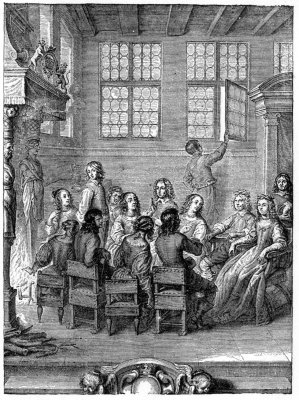
conversation and telling of stories at the house of the duchess of newcastle, 1656.
[p. 379.
The Duchess lived till 1674, surrounded by an ever-increasing group of admirers, deaf to the jokes of courtly people concerning her old-fashioned chastity; more than consoled by the firm belief she had as to the strength of her mind and genius. In this persuasion "she kept," wrote Theophilus Cibber, "a great many young ladies about her person, who occasionally wrote what she dictated. Some of them slept in a room contiguous to that in which Her Grace lay, and were ready at the call of her bell to rise any hour of the night to write down her conceptions, lest they should escape her memory. The young ladies no doubt often dreaded Her Grace's conceptions, which were frequent."[337] Here, again, her restless spirit was in some manner anticipating unawares another great writer, namely, Pope.
Thus, in spite of Cromwell and the Puritans on the one side, and Charles II. and his courtiers on the other, French ideas as to the possible dignity and purity of lives in which the worldly element was not wanting grew to some extent on the English soil, though, it is true, with less success, being as we see mainly relegated at that time to the country. The true hour for virtues not the less real because sociable, virtues such as they were understood by Madame de Sévigné or Madame de Rambouillet, had not yet come. They were to be thoroughly acclimatized only in the next century, principally through the exertions of Steele and Addison.
But the strictly heroical part of French tastes was accepted immediately and with great enthusiasm. The extraordinary number of folio heroical romances still to be seen in old English country houses testifies at the present day to their extraordinary hold upon the polite society of the time. The King gave the example. Charles I. had been a reader of such novels; on the eve of his death he distributed a few souvenirs to his most faithful friends, and we see him give away, besides Hooker's "Ecclesiastical Polity" and Dr. Andrews' sermons, the romance of "Cassandre," which he left to the Earl of Lindsey. During the troublous times of the civil war, Dorothy Osborne constantly alludes, in her letters to Sir William Temple, to the books she reads, and they are mostly these same French novels. While troops are marching to and fro; while rebellions and counter-rebellions are preparing or breaking out, the volumes of "Cléopatre" and "Grand Cyrus" go to and fro between the lovers and are the subject of their epistolary discussions. "Have you read 'Cléopatre'? I have six tomes on't here that I can lend you if you have not; there are some stories in't you will like, I believe."—"Since you are at leisure to consider the moon, you may be enough to read 'Cléopatre,' therefore I have sent you three volumes.... There is a story of Artimise that I will recommend to you; her disposition I like extremely, it has a great deal of practical wit; and if you meet with one Brittomart, pray send me word how you like him."—"I have a third tome here [of "Cyrus"] against you have done with that second; and to encourage you, let me assure you that the more you read of them, you will like them still better,"[338] and so on.
The wife of Mr. Pepys was not less fond of French romances than Dorothy Osborne, and we sometimes find her husband purchasing copies at his bookseller's to bring home as presents. But he himself did not like them very much; he seems to have been deterred from this kind of literature by his wife's habit of reciting stories to him out of these works; some quarrel even took place between the couple about "Cyrus," though it seems that "Cyrus" was in this case more the pretext than the reason of the discussion, as honest Pepys with his usual frankness gives us to understand: "At noon home, where I find my wife troubled still at my checking her last night in the coach in her long stories out of 'Grand Cyrus,' which she would tell, though nothing to the purpose, nor in any good manner. This she took unkindly, and I think I was to blame indeed; but she do find with reason that in the company of Pierce, Knipp, or other women that I love I do not value her as I ought. However very good friends by and by." As a penance doubtless we see him buying for her later "L'Illustre Bassa in four volumes" and "Cassandra and some other French books."[339]
III.
But reading and translating was not enough for a society so enamoured of heroical romances; some original ones were to be composed for English readers and the composing of them became a fashionable pastime. "My lord Broghill," writes again Dorothy Osborne to her future husband, Sir William Temple, the patron hereafter of the yet unborn Jonathan Swift, "sure will give us something worth the reading. My Lord Saye, I am told, has writ a romance since his retirement in the isle of Lundy, and Mr. Waller they say is making one of our wars, which if he does not mingle with a great deal of pleasing fiction, cannot be very diverting, sure, the subject is so sad."[340]
The following year, that is 1654, the English public received, according to Dorothy's previsions, the first instalment of the most noticeable heroical romance composed in their language. It was called "Parthenissa,"[341] and had for its author Roger Boyle, Lord Broghill, afterwards Earl of Orrery, one of the matchless Orinda's great friends.[342]
In this heroic romance, the imitation of France is as exact as possible; the few literary qualities perceptible in the vast compositions of Mdlle. de Scudéry and of La Calprenède, do not shine with any brighter lustre in "Parthenissa." As in France ancient history is put to the torture, though Scudéry, as we have seen, had set up as a rule that the truth of history was to be respected in romances; of observation of nature there is little or none, and the conversations of the characters are interminable. "Turning over the leaves of the large folio," wrote one of the last critics who busied themselves with this work, "I perceived that ... the story some-how or other brought in Hannibal, Massinissa, Mithridates, Spartacus, and other persons equally well known.... How they came into the story or what the story is I cannot tell you; nor will any mortal know any more than I do, between this and doomsday; but there they all are, lively though invisible, like carp in a pond."[343] We must make bold, though doomsday has not yet come, to draw forth some of these carp out of the water, and, after all, this is not the darkest pond in which we shall have fished.
At the commencement, Boyle introduces us to a young and handsome stranger who comes to Syria in order to consult the oracle of Venus. The priest Callimachus appears before him, and quite suddenly asks for his history. The stranger is very willing to tell it. His name is Artabanes and he is the son of the King of Parthia; he is in love with the Princess Parthenissa and has proved his affection for her in the manner of Sidney's heroes: he met on one occasion an Arab prince, who was travelling with a collection of twenty-four pictures, representing the mistresses of twenty-four famous champions overthrown by him. Artabanes in his turn measured swords with the Arab and got possession of the twenty-four paintings, and one in addition, which represented the mistress of his adversary: whence it results that Parthenissa is the most beautiful woman in the world, exactly what the hero intended to prove.
Artabanes has a rival, Surena; he fancies that Surena is the happy man, leaves Parthenissa and goes to live in solitude. Pirates carry him off, and sell him at Rome for a slave. Then under the name of Spartacus, he stirs up a revolt and accomplishes exploits attributed by ancient writers to that rebel; however he does not die as in history, but returns to Asia. There, Parthenissa, rather than surrender to a lover, swallows a drug and dies; but hers is only an apparent death and she returns to life. Artabanes, in the same way, stabs himself, but he is cured; and then it is that he comes to consult the oracle.
Callimachus thanks him for his interesting but somewhat lengthy story, and revenges himself by relating his own. Unfortunately he is interrupted: they see a lady who looks exactly like Parthenissa herself enter a neighbouring grove; she is accompanied by a young cavalier; they embrace and disappear among the trees. Artabanes' anguish at this sight cannot be described. But here Roger Boyle found that he was tired and wrote no more. His romance, which already comprised five parts, was published by him in this unfinished form.
For a long time the public was left in suspense. The Protector was dead, his son had fallen, the Stuarts had again ascended the throne, and no one knew the end of the loves of Prince Artabanes. The continuation of the romance is due to the charming Henrietta of England, Duchess of Orleans. Ten or twelve years after the appearance of the first volume, she was curious to know what Parthenissa was doing in the wood, and begged Roger Boyle to bring her out of it. He wrote a sixth part in four books and dedicated it to her.
Are we to imagine that the author is now going to lead his impatient readers in search of the heroine? Not at all. Callimachus, who was unfairly interrupted in his tale, proposes to his companions to leave one of them, Symander, on guard, and to go and refresh themselves. When they were rested, "they conjur'd him to prosecute his story, though what they had seen and heard gave them impatiences which nothing but their desires of knowing so generous a friend's fortunes could have dispensed with." The four books of the sixth part are devoted to this narrative; Boyle, as he said in his preface, had thought at first of concluding everything in this supplement; but he was forced to recognize that it was impossible to "confine it within so narrow a compass." This statement will be found on page 808 of his folio volume. Why Parthenissa entered the grove was never to be known nor what she had to say in her justification. Boyle, who had taken up his pen again at the instance of the young duchess, had very soon no reason to continue: Bossuet was calling on the court of the Grand Roi to weep with him for the loss of this charming woman, whose beauty and grace had only blossomed "for one morning."
As soon as the book was out, Dorothy Osborne had a copy sent to her, but she did not like it so much as the French models. She writes to Temple: "I'll ... tell you that 'Parthenissa' is now my company. My brother sent it down and I have almost read it. 'Tis handsome language; you would know it to be writ by a person of good quality though you were not told it; but on the whole I am not very much taken with it. All the stories have too near a resemblance with those of other romances; there is nothing new and surprenant in them; the ladies are all so kind they make no sport."[344]
Boyle, it is said, besides his dramas and other works, again tried his fortune as a novel writer, and published in 1676 "English Adventures by a person of honour." It is in a style so absolutely different from his former romance that it is scarcely credible that both came from the same pen. "English Adventures" tell the story of the amours of King Henry VIII., of Brandon, and others. All the reserve in "Parthenissa" has entirely disappeared, and scenes are presented to the eye which, except at the time of the Restoration, have usually been veiled. Love is in this novel the subject of many discussions, and so it was in heroic romances, but while it was spoken of there with decency and dignity, it is never mentioned in "English Adventures" but in a tone of banter and raillery. The discourses about this passion recall Suckling's ideas much more than those of Madeleine de Scudéry. "Pardon me, madam, Wilmore reply'd, if I think you mistake the case, for I never said I was for a siege in Love: that is the dull method of those countries whose discipline in amours I abominate. I am for the French mode, where the first day, I either conquer my mistress or my passion." Whether or not this be according to "the French mode," we are obviously very far from the Montausier ideal. The author continues: "Nor indeed did I ever see any woman (I mean in France) cry up constancy, but she was decaying; for when any thing but love is to maintain love 'tis a proof Beauty cannot do it, and then, alas, nothing else can."[345] If this and the very licentious adventures which follow are really Boyle's, it must be conceded that the change worked upon him by the new Restoration manners was indeed vast and comprehensive.
Other original attempts at the heroical romance were made in England at this period. It will be enough to mention one more. The two main defects of the heroical dramas of Dryden and his contemporaries are bombast in the ideas and bad taste in the expressions. In Crowne's heroical novel of "Pandion and Amphigenia"[346] both defects are pushed to an extreme which, incredible as it may seem to the readers of Dryden, was never at any time reached by the laureate.
The story is the usual heroical story of valorous deeds and peerless loves; the author is careful to assert that he is perfectly original: "All ... is genuine, nothing stole, nothing strained." He has been especially careful to avoid imitating the French and the elegancies of "that ceremonious nation." After such a declaration we are rather surprised to hear Periander thus answer a lady who, in the usual way, had asked him for his inevitable story: "Madam," said he, "your expressions speak you no less rich in virtue than beauty.... I should be more savage then the beasts that Orpheus charmed into civility, should I remain inexorable to the intreaties of so sweet an orator, whose perfections are such that I cannot but account it as great a glory to obey you, as it would make me sensible of shame to refuse any thing you should command, though it were to sacrifice my life and honour, which are the only jewels I ever prized in my prosperity, and which is all that Fortune hath left to my disposal in my adversity." Then he tells his story, which we had better not listen to, for it begins: "Know you then that in the city of Corinth, there dwelt a gentleman called Eleutherius ...," and we know full well what such beginnings threaten. The romance goes on describing bloody feuds and matchless beauties. Here is in characteristic style a portrait of a matchless beauty:
"The pillow blest with a kiss from her cheeks, as pregnant with delight, swelled on either side.... A lock that had stollen from its sweet prison, folded in cloudy curls, lay dallying with her breath, sometimes striving to get a kiss, and then repulsed flew back, sometimes obtaining its desired bliss, and then as rapt with joy, retreated in wanton caperings.... Her breasts at liberty displayed were of so pure a whiteness as if one's eye through the transparent skin, had viewed the milky treasures they inclosed."
Oh! for a Boileau, shall we exclaim, to cut off the flowers of such paper gardens! for a Defoe to show how prose fiction should be written! But Boileau is abroad and Defoe's time is yet to come. Wait, besides, for this is nothing and we have better in store; that was love, here is war:
"The signal for the battail being given, there began such a terrible conflict, as that within a short time thousands lay dead in the place, both sides maintaining their assaults with such impetuous rage as if the Gyants had been come to heap mountains of carcasses to assail heaven and besiege the gods; nothing but fury reigned in every breast, some that were thrust through with lances would yet run themselves farther on to reach their enemies and requite that mortal wound ... the earth grew of a sanguine complexion, being covered with blood, as if every soldier had been Death's herald, and had come to emblazon Mars's arms with a sword Argent on a field Gules.... In one place, lay heads deposed from their sovereignties, yawning and staring as if they looked for their bodies."[347] One refreshing thought is the remembrance of the pure, deep pleasure Crowne must have found in fastening together such an unparalleled series of conceits. "Peste," is he sure to have said with Sosie:
"Peste! où prend mon esprit toutes ces gentillesses?"
As for the final result of these wars and love-makings, it is a very airy one; for Crowne seems to have entertained a higher ideal of purity than even Montausier and Orinda. His ladies bestow upon their lovers nothing at all, not even marriage, and the author, after having been at some trouble to re-establish order in Thessaly and other countries, gives up all idea of getting Pandion and Amphigenia wedded, this lady, she of the pillow above described, being as he says so very "coy."
Though not quite a match for Crowne's it must be conceded that neither is Dryden's bombast of a mean order. The following passage which very nearly bears comparison with the above, will show how heroism appeared when transferred to the stage. In one of the dramas, the plot of which Dryden took from the French romances, Almanzor thus addresses a rival:
"If from thy hands alone my death can be, I am immortal and a god to thee, If I would kill thee now, thy fate's so low That I must stoop ere I can give the blow: But mine is fixed so far above thy crown, That all thy men, Piled on thy back, can never pull it down: But at my ease, thy destiny I send, By ceasing from this hour to be thy friend. Like heaven, I need but only to stand still, And not concurring to thy life, I kill."[348]
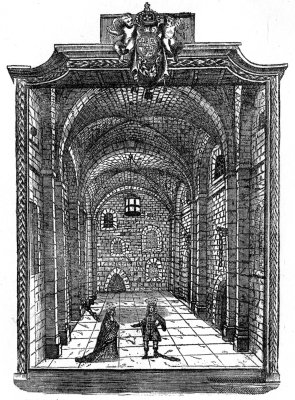
heroes (moorish ones) as they appeared on the stage, from settle's "empress of morocco," 1673.
[p. 393.
Any number of speeches of this sort are to be found in the heroical dramas of Dryden, Settle, Lee, and their contemporaries. Roman, Arab, Turk, Greek or Moorish heroes, pirates or princes, when they mean to set anything at defiance, choose nothing less than heaven and earth as their object; they divide the world between them as if it were an orange; they rush to the fight or stop for a speech with a fine shake of the head which sends a majestic undulation round the wig worn by them, even by the Moors, as we may see in one of the very rare dramas then published with engravings. They are represented there with embroidered justaucorps, wigs and ribbons.[349]
Crowne besides his romance wrote several dramas that secured him a wide, if temporary, popularity. He also adapted Racine's "Andromaque" for the English stage, but he was very much disgusted with this work; the French original, though not "the worst" of French plays, was after all so mean and tame! "If the play be barren of fancy, you must blame the original author. I am as much inclined to be civil to strangers as any man; but then they must be strangers of merit. I would no more be at the pains to bestow wit (if I had any) on a French play, than I would be at the cost to bestow cloaths on every shabby Frenchman that comes over." Here we have Racine put in his proper place; what claim had he to be considered "a stranger of merit"? True, some crabbed English critics seem to have taken his part against the translator, and, incredible as it may seem, they have expressed a thought that "this suffered much in the translation.—I cannot tell in what," answers Crowne, "except in not bestowing verse upon it, which I thought it did not deserve. For otherwise, there is all that is in the French play, verbatim, and something more, as may be seen in the last act, where what is dully recited in the French play is there represented, which is no small advantage."[350] And true, it is, Pyrrhus is slain before our eyes; there are "alarums" and other lively, if customary, ornaments.
In this age obviously Racine could not please. Nor would Shakespeare have pleased a French audience, but as we know no attempt in that direction was made in Paris. The two nations lent one another, if anything, their defects. "Alaric" was named with praise by Dryden; Scudéry and La Calprenède continued to be most popular French authors during the century. Even in the next we find something remaining of their fame. Among the books in the library of the fashionable Leonora, Addison notices: "'Cassandra,' 'Cleopatra,' 'Astræa' ... the 'Grand Cyrus,' with a pin stuck in one of the middle leaves ... 'Clelia,' which opened of it self in the place that describes two lovers in a bower,"[351] &c. The passions in them which seem to us now so incredibly frigid, had not yet cooled down; their warmth was still felt: so much so that in one of Farquhar's plays, "Cassandra" is mentioned as greatly responsible for Lady Lurewell's first and greatest fault, the beginning of many others: "After supper I went to my chamber and read 'Cassandra,' then went to bed and dreamt of it all night, rose in the morning and made verses ..."[352] We cannot follow her in her account of the consequences.
All that was truly noble and simple in French literature was known, but at the same time generally misunderstood in England. To make French authors acceptable, grossness was added to Molière, bombast to Racine; even Otway, when translating "Bérénice," transformed Racine's "Titus" into a bully of romance who, in order to assuage his grief, goes to overrun "the Universe" and make "the worlds" as wretched as he is.[353] Madame de la Fayette had shown how it was possible to copy from life, in a novel, true heroism and true tenderness without exaggeration; her exquisite masterpiece was translated of course as was everything then that was French; but oblivion soon gathered round the "Princess of Cleve," and the only proof we have that it did not pass unnoticed is a clumsy play by Lee, in which this best of old French novels is mercilessly caricatured.[354] There was no attempt to imitate the Comtesse's pure and perfect style and high train of thought.
IV.
Reaction against the heroical romances did not wait, however, till the eighteenth century to assert itself in England; it set in early and very amusingly: but it remained powerless. As the evil had chiefly come from France, so did the remedy; but the remedy in France proved sufficient for a cure. In that country at all times the tale had flourished, and at all times in the tale, to the detriment of chivalry and heroism, writers had prided themselves on seeking mere truth. Thus, in the charming preface of the Reine de Navarre's "Heptaméron," Dame Parlamente establishes the theory of these narratives, and relates how, at the court, it had been decided to write a series of them, but to exclude from the number of their authors "those who should have studied and be men of letters; for Monseigneur the Dauphin did not wish their artifice to be introduced into them, and was also afraid lest the beauty of rhetoric should in some place injure the truth of the tale."
In the seventeenth century, the tradition of the old story-tellers is carried on in France in more developed writings, in actual novels, such as the "Baron de Fœneste" of D'Aubigné, 1617; the "Francion" of Charles Sorel, 1622(?); the "Berger extravagant" of the same, 1628; the "Roman Comique" of Scarron, 1651; the "Roman bourgeois" of Furetière, 1666, and many others. Scarron, who had travestied Virgil, was not the man to spare La Calprenède, and he does not lose his opportunity. "I cannot exactly tell you," he writes of one of his characters, "whether he had sup'd that night, or went to bed empty, as some Romance-mongers use to do, who regulate all their heroes' actions, making them rise early, and tell on their story till dinner time, then dine lightly, and after their meal proceed in the discourse: or else retire to some shady grove to talk by themselves, unless they have something to discover to the rocks and trees."
Furetière, writing in the same spirit, declares that he wishes to concern himself with "persons who are neither heroes nor heroines, who will neither raise armies nor overturn kingdoms; but who will be good people of middling rank who quietly go on their usual way, of whom some are handsome and others plain, some wise and others foolish; and the latter have the appearance indeed of forming the greatest number."[355]
Without speaking of the more important works of Cervantes and Rabelais,[356] most of these novels were translated into English, and in the same spirit as they had been written, that is, to be used as engines of war against heroes and heroism. "The French themselves," writes one of the translators, "our first romantique masters ... have given over making the world otherwise than it was; are now come to represent it to us as it is and ever will be."[357] "Among all the books that ever were thought on," writes another, who curiously enough had about the same opinion of the favourite novels of his time as Sidney had had of the drama a century earlier, "those of knight errantry and shepherdry have been so excellently trivial and naughty, that it would amuse a good judgment to consider into what strange and vast absurdities some imaginations have straggled ... the Knight constantly killing the gyant, or it may be whole squadrons; the Damosel certainly to be relieved just upon the point of ravishing; a little childe carried away out of his cradle after some twenty years discovered to be the sone of some great prince; a girl after seven years wandring and co-habiting and being stole, confirmed to be a virgin, either by a panterh, fire or a fountain, and lastly all ending in marriage ... These are the noble entertainments of books of this kinde, which how profitable they are, you may judge; how pernicious 'tis easily seen, if they meet but with an intentive melancholy and a spirit apt to be overborn by such follies;"[358] a spirit, in fact, such as Lady Lurewell's, whose reading of "Cassandra" had, as we have seen, such remarkable consequences.[359]
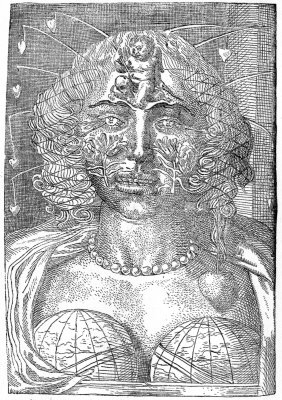
a poet's dream realized, from "the extravagant shepherd," 1653.
[p. 401.
Efforts made in England to imitate this style and to lead, by means of the romance itself, a reaction against the false heroism that the romance had introduced, proved sadly abortive. These attempts have fallen into a still more profound oblivion than those of the story-tellers of Shakespeare's time. The English were not yet masters of the supple, crisp and animated language which suited that kind of tale, and which the French possessed from the thirteenth century. A few original minds like Sidney in his "Apologie" had employed it; but they formed rare exceptions, and in the seventeenth century most men continued to like either the pompous prose with its Latin periods, held in highest honour by Bacon, or the various kinds of flowery prose used by Lodge, Greene, Shakespeare and Sidney. So the romance writers who attempted to bring about a reaction received no encouragement and were forgotten less from want of merit than because even their contemporaries paid no attention to them. Thinking to open up a new path, they got entangled in a blind alley where they were left. The ground was to be broken anew by more robust hands than theirs, the hands of Defoe.
Some of these attempts however are worthy of attention, notably one in which imitation of Scarron and Furetière is to be found, entitled "The Adventures of Covent Garden."[360] The scene is laid in London among the cultivated upper middle class: life is so realistically represented, that this work, now entirely unknown, is one of those that best aid us to re-constitute that society in which Dryden, Wycherley and Otway lived.
Peregrine, the hero of the tale, spends his evenings at the "Rose" or at "Will's," Dryden's favourite coffee-house, or at the theatre, where the "Indian Emperor," one of Dryden's heroic dramas, was being played. With the Lady Selinda, in whose box he sits, he discusses the merits of the play, the value of the French rules and the license of Shakespeare and Ben Jonson. Many interesting remarks occur in these conversations which seem put in writing after nature, and are very curious in the history of literature. If they do not exactly recall the Molière of the "Critique de l'Ecole des Femmes," they will recall Furetière, no insignificant praise. It is, besides, a compliment difficult to apply to any other English novelist of the period. Here is a specimen of literary criticism if not deep, at least lively, such as was going on at the play, or in the drawing-rooms at the time of the Restoration:
"You criticks, said Selinda, make a mighty sputter about exactness of plot, unity of time, place and I know not what, which I can never find do any play the least good (Peregrine smiled at her female ignorance). But, she continued, I have one thing to offer in this dispute, which I think sufficient to convince you. I suppose the chief design of plays is to please the people,[361] and get the playhouse and poet a livelihood?
"You must pardon me, madam, replyed Peregrine, Instruction is the business of plays.
"Sir, said the lady, make it the business of the audience first to be pleased with instruction, and then I shall allow you it to be the chief end of plays.
"But, suppose, madam, said he, that I grant what you lay down.
"Then sir, answered she, you must allow that whatever plays most exactly answer this aforesaid end are most exact plays. Now I can instance you many plays, as all those by Shakespeare and Johnson, and the most of Mr. Dryden's which you criticks quarrel at as irregular, which nevertheless still continue to please the audience and are a continual support to the Theatre. There is very little of your unity of time in any of them, yet they never fail to answer the proposed end very successfully.... Certainly, these rules are ill understood, or our nature has changed since they were made, for we find they have no such effects now as they had formerly. For instance, I am told the 'Double Dealer' and 'Plot and no Plot' are two very exact plays, as you call them, yet all their unity of time, place and action neither pleased the audience nor got the poets money. A late play called 'Beauty in distress,'[362] in which the author no doubt sweat as much in confining the whole play to one scene, as the scene-drawers should, were it to be changed a hundred times, this play had indeed a commendatory copy from Mr. Dryden, but I think he had better have altered the scene and pleased the audience; in short, had these plays been a little more exact as you call it, they had all been exactly damn'd."
Further, some traits of character almost worthy of Fielding are to be remarked in the course of the tale, though, it is true, it grows confused towards the end, and touches the melodramatic in the same way as Nash's novel. Thus the above conversation is interrupted by the entrance of the coquette Emilia, long before loved by Peregrine who had vainly asked for her hand. "Peregrine would have answered, but a pluck by the sleeve obliged him to turn from Selinda to entertain a lady mask'd who had given him the nudg. He presently knew her to be Emilia, who whispered him in the ear: I find sir, what Guyomar said just now is very true:
That love which first took root will first decay; That of a fresher date will longer stay.
Peregrine tho surprised was pleased with her pretty reprimand, being delivered without any anger, but in murmuring, complaining accents, which never fail to move ..."
Thus again, Peregrine goes to the famous St. Bartholomew fair, which was still, as in Ben Jonson's time, a place of general meeting. "Lord C." is there discovered, who had a masked lady with him; she pulls off her mask and smiles at Peregrine, who again recognizes Emilia. The mixed impressions that this sight makes on the hero are analysed in these terms:
"He took a secret pride in rivalling so great a man, and it confirmed his great opinion of Emilia's beauty to see her admir'd by so accomplish't a person and absolute a courtier as my lord C. These considerations augmenting his love increased his jealousy also, and every little familiarity that my Lord us'd, heightened his love to her and hatred to his Lordship; he lov'd her for being admir'd by my Lord, yet hated my Lord for loving her."
The vain woman for her part is sufficiently interested in Peregrine to put a stop to a dawning passion which she discovers in him for another woman, and which might have ended in a marriage; but not at any rate enough to repay his sacrifice by true love. Emilia's artifices are studied with much skill, and the author seems, here too, to be imitating nature, and recounting personal experiences: "Quorum pars magna fui," as he says on the title-page of his book. At one time Emilia feels that Peregrine is escaping her; what does she conceive will keep him attached to her? At such a crisis she is shrewd enough not to resort to vulgar coquetries, feeling that they are no longer in season. With excellent instinct she guesses that the only means of recovering possession of honest Peregrine is to appeal to his good heart: instead of promising him her favours, she asks of him a service. Peregrine would have despised himself had he not rendered it, and it is only afterwards that he perceives his chain is by this means newly forged. Emilia has fixed ideas on the usefulness of men of this sort, and puts them very clearly before Lord C. Only unsubstantial favours must ever be granted them, in order that the favours by which they see their rivals profit, may not give them too gloomy suspicions. They are very useful for defending publicly their mistress' honour; they must if possible be men of a lofty and refined mind, for only such persons are simple enough to feed their passions on nothing.
The direct satire and caricature of heroical novels in the style of Scudéry and La Calprenède, which had been also practised in France, is to be found in a few English tales, of which the best, as entirely forgotten as the worst, is entitled "Zelinda, an excellent new romance, translated from the French of Monsieur de Scudéry."[363] With an amusing unconcern, and a very lively pen, the author hastens, on the first page, to give the lie to his title, and to inveigh against the impertinences of publishers in general. "Book-sellers too are grown such saucy masterly companions, they do even what they please; my friend Mr. Bentley calls this piece an excellent romance; there I confess his justice and ingenuity. But then he stiles it a translation, when (as Sancho Panca said in another case) 'tis no more so then the mother that bore me. Ingrateful to envy his friend's fame.... But I write not for glory, nor self-interest, nor to gratifie kindness nor revenge. Now the impertinent critical reader will be ready to ask, for what then? For that and all other questions to my prejudice, I will borrow Mr. Bays's answer and say, Because—I gad sir, I will not tell you—I desire to please but one person in the world, and, as one dedicates his labours and heroes to Calista, another to Urania, &c., at the feet of her my adored Celia, I lay all my giants and monsters."
There follows a story in the manner of Scudéry, the plot of which, however, is drawn not from Scudéry, but from Voiture,[364] and which is treated in a playful accent, and with an air of persiflage that reminds us of Byron's tone when relating the adventures of Don Juan. It is Voiture indeed, but Voiture turned inside-out. As with Byron, the raillery is from time to time interrupted by poetical flights, and, as with him, licentious scenes abound and are described with peculiar complacency.
Alcidalis and Zelinda, both pursued by a contrary fate, adore one another, but at a distance: for tempests, pirates, family feuds separate them, according to the classical standard of the grave romances of the day. They mutually seek one another; Alcidalis, who only dreams of Zelinda, has every good fortune he does not want. He believes his fiancée has been married to an elderly Italian duke distractedly in love with the young princess: "As we are never so fond of flowers, as in the beginning of spring, or towards the end of autumne; the first for their novelty, and the others because we think we shall see them no more: so the pleasures of love are at no time so dear to us as in the beginning of our youth and the approaches of our age." Alcidalis, deceiving the jealous vigilance of the duke, makes the tour of a promontory in a boat by night, climbs to a window by means of a rope-ladder, and in the second visit gains the favour of the duchess, who was not at all the lady whom he thought to find. "Ye gods! do I again behold the fair Zelinda? cries Alcidalis in his joy (a very pertinent question, for it is to be remembred there was no light)."
Very unseasonably the husband arrives; Alcidalis has as much difficulty in escaping as Don Juan; and the duchess, just like the first mistress of Byron's hero, bursts out into reproaches against her bewildered husband, who has much trouble to obtain her pardon. "O woman! woman!" continues the author in an apostrophe Byron would not have disowned; "thou dark abysse of subtility; 'tis easier to trace a wandring swallow through the pathless air, then to explicate the crafty wyndings of thy love or malice."
During this time, Alcidalis in flight, comes "to the sea side, where a ship being just ready to leave the port (for that must never be wanting to a hero upon a ramble)," he gets on board and resumes his search for the true Zelinda. He encounters many new adventures, and in a battle dangerously wounds a warrior. This warrior is a woman, Zelinda herself. The lovers recognize one another, embrace, and relate their adventures. Alcidalis omits nothing except the episode of the duchess, and shows himself as fond a lover as at starting: "Were I racked to ten thousand pieces, as every part of a broken mirrour presents an entire face, in every part of Alcidalis would appear the bright image of my adored Zelinda." At length they are married; the couple recline at their banquet of love, "and if no other pen raises them, they shall lye there till Doomsday."
V.
Thus in two different ways a reaction showed itself against the literature in fashion, and the merits of those who attempted it only made its failure the more felt. The caricature of the heroic romance and the attempt at the novel of common life were without effect. Their authors had come too soon, and remained isolated; the false heroism now scoffed at in France continued in England until the eighteenth century. The writers under Queen Anne, in order to destroy it, were obliged to recommence the whole campaign. Addison, as we have seen, found heroism still in fashion, and the great romances in their places in ladies' libraries. They were still being reprinted. There is, for example, an English edition of "Cassandra" dated 1725, and one of "Cleopatra" dated 1731. Fielding saw heroism still in possession of the stage, and he satirized it in his amusing "Tom Thumb." Carey attacked it in his "Chrononotontologos."[365]
The hundred years which follow Shakespeare's death are, therefore, taken altogether, a period of little invention and progress for romance literature. The only new development it takes, consists in the exaggeration of the heroic element, of which there was enough already in many an Elizabethan novel; it consists, in fact, in the magnifying of a defect. The imitation of France only resulted in absurd productions which were so successful and filled the literary stage so entirely that they left no space for other kinds of romances. In vain did a few intelligent persons, such as the authors of "The Adventures of Covent Garden" and of "Zelinda," attempt to bring about a reaction; their words found no echo. The other kinds of novels started in Shakespearean times continued to be cultivated, but were not improved. The picaresque romance as Nash had understood it, includes in the seventeenth century no original specimen but Richard Head's "English Rogue,"[366] one of the worst compositions in this style to be found in any literature. The allegorical, social, and political novel, as inaugurated by Sir Thomas More, continued by Bacon, by Joseph Hall, Bishop of Norwich, and by Godwin,[367] that novel which was to gain new life in the hands of Swift and Johnson, is, if we except Bunyan's eloquent manual of devotion, mainly represented in the second half of the century by barren allegories, such as Harrington's "Oceana," 1656, and Ingelow's "Bentivolio and Urania," 1660; or by short stories like "The perplex'd Prince," "The Court Secret," &c.[368] When we have read ten pages of these it is difficult to speak of them with coolness and without an aggressive animosity towards their authors.
Persistent and close analysis of human emotion and of the passion of love in the way in which Sir Philip Sidney had caught sight of it, disappeared from the novel until the day when a second "Pamela" was to figure on the literary stage, and to fill with emotion all London and Paris, down even to Crébillon fils, who was to write to Lord Chesterfield: "Without 'Pamela' we should not know what to read or to say." And at reading it, the author of "The Sopha" was "moved to tears."
One work alone was published towards the end of the century in which an original thought is to be found, the "Oroonoko"[369] of Mrs. Behn. The sentiment that animates it is of another epoch, and belongs to a quite peculiar class of novel; with her begins the philosophical novel, crowded with dissertations on the world and humanity, on the vanity of religions, the innocence of negroes, and the purity of savages. These are the ideas of Rousseau before Rousseau: other ideas of Rousseau had been, as we have seen, anticipated, in the history of the novel, by Lyly.
Remains of the ordinary heroic style are of course not wanting. Being love-struck Oroonoko, an African negro, well read in the classics, refuses to fight, and following Achilles' example, retires to his tent. "For the world, said he, it was a trifle not worth his care. Go, continued he, sighing, and divide it amongst you, and reap with joy what you so vainly prize!" In trying to carry out this advice his companions are utterly routed, until after two days Oroonoko consents to take up his arms again, and the victors are at once all put to flight. Oroonoko's death is also in the heroical style, but a peculiar sort of heroism which recalls Scudéry, and at the same time Fenimore Cooper.
But more striking are the parts in which the manners of the savages are compared to those of civilized nations. "Everything is well," Rousseau was to say later, "when it comes fresh from the hands of the Maker of things; everything degenerates in the hands of man."[370] Mrs. Behn expressed many years before the very same ideas; her Oroonoko has been educated by a Frenchman who "was a man of very little religion, yet he had admirable morals and a brave soul," an ancestor obviously of Rousseau himself, and a fit tutor for this black "Emile." The aborigines of Surinam live in a state of perfection which reminds Mrs. Behn of Adam and Eve before the fall: "These people represented to me an absolute idea of the first state of innocence, before man knew how to sin: and 'tis most evident and plain that single nature is the most harmless, inoffensive and virtuous mistress. 'Tis she alone, if she were permitted, that better instructs the world than all the inventions of man. Religion would here but destroy that tranquillity they possess by ignorance, and laws would but teach 'em to know offences of which now they have no notion. They made once mourning and fasting for the death of the English governor who had given his hand to come on such a day to 'em and neither came nor sent; believing when a man's word is past, nothing but death could or should prevent his keeping it."
The words "humanity," "mankind," are repeated also with a frequency worthy of Rousseau, and the religion of humanity is set in opposition to the religion of God with a clearness foreshadowing the theories of Auguste Comte. When the sea captain refuses to take the word of Oroonoko as a pledge equivalent to his own, "which if he should violate, he must expect eternal torments in the world to come,"—"Is that all the obligations he has to be just to his oath? replyed Oroonoko. Let him know, I swear by my honour; which to violate, would not only render me contemptible and despised by all brave and honest men, and so give me perpetual pain, but it would be eternally offending and displeasing to all mankind, harming, betraying, circumventing and outraging all men."[371]
Most of these ideas, including an embryo-taste for landscape painting, were to be cherished and eloquently defended by Rousseau. Mrs. Behn, as a novelist, can only be studied with the authors of the middle of the eighteenth century; she carries us at once beyond the times of Defoe, Richardson, and Fielding, and takes us among the precursors of the French Revolution. With the change she foreshadows, philosophy and social science are perhaps more concerned than the novel proper.
It can, all things considered, be stated with truth that, between the age of Elizabeth, and the age of Anne and the Georges, there is in the history of the novel a long period of semi-stagnation. The seventeenth century, which furnishes hardly any important name, added very little, apart from an exaggerated heroism, to the art of the novel. Defoe, Richardson and Fielding are, as novelists, more nearly related to the men of the time of Shakespeare than to the men of the time of Dryden. They have been thus so completely separated from their literary ancestors that the connection has been usually forgotten. It cannot, however, be doubted.
Now that we have carried so far this sketch of the history of the early English novel, as far indeed as the time of writers whose works are still our daily reading, we have to take leave of our heroes, picaroons, and monsters, of Arthur and Lancelot, Euphues and Menaphon, Pyrocles and Rosalind, Jack Wilton and Peregrine, Oroontades and Parthenissa; nor let us forget to include in this farewell our Lamias, Mantichoras, dragons, and all the menagerie of Topsell and of Lyly. Mummified, buried and forgotten as most of these romances have long been, they managed somehow not to die childless, but left behind them the seed of better things. "No, those days are gone away," says Keats, thinking of the legends of early times,
"And their hours are old and grey, And their minutes buried all Under the down trodden pall Of the leaves of many years.... Gone, the merry morris din; Gone, the song of Gamelyn; Gone, the tough-belted outlaw; All are gone away and past."
With them many reputations are gone. White fingers circled with gold no longer turn over the pages of "Euphues" or "Arcadia." But the writings of the descendants of Greene and Nash and Sidney afford endless delight to-day. And that is why these old authors deserve not the lip-tribute of cold respect, but the heart's offering of warmest gratitude; for they have had the most numerous and the most brilliant posterity, perhaps the most loved, that literary initiators have ever had in any time or country.
aquarius.