APPENDIXES
Reading edition
APPENDIX A
I. RATES OF INLAND LETTER POSTAGE CHARGED IN ENGLAND, 1635-1915
Witherings' Rates, 1635.
Single Letter.Double Letter.Per ounce.
Under 80 miles2d.4d.6d.
80 miles and not exceeding 1404d.8d.9d.
Above 1406d.12d.12d.
To or from Scotland8d.
To or from Ireland9d.After 2 ounces, 6d. the ounce.
—Royal Proclamation of 31st July 1635.
This was the introduction of postage in the modern sense. The object of the exceptional rate for Ireland was to avoid interference with a Proclamation recently issued there by the Lord Deputy and Council.
"A single letter is one written on one sheet of paper sealed; a double letter is one sheet of paper which covers another sheet sealed up; a treble letter proportionately."—Calendar of State Papers (Domestic Series), 1658, p. 368.
Ordinance of 1657.
For every Letter—If Single.If Double.Per ounce.
s.d.s.d.s.d.
To or from any place within 80 miles of London020408
At a further distance than 80 miles030610
To or from Scotland040816
To or from Ireland061020
In Ireland—
To or from any place within 10 miles of Dublin020408
At a further distance than 40 miles040810
—H. Scobell, A Collection of Acts and Ordinances, London, 1658, p. 512.
Act of 1660 (12 Car. II, Cap. 35).
On Single Letter.On Double Letter.Per ounce.
From London—d.d.d.
80 miles and under248
Above 80 miles3612
To or from Berwick3618
From Berwick within Scotland—
40 miles and under248
Above 40 miles4812
To or from Dublin61224
From Dublin within Ireland—
40 miles and under248
Above 40 miles4812
N.B.—There were no cross posts. Between two towns not on the same post road, however near, letters could circulate only through London, and whenever a letter passed through London an additional rate was imposed, e.g. from Bristol to Exeter (less than 80 miles) a letter would be sent via London and charged two rates for over 80 miles.
1711 (9 Anne, Cap. 10).
Single.Double.Ounce.
From London—d.d.d.
80 miles and under3612
Above 80 miles4816
To Edinburgh61224
To Dublin61224
From Edinburgh within Scotland—
50 miles and under248
Above 50 miles and not exceeding 80 miles3612
Above 80 miles4816
From Dublin within Ireland—
40 miles and under248
Above 40 miles4816
The initial charge was raised from 2d. to 3d. The area of the penny post delivery was therefore restricted to the 10-mile circle from the General Post Office. Previously, towns within about 20 miles had been served by the penny post, but an additional penny was charged for all packets delivered in the suburbs.
1765 (5 Geo. III, Cap. 25).
For Great Britain—
Not exceeding one post stage1d.
For England only—
Over one and not exceeding two stages2d.
No change was made in other inland rates.
1784 (24 Geo. III, Sess. 2, Cap. 25).
The rates of 1765 were increased by 1d. for a single letter for distances under 150 miles, and 2d. for greater distances.
1796 (37 Geo. III, Cap. 18).
Within England, Wales, and Berwick—For a Single Letter.
Not exceeding 15 miles3d.
From 15 to 30 miles4d.
From 30 to 60 miles5d.
From 60 to 100 miles6d.
From 100 to 150 miles7d.
Over 150 miles8d.
Within Scotland—
In addition to existing rates1d.
1801 (41 Geo. III, Cap. 7).
Within Great Britain—
Not exceeding 15 miles3d.
15to30miles4d.
30to50"5d.
50to80"6d.
80to120"7d.
120to170"8d.
170to230"9d.
230to300"10d.
For every 100 miles above 3001d.
1805 (45 Geo. III, Cap. 11).
Within Great Britain, in addition to existing rates—
1d. for a single letter
2d. for a double letter
3d. for a triple letter
4d. for an ounce letter.
1812 (52 Geo. III, Cap. 88).
Within Great Britain—
For a Single Letter.
Not exceeding 15 miles4d.
Above15but not exceeding20miles5d.
"20" "30"6d.
"30" "50"7d.
"50" "80"8d.
"80" "120"9d.
"120" "170"10d.
"170" "230"11d.
"230" "300"12d.
"300" "400"13d.
"400" "500"14d.
"500" "600"15d.
"600" "700"16d.
"700miles17d.
These rates were re-enacted by I Vict., cap. 34, § 3. The usual increased charges for double, treble, and ounce letters applied throughout. Additional rates were charged in respect of conveyance by packet boat, e.g. for a single letter between Holyhead and Dublin, 2d.; in respect of Menai Bridge, 1d.; in respect of Conway Bridge, 1d.; and in respect of any letter conveyed in Scotland by a mail carriage with more than two wheels, ½d. (See 1 Vict., cap. 34, §§ 3, 5, 6 and 7).[674]
By 2 and 3 Vict., cap. 52, the Treasury was empowered to regulate rates of postage, and subsequent changes have been made by Treasury Warrant.
1840.
Not exceeding ½ ounce (uniform rate irrespective of distance of transmission).1d.
Not exceeding 1 ounce (uniform rate irrespective of distance of transmission).2d.
For each additional ounce, or fraction of an ounce, 2d.
1865.
Rate for letters exceeding 1 ounce in weight reduced to 1d. for each ½ ounce, or fraction of ½ ounce, after the first ounce.
1871.
Not exceeding 1 ounce1d.
Not exceeding 2 ounces1½d.
For every additional 2 ounces or fraction of 2 ounces up to 12 ounces, ½d.
For letters exceeding 12 ounces in weight, 1d. per ounce, including the first ounce.
1885.
Rate of ½d. per ounce after the second ounce continued without limit.
1897.
Not exceeding 4 ounces1d.
For every 2 ounces, or fraction of 2 ounces, thereafter, ½d.
1915.
Not exceeding 1 ounce1d.
Not exceeding 2 ounces2d.
For every 2 ounces, or fraction of 2 ounces, thereafter, ½d.
II. FOREIGN RATES IN THE BRITISH SERVICE
One of the earliest regular posts in England was the post to Dover, established for the transmission of despatches to and from the Continent.[675] This post early assumed considerable importance relatively to the other posts. The settlement of foreign artisans in this country, in consequence of the persecutions on the Continent, naturally led to the growth of a considerable intercourse with places abroad. There was besides a large cloth trade. Letters were not, however, sent exclusively by the King's post. Frequently the merchants made their own arrangements for the conveyance of their letters; and since one of the functions of the post in those days was to enable the authorities to keep a close watch on all correspondence passing within the realm, in order that conspiracies against the State might be detected, this proceeding of the merchants was viewed by the Government with much jealousy. It led to the first assumption by the State of the monopoly of the carriage of letters. In 1591, before the use of the posts for the transmission of inland letters for private individuals had been officially recognized, a royal proclamation forbade the conveyance of letters to or from places outside the realm except by the King's post. A further proclamation to the same effect, so far as it related to foreign letters, was issued in 1609.[676]
In 1619 the foreign post was separated from the ordinary post, and a foreigner, Matthew De Quester, who had been appointed by Lord Stanhope, then Master of the Posts, to superintend the foreign post, was appointed to control the service. In 1626 De Quester published the following tariff applicable to foreign letters:—
To or from the Hague, Brussels, Paris, and Vienna30s.
To or from any part of Germany6s.
From Venice for a single letter9d.
From Venice for any letter other than a single letter2s. 8d.
From Leghorn and Florence for a single letter1s.
From Leghorn and Florence for any letter other than a single letter3s. the ounce.[677]
The tariff was incomplete, but is noteworthy as the first set of rates of any description issued in England for the conveyance of letters by post. Stanhope had charged certain fees on letters for the Continent. On letters to or from Amsterdam or Hamburg, for example, his fee had been 8d.[678] But, until this time, no general table of rates had been issued.
By the Ordinance of 1657[679] the following rates for foreign letters were established:—
For a Single Letter.Double Letter.Per ounce.
d.d.d.
To Leghorn, Genoa, Florence, Lyons, Marseilles, Aleppo, Constantinople122445
To St. Malo, Morlaix, Nieuhaven61218
To Bordeaux, Rochelle, Nantes, Bayonne Cadiz, Madrid91824
To Hamburg, Frankfort, Cologne81624
To Dantzic, Leipsic, Lübeck, Stockholm, Copenhagen, Elsinore, Königsberg122448
No rates were fixed for letters passing outside Europe.
These rates were not substantially altered by the Act of 1660, although in some cases a variation according to the route followed was introduced. For example, a letter sent to the North of Italy via Lyons was charged 3d. more than a letter sent direct.
Under James II rates of postage (6d. a single letter, 1s. a double letter, and 2s. the ounce) were fixed for letters to and from Jamaica, although no service to and from the island was provided by the Crown.
In 1686 regular mail services were established under contract between Dover and Calais and between Dover and Ostend, and in 1687 a service between England and Holland. It is probable that packets were sailing between Dover and Calais before that time,[680] but in general the cross-Channel services had previously been conducted by boats hired casually for the conveyance of particular mails. For the Calais service a sum of £1,170 a year was paid, and for the Dutch service a sum of £900 a year.[681]
Letters from abroad brought by merchant ships (known as "ship letters") were by the Ordinance of 1657[682] and by the Act of 1660 made subject to postage on arrival in this country. Such letters were required to be given up to the postmaster at the port of arrival, who forwarded the letters to London, where they were charged with the proper amount of postage. No payment was made to the shipmaster in respect of letters handed over to the Post Office in this way, and no penalty was incurred if the letters were not so handed over. This part of the Act consequently remained a dead letter. The farmers of the Post Office saw, however, that it would be profitable to them to offer a small pecuniary inducement to the shipmasters, and accordingly offered to pay a penny for every letter brought by private ship and handed over by the shipmaster to the postmaster of the port of arrival.[683] As the farmers were able to charge the legal rate of inland postage on all such letters, there was a sufficient margin to leave a profit after payment of the penny. The regular ship letter fee, which was afterwards legalized, originated in this practice.
Most of the ship letters came to the port of London, and the establishment of the penny post in 1680 had a serious effect on the proceeds of the ship letter money. If the letters were for delivery in London, they could be dropped into the penny post for delivery at a penny each, whereas if handed in to the General Post Office as ship letters they would be charged at the appropriate foreign rates, according to their place of origin. Thus, letters from Marseilles for delivery in London would be charged 1s. each, although the service actually performed by the Post Office was no greater than that performed for a penny in the penny post. The foreign rates, as applied to ship letters, were therefore for the most part a simple tax, and the use of the penny post was greatly resorted to.[684] The Postmasters-General protested continually against this fraud on the revenue; and in 1696, in order to put a stop to it, two officers were appointed whose duty it was to receive letters and packets from all "masters of ships and vessels, mariners, and passengers as shall be by them hereafter brought in any ships or vessels into the Port of London."[685]
The payment of a penny a letter to the shipmasters was without legal sanction until the Act of 1711.[686] This Act revised the foreign rates, in general in an upward direction, the increase on the rates of 1660 varying from 1d. to 3d., and first established statutory rates for letters passing to or from the colonies. From London to or from the West Indies the rate was 18d. for a single letter, and to or from New York 12d. The rate to the West Indies was, in 1765, reduced to 1s. for a single letter, and this rate became in course of time the standard for all colonial letters.
In 1796, in addition to the ordinary shilling rate, letters from the colonies were subjected to a charge at the inland rate in respect of transmission within this country: e.g., a letter from America would be charged the shilling rate, and the inland rate from Falmouth to its destination. An addition of 4d. was also made to the rates on letters to or from places abroad, other than places in the colonies. In 1805 an additional penny was laid on letters between Great Britain and the American Colonies.
The Act of 1711 had made illegal the despatch by private ship of letters which could be sent by the regular packets; but for places to which no packet service existed, shipmasters were free to accept and carry letters, and to charge what fees they chose. So far as it directed that all letters for places abroad should be sent by packet where a packet service existed, the Act was ineffective. From the chief coffee-houses in the City of London it was customary to collect letters to be sent in this way by private ship where no packet service existed. This practice was extended to those places to which there was a packet service, and became generally recognized. Shipmasters usually charged a fee of 2d. per letter,[687] and the whole traffic was conducted independently of the Post Office.
No attempt was made to collect postage on letters conveyed by private ship, whether received or despatched by such ship, except in respect of transmission within the kingdom. The penny authorized by the Act of 1711 went to the master of the ship. About the year 1790 Frederick Bourne, a clerk in the foreign department of the Post Office, suggested a scheme which should bring all ship letters into the post and subject them to postage for foreign transmission. He proposed that inward ship letters should be charged a uniform rate of 4d., and outward letters should be charged half the packet rate; for those places to which there was no packet rate, the rate was to be based on what the packet rate might be presumed to be if a packet service existed. In view of the long period during which the provisions of the Act of Anne had not been enforced in this respect, Pitt was unwilling to attempt to suppress the illegal practice which had grown up. He considered that in respect of outward letters the service performed by the Post Office, which amounted to no more than sealing the bags and handing them to the shipmaster, was insufficient to justify compulsory payment of packet postage. The proposal was therefore adopted only as a permissive measure: merchants were given the option of handing their letters to the Post Office. The Act authorizing the change empowered the Post Office to despatch and receive letters by vessels other than the regular sailing packets. On letters despatched by private ship the Post Office was authorized to charge half the packet rates in the case of letters for places to which a packet service existed; in cases in which no rate of postage was established, the charge was to be half the rates then paid, as near as could be ascertained.[688] On letters brought in by such vessels, in addition to the inland postage, a charge of 4d. a single letter, and so in proportion, was authorized. A fee of 2d. was payable to the master of the ship in respect of every letter delivered to or received from him by the Post Office in proper course.
A Ship Letter Office was opened on the 10th September 1799. No vessel was allowed to make entry or break bulk until letters brought by it had been handed over to the Post Office. The chief object in view was not, however, achieved. Letters sent out of the country by private ship still continued for the most part to be handed to the shipmaster without the intervention of the Post Office. Efforts were made to secure the assistance of coffee-house keepers as agents of the Post Office, but without success; and for many years the proportion between incoming and outgoing private ship letters was eighteen to one.[689]
In 1814 a further Ship Letter Act[690] raised the rate on inward single letters from 4d. to 6d., and made it compulsory to hand all outward ship letters to the Post Office to be charged. The East India Company, whose servants had previously been allowed to send and receive letters free, protested strongly against the new Act, although the official correspondence of the Company had been exempted. The Company pointed out that the Post Office maintained no packet communication with the East Indies, and to charge postage was to levy a charge where no service was performed, and in effect to lay a tax on letter-writing. They had a stronger weapon than sound argument: the ships sailing between England and India were to a large extent controlled by them, and the Act laid no compulsion on the owners of private ships to carry letters for the Post Office. When, therefore, the Post Office requested the Company to carry post letters to India, the Company replied that they did "not see fit to authorize the commanders or owners of any of their ships to take charge of any bag of letters from the Post Office subjected to a rate of postage for sea conveyance."[691] In consequence of this difficulty an Act was passed in 1815 making it compulsory on all shipmasters to carry such mails as should be tendered to them by the Post Office. The Post Office was required to pay the owners a reasonable sum as remuneration for the carriage of the letters, the ordinary fee of 2d. a letter still being paid to the commander as a perquisite. The East India Company was placated by the concession of further exemptions in its favour. By this Act the rate of postage to India or the Cape was fixed at 14d. the ounce on letters, and on newspapers at 3d. the ounce—the first enactment providing a lower rate for newspapers than for letters in the foreign service.[692]
The result of this Act was eminently satisfactory. In the first eighteen months or so the postage on letters for India and the Cape of Good Hope amounted to £11,658, while the amount paid for the conveyance by private ship was only £1,250; although it should be explained that expense was incurred for less than half the number of despatches, the remainder being conveyed by his Majesty's ships, or by ships of the East India Company which were placed at the disposal of the Post Office free of charge.
Other minor changes were made in subsequent years. In 1836 a postal treaty was arranged with France, under which certain rates—in general, rates slightly lower than those previously in force—were agreed for all letters passing through France.
The rates for colonial letters were revised when uniform postage was introduced in the inland service. They were made chargeable according to weight, and for transmission to any port in the colonies were fixed generally at 1s. the ½ ounce.
In 1850, on political grounds, the Postmaster-General[693] proposed the establishment of a general 1s. rate for all colonial letters. The proposal was not immediately adopted, but a few years later a rate of 6d. the ½ ounce was established for all parts of the Empire except India, the Cape, Mauritius, and Tasmania. This rate was extended to all the colonies in 1857, and to the United States in 1868. In 1869 the rate for letters to the United States, Canada, and Prince Edward Island was reduced to 3d. In 1875 the Universal Postal Union rate of 2½d. came into operation. The next great advance was the result mainly of the efforts of Sir J. Henniker Heaton, who for many years advocated the facilitation of postal intercourse, especially within the Empire. In 1898 penny postage was established between the United Kingdom and all the chief colonies except Australia, the Cape, and Natal. In 1905 these colonies joined, and were followed by Egypt and the Sudan.
In 1907 a special rate of 1d. a pound was established for magazines and trade journals posted in the United Kingdom, for Canada. The rate did not cover the cost of service, and its justification is to be sought in political considerations. In order to secure the low rate Canada undertook to defray the whole cost of ocean transport. Difficulties in regard to the financial arrangements arose subsequently, and on the 1st January 1915 the rate was altered to the following, viz. 1d. for the first 6 ounces, 1½d. for 1½ pounds, 2½d. for 2½ pounds, and so on.
Under the old system the rates of postage were for the most part nominal, that is to say, no attempt was made to adjust the rates to the actual cost of providing the service, although in allocating between the different States the total amount of postage, a rough assignment as between land and sea services was made.[694] The usual 6d. rate for single letters to and from the various colonies illustrates this. The actual cost of service must have varied greatly. In the case of the colonies other considerations, mainly political, were allowed to enter. In the case of foreign countries the whole arrangements for the interchange of correspondence were based on such agreements as could be arrived at, and the actual rates of postage were determined in that way.[695] The chief difficulties in negotiations occurred in connection with the division between the contracting parties of the postage collected. The packet service was often conducted at a loss, and the rates of postage on foreign and colonial letters were not, in general, fixed with a view to rendering the service self-supporting, although this was regarded as a condition to be aimed at.[696]
By the Consolidating Acts of 1837 (1 Vict., cap. 34 & 36) the Postmaster-General was empowered to require the masters of outward-bound vessels to accept mails, and to deliver them without delay on arrival at the port of destination, under penalty of £200.
The general character of the foreign packet service was entirely changed by the introduction of steam propulsion, which greatly shortened the length of voyages and introduced a degree of punctuality and regularity hitherto undreamt of. Until this time the Post Office had, for many long-distance services, relied on its own packets; i.e. packets sailing under contract expressly for the conveyance of the mails and under the control of the Post Office. In 1818, with the introduction of steam vessels, this policy was changed and that of Crown ownership of the packets adopted. This method was found extremely costly, and the Commissioners of Revenue Inquiry reported emphatically against it.[697]
The policy of providing for the service by contract was then reverted to. It now appeared, however, that vessels sailing for commercial purposes could be counted upon to sail and arrive regularly, and the Government desired therefore to make use of them for the despatch of mails. It was proposed to forward mails by the Great Western under the powers conferred on the Postmaster-General by the Act of 1837 (1 Vict. 34, § 19) for the prescribed remuneration (§ 24). The owners refused to carry mails on these terms, and the Law Officers advised that the Postmaster-General had no power, either by Statute or Common Law, to compel the owners to carry mails.[698] It was not found necessary, perhaps it was not deemed wise, to follow up the question of powers. In 1839 a contract was entered into with Samuel Cunard for the provision of a steamship service between England and North America, at a cost to the Post Office of £55,000 a year. This policy proved successful. It has been followed in the case of all the great routes, and has continued until the present day.
In considering the question of the rates of postage the sums paid to the shipping companies are a little misleading. The payments were not then, and are not now, made solely from regard to the fact that the vessels convey mails. Other considerations, such as the desirability of encouraging the shipping industry, its value to the commerce of the nation, and the value of a strong mercantile marine as a naval reserve, have always entered largely into the question. It was in accordance with this view, and largely on account of abuses in the administration of the services by the Post Office which had come to light, that the control of the Post Office packet services and of contracts for the conveyance of mails by sea was in 1837 transferred from the Post Office to the Admiralty. The control was in 1860 retransferred to the Post Office, but the amount of the subsidies paid to steamship companies conveying mails has continued to be influenced by other than purely Post Office considerations. The chief development in this direction has been a legal decision obtained in 1889, in a dispute between the Post Office and the Cunard Steamship Company, which arose from an attempt by the Post Office to introduce the American system of despatching mails by the fastest ships available, and paying, not a general subsidy, but a sum calculated on the basis of the weight of mails carried. The High Court ruled that the Postmaster-General is entitled to have all such mails as he may think fit received on board any of the Company's ships and conveyed and delivered at the ports of destination without delay.[699] Failing agreement as to the payment to be made in respect of such services, the Post Office can fall back on its statutory right to the conveyance by merchant ship of all letter mails at the rate of a halfpenny a letter.
The extension of penny postage to all countries has been prevented simply by financial considerations.[700] In 1910 the question of establishing penny postage with France received a good deal of public attention both in this country and in France, but the Government were not prepared at that time to face the sacrifice of revenue.
III. THE THURN AND TAXIS POSTS IN GERMANY
The great number of the principalities which made up the Germany of the early Middle Ages, the mutual jealousy of the princes, and the indefinite authority of the Emperor, made the introduction of any sort of general system of communication extremely difficult. But for a long period before posts of the ordinary type were established in Germany, there existed throughout the Empire a system of messengers (Boten-Anstalten).
These establishments were maintained by the political administration, by the scholastic institutions, by political corporations, by merchant bodies, or by private individuals.[701] Their function was to effect the exchange of the correspondence of their founders. In addition, the occasional posts (Metzger), merchants travelling to the fairs, judicial and Imperial messengers, and pilgrim monks were much employed for the carrying of letters.
The system of Boten-Anstalten was widely extended, and its functions were not limited to the conveyance of letters.[702] Its messengers travelled some of the great routes, such as Hamburg-Stettin-Danzig; Hamburg-Leipzig-Nuremberg; Cologne-Frankfort-Augsburg; and these services were more or less permanent in character. Services on other routes were established to meet local or temporary needs, such as the assembly of the Reichstag, the meeting of the Electors, Peace Congresses, War Conferences, and fairs; and these services were discontinued when the occasion which had required them disappeared.
The organization of this system of messengers resembled in many ways that of ordinary posts: it was established and managed by the political authorities; the services were regular; the routes were fixed and stages were appointed; and the messengers undertook the conveyance of letters, goods, and persons, by foot, horse, or wagon.[703] At a later date letter-carriers were employed in some instances for the delivery of letters conveyed by the messenger services. A charge of 3 pf. was raised on letters so delivered, the delivery charge on letters obtained directly from the Botenmeister being 1 pf.[704]
The intellectual awakening of the early sixteenth century, the great discoveries of that period and their effect on commerce, together with the tendency then developing towards amalgamation of the principalities and creation of larger political entities, all increased the necessity for an efficient system of intercommunication. The result is seen in the establishment of an Imperial system of posts.[705]
The regular Imperial posts were established towards the end of the fifteenth century by the Emperor Maximilian I. Johann von Taxis was the first Imperial Postmaster, and the earliest record of his tenure of the office is in 1489.[706] A decree suppressing the system of Boten-Anstalten and the Metzgerposten was issued, but these posts continued, and it was discovered at a later date that their continuance was not incompatible with the maintenance of a system of Imperial posts.[707]
The Imperial posts were to provide more particularly for the transmission of despatches, and their immediate object was to provide a means of obtaining information regarding the Turks, and a means of communication with the princes of neighbouring territories.[708] Their history is inseparable from that of the family of Thurn and Taxis, to whom their management was from the first entrusted. This family was of Italian origin, and before the establishment of the Imperial posts, Roger the First of Thurn and Taxis had established a horse-post between Italy and the Tyrol, which proved of so much value to the Empire that as a reward Roger was made a chevalier. On the routes along which the Imperial posts were laid, stages were fixed at intervals of about 5 (German) miles, and messengers were stationed at each stage.[709] These messengers from the first enjoyed the privilege of exemption from all taxes and charges in all the countries through which the post routes passed. The posts were solely for the service of the Emperor, and at his charge; and at first, like the earlier messenger services, were established temporarily for special purposes, such as the movements of the Imperial Court, or to meet necessities arising from war; or permanently to provide services between distant and newly acquired territory.[710]
In 1500 Francis von Taxis was appointed capitaine et maître de nos postes at Ghent by Philip the Fair, son of the Emperor Maximilian I, and in 1505 a convention was concluded between Philip and von Taxis under which the latter undertook to establish a line of posts between the Court of Maximilian I, the Court of the French King, and the Spanish Court, for a payment of 12,000 livres a year. The German and Spanish services were intended to maintain permanent and regular communications. The French post was intended to facilitate diplomatic intercourse.[711] The time occupied in the transmission of letters between Innsbruck and Brussels at this period was 5½ days in summer and 6½ days in winter; between Paris and Brussels 44 hours; and between Granada and Brussels 15 days.
Owing to financial difficulties the payments to von Taxis from the royal exchequer could not be kept up, and in order to maintain the service another source of revenue had to be discovered. It was found in the acceptance for transmission by the posts of private letters, and in allowing the use of the posts by private persons desirous of travelling. This was made part of the ordinary business of the posts, with the reservation that the use of the posts by private persons should not interfere with or impede the official service.[712]
In 1512 the Emperor Maximilian conferred on Francis von Taxis, and on several others of his family, titles of hereditary nobility in the Empire and in the Austrian and Burgundian dominions, together with the dignity of Count Palsgrave.[713] In 1516 the Taxis posts were extended to Verona, Rome, and Naples, and were improved and accelerated. In 1615 the office of Imperial Postmaster-General was conferred on Lamoral von Taxis and his descendants as an hereditary fief.
The actual development of the posts was of a twofold character. At first the Taxis family were able to establish their posts in various parts of the Empire without opposition; the princes were themselves satisfied with their messenger systems, and were indisposed to establish posts on account of the heavy cost. But after a time, when the profitable character of the Taxis posts became apparent,[714] the princes questioned the right of the Imperial Postmaster-General to lay posts within their territories, and claimed that they alone possessed that right.[715] In 1597 the posts were proclaimed an Imperial reservation,[716] but this theory was never accepted by the princes.[717] The Taxis posts, therefore, never became general throughout the Empire. Eights were obtained in certain States, so that they became an important system reaching many parts of the Empire; but they did not altogether supplant the territorial services.[718]
In the early part of the seventeenth century the struggle against the monopoly of the Imperial posts developed. The States were jealous of the growing power of Austria, and political affinities were weakening. There was, moreover, some feeling against such an office being held by an alien family.[719] The Palatinate, Würtemberg, Saxony, Brandenburg, and Mecklenburg established posts within their respective territories.[720] The whole question became involved with the disputes which led up to the Thirty Years' War, and the princes found their position indirectly strengthened by the Peace of Westphalia, which contained no settlement of the disputes regarding the posts, but merely referred the question to the next Reichstag. Attempts were made to extend the Imperial posts, but much opposition was encountered. Nevertheless, the system continued to expand and attained considerable dimensions. The family held the exclusive right of carrying passengers as well as letters; and it was estimated that during the eighteenth century the house of Thurn and Taxis received a gross sum of 20,000 livres per day, and a net profit of four millions a year. Some 20,000 men, and a greater number of horses, were employed in the service.[721]
The Revolutionary Wars were disastrous to the system. The Taxis posts were in many instances replaced by territorial posts,[722] and by the Peace of Luneville (1801), which made the Rhine the boundary between France and Germany, the family lost control of all their posts to the west of the Rhine. They were, however, compensated for the loss of the revenues of those posts by a grant of territory (Reichs-Deputationshauptschluss of 25 February 1803).
In the following years the Prince of Taxis strengthened his position by a series of agreements with the German States, but with the establishment in 1806 of the Confederation of the Rhine and the abdication of the Emperor, the Holy Roman Empire and the Imperial posts fell together. In 1814 Prince Charles Anselm of Thurn and Taxis attempted unsuccessfully to regain possession of the posts in the Low Countries. The territorial posts were not, however, altogether satisfactory, and the rights of the Taxis family were restored by the Agreement of 1815, establishing the German Confederation; in pursuance of which the family recovered the posts in Electoral Hesse in 1816, in Schwarzburg-Rudolstadt, Oldenburg, and Saxe-Coburg in 1817, Hesse-Darmstadt in 1818, and Würtemberg in 1819. The posts in other States were recovered in subsequent years, and in 1848 the Taxis posts comprised an area of 2,675 square (German) miles, with a yearly income of a million Marks.[723] In most cases a rent was paid to the State for the privilege of conducting the posts. Thus, Würtemberg received a yearly payment of 70,000 florins, the Grand Duchy of Hesse of 25,000 florins, and Electoral Hesse of 40,000 thalers.[724] In addition, the Governments of the respective States were given considerable privileges in regard to free transmission of State correspondence, etc. The rates of postage charged compared favourably with those charged in the States in which territorial posts were established.[725] In 1850 the rates were simplified by the introduction of a scale based on three distance zones: not exceeding 15 miles, 4 kr. (1 sgr.); from 15 to 30 miles, 7 kr. (2 sgr.); and for distances exceeding 30 miles, 10 kr. (3 sgr.). In 1861 these rates were reduced to 3, 6, and 9 kr. respectively for the three zones.[726] In addition there was a local rate of 2 kr. (½ sgr.) for letters delivered within a distance of 3 miles. In some of the towns a still lower local rate, 1 kr. (¼ sgr.) was in operation.[727]
The Taxis posts were, however, still regarded with a good deal of jealousy, although it was recognized that in some ways the system was advantageous in providing a unified postal service for a large part of Germany at a time when it would have been difficult to arrange directly between the various States for the maintenance of a common service.
The situation was materially changed when, after the events of 1864-6, Prussia absorbed the duchies of the Elbe, Hanover, Electoral Hesse, the Grand Duchy of Hesse, Nassau and Frankfort. Prussia, of course, desired to assume control of the posts in these territories, which formed a large part of the whole Taxis system. After some discussion of the rights of the Taxis family, as a result of which it appeared that legally the system was well grounded, and could not be taken, therefore, from the Taxis family without compensation, the Prussian Government decided to buy up the rights of the family in the new Prussian territory.[728] The taking over of these posts would have left so small a system in the hands of the Taxis family that they preferred to negotiate for the transfer of the whole system to Prussia. The compensation to be paid was based mainly on consideration of the net revenue of the Taxis posts.
During the years 1855-65 this had been as follows:—
Florins.
1855-6405,582
1856-7579,218
1857-8692,884
1858-9500,412
1859-60638,801
1860-1648,519
1861-2464,751
1862-3583,409
1863-4753,917
1864-5724,405[729]
The amount of compensation was agreed at three million Marks. The sum was voted by the Prussian Parliament without debate, and on the 1st July 1867 Prussia assumed the control of the entire Taxis system of posts. The administration was amalgamated with that of the ordinary Prussian posts.
IV. PARCEL POST IN CANADA
Difficulties arising from the circumstances of the country made the early establishment of a parcel post system impracticable.[730]
For many years, however, a strong feeling in favour of a parcel post system existed, especially among the farmers of the West; and with the establishment of a service in the United States in 1913 it became impossible to withhold a similar service from Canada. The question was discussed in Parliament in January 1913, and, as the immediate adoption of a system was obviously desired, the Government undertook to give the matter fullest consideration, with the view of submitting a scheme at an early date. The matter was really of some urgency since, under an existing Convention, although no internal parcel post service was in operation, Canada was called upon to carry throughout her territory parcels originating in the United States; and in June 1913, when the success of the service in the United States was seen to be assured, a Bill was introduced authorizing the establishment of a parcel post in Canada.
There could be no question of applying a flat rate in a country of such vast territories and scattered population;[731] and the Canadian system, like the American, is based on zones of distance. The limits of the zones correspond with the provincial boundaries. Each province forms a zone, with a flat rate within its borders; a rate as for an additional zone is charged on parcels crossing into an adjoining province; and a rate as for a third zone on parcels crossing an intermediate province to a third province; and so on. The three maritime provinces are grouped together as one zone, and a special local zone rate is given for parcels delivered within 20 miles of the place of posting. This local rate is independent of the provincial boundaries. It is a concession to the storekeepers of the smaller towns, given chiefly for their protection against the competition of the great departmental stores of Montreal, Toronto, and Winnipeg.
The determination of the actual amount of the rates was left to the Post Office department, with the proviso that they must be such as would make the service self-supporting.
The service was introduced in April 1914, with the following rates of charge:—
(a) Five cents for the first pound and 1 cent for each additional pound or fraction thereof, up to four pounds, and 2 cents for each subsequent pound up to eleven pounds within a radius of 20 miles from the place of mailing, irrespective of provincial boundaries.
(b) Ten cents for the first pound and 4 cents for each subsequent pound or fraction thereof, for all points in the province in which a parcel is posted, outside of the 20-mile radius.
(c) Ten cents for the first pound and 6 cents for each additional pound or fraction thereof, for all points outside the province in which a parcel is posted, and beyond the 20-mile radius, with an additional charge of 2 cents a pound for each province that has to be crossed to the destination of the parcel, not including the province in which it is to be delivered, up to a maximum of 12 cents a pound.[732]
An additional charge to meet the extra cost of transportation is made on parcels addressed to or posted at offices in certain outlying districts when the parcels have to be conveyed on stage routes over 100 miles in length.
Statistics of the number of parcels dealt with are not taken by the Canada Post Office.
V. THE SUPPLEMENTAL SERVICES
In connection with the transmission of postal packets, other services, which are supplemental, and in some cases complementary, have been added, e.g. registration and insurance, in order that senders may protect themselves against loss or damage of packets in the post.[733] Closely allied to the transmission of ordinary letters is the transmission of money from place to place, and from early times the Post Office has also undertaken this function for appropriate fees. This is the money order and postal order business. These services apply only to a very small proportion of the total number of packets posted, and may in general be regarded as exceptional.[734]
In addition to these supplemental functions, the Post Office has usually been called upon to undertake services which have little or no relation to the transmission of letters from place to place. Thus, the British Post Office conducts a Savings Bank, undertakes the issue of certain local taxation licences (gun and dog licences, etc.) on behalf of the Inland Revenue Department and local authorities, pays Old Age Pensions, sells stamps on behalf of the National Health and Unemployment Insurance Commissioners, exhibits certain Government notices in the windows of post offices, and, in general, stands ready to perform any service to which, by reason of its ramifications reaching to the remotest part of the kingdom, it may be specially well adapted.[735] In many countries the Post Office has assumed the control of the telegraph or telephone systems, or both—this, of course, largely in consideration of the close affinity between the essential character of those services—transmission from place to place of information and intelligence—and the primary function of the Post Office; and in consideration of the tendency of those services, like the letter service, to develop on monopolistic lines.[736] In continental countries the Government control of the telegraphs has been regarded as a military necessity.[737] The assumption of these functions has no necessary relation to the rates charged for the transmission of packets, but the circumstances under which the services are conducted, whether at a profit or at a loss, may indirectly affect the rates.
VI. POST OFFICE REVENUE
In England, Germany, and France the Post Office has, almost from the first, been a source of revenue to the State. What has happened has been that since the reform the Governments have been glad to take whatever net revenue a penny rate would yield, but, in general, they have not been prepared to raise that rate in order to obtain a greater revenue.[738] The only one of the five countries which does not make, and on principle does not wish to make, a revenue out of the Post Office is the United States of America.
The penny letter rate is not by any means as low as the cost of the service. It is, however, not a burdensome charge in any circumstances, and, although so much greater than the cost, represents in a large number of instances much less than the full measure of benefit which the provision of the service confers on the beneficiary. This is, of course, the ordinary case of the purchaser of a commodity securing a "consumer's surplus."[739] Rates which yield a profit of 50 per cent. (pp. 76 and 311) must, however, be admitted to contain some element of taxation. In France particularly the Post Office occupies a definite place in the fiscal system.[740] There is, however, considerable diversity of opinion among economists with regard to the theoretical character of this revenue. Indeed, the general classification of public revenues is itself not yet agreed upon.[741] Under any classification there is difficulty in assigning a place for the Post Office revenue. With the simplest and most fundamental division it has been regarded as falling under one or other heading, according to the notion of the writer, or in accordance with certain changes of conception based on variations in attendant circumstances.[742]
The difficulty of classification arises from the fact that of the total amount of the postage charges actually levied, only a portion can in any case be regarded as taxation. A person who purchases a commodity from the State, but in purchasing it is charged something more than its actual value, is not taxed to the extent of the whole of the amount which he is charged. There can be no taxation in that part of the amount for which he receives equivalent value in the commodity purchased. It is easy to say of the gross postal revenue that so much is tax (i.e. the net revenue), and so much is cost of service (i.e. the actual expenses), though it may not be easy to justify even this distinction;[743] but what principle is to be followed in determining whether a particular postage charge (e.g. the letter rate or the parcel rate), or any part of it, is taxation?
Taxes are reckoned according to the rate of charge. Thus, the income tax is 2s. 3d. in the pound on earned incomes; but approached in this way postage is not a tax. If the charge only covers the cost of the service, there can be no tax.[744] And when there is a surplus (above normal commercial profit) it cannot be argued that the whole charge becomes a tax. The solution seems to be that in such a case it is neither tax nor industrial price. It contains elements of both, and cannot be classed wholly under either.[745]
The differing analyses of Post Office revenue result largely from their being based on consideration of the balance-sheet of the Post Office, as indicating whether postal charges are to be regarded as taxes.[746] The character of postal charges should not, however, be determined by reference solely to the amount of the surplus revenue. The true classification rests on the conception that the character of public revenue (including Post Office revenue) varies with varying circumstances.[747]
The penny letter rate is a source of very considerable profit, and is therefore not a pure price. Nor can it be said that this penny rate, although it is the source of practically all the profit, is a pure tax. In the case of a large number of letters there is no surplus beyond the cost of the service, and often the cost is greater than the yield of the postage on the particular letters dealt with. In such cases the rate does not contain any element of tax. In other cases the proportion of surplus over cost which the rate yields is exceedingly large.[748] But in all cases it contains some element of remuneration for service rendered. That part of it which is appropriated to cover the cost of conducting the service is of the nature of a price for a service rendered. The remaining part (when found), after allowance has been made for the element of monopoly, is a tax.[749] But it does not exist in all cases. Three categories of letters are therefore found; and the letter rate in general may, according to the circumstances under which the service is rendered, be (1) of composite character, partly price and partly tax, (2) a pure price, (3) a mere fee.
The other rates (excepting for the moment the parcel rate) have all for some specific purpose of State been fixed at a lower level than the letter rate; but, for the most part, without any nice adjustment to the cost of service. Consequently these subsidiary rates are not prices, and do not contain any element of taxation.[750] They are, however, charges made to individuals in respect of certain services performed by the State, and fall, therefore, under the heading of fees.
The parcel rates in England and Germany may be put under the same heading. In both cases the service is conducted at a loss, and the charges cannot therefore be regarded as prices. In the United States and in Canada the law provides that the rates for parcels must in all cases be such as to yield a revenue sufficient to cover the cost of the service, and the presumption is therefore that in those countries the rates will partake of the nature of prices.[751]
Although there has been diversity of opinion regarding the nature of Post Office revenue, there has been remarkable unanimity as to the propriety of raising a net revenue for the State on the service for the transmission of letters. In the days of high rates and relatively high revenue it was not challenged.[752] Sir Rowland Hill's reform took away any sort of feeling that the revenue obtained from the Post Office lay as a burdensome tax, but the amount of surplus revenue was still so considerable that it could fairly be regarded as containing an element of tax.[753] It has, moreover, steadily increased, and its existence been made the justification for claims for further reductions of rate.[754]
The use of the Post Office for the purpose of taxation, that is, the refusal to give away in improvements of service, or by reduction of rates, the net surplus of revenue, is accepted by economists as justifiable[755] and the public acquiesces. The surplus is obtained with the minimum of sacrifice on the part of those who pay, and it would be difficult to discover a tax in substitution which would fall as lightly. Apart from the fact that rates higher than would be necessary for defraying the actual cost of the service must of necessity operate to some extent to the disadvantage of trade and commerce,[756] there is little to urge against the raising of revenue from the Post Office, especially as it is obtained from such popular charges as a penny and a halfpenny, which are well within the reach of the poorest. Payment is, moreover, in a large degree voluntary. The number of letters which a private individual must write, and cannot avoid writing, in the course of a year is very small. If he has anything of importance to write, he does not think a penny an excessive sum to pay for its transmission. If he has nothing to write, there is no law to compel him to pay postage. The profits of postage are, however, large; and the existence of the State monopoly, and the essentially fiscal character of the rates charged, should not be overlooked.[757]
VII. GRAPHS
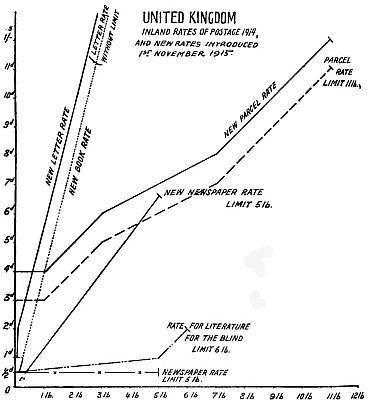
UNITED KINGDOM INLAND RATES OF POSTAGE 1914, AND NEW RATES INTRODUCED 1ST NOVEMBER 1915.
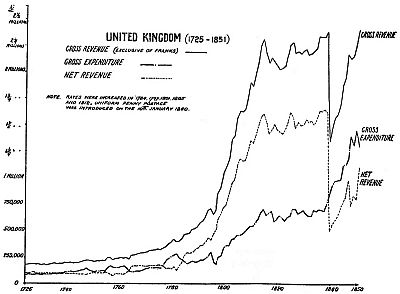
UNITED KINGDOM (1725-1851)
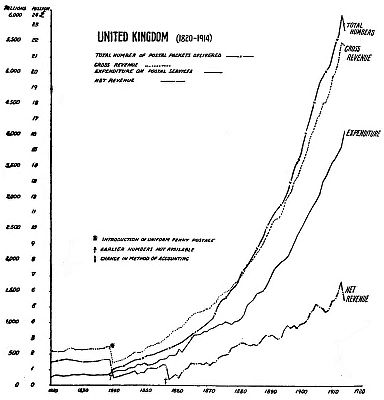
UNITED KINGDOM (1820-1914)
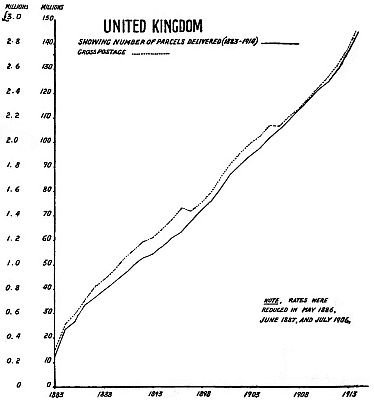
UNITED KINGDOM
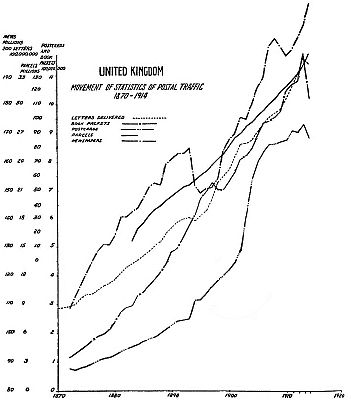
UNITED KINGDOM MOVEMENT OF STATISTICS OF POSTAL TRAFFIC 1870-1914
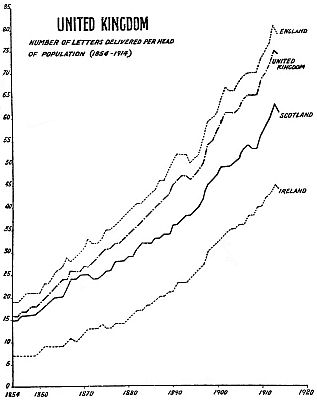
UNITED KINGDOM NUMBER OF LETTERS DELIVERED PER HEAD OF POPULATION (1854-1914)
APPENDIX B DOCUMENTS AND EXTRACTS ILLUSTRATING ASPECTS OF POSTAL HISTORY
(i) Ancient Posts.
Persia (circa b. c. 500).
"In Darius's idea of government was included rapidity of communication. Regarding it as of the utmost importance that the orders of the Court should be speedily transmitted to the provincial Governors, and that their reports and those of the royal secretaries should be received without needless delay, he established along the lines of route already existing between the chief cities of the Empire, a number of post-houses, placed at regular intervals, according to the estimated capacity of a horse to gallop at his best speed without stopping. At each post-house were maintained, at the cost of the State, a number of couriers and several relays of horses. When a despatch was to be forwarded, it was taken to the first post-house along the route, where a courier received it, and immediately mounting on horseback, galloped with it to the next station. Here it was delivered to a new courier, who, mounted on a fresh horse, took it the next stage on its journey; and thus it passed from hand to hand till it reached its destination. According to Xenophon, the messengers travelled by night as well as by day; and the conveyance was so rapid that some even compared it to the flight of birds. Excellent inns or caravanserais were to be found at every station; bridges or ferries were established upon all the streams; guard-houses occurred here and there, and the whole route was kept secure from the brigands who infested the Empire. Ordinary travellers were glad to pursue so convenient a line of march; it does not appear, however, that they could obtain the use of post-horses, even when the Government was in no need of them.
"Note.—It was not the distance a horse ridden gently could accomplish in the entire day, but the distance he could bear to be galloped once a day. From the account which Herodotus gives of the post-route between Sardis and Susa, we may gather that the Persians fixed this distance at about fourteen miles."—George Rawlinson, The Five Great Monarchies of the Ancient Eastern World, London, 1871, vol. iii. pp. 426-7.
Roman Empire.
"The advantage of receiving the earliest intelligence, and of conveying their orders with celerity, induced the Emperors to establish throughout their extensive dominions the regular institution of posts. Houses were everywhere erected at the distance only of five or six miles; each of them was constantly provided with forty horses, and, by the help of these relays, it was easy to travel an hundred miles in a day along the Roman roads. The use of the posts was allowed to those who claimed it by an Imperial mandate; but though originally intended for the public service, it was sometimes indulged to the business or conveniency of private citizens (Pliny, though a favourite and a minister, made an apology for granting post-horses to his wife on the most urgent business)."—Edward Gibbon, The History of the Decline and Fall of the Roman Empire, London, ed. 1896, vol. i. p. 50.
Arabia.
"The first traces of the Arabian postal arrangements date from about fifty years after the death of Mahomed. Calif Mdowija, who died in 679, is regarded as the founder of the Arabian posts. Kodama, a native of Bagdad, who died in 959, gives an account of the service in his work called The Book of Taxes. There were 930 postal stations on the six great highroads starting from Bagdad. At some stations there were relays of horses, but in Syria and Arabia the messengers rode on camels; and in Persia the letters were conveyed from station to station by messengers on foot. The postal service under the Califs was an independent branch of the administration, and in addition to the conveyance of despatches and travellers was added the supervision of all the authorities in outlying possessions. Of the two classes of superior postal officers, the nowaqquium was the postmaster who received the postal packets and letters and attended to their conveyance, whereas the farwaneqqyun was a kind of chief postmaster at the capital of a province, who controlled the work of the postmasters and made his own report on all the civil and military authorities to the central office in Bagdad. These reports were so valuable that Calif Abu Djafar Manssur is credited with the statement: 'My throne rests on four pillars, and my power on four men—a blameless kazi (judge), an energetic chief of police, an honest minister of finance, and a faithful postmaster who gives me reliable information on everything.' It has been said that the Roman cursus publicus, the frumentarii, the agentes in rebus, and the curiosi served a similar purpose, but the Arabian arrangement was more systematic. In the Post Office of the Califs the letters and packets posted, as well as those received from other places, were entered in special lists, where their number and address had to be stated. This practice was observed in India till a few years ago, and it will thus be seen that the letter bill of the modern posts was in use already among the Egyptians in 270 b.c., and also among the Arabs. From the information that has been preserved, it is inferred that the Arabian posts did, to a certain extent, transmit private letters, but this was not done officially, and the couriers and postmasters conveyed such correspondence, along with the official despatches, on their own account."—I. G. J. Hamilton, Outline of Postal History, Calcutta, 1910, p. 4.
Mexico.
"Communication was maintained with the remotest parts of the country by means of couriers. Post-houses were established on the great roads, about two leagues distant from each other. The courier, bearing his despatches in the form of a hieroglyphical painting, ran with them to the first station, where they were taken by another messenger and carried forward to the next; and so on till they reached the capital. These couriers, trained from childhood, travelled with incredible swiftness—not four or five leagues an hour, as an old chronicler would make us believe, but with such speed that despatches were carried from one to two hundred miles a day. Fresh fish was frequently served at Montezuma's table in twenty-four hours from the time it had been taken in the Gulf of Mexico, two hundred miles from the capital. In this way intelligence of the movements of the royal armies was rapidly brought to Court; and the dress of the courier, denoting by its colour the nature of his tidings, spread joy or consternation in the towns through which he passed."—W. H. Prescott, History of the Conquest of Mexico, London, 1903, pp. 20, 21.
A similar system existed in Peru (W. H. Prescott, History of the Conquest of Peru, Philadelphia, 1874, vol. i. p. 69).
China.
"From the city of Kanbulu[758] there are many roads leading to the different provinces, and upon each of these, that is to say, upon every great highroad, at the distance of twenty-five or thirty miles, accordingly as the towns happen to be situated, there are stations, with houses of accommodation for travellers, called yamb or post-houses. These are large and handsome buildings, having several well-furnished apartments hung with silk, and provided with everything suitable to persons of rank. Even kings may be lodged at these stations in a becoming manner, as every article required may be obtained from the towns and strong places in the vicinity; and for some of them the Court makes regular provision. At each station four hundred good horses are kept in constant readiness, in order that all messengers going and coming upon the business of the grand khan, and all ambassadors, may have relays, and, leaving their jaded horses, be supplied with fresh ones.... When it is necessary that messengers should proceed with extraordinary despatch, as in the cases of giving information of disturbance in any part of the country, the rebellion of a chief or other important matter, they ride two hundred, or sometimes two hundred and fifty miles in the course of a day."—Travels of Marco Polo the Venetian, London, 1904, pp. 190 et seq.
(ii) Nuncii and Cursores.
"The Royal Nuncii et Cursores constituted a very important branch of the Royal Establishment, and the payments to them form a very large and important item in the Household and Wardrobe Accounts from the earliest period when those accounts exist.
"These Messengers were employed both in England and in foreign parts, and as well on affairs of State as what may be considered as the private and confidential business of the Crown and Royal Family and the individuals attached to or composing the Royal Court. These Messengers, so attached to the Court, became the foundation of the establishment, which about the time of Henry VIII, or somewhat earlier, assumed the form of the regular establishment of the Post; and the information connected with them is important, as showing that the institution was intimately connected with the person of the sovereign, and that, in the first instance, it was his convenience that was sought. Those servants who, by usage, were more particularly employed on State affairs, probably became those who are now specially termed the 'Queen's Messengers.'"—Report from Secret Committee on the Post Office (Commons), 1844, Appx., p. 21.
(iii) Witherings' Scheme for the Reform of the Posts, 1635.
A Proposition for setling of Staffets or pacquet posts betwixt London and all parts of his Maiesties dominions, for the carrying and recarrying of his subiects lr̃es. The cleere proffitt whereof to goe towards the payment of the Postmrs of ye Roades of England, for wch his Matie is now chardged wth 3400l. p añm.
In the first place, a certen office or compting house to be by his Matie appointed wthin the cittie of London, of purpose for carrying out & receiving in of all Lr̃es to be conveyed from ye cittie of London into all pts wthin his Mats dominions & answers thereof retorned to the said Cittie of London, according as occasion shall serve.
Inprimis, for the Northerne and Scotland roade, All lr̃es to be put into one Portmantle that shalbe directed to Edenburgh in Scotland, and for all places of the sd roade, or neere the sd roade, to be accordinglie put into ye sd Portmantle, wth p̱ticuler baggs directed to such Postmrs as live upon the Road neere unto any Cittie or Towne Corporate.
As for Example—
One Bagge to be directed to Cambridge wth such lr̃es therein as shalbe directed to that place or neere thereunto; to take port for them as is now pd̃ to the Carriers, wch is Two pence a single lr̃e, and so accordinglie as they shalbe in bignes. At Cambridge a footpost to be provided, wth a knowne badge of his Mats Armes, whome upon the markett daies is to goe to all Townes wthin 6: 8: or 10 miles, there to receive & deliver all such lr̃es as shalbe directed to those places. The lr̃es that the sd footpost shall then and there receive, hee is to bring them to the sd Towne of Cambridge before the retorne of the Portmantle out of Scotland, wch is to retorne at a certen daie & houre, by wch meanes they maie be upon the verie instante comeing back of the sd Portmantle, as before, put into a little bagge, wch sd bagg is to be put into ye sd Portmantle as aforesaid. It is alwaies to be understood that upon the verie instant cominge of the Portmantle to Cambridge, the bagg of lr̃es for that place & thereaboutes ymmediatly to be tooke out of the sd Portmantle; the said Portmantle being presentlie to goe forwards, night and day, wthout stay, to Huntingdon, wth fresh horse & man. At wch place the like rule is to be observed as before at Cambridge, & so the sd Portmantle is to goe from Stage to Stage, night & day, till it shall come to Edenburgh. The bags of lr̃es to be left at all Stages as at Cambridge and Huntingdon, as before.
Only it is to be understood, that the further the lr̃es shall goe, the port thereof is to be advanced, as to 3d, 4d, & 6d, & to Scotland more. By this way of carrying and recarrying of lr̃es, his Mats subjects shall, once in 6 daies, receive answer from Edenburgh in Scotland, and so consequently from all pts betwixt London & Scotland.
The daie and howre of the comeing and going of the sd Portmantle to and from London to be alwaies certaine. By wch meanes all Stages upon the Road will knowe at what certen howre the Portmantle is to come to yt place.
It is truth it maie be alledged, that some Citties & Townes of noate will lye so farre from any of the mayne Roads of England, as Hull & other Townes of noate upon the Sea coasts, as that it wilbe impossible for a footman to carry and recarry the sd lr̃es wthin such time as shalbe limitted: for remedie thereof a horse is to be provided for the sd footpost, for the execuc̃on of the sd service wth more expedic̃on.
The like rule is to be observed to Westchester & so to Ireland.
The like rule is to be observed to Oxford, Bristoll, & so to Ireland.
The like rule is to be observed to Worcester, Shrewesbury, and so to ye Marches of Wales.
The like rule to be observed to Exceter, & so to Plymouth.
The like rule to be observed to Canterbury, & so to Dovor.
The like rule to be observed to Chelmesford, Colchester, and so to Harwch.
The like rule to be observed to Newmarket, Bury, Norwch, and so to Yarmouth.
In the first place, it wilbe a great furtherance to the correspondency betwixt London & Scotland, & London & Ireland, and great help to Trades, & true affecc̃on of his Mats subiects betwixt theis kingdomes, which, for want of true correspondency of lr̃es, is now destroyed, & a thing above all things observed by all other nations.
As for Example—
If anie of his Mats subiects shall write to Madrill, in Spain, hee shall receive answer sooner & surer then hee shall out of Scotland or Ireland. The lr̃es being now carried by carriers or footposts 16 or 18 miles a day, it is full two monthes before any answer can be received from Scotland or Ireland to London, wch by this Conveyance all lr̃es shall goe 120 miles at ye least in one day & night.
It will Secondlie be alledged, that it is a wrong to the Carriers that bring the said letters. To which is answered, a Carrier setts out from Westchester to London on the Mundaie, wch is 120 miles. The sd Carrier is 8 daies upon the Road, and upon his cominge to London delivers his letters of advise for his relodinge to Westchester againe, and his forced to staie in London two daies at extraordinary charges before he can get his loding redy.
By this Conveyance lr̃es wilbe frō Westchester to London in one day & night, so that the sd Carriers loading wilbe made ready a weeke before the sd Carriers shall come to London, and they no sooner come to London but maie be redy to depte againe.
The like will fall out in all other pts.
Besides, if at any time there should be occasion to write from anie of the coast Townes in England or Scotland to London, by this Conveyance lr̃es wilbe brought ymmediatly: & from all such places there wilbe weekely advise to & from London.
As for Example—
Anie fight at Sea: any distress of his Mats shipps, (wch Godd forbidd), anie wrong offered by any other nation to any of ye Coaste of England, or anie of his Mats forts: the Posts being punctually paid, the newes will come sooner then thought.
It wilbe, thirdlie, alledged that this service maie be p̑tended by the Lo: Stanhope to be in his graunt of Post Mr of England. To wch is answered, neither the Lo: Stanhope, nor anie other that ever enjoyed the Postms place of England, had any benefitt of the carrying and recarrying of the subiects Lr̃es: beside, the profitt is to paie ye Posts of the Road, wch next unto his Matie, belong to ye office of the sd Lo: Stanhope, and upon determinac̃on of any of the sd Posts places, by death or otherwise, the Lo: Stanhope will make as much of them as hath heretofore bin made by this said advancement of all theire places.
The Lord Stanhope now enioying what either hee or any of his Predecessos hath ever heretofore done to this day.
(Indorsed by Sec. Coke) "Proposition for Missive Letters."
—Report from Secret Committee on the Post Office (Commons), 1844, Appx., pp. 55-6.
(iv) The Monopoly and the General Farm of the Posts.
No. 1.
"Whereas heretofore sundry wayes have bene devised to redresse the disorders among the postes of our realme in generall, and particularly to prevent the inconveniences, both to our owne service and the lawfull trade of the honest merchants, by prohibiting that no persons whatsoever should take upon them, publiquely or privately, to procure, gather up, receive ... any packets or letters to or from the countreys beyond the seas, except such our ordinarie posts and messengers for those parties, etc."—royal Proclamation, April 26th 1591.
No. 2.
"There has long been a constant trade betwixt London and Norwich in sundry sorts of stuffs and stockings made in Norwich and Norfolk, which trade has always been maintained by the merchants of Norwich employing their stocks in buying wares of the makers and sending them up weekly in carts by common carriers to London, whence they are dispersed into all parts of this kingdom, and also exported to foreign parts, in which intercourse of trade we always had our letters safely and speedily carried by our common carrier, by a horseman, not in manner of postage by change of horses, but as is usual by common carriers, and for little or no charge to us. Of late Mr. Witherings has intercepted our letters and molested our carriers, forbidding them to carry any of our letters otherwise than to go along with their carts, and no faster."—Petition to Privy Council, 1638; J. W. Hyde, The Post in Grant and Farm, London, 1894, p. 131.
No. 3.
" ... By a Proclamation dated about July 1635 his Majestie did expresse his pleasure, that Thomas Witherings should have the carriage of the said letters who would settle it in a better and more speedy course; thereupon he undertook the said work, and for a long time, after his said undertaking, it cost him some weeks 20l. 30l. 40l. more than he received, to the great weakening and hazard of the ruine of his estate. It is verie true, that untill he had his patent of his Office granted unto him for his life, which was in the yeare 1637, he did in some places lay horses of his owne, in others he did make use of the ordinarie Post-horses, and because he desired quick dispatch, hee paid them for a guide and a horse to carrie the male 6d. per mile, after not conceiving a guide necessarie he made only use of one horse, and paid 3d. per mile.... for the other Posts, they have 3d. per mile which is more than ordinarie pay. But the objection which seems to carrie the greatest shew, or colour of probabilitie with it is; That the Pmrs had formerly 4,000l. per annum fee, onely for carrying his Majesties packets, that Witherings hath reduced this to 2,053l. per annum, and yet puts a greater burthen upon them by carrying his male; hath displaced many of them and received 4,000l. for Post places."—Full and cleare answer to a false and scandalous Paper entituled: The humble Remonstrance of the grievances of all his Majesties Posts of England, together with Carriers, Waggoners, etc., 1641, pp. 2, 3.
No. 4.
Reasons presented to the Committee for Postmasters why the office should not be farmed:—
(1) What is of public interest, if farmed, often becomes a great public grievance.
(2) The postmasters who have served faithfully and others who run best to Lynn, Yarmouth, etc., must be restrained and will complain as they did in 1642 to the late Parliament which ordered them redress.
(3) By farming, the pay of postmasters will be made so inconsiderable that they will grow careless.
(4) The expectations of the people now at this juncture so highly raised to hopes of ease and freedom, will be disappointed when they see new monopolies.
Suggestions for reducing the office into one channel, for easing the people, encouraging the postmasters and raising money for the public:—
1. To declare it unsafe for private persons to erect post stages without licence.
2. To chose faithful persons in all the roads and appoint a supervisor on each road.
3. To declare that you have appointed them postmasters and give power to their controller only to sign labels for speedy conveyance of mails and give them writs of assistance.
Signed by Robert Girdler and seven others.—Calendar of State Papers (Domestic Series), 26th November, 1652.
No. 5.
Offers of the well-affected postmasters to the Posts' Committee....
The order of the Council in the case of the Inland Post Office being that it be improved to the greatest advantage either by farm or account, they conceive the advantages consist not so much in the advance of money, as the service and safety of the State, and beg to offer,
1. That persons of known integrity may be employed in all parts, and a sufficient salary allowed, as becomes a trust of that great concernment.
2. That a fit person be appointed for the control thereof, according to orders from the State, etc.
3. As righteousness exalteth a nation, it is hoped that after the expense of so much blood and treasure, the very things adjudged and condemned in others (viz. monopolies) will not now be practised, but that next to public safety, you will be tender of the people's just liberty; for both by the laws of God and man it is lawful for every man to employ himself in a lawful calling, especially in that to which he has been bred, and it is also lawful for divers men to employ themselves in one calling, otherwise there must be as many callings as men.
4. For avoiding of many inconveniencies that will follow in the farming of it, viz.
The persons depositing or obliging themselves for so much money a year, will not lay out themselves and their estates without expectation of profit, which must arise either out of the people's letters or postmasters' labour, besides the hazard to the Commonwealth; for notwithstanding the faithfulness of the postmasters yet if they will not do their work at their rates (which may prove an oppression too heavy, like that in Egypt) others shall.—Calendar of State Papers (Domestic Series), May 1653.
No. 6.
"Petition of John Mann, Mayor, and 22 aldermen & inhabitants of Norwich:—
"Having much commerce with London we have always employed a faithful and careful messenger to carry letters, bills of exchange, etc., but he has lately been molested by John Manley whose agents have not only rifled and detained our letters and goods, but charged more than double price for small parcels of ware, which is a greater burden to many of us than the monthly assessment....
"Having bought our liberties at vast expense of blood and treasure, we hope not again to be troubled with distasteful monopolies but to have liberty to convey our letters freely."—Calendar of State Papers (Domestic Series), 1653-4, p. 25.
No. 7.
"Also it hinders a man to be as civil as otherwise he would, or might be, in having, or returning an accompt to, or from his friend, many a man in these times being forced to set a greater value of 6d. or 3d. then of three times as much in former times, when money was more plentiful; and certainly any man but a Farmer wil confess it to be a strange imposition, that a man cannot have an accompt of the condition of his Wife or Family, without paying thrice as much as he need; & it seems as unreasonable for a man to be forced to pay 3d. for what may be done for a penny, (in relation to Letters) as for a man to be compelled to pay thrice as much for meat or any other commodity, as the price currant."—J. Hill, A Penny Post, London, 1659, p. 7.
No. 8. 1657, Cap. 30.
Postage of England, Scotland, and Ireland settled.
"Whereas it hath been found by experience, That the Erection and Settling of one General Post Office, for the speedy Conveying, Carrying, and Re-carrying of Letters by Post, to and from all Places within England, Scotland and Ireland, and into several parts beyond the Seas, hath been, and is the best means, not only to maintain a certain and constant Intercourse of Trade and Commerce betwixt all the said Places, to the great benefit of the People of these Nations, but also to convey the Publique Despatches, and to discover and prevent many dangerous, and wicked Designs, which have been and are daily contrived against the Peace and Welfare of this Commonwealth, the Intellegence whereof cannot well be Communicated, but by Letter of Escript,
"Be it Enacted by His Highness the Lord Protector and the Parliament, And it is Enacted and Ordained by Authority thereof, That from henceforth there be one General Office, to be called and known by the name of the Post Office of England, and one Officer from time to time to be nominated, etc."—H. Scobell, A Collection of Acts and Ordinances, London, 1658, p. 511.
(v) Extract from "The Present State of London,"
By Tho. de Laune, Gent., London, 1681. Of the Post-office.
This Office is now kept in Lumbard-street, formerly in Bishopsgate-street, the Profits of it are by Act of Parliament settled on his Royal Highness the Duke of York. But the King by Letters Patents, under the Great Seal of England, constitutes the Post-Master-General.
From this General Office, Letters and Packets are dispatched:
On Mondays— To France, Spain, Italy, Germany, Flanders, Sweedland, Denmark, Kent, and the Downs. On Tuesdays— To Holland, Germany, Sweedland, Denmark, Ireland, Scotland, and all parts of England and Wales. On Wednesdays— To all parts of Kent, and the Downs. On Thursdays— To France, Spain, Italy, and all parts of England and Scotland. On Fridays— To Flanders, Germany, Italy, Sweedland, Denmark, Holland, Kent, and the Downs. On Saturdays— All parts of England, Wales, Scotland, and Ireland. Letters are returned from all parts of England and Scotland, certainly every Monday, Wednesday, and Friday; from Wales every Monday and Friday; and from Kent and the Downs every day: But from other parts more uncertainly, in regard of the Sea.
A Letter containing a whole sheet of Paper is convey'd 80 Miles for 2d. two sheets for 4d. and an Ounce of Letters for 8d. and so proportionably; a Letter containing a sheet is conveyed above 80 miles for 3d. two sheets for 6d. and every Ounce of Letters for 12d. A sheet is conveyed to Dublin for 6d. two for a shilling, and an Ounce of Letters for 12d.
This Conveyance by Post is done in so short a time, by night as well as by day, that every 24 hours, the Post goes 120 Miles, and in five days, an answer of a Letter may be had from a Place 300 Miles distant from the Writer.
Moreover, if any Gentlemen desire to ride Post, to any Principal Town of England, Post Horses are always in readiness, (taking no Horse without the consent of his owner) which in other Kings Reigns was not duly observed; and only 3d. is demanded for every English Mile, and for every Stage to the Post-Boy, 4d. For conducting.
Besides this Excellent convenience of conveying Letters, and Men on Horse-back, there is of late such an admirable commodiousness, both for Men and Women of better rank, to travel from London, and to almost all the Villages near this great City, that the like hath not been known in the World, and that is by Stage-Coaches, wherein one may be transported to any place, sheltred from foul Weather, and foul ways, free from endamaging ones Health or Body by hard jogging, or over violent motion; and this not only at a low price, as about a shilling for every five Miles, but with such velocity and speed, as that the Posts in some Foreign Countries, make not more Miles in a day; for the Stage-Coaches, called Flying-Coaches, make forty or fifty Miles in a day, as from London to Oxford or Cambridge, and that in the space of twelve hours, not counting the time for Dining, setting forth not too early, nor coming in too late.
The several Rates that now are and have been taken for the Carriage of Letters, Pacquets, and Parcels, to or from any of His Majesties Dominions, to or from any other parts or places beyond the Seas, are as followeth, that is to say,
s.d.
Morlaix, St. Maloes, Caen, Newhaven, and places of like distance, Carriage paid to Rouen{Single06
Double10
Treble16
Ounce16
Hamburgh, Colen, Frankfort, Carriage paid to Antwerp, is{Single08
Double14
Treble20
Ounce20
Venice, Geneva, Legorn, Rome, Naples, Messina, and all other parts of Italy by way of Venice, Franct pro Mantua{Single09
Double16
Treble23
Ounce28
Marseilles, Smirna, Constantinople, Aleppo, and all parts of Turky, Carriage paid to Marseilles{Single10
Double20
¾ Ounce29
Ounce28
And for Letters brought from the same places to England{Single08
Double14
Treble20
Ounce20
The Carriage of Letters brought into England, from Calice, Diep, Bulloign, Abbeville, Amiens, St. Omers, Montrel{Single04
Double08
Treble10
Ounce10
Rouen{Single06
Double10
Treble16
Ounce16
Genoua, Legorn, Rome, and other parts of Italy by way of Lyons, Franct pro Lyons{Single10
Double20
¾ Ounce29
Ounce39
The Carriage of Letters Outwards—
To Bourdeaux, Rochel, Nants, Orleans, Bayon, Tours, and places of like distance, Carriage paid to Paris{Single09
Double16
Treble23
Ounce20
Letters brought from the same places into England{Single10
Double20
¾ Ounce30
Ounce40
The Carriage of Letters Outwards—
To Norembourgh, Bremen, Dantzick, Lubeck, Lipswick, and other places of like distance, Carriage paid to Hamburgh{Single10
Double20
¾ Ounce30
Ounce40
Paris{Single09
Double16
Treble23
Ounce20
Dunkirk, Ostend, Lisle, Ipers, Cambray, Ghent, Bruxels, Bruges, Antwerp, and all other parts of Flanders. Sluce, Flushing, Middleburgh, Amsterdam, Rotterdam, Delph, Hague, and all other parts of Holland and Zealand.{Single08
Double14
Treble20
Ounce20
All Merchants Accounts, not exceeding a Sheet, Bills of Exchange, Invoices, Bills of Lading, shall be allowed without rate in the price of the Letters, and also the Covers of the Letters not exceeding a Sheet, to Marseilles, Venice, or Legorn, towards Turkie.
The said Office is managed by a Deputy, and other Officers to the Number of seventy seven persons; who give their actual attendance respectively, in the dispatch of the business.
Upon this Grand Office, depends one hundred eighty two Deputy-Post-Masters in England and Scotland; most of which keep Regular Offices in their Stages, and Sub-Post-Masters in their Branches; and also in Ireland, another General Office for that Kingdom, which is kept in Dublin, consisting of Eighteen like Officers, and Forty-five Deputy-Post-Masters.
The Present Post-Master-General, keeps constantly, for the transport of the said Letters and Pacquets;
Between England and{France, two Pacquet-Boats.
Flanders, two Pacquet-Boats.
Holland, three Pacquet-Boats.
Ireland, three Pacquet-Boats.
And at Deal, two Pacquet-Boats for the Downs.
All which Officers, Post-Masters, Pacquet-Boats, are maintained at his own proper Charge.
And as the Master-piece of all those good regulations, established by the present Post-Master-General, for the better Government of the said Office, he hath annexed and appropriated the Market-Towns of England, so well to their Respective Post-Stages, that there is no considerable Market-Town, but hath an easie and certain Conveyance for the Letters thereof, to and from the said Grand Office, in the due course of the Males every Post.
Though the Number of Letters Missive in England, were not at all Considerable in our Ancestors days, yet it is now so prodigiously great, (since the meanest People have Generally learned to write) that this Office is Farmed for above 40, rather 50,000l. a Year.
(vi) The Cross Posts.[759]
No. 1 (a).
To the Rt. Honble. Sidney Ld. Godolphin Lord High Trearer of England. May it please yr. Lopp.
My Lord Grandville and seaverall Gentlemen of Cornwell having represented to Us that by reason of the Post Road passing along the South Coast of Cornwell seaverel Inland Towns are under great disadvantages in their Correspondence paying two pence pr Letter over & above the Common Postage being serv'd only by a By Post; We did give directions to Our Deputys of Exeter, Plymo, and Lanceston to meet and Consult what Method might be proper to serve those parts more conveniently, and at as Easie an Expence to Her Matie. as might be, and to Report to Us their Opinion of that Matter with an Estimate of the Charge; which they accordingly did, and have proposed a Scheme of that Matter how 'tis to be performed with the Charge of each Stage, which amounts according to their Computation to about £260 pr Ann a Sum more considerable than We at first apprehended; but We doubt the Charge Her Matie. will be put to will Scarce be recompenced by the increase of Letters upon Settling such a Stage, especially when We consider the great Number of Letters for that Country which pass Frank: If Yr Lopp. shall think fitting a Post be Settled for the Midland Towns, as well as for the South Coast, We shall upon yr Directions endeavour to do it with the best Husbandry We can, and as We hope to the Satisfaction of the Country, and shall lay before Yr. Lopp. an Establishmt. to be approved by Yr. Lopp.
We have indeed found by Experience in other Places, That where We have made the Correspondence more Easie and Cheap, the Number of Letters has been thereby much increased; and therefore do believe such a Settlement may be attended with the like effect in those Parts. All which is humbly Submitted to yr. Lopp.
R.C. T.F. Genl. Post Office, 22d. Novembr. 1703.
No. 1 (b).
After my hearty Comendations, Whereas my very good Lord John Lord Grandville and seaveral Gentlemen of Cornwall have Represented to you, That by reason of the Post Road passing along the South Coast of Cornwall, Seaveral Inland Towns are under great disadvantages in their Correspondence; Whereupon you have proposed to Me the Settlement of a New Post for the Midland Towns, as well as for the South Coast, the better to Serve those parts, the Charge whereof will Amount to Two hundred and Sixty pounds p. Ann I approve of what you have proposed, And do hereby Authorize and Require you to Settle and Establish such a Post accordingly. But you are at twelve months End to Represent to Me or the Lord High Treasurer or Commissrs. of the Treasury then being, how far such a Post doth answer the Expence Her Matie. is at in Settling the Same. And for so doing this shall be yr. Warrant. Whitehall Treary Chambers the 7th December 1703.
Godolphin. To my very loving Friends Sr. Robt. Cotton Knt. and Sr. Thoms. Frankland Bart. Her Maties. Post-Mr. Genl.
No. 2.
Sr. Robert Cotton Knt. and Sir Thomas Frankland Baronet Her Mties. Post Master Genl. in the Kingdoms of England Scotland and Ireland and in all Her Maties other Dominions Territorys and Isles thereunto belonging in Europe Affrica and America.
To all People to whom this shall come Greeting know ye, that whereas the County of Lincoln has not hitherto been Served so well with the Correspondence by Letters as other parts of the Nation, several Towns therein not having had the Convenience of a Post at all, and others having been obleig'd to pay an extraordinary Tax above the Common Postage, We have thought it proper to appoint Mr. Richard Bigg of Winslow in the County of Buckingham Gentleman, and Mr. Richard Dixon of Bourn in the County of Lincoln Gentleman (having receiv'd good Testimony of the fidelity and Loyalty of both and each of them to Her Matie. and reposing great trust & confidence in the knowledge Care and Ability of them both) to be our lawfull and Sufficient Deputys with full Power and Authority to Erect Settle and Establish Posts in such Towns of the said County for the Carrying and Conveying the Letters as well those called the London Letters as the By Letters of the said County, as shall be judged most proper for Her Maties. Service, and the improvemt. of the Correspondence of the said County and to Agree and Contract with such Persons as the said Richard Bigg and Richard Dixon or either of them shall think fitt to Agree and Contract with for performing the Riding part through such Stages as shall be Erected by them or for keeping Letter Offices in any Towns of the said County, And do by these presents Depute Constitute Authorise and Appoint the said Richd. Bigg and Richard Dixon to be our Lawfull and Sufficient Deputys in manner and form aforesaid from the tenth day of August next ensuing the date hereof during such time as We or the Postmaster Genl, for the time being shall think fit under such Conditions payments and Instructions to be faithfully observ'd perform'd and done by the said Richd. Bigg and Richard Dixon their Deputys and Servants as they shall from time to time receive from the Genl. Post Office in London in writing Subscribed by Us our Deputy or Deputys in the Post Office, in Witness whereof We the said Sr. Robert Cotton and Sir Thomas Frankland have hereunto sett our hands & Caused the Seal of the said Office in such Cases used to be affixed this fourth day of August 1705.
R.C. T.F.
No. 3.
To ye Rt. Honble ye Lords Comrs. of his Majestys Treary. May it please your L.sps—
A Proposall having some time since been made to your Lordsps That a Cross Post might be settled between Bristol & Shrewsbury, you were pleased to refer ye same to Us to Consider of it & Report Our opinions thereupon wch Wee did accordingly and acquainted yor Lordsps Wee did hope Wee should find some persons who would at their Owne Cost and Charges undertake to Settle a Cross Post, upon such terms as his Majesty would not be a loser and the people receive the benefit they proposed.
The Establishing such a Cross Roade would undoubtedly be of great Use to Trade & Convenience to ye People and appeares to be very much desired by the several Countrys thro' wch it wou'd pass; but as at present it might become loss to ye Revenue Wee think it Our Duety to lay ye whole state of the Case before Yor Lorsps to receive yor further Directions and have hereunto annexed a scheme both of the Charge & loss that may accrew to the Office thereby.
Wee must observe to yor Lordsps That Londo. (from ye establishing of a post Office) having been esteemed the Center all letters passing thro' one Road to an other thro' Londo. have been constantly taxed with a double post first to Londo. yn to ye places where to they were directed, but the settling of this Cross Post wch will Cause a direct Intercourse between ye West Bristol & Chester Roades, all lres, passing that way can only be Charged wth a single Post according to ye distance of one place from an other; but yn it ought to be considered on the other hand That the passing thro' Londo. is both tedious and Chargeable, and a more Speedy Conveyance would in all probability produce of an encrease of ye no. of letters besides the bringing such into ye Office as are now Conveyed by Carryers; for where ever there are any Townes wch have Comerce one wth an other so as to occasion a Const. Intercourse by Carryer or Tradesmen Wee do find it a General Practice to Convey at ye same time a Considerable No. of lres as pticularly between Bristol & Worcester & Worcester & Shrewsbury; where there are two persons that make it their business to Colect & disperse letters and make a Considerable advantage by it. That if ye settling this Roade should have yt good effect to suppress all these By Posts (as in all probability it will) notwithstanding at present there will be some Loss the Revenue in time may be Improved by it; and Wee do find that the Cross Road set up 3 yeares & ½ since Between Exon [760] & Bristol doth now produce about 255l. p. annum neat proffit, but in regard this is altogether new Wee can not possibly be so much Masters of it as to know wt. terms to propose to any undertakers that may be equall between the King and them and therefore if yor Lordsps do agree to the Proposal Wee are of opinion it may be most proper to be set up and managed for his Majesty and Carryed on as far as Chester....
(vii) The Early Posts in North America.[761]
No. 1 (a).
To the Right Honble the Lords Comrs. of his Majesty's Treas'y. Thomas Neale Esqre. humbly sheweth
That their sacred Majesty's by their letters pattents bearing date the 17th day of February 1692 granted to the said Thomas Neale a power of settling Post Offices in North America to be executed by a person to be nominated by the said Thomas Neale and Deputed by the Postmaster Generall of England and thereby directed that accounts shall be kept of the Charge and produce of the said Post Offices, and transmitted to the Right Honble the Lord Treasurer or Lds. Comissioners of the Treasury for the time being.
That in pursuance of this Grant Andrew Hamilton Esqre. was nominated and Deputed to erect Post Offices, who hath at Thomas Neales great Charge settled 'em 700 miles in Length, upon the Continent of America and kept true accounts of the Expences and proffits thereof, which accts. sworne to by the said Deputy Postmaster before the Governor of New Yorke are now humbly laid before your Lordshipps and an abstract of it for yor. Lordspps. ease.
That the said Deputy Postmaster is come over to give your Lordshipps Information of all matters relating to that subject which your Lordshipps shall think fit to enquire of, and hath proposed the Method contained in the Memoriall annexed as of absolute necessity in his opinion to support the Post, which proves a great service to the Crowne as well as advantage to his Majesty's subjects residing in those Colliny's and Trading thither.