Volume 1 — CHAPTER IV THE PROBLEM OF WORLD-HISTORY (continued 2)
Charles Francis Atkinson translation
153At this point a distinction presents itself between the immediate impression of the present and the image of the past that is only presented in the spirit, in other words between the world as happening and the world as history. The eye of the man of action (statesman and general) appreciates the first, that of the man of contemplation (historian and poet) the second. Into the first one plunges practically to do or to suffer; chronology,[172] that great symbol of irrevocable past, claims the second. We look backwards, and we live forward towards the unforeseen, but even in childhood our technical experience soon introduces into the image of the singular occurrence elements of the foreseeable, that is, an image of regulated Nature which is subject not to physiognomic fact but to calculation. We apprehend a “head of game” as a living entity and immediately afterwards as food; we see a flash of lightning as a peril and then as an electrical discharge. And this second, later, petrifying projection of the world more and more tends to overpower the first in the Megalopolis; the image of the past is mechanized and materialized and from it is deduced a set of causal rules for present and future. We come to believe in historical laws and in a rational understanding of them.
Nevertheless science is always natural science. Causal knowledge and technical experience refer only to the become, the extended, the comprehended. As life is to history, so is knowledge (Wissen) to Nature, viz., to the sensible world apprehended as an element, treated as in space and subjected to the law of cause and effect. Is there, then, a science of History at all? To answer this question, let us remember that in every personal world-picture, which only approximates more or less to the ideal picture, there is both something of Nature and something of History. No Nature is without living, and no History without causal, harmonies. For within the sphere of Nature, although two like experiments, conformably to law, have the like result, yet each of these experiments is a historical event possessing a date and not recurring. And within that of History, the dates or data of the past (chronologies, statistics, names, forms[173]) form a rigid web. “Facts are facts” even if we are unaware of them, and all else is image, Theoria, both in the one domain and in the other. But history is itself the condition of being “in the focus” and the material is only an aid to this condition, whereas in Nature the real aim is the winning of the material, and theory is only the servant of this purpose.
There is, therefore, not a science of history but an ancillary science for history, 154which ascertains that which has been. For the historical outlook itself the data are always symbols. Scientific research, on the contrary, is science and only science. In virtue of its technical origin and purpose it sets out to find data and laws of the causal sort and nothing else, and from the moment that it turns its glance upon something else it becomes Metaphysics, something trans-scientific. And just because this is so, historical and natural-science data are different. The latter consistently repeat themselves, the former never. The latter are truths, the former facts. However closely related incidentals and causals may appear to be in the everyday picture, fundamentally they belong to different worlds. As it is beyond question that the shallowness of a man’s history-picture (the man himself, therefore) is in proportion to the dominance in it of frank incidentals, so it is beyond question that the emptiness of written history is in proportion to the degree in which it makes the establishment of purely factual relations its object. The more deeply a man lives History, the more rarely will he receive “causal” impressions and the more surely will he be sensible of their utter insignificance. If the reader examines Goethe’s writings in natural science, he will be astounded to find how “living nature” can be set forth without formulas, without laws, almost without a trace of the causal. For him, Time is not a distance but a feeling. But the experience of last and deepest things is practically denied to the ordinary savant who dissects and arranges purely critically and allows himself neither to contemplate nor to feel. In the case of History, on the contrary, this power of experience is the requisite. And thus is justified the paradox that the less a historical researcher has to do with real science, the better it is for his history.
To elucidate once more by a diagram:
Soul ⎯⎯⎯⎯⎯⎯⎯⎯⎯⎯⎯⎯⎯⎯⎯⎯⎯⎯⎯⎯⎯⎯⎯⎯⎯⎯⎯⎯⎯⎯⎯⎯➛ World

Life, Direction Extension
Destiny-Experience Causal Knowledge
The uniquely The
occurring and irrevocable constantly-possible
“Fact” “Truth”
Physiognomic tact (instinct) Systematic criticism (reason)
↓ ↓
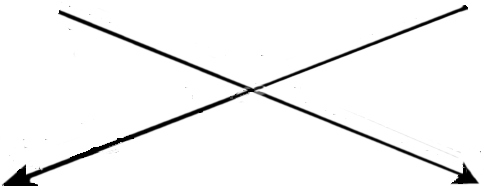
Consciousness Consciousness
as servant of Being as master of Being
The world-image of “History” The world-image of "Nature"
Life-experience Scientific methods
Image of the Past Religion. Natural Science
Constructive Contemplation Theoretical: Myth and Dogma. Hypothesis
(Historian, Tragic Dramatist) Practical: Cult. Technique
to investigate Destiny
Direction into the Future
Constructive Action
(Statesman)
to be Destiny
155
XI
Is it permissible to fix upon one, any one, group of social, religious, physiological or ethical facts as the “cause” of another? “Certainly,” the rationalistic school of history, and still more the up-to-date sociology, would reply. That, they would say, is what is meant by our comprehending history and deepening our knowledge of it. But in reality, with “civilized” man there is always the implicit postulate of an underlying rational purpose—without which indeed his world would be meaningless. And there is something rather comic in the most unscientific freedom that he allows himself in his choice of his fundamental causes. One man selects this, another that, group as prima causa—an inexhaustible source of polemics—and all fill their works with pretended elucidations of the “course of history” on natural-science lines. Schiller has given us the classical expression of this method in one of his immortal banalities, the verse in which the “Weltgetriebe” is stat “durch Hunger und durch Liebe”; and the Nineteenth Century, progressing from Rationalism to Materialism, has made this opinion canonical. The cult of the useful was set up on high. To it Darwin, in the name of his century, sacrificed Goethe’s Nature-theory. The organic logic of the facts of life was supplanted by a mechanics in physiological garb. Heredity, adaptation, natural selection, are utility-causes of purely mechanical connotation. The historical dispensations were superseded by a naturalistic movement “in space.” (But are there historical or spiritual “processes,” or life-“processes” of any sort whatever? Have historical “movements” such as, for example, the Renaissance or the Age of Enlightenment anything whatever to do with the scientific notion of movement?) The word “process” eliminated Destiny and unveiled the secret of becoming, and lo! there was no longer a tragic but only an exact mathematical structure of world-happening. And thereupon the “exact” historian enunciated the proposition that in the history-picture we had before us a sequence of “states” of mechanical type which were amenable to rational analysis like a physical experiment or a chemical reaction, and that therefore causes, means, methods and objects were capable of being grouped together as a comprehensible system on the visible surface. It all becomes astonishingly simple. And one is bound to admit that given a sufficiently shallow observer, the hypothesis (so far as concerns his personality and its world-picture) comes off.
Hunger and Love[174] thus become mechanical causes of mechanical processes in the “life of peoples.” Social problems and sexual problems (both belonging to a “physics” or “chemistry” of public—all-too-public—existence) become the obvious themes of utilitarian history and therefore of the corresponding tragedy. For the social drama necessarily accompanies the materialist treatment of history, and that which in Goethe’s “Wahlverwandtschaften” was destiny 156in the highest sense has become in Ibsen’s “Lady from the Sea” nothing but a sexual problem. Ibsen and all the reason-poets of our great cities build—build from their very first causes to their very last effect—but they do not sing. As artist, Hebbel fought hard to overcome this merely prosaic element in his more critical than intuitive temperament, to be a poet quand même, hence his desperate and wholly un-Goethean effort to motive his events. In Hebbel, as in Ibsen, motiving means trying to shape tragedy causally, and he dissected and re-dissected and transformed and retransformed his Anecdote until he had made it into a system that proved a case. Consider his treatment of the Judith story—Shakespeare would have taken it as it was, and scented a world-secret in the physiognomic charm of the pure adventure. But Goethe’s warning: “Do not, I beg you, look for anything behind phenomena. They are themselves their own lesson (sie selbst sind die Lehre)” had become incomprehensible to the century of Marx and Darwin. The idea of trying to read a destiny in the physiognomy of the past and that of trying to represent unadulterated Destiny as a tragedy were equally remote from them. In both domains, the cult of the useful had set before itself an entirely different aim. Shapes were called into being, not to be, but to prove something. “Questions” of the day were “treated,” social problems suitably “solved,” and the stage, like the history-book, became a means to that end. Darwinism, however unconscious of what it was doing, has made biology politically effective. Somehow or other, democratic stirrings happened in the protoplasm, and the struggle for existence of the rain-worms is a useful lesson for the bipeds who have scraped through.
With all this, the historians have failed to learn the lesson that our ripest and strictest science, Physics, would have taught them, the lesson of prudence. Even if we concede them their causal method, the superficiality with which they apply it is an outrage. There is neither the intellectual discipline nor the keen sight, let alone the scepticism that is inherent in our handling of physical hypotheses.[175] For the attitude of the physicist to his atoms, electrons, currents, and fields of force, to æther and mass, is very far removed from the naïve faith of the layman and the Monist in these things. They are images which he subjects to the abstract relationships of his differential equations, in which he clothes trans-phenomenal numbers, and if he allows himself a certain freedom to choose amongst several theories, it is because he does not try to find in them any actuality but that of the “conventional sign.”[176] He knows, too, that over 157and above an experimental acquaintance with the technical structure of the world-around, all that it is possible to achieve by this process (which is the only one open to natural science) is a symbolic interpretation of it, no more—certainly not “Knowledge” in the sanguine popular sense. For, the image of Nature being a creation and copy of the Intellect, its “alter ego” in the domain of the extended, to know Nature means to know oneself.
If Physics is the maturest of our sciences, Biology, whose business is to explore the picture of organic life, is in point both of content and of methods the weakest. What historical investigation really is, namely pure Physiognomic, cannot be better illustrated than by the course of Goethe’s nature-studies. He works upon mineralogy, and at once his views fit themselves together into a conspectus of an earth-history in which his beloved granite signifies nearly the same as that which I call the proto-human signifies in man’s history. He investigates well-known plants, and the prime phenomenon of metamorphosis, the original form of the history of all plant existence, reveals itself; proceeding further, he reaches those extraordinarily deep ideas of vertical and spiral tendencies in vegetation which have not been fully grasped even yet. His studies of ossature, based entirely on the contemplation of life, lead him to the discovery of the “os intermaxillare” in man and to the view that the skull-structure of the vertebrates developed out of six vertebræ. Never is there a word of causality. He feels the necessity of Destiny just as he himself expressed it in his Orphische Urworte:
“So must thou be. Thou canst not Self escape.
So erst the Sibyls, so the Prophets told.
Nor Time nor any Power can mar the shape
Impressed, that living must itself unfold.”
The mere chemistry of the stars, the mathematical side of physical observations, and physiology proper interested him, the great historian of Nature very little, because they belonged to Systematic and were concerned with experiential learning of the become, the dead, and the rigid. This is what underlies his anti-Newton polemic—a case in which, it must be added, both sides were in the right, for the one had “knowledge” of the regulated nature-process in the dead colour[177] while the experiencing of the other, the artist, was intuitive-sensuous “feeling.” Here we have the two worlds in plain opposition; and now therefore the essentials of their opposition must be stated with all strictness.
158History carries the mark of the singular-factual, Nature that of the continuously possible. So long as I scrutinize the image of the world-around in order to see by what laws it must actualize itself, irrespective of whether it does happen or merely might happen—irrespective, that is, of time—then I am working in a genuine science. For the necessity of a nature-law (and there are no other laws) it is utterly immaterial whether it becomes phenomenal infinitely often or never. That is, it is independent of Destiny. There are thousands of chemical combinations that never are and never will be produced, but they are demonstrably possible and therefore they exist—for the fixed System of Nature though not for the Physiognomy of the whirling universe. A system consists of truths, a history rests on facts. Facts follow one another, truths follow from one another, and this is the difference between “when” and “how.” That there has been a flash of lightning is a fact and can be indicated, without a word, by the pointing of a finger. “When there is lightning there is thunder,” on the contrary, is something that must be communicated by a proposition or sentence. Experience-lived may be quite wordless, while systematic knowing can only be through words. “Only that which has no history is capable of being defined,” says Nietzsche somewhere. But History is present becoming that tends into the future and looks back on the past. Nature stands beyond all time, its mark is extension, and it is without directional quality. Hence, for the one, the necessity of the mathematical, and for the other the necessity of the tragic.
In the actuality of waking existence both worlds, that of scrutiny and that of acceptance (Hingebung), are interwoven, just as in a Brabant tapestry warp and woof together effect the picture. Every law must, to be available to the understanding at all, once have been discovered through some destiny-disposition in the history of an intellect—that is, it must have once been in experiential life; and every destiny appears in some sensible garb—as persons, acts, scenes 159and gestures—in which Nature-laws are operative. Primitive life is submissive before the daemonic unity of the fateful; in the consciousness of the mature Culture this “early” world-image is incessantly in conflict with the other, “late,” world-image; and in the civilized man the tragic world-feeling succumbs to the mechanizing intellect. History and nature within ourselves stand opposed to one another as life is to death, as ever-becoming time to ever-become space. In the waking consciousness, becoming and become struggle for control of the world-picture, and the highest and maturest forms of both sorts (possible only for the great Cultures) are seen, in the case of the Classical soul, in the opposition of Plato and Aristotle, and, in the case of our Western, in that of Goethe and Kant—the pure physiognomy of the world contemplated by the soul of an eternal child, and its pure system comprehended by the reason of an eternal greybeard.
XII
Herein, then, I see the last great task of Western philosophy, the only one which still remains in store for the aged wisdom of the Faustian Culture, the preordained issue, it seems, of our centuries of spiritual evolution. No Culture is at liberty to choose the path and conduct of its thought, but here for the first time a Culture can foresee the way that destiny has chosen for it.
Before my eyes there seems to emerge, as a vision, a hitherto unimagined mode of superlative historical research that is truly Western, necessarily alien to the Classical and to every other soul but ours—a comprehensive Physiognomic of all existence, a morphology of becoming for all humanity that drives onward to the highest and last ideas; a duty of penetrating the world-feeling not only of our proper soul but of all souls whatsoever that have contained grand possibilities and have expressed them in the field of actuality as grand Cultures. This philosophic view—to which we and we alone are entitled in virtue of our analytical mathematic, our contrapuntal music and our perspective painting—in that its scope far transcends the scheme of the systematist, presupposes the eye of an artist, and of an artist who can feel the whole sensible and apprehensible environment dissolve into a deep infinity of mysterious relationships. So Dante felt, and so Goethe felt. To bring up, out of the web of world-happening, a millennium of organic culture-history as an entity and person, and to grasp the conditions of its inmost spirituality—such is the aim. Just as one penetrates the lineaments of a Rembrandt portrait or a Cæsar-bust, so the new art will contemplate and understand the grand, fateful lines in the visage of a Culture as a superlative human individuality.
To attempt the interpretation of a poet or a prophet, a thinker or a conqueror, is of course nothing new, but to enter a culture-soul—Classical, Egyptian or Arabian—so intimately as to absorb into one’s self, to make part of one’s own life, the totality expressed by typical men and situations, by religion and polity, by style and tendency, by thought and customs, is quite a new manner 160of experiencing life. Every epoch, every great figure, every deity, the cities, the tongues, the nations, the arts, in a word everything that ever existed and will become existent, are physiognomic traits of high symbolic significance that it will be the business of quite a new kind of “judge of men” (Menschenkenner) to interpret. Poems and battles, Isis and Cybele, festivals and Roman Catholic masses, blast furnaces and gladiatorial games, dervishes and Darwinians, railways and Roman roads, “Progress” and Nirvana, newspapers, mass-slavery, money, machinery—all these are equally signs and symbols in the world-picture of the past that the soul presents to itself and would interpret. "Alles Vergängliche ist nur ein Gleichnis." Solutions and panoramas as yet unimagined await the unveiling. Light will be thrown on the dark questions which underlie dread and longing—those deepest of primitive human feelings—and which the will-to-know has clothed in the “problems” of time, necessity, space, love, death, and first causes. There is a wondrous music of the spheres which wills to be heard and which a few of our deepest spirits will hear. The physiognomic of world-happening will become the last Faustian philosophy.
161CHAPTER V
MAKROKOSMOS
I
THE SYMBOLISM OF THE WORLD-PICTURE AND THE
SPACE-PROBLEM
163