THE Curiosities of Dudley AND THE Black Country. (continued 9)
Reading edition
The Dowager Lady Ward was present during the proceedings; and evinced a lively interest in them. Her ladyship, together with the noble Earl, the gentlemen composing the deputation, R. Smith, Esq., and G. Taylor., Esq., subsequently sat down to a sumptuous luncheon, and at its conclusion the deputation thanked his Lordship for the princely reception they had met with, and retired.
His Lordship has courteously accepted an invitation to a banquet at Dudley, on Tuesday, the 28th inst., and on the same day his Lordship will supply the indigent poor of the borough with beef. Upon the same day the children in the various schools in the town will receive a treat, the expense of which will be met by public subscriptions.—Birmingham Journal.
THE EARLDOM OF DUDLEY.
Yesterday a deputation from Brierley Hill waited upon the Right Hon. the Earl of Dudley, at Himley Hall, to present to his lordship, on behalf of the inhabitants of Brierley Hill and the district, their congratulations on his lordship’s recent elevation in the peerage. The deputation started from the Star Hotel (Mr. English’s), about one o’clock, in four carriages, and consisted of the following gentlemen:—Rev. S. Franklin (incumbent of Brierley Hill), Rev.—Gray (curate), Rev. J. Roebuck (Independent minister), Rev. J. Williams (Wesleyan minister), Dr. Walker, Messrs. Ford, P. Harris, R. Plant, W. H. Westwood, G. Pearson, Chapman, Wheeler, Williams, Horton, Homer, and Cook. Upon arriving at the Hall, the deputation were received by the noble Earl in a very cordial manner, and Mr. R. Plant, after making a few eulogistic remarks, proceeded to read the following address:—“We, the undersigned, clergy, ministers of the gospel, and others, inhabitants of the town of Brierley Hill and district, beg to present our congratulations to your Lordship on your accession to your family dignities and honours, bestowed upon you by the act of our most gracious Sovereign; and that you may be spared to live long in the enjoyment of your revived family title, and that it may be handed down through succeeding generations, is our fervent wish, who fully appreciate your Lordship’s interest towards us, as exhibited in your untiring efforts to promote the welfare and prosperity of this locality.” To this address were attached about 1,200 signatures. In order that beauty and harmony should be better preserved the signatures were transcribed, and with the dedication and address the souvenir took the form of a thin royal octavo volume, beautifully bound in gilt russia. On the outer cover appeared the following words:—“Address from the town and district of Brierley Hill to the Right Honourable the Earl of Dudley, 1860.” On the frontispiece the Earl’s crest and motto were tastefully lithographed in gold and colours, immediately succeeding which was the following dedication:—“To the Right Honourable the Earl of Dudley, of Dudley, in the county of Worcester, and of Dudley Castle in the county of Stafford, Viscount Ednam of Ednam, in the county of Roxburgh, 1860.” The dedication and address were printed in colours, and each of the pages containing the signatures was surrounded with an illuminated border. After the reception of the address, the noble Earl made a few appropriate remarks in reply. He said that an address of such a character, signed as it was by about 1,200 persons, was a source of great gratification to him, and would have been equally so if it had consisted of simple sheets of paper, instead of assuming the elegant form it had. Considering the short time occupied in obtaining the signatures (one day) it was extremely gratifying to find such a feeling exhibited towards himself and his house as was evinced by the 1,200 who had come forward and signed the document on behalf of themselves and those surrounding them. It proved that Brierley Hill was fast rising in all the importance due to a town, and he hoped it would still continue to rise, and be supplied with such public buildings as it required, towards which object he should always be happy to render a helping hand. With regard to supplying the requisite churches and chapels for the district, his Lordship took occasion to remark that it was almost impossible to “overtake” the work—to use a Scotch expression. It was also difficult to obtain ministers who would enter into the work with a proper spirit, and properly perform it, and generally it was very difficult to find sufficient accommodation for the wants of the place. After alluding to the importance of mechanics’ institutions, and kindred sources of improvement, and remarking that they were also necessary in a growing locality like Brierley Hill, his Lordship concluded by remarking that the address presented that day would be treasured along with the most honoured archives of the house and family; and as he might not stand again before the same body of gentlemen, who represented 1200 inhabitants, and doubtless many more, he begged them to convey his thanks to each person who had signed the document, and participated in the congratulations conveyed.
Deputations from Netherton, Sedgley, and Quarry Bank (near Brierley Hill) were also present. The latter address was as follows:—“To the Right Hon. Earl of Dudley, &c., &c., &c. May it please your Lordship, we, the undersigned clergy, churchwardens, and tenants under your Lordship in the new district parish of Quarry Bank, Diocese of Lichfield, and in the county of Stafford, take the liberty of congratulating your Lordship on your elevation by our most gracious Queen to the Earldom of Dudley, a dignity heretofore enjoyed by some of your Lordship’s ancestors. We humbly conceive that this evidence of Royal favour has been most judiciously conferred upon a nobleman, the management of whose property throughout this entire district justly entitles him to be ranked amongst the kindest, most liberal, and best of England’s landlords, in whom an industrious and well-conducted tenantry always find a protector, friend, and patron; at the same time your Lordship proves by great liberality your anxiety for the religious and moral welfare of the people of this district, granting, in this mining country where land is so valuable, ground for the erection of a church for the people, for a churchyard, for parsonage and gardens, liquidating the balance of mortgage due on parsonage to Queen Anne’s bounty, defraying the entire cost of introducing gas into the church, subscribing annually towards the support and the education of the young in the district, and contributing towards the aid of clerical ministrations throughout the parish. Fervently do we pray that your Lordship may long be spared to enjoy every blessing, and that the dignity conferred upon you by our gracious Queen may descend (with even increased honours) to your Lordship’s latest posterity.” The gentlemen comprising the various deputations were subsequently entertained by the noble Earl at an elegant and sumptuous luncheon, after which they thanked his lordship for his cordial reception, and retired.
The Dowager Lady Ward, with two or three lady friends, and G. Taylor, Esq. (his lordship’s estate agent), were present during the interesting proceedings.—Birmingham Journal.
After the several deputations had been gone through, it was deemed the correct thing to invite the noble Earl to a grand banquet, to be given by the Mayor, and principal inhabitants of the town and district. This ever-to-be-remembered dinner became the source of much merriment to those present, as well as annoyance and chagrin to two reporters to the press, who would not accommodate themselves to the pressure that had to be put upon the small space afforded in the Hotel Ball Room to seat 128 guests at this dinner; the consequence was, that the eloquent speeches were not reported at all, and the whole affair resolved itself into a semi-private dinner party.
It was an unfortunate incident that the then Mayor was neither a moderate speaker, or well acquainted with the Queen’s English, and the mistakes and blunders that were made, under the eyes and ears of so many distinguished visitors, were a source of much annoyance to the better sort of people in the town, who had some sincere regard for the fame and honour of Dudley. However, this celebrated banquet was destined to have one Chronicler, who in the following lines records the proceedings.
DUDLEY CASTLE AND THE GREAT BANQUET.
By Solomon Squib.
I sing in praise of our old Castle Walls, Its tilts and tournaments, fêtes and balls; Of the great Dodo, and his humble bride, Daughter of the far-famed Edmund Ironside, Whose son Athelstan its Towers erected, Whose successors its buildings for centuries protected; Of the martial achievements of great Simon Ward, Of his noble descendant becoming its Lord; Of its loyal defence in the great revolution, Its destruction by fire, and its sad dissolution. I sing of the days of chivalry, Of the noble spirit of rivalry. When every knight detested a sinner, And swore to be true to his fair Dulcinea. When each one received the accolade, And was dubb’d and in costly mail array’d, With a strippling squire to carry his shield, Determin’d to conquer and never to yield To any power but the power above, For the sake of his bright-eyed lady-love. I sing of the tournaments of old, When every knight with a spirit bold, Dash’d his gauntlet into the ring, Defying all comers from peasant to king. Strange times were these, when the Lord of the Castle, With bondsmen and freemen excited with wassail, Rush’d on their neighbours by day and by night, Shouting vociferously, “Might shall be right!” E’en in the days of our good Queen Bess, Ashwood and Priestwood were forced to confess The power of seven score madden’d with wine, Who stole their best oxen, their sheep and their kyne. These customs were past when our Earl’s noble ancestor Fair Frances won, and the Lord of all blest her With children whose numerous descendants were famed For talents, for actions, for virtues oft named,— Talents acknowledged by Peel, Byron, Moore, Kings, Lords and Commons, by the rich and the poor— By Oxford and Cambridge, by linguists, by all, By the foes of old England, far and near, great and small. Actions engraved on the hearts of the people, And telling their story from steeple to steeple. Virtues in Heaven’s blest mansions recorded, Where the vile never go, and the pure are rewarded. I care not for critics, ’cased in temples of marble, Sending forth bombshells and missiles of garble, ’Gainst the wide reputation of Dudley’s great Earl,— Let them come forth, and their banners unfurl, With their mischievous motto, “Wealth’s all my eye;” Go back, silly mortals, and mind the small fry, And we’ll give a shout of exuberant joy, For our great benefactor, that broth of a boy, Who never deserts us in time of great need,— Noble patron, we heartily wish thee God speed! Thy bounty has blest many a worthy civilian, And given enjoyment and fun to the million. Our Whitsuntide fêtes on the Castle to wit: But stay, this long metre this subject won’t fit. Reader, with your permission, I’ll make a short digression; For brevity is best, no doubt, When wit, fun, frolic, are about. The Castle Fêtes, alas! alas! Let them to oblivion pass, With the ugly Balance Sheet, Afraid the public eye to meet; We no doubt can do without it, Therefore say no more about it. Why rave, and rant, and grumble? Zounds! The gains exceed a thousand pounds! In spite of the great defalcation, And the costly presentation, Sufficient to clothe and equip a score Of the “Dudley Volunteer Rifle Corps.” I now sing of the blind man’s happy home, The Asylum for those who care not to roam, The magnificent gift of our patron and friend,— May his praises resound to the wide world’s end. ’Twas a gladdening sight, it did one’s heart good, When he laid the foundation stone, humbly he stood, ’Midst the ragged, and wretched, and the poor cast-away, The well-to-do folk, and the great and the gay,— Proclaiming “My worldly possessions I owe To the Ruler of all things above and below, And through life my earnest endeavour shall be To distribute those blessings given to me.” Well spoken, my Lord, may your stewardship meet The approval of Him who knows no deceit; Then when titles and grandeur shall crumble to dust, Your soul will be found ’mongst the righteous and just. And now let us sing of the great Deputation, With address clothed in gold, a sweet gratulation. To Himley they journey’d without ostentation, Made their bows and delivered a first-rate oration. So flattering, so powerful, it caused quite a sensation,— And ended at last with the Earl’s observation, “My friends, your respect has my warm approbation; “I pray you partake of a cold collation.” Each one took his seat without hesitation, Eat and drank and talk’d o’er the affairs of the nation, And the Captain delivered a long peroration, So fulsome, it met with the Earl’s condemnation. The business being o’er, and the Mayor’s invitation Accepted, each went to his own habitation. And the Mayor, uplifted with such exultation, Sends forth the following proclamation: “O yes! O yes! be it known to all men, (We never shall see the like again), On the 28th instant we hold our Banquet! And after the 19th no seats will be let— A guinea a piece—‘Hark! forward, boys, hark!’ Signed, P. G. M., L. M. N. O. P., C. F. G. (Clerk).” ’Twas a splendid affair, all the tickets were taken, And they sat down to fish, flesh, fowl, and bacon. The Mayor took the chair, and the Bailiff was Vice,— Vice versa, some thought would have been the best choice. The great guest was welcom’d with loud acclamation, And the nobles were greeted with kind adulation: Talented Lyttelton, “honourable” Ward, (Promoters of progress, stem foes to discord,) The great Dean of Worcester, the immaculate Paul, The Sheriff whom no power on earth can appal: These were the guests that graced the Mayor’s table, Men full of good works, free, willing, and able To assist us in all things pertaining to good, To bodily comforts and spiritual food. And besides, there were present the renown’d Dr. Browne, The unknown Doctor D., and the élite of the town, All the Clergy of the Established Church were there, Only one Chapel preacher thought fit to appear. Ten magistrates (bless ’em), a glorious batch, Like jolly good fellows, came up to the scratch; Exclusive of them there appear’d twenty-two, In the Coal and Iron trade some few good and true. Eight respectable lawyers, five doctors, four quacks, Seven victuallers, four sellers of leather and wax, Eight drapers and tailors, the glass-master Renaud, One hatter, one painter, one printer, one Howard; Tom and John the surveyors, fond of all things good; The important ex-Mayor, and the little Ned Wood, Tom Smart the butcher, and the millionaire Guest, Fourteen agents (two ticketless) make up the rest: Numbering one hundred and twenty and nine, And all pleased with their excellent dinner and wine. The cloth was drawn, and the plate went round, And in lieu of two tickets two guineas were found: The shorthands were call’d from the taproom below, By the Clerk and Committee, yet none would go; Inducements were offered, but all was in vain, The help of reporters they could not obtain,— They’d insulted most grossly the “fourth estate,” And all they could say would not compensate; Its reporters they forced from their usual places, (A thing never known e’en at prize-fights and races), And sent them down stairs till the stuffing was o’er, And then “This way, gentlemen, to the next floor.” Why the dirtiest hole throughout all the nation Could not have display’d less civilization. Amidst great confusion, and cries of “Chair, chair!” The business proceeded by our eloquent Mayor, Proposing so brilliantly each loyal toast, I’m afraid he disturbed old Demosthenes’ ghost. He came to the Bishops and Clergy at last, And on the great Doctor his north twinkler cast Up jumps the bold Doctor and spouted away, ’Bout Dudley’s great Earl, whom none can gainsay “Look at his acts and his kind liberality, “Especially confined to this favour’d locality. Then he spoke of St. Thomas’s tottering steeple, And the need of a church for the Cemetery people: “Much money is wanted, but little is found; “Will you suffer God’s Temple to fall to the ground? “Let the Town Hall and such useless fabrics be floor’d, “But let not my Church and your vestry be lower’d; “I claim your support and your very best wishes, “For the sake of the long lost loaves and fishes.” And now comes the toast, the toast of the day, “The great Earl of Dudley”—huzza! and huzza!!! ’Twas given by Blackwell in a splendid oration, Boldly deliver’d without ostentation, Free from all twaddle and mean adulation. He gained great applause from beginning to end, And the Earl was pleased to call him “his friend.” (This Blackbird, so flighty, sagacious, and clever, In crossing a Brooke, once display’d a white feather.) But what said the Earl in reply to the toast? Magnanimous sentiments! could the town boast Of another like him, we’d have nothing to fear, All would be prosperous year after year. He spoke like a man of the warmest sincerity, Express’d his desire for Dudley’s prosperity, Declar’d he was willing to do all he could Towards all things pertaining to public good. Improvements were wanted all over the town— The dirty old Town Hall he’d have taken down; And hop’d he should see, in a very short time, More refinement in all things, less ignorance and crime. Ye pooh-poohing puppies, ye foul-mouthed jokers, Contemptible cynics, and broken-down croakers, Your rancorous shafts can’t harm or offend Our high-minded leader, our patriot and friend. Go to bed, rantipoles, your day’s on the wane; Lie still, for you’ll never be wanted again. The Earl in due time gave “Long life to the Mayor,” And the chairman responded in terms rich and rare; He talk’d of his “Earlship’s well-known festivalities,” Our local inducements, our strange nationalities. Of his “READING at Himley the great Deputation,” And his “Earlship’s” high and magnificent station. The guests were astounded at language so able, And the Earl, overcome, dropp’d his head on the table. Lord Lyttelton fancied it could not last long, So balanced a spoon on the tip of his tongue!! It ended at last with a hem and a haw, And the Mayor sat down with immense eclât. The High Bailiff came out with his “verbalized finery”, Inexplicable terms and unmeaning irony. The town and the Trade, and Squire Knight’s quackery He prefers the year round to Dickens or Thackeray; He loves the black country—may nothing upset it,— For though he may leave it, he’ll never forget it. Mr. Haden replied to the “Coal and Iron Trade,” In language concise, unadorned, unarrayed. Our Captain, as bold, as the heroes of Rome, Proposed “Lady Ward” and the old house at home. Our Lord Lieutenant, whom all men adore, Drank success to our Volunteer Rifle Corps. Th’ intelligent Fred, whom the world scarcely knows, In an eloquent speech, thought fit to propose The health of the Sheriff, whom none can gainsay, His namesake and friend, and the County’s mainstay. To the “Sports of the Field,” Will Grazebrook replied In a humorous speech which none can deride: Yet, sad to relate, when this sportsman departed, Full of good cheer, light-headed, light-hearted, On his travels towards home he upset a trap, Which eventually proved a serious mishap. The coachman pull’d up, but all advice scorning, “Drive on,” cried his master, “I’ll call in the morning.” Shame! shame! Billy Grazebrook; if a fox had been there You’d have been at the death, and not in the rear; But alas! a fond husband has now to bewail The loss of his lov’d one: so here ends my tale.
DUDLEY.
EARLDOM OF DUDLEY.
To the Editor of the Daily Post.
Sir,—In your impression of this day’s Daily Post it is observed that your Mr. Simpson, the recognised Dudley reporter of the Daily Post, has thought fit to advert to what he conceives to be “an indignity” offered to the reporters of the press, at the dinner given to the Earl of Dudley last evening.
As one of the Committee of Management in that matter, I would wish, by your permission, to rectify some of the erroneous impressions which your remarks are calculated to convey to the public.
I beg to inform your readers that the “Press” was one of the “first considerations” of the committee at its meetings; as a proof of which your Mr. Simpson obtained, through the influence of the committee, the exclusive privilege to report the proceedings of the Himley deputation, and received that distinguished recognition rarely accorded to the “Fourth Estate.”
The unprecedented rush for tickets to do honour to the Earl of Dudley, and the very confined nature of the space for dining at the disposal of the committee, necessarily compelled that body to adopt “extraordinary means” for the purpose of giving as many of the public as possible an opportunity of “doing honour to whom honour is due.”
Under these pressing circumstances, the representatives of the press were respectfully solicited to accommodate the committee by dining at its expense, truly “downstairs,” because there was “no available dining space” upstairs, with the clear intimation that they would be accommodated with seats, wines, and dessert in the dining-room as soon as the cloth was drawn. This offer the egotistical representatives of the press indignantly declined to accept, and, unfortunately for the gratification of the public, forgot their quota of courtesy due to the committee by neglecting to forward their portentous decision until it was too late for the committee to procure additional reporters.
These, Sir, are the naked facts of the case, and however much it is to be regretted that the interests of the press should get into disrepute by an assumption on behalf of its reporters, it must now be left to the dispassionate public to determine whether the committee would have been justified in displacing a number of gentlemen to make way for the reporters of the “Fourth Estate” (merely at the time of dining), and whether the press has the right to arrogate to itself, on all occasions, “the chief corners in the temple.”
I am, your obedient servant,
C. F. G. CLARK, High Bailiff.
Dudley, February 29th, 1860.
[In a few remote places, and in those circles of society into which modern notions of courtesy have imperfectly penetrated, we still find some lingering belief that the Press and its representatives are very much in the position of singers at a feast, to have a plate sent out to them in the corridor, and a chair in the windiest corner of the room when the cloth is drawn. But it is not often that we have the idea so honestly expressed. According to Mr. Clark, the accommodation of the Press was one of the earliest considerations of the committee, who seem to have balanced the profit of admitting 127 diners against the propriety of restricting that number to 125 and two reporters, by whose agency the whole of the vast district through which we circulate would in effect have shared in the honour done to the noble guest, and in the eloquence with which that honour was recognised. The committee, in its shortsightedness, deliberately chose to make room for two diners more, under the impression that they would manage the Press somehow,and the spirit of courtesy in which that “management” was undertaken may be inferred from the tone of the remarkable letter of our correspondent. It appears that by some gracious act of condescension our reporter was actually allowed to accompany a deputation to Himley Hall, “a distinguished recognition,” quoth Mr. Clark, “rarely accorded to the Fourth Estate.” The gentleman who can assume these grand airs, which the master of Himley Hall himself would be about the last to dream of, was very well qualified to execute and excuse the orders of the committee in asking the reporters to come in with the dessert. We quite approve of their refusal to submit to this servants’ hall treatment. They have no right to expect, and as far as we know, they never lay claim to the chief places at feasts; but so long as their refusal is expressed with courtesy they have our entire approval when they decline to submit to treatment, the result not of accident or oversight—this we are sure they would be the first to make allowance for—but, as the “early consideration” shows, deliberately resolved upon. It was not until all the tickets were sold that this dining-down-stairs project was made known to our reporter, or we would have taken good care that he should have had such accommodation as a guinea could have given him. It is very droll, in the midst of all that is silly in this letter, to hear it charged against the reporters that they didn’t study the convenience of these gracious gentlemen, so far as to allow them the opportunity of obtaining “other reporters.” Other reporters! One would imagine these commodities were as easy to procure as change for a shilling. But suppose they were provided; we say it for ourselves, and we dare say the same for the majority, if not the whole, of our contemporaries, that the product of the “other reporters” would have found its way to the office waste-paper basket. As it is, the committee have made a pretty mess of it. They have dined the Earl truly, but they have contrived to rob the honour of half its graciousness and all its value, by denuding it of the crowning grace of publicity.—Ed. Daily Post.]
To the Editor of the Daily Post.
Sir,—There is a paragraph in your edition of to-day respecting the banquet last evening, given by the town to the Earl of Dudley, in which the writer is facetious, regarding the indignant treatment to which it was proposed to submit the gentlemen of the Fourth Estate, and their noble protest against such treatment. Doubtless your sense of what is just and fair will admit a statement on the part of the committee of that dinner.
On Wednesday up to four o’clock 111 tickets had been sold—bought and paid for. The Mayor had been requested to reserve four for various parties, and six were kept for the invited guests, making in all 121. On Wednesday evening four more were issued, making 125; and on Monday evening, when the committee next met, a list of a dozen applications could not even be considered. Besides this 125, it was expected that some few guests might be present, and there were at least three (Mr. Melville, Mr. Campbell, and another); and careful and accurate measurement of the room had given as a result the utter impossibility of putting more than 128 into it. Where then, I ask, could the reporters be accommodated at dinner, being, as they might be, some six or eight? Arrangements were made for their dining, and as soon as space could be obtained, by the absence of the waiters, a table was placed for their accommodation in the centre of the room. We were perfectly willing to treat them as well as circumstances would allow, but we could not do what was palpably impossible.
I have only to add that a full report of the banquet shall be forwarded to you for Saturday’s Journal. The committee would have been best pleased to have a professional report; but in default of that must do the best they can to preserve a record of that portion of the events of the day.
I am, Sir, yours faithfully,
ONE OF THE COMMITTEE.
[Our reply to this is that there were only two papers represented, our own and the Wolverhampton Chronicle. The committee should have reserved two places for those reporters, no matter what the demand was. That is a prime article in the creed of all public dinner-giving committees, and a wise one we think.—Ed. Daily Post.]
Shortly after these civic proceedings were accomplished, the noble Earl laid the Foundation Stone of the Blind Asylum in the Tipton Road, which was built at his Lordship’s entire cost, as a home and maintenance for those unfortunate miners and stone quarry men, who are constantly losing their sight by explosions in his Lordship’s extensive mines. In consequence of these sightless men refusing to avail themselves of this charitable hospitality, this noble structure was tenantless for some years, until it was so liberally given up by the Earl of Dudley to the Trustees appointed by the late Joseph Guest, Esq., “for the purpose of founding a hospital in Dudley,” which has since that time been of incalculable benefit to the working classes, and now assumes vast usefulness as our renowned “Guest’s Hospital.” The following ceremony took place on that occasion:—
ELEVATION OF LORD WARD TO AN EARLDOM.
CELEBRATIONS IN DUDLEY YESTERDAY.
Yesterday (Tuesday) was a day specially set apart by the inhabitants of Dudley—having first duly consulted his lordship’s convenience—for celebrating in some marked and public manner the elevation of Lord Ward, who is so intimately connected with the town, to the dignity and position of Earl of Dudley, a title which one of his ancestors had previously held. The day seemed to be observed as a day of festivity and general rejoicing, and the ordinary avocations of life appeared to be in a great degree suspended. From an early hour the bells of the various churches in the locality rang out a merry peal, the streets were unusually thronged with pedestrians, flags floated in the breeze from some of the houses, and the universal subject of conversation was the Earl of Dudley and his probable movements during the day. As we have already noticed in these columns the distribution of about four thousand pounds weight of beef, which the liberality of his lordship had provided, it is unnecessary to state more now than the fact that the beef was distributed among the poor on Monday last in pieces weighing 4lbs. each, the clergymen and ministers of various denominations in the town acting as the almoners of the noble Earl’s bounty. The colliers on the Dudley estate were presented with a day’s pay yesterday, in harmony with the practice adopted towards their fellow workmen at Brierley Hill on the preceding day, and we believe that Dudley was not the only place that participated in the distribution of beef. Five oxen were slaughtered for Dudley—one being apportioned to the Kate’s Hill district, one to Netherton, one to Wolverhampton Street, and two to High Street. One or two bands of music paraded the streets of the town yesterday, and about mid-day everyone was on the tiptoe of expectation, and anxious to see his lordship pass through the streets on his way to the Tipton New Road, where the ceremony of
LAYING THE FOUNDATION STONE OF THE BLIND ASYLUM
was to take place. The asylum is intended by his lordship for the reception of those men in his employ who have lost their sight through working in the limestone caverns, which underlie the Castle Hill and grounds. The plan and “bird’s-eye view” of the institution show that it is intended to accommodate twenty-six families, each family being furnished with a suite of five rooms and out-houses. There will also be an infants’, boys’, and girls’ school, capable of accommodating together about 150 children. A schoolmaster’s residence will be attached to the schools, and at a little distance a chapel and minister’s house will be erected. The chapel will be consecrated by the Bishop of the diocese when completed, and the noble Earl will endow it from his own private purse. A laundry, sick ward, and convenience for a surgeon, form part of the scheme, and the sanitary arrangements are of a most perfect character. The block of buildings occupy three sides of a quadrangle, and the whole is enclosed by a low wall and ornamental palisadings, the entrance being through a neat iron gateway, to which is attached a porter’s lodge. There is a separate entrance to the church on the south side of the Asylum. In the centre of the east side is a tower, in which is constructed a large tank for supplying the various houses with water, the idea being that the tank shall be supplied by the manual labour of the blind inmates, a pump being placed over a conduit in the centre of the ground for that purpose. Under such an arrangement it is contemplated that an ample supply of water will always be at hand for every sanitary and culinary purpose. The centre of the quadrangle is laid out as a greensward, with footpaths intersecting it, and in the rear about two acres of land are devoted to the purposes of a kitchen and flower garden. The South Staffordshire Railway runs along a short distance behind the block of buildings, and the Oxford, Worcester and Wolverhampton Railway passes in front, midway between the Asylum and the Castle Hill. The new turnpike road from Dudley to Tipton is also closely contiguous. The material used in the erection of the various buildings is red and white sandstone, supplied from his lordship’s quarries, and the style of architecture is the early decorated Gothic. The whole of the expense of the erection and fitting-up will be borne by his lordship, and the asylum will, when complete, form another memento of the princely munificence for which he is so deservedly celebrated. About twelve o’clock yesterday his lordship arrived upon the ground, in company with the Dowager Lady Ward and the Hon. Mrs. Claughton and party. Among other ladies and gentlemen also present at the ceremony were the Rev. D. Melville and party; Rev. Dr. Browne, Vicar of Dudley; Mrs. E. F. Smith, Mrs. S. D. Fereday, Miss Roberts, T. Tinsley, Esq., (Mayor of Dudley), Mr. E. Hollier, (ex-Mayor), Mr. C. F. G. Clark (High Bailiff) &c. The ceremonial commenced by the noble earl placing in the cavity of the stone prepared for its reception a glass bottle containing a copy of the Gazette in which he was declared to have been created an earl, and also the current coins of the realm. His lordship then proceeded to read the following inscription, which was engraved on a brass plate placed over the cavity: “The corner stone of this building, erected for the collecting together under one roof, and for the comfort and consolation of those who have lost their eyesight in the working of the Dudley limestone caverns, was laid by the Earl of Dudley, of Dudley Castle, William Baron Ward, of Birmingham, the 28th day of February, 1860. Richard Smith, mine agent of the Dudley estates, to whose suggestion this institution owes its origin. William Bourne, architect; J. Hartland, W. Walker, builders. Dimidium cœpti qui bene cœpit habet.” The noble Earl then received a silver trowel from the Dowager Lady Ward, to whom it had been first presented, and the stone having been lowered to its final resting place, the customary formalities were gone through. It may be incidentally mentioned, that, at the request of a bystander a medal, commemorative of the erection of St. Thomas’s Church, was also placed with the coins. The inscription on the plate was surmounted by the Dudley arms. After the lowering of the stone the Rev. Dr. Browne offered up prayer, and subsequently the Earl of Dudley addressed the assembled crowd. He commenced his remarks by reminding those present that although they had just seen the corner stone of the building laid the work had not to be begun, as the foundation has been laid for some time past, and everything would now go on rapidly towards completion. It gave him the greatest possible pleasure that he was enabled on an occasion like that—so soon after his accession to an earldom—to lay the foundation stone of a building which it was his prayer would last till the sons and grandsons of those by whom it would be tenanted should have passed away. They all knew what the building was intended for, but he would add one other word. Although a large employer of labour like himself was bound as a matter of duty to provide for the maintenance of those who by a dispensation of Providence were deprived of their eyesight while in his employ, the contemplated benefits of the asylum would extend further than that. In that building they might meet those with whom they had been in the habit of associating, and one would be enabled to comfort the other, and add consolation to consolation as long as life should last—that inward consolation which was so necessary to those who had lost their outward sight, and therefore could not look upon the beauties of earth. The inmates would thus feel great pleasure in knowing that those who formerly were engaged with them in the same occupation were sitting around them, praying with them, and reciprocating the same sentiments. Their wives—to whom they were bound by the common natural tie—and their children—in whom their happiness must to a great extent be centred—would also be near them, and around them, and would grow up among acquaintances who, becoming friends, would prove invaluable upon starting in life, as they often gave a man a better chance of taking his proper position in society. The noble Earl went on to say that he took no credit to himself for suggesting such an institution, as it was not his due. If he carried the work out it would be because, being by the gift of Providence the possessor of such large estates, he felt it to be his duty to look after those who suffered in his interests. But the idea did not originate with him, but with a gentleman who, day by day and week by week, saw with his own eyes what escaped his lordship’s—the suffering and misery of those who lost their sight. The suggestion was made by a man well known and highly respected in this district, where he was born, and where he had ever maintained an unspotted name of honour and integrity of purpose. That gentleman having suggested the work, he (the noble Earl) was bound to carry it out, although not perhaps without some jealousy, on account of not having been the first to originate it. After expressing a hope that in a few months they would see the building rise in all its fair proportions, and that the day would soon arrive when they should see those for whom the building was intended marching in to take possession of it, his lordship concluded amid loud and continued cheers. Three cheers were also given for Lady Ward, the Rev. Dr Browne, and R. Smith, Esq. A number of copies of a view of the projected building, which was dedicated to the last-named gentleman, were then distributed by the noble Earl, and the assembly soon afterwards dispersed.
THE BANQUET.
Of the banquet in the evening to the noble Earl we can say nothing, except that we believe about 120 sat down. The Dinner Committee, in making their arrangements, seem to have ignored the existence of such an institution as the Press, and it was not till all the tickets were sold, and all the available space occupied, that they appear to have entertained the idea that probably the public would like to know something about their proceedings. Accordingly, in their magnanimity, they arranged that provision should be made in some room “downstairs,” where the reporters might eat and drink by themselves, and await the summons to “go up higher,” which happy period, it is supposed, would have arrived when the cloth was withdrawn, and the serious part of the business of the evening commenced. However, the representatives of the “fourth estate” present did not feel inclined to submit to such unusual indignities. In consequence of these proceedings of the committee our readers are deprived of a report of the speeches made at the banquet; but we may perhaps be allowed to remark that such a mode of conducting what is really public business, is alike disrespectful to the noble Earl they intended to congratulate, and insulting to every person who has a just idea of the dignity of the press. If the committee had informed us that the right of a reporter to be present was only purchaseable, we should, for the sake of our readers, have taken care that this right was secured for our representative.—Daily Post.
June 18th, 1860. The Old Town Hall, which had stood between two and three centuries in the Market Place, Dudley, was doomed to destruction, and workmen commenced pulling it down this day. The noble Earl of Dudley had previously signified his intention to erect a handsome Italian Fountain on the site, which now adorns our Market Place.
Died, October 14th, 1860, Mr. Thomas Rudd, Jeweller and Watchmaker, Market Place, after a very protracted illness, brought on by an accident in his gig. Aged 52 years.
THE COURT LEET.
Oct. 26th, 1860. This ancient Court for the barony of Dudley was held yesterday at the Hotel. There were present in addition to J. H. Bourne, Esq., (Steward of the Manor), S. Bourne, Esq., G. Taylor, Esq., T. Tinsley, Esq. (Mayor), and C. F. G. Clark, Esq. (High Bailiff), Messrs. S. Fereday, J. Jordan, Grainger, Hollier, Finch, Williscroft, E. Wood, W. Sheppard, Smart, S. Cook, Marsh, Timmins, Bowen, Minty, Watkins, Houghton, W. C. Wood, Saml. Rudge, S. Price, Patterson, D. Lloyd, D. Jordan, G. Stevenson, C. H. Tyler, C. Lucas, Dixon, T. Sheppard, Smith, Terry, and Wesley. The opening of the Court having been proclaimed and the jury duly sworn, Mr. G. Stephenson proposed, and Mr. Finch seconded, the election of Mr. Clark (late High Bailiff) to the office of Mayor for the ensuing year. There was no opposition and consequently Mr. Clark was declared duly elected. Upon the proposition of Mr. Hollier, seconded by Mr. W. H. Brooke, Mr. E. Grainger was elected High Bailiff. The Sergeants, Messrs. A. Patterson and J. Jordan, were reappointed, as were also Messrs. C. Lucas and S. Smart, (flesh-tasters), and Messrs. W. Minty and J. F. Watkins, (constables). The only alteration made in the appointment of ale connors was the election of Mr. W. Smith instead of Mr. J. Smith, who is ill, to act in conjunction with Mr. W. Sheppard. Mr. Samuel Cook, amid some merriment, made his customary annual protest against the illegal appointment of a Mayor of Dudley, inasmuch as Mayors were usually elected from the Court of Aldermen; and although he found from ancient documents that there was once a court of Aldermen in Dudley, yet as there was not such a court now, the office of Mayor must have become extinct. He protested most solemnly against the farce of continuing such elections. (Laughter). Mr. Cook was thanked for his protest, and the subject dropped. Mr. Clark, in a few words, thanked the jury for the honour conferred upon him that day, and expressed his hope that at the termination of the year of office they would find that he had discharged the duties incumbent upon him in a very satisfactory manner, and that he could allow the mantle of an office which had been in existence 200 years to descend upon his successor unsullied in the slightest degree. The various officers were then duly sworn to “serve our Sovereign Lady the Queen,” &c., and the business of the Court terminated. Subsequently the whole of the above-named gentlemen, together with F. Smith, Esq., Messrs. T. Oakes, W. C. Wood, sen., Bateman, Houghton, Deely, Cartwright, &c., sat down to a luxurious dinner, provided by Mrs. Smith, of the hotel, in her accustomed good style. Amongst those who sat down to dinner was Mr. S. Cook, who so indignantly protested against the proceedings of the morning, and the fact caused not a little pleasantry.—Daily Post.
Died, November 11th, 1860, Isaac Badger, Esq., J.P., aged 76 years. Mr. Isaac Badger was the last of a section of contracted Tories who had literally ruled this town for half a century. Tory in political faith but Radical in practice, unlettered but audacious, this gentleman rode over all obstacles, and died a rich man, respected by a large circle of life-long friends. A public funeral was given to his remains, as a mark of respect.
FUNERAL OF THE LATE ISAAC BADGER, Esq.
THE BAILIFF (in the absence of the Mayor), respectfully invites those Persons who are desirous of paying a last Tribute of Respect to the Memory of the late ISAAC BADGER, Esq., to meet at the DUDLEY ARMS HOTEL, on FRIDAY Morning next, at 11-30 precisely, for the purpose of joining the FUNERAL PROCESSION from his late residence to St. Edmund’s Church. As a further mark of respect the Public are respectfully requested to PARTIALLY CLOSE their respective Establishments on the Morning of the above day.
EDWARD GRAINGER, Bailiff.
Dudley, November 14th, 1860.
The following list of returns of the various Parliamentary Elections in this Borough may be useful as an occasional reference:—
A LIST OF THE DUDLEY BOROUGH ELECTIONS, Since the Borough was Enfranchised in 1832.
1832.Votes.
John Campbell, Reformer318
Sir Horace St. Paul, Tory229
——
Majority89
1834.
Mr. Thos. Hawkes, Tory322
Sir John Campbell, Reformer254
——
Majority68
1835.
Mr. Thos. Hawkes, Tory327
Mr. Forbes, Radical250
——
Majority77
1837.
Mr. Thos. Hawkes, Tory385
Mr. Merryweather Turner, Radical289
——
Majority96
1841.
Mr. Thos. Hawkes, Tory436
Mr. Smith, Radical189
——
Majority247
1844.
Mr. Jno. Benbow, Tory388
Mr. Wm. Rawson, Freetrader175
——
Majority213
1852.
Mr. Jno. Benbow, Tory400
Mr. Jas. Baldwin, Radical231
——
Majority169
1855.
Mr. Jno. Benbow. Died, February 26th, 1855.
1855.
Sir Stafford Northcote, Conservative346
Mr. Jas. Baldwin, Radical3
——
Majority343
1857.
Mr. H. B. Sheridan, Doubtful
Mr. Sandars, resigned, Conservative
1859.
Mr. H. B. Sheridan, Radical432
Viscount Monck, Liberal Conservative361
——
Majority71
1865.
Mr. H. B. Sheridan, Radical526
Mr. Francis Truscott, Conservative275
——
Majority251
1868.
Mr. H. B. Sheridan, Radical.Unopposed.
February, 1874.
Mr. H. B. Sheridan, Radical[36]5149
Mr. Fred Smith Shenstone, Liberal Conservative[36]4181
——
Majority968
May, 1874.
Mr. H. B. Sheridan, Radical5607
Mr. Noah Hingley, Conservative4889
——
Majority718
1880.
Mr. H. B. Sheridan, Radical6948
Mr. Alfred Waterman, Conservative4163
——
Majority2785
TRIAL OF MR. SAMUEL COOK, DRAPER OF DUDLEY.
1827. Posterity will view in very different light the public acts of this remarkable townsman, when we consider that all the points of the Great Charter, which he so strenuously advocated, and never failed to bring to the front when occasion presented itself, have now, save one or two divisions, been passed by succeeding Parliaments, and entered upon the Statute Book of this country, as just and lawful measures to be exercised by voters in sending “fit and proper men” to make laws and administer the gigantic affairs and policy of this great country. Mr. Samuel Cook’s great sin was, “that he lived before his time;” his great heart, and undying love of justice and fair play, made him a leader amongst the people and a friend of the oppressed and friendless. His Republican principles were based upon a well-informed insight into the motives and actions of the governed and governing, and where he overstepped the bounds of what was considered proper decorum, and enunciated political and social doctrines, which were far in advance of the times in which he lived, he followed the dictates of an honest and earnest mind, burning to regenerate what he believed to be an unnatural and vicious state of both political and social growth. Mr. Cook was at times decidedly fanatical, headstrong, and ungovernable, but he held a reason for the faith which led him on at periods to denounce, in unmeasured language, the perpetration of wrongs under which society then laboured and groaned, and the oppression, and the grinding down of the half-starved wretches who craved his protection and claimed his care. It has often been urged that the unwise riots at the Lye-Waste amongst the Nailers in 1827 led to the arrest and trial of Mr. Cook at Worcester Assizes, on August 1st, 1827, “for falsely, seditiously and maliciously writing and publishing in his shop window at Dudley certain false, seditious, and scandalous libels, tending to inflame the minds and alienate the affections of the people from his majesty the King, and to excite them to traitorous insurrections against the Government.”
The fact of Mr. Cook being then an active advocate of the rights of labour, and “a fair wage for a fair day’s work,” added to his invincible courage in rooting out the oppression and injustice which then tainted the nail trade under the manipulations of that detestable “go-between” the Nail Fogger, made him an object of fear and dread to the Nail Masters, whilst he became the idol of the Nailers, and a very desirable person and agitator to be denounced, “shut up,” and removed from his chosen sphere of action; hence the persecution for the first time of this remarkable and courageous townsman. Mr. Cook was no paid agent, and what he did for upwards of thirty years was done from a sure belief that it was his mission thus to oppose all oppression, and assert the undeniable rights of man. He became a serious pecuniary loser by these lengthened social and political proceedings, and died, December 8th, 1861, at the ripe old age of 75 years.
Mr. Cook had a large host of genuine friends and admirers who had viewed his arduous long-life labours with admiration and profound regard. I need hardly say that Mr. Cook received no personal harm or imprisonment for his supposed misdeeds, but was found “legally guilty” and bound over to come and receive judgment when required, which never occurred. He was ably defended by Mr. John Campbell, who was a very rising man at the Bar, and eventually became the first M.P. for Dudley. The public reception which awaited Mr. Cook on his return from Worcester Assizes was of a most characteristic and demonstrative description, for he was met near Stourbridge by a deputation with a carriage and four grey horses, and from thence driven to old Dudley amid a perfect ovation of men, women, and children of all classes. A brass band discoursed sweet and patriotic music at the head of a procession, said to number 40,000 people, who, ever and anon, continued their welcome acclamations in honour of their triumphant friend, patriot, and advocate. It will be a long time before we shall meet with such another self-sacrificing life in Dudley.
October 3rd, 1861. The Dudley Rifle Corps up to this date had, under the energetic management of our highly respected and talented townsman, Captain Wainwright, acquired great proficiency; so the Mayor (Mr. C. F. G. Clark) offered a handsome silver cup, value £8, to be shot for, as an absolute prize, which was won by Corporal Devall, the successful winner of the Beauchamp Cup a short time before, who made 18 points on this occasion at the three ranges, securing three more points than in his former shooting.
THE DUDLEY RIFLE MOVEMENT.
Wednesday was a gala day with this company. The proceedings commenced with a rifle match for a handsome silver cup, given by C. F. G. Clark, Esq. (Mayor of Dudley): and Corporal Devall, the winner of the Beauchamp Cup (shot for last week), was again the victor. He made eighteen points at the three ranges—three more points than won the first cup. The other competitors who most nearly approached the winner were as follow:—Lieutenant Sanders, 16; Ensign Hewitt, 16; Sergeant Wood, 17; J. Wilkinson, 14; Albert Wood, 14; J. H. Smith, 13; J. Bromwich, 16; Worrall, 14; G. Fellows, 12; Burton, 14; Blackstock, 15; Dixon, 11; Wilson, 14. In the evening the officers of the company were entertained at a sumptuous dinner at the Bush Hotel (Mr. J. Cartwright’s), provided by the non-commissioned officers and privates, intended as a return of a similar compliment paid to the men by the officers some time ago. About eighty sat down, under the presidency of Sergeant G. H. Deeley; Sergeant Williscroft occupying the vice-chair; and among the other invited guests were, Rev. J. Davis (hon. chaplain to the corps), Captain Woolridge (adjutant to the battalion), W. Haden, Esq., J. P.; C. F. G. Clark, Esq. (Mayor), E. Grainger, Esq., (High Bailiff), T. Tinsley, Esq. (Ex-Mayor), S. D. Fereday, Esq., G. Taylor, Esq., J. Renaud, Esq., &c., &c.—The efficient band of the corps played a selection of music during dinner. After the withdrawal of the cloth, the customary loyal and patriotic toasts were proposed in due order from the chair. In responding to the “Bishop and Clergy,” the hon. chaplain defended the rifle corps movement against the attacks of those who said it was inconsistent with the profession of Christianity to be a soldier, and quoted various examples from Holy Writ in support of his argument. Among other examples he instanced Joshua, David, Goliath, Jehoshaphat, and John the Baptist. The rev. gentleman concluded by expressing a hope that all engaged in the Volunteer movement would understand the obligations they took upon themselves, and endeavour to discharge their duties properly. The health of the corps followed. The “Army and Navy” followed, with “three times three” for Captain Woolridge. The Captain on rising to respond, was again received with loud cheers. He said the toast of the army and navy was always well received, but seldom or never so cordially as by a company purely civilian in character, because those who worked at home for their own good seemed to have a sort of innate sympathy with soldier or sailor who worked hard, but not for his own aggrandizement—for they could hardly tell him of one who had grown rich in the service. They were sympathised with because they worked for the honour of their Queen and the safety of the country. (Cheers.) The Volunteer movement had been eulogised by everybody, from her Majesty downwards, and it was scarcely his place—if, indeed, it was necessary—to say anything about it then, connected as he was with the movement, and occupying some such position as an attache did to an embassy, inasmuch as he was obliged to perform the orders received from head quarters. As far as he knew about the policy of head quarters, he was sure they did not intend to reduce the regular army in consequence of the efficiency of the volunteer corps in the kingdom. He thought their intention was to keep up the army as it was at present, so that if war broke out they might be employed in defending our wide-spread colonies, and the volunteers, if wanted, could keep peace at home. After alluding to the difficulties which surrounded the office of adjutant, Captain Woolridge went on to compliment the Dudley Company upon their efficiency, and said that if they would only go on as they had begun, they ought to achieve great things. He had eleven companies in his district, but he believed the Dudley corps was the only one which was almost or entirely self-supporting. From such a company he should expect to see an example set to others, both as respect to discipline and conduct. Now that Government was going to provide instructors and ammunition, he should like to see a company out of the battalion perfectly equipped for service in the field, and he knew of no company possessing such pecuniary advantages for such a purpose as the Dudley Company. The gallant captain concluded, amidst loud cheers, by again speaking in eulogistic terms of the general character of the corps. The “Lord Lieutenant and Magistrates of the County” was responded to by W. Haden, Esq., in a brief speech, in which he took occasion to remark that, in discharging the difficult and onerous duties of their office, it was of the greatest importance that the Magistrates should be supported in their decisions by the good feeling of their fellow townsmen; and if they were supported in their work by such a respectable body of fellow-townsmen as he saw before him that night, the decisions and acts of the Magistrates must have far more importance and weight than they otherwise possibly could. The toast of the evening, “The Officers of the Corps,” followed in a neat speech from the chair, to which Captain Wainwright responded on behalf of himself and his brother officers, and was received with boisterous outbursts of applause. He said they had been associated together in a new and difficult undertaking for about two years. The officers especially were surrounded with difficulties, inasmuch as they had to learn their own business before they could teach it to others, and to acquire the art of obtaining a certain amount of obedience from those who were not accustomed to obey military command. Looking back all this time he thought his brother officers would agree with him that they were very much indebted to the members of the corps for the attention they had always paid to their duties, by which great assistance had been rendered to the officers. To quote the expression of Colonel McMurdo at Worcester, they were indebted to the company for the “forbearance” they had shown to their officers. It was necessary that such “forbearance” should be shown, because officers had to learn their duties like the men, and they required a greater amount of attention, and consequently they might not be performed so well as they ought; but with the help afforded by the members of the company they would in time become better informed than they were. Therefore he hoped they would continue to help the officers for the future, and all act as harmoniously together as they had done that day, and then the corps would be a credit to the county and the country. Alluding to the address of the chaplain, in which that gentleman remarked upon the blessings of the Almighty resting upon those who were attempting to get possession of a land that was promised only, the Captain remarked how much more might they expect that blessing to rest upon those employed in the defence of a country already in possession. (Cheers.) After stating that he took the entertainment given to the officers that evening as an expression of the good feeling and harmony subsisting between them, the speaker referred to the assistance they had received from their friends and neighbours, and to the proposed movements for the future, including the shooting to come off next week for a “Lancaster rifle,” presented by W. Haden, Esq.—The winner of the Beauchamp and Mayor’s Cups (Corporal Devall) was then formally presented to the Mayor, who presented him with the cup won that day, and addressed him in a suitable and encouraging speech. Corporal Devall replied “The Mayor,” with three cheers; “The High Bailiff,” “The Chairman, Vice-chairman, and non-commissioned Officers,” “The Lieutenants,” “Quarter Master,” (Mr. Johnson), and other toasts followed. In addition to the instrumental music of the band, the proceedings of the evening were much enlivened by various vocal performances.
DUDLEY ELECTION, 1832.
1 NOW Dudley boys! Exalt your joys, Nor fear the Tory faction; Lord Russell’s Bill, Indeed it will Reduce them to a fraction. 2 CAMPBELL you know Is sure to go, Though all their might are using; Horace’s friends Can’t gain their ends; They have no chance but losing. 3 Frank, Tom, and Paul, Isaac, and all, Their slaves will call together; The SHIP REFORM Their puny storm With perfect ease will weather. 4 No doubt they’ll try To place him high On the first day of polling; Then Lygon like, He soon will strike, Down like a stone come rolling. 5 So Parson Ned Gives meat and bread To those who will but hear him; With bread and meat, And a free seat, The poor folks won’t go near him. 6 The reason’s plain. He’s short of brain, And wants what still is better; To make men slaves The madman raves— Says gold shall be their fetters. 7 Won’t SOUP nor ALE? NOR GOLD PREVAIL? Whatever is the matter? The people see, And will be free— Justice demands the latter. 8 ’Twixt Church and state, The wound’s so great, It can’t again be healed; What with the Tithes, And Parsons’ lives, Poor Church her doom is sealed! 9 They say old Gray Has turned away— Horace St. Paul preferring; And tinker Dick, That honest stick, It seems some brass is stirring. 10 Where is great John The Draper gone, Chairman at last Election? The Bowling Green, That source of spleen, Which led to his detection. 11 Highway Robbers, Church-Rate jobbers, And such as have a pension; All of one mind, You soon will find, Most prompt in their attention. 12 Now once for all, We’ll have no Paul! Indeed it would be folly; Led by the nose, By our old foes— Rough Joe and Doctor Molly.
As a great amount of talk and contention has of late been indulged in by all classes of ratepayers, in reference to the proceedings of the Dudley Town Council; more especially about the Deep Drainage, and the Public Baths, &c., it may not be out of place in preserving a record of the names of those gentlemen and ratepayers who, in 1864, appended their names to the largest requisition ever signed in this town, “for the purpose of considering the desirability of presenting a petition to the Queen in Council, praying Her Majesty to grant a Charter of Incorporation to this Borough.”
INCORPORATION OF THE BOROUGH.
TO SAMUEL RUDGE, Esq., MAYOR OF DUDLEY.
We, the undersigned, Ratepayers and Inhabitants of the Parish of Dudley, respectfully request you to convene a PUBLIC MEETING, for the purpose of considering the desirability of presenting a Petition to the Queen in Council, praying Her Majesty to grant a Charter of Incorporation to this Borough.
James C. Browne, D.C.L., vicar
Alexander George Davies, M.A., incumbent of St. James’s
John Davies, M.A., incumbent of St. Edmund’s
E. H. L. Noott, B.A., incumbent of St. John’s, Dudley
Robert Harper, M.A., head master of the Grammar School
George Lewis, Presbyterian minister, Dudley
Richard Rymer, Wesleyan minister, Dudley
David Evans, Baptist minister, Dudley
Matthew Gibson, Unitarian minister
Jas. Bond, Catholic priest, Dudley
Samuel Price, tanner and currier
Hy. Coldicott, solicitor
Theophilus Tinsley, merchant
Thos. Sheppard, ironmonger
Geo. J. England, maltster and brewer
Ed. M. Warmington, solicitor
John Round Tilley, tanner
Daniel Timmins, surgeon
R. C. Buck, chemist
W. Challingsworth, victualler
Reginald Unwin Dudley, silk mercer
William Beddard, Jun., wholesale grocer
John Finch, iron founder
Henry Bagott, woollen draper
C. F. G. Clark, chemist
Thomas Price, tanner and currier
J. O. Pearse, agent
James Cartwright, wine merchant
Saml. D. Fereday, surgeon
J. H. Deakin, wine merchant
Joseph Taylor, agent
W. H. Laxton, bookseller
Thos. Baker, shoe manufacturer
John Dawson, chemist
John Whitehouse, Dudley
Saml. Bastick, hatter
John S. Fisher, jeweller
James Hemmings, shoe manufacturer
H. Wythes, plumber
Ed. Bowen, draper
Joseph Sheldon, milliner
Alexander M. Intyre, draper
Thos. Maguire, boot maker
Ebenezer Hutchings, news agent
C. Cetti, furniture dealer
Joseph Holland, pork butcher
William Coleman, spirit merchant
Isaac Collins, hosier
William Hewitt, fruiterer
George Henry Hewitt, ditto
E. Lancey
George Whitford, bookseller
S. Q. Cook, draper
Joseph Caswell, tobacconist
J. C. Green, banker
John Cartwright, banker’s clerk
E. Dunn, chemist
W. Piddington, tobacconist
Henry Woodhouse, innkeeper
F. C. Hickling, clerk
John Bromwich, jeweller
Cornelius James, wire worker
George Thorns, pork butcher
Edwin Baker, fruiterer
J. C. Westley, brass founder
B. Wilcox, currier
J. Parsons
Alexander Barker
Bartholomew Duffy, shoemaker
James Frost, iron merchant
Jos. Walker, wholesale draper
William Palmer
William Holland, builder
John G Wright, auctioneer
S. Grosvenor, M.B., Oxon.
W. Fletcher and Sons, nail ironmongers
William Smith, victualler
James Grigg, wheelwright
William Wilkinson, vice and anvil manufacturer
James Woodall, builder
Matthew Smith
John Jones, shoemaker
Charles Pardoe, victualler
Thomas Parsons
John Baker
Thomas Lees, shopkeeper
William Iles, iron dealer
Saml. Ward, butcher
Charles T. Sturtevant, artist
James Henry Bourne, grocer
Joseph Owen, broker
John Fisher, merchant
William Richards, draper
Richard Coates, watchmaker
William Insull, bookseller
Fredk. Tandy
Saml. Lee, baker
Hy. Mence, shoemaker
J. Thompson, painter
Richard Davies, fruiterer
J. T. Edwards, watchmaker
Francis Garner, confectioner
Richard Williams, shoemaker
Joseph Watson, victualler
Henry Bodin, builder
George Grove, builder
Wm. Hooper, victualler
George Smith, engineer
Edward Round, agent
George Hartshorne, iron merchant
Daniel G. Ward, iron merchant
George Cooke, victualler
James Wright, engineer
H. and J. Wright and Co., engineers
Thomas Ward, victualler
Jesse Crompton, farrier
John Hyslop, wine merchant
George Ashfield, baker
Thomas Hale, schoolmaster
Thomas Marsh, grocer
William Nelson, builder
George Chaplin, hatter
Robert Houghton, draper
John Williscroft, hatter
Thomas Roberts, draper
John Evans, hosier
C. H. Gare, chemist
John Smart, fruiterer
Mark Malugani, umbrella manufacturer
Thomas Timmins, butcher
Joseph Waterson, cabinet maker
Mark W. Dickins, agent
Joseph Williams, schoolmaster
Charles W. Westley, brass founder
Hy. Harper, coal master
James Fisher, surgeon, Dudley
John Tandy, Dudley
William Gordon Coulton, solicitor, Dudley
George Wood, wine merchant
Joseph Stokes, solicitor, Dudley
Samuel Mills, stationer, Dudley
Enoch Brooks, currier
James Shedden, stationer
William Waring, tailor
Samuel Waring, tailor
Thomas Wright, ironmaster
James Wilkins, hair dresser
Samuel Dudley, confectioner
Joseph Green, millinery warehouseman
John Harris, hosier
James Homer, butcher
Messrs. T. and S. Davies, spirit merchants
C. H. Tyler, cement manufacturer
W. Morris, tailor
John Bagott and Son, tailors
E. Hollier, chemist
T. L. Rutland, clothier
Edward Smith, grocer
John Neale, hatter
George Morris, cab proprietor
M. Dennison, chemist
Thomas Willis, wholesale grocer, Market Place
Fox Wright, commercial traveller, Rose Hill
Thomas Stevenson, clothier
Benjamin Guest, confectioner
Edward Wood, woollen draper
Thomas Reynolds, confectioner
Thomas L. Stevenson, clothier
James Cowden Haxeltine, butcher
Thomas Allen, wine merchant
James Ellis, wine merchant
Richard Clark, haberdasher
George Stevenson, clothier
Edward Devall, clothier
Joseph Stevenson, clothier
Joseph Goodwin, printer, &c.
John Davies, furniture dealer
Henry Timmins, butcher
James Brown, egg merchant
William Pearsall, victualler
James Smitheman, victualler
M. Brown, agent
Hughes and Hanson, wine merchants
Cordy Manby, merchant, Dudley
Henry Jennings, clerk, Dudley
J. W. Matthews, oil merchant, Dudley
Joseph Eld, tobacconist, Dudley
George Edward Horton, surgeon
John Underhill, licensed victualler
Owen Wright, vice and anvil manufacturer, Tower-street
J. Houghton, surgeon, New-street
Evan Roberts, innkeeper
Thomas Brettell, surveyor
Thomas Davenport, innkeeper
Thomas W. Smart, bacon factor
Arthur Timmins, upholsterer
John Castree, agent
Geo. Burn Lowe, attorney at law
Thomas Morris, chemist, &c.
Chas. Russell, auctioneer
John Bent, Jun., auctioneer
Thos. Steedman, merchant
Richard Winter, banker’s clerk
James Sackerson, cabinet maker
Richard Wilkinson, vice manufacturer
Joseph Skidmore, victualler
A. Gaul, saddler
George Bagott, Chemist, High-street, Dudley
E. T. Terry, grocer, Dudley
John Danes, shoe manufacturer
William Summerland, milliner, &c.
John Jordan, grocer
Edward Grainger, draper
Rudge and Griffith, drapers
James Shedden, tailor
Alexander Shedden, tailor
Alfred Bowers, butcher
Isaac Aulton, victualler
William and Edward Thompson, maltsters
Edward Packwood, pork butcher
Thomas Danks, auctioneer
William Steele, photographer
Henry Smith, maltster
Frederick Blunson, hosier, &c.
George Pitt, currier
Joseph Hillman, currier
Thomas Harvey, general dealer
Daniel Timmins, hairdresser
John Roberts, watchmaker
Henry Hayward, butcher
James Stokes, cutler
William Bagott, draper
Henry Wood, grocer
Thomas Mason, tobacco dealer
Thomas Smith, maltster
James Evans, butcher
Job Thomas Hamblett, grocer, &c.
Ann Richards, grocer
Henry Rushton, builder
Solomon Danby, victualler
John Chambers, victualler
Joshua Wilkinson, vice maker, Freebodies
William Clarke, baker
Thomas Westwood, slater
Jacob Westwood, slater
John Lloyd, victualler
Daniel May, butcher
Henry Beeston, butcher
Thomas Price, pawnbroker
And others, making a total of 717 signatures of largest Ratepayers.
In compliance with the above numerously signed Requisition, I hereby convene A PUBLIC MEETING to be held in the PUBLIC HALL of the NEW MECHANICS’ INSTITUTE, Wolverhampton Street, on FRIDAY Evening, JANUARY 22nd, 1864, at half-past Six o’clock.
SAMUEL RUDGE, Mayor.
January 15th, 1864.

MUNICIPAL INCORPORATION OF THE PARLIAMENTARY BOROUGH OF DUDLEY.
WHEREAS, in pursuance of the Provisions of the Act of Parliament passed in the 5th and 6th years of the Reign of His late Majesty King William the Fourth, chapter 76, entitled “An Act to provide for the Regulation of Municipal Corporations in England and Wales” and of other Acts of Parliament passed for the Regulation of Municipal Corporations, and of a Petition of the Inhabitant Householders of the Parliamentary Borough of Dudley, in the County of Worcester, addressed to the Queen’s Most Excellent Majesty in Council, praying for a Charter of Incorporation to the said Parliamentary Borough of Dudley.
INQUIRY has been directed to the subject Matter of such Petition.
NOTICE is therefore hereby given, that on FRIDAY, the 15th day of JULY instant, at Eleven o’clock in the forenoon, at the MECHANICS’ INSTITUTE, IN DUDLEY, CAPTAIN DONNELLY, R.E., the Commissioner appointed by the Lords of Her Majesty’s Privy Council for the purpose:—Will proceed upon the said Inquiry, and will then and there be prepared to hear all Persons (being Inhabitant Householders within the said Parliamentary Borough of Dudley), or their representatives, desirous of being heard before him upon the subject of the said Inquiry.
BY ORDER.
Dated this 5th day of July, 1864.
JONAH CHILD, Portrait Painter, and Modeller.
Specimens may be seen at his Residence.
“Think not, my friend, with supercilious air, I rank the Portrait as beneath thy care: Blest be the pencil, which from death can save, The semblance of the virtuous, wise, and brave; That youth and emulation, still may gaze On those inspiring forms of ancient days, And, from the force of bright example, bold, Rival their worth, “and be what they behold” Blest be the pencil! whose consoling power, Soothing soft friendship in her pensive hour, Dispels the cloud, with melancholy fraught, That absence throws upon her tender thought. Blest be the pencil! whose enchantment gives To wounded Love the food on which he lives; Rich in this gift, tho’ cruel ocean bear The youth to exile from his faithful fair, He in fond dreams hangs o’er her glowing cheek, Still owns her present, and still hears her speak. Oh! Love, it was thy glory to impart Its infant being to this magic art! Inspir’d by thee, the soft Corinthian maid Her graceful lover’s sleeping form portray’d; Her boding heart his near departure knew, Yet long’d to keep his image in her view: Pleased she beheld the steady shadow fall, By the clear lamp, upon the even wall; The line she trac’d with fond precision true, And drawing, doated on the form she drew; Nor, as she glow’d with no forbidden fire, Conceal’d the simple picture from her sire: His kindred fancy still to nature just, Copied her line, and form’d the mimic bust, Thus from thy power, inspiring Love, we trace The Modell’d Image, and the Pencil’d Face.”
The publication of the following celebrated Will, led to the resuscitation of a valuable charity bequeathed to this town.
EXTRACTS FROM THE WILL OF THE LATE REV. HENRY ANTROBUS.
“In the Name of God, Amen. I, Henry Antrobus, Rector of Himley, in the County of Stafford, and now living at Dudley, in the County of Worcester, being in perfect health, and of sound mind, memory, and understanding, blessed be God for it, do make and ordain this my last will and testament.
“For my body, I desire it may be buried in the same grave with my dear mother, in the centre of the dome of St. Edmund’s Church, in Dudley; on the right side of which I desire may be fixed in the wall, a small monument of marble, of an oval form, with this inscription:—”Near this place lies interred the body of Penelope Antrobus, widow, who departed this life the 10th day of Aug. 1756, aged 59, adding these words: “She departed not from the temple, but served God with fastings and prayers night and day.” On the left side I desire another for myself, and of the same size and form, with this inscription:—“Here lies the body of the Rev. Henry Antrobus, &c.” adding these words:—“Christ Jesus came into the world to save sinners, of whom I am chief.” As for my worldly estates, which God of his undeserved goodness hath given me, I dispose thereof as follows:—
“Whereas, it was my aunt Oliver’s desire, that I should buy Land to the value of ten pounds per Annum, to pay a School Mistress FOR TEACHING FORTY POOR GIRLS, of the Parish of Dudley, to read, sew, and knit; that they be brought to church constantly when there are prayers, and to be catechised every Friday in Lent, by the Minister of the Parish; which Land is not as yet purchased. I do hereby give, devise and bequeath MY ESTATE AT HOKEHAM, which John Whitehouse holds of me, for that purpose; and desire my executrix, hereafter mentioned, to lay out the sum of SIX HUNDREDS POUNDS, the profits whereof to make a provision for Clothing the said Girls every year, and to buy Books for the use of the School.
Item.—I give, devise, and bequeath MY ESTATE which William Aynsworth holds of me, in the Parish of Rowley Regis, to the intent TO CLOTHE, (according to Mr. Oliver’s will, who left One Hundred and Fifty Pounds for that purpose, to which was added Fifty Pounds more by his Wife, which money remains in my hands, and has not, as yet, been disposed of,) SIX POOR MEN, belonging to the Parish of Dudley, upon every 1st day of November for ever; and if the profits of the said Estate will bear it, to add a seventh then to the above-mentioned number.
“Whereas, my aunt Oliver had desired that FIFTY POUNDS might be given to erect a GALLERY in the NEW CHURCH in Dudley:—I desire my executrix, hereafter mentioned, to pay within twelve months after my decease, or begin the Gallery, and carry it on as far as the money will go, as soon as possible.
“I do hereby appoint and nominate the said Elizabeth Perry, sole executrix of this my last will and testament: CHARGING HER, AS SHE MUST ANSWER IT AT THE DREADFUL DAY OF JUDGMENT, to fulfil the Will of the Rev. Thos. Oliver, my aunt, and my own, as punctually as may be; and to have all the Charities enrolled in Chancery, as soon as possible; THAT THE POOR MAY NOT BE DEPRIVED OF THEIR RIGHTS!!! To this my last will and testament have set my hand and seal, this 30th day of December, 1762.”
Proved at London, 9th Dec. 1766, by the oath of Eliz. Antrobus, formerly Perry, widow, relict of the deceased.
ST. THOMAS’S PARISH CHURCH.
Much unkindly feeling and animosity was occasioned in the Parish when this fine Old Parish Church was doomed to be demolished, more especially when it became known that a heavy Church Rate for years to come would be levied upon the Ratepayers, partly to meet the cost of building the New Parish Church.[37]
On laying the Foundation Stone of the present St. Thomas’s Church, on October 25th, 1816, the following ticket was issued:—
ADMIT THE BEARER INTO ST. THOMAS’S CHURCH YARD,
On the 25th of OCTOBER, 1816.
N.B.—This Ticket will entitle the Purchaser to a Medal.
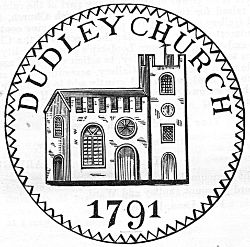
As many discrepancies have often appeared in print as to the cost of the erection of the present Church of St. Thomas, Dudley, I am enabled, through the courtesy of Ephraim Ball, Esq., of Halesowen, to lay before the reading public some authentic information on this head, taken from valuable documents now in his possession, which belonged to the Churchwardens and Building Committee at that remote period. Mr. Ball’s subjoined letter to the Dudley Guardian, in 1871, effectually sets that question for ever at rest.
We have also another very pleasant evidence of the liberality and care for the spiritual wants of the parishioners displayed at that time by the then Viscount Dudley and Ward, in erecting a new Gallery in St. Edmund’s Church, to enable the church going inhabitants to obtain some sitting accommodation in public worship, during the very protracted time occupied in the erection of the New Parish Church.
Dudley, July 10th, 1815.
My Lord,
The Churchwardens of Dudley beg leave most respectfully to inform your Lordship that, as it is found expedient to put up a Gallery in Saint Edmund’s Church, for the accommodation of the inhabitants, while the Parish Church is building; that a space on your Lordship’s Chancel being the only one for such Gallery, which will become your Lordship’s property hereafter; that there is no power of applying any part of the subscription money, raised for the intended New Parish Church, towards the said Gallery; and that the parishioners having contributed to the utmost of their means, for the erection of the Church—we are emboldened by your Lordship’s great liberality, on all occasions to the town of Dudley, to solicit your kind assistance to enable us to complete the Gallery, according to an estimate amounting to £181, which will greatly add to the many obligations which we owe your Lordship. In behalf of the parish, we are my Lord,
Your Lordship’s much obliged,
And most respectful Servants,
T. HILL AND EDWARD GUEST.
The Right Honourable Lord Viscount Dudley and Ward, Park Lane, London.
[Reply.]
My Dear Sir,
I shall be at Himley, quite as soon as I intended, and take the liberty of sending the enclosed for your inspection; and beg that you will inform the inhabitants of Dudley, that I shall be happy to accommodate them with a Gallery in my Chancel, and will talk further on the business when I have the pleasure of seeing you.
I am, yours sincerely,
DUDLEY AND WARD.
London, Wednesday July 12th, 1815.
Dudley, October 15th, 1815.
My Lord,
A wish having been expressed by a few, that the Gallery with which your Lordship has had the goodness and generosity to present to this parish in the Chancel of St. Edmund’s, should consist of close pews instead of open benches, we respectfully request your Lordship will be pleased to inform us, whether (if deemed expedient), such wish shall be complied with, no additional expense falling on your Lordship in consequence of any deviation from the original plan. And, if complied with, whether any rent for the seats ought to be paid to the Minister of St. Edmund’s for the same. The children of the charity schools being about 1,000 in number, we also beg leave most respectfully to submit it to your Lordship’s consideration, whether, (when the new Parish Church is completed), the said Gallery (if thought advisable), should not be converted into open benches for their accommodation.
We are, my Lord, your Lordship’s
Most respectful obedient Servants,
T. HILL, EDWARD GUEST,
} Churchwardens.
[Reply.]
To Rev. Dr. Booker, Dudley.
My Dear Sir,
I wish the Gallery to be so constructed as may best answer the wants of the inhabitants, especially the householders, while the Parish Church is being built. If close pews will be most eligible for the purpose during that time, I have no objection to their being put up by the persons wanting them, under the direction of yourself and the Churchwardens, provided the pews be so formed as to be capable of being altered hereafter, as I may think proper.
I am, my dear Sir,
Yours sincerely,
DUDLEY AND WARD.
Himley, November 4th, 1815.
The following correspondence is a valuable compendium to Dudley lore—
DUDLEY DURING THE LAST SIXTY YEARS.
To the Editor of the Dudley Guardian.
Sir,—In my former letters to you I have given an account of what took place and about the old Parish Church, in this I shall give some information respecting the present church, which is so great an ornament to the town. The foundation stone was laid in the year 1816, and finished building in the year 1819, at a cost of £24,000, raised partly by rates and partly by voluntary contributions. The following is a list of the donors:—
£ s. d.
The Right Hon. Viscount Dudley and Ward2000 0 0
The Rev. Luke Booker, (Vicar)120 0 0
Edward Dixon500 0 0
James Bourne100 0 0
Thomas Wainwright150 0 0
Elizabeth Wainwright30 0 0
Whitehouse, Moore, and Guest100 0 0
Richard Moore100 0 0
Edward Guest100 0 0
Cornelius Cartwright60 0 0
Mary Cartwright40 0 0
Thomas Hill100 0 0
Thomas and Isaac Badger80 0 0
W. O. Chinner50 0 0
Edward Terry30 0 0
John Badley, Blowers Green100 0 0
John Badley, Surgeon100 0 0
—————
Total£3760 0 0
—————
So that it will be seen that upwards of twenty thousand pounds were raised from the Parishioners by a rate levied upon them under an Act of Parliament. It would not have fallen so heavily upon the Ratepayers as it did but for the fact that the person who bought the materials of the old church never paid for them. The agreement with the purchaser was to pay for them when he fetched the last load away, but this part of the contract was never completed, for he either forgot it or wilfully neglected it. However this may be, a nice row of houses were built with the materials he did fetch away on the road that cuts off at right angles leading to Rowley from Dixons Green. The bottom part of the ovens which were in the brewhouses belonging to these buildings were laid with some of the gravestones taken from the old churchyard, and not unfrequently was to be seen upon the newly-baked loaves “Sacred to the Memory,” “Departed this life,” or “Here lie the remains,” &c. The individual referred to was one of the leading men of the town in that day, and the least we can say is that he had a jolly bargain at the expense of the parishioners. The first Vicar of the newly built Church was the Rev. Luke Booker, the next the Rev. W. H. Cartwright, M.A., who gave up the living, and was succeeded by the Rev. J. C. Browne, D.C.L. The present Vicar is the Rev. W. R. Cosens, M.A. The magnificent organ in the church was the gift of the Right Hon. Viscount Dudley and Ward, and at his request, Mr. Richard Bourne, a very respectable inhabitant of the town, was appointed organist. Mr. Bourne was much respected by his Lordship, having been for many years his organist at the church close to his baronial mansion at Himley. His Lordship was a great patron of music, and every year at Christmas he was in the habit of having some of the best singers down from London, to spend a few weeks with him at Himley Hall. The party who generally visited him were the Messrs. Abram, Knyvett, Vaughan, Braham, and Bellamy, and during their visits a selection of sacred music was performed, and often a number of the leading families of the surrounding neighbourhood were invited to the hall to hear these celebrated vocalists. His Lordship generally selected a portion of the Messiah to be performed, and would often join in the choruses, especially “And the Glory of the Lord,” and “The Hallelujah Chorus.” A remarkable instance of his Lordship’s benevolence occurred one occasion when these celebrities were visiting him. He observed Braham to be somewhat downcast, and asked Mr. Knyvett if he knew what was the matter with him. Mr. Knyvett did not probably tell his Lordship all he knew, but from what he did tell him he inferred that some money would be useful to Braham, and at length determined to have a private interview with him, and ask him the cause of his despondency, without Braham saying much on this rather delicate subject. His Lordship inquired if some money would be of any use to him; he replied that just at that time it would, and he immediately wrote him out a cheque for £500. His Lordship was remarkably charitable and often caused three or four oxen to be killed weekly to be distributed amongst the poor of Dudley, Sedgley, Gornal, and Himley, and the couplet written by the late Dr. Booker, as a tribute of respect to his memory, will not easily be forgotten—
“To doomsday may the name descend Dudley, and the poor man’s friend.”
The present Earl of Dudley has shewn much kindness towards the people of this town and district, and his noble gift of the Hospital will confer an immense benefit upon the poor of the town and neighbourhood, and may he long live to see some of the good results of this great act of benevolence.
I remain, yours truly,
VERITAS.
October 7, 1871.
Mr. Ephraim Ball’s reply to “Veritas,” based as his letter is upon absolute documents in the hands of Mr. Ball, at one time the property of the then Churchwardens and Building Committee, removes all doubts and conjectures about the cost of erection of our noble Parish Church, which has been beautified and adorned twice since that period.
OLD DUDLEY DURING THE LAST SIXTY YEARS.
To the Editor of the Dudley Guardian.
Sir,—In reference to the letters which have appeared in the Dudley Guardian for several weeks past signed “Veritas,” and “Z.”—such letters containing matters which are in many instances preserved as historical records,—permit me to say that some of the statements are very vague and indefinite. We will take for instance Saint Thomas’ Church, Dudley. Your correspondent states it cost the sum of £24,000, raised partly by rates and partly by voluntary contributions, also giving the list of the donors, from which your correspondent omits many old Dudley names. As there was more than one subscription list, I beg to give you a copy of one of them:—
“Dudley Parish Church of St. Thomas.
July 21st, 1814.
“At a meeting held at the time and place aforesaid, in pursuance of public notice given on the preceding Sabbath in both churches (the Rev. Dr. Booker in the chair), the following resolutions were passed unanimously, to carry into effect the pious intentions of the inhabitants of Dudley, to erect a suitable parish church for the services of the Almighty.
First.—That a committee be appointed, and that all subscribers of forty pounds and upwards do constitute such committee.
Secondly.—That the following form be immediately submitted to the Right Honourable Lord Viscount Dudley and Ward, the patron, for his lordship’s concurrence and subscription, as well as that of the inhabitants at large.
We, whose names are hereunder written, do hereby undertake and promise to subscribe the several sums of money set opposite to our respective names; the same to be applied in taking down and rebuilding the Church of St. Thomas, in Dudley, and for defraying other expenses incident thereto. Which sums we do hereby severally agree to pay into the hands of the Treasurer hereafter to be appointed, by ten equal successive quarterly payments, the first quarterly payment to be made on the 25th of January, 1815.
Each subscriber of twenty pounds and upwards to be entitled to sittings to the amount of one-half of his subscription; the value of such sittings to be fixed by the Commissioners appointed under the Act of Parliament: the other half of the subscription to be a sacred gift applied towards the erection of the church.
List of Subscribers.
£ s. d.
L. Booker, vicar, who, by a plan he means to adopt and hopes to realize, trusts this sum will be augmented to not less than £200[38]120 0 0
The following additional Donations were subsequently added:—
The Right Hon. Viscount Dudley and Ward2000 0 0
Edward Dixon500 0 0
Elizabeth Wainwright30 0 0
Mary Cartwright40 0 0
Thomas and Isaac Badger80 0 0
W. O. Chinner50 0 0
Edward Terry30 0 0
John Badley, Blowers Green100 0 0
John Badley, Surgeon, Dudley100 0 0
Thomas Hawkes150 0 0
James Bourne (his services gratis as Solicitor)100 0 0
Cornelius Cartwright60 0 0
Whitehurst, Moore, and Guest100 0 0
Richard Moore70 0 0
Edward Guest70 0 0
Thomas Onions80 0 0
Richard Powell80 0 0
Thomas Bunn50 0 0
Richard Salisbury100 0 0
Thomas Wainwright150 0 0
Timothy Hill80 0 0
John Jesson40 0 0
Francis Downing50 0 0
Thomas Caddick60 0 0
R. G. Shaw60 0 0
Joseph Haden50 0 0
Thomas Davis50 0 0
Joseph Cox50 0 0
Richard Lakin40 0 0
R. W. Hawkes100 0 0
As regards the church costing £24,000, your correspondent is quite in error, as will be seen by the following extracts from two letters. On the 18th of January, 1818, the Bishop of Worcester writes as under, from Hartlebury Castle, “and desires to know what further sum, beyond what has been expended or is in hand, is requisite for completing the new church at Dudley, in order that he may judge whether, consistently with other urgent claims on him for pecuniary aid, he can subscribe any sum of importance to the undertaking.”
The following statement was sent to the Bishop:—
£ s. d.
Church Contract10,670 0 0
Bells500 0 0
Organ800 0 0
Extra expenses1,000 0 0
Act of Parliament, &c.460 0 0
——————
£13,430 0 0
——————
Raised by subscription£7,100 0 0
Expected deficiency200 0 0
6,900 0 06,900 0 0
Parish rate till Midsummer1,900 0 0
Unprovided except by Rate and Brief4,630 0 0
——————
£13,430 0 0
——————
It also appears that the Churchwardens applied and obtained leave to get a brief at the Sessions in October, 1817, but being too late in the year they could not get it signed by the Lord Chancellor, therefore they could not receive any sum from it before 1820, and then not more than £200 to £300.
A few other particulars regarding St. Thomas’s Church may be interesting to your readers. Mr. Brooks, of London, was the architect, and Daniel Evans, London, the builder. The following is a statement how the builder was to be paid:—
£ s. d.
On laying foundation stone500 0 0
When the several walls are built level with the second plinth500 0 0
When the walls are built up to the gallery, and the timbers of the gallery put on and the tower of Church built level with bell ringers’ floor1,500 0 0
When walls are built up to raising plates, the window frames fixed in, and the tower level with the bell loft1,000 0 0
When the roof is wholly put on, and the gutters laid, the battlements and upper roof put on, the roof wholly finished, and the tower level with the base of the pinnacles1,500 0 0
When the pinnacles are finished, the ground floor joists and small joists of the gallery are laid, and the ribs for ceilings are finished1,000 0 0
When the second coat of plastering is put on, floors of gallery and ground floors are laid, and gallery fronts are fixed up, and staircases erected1,000 0 0
When the whole of the said buildings and erections are completely finished1,500 0 0
And when Architect shall have certified that the whole of the work is finished to his satisfaction1,400 0 0
Six months after completion200 0 0
——————
£10,100 0 0
The builder of the organ was Mr. Thomas Elliot, of London, and cost, with fixing, &c., complete, £1025. The order was given for the organ in 1817, and some parties were not satisfied at the position in which it was to be placed. Viscount Dudley and Ward was written to early in 1818, asking if he would allow it to be placed in the Chancel gallery which would prevent great inconvenience in going into and coming out of the Church. The reply of Viscount Dudley and Ward to Dr. Booker was:—
“I beg leave to repeat to you that my mind is unaltered and unalterable with respect to the situation of the organ, and that I shall not, by any means give my consent to its being placed in the Chancel gallery.” Dated Himley, February 5th, 1818.
After this letter from Viscount Dudley and Ward, Mr. Brooks and Mr. Elliot were consulted. The result was Mr. Elliot informed Dr. Booker that he would construct the movements of the organ so as to leave a handsome entrance through the middle of the organ, and if the plan was carried out Mr. Elliot considered the organ would have a grand appearance.
The organ being made for the situation it now occupies, and the protest of the Viscount Dudley and Ward against it being put elsewhere, it is to be hoped a fixed determination will be made against any party or parties wishing it moved from its present situation—In fact, I have no hesitation in saying it will spoil the appearance of the church.
The magnificent Altar Window, painted by Blackler of London, was commenced in 1818 and finally completed and placed in the church in Sept., 1821. The original estimate for this splendid window was 500 guineas, and which Mr. Blackler, in a letter, states was but a moderate calculation for the work. Mr. Brooks, however, assured him that such a sum would be considered far too high, he therefore undertook to execute the window for one hundred guineas less than his first estimate, and the expense of fitting up and completing the window in the church was to be fifty guineas extra. The window is a masterpiece, and the Dudley people may well be proud that they obtained the same at so small a cost.
The bells, clock, and palisading cost (after allowing for old bells)£1120 0 0
Other sundries about400 0 0
—————
£1520 0 0
—————
Your correspondent will see by the above items that the Church did not cost £24,000. Your correspondent also states that a leading man of the town of that day had a jolly bargain at the expense of the parishioners, having bought the materials of the old church, which he was to pay for when he fetched the last load away. This I presume he has stated on hearsay, not from any foundation on fact. The person referred to could well afford to pay for anything he contracted for, and I do not think the Dudley people at the time would allow him to go scot free, or would they make such a foolish bargain as stated. I also see the party hinted at gave £50 towards the new Church.
In conclusion allow me to say Dr. Booker at the time worked hard for the building of the new Church. He was a good sound churchman, also an author of several works on various subjects, his name to the present day is an household word, and Saint Thomas’ Church remains a monument to him as first Vicar.
I may mention that Dr. Booker’s history of Dudley Castle is the most authentic work upon the subject that has yet been issued, and is now become very scarce and valuable.
I am, sir, your obedient servant,
EPHRAIM BALL.
Dudley, October 23rd, 1871.
The late Mr. Mainwaring of Dudley, an old St. Thomas’s Chorister for a many years, gave us an amusing story of a marriage at the New Parish Church. “Soon after the New Parish Church was opened, Mr. Bourne, the Organist, and I went into the Parish Church to have a little practice upon the organ, after Mr. Bourne had played a voluntary, Mr. Richard Stanley, the Beadle, came to us and said, that the Vicar, Dr. Booker, wished us to give over for a time, as a parish wedding was about to take place; not exactly understanding what this meant, we determined to go and see it. As soon as we had reached the Chancel, we were informed by Mr. Bond, the Parish Clerk, that a certain sum of money was to be given to the young man by the parish authorities. As we had no Board of Guardians in those days, the parties in charge of the parish funds did pretty much as they liked with them, in this instance, and for certain reasons, they offered the young man about to be married five pounds. When we arrived near the altar rails we observed several young men and women in the pews, and there was an abundance of sly winking and laughing going on. At last, the Doctor entered from the vestry, and all the people became orderly and quiet. The service commenced and all went on smooth as a marriage bell, when the Doctor came to that part of the service where he said to the man, ‘Wilt thou take this woman to be thy wedded wife, to live together after God’s ordinance in the holy state of matrimony,’ &c., &c. Here Mr. Bond, the Clerk, stepped forward, and told the man to answer ‘I will!’ He replied, ‘I’ll have the money first.’ The Doctor was indignant at this proceeding, and said, ‘What money do you mean sir?’ The man said, ‘Why the money they have promised me if I will marry this young woman, and I’ll have it before I answers, I will!!’ Upon this the Clerk went up to the Doctor and explained the matter to him, Mr. Bond also told the man that it was all right, the money was at his house ready counted, and after he was married he could go with him and have it. The man said, ‘I don’t care where it is, I’ll have it now and in my pocket before I am married.’ Upon this Dr. Booker told Mr. Bond to go and fetch it; the service being delayed until he came back. When Mr. Bond returned, he put the money into the man’s hands and after he counted it and put it into his pocket, he said to the Doctor, ‘You can go on now, it’s all right!’ and the service was completed, and the man, woman, and money, were all united in this (let us hope), blissful celebration.”