THE Curiosities of Dudley AND THE Black Country. (continued 10)
Reading edition
At the earlier part of the late Dr. Browne’s ministry among us, he met with a singular amount of innocency and ignorance at the baptismal font. A man and woman, well-known characters at Gornal Wood, thought they should like to have their next child christened at Dudley by Dr. Browne. In due course the child was brought to the font, and the portly Doctor, already equipped, enquired in his usual clear and musical voice, “Was this child born in wedlock?” “Noa, it worn’t,” says the man, “it wur born in Gornall Udd!” It is needless to say that the child got the spiritual induction, and the Doctor a homely sample of ignorance amongst the colliers in the Black Country.
This subjoined Bill is a curiosity in its way, shewing the way we did in the Army, long, long ago.
THE VOLUNTEER INFANTRY,
TO R. MOORE, Dr.
1804.
Mar. 26.Paid for a Lock mending0 1 4
May 27.Ditto ditto0 0 6
Sep. 10.Ditto0 1 0
“Flints0 1 0
Oct.Ditto0 1 0
Paid for Drink at Droitwich, by order of Major Wainwright1 8 6
Paid for Sick Men at Worcester1 6 6
Paid for Mending Locks0 4 6
Ditto0 0 8
———
£3 5 0
———
Examined,
J. Payton,
W. Harrison,
Edwd. Dixon,
Thos. Moore.
A NARRATIVE OF THE REJOICINGS AT THE CORONATION OF KING GEORGE THE FOURTH, WITH A SEQUEL, BY AN EYE WITNESS.
On Thursday, the 19th July, 1820, the day appointed for the Coronation of His Majesty King George the Fourth, the inhabitants of Dudley entered into a subscription for the purpose of furnishing the poor people with a dinner, and also to regale the children of the different Sunday schools and schools of industry in the said parish, to the number of four or five thousand. This was a most delightful sight; they paraded the different streets in a very orderly manner indeed. Four sheep were roasted in the Market Place and distributed, with a large quantity of ale, to the populace. There assembled a very considerable number of people, the principal street being utterly crowded from one end to the other. An advertisement had been distributed announcing a display of fireworks which would take place in the course of the evening; this caused a great number of people to remain in the town during the whole of the day. The shops were ordered not to be opened during the day, and the mandate was obeyed, save and except the public houses, where most of the lower orders of people resorted to after having been plentifully regaled by the inhabitants. The old saying is much would have more, and it is difficult to satisfy such people, or even keep them peaceable and quiet, when a little elevated. The Himley and Enville troop of Yeomanry met on the morning of that day at Himley, and after partaking of some refreshment, proceeded to Wolverhampton, where they paraded the town and partook of a considerable quantity of wine, which, to many not being in the habit of drinking, must have had considerable effect, and was very distinguishable by one drawing his sword and threatened to cut a man down for crying the Queen. This act very much irritated the populace, and it was asserted that if they (the Yeomanry) had not filed off as they did, they would have been very roughly handled. They then bent their course to Dudley, where they arrived about three o’clock, not very sober; and after going through their exercise and firing, repaired to the hotel (Dudley Arms) to dinner in some of the lower apartments. The gentlemen of the town with the Dudley Cavalry occupied the assembly room. Things were going very peaceably in the town till between eight and nine o’clock, when the Yeomanry became very refractory, and proceeded to violence among themselves; the windows were thrown open, and one of them jumped upon the table which stood under the window facing the street, and held out a white handkerchief, and cried out “the Queen, my lads,” which immediately caused a shout from the surrounding multitude. This was followed by the Cavalry commencing a battle royal. The tables, bottles, glasses, and furniture went to rack; the remains of the bottles and glasses, in part, were thrown through the window on the heads of the populace, which they took as a gross insult. The boys procured some squibs and threw into the room, and the noise became very loud, which soon reached the ears of the gentlemen above, some of whom came into the street very drunk, and began to assault several persons who had committed no offence whatever. The young men and apprentices had been parading the street in a very sober and quiet manner, not offering to give offence to any person or persons, but having in the course of the day worn white favours in their bosoms, they excited the indignation of some very hot-headed persons who were possessed of more money than wisdom, and to shew over and above loyalty, would go any lengths to serve the cause they had espoused. At the time these scuffles were taking place, the young shop men and apprentices, as before stated, were coming through the throng. Messrs. Clymer and Stokes were arm-in-arm, and Clymer was robbed and assaulted by one of the gentlemen who could hardly articulate; Stokes said “I would never suffer myself to be insulted in that manner, knock his red nob off,” which was noticed by a person near and one of the party. This appeared a favourable opportunity for these gentlemen to show their loyalty to the world at large, by prosecuting these young men, who had done no harm to any one individual. Several of the runners were sent out to take any of the young men into custody, which they soon effected; some were confined for the night, and others bailed out till morning, when a Bench of Magistrates would sit to judge the case. On the morrow, those who were not apprehended on the preceding night, and who were seen wearing white favours, were sent for by the Magistrates, which summons was immediately obeyed. The examination took place, not by the magistrates only, but by some unknown gentlemen, whose word, had it been as strictly scrutinized as these unfortunate young men, they would e’er this have crossed the briny ocean; but their time is not yet come, when it does I have no doubt they will cut a very conspicuous figure. The young men were ordered to find bail or they were committed. Some had no bail, or would not get any one to give bail for them. What was the consequence; they were sent to prison to the Workhouse in Dudley, and were to be removed to Worcester Gaol on the morrow morning, but about nine o’clock at night the prison door was thrown open and the prisoners ordered to go about their business. These very men had confessed they broke the windows at the hotel; this is a most strange business to release the guilty and punish the innocent. This appears to be Dudley law. Stokes was not apprehended till Monday following, when he attended at the Public Office; as soon as he appeared in the room one of the Magistrates asked his father who had put that plaster on his son’s head, and whether it was a real or an artificial scar. It is proper to remark here that on the Coronation night, when one of the young men was being taken to the hotel, the Constable used him very roughly, on which Stokes cried out “don’t use him so bad, he will go gently with you without such rash behaviour.” At this moment came up Payton the Constable and struck Stokes with his stick or club on the head and broke a hole in his hat, he again lifted his staff and gave him a violent blow which cut his head; this took place in consequence of his interceding for a friend, to one who had neither pity nor mercy. As soon as the Magistrate received an answer he took his hat and left the room, and did not return. Spurrier, the Attorney, was employed on the occasion, who immediately rose and addressed the other Magistrates, saying that Mr. Stokes’s son had been served with a warrant, and was there ready to answer to any charge. If that is the case, said one of the magistrates, it ought to be heard, and immediately asked the prosecutor if he had any objections to its being gone into. He first said no, then said he had nothing against him. Spurrier then replied to the Magistrates, the warrant then in course must be discharged—the Magistrate answered assuredly so; then the matter ended as was generally supposed, but, a few days previous to the Sessions a fresh warrant was obtained, under the same charges, and Stokes was taken into custody on Friday, bail was taken for his appearance next morning at ten o’clock, which was punctually attended to; his father attended with him, met the Magistrate in the street, who shook hands with him, and said, why there is a warrant against your son, yes the father said, it is very strange he should be brought up to answer the same charges which were contained in the former warrant, he replied, pity but he had kept better company, and walked off. He was then sent after by one of the Constables, who brought word he would not hear it till four o’clock in the afternoon; the Lawyer for the Plantiff sent a Constable after Stokes, and put him into confinement till the case would be heard, which took place about five o’clock; his father was bound for him to appear at Sessions. In that part of this narrative which relates to the disturbance between the Himley and Enville Cavalry in the Hotel, it will be proper to remark what succeeded; the broken glasses, &c., that were thrown upon the heads of the people in the street, caused an immediate retaliation by the populace throwing stones, brick-bats, or anything they could lay their hands upon, and thought themselves justified, the assailants broke two or three dozen panes of glass; it has been said that the Riot Act was read, but that is very much doubted. To prevent further damage, someone, more wise than the rest, ordered the gas-lights and fireworks to be immediately lighted, which was done with all possible speed, and had the desired effect. The High Constable was, I believe, the person who furnished the fireworks, and his shop was generally furnished with those kind of articles, and exhibited for sale which is contrary to, and in violation of, the established laws of the land. It having been evidently reported that the young men had dined together at the Saracen’s Head, on that day, for a widely different purpose than really was the case, the fact is that sometime previous to the Coronation a wager was laid among the young men that the Queen would be crowned with the King; not being able to decide the wager then, it was agreed to dine together on that day, and whoever lost to pay for the same. The party broke up at a very early hour perfectly sober, and conducted themselves with the greatest propriety during the whole of the evening. Had there been no Cavalry at Dudley that day there would have been no disturbance; when the first commotion took place several of the Cavalry came into the street and proceeded to draw their swords and strike several persons in the throng, who gave them the answer to it without delay, and forced them to go back more rapid than they came. One of the Cavalry fired and wounded a man in the face in a most shocking manner. The young man (one of the Himley Cavalry), who had excited the attention of the populace by holding out his handkerchief and crying “the Queen my lads,” was brought to a Court Martial soon after, but not discharged; great numbers are ready to attest the statements herein contained, if it should be found necessary.
ANCIENT DUDLEY SOUP KITCHEN.
In the earlier part of this book I have had occasion to refer to the commencement of the present Dudley Soup Kitchen, which I consider is well supported by the town, and does an immense amount of real good, in distributing such large quantities of excellent soup amongst the poor and indigent classes in bad winter weather; since that was printed I have been favoured with the following particulars of the old Soup Kitchen, established in 1799. The establishment of this Soup Kitchen and Relief to the poor commenced in November of that year, in consequence of much stagnation in the then local trades of the town, and great distress amongst the poor. A Subscription List was opened by a few leading individuals, resident in the town, which was heartily supported by all classes in the town from the peer to the peasant.
£ s. d.
Lord Dudley63 0 0
Edward Dixon50 0 0
Edward Hancox35 0 0
D. and R. Parsons42 0 0
J. and B. Hodgetts42 0 0
Whitehouse, Moore, and Guest42 0 0
James Cartwright21 0 0
James Wainwright21 0 0
James Bourne21 0 0
Edward Cockshutt15 15 0
Charles Roberts15 15 0
Joseph Hill12 12 0
Richard Parkes15 15 0
Luke Booker10 10 0
G. and B. Parker52 10 0
Samuel and William Bennett42 0 0
John Simpson31 10 0
Jos. Amphlett25 0 0
Exors Abiathar Hawkes25 0 0
John Twamley10 10 0
Thomas Wainwright10 10 0
William Perry10 10 0
William Penn10 10 0
John Bolton10 10 0
John Hateley10 10 0
Leah Parkes10 10 0
Southall & Co.10 10 0
John and Edward Davies10 10 0
&c., &c.
This handsome commencement was quickly followed by 82 other subscribers of smaller amounts, making a grand total of £804 17s. raised by the good people of Dudley in those hard times, for the sustenance and relief of their poorer brethren.
On November 19th, 1800, the accounts were duly examined and audited, when the sum of £781 16s. 4d. had been expended during the year, amongst the poor and helpless in the parish.
Signed,
S. Bennitt,
Jos. Hateley,
Richard Moore,
B. Hughes,
B. Hodgetts.
Edward Dixon.
Edward Hancox.
J. Wainwright.
In January, 1813, it is recorded that this town and district was at this time visited with great depression in trade, and much sickness and distress prevailed amongst the working classes. A very handsome subscription was at once started, with most encouraging results, for the sum of £870 11s. 9d. was (before the end of March) raised for the relief of the Poor by 171 subscribers, giving another evidence of the good will and care of the rich for their poorer neighbours.
1816. This year was one of the most disastrous in our annals; an awful wet harvest followed close upon the war, which had just then successfully terminated, with the finances of the country in a very disordered state, casting a settled gloom and distrust all over the land.
The parish of Dudley unhappily shared in these hard times, for we find that on November 30th, 1816, a Public Meeting was held at the Public Office. Mr. Edward Guest occupied the chair. At this meeting a Committee was appointed to collect subscriptions for a Soup Kitchen and relief of the necessitous poor, when the appeal was equally successful, for the sum of £831 2s. 0d. was speedily subscribed by 162 contributors, and judiciously given amongst the poor.
July 29th, 1817. At a meeting of the subscribers to the Soup Charity held this day, it was resolved,—That the accounts produced by Mr. Guest appear so highly satisfactory that he be requested to accept our best thanks for his services. Resolved,—That the thanks of the Society be also voted to Mr. Gordon, for his kind and active services. Resolved,—That as a reward for Mrs. Stilyard’s particular attention in the management and superintending in the making of soup, the sum of two guineas be presented to her for the same. Resolved,—That the balance, after discharging the small debts, to remain in the hands of Messrs. Dixon, Dalton & Co., the Treasurers appointed.
Luke Booker,
Thos. Badger,
Timothy Hill,
Thomas Fehr.
Richd. Lakin.
Richd. Bond.
There are varied scenes near the neighbourhood of the town of Dudley, where antiquity and picturesque beauty, art, and nature present themselves in every wondrous form. The secrets and wonders of former worlds are to be found in our Limestone and Silurian formations, which are daily worked by the active miner; the very extensive employment of manufactures and commerce are well worth an inspection by the stranger who may visit our ancient town; for these mixed sources of contemplation are adequately fitted to engage the attention of the curious, and the searcher for scientific truth, and to fill the mind of the moralist, the poet, the politician, and the philanthropist with sentiments akin to reverence and thankfulness.
My labours being now ended, I trust that this memento of many humorous and stirring events, in the social and political life of this ancient borough, may prove a source of amusement and happy reflection to the aged, and lessons of instruction to the young, and the comparative strangers in our midst; bearing in mind that we now live and move under very altered conditions of both social and moral life, leading us to feel thankful that we are now living in the age of national progression.
I have studiously avoided commenting upon the various charities in this town, because an abler pen than mine has recently undertaken that most necessary illustration of the “Charities of Dudley,” which I feel assured could not be in safer hands than our highly esteemed Town Clerk of Dudley, Edward M. Warmington, Esq., Solicitor. Let us hope that these learned “Articles on the Charities of Dudley” may shortly be collected and printed in a volume for local preservation. I have, finally, greatly to thank many ladies and gentlemen, in and around Dudley, for their courtesy and kindness, in furnishing me with copies of many additional paragraphs which appear in this book.
C. F. G. C.
Finis.
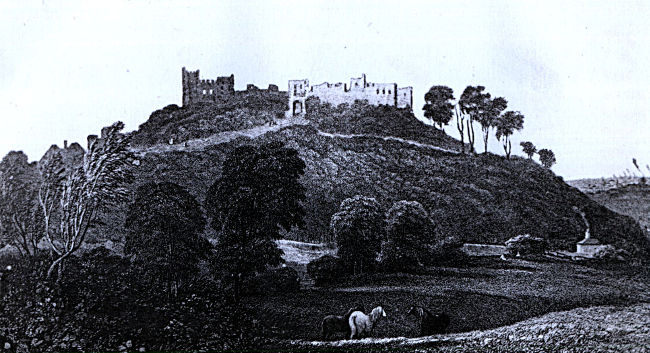
DUDLEY CASTLE FROM THE NORTH-EAST, 1810