THE Curiosities of Dudley AND THE Black Country. (continued 6)
Reading edition
FELLOW RATEPAYERS.—Have your payments been less during the last year?
OWNERS OF SMALL PROPERTIES.—Have you not been compelled to pay the Rates for your tenants, in addition to your own usual Rates? and to whom are you indebted for this increase of your burdens? It is a fact, that every one of the SEVEN ACTIVE INTELLIGENCES did vote for the imposition of this additional Tax on you to relieve themselves, for I believe not one of them pay a Shilling on small Property in this Parish. Improvements we want, but do not be deceived; be careful to whom you trust the Power of Local Taxation. Vote for Guardians who have a stake in the Parish, who will spend your money as carefully as they would their own. Vote NOT for those who merely seek the office to gratify their own private vanity, and serve party purposes at the Cost of the Poor hard-working Ratepayers.
Vote like I intend to do, for the TEN LAST NAMES on the List, for the men nominated by your most respected Fellow Townsman, Thomas Badger, Esq.; he has long been a tried and true friend to the Town of Dudley, and would not deceive you by nominating improper ones.
Fellow Ratepayers, Your Faithful Servant,
ANOTHER QUIET OBSERVER.
Dudley, March 30th, 1854.
ELECTION OF GUARDIANS.
TO THE RATEPAYERS OF THE PARISH OF DUDLEY.
“Another Observer” has thought proper to intrude some remarks upon your notice. To this there could be no objection, so long as truth was adhered to; unfortunately, the truthfulness as well as the reason of his remarks are about “as two grains of wheat in two bushels of chaff, you shall search all day ere you find them, and when you have, they shall not prove worth the search!” Let me take his observations then seriatim—that Owners’ Proxies have been procured, and this to some extent by misrepresentation, if not something worse, is beyond doubt, and that they will in very many instances be used contrary to the wishes and intentions of the Owners, is a fact which admits also of as little doubt. No person with any discrimination can suppose that if unscrupulously obtained they will not as unscrupulously be employed. Does “Another Observer” wish you to believe falsehood by proxy, or does he wish to propagate untruth by insinuation? He knows that with regard to the Board of Health proxies were not and could not be used,—and he is defied to prove that either “misrepresentation or cajolery” was employed by his opponents to gain that election. Notwithstanding the number of paid agents employed by himself and others to disseminate that “misrepresentation and cajolery” of which he speaks so much, the good sense and independent judgment of the Ratepayers emphatically decided against them; and so also, if left to their own free and unbiassed opinions, will they do in the present election for the Guardians.
In regard to the Workhouse question, the facts stated by “A Ratepayer” are a sufficient answer; but “Another Observer” here again knows that his statements are a gross exaggeration, and wilfully intended to mislead. So also are his statements in regard to the salaries paid to some of the Officers of the Board of Health. Will he, however, assert that he or his friends would or could have procured proper and intelligent persons, qualified to carry out the important works which will be required of them, for less amounts than are now paid? I trow not. But why wish you to believe that these are extra burdens imposed upon you? Why not tell you of the sums paid, IN THE GOOD OLD TIMES OF HIS FRIENDS, to the late Clerk to the Town Act Commissioners,—to the Collectors of the Town Rate and Highway Rate,—the Inspector of Nuisances under the Diseases’ Prevention Act,—the Surveyor of the Highways and other Officers? and I am much mistaken if you will not find MORE MONEY PAID FOR LESS WORK DONE! It was either because he considered “discretion the better part of valour,” or, “where ignorance is bliss, ’twas folly to be wise.” Why, too, did not this “other Observer” tell you what either himself or his friend (?), a THRICE-REJECTED-ASPIRING-WOULD-BE-GUARDIAN!!! has received of the Parish money for some years before he pretended to pass judgment on others.
As to the Rates made by your Local Board of Health, what are they? Why a Shilling Town Rate instead of an Eighteen-penny one as it was last year, and Two Shillings a year or two ago; and a tenpenny Highway Rate which has been its amount for many years—thus actually shewing that you are paying from Sixpence to One Shilling in the pound less than when under the old rulers. As to the expenses of Survey, Plans, Drainage, and other improvements, what has necessitated their adoption but the neglect of those who held the power in your parish years ago. Will this “Observer” assert that there is no need of them? Will he assert that there are many places in this kingdom worse off than Dudley in these respects? Can he controvert the fact that the average duration of life in Dudley is almost the shortest, if not quite so, of any place in England? or, in other words, that whilst in some places of all the people born, the average duration of their lives is 40 years, in Dudley it is only about 19—or that during this past year there have been more deaths in this parish, from fevers and other preventable causes, than during the years of the Cholera—and these, too, principally, if not entirely, caused by bad drainage, imperfect ventilation, and improper sanitary regulations. Your present high Poor Rates are only a portion of the short-comings left by those to whom you entrusted your interests in past times. Your payments now are but a legacy of that mismanagement which this “Observer” would desire you to perpetuate.
What does he mean by his allusions to the projected Model Lodging Houses, Public Hall, School of Design, Mechanics’ Institute, &c.? as being provided for out of the Public Rates—insinuations as utterly false and groundless as they are base and malicious, and which could only originate in a mind incapable of a good action in itself, and therefore suspicious of others. “Have your payments been less during the past year?” he asks. I would answer there is the undeniable fact, that in the past year the cost of out-door relief to your poor has been less by nearly £500 than in previous ones. Why, I would retort, was not this diminution observable during former years, when trade was quite as good as during the past one? Then he enquires, why were the Overseers required to borrow £500 in order to provide the necessary means to meet parochial expenses? Why! Because they were compelled to wait the granting of another rate, whilst hundreds of our poor were summoned to appear before the Magistrates in order that they might be legally excused, or payment enforced, before another rate could be made; because such as this “Observer” would not compound for the payment of their rates, and, without the introduction of the Rating-of-Tenements’ Act, this must have been done at the close of every rate,—a fact alone sufficient to counterbalance any disadvantages which from its introduction may arise, and which will ultimately be as great a benefit to the Landlord as to the poor Tenants themselves.
“Another Observer” says “Improvements we want!!” Out upon such cant! why have we not had them before? why have they not been projected long ago? why, when anything has been proposed for the good and prosperity of the town, have not our men of influence, and those having a “stake” in the Parish been the first to support them? why has every thing been left to be done by the insulted “shopkeepers?” “Talk of spending your money carefully!” Who were the parties who objected to let you know how your money was spent? who were the parties who opposed the admission of the Press to your Board Room? why, the very friends of this “Another Observer;” and when there are those who would not that Dudley should be second to Stourbridge, Bilston, or even Wolverhampton, such as this “Another Observer” are found to deride and revile their “private enterprize” and impute interested motives.
Finally, “Another Observer” says “Vote for those who have a stake in the Parish,” and “who would not seek office to gratify personal vanity.” I ask you Ratepayers, to inspect the List proposed by Messrs. Dixon & Lester, and that advocated by this accurate “Another Observer,” and I venture to affirm, that on examination it will be found they pay a much greater amount of Rates, and that THEY ALSO REPRESENT BY FAR A MUCH LARGER AMOUNT OF INTEREST in this Parish. In regard to experience in parochial affairs, in regard to a knowledge of the administration of the Poor Laws, in regard to business habits and general intelligence, in regard to their attention to your interests, without wishing to utter one word in disparagement of their opponents, I fearlessly challenge a comparison. Talk of a “Stake” in the Parish, indeed! Pray, how much Rates does this “Another Observer” pay? Be not deceived by falsehood.—Be not misled by misrepresentation.—Judge by facts and not by the words of such “Another Observer.” Exercise your own impartial and independent opinions. Weigh all the circumstances calmly and impartially, and the undoubted result will be, that your confidence will again be placed in those who have not yet deceived you, and that the gentlemen nominated by Messrs. Dixon and Lester will be your Guardians for the ensuing year.
With all respect, I am, Fellow Ratepayers, yours still,
“THE QUIET OBSERVER OF FACTS.”
Dudley, March 31st, 1854.
ELECTION OF GUARDIANS.
TO THE RATE-PAYERS OF THE PARISH OF DUDLEY.
Gentlemen,
A Handbill, headed “Election of Guardians,” and signed “another Quiet Observer,” has been published, which contains a number of insinuations so disgraceful and false in reference to several public matters in which individually I take great interest, that however reluctant I may be to intrude myself personally upon you, I feel I should be wanting in a sense of public honor, if I were to allow it to remain without a distinct and indignant denial of its truth.
Had it confined itself to the ensuing Election of Guardians I should not have thought it necessary to reply to its insinuations, because it would be an insult to the Rate-payers to suppose for a moment that they could be deceived by its one-sided statements—statements, every one of which, if not false in fact, are false and knowingly false in the inferences drawn from them. But it goes beyond the Election of Guardians, and insinuates that all the Public Institutions, which some amongst you are now endeavouring to establish and to support, are to be paid for by Public Rates.
I suppose the writer of the Handbill thought that by throwing this paragraph into the form of an insinuation, and not a positive assertion, he would escape from being branded with the charge of Falsehood, but surely he cannot be ignorant of the fact, that to deceive by the insinuation of a Falsehood is as great a breach of Truth, as to deceive by an actual falsehood itself.
The writer of that Handbill, whoever he may be, knows very well that the Model Lodging Houses—the Public Hall—the School of Design—and the Mechanics’ Institute—are all supported, and supported with one exception, exclusively by Private Enterprise, and not by Public Rates. The exception to which I allude is the assistance of Government to the School of Design, to the extent of £10 during the first year of its establishment, whilst Private Enterprise alone has raised for its support during this time upwards of £400. I regret, exceedingly, that any one should have attempted thus to injure these Institutions, which are so much needed in this town, and which are so rapidly placing it on a more equal footing with the neighbouring Towns of the District.
From the falsehood of the insinuations thrown out, you may judge how far the actual assertions which the writer of this Handbill ventures to make, are to be depended upon.
The writer states that the “huge Union Bastile,” as he terms the new Poor House about to be erected, will separate Man and Wife—Children and Parents.
He knows that the separation of Man and Wife—Children and Parents—takes place of necessity in the present Poor Houses to a far greater extent than can be the case in the new House.
He knows that now the children cannot remain even in the same House as their Parents, but that in the new Union House they will be under the same roof, and within the reach of their Parents, at all reasonable and proper times.
He also knows that Man and Wife are invariably separated in the present Poor Houses, and that this separation will not take place after sixty years of age in the new Union House.
The writer states that the cost of the new Union House will be £20,000.
He knows that the cost is limited to £12,000 by the Poor Law Board, and that this amount will be borrowed, and repaid at the rate of £600 per year, with interest at four per cent.
He also knows that the economy of this expenditure will far exceed the annual amount of the instalments; or if he does not know this, it is because he will not take the trouble to examine the results attained in other Unions by the erection of proper Poor Houses. Upon this point Mr. Doyle has proved “that the pecuniary interests of the Union would be materially benefitted by the building of a workhouse adequate to its wants.”
But if the desirability of a new Poor House were not so evident on the ground of economy, it would be so on far higher grounds, since the existing Dudley Poor House is described in a letter to me of the 28th instant, by one of the most respectable of the medical gentlemen of this town, “as the FOCUS of epidemic disease and starting point of Cholera, at two successive periods.”
You, the Ratepayers of Dudley, will, I am sure, weigh well these words, and you will not shrink from showing the estimation in which you hold the writer of a Handbill who thus ignores the most sacred claims of Truth and Humanity.
Nor does the writer confine himself to the Guardian question—he endeavours to make you believe that the Board of Health is administered with great recklessness of expenditure.
As one of such Board, I am responsible only to the extent of my individual vote for its expenditure; but here again the writer endeavours only to deceive.
The Rates under the Dudley Town Act Commissioners and the Board for the Repair of the Highways were during the following years as under:
Town Rate.—1847-1848-1849, 2s. in the Pound. 1850-1851-1852, 1s. 6d. in the Pound.
Highway Rate, for the above Six years, 10d. in the Pound.
Under the Board of Health the Rates already granted are—
A General and District Rate, in lieu of old Town Rate, of 1s. in the Pound.
A Highway Rate of 10d. in the Pound. These will be more than sufficient to meet the expenditure heretofore paid out of the Town and Highway Rates.
The writer wishes to make you believe that the cost of Salaries is entirely additional under the present Board.
He knows that this is not the case, and he also knows that the amount payable under the Board of Health, under this head, will be less, including Professional Charges, than under the Town Commissioners.
The writer would deceive you as to the amounts to be paid for Drainage, &c., and the desirability of such expenditure. I cannot say at present what this expenditure may amount to; but the largest amount—efficiently expended in Drainage—will be the most economical to the Parish, when the saving to the Poor Rates, from the prevention of disease and death, is taken into account. Upon this point, let me again quote the words of the Medical Gentleman already alluded to (not the Officer of Health):—“The inhabitants of this Town are ill prepared to withstand the onslaught of Cholera, which would be brought to our very doors by living in such a tainted and impure atmosphere as that which exists in the very centre of the Town.”
The writer of the Handbill does not tell you, that whatever may be the expenditure of the Board of Health, it will always have to be audited by a Public Officer, and the Balance Sheets open to the inspection of any Ratepayer.
The Handbill would deceive you again in reference to the stake in the Parish which those proposed as guardians on the List nominated by Messrs. Dixon and Lester possess.
He again insinuates, where he dares not assert. What will you think of this insinuation, when I tell you that there are Four Persons on that List, each of whom pays separately, three of them as individuals, and one as Agent of a Company, a larger amount of local taxation, as far as the Parish of Dudley is concerned, than the entire Ten upon the opposite List.
I regret exceedingly, that I should be obliged thus even to allude to a matter which may appear to be personal, but I am compelled to do so. It would be false delicacy to shrink from the exposure of the deceit contained in the Handbill. I am ready at any moment to confront the writer, and to prove, not only every statement I here make, but also any inference I have drawn therefrom.
For myself, I can only say, that personally I have no motive to serve in allowing myself to be nominated as one of your Guardians. If you honor me by election, I shall earnestly strive to fulfil the duties so imposed—but how painful those duties are, they only know who have accompanied me over the Poor House in this Town, which, I hesitate not to say, is a disgrace to humanity, and to the intelligence of the present day. The hours which I have spent within its walls have been amongst the most painful of my life, and there is, I am sure, no Ratepayer who would accompany the Visiting Committee in their periodical inspection of it, who would not most earnestly labour for its removal, as a religious duty which he dared not neglect.
I am, Gentlemen,
Your obedient Servant,
S. H. BLACKWELL.
Dudley, March 31st, 1854.
This disgraceful strangling of common sense and prostitution of all recognised rules of decent electioneering propriety came to a close with the following result:
ELECTED TORIES.
Votes.
Isaac Badger1565
Thos. Griffiths1500
Jos. Guest1402
Jos. G. Walker1378
Edw. Fisher Smith1372
M. Dennison1290
Jno. Aston1223
Jas. Harrison1201
Jno. Renaud1166
Francis Northall1166
REJECTED LIBERALS.
Votes.
S. H. Blackwell940
A. B. Cochrane876
Thomas Wood772
J. C. Cook771
—— Thomson710
Evors Swindell707
Alex Patterson657
Jno. Finch651
D. Lloyd517
METROPOLITAN ASSOCIATION FOR IMPROVING THE DWELLINGS OF THE INDUSTRIOUS CLASSES.
Dudley Branch.
March 31st, 1854.
In a handbill addressed “To the Ratepayers of the Parish of Dudley,” by “Another Quiet Observer,” occurs the following paragraph:—“As to Model Lodging Houses, Public Hall, School of Design, Mechanics’ Institute, &c., of which they make such boast; all very well I reply provided they are paid for by Private Enterprise, and not by Public Rates.”
As this, if uncontradicted, is calculated to produce an erroneous impression that the Public Money is being or is to be applied to the furtherance of these objects, I beg to give a most unqualified denial that such is the case as to the Model Lodging Houses, the funds for which are being raised by Shares of £25 each, with limited liability, under the Provisions of the Charters of the above Association.
Any further information respecting which will with pleasure be afforded by
WILLIAM BARNS,
Wolverhampton Street,
Local Secretary.
Died April 19th, 1854, Mr. Thomas Lester, Wine and Spirit Merchant, Market Place, much esteemed by a very large circle of friends. Mr. Lester was a gentleman of strong common sense; he lived a great many years in Dudley, and accumulated a handsome fortune, he was a Liberal in politics, but of a retiring disposition, disliking extremes of any kind. Mr. Lester was a Wesleyan Methodist, New Connexion, in persuasion, and a most liberal giver to that especial cause. Being of an exceedingly liberal and charitable disposition, no honest case of accident or distress was ever turned from his door without relief, and his open-handed contributions to all good objects in the town were at all times most benevolent and unostentatious. At this good Christian’s death the widow and orphans lost an untold friend, and the immense concourse of people of all shades of politics and religion who attended his funeral bore a sorrowing testimony to his universal worth. Aged 65 years.
Died July 9th, 1854, at Handsworth, formerly of Wolverhampton street, Dudley, Mr. Matthew Houghton, gentleman.
Mr. C. F. G. Clark, Chemist, Market Place, gave a series of Free Lectures on popular subjects in most of the villages and towns around Dudley, addressed especially to the rising generation.
July 14th, 1854. A Silver Inkstand and two handsome books of Music, costing £21 10s., were presented to Mr. John H. Vanes, Currier, the late Organist of St. Edmund’s Church, by the congregation, as a mark of respect and esteem on his leaving Dudley.
A block plan of the New Model Dwellings to be erected in the Dock Lane was now issued by the Committee, and building operations were commenced upon the row of fancy dwellings now standing “all alone in their glory” in Dock Lane, but, as the Association “did not take in Dudley,” all further operations were suspended, and the houses in Dock Lane were the only dwellings completed. Chairman, Dr. Browne, Vicar; Architect, Mr. Wm. Wiggington; Secretary, Mr. Wm. Barns.
September 20th, 1854. The Grand Lodge of (Worcestershire) Free Masons walked in procession this day in Dudley, to St. Thomas’s Parish Church to a special service, and then afterwards repaired to the hotel to a Masonic banquet; H. C. Vernon, Esq., J.P., Hilton Park, Grand Master.
October 24th, 1854. Died, Old Mr. James Wilkinson, formerly an extensive vice and anvil manufacturer of Tower Street, Dudley. This gentleman was another true type of a Dudley man, having an exceedingly quick and retentive memory of past events in Dudley. The Wilkinson’s, like the Finch’s, are decidedly the oldest descended families in this town, for Dudley had an Alderman John Finch in Charles II.’s reign, and we have a second Alderman John Finch, J.P. in our present time; and it is singular that these robust sons of the forge have ever been connected with the nail trade, fender and fire iron trade, the anvil and vice trade, and all kindred trades of such manufacture. Like Tubal Cain of old, they welded molten iron into form and shape, long before the steam hammer was thought about. Mr. Wilkinson’s recital of his early days, when, he says, we had no carts or waggons in those days to convey our anvils and vices to the Cross, Dale End, Birmingham, for sale to the factors, who used to come and buy our goods; we had to travel with them in large baskets slung on horses backs, and in single file we travelled over Bromwich Heath to Birmingham. Mr. Wilkinson lived to the good old age of 85 years, and died esteemed and respected by all men.
November 27th, 1854. A patriotic meeting was held this evening at the town hall, for the noble purpose of joining in the endowment of a national fund for the maintenance of the widows and children of soldiers and sailors killed in this just Russian war; a committee of willing hands was nominated, and after the town had been thoroughly canvassed, the handsome sum of £3,282 was given for this noble object. Hurrah! for old Dudley.
NIL DESPERANDUM!
“Britons Strike Home.”
EXTRACT FROM A LETTER
Written in Sebastopol on the Evening of the Battle of Inkermann, by a russian soldier:
“We are still alive although the English and French use every means for our destruction; but we know not how long this may last. The carnage is terrible! all our efforts against the enemy are vain, and without result. Although we have a superiority in numbers, we cannot conquer the enemy in the open Country! The terrible coolness of the English, their frightful Artillery, which destroying entire lines of our Troops, disturbed their retreat, and the Balls and Shells committed the greatest ravages. The Riflemen picked off all our Officers. Our Soldiers are obedient, and execute all the orders like machines, but they want address, intelligence, presence of mind, and enthusiasm.”
“The cool steadiness of the English, and the vigour of the attack of the French equally alarmed them.”—See Guardian Newspaper, pages 919, 920, for Nov. 29, 1854.
The Vicarage, Dudley, Nov. 30th, 1854.
Died January 26th, 1855. Mr. Edward Dixon, Sen., formerly banker in Dudley. The disasters and stoppage of Messrs. Dixon, Dalton & Co’s. Bank in this town a few years before is a matter of commercial history, indelibly fixed in the recollections of many eminent firms in this locality. Mr. Dixon never took a very active part in the bank, but his urbanity, generosity, and kindly feeling to every one, won the universal respect of all orders of men in the town and district; his prompt honesty, and genuine honour and integrity in his commercial transactions, were the means of saving many respectable people from utter ruin, and at his death it was deemed desirable that a public funeral should mark the wide-spread sense of sorrow and deep regret at the loss of so good a friend and honourable a townsman. Aged 68 years.
February 16th, 1855. Mr. William Masefield’s candle manufactory, situate between High Street and King Street, was this night burnt down. Damages £650.
Died February 26th, 1855, at Hastings, John Benbow, Esq., M.P. for this town, aged 87 years. Mr. Benbow was a decided Tory in politics, and a churchman in religion; his school of thought was narrow and contracted, and he looked upon all reforms and progressions with alarm and distrust. He was well known to be the nominee of the young Lord Ward and his Trustees; he secured and maintained his seat as M.P. for Dudley entirely on the sufferance of the Castle power and influence; for the electors of Dudley would never have returned him had it not been for quarrelling with their own bread and living. The old gentleman never spoke in the House of Commons; he seldom favoured Dudley with his presence; he represented us (or rather never represented us at all) for about eleven years, and it was always keenly felt that he was of no use to this enterprising and increasing Borough.
Died March 2nd, 1855, Nicholas, the tyrannical and ambitious Emperor of all the Russias, aged 59 years. This wicked man caused the invasion of Turkey, and the war in the Crimea, by which so many of our brave countrymen fell in defence of the Turkish Empire, and the cause of humanity.
BOROUGH ELECTION.
The death of Mr. Benbow necessitated another Parliamentary Election in this borough, and as very little time was given (only eleven days) for the burgesses to look around for a new member, that short time was very adroitly occupied by the Castle wire-pullers in trimming and burnishing up the rather raw and unsettled political ideas of a perfect stranger to Dudley, in the person of Sir Stafford H. Northcote, Bart., of the Pynes, near Exeter. This gentleman, of great ability and good lineage and descent, was brought out from the Priory, for our acceptance, as a Liberal-Conservative, with the hope that a candidate untried (for Sir Stafford had not been in Parliament before), who had some tincture of Liberalism in his composition, might be made to suit all factions in the Borough, and save the tumult and annoyance of another contested election. This ruse would not go down with the Radical electors, for it was thought that it was high time the Himley incubus should be thrown down, once and for ever. To accomplish this intention, our old townsman, Mr. Samuel Cook, with Mr. Wm. Insull, and other Chartists, again prevailed upon Mr. James Baldwin, of Birmingham, to become their champion, upon not quite such an extravagant platform as he had appeared before us in 1852. Sir Stafford Northcote spoke both eloquently and reasonably at his various meetings, and it soon became evident that he would be the next member for Dudley. Mr. Baldwin, on the other hand, with all the bluster his friends could ventilate in his favour, had to fight a forlorn hope, for Dudley was not yet ripe for his politics; Chartism had lately received a most sensible check, and people were beginning to look with alarm at the uncertain end the Charter would lead them to. Besides all this, there was a strong belief that Sir Stafford was not the young politician to be put into “leading strings” by anyone, for he was an independent man, and had an inflexible will of his own, which subsequent events brought out into strong relief.
On March 9th, 1855, this Dudley Election had to be gone through, although Mr. Baldwin and his admirers had virtually “caved in.” Close of the poll:—
Sir Stafford Northcote (Liberal Conservative)346
Mr. James Baldwin (Radical)3
——
Majority343
TO THE ELECTORS OF DUDLEY.
Gentlemen,
It is impossible for me to suppress a feeling of pride in regarding the position in which you have placed me. This feeling, however, gives place to one of gratitude to those who have so generously placed confidence in me, and to a sense of the high responsibility which your votes have imposed upon me.
I am not fond of making professions, and it has been one great drawback to the pleasure I have had in making myself known to you, that I have been obliged, as a stranger, to hold more of the language of self-recommendation than I could have wished. I trust that, under God’s blessing, I may be able so to do my duty towards you that, whenever I may have occasion to ask a renewal of your confidence, I may be able to point to my actions as affording a mere satisfactory test of my inclination and ability to serve you than words can do.
I thank you heartily for the kind reception I have met with, for the courtesy which has been shewn to me even by those who differ from me in opinion, and for the final mark of your confidence which now calls for my warm acknowledgments. I have but one favour more to ask. It is, that you will use my services as freely as I now place them at the disposal of you all.
I remain, Gentlemen,
Your obliged and faithful Servant,
STAFFORD H. NORTHCOTE.
Dudley, March 9th, 1855.
Died, March 13th, 1855, Mr. James Jesson, of Victoria Terrace, a man of isolated and penurious habits, but he left a noble evidence of his good will to the town at his death, by bequeathing £10,000 to endow “Alms Houses,” a school known as “Jesson’s School and Charity.” Aged 76 years.
March 21st, 1855. This day was observed as a public day of prayer and fasting for the success of our glorious soldiers and sailors in the Crimean War.
May 13th, 1855. A dreadful murder was committed this morning at the “Sailor’s Return” public house, Kateshill, Dudley, by one John Meadows, who deliberately shot his sweetheart, because he was jealous of her; the poor girl died instantly.
May 17th, 1855. Married, Miss Elizabeth Bourn, step-daughter of Mr. F. Pigott, Railway Contractor, of this town, at St. Edmund’s Church, to Mr. Elliott, Manufacturer, Birmingham. Great pomp and ceremony was observed on this occasion, there being nine carriages in attendance at the wedding.
A sad sequel happened at the Railway Station as the bridal party started on their honeymoon. A collision betwixt two trains took place, by which numbers of passengers were severely shaken and bruised, and Mr. Thos. Fehr, Spirit Merchant, Market Place, was maimed for life.
May 28th, 29th, 30th, 1855. A series of fetes took place on the Castle grounds this Whitsuntide, under the management and for the benefit of Mr. Alfred Bunn, of the Opera House, London. Upwards of 20,000 people came to see the “sights,” and it was said that Mr. Bunn cleared £500 by this affair, but he forgot to leave any token of his liberality to our local charities.
Died, July 14th, 1855, Mr. Bagott, Tailor and Draper, High Street. Aged 70 years.
Died, July 27th, 1855, Mr. Joseph Haden, of Dixon’s Green. This gentleman had much to do with the building of St. Thomas’s New Church in 1816.
August 4th, 1855. Hanged at Worcester this morning John Meadows, for the brutal and unfeeling murder of his sweetheart, Ann Mason, at Kateshill, in May last.
September 9th, 1855. Great rejoicings all over the land at the news: “The Russians evacuated Sebastopol after two days’ desperate bombardment by both sea and land by the Allied Forces; they blew up their magazines, sunk their ships, and set fire to the town previous to leaving it, and then they retired to the North side of the Harbour.” Glorious news for Old England!
Died, November 2nd, 1855, Mr. Thos. Guest, junr., Grocer, Market Place. Aged 42 years.
Died, January 24th, 1856, Mr. Josiah C. Cook, Ironmonger, High Street. Mr. Cook was a prominent Freemason in his time, and was universally respected as a friend and neighbour. His remains were followed to the grave, as a mark of fraternity and respect, by many of the leading Freemasons of the district.
PEACE!
March 30th, 1856. A Treaty of Peace was signed at Paris this day, which put an end to the cruel and unsatisfactory Russian War.
Six New Members of our Local Board of Health had to be elected this spring, and the contest was again both sharp and bitter; for the old Tory party, with Mr. Isaac Badger at its head, were determined to get rid of all Liberals and Liberal progress in the Board; hence followed some smart hand bills.
DUDLEY LOCAL BOARD OF HEALTH ELECTION.
Isaac opposed all Civil Liberty!
Isaac opposed Repeal of the Corn Laws!
Isaac opposed Free Trade!
Isaac opposed Parliamentary Reform!
Isaac opposed and opposes the Press in the Board Rooms!
Isaac opposes Information and Knowledge as the basis of Local Legislation!
Isaac and his Friends opposed Economy in the Workhouse, when it was proved each Pauper cost 1s. 7½d. per week more than Birmingham and Wolverhampton; increasing the Rates £422 per year.
WOOD AND HOLLIER
Reduced this Extravagance;—What Isaac has been Isaac will be, if you Vote for his Nominees.
⁂ Vote for Hollier, Browne, Fereday, Smith, Wood, and England.
THE LOCAL BOARD OF HEALTH.
THE ELECTION.
Fellow Electors,
Doubtless it is advisable we should Elect Men to serve on this Board rather than One Man and so many Looking Glasses, or things to reflect his will and pleasure simply.
Look at the two Lists already submitted to you—First, and mark this—Mr. Isaac Badger proposes Messrs. J. R. Tilley, George Bagott, John Marsh, William Beddard, Sen., E. Whitfield, and W. Jacam, and no doubt he is sanguine enough to suppose you will do as you are told, and Elect his nominees. Of this select List you will be better able to form an opinion, when you have fully considered the extent to which any one of these Gentlemen has ever been mixed up in matters of real popular service—with how many of the People’s Institutions or Philanthropic Schemes of this country is any one of these persons identified—and how much, or how little, rather, you have any reason to expect from them in any matter of wide or general bearing on your interests. “Grapes cannot be gathered from thorns, nor figs from thistles?” so that, with all forbearance for the Gentlemen whose names have thus been dragged from their natural and proper retirement, your attention is now invited to the following List of WORTHY Candidates for your support and interest, viz:—The Rev. Doctor Browne, Mr. Richard Smith, Mr. Elliott Hollier, Mr. S. D. Fereday, Mr. W. C. Wood, Mr. George J. England.
These are, as you know, well-tried Men! These as you know, have been your consistent Friends and Advocates for years; not pandering (like others) in some Petty (or even Pig) question for favours and smiles, with the view of making that favour and those smiles, hereafter, the excuse for tyrannizing over you in large questions; but who have striven from time to time for your welfare and the general good—ever resting satisfied in the midst of their efforts that time would enable you to see that Truth is ever consistent with itself—Liberality of Sentiment ever an instinct that should be easily traced through the entire life, political or social, of those who lay claim to it. And now
1st.—Whose efforts have been the most determined to secure in this parish Comfortable Homes for the Poor? Who persuaded the Landlords, that whilst they were getting from 15 to 20 per cent. interest upon the miserable dens they call houses, it was politic they should pay the Local Rates?
2nd.—Who have been the consistent supporters of all Educational Schemes, by which the employer is secured an intelligent and moral servant, in the place of a mere tool, without thought or respect for himself; and in opposition to that other weakly theory that insists upon keeping the people ignorant, lest they should discover the ignorance of those called their “betters?”
3rd.—Who have (and without ostentation) supported schemes of Public Amusement and Relaxation? Those who believe that the “Great Unwashed” are often whiter and cleaner than those who sit in high places;—those who, as before stated, are anxious to promote the general good!
4th.—Who have, from first to last, advocated the exposure of all they do to fair criticism, and voted for the Admission of Reporters to Newspapers, in the very face of other gentlemen who desire a secrecy as strict as the Inquisition of old?
5th—Who is it—that can create any hope within you, that whatever of rottenness there may be, even in the rottenest end of Dudley, shall be cleansed in due time?—
The answer—you have already anticipated, is that which will determine you to Vote for the Rev. Dr. Browne, Messrs. Richard Smith, Elliott Hollier, S. D. Fereday, W. C. Wood, and G. J. England.
Be not deceived! These Gentlemen are recommended for your adoption because it is evident you may trace in their past conduct that openness and that independence which must ever constitute true manhood; that intelligent persistence in efforts for the general good, which is the best guarantee of any “Trusteeship” being wisely sustained; Who have displayed an indifference to be governed by any one man—or even by any doubtful hero—whose chief recommendation could be, that he “swears heartily,” and “foams” angrily when he finds any one near his august presence that deigns to think for himself.
Look to it well, you men of Dudley and the District, that you select only such men as can act for themselves, without first asking what Mr. So-and-so thinks. Depend upon it, that in this case, as in many others, “it is better to bear the ills we (are alleged to) have, than fly to others we know not of!”
“AREOPAGITICA.”
TO THE INTELLIGENT RATEPAYERS OF DUDLEY.
Gentlemen,
A “Wellwisher,” certainly not to the Town of Dudley, has thought proper to insult you by the publication of a scurrilous Handbill, reflecting upon the Gentlemen retiring during the present year from office in your Local Board of Health. A more disgraceful production, and one more calculated to serve purely party purposes at the expense of truth, it has seldom been my lot to read. The Gentlemen there alluded to have exercised no deception—have been guilty of no trickery. They have made no professions which have not been faithfully carried out in practice. As to recklessness and extravagance compare their amount of Assessment and Rates with those of the Gentlemen “Wellwisher” so magniloquently recommends to your notice; WHILST THE FORMER REPRESENT PROPERTY PAYING UPWARDS OF £650 PER RATE, THE LATTER, OR MR. BADGER’S NOMINEES, PAY ONLY £57—the best answer to any assertion as to their expending so much money of their own for the mere pleasure of spending yours.
“Wellwisher” then appeals to the Ratepayers of Freebodies, Netherton, Woodside, and Holly Hall, evidently wishing to excite a hostile feeling between the Ratepayers of the districts and the Town itself. He asks “what has been done to our streets and thoroughfares?” Why, kept in as good repair and as well attended to as during the supremacy of his friends upon the old Highway Board; but doubtless “Wellwisher” wishes sufficiently well to the Tradesmen and “Shopkeepers” as to desire them not only to keep in repair the “streets, roads, and thoroughfares,” but also to make them, for the benefit of those who have sold and bought land at a great profit, and built houses in these localities, a thing always refused by the Highway Board as well as the Board of Health.
Beyond this, why does not “Wellwisher” tell you what his immaculate saving friends are endeavouring to do at the present moment, viz.—to throw the expenses of the repairs of the roads generally upon the rates, and which if effected will go far to double the payments upon the Town itself. This has already in part been done,—the Turnpike Commissioners have refused to repair (which has always before been done by them) that part of the street leading to Wolverhampton, situate between St. James’s Church and the Turnpike Gate, and without any notice having been given to the Board or their Surveyor, consequently this part of your streets has not been attended to or cleansed for many weeks. If it be not for mere “deception and trickery,” why does “Wellwisher” wish you to suppose that the Rates levied by the Local Board of Health are something new, and that without its establishment such payments would not have been required, whilst it admits of easy proof that the Rates paid by you during the past three years, under the management of the Board, have been considerably less than those formerly levied by the Town Commissioners and Highway Board.
As to the salaries paid to the various officers, why does not “Wellwisher” [?] go back to the palmy days of the old Town Act Commissioners and Highway Board, and tell us of the payments made in secret in those times? why does he not refer to the appointment of the salary of the Clerk to the Guardians, which was fixed, in spite of the Poor Law Board, at a higher amount than they thought necessary? why does he not refer to the job as to the appointment of the Relieving Officer as Master of the Dudley Workhouse?—because, forsooth, he happened to be a relative of one of those who prates most and pays least. “The labourer is worthy of his hire,” but if their salaries be too high, let their work be ascertained and paid for accordingly; but far better a good round sum at once, which is known to all, than allow an officer to eke it out by summonses and expenses, obtained from poor people before the magistrates.
He talks about sewerage, and the probability of its being carried into effect, estimating its amount at an extravagant rate. Will “Wellwisher” have the hardihood to assert that drainage is not wanted, when it is a well-known fact that, with great natural facilities, Dudley is one of the worst seweraged towns in the whole kingdom; that there is not a drain in any street sufficient to take away the water from the various cellars and lower parts of the houses; and to this fact alone is it to be attributed its great and extraordinary mortality, the average duration of life here being only 19 years: or would he rather that these things should exist than that any attempt should be made to improve them. “Wellwisher” then pathetically alludes to the Poor Man’s Pigs, very probably not only having a great sympathy for them, but also for the mire in which they wallow; but will those whose feelings he wishes to excite, believe that very many of his professing friends actually signed a memorial to the Board, calling strongly for the removal of Pigs from the entire of the Town District, and which was objected to by some of those he so harshly anathematizes. Doubtless, too, he approves of some of those high in authority keeping pigs in such a condition that the filth from their styes should drain into his neighbour’s sitting or bed room. “Wellwisher” next endeavours to enlist the sympathies of others by allusion to the Rating of Tenements’ Act, falsely asserting that those who were in favour of its introduction were themselves exempt from any effect of its operation. “Let the galled jade wince!” Its promoters supported it from just and proper motives, and not from the wish that their smaller dwellings should be drained and cleansed at the expense of other people.
FELLOW RATEPAYERS.—“Wellwisher’s” publication is nothing more than an impudent attempt to set Town against Country, and Country against Town, in order to relieve the Country part of the District of their fair share of the Rates at the expense of the heavily taxed Ratepayers of the Town. It is a disgraceful attack upon individuals who have devoted much valuable time to serve the Town, and who had the “unblushing effrontery” to endeavour to do right,—who have not sought either to do their fellow ratepayers “Brown,” or “Badger” them, but to act independently and faithfully for their best interests, and which time alone will fully prove. If you still wish to have men to represent you, who are disposed to continue to act thus, do not be dictated to by Mr. Badger, but Vote for
R. SMITH, ESQ.
S. D. FEREDAY, ESQ.
REV. DR. BROWNE.
MR. ELLIOTT HOLLIER.
“ W. C. WOOD.
“ G. J. ENGLAND.
I am, Fellow Ratepayers,
YOUR WELLWISHER, AND ALSO A LOVER OF TRUTH.
Dudley, March 1856.
May 27th, 1856. After twelve days trial in London, William Palmer, Surgeon, of Rugeley, Staffordshire, was found guilty of poisoning his racing companion, Mr. J. P. Cook, at the Shrewsbury races. Palmer poisoned poor Cook with strychnine for the purpose of robbing him of a large sum of money which Cook had won at the races. Palmer was hanged at Stafford Gaol for this dastardly offence on June 14th following; the murderous wretch maintained the most callous indifference to all around him to the last. He was well known in Dudley.
May 29th, 1856. This day was kept as a general holiday throughout the country in commemoration of the Peace. Old Dudley Castle, which had “braved the Battle and the Breeze” for upwards of 800 years, was illuminated with a grand display of fireworks.
Died, August 19th, 1856, Thomas Badger, Esq., of the “Hill House,” Dudley. This genial, but blunt and frank old gentleman, was one of Dudley’s worthiest sons; his familiar figure daily moving in our midst, secured the esteem of all good people, and his quiet and unostentatious benevolence has gladdened the hearts of widows and orphans, when none were allowed to witness the tear of the giver. Mr. Badger (like a great many more of our Dudley worthies) began life in very humble circumstances, and rose step by step until he became Chief Magistrate of this Borough. He was for a lengthened period (along with his brother, Isaac Badger) very extensively engaged in the glass trade, the nail trade, the coal trade, and iron trades of this district, and it is not too much to say that Messrs. Badger Brothers at all times exercised the most potent influence upon the industries of Dudley and neighbourhood. As a large employer of labour, he was much respected by all his workpeople, and a cordial feeling always existed between the head of the firm and the numerous employes both in the ironworks and collieries. In religion he was a sound Churchman, and in politics he belonged to the Tory party, but Mr. Badger was not a rabid politician, for he had the honour of once being requested to stand as a Candidate for the Borough of Dudley, on Independent principles, but he declined the honour. He was a most shrewd and active Magistrate for many years, and as Mr. Badger lived through perilous times his decisions on the Bench were always tempered with a wonderful insight into the human character, accepting Mercy and Justice as his motto. His personal friendships created a halo of kindly feeling and generous sentiment amongst a large circle of personal friends and acquaintances, which will be long remembered in Dudley, and his death, at the ripe old age of 75 years, was universally regretted. A marble monument in St. Edmund’s Church records his numerous virtues.
Died, suddenly, August 23rd, 1856, Mr. Joseph Pitchfork, Master for 30 years of Baylies’s School, Tower Street. Mr. Pitchfork was a man of very deep and extensive intellectual acquirements, and a more kind-hearted and genial soul never lived. Through his assiduity and zeal, for he was a real lover of his work, his educational training in Baylies’s School has bequeathed to this town and locality some of the foremost and most eminent commercial men in our midst, and it is a source of great pleasure to the author of these lines to witness and observe in his walk in life so many evidences of the estimable teaching of the late Mr. Pitchfork. So soon as his lamentable death became known, the following letter was issued, and a public meeting was convened at Baylies’s School Room, expressing condolence and sympathy with Mrs. Pitchfork and her family. A Committee of upwards of 60 gentlemen, many of them old pupils, was formed “for the purpose of raising a fund in grateful recognition of his valuable services rendered to the cause of education.”
Saracen’s Head Inn, Dudley,
August 24th, 1856.
Dear Sir,
At a Meeting held this morning, at the above Inn, of a few Friends of the late Mr. Joseph Pitchfork, most of whom were educated by him in their youth, the following Resolutions were adopted:—
“That considering the very great and valuable services rendered to the cause of Education by the Deceased, who held the appointment of Master of Baylies’s School, in Dudley, for upwards of thirty years, it is desirable that a Subscription be entered into for presentation to his family, as a suitable Memorial of the gratitude of his Friends, Pupils, and Admirers, and in recognition of his eminent public services.”
“That Messrs. John Finch, John Castree, John H. Smith, James Worley, William Insull, Frederick Stokes, William Timmins, and Edmund Long, all of Dudley, do form themselves into a Committee for effecting the above purpose.”
“That a Meeting be held at the School Room, in Tower Street, on Friday next, the 29th instant, at Eight o’clock p.m., when arrangements will be made and Subscriptions received, and that Subscribers and Friends be respectfully requested to give their attendance on the occasion.”
Should you be prevented attending the Meeting, you or your Friends will oblige by paying or remitting Subscriptions to any Member of the Committee, or to myself at any time.
I am also requested to state that such Pupils and Friends as may be desirous of showing their respect to the Deceased’s memory, and of accompanying his body to the grave, will assemble at Baylies’s School, next Sunday morning at Ten a.m.
I am, dear sir,
Yours respectfully,
JOHN H. SMITH, Hon. Sec.
Kate’s Hill, Dudley.
A very successful appeal was made on this very worthy occasion, and the following friends assisted in the cause:—
PITCHFORK TESTIMONIAL FUND.
Committee:
Rev. William McKean
W. E. Johnson, Esq.
Mr. Edward Grainger
“ C. F. G. Clark
“ Peter Wright
“ Edward Wood
“ Charles Tyler
“ W. Sheppard
“ John Owen
“ Thomas Roberts
“ Alexander Patterson
“ George E. Horton
“ John Williscroft
“ James Smith
“ Henry Silvers
“ Thomas Crew
“ T. E. Beesley
“ W. Meese
“ Joseph Beddard
“ R. W. Vanes
“ Geo. T. Patterson
“ William Davies
“ Samuel Boden
“ Thomas Haynes
“ George Wood
“ George Stevenson
“ Thomas Morris
Mr. John Finch
“ John Castree
“ John H. Vanes
“ John H. Smith
“ James Worley
“ William Insull
“ Frederick Stokes
“ William Timmins
“ Edward Long
“ Edward Wood, jun.
“ William Bunch
“ John Baugh
“ G. H. Deeley
“ Richard Meredith
“ John Newey
“ Charles Russell
“ Alfred Patterson
“ Frederick Timmins
“ Elijah Smith
“ Edward Pratt
“ Thomas Jones
“ William Glaze
“ James Powell
“ George Pitt
“ George Blunt
“ David Davies
“ Simeon Davies
Treasurer, Mr. J. Finch.
Honorary Secretary, Mr. J. H. Smith.
A Meeting will be held at Baylies’s School, Tower Street, Dudley, on Friday, August 29th, 1856, for the purpose of raising a Fund in grateful recognition of the valuable services rendered to the cause of Education by the late Mr. Joseph Pitchfork, who was Master of that School for a period of 30 years.
The Committee earnestly appeal to the Public, the Friends, and the Pupils of the deceased in furtherance of this desirable object, it being the last mark of respect they can pay to the memory of one who has long and unweariedly laboured for the intellectual advancement of the rising generation, and whose sudden decease has left so much to pity and deplore.
Mr. Pitchfork was a Radical in politics, and, in his early days, a friend and unswerving supporter of Sir John Campbell, Bart. He died at the early age of 51 years, respected and beloved by a very large circle of scholars, old pupils and acquaintances, leaving a blank in the town which was long unfilled.
September 9th, 1856. The Grand Lodge of Freemasons of Worcestershire, clothed in their regalia, walked in procession through the town, and dined together at the hotel.
September 10th, 1856. Mr. James Worley, the Collector of the Income and Property Tax and Assessed Taxes for this Parish suddenly absconded with upwards of £2,000 belonging to the Crown Treasury; he afterwards underwent imprisonment in Worcester Gaol for the offence, the town being compelled to make up the deficiency.
Died, September 19th, 1856, having dropped down dead in the street, Mr. John Shedden, Tailor, Stone Street, aged 74 years.
December 10th, 1856. The new Parsonage House of St. Edmund’s Parish was occupied at this time by the respected incumbent, the Rev. John Davies, M.A., the land and a handsome donation was given by Lord Ward, the rest of the funds having been raised by voluntary subscription amongst the congregation and friends of the church.
December 17th, 1856. The ladies of St. Edmund’s Congregation this evening presented to Mrs. John Davis, at the new St. Edmund’s Parsonage, a purse containing £100, as a mark of respect and esteem. Mr. Churchwarden C. F. G. Clark was mainly instrumental in securing the erection of this Parsonage House.
On December 22nd, 1856, a large public meeting was held in the old town hall, Mr. John Renaud, the Mayor, in the chair, to take into consideration the very great injustice of the Income Tax, and to adopt such measures by a petition to the legislature as will lead to its immediate and total repeal. The town having recently been compelled to pay over again James Worley’s defalcations, had sorely vexed all parties on the imposition of this tax, but alas, the Exchequer did not like to part with an easily collected tax; so it would look as if we were doomed to have this imposition in perpetuity; for it is 25 years since that meeting was held, and we see the Income Tax gatherer, as heretofore, “taking his walks abroad” amongst us, book in hand.
March 12th, 1857, the borough was greatly astonished and surprised this morning at the publication of the following hand bill, announcing the resignation of our highly esteemed representative, Sir Stafford Northcote, Bart., M.P. A variety of supposed reasons were rapidly floated in the borough for this sudden determination of the honourable baronet to sever his connexion with Dudley; but it was well understood that Sir Stafford’s vote on Mr. Cobden’s motion against the odious “China opium trade” had given mortal offence to his noble friend, who had withdrawn his countenance and local support from him in these critical times.
TO THE ELECTORS OF THE BOROUGH OF DUDLEY.
Gentlemen,
I hasten to inform you that I have been induced to offer myself as a Candidate for the Northern Division of my own County, both the representatives of which are about to retire from Parliament. This circumstance will lead to the termination of my connection with your Borough, a connection to which I shall always look back with pleasure, and with a sincere feeling of gratitude for the uniform kindness I have received at the hands both of my political supporters and my opponents among you. Should it ever be in my power at any future time to render any service to my late constituents, they may freely command me.
I remain, Gentlemen,
Your faithful and obliged Servant,
STAFFORD H. NORTHCOTE.
Pynes, Exeter, March 12th, 1857.
This announcement caused a deputation to start off at once to induce Sir Stafford to withdraw his determination, but it returned with the unpleasant news that “the die was cast,” and that our honourable member would not withdraw his resignation, nor sit any longer under a local dictatorship.
Swift and decisive was the action of all the political elements in the Borough at this momentous period. The old Tory party, with Mr. Isaac Badger at their head, was highly enraged at the Castle influence over our esteemed member. The Radical party was equally furious at this wanton interference in high quarters; and the more sober thinking electors began to feel that it was absolutely necessary, now at this juncture, and for ever, to break the neck of that galling dictation which had so long existed in the Borough. The strife began at once in earnest, and bitter indeed was that contest which shook the political House of Himley to its base, and sent the Castle Nominee back to his friends.
DUDLEY ELECTION.
The Independent Electors of the Borough of Dudley are earnestly requested to withhold any pledge upon the forthcoming Election until a Deputation which is about to wait upon Sir Stafford H. Northcote returns from the interview with him.
By Order of the Council of Snobs,
I. SNUBB, Esquire, Chairman.
Brandy Row, March 16th, 1857.
DUDLEY ELECTION!
All Persons desirous of Redeeming the Political Independence of Dudley, are requested to attend a Meeting at the Castle and Falcon Inn, this afternoon, Thursday, March the 19th, at three o’clock precisely.
Castle and Falcon Inn, Wolverhampton Street, March 19th, 1857.
Whilst these angry elements were getting ventilated amongst the irritated electors, it was known to a chosen few that the wire-pullers were at work, and that a ready cut and dried candidate “was bottled up not far from the Priory,” ready to be let off at any moment, hence, at the fitting time, out came his address.
TO THE INDEPENDENT ELECTORS OF THE BOROUGH OF DUDLEY.
Gentlemen,
The retirement of Sir Stafford Northcote having created a vacancy in the Representation of your Borough, I venture to offer myself as a Candidate for your suffrages at the approaching Election.
In doing so, I am anxious to state, with perfect candour, the political views I entertain on some of the important questions of the day.
I am in favor of that system of progressive Legislation which has for its object the Reform of all existing abuses, without having recourse to violent and organic changes in the constitution of Church and State.
During the period I had the honour of a seat in Parliament, at a time when the policy of Free Trade was much questioned, I felt it my duty to support and advocate the system of Commercial Freedom introduced by the late Sir Robert Peel.
I rejoice to think that this policy has tended to promote the comfort and welfare of the People, to inspire confidence in the justice of Parliament, and to augment to such a wonderful extent the Trade and Revenue of the Country.
While the partial diminution of the Income Tax is a matter of congratulation, I am strongly of opinion that it is the duty of the Government, by means of well-considered reductions in our expenditure, to make provision for the final extinction of a Tax, valuable in time of war, but unjust as a permanent burden on the energies and property of the Country during a period of Peace.
With respect to the vote on the Chinese War, which has led directly to the present appeal to the Country, while I deeply regret that hostilities should have been carried to such an extent without the knowledge of the Government, I am nevertheless strongly of opinion that it was necessary for the honor of the Country, as well as for the security of the lives and property of our fellow-subjects in that distant quarter of the Globe, that the Government should uphold and defend, with that courage and determination which has ever characterized Lord Palmerston on such occasions, the conduct of its Officers, until the adjustment of the points in dispute shall have been obtained.
Subjects connected with the reform of many social evils must shortly engage the attention of the Legislature—the extension of the blessings of Education—the Reformation of Juvenile Offenders, and the Policy to be pursued towards those under sentence of Penal servitude.
To all these measures I will give my best attention, believing that they are the questions which touch most nearly the best interests of the Country at the present moment—the consideration of which can no longer be delayed, and for the speedy carrying out of which it is necessary, in my opinion, to strengthen the hands of the present Ministry.
Gentlemen,—Having no mere Party or personal motives to gratify, my conduct, should I have the honor of being returned to Parliament as your Representative, will ever be governed by the best judgment I am able to form of what is conducive to the honor, welfare, and commercial prosperity of the Country.
I may be permitted to add, that it will always be my wish to attend to your Local interests, and to forward those measures which you may think necessary to the prosperity of Dudley and its neighbourhood.
I have the honor to be, Gentlemen,
Your most obedient Servant,
J. SANDARS.
15, Eaton Square, March 18th.
Mr. J. Sandars’ address was read with a good share of criticism by both parties, but as it was hatched at the Priory it would not go down the throats of the ultra Tories, and as for the ultra Radicals they were determined to fish out a candidate of their own liking. Mr. J. Sandars (it came out on investigation) had represented Great Yarmouth for a short period as a Palmerstonian supporter, that he had been rejected for Bewdley, and was willing to do the “Ward Trick” for Dudley, if elected. Just at this juncture of events the Earldom of the house of Himley was looming in the distance, and any support that could be given to Lord Palmerston’s government was of moment to the interested parties; but another strong element was also engaging the minds and inclinations of some of the most active politicians in Dudley on both sides of the question, and it was determined to make a bold and resolute effort to shake off the “unhallowed incubus” which had so long sat upon the backs of the Dudley so-called free and independent electors. This extreme measure was successfully effected by a “Public Coalition” between the ultra Tories, lead on by Mr. Isaac Badger, Mr. Wm. Haden, Mr. J. G. Walker, &c., and the ultra Radicals, headed by Messrs. T. Wood, G. Wood, Wm. Insull, Samuel Cook, and others. After this “happy family” had been wrought into working condition, its first business was to fraternize after Dudley fashion, and then bring out an “Independent Candidate that could lick Lord Ward.” The greatest desideratum believed to be advisable was to secure a local man, one who knew something about the iron and coal trades. Three or four highly eligible gentlemen hereabouts were interviewed without success, so that there was no alternative but sending up to London for an enterprising young gentleman willing to stand for Dudley.
On March 21st, 1857, a supple candidate to suit both parties was brought down from London, equipped for any emergency, in the person of (a time-honoured name) Mr. Henry Brinsley Sheridan, Barrister-at-law, the Inner Temple, London.
Mr. Sheridan’s address appeared at once, and as it smacked a good deal of the learned lawyer, and promised to abrogate questions which both the Tories and the Radicals were anxious to see expunged from the Statute Book, its appearance was hailed with a jubilee of satisfaction, and the crowning period of Dudley’s Political Freedom was foreshadowed. Strenuous efforts were made to induce Mr. Charles Shaw, of Birmingham, Merchant, to come forward on moderate Conservative principles, which was thought by some might conduce to heal the Tory breach in the Borough; but Mr. Shaw was too shrewd a gentleman to be dropped betwixt two stools, so he declined the honour with thanks, and left the Electors of Dudley to fight the battle of political freedom in the candidature of Mr. J. Sandars and Mr. H. B. Sheridan.
TO THE ELECTORS OF THE BOROUGH OF DUDLEY.
Gentlemen,
In pursuance of a Requisition, I offer myself to the Electors of Dudley as a Candidate for the honor of representing you in the forthcoming Parliament, and my desire is to assist you in the assertion of your right to choose for yourselves the man who is to represent your views in the House of Commons. I take this step the more readily from an inherent desire to be independent myself, and to co-operate with men animated by similar views. If I am fortunate enough to be returned to Parliament by your votes, I will submit to neither blandishment nor dictation, but will think for myself on the great questions of the day, and in thus doing, I shall be imitating the manly characteristics of the Electors of Dudley, who are neither to be unduly influenced, interfered with, or dictated to. Impressed with these views, I will be open and candid with you in reference to those articles in the Political Creed, which at the present hour are the principal subjects of discussion.
INCOME TAX.—I am a staunch advocate for its entire and immediate abolition.
CHURCH RATES.—I am in favor of their Repeal, but am willing to substitute, if practicable, some equivalent that will preserve our magnificent National Edifices from decay, and at the same time secure to our Protestant Church the alliance and protection of the state.
FRANCHISE.—I am in favor of gradually and carefully extending the Franchise, to meet the wants arising from the advancement and progress of the age, and in furtherance of this view, am willing to place the County Voter upon an equality with the Borough Voter by giving him a £10 qualification.
ARMY AND NAVY.—I am decidedly in favor of a thorough and searching Reform in both these departments of the National Service, and particularly of introducing, as a chief feature of such Reform, the practice of granting Commissions and giving Promotion to merit.
SHIPPING AND SOUNDING DUES.—I am determined to use every constitutional means to obtain the entire removal of these obstructive imposts, believing that no Corporate Funds ought to be increased by Taxes that amount to a restriction on Trade, and which press with peculiar severity upon industry and manufacture.
EXTRA PAROCHIAL PROPERTY.—All property should and must be made to bear its equal share of local burdens.
THE WAR WITH CHINA.—I am not in favor of delegating to individuals the power to declare War in the name of Great Britain, or the right to bombard Cities and destroy life and property. I deprecate at all times the unnecessary shedding of human blood; but the Chinese War having now commenced and the interests involved being so enormous, I am in favor of adopting every legitimate means for bringing the conflict to an end, a jealous regard being had for the honour of English Policy, and the power of English might.
EDUCATION.—This I am desirous of extending to its utmost limits, totally irrespective of Sectarianism, firmly believing that to Education we must look for the ultimate happiness and prosperity of the country.
THE BALLOT.—I am not disposed to adopt the Ballot, believing that the reasons at present urged in favour of secret voting will rapidly and altogether pass away with the growing intelligence and progress of the age.
FREE TRADE has my unqualified support.
LOCAL INTERESTS.—I am anxious to identify myself absolutely with the views and interests of your Borough, and in the event of my Election, I will spare no opportunity of proving to you practically the earnestness and sincerity of my professions.
Gentlemen, These are my political views, and I believe that if honestly advocated and carried out with purity of purpose, under the blessing of Providence, they will conduce to the happiness and welfare of the millions of our native land.
I am, Gentlemen,
Your most obedient Servant,
HENRY BRINSLEY SHERIDAN.
Inner Temple, London, and Bellefield House, Fulham, Middlesex. March 21st, 1857.
To Enterprising Young Men in Search of Employment, Stump Orators, and Others.
Wanted, for the Borough of Dudley, a CANDIDATE for PARLIAMENT! to Represent the “Badger” Interest.
He must be a man with plenty of “Jaw,” and one who will not stick at trifles, but can turn himself round as a Weathercock. One who has formerly been a Conservative, but is now an extreme Radical, will be preferred.
⁂ None need apply except they have both “jaw” and credit, as many of those who would otherwise do, as regards the former, are excluded by want of the latter.
Apply by Letter only, W. Rattlebrain, Pig street.
TO THE ELECTORS OF THE BOROUGH OF DUDLEY.
Mr. SANDARS, the Candidate for the Representation of this Borough, will address the Electors at the Old Town Hall, on Friday, the 20th instant, at Three o’clock in the Afternoon.
Dudley, 19th March, 1857.
Found! Found!! Found!!! The “Enterprising Young Man for the Borough of Dudley.” He has both “Jaw and Credit,” and can Represent the Badger Interest, but Alas! Alas!! Alas!!! When I advertised for him I did not think he would so soon have made his appearance.
Signed, HONEY MERRY.
DUDLEY ELECTION.
To the Free and Independent Electors of the Borough of Dudley.
Withhold the Promise of your Votes to Mr. Sandars, as Charles Shaw, Esq., of Birmingham, is expected in Dudley this Evening.
AN ELECTOR.
Dudley, March 20th, 1857.
At a Meeting of the Non-Electors of Dudley, held at the Lancasterian School Room, Stafford Street, the 25th day of March, 1857. Mr. William Gilbert, Jun., in the chair, it was—
Moved by Mr. Longhurst, and Seconded by Mr. Oakley, and carried unanimously:—“That this Meeting of Non-Electors of Dudley welcomes the present favourable opportunity which now offers itself of freeing the Borough of Dudley from Political Vassalage, Nomineeism, and Lordly Dictation.”
Moved by Mr. Wallwork, seconded by Mr. Ginder, Jun., and carried unanimously:—“That the Non-Electors of Dudley, hereby pledge themselves to support the Political Freedom and Independence of this Borough, by using all legitimate efforts to ensure the triumphant return of the Independent Candidate, Henry Brinsley Sheridan, Esq.”
Moved by Mr. Wallwork, seconded by Mr. Parsons, and carried unanimously:—“That the best thanks be given to the Chairman, for his conduct in the Chair.”
W. GILBERT, Jun., Chairman.
TO THE INDEPENDENT ELECTORS OF THE BOROUGH OF DUDLEY.
We, the undersigned, request the Independent Electors of the Borough of Dudley to meet at the Old Town Hall, to-morrow, at One o’clock, to consider what steps can be best taken to secure the Independence of the Borough, and to enable the Electors to exercise their free and unbiassed judgment in the choice of their Representative.
Isaac Badger
W. Robinson
W. Haden
J. Renaud
Thomas Badger
J. G. Walker
J. Beddard
J. Owen
J. Walker
Thomas Steedman
W. Wilkinson
G. Smith
Joshua Wilkinson
Gilbert Shaw
Thomas Shaw
Joseph Owen
James Darby.
March 23rd, 1857.
The Political ball had now been set rolling by both parties in this unnatural contest, but men in Dudley had learnt the old adage—“that misfortune makes men acquainted with strange bedfellows,” therefore they had accepted their dubious lot at all hazards, and it soon became evident that Mr. Sheridan was the idol of the Non-Electors, whose potent influence was brought to bear with great persistence upon the thousand Electors. Mr. Sheridan was found to be free and pleasant and spoke well on the platform; he was admirably schooled in political knowledge, and he knew how to please the wives as well as the voters. Meetings by both Candidates were held almost hourly, for there was no time to lose, and the screw that was put on at head-quarters was both unmanly and ungenerous, causing a large number of former Conservative voters to declare their intention to support Mr. Sheridan, the Independent Candidate. However, before the Nomination day arrived, (March 28th) Mr. Sandars had found out that his cards had been seen by his opponents and that he was playing a losing game, calculated to damage his aspirations at some more acceptable Borough, he therefore issued the following address, which promoted H. B. Sheridan, Esq., to the distinguished position of being elected the Independent Member for the Nominee Borough of Dudley.
TO THE ELECTORS OF DUDLEY.
Gentlemen,
The aspect of this Election has assumed a character of a purely personal nature, in which Politics are entirely forgotten.
While I feel my own individual claims to the honor of representing you in Parliament have not even been called in question, and am deeply sensible of the kind manner in which I have been generally received, I cannot disguise from myself that in the present state of feeling in the Borough, arising from misrepresentation, and a disinclination on the part of the Electors to calmly consider the actual facts of the case, the result of a direct appeal to the Constituency would be doubtful.
Under these circumstances I have resolved to retire from the contest, persisting in which would occasion an unusual amount of ill feeling, and be painful to those, who, having hitherto acted together during the whole of their Political life, would on this occasion be found ranged in opposition to each other.
Time, I trust, will convince you, that I came forward on purely Independent grounds, as a supporter of the energetic policy of Lord Palmerston, to uphold which I believe to be the real wish of the Electors of Dudley.
I have the honour to be,
Gentlemen,
Your most obedient Servant,
J. SANDARS.
Dudley, 27th, March, 1857.
NOT WANTED! “THE WEAKLY PRESS-GANG!”
URGENTLY WANTED!!
A GOOD LEADER THERE FOR!
Must be a Leader of principal wherewith to prop the LOCAL BUTTER Paper interest!!! Local Cockney Correspondents, Castle Toadies, Priory Vassals, Quibbling Quacks, Old Women, Lazy Printers’ Devils, and Industrious Nonentities, especially needed, as the Butter Paper Press, alias the “Weakly Times,” is in feeble health!!!
By order of the Society for the prohibition of useless knowledge, the protection of the Queen’s English, and the total suppression of the Public Traffic in Cheap Composition, Cant, Cabbage, and Castle-toadyism.
Address—
COBBLEM & MACKEMTIRE,
Little Castle Alley!!!
A FRIEND OF ONE THAT HAS BRAINS TO RATTLE.
DUDLEY ELECTION.
What causes Electors to wish for the Ballot?
What causes Electors to remain neutral?
What causes Chartism?
Through Lords or their Agents to exert authority or power in an Insolent, Arbitrary, or Tyrannical manner.
Down with such, and we, as Englishmen, had ought to enjoy that Charter which was given to us by King John.
Stick true to those liberties you have, and not be slaves to any one. Use your own opinion and fear no one.
AN ELECTOR.
STOP.
ELECTORS OF DUDLEY be Men.—Think for yourselves.—Vote for yourselves.—Do not allow any Lord to rob you of your franchise.
If you vote for Sandars you sanction the right of Lord Ward to choose your Representative.—You abandon your right of selecting one that is independent.
If Sandars be elected he dare not vote in opposition to his Lordship’s will, if he did he would soon cease to be Member for Dudley, under such circumstances he will be Lord Ward’s and not your Member.
How has Lord Ward treated Sir Stafford H. Northcote? Most shamefully; there is proof in this town that Sir Stafford did not go to North Devon as a matter of choice.—He abandoned Dudley because Lord Ward abandoned him for Voting honorably on the China question in opposition to the Ministry which has the support of Lord Ward, on that ground his Lordship sent us Mr. Sandars.—Now this Gentleman told us at his first Meeting that he had his Lordship’s support, that his Lordship spent a quarter of a million annually in ‘this Borough’ (we suppose this was a mistake, and that he meant ‘the world’) and that therefore his Lordship had a right to be represented.
The meaning of this could not be mistaken, but let us ask why does not his Lordship act and vote for himself in the House of Peers? Let him use his hereditary privileges for the protection of his rights and not rob us of ours.—We would not ask by what means his ancestors became entitled to the Estates the income whereof enables so large an expenditure; but we will tell his Lordship that were he alone upon those Estates, and had not the assistance and labor of the surrounding inhabitants, he would have no income to expend—Thus it is clear that his Lordship is indebted to the people, and not the people to him. Shall he then hold us in hereditary bondage with the very means the people create for him? Shall he put a veto on the use of our intellects and nominate his as our Representative without a struggle on our part? Could our ancestors arise they would be ashamed of us, they would weep to see us licking the dust upon the heels of power without an effort to be free.
This nominee tells us he is a supporter of Lord Palmerston on the China question, which means that he, Sandars, will back the murder and wholesale butchery in China of thousands of innocent men; he will support the Government in burning and destroying the houses of the rich and poor at Canton; he is the man to aid and abet the breaking out of war on the part of the English, without the knowledge or assent of the people, or of the Parliament: he is the man to uphold the Government in setting the vote of the Peoples’ Representatives at defiance: he is the man who talks of assisting in the reduction of the Income Tax, and yet will afford facilities for the expenditure of our money in war without our knowledge or consent: he is the man who on the hustings at Bewdley alleged that he was a follower of Earl Derby, and now comes here in opposition to that Nobleman on the very question which has broken up the present Parliament.
ELECTORS “awake, arise, or be for ever fallen.” Men of all shades of Politics, Whig and Tory, buckle on your armour, go hand in hand, beat back the foe that would rob you of your franchise. Shew your independence, let cowardice be distant. It is not a question between Whig and Tory that we have to decide, (Sandars is neither Whig or Tory,) but between Independence and Mental Slavery. The days when Lordlings treated Villagers as Serfs and Vassals have passed, and it is only history that should remind us that such things were.
Shall we return to serfdom and vassalage?—No.
Is the Lord of our manor to nominate our man, and say as of old “to hear is to obey”?—No.
Stir yourselves, put an end to your lethargy, rally round the standard of the worthy, independent, and intelligent Mr. SHERIDAN; go forth to the battle determined to defend your rights, even as our ancestors would have done with their blood, and Victory shall be yours.
AN ELECTOR.
DUDLEY ELECTION—
The Rival Candidates—Which is the True and Consistent one?
Brother Electors,
Be not deceived! Look at the member for Yarmouth’s policy at Bewdley—examine well his opinions upon that occasion, and then turn to his address to you—can you call this man Consistent? Is he one that you can trust? Common-sense men will tell you NO! And we trust that you will echo and repeat this answer No!—to the poll—and prove to everybody that you will not have a man who comes under false colours, or who is a mere Weathercock to suit the several constituencies to whom he may offer himself. A Derbyite to the Electors of Bewdley, and a Palmerstonian to Lord Ward, whom He deems to be the “Borough of Dudley” itself. Ponder this and you will then plump for the man who has so nobly responded to your call—the man who bears the time-honoured name of Henry Brinsley Sheridan.
Brother Electors, do not be deceived!
AN INDEPENDENT ELECTOR.
A FEW LINES TO THE PRAISE OF THE CASTLE BLOATER!
SHERIDAN, the brave has come to the scratch, And in him the bloater will find a good match; When back’d by a BADGER and “Marine store,” The bloater will find his existence is o’er! Chorus. So ye voters of Dudley, now come to a man, And vote for the honest H. B. SHERIDAN. Mr. Stoke-em, and Bed-em, Insult-em, and all, Declare that the power of the Castle shall fall!! And prove to his Lordship, and also his men, We’ll have for our M.P.—H. B. SHERIDAN. So ye voters of Dudley, &c. ISAAC BADGER with honor has left all the knaves Who stick to his Lordship because they’re his slaves; For Dick Smith and T—r have tried all they can, But BADGER has stuck to us like a true man. So ye voters of Dudley, &c. For the power of his Lordship we don’t care a straw, And we’ll show him in Dudley his will is not law! At his Lordship and Dickey we’ll level a reef, Not at Christmas to rob his poor men of their beef So ye voters of Dudley, &c. But sure with poor Dickey I don’t want to quarrel, Although to us he was sent pack’d up in a barrel! The barrel was pierc’d with holes very fine, If they’d found him out, he’d been hung with a line. So ye voters of Dudley, &c.
Just arrived, a few Barrels of choice YARMOUTH BLOATERS, 7 a 1d., stirred up fresh from the bottom.
DUDLEY ELECTION.
The Tories and Radicals, strange though it be, Have banded together for “Libertie,” In the famous Borough of old Dudley; Singing fiddle de diddle, diddle de dee, Oh, for his Lordship’s Nominee! So away they go, with a hop and a jump! Fish, flesh, and fowl, to find if they can, An ornithorincus kind of a man! Singing fiddle de diddle, diddle de bump, Whig, Tory, and Radical all in a lump; There’s Badger, and Walker, and Cookee, and Stokes, And the devil knows how many capital folks! And they all are resolved, though they love bread and butter, To tickle his Lordship’s respectable crupper: Singing, go it, ye Britons, three cheers for the three, Lord Ward, Isaac Badger, and Sammy Cookee, The Radical, Whig, and jolly Tory; And good luck to the man who will purchase of me.—B.B.
DUDLEY ELECTION.
Fellow Electors,
By way of adding injury to the insult which Lord Ward and his party have already inflicted upon you, it is now currently reported that the Workmen of the Ward and Black-Cock interest have been made to understand that they must surround the hustings to-morrow morning, and prevent your own Candidate, SHERIDAN, from getting a hearing; so much for Liberty and Freedom of Speech! Let me advise you, at least to give a hearing to Sandars; don’t do him an injustice or yourselves. If Lord Ward’s Interest demands that you shall not hear Mr. Sheridan, the Public Press will contain a faithful report of all he will say in reply, and will be published on Saturday morning.
IMPARTIAL.
To be Sold Cheap!—a Yarmouth BLOATER, none the worse for unsuccessful exposure for sale on the stalls of Bewdley and Dudley. For terms of Sale apply to The Priory!
N.B.—The above Bloater is well cured!
1840-1. The bad trade at this time, and the disturbed state of the working classes, arising in a great measure from the poisoned seeds of anarchy and distrust which was then sown broadcast by the Chartist leaders amongst the idle, ignorant, and dissolute, made it incumbent upon the public authorities in Dudley to erect a safeguard against any sudden surprise to life and property; thus it was that a day and night patrol of the roads and streets was established to maintain the peace and keep order in the town, and the following respectable townsmen formed a section of our guardian angels—
DUDLEY CONSTABULARY FORCE:
John Roberts, Commandant.
Seventh Division.
Isaac Badger, Superintendent.
E. Cresswell, Deputy Superintendent.
Ed. Cresswell, jun.
William Beddard
H. Addenbrooke
John Bent
Samuel Edwards
William Cole
Daniel Parker
Jeremiah Parker
Thomas Berry
William Fellowes
Stephen Dunn
William Cooper
James Wood
Stephen Hodgetts
Peter Minty
Moses Hughes
Richard Stokes
William Deeley
George Cardo
Instructions.—When summoned, to attend instantly; and when assembled on duty not to depart or absent themselves without permission from the Magistrates or their respective Superintendents. The ringing of the small and large bells of St. Thomas’s Church will be the signal for the immediate assembling of the whole Constabulary force. Every one disobeying these instructions will have the full penalty of the Law enforced against him. Fortunately for the comfort of these brave volunteers no bells were rung, neither did any dreaded Chartists appear to oppose their pot-valiant authority, but the capers which some of these “Specials” occasionally cut, and the midnight orgies at certain favoured houses of public resort, kept by many a “hearty good fellow,” where ale was strong and protection sure against all assaults upon the body, made these persons on special public duty memorable, and afforded food for scandal and amusement to many in after years.
BEN BOUCHER,
The Dudley Poet and Rhymist.
“Oh! rare Ben Boucher, Boucher Ben; The best of Poets, but worst of men.”
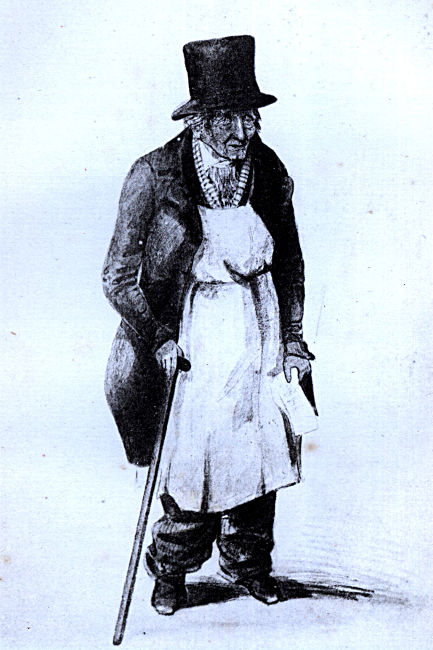
BEN BOUCHER. THE DUDLEY POET, 1847.
This extraordinary old man was truly a “curiosity” in himself; for many years he enlivened the Black Country with distiches of the ins and outs of life, in all its varied phases, by his peculiar doggerel poetry or songs, which the old man used to compose on any public event which struck his fancy or provoked his wrath. He then sallied out to the wondering public, and sold his songs at one penny per sheet, and familiar indeed was the figure of the old poet, daily in our streets vending his singular wares. He took up all sorts of sad, grim, and pleasurable subjects, from the hanging of some wretch at Stafford Gaol, to a dog, or cock fight at Sedgley, or Tipton. Ben Boucher was a Collier by trade, and was born at Horseley Heath, in the year 1769, but the greater part of his singular and irregular life was spent in Dudley, at certain favourite public house haunts, where his talents were appreciated, and his songs admired and read by the curious.
The following is a sample of some of his effusions:—On the death of Dr. Booker, away from Dudley.
St. Luke is dead—a Poet and Divine— I hope his spirit doth in glory shine. To save expense, and the roads being ugly, Or the Doctor would have come to Dudley.
In Dudley town there lives a man Who deals in silk and clothes, sir; If you trust him your mutton to Cook, He’ll be sure to spoil your broth, sir.
A certain tailor kept a horse for amusement in those days, not in the best condition, so we have the horse described:—
THE HORSE.
His back it is both long and thin, His belly has got no corn therein; He looks both naked and forlorn, And takes the whip instead of corn.
Mr. Jno. Williams a highly respectable draper in the town, having altered his political opinions in those days, fell in for Ben’s animadversions on that occasion.
Where is big John the draper gone, Chairman at last election, The Bowling Green, that source of spleen Which led to his detection.
Written on the pulling down of the old St. Thomas’s Parish Church:—
The seats and the windows, ah, and the clock too, Were sent on to Gornal, to their Gornal crew; For the sand men and asses, for to go to church, And the people of Dudley were left in the lurch.
LINES ON DUDLEY MARKET, 1827.
At Dudley Market, now I tell, Most kind of articles they sell; The women take the greatest care To buy up crocks and earthenware, Milkpans, and colliers’ tots, Coloured cups and chamber-pots. Old shoes to sell, there stands close by, With shabby strings—the same they tie; If in those shoes you walk about, The bottoms soon will tumble out— Hats, caps, and bonnets blue, And trowsers wide enough for two.— If you pop round the market place There you may buy a farthing lace; Besides penknives, for Jack and Jim, And razors for the daddy’s chin— Rocking-chairs and children’s cradles, Porridge-pots and wooden ladles.— Kash from Walsall, kills the worms; Judas brings a salve for corns; Mind these men or you’ll be bitten— Black Jack’s wife brings salve from Tipton— At the top of the Shambles Sally stands, She holds the basket in her hands: “Now my good people don’t be lacking, Here you may buy the best of blacking.” Just below, the butchers there you’ll find, With shows of meat to please the mind; From most parts these butchers come; Mind the steelyard—twig the thumb.— There’s hares, rabbits, and partridges, and pheasants, too, Some are shot by sportsmen, and some are hung by the neck, too— There’s butter, bacon, cheese, and eggs, Sold by old Giles with crooked legs— More than that if you just turn round, There’s gingerbread eightpence a pound! Besides plum pudding, both rich and nice, On the next stall twopence a slice.— In Stoney Street there stands the swine, Both right and left all in a line; They sell these pigs so much per score, So on that street I’ll say no more.— Come, to a tavern let us go, There’s some above and some below; There’s one that keeps good ale and pop, He also keeps a liquor shop; He sells roast beef down in Queen Street, His house is always clean and neat— Old Nanny Mason comes in with her nuts, And on the floor her basket puts; A curtsey drops, “Kind sirs,” says she, “Mine age is nearly eighty-three.”— Old Timms comes in, “All hot,” did cry, And you may either toss or buy.— There’s one-arm’d Joe among the lot, With mutton pies all smoking hot. Please to remember what I have said: You will never hear the like again.
When Mr. Thomas Hawkes defeated Sir John Campbell at the election:—
Hawkes to Cape—ll gave a note, And for five pounds bought his vote; He therefore thus did change his coat And to the Tories gave his vote.
ON A WATERLOO VETERAN
Charley was young and in his prime, A courting went to widow Pincher; She was shy, and fair, and fine, He was constant and no flincher. The time arrived when they got married, She had houses, and cows, Sirs, four, But Charley soon them all did swallid, And left her in an evil hour; He went and drank just like an ass, Then came home as you may guess And found her dead; but was not wise, So he’d make her do the exercise; The women did not like such jokes, So they sent off for T. Pitt Stokes— Who neck and crop to the Workhouse took him And in the dungeon they did hook him. This madman told the gentlemen, That he would fetch her back again, So they kept him there till she was buried, When he got home he was most worried.
Many hundred comical verses by this singular man have perished from memory since his death, but Ben was a great Tory in his time, and his latter days were sustained by political association and sympathy. The old man at last became houseless and very poor, and was eventually removed to the Workhouse, where he died in 1851, being upwards of eighty years of age.
TO THE FREE AND INDEPENDENT ELECTORS OF THE BOROUGH OF DUDLEY.
Gentlemen,
The proceedings of this morning at the Hustings having through your united generous efforts resulted in my being elected as your Representative in the ensuing Parliament, I hasten to tender you my most heartfelt acknowledgments for the honour you have conferred upon me in placing me in the proud position which it is now my privilege to occupy.
I abstain from referring to the contest, which during my canvass appeared to be before me, and I cheerfully congratulate you on the peaceful and successful termination of the struggle in which we have been engaged.
To you, Gentlemen, the victory is due; a more enlightened, faithful, and zealous body of supporters never rallied round a Candidate, even to vindicate the great right of Municipal Independence.
Gentlemen, my political principles are now well known to you, they have been unreservedly communicated, and have your unqualified approbation. Believe me, it shall be my study vigorously to aid in giving effect to them in the House of Commons, and also to further all measures of local improvement or general principle which have the approval of my Constituents.
I trust, Gentlemen, I shall ere long have an opportunity of renewing my personal acquaintance with you, and by interchanging those sentiments and feelings which have animated and sustained us in the contest now happily at an end.
Till then I bid you farewell; and once more offering you my grateful acknowledgements,
I have the honor to be,
Your most obedient Servant,
HENRY BRINSLEY SHERIDAN.
Bush Hotel, Dudley, March 27, 1857.
This contest, so abruptly brought to a close by the resignation of Mr. Sandars at the eleventh hour, proclaimed the Political Independence of the Borough of Dudley for all time. The pointed pen of squibs and banter was more liberally used at this election than on former occasions, but it must be recollected that the 25 years past had brought new literary blood into the town; that our old sedate fashion of conducting an election had died out, and we had now entered upon a new path of fame and progression, which our grandfathers never dreamt about. However, “the horse-play” at the time was taken in good part, “a Roland was now and then given for an Oliver,” and there was not a few of our liege subjects who were more pleased than offended at being placed in the mirror of these stirring days. Mr. Sheridan received a truly public ovation on his leaving the town for London, and old, excited Dudley soon resumed its wonted quietude.