THE CRUISE OF THE "JANET NICHOL"
Reading edition
The Janet Nichol was an iron-screw cargo boat, topsail schooner rigged, of some six hundred tons gross. Her large, airy saloon and cabins were placed amidship on the main deck, with ports opening forward, the "trade room" being at the extreme aft. There was a comfortable bathroom and space enough on deck for exercise; but, for that matter, we might walk, sit, or sleep where we would. I have slept in the chart room and on the platform of the captain's bridge; though the after hatch, over which a great awning was spread, was the place chosen by the most of us for permanent night quarters. Here some swung in hammocks, some lay on mats, while the more luxurious carried blankets and pillows back and forth each night and morning. For me four mats were hung in a square; the mats, being loosely woven, did not cut off the current of air that usually swept over the hatch nor, unfortunately, the terrible groans of one of the mates who slept near me and was subject to nightmares.
Our mess consisted of Mr. Henderson, a member of the company that owned the vessel; Captain Henry, sailing-master; Mr. Hird, supercargo; Mr. Stoddard, engineer; Mr. Buckland, commonly called Tin Jack (Tin being the island equivalent for Mr.), a trader of the company returning to his station, my husband, my son Lloyd, and myself. The Janet carried a crew of about nine white men and some forty-odd black boys from the different islands of the Solomons and the New Hebrides.
We left Sydney on the 11th of April with a head wind and heavy seas until we arrived at Auckland, making seven days from port to port.
April 18th, 1890.—At Auckland in time for dinner. Went on shore and dined at a hotel with the supercargo and Tin Jack. Louis and I slept at the hotel with the understanding that Tin Jack and Lloyd should meet us in the morning with a shopping list. Immediately on our arrival in Auckland a strange cat jumped through a port-hole and now remains on board.
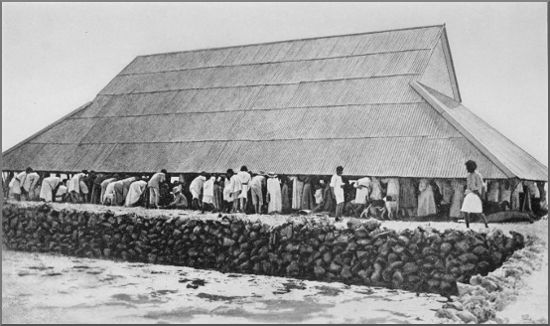
Outside of the great dance-house, Butaritari, during the competition between the dancers of Butaritari and those of Little Makin. Robert Louis Stevenson can be seen near the centre, just bending over to enter
19th.—Bought a broadcloth coat for Maka and a good black silk dress for Mary. As the Janet was bound for "the South Seas" and nothing more definite, we thought it better to carry presents in case we found ourselves in the neighbourhood of Butaritari.[1] I came back to the hotel in advance of Tin Jack and Lloyd, who stopped to buy fireworks for the entertainment of Tin Jack's native retainers. Besides the fireworks, which included ten pounds of "calcium fire," Tin Jack has also purchased cartridges, grease-paints, a false nose, and a wig.
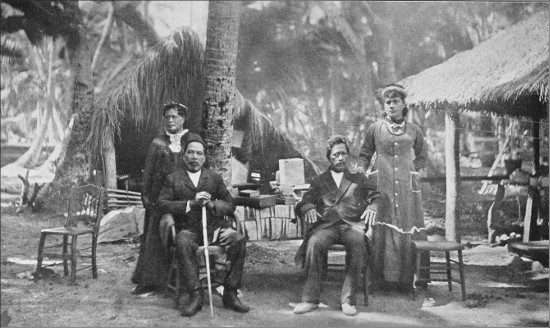
Maka and Mary Maka, Kanoa and Mrs. Maria Kanoa, Hawaiian missionaries of the American Board of Missions, Honolulu, on the Island of Butaritari, one of the Gilbert Islands
Lloyd was a little doubtful about the calcium fire and questioned the man at the chemist shop rather closely, particularly as to its inflammability, explaining that it was to be carried on board ship. The man declared that it was perfectly safe, "as safe," said he, "as a packet of sugar," adding that fire from a match would not be sufficient to ignite it. "Will you have it with or without fumes?" he asked as he turned to make up the parcel. The thrifty trader thought that he might as well get all he could for the money expended, therefore took it with fumes.
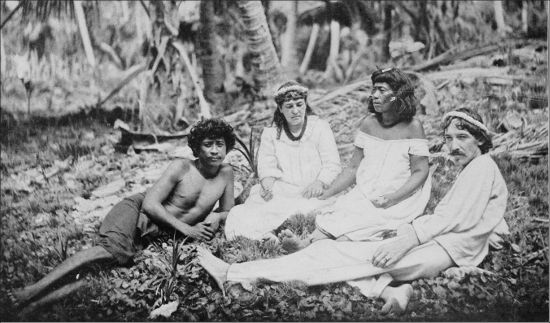
Mr. and Mrs. Stevenson in company with Nan Tok and Natakanti on Butaritari Island
On Board in the Afternoon.—A little trouble with the trades-union, but nothing serious. Mr. W——, a bookseller, who had recognised Louis from a published portrait, called in the evening. He kindly offered to get pistol cartridges for us, and after a few minutes' conversation ran away after them, returning just as we were about to leave, with a couple hundred or thereabouts. The fireworks were sent aboard with other parcels, and, having no distinguishing marks, Lloyd put them all, along with our cartridges, on his bunk until Tin Jack, whose cabin he shared, should come below and sort them out. Among them should be a pistol Tin Jack had taken to have mended, belonging to Louis.
20th.—We left Auckland last evening at about eight, the streaming lights from the town following us a long way. A small, half-grown dog has joined the ship's company.
Between ten and eleven Louis was lying in his cabin very tired and glad to rest. Tin Jack and Lloyd were in Mr. Henderson's cabin drinking coffee and discussing "land booms." I sat at the saloon table eating brown bread and butter. Suddenly, from the cabin occupied by Tin Jack and Lloyd, came a spitting puff, almost immediately followed by gorgeous flames and the most horrible chemical stench. The calcium fire that was as safe as a packet of sugar had gone off and ignited the rest of the fireworks. Only Lloyd and I knew of the cartridges in their midst, but we discreetly held our tongues, though every moment we expected to hear the ping of flying bullets. I ran into our cabin and snatched a heavy red blanket. At the same time Mr. Henderson was fetching a large, handsome woollen rug from his cabin. I felt for a hand to put the blanket in, for the place was so full of suffocating vapour that one could see nothing but the many-hued flames darting through it. Fortunately, it was the captain's hand I delivered my blanket into. Rid of my blanket, I ran back and thrust my head out of a port to get a breath of air; the ports, although they were the means of fanning the flames, could not be shut on account of the strangling fumes. Here Mr. Henderson, who had been for some minutes lying on the stairs quite insensible, came to fetch me out; so, catching his hand, I ran through the saloon to the companionway and up to the deck.
Louis, who knew nothing of the fireworks having been brought on board, was thunderstruck by the vivid changing colours of the spouts of flame, and stood for some time gazing at the extraordinary scene and inhaling the poisonous vapours. "Why," he thought with wonder, "should a fire at sea look like a Christmas pantomime?" His amazement was so great that he was hardly conscious of the fumes.
The captain, from the bridge, had seen heavy vapour pouring upward and was both puzzled and angry, thinking the engineer was letting off steam for purposes of his own. The stuff must, therefore, have been smouldering for a considerable time before it burst into flames, the draught carrying the smoke out of the open port instead of into the saloon, so that our first knowledge of anything amiss came from the bursting of rockets into the saloon. As the captain was looking at the supposed column of steam there suddenly shot through it, rising high into the air, a shaft of blue, green, and red fire. Ordering the donkey-engine to pump water and the hose to be put on, he ran below and crawled into the very centre of the fire with the blanket, rug, and hose, and succeeded in smothering the flames none too soon for the safety of the ship; he said afterward that had the wind come from a different quarter, or had the cartridges exploded, nothing could have saved us.
There was no panic among our black boys, who worked swiftly and obediently; I rather suspect they enjoyed the excitement of the affair. Talking it over, the captain said how lucky it was that he had a man at the wheel that he could trust. Lloyd and I said nothing, but we both knew there had been no man at the wheel; the trusted one ran below with the rest. It was a rather dangerous moment to leave the ship drifting, for we were not nearly out of the harbour, being just opposite the lighthouse when the fire broke out. A steamer passed us quite closely when the scene was at its wildest. Coloured fire and thick white vapour belching from our ports must have given us a very strange and alarming aspect. Lloyd looked over the opposite side of our ship and saw the ports there, also, vomiting vapour like a factory.
To our surprise the cartridge-boxes were only slightly scorched. Our personal loss, however, has been very severe. About ninety photographs were destroyed and all of Lloyd's clothes except those on his back. Neither he nor I have even a tooth-brush left. The annoying thing is that Tin Jack has lost nothing whatever. Lloyd is very bitter about the discrimination shown in the matter of trousers by the fire. I stopped a couple of black boys just in time to prevent them throwing overboard a blazing valise containing four large boxes of Louis' papers. A black bag, its contents at present unknown, is burned, and innumerable small necessaries that conduce to comfort on shipboard are lost. I have ever since been in a tremor lest Louis have a hæmorrhage. If he does I shall feel inclined to do something very desperate to the chemist, who, for the sake of a few shillings, put us all in such deadly peril. A horrid smell still hangs about the place and every one feels ill. Though I hardly breathed in the room, I have a heavy oppression on my chest, and my throat and lungs burn as though I were inhaling pepper. From the time we left Auckland the water has been as smooth as glass, and there has been no jarring or knocking about; the stuff must have gone off by simple spontaneous combustion. Had it taken place a very little later, Tin Jack must have been sleeping in the berth above, and should undoubtedly have been suffocated.
2lst.—Still drying the remains of Lloyd's clothes, burned and wet in the fire, and discovering more and more losses. Fortunately, the flag I had made for King Tembinoka was not injured at all (a royal standard I invented for him). The flag for the island I had already sent, and the cartridge-belt Lloyd is taking to him for a present is only a little smudged.[2] Both our cameras escaped as by magic.
Louis has been playing chess with the captain, who has not played before for many years. I have been making wreaths of artificial flowers for presents to the natives. I bought in Sydney several large boxes of old-fashioned artificial flowers, perfectly fresh and pretty, also green leaves unwired. For one pound and three shillings I got enough for twenty full wreaths and eighteen more to be worked up with coloured feathers. I do not think the natives will enjoy getting the wreaths any more than I enjoy making them.[3] (One of our sailors appeared on duty in a garland and necklace of orange-peel.) The sea is smooth and the weather perfect.
22d.—The weather still lovely. Saw a small island called Curtis Island, and at half past ten sighted Sunday Island. The captain kindly took us very close in that we might get a good photograph. A puff of smoke appeared on the horizon, supposed to be a steamer; great excitement. I ran to write letters and found Mr. Henderson doing the same; but alas, the ship, which looked like a man-of-war, moved away from us nearer to the island, and it was too late to venture to chase her, so our letters must wait. Sunday is the island where an American family once took up their residence, remaining until it began to blow up. Some settlers have lately gone there. Lloyd reminds me that this was the place Louis and he once proposed to try and get possession of, and I refused to hear of the plan because of the volcano and the hordes of rats that infest the place. I repented when I saw it, and my heart is now set upon owning an island. It grows warmer daily, and I hope soon to be able to put away my shoes and stockings.[4] Mr. Henderson is looking for an island about the existence of which there is some doubt. Lloyd tells me that Mr. Low, the artist in New York, once said that he had a friend who had actually been upon this very island.
26th.—I have not been able to put away my shoes and stockings, for the sun disappeared soon after my last entry; for several days we have been knocking about in a gale of wind with almost continuous rain. The air is thick and breathless, hot, and at the same time chill. To my discomfort, I caught a cold and developed a smart attack of rheumatism. The captain has also been unfortunate; he, too, took cold, and in addition had a heavy door slam upon one of his fingers, crushing the nail. Some time ago a cinder blew into one of his eyes, causing an inflammation, and now the other is as bad in consequence of the poisonous fumes of our involuntary firework display.
To-day we came to anchor off Savage Island, or Nuieue, having on board some eight natives of the place who were being returned home by the company. It was pleasant to see the happy, excited faces of the "boys" as we drew near their native land. They were all dressed for the occasion in new clothes, every man with a pair of strong new boots on his feet. A couple of dandies wore velvet smoking-caps with tassels, and red sashes. It is a smaller and lighter-coloured race than we have been accustomed to, their features and expression reminding one of pretty, sweet-faced Chinamen. Before we had anchored, neatly made outriggers were circling round the ship and cries of greeting arose from all sides. When the steam-whistle sounded a joyful answering shout ran along the beach. No women came out to us. To them a ship is tapu, but numbers of small boys accompanied the men. Soon they were all wandering over the ship, marvelling at the strange sights, but also cannily ready to make an honest or dishonest penny. I bought a couple of sticks of sugar-cane for a stick of tobacco and ordered a hat from a man for which I am to pay two shillings. The man had a hat with him but charged four shillings for it on account of its trimming, a small bit of red flannel laid round the crown. I also bought a couple of little model canoes (one for Tin Jack) for two shillings.
Our sailors are "black fellows," some from the New Hebrides, some from the Solomons and various other places. They seem to find it easier to speak to one another in English than in their own tongues; I heard one say: "I wouldn't like to go across that water in that fellow's canoe." The men from Nuieue looked at those black fellows with great curiosity and asked in what island did they find men like that. One of these black sailors has his name signed as Sally Day. To-day I heard one of the others politely call him Sarah. Savage Island is a high-low island; that is, it is a coral atoll with a soil, raised more or less unevenly, some two hundred feet above the sea-level. It produces copra, bananas, cotton, breadfruit, bêche-de-mer, and fungus, and is governed by a king with the assistance of four chiefs and four sub-chiefs. Food trees and plants are carefully cultivated, and the people have the reputation of being industrious and willing to work. Captain Henry wished to take a little girl home to his wife, but was not allowed, it being against the law that a female should leave the island.
In at least one of the villages of Nuieue a singular custom prevails. One day in the year is fixed as a day of judgment. Every soul, man, woman, and child, gathers together on the village green. Votes are cast for a whipper, and a jury, composed of half Christians and half heathens, is chosen. One by one the people come forward and publicly confess their sins, while the jury fixes the punishment, which is whipping or an equivalent fine. The fines may be paid in goods of any sort, the value of the article offered being rated at the price originally paid for it. For instance, a man fined a dollar may bring the unwearable remains of a tattered hat that cost him a dollar the year before. The elected officials do not escape punishment by virtue of their position. After the jury has confessed and fixed its own punishment, the whipper must do the same, and, if whipping is his doom, must proceed to whip himself. So, next day, every soul starts afresh with consciences sponged clean, ready for a new record of sins. The confessions seem to be genuine and sometimes cause the utmost surprise and consternation to those who have been sinned against.
The desire to own an island is still burning in my breast. In this neighbourhood, nearer Samoa, is just the island I want, owned, unfortunately, by a man in Tahiti. It is called Nassau and is said to be uninhabited.
Last night an immense rat ran over me in bed, and Mr. Henderson had the same unpleasant experience. In the hold of the Janet are a number of pure white rats with red eyes, which appeared of themselves quite mysteriously. The captain will not allow them to be harmed, which I think is very nice and sentimental of him. It was amusing to see our dog's perplexity when we came to anchor, and he put his head out of a port-hole to have a look at Auckland. His very tail expressed alarmed surprise. Our second steward (a white man) is in a state of wild delight. He took his "billet" under the head steward from a romantic hope of seeing Samoa, of which he had once read a description in a newspaper. Every little while I hear his voice, quivering with excitement: "What do you think of it, Mrs. Stevens?" One moment he is thrusting sugar-cane into my hand: "Taste it, Mrs. Stevens, it's sugar stick! I never saw it before!" and the next is: "Cocoanut! cocoanut! It's green cocoanut, Mrs. Stevens; I never saw it before in my life!" It is of no use to tell him that it is all an old story to me; he hears nothing but babbles on with shining eyes. I have just overheard this from a white stoker who had also never been in the tropics before: "He's been and swindled me, that native! There's nothing inside this green cocoanut but some kind of water."
Mr. Henderson has just told us as a secret that our next island will be Upolu, Samoa, and we are now as wildly excited as the second steward. On Wednesday afternoon, at four o'clock, we shall arrive at Apia, and the next morning, at break of day, off we fly to Vailima. As we were discussing the subject, the captain called out that there was a white rat in his cabin and he wished to catch and tame it, so I ran to help him. It was under his bed, he said, and the loveliest rat in the world. As he was dilating on its beauty, out it flashed, jumping on him and rebounding against my breast like a fluff of white cotton wool. The captain laughed and screamed with shrill, hysterical cries, in which I joined, while the loveliest rat in the world scurried away.
27th.—The weather really abominable, so cold that I have had to put on a flannel bodice. Tin Jack and Lloyd went to the station last night and returned with the white trader, a thin, pallid man, with a large, hooked nose and soft, frightened brown eyes. For very dullness I was about to go to sleep, when Mr. Henderson ran up, crying: "Sail ho!" Sure enough, there was a large vessel wallowing in the great seas. Captain Henry thought her an American driven in by the heavy weather. Round the point of the island the breakers were rising, he said, some forty feet high. While we were watching the strange craft she turned about and sailed away, to our great disappointment, no doubt having only come up to take her bearings. After I had closed my diary last night Mr. Henderson got out the chart and showed us his own islands and the supposed location of Victoria Island which he is looking for. I offered to toss him for the latter, to which he agreed. Louis threw up a piece of money and I won. I have yet, however, to find Victoria.
Nuieue has not yet recovered from the effects of last year's hurricane, and we shall not get many delicacies here. There are no ripe cocoanuts, few bananas, and no breadfruit. Some one said that I could get spring onions. "How do they grow them?" I asked; meaning did they sow seeds or plant sets. "On the graves," was the rather startling answer.
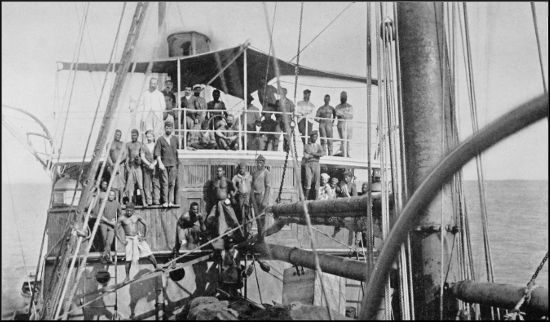
The "Janet Nichol" with ship's company
Last night Mr. Henderson pulled off a rat's tail. He thought to pull the rat from a hole from which the tail protruded, but the tail came off, and the rat ran away. The captain tells me that there is generally a plague of flies in Nuieue. It is too cold for them now, but usually when the natives come out in their canoes their backs, especially, are black with flies. Some one has sent me a basket of bananas almost too sweet and rich; also some excellent oranges. I have mended the bellows of our camera, where it has been eaten by cockroaches, with sticking-plaster.
28th.—Steamed round to the other side of the island to the missionary station, carrying with us the trader and a young Irishman named Hicks; also a native woman and a boy. Here, to our surprise, we saw the vessel we had sighted and lost; she proved to be the John Williams.
We watched her plunging to and fro, now close under the cliffs, now skirting the Janet, now fetching our hearts in our mouths as she stayed, and forereached in staying, till you would have thought she had leaves on her jib-boom. We actually got up the camera to take a photograph of the expected shipwreck. We were told afterward that it was only Captain Turpie showing off his seamanship.
The John Williams is a missionary ship on her way to Samoa with an English missionary and his family and a German lady who is going to open a school for Samoan girls. Mr. Lawes is the Nuieue missionary, a dark, foreign-looking man. We heard nothing but good of him from traders and natives.
We landed and climbed up the part path, part stairs of the cliff, our boys already trailing down it with copra sacks, the ship's boat slamming away at the jetty with a couple of black fellows holding on to it like grim death. The missionary natives were ranged in bodies on the path to meet us. First the men pressed forward, giggling, and shook hands; then the women, whose many-coloured garments we had remarked even from the ship, glowing on the cliff like a bank of flowers. The children who followed after pretended alarm and fled, but laughed as they ran. I was some distance from Louis, who has written the following in my diary:[5] "They closed in on me like a sea; I was in the close embrace of half a dozen outstretched hands, with smiling faces all round me, and a perfect song of salutation going up. From the sirens I escaped by means of a present of tobacco, which was the cause of my ruin, later on, when Lloyd and I went out to photograph. A bevy of girls followed, hugging and embracing me, and going through my pockets. It was the nearest thing to an ugly sight, and still it was pretty; there was no jeering, no roughness, they fawned upon and robbed me like well-behaved and healthy children with a favourite uncle. My own cut tobacco and my papers they respected; but a little while after, on making a cigarette, I found my match-box gone. There was small doubt in my mind as to the culprit; a certain plump little maid, more like a Hawaiian, with a coquettish cast of face and carriage of the head, and conspicuous by a splendid red flower stuck in her ear, had visited me with a particular thoroughness. I demanded my matches. She shook her head at first; and then from some unknown receptacle produced my box, drew out a single match, replaced the box, and with a subtle smile and considerable grace of demeanour, something like a courtly hostess, passed me on the match!"
Tin Jack was shown some spies who were taking names of women who had, against rules, been aboard ship. They will all be fined to-morrow. Levity of conduct, they tell us, is not allowed and is met by fines. I should imagine the public funds to be in a plethoric condition.
Before I knew where I was the trader had swept me up to the mission house, well built of coral, with a high, wide roof of cocoanut thatch beautifully braided together and tied with cocoanut sennit. In an inner room we found the passengers from the John Williams, Mr. and Mrs. Marriott and the German teacher. The Marriotts had with them the loveliest little twins imaginable, two years old, and almost exactly alike. Louis and Lloyd disappeared at once in search of photographs. The king, who seems to be liked and respected, was off in the bush, so they were disappointed in his likeness. After a reasonable time of worship before the twins, I started to follow the photographers, the trader conducting me, the John Williams party and Mr. Lawes (the resident missionary) following. We passed a cow, a bull, and two horses, strange sights for these latitudes. There were a great many flowers blooming in the underbrush—jasmine, the flamboyant, and a yellow blossom like a "four-o'clock"—and where a space had been cleared grass was growing. There is no running water, but through small fissures in the rock brackish water is found at the depth of seven fathoms. I was told of one great fissure, into which stone steps had been cut, where a subterranean stream gushes out in a waterfall.
The trader, who had already sold us three tappa (native bark-cloth) table-cloths at an exorbitant price, clung to me pertinaciously, taking me into his house, where he showed me a mat he wished a pound for, whereas it was worth but a couple of dollars. I refused to buy it, whereupon he presented me with two small rather pretty mats. I thought he owed them to me, so I accepted them without compunction. The young Irishman, who had followed us in, opened his box and took out an immense yellow shell necklace, a cocoa-shell basket, and a strange, very heavy, carefully shaped stone, which the natives use in fighting. All these articles he insisted on my accepting. I was greatly pleased with the fighting stone. The trader promised to get me a couple of "peace sticks" when we return to his side of the island. These are used by the women when they think a fight has lasted long enough. They rush between the combatants, waving their "peace sticks," and the affair ends. These peace sticks are made of dark, almost black ironwood, are about three feet long, shaped like spears, and ornamented, where the hand naturally holds them, with cocoa-fibre sennit and yellow bird feathers. The feathers looked to be the same as were used in Hawaii for the royal cloaks. As I write Tin Jack appears in a hat of Nuieue manufacture, braided pandanus, in shape an exact reproduction of the civilised high silk hat, and indescribably comic.
Returning to the mission house, we stopped at the king's newly built palace for a piece of ironwood that I wanted to mend the camera stand. The queen, a pretty, smiling, young woman, stood in the doorway directing us where to look. Arriving at the house, I examined the house dog's ear, and found he was suffering from canker. Louis and I, together, remembered the remedy for him, and told it to Mr. Lawes. I begged that Louis and Lloyd might see the twins. The little fairies were heavy-eyed from the knocking about and the close air of the John Williams. Each had had a convulsion during the last two days. I thought they looked rather too much like little angels. I tried, without success, to make our party refuse Mrs. Lawes's invitation to high tea. It did seem very hard; month after month passes in the most deadly monotony. Suddenly here are two ships at her door, each, incredible fact, with white women on board, and she has almost no time to speak to either, and in an hour or two they are gone. Poor Mrs. Lawes had wild eyes when the two sets of passengers and most of the officers gathered in a great circle round her board. It was an excellent meal, which I should have thoroughly enjoyed had I not felt like a cannibal and that I was eating Mrs. Lawes. But this it is to be a missionary's wife. I am sure she must have had a nervous fever after we were gone. She found a moment to bewail her fate to Louis; if only we had come piecemeal, as it were, and not all at once, like a waterspout, she would have been so happy. We shall leave behind us only a memory of hurry and flurry and confusion worse confounded. While we were at table the John Williams ran so close inshore that we were frightened, and Mr. Marriott very anxious, as all his worldly goods were on board. The John Williams left Sydney on Friday the 11th, the same day we did, and now we meet here and possibly may meet again in Samoa. We had just finished our meal when the steam-whistle blew for us, and away we all trooped to the boat. The John Williams was leaving also.
We had some trade stuff to be landed at the other side of the island. There Lloyd went ashore and got my peace sticks for which he paid two shillings the pair. A great many natives came aboard, among the rest the handsome sister and daughter of a chief. I gave them both a wreath, to their great pride and joy. Tin Jack dressed up in his wig and whiskers and false nose. The natives at first were much alarmed and some of the women inclined to cry.
29th.—Squally all night, but this morning the sun has come out and it really looks hopeful. The captain has been working all day until four o'clock at my device for mending the camera with Nuieue ironwood. I hardly slept last night for the heavy rolling and pitching of the Janet. A black cat has appeared, brought on board from Nuieue. It was proposed to have a rat hunt with the Auckland dog. I meanly intended to inform the captain, but I need not have troubled myself, for when a rat was shown to the dog he nearly went into a fit with terror. I have all my things ready packed to go on shore at Samoa.
30th.—Passed Tutuila in the morning. Almost despair of reaching Upolu before to-morrow, owing to an adverse current, but make it just after sundown. We ran along Upolu for a couple of hours, the scenery enchanting; abrupt mountains, not so high as in Tahiti or Hawaii, nor so strangely awful as the Marquesan highlands, but with a great beauty of outline and colour, the thick jungle looking from the deck of the ship like soft green moss. Through the glass I could see a high, narrow waterfall drop into the sea. Breaths of the land breeze began to come out to us, intoxicating with the odours of the earth, of growing trees, sweet flowers and fruits, and dominating all, the clean, wholesome smell of breadfruit baking in hot stones. Soon masts of ships began to show, and the smoke of Apia. The signal-flag was carried up to the foretopmast and laboriously tied on by a black boy, when the pilot came quickly on board. It was not quite dark, but we thought it better to dine on the Janet, though we were burning to get on shore. While we were eating, people began to arrive in boats to offer their welcome to Samoa. Louis and I started off, leaving Lloyd to follow in the ship's boat. It was a dream-like thing to find oneself walking along Apia beach, shaking hands and passing talofas on every side. We spent the evening on shore and, after ordering horses for the early morning, went to bed tired out.
May 1st.—Woke at six to hear the horses coming for us. When last we rode out to Vailima the road was but a bridle-path almost closed in by the bush. We can now ride two abreast, or even three, if we like. Tin Jack was much delighted to see pineapples growing wild, and bewailed his mistake in having settled on a low island. Lloyd rode ahead to a native village on the road with a packet of sweeties for some little girls who used to dance for us when we lived in the bush near by. We found Lloyd waiting for us; only one of the little girls was about. After we left the village the road plunged into the forest. The tall, liana-draped trees, carrying ferns in the forks of their branches, cast a grateful shade, and we rode slowly, to enjoy all to the utmost.
There was a crowd of black boys at Vailima cutting down and burning trees and brush. I believe they are runaways from the German plantations. There are a good many noble trees, of great height and girth, left standing. A little, wooden house has been run up, from the balcony of which we could see the masts of the Janet as she lay at anchor and past her far out over the sea.
It is odd how little is known of Samoa, even by its inhabitants. In Sydney I asked particulars concerning a turbine wheel in case I should want one in Vailima. The man I consulted assured me it would be quite useless to attempt such a thing, as a friend of his just from Samoa, who had lived there a long time, told him there was not a tree of any size in Upolu, and none whatever of hardwood. On the contrary, in the bush are numbers of magnificent timber-trees, very hard and beautiful in colour. One in particular, a light yellow, is very like satinwood and another seems to be a sort of mahogany. We took photographs, and after a couple of hours reluctantly tore ourselves away.
A native man, an old friend, stopped us on the way back to Apia, holding the bridles of our horses that we should not escape him. A woman we were acquainted with passed; she turned and stopped, cooing like a dove, every limb and feature expressing surprise and delight.
After an inordinate luncheon I opened some boxes we had left here and took out various articles suitable for presents. At the main store we found our bush friend and his little daughter waiting for us with a large basket of oranges. Louis gave the child a shilling and told her to choose from the shelves a piece of cotton print. She was dazzled by the magnificence of the offer, and after long deliberation chose the ugliest piece of the lot. I gave an old woman a print gown, upon which she purred like a cat and kissed my hands. Our old friend Sitione (wounded in the late war) came up and spoke to us, looking very ill, his arm bandaged and in a sling. The doctor tells Louis he thinks very badly of the arm and fears he must amputate it.[6] There was also something wrong with Sitione's eye which was bandaged.
A little boy brought a basket of chilli peppers I wanted to carry on board with me. There were no vegetables to be had, as the Chinaman's garden, the only one in Samoa, had been washed away by a freshet. At half past three we returned to the Janet, where Doctor Steubel, the German consul-general, Baron von Pritzfritz, captain of the German man-of-war lying in Apia harbour, and another German whose name I forget paid us a visit. We talked a few moments and drank a glass of champagne; then the whistle sounded, our friends bade us good-bye, and at about four we steamed out. Our little house in the bush was visible to the naked eye from the deck of the steamer.
3d.—At about three o'clock we sighted an island known by various names—Swayne's Island, Quiros, or Olesenga—a small, round, low island surrounding a triangular brackish lagoon like an ornamental lake in a park. It is inhabited by a half-caste man known as King Jennings, his family, and about eighty people from different islands. The original Jennings was an American who married a Samoan wife. He left Samoa in a huff after having built a man-of-war for the government, for which payment was refused. As the motive power of the ship came from wooden paddle-wheels, turned with a crank by hand, it is hardly surprising that the complaint of her extreme slowness and the great labour involved in working her should have been brought forward as reasons for non-payment. She had a complete armament of great guns and all the equipments of a proper man-of-war. Jennings, in a fury of indignation and disappointment, shook the dust of Samoa off his feet, and with his wife and family set up a little kingdom of his own in Quiros. Here he blew out a passage through the reef, built two schooners of island wood, floated them off with barrels, and sold them to the German firm at Samoa.
A flag was hoisted on Quiros, the stars and stripes, with what appeared to be a dove in the field. We asked with some curiosity what the dove indicated. They told us that a night-bird came and cried about the settlement for months; this was supposed to bode sickness; so to propitiate the ill-omened bird it was added to the flag.
There is a good road on the island, excellent houses, a church, and a schoolhouse containing an imported half-caste schoolmaster. From a tall building used for storing copra men were already laying a temporary wooden track down to the landing for the copra trucks to run upon. This busy scene was brought to an end by Mr. Henderson's information that he would not take in cargo until our return voyage. This is a rich, low island with plenty of soil, and is said to bring in a very comfortable revenue, which might be still larger did King Jennings care to make it so.
Mr. Henderson and Louis went on shore; while they were away I tried to make a Mexican sauce, called salsa, with the chillis from Samoa and the onions from the Nuieue graves. The chillis burned my hands dreadfully, and the sauce turned out to be too hot to be used except as a flavouring for soups, for which it was excellent.
Mr. Henderson and Louis came back with some return labour boys for Danger Island. One who had signed to serve five years had been waiting another three for a vessel to take him home. He was once disappointed, and nearly died of it. I am thankful he had this opportunity.[7] I can see a horse eating grass on the island, and Louis has seen a carriage.
4th.—Ran through a light squall in the night and sighted Danger Island at four in the morning. At the first landing is a place in the reef where people upset in boats are sucked under, never to be seen again. Our Quiros passengers are in a wild state of excitement; ladies on the after hatch slipping on their clean shifts, and the comb going from hand to hand. The eight-year exile clutched Louis's hand, and in a voice trembling with emotion ejaculated "coco nuk." As we drew nearer the three islands of the group began to detach themselves. Danger Island, or Pukapuka, is the only one inhabited. It is governed by a king who allows none of his subjects to gather cocoanuts without his royal permission, and as he seldom lets any one have more than is sufficient for his food, very little copra is made. Here the nuts, contrary to the usual custom, are dried in the shell to prevent cockroaches from devouring the meat, and consequently the copra is very fine and white; but the quantity made is so small that it does not pay to keep a trader on the island.
We could see the natives gathering on the beach in great force. They seemed thunderstruck at the sight of a vessel with furled sails moving so rapidly against a strong head wind, the Janet being the first steamer that had touched at Pukapuka. As soon as our passengers were recognised, a joyful shout ran up and down the beach, and, canoes were launched and paddled out to meet us. When they were just abreast of us Captain Henry blew the steam-whistle. The natives were appalled; every paddle stopped short, and the crowds on the beach seemed stricken to stone. Our Pukapuka passengers tried to encourage the people in the canoes to come nearer, calling to them from the deck of the ship, but it was some time before they took heart and resumed their paddling. The King, a shabbily clad man of rather mean appearance, was among them.
The meeting between the long-parted friends was very pretty and touching. I like their mode of showing affection better than ours. They took hands and pressed their faces together lightly with a delicate sniff, as I have often seen a white mother caress her baby. One elderly woman, I was sorry to see, had bad news; she looked very sorrowful, and when a young boy came up to greet her she threw her arms round him and wept aloud. All the rest, however, were sparkling with excitement and joy. The sheep, which the strangers saw for the first time, were studied with much interest. A group of middle-aged, respectable men stood off at some distance and whistled to the sheep as though they were dogs; getting no response, they ventured a little nearer, when one of the sheep happened to move. The crowd fell back in dire confusion, and one man who had been in the van, but now occupied a rear position, asked in a trembling voice if the bite of those animals was very dangerous.
Before our passengers left us, each shook hands with all on board and bade us farewell; they said "good-bye, sir," to Louis and "good-bye, mister," to me. As they paddled away I took out my handkerchief and waved it. One woman, the proud possessor of a handkerchief of her own, waved hers in reply and kept it up until I, at least, was tired. I like to think of the pleasant evening at Pukapuka, the gossip, the news, the passing of presents, and the exhibition of treasures and foreign curiosities.
6th.—Sighted Manihiki at half past twelve, an outlying, low coral island with enclosed lagoon, very thinly wooded with cocoa-palms and pandanus trees.
Quiros, the first Spanish navigator of the Pacific, gave to an island the name "Gente Hermosa" (Beautiful People), which has always been ascribed to Olesenga or Quiros Island; but since the memory of man Quiros has been uninhabited until the advent of the American Jennings. It is very possible that the navigator meant Manihiki, or its neighbouring island Rakahoa, as the isle of beautiful people. It is significant that Manihiki is always conspicuously marked on even the smallest maps of the world, no doubt from the fact that its delightful people have attracted so much attention from seamen that the place has acquired an artificial importance out of all proportion to its few square miles of reef.
The regular diet of the Manihikians is composed almost entirely of cocoanuts. The pandanus seeds are boiled and chewed, but never made into foodstuff as is done in the Gilberts. There are pigs and fowls in abundance, but these are only killed on great occasions, such as marriages or deaths. Sucking pigs are not killed, but only large ones, the larger the better. There are no white women on Manihiki, and but three white men—an absconding produce-merchant, a runaway marine, and a young Englishman who was wrecked on a neighbouring island. These men live on the bounty of the natives, and though they dislike eating copra, or "cocoanut steak," as it is called, they seem to thrive very well upon it.
We landed on the beach as there was no entrance to the lagoon. The aspect of the reef was not very reassuring as we rowed toward it, but our men took us through a narrow, tortuous passage, and in a few minutes we were shaking hands and exchanging salutations with the natives, a pleasant, smiling crowd with many beautiful children. We were delighted to find that we had arrived at a most interesting period, that of the yearly jubilee. No one could tell us how this institution, which is known in other islands besides Manihiki, first arose. For one week out of every year all laws are held in abeyance, and the island gives itself up to hilarious enjoyment without fear of consequences, singing, beating the cocoanut-wood drum, and dancing according to the old heathen customs. At any other time the punishment for heathen dances is most severe.
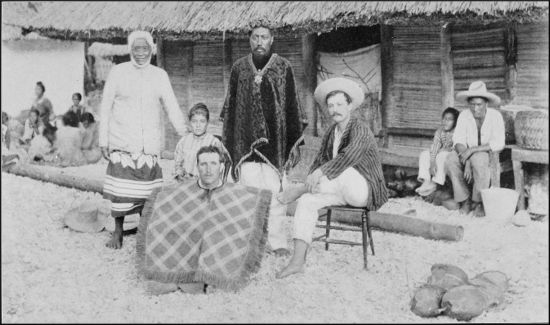
The King of Manihiki in the centre, with the Island Judge on his right and Tin Jack, seated, on his left. The man squatting in the foreground is one of the beach-combers.
The three "beach-combers" were all well dressed, in coats and trousers, and very good-looking. One man said his present way of life "had an air of loafing on the natives" which he disliked, but they all seemed proud of their high position as whites, with the exception of the ex-marine, who had fallen under the scorn of his companions for becoming "kanaka-ised." Still, that they were under some subjection, we could see, but owned themselves well used. They do not exactly like copra, but, as one said: "We have no right to complain; they give us what they have." They had had no tobacco for months, which they felt a great privation. When a ship comes in, the natives, men, women, and children, often smoke the strong trade tobacco until they fall down insensible, sometimes becoming convulsed as in epilepsy.
The trader, a half-caste, had already boarded the Janet in a boat of his own, but his wife, a stout, good-natured, sensible-looking woman, was waiting on the beach to receive us. She at once took possession of me as her right, and I was triumphantly swept off to her house, the crowd at our heels; here we were regaled on cocoanuts, while all the population who could crowd into the room gazed on us unwinking. The windows, also, were filled, which cut off the air and made the place rather suffocating. The children were made to sit down in the front row so that the older people could see over their heads. One old woman made me feel quite uncomfortable. Her eyes remained fixed, her jaw dropped, and nothing for a single moment diverted her attention from what she evidently regarded as a shocking and wonderful spectacle. Natives have said that the first sight of white people is dreadful, as they look like corpses walking. I have myself been startled by the sight of a crowd of whites after having seen only brown-skinned people for a long time. Louis has a theory that we whites were originally albinos. Certainly we are not a nice colour. I remember as a child the words "flesh colour" were sickening to me, and I could not bear to see them in my paint-box.
The room was neat and clean, as were all the houses in the village. Most of them contained a bedstead cut out of imported hardwood with a spread of gay patchwork, and a mat-covered sofa, very high and wide. In an inner room were great stacks of pearl shell, not, I should say, of the very best quality, and much smaller than the law allows in the Paumotus. The shell is gathered in the lagoon by native divers. Very few pearls are found, probably because the shell is taken so young. Leaving the trader's house, we started to cross the island, which is very narrow; Louis thought about one hundred and fifty yards and I no more than one hundred yards. On the way we passed a crowd of dancers, ranged in two rows, the women on one side, the men on the other, in front of the "speak-house." The dance was more like the Marquesans' than we had ever seen. The European costumes in which most of the people had dressed for our reception rather spoiled the effect, though many wore wreaths and head-dresses made of dyed leaves. The native dyes give beautiful, soft colours, yellow, red, and pink, which they also use in hats and mats, some of the latter being exquisitely fine and as pliant as cloth.
We found the lagoon of crystal clearness and dotted with little islands. Numbers of small vessels were lying at anchor; no doubt they had been collecting the shell. Though it was very lovely to look at, we did not stay long on the borders of the lagoon, being driven away by an ancient and fishlike smell. On our way back we went into the church and the speak-house. In the speak-house, a very good building of coral, were stocks which were used to punish malefactors. These stocks consisted of a couple of ring-like handcuffs fastened, one above the other, a foot from the ground, at the side of a post. The church, a thatched coral building without flooring, was really beautiful. The seats, with backs, are in rows, each with a fine, narrow mat spread over it. On either side run galleries, the balustrades elaborately carved and stained with yellow, red, and pink dyes. In the middle of one balustrade the word "Zion" was carved. The pulpit was a mass of carving and inlaid mother-of-pearl; the altar, which ran round it, was covered with fringed mats extremely fine and flexible and worked in different colours.
Among many others we made the acquaintance of a man who had been in Samoa, blown there in a storm. There were with him one other man and three little girls. It began to blow, he said, the sea rose very high, and the air and sky grew black. Suddenly his boat capsized and "my girls," he said, "swim—swim—swim in the sea." With their help he got the boat righted and gathered up what he could of his cargo, green cocoanuts and copra, and ran for Samoa. "Was any one frightened?" I asked. "Only the other man," he said. We met two of his little girls; one seemed clever and had picked up a little Samoan and a little English while she was in Apia. We asked her name. "Anna," she proudly answered. The other called herself Anna Maria.
Lloyd had photographed the King in his royal robes, a pair of white duck trousers and a black velveteen coat; over all was worn a sort of black cloth poncho bordered with gold fringe. Suspended from the neck of royalty was a tinsel star and on his head a crown of red and white pandanus leaves. Later in the evening he appeared in a pair of black trousers and a frock coat. In common with his subjects, the King is not of commanding stature. None of the islanders we have yet seen on this cruise can compare with the Kingsmill people in haughty grace of carriage, nor are they in any way so fine a race physically though most charming in manner. After dinner, finding the trader's wife and the missionary's wife having tea on deck, I gave them each a wreath, which delighted them extremely. We hired a native boat to take us on shore again for the evening; the man to whom the boat belonged begged us to go to his house, but I wished first to take a present, a print dress, to Anna.
Found Anna's house and gave my present. We were offered cocoanuts, to our great embarrassment, but Louis fortunately thought of saying "paea" (a rather vulgar Tahitian word signifying "I am full to repletion"). They understood at once and seemed greatly amused. Anna gave me a hat of her own manufacture and then we went with the boatman to his house. A party of young girls followed us, wrangling together as to which had chosen me first. It seemed to be settled amicably, for one girl ran up to me while the rest held back, and catching me by the hand said: "You belong me." The boatman's wife, a sensible-looking woman with a pathetic smile, was ill, he said; we were afterward told that she had consumption. Again cocoanuts, and once more we got off with "paea." When we left, the lady presented me with a large mat and a fine hat. I had nothing with me to give in return, so took the wreath from my own hat (I always wear one in case of an emergency) and also gave her an orange (a rare luxury) I had in my pocket. I afterward sent her a piece of print of the best quality. From the boatman's we went to the speak-house, where the dancers were assembled. As we came out of the bush toward the main road we heard a clapping of hollow sticks and whelp-like cries; at intervals a sentence was shouted. It was curfew. At eight o'clock several high officials parade the street, clapping sticks together and crying out: "Remain within your houses." No one obeys, but it is etiquette to keep off the main road when the officers march. We saw that the people kept to the coral on either side, so we did the same. When we first came on shore this evening, Louis, seeing a little girl about four carrying a naked boy, patted him on the shoulder; he howled, whereupon the little girl laughed and ran away. As we waited for the procession to pass, the little girl came up behind Louis in the darkness and, slipping her hand in his, nestled close to him. Her name was Fani, also Etetera; she was neat as a little statue, as tight as india-rubber; so was her sister; so was "Johnny Bull," who had walked hand in hand with Louis all afternoon. The type is well marked: forehead high and narrow, cheek-bones high and broad, nose aquiline and depressed (the depression probably artificial), the mouth large, with finely chiselled lips, the bow of the upper lip sharply defined, the eyes, of course, admirable; and altogether there is a strong appearance of good nature and good sense.
Part of the night Louis had a second satellite in the form of a beautiful boy, so that he walked between him and Fani, hand in hand with each; but Fani was his affinity. The whole island seemed interested; the King, not too well pleased, suffered Fani to sit beside Louis in the speak-house on the sofa of honour during the dance. Women came up and commented on the resemblance between Fani and Fanny and Etetera and Teritera (Louis's Tahitian name). On a table in front of us were the lights—a half shell of cocoanut-oil with a twist of fibre swimming on top and a glass bottle with the same oil and a wick. In the side of the bottle a round hole had been ingeniously cut through the glass for the convenience of cigarette smokers. While we were sitting there, waiting for the dance, Tin Jack came in wearing the false nose and wig. At first there was a general feeling of alarm, but most of the people soon penetrated the disguise and were greatly amused. One old dignitary, however, never discovered the jest, and was very much frightened, asking me several times in a trembling voice if it was the white man's devil. Louis's little girl did not even shrink, but looked up into his face with smiling confidence.
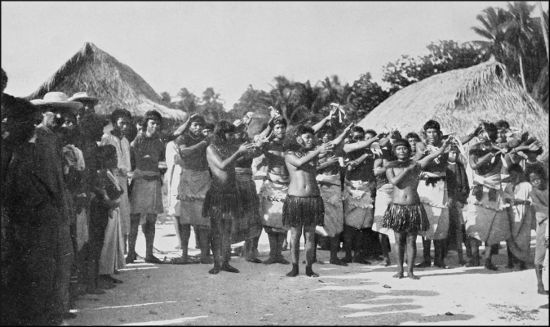
Natives dancing
The room was so dark that we could hardly see the dancers, so Louis and I concluded to make a few calls and go back to the ship. We had been asked to spend the night by some people as we passed their house in the afternoon, so we thought to go there first. However, the man who had been blown to Samoa caught us at the door and would have us go to his house first. By this time all the people knew my name and were calling me Fanny. When we thought we had done our duty by the mariner we said we must now visit the people who had asked us to sleep in their house; the man offered to guide us there, but instead took us to the house where Fani belonged. It was a very large house and the people seemed to be all asleep; but in a moment they were broad awake and in a state of lively excitement, with the exception of one very old man who remained lying in his bed and yawned drearily. Louis tried conversing in a mélange of Samoan and Tahitian, with appreciable success. We drank cocoanuts until we were "paea," and rose to go. A large fish was laid at our feet in a plaited basket, then taken up and carried to our boat. This was a handsome present, as fish is a great rarity. Fani's father followed me with an immense number of large sponges tied on a long pole. We were again haled away from our destination, this time by the boatman, who took us back to his house, waking, I fear, his sick wife, who, however, was all smiles. Pleaded "paea" and turned our faces toward the boat, having given up our first intention in despair.
On the road we passed the schoolhouse compound where a double row of people were singing and dancing. The men were squatted on their haunches on one side of the path, the women on the other; down the centre an oldish, very respectable-looking man, with the appearance of a deacon, directed the dance, a staff in his hand. We were received with shouts of welcome and a bench set out for us. I was envious of the big town drum, made of hollowed cocoanut wood and covered with shark skin, very like one I had already got from the Marquesas, and deputed the trader to buy it for me. With the arrival of Mr. Henderson, who came sauntering down the road, the deacon heartened up to a sort of frenzy, suddenly bounding along the path and throwing his body and legs about with the most grotesque and mirth-provoking contortions. We sat here yet awhile, and at last tore ourselves away from the most charming low island we have yet seen, Fani's father still following with the sponges. I sent back, by the boatman, a piece of print for Fani, sufficient to make a gown for her mother as well as herself. It was the correct thing to do from the island point of etiquette, but all the same a pity, for the less Fani covered her pretty brown body the better she looked.
7th.—Fani, her papa and her sister, first thing in the morning with a basket of green cocoanuts and three packets of dyed pandanus leaves. Fani at once possessed herself of one of Louis's hands, the sister the other, while the lovely "Johnny Bull," who was on board almost as soon as they were, hovered about smiling, and when he saw a chance slipped an arm round Louis's neck. Johnny Bull was a tall lad of fifteen, and I was told a half-caste, though he did not look it. Louis, having been taken up by Fani, was considered quite one of the family. It is easy to see how the copra eaters came by their "billets," and how decently whites must have behaved here, that this little creature should have come up to Louis in the dark as naturally as a child to its mother. The sisters stayed by him until the whistle sounded. They were thoroughly well-behaved, obedient children, neither shy nor forward. No doubt Louis could have eaten copra from that day forth at the father's expense.
One of the beach-combers was wrecked on Starbuck Island, his ship the Garston; he lost all he possessed, and says he is passionately eager to get away and very sick of living on cocoanuts; and yet, when offered a chance to work his way home on the Janet, he asked anxiously if it were a "soft job," refusing any other. Louis gave him the better part of a tin of tobacco, but he got very little good from it. The hands of the natives who had adopted him were stretched out on every side, and one cigarette was his sole portion.
Have gone to another station on the same island, a very bad landing, so Lloyd and I concluded to remain on the ship, but Louis, more venturesome, went on shore with Mr. Hird. They were nearly pitched into the water as the boat struck on her side on the reef. The black boys all went, with the seas breaking over them, to shove her off. The town is described as most delightful; very neat, with one straight, sanded thoroughfare bordered by curbstones; the houses with verandas, some of the verandas with carved balustrades. The heat is very great. Louis sat on the sofa in the missionary's house, the boat's crew lying on the floor and being fed with dried clams strung on cocoanut-fibre sennit. At the same time they were interviewed by the missionary himself, a fine, bluff, rugged, grizzled Raratongan, universally respected. Two old men asked for the news, giving theirs in return, their latest being that Tahiti had been taken by the French; they added a rider that the French were "humbug," which was refreshingly British. "One white man he say Queen he dead?" queried one man anxiously. They were assured that it was the Queen of Germany, and not Victoria. "Methought," said Louis, "in petto, it was perhaps Queen Anne." They are all well up in the royal family, and most loyal subjects, the island flying the Union Jack. The only "white man" in the settlement was a Chinaman, dying for curry-powder. It seemed impossible to get away without carrying half the settlement with us, and even after we thought they were all off, two young girls and a boy were discovered trying to stow away. We returned to the first landing yet again, but by that time I was sound asleep.
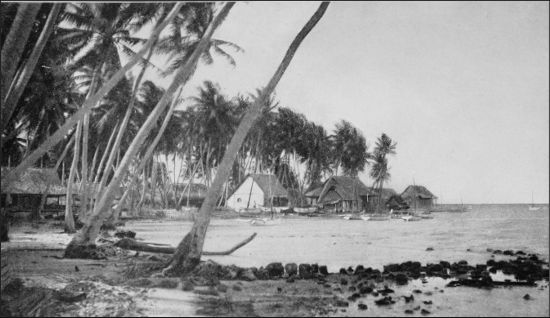
Penrhyn Island
8th.—Sighted Penrhyn at five o'clock, but did not attempt to go in as it is an exceedingly dangerous passage, and the night was black, with heavy squalls. Lloyd and I had to leave our sleeping place on the after hatch and take refuge in the trade room where we slept on the floor. In the morning I went to look up my wet pillows and mats. Suddenly I heard a shout: "Mrs. Stevenson, don't move!" I stopped short, hardly moving an eyelash, but curious to know the reason of this command. I soon found out; the captain threw up one corner of a large tarpaulin showing me the open hatch on the brink of which I was standing. On the last voyage a seaman was terribly injured by falling down the fore-hatch. He lay two hours insensible before he was reported missing and a search made.
9th.—We enter the lagoon very early in the morning; a most perilous passage, the way through the reef seeming but little wider than the ship itself; the captain calls it two ship widths. Our route, until we dropped anchor, was studded with "horses' heads" as thick as raisins in a pudding. There would be a rock just awash on either side of us, a rock in front almost touching our bows, and a rock we had successfully passed just behind us. We were all greatly excited and filled with admiration for the beautiful way Captain Henry managed his ship. She would twist to the right, to the left, dash forward—now fast, now slow—like a performing horse doing its tricks. The native pilot was on the masthead nearly mad with anxiety. It was the first he had had to do with a steamer, and he was convinced that the Janet was on the point of destruction every moment. At last, quite worn out with such breathless excitement, we came safely to anchor in front of the village, a cluster of native houses gathered together on a narrow spit of land, or rather coral. A big wave, a short time ago, washed over the village from sea to sea. Our men are working hard getting out the boxes for the shell we are to take in, and the mates are making new boxes, hurrying as fast as their natures allow. There is quite a fleet of pearling boats hanging about. One has just come in filled with natives; the colours are enchanting: the opaline sea, the reds and blues of the men's clothing, running from the brightest to the darkest shades, the yellow boats wreathed with greenery, the lovely browns of the native skin, with the brilliant sun and the luminous shadows. Boys are already swimming out to the ship, resting on planks (bits of wreckage), their clothes, tied in a bundle and hanging over their heads, dependent from sticks. I can hear the voices of the girls and the clapping of their hands as they sing and dance on the beach. I see a man hurrying along a path, a little child with him and their black pig following like a terrier. Sometimes piggy stops a moment to smell or root at the foot of a palm, but always with a glance over his shoulder; if the distance seems growing too wide between himself and his family, he rushes after them, and for a moment or two trots soberly at his master's side.
After luncheon we went over to the village in one of the boats going for shell, landing at the white trader's house. From the first, I had been puzzled by a strange figure on the trader's veranda. When we were nearer I discovered it to be the figurehead of a wrecked ship, a very haughty lady in a magnificent costume. She held her head proudly in the air and had a fine, hooked nose. All about the trader's house were great piles of timber, and in one of the rooms a piano woefully out of tune, and other signs of the wreck of a big ship. It was a timber vessel, they told us, this last one, that went to pieces just outside the reef. Numbers of houses are being built of the boards by the more thrifty-minded of the islanders. One of the sailors cast ashore still remains here, a gentle, soft-eyed youth from Edinburgh, now fairly on the way to become a beach-comber. Fortunate lad! His future is assured; no more hard work, no more nipping frosts and chilly winds; he will live and die in dreamland, beloved and honoured and tenderly cared for all the summer days of his life. He already speaks the native tongue, not only fluently, but in the genteelest native manner, raising and lowering his eyebrows in the most approved fashion as he whispers to the elderly dames matter that is no doubt better left untranslated.
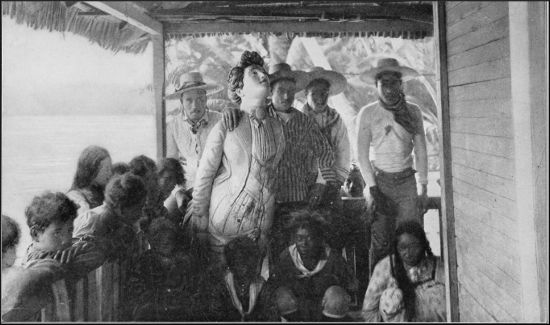
Figurehead from a wrecked ship on the veranda of the white trader's house, Penrhyn Island
When the figurehead came ashore people were terribly alarmed by the appearance of the "white lady." The children are still frightened into submission by threats of being handed over to her. The trader's wife is a Manihiki woman, very neat and well-mannered; we drank cocoanuts with her, and were introduced to the native missionary's daughter, an enormously large, fat girl of thirteen, but looking twenty. I believe her parents are from another island. Lloyd photographed the proud lady with a lot of children and girls grouped round her, the soft-eyed Scot familiarly leaning against her shoulder. The girls went through an elaborate affectation of terror and had to be caught and dragged to the place, whence, I believe, nothing could have dislodged them. After this photography was finished we wandered through the village, a large chattering crowd at our heels. This is the least prepossessing population I have seen since Mariki, and I am assured they are no better than they look. As we walked along I happened to pick up a pretty little shell from the beach; the missionary's fat daughter instantly gathered and pressed upon me four other shells, but as I held them in my hand living claws projected from inside and pinched me so that I cried out in alarm and threw them to the ground. Every one laughed, naturally, but an impudent young man picked up and offered me a worn aperculum, saying with a grin: "Buy; one pearl." "I could not," I assured him with mock courtesy, "deprive you of so valuable an ornament; tie it round your neck." This feeble jest seemed to be understood and was greeted with shouts of laughter. The lad was cast down for a moment, and fell behind; pretty soon he came forward again, with a dog's bone. "Buy," he said; "very good; twenty pounds." "I could not," I returned, "take from you a weapon so suitable to your courage." Of course I used pantomime as well as speech. The other young men, with shrieks of laughter, pretended to be terrified by his warlike appearance, and he shrank away to annoy me no further. Several men and women offered us very inferior pearls at the most preposterous prices, at which Tin Jack and I jeered them, when the pearls were hidden shamefacedly. They knew as well as we that their wares were worthless.
Lloyd and Louis planted their camera stand in the centre of the village, and walked about to look for good points of view. While they were away a serious-looking man delivered a lecture upon the apparatus, to the evident edification and wonder of the crowd. During his explanation he mimicked both Louis's and Lloyd's walk, showing how Lloyd carried the camera, while Louis walked about looking round him. I sat down on a log to wait, when immediately all the women and girls seated themselves on the ground, making me the centre of a half circle and gazing at me with hard, round eyes.
After the photography Louis and I went to call on the missionary. He and his wife were at home, evidently expecting us. His wife is enormously stout, with small features and an unpleasant expression; the man rather sensible and superior-looking. A number of women and the pilot who had brought us into the lagoon ranged themselves on the floor in front of us. One of the ladies, a plain body, seeming more intelligent than the rest, possessed a countenance capable of expressing more indignation than one would think possible. She wished to have our relationship explained to her. Louis and I were husband and wife; this statement was received with a cry of anger, but at the announcement that Lloyd was our son, she fairly howled; even Lloyd's name seemed objectionable. About mine there was a good deal of discussion, as they appeared to have heard it before. We drank cocoanuts under the disapproving eye of the intelligent lady, and, after receiving as a present a pearl-shell with a coral growth on its side from the missionary's wife, and another, somewhat battered, from his daughter, I gave, in return, the wreath from my hat and we departed.
Louis and Lloyd went back to the ship, but I remained, with Tin Jack, to see the church. All but three little girls were too lazy to show us the way; so, accompanied by the trio, we started on a broad path of loose, drifting coral sand. The church was a good, substantial structure of white coral, with benches and Bible rests, but there was no attempt at decoration. The room was large enough to hold all the inhabitants of the village twice over. As in most of the other islands, being "missionary"—religious—goes by waves of fashion. In Penrhyn, at any moment, the congregation may turn on the pastor and tell him he must leave instantly, as they are tired of being missionary. They have the "week of jubilee," which means the whole island goes on a gigantic "spree," when Penrhyn is not a pleasant, or hardly a safe, abiding-place. We stopped at the schoolhouse on the way back, a large, ill-smelling room, containing for furniture one table with pearl-shell disks let into the legs, standing on a dais. The only really neat house was the trader's, and he had a Manihikian wife.
The laws of Penrhyn, some of them very comical, are stringently enforced. There is no nonsense about "remain within your houses" here, for, after nine o'clock, remain you must. Last night our cook was shut into a house where he was paying a visit, and was not allowed out until after the breakfast hour. There was also a rumour that Tin Jack, being seen after curfew, had to run, the police after him, to the house of the trader, where he remained until morning. Our sailors, to-day, somehow offended the natives and came running back to the ship pursued by a crowd. The children are much more prepossessing than their parents, some of them, especially the little girls, being quite pretty and well-behaved. It is much easier to restrain them and keep them within bounds than if they were white children in similar case. Every scrap of orange-peel thrown overboard was gathered up by them to be converted into ornaments. A bit of peel cut into the shape of a star, with a hole in the centre for the purpose, would be drawn over the buttons of their shirts and gowns, while long strings were worn hanging over the breast, or twined round the head and neck. The trader's little half-caste boy was clad in the tiniest imaginable pair of blue jeans, with a pink cotton shirt, and had little gold earrings in his ears.
10th.—None of our party cared to go on shore. I sent a chromo representing a "domestic scene" to the trader's wife in return for her present of a coral-grown shell. The shell I afterward gave to the cook and another to the second steward, who, by this time, was almost insane with excitement and pleasure. We had a very busy day receiving shell and packing it in the wooden cases that are still being made on the forward deck. The black sailors work extraordinarily well and with perfect willingness and good nature. They make play of everything, and in spite of their small stature and slender, elegant figures, handle great weights with the utmost ease and dexterity. The little native boys work as hard as any in helping pack the shell. One little naked fellow of about ten, I was told, was deaf and dumb, but I should never have guessed it.
As soon as there was a movement on the ship the young girls came swimming out to us like a shoal of fish. The sea was dotted with the black heads over which they held their parcel of clothes in one hand to keep them dry, making their toilets on the lower rungs of the ship's ladder. One girl would stand at the foot of the ladder where she received the clothes of the newcomer; as the latter emerged dripping from the sea her garment was dexterously dropped over her head, so that she rose with the utmost decorum fully clad.
Louis soon had his particular following, some three or four little girls eight or ten years of age. They made him sit down and then sang to him. One of these children must have been the daughter of the indignant lady we met at the missionary's house, for her powers of expression were the same. She was, however, pleased to signify approval of Loia (Lloyd). If Louis attempted to leave these small sirens he was peremptorily ordered to resume his seat, and the singing redoubled in vigour. They had shrill voices and sang not badly. Louis bought a tin of "lollies" from the trade room and regaled his little maids on that and plug tobacco. Oranges and biscuits were given to the people quite freely, and the leavings from our table were continually passing about. The cook said the contents of the swill-pail were eaten clean, pumpkin rinds being a favourite morsel. Except for the "lollies," the little girls generously divided with their friends, but the boys were more selfish. One little fellow who had secured a whole pumpkin rind ran about the deck with a wolfish terror, trying to find a hiding-place where he could devour his prize safe from the importunities of his mates.
Tin Jack, without my knowledge (I should have stopped him had I known) donned the wig and beard and false nose; his appearance created a real panic. One girl was with difficulty restrained from jumping overboard from the high deck, and many were screaming and rushing about, their eyes starting with terror; Louis's little girls ran to him and me and clung to us. A fine, tall young woman kept up a bold front until Tin Jack took hold of her, when she slipped through his hands, a limp heap on the deck. I tried in vain to get near him to make him cease with his cruel jest, but he was running among the frightened crowd, and I could not make him hear me through the confusion and noise. The girl who tried to jump overboard collapsed among some bags on top of the shell, where, covering her face, she wept aloud. I climbed over to her and soothed her, and tried to explain that it was not the devil but only Tin Jack with a mask. The children were the first to recover from their terror, soon recognising Tin Jack, either from his voice, or his walk, or something that marked his individuality, for in the afternoon they returned to the ship, fetching other children, and boldly demanded that these, too, should be shown the foreign devil. All evil spirits, and there are many in Penrhyn, are called devils.
Speaking about the superstitions of Penrhyn, Mr. Hird recalls the following grisly incident that occurred when he was stopping on the island. A man who was paralysed on one side had a convulsion which caused spasmodic contractions on the other side. One of the sick man's family began at once to make a coffin. "But the man's not dead," said Mr. Hird. "Oh yes," was the reply; "he's dead enough; it's the third time he has done this, so we are going to bury him." Mr. Hird went to the native missionary, but his remonstrances had no effect; he kept on protesting until the last moment. "Why look," he said, "the man's limbs are quivering." "Oh that's only live flesh," was the reply, and some one fell to pommelling the poor wretch to quiet the "live flesh." The belief was that the man's spirit had departed long before and a devil who wished to use the body for his own convenience had been keeping the flesh alive. Mr. Hird thinks that the man was insensible when buried and must soon have died.
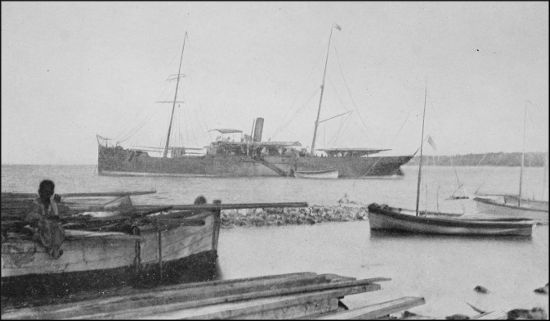
The "Janet Nichol" at anchor off Penrhyn Island
At another time some natives had been "waking" a corpse; tired out, they all fell asleep except a single man who acted as "watcher." By and by he, too, dropped off. The party were awakened by a great noise. The watcher explained that he had been napping and suddenly opened his eyes to behold the dead man sitting up. "A corpse sitting up just like this!" he exclaimed indignantly; "but I was equal to him; I ran at him and knocked him down, and now he's decently quiet again." And so he was, dead as a door-nail from the blow he had received.
Another thing Mr. Hird saw in Penrhyn. A very excellent man, but a strict disciplinarian, died and his family were sore troubled by the appearance of his ghost. They had suffered enough from his severity during his lifetime, and were terrified lest his spirit had returned to keep them up to the standard he had marked out for them. The day after the apparition was seen, the grave was opened, the body taken out, and the hole deepened till they came to water; the corpse was then turned over in the coffin and reburied face down.
At about five o'clock we weighed anchor and went through the exciting ordeal of the passage out of the lagoon, taking with us as passengers to Manihiki a woman and her two children. After we were quite away, outside the lagoon, a boat came after us with a quantity of timber from the wreck; this extra and unexpected work of taking the timber on board and stowing it away, instead of being received with grumbling by our black boys, was taken as gleefully as though it were a pleasant game of their own choosing.
The passengers slept on the after hatch with us. The baby cried in the night, and the mother quieted it by clapping her hands, yawning, meanwhile, with a great noise like the snarling of a wild beast; consequently I did not sleep well. For the first time the wind is aft and the ship very airless and close.
11th.—The captain's eyes, which have been dreadfully inflamed, are much better, thanks to an eye lotion from Swan, the chemist at Fiji, that we had in our medicine-chest.
In the evening, about nine, we made Manihiki. Mr. Henderson burned a blue light which was answered by bonfires on shore. We did not anchor, but lay off and on, as we were only to stay long enough to land our passengers. Louis wished to go on shore with the boat, but as it did not get off until ten he gave it up and went to bed. I made up a little parcel for him to send to Fani, and Mr. Hird carried it to her, a few sweeties carefully folded up in a Japanese paper napkin and tied with a bright-green ribbon. The child was in bed and asleep, but waked to receive her parcel which she resolutely declined to open until the next day, though earnestly persuaded by the whole family to let them have a peep inside. She appealed to Mr. Hird, who upheld her decision, so she returned to her mat and fell asleep holding her present in her hands.
I am trying to paint a small portrait of Tin Jack, who is a beautiful creature, but during the reluctant moments he poses he sits with his back toward me, his eye fixed on the clock, counting the minutes until his release. We took from the island a man, woman, and boy for Suwarrow, our next stopping-place. Mr. Hird had a singular dream, or rather vision, of the white trader in Suwarrow lying dead and ready for burial. He was so impressed by this that he took note of the time and feels very anxious.
13th.—I awoke at six, after a night's struggle with my mats, which the wind nearly wrested from me several times, to find we are just off Suwarrow. At breakfast Captain Henry presented me with a gorgeous hibiscus flower and Mr. Henderson laid beside my plate a couple of bananas and a vi-apple, products of the island. At present there are only six people living on Suwarrow; our three passengers, counting the boy, will make nine.
I went on deck to look at the island and was told that the flag was at half-mast. Sure enough, the trader was dead; the date of his death tallied with that of Mr. Hird's vision. The poor fellow was most anxious to be relieved the last time the ship was here, wherefore one of the native passengers was brought to take his place. A neat white paling fence enclosed the grave. I asked from what disease he died. "Sickness in here," was the answer, indicating the liver; "a long time he no stand up; all the time lie down. Pain—cry out—cry out—then die."
Suwarrow and its attendant isles have been planted in cocoanuts by Mr. Henderson. A few pandanus are here and there and more varieties of small weeds than is usual in low islands. There is, also, a great deal of fine, feathery grass, worthless, unfortunately, for feeding animals. Mr. Henderson tried goats upon it, and sheep, also, I believe; they ate the grass greedily but did not thrive, and soon dwindled and died. It was found, on examination, that the grass did not digest but remained in balls in the intestines. The cocoanuts, though most of them were planted eight years ago, do not bear very heavily; Mr. Henderson thinks they were not planted deep enough. He says they should be planted four feet under the soil, the sprouts being about five feet high. Bananas planted in imported earth are growing well, and some have taken kindly to the native soil; also chilli peppers from the high islands. Vi-trees are in full bearing, the hibiscus is gaudy with blossoms, and cotton-plants, not indigenous, but now become wild, flourish luxuriantly.
Suwarrow at some former period must have been a thriving and important settlement. One has the feeling that stirring events have happened here and that its history should be wild and romantic. At present it is very like the desert stronghold of a pirate. The pier is a very fine one and must have cost much money and labour; a number of houses are clustered near it, giving at first sight the impression of a village; there are beacons to guide the mariner and a "lookout" on the opposite side of the island. Turtles are caught occasionally, and large crabs and excellent fish. There are also birds, very good eating, and in the season innumerable eggs of a fine flavour may be gathered. One bird, no larger than a dove, lays an egg as big as a hen's, out of all proportion to her size.
I first walked over to the weather side; here I found it delightfully cool, but the tide was high, forcing me to the shingle, so I returned, marking on the way a fine, clear pool where I mean to have a bath to-morrow. The room where I am writing looks as though it were meant for a church or a schoolhouse; but of course that is only conjecture. It is a large room, long and narrow, with double doors at each side, a single door at one end, and four unglazed windows. The windows are protected by foot-wide slats arranged to move up and down like Venetian blinds; both doors and slats are painted green. The roof, open to the peak, is neatly thatched with either pandanus or cocoanut leaves, I am not sure which. A table, originally very sturdy, but now fallen into the rickets, holds the dead man's books: "Chetwynd Calverly" by W. Harrison Ainsworth, "The Mystery of Orcival," by Gaboriau, and an advertisement book about next of kin. Behind the table is a cotton-gin, the "Magnolia," with a picture of the flower indifferently well done on its front. I sat awhile on one of the two wooden benches that help furnish the room and studied the walls, over which are scrawled names: Etelea, Mitemago, Saviti, Patawe, Polohiu, Atolioinine, Salhisi, Kari, Fuehau, Laku, Mitima, Paopave, Munokoa, and many others.
In another large house of a single room, roofed with corrugated iron, I found all sorts of treasure-trove from vessels that had been wrecked on Suwarrow. Piled up in one end of the house are ship's blocks, oakum, strange, antiquated firearms, iron parts of a ship, and the two stairs of her companionway. There is a single oar, and a tool-chest with rope handles at either end, the word Sweden on it, and the top covered with canvas; an iron gate, two steering-wheels, a winch, a copper blubber dipper green with verdigris, the handle of wood and iron; two life-preservers, one marked Levi Stevens; small, glass-bottomed boxes for searching the bottom of the sea, wheels, hatch-covers, and I know not what. At the other end of the room a ladder leads up to a loft, where sieves for guano, a harpoon, a double-handed saw, and iron shell baskets are heaped together. Two immense iron tanks, painted red, stand at either side of the seaward doors.
Next to this house came the "office," with a little cubby partitioned off one side. I looked through the pigeonholes of the cubby and found a packet of thin sheets of tortoise-shell and a large parcel of a native woman's hair. Mildewed maps hang on the walls, the ceiling is adorned with ten rusty cutlasses, old ledgers lie about, and a bag of cotton lies on the floor as though it had just been dropped there. On one of the sides of the room is a broad, white band with painted black letters "Peerless wrecked on Suwarrow Island." In one corner stands a box of bits of old iron which are put in with cocoanuts when they are planted. It is called "cocoanut manure." This reminds me that the Paumotuans plant with their cocoanuts a rusty nail and a ship's biscuit. In the outer room sixteen decaying muskets are ranged in a rack. Shelves are filled with all sorts of tools, nails, axes, bush knives, tins of sardines and salmon, and a quantity of mouldy shoes in children's sizes only; among the shoes were a toy chest of drawers and a box of moulting feathers.
Passing another building containing miscellaneous wreckage, blue and white china among the rest, I came to the manager's house, a large, wooden-floored structure with a thatched roof. Here I found a native man at work on accounts, his old dog at his feet, which were wrapped up in the Union Jack to keep them warm. This room was evidently designed by a sailor and gave one quite the feeling of being on board ship. Instead of windows there were port-holes, three on either side, with a couple flanking the front door. Covers, painted black to imitate iron, could be screwed over the ports like deadlights on shipboard. The doors, one in either end, opened in two parts, being divided across the middle. The furniture consisted of two bedsteads of native wood with cocoa sennit laced across them to serve for mattresses. A couple of bunches of bananas hung from the roof. Against the wall hung the death certificate of the dead man, which, in such cases, must be the only proof that the death was due to natural causes, and not a crime. I copied the certificate.
Samuli lee aho 2 .... he motu nai mate he malu va he tau fro ia gauali 2 1889 Ka Papu Ko Maro tolu ne ha nie ne tamu Ka Patiti ma miti San ma J ketiti ma Paemani Koe tau wine Kwenia kia mounina kelie iki lagi ke he tan ban nei kua hobooko kiai a tautala June ati 2—1890
Next comes "government house," as Louis calls it, neatly thatched, the floors of wood, and separated into two rooms by panelled wood from a wreck; the rooms are connected by a wide, open doorway, the arched top and sides edged with brass. In one room is a table with a Bible and other books lying on it, a home-made sofa covered with a mat; two corner shelves, spread with newspapers cut in points where they hang over, are filled with miscellaneous books; chests, a compass-box, and a water-monkey with its neck gone stand about. On the walls are some rather pretty engravings, a few framed and one glazed. On each side of the house are small, square windows protected by solid wooden shutters that drop down when not upheld by a stick. The front and back doors are strong and divided across the middle. In the back room are two home-made bedsteads, sennit crossed, one with a mosquito curtain. Chests are on the floor, mats lie about, and a roll of fine mats is lashed to the ceiling. In front of the house, the gable end, are two large, rusty, iron boilers such as are used on ships. Inside the compound, which is neatly fenced with whitewashed palings, are two small, mounted cannon with a couple of vi-trees growing beside them. Returning to what I call the church, I passed a tool house, a large room filled with rusting tools. Two small casks of fresh water lie waiting there in case a boat should come ashore in distress for water. There is also an immense cistern sunk in the ground, filled with rain-water caught on the iron roofs, but that, I believe, is kept locked.
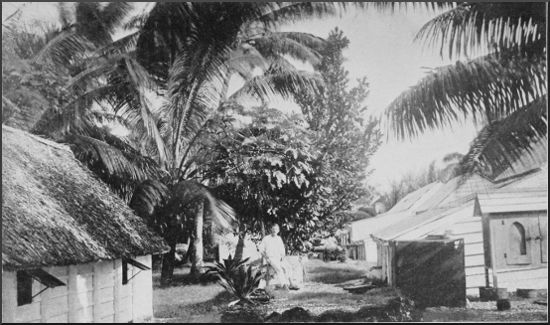
View of deserted buildings on Suwarrow Island. The man seated in the centre is Tin Jack
Leaving the dog that boarded us at Auckland, and some cats, we departed from the most romantic island in the world, regretting that to us its history must always remain a mystery unsolved.
16th.—Arrived at Danger Island. Boats put out to inform Mr. Henderson that, despite all their promises when we were here before, there is no copra ready, it being the season when the natives collect subscriptions for the church and hold the "Me" meeting. "No tobacco," says Mr. Henderson with malicious glee as he orders the people off the ship. To my joy he says to the captain: "Can you make Nassau by night!" The captain can; and we arrive the same night and lie off and on until morning. We give Nassau a blue light, and the inhabitants respond with a bonfire, keeping it blazing all night, apparently afraid if they let it go out we may steam away.